TYPES OF HYDRIDES
By : Ishita , Pradhna , Raeshmikhaa ,
Santwana , Swaranya [ 11 A ]
WHATARE HYDRIDES?
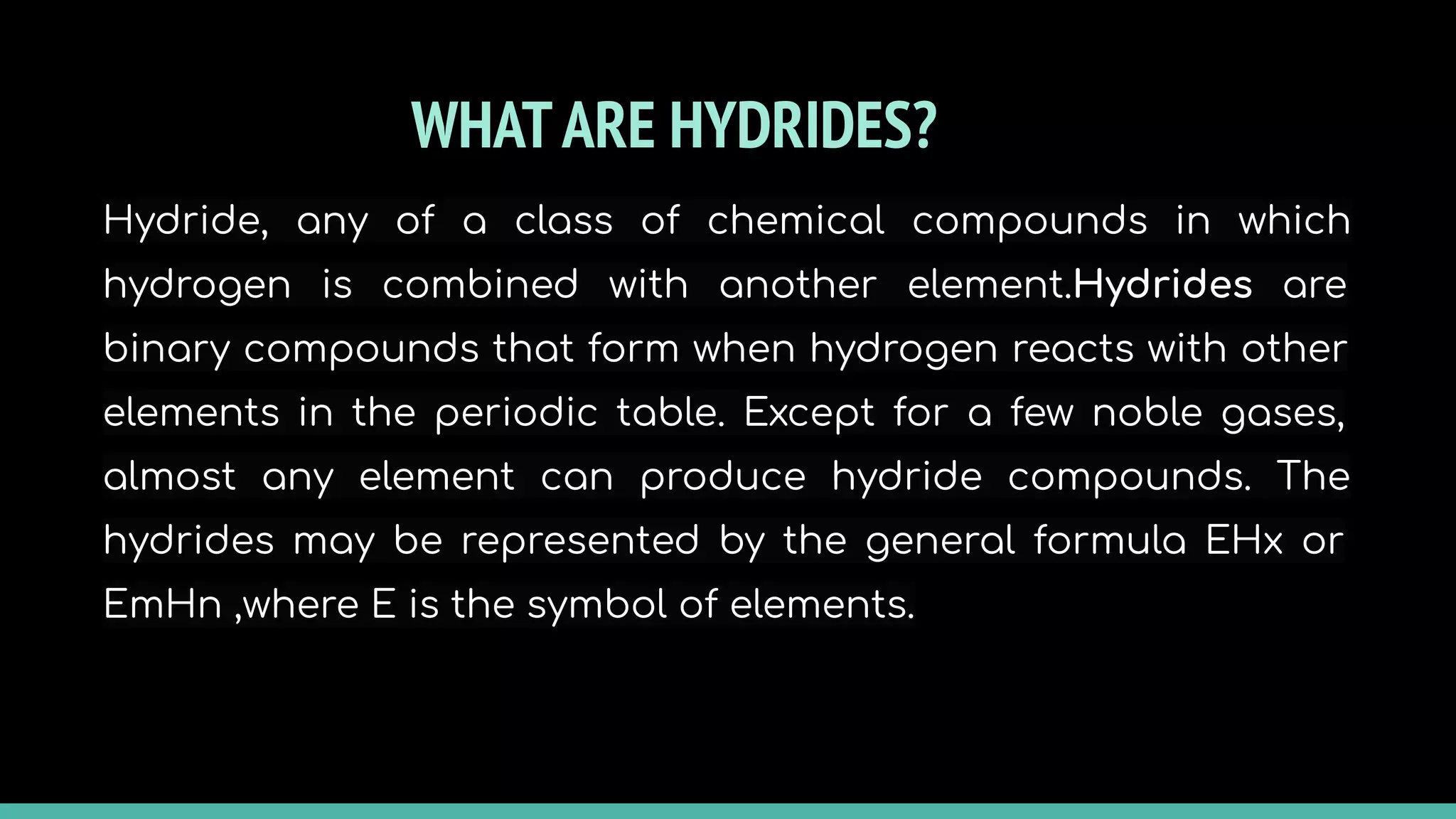
Hydride, any of a class of chemical compounds in which
hydrogen is combined with another element.Hydrides are
binary compounds that form when hydrogen reacts with other
elements in the periodic table. Except for a few noble gases,
almost any element can produce hydride compounds. The
hydrides may be represented by the general formula EHx or
EmHn ,where E is the symbol of elements.
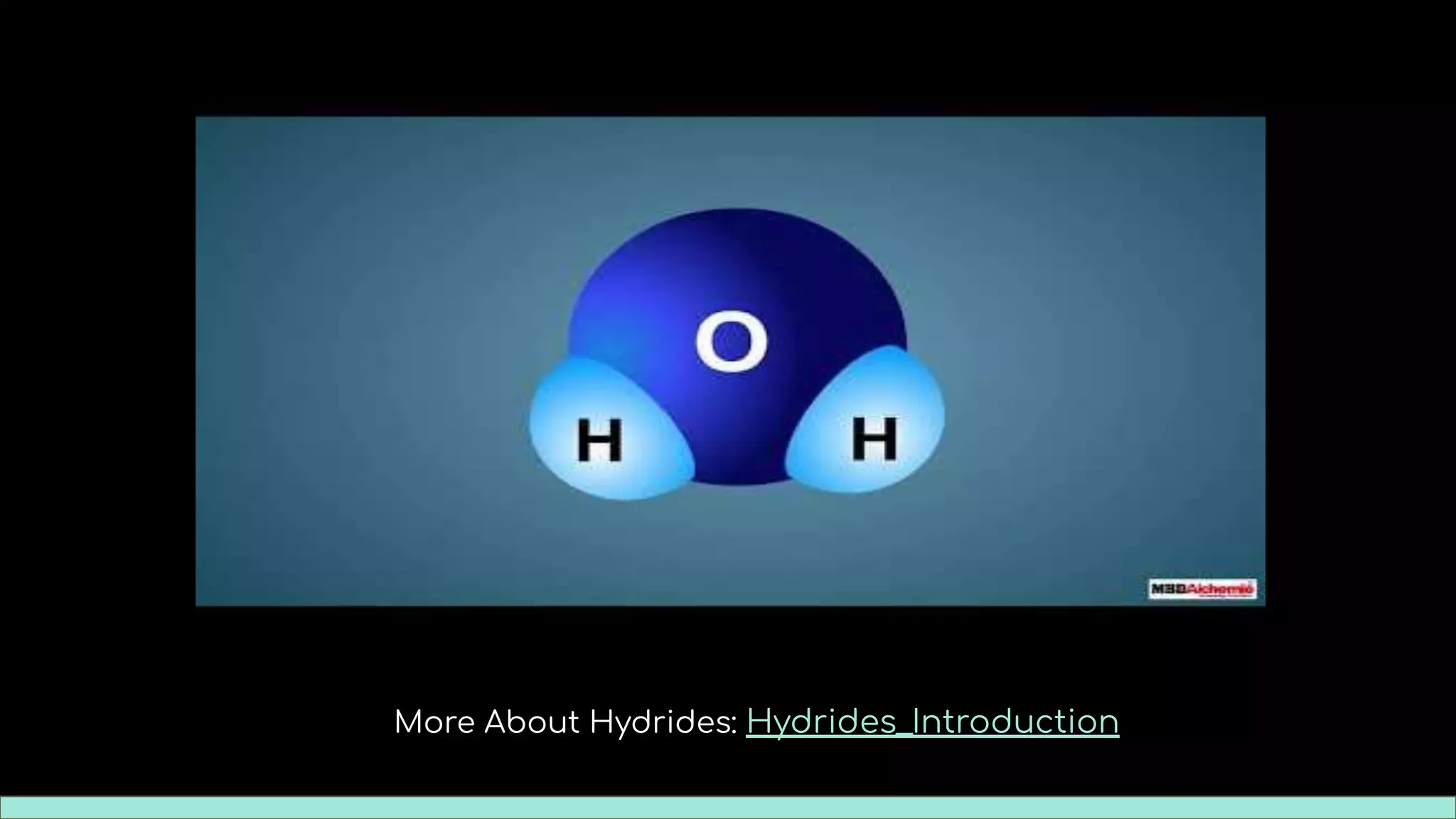
More About Hydrides: Hydrides_Introduction
HYDRIDE ION
Free hydride anions exist only in extreme
conditions and are not used in
homogeneous solutions. Many compounds,
on the other hand, have hydrogen centres
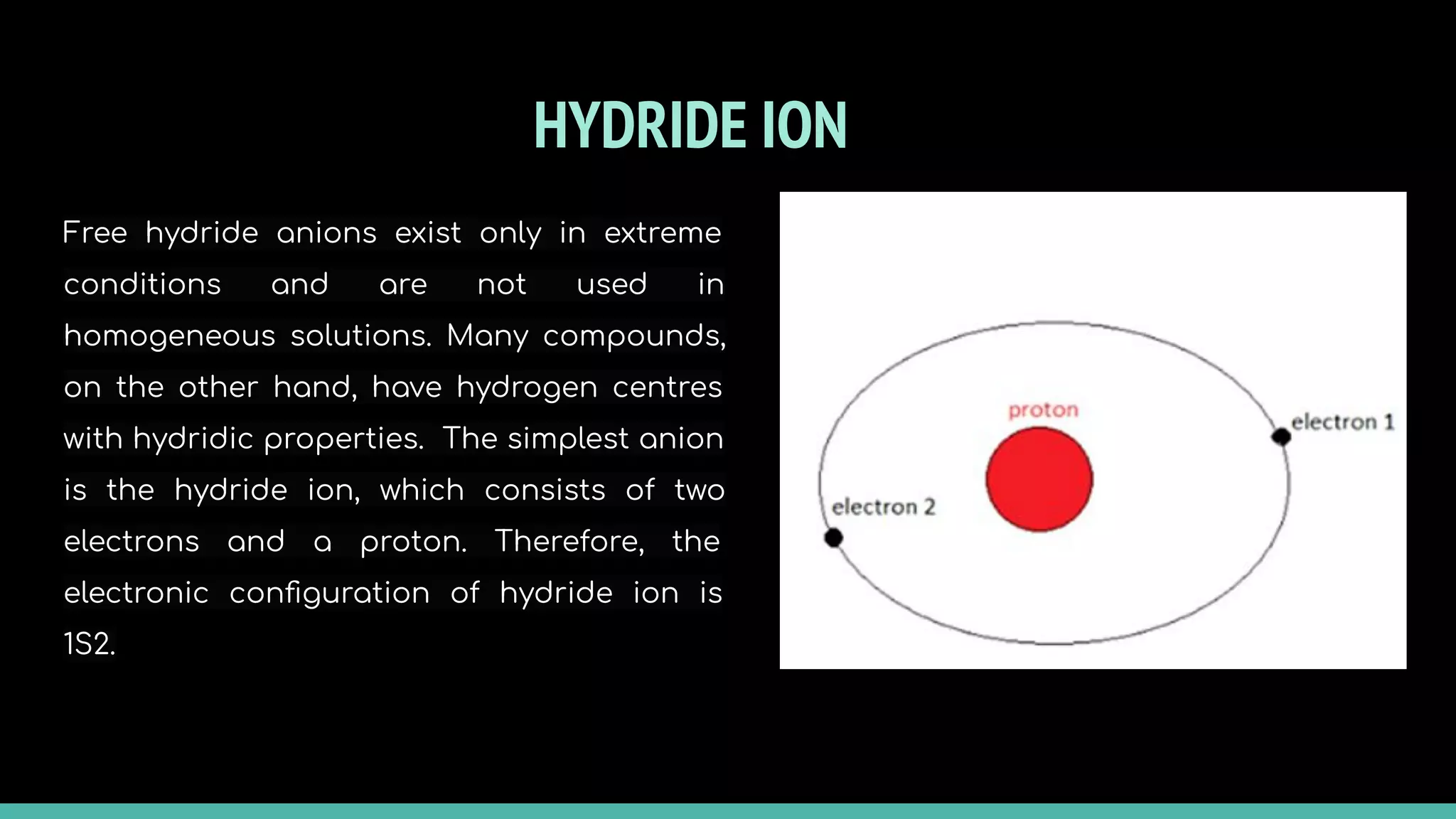
with hydridic properties. The simplest anion
is the hydride ion, which consists of two
electrons and a proton. Therefore, the
electronic configuration of hydride ion is
1S2.
BASIS OF CLASSIFICATION
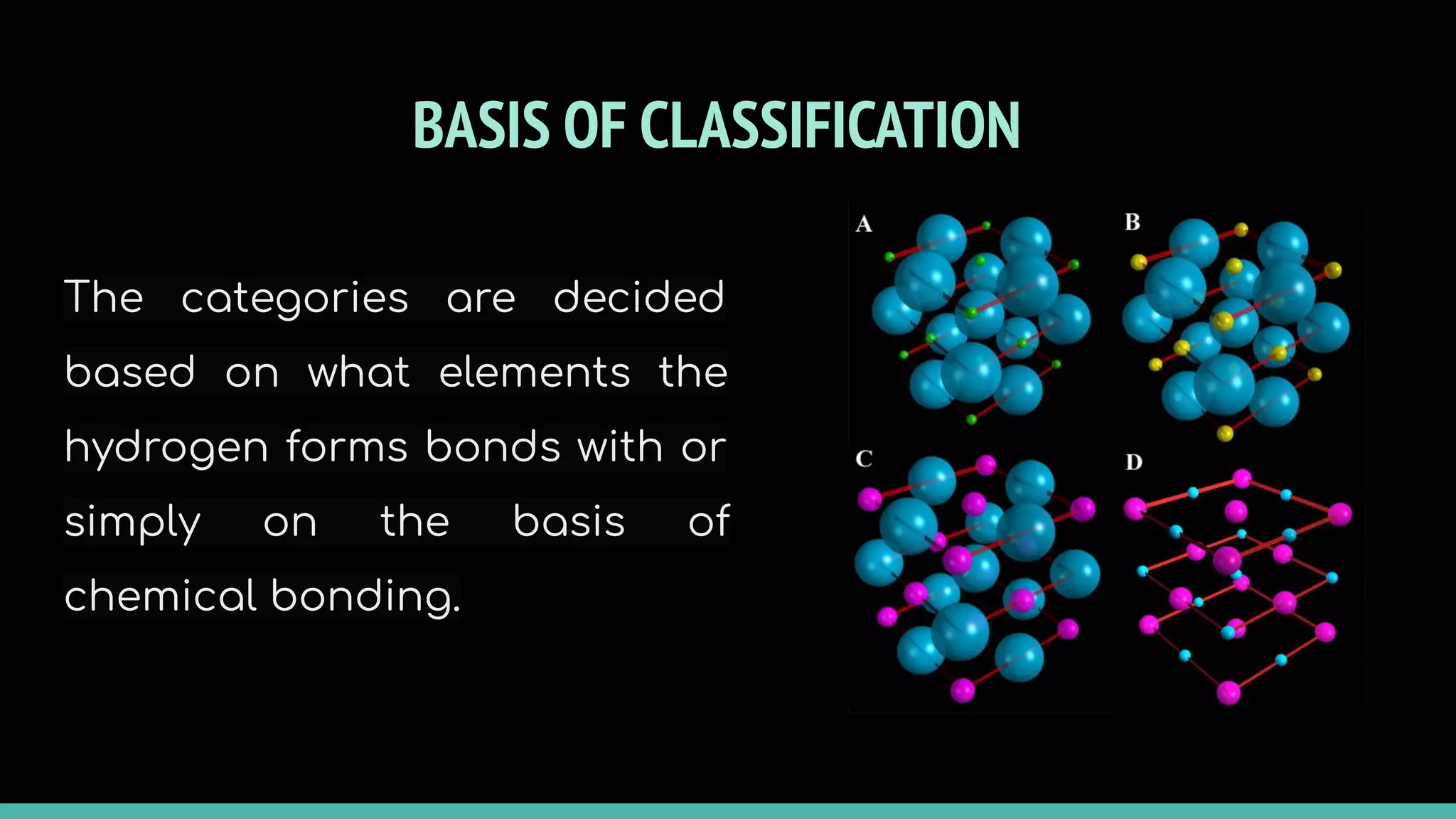
The categories are decided
based on what elements the
hydrogen forms bonds with or
simply on the basis of
chemical bonding.
TYPES OF HYDRIDES
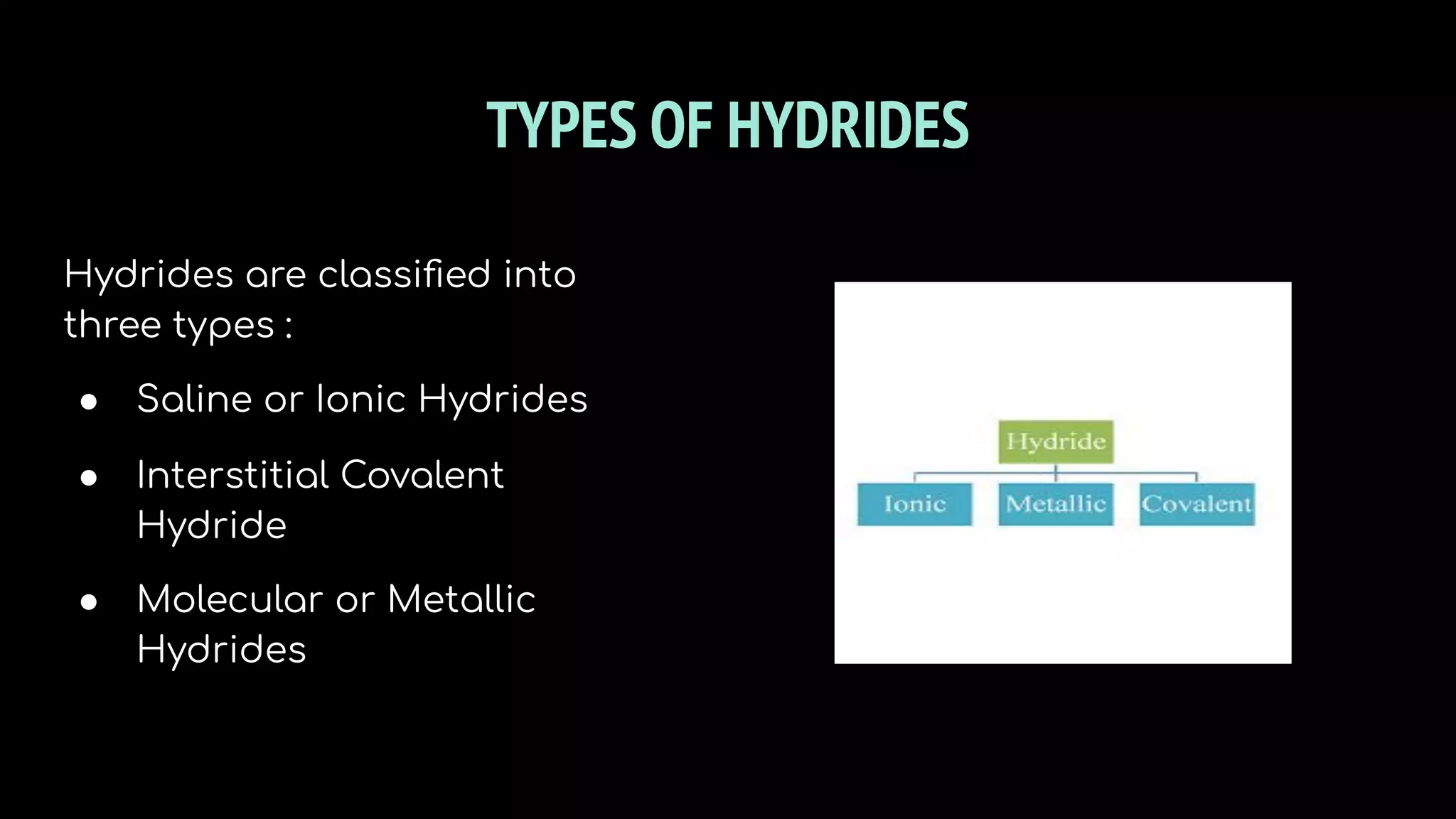
Hydrides are classified into
three types :
● Saline or Ionic Hydrides
● Interstitial Covalent
Hydride
● Molecular or Metallic
Hydrides
IONIC OR SALINE HYDRIDES
Saline hydrides (also known as ionic hydrides or pseudohalides) are stoichiometric
compounds formed between hydrogen and the most active metals (highly
electropositive elements) , especially with the alkali and alkaline-earth metals of
group one and two elements ( s-block elements). They bond with more
electropositive metal atoms.
PROPERTIES :
● In this group, the hydrogen acts as the hydride ion (H−).
● In solid-state, the ionic hydrides are crystalline, non-conducting and non-volatile.
However, in a liquid state, they conduct electricity.
● Ionic hydrides on electrolysis liberate hydrogen gas at the anode.
● Saline or ionic hydrides does not dissolve in conventional solvents and they are
mostly used as bases or reducing reagents in organic synthesis.
● One very unique chemical property of Saline hydrides is that they react very
vigorously with water and other solvents such as ethanol and ammonia. In the
process, they release pure hydrogen gas. This is why they must be kept in moisture
free environments. Here is a reaction of Sodium Hydride reacting with water and
ammonia
NaH + H2O → NaOH + H2
NaH + NH3 → NaNH2 + H2
● They conduct electricity in molten state liberating a diatomic molecule of hydrogen
gas at the anode. This is also a way to confirm the presence of hydrogen in the
compound. Let us take a look at the reaction of Calcium Hydride electrolysis
CaH2 (melt) → Ca2+ + 2H–
At anode: 2H– → H2 + 2e-
At cathode: Ca2+ + 2e– → Ca
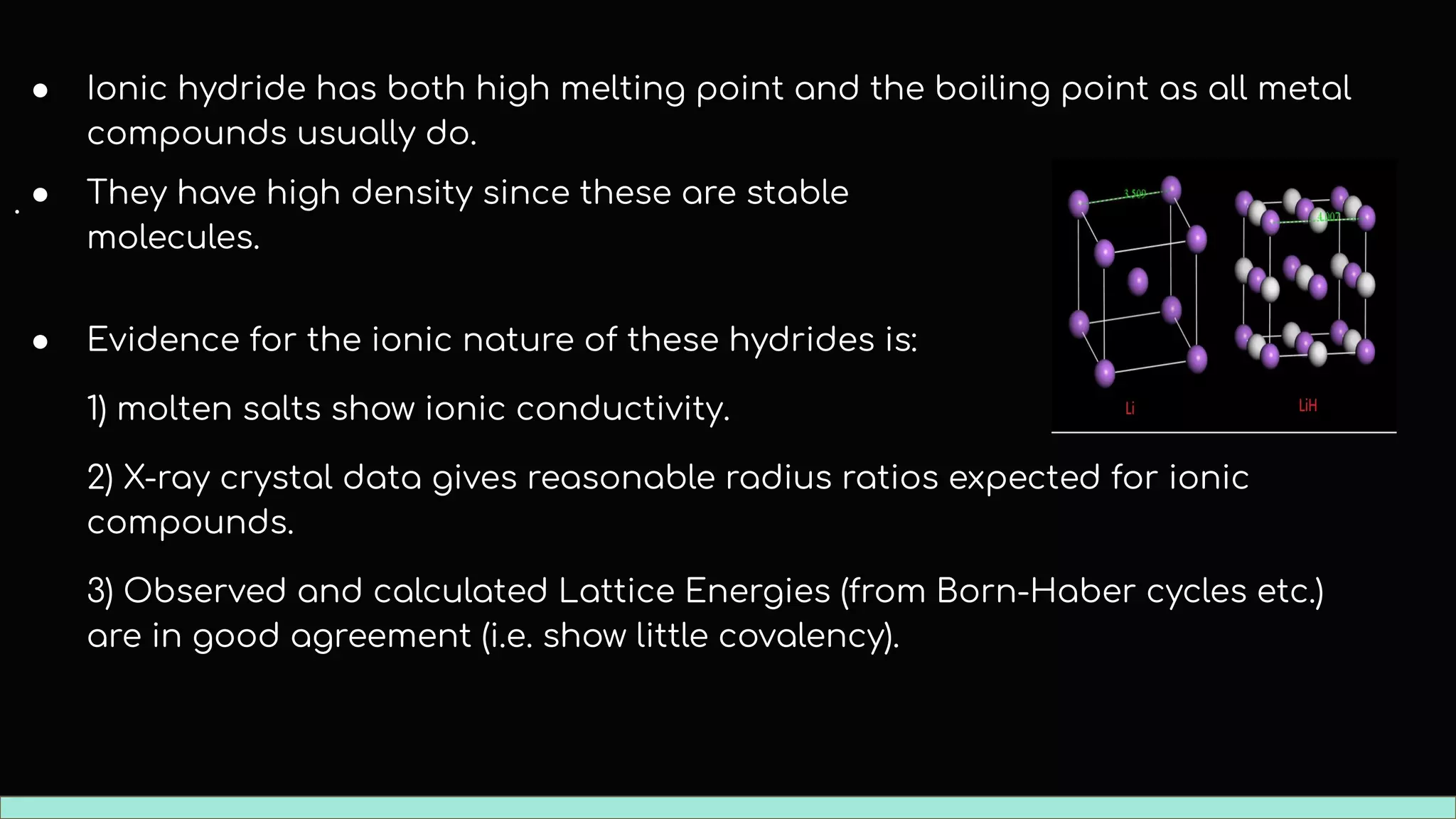
● Ionic hydride has both high melting point and the boiling point as all metal
compounds usually do.
.
● Evidence for the ionic nature of these hydrides is:
1) molten salts show ionic conductivity.
2) X-ray crystal data gives reasonable radius ratios expected for ionic
compounds.
3) Observed and calculated Lattice Energies (from Born-Haber cycles etc.)
are in good agreement (i.e. show little covalency).
● They have high density since these are stable
molecules.
EXAMPLES : NaH, KH, CaH2
4 LiH + AlCl3 → LiAlH4 + 3 LiCl - Lithium Hydride
iH is rather unreactive at moderate temperatures with Oxygen or Chlorine.
It is therefore, used in Synthesis of other useful hydrides.
( LiH2 and BeH2 exhibit covalent nature )
https://www.youtube.com/watch?v=7p7EKXN1jF0 - Useful Resource.
Additional Resource : Hydrides_Types
Ionic Hydrides
METALLIC HYDRIDES
A hydrogen compound that forms a bond with another metal element is classified as a
metal hydride. The bond is mostly covalent type but sometimes the hydrides are formed
with ionic bonds. These are usually formed by transition metals and are mostly
non-stoichiometric, hard, high melting and boiling points.
Example of Metallic Hydrides: TiH aluminium, cadmium, magnesium, etc.
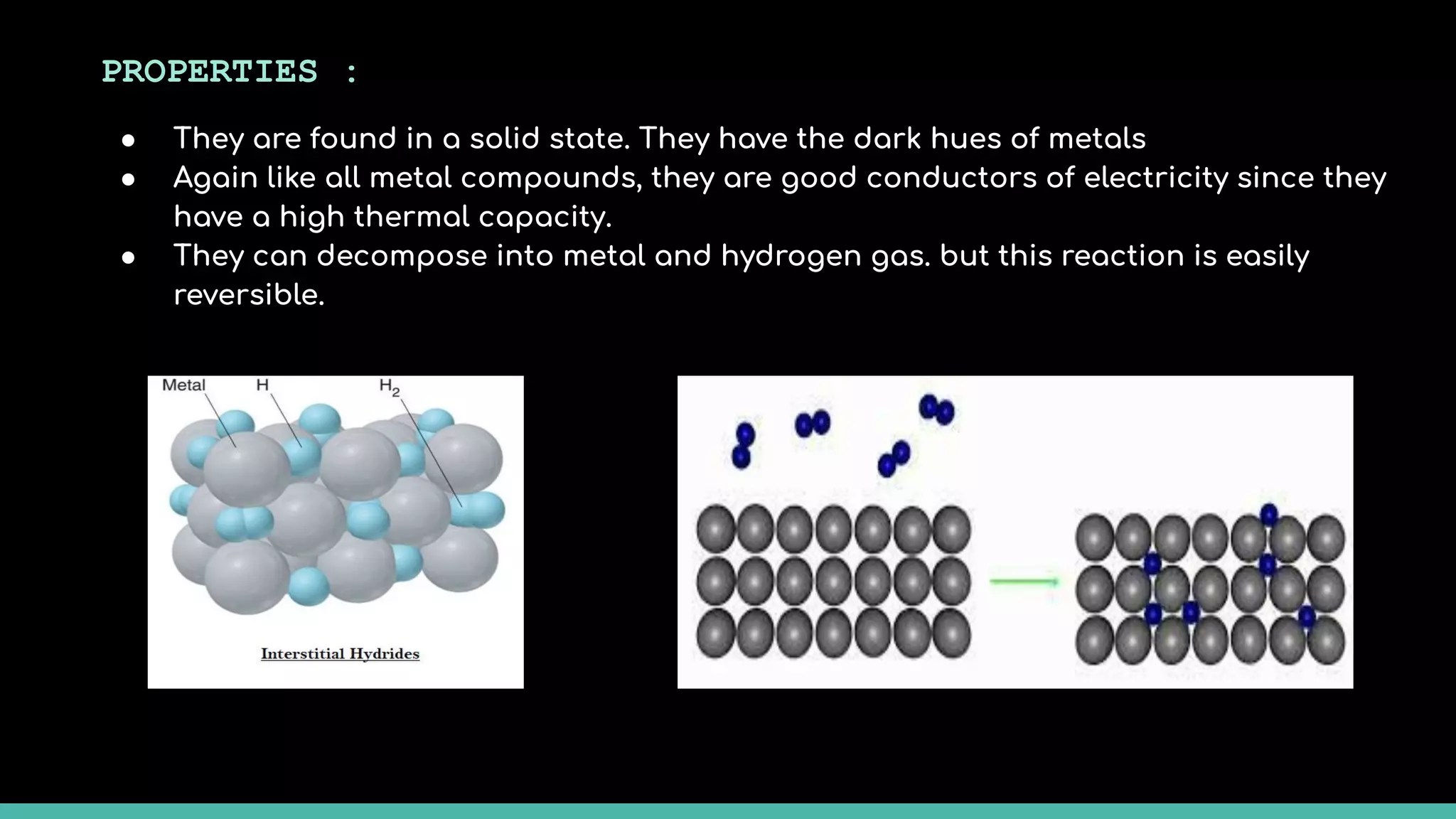
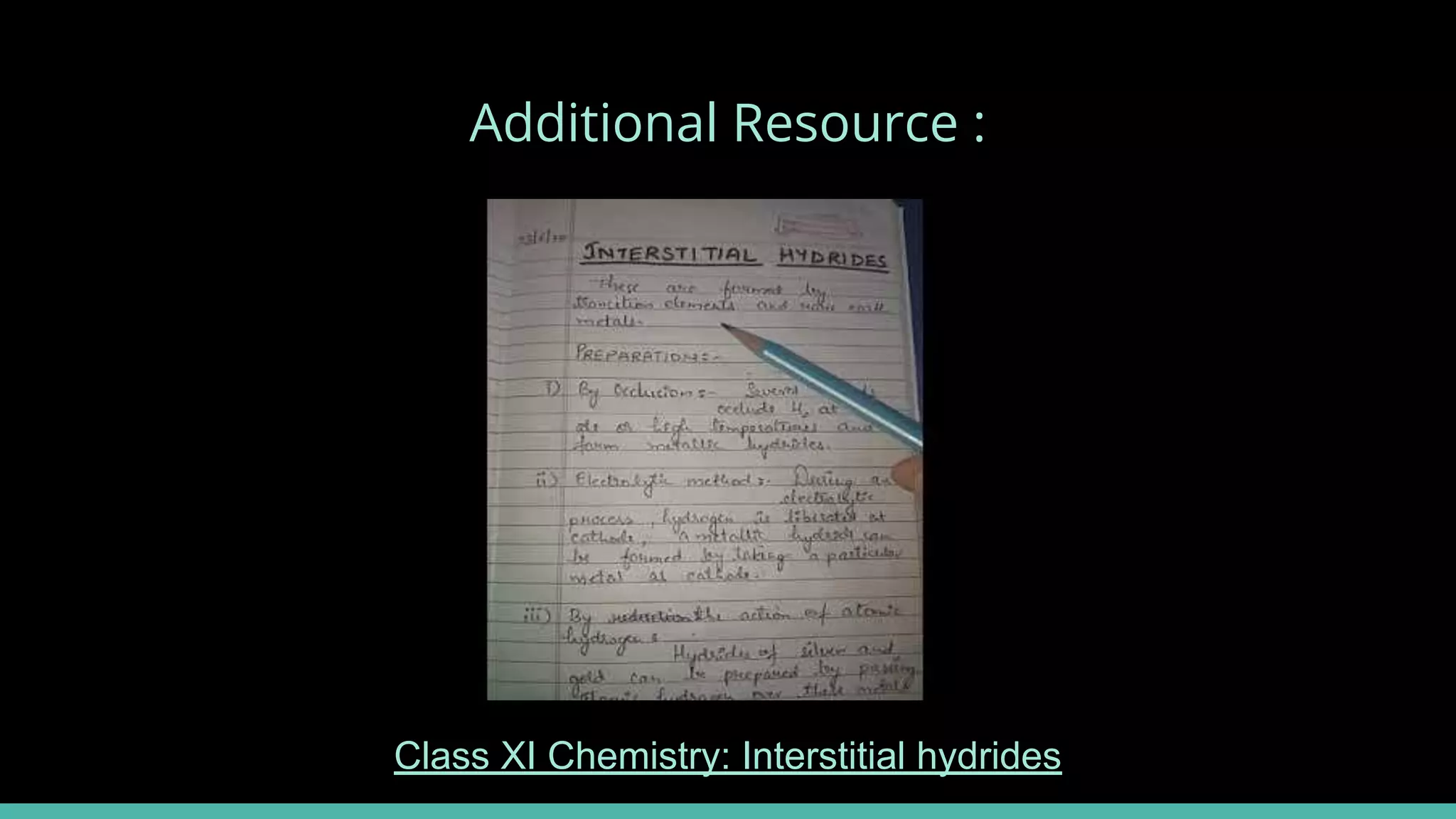
Metal hydrides are also known as interstitial hydrides. They are formed when hydrogen
molecule reacts with the d- and f-block elements. Metals of group 7, 8, and 9 do not form
hydrides. They do conduct heat and electricity but not to the extent of their parent
metals.
PROPERTIES :
● They are found in a solid state. They have the dark hues of metals
● Again like all metal compounds, they are good conductors of electricity since they
have a high thermal capacity.
● They can decompose into metal and hydrogen gas. but this reaction is easily
reversible.
Additional Resource :
Class XI Chemistry: Interstitial hydrides
COVALENT HYDRIDES
Covalent or Molecular hydrides are formed when hydrogen reacts with other similar
electronegative elements like Si, C, etc. The most common examples are CH4 and NH3. In
general, compounds that are formed when hydrogen is reacted with non-metals are called
covalent hydrides. The compound shares a covalent bond and are either volatile or
non-volatile compounds. Covalent hydrides are also either liquids or gases.
Example of Covalent Hydrides: SiH4 (silane)
Covalent hydrides are liquids or gases that have low melting and boiling points, except in those
cases (such as water) where their properties are modified by hydrogen bonding. For example,
although volatile, NH3, H2O, and HF are held together in the liquid state primarily by hydrogen
bonding.
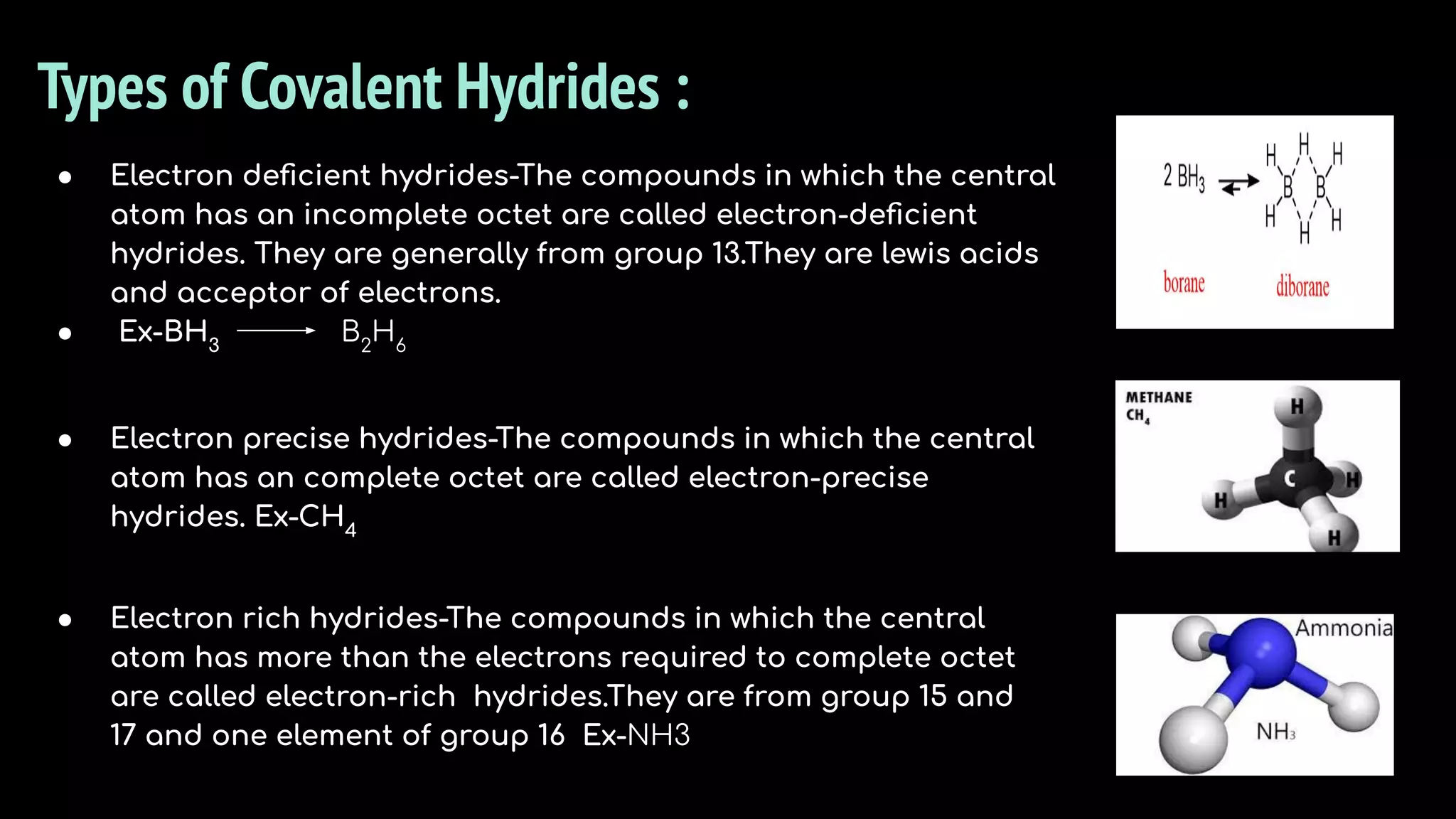
Types of Covalent Hydrides :
● Electron precise hydrides-The compounds in which the central
atom has an complete octet are called electron-precise
hydrides. Ex-CH4
● Electron rich hydrides-The compounds in which the central
atom has more than the electrons required to complete octet
are called electron-rich hydrides.They are from group 15 and
17 and one element of group 16 Ex-NH3
● Electron deficient hydrides-The compounds in which the central
atom has an incomplete octet are called electron-deficient
hydrides. They are generally from group 13.They are lewis acids
and acceptor of electrons.
● Ex-BH3
B2
H6
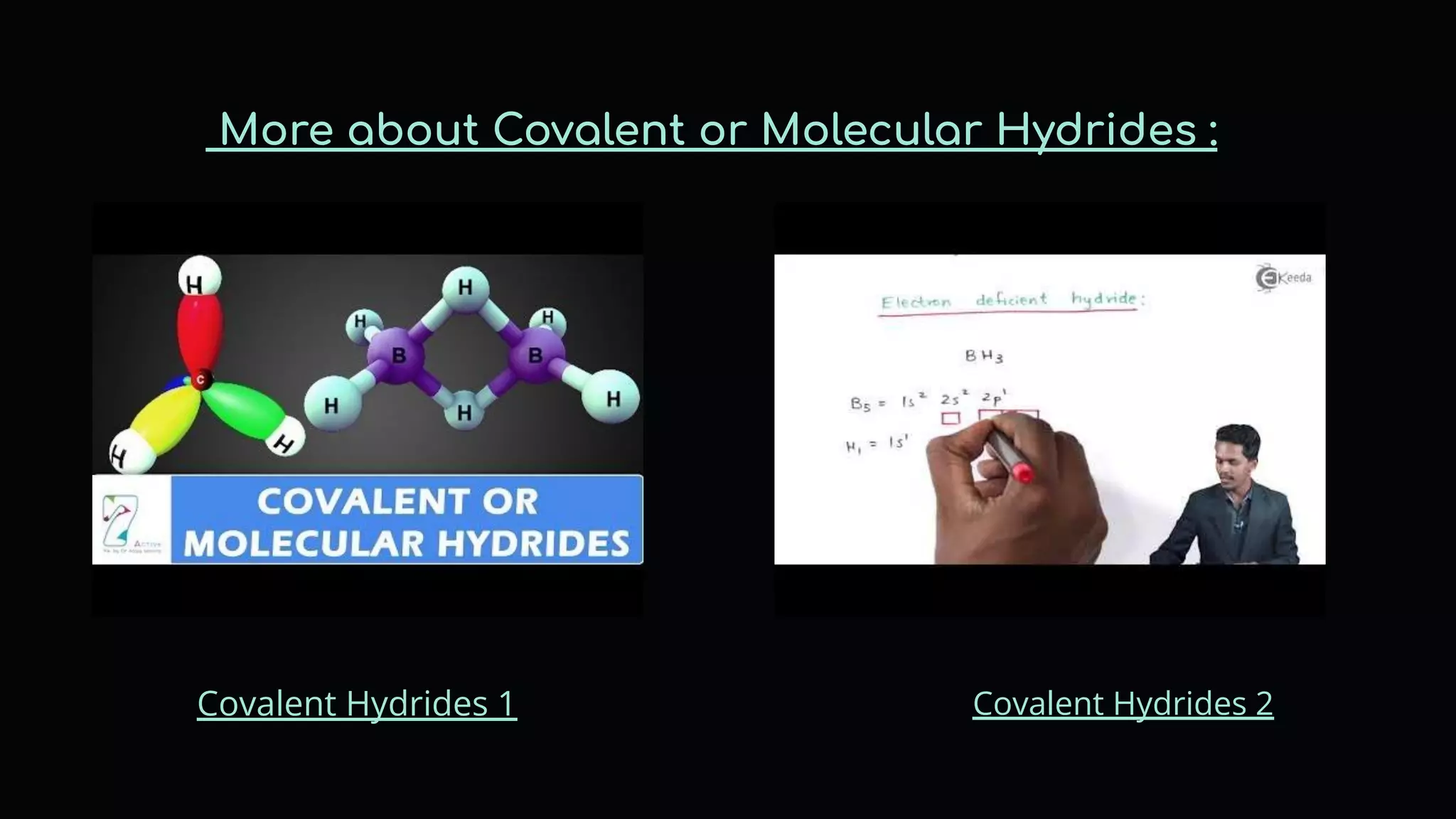
More about Covalent or Molecular Hydrides :
Covalent Hydrides 2
Covalent Hydrides 1
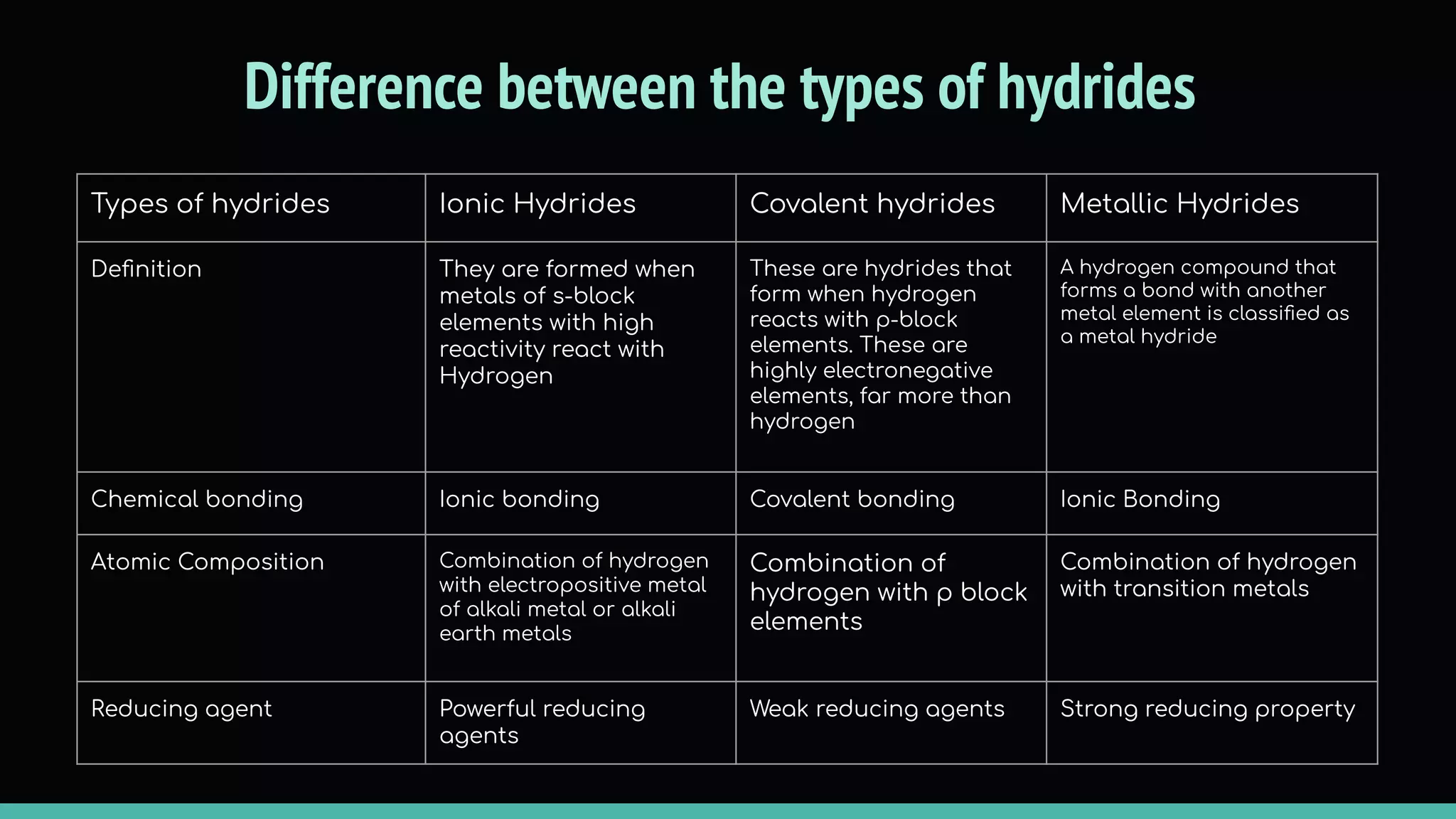
Difference between the types of hydrides
Types of hydrides Ionic Hydrides Covalent hydrides Metallic Hydrides
Definition They are formed when
metals of s-block
elements with high
reactivity react with
Hydrogen
These are hydrides that
form when hydrogen
reacts with p-block
elements. These are
highly electronegative
elements, far more than
hydrogen
A hydrogen compound that
forms a bond with another
metal element is classified as
a metal hydride
Chemical bonding Ionic bonding Covalent bonding Ionic Bonding
Atomic Composition Combination of hydrogen
with electropositive metal
of alkali metal or alkali
earth metals
Combination of
hydrogen with p block
elements
Combination of hydrogen
with transition metals
Reducing agent Powerful reducing
agents
Weak reducing agents Strong reducing property
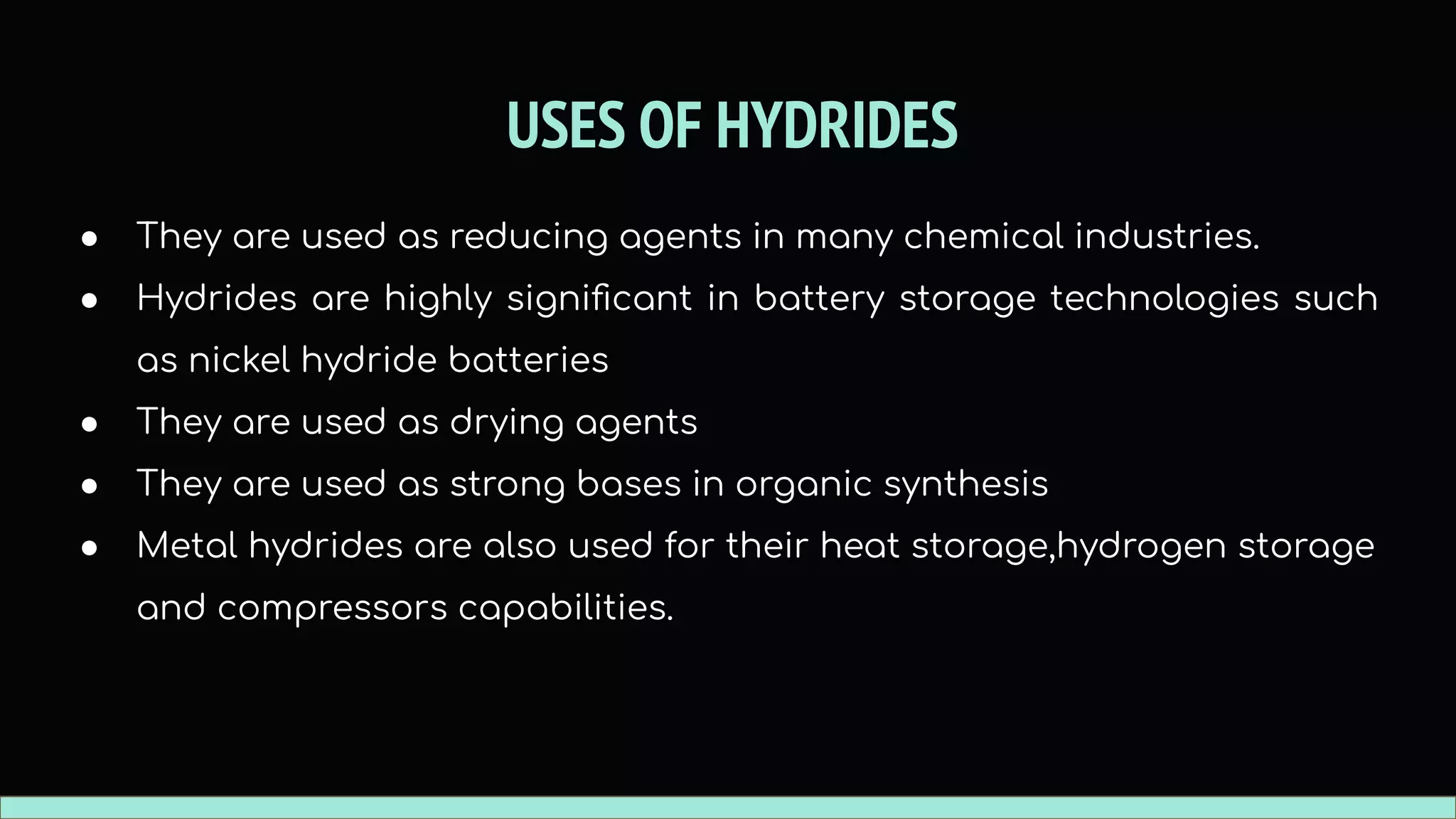
USES OF HYDRIDES
● They are used as reducing agents in many chemical industries.
● Hydrides are highly significant in battery storage technologies such
as nickel hydride batteries
● They are used as drying agents
● They are used as strong bases in organic synthesis
● Metal hydrides are also used for their heat storage,hydrogen storage
and compressors capabilities.
Chem Project.pdf class 11

Chem Project.pdf class 11

  • 1.
    TYPES OF HYDRIDES By: Ishita , Pradhna , Raeshmikhaa , Santwana , Swaranya [ 11 A ]
  • 2.
    WHATARE HYDRIDES? Hydride, anyof a class of chemical compounds in which hydrogen is combined with another element.Hydrides are binary compounds that form when hydrogen reacts with other elements in the periodic table. Except for a few noble gases, almost any element can produce hydride compounds. The hydrides may be represented by the general formula EHx or EmHn ,where E is the symbol of elements.
  • 3.
    More About Hydrides:Hydrides_Introduction
  • 4.
    HYDRIDE ION Free hydrideanions exist only in extreme conditions and are not used in homogeneous solutions. Many compounds, on the other hand, have hydrogen centres with hydridic properties. The simplest anion is the hydride ion, which consists of two electrons and a proton. Therefore, the electronic configuration of hydride ion is 1S2.
  • 5.
    BASIS OF CLASSIFICATION Thecategories are decided based on what elements the hydrogen forms bonds with or simply on the basis of chemical bonding.
  • 6.
    TYPES OF HYDRIDES Hydridesare classified into three types : ● Saline or Ionic Hydrides ● Interstitial Covalent Hydride ● Molecular or Metallic Hydrides
  • 7.
    IONIC OR SALINEHYDRIDES Saline hydrides (also known as ionic hydrides or pseudohalides) are stoichiometric compounds formed between hydrogen and the most active metals (highly electropositive elements) , especially with the alkali and alkaline-earth metals of group one and two elements ( s-block elements). They bond with more electropositive metal atoms. PROPERTIES : ● In this group, the hydrogen acts as the hydride ion (H−). ● In solid-state, the ionic hydrides are crystalline, non-conducting and non-volatile. However, in a liquid state, they conduct electricity. ● Ionic hydrides on electrolysis liberate hydrogen gas at the anode. ● Saline or ionic hydrides does not dissolve in conventional solvents and they are mostly used as bases or reducing reagents in organic synthesis.
  • 8.
    ● One veryunique chemical property of Saline hydrides is that they react very vigorously with water and other solvents such as ethanol and ammonia. In the process, they release pure hydrogen gas. This is why they must be kept in moisture free environments. Here is a reaction of Sodium Hydride reacting with water and ammonia NaH + H2O → NaOH + H2 NaH + NH3 → NaNH2 + H2 ● They conduct electricity in molten state liberating a diatomic molecule of hydrogen gas at the anode. This is also a way to confirm the presence of hydrogen in the compound. Let us take a look at the reaction of Calcium Hydride electrolysis CaH2 (melt) → Ca2+ + 2H– At anode: 2H– → H2 + 2e- At cathode: Ca2+ + 2e– → Ca
  • 9.
    ● Ionic hydridehas both high melting point and the boiling point as all metal compounds usually do. . ● Evidence for the ionic nature of these hydrides is: 1) molten salts show ionic conductivity. 2) X-ray crystal data gives reasonable radius ratios expected for ionic compounds. 3) Observed and calculated Lattice Energies (from Born-Haber cycles etc.) are in good agreement (i.e. show little covalency). ● They have high density since these are stable molecules.
  • 10.
    EXAMPLES : NaH,KH, CaH2 4 LiH + AlCl3 → LiAlH4 + 3 LiCl - Lithium Hydride iH is rather unreactive at moderate temperatures with Oxygen or Chlorine. It is therefore, used in Synthesis of other useful hydrides. ( LiH2 and BeH2 exhibit covalent nature ) https://www.youtube.com/watch?v=7p7EKXN1jF0 - Useful Resource.
  • 11.
    Additional Resource :Hydrides_Types Ionic Hydrides
  • 12.
    METALLIC HYDRIDES A hydrogencompound that forms a bond with another metal element is classified as a metal hydride. The bond is mostly covalent type but sometimes the hydrides are formed with ionic bonds. These are usually formed by transition metals and are mostly non-stoichiometric, hard, high melting and boiling points. Example of Metallic Hydrides: TiH aluminium, cadmium, magnesium, etc. Metal hydrides are also known as interstitial hydrides. They are formed when hydrogen molecule reacts with the d- and f-block elements. Metals of group 7, 8, and 9 do not form hydrides. They do conduct heat and electricity but not to the extent of their parent metals.
  • 13.
    PROPERTIES : ● Theyare found in a solid state. They have the dark hues of metals ● Again like all metal compounds, they are good conductors of electricity since they have a high thermal capacity. ● They can decompose into metal and hydrogen gas. but this reaction is easily reversible.
  • 14.
    Additional Resource : ClassXI Chemistry: Interstitial hydrides
  • 15.
    COVALENT HYDRIDES Covalent orMolecular hydrides are formed when hydrogen reacts with other similar electronegative elements like Si, C, etc. The most common examples are CH4 and NH3. In general, compounds that are formed when hydrogen is reacted with non-metals are called covalent hydrides. The compound shares a covalent bond and are either volatile or non-volatile compounds. Covalent hydrides are also either liquids or gases. Example of Covalent Hydrides: SiH4 (silane) Covalent hydrides are liquids or gases that have low melting and boiling points, except in those cases (such as water) where their properties are modified by hydrogen bonding. For example, although volatile, NH3, H2O, and HF are held together in the liquid state primarily by hydrogen bonding.
  • 16.
    Types of CovalentHydrides : ● Electron precise hydrides-The compounds in which the central atom has an complete octet are called electron-precise hydrides. Ex-CH4 ● Electron rich hydrides-The compounds in which the central atom has more than the electrons required to complete octet are called electron-rich hydrides.They are from group 15 and 17 and one element of group 16 Ex-NH3 ● Electron deficient hydrides-The compounds in which the central atom has an incomplete octet are called electron-deficient hydrides. They are generally from group 13.They are lewis acids and acceptor of electrons. ● Ex-BH3 B2 H6
  • 17.
    More about Covalentor Molecular Hydrides : Covalent Hydrides 2 Covalent Hydrides 1
  • 18.
    Difference between thetypes of hydrides Types of hydrides Ionic Hydrides Covalent hydrides Metallic Hydrides Definition They are formed when metals of s-block elements with high reactivity react with Hydrogen These are hydrides that form when hydrogen reacts with p-block elements. These are highly electronegative elements, far more than hydrogen A hydrogen compound that forms a bond with another metal element is classified as a metal hydride Chemical bonding Ionic bonding Covalent bonding Ionic Bonding Atomic Composition Combination of hydrogen with electropositive metal of alkali metal or alkali earth metals Combination of hydrogen with p block elements Combination of hydrogen with transition metals Reducing agent Powerful reducing agents Weak reducing agents Strong reducing property
  • 19.
    USES OF HYDRIDES ●They are used as reducing agents in many chemical industries. ● Hydrides are highly significant in battery storage technologies such as nickel hydride batteries ● They are used as drying agents ● They are used as strong bases in organic synthesis ● Metal hydrides are also used for their heat storage,hydrogen storage and compressors capabilities.