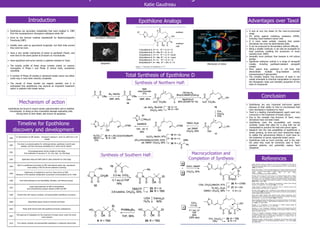
Synthesis of Northern Half:
Epothilone Analogs
Total Synthesis of Epothilone D
Synthesis of Southern Half: Macrocyclization and
Completion of Synthesis:
Introduction
Katie Gaudreau
Timeline for Epothilone
discovery and development
References
Advantages over Taxol
 It acts at very low doses (in the nano-to-picomolar
range
 It’s active against multidrug resistance (MDR),
including Taxol-resistant cancer cells
 It is more water soluble, meaning that certain
derivatives can even be administered orally
 It can be produced by fermentation without difficulty
 Being a smaller molecule, it can also be accessible by
total synthesis, enabling the production of many
variants (over 1000!)
 Generally more cytotoxic than taxanes in cell culture
studies
 Significant antitumor activity in a range of xenograft
models, including paclitaxel-resistant xenograft
models
 More potent than paclitaxel in cell lines that
demonstrate multiple drug-resistant activity
overexpressing P-glycoprotein
 The complex taxane ring structure of taxol is not
readily amenable to chemical manipulation to improve
the therapeutic index and solubility properties of this
class of compounds
Conclusion
Mechanism of action
Epothilones are found to induce tubulin polymerization and to stabilize
microtubules. In doing so they irreversibly damage replicating cells,
driving them to their death, also known as apoptosis.
 Epothilones are secondary metabolites that were isolated in 1985
from the myxobacterium Sorangium cellulosum strain 901.
 Done by the German institute Gesellschaft fur Biotechnologische
Forschung (GBF).
 Initially were used as agricultural fungicides, but field trials proved
they were too toxic.
 Have a very similar mechanism of action to paclitaxel (Taxol), and
even bind to the same pocket of β-tubulin on microtubules.
 Have significant anti-tumor activity in patients resistant to Taxol.
 The toxicity profile of these drugs consists mostly on sensory
neuropathy in Phase I and Phase II clinical trials, sometimes
reversible.
 A number of Phase III studies in advanced breast cancer are either
under way or have been recently completed.
 The results of these studies are eagerly awaited, and it is
anticipated that epothilones may become an important treatment
option in patients with breast cancer.
Sorangium cellulosum
Apoptosis
 Epothilones are very important anti-tumor agents
because of their ability to bind to microtubules that
have developed a resistance to Taxol.
 Taxol is a leading chemotherapeutic agent used very
commonly in the treatment of breast cancer.
 Due to the complex ring structure of Taxol, many
derivatives have not been made.
 Epothilones have the accessibility and varying
synthetic routes that allow for a drug that can be
manipulated to produce the best anti-cancer agent.
 Research into the vast possibilities of epothilones is
slowly growing, as more and more researchers begin
to realize the astronomical effects it could have on
the treatment of cancer, especially breast cancer.
 Epothilones hold so much promise, and in the next
ten years they could be commonly used in Taxol-
resistant patients, and potentially replace Taxol
altogether.
Bollag, Daniel M.; McQueney, Patricia A.; Zhu, Jian; et al. Epothilones, a New Class of
Microtubule-stabilizing Agents with a Taxol-like Mechanism of Action. Cancer Research
1995, 55, 2325-2333.
Bristol-Myers Squibb. "A Trial to Evaluate Epothilone D in Patients With Advanced Solid
Tumors." A Trial to Evaluate Epothilone D in Patients With Advanced Solid Tumors. Bristol-
Myers Squibb, 7 Feb. 2002. Web. 16 Mar. 2015.
<https://clinicaltrials.gov/ct2/show/NCT00030173>.
Brunden, Kurt R.; Zhang, Bin; Carroll, Jenna; Yao, Yuemang; Potuzak, Justin S.; Hogan,
Anne-Marie L.; Iba, Michiyo; James, Michael J.; Xie, Sharon X.; Ballatore, Carlo; Smith
III, Amos B.; Lee; et al. Epothilone D Improves Microtubule Density, Axonal Integrity,
and Cognition in a Transgenic Mouse Model of Tauopathy. The Journal of Neuroscience
2010, 30(41): 13861-13866.
Cortes, Javier; Baselga, Jose. Targeting the Microtubules in Breast Cancer Beyond
Taxanes: The Epothilones. The Oncologist 2007, 12: 271-280.
Cragg, Gordon M.; Kingston, David G.I.; Newman, David J.; Anticancer agents from
natural products. CRC Press, 2011, 2nd edition, pp
Donovan, Diana; Vahdat, Linda T. Epothilones: Clinical Update and Future Directions.
Cancer Network 2008. Web. http://www.cancernetwork.com/breast-cancer/epothilones-
clinical-update-and-future-directions.
Gerth, Klaus; Bedorf, Norbert; Hofle, Gerhard; Irschik, Herbert; Reichenbach, Hans.
Epothilons A and B: Antifungal and Cytotoxic Compounds from Sorangium cellulosum
(Myxobacteria). The Journal of Antibiotics 1996, 49: 560-563.
Meng, Dongfang; Bertinato, Peter; Balog, Aaron; Su, Dai-Shi; Kamenecka, Ted; Sorensen,
Erik J.; Danishefsky, Samuel J.; Total Syntheses of Epothilones A and B. J. Am. Chem.
Soc. 1997, 119, 10073-10092.
Nicolaou, K. C., Roschangar, F. and Vourloumis, D. (1998), Chemical Biology of
Epothilones. Angew. Chem. Int. Ed., 37: 2014–2045
Nicolaou, K. C., and T. Montagnon. "Epothilones." Molecules That Changed the World: A
Brief History of the Art and Science of Synthesis and Its Impact on Society. Weinheim:
Wiley-VCH, 2008. 252. Print.
Troiani, T., C. Schettino, E. Martinelli, F. Morgillo, G. Tortora, and F. Ciardiello. "The use
of xenograft models for the selection of cancer treatments with the EGFR as an
example." National Center for Biotechnology Information. U.S. National Library of
Medicine, Mar. 2008. Web. 16 Mar. 2015.
Wessjohann, Ludger A.; Scheid, Gunther O.; Eichelberger, Uwe; Umbreen, Sumaira. Total
Synthesis of Epothilone D: The Nerol/Macroaldolization Approach. J. Org. Chem. 2013,
78, 10588-10595.
Mechanism of Action
1985
1987
1991
1992
1994
1995
1996
1997
1999
2000
2003
2007
2010
Phase II/III clinical trials with epothilone B-lactam (ixabepilone)
FDA approval of ixabepilone for the treatment of breast cancer under the brand
name Ixempra
Five natural, synthetic and semisynthetic epothilones in advanced clinical trials
Work on epothilones terminated at GBF, international patent app. abandoned
Good activity in NCI 60 cell line antitumor screening
Rediscovery of epothilone A and B as Taxol mimics at MSD
Disclosure of the absolute configuration as personal communications by Dr. Hofle
First total syntheses by the Danishefsky, Nicolaou, and Schinzer groups
Large scale production at GBF by fermentation
Joint semisynthesis program started at BMS and GBF
Clinical trials with natural, synthetic, and semisynthetic epothilones commence
Biosynthesis genes cloned by Novartis and Kosan
Dr. Reichenbach at GBF isolates Sorangium cellulosum strain So ce90 from a soil
sample
The strain is screened positive for antifungal activity, epothilone A and B were
isolated, and their structures elucidated by Dr. Gerth and Dr. Bedorf
Immunosuppressive activity studied at Ciba Geigy
First publication of structure in Sci. Ann. Rep . by Ciba-Geigy
Application tests and field trials for plant protection by Ciba-Geigy

CHE450_katiegaudreau2

  • 1.
    Synthesis of NorthernHalf: Epothilone Analogs Total Synthesis of Epothilone D Synthesis of Southern Half: Macrocyclization and Completion of Synthesis: Introduction Katie Gaudreau Timeline for Epothilone discovery and development References Advantages over Taxol  It acts at very low doses (in the nano-to-picomolar range  It’s active against multidrug resistance (MDR), including Taxol-resistant cancer cells  It is more water soluble, meaning that certain derivatives can even be administered orally  It can be produced by fermentation without difficulty  Being a smaller molecule, it can also be accessible by total synthesis, enabling the production of many variants (over 1000!)  Generally more cytotoxic than taxanes in cell culture studies  Significant antitumor activity in a range of xenograft models, including paclitaxel-resistant xenograft models  More potent than paclitaxel in cell lines that demonstrate multiple drug-resistant activity overexpressing P-glycoprotein  The complex taxane ring structure of taxol is not readily amenable to chemical manipulation to improve the therapeutic index and solubility properties of this class of compounds Conclusion Mechanism of action Epothilones are found to induce tubulin polymerization and to stabilize microtubules. In doing so they irreversibly damage replicating cells, driving them to their death, also known as apoptosis.  Epothilones are secondary metabolites that were isolated in 1985 from the myxobacterium Sorangium cellulosum strain 901.  Done by the German institute Gesellschaft fur Biotechnologische Forschung (GBF).  Initially were used as agricultural fungicides, but field trials proved they were too toxic.  Have a very similar mechanism of action to paclitaxel (Taxol), and even bind to the same pocket of β-tubulin on microtubules.  Have significant anti-tumor activity in patients resistant to Taxol.  The toxicity profile of these drugs consists mostly on sensory neuropathy in Phase I and Phase II clinical trials, sometimes reversible.  A number of Phase III studies in advanced breast cancer are either under way or have been recently completed.  The results of these studies are eagerly awaited, and it is anticipated that epothilones may become an important treatment option in patients with breast cancer. Sorangium cellulosum Apoptosis  Epothilones are very important anti-tumor agents because of their ability to bind to microtubules that have developed a resistance to Taxol.  Taxol is a leading chemotherapeutic agent used very commonly in the treatment of breast cancer.  Due to the complex ring structure of Taxol, many derivatives have not been made.  Epothilones have the accessibility and varying synthetic routes that allow for a drug that can be manipulated to produce the best anti-cancer agent.  Research into the vast possibilities of epothilones is slowly growing, as more and more researchers begin to realize the astronomical effects it could have on the treatment of cancer, especially breast cancer.  Epothilones hold so much promise, and in the next ten years they could be commonly used in Taxol- resistant patients, and potentially replace Taxol altogether. Bollag, Daniel M.; McQueney, Patricia A.; Zhu, Jian; et al. Epothilones, a New Class of Microtubule-stabilizing Agents with a Taxol-like Mechanism of Action. Cancer Research 1995, 55, 2325-2333. Bristol-Myers Squibb. "A Trial to Evaluate Epothilone D in Patients With Advanced Solid Tumors." A Trial to Evaluate Epothilone D in Patients With Advanced Solid Tumors. Bristol- Myers Squibb, 7 Feb. 2002. Web. 16 Mar. 2015. <https://clinicaltrials.gov/ct2/show/NCT00030173>. Brunden, Kurt R.; Zhang, Bin; Carroll, Jenna; Yao, Yuemang; Potuzak, Justin S.; Hogan, Anne-Marie L.; Iba, Michiyo; James, Michael J.; Xie, Sharon X.; Ballatore, Carlo; Smith III, Amos B.; Lee; et al. Epothilone D Improves Microtubule Density, Axonal Integrity, and Cognition in a Transgenic Mouse Model of Tauopathy. The Journal of Neuroscience 2010, 30(41): 13861-13866. Cortes, Javier; Baselga, Jose. Targeting the Microtubules in Breast Cancer Beyond Taxanes: The Epothilones. The Oncologist 2007, 12: 271-280. Cragg, Gordon M.; Kingston, David G.I.; Newman, David J.; Anticancer agents from natural products. CRC Press, 2011, 2nd edition, pp Donovan, Diana; Vahdat, Linda T. Epothilones: Clinical Update and Future Directions. Cancer Network 2008. Web. http://www.cancernetwork.com/breast-cancer/epothilones- clinical-update-and-future-directions. Gerth, Klaus; Bedorf, Norbert; Hofle, Gerhard; Irschik, Herbert; Reichenbach, Hans. Epothilons A and B: Antifungal and Cytotoxic Compounds from Sorangium cellulosum (Myxobacteria). The Journal of Antibiotics 1996, 49: 560-563. Meng, Dongfang; Bertinato, Peter; Balog, Aaron; Su, Dai-Shi; Kamenecka, Ted; Sorensen, Erik J.; Danishefsky, Samuel J.; Total Syntheses of Epothilones A and B. J. Am. Chem. Soc. 1997, 119, 10073-10092. Nicolaou, K. C., Roschangar, F. and Vourloumis, D. (1998), Chemical Biology of Epothilones. Angew. Chem. Int. Ed., 37: 2014–2045 Nicolaou, K. C., and T. Montagnon. "Epothilones." Molecules That Changed the World: A Brief History of the Art and Science of Synthesis and Its Impact on Society. Weinheim: Wiley-VCH, 2008. 252. Print. Troiani, T., C. Schettino, E. Martinelli, F. Morgillo, G. Tortora, and F. Ciardiello. "The use of xenograft models for the selection of cancer treatments with the EGFR as an example." National Center for Biotechnology Information. U.S. National Library of Medicine, Mar. 2008. Web. 16 Mar. 2015. Wessjohann, Ludger A.; Scheid, Gunther O.; Eichelberger, Uwe; Umbreen, Sumaira. Total Synthesis of Epothilone D: The Nerol/Macroaldolization Approach. J. Org. Chem. 2013, 78, 10588-10595. Mechanism of Action 1985 1987 1991 1992 1994 1995 1996 1997 1999 2000 2003 2007 2010 Phase II/III clinical trials with epothilone B-lactam (ixabepilone) FDA approval of ixabepilone for the treatment of breast cancer under the brand name Ixempra Five natural, synthetic and semisynthetic epothilones in advanced clinical trials Work on epothilones terminated at GBF, international patent app. abandoned Good activity in NCI 60 cell line antitumor screening Rediscovery of epothilone A and B as Taxol mimics at MSD Disclosure of the absolute configuration as personal communications by Dr. Hofle First total syntheses by the Danishefsky, Nicolaou, and Schinzer groups Large scale production at GBF by fermentation Joint semisynthesis program started at BMS and GBF Clinical trials with natural, synthetic, and semisynthetic epothilones commence Biosynthesis genes cloned by Novartis and Kosan Dr. Reichenbach at GBF isolates Sorangium cellulosum strain So ce90 from a soil sample The strain is screened positive for antifungal activity, epothilone A and B were isolated, and their structures elucidated by Dr. Gerth and Dr. Bedorf Immunosuppressive activity studied at Ciba Geigy First publication of structure in Sci. Ann. Rep . by Ciba-Geigy Application tests and field trials for plant protection by Ciba-Geigy