Issues in Human Services
(HMNS 10085)
Module 6: Issues Pertaining to
Older Adults
Defining Older Adulthood:
• Very complex
• Statistics Canada defines a senior citizen as,
– “a person age 65 years or older, who is eligible
to collect full pension benefits.”

• Chronological age (years)
• Social age (social expectation for 65 year
old adults to retire
Different Categories of
Older Adulthood
• 3 different age groups:
– “Young old” - 65 to 70 years
» 53% are women

– “Middle old” - 75 to 84 years
» 60% are women

– “Old old” - 85+ years
» 70% are women
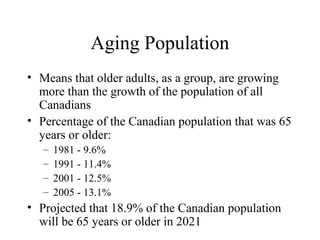
Aging Population
• Means that older adults, as a group, are growing
more than the growth of the population of all
Canadians
• Percentage of the Canadian population that was 65
years or older:
–
–
–
–

1981 - 9.6%
1991 - 11.4%
2001 - 12.5%
2005 - 13.1%

• Projected that 18.9% of the Canadian population
will be 65 years or older in 2021
Reasons for Aging Population:
• Longer life expectancy - more older adults
• The beginning of the baby boom generation
have started to reach the age of 65 years (in
2011).
• Lowered birth rate - fewer babies being
born
Ageism:
• “Any attitude, action or institutional structure that
subordinates or oppresses a person or group on the
basis of age.” (Hick, 2006, p. 252).
• Western society > aging is feared
> places premium importance on productivity
>when one stops working in the paid labour force, rely on
fixed income
>viewed as not productive but as burdensome

• Canadian Charter of Rights and Freedoms, 1982.
>prohibited to discriminate based on age
Health Problems of Aging:
• 65-74 age group:
– Most remain in good health
– 1/3 report some level of pain or discomfort

• 75+ years:
– More likely to suffer from pain - acute pain from injury
or illness
– Chronic pain lingering months to years
– Eg. arthritic conditions, diabetes, heart disease
– May lead to depression
Health Problems of Aging:
• Over the age of 75 years, adults experience
the following problems at higher rates:
– Mobility
– Vision
– Memory
Health Problems of Aging:
• Incidence of long term, debilitating terminals
illness have increased with increased life
expectancy:
– Cancer
– Alzheimers

• Loss of independence and the fear of it
• Myth > older adults all get dementia
> only 4% of people aged 75+ have dementia
Need for Care: At Home
• Need assistance with many of the activities they
do daily:
– Eg. Meal preparation
Everyday housework
Heavy household chores
Attending appointments
Financial managing
Moving around the house
Nursing care
Need for Care: At Home
• Large proportion do not tend to receive the help
they need.
• 41% of older adults 65+ either received help but
needed more or received no help at all.
– Mobility – 42% of those aged 65+ received no help or
received help but needed more.
– Vision – 46.3% of those aged 65+ received no help or
received help but needed more.
– Memory – 50.8% of those aged 65+ received no help
or received help but needed more.
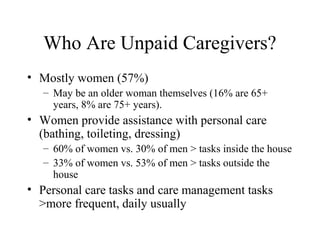
Who Are Unpaid Caregivers?
• Mostly women (57%)
– May be an older woman themselves (16% are 65+
years, 8% are 75+ years).

• Women provide assistance with personal care
(bathing, toileting, dressing)
– 60% of women vs. 30% of men > tasks inside the house
– 33% of women vs. 53% of men > tasks outside the
house

• Personal care tasks and care management tasks
>more frequent, daily usually
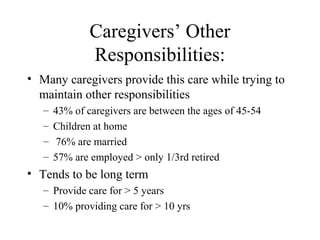
Caregivers’ Other
Responsibilities:
• Many caregivers provide this care while trying to
maintain other responsibilities
–
–
–
–

43% of caregivers are between the ages of 45-54
Children at home
76% are married
57% are employed > only 1/3rd retired

• Tends to be long term
– Provide care for > 5 years
– 10% providing care for > 10 yrs
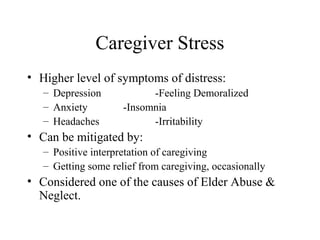
Caregiver Stress
• Higher level of symptoms of distress:
– Depression
– Anxiety
– Headaches

-Feeling Demoralized
-Insomnia
-Irritability

• Can be mitigated by:
– Positive interpretation of caregiving
– Getting some relief from caregiving, occasionally

• Considered one of the causes of Elder Abuse &
Neglect.
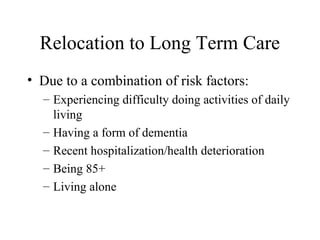
Relocation to Long Term Care
• Due to a combination of risk factors:
– Experiencing difficulty doing activities of daily
living
– Having a form of dementia
– Recent hospitalization/health deterioration
– Being 85+
– Living alone
Impacts of Move to
Long Term Care
• Stress
• Loss of culture
• Loss of community
– LGBTQ

• May feel relief
Impacts of Move to
Long Term Care
•
•
•
•

Change in habits and routines
Less contact with family and friends
Loss of clubs or organizations
Greater difficulty doing hobbies previously
enjoyed.
Rights of Older
Adults:Violations
• Abuse in institutional settings
• Direct - individual resident is target of
abuse or neglect
• Systemic - policies or procedures that limit
the rights or result in the direct abuse or
neglect of residents (eg. restraints)
Rights of Older Adults:
Violations:
• Some signs or symptoms of abuse:
–
–
–
–
–
–

Dehydration/malnourishment
Untreated medical issues
Missing aids (eg. hearing aids) or property
Unexplained injuries
Use of restraints, if frequent & to replace care
Decisions made for the resident - not able to participate
in decision-making
– Lack of sufficient medical reasons for medication given
– Family having difficulty contacting resident
Rights of Older Adults: Long
Term Care Homes Act, 2007
• To improve the quality of care in Long-Term
Care:
• Steps to improve care:
– The Home is “primarily the home of its residents & is to be operated so
that it is a place where they may live with dignity & in security, safety &
comfort, and have their physical, psychological, social, spiritual &
cultural needs adequately met.” (Mead, 2010).
– Bill of rights which includes the right not to be neglected, to have access
to their personal health records
– Goal of care -> independence to the greatest extent possible
Rights of Older Adults: Long
Term Care Homes Act, 2007
• Steps to improve care:
– Limits to restraints- resident safety
– Respect of choices and lifestyle
– Provide opportunity to have private meetings
with partners or another person
– Provide social & recreational activities >
includes those who not able to leave room
– Enforcement of these rights by the Ministry of
Health and Long-Term Care
Loss of Significant Relationships
• Acute grief - up to ~ 6 months
– Physical symptoms - headaches
- dizziness…

– Psychological symptoms - intense sadness
- longing & yearning for deceased
- Feelings of hopelessness….

--> Becomes less acute & intense - may last years
Loss of Significant Relationships
• Major disruption to the life of the surviving
spouse
– Finding new & positive meaning in life
– Developing new social roles
– Relationships with friends may change
– Financial loss
– Housing
– Transportation
– Need for increased social support
Income of Older Adults:
• Sources of income (beginning at age 65):
– Old Age Security/Guaranteed Income Supplement
– Canada Pension Plan
– Guaranteed Annual Income Supplement (GAINS)
(Ontario)
– Over two thirds of older adults rely on OAS & CPP as
main source of income
– the remainder > private pension or one sponsored by an
employer.
– small number of older adults also have RRSPs
Income of Older Adults
• Has improved > success of combined public &
private retirement income system.
– Seniors with low income: 1985 > 14.7%
2004 > 7.3%

• Due to:
– More people becoming eligible for Canada Pension
Plan
– Maturation of CPP - 1990s > more retirees earning full
benefits
– More women in the labour force
Groups of Older Adults Vulnerable
to Experiencing Poverty:
• Women:
– 22% of all older adult women experience poverty vs. 10% of older
adult men (City of Hamilton)

• Recent newcomers (1991+):
– 27% vs. 17% of older adults on the whole, experience poverty

• Visible minorities:
– 20% & 23% (Ontario) vs. 17% of older adults experience poverty

• Aboriginal:
– 25% vs. 17% of older adults experience poverty
Readings:
1. Mayo, S., Wetselaar, R., Bakht, L. & Camplin,
B. (2011). Profile of Vulnerable Seniors in
Hamilton: Summary Report. Hamilton: Social
Planning and Research Council of Hamilton
•

http://www.sprc.hamilton.on.ca/Reports/pdf/SPRC_Seni
ors_Report_2011_Summary.pdf

2. Walters, Joan (2012). “The Silver Tsunami”. In
The Hamilton Spectator, January 14, 2012.
Hamilton:
•

http://www.thespec.com/news/local/article/654486--the-silver-t

Hmns10085 mod6

  • 1.
    Issues in HumanServices (HMNS 10085) Module 6: Issues Pertaining to Older Adults
  • 2.
    Defining Older Adulthood: •Very complex • Statistics Canada defines a senior citizen as, – “a person age 65 years or older, who is eligible to collect full pension benefits.” • Chronological age (years) • Social age (social expectation for 65 year old adults to retire
  • 3.
    Different Categories of OlderAdulthood • 3 different age groups: – “Young old” - 65 to 70 years » 53% are women – “Middle old” - 75 to 84 years » 60% are women – “Old old” - 85+ years » 70% are women
  • 4.
    Aging Population • Meansthat older adults, as a group, are growing more than the growth of the population of all Canadians • Percentage of the Canadian population that was 65 years or older: – – – – 1981 - 9.6% 1991 - 11.4% 2001 - 12.5% 2005 - 13.1% • Projected that 18.9% of the Canadian population will be 65 years or older in 2021
  • 5.
    Reasons for AgingPopulation: • Longer life expectancy - more older adults • The beginning of the baby boom generation have started to reach the age of 65 years (in 2011). • Lowered birth rate - fewer babies being born
  • 6.
    Ageism: • “Any attitude,action or institutional structure that subordinates or oppresses a person or group on the basis of age.” (Hick, 2006, p. 252). • Western society > aging is feared > places premium importance on productivity >when one stops working in the paid labour force, rely on fixed income >viewed as not productive but as burdensome • Canadian Charter of Rights and Freedoms, 1982. >prohibited to discriminate based on age
  • 7.
    Health Problems ofAging: • 65-74 age group: – Most remain in good health – 1/3 report some level of pain or discomfort • 75+ years: – More likely to suffer from pain - acute pain from injury or illness – Chronic pain lingering months to years – Eg. arthritic conditions, diabetes, heart disease – May lead to depression
  • 8.
    Health Problems ofAging: • Over the age of 75 years, adults experience the following problems at higher rates: – Mobility – Vision – Memory
  • 9.
    Health Problems ofAging: • Incidence of long term, debilitating terminals illness have increased with increased life expectancy: – Cancer – Alzheimers • Loss of independence and the fear of it • Myth > older adults all get dementia > only 4% of people aged 75+ have dementia
  • 10.
    Need for Care:At Home • Need assistance with many of the activities they do daily: – Eg. Meal preparation Everyday housework Heavy household chores Attending appointments Financial managing Moving around the house Nursing care
  • 11.
    Need for Care:At Home • Large proportion do not tend to receive the help they need. • 41% of older adults 65+ either received help but needed more or received no help at all. – Mobility – 42% of those aged 65+ received no help or received help but needed more. – Vision – 46.3% of those aged 65+ received no help or received help but needed more. – Memory – 50.8% of those aged 65+ received no help or received help but needed more.
  • 12.
    Who Are UnpaidCaregivers? • Mostly women (57%) – May be an older woman themselves (16% are 65+ years, 8% are 75+ years). • Women provide assistance with personal care (bathing, toileting, dressing) – 60% of women vs. 30% of men > tasks inside the house – 33% of women vs. 53% of men > tasks outside the house • Personal care tasks and care management tasks >more frequent, daily usually
  • 13.
    Caregivers’ Other Responsibilities: • Manycaregivers provide this care while trying to maintain other responsibilities – – – – 43% of caregivers are between the ages of 45-54 Children at home 76% are married 57% are employed > only 1/3rd retired • Tends to be long term – Provide care for > 5 years – 10% providing care for > 10 yrs
  • 14.
    Caregiver Stress • Higherlevel of symptoms of distress: – Depression – Anxiety – Headaches -Feeling Demoralized -Insomnia -Irritability • Can be mitigated by: – Positive interpretation of caregiving – Getting some relief from caregiving, occasionally • Considered one of the causes of Elder Abuse & Neglect.
  • 15.
    Relocation to LongTerm Care • Due to a combination of risk factors: – Experiencing difficulty doing activities of daily living – Having a form of dementia – Recent hospitalization/health deterioration – Being 85+ – Living alone
  • 16.
    Impacts of Moveto Long Term Care • Stress • Loss of culture • Loss of community – LGBTQ • May feel relief
  • 17.
    Impacts of Moveto Long Term Care • • • • Change in habits and routines Less contact with family and friends Loss of clubs or organizations Greater difficulty doing hobbies previously enjoyed.
  • 18.
    Rights of Older Adults:Violations •Abuse in institutional settings • Direct - individual resident is target of abuse or neglect • Systemic - policies or procedures that limit the rights or result in the direct abuse or neglect of residents (eg. restraints)
  • 19.
    Rights of OlderAdults: Violations: • Some signs or symptoms of abuse: – – – – – – Dehydration/malnourishment Untreated medical issues Missing aids (eg. hearing aids) or property Unexplained injuries Use of restraints, if frequent & to replace care Decisions made for the resident - not able to participate in decision-making – Lack of sufficient medical reasons for medication given – Family having difficulty contacting resident
  • 20.
    Rights of OlderAdults: Long Term Care Homes Act, 2007 • To improve the quality of care in Long-Term Care: • Steps to improve care: – The Home is “primarily the home of its residents & is to be operated so that it is a place where they may live with dignity & in security, safety & comfort, and have their physical, psychological, social, spiritual & cultural needs adequately met.” (Mead, 2010). – Bill of rights which includes the right not to be neglected, to have access to their personal health records – Goal of care -> independence to the greatest extent possible
  • 21.
    Rights of OlderAdults: Long Term Care Homes Act, 2007 • Steps to improve care: – Limits to restraints- resident safety – Respect of choices and lifestyle – Provide opportunity to have private meetings with partners or another person – Provide social & recreational activities > includes those who not able to leave room – Enforcement of these rights by the Ministry of Health and Long-Term Care
  • 22.
    Loss of SignificantRelationships • Acute grief - up to ~ 6 months – Physical symptoms - headaches - dizziness… – Psychological symptoms - intense sadness - longing & yearning for deceased - Feelings of hopelessness…. --> Becomes less acute & intense - may last years
  • 23.
    Loss of SignificantRelationships • Major disruption to the life of the surviving spouse – Finding new & positive meaning in life – Developing new social roles – Relationships with friends may change – Financial loss – Housing – Transportation – Need for increased social support
  • 24.
    Income of OlderAdults: • Sources of income (beginning at age 65): – Old Age Security/Guaranteed Income Supplement – Canada Pension Plan – Guaranteed Annual Income Supplement (GAINS) (Ontario) – Over two thirds of older adults rely on OAS & CPP as main source of income – the remainder > private pension or one sponsored by an employer. – small number of older adults also have RRSPs
  • 25.
    Income of OlderAdults • Has improved > success of combined public & private retirement income system. – Seniors with low income: 1985 > 14.7% 2004 > 7.3% • Due to: – More people becoming eligible for Canada Pension Plan – Maturation of CPP - 1990s > more retirees earning full benefits – More women in the labour force
  • 26.
    Groups of OlderAdults Vulnerable to Experiencing Poverty: • Women: – 22% of all older adult women experience poverty vs. 10% of older adult men (City of Hamilton) • Recent newcomers (1991+): – 27% vs. 17% of older adults on the whole, experience poverty • Visible minorities: – 20% & 23% (Ontario) vs. 17% of older adults experience poverty • Aboriginal: – 25% vs. 17% of older adults experience poverty
  • 27.
    Readings: 1. Mayo, S.,Wetselaar, R., Bakht, L. & Camplin, B. (2011). Profile of Vulnerable Seniors in Hamilton: Summary Report. Hamilton: Social Planning and Research Council of Hamilton • http://www.sprc.hamilton.on.ca/Reports/pdf/SPRC_Seni ors_Report_2011_Summary.pdf 2. Walters, Joan (2012). “The Silver Tsunami”. In The Hamilton Spectator, January 14, 2012. Hamilton: • http://www.thespec.com/news/local/article/654486--the-silver-t

Editor's Notes

  • #12 Statistics Canada, 2006.
  • #14 Statistics from 2007.
  • #27 These statistics are for the City of Hamilton for 2006 unless otherwise stated.