The E-Brarian Revolution:
The Collapse of the Traditional Librarian
and the Dawn of the E-Empire
2010 Charleston Conference
Charleston, South Carolina
November 5th, 2010
Panel Chair::
Dr. Mehdi Khosrow-Pour,
President and CEO
Panel Members:
Mirela Roncevic,
Director of Library Relations
Lynn Silipigni Connaway,
Senior Research Scientist
Rick Anderson,
Assoc. Dir. for Scholarly
Resources
& Collections Marriott Library
Kevin Sayar,
President
Marcus Woodburn,
Vice President, Digital Products
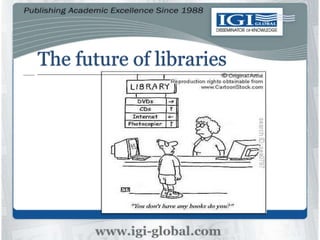
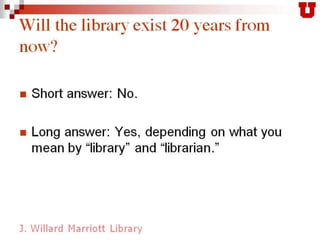
The future of libraries
Will print collections be
replaced by e-resources
within the next 20 years?
Mirela Roncevic
mirela@igi-global.com
Director of Library Relations, IGI Global
Editor-in-Chief, “Advances in Library &
Information Science” Book Series
Librarians
 No, smaller libraries still cannot afford databases
 No, people are drawn to libraries, in part, for the experience
 No, it’s impossible to replace serendipity made possible by
physical browsing
 No, you cannot use an e-book to stabilize a wobbly table leg
NACS Survey
 627 students surveyed at campuses across the U.S.
 76% would pick a printed book if left up to them
 13 percent purchased an ebook in the past three months
 8 percent owned an e-reading device
 Most popular device: iPhone
 An increase of 10 to 15 percent expected by 2012
Why can’t it happen now?
 We are still talking about standardizing the format
 Content remains largely undiscoverable
 Old business models still reinforce inefficient practices
 Content is born digital but not global
CONTENT vs. FORMAT
 Format is in the spotlight
 Evolution of content is trailing behind
 A-Z no longer applies
 Reference has morphed into nonfiction (& vice versa)
 The word “reference” has become irrelevant
 Review media’s leadership role in the process is changing
Discoverability
 Lake vs. river (Static vs. dynamic)
 Re-purposing and re-organization of content
 Finding your niche
 True access: print availability
Born global
 English-language research reigns in
non-English language territories
 Globalization of perspectives is imperative
 Publishers of fiction and creative nonfiction
remain “local” with global potential
 Publishers of research materials serve the needs
of a global community from the onset
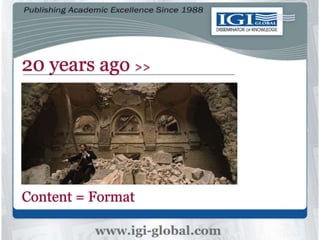
20 years ago >>
Content = Format
20 years from now…
 After the storm (the present)
 Coming full circle
 Format is no longer an issue
 Content flows globally
The E-Brarian Revolution: The Collapse of the Traditional Librarian and the Dawn of the E-Empire

The E-Brarian Revolution: The Collapse of the Traditional Librarian and the Dawn of the E-Empire

  • 1.
    The E-Brarian Revolution: TheCollapse of the Traditional Librarian and the Dawn of the E-Empire 2010 Charleston Conference Charleston, South Carolina November 5th, 2010
  • 2.
    Panel Chair:: Dr. MehdiKhosrow-Pour, President and CEO Panel Members: Mirela Roncevic, Director of Library Relations Lynn Silipigni Connaway, Senior Research Scientist Rick Anderson, Assoc. Dir. for Scholarly Resources & Collections Marriott Library Kevin Sayar, President Marcus Woodburn, Vice President, Digital Products
  • 3.
    The future oflibraries
  • 4.
    Will print collectionsbe replaced by e-resources within the next 20 years? Mirela Roncevic mirela@igi-global.com Director of Library Relations, IGI Global Editor-in-Chief, “Advances in Library & Information Science” Book Series
  • 5.
    Librarians  No, smallerlibraries still cannot afford databases  No, people are drawn to libraries, in part, for the experience  No, it’s impossible to replace serendipity made possible by physical browsing  No, you cannot use an e-book to stabilize a wobbly table leg
  • 6.
    NACS Survey  627students surveyed at campuses across the U.S.  76% would pick a printed book if left up to them  13 percent purchased an ebook in the past three months  8 percent owned an e-reading device  Most popular device: iPhone  An increase of 10 to 15 percent expected by 2012
  • 7.
    Why can’t ithappen now?  We are still talking about standardizing the format  Content remains largely undiscoverable  Old business models still reinforce inefficient practices  Content is born digital but not global
  • 8.
    CONTENT vs. FORMAT Format is in the spotlight  Evolution of content is trailing behind  A-Z no longer applies  Reference has morphed into nonfiction (& vice versa)  The word “reference” has become irrelevant  Review media’s leadership role in the process is changing
  • 9.
    Discoverability  Lake vs.river (Static vs. dynamic)  Re-purposing and re-organization of content  Finding your niche  True access: print availability
  • 10.
    Born global  English-languageresearch reigns in non-English language territories  Globalization of perspectives is imperative  Publishers of fiction and creative nonfiction remain “local” with global potential  Publishers of research materials serve the needs of a global community from the onset
  • 11.
    20 years ago>> Content = Format
  • 12.
    20 years fromnow…  After the storm (the present)  Coming full circle  Format is no longer an issue  Content flows globally

Editor's Notes

  • #6 This is just a sampling of the responses I received over the course of two weeks, all of which I’m sure you’ve heard many times before. 1. Databases too pricey; models still broken 2. which can only be had among printed tomes 3.
  • #7 A recent survey conducted by the National Association of College Stores and reported on in The Chronicle of Higher Education last week also went again what I would have guessed at this time. In a nutshell, it reported that users still preferred printed textbooks. While I am still not convinced that research materials will still be printed and bound the same way as today 20 years from now, I am now convinced that we have long ways to go.
  • #8 Why do we have long ways to go? To best address the question of whether print textbook will be around 20 years from now, we need to ask Why hasn’t it happened already? Why Can’t it Happen now. There are many reasons for this. Today, I’d like to focus not so much on the user-experience but on the processes within our industry that are stiffling the process of change (i.e., our own shortcomings)
  • #10 A recent survey conducted by the National Association of College Stores and reported on in The Chronicle of Higher Education last week also went again what I would have guessed at this time. In a nutshell, it reported that users still preferred printed textbooks. While I am still not convinced that research materials will still be printed and bound the same way as today 20 years from now, I am now convinced that we have long ways to go.
  • #11 Content can only be globalized if the perspectives it reflects come from all parts of the globe
  • #12 This is a picture of The National & University Library of Sarajevo that shows a library and research materials in it as vulnerable physical objects. The library burned for three straight days, with most of its irreplacable contents reduced to ashes. Before the fire, the library held 1.5 million volumes, including over 155,000 rare books and manuscripts, the country’s national archives, deposit copies of newspapers, periodicals and the collections of the University of Sarajevo. 20 years ago it was possible to erase a country’s cultural memory and reduce it to ashes. We’ve come a long way since then, but...
  • #13 Coming full circle: after weathering the storm that is the present, I foresee the industry coming full circle – to a place – a global place where the format is no longer an issue