SURVEY OF APPAREL DESIGN
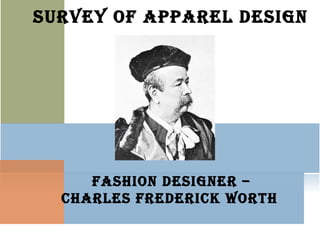
FASHION DESIGNER –
CHARLES FREDERICK WORTH
INTRODUCTION
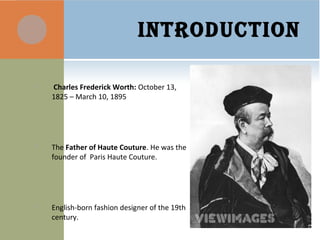
 Charles Frederick Worth: October 13,
1825 – March 10, 1895
 The Father of Haute Couture. He was the
founder of Paris Haute Couture.
 English-born fashion designer of the 19th
century.
 Worth was a gifted designer.
 had a clear understanding of the times.
 dressed both royalty and high society
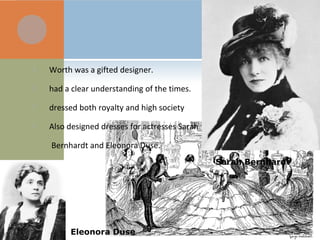
 Also designed dresses for actresses Sarah
Bernhardt and Eleonora Duse.
Sarah Bernhardt
Eleonora Duse
HISTORY AND
EVOLUTION
 Charles Frederick Worth was born in Bourne, Lincolnshire,
England in 1825 and from the age of 13 he worked in the dress
goods firm of Swan and Edgar.
 When not yet 20, he set out for Paris. He joined Maison
Gagelin, making silk coats and shawls.
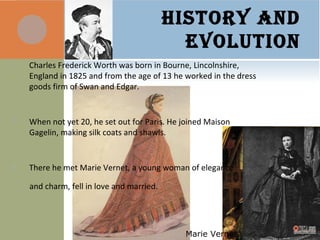
 There he met Marie Vernet, a young woman of elegance
and charm, fell in love and married.
Marie Vernet
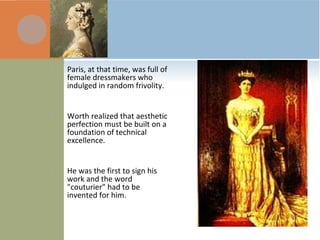
 Paris, at that time, was full of
female dressmakers who
indulged in random frivolity.
 Worth realized that aesthetic
perfection must be built on a
foundation of technical
excellence.
 He was the first to sign his
work and the word
"couturier" had to be
invented for him.
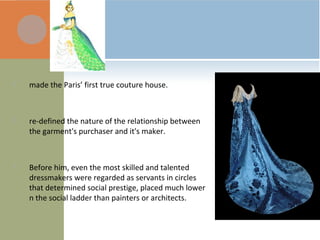
 made the Paris’ first true couture house.
 re-defined the nature of the relationship between
the garment's purchaser and it's maker.
 Before him, even the most skilled and talented
dressmakers were regarded as servants in circles
that determined social prestige, placed much lower
n the social ladder than painters or architects.
CHARACTERISTICS
 he was a man, a couturier, successfully imposing
himself on the hitherto female and low-prestige world
of the dressmaker
 he was able to get his clients to come to his house,
rather than the other way around, just as a patron
might visit an artist's studio.
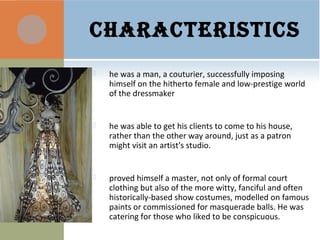
 proved himself a master, not only of formal court
clothing but also of the more witty, fanciful and often
historically-based show costumes, modelled on famous
paints or commissioned for masquerade balls. He was
catering for those who liked to be conspicuous.
HIS STYLE
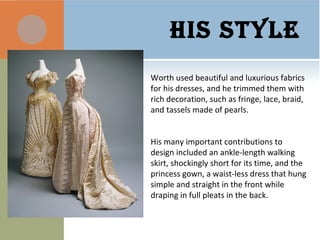
Worth used beautiful and luxurious fabrics
for his dresses, and he trimmed them with
rich decoration, such as fringe, lace, braid,
and tassels made of pearls.
His many important contributions to
design included an ankle-length walking
skirt, shockingly short for its time, and the
princess gown, a waist-less dress that hung
simple and straight in the front while
draping in full pleats in the back.
HIS CONTRIBUTION
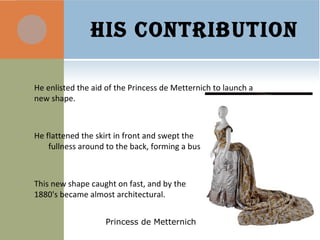
 He enlisted the aid of the Princess de Metternich to launch a
new shape.
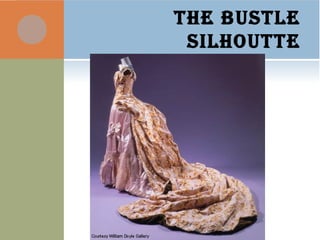
 He flattened the skirt in front and swept the
fullness around to the back, forming a bustle.
 This new shape caught on fast, and by the
1880's became almost architectural.
Princess de Metternich
THE BUSTLE
SILHOUTTE
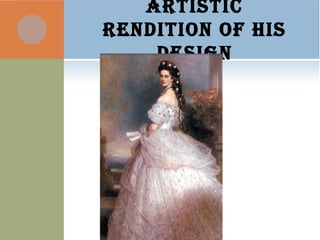
ARTISTIC
RENDITION OF HIS
DESIGN
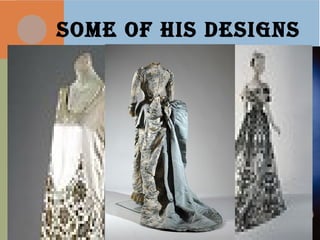
SOME OF HIS DESIGNS
HAUTE
COUTURE!
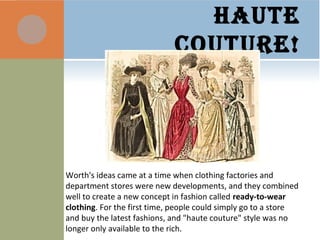
Worth's ideas came at a time when clothing factories and
department stores were new developments, and they combined
well to create a new concept in fashion called ready-to-wear
clothing. For the first time, people could simply go to a store
and buy the latest fashions, and "haute couture" style was no
longer only available to the rich.
THE LEGACY
CONTINUES…….
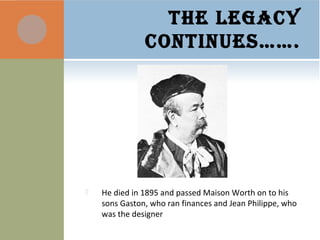
 He died in 1895 and passed Maison Worth on to his
sons Gaston, who ran finances and Jean Philippe, who
was the designer
THANK YOU!

Charles worth

  • 1.
    SURVEY OF APPARELDESIGN FASHION DESIGNER – CHARLES FREDERICK WORTH
  • 2.
    INTRODUCTION  Charles FrederickWorth: October 13, 1825 – March 10, 1895  The Father of Haute Couture. He was the founder of Paris Haute Couture.  English-born fashion designer of the 19th century.
  • 3.
     Worth wasa gifted designer.  had a clear understanding of the times.  dressed both royalty and high society  Also designed dresses for actresses Sarah Bernhardt and Eleonora Duse. Sarah Bernhardt Eleonora Duse
  • 4.
    HISTORY AND EVOLUTION  CharlesFrederick Worth was born in Bourne, Lincolnshire, England in 1825 and from the age of 13 he worked in the dress goods firm of Swan and Edgar.  When not yet 20, he set out for Paris. He joined Maison Gagelin, making silk coats and shawls.  There he met Marie Vernet, a young woman of elegance and charm, fell in love and married. Marie Vernet
  • 5.
     Paris, atthat time, was full of female dressmakers who indulged in random frivolity.  Worth realized that aesthetic perfection must be built on a foundation of technical excellence.  He was the first to sign his work and the word "couturier" had to be invented for him.
  • 6.
     made theParis’ first true couture house.  re-defined the nature of the relationship between the garment's purchaser and it's maker.  Before him, even the most skilled and talented dressmakers were regarded as servants in circles that determined social prestige, placed much lower n the social ladder than painters or architects.
  • 7.
    CHARACTERISTICS  he wasa man, a couturier, successfully imposing himself on the hitherto female and low-prestige world of the dressmaker  he was able to get his clients to come to his house, rather than the other way around, just as a patron might visit an artist's studio.  proved himself a master, not only of formal court clothing but also of the more witty, fanciful and often historically-based show costumes, modelled on famous paints or commissioned for masquerade balls. He was catering for those who liked to be conspicuous.
  • 8.
    HIS STYLE Worth usedbeautiful and luxurious fabrics for his dresses, and he trimmed them with rich decoration, such as fringe, lace, braid, and tassels made of pearls. His many important contributions to design included an ankle-length walking skirt, shockingly short for its time, and the princess gown, a waist-less dress that hung simple and straight in the front while draping in full pleats in the back.
  • 9.
    HIS CONTRIBUTION  Heenlisted the aid of the Princess de Metternich to launch a new shape.  He flattened the skirt in front and swept the fullness around to the back, forming a bustle.  This new shape caught on fast, and by the 1880's became almost architectural. Princess de Metternich
  • 10.
  • 11.
  • 12.
    SOME OF HISDESIGNS
  • 13.
    HAUTE COUTURE! Worth's ideas cameat a time when clothing factories and department stores were new developments, and they combined well to create a new concept in fashion called ready-to-wear clothing. For the first time, people could simply go to a store and buy the latest fashions, and "haute couture" style was no longer only available to the rich.
  • 14.
    THE LEGACY CONTINUES…….  Hedied in 1895 and passed Maison Worth on to his sons Gaston, who ran finances and Jean Philippe, who was the designer
  • 15.