FASHION
History of Fashion Design
since 1900
1900s
.

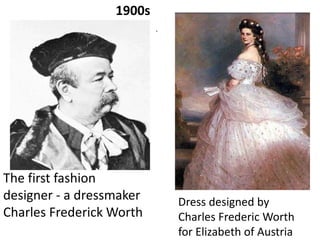
The first fashion
designer - a dressmaker
Charles Frederick Worth

Dress designed by
Charles Frederic Worth
for Elizabeth of Austria
1910s

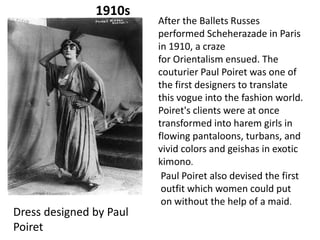
Dress designed by Paul
Poiret

After the Ballets Russes
performed Scheherazade in Paris
in 1910, a craze
for Orientalism ensued. The
couturier Paul Poiret was one of
the first designers to translate
this vogue into the fashion world.
Poiret's clients were at once
transformed into harem girls in
flowing pantaloons, turbans, and
vivid colors and geishas in exotic
kimono.
Paul Poiret also devised the first
outfit which women could put
on without the help of a maid.
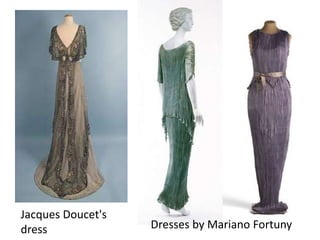
Jacques Doucet's
dress

Dresses by Mariano Fortuny
1920s
1930s

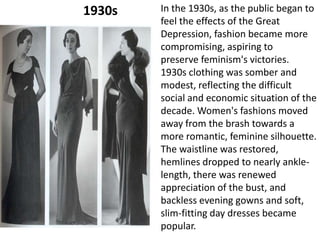
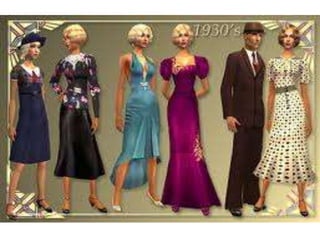
In the 1930s, as the public began to
feel the effects of the Great
Depression, fashion became more
compromising, aspiring to
preserve feminism's victories.
1930s clothing was somber and
modest, reflecting the difficult
social and economic situation of the
decade. Women's fashions moved
away from the brash towards a
more romantic, feminine silhouette.
The waistline was restored,
hemlines dropped to nearly anklelength, there was renewed
appreciation of the bust, and
backless evening gowns and soft,
slim-fitting day dresses became
popular.
Fashion
Fashion

Fashion

  • 1.
    FASHION History of FashionDesign since 1900
  • 2.
    1900s . The first fashion designer- a dressmaker Charles Frederick Worth Dress designed by Charles Frederic Worth for Elizabeth of Austria
  • 4.
    1910s Dress designed byPaul Poiret After the Ballets Russes performed Scheherazade in Paris in 1910, a craze for Orientalism ensued. The couturier Paul Poiret was one of the first designers to translate this vogue into the fashion world. Poiret's clients were at once transformed into harem girls in flowing pantaloons, turbans, and vivid colors and geishas in exotic kimono. Paul Poiret also devised the first outfit which women could put on without the help of a maid.
  • 5.
  • 6.
  • 8.
    1930s In the 1930s,as the public began to feel the effects of the Great Depression, fashion became more compromising, aspiring to preserve feminism's victories. 1930s clothing was somber and modest, reflecting the difficult social and economic situation of the decade. Women's fashions moved away from the brash towards a more romantic, feminine silhouette. The waistline was restored, hemlines dropped to nearly anklelength, there was renewed appreciation of the bust, and backless evening gowns and soft, slim-fitting day dresses became popular.