Character Creating Characters Character Development Speech Appearance Private Thoughts How Other Characters Feel Actions Direct and Indirect Characterization Practice Feature Menu
Creating Characters Creating characters—telling what human beings are like—is the whole point of writing stories. [End of Section]
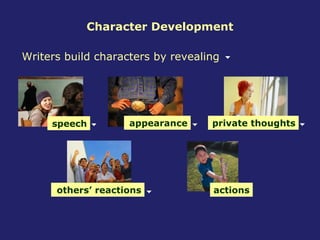
Character Development Writers build characters by revealing  speech appearance private thoughts others’ reactions actions
Character Development Which methods of character development are being used? What do you think of the man based on this excerpt?  Quick Check “ Keep still, you little devil, or I’ll cut your throat!” A fearful man, all in coarse grey, with a great iron on his leg. A man with no hat, and with broken shoes, and with an old rag tied round his head. A man who had been soaked in water, and smothered in mud, and lamed by stones, and cut by flints . . . ; who limped, and shivered, and glared and growled; and whose teeth chattered in his head as he seized me by the chin. from  Great Expectations  by Charles Dickens [End of Section]
Character Development Speech Actions Description Quick Check Which methods of character development are being used? “ Keep still, you little devil, or I’ll cut your throat!” A fearful man, all in coarse grey, with a great iron on his leg. A man with no hat, and with broken shoes, and with an old rag tied round his head. A man who had been soaked in water, and smothered in mud, and lamed by stones, and cut by flints . . . ; who limped, and shivered, and glared and growled; and whose teeth chattered in his head as he seized me by the chin. from  Great Expectations  by Charles Dickens
Character Development He’s dangerous and desperate. He seems to be an escaped prisoner on the run. What do you think of the man based on this excerpt?  Quick Check “ Keep still, you little devil, or I’ll cut your throat!” A fearful man, all in coarse grey, with a great iron on his leg. A man with no hat, and with broken shoes, and with an old rag tied round his head. A man who had been soaked in water, and smothered in mud, and lamed by stones, and cut by flints . . . ; who limped, and shivered, and glared and growled; and whose teeth chattered in his head as he seized me by the chin. from  Great Expectations  by Charles Dickens
Speech First-person narrators  reveal their personal traits as they tell us what they think and feel Be aware that some first-person narrators mislead or lie to the audience. tell their own stories (using pronouns like  I, me,  and  we ) Soliloquy Dramatic Monologue
Speech what characters say and don’t say Dialogue  can reveal a lot about characters and their relationships with each other. Pay attention to how characters respond to each other [End of Section]
Appearance Pay attention to language the writer uses to describe the characters’ looks, clothes, and demeanor.  Does the description give you a positive or negative impression of the character?  [End of Section] Which words contribute to this impression? The cold within him froze his old features, nipped his pointed nose, shriveled his cheek, stiffened his gait; made his eyes red, his thin lips blue. . . . from  A Christmas Carol  by Charles Dickens
Private Thoughts Writers can take us into the characters’ minds to reveal their thoughts and feelings.  As you read, note whether the characters’ thoughts and feelings match their speech and actions. [End of Section]
How Other Characters Feel Watch how other characters in the story react to the character. Note  [End of Section] how the others feel about the character what the others say about the character
Actions What characters do and how they treat each other often reveal the most about them.  Observe characters’ actions to determine what their personality is like what motivates them how they deal with conflict  [End of Section]
Direct and Indirect Characterization Direct Characterization —Writers  tell  us directly what characters are like or what their motives are.  Oh, but he was a tightfisted hand at the grindstone, Scrooge! a squeezing, wrenching, grasping, scraping, clutching, covetous old sinner! from  A Christmas Carol  by Charles Dickens Indirect Characterization —Writers  show  us characters (through speech, appearance, private thoughts, other characters’ reactions, and actions) but allow us to decide what characters are like.
Direct and Indirect Characterization Quick Check My sister, Mrs. Joe, with black hair and eyes, had such a prevailing redness of skin that I sometimes used to wonder whether it was possible she washed herself with a nutmeg-grater instead of soap. She was tall and bony, and almost always wore a coarse apron, fastened over her figure behind with two loops, and having a square impregnable bib in front, that was stuck full of pins and needles.  from  Great Expectations  by Charles Dickens Is this an example of direct or indirect characterization? What kind of person do you think this character is? [End of Section]
Direct and Indirect Characterization Indirect. The writer is describing the character’s appearance. Quick Check Is this an example of direct or indirect characterization? My sister, Mrs. Joe, with black hair and eyes, had such a prevailing redness of skin that I sometimes used to wonder whether it was possible she washed herself with a nutmeg-grater instead of soap. She was tall and bony, and almost always wore a coarse apron, fastened over her figure behind with two loops, and having a square impregnable bib in front, that was stuck full of pins and needles.  from  Great Expectations  by Charles Dickens
Direct and Indirect Characterization I think she’s strict and unfriendly. What kind of person do you think this character is? Quick Check My sister, Mrs. Joe, with black hair and eyes, had such a prevailing redness of skin that I sometimes used to wonder whether it was possible she washed herself with a nutmeg-grater instead of soap. She was tall and bony, and almost always wore a coarse apron, fastened over her figure behind with two loops, and having a square impregnable bib in front, that was stuck full of pins and needles.  from  Great Expectations  by Charles Dickens
Practice Who is the most unforgettable character you’ve ever met in a story? Write a few sentences about why you find the character so memorable. Before you begin, jot down your ideas on a chart like this one. [End of Section] Most memorable character Most outstanding character Character’s appearance Important statements Important thoughts Important actions Reactions of other characters
The End
Speech Dramatic monologue —a type of poem in which a speaker addresses one or more silent listeners. often dicusses a specific problem or situation may tell us about his or her life and values may reveal his or her relationship with the listener(s) The  narrator  of a dramatic monologue
Speech Soliloquy —a long speech in which a character who is onstage alone expresses his or her thoughts aloud. discuss a specific problem or situation reveal his or her deepest private thoughts to the audience The character may

Characters

  • 1.
    Character Creating CharactersCharacter Development Speech Appearance Private Thoughts How Other Characters Feel Actions Direct and Indirect Characterization Practice Feature Menu
  • 2.
    Creating Characters Creatingcharacters—telling what human beings are like—is the whole point of writing stories. [End of Section]
  • 3.
    Character Development Writersbuild characters by revealing speech appearance private thoughts others’ reactions actions
  • 4.
    Character Development Whichmethods of character development are being used? What do you think of the man based on this excerpt? Quick Check “ Keep still, you little devil, or I’ll cut your throat!” A fearful man, all in coarse grey, with a great iron on his leg. A man with no hat, and with broken shoes, and with an old rag tied round his head. A man who had been soaked in water, and smothered in mud, and lamed by stones, and cut by flints . . . ; who limped, and shivered, and glared and growled; and whose teeth chattered in his head as he seized me by the chin. from Great Expectations by Charles Dickens [End of Section]
  • 5.
    Character Development SpeechActions Description Quick Check Which methods of character development are being used? “ Keep still, you little devil, or I’ll cut your throat!” A fearful man, all in coarse grey, with a great iron on his leg. A man with no hat, and with broken shoes, and with an old rag tied round his head. A man who had been soaked in water, and smothered in mud, and lamed by stones, and cut by flints . . . ; who limped, and shivered, and glared and growled; and whose teeth chattered in his head as he seized me by the chin. from Great Expectations by Charles Dickens
  • 6.
    Character Development He’sdangerous and desperate. He seems to be an escaped prisoner on the run. What do you think of the man based on this excerpt? Quick Check “ Keep still, you little devil, or I’ll cut your throat!” A fearful man, all in coarse grey, with a great iron on his leg. A man with no hat, and with broken shoes, and with an old rag tied round his head. A man who had been soaked in water, and smothered in mud, and lamed by stones, and cut by flints . . . ; who limped, and shivered, and glared and growled; and whose teeth chattered in his head as he seized me by the chin. from Great Expectations by Charles Dickens
  • 7.
    Speech First-person narrators reveal their personal traits as they tell us what they think and feel Be aware that some first-person narrators mislead or lie to the audience. tell their own stories (using pronouns like I, me, and we ) Soliloquy Dramatic Monologue
  • 8.
    Speech what characterssay and don’t say Dialogue can reveal a lot about characters and their relationships with each other. Pay attention to how characters respond to each other [End of Section]
  • 9.
    Appearance Pay attentionto language the writer uses to describe the characters’ looks, clothes, and demeanor. Does the description give you a positive or negative impression of the character? [End of Section] Which words contribute to this impression? The cold within him froze his old features, nipped his pointed nose, shriveled his cheek, stiffened his gait; made his eyes red, his thin lips blue. . . . from A Christmas Carol by Charles Dickens
  • 10.
    Private Thoughts Writerscan take us into the characters’ minds to reveal their thoughts and feelings. As you read, note whether the characters’ thoughts and feelings match their speech and actions. [End of Section]
  • 11.
    How Other CharactersFeel Watch how other characters in the story react to the character. Note [End of Section] how the others feel about the character what the others say about the character
  • 12.
    Actions What charactersdo and how they treat each other often reveal the most about them. Observe characters’ actions to determine what their personality is like what motivates them how they deal with conflict [End of Section]
  • 13.
    Direct and IndirectCharacterization Direct Characterization —Writers tell us directly what characters are like or what their motives are. Oh, but he was a tightfisted hand at the grindstone, Scrooge! a squeezing, wrenching, grasping, scraping, clutching, covetous old sinner! from A Christmas Carol by Charles Dickens Indirect Characterization —Writers show us characters (through speech, appearance, private thoughts, other characters’ reactions, and actions) but allow us to decide what characters are like.
  • 14.
    Direct and IndirectCharacterization Quick Check My sister, Mrs. Joe, with black hair and eyes, had such a prevailing redness of skin that I sometimes used to wonder whether it was possible she washed herself with a nutmeg-grater instead of soap. She was tall and bony, and almost always wore a coarse apron, fastened over her figure behind with two loops, and having a square impregnable bib in front, that was stuck full of pins and needles. from Great Expectations by Charles Dickens Is this an example of direct or indirect characterization? What kind of person do you think this character is? [End of Section]
  • 15.
    Direct and IndirectCharacterization Indirect. The writer is describing the character’s appearance. Quick Check Is this an example of direct or indirect characterization? My sister, Mrs. Joe, with black hair and eyes, had such a prevailing redness of skin that I sometimes used to wonder whether it was possible she washed herself with a nutmeg-grater instead of soap. She was tall and bony, and almost always wore a coarse apron, fastened over her figure behind with two loops, and having a square impregnable bib in front, that was stuck full of pins and needles. from Great Expectations by Charles Dickens
  • 16.
    Direct and IndirectCharacterization I think she’s strict and unfriendly. What kind of person do you think this character is? Quick Check My sister, Mrs. Joe, with black hair and eyes, had such a prevailing redness of skin that I sometimes used to wonder whether it was possible she washed herself with a nutmeg-grater instead of soap. She was tall and bony, and almost always wore a coarse apron, fastened over her figure behind with two loops, and having a square impregnable bib in front, that was stuck full of pins and needles. from Great Expectations by Charles Dickens
  • 17.
    Practice Who isthe most unforgettable character you’ve ever met in a story? Write a few sentences about why you find the character so memorable. Before you begin, jot down your ideas on a chart like this one. [End of Section] Most memorable character Most outstanding character Character’s appearance Important statements Important thoughts Important actions Reactions of other characters
  • 18.
  • 19.
    Speech Dramatic monologue—a type of poem in which a speaker addresses one or more silent listeners. often dicusses a specific problem or situation may tell us about his or her life and values may reveal his or her relationship with the listener(s) The narrator of a dramatic monologue
  • 20.
    Speech Soliloquy —along speech in which a character who is onstage alone expresses his or her thoughts aloud. discuss a specific problem or situation reveal his or her deepest private thoughts to the audience The character may