Norman Geisler 
Systematic Theology 
Chapter 73 
“The Government of the Visible Church” 
PowerPoint Prepared by Mark E. Hardgrove, Ph.D.
Chapter Outline 
• Church Government in the New Testament 
• Relationships and Functions of Elders, Deacons, 
Apostles, Pastors, and the Congregation in the 
New Testament Church 
• Theological Basis for the Nature of the Local 
Church 
• The Historical Basis for the Nature of Church 
Government 
• Summary and Conclusions
Definitions 
• Elder: From the Greek presbuteros, from 
which we get the word presbyterian. It is a 
form of government is one of elder authority. 
• Bishop: From the Greek episcopos, from 
which we get the word episcopalian. It is a 
form of government ruled by the bishop, who is 
considered higher than the elders. 
•Assembly: From the Greekl ekklesia, 
meaning “assembly.” In this form of 
government the congregation is the final 
authority.
Episcopal View 
• Distinguishes the office of a bishop from 
that of an elder, giving him authority over 
the elders and the congregation. 
• Examples: Roman Catholic, Eastern 
Orthodox, Some Lutheran, Anglican, 
Episcopal, and Methodist churches. Also 
some smaller denominations.
The Presbyterian View 
•A board of elders holds final authority on 
the administration of church affairs. This 
view sees elder and bishop as one office, 
based on two different words—bishop from 
a Greek background and elder from a 
Hebrew background. 
• Examples: Presbyterian churches, 
Plymouth Brethren, growing number of 
baptistic and independent churches 
influenced by the Reformed tradition.
The Congregational View 
• While it may have elders and/or deacons, 
the congregational form view the final 
authority as resting in the congregation 
which must approve major matters relating 
to faith and practice. 
•Examples: Congregational, Free Baptist, 
and many independent churches.
Church Government in the New Testament 
• Doctrinally, the basis of the New 
Testament church government was 
apostolic: The church was built on the 
foundation of the apostles and 
prophets, Christ being the cornerstone 
and the apostles being the living 
authority. 
• Geisler argues that there is not 
apostolic succession and that apostles 
were replaced by their.
Offices and Gifts 
• The New Testament makes and important 
distinction between an office and a gift. 
• Gifts for ministry are given only by God: 
apostleship, prophecy, evangelism, and 
pastor/teacher are all gifts. 
• Offices, on the other hand, are under the 
domain of the local church which must find 
people who meet the required qualifications 
and then place them in office. The two primary 
offices lifted up on the New Testament are elder 
and deacon. 
• The church determines offices, but does not 
bestow gifts.
Overall Principle of Church Government 
• In dealing with the Corinthian church, Paul 
set forth the most basic principle beneath all 
church government: 
• “Everything should be done in a fitting and 
orderly way” (1 Cor. 14:40).
Role of Elders in the New Testament 
Church Government 
• A Position of Authority: In the Jewish 
community elder was a position of great 
authority. 
• A Position of Dignity: Elder was a position 
of dignity (Prov. 31:23, 1 Kings 21:8). 
• A Position of Maturity: The term elder 
implies maturity (see also, 1 Tim. 5:1). 
• A Position of Sagacity: The elder held a 
position of wisdom (Ezek. 7:26)
The Location of Elders in the NT Church 
• There were elders in Jerusalem (Acts 
11:30; 15:2, 4, 6). 
• There were elders in every city (Acts 
20:17; Titus 1:5). 
• There were elders in every local church 
(Acts 14:23)
The Function of an Elder in the NT Church 
• An Elder is an Overseer: See “bishop” in 1 
Peter 2:25. Bishop means “overseer.” 
• An Elder is a Ruler: Hebrews 13:17 states, 
“Obey them that have rule over you, 
and submit yourselves.” 
• An Elder is an Undershepherd: Not 
overlords, guide by example (1 Pet. 5:1-4) 
• An Elder is a Teacher: The elder feeds 
“the flock of God” (1 Tim. 3:2; cf. 2:24) 
and must be able to teach (Titus 1:9).
The Function of an Elder in the NT Church 
• An Elder is an Apologist: That is, a 
defender of the faith (Phil. 1:17; Titus 1:9). 
• An Elder is an Arbiter of Disputes (Acts 
15:2; cf. 1 Cor. 6:1-4). 
• An Elder is a Watchman: “They watch for 
your souls, as they that must give 
account . . .” (Heb. 13:17).
Dr. Mark Hardgrove’s reflection on 
Geisler 
• According to Geisler’s position, the elder 
is the leader or pastor of the church, a 
woman cannot be an elder, therefore, a 
woman cannot be a pastor. 
• I disagree. Though in the context to 
which Paul writes a woman would not be 
able to be an elder, even Paul writes that 
in the kingdom there is “neither Jew nor 
Greek, there is neither slave nor free, 
there is neither male nor female, for you 
are all one in Christ Jesus” (Gal. 3:28).
Dr. Mark Hardgrove’s reflection on 
Geisler 
• Just as there would be no distinction 
between Jews or Greeks in roles or 
positions in the church, or giftings from 
God, in the very same breath Paul states 
that there is neither male nor female. 
• To the extent that we are able to 
understand the cultural context that 
gave rise to the words of Paul for slaves 
to obey their masters, and yet now reject 
slavery, the same should be true of the 
issue of man and woman.
Dr. Mark Hardgrove’s reflection on 
Geisler 
• Paul said that he did not to suffer a 
woman to teach (1 Tim. 2:12), and in that 
culture that may have been prudent, but 
just as we now reject slavery, we should 
also be able to reject the subjugation of 
women, or the idea that women cannot 
full participate fully in the kingdom of 
God or the life of the church. Further, 
note that Paul says “I do not permit a 
woman to teach.” Those words are 
descriptive, not prescriptive.
Dr. Mark Hardgrove’s reflection on 
Geisler 
• Therefore, I reject Geisler’s position, and the 
position of denominations that deny women 
full partnership in the life of the church. 
• The argument of some is that if we make 
cultural accommodation for women, then 
what is to prevent the church from making 
cultural accommodation for homosexuals? 
Very simply, the Bible states that 
homosexuality is a sin (1 Cor. 6:9, NIV), but 
being woman is never considered a sin. 
That is comparing apples and oranges.
The Interchangeability of the Terms: 
Elder and Bishop 
Both were a plurality in each church. There 
were “elders in every church” (Acts 14:23; cf. 
Phil. 1:1). 
Bother had to have the same basic 
qualifications (compare 1 Tim. 3:1-7 with Titus 
1:6-9). 
The terms were used interchangeably in the 
same text (Titus 1:5-7). 
Likewise the function was used interchangeably 
by Peter (1 Peter 2:25; 5:1-2; see also Acts 
20:17, 28)
Must every Church have Elders? 
• Passages about elders/bishops are in a 
didactic (teaching) context (e.g., 1 Tim. 3:16; 
Titus 1:5). 
• Paul tells Titus to appoint elders in every city. 
• All the congregations were to have elders. 
• The Philippian church had pluralities of elders 
and deacons. 
• Every church was to have elders (Acts 14:23) 
• Languages on church government are 
prescriptive.
Treatment of Elders 
Elders should not be rebuked but entreated (1 
Tim. 5:1-2) 
Elders should be honored (1 Tim. 5:17) 
Elders should not be unfairly accused (1 Tim. 
5:19) 
Elders should receive submission (1 Pet. 5:1, 5) 
Elders should be obeyed (Heb. 13:17; Eph. 6:1) 
Elders should be held up on prayer (Heb. 13:7) 
Elders should be remembered (Heb. 13:24; Rom. 
13:7) 
Elders should be called upon for prayer (Ja. 5:14)
The Role of Deacons in the Church 
• Origins of Deacons: Appointed to alleviate the 
demands of the church upon the apostles so that 
they could give themselves to the Word and to 
prayer. They were tasked with helping to 
administrate the benevolence effort of the 
church. 
• Qualifications of a Deacon: In 1 Timothy 3:8-13 
Paul gives the qualifications of a deacon: 
1) Worthy of respect, 2) sincere, 3) not given to wine, 
4) not pursuing dishonest gain, 5) maintain faith with 
a clear conscience, 6) must be examined for 
worthiness, 7) not malicious talkers, 8) temperate, 9) 
trustworthy, 10) married to one spouse, 11) manage 
their household well.
Dr. Mark Hardgrove’s reflection on the 
issue of gender. 
• Again, Geisler will argue that they must be a man. 
However, consider Romans 16:1-2 
• 1I commend to you our sister Phoebe, a servant[a] of the 
church in Cenchrea. 2I ask you to receive her in the Lord 
in a way worthy of the saints and to give her any help 
she may need from you, for she has been a great help 
to many people, including me. 
• The word translated “servant” is from the Greek 
diakonos, which is the very same word translated 
“deacon” elsewhere.
Dr. Mark Hardgrove’s reflection on the 
issue of gender. 
• Geisler states: 
• “Paul called one woman a deacon in Romans 
16:1 . . . Since the word deacon means 
“servant,” there is not certainty as to whether 
Phebe was an official deacon or an unofficial 
servant.” 
• Note that Geisler admits the uncertainty and 
then he concludes that she was nothing more 
than an “unofficial servant.” That’s quit a leap 
from admitted uncertainty to virtual certainty on 
his part. It is a leap I do not take with him.
The Relationships and Functions of Elders, 
Deacons, etc. 
• Deacons were created to assist the 
elders. 
• As subordinates they were to relieve the 
elders of menial tasks so that the elders 
could concentrate on prayer and 
ministry of the Word of God (Acts 6:2). 
• Elders were overseers of the church’s 
doctrinal and spiritual matters. 
• Deacons were assistants in charge of 
the social and physical ministries.
The Role of Apostles 
• Relationship of Apostles and Elders: All 
apostles were elders, but not elders were 
apostles. 
• The Apostolic Role was Temporary: Or 
so Geisler argues. As a cessationist, he 
does not believe that the manifestational 
gifts, or the gifts of apostle or prophet 
continued after the church was established. 
While the original Twelve were unique, Paul 
is an example of an apostle who was not 
one of the Twelve.
The Role of Apostles 
• It is my position (Dr. Hardgrove) that 
while the office of apostle may not have 
continued in the official governmental 
structure of the church, the gift of 
apostle continues in the role of church 
planters and missionaries in the 
contemporary church.
The Role of Apostles 
• Back to Geisler—Apostles were the 
Early Church’s Final Authority: Not only 
were they the foundation (Eph. 2:20), they 
were also its ruling authority. 
• Apostles were the Early Church’s 
Source of New Revelation (Gal. 1:11-12).
The Role of the Congregation in the 
Local Church 
• The Congregation Screened Their Own 
Membership 
• The Congregation Chose Their Leaders 
• The Congregation Exercised Church 
Discipline 
• The Congregation Made the Final Decision 
in Cases of Offense 
• The Congregation Commissioned 
Missionaries 
• The Entire Jerusalem Congregation was 
Involved in a Doctrinal Decision
The Role of the Congregation in the 
Local Church 
• Elder Rule or Congregation? 
• Alexander Strauch says: 
“The New Testament does not indicate that 
the congregation governs itself by majority 
vote, and there is no evidence that God has 
granted every member one equal vote with 
every other member. Rather, the New 
Testament congregation is governed by its 
own congregational elders” (~ in Geisler).
Relationships Between the New 
Testament Churches 
• Earl Radmacher (in Geisler) 
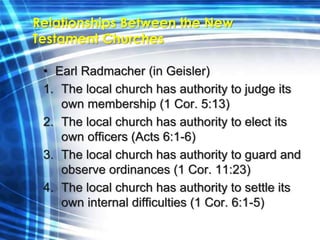
1. The local church has authority to judge its 
own membership (1 Cor. 5:13) 
2. The local church has authority to elect its 
own officers (Acts 6:1-6) 
3. The local church has authority to guard and 
observe ordinances (1 Cor. 11:23) 
4. The local church has authority to settle its 
own internal difficulties (1 Cor. 6:1-5)
Relationships Between the New 
Testament Churches 
• Earl Radmacher (in Geisler) 
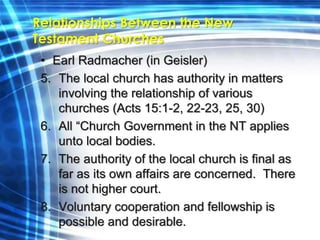
5. The local church has authority in matters 
involving the relationship of various 
churches (Acts 15:1-2, 22-23, 25, 30) 
6. All “Church Government in the NT applies 
unto local bodies. 
7. The authority of the local church is final as 
far as its own affairs are concerned. There 
is not higher court. 
8. Voluntary cooperation and fellowship is 
possible and desirable.
Lessons of John and the Seven 
Churches of Asia Minor 
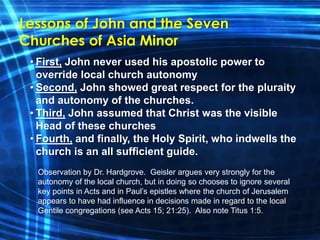
• First, John never used his apostolic power to 
override local church autonomy 
• Second, John showed great respect for the pluraity 
and autonomy of the churches. 
• Third, John assumed that Christ was the visible 
Head of these churches 
• Fourth, and finally, the Holy Spirit, who indwells the 
church is an all sufficient guide. 
Observation by Dr. Hardgrove. Geisler argues very strongly for the 
autonomy of the local church, but in doing so chooses to ignore several 
key points in Acts and in Paul’s epistles where the church of Jerusalem 
appears to have had influence in decisions made in regard to the local 
Gentile congregations (see Acts 15; 21:25). Also note Titus 1:5.
Comparing and Contrasting 
the Universal and the Local Church(es) 
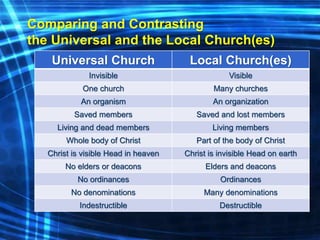
Universal Church Local Church(es) 
Invisible Visible 
One church Many churches 
An organism An organization 
Saved members Saved and lost members 
Living and dead members Living members 
Whole body of Christ Part of the body of Christ 
Christ is visible Head in heaven Christ is invisible Head on earth 
No elders or deacons Elders and deacons 
No ordinances Ordinances 
No denominations Many denominations 
Indestructible Destructible

Chapter 73

  • 1.
    Norman Geisler SystematicTheology Chapter 73 “The Government of the Visible Church” PowerPoint Prepared by Mark E. Hardgrove, Ph.D.
  • 2.
    Chapter Outline •Church Government in the New Testament • Relationships and Functions of Elders, Deacons, Apostles, Pastors, and the Congregation in the New Testament Church • Theological Basis for the Nature of the Local Church • The Historical Basis for the Nature of Church Government • Summary and Conclusions
  • 3.
    Definitions • Elder:From the Greek presbuteros, from which we get the word presbyterian. It is a form of government is one of elder authority. • Bishop: From the Greek episcopos, from which we get the word episcopalian. It is a form of government ruled by the bishop, who is considered higher than the elders. •Assembly: From the Greekl ekklesia, meaning “assembly.” In this form of government the congregation is the final authority.
  • 4.
    Episcopal View •Distinguishes the office of a bishop from that of an elder, giving him authority over the elders and the congregation. • Examples: Roman Catholic, Eastern Orthodox, Some Lutheran, Anglican, Episcopal, and Methodist churches. Also some smaller denominations.
  • 5.
    The Presbyterian View •A board of elders holds final authority on the administration of church affairs. This view sees elder and bishop as one office, based on two different words—bishop from a Greek background and elder from a Hebrew background. • Examples: Presbyterian churches, Plymouth Brethren, growing number of baptistic and independent churches influenced by the Reformed tradition.
  • 6.
    The Congregational View • While it may have elders and/or deacons, the congregational form view the final authority as resting in the congregation which must approve major matters relating to faith and practice. •Examples: Congregational, Free Baptist, and many independent churches.
  • 7.
    Church Government inthe New Testament • Doctrinally, the basis of the New Testament church government was apostolic: The church was built on the foundation of the apostles and prophets, Christ being the cornerstone and the apostles being the living authority. • Geisler argues that there is not apostolic succession and that apostles were replaced by their.
  • 8.
    Offices and Gifts • The New Testament makes and important distinction between an office and a gift. • Gifts for ministry are given only by God: apostleship, prophecy, evangelism, and pastor/teacher are all gifts. • Offices, on the other hand, are under the domain of the local church which must find people who meet the required qualifications and then place them in office. The two primary offices lifted up on the New Testament are elder and deacon. • The church determines offices, but does not bestow gifts.
  • 9.
    Overall Principle ofChurch Government • In dealing with the Corinthian church, Paul set forth the most basic principle beneath all church government: • “Everything should be done in a fitting and orderly way” (1 Cor. 14:40).
  • 10.
    Role of Eldersin the New Testament Church Government • A Position of Authority: In the Jewish community elder was a position of great authority. • A Position of Dignity: Elder was a position of dignity (Prov. 31:23, 1 Kings 21:8). • A Position of Maturity: The term elder implies maturity (see also, 1 Tim. 5:1). • A Position of Sagacity: The elder held a position of wisdom (Ezek. 7:26)
  • 11.
    The Location ofElders in the NT Church • There were elders in Jerusalem (Acts 11:30; 15:2, 4, 6). • There were elders in every city (Acts 20:17; Titus 1:5). • There were elders in every local church (Acts 14:23)
  • 12.
    The Function ofan Elder in the NT Church • An Elder is an Overseer: See “bishop” in 1 Peter 2:25. Bishop means “overseer.” • An Elder is a Ruler: Hebrews 13:17 states, “Obey them that have rule over you, and submit yourselves.” • An Elder is an Undershepherd: Not overlords, guide by example (1 Pet. 5:1-4) • An Elder is a Teacher: The elder feeds “the flock of God” (1 Tim. 3:2; cf. 2:24) and must be able to teach (Titus 1:9).
  • 13.
    The Function ofan Elder in the NT Church • An Elder is an Apologist: That is, a defender of the faith (Phil. 1:17; Titus 1:9). • An Elder is an Arbiter of Disputes (Acts 15:2; cf. 1 Cor. 6:1-4). • An Elder is a Watchman: “They watch for your souls, as they that must give account . . .” (Heb. 13:17).
  • 14.
    Dr. Mark Hardgrove’sreflection on Geisler • According to Geisler’s position, the elder is the leader or pastor of the church, a woman cannot be an elder, therefore, a woman cannot be a pastor. • I disagree. Though in the context to which Paul writes a woman would not be able to be an elder, even Paul writes that in the kingdom there is “neither Jew nor Greek, there is neither slave nor free, there is neither male nor female, for you are all one in Christ Jesus” (Gal. 3:28).
  • 15.
    Dr. Mark Hardgrove’sreflection on Geisler • Just as there would be no distinction between Jews or Greeks in roles or positions in the church, or giftings from God, in the very same breath Paul states that there is neither male nor female. • To the extent that we are able to understand the cultural context that gave rise to the words of Paul for slaves to obey their masters, and yet now reject slavery, the same should be true of the issue of man and woman.
  • 16.
    Dr. Mark Hardgrove’sreflection on Geisler • Paul said that he did not to suffer a woman to teach (1 Tim. 2:12), and in that culture that may have been prudent, but just as we now reject slavery, we should also be able to reject the subjugation of women, or the idea that women cannot full participate fully in the kingdom of God or the life of the church. Further, note that Paul says “I do not permit a woman to teach.” Those words are descriptive, not prescriptive.
  • 17.
    Dr. Mark Hardgrove’sreflection on Geisler • Therefore, I reject Geisler’s position, and the position of denominations that deny women full partnership in the life of the church. • The argument of some is that if we make cultural accommodation for women, then what is to prevent the church from making cultural accommodation for homosexuals? Very simply, the Bible states that homosexuality is a sin (1 Cor. 6:9, NIV), but being woman is never considered a sin. That is comparing apples and oranges.
  • 18.
    The Interchangeability ofthe Terms: Elder and Bishop Both were a plurality in each church. There were “elders in every church” (Acts 14:23; cf. Phil. 1:1). Bother had to have the same basic qualifications (compare 1 Tim. 3:1-7 with Titus 1:6-9). The terms were used interchangeably in the same text (Titus 1:5-7). Likewise the function was used interchangeably by Peter (1 Peter 2:25; 5:1-2; see also Acts 20:17, 28)
  • 19.
    Must every Churchhave Elders? • Passages about elders/bishops are in a didactic (teaching) context (e.g., 1 Tim. 3:16; Titus 1:5). • Paul tells Titus to appoint elders in every city. • All the congregations were to have elders. • The Philippian church had pluralities of elders and deacons. • Every church was to have elders (Acts 14:23) • Languages on church government are prescriptive.
  • 20.
    Treatment of Elders Elders should not be rebuked but entreated (1 Tim. 5:1-2) Elders should be honored (1 Tim. 5:17) Elders should not be unfairly accused (1 Tim. 5:19) Elders should receive submission (1 Pet. 5:1, 5) Elders should be obeyed (Heb. 13:17; Eph. 6:1) Elders should be held up on prayer (Heb. 13:7) Elders should be remembered (Heb. 13:24; Rom. 13:7) Elders should be called upon for prayer (Ja. 5:14)
  • 21.
    The Role ofDeacons in the Church • Origins of Deacons: Appointed to alleviate the demands of the church upon the apostles so that they could give themselves to the Word and to prayer. They were tasked with helping to administrate the benevolence effort of the church. • Qualifications of a Deacon: In 1 Timothy 3:8-13 Paul gives the qualifications of a deacon: 1) Worthy of respect, 2) sincere, 3) not given to wine, 4) not pursuing dishonest gain, 5) maintain faith with a clear conscience, 6) must be examined for worthiness, 7) not malicious talkers, 8) temperate, 9) trustworthy, 10) married to one spouse, 11) manage their household well.
  • 22.
    Dr. Mark Hardgrove’sreflection on the issue of gender. • Again, Geisler will argue that they must be a man. However, consider Romans 16:1-2 • 1I commend to you our sister Phoebe, a servant[a] of the church in Cenchrea. 2I ask you to receive her in the Lord in a way worthy of the saints and to give her any help she may need from you, for she has been a great help to many people, including me. • The word translated “servant” is from the Greek diakonos, which is the very same word translated “deacon” elsewhere.
  • 23.
    Dr. Mark Hardgrove’sreflection on the issue of gender. • Geisler states: • “Paul called one woman a deacon in Romans 16:1 . . . Since the word deacon means “servant,” there is not certainty as to whether Phebe was an official deacon or an unofficial servant.” • Note that Geisler admits the uncertainty and then he concludes that she was nothing more than an “unofficial servant.” That’s quit a leap from admitted uncertainty to virtual certainty on his part. It is a leap I do not take with him.
  • 24.
    The Relationships andFunctions of Elders, Deacons, etc. • Deacons were created to assist the elders. • As subordinates they were to relieve the elders of menial tasks so that the elders could concentrate on prayer and ministry of the Word of God (Acts 6:2). • Elders were overseers of the church’s doctrinal and spiritual matters. • Deacons were assistants in charge of the social and physical ministries.
  • 25.
    The Role ofApostles • Relationship of Apostles and Elders: All apostles were elders, but not elders were apostles. • The Apostolic Role was Temporary: Or so Geisler argues. As a cessationist, he does not believe that the manifestational gifts, or the gifts of apostle or prophet continued after the church was established. While the original Twelve were unique, Paul is an example of an apostle who was not one of the Twelve.
  • 26.
    The Role ofApostles • It is my position (Dr. Hardgrove) that while the office of apostle may not have continued in the official governmental structure of the church, the gift of apostle continues in the role of church planters and missionaries in the contemporary church.
  • 27.
    The Role ofApostles • Back to Geisler—Apostles were the Early Church’s Final Authority: Not only were they the foundation (Eph. 2:20), they were also its ruling authority. • Apostles were the Early Church’s Source of New Revelation (Gal. 1:11-12).
  • 28.
    The Role ofthe Congregation in the Local Church • The Congregation Screened Their Own Membership • The Congregation Chose Their Leaders • The Congregation Exercised Church Discipline • The Congregation Made the Final Decision in Cases of Offense • The Congregation Commissioned Missionaries • The Entire Jerusalem Congregation was Involved in a Doctrinal Decision
  • 29.
    The Role ofthe Congregation in the Local Church • Elder Rule or Congregation? • Alexander Strauch says: “The New Testament does not indicate that the congregation governs itself by majority vote, and there is no evidence that God has granted every member one equal vote with every other member. Rather, the New Testament congregation is governed by its own congregational elders” (~ in Geisler).
  • 30.
    Relationships Between theNew Testament Churches • Earl Radmacher (in Geisler) 1. The local church has authority to judge its own membership (1 Cor. 5:13) 2. The local church has authority to elect its own officers (Acts 6:1-6) 3. The local church has authority to guard and observe ordinances (1 Cor. 11:23) 4. The local church has authority to settle its own internal difficulties (1 Cor. 6:1-5)
  • 31.
    Relationships Between theNew Testament Churches • Earl Radmacher (in Geisler) 5. The local church has authority in matters involving the relationship of various churches (Acts 15:1-2, 22-23, 25, 30) 6. All “Church Government in the NT applies unto local bodies. 7. The authority of the local church is final as far as its own affairs are concerned. There is not higher court. 8. Voluntary cooperation and fellowship is possible and desirable.
  • 32.
    Lessons of Johnand the Seven Churches of Asia Minor • First, John never used his apostolic power to override local church autonomy • Second, John showed great respect for the pluraity and autonomy of the churches. • Third, John assumed that Christ was the visible Head of these churches • Fourth, and finally, the Holy Spirit, who indwells the church is an all sufficient guide. Observation by Dr. Hardgrove. Geisler argues very strongly for the autonomy of the local church, but in doing so chooses to ignore several key points in Acts and in Paul’s epistles where the church of Jerusalem appears to have had influence in decisions made in regard to the local Gentile congregations (see Acts 15; 21:25). Also note Titus 1:5.
  • 33.
    Comparing and Contrasting the Universal and the Local Church(es) Universal Church Local Church(es) Invisible Visible One church Many churches An organism An organization Saved members Saved and lost members Living and dead members Living members Whole body of Christ Part of the body of Christ Christ is visible Head in heaven Christ is invisible Head on earth No elders or deacons Elders and deacons No ordinances Ordinances No denominations Many denominations Indestructible Destructible