CSE 477 8051 Overview 1
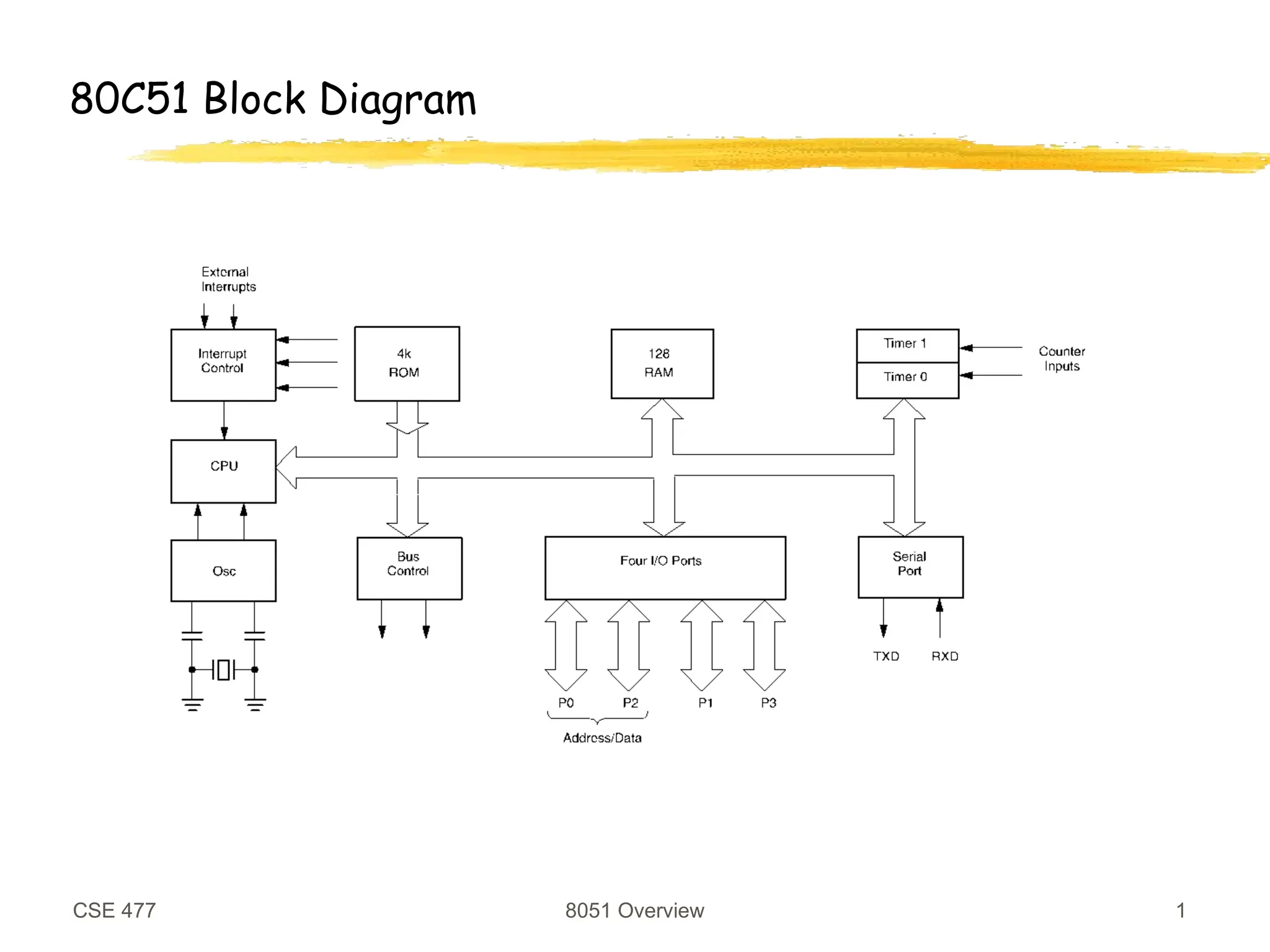
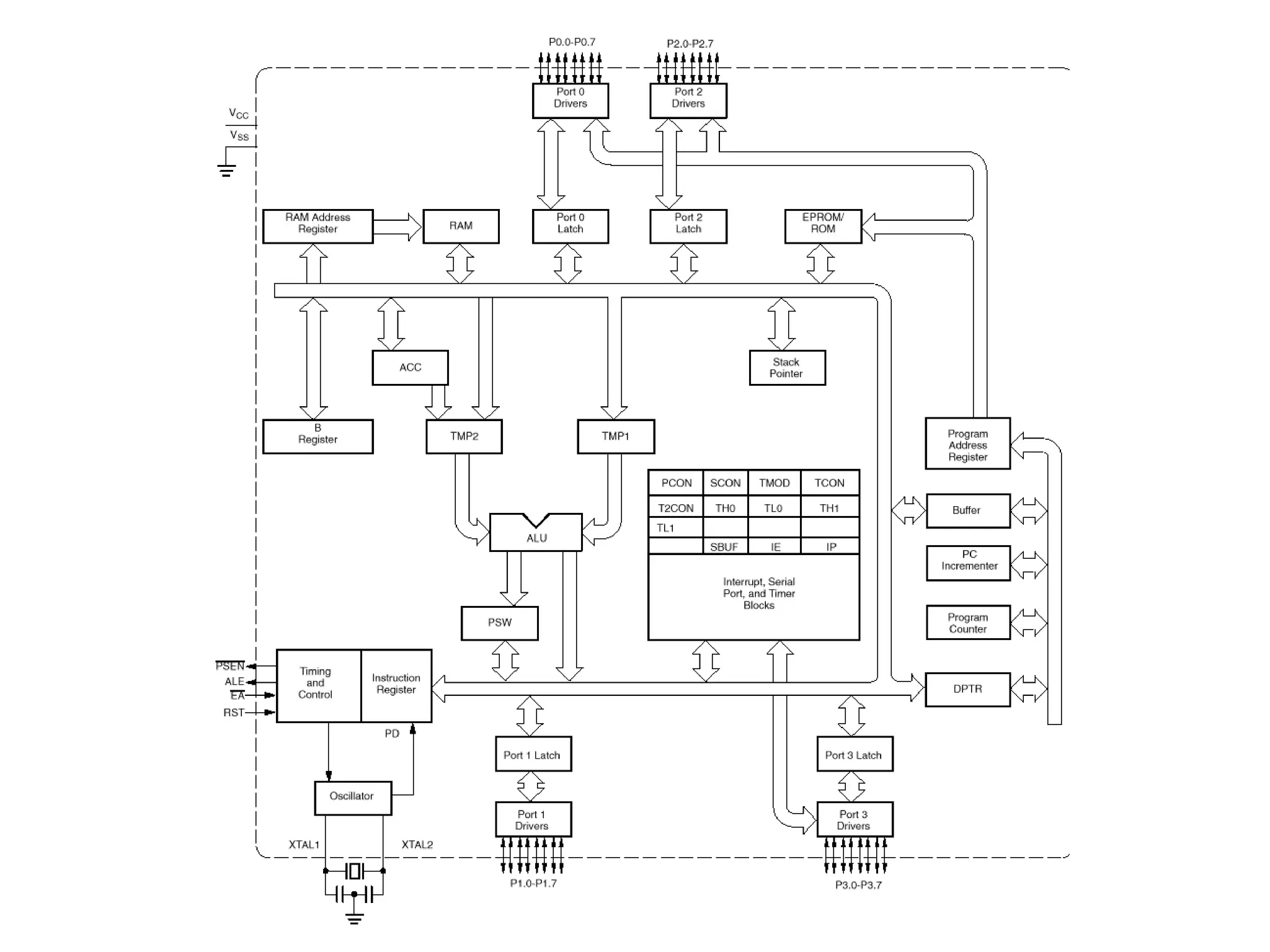
80C51 Block Diagram
CSE 477 8051 Overview 3
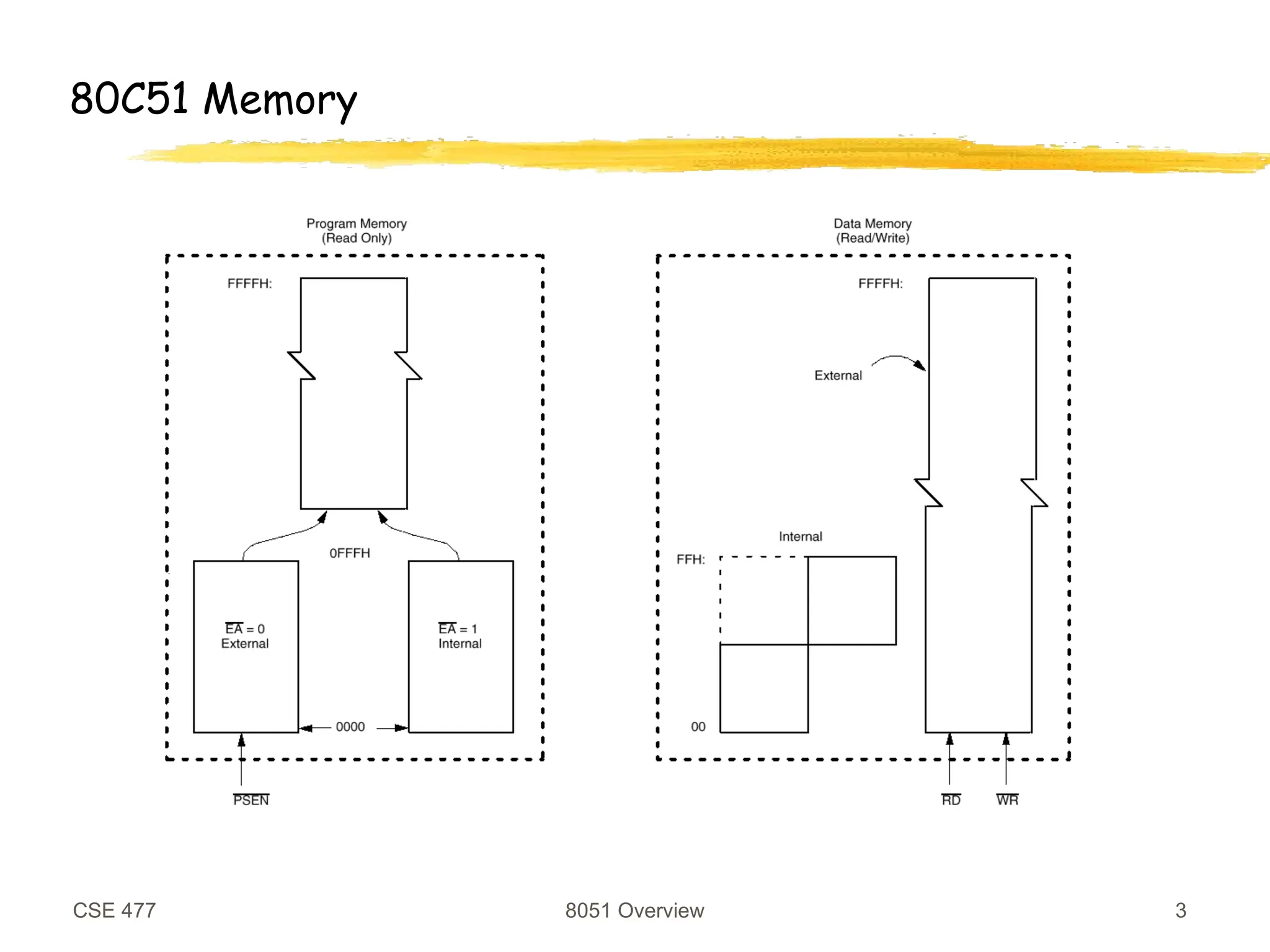
80C51 Memory
CSE 477 8051 Overview 4
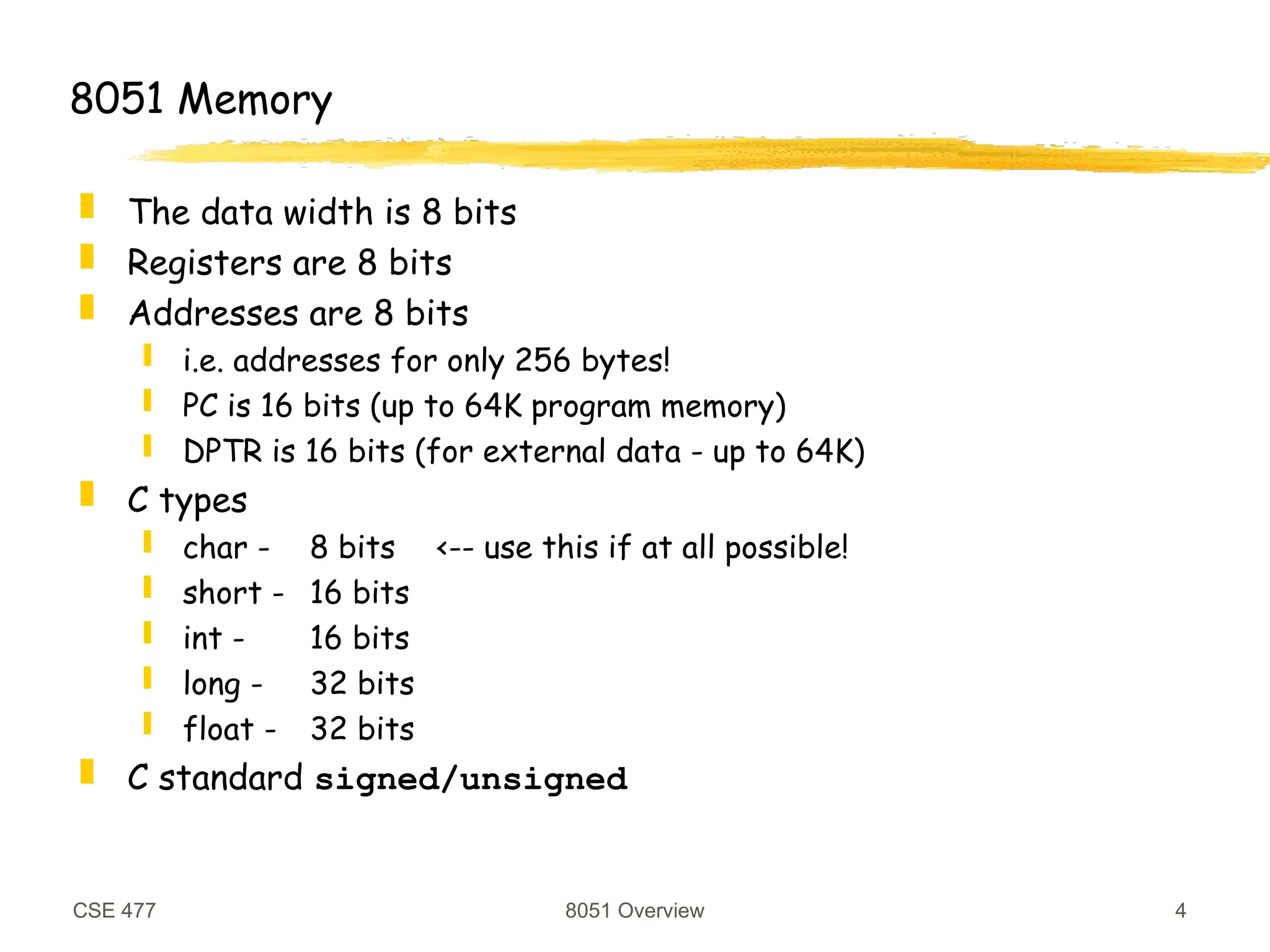
8051 Memory
 The data width is 8 bits
 Registers are 8 bits
 Addresses are 8 bits
 i.e. addresses for only 256 bytes!
 PC is 16 bits (up to 64K program memory)
 DPTR is 16 bits (for external data - up to 64K)
 C types
 char - 8 bits <-- use this if at all possible!
 short - 16 bits
 int - 16 bits
 long - 32 bits
 float - 32 bits
 C standard signed/unsigned
CSE 477 8051 Overview 5
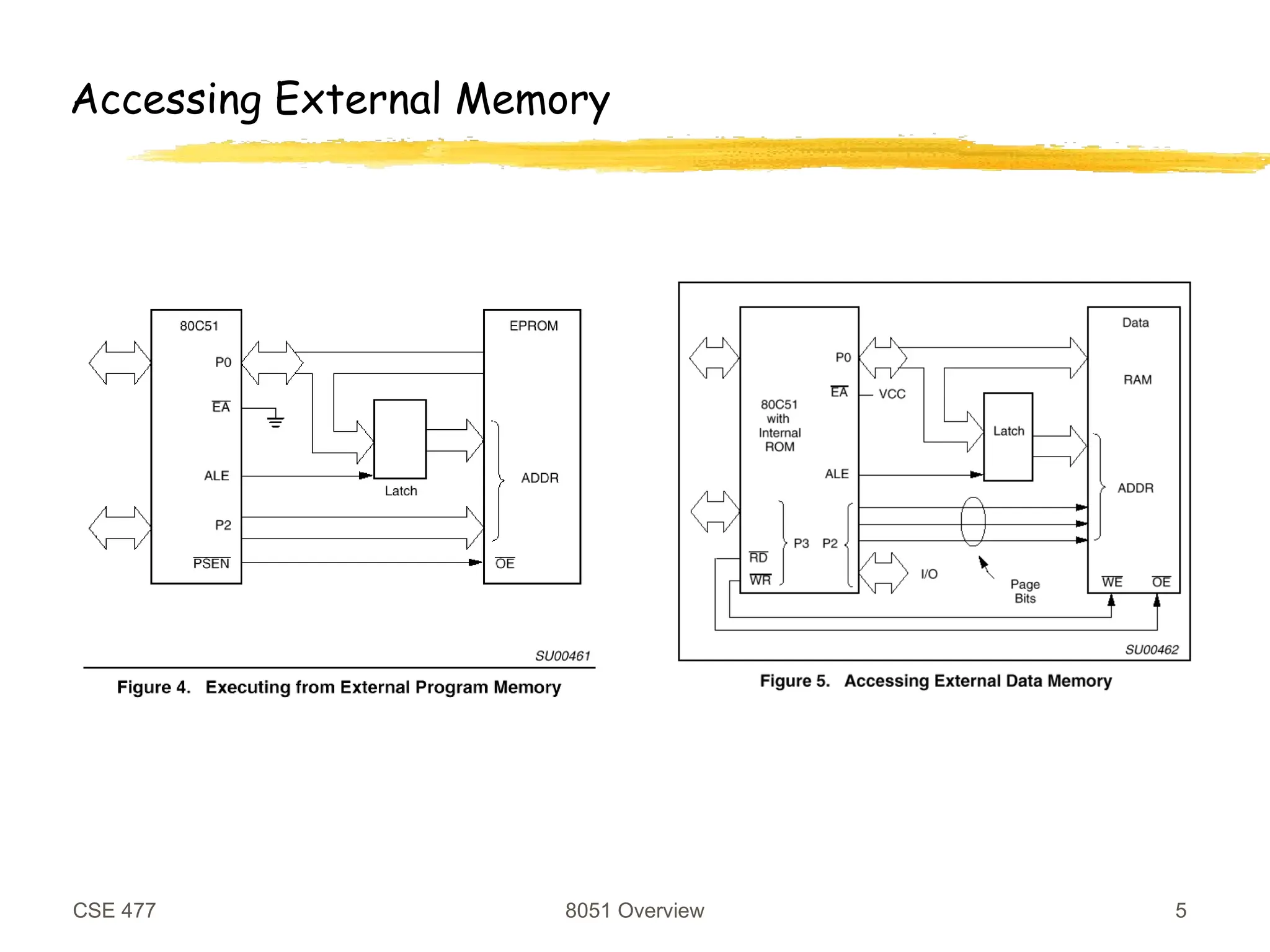
Accessing External Memory
CSE 477 8051 Overview 6
Program Memory
 Program and Data memory are separate
 Can be internal and/or external
 20K internal flash for the Atmel controller
 Read-only
 Instructions
 Constant data
char code table[5] =
{‘1’,‘2’,‘3’,‘4’,‘5’} ;
 Compiler uses instructions for moving “immediate” data
CSE 477 8051 Overview 7
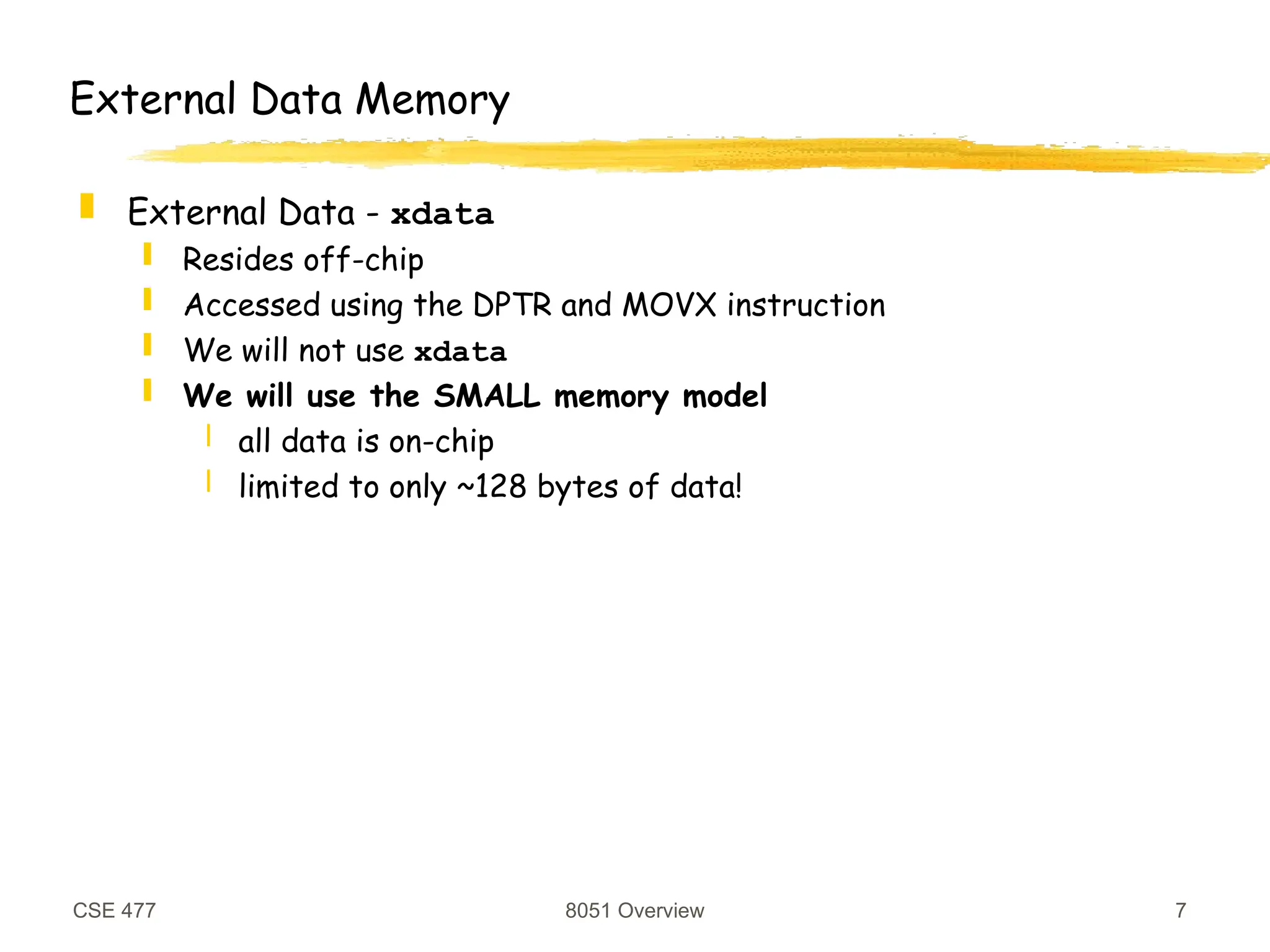
External Data Memory
 External Data - xdata
 Resides off-chip
 Accessed using the DPTR and MOVX instruction
 We will not use xdata
 We will use the SMALL memory model
 all data is on-chip
 limited to only ~128 bytes of data!
CSE 477 8051 Overview 8
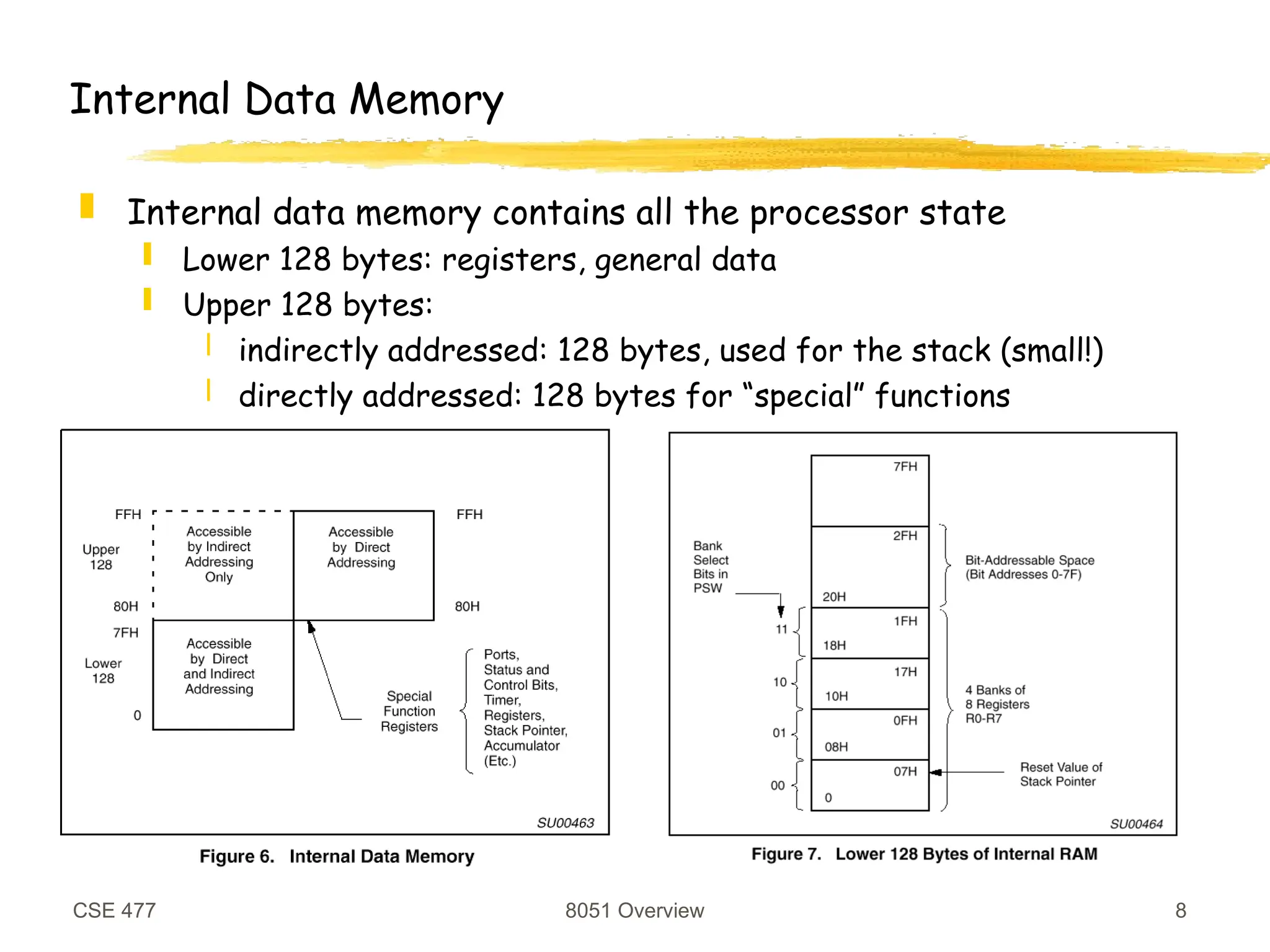
Internal Data Memory
 Internal data memory contains all the processor state
 Lower 128 bytes: registers, general data
 Upper 128 bytes:
 indirectly addressed: 128 bytes, used for the stack (small!)
 directly addressed: 128 bytes for “special” functions
CSE 477 8051 Overview 9
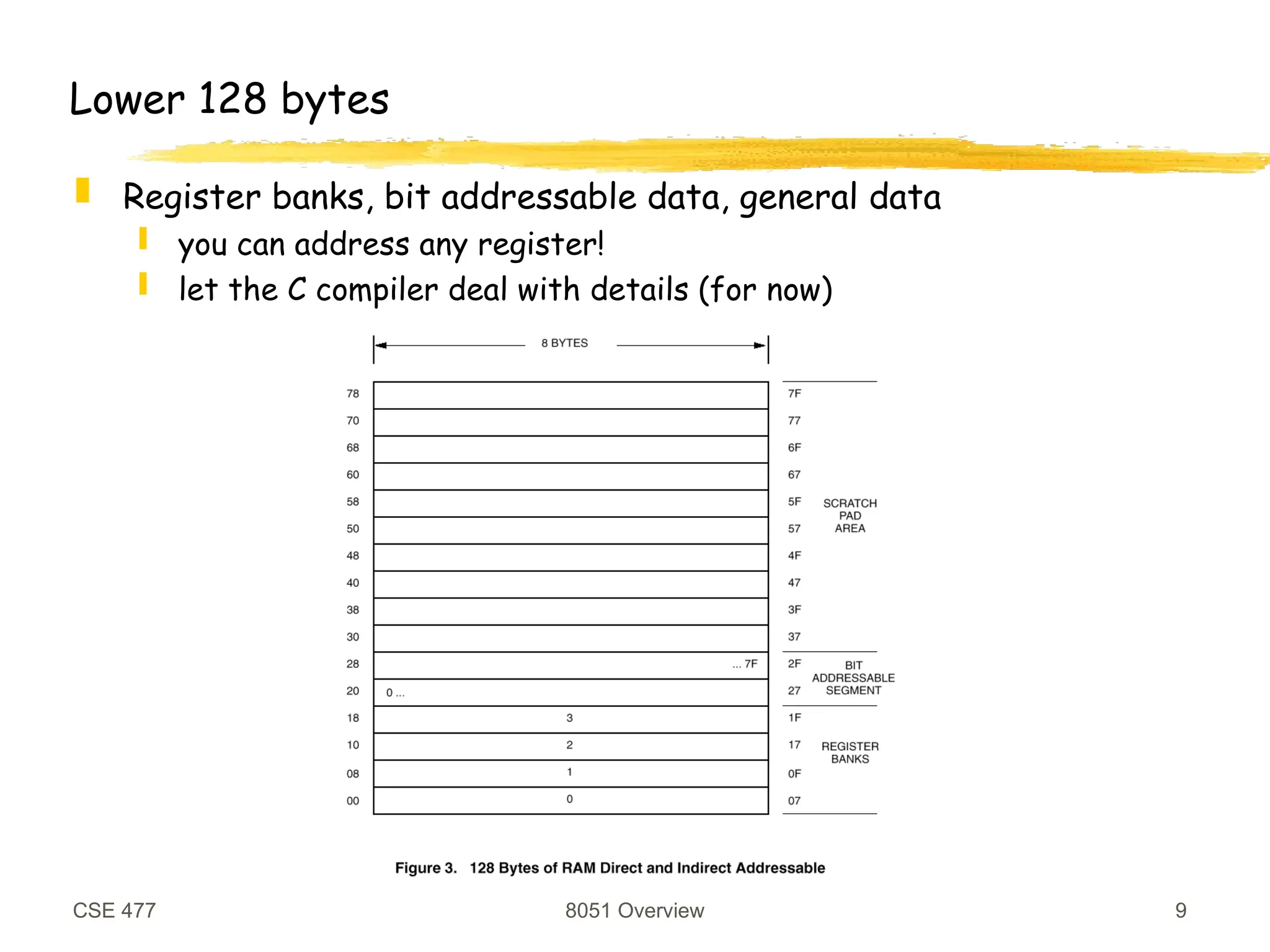
Lower 128 bytes
 Register banks, bit addressable data, general data
 you can address any register!
 let the C compiler deal with details (for now)
CSE 477 8051 Overview 10
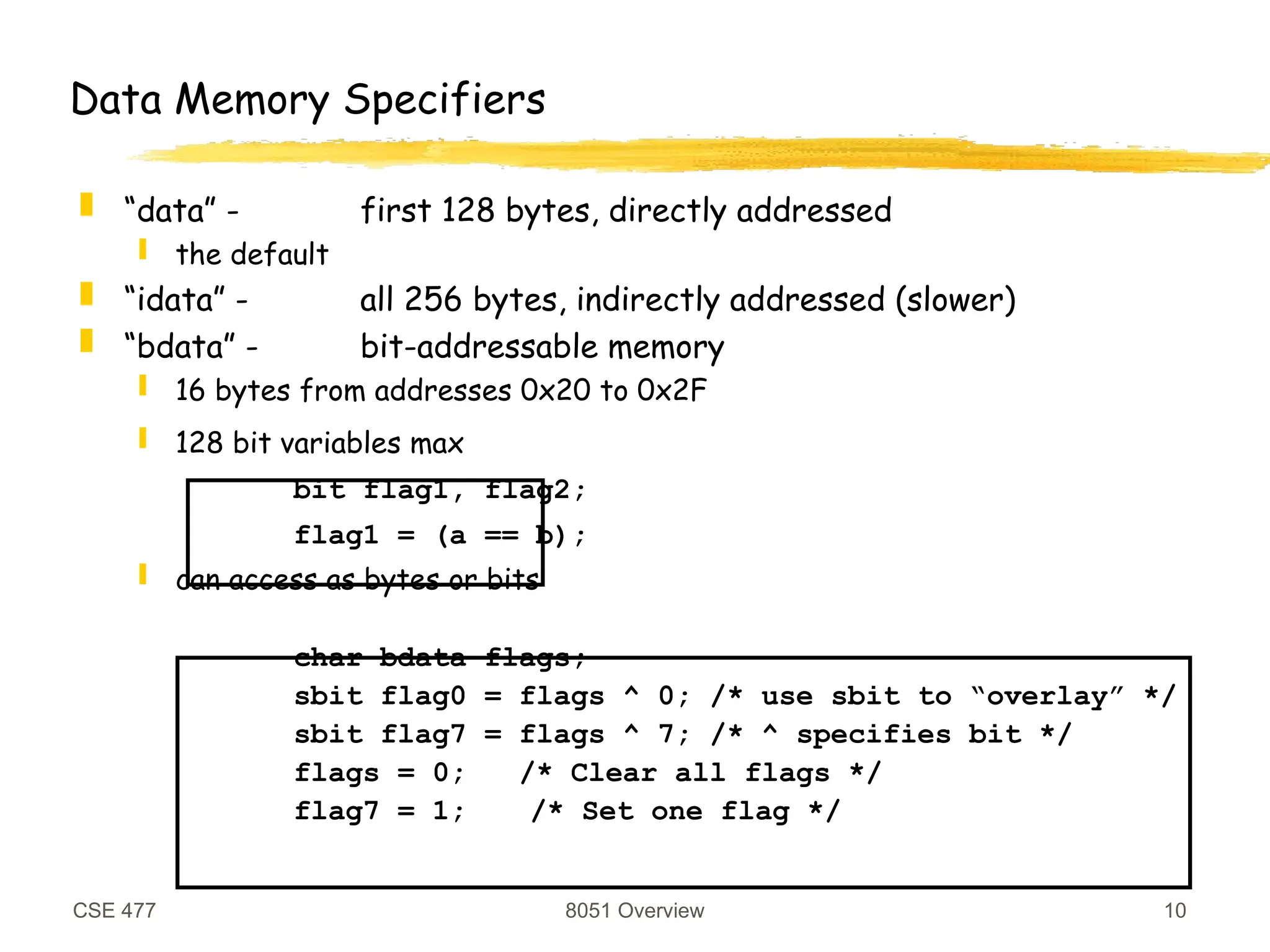
Data Memory Specifiers
 “data” - first 128 bytes, directly addressed
 the default
 “idata” - all 256 bytes, indirectly addressed (slower)
 “bdata” - bit-addressable memory
 16 bytes from addresses 0x20 to 0x2F
 128 bit variables max
bit flag1, flag2;
flag1 = (a == b);
 can access as bytes or bits
char bdata flags;
sbit flag0 = flags ^ 0; /* use sbit to “overlay” */
sbit flag7 = flags ^ 7; /* ^ specifies bit */
flags = 0; /* Clear all flags */
flag7 = 1; /* Set one flag */
CSE 477 8051 Overview 11
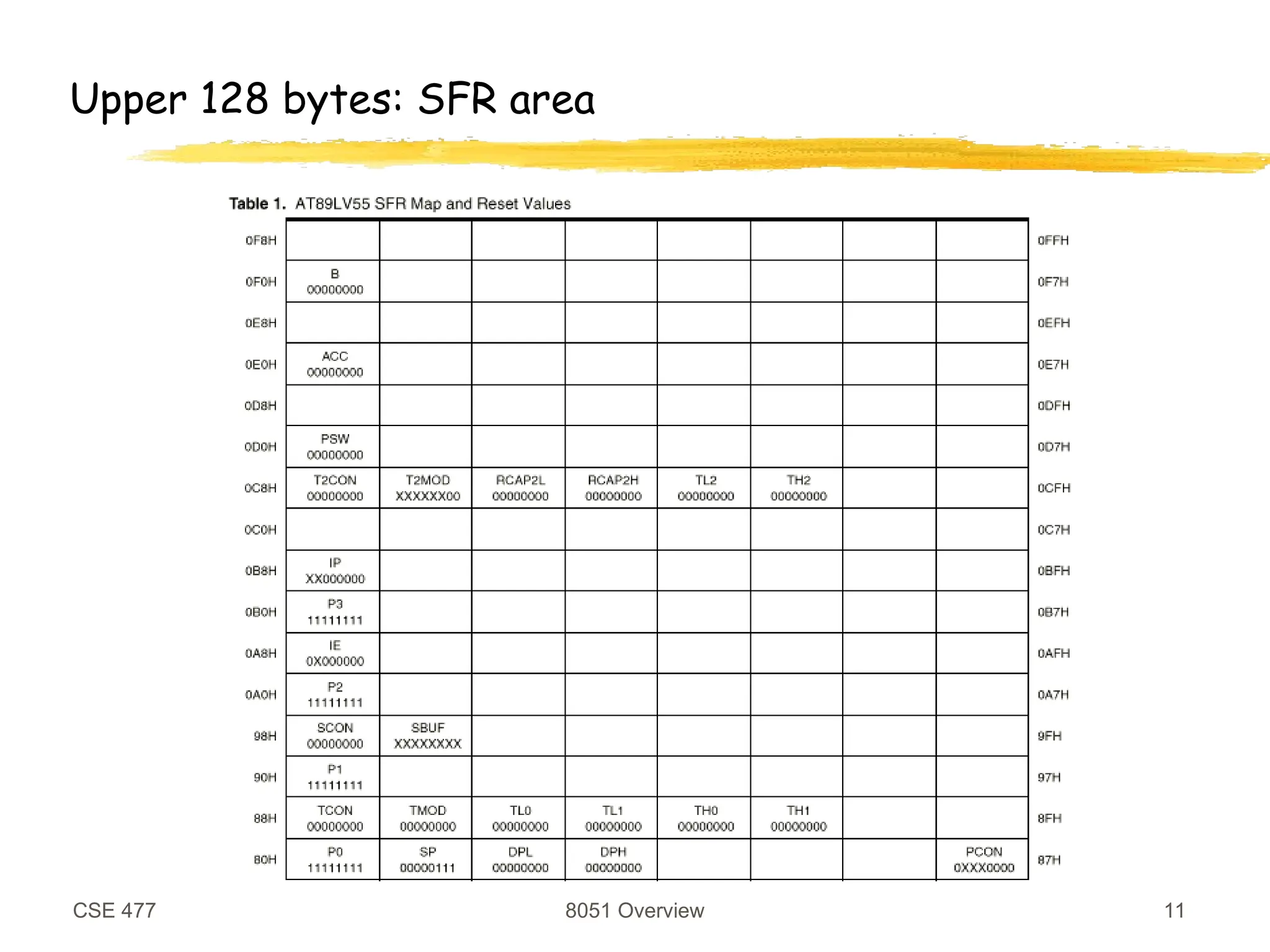
Upper 128 bytes: SFR area
CSE 477 8051 Overview 13
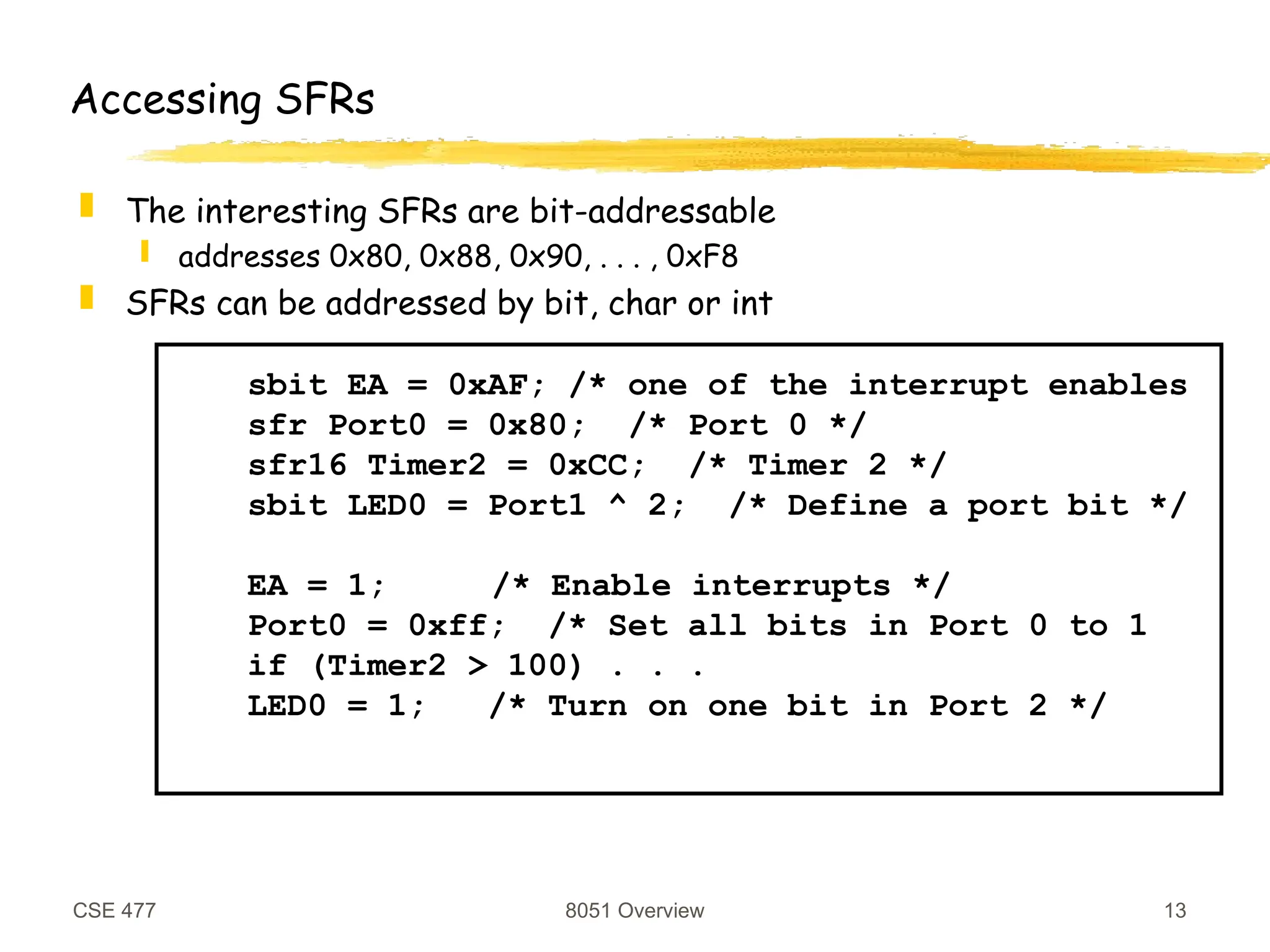
Accessing SFRs
 The interesting SFRs are bit-addressable
 addresses 0x80, 0x88, 0x90, . . . , 0xF8
 SFRs can be addressed by bit, char or int
sbit EA = 0xAF; /* one of the interrupt enables
sfr Port0 = 0x80; /* Port 0 */
sfr16 Timer2 = 0xCC; /* Timer 2 */
sbit LED0 = Port1 ^ 2; /* Define a port bit */
EA = 1; /* Enable interrupts */
Port0 = 0xff; /* Set all bits in Port 0 to 1
if (Timer2 > 100) . . .
LED0 = 1; /* Turn on one bit in Port 2 */
CSE 477 8051 Overview 14
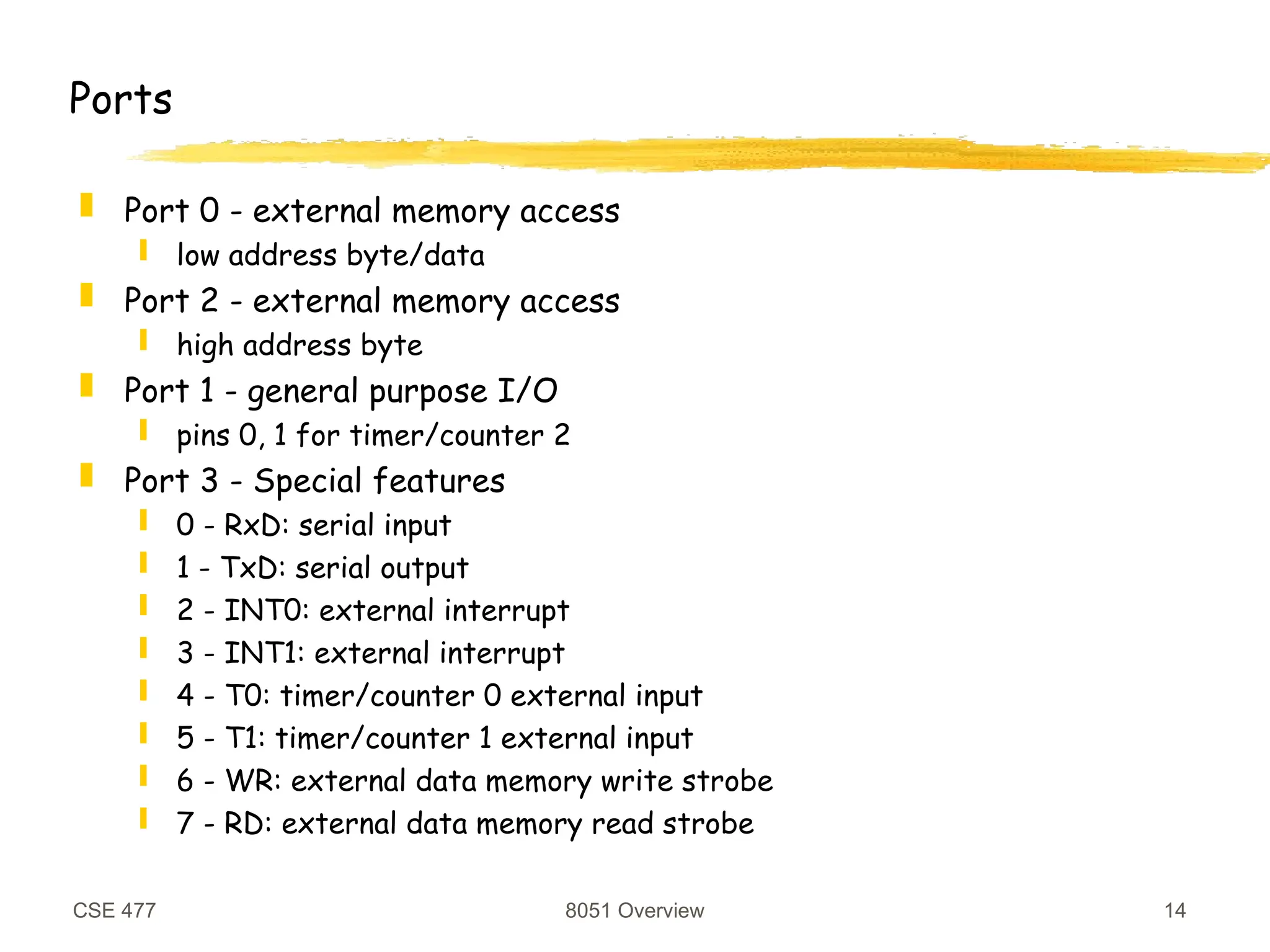
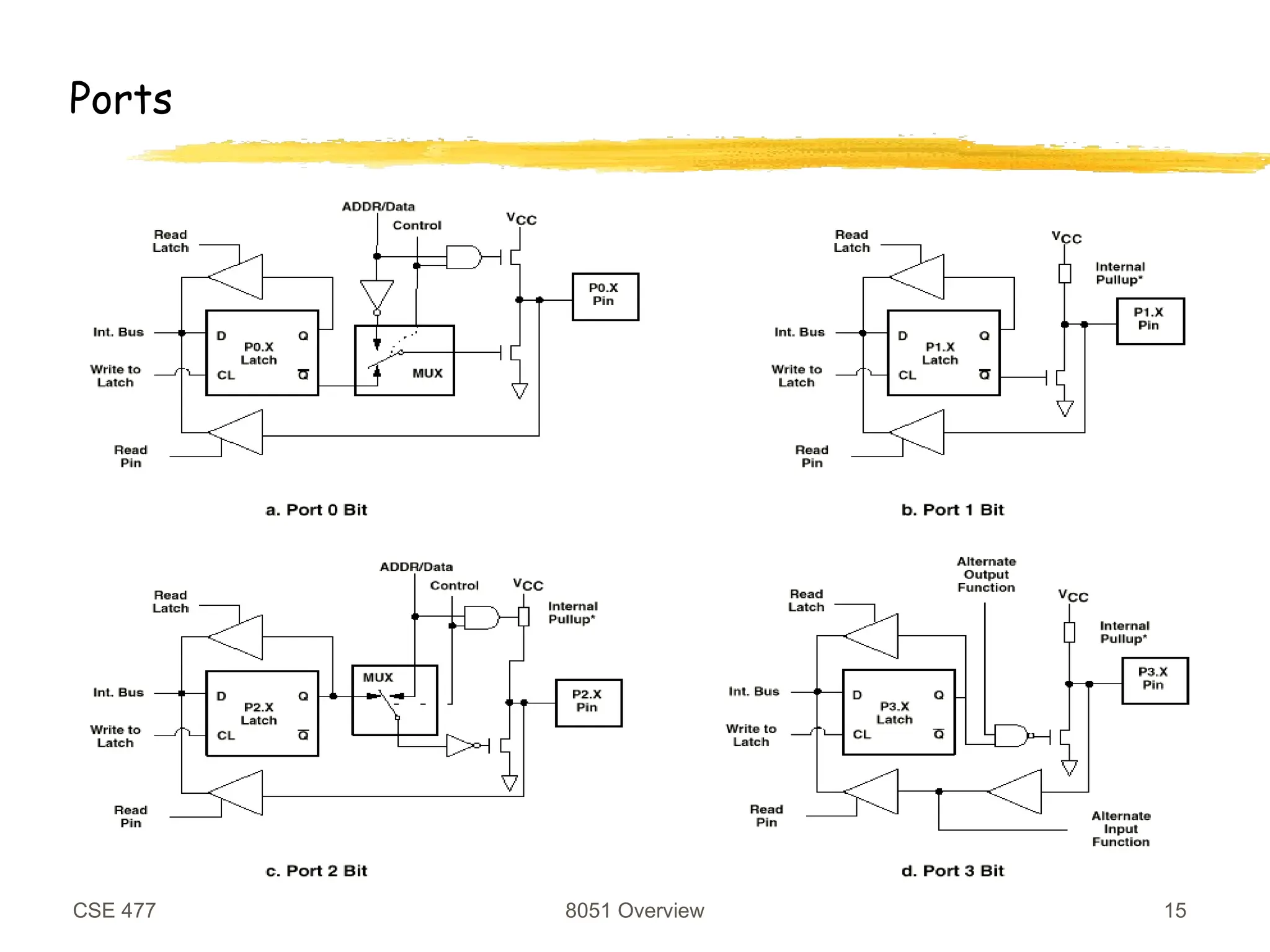
Ports
 Port 0 - external memory access
 low address byte/data
 Port 2 - external memory access
 high address byte
 Port 1 - general purpose I/O
 pins 0, 1 for timer/counter 2
 Port 3 - Special features
 0 - RxD: serial input
 1 - TxD: serial output
 2 - INT0: external interrupt
 3 - INT1: external interrupt
 4 - T0: timer/counter 0 external input
 5 - T1: timer/counter 1 external input
 6 - WR: external data memory write strobe
 7 - RD: external data memory read strobe
CSE 477 8051 Overview 15
Ports
CSE 477 8051 Overview 16
Ports
 Port 0 - true bi-directional
 Port 1-3 - have internal pullups that will source current
 Output pins:
 Just write 0/1 to the bit/byte
 Input pins:
 Output latch must have a 1 (reset state)
 Turns off the pulldown
 pullup must be pulled down by external driver
 Just read the bit/byte
CSE 477 8051 Overview 17
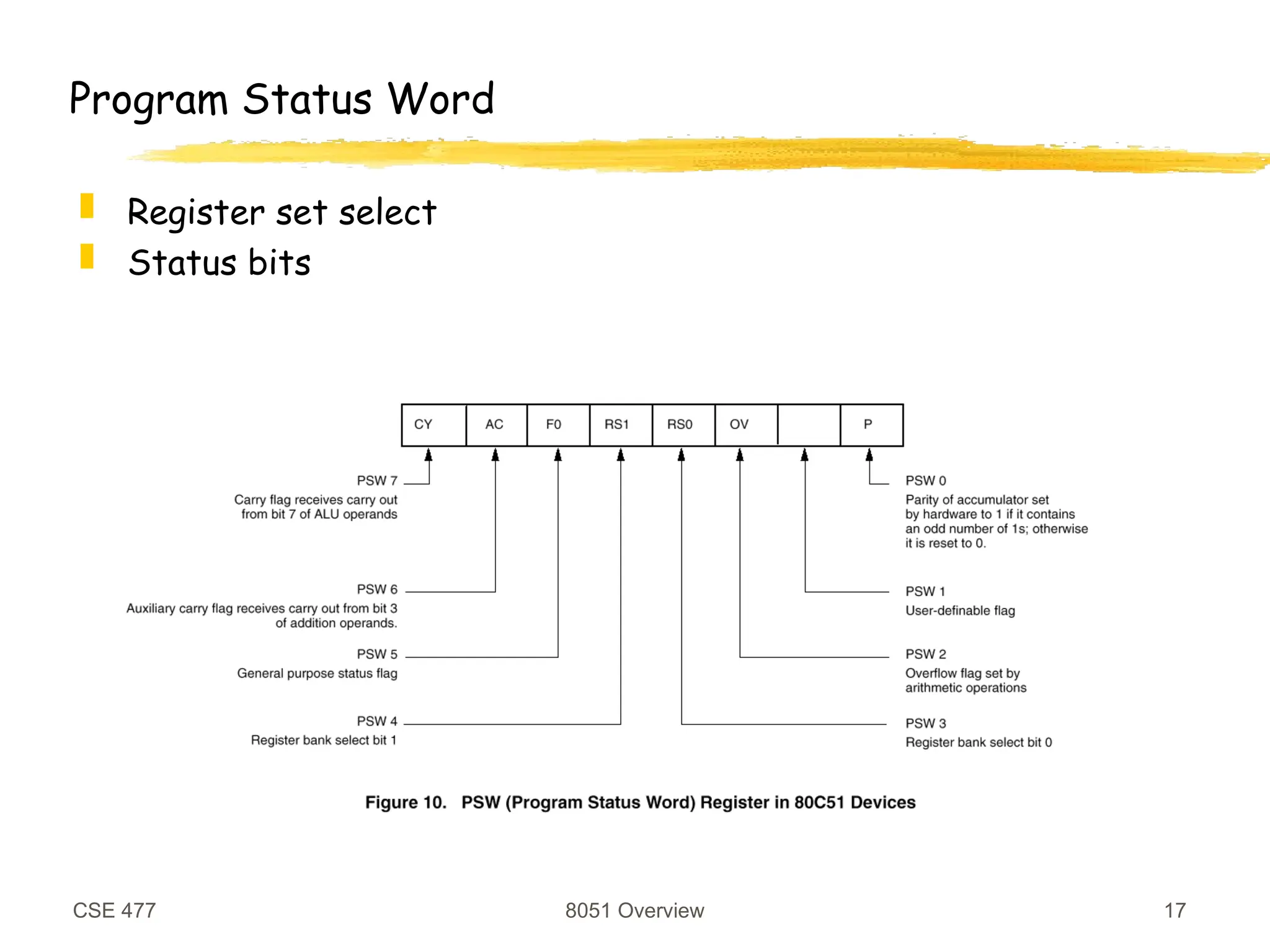
Program Status Word
 Register set select
 Status bits
CSE 477 8051 Overview 18
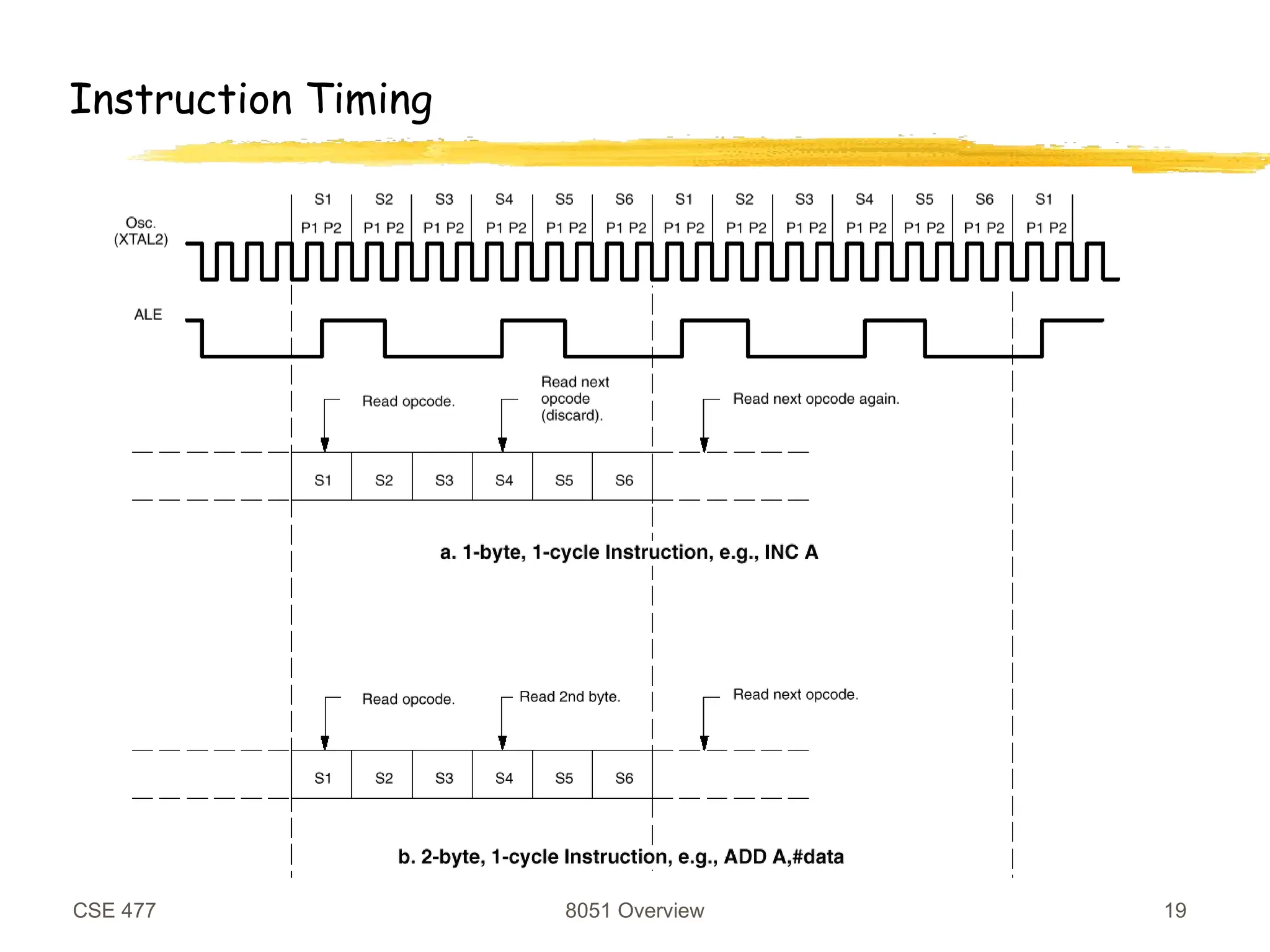
Instruction Timing
 One “machine cycle” = 6 states (S1 - S6)
 One state = 2 clock cycles
 One “machine cycle” = 12 clock cycles
 Instructions take 1 - 4 cycles
 e.g. 1 cycle instructions: ADD, MOV, SETB, NOP
 e.g. 2 cycle instructions: JMP, JZ
 4 cycle instructions: MUL, DIV
CSE 477 8051 Overview 19
Instruction Timing
CSE 477 8051 Overview 20
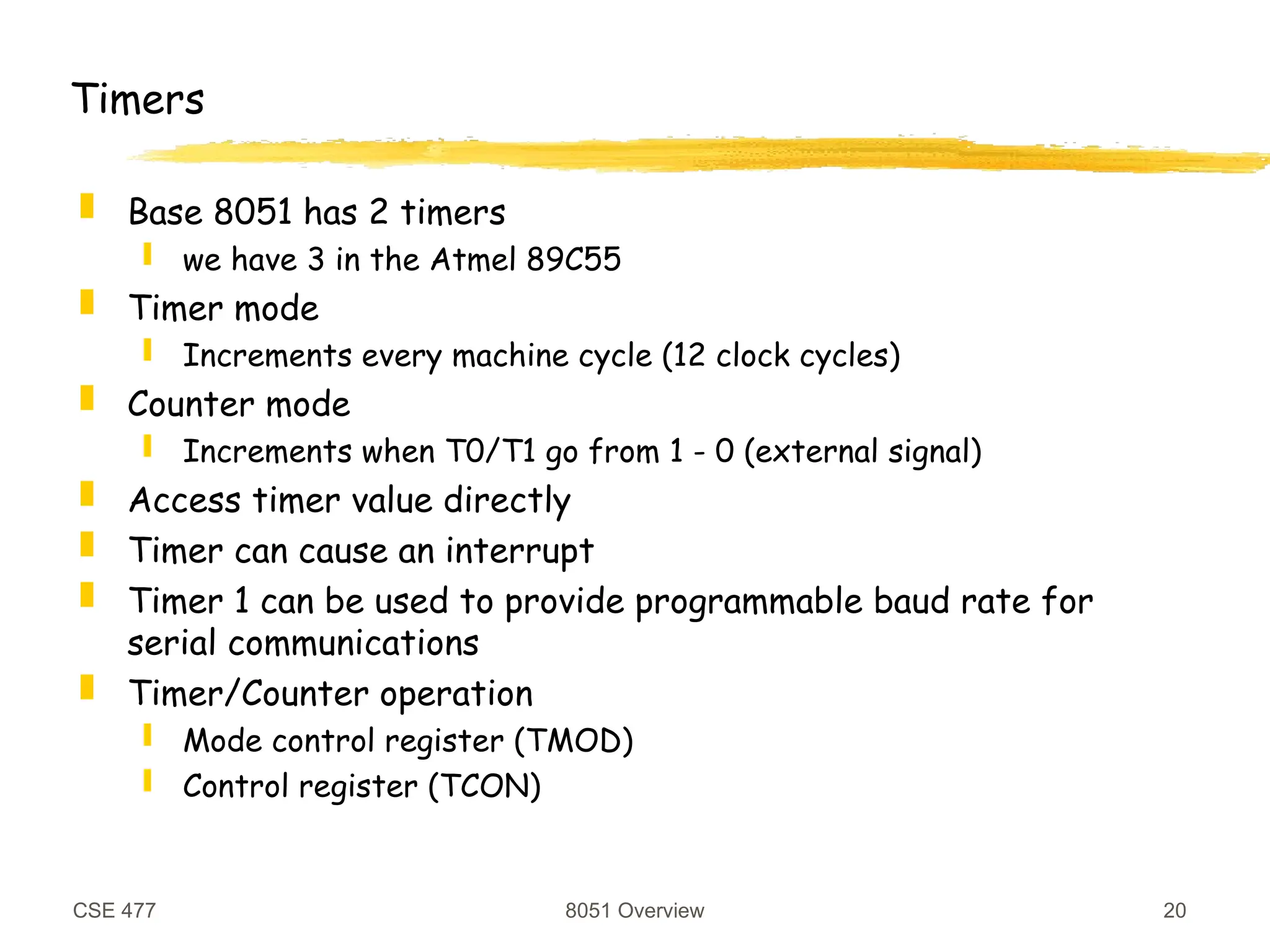
Timers
 Base 8051 has 2 timers
 we have 3 in the Atmel 89C55
 Timer mode
 Increments every machine cycle (12 clock cycles)
 Counter mode
 Increments when T0/T1 go from 1 - 0 (external signal)
 Access timer value directly
 Timer can cause an interrupt
 Timer 1 can be used to provide programmable baud rate for
serial communications
 Timer/Counter operation
 Mode control register (TMOD)
 Control register (TCON)
CSE 477 8051 Overview 21
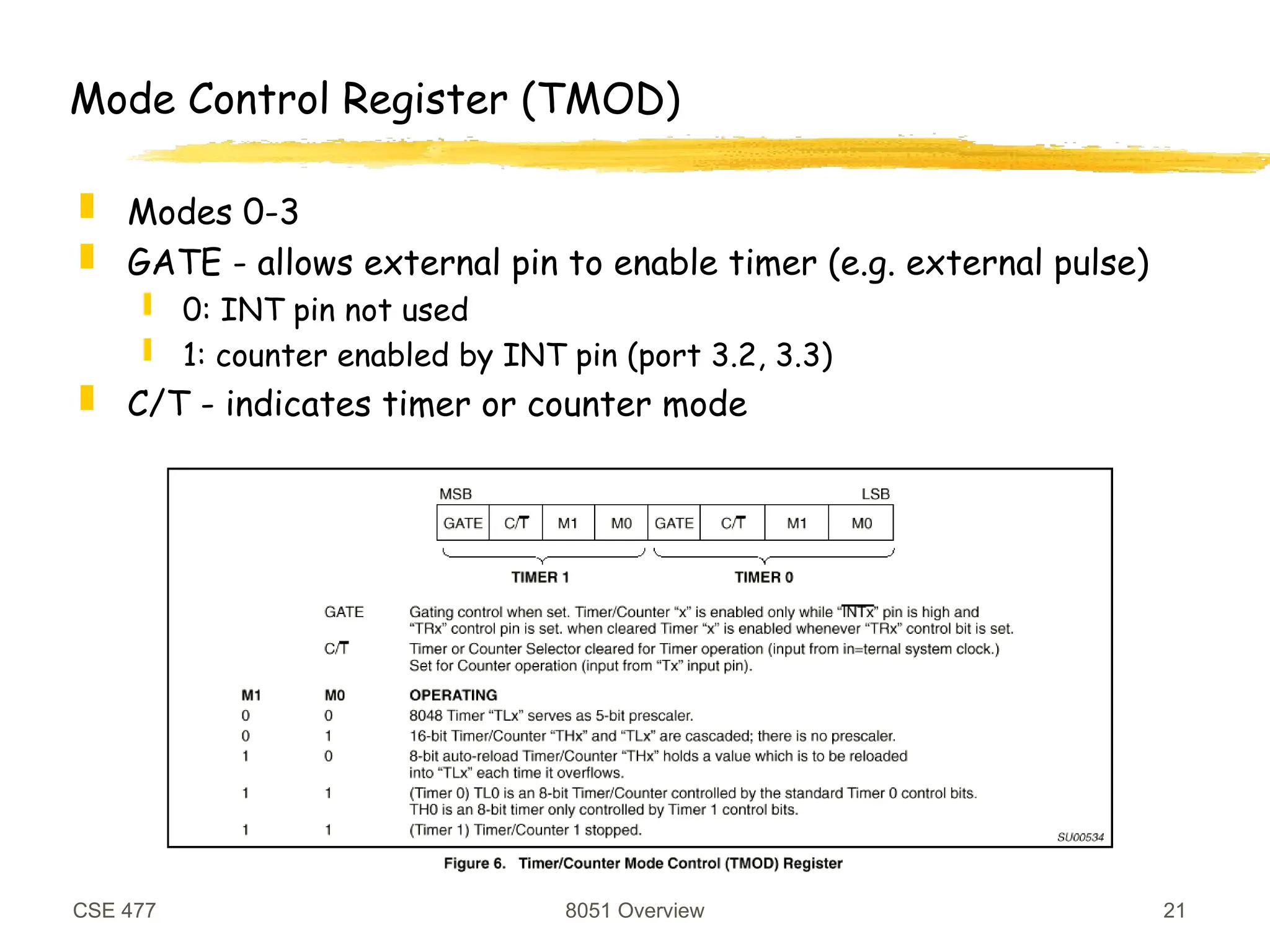
Mode Control Register (TMOD)
 Modes 0-3
 GATE - allows external pin to enable timer (e.g. external pulse)
 0: INT pin not used
 1: counter enabled by INT pin (port 3.2, 3.3)
 C/T - indicates timer or counter mode
CSE 477 8051 Overview 22
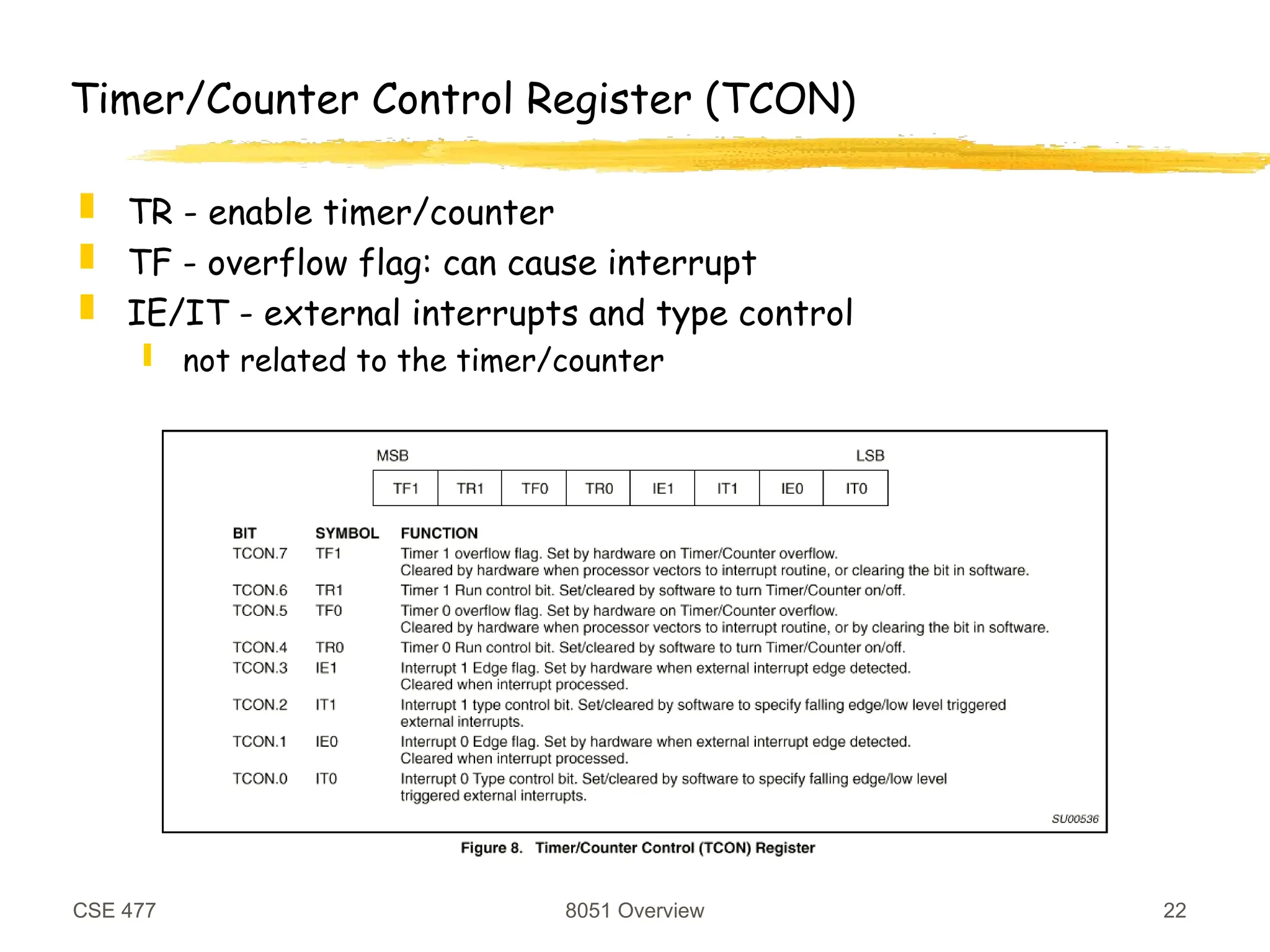
Timer/Counter Control Register (TCON)
 TR - enable timer/counter
 TF - overflow flag: can cause interrupt
 IE/IT - external interrupts and type control
 not related to the timer/counter
CSE 477 8051 Overview 23
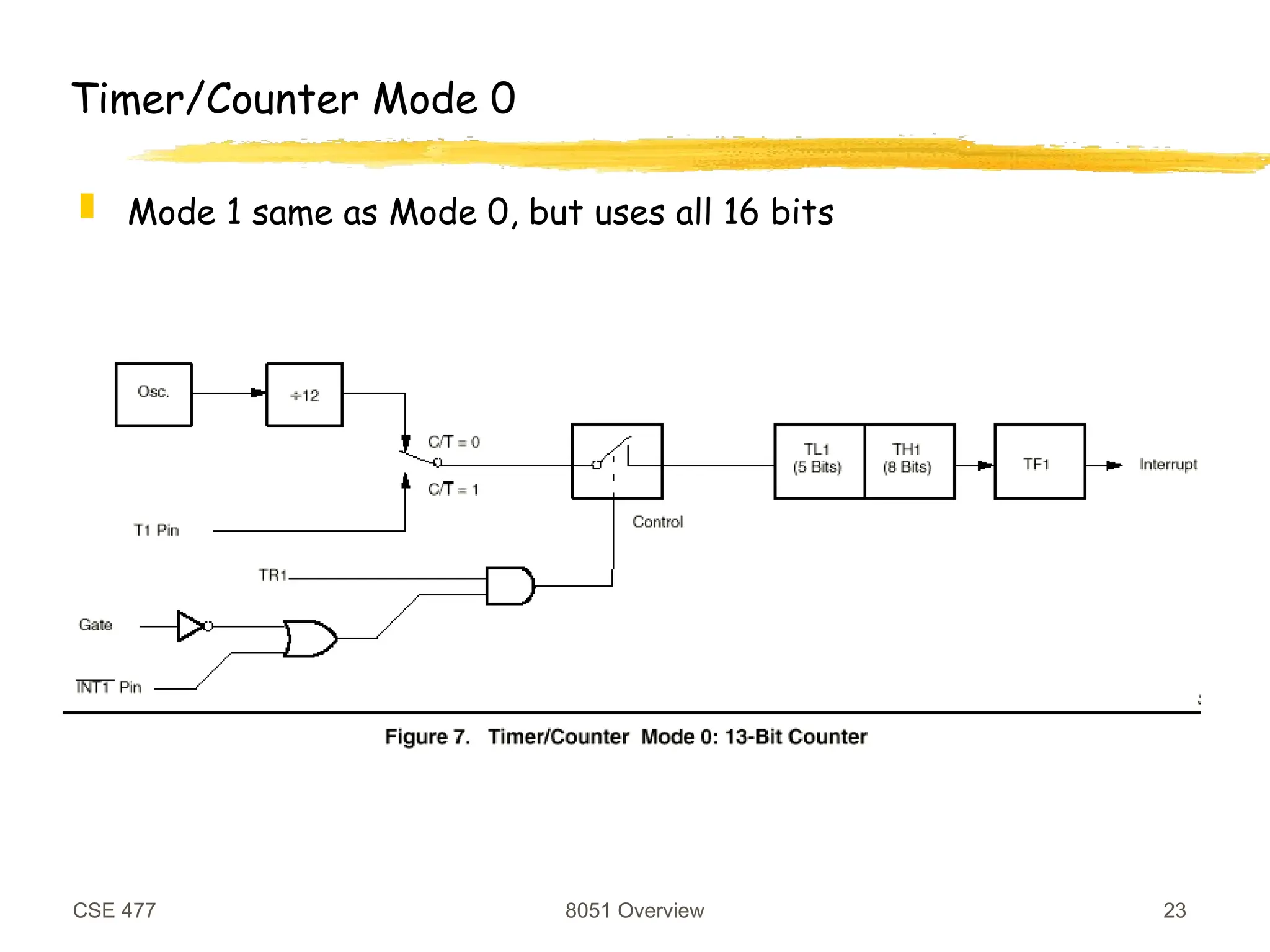
Timer/Counter Mode 0
 Mode 1 same as Mode 0, but uses all 16 bits
CSE 477 8051 Overview 24
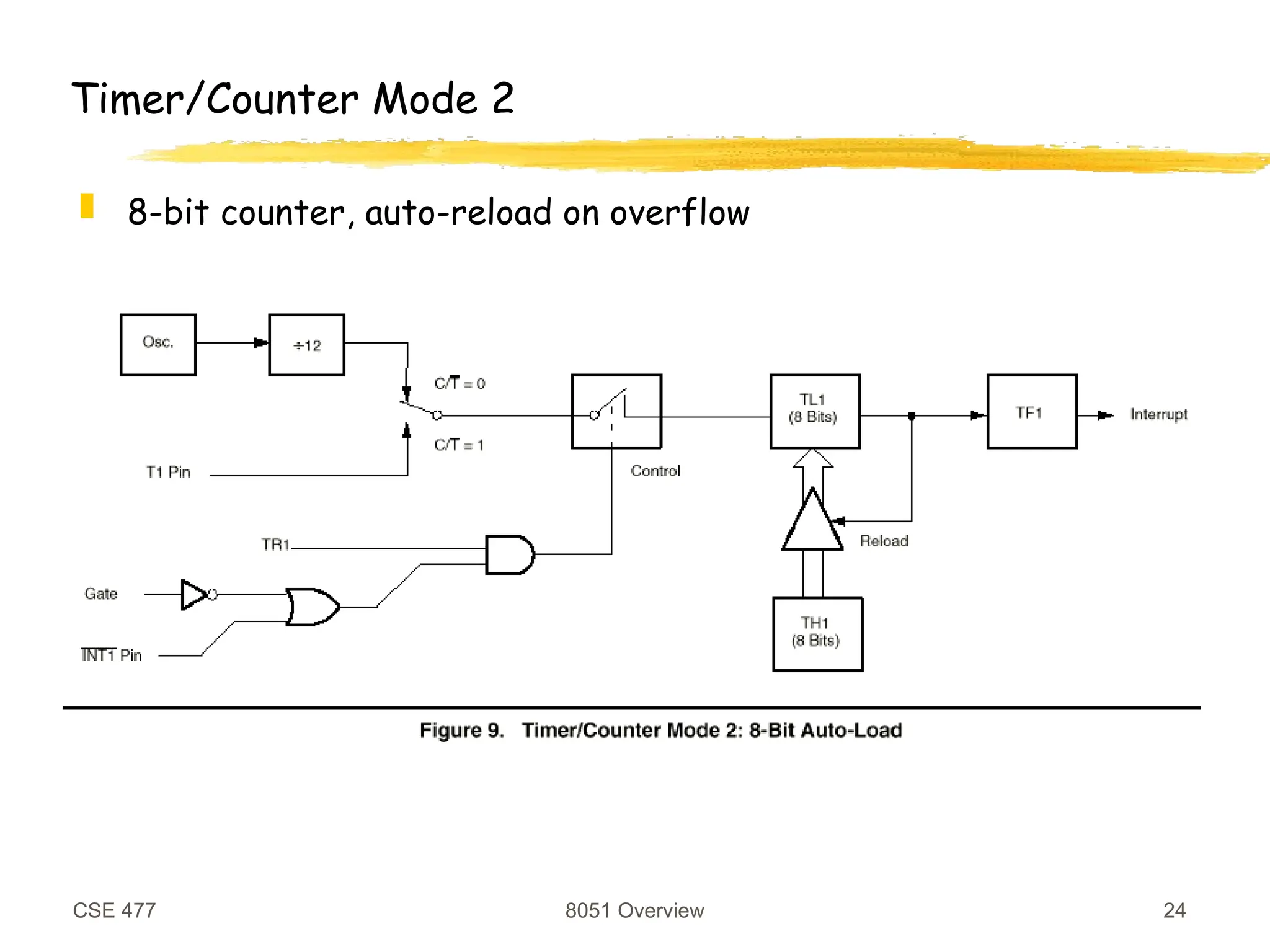
Timer/Counter Mode 2
 8-bit counter, auto-reload on overflow
CSE 477 8051 Overview 25
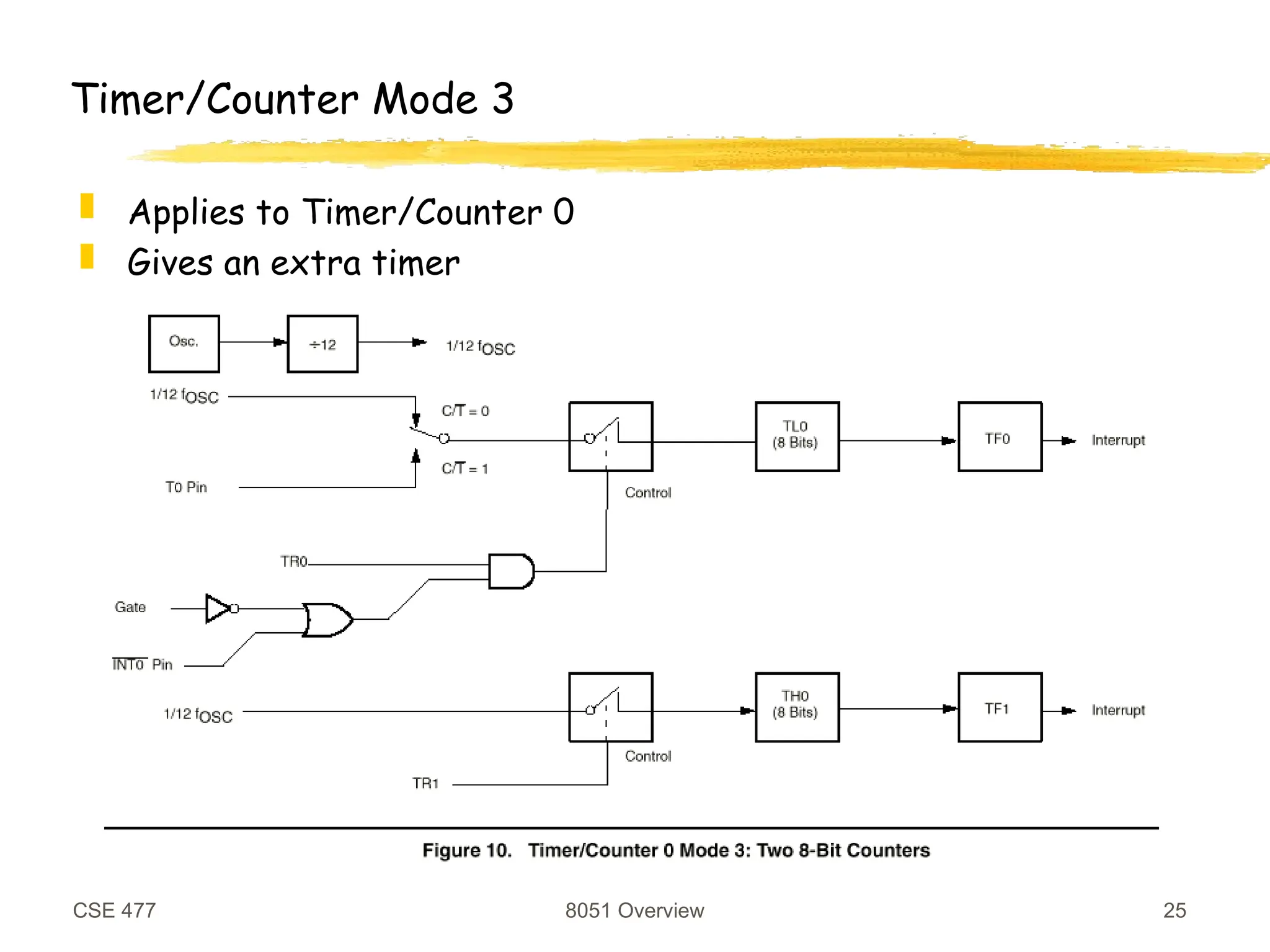
Timer/Counter Mode 3
 Applies to Timer/Counter 0
 Gives an extra timer
CSE 477 8051 Overview 26
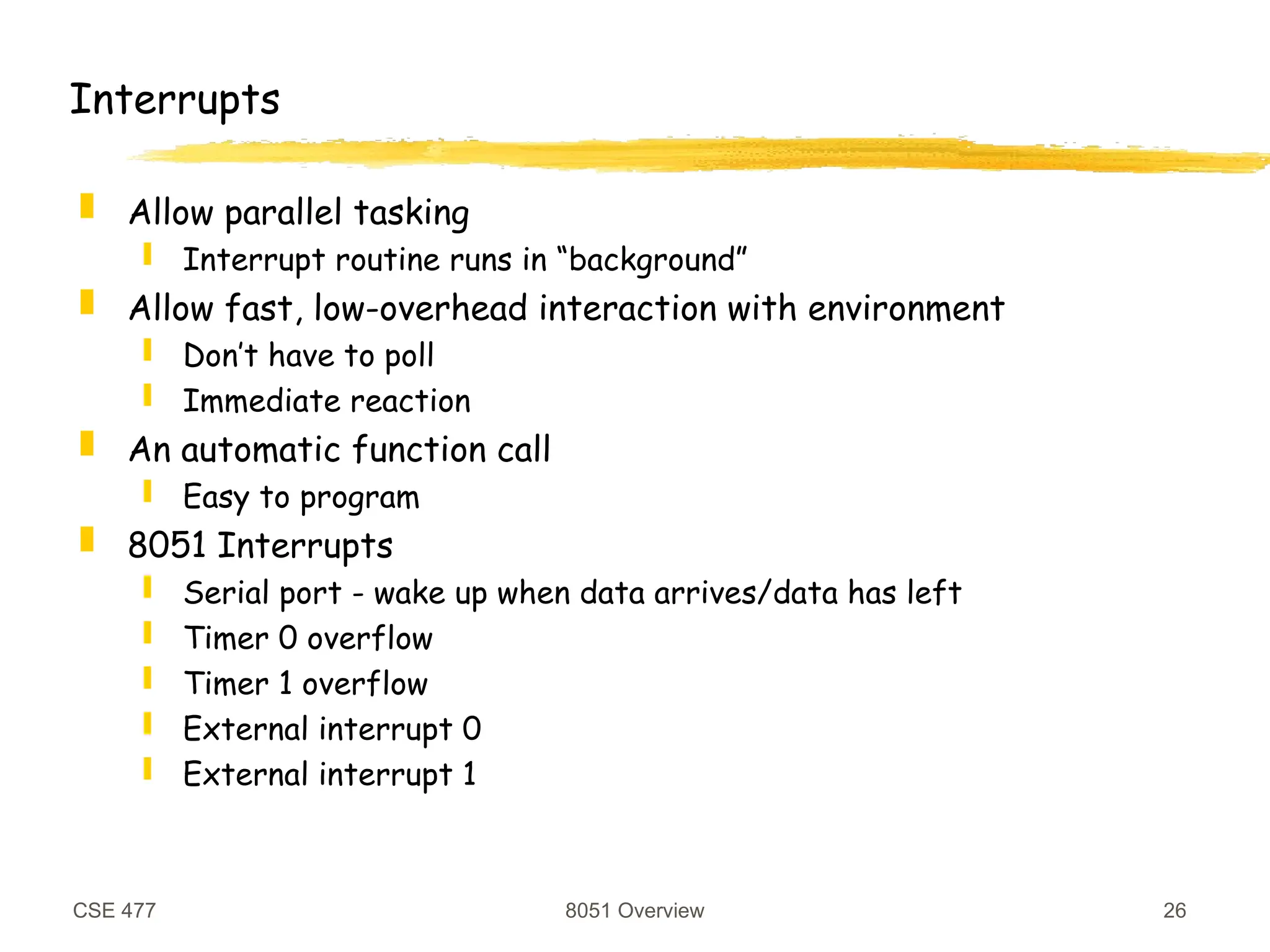
Interrupts
 Allow parallel tasking
 Interrupt routine runs in “background”
 Allow fast, low-overhead interaction with environment
 Don’t have to poll
 Immediate reaction
 An automatic function call
 Easy to program
 8051 Interrupts
 Serial port - wake up when data arrives/data has left
 Timer 0 overflow
 Timer 1 overflow
 External interrupt 0
 External interrupt 1
CSE 477 8051 Overview 27
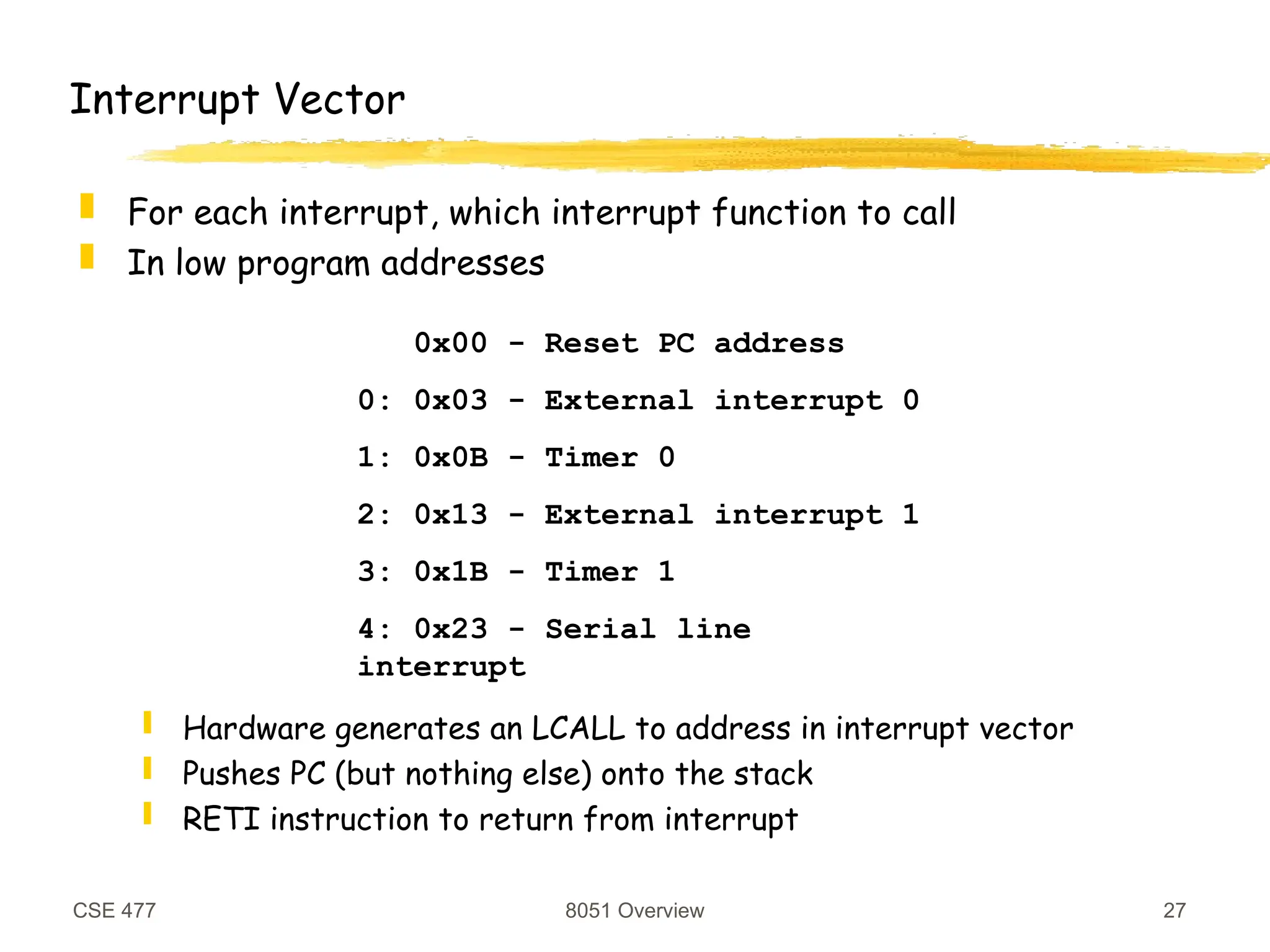
Interrupt Vector
 For each interrupt, which interrupt function to call
 In low program addresses
 Hardware generates an LCALL to address in interrupt vector
 Pushes PC (but nothing else) onto the stack
 RETI instruction to return from interrupt
0x00 - Reset PC address
0: 0x03 - External interrupt 0
1: 0x0B - Timer 0
2: 0x13 - External interrupt 1
3: 0x1B - Timer 1
4: 0x23 - Serial line
interrupt
CSE 477 8051 Overview 28
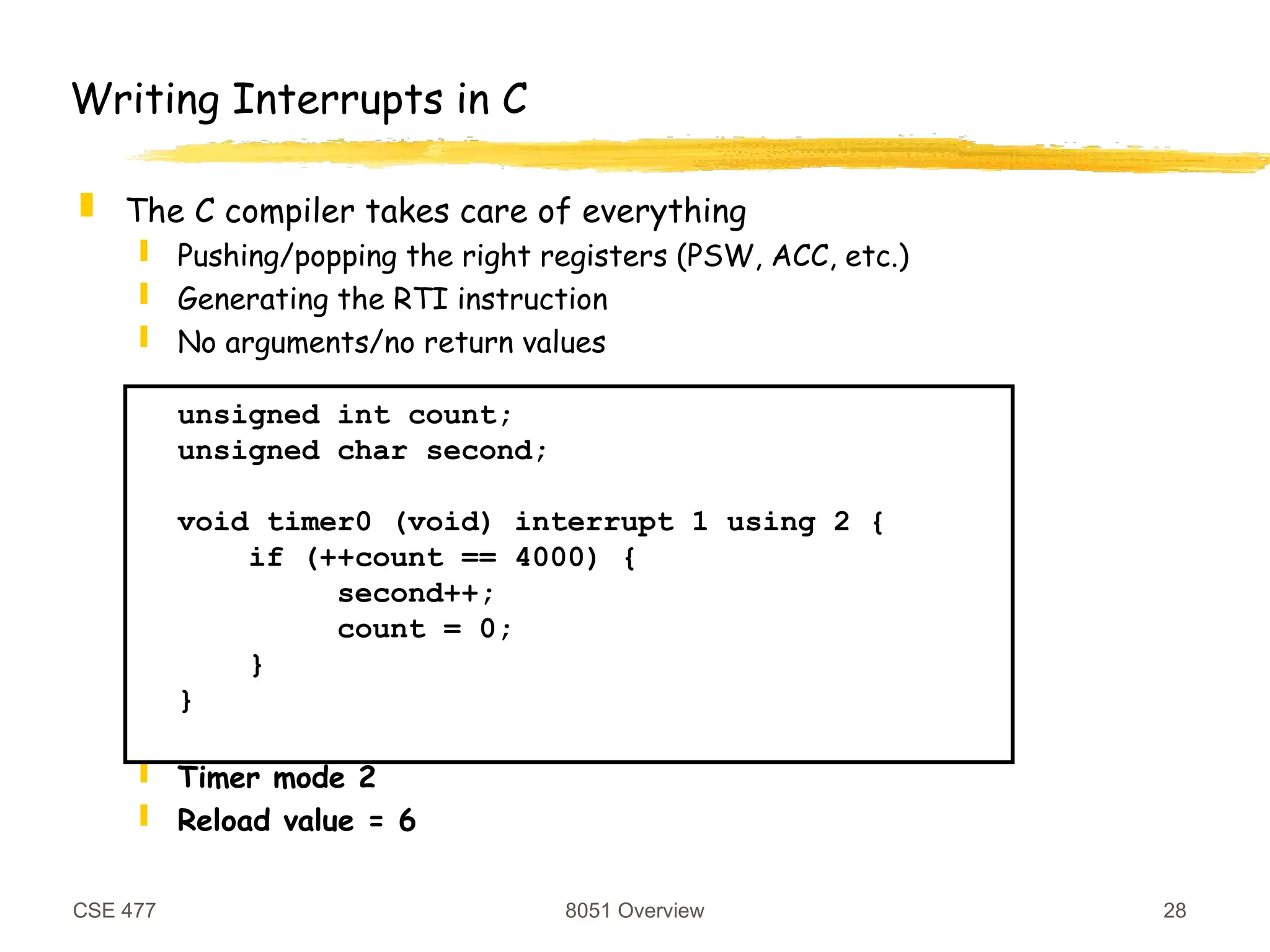
Writing Interrupts in C
 The C compiler takes care of everything
 Pushing/popping the right registers (PSW, ACC, etc.)
 Generating the RTI instruction
 No arguments/no return values
unsigned int count;
unsigned char second;
void timer0 (void) interrupt 1 using 2 {
if (++count == 4000) {
second++;
count = 0;
}
}
 Timer mode 2
 Reload value = 6
CSE 477 8051 Overview 29
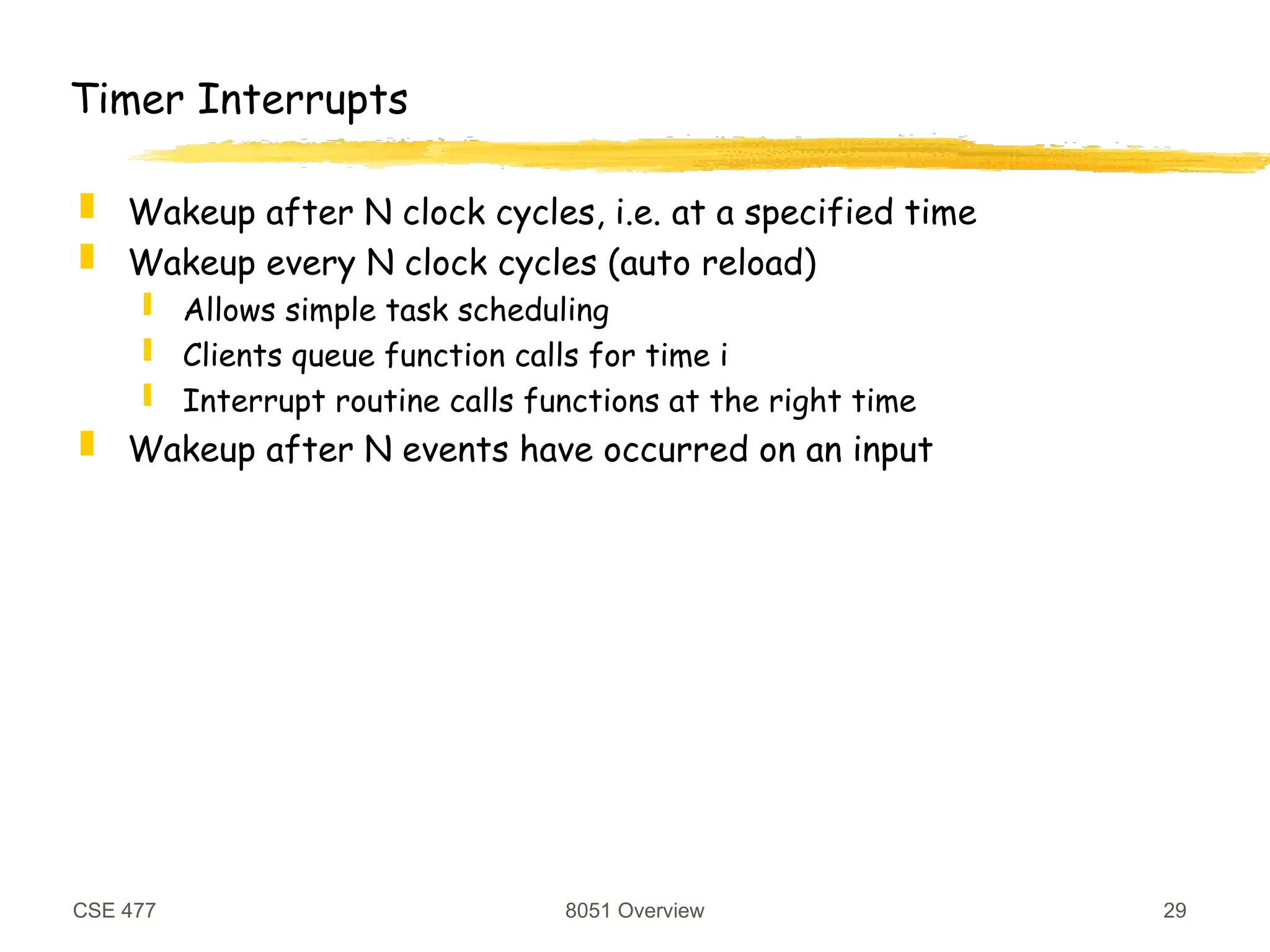
Timer Interrupts
 Wakeup after N clock cycles, i.e. at a specified time
 Wakeup every N clock cycles (auto reload)
 Allows simple task scheduling
 Clients queue function calls for time i
 Interrupt routine calls functions at the right time
 Wakeup after N events have occurred on an input
CSE 477 8051 Overview 30
Design Problem 1 - frequency counter
 Measure the frequency of an external signal
 Display as a number using the 7-segment display
 e.g. number represents exponent of 2 or 10
CSE 477 8051 Overview 31
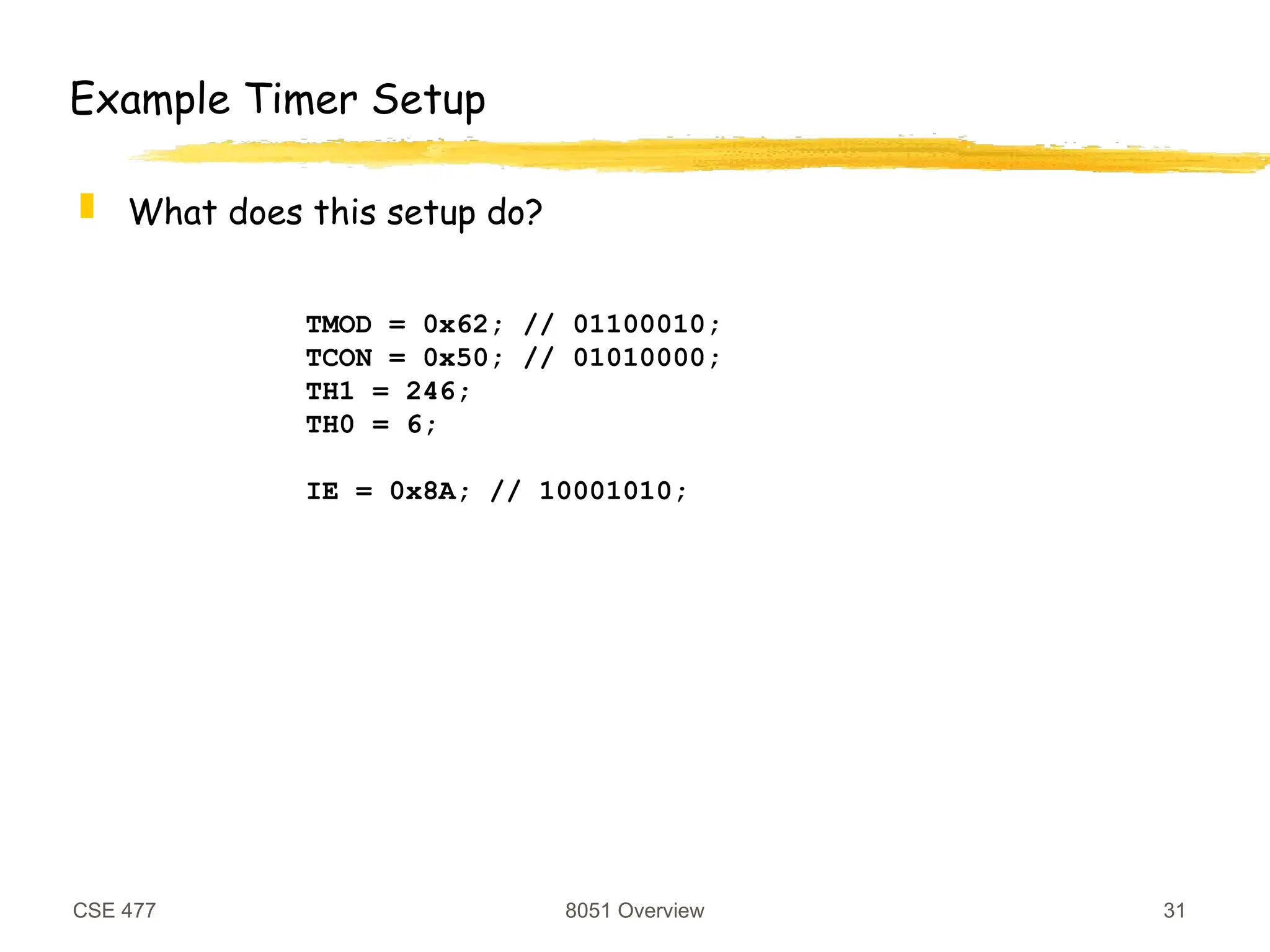
TMOD = 0x62; // 01100010;
TCON = 0x50; // 01010000;
TH1 = 246;
TH0 = 6;
IE = 0x8A; // 10001010;
Example Timer Setup
 What does this setup do?
CSE 477 8051 Overview 32
Using the timers
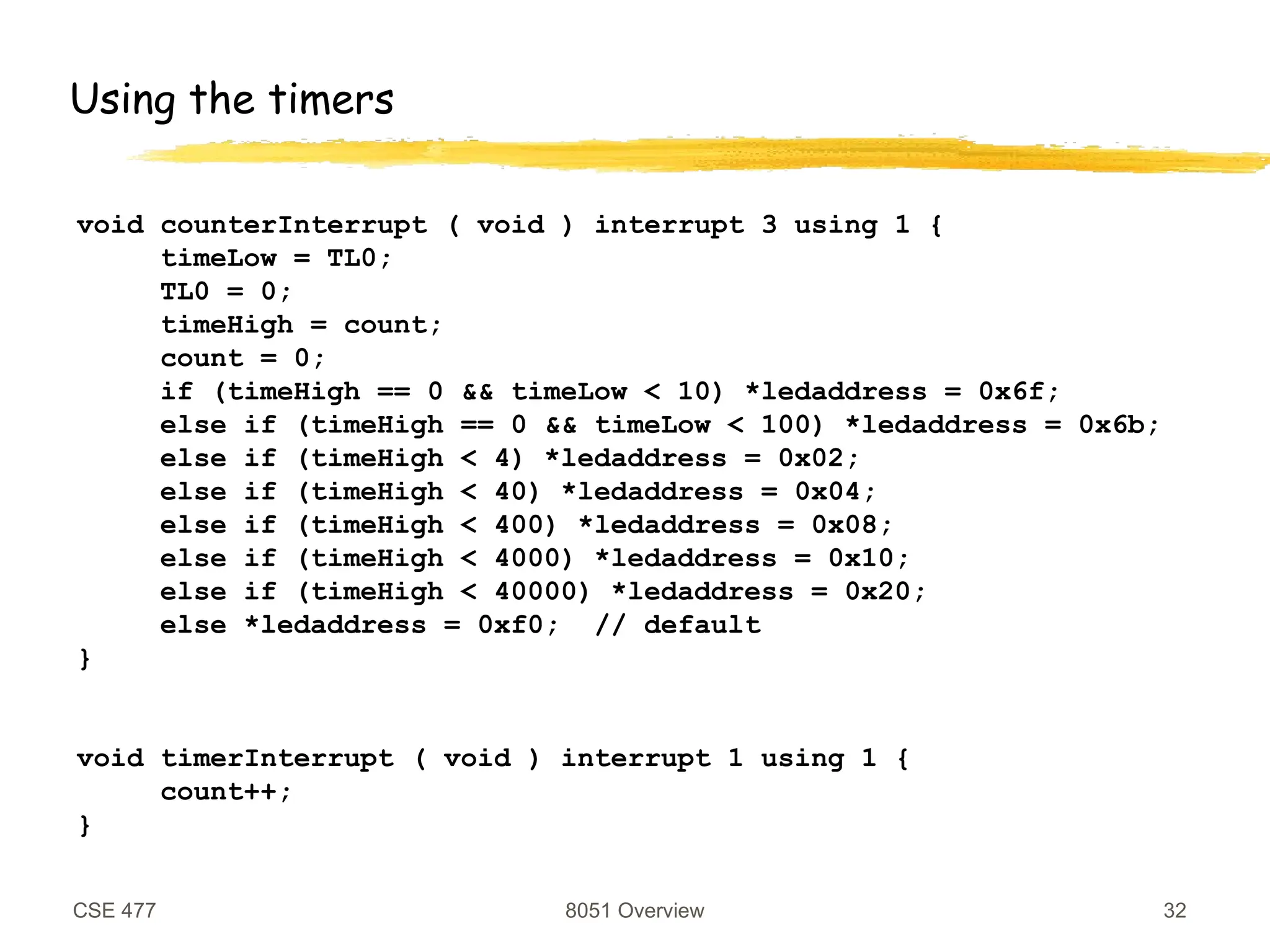
void counterInterrupt ( void ) interrupt 3 using 1 {
timeLow = TL0;
TL0 = 0;
timeHigh = count;
count = 0;
if (timeHigh == 0 && timeLow < 10) *ledaddress = 0x6f;
else if (timeHigh == 0 && timeLow < 100) *ledaddress = 0x6b;
else if (timeHigh < 4) *ledaddress = 0x02;
else if (timeHigh < 40) *ledaddress = 0x04;
else if (timeHigh < 400) *ledaddress = 0x08;
else if (timeHigh < 4000) *ledaddress = 0x10;
else if (timeHigh < 40000) *ledaddress = 0x20;
else *ledaddress = 0xf0; // default
}
void timerInterrupt ( void ) interrupt 1 using 1 {
count++;
}
CSE 477 8051 Overview 33
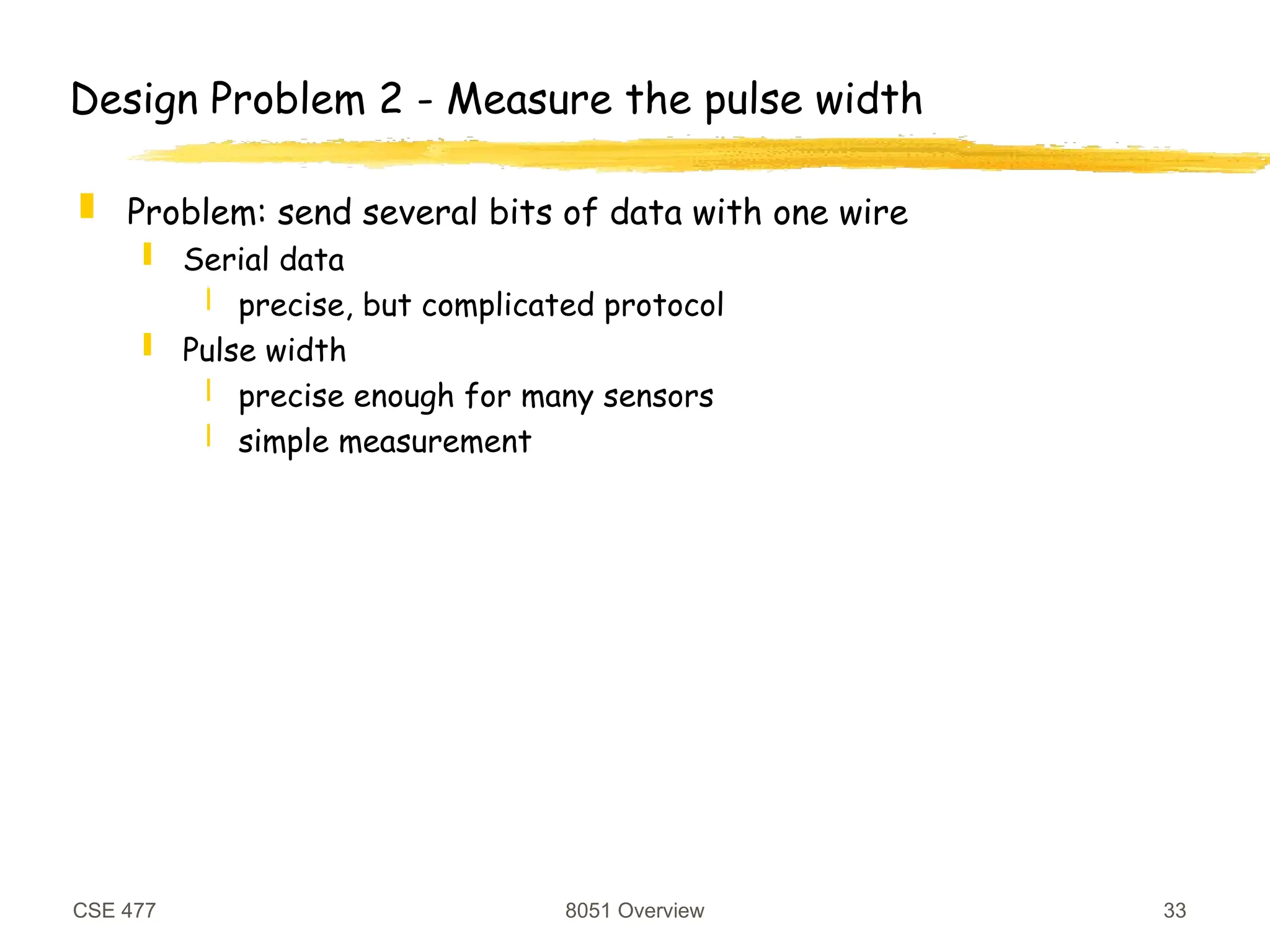
Design Problem 2 - Measure the pulse width
 Problem: send several bits of data with one wire
 Serial data
 precise, but complicated protocol
 Pulse width
 precise enough for many sensors
 simple measurement
CSE 477 8051 Overview 34
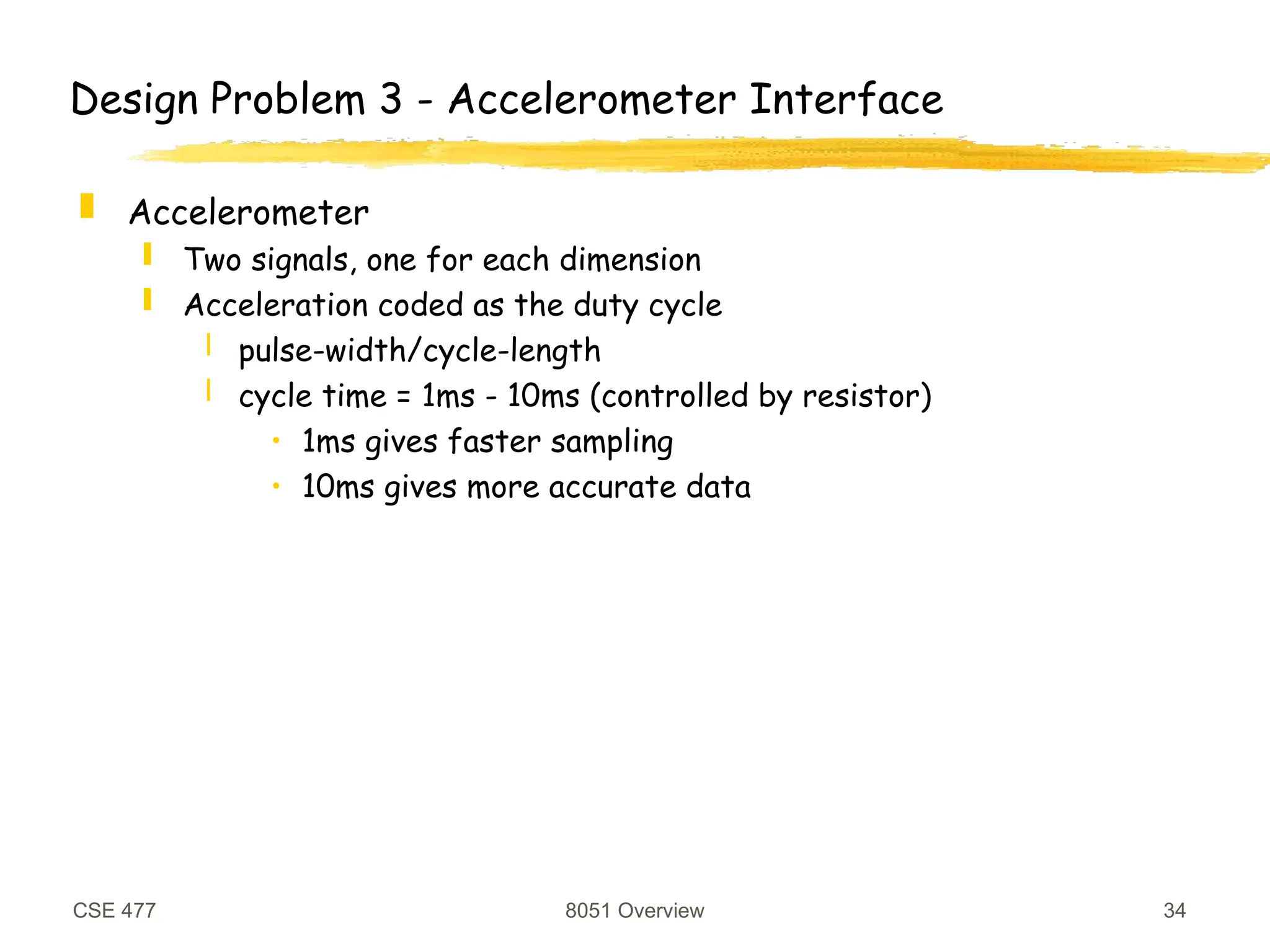
Design Problem 3 - Accelerometer Interface
 Accelerometer
 Two signals, one for each dimension
 Acceleration coded as the duty cycle
 pulse-width/cycle-length
 cycle time = 1ms - 10ms (controlled by resistor)
• 1ms gives faster sampling
• 10ms gives more accurate data
CSE 477 8051 Overview 35
Controlling Interrupts: Enables and Priority
CSE 477 8051 Overview 36
Interrupt Controls
CSE 477 8051 Overview 37
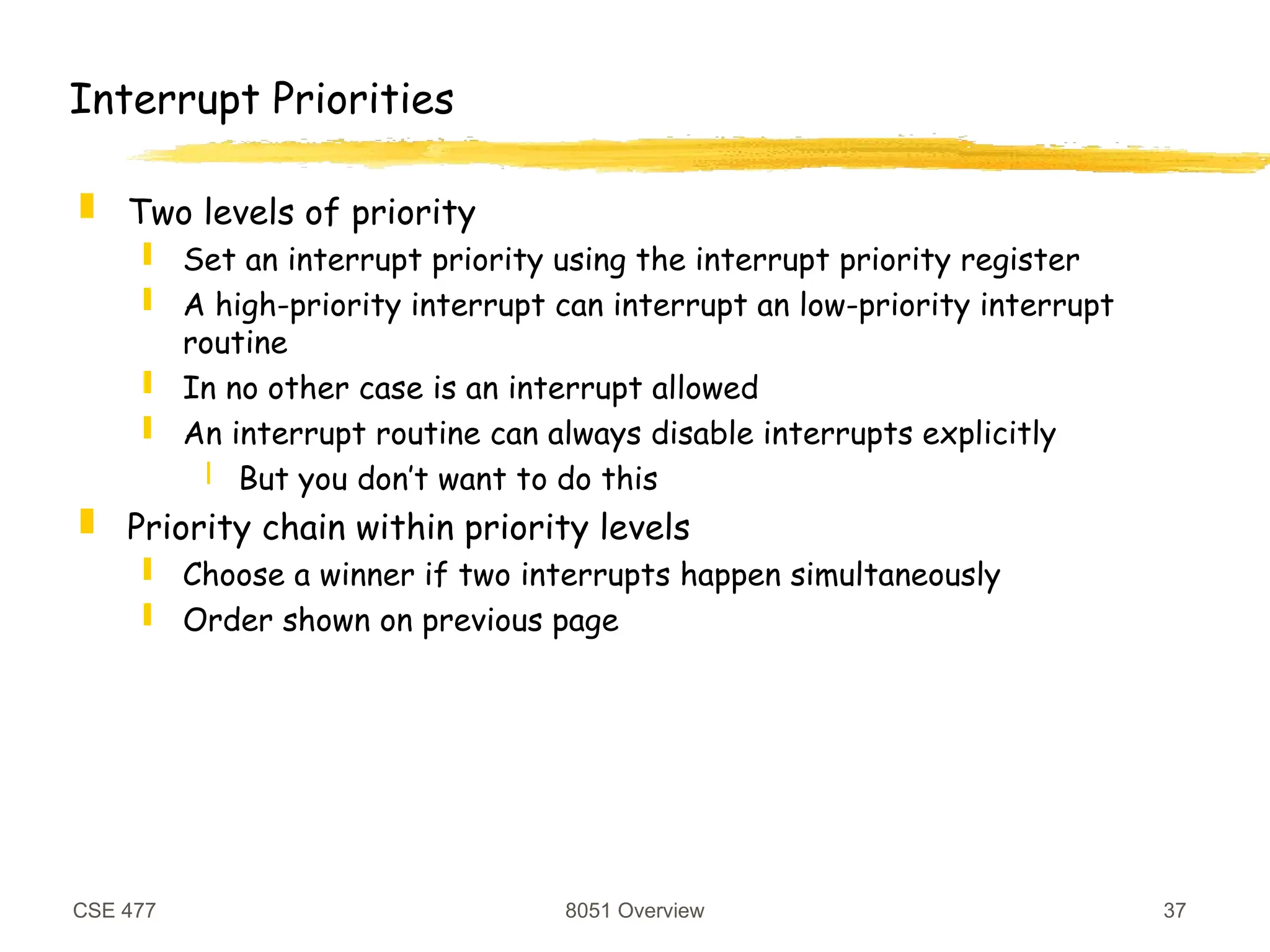
Interrupt Priorities
 Two levels of priority
 Set an interrupt priority using the interrupt priority register
 A high-priority interrupt can interrupt an low-priority interrupt
routine
 In no other case is an interrupt allowed
 An interrupt routine can always disable interrupts explicitly
 But you don’t want to do this
 Priority chain within priority levels
 Choose a winner if two interrupts happen simultaneously
 Order shown on previous page
CSE 477 8051 Overview 38
Re-entrant Functions
 A function can be called simultaneously be different processes
 Recursive functions must be re-entrant
 Functions called by interrupt code and non-interrupt code must
be re-entrant
 Keil C functions by default are not re-entrant
 Does not use the stack for everything
 Use the reentrant specifier to make a function re-entrant
int calc (char i, int b) reentrant {
int x;
x = table[i];
return (x * b);
}
CSE 477 8051 Overview 39
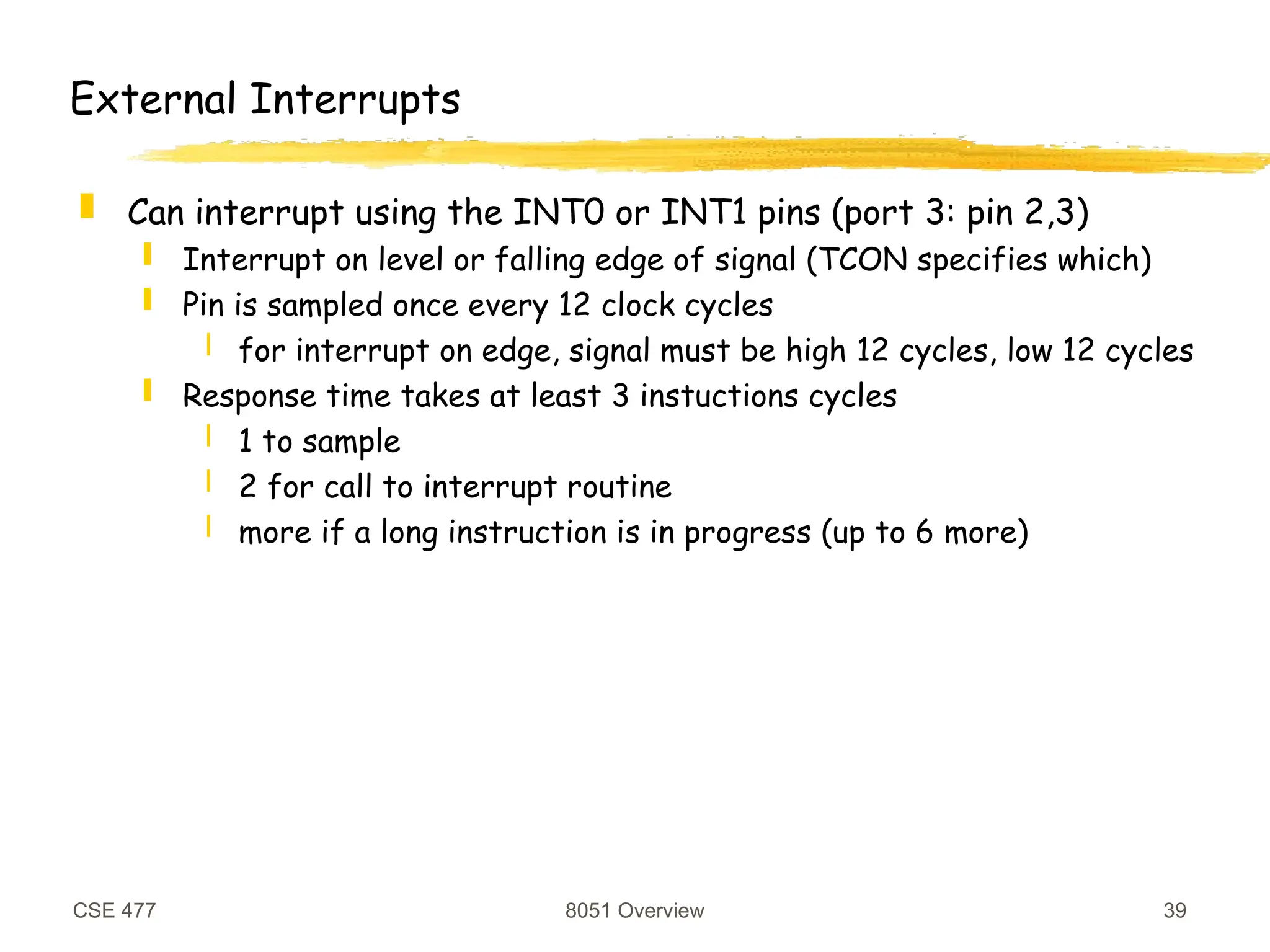
External Interrupts
 Can interrupt using the INT0 or INT1 pins (port 3: pin 2,3)
 Interrupt on level or falling edge of signal (TCON specifies which)
 Pin is sampled once every 12 clock cycles
 for interrupt on edge, signal must be high 12 cycles, low 12 cycles
 Response time takes at least 3 instuctions cycles
 1 to sample
 2 for call to interrupt routine
 more if a long instruction is in progress (up to 6 more)

MEMORY.ppt 8051/8052 MEMORY MANEGEMENT MEMORY DESCRIPTION

  • 1.
    CSE 477 8051Overview 1 80C51 Block Diagram
  • 3.
    CSE 477 8051Overview 3 80C51 Memory
  • 4.
    CSE 477 8051Overview 4 8051 Memory  The data width is 8 bits  Registers are 8 bits  Addresses are 8 bits  i.e. addresses for only 256 bytes!  PC is 16 bits (up to 64K program memory)  DPTR is 16 bits (for external data - up to 64K)  C types  char - 8 bits <-- use this if at all possible!  short - 16 bits  int - 16 bits  long - 32 bits  float - 32 bits  C standard signed/unsigned
  • 5.
    CSE 477 8051Overview 5 Accessing External Memory
  • 6.
    CSE 477 8051Overview 6 Program Memory  Program and Data memory are separate  Can be internal and/or external  20K internal flash for the Atmel controller  Read-only  Instructions  Constant data char code table[5] = {‘1’,‘2’,‘3’,‘4’,‘5’} ;  Compiler uses instructions for moving “immediate” data
  • 7.
    CSE 477 8051Overview 7 External Data Memory  External Data - xdata  Resides off-chip  Accessed using the DPTR and MOVX instruction  We will not use xdata  We will use the SMALL memory model  all data is on-chip  limited to only ~128 bytes of data!
  • 8.
    CSE 477 8051Overview 8 Internal Data Memory  Internal data memory contains all the processor state  Lower 128 bytes: registers, general data  Upper 128 bytes:  indirectly addressed: 128 bytes, used for the stack (small!)  directly addressed: 128 bytes for “special” functions
  • 9.
    CSE 477 8051Overview 9 Lower 128 bytes  Register banks, bit addressable data, general data  you can address any register!  let the C compiler deal with details (for now)
  • 10.
    CSE 477 8051Overview 10 Data Memory Specifiers  “data” - first 128 bytes, directly addressed  the default  “idata” - all 256 bytes, indirectly addressed (slower)  “bdata” - bit-addressable memory  16 bytes from addresses 0x20 to 0x2F  128 bit variables max bit flag1, flag2; flag1 = (a == b);  can access as bytes or bits char bdata flags; sbit flag0 = flags ^ 0; /* use sbit to “overlay” */ sbit flag7 = flags ^ 7; /* ^ specifies bit */ flags = 0; /* Clear all flags */ flag7 = 1; /* Set one flag */
  • 11.
    CSE 477 8051Overview 11 Upper 128 bytes: SFR area
  • 13.
    CSE 477 8051Overview 13 Accessing SFRs  The interesting SFRs are bit-addressable  addresses 0x80, 0x88, 0x90, . . . , 0xF8  SFRs can be addressed by bit, char or int sbit EA = 0xAF; /* one of the interrupt enables sfr Port0 = 0x80; /* Port 0 */ sfr16 Timer2 = 0xCC; /* Timer 2 */ sbit LED0 = Port1 ^ 2; /* Define a port bit */ EA = 1; /* Enable interrupts */ Port0 = 0xff; /* Set all bits in Port 0 to 1 if (Timer2 > 100) . . . LED0 = 1; /* Turn on one bit in Port 2 */
  • 14.
    CSE 477 8051Overview 14 Ports  Port 0 - external memory access  low address byte/data  Port 2 - external memory access  high address byte  Port 1 - general purpose I/O  pins 0, 1 for timer/counter 2  Port 3 - Special features  0 - RxD: serial input  1 - TxD: serial output  2 - INT0: external interrupt  3 - INT1: external interrupt  4 - T0: timer/counter 0 external input  5 - T1: timer/counter 1 external input  6 - WR: external data memory write strobe  7 - RD: external data memory read strobe
  • 15.
    CSE 477 8051Overview 15 Ports
  • 16.
    CSE 477 8051Overview 16 Ports  Port 0 - true bi-directional  Port 1-3 - have internal pullups that will source current  Output pins:  Just write 0/1 to the bit/byte  Input pins:  Output latch must have a 1 (reset state)  Turns off the pulldown  pullup must be pulled down by external driver  Just read the bit/byte
  • 17.
    CSE 477 8051Overview 17 Program Status Word  Register set select  Status bits
  • 18.
    CSE 477 8051Overview 18 Instruction Timing  One “machine cycle” = 6 states (S1 - S6)  One state = 2 clock cycles  One “machine cycle” = 12 clock cycles  Instructions take 1 - 4 cycles  e.g. 1 cycle instructions: ADD, MOV, SETB, NOP  e.g. 2 cycle instructions: JMP, JZ  4 cycle instructions: MUL, DIV
  • 19.
    CSE 477 8051Overview 19 Instruction Timing
  • 20.
    CSE 477 8051Overview 20 Timers  Base 8051 has 2 timers  we have 3 in the Atmel 89C55  Timer mode  Increments every machine cycle (12 clock cycles)  Counter mode  Increments when T0/T1 go from 1 - 0 (external signal)  Access timer value directly  Timer can cause an interrupt  Timer 1 can be used to provide programmable baud rate for serial communications  Timer/Counter operation  Mode control register (TMOD)  Control register (TCON)
  • 21.
    CSE 477 8051Overview 21 Mode Control Register (TMOD)  Modes 0-3  GATE - allows external pin to enable timer (e.g. external pulse)  0: INT pin not used  1: counter enabled by INT pin (port 3.2, 3.3)  C/T - indicates timer or counter mode
  • 22.
    CSE 477 8051Overview 22 Timer/Counter Control Register (TCON)  TR - enable timer/counter  TF - overflow flag: can cause interrupt  IE/IT - external interrupts and type control  not related to the timer/counter
  • 23.
    CSE 477 8051Overview 23 Timer/Counter Mode 0  Mode 1 same as Mode 0, but uses all 16 bits
  • 24.
    CSE 477 8051Overview 24 Timer/Counter Mode 2  8-bit counter, auto-reload on overflow
  • 25.
    CSE 477 8051Overview 25 Timer/Counter Mode 3  Applies to Timer/Counter 0  Gives an extra timer
  • 26.
    CSE 477 8051Overview 26 Interrupts  Allow parallel tasking  Interrupt routine runs in “background”  Allow fast, low-overhead interaction with environment  Don’t have to poll  Immediate reaction  An automatic function call  Easy to program  8051 Interrupts  Serial port - wake up when data arrives/data has left  Timer 0 overflow  Timer 1 overflow  External interrupt 0  External interrupt 1
  • 27.
    CSE 477 8051Overview 27 Interrupt Vector  For each interrupt, which interrupt function to call  In low program addresses  Hardware generates an LCALL to address in interrupt vector  Pushes PC (but nothing else) onto the stack  RETI instruction to return from interrupt 0x00 - Reset PC address 0: 0x03 - External interrupt 0 1: 0x0B - Timer 0 2: 0x13 - External interrupt 1 3: 0x1B - Timer 1 4: 0x23 - Serial line interrupt
  • 28.
    CSE 477 8051Overview 28 Writing Interrupts in C  The C compiler takes care of everything  Pushing/popping the right registers (PSW, ACC, etc.)  Generating the RTI instruction  No arguments/no return values unsigned int count; unsigned char second; void timer0 (void) interrupt 1 using 2 { if (++count == 4000) { second++; count = 0; } }  Timer mode 2  Reload value = 6
  • 29.
    CSE 477 8051Overview 29 Timer Interrupts  Wakeup after N clock cycles, i.e. at a specified time  Wakeup every N clock cycles (auto reload)  Allows simple task scheduling  Clients queue function calls for time i  Interrupt routine calls functions at the right time  Wakeup after N events have occurred on an input
  • 30.
    CSE 477 8051Overview 30 Design Problem 1 - frequency counter  Measure the frequency of an external signal  Display as a number using the 7-segment display  e.g. number represents exponent of 2 or 10
  • 31.
    CSE 477 8051Overview 31 TMOD = 0x62; // 01100010; TCON = 0x50; // 01010000; TH1 = 246; TH0 = 6; IE = 0x8A; // 10001010; Example Timer Setup  What does this setup do?
  • 32.
    CSE 477 8051Overview 32 Using the timers void counterInterrupt ( void ) interrupt 3 using 1 { timeLow = TL0; TL0 = 0; timeHigh = count; count = 0; if (timeHigh == 0 && timeLow < 10) *ledaddress = 0x6f; else if (timeHigh == 0 && timeLow < 100) *ledaddress = 0x6b; else if (timeHigh < 4) *ledaddress = 0x02; else if (timeHigh < 40) *ledaddress = 0x04; else if (timeHigh < 400) *ledaddress = 0x08; else if (timeHigh < 4000) *ledaddress = 0x10; else if (timeHigh < 40000) *ledaddress = 0x20; else *ledaddress = 0xf0; // default } void timerInterrupt ( void ) interrupt 1 using 1 { count++; }
  • 33.
    CSE 477 8051Overview 33 Design Problem 2 - Measure the pulse width  Problem: send several bits of data with one wire  Serial data  precise, but complicated protocol  Pulse width  precise enough for many sensors  simple measurement
  • 34.
    CSE 477 8051Overview 34 Design Problem 3 - Accelerometer Interface  Accelerometer  Two signals, one for each dimension  Acceleration coded as the duty cycle  pulse-width/cycle-length  cycle time = 1ms - 10ms (controlled by resistor) • 1ms gives faster sampling • 10ms gives more accurate data
  • 35.
    CSE 477 8051Overview 35 Controlling Interrupts: Enables and Priority
  • 36.
    CSE 477 8051Overview 36 Interrupt Controls
  • 37.
    CSE 477 8051Overview 37 Interrupt Priorities  Two levels of priority  Set an interrupt priority using the interrupt priority register  A high-priority interrupt can interrupt an low-priority interrupt routine  In no other case is an interrupt allowed  An interrupt routine can always disable interrupts explicitly  But you don’t want to do this  Priority chain within priority levels  Choose a winner if two interrupts happen simultaneously  Order shown on previous page
  • 38.
    CSE 477 8051Overview 38 Re-entrant Functions  A function can be called simultaneously be different processes  Recursive functions must be re-entrant  Functions called by interrupt code and non-interrupt code must be re-entrant  Keil C functions by default are not re-entrant  Does not use the stack for everything  Use the reentrant specifier to make a function re-entrant int calc (char i, int b) reentrant { int x; x = table[i]; return (x * b); }
  • 39.
    CSE 477 8051Overview 39 External Interrupts  Can interrupt using the INT0 or INT1 pins (port 3: pin 2,3)  Interrupt on level or falling edge of signal (TCON specifies which)  Pin is sampled once every 12 clock cycles  for interrupt on edge, signal must be high 12 cycles, low 12 cycles  Response time takes at least 3 instuctions cycles  1 to sample  2 for call to interrupt routine  more if a long instruction is in progress (up to 6 more)