Function of
Management
Chapter 7,
Function of Management
1. Planning
2. Organizing
3. Staffing
4. Directing
5. Controlling
Meaning, Nature and Importance of
Planning
“Management planning involves the development of forecasts,
objectives, policies, programmes, procedures, schedules and
budgets”.
Nature Of Planning
 Planning is goal-oriented
 Primacy of Planning
 Pervasiveness of Planning
 Efficiency, Economy and Accuracy
 Co-ordination
 Limiting Factors
 Flexibility
 Planning is an intellectual process
Importance of Planning
 To manage by objectives
 To offset uncertainty and change
 To secure economy in operation
 To help in co-ordination
 To make control effective
 To increase organizational effectiveness
Meaning, Nature and Importance of
Organizing
“Organisation is the process of identifying and
grouping the work to be performed, defining and
delegating responsibility and authority, and
establishing relationships for the purpose of enabling
people to work most effectively together in
accomplishing objectives.”
“Organization is a system of cooperative activities of
two or more persons.” – Chester Barnard
Nature of Organizing
1. Process
2. Structure
3. Dividing and Grouping the Activities
4. Accomplishment of Goals or Objectives
5. Authority-Responsibility Relationship
6. Human and Material Aspects
Meaning, Nature and Importance of
Staffing
“The managerial function of staffing involves manning
the organizational structure through effective and
proper selection, appraisal, and development of
personnel to fill the roles designed into the structure.”
— Koontz and O’Donnell
Nature of the Staffing
1. People Centered
2. Responsibility of Every Manager
3. Human Skills
4. Continuous Function
Importance of Staffing
1. Efficient Performance of Other Functions
2. Effective Use of Technology and Other Resources
3. Optimum Utilization of Human Resources
4. Development of Human Capital
5. Motivation of Human Resources
6. Building Higher Morale
Meaning, Nature and Importance of
Directing
Directing is “a managerial function that involves the
responsibility of managers for communicating to others
what their roles are in achieving the company plan.”
Pearce and Robinson
Nature of Direction
1. Process of action
2. On-going process
3. Not supported by rules
4. Directing is situational
5. Behavioral science
6. Understand group behavior
7. Participative
Importance of Direction
1. Initiates action
2. Creates a sound work
environment
3. Develops managers
4. Behavioral satisfaction
5. Increase in productivity
6. Achieves coordination
7. Facilitates control
8. Facilitates change
9. Facilitates growth
Meaning, Nature and Importance of
Controlling
According to E.F.L. Breach “Controlling is checking
performance against pre-determined standards
contained in the plans, with a view to ensuring
adequate progress and satisfactory performance”.
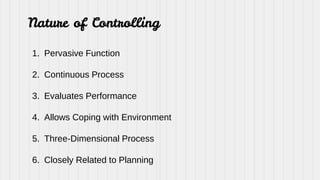
Nature of Controlling
1. Pervasive Function
2. Continuous Process
3. Evaluates Performance
4. Allows Coping with Environment
5. Three-Dimensional Process
6. Closely Related to Planning
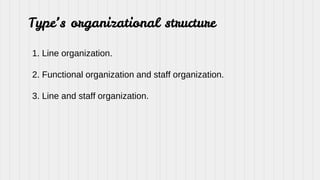
Type’s organizational structure
1. Line organization.
2. Functional organization and staff organization.
3. Line and staff organization.
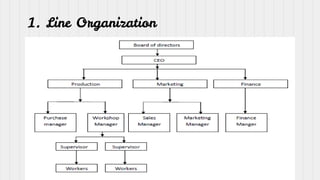
1. Line Organization
Advantages and Disadvantages
 Advantages:
 Simplicity
 Fixed responsibility
 More Discipline
 Direct communication
 Unity of command
 Quick decisions
 Disadvantages:
 Overloading
 Lack of specialization
 Scope for favouritisms
 Lack of co-ordination
 Lack of initiative
2. Functional Organization / Staff
Organization
1.
Advantages and Disadvantages
 Advantages:
 Specialization we can use
 Large scale Production
 Flexibility
 Decentralization of Authority
 Excess Of Clerical
 Growth Of Unit
Disadvantages:
 Expensive
 Violation of the Unity of
Command
 Lack of Discipline and Control
 Absence of Authority
 Difficulty of Co ordination
3. Functional and Staff Organization
Advantages and Disadvantages
 Advantages:
 Simplicity
 Co ordination
 Balance
 Flexibility
 Relief to the line Authority
 Blending Of abilities of Line
and Staff
 Prompt Decision
 Disadvantages:
 Conflict Among Officials
 Expensive
 Evading Responsibilities
 Neglect Of Line Authority
Suggestion
 Conflict Between old and New
 Carelessness among the Line
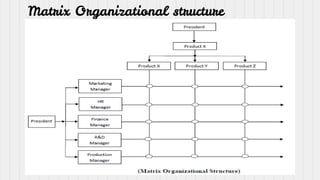
Matrix Organizational structure
Advantages and Disadvantages
 Advantages:
 Dual benefit
 Batter planning and control
 Environmental Adaptability
 Flexibility
 Batter Motivation
 Development of Personnel
Disadvantages:
 Complex Relationship
 Power Struggle
 Heterogeneity
 More costly
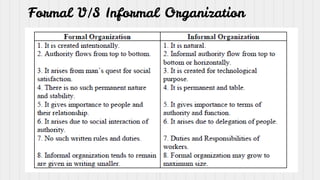
Formal V/S Informal Organization
Span Of Control
Span of Control can be defined as the total number of direct
subordinates that a manager can control or manage. The number of
subordinates managed by a manager varies depending on the complexity
of the work.
For example, a manager can manage 4-6 subordinates when the nature
of work is complex, whereas, the number can go up to 15-20
subordinates for repetitive or fixed work.
Narrow Span of Control
A narrow span of control is a management style where
supervisors manage only a small number of employees. ...
Narrow spans of control are the opposite of wide spans of
control, where many employees report to a single manager
rather than only a few.
Advantages and Disadvantages
 Advantages:
 The manager can supervisor each
of his subordinates intimately.
 The nature of work is usually
complicated.
 Effective communication between
the subordinates and their
manager.
 More layers in the hierarchy of
management.
Disadvantages:
 Too much control over employees
might hamper their original talent and
creativity.
 Extended hierarchy of control results in
a long time in decision-making.
 Narrow span of controlling prevents
cross-functional problem-solving.
Narrow Span of Control
Wide span of control: Wide span of control means a
manager can supervise and control effectively a large
number of persons at a time. It is because shorter span of
control leads to rise in number of steps or levels in vertical
chain of command which leads to tall organization.
Advantages and Disadvantages
 Advantages:
 In a wide span of control,
subordinates are more
independent.
 Fewer layers in the hierarchy of
management.
 The nature of work is repetitive.
 Less direct communication
between subordinates and
managers.
 Disadvantages:
 Ineffective management.
 Increased workload on managers.
 The roles of team members are not
clearly defined.
 Less communication between
managers and subordinates
reduces the control of the manager.
Important Questions
Q.1 What is mean by organization? Explain the organizational structure.
Q.2 Explain the types of organization.
Q.3 What is mean by departmentalization? Explain the types of it.
Q.4 What is span of control? Discuss in detail.
Q.5 Explain the principles of organization
Q.6 What is mean of matrix organizational structure? Merit and demerit.
Q.7 Explain the different organizational structure with merit and demerits.
Thank You

Chapter+7,+function+of+management.pptx

  • 1.
  • 2.
    Function of Management 1.Planning 2. Organizing 3. Staffing 4. Directing 5. Controlling
  • 3.
    Meaning, Nature andImportance of Planning “Management planning involves the development of forecasts, objectives, policies, programmes, procedures, schedules and budgets”.
  • 4.
    Nature Of Planning Planning is goal-oriented  Primacy of Planning  Pervasiveness of Planning  Efficiency, Economy and Accuracy  Co-ordination  Limiting Factors  Flexibility  Planning is an intellectual process
  • 5.
    Importance of Planning To manage by objectives  To offset uncertainty and change  To secure economy in operation  To help in co-ordination  To make control effective  To increase organizational effectiveness
  • 6.
    Meaning, Nature andImportance of Organizing “Organisation is the process of identifying and grouping the work to be performed, defining and delegating responsibility and authority, and establishing relationships for the purpose of enabling people to work most effectively together in accomplishing objectives.” “Organization is a system of cooperative activities of two or more persons.” – Chester Barnard
  • 7.
    Nature of Organizing 1.Process 2. Structure 3. Dividing and Grouping the Activities 4. Accomplishment of Goals or Objectives 5. Authority-Responsibility Relationship 6. Human and Material Aspects
  • 8.
    Meaning, Nature andImportance of Staffing “The managerial function of staffing involves manning the organizational structure through effective and proper selection, appraisal, and development of personnel to fill the roles designed into the structure.” — Koontz and O’Donnell
  • 9.
    Nature of theStaffing 1. People Centered 2. Responsibility of Every Manager 3. Human Skills 4. Continuous Function
  • 10.
    Importance of Staffing 1.Efficient Performance of Other Functions 2. Effective Use of Technology and Other Resources 3. Optimum Utilization of Human Resources 4. Development of Human Capital 5. Motivation of Human Resources 6. Building Higher Morale
  • 11.
    Meaning, Nature andImportance of Directing Directing is “a managerial function that involves the responsibility of managers for communicating to others what their roles are in achieving the company plan.” Pearce and Robinson
  • 12.
    Nature of Direction 1.Process of action 2. On-going process 3. Not supported by rules 4. Directing is situational 5. Behavioral science 6. Understand group behavior 7. Participative
  • 13.
    Importance of Direction 1.Initiates action 2. Creates a sound work environment 3. Develops managers 4. Behavioral satisfaction 5. Increase in productivity 6. Achieves coordination 7. Facilitates control 8. Facilitates change 9. Facilitates growth
  • 14.
    Meaning, Nature andImportance of Controlling According to E.F.L. Breach “Controlling is checking performance against pre-determined standards contained in the plans, with a view to ensuring adequate progress and satisfactory performance”.
  • 15.
    Nature of Controlling 1.Pervasive Function 2. Continuous Process 3. Evaluates Performance 4. Allows Coping with Environment 5. Three-Dimensional Process 6. Closely Related to Planning
  • 16.
    Type’s organizational structure 1.Line organization. 2. Functional organization and staff organization. 3. Line and staff organization.
  • 17.
  • 18.
    Advantages and Disadvantages Advantages:  Simplicity  Fixed responsibility  More Discipline  Direct communication  Unity of command  Quick decisions  Disadvantages:  Overloading  Lack of specialization  Scope for favouritisms  Lack of co-ordination  Lack of initiative
  • 19.
    2. Functional Organization/ Staff Organization 1.
  • 20.
    Advantages and Disadvantages Advantages:  Specialization we can use  Large scale Production  Flexibility  Decentralization of Authority  Excess Of Clerical  Growth Of Unit Disadvantages:  Expensive  Violation of the Unity of Command  Lack of Discipline and Control  Absence of Authority  Difficulty of Co ordination
  • 21.
    3. Functional andStaff Organization
  • 22.
    Advantages and Disadvantages Advantages:  Simplicity  Co ordination  Balance  Flexibility  Relief to the line Authority  Blending Of abilities of Line and Staff  Prompt Decision  Disadvantages:  Conflict Among Officials  Expensive  Evading Responsibilities  Neglect Of Line Authority Suggestion  Conflict Between old and New  Carelessness among the Line
  • 23.
  • 24.
    Advantages and Disadvantages Advantages:  Dual benefit  Batter planning and control  Environmental Adaptability  Flexibility  Batter Motivation  Development of Personnel Disadvantages:  Complex Relationship  Power Struggle  Heterogeneity  More costly
  • 25.
    Formal V/S InformalOrganization
  • 26.
    Span Of Control Spanof Control can be defined as the total number of direct subordinates that a manager can control or manage. The number of subordinates managed by a manager varies depending on the complexity of the work. For example, a manager can manage 4-6 subordinates when the nature of work is complex, whereas, the number can go up to 15-20 subordinates for repetitive or fixed work.
  • 27.
    Narrow Span ofControl A narrow span of control is a management style where supervisors manage only a small number of employees. ... Narrow spans of control are the opposite of wide spans of control, where many employees report to a single manager rather than only a few.
  • 28.
    Advantages and Disadvantages Advantages:  The manager can supervisor each of his subordinates intimately.  The nature of work is usually complicated.  Effective communication between the subordinates and their manager.  More layers in the hierarchy of management. Disadvantages:  Too much control over employees might hamper their original talent and creativity.  Extended hierarchy of control results in a long time in decision-making.  Narrow span of controlling prevents cross-functional problem-solving.
  • 29.
    Narrow Span ofControl Wide span of control: Wide span of control means a manager can supervise and control effectively a large number of persons at a time. It is because shorter span of control leads to rise in number of steps or levels in vertical chain of command which leads to tall organization.
  • 30.
    Advantages and Disadvantages Advantages:  In a wide span of control, subordinates are more independent.  Fewer layers in the hierarchy of management.  The nature of work is repetitive.  Less direct communication between subordinates and managers.  Disadvantages:  Ineffective management.  Increased workload on managers.  The roles of team members are not clearly defined.  Less communication between managers and subordinates reduces the control of the manager.
  • 31.
    Important Questions Q.1 Whatis mean by organization? Explain the organizational structure. Q.2 Explain the types of organization. Q.3 What is mean by departmentalization? Explain the types of it. Q.4 What is span of control? Discuss in detail. Q.5 Explain the principles of organization Q.6 What is mean of matrix organizational structure? Merit and demerit. Q.7 Explain the different organizational structure with merit and demerits.
  • 32.