Chapter 3- slide 1
Copyright © 2009 Pearson Education, Inc.
Publishing as Prentice Hall
Chapter Three
Analyzing the Marketing Environment
Chapter 3- slide 2
Copyright © 2010 Pearson Education, Inc.
Publishing as Prentice Hall
The Marketing Environment
The marketing environment includes the actors and
forces outside marketing that affect marketing
management’s ability to build and maintain
successful relationships with customers
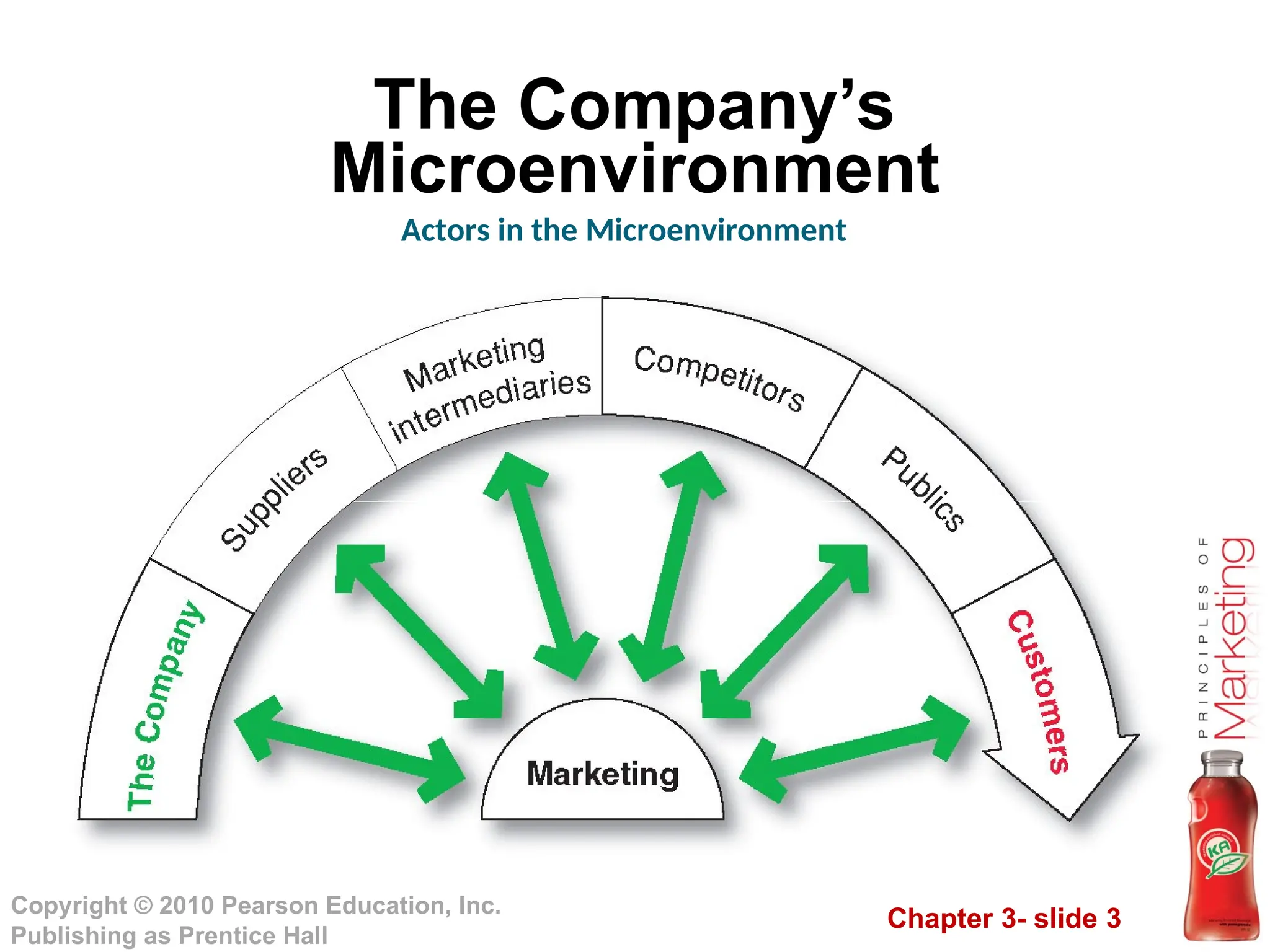
Microenvironment consists of the actors close to the
company that affect its ability to serve its
customers, the company, suppliers, marketing
intermediaries, customer markets, competitors,
and publics
Chapter 3- slide 3
Copyright © 2010 Pearson Education, Inc.
Publishing as Prentice Hall
The Company’s
Microenvironment
Actors in the Microenvironment
Chapter 3- slide 4
Copyright © 2010 Pearson Education, Inc.
Publishing as Prentice Hall
The Company’s
Microenvironment
• The Company: functional areas such as top
management,
finance,manufacturing,purchasing,operation
accounting etc
• Suppliers: provide the resources to produce
goods and services
• Marketing Intermediaries: help the company to
promote, sell and distribute its goods to
consumer
Chapter 3- slide 5
Copyright © 2010 Pearson Education, Inc.
Publishing as Prentice Hall
Competitors
• Those who aim at what we aim at.
• Those you serve the market with similar products
and service
• Inspirers or rivals ?
Chapter 3- slide 6
Copyright © 2010 Pearson Education, Inc.
Publishing as Prentice Hall
Customers
Customers: those who buy and for whom marketing
takes place
•Consumer markets
•Business markets
•Reseller markets
•Government markets
•International markets
Chapter 3- slide 7
Copyright © 2010 Pearson Education, Inc.
Publishing as Prentice Hall
Publics
• Any group that has an actual or potential interest in or
impact on an organization’s ability to achieve its
objectives such as
• Financial public
• Media public
• Government public
• Local public
• Internal public
• General Public
Chapter 3- slide 8
Copyright © 2010 Pearson Education, Inc.
Publishing as Prentice Hall
Publics (cont)
• Financial publics: influences the company’s ability
to obtain funds, investment companies, banks,
stockholders
• Media publics: carries news,features,editorial
opinions and other content,
newpapers,magzines,blogs, and other social
media etc
Chapter 3- slide 9
Copyright © 2010 Pearson Education, Inc.
Publishing as Prentice Hall
Publics (cont)
• Government publics: Marketers must often
consult company’s lawyers on issues of product
safety,truth in advertising and other matters.
• Local publics: The group includes local community
residents and organization
• General Public: A company needs to be
concerned about general public’s attitude
towards its products and activities. The public
image of a company affects its buying behavior
Chapter 3- slide 10
Copyright © 2010 Pearson Education, Inc.
Publishing as Prentice Hall
Publics (cont)
• Internal publics: This group includes workers,
managers,boards of directors ,volunteers and all
employees .
Chapter 3- slide 11
Copyright © 2010 Pearson Education, Inc.
Publishing as Prentice Hall
The Company’s
Macroenvironment
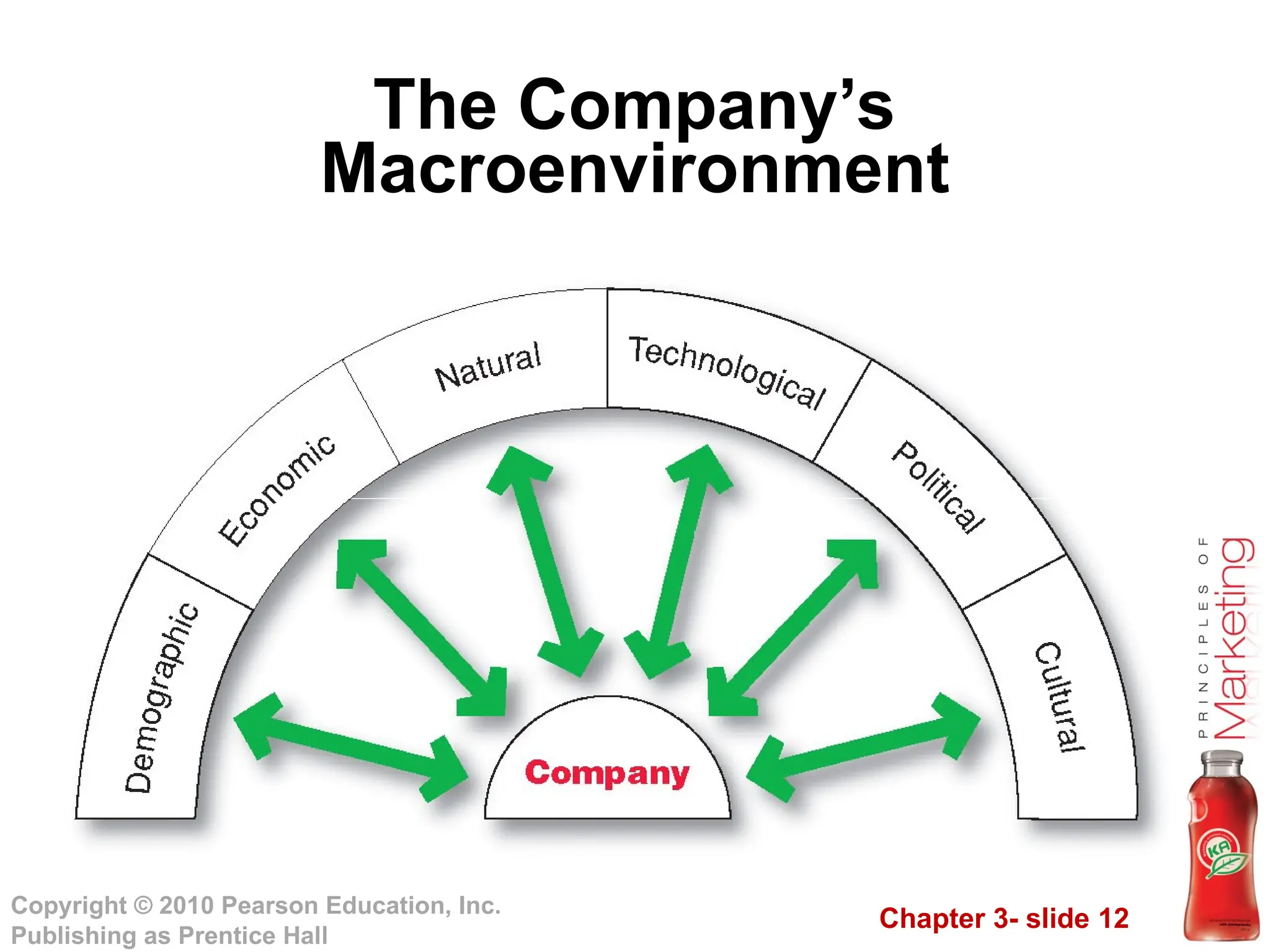
Consists of larger environmental forces that affect
the microenvironment
•Demographic
•Economic
•Natural
•Technological
•Political
•Cultural
Chapter 3- slide 12
Copyright © 2010 Pearson Education, Inc.
Publishing as Prentice Hall
The Company’s
Macroenvironment
Chapter 3- slide 13
Copyright © 2010 Pearson Education, Inc.
Publishing as Prentice Hall
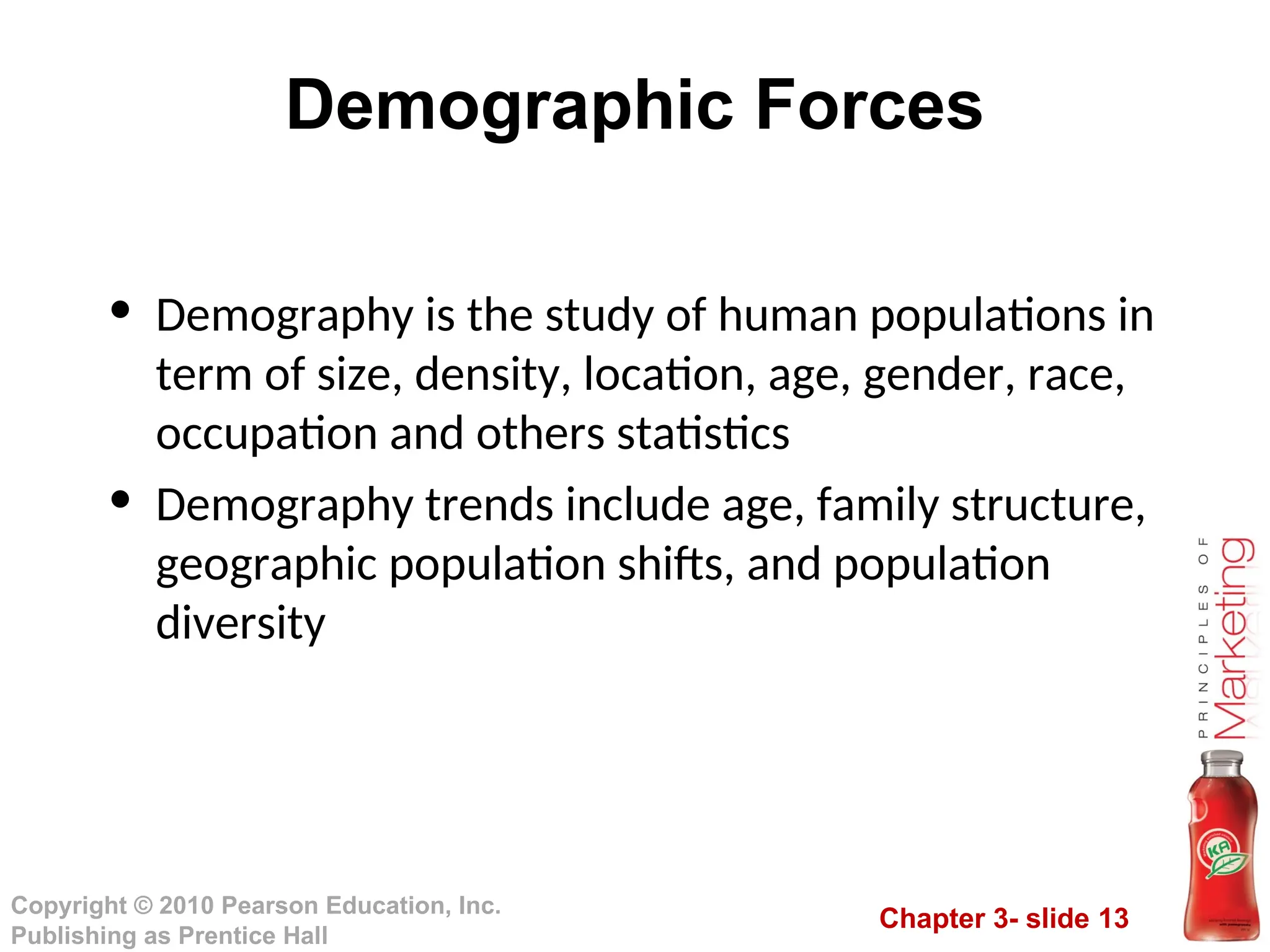
Demographic Forces
• Demography is the study of human populations in
term of size, density, location, age, gender, race,
occupation and others statistics
• Demography trends include age, family structure,
geographic population shifts, and population
diversity
Chapter 3- slide 14
Copyright © 2010 Pearson Education, Inc.
Publishing as Prentice Hall
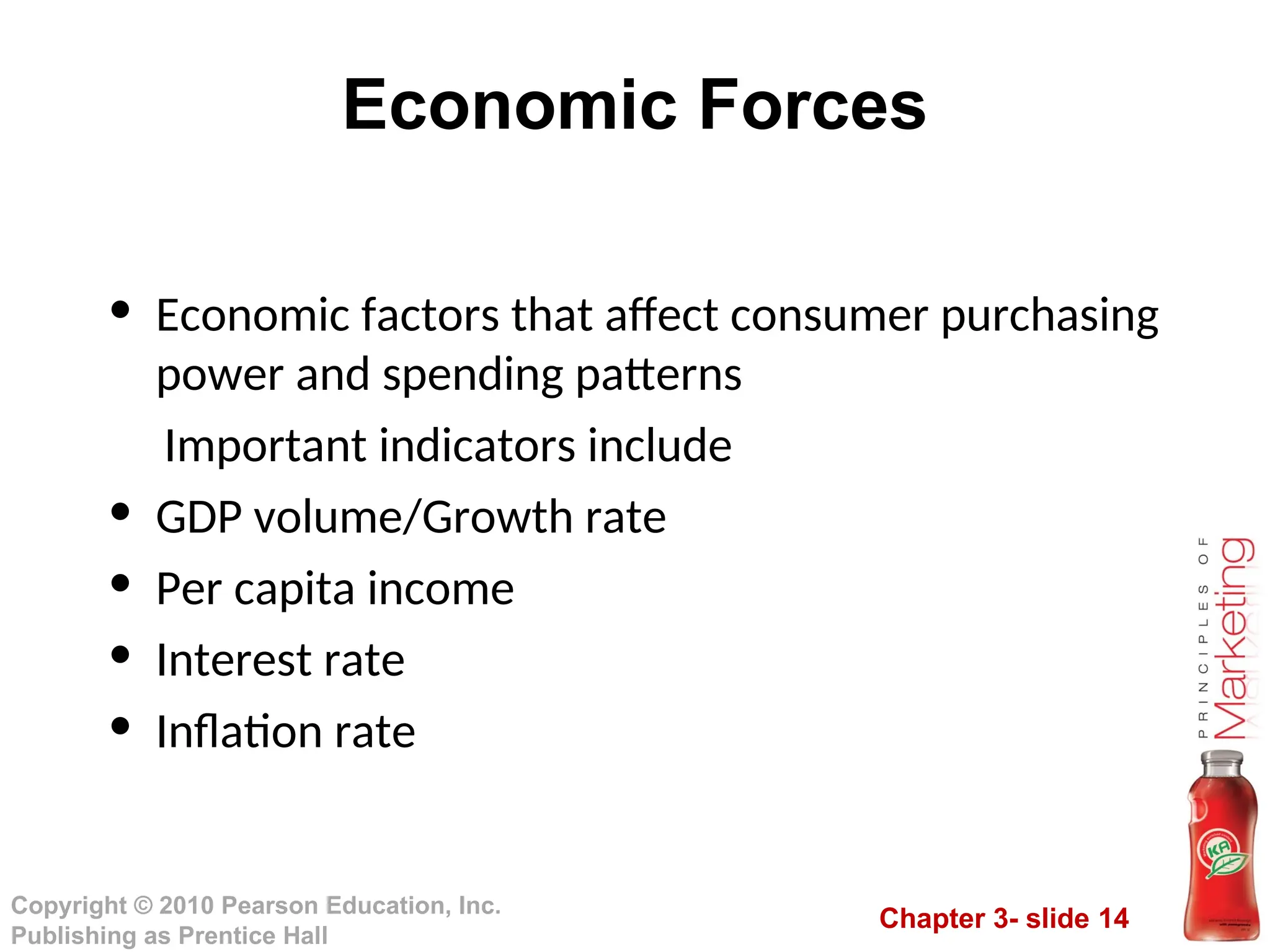
Economic Forces
• Economic factors that affect consumer purchasing
power and spending patterns
Important indicators include
• GDP volume/Growth rate
• Per capita income
• Interest rate
• Inflation rate
Chapter 3- slide 15
Copyright © 2010 Pearson Education, Inc.
Publishing as Prentice Hall
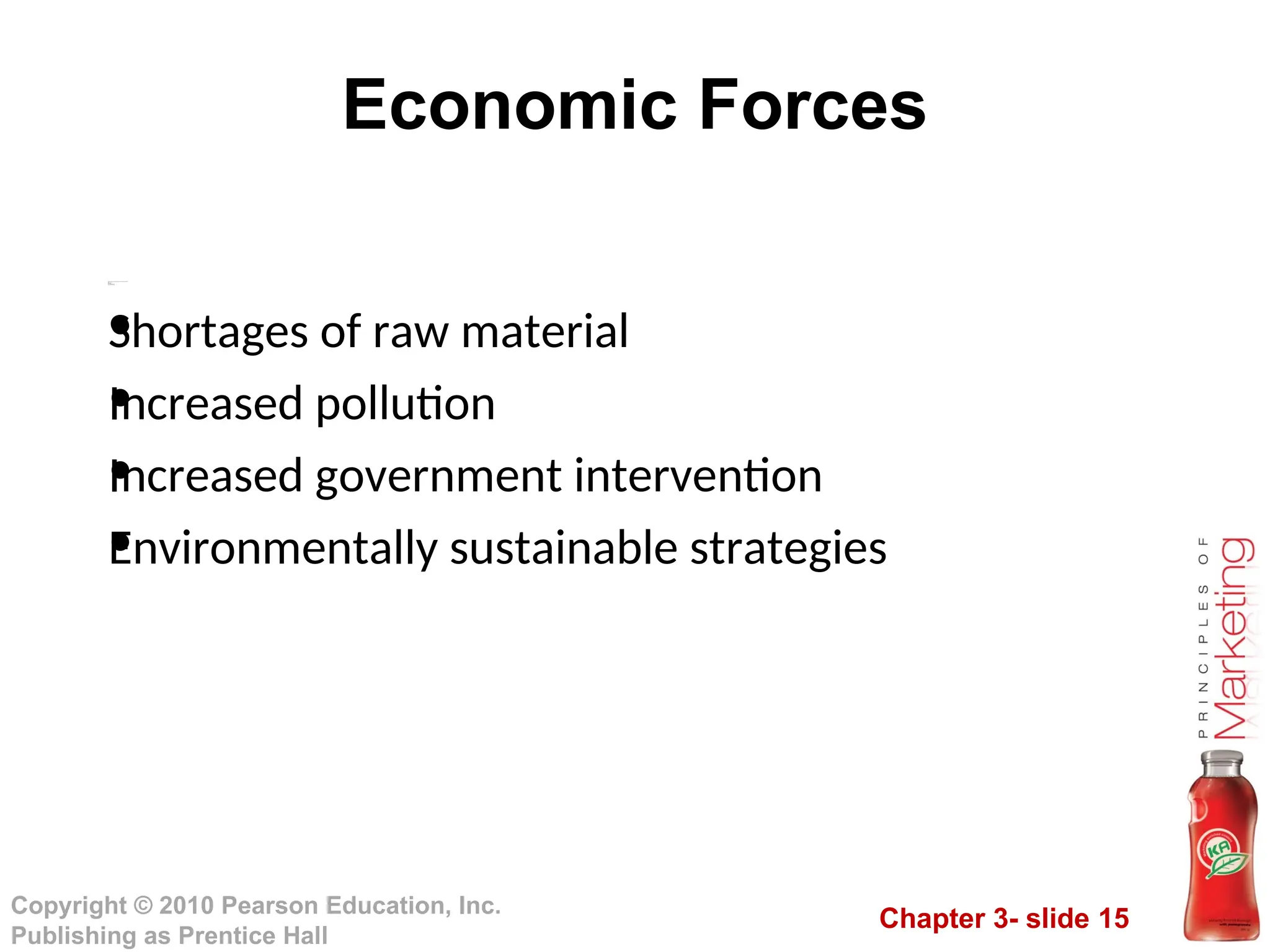
Economic Forces
Invol
vesthenatur al
resource sthat arene ededa si
nputs byma rket ersor theya reaff
e ctedby mark eti
ng acti
vi
ties
Trends
•
Shor tages ofraw
m ater i
al
•
Incr easedpol
l
uti
on
•
Incr easedgovernment i
nter venti
on
•
Envi
r onme ntal
l
ysustai
na bl
est rateg i
es
•
Shortages of raw material
•
Increased pollution
•
Increased government intervention
•
Environmentally sustainable strategies
Chapter 3- slide 16
Copyright © 2010 Pearson Education, Inc.
Publishing as Prentice Hall
Technological Forces
Forces that create new technologies, creating new
products and marketing opportunities
Chapter 3- slide 17
Copyright © 2010 Pearson Education, Inc.
Publishing as Prentice Hall
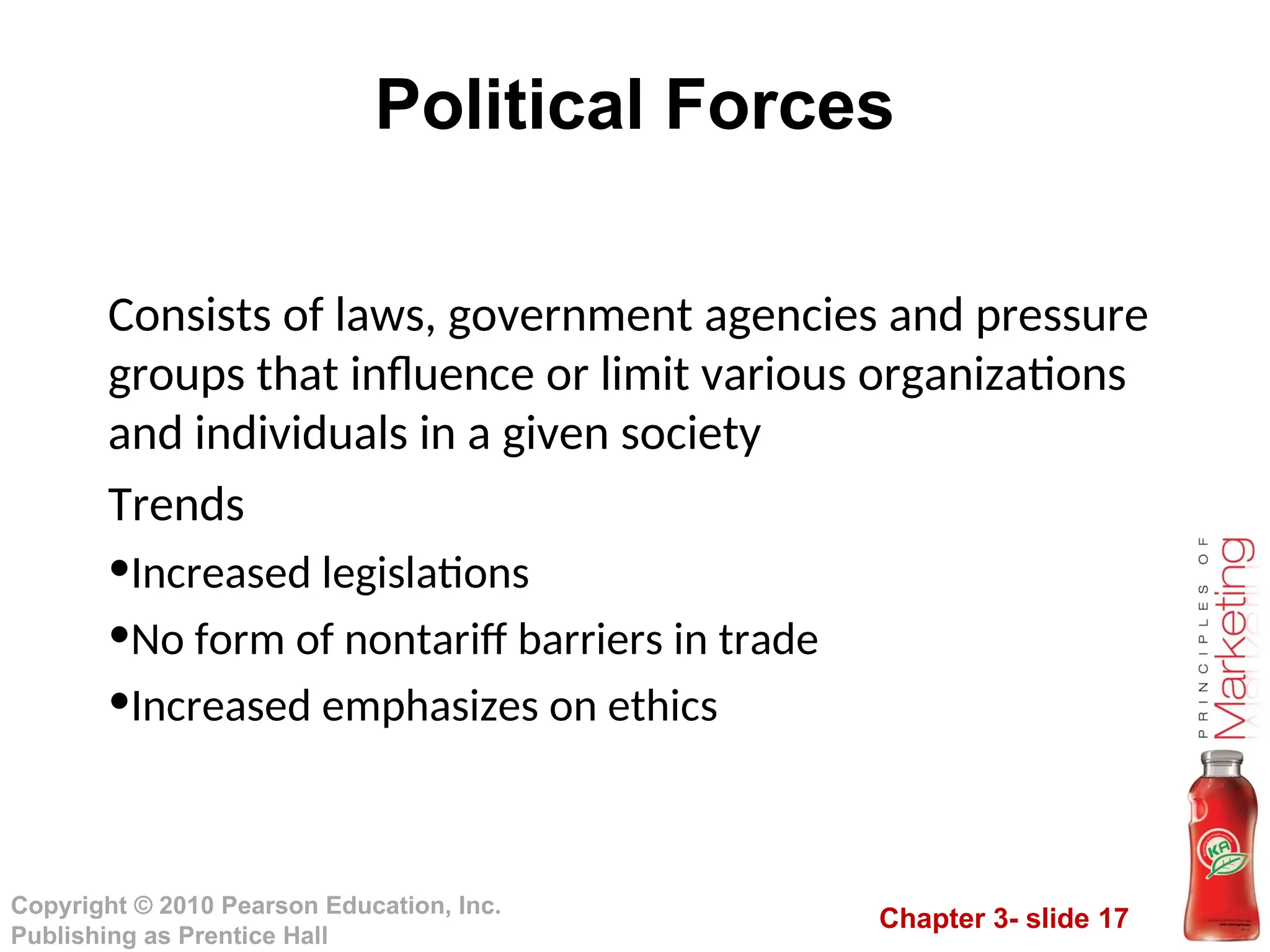
Political Forces
Consists of laws, government agencies and pressure
groups that influence or limit various organizations
and individuals in a given society
Trends
•Increased legislations
•No form of nontariff barriers in trade
•Increased emphasizes on ethics
Chapter 3- slide 18
Copyright © 2010 Pearson Education, Inc.
Publishing as Prentice Hall
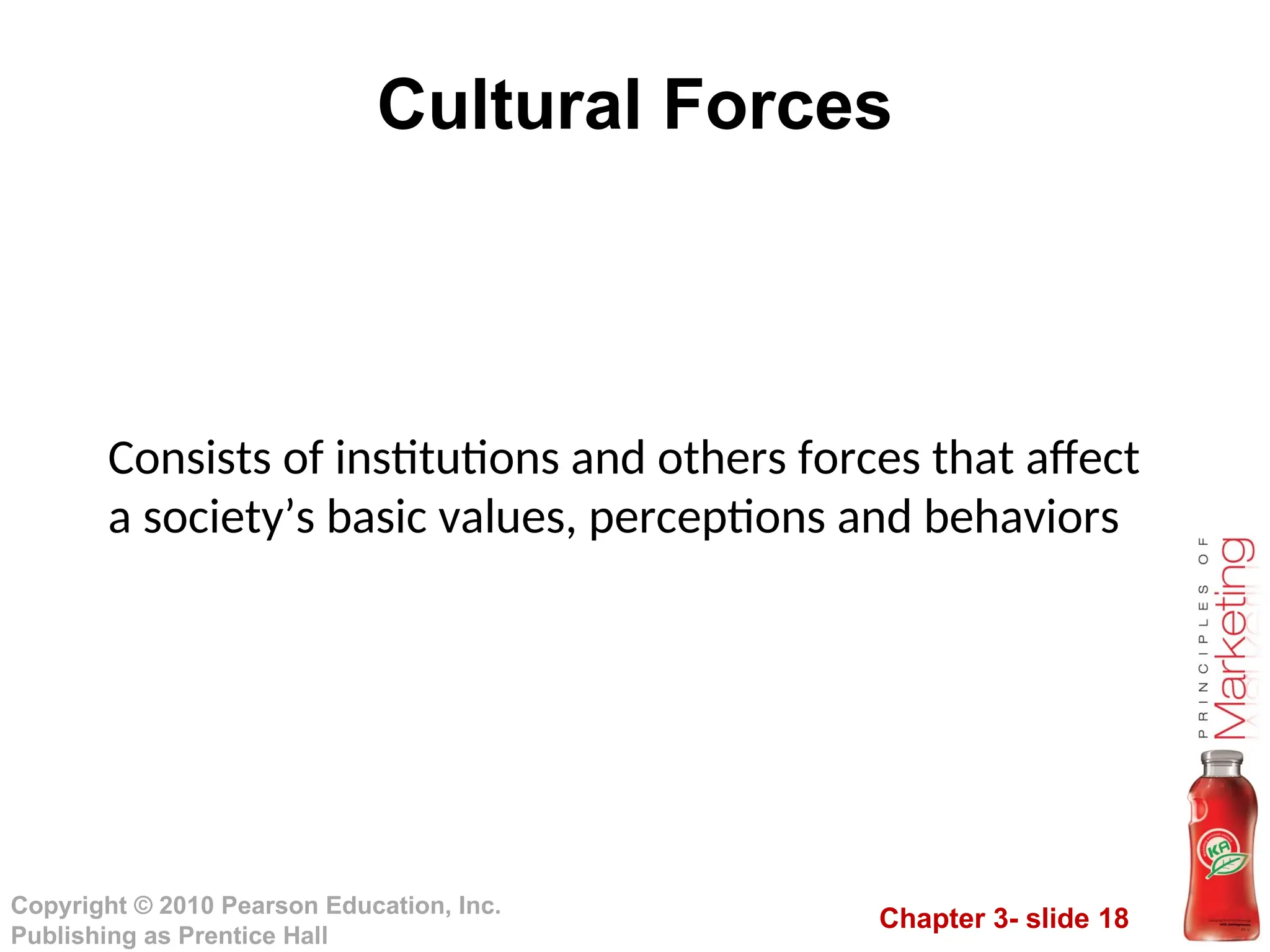
Cultural Forces
Consists of institutions and others forces that affect
a society’s basic values, perceptions and behaviors
Chapter 3- slide 19
Copyright © 2010 Pearson Education, Inc.
Publishing as Prentice Hall
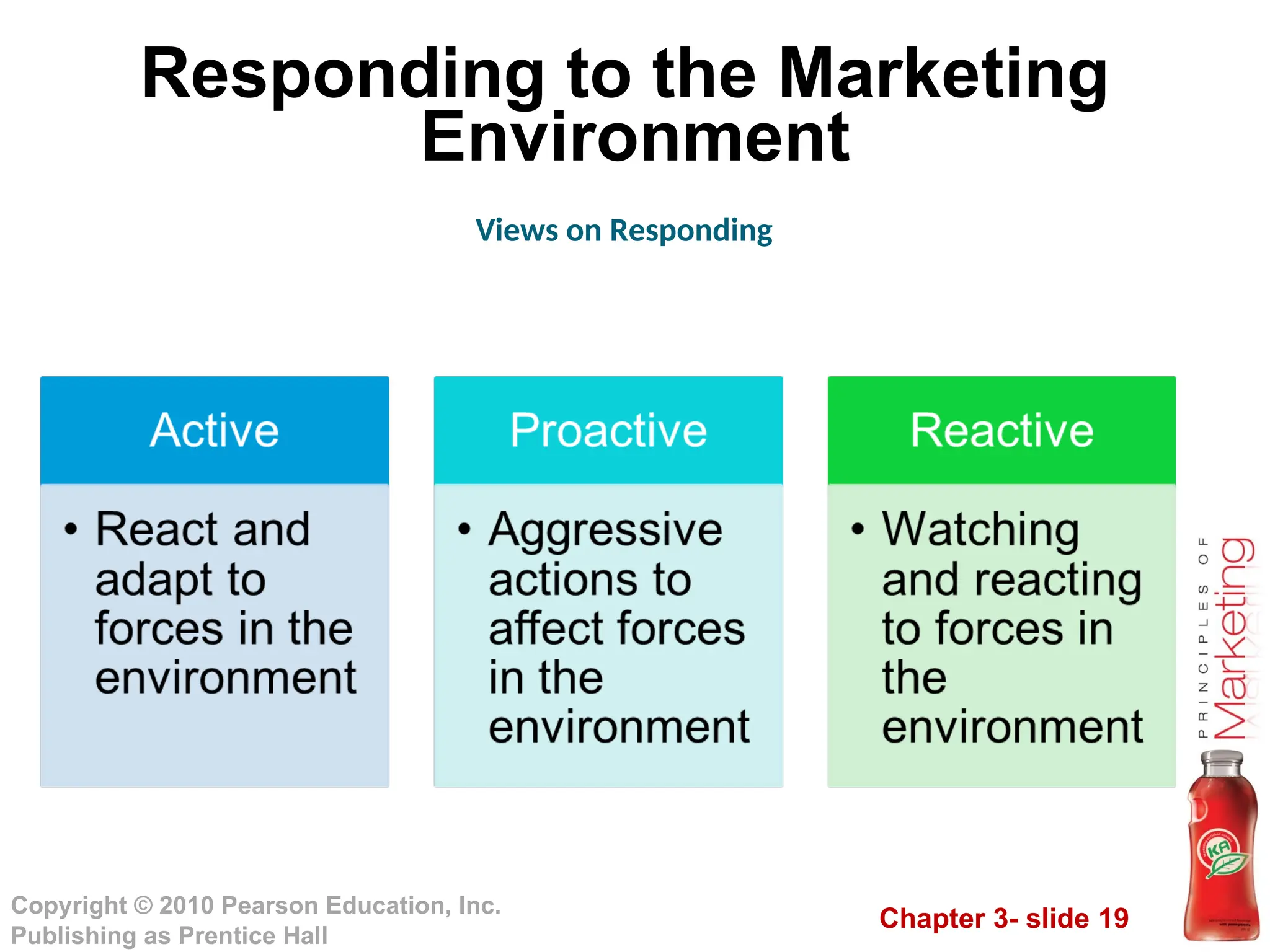
Responding to the Marketing
Environment
Views on Responding

Chapter 3.ppt Marketing environment analyzing

  • 1.
    Chapter 3- slide1 Copyright © 2009 Pearson Education, Inc. Publishing as Prentice Hall Chapter Three Analyzing the Marketing Environment
  • 2.
    Chapter 3- slide2 Copyright © 2010 Pearson Education, Inc. Publishing as Prentice Hall The Marketing Environment The marketing environment includes the actors and forces outside marketing that affect marketing management’s ability to build and maintain successful relationships with customers Microenvironment consists of the actors close to the company that affect its ability to serve its customers, the company, suppliers, marketing intermediaries, customer markets, competitors, and publics
  • 3.
    Chapter 3- slide3 Copyright © 2010 Pearson Education, Inc. Publishing as Prentice Hall The Company’s Microenvironment Actors in the Microenvironment
  • 4.
    Chapter 3- slide4 Copyright © 2010 Pearson Education, Inc. Publishing as Prentice Hall The Company’s Microenvironment • The Company: functional areas such as top management, finance,manufacturing,purchasing,operation accounting etc • Suppliers: provide the resources to produce goods and services • Marketing Intermediaries: help the company to promote, sell and distribute its goods to consumer
  • 5.
    Chapter 3- slide5 Copyright © 2010 Pearson Education, Inc. Publishing as Prentice Hall Competitors • Those who aim at what we aim at. • Those you serve the market with similar products and service • Inspirers or rivals ?
  • 6.
    Chapter 3- slide6 Copyright © 2010 Pearson Education, Inc. Publishing as Prentice Hall Customers Customers: those who buy and for whom marketing takes place •Consumer markets •Business markets •Reseller markets •Government markets •International markets
  • 7.
    Chapter 3- slide7 Copyright © 2010 Pearson Education, Inc. Publishing as Prentice Hall Publics • Any group that has an actual or potential interest in or impact on an organization’s ability to achieve its objectives such as • Financial public • Media public • Government public • Local public • Internal public • General Public
  • 8.
    Chapter 3- slide8 Copyright © 2010 Pearson Education, Inc. Publishing as Prentice Hall Publics (cont) • Financial publics: influences the company’s ability to obtain funds, investment companies, banks, stockholders • Media publics: carries news,features,editorial opinions and other content, newpapers,magzines,blogs, and other social media etc
  • 9.
    Chapter 3- slide9 Copyright © 2010 Pearson Education, Inc. Publishing as Prentice Hall Publics (cont) • Government publics: Marketers must often consult company’s lawyers on issues of product safety,truth in advertising and other matters. • Local publics: The group includes local community residents and organization • General Public: A company needs to be concerned about general public’s attitude towards its products and activities. The public image of a company affects its buying behavior
  • 10.
    Chapter 3- slide10 Copyright © 2010 Pearson Education, Inc. Publishing as Prentice Hall Publics (cont) • Internal publics: This group includes workers, managers,boards of directors ,volunteers and all employees .
  • 11.
    Chapter 3- slide11 Copyright © 2010 Pearson Education, Inc. Publishing as Prentice Hall The Company’s Macroenvironment Consists of larger environmental forces that affect the microenvironment •Demographic •Economic •Natural •Technological •Political •Cultural
  • 12.
    Chapter 3- slide12 Copyright © 2010 Pearson Education, Inc. Publishing as Prentice Hall The Company’s Macroenvironment
  • 13.
    Chapter 3- slide13 Copyright © 2010 Pearson Education, Inc. Publishing as Prentice Hall Demographic Forces • Demography is the study of human populations in term of size, density, location, age, gender, race, occupation and others statistics • Demography trends include age, family structure, geographic population shifts, and population diversity
  • 14.
    Chapter 3- slide14 Copyright © 2010 Pearson Education, Inc. Publishing as Prentice Hall Economic Forces • Economic factors that affect consumer purchasing power and spending patterns Important indicators include • GDP volume/Growth rate • Per capita income • Interest rate • Inflation rate
  • 15.
    Chapter 3- slide15 Copyright © 2010 Pearson Education, Inc. Publishing as Prentice Hall Economic Forces Invol vesthenatur al resource sthat arene ededa si nputs byma rket ersor theya reaff e ctedby mark eti ng acti vi ties Trends • Shor tages ofraw m ater i al • Incr easedpol l uti on • Incr easedgovernment i nter venti on • Envi r onme ntal l ysustai na bl est rateg i es • Shortages of raw material • Increased pollution • Increased government intervention • Environmentally sustainable strategies
  • 16.
    Chapter 3- slide16 Copyright © 2010 Pearson Education, Inc. Publishing as Prentice Hall Technological Forces Forces that create new technologies, creating new products and marketing opportunities
  • 17.
    Chapter 3- slide17 Copyright © 2010 Pearson Education, Inc. Publishing as Prentice Hall Political Forces Consists of laws, government agencies and pressure groups that influence or limit various organizations and individuals in a given society Trends •Increased legislations •No form of nontariff barriers in trade •Increased emphasizes on ethics
  • 18.
    Chapter 3- slide18 Copyright © 2010 Pearson Education, Inc. Publishing as Prentice Hall Cultural Forces Consists of institutions and others forces that affect a society’s basic values, perceptions and behaviors
  • 19.
    Chapter 3- slide19 Copyright © 2010 Pearson Education, Inc. Publishing as Prentice Hall Responding to the Marketing Environment Views on Responding

Editor's Notes

  • #4 Intermediaries: Holistic Marketing now companies see their resellers, wholesalers are business partnered price of product sometimes are higher at the compnay’s own website but discounted on resellers store or marketing services agenscies ,social media advertising companies. They are important part of any company’s value delivery network I was given Apples new phone and every year as a store manager.
  • #6 Most import actors in company's microenvironment The aim of whole value delivery network is to engage target cx and create stronger relationships with them Company can target all or any 5 types of customer’s market (consumer,business, reseller,government or international market)
  • #13 Youtube kids, Netflex for kids ect Youtube only show content India and Pakistan Coke Diet is not popular in Pakistan and India , but very famous overseas
  • #14 Pakistani Jewelers are now selling ligh weight gold rather than pure gold Adidas runners by recycled plastic or material Lévis waterless jeans Biogradeable plactsic bags, One of my friends plastic factory business got banned as he was making single use plastic by environmentlist
  • #16 Most Dramatic forces changes our destiny AI, Auto Cars , robots , Planted chips in products from its manufacturing to disposal AliApy , apple pay , google pay etc, HBL app to make any sort of DD from your nearest branch
  • #17 Single use plastic , bags and liquor is banned in paksitan
  • #18 British india Satti practice removed by some certain area after having opened a school and educating peoples there. Because of tiny screens people are connected but alone altogether , immersed in their own little bubble Organizational loyalty has been declined over the past 2 declined Made in Australia has huge recognition against overseas brands