Law of Contract
By Nihal Matara Arachchige
(LL.M, Attorney-at-Law)
The need for a law of contract
• Our society would not survive if agreements
and promises could be broken without any
fear of legal sanction.
• The law of contract is a part of law of
obligation.
• Unlike tort ,the obligation in contract arise out
of agreement.
Basic doctrine in contract law
• The principal source of obligations under the
law of contract must be the contract itself.
• “The freedom of contract.”
• “Sanctity of a contract.”
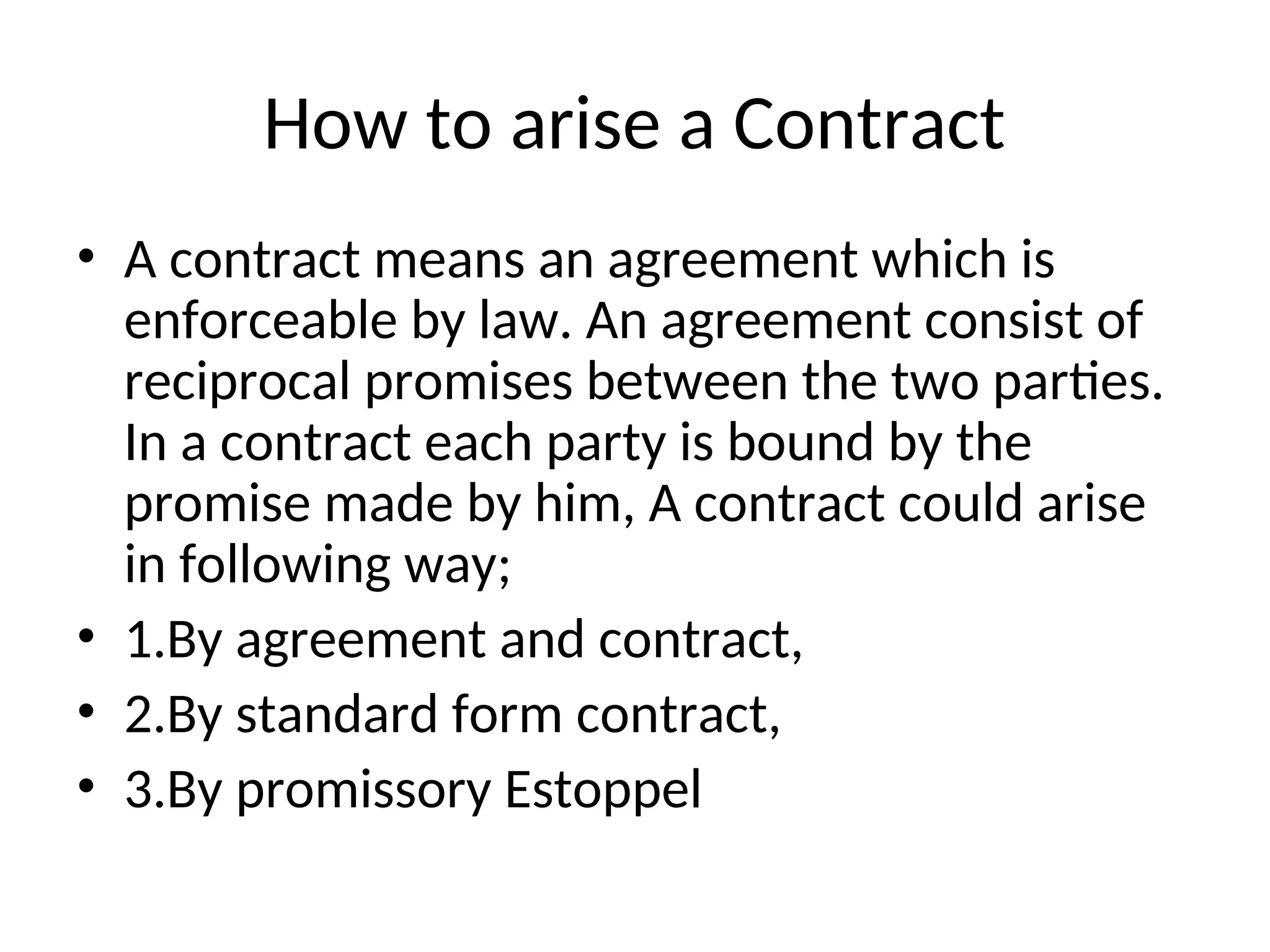
How to arise a Contract
• A contract means an agreement which is
enforceable by law. An agreement consist of
reciprocal promises between the two parties.
In a contract each party is bound by the
promise made by him, A contract could arise
in following way;
• 1.By agreement and contract,
• 2.By standard form contract,
• 3.By promissory Estoppel
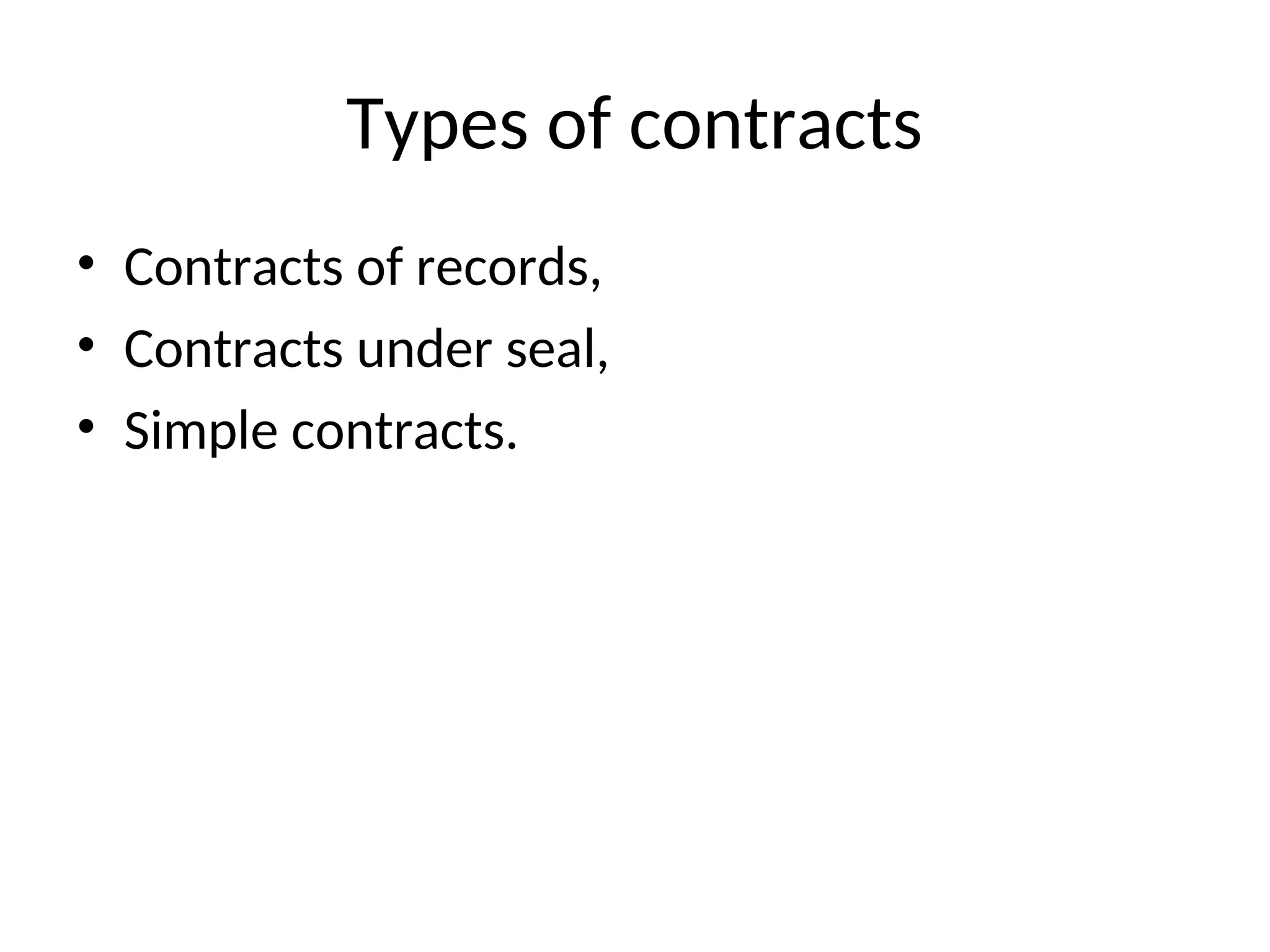
Types of contracts
• Contracts of records,
• Contracts under seal,
• Simple contracts.
Agreement &Contract
• An agreement enforceable by law is a contract
• All agreements are not enforceable by law and
therefore all agreements are not contracts
• (Agreement to go to see a movie, agreement to
play a cricket match, agreement to go for a
dinner….etc may not contracts)
• But reverse is not the same all the contracts are
agreements.
agreement
• In an agreement there is a promise from both
parties
• A promise is a result of offer(proposal) and
acceptance.
• This promise is known as agreement.
• If this agreement satisfy all the basic element
of a contract are contracts.
The intention to create legal
relations
• A critical factor in the formation of a contract
is the legal intention of the parties.the parties
must have intended agreement to be binding
in law
Domestic agreement &Commercial
agreement
• Balfour v Balfour
• Meritt v Meritt
• Edwards v Skyways Ltd
• O’Keefe v Ryanair Holdings PLC
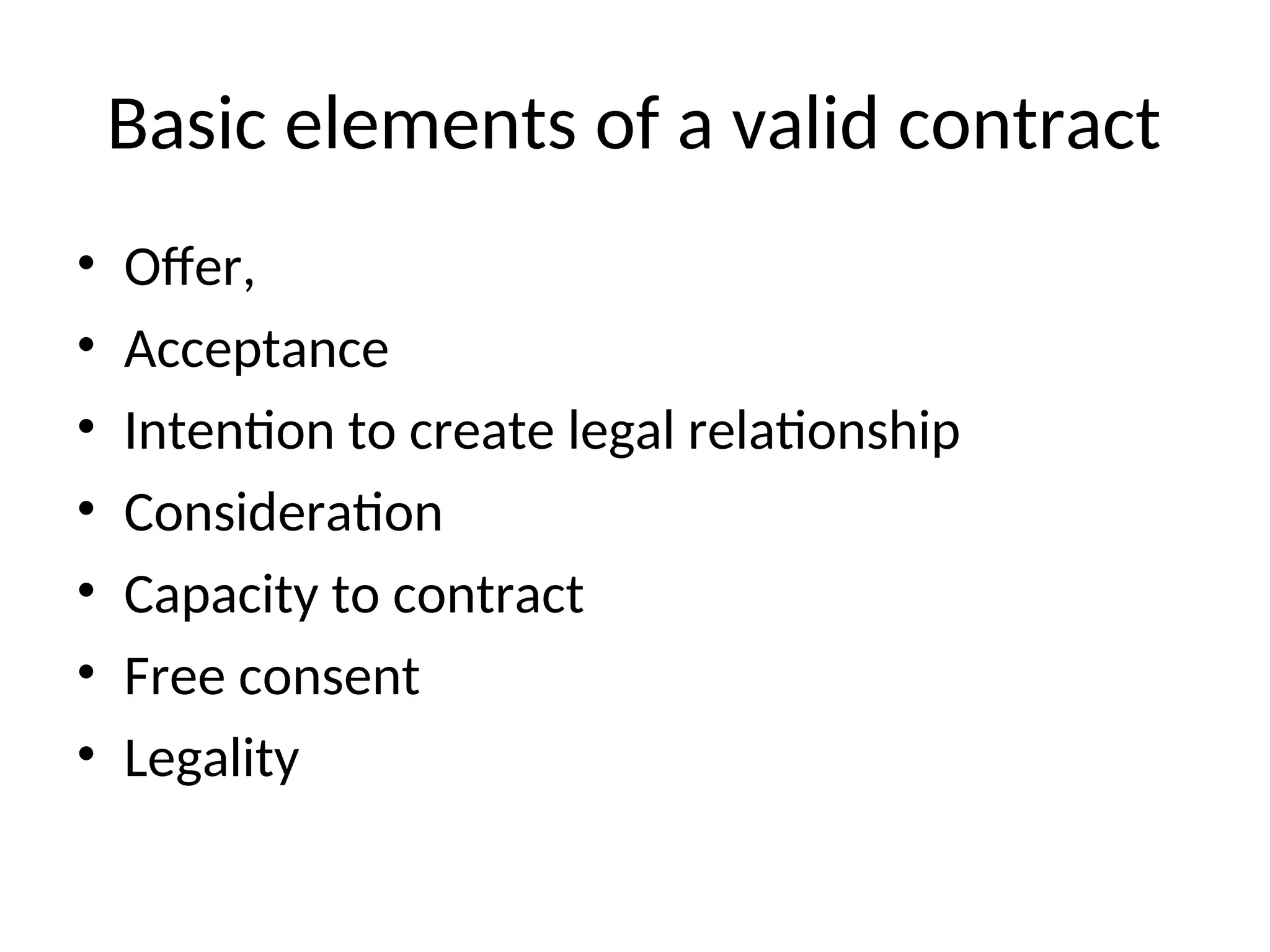
Basic elements of a valid contract
• Offer,
• Acceptance
• Intention to create legal relationship
• Consideration
• Capacity to contract
• Free consent
• Legality
OFFER
• An offer is an expression of willingness to
contract on certain terms made with the
intension that the offer shall become binding
as soon as it is accepted by the person to
whom it is addressed.
• The person who makes the offer is called the
offerer and the person to whom it is made is
called the offeree.
Requirement of a valid offer
• An offer must be definite
• An offer must be Serious
• An offer must be Communicated to the
offeree
• An offer must be Distinguished from an
invitation to treat
Offer &invitation to treat
distinguished
• An invitation to treat is a preliminary steps of an
offer.it invites to get offers. An offer has to be
distinguished from an invitation to treat.
sometimes person may not offer to sell his
goods, but make some statement or give some
information with a view to inviting others to
make offers on that basis.
(Sending catalogue of books)
(Inviting persons to an auction)
cases
• Harris v Nickerson
• Pharmaceutical Society of Great Britain v
Boots Cash Chemists Ltd.
• Carlill v Carbolic Smoke Ball Co.
• Fisher v Bell
Cross offers &Counter offers
• Wrench v Hyde
• Tinn v hoffman
Termination of an offer
• By notice(an offer may be revoked any time
before acceptance but not afterwards)
• By lapse of time
• By death or insanity
• By counter offer
• By rejection by offeree.
Acceptance
• When one person to whom the offer is made
signifies his assent thereto, the offer is said to
be accepted. An offer when accepted
becomes an agreement.
Who can accept?
• An offer can be accepted only by the person or persons
for whom the offer is intended. an offer made to a
particular person can only be accepted by him because
he is the only person intended to accept.
• But ,an offer made to the word at large can be accepted
by any person whatsoever
• To constitute a valid acceptance the assent must be
communicated to the offeror.(Boulton v Jones)
•
Essentials for a valid acceptance
• Acceptance must be Absolute and Unqualified
Hyde v Wrench
• Acceptance must be Communicated to the offeror
• Acceptance must be In the prescribed manner
• An acceptance must be by the offeree.
Powell v lee
• Acceptance must be Express or implied
Consideration
• The consideration is the price of the promise
• Quid-pro-quo=something in return. this
something may be some benefit, right, interest
or profit or it may also be some forbearance,
detriment, loss or responsibility upon the other
party.
Currie v Misa
• Consideration is what the promisor demands as
the price for his promise.
Capacity to contract
• One of the essentials of a valid contract is that
the parties to the contract should be
competent to make the contract.
• “every person is competent to contract who is
of the age of majority according to the law to
which he is subject ,and who is of sound
mind ,and is not disqualified from contracting
by any law to which he is subject”
The position of a minor
• Minor’s agreement is void ab initio, and he is
incapable of making a contract to pay for any
services rendered or goods supplied to him.
• Leslie v Sheill
• However, for the necessaries supplied to a
minor reimbursement is permitted .
• A minor may bind by beneficial contract.
• Nash v Inman
• Costa v A.G/Doyle v White City Stadium
Position of………
• Insane persons,
• Drunkards
• Foreigners',
• Companies,
• Partnership,
• Embassodors,
Consensus –ad- idem ,Free consent
• One of the essentials of a valid contract is that
the parties should enter into the contract with
their free consent.consent is said to be free
when it is not caused by ,
• Mistake,
• Misrepresentation,
• Duress,
• Undue influence.
Legality
• Every agreement of which the object or
consideration is not lawful is void. eg…
Forbidden by law
Fraudulent purpose
Agreement injurious to the person or property of
another.
Immoral
Opposed to public policy,
Agreement tending to injure the public service
The terms of a contract
• Express terms
• Implied terms
• Exemption Clauses
Termination and discharge of a
contract
• Performance
• Agreement
• Operation of law
• Breach
Contractual remedies
• Damages
• Specific performance
• Rescission
• Injunction
• Restitutio in integrum
Law of Delict/Tort

Fundamental principles of law of contract

  • 1.
    Law of Contract ByNihal Matara Arachchige (LL.M, Attorney-at-Law)
  • 2.
    The need fora law of contract • Our society would not survive if agreements and promises could be broken without any fear of legal sanction. • The law of contract is a part of law of obligation. • Unlike tort ,the obligation in contract arise out of agreement.
  • 3.
    Basic doctrine incontract law • The principal source of obligations under the law of contract must be the contract itself. • “The freedom of contract.” • “Sanctity of a contract.”
  • 4.
    How to arisea Contract • A contract means an agreement which is enforceable by law. An agreement consist of reciprocal promises between the two parties. In a contract each party is bound by the promise made by him, A contract could arise in following way; • 1.By agreement and contract, • 2.By standard form contract, • 3.By promissory Estoppel
  • 5.
    Types of contracts •Contracts of records, • Contracts under seal, • Simple contracts.
  • 6.
    Agreement &Contract • Anagreement enforceable by law is a contract • All agreements are not enforceable by law and therefore all agreements are not contracts • (Agreement to go to see a movie, agreement to play a cricket match, agreement to go for a dinner….etc may not contracts) • But reverse is not the same all the contracts are agreements.
  • 7.
    agreement • In anagreement there is a promise from both parties • A promise is a result of offer(proposal) and acceptance. • This promise is known as agreement. • If this agreement satisfy all the basic element of a contract are contracts.
  • 8.
    The intention tocreate legal relations • A critical factor in the formation of a contract is the legal intention of the parties.the parties must have intended agreement to be binding in law
  • 9.
    Domestic agreement &Commercial agreement •Balfour v Balfour • Meritt v Meritt • Edwards v Skyways Ltd • O’Keefe v Ryanair Holdings PLC
  • 10.
    Basic elements ofa valid contract • Offer, • Acceptance • Intention to create legal relationship • Consideration • Capacity to contract • Free consent • Legality
  • 11.
    OFFER • An offeris an expression of willingness to contract on certain terms made with the intension that the offer shall become binding as soon as it is accepted by the person to whom it is addressed. • The person who makes the offer is called the offerer and the person to whom it is made is called the offeree.
  • 12.
    Requirement of avalid offer • An offer must be definite • An offer must be Serious • An offer must be Communicated to the offeree • An offer must be Distinguished from an invitation to treat
  • 13.
    Offer &invitation totreat distinguished • An invitation to treat is a preliminary steps of an offer.it invites to get offers. An offer has to be distinguished from an invitation to treat. sometimes person may not offer to sell his goods, but make some statement or give some information with a view to inviting others to make offers on that basis. (Sending catalogue of books) (Inviting persons to an auction)
  • 14.
    cases • Harris vNickerson • Pharmaceutical Society of Great Britain v Boots Cash Chemists Ltd. • Carlill v Carbolic Smoke Ball Co. • Fisher v Bell
  • 15.
    Cross offers &Counteroffers • Wrench v Hyde • Tinn v hoffman
  • 16.
    Termination of anoffer • By notice(an offer may be revoked any time before acceptance but not afterwards) • By lapse of time • By death or insanity • By counter offer • By rejection by offeree.
  • 17.
    Acceptance • When oneperson to whom the offer is made signifies his assent thereto, the offer is said to be accepted. An offer when accepted becomes an agreement.
  • 18.
    Who can accept? •An offer can be accepted only by the person or persons for whom the offer is intended. an offer made to a particular person can only be accepted by him because he is the only person intended to accept. • But ,an offer made to the word at large can be accepted by any person whatsoever • To constitute a valid acceptance the assent must be communicated to the offeror.(Boulton v Jones) •
  • 19.
    Essentials for avalid acceptance • Acceptance must be Absolute and Unqualified Hyde v Wrench • Acceptance must be Communicated to the offeror • Acceptance must be In the prescribed manner • An acceptance must be by the offeree. Powell v lee • Acceptance must be Express or implied
  • 20.
    Consideration • The considerationis the price of the promise • Quid-pro-quo=something in return. this something may be some benefit, right, interest or profit or it may also be some forbearance, detriment, loss or responsibility upon the other party. Currie v Misa • Consideration is what the promisor demands as the price for his promise.
  • 21.
    Capacity to contract •One of the essentials of a valid contract is that the parties to the contract should be competent to make the contract. • “every person is competent to contract who is of the age of majority according to the law to which he is subject ,and who is of sound mind ,and is not disqualified from contracting by any law to which he is subject”
  • 23.
    The position ofa minor • Minor’s agreement is void ab initio, and he is incapable of making a contract to pay for any services rendered or goods supplied to him. • Leslie v Sheill • However, for the necessaries supplied to a minor reimbursement is permitted . • A minor may bind by beneficial contract. • Nash v Inman • Costa v A.G/Doyle v White City Stadium
  • 24.
    Position of……… • Insanepersons, • Drunkards • Foreigners', • Companies, • Partnership, • Embassodors,
  • 25.
    Consensus –ad- idem,Free consent • One of the essentials of a valid contract is that the parties should enter into the contract with their free consent.consent is said to be free when it is not caused by , • Mistake, • Misrepresentation, • Duress, • Undue influence.
  • 26.
    Legality • Every agreementof which the object or consideration is not lawful is void. eg… Forbidden by law Fraudulent purpose Agreement injurious to the person or property of another. Immoral Opposed to public policy, Agreement tending to injure the public service
  • 27.
    The terms ofa contract • Express terms • Implied terms • Exemption Clauses
  • 28.
    Termination and dischargeof a contract • Performance • Agreement • Operation of law • Breach
  • 29.
    Contractual remedies • Damages •Specific performance • Rescission • Injunction • Restitutio in integrum
  • 30.