Here is where your presentation begins
ART APPRECIATION
Isabela State University- Cabagan
Mr. Joseph S. Dauag
COURSE OUTLINE
CHAPTER 1- The Meaning and Importance of Art
• The Nature of Art
• The Subject of Art
• The Function of Art
CHAPTER 2- The Artist’s Medium
• Medium and Technique
• Mediums of the Visual Arts
• Mediums of the Performing Arts
• Methods of Art Production and Presentation
CHAPTER 3- The Elements of Visual Arts and Performing Arts
• The Elements of Visual Arts
• The Elements of Performing Arts
PART I- AN OVERVIEW OF ART
• The Scope of Art
• The Origin of Art
COURSE OUTLINE
CHAPTER 4- The Principles of Art Design
• Harmony
• Rhythm
• Balance
• Proportion
• Emphasis
• Other Art Principles
CHAPTER 5- The Development of Visual Arts
• The Development of Painting
• The Development of Sculpture
• The Development of Architecture
PART II- THE HISTORICAL DEVELOPMENT OF ARTS
COURSE OUTLINE
CHAPTER 6- Asian Art
• Ancient Near Eastern Art and Islamic Art
• East Asian Art
CHAPTER 7- The Development of Visual Arts in the Philippines
• The Development of Painting in the Philippines
• The Development of Sculpture in the Philippines
• The development of Architecture in the Philippines
CHAPTER 8- The Development of Performing Arts in the Philippines
• The Development of Music in the Philippines
• The Development of Literature in the Philippines
• The Development of Dance in the Philippines
• The Development of Cinema in the Philippines
COURSE OUTLINE
CHAPTER 9- Arts in the Cordillera Region and Muslim South
• Arts in the Cordillera Region
• Arts in the Muslim South
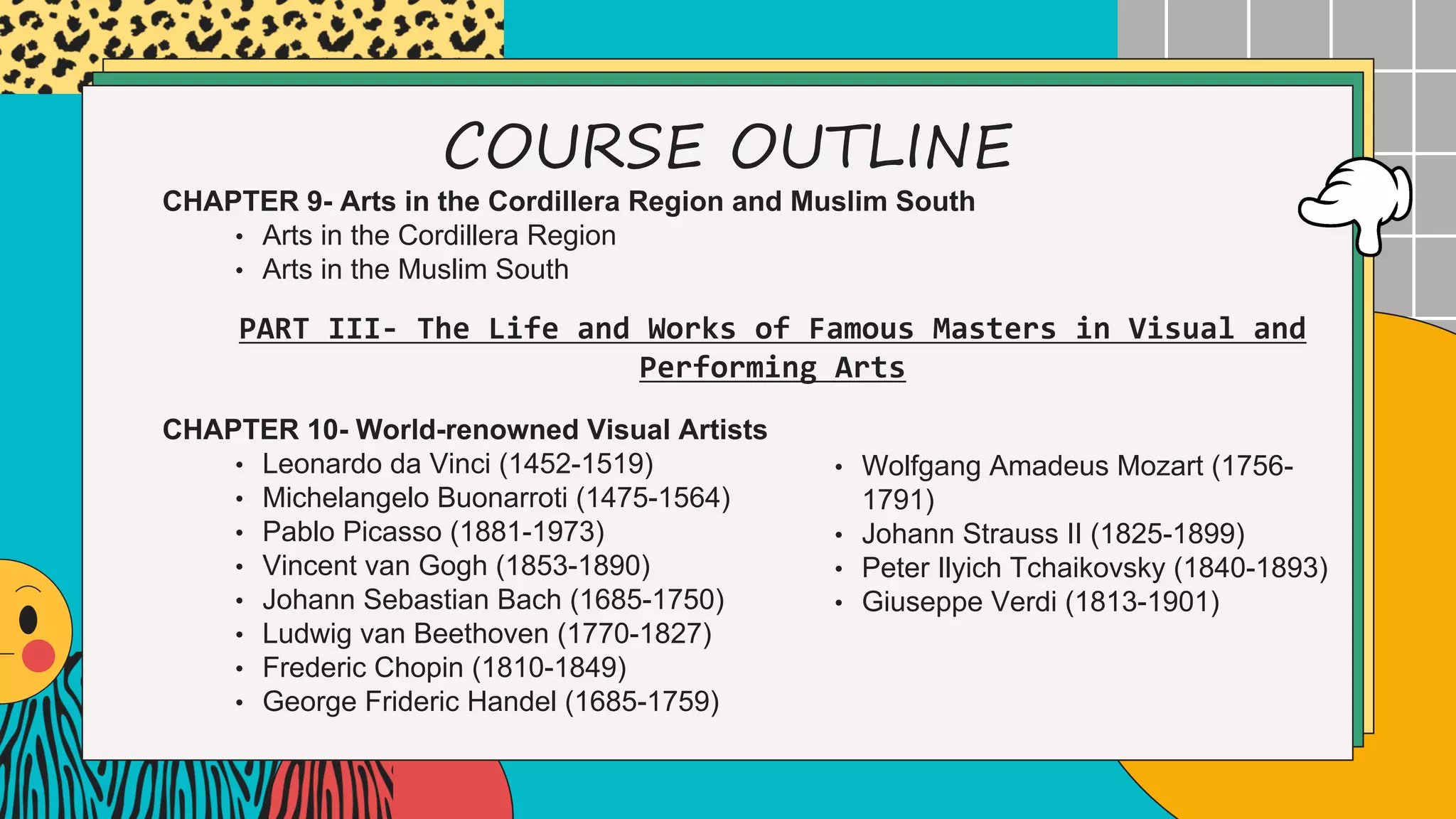
CHAPTER 10- World-renowned Visual Artists
• Leonardo da Vinci (1452-1519)
• Michelangelo Buonarroti (1475-1564)
• Pablo Picasso (1881-1973)
• Vincent van Gogh (1853-1890)
• Johann Sebastian Bach (1685-1750)
• Ludwig van Beethoven (1770-1827)
• Frederic Chopin (1810-1849)
• George Frideric Handel (1685-1759)
PART III- The Life and Works of Famous Masters in Visual and
Performing Arts
• Wolfgang Amadeus Mozart (1756-
1791)
• Johann Strauss II (1825-1899)
• Peter Ilyich Tchaikovsky (1840-1893)
• Giuseppe Verdi (1813-1901)
COURSE OUTLINE
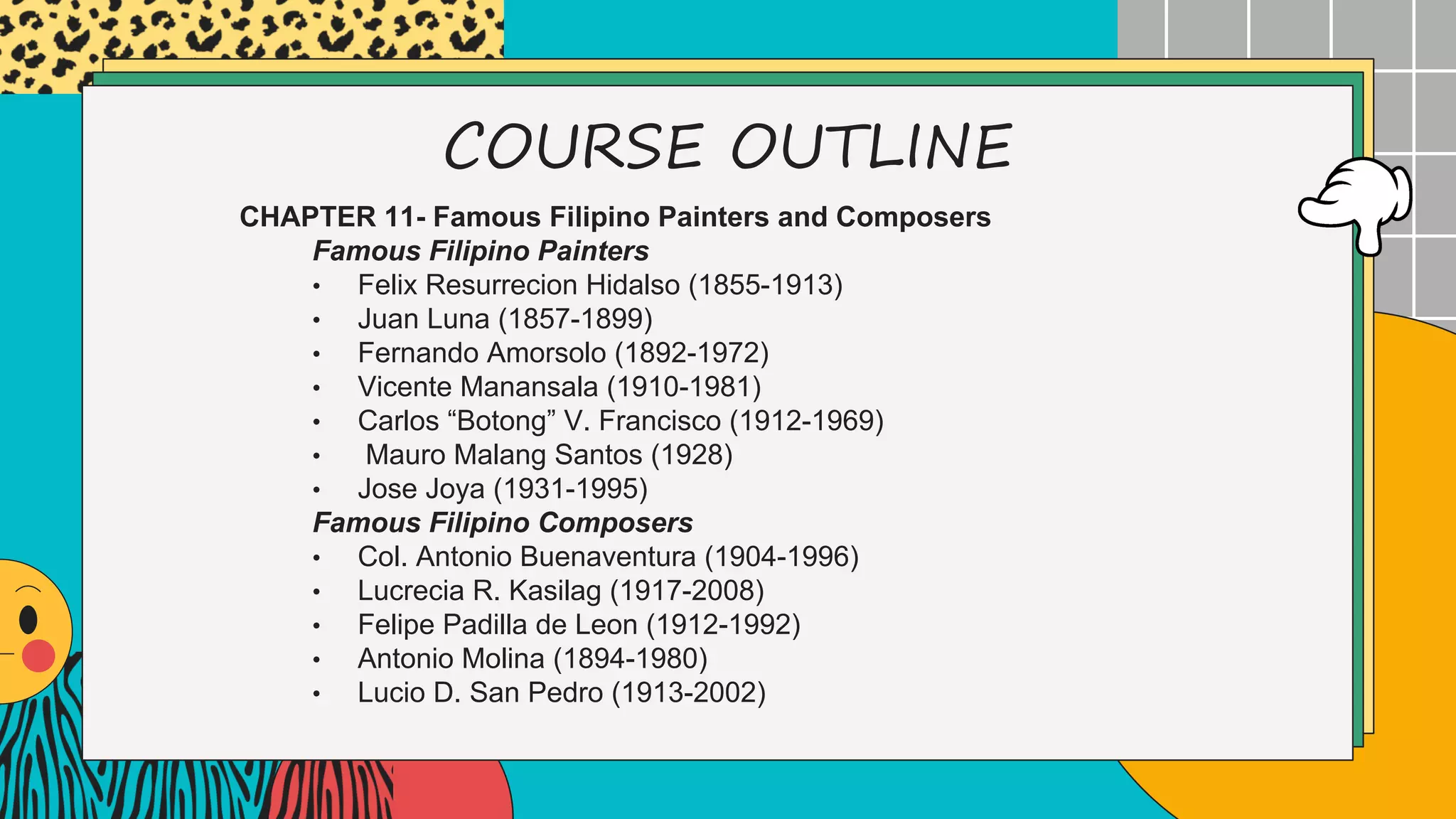
CHAPTER 11- Famous Filipino Painters and Composers
Famous Filipino Painters
• Felix Resurrecion Hidalso (1855-1913)
• Juan Luna (1857-1899)
• Fernando Amorsolo (1892-1972)
• Vicente Manansala (1910-1981)
• Carlos “Botong” V. Francisco (1912-1969)
• Mauro Malang Santos (1928)
• Jose Joya (1931-1995)
Famous Filipino Composers
• Col. Antonio Buenaventura (1904-1996)
• Lucrecia R. Kasilag (1917-2008)
• Felipe Padilla de Leon (1912-1992)
• Antonio Molina (1894-1980)
• Lucio D. San Pedro (1913-2002)
The Meaning
and Importance
of Art
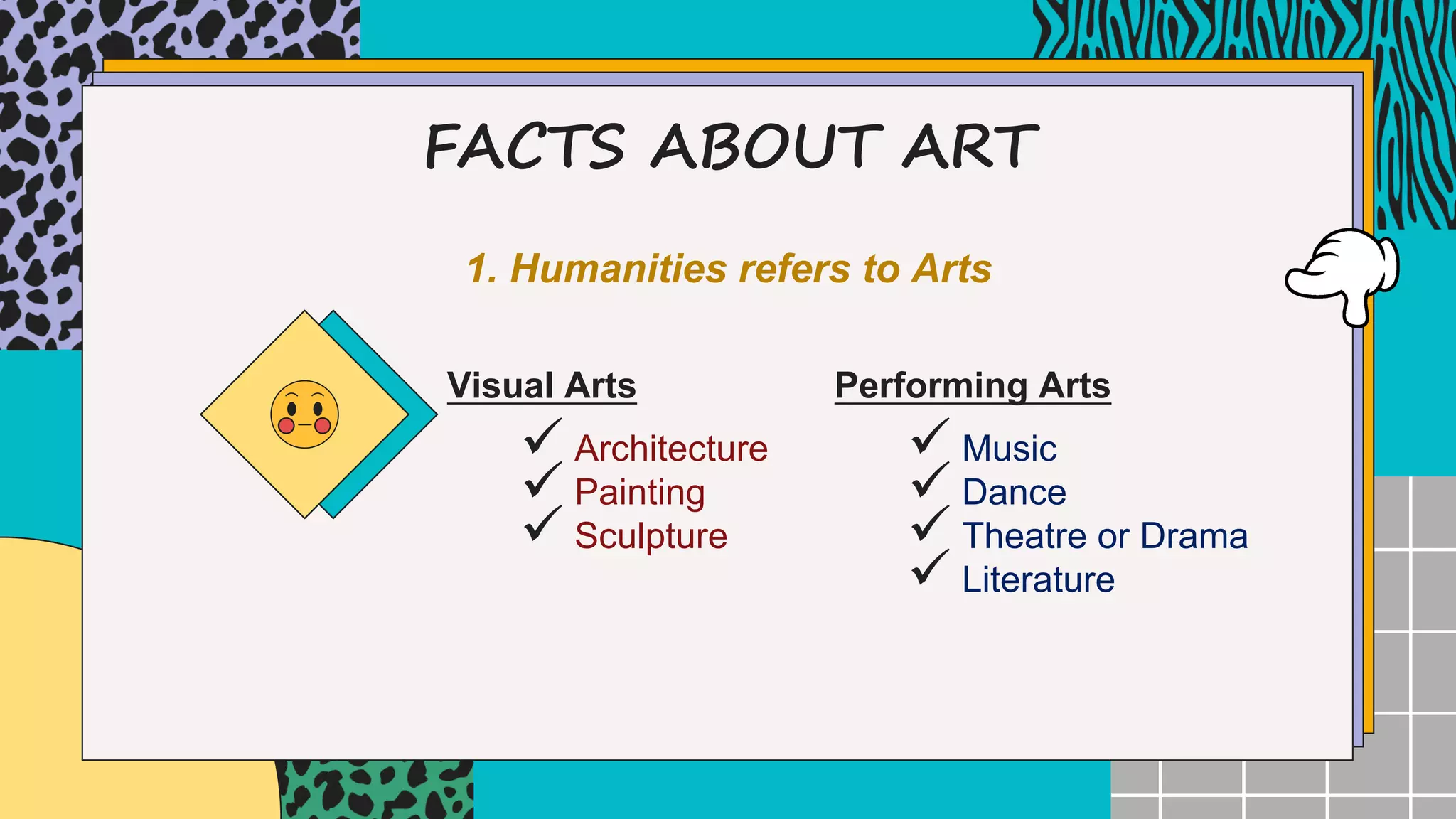
FACTS ABOUT ART
Visual Arts
ü Architecture
ü Painting
ü Sculpture
1. Humanities refers to Arts
Performing Arts
ü Music
ü Dance
ü Theatre or Drama
ü Literature
FACTS ABOUT ART
2. The word art comes from:
ü The Italian word, “artis” which means “craftsmanship,
skill, mastery of form, inventiveness, and the
association that exist between form and ideas and
between material and techniques;”
ü The Aryan root “ar” which means “to join” or “put
together;”
ü The Greek words “artizien,” which means to “prepare,”
and “arkiskein”, meaning to “put together.”
FACTS ABOUT ART
3. Art is very important in our lives as it is concerned with
the communication of certain ideas and feelings by means
of a sensuous medium– color, sound, bronze, marble,
words, and film.
4. The subject of art is varied. Some arts are
representational; others are nonrepresentational, non-
objective, or abstract.
5. All arts have functions for people since they satisfy
particular needs of people.
FACTS ABOUT ART
6. Visual arts or space arts are those that we perceive
with our eye and which occupy space.
7. Auditory or time arts are those that can be heard and
expressed in time.
8. Combined arts are those that can be both seen and
heard exist in both space and time.
WHAT IS
ART???
Art has been defined in various
ways. The following are some
of the definitions given by
various authors.
THE NATURE OF ART
THE NATURE OF ART
Art is very important in our lives. It constitutes one of the oldest
and most important means of expression developed by man.
Art has been existent since men have lived together. In fact, in
nearly every country, art can be found in primitive societies. Art
has been created by all people at all times; it has lived
because it is liked and enjoyed. A true work of art is made by
man himself not imitatively, but creatively.
A true artist doesn’t imitate nature, but rather interprets it in his
own way by selecting the essential features of the subject and
rejecting the minor ones.
Meanings of Art
Art is derived from the
latin word ars, meaning
“ability or skill.”
J.V Estolas
Art is taken from the Italian
word artis, which means
“craftsmanship, skill, mastery
of form, inventiveness, and
the association that exist
between form and ideas and
between material and
technique”
A. Tan
Art is a product of
man’s need to express
himself.
F. Zulueta
Art is concerned with the
communication of certain
ideas and feelings by
means of sensuous
medium– color, sound,
bronze, marble, words,
and film.
C. Sanchez
Meanings of Art
Arts is that which brings
life in harmony with the
beauty of the world.
Plato
Art is an attitude of spirit, a
state of mind– one which
demands for its own
satisfaction and fulfilling, a
shaping of matter to new and
more significant form.
John Dewey
Art is the skillful arrangement
or composition of some
common but significant
qualities of nature such as
colors, sounds, lines,
movements, words, stones,
wood, etc., to express human
feelings, emotions, or
thoughts in a perfect
meaningful and enoyable
way.
Panizo and
Rustia
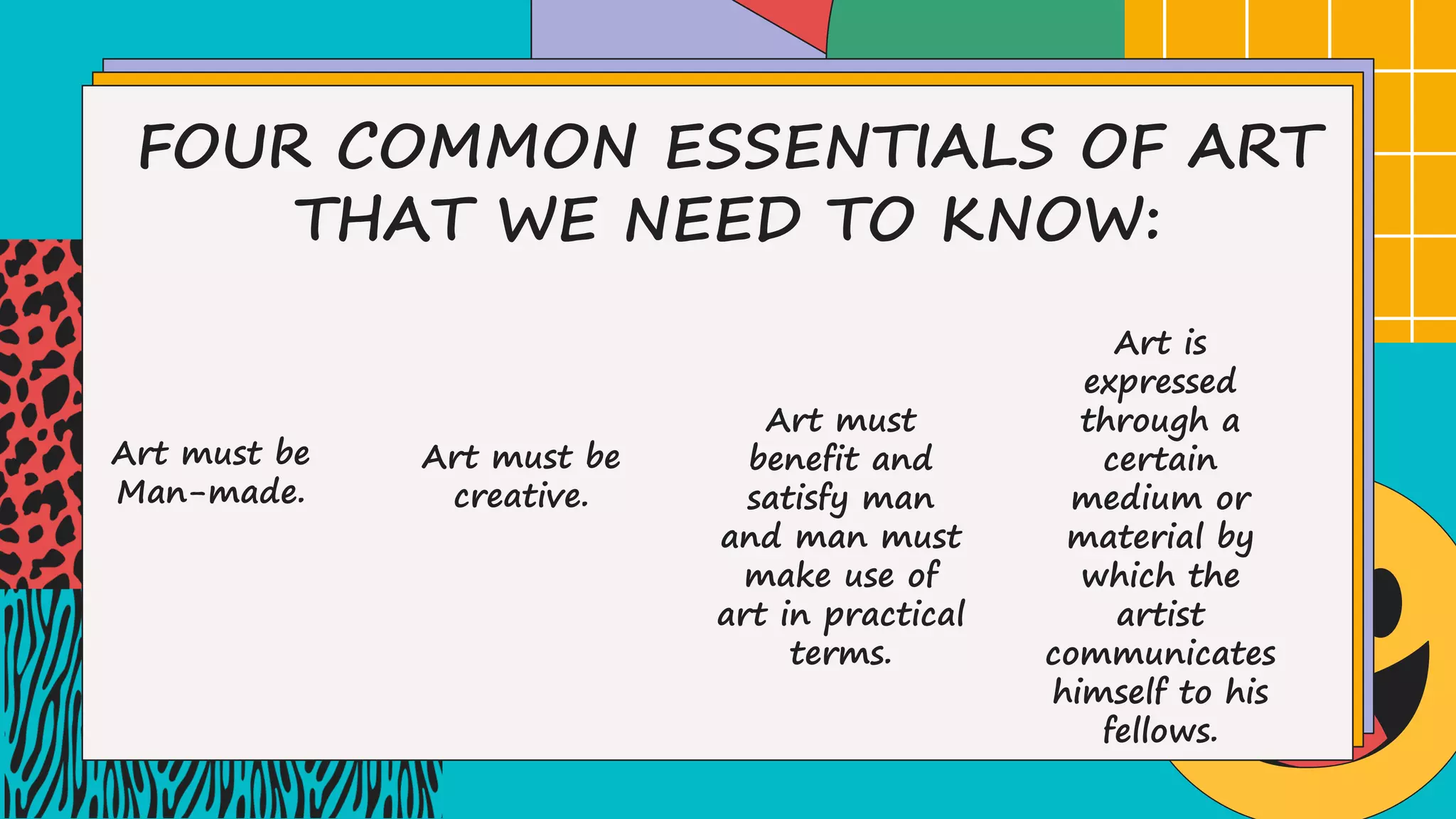
FOUR COMMON ESSENTIALS OF ART
THAT WE NEED TO KNOW:
Art must be
Man-made.
Art must be
creative.
Art must
benefit and
satisfy man
and man must
make use of
art in practical
terms.
Art is
expressed
through a
certain
medium or
material by
which the
artist
communicates
himself to his
fellows.
IMPORTANCE OF ART
Art has a particular importance in our lives. All the art that we
see and hear have a purpose; they occupy some place in our
judgment.
We can communicate through paintings, songs, dances, and
dramatic plays to highlight and heighten the importance of
certain events, keep them in memory and indulge in pleasure.
We also build monuments to remind us of the heroic deeds of
great men.
IMPORTANCE OF ART
Artworks are also valuable sources of inspiration. We are
delighted by the books we read and moved by the music we hear.
Paintings, sculptures, and plays capture our attention and
stimulate critical thinking. Modern architectural designs inspire us
to plan and construct our houses beautifully.
IMPORTANCE OF ART
Through an artist’s work, we get a glimpse of the thoughts,
feelings, and beliefs of the people who lived in the period the
artwork was produced and the external factors that influenced the
artwork.
We also value and appreciate beautiful things as a
consequence of our encounter with the arts. Our aesthetic
experiences can change our ways and behavior. They can
transform us into highly-cultured, dignified, and respectable
human beings. The arts can beautify our humanity.
IMPORTANCE OF ART
Arts can beautify our humanity.
This explains why the arts is called humanities. It brings out
the good and the noble in us. Through the arts, we come to
know the changing image of man as he journeys across
time, searches for the reality, and strives to achieve the
ideals that create the meaning of life.
WHAT IS ART
APPRECIATION?
The ability to interpret or
understand man-made arts and
enjoy them either through
actual and work-experience
with art tools and materials or
possession of these works of
art for one’s admiration and
satisfaction.
THE SUBJECT OF ART
THE SUBJECT OF ART
In any art form– painting, music, sculpture,
architecture, or dance– there is always a subject that
serves as the foundation of the creation of the work
of art. The subject of art is varied. A subject of art is
usually anything that is represented in the artwork. It
is varied– it may be a person, object, scene, or event.
THE SUBJECT OF ART
Representational or Objective Arts
Ø Artworks that depict something easily recognized by most
people.
Ø Painting, sculpture, graphic arts, literature, and theatre
arts are generally classified as representational, although
some paintings and sculptures are without subjects.
Music and dance may or may not have subjects.
THE SUBJECT OF ART
Non-Representational or Non-Objective Arts
Ø Artworks that have no resemblance to any real subject.
Ø They do not represent anything and they are what they
are.
Ø They rather appear directly to the senses primarily
because of the satisfying organization of their elements.
THE FUNCTION OF ART
THE FUNCTION OF ART
Every art form has a definite function since it
satisfies a particular need. To the layman, art
may have little function. Some find meaning in
art in its ability to serve the purpose for which
it was designed.
THE FUNCTION OF ART
Architecture is directly and almost entirely functional because
buildings and other structures are always built for some special
purpose. Music and dance were used in ancients rituals and
worship of the gods, for social and folk entertainment, as well in
the military.
Painting and sculpture may be used to narrate events, to
portray people or events, to instruct (as in the case of Christian
art), to commemorate individuals or historical events, and to
serve as vehicles of personal expression.
THE FOUR MAIN FUNCTIONS
OF ART
1. Aesthetic Function
Ø Through art, man becomes conscious of the beauty of
nature. He benefits from his own work and from those
done by his fellowmen. He learns to use, love, and
preserve them for his enjoyment and appreciation.
THE FOUR MAIN FUNCTIONS
OF ART
2. Utilitarian Function
Ø With he creation of various forms of art, man now lives in
comfort and happiness. Through art, man is provided with
shelter, clothing, food, light, medicine, beautiful surroundings,
personal ornamentals, entertainment, language, transportation,
and other necessities and conveniences of life. Art doesn’t only
enrich man’s life but also improves nature through landscape
gardening, creation of super-highways, and through
propagation and conservation of natural resources.
THE FOUR MAIN FUNCTIONS
OF ART
3. Cultural Function
Ø Through the printed matter, art transmits and preserves
skills and knowledge from one generation to another. It
makes man aware of his/her cultural background, making
him/her more knowledgeable and his/her life more
enduring and satisfying.
THE FOUR MAIN FUNCTIONS
OF ART
4. Social Function
Ø Through civic and graphic arts, man learns to love and to
help each other. International understanding and
cooperation are fostered and nations become more
unified, friendly, cooperative, helpful, and sympathetic.
THE SCOPE OF ART
THE SCOPE OF ART
Two (2) General Dimensions of Arts according to Manaois:
1. Fine Arts or Aesthetic Arts
Ø Made primarily for aesthetic enjoyment through the senses,
especially visual and auditory.
2. Practical Arts or Useful or Utilitarian Arts
Ø Intended for practical use. It is the development of raw
materials for utilitarian purposes.
Manaois
Fine Arts or Aesthetic Arts
o Music
o Painting
o Sculpture
o Architecture
o Literature
o Dance
o Drama
Practical Arts or Useful Arts
o Industrial Art
o Applied or Household Art
o Civic Arts
o Commercial Art
o Graphic Art
o Agricultural Art
o Fishery Art
THE SCOPE OF ART
According to Custodiosa Sanchez in 2002:
Arts consist of visual arts, literature, drama and theatre, music,
and dance.
According to her, visual arts may be classified into two groups,
namely:
1. Graphic Arts- portrayals of forms and symbols are recorded on a
two-dimensional surface.
2. Plastic Arts- all fields of visual arts for which materials are
organized into three-dimensional forms.
Custodiosa Sanchez
Graphic Arts
o Painting
o Drawing
o Photography
o Graphic process (Printing)
o Commercial Art (designing of
books, advertisements, signs,
posters, and other displays)
Plastic Arts
o Structural Architecture
o Landscape Architecture
o City Physical Planning and
Interior Arranging
o Sculpture
o Crafts
o Industrial Design
o Dress and Costume Design
o Theatre Design
THE SCOPE OF ART
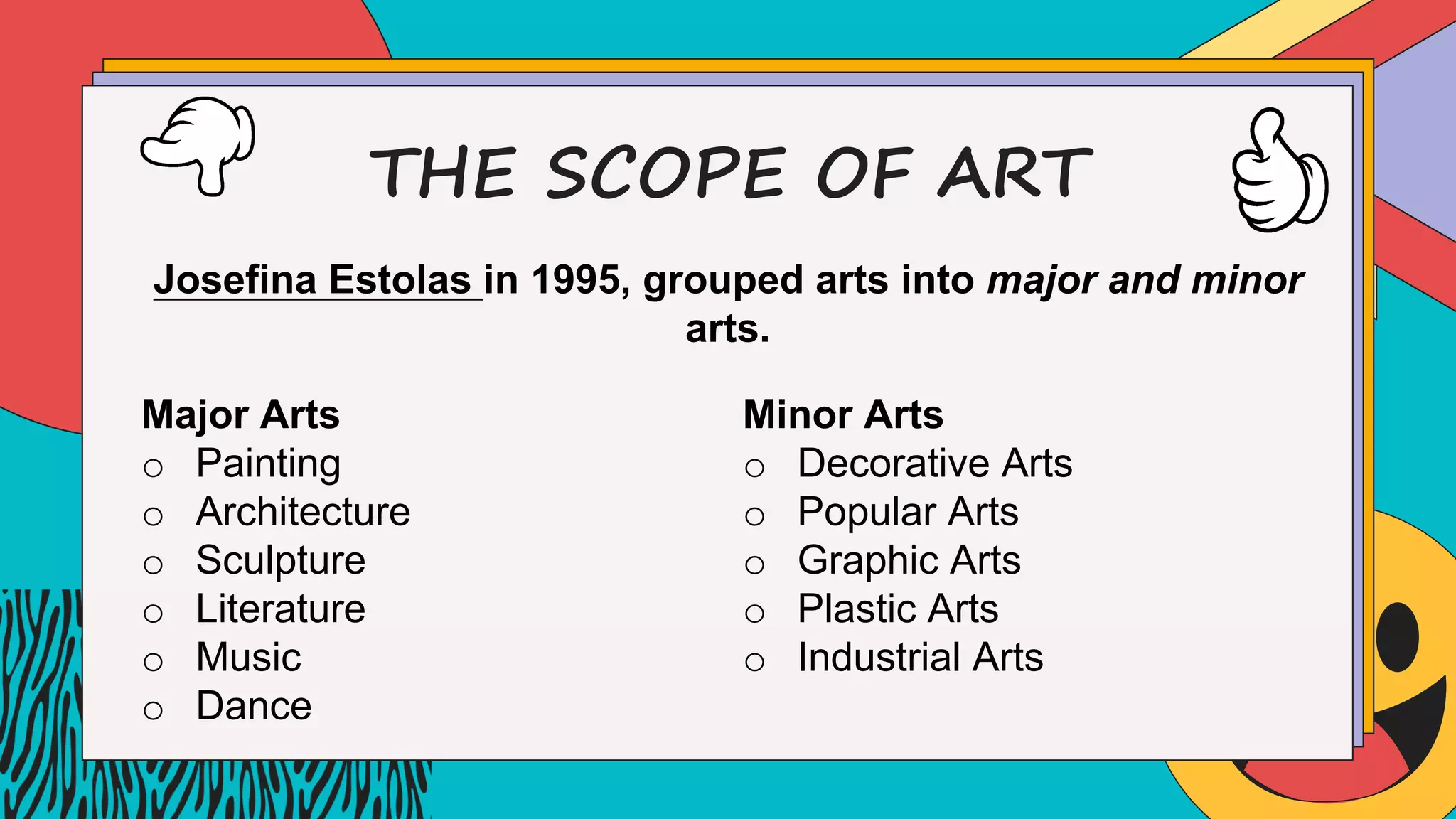
Josefina Estolas in 1995, grouped arts into major and minor
arts.
Major Arts
o Painting
o Architecture
o Sculpture
o Literature
o Music
o Dance
Minor Arts
o Decorative Arts
o Popular Arts
o Graphic Arts
o Plastic Arts
o Industrial Arts
THE SCOPE OF ART
Josefina Estolas also grouped arts into:
A. Visual Arts (graphic arts and plastic arts)
B. Performing Arts (theatre, play, dance, music)
C. Literary Arts (short story, novel, poetry, drama)
D. Popular Arts (film, newspaper, magazine, radio, TV)
E. Gustatory Art of the Cuisine (food prep, beverage prep)
F. Decorative Arts (beautification of houses, offices, cars, and
other structures)
THE SCOPE OF ART
Panizo and Rustia in 1995, classified Arts into two (2) major
divisions:
1. According to Purpose
2. According to Media and Forms
Panizo and Rustia in 1995 (5
PURPOSES)
1. Practical or Useful Arts
Ø directed to produce artifacts and utensils for the satisfaction of
human needs. (e.g. handicrafts, embroidery, ceramics, iron
and metal crafts, and tin can manufacturing)
2. Liberal Arts
Ø Directed toward intellectual growth (e.g. study of philosophy,
psychology, literature, mathematics, and science)
Panizo and Rustia in 1995 (5
PURPOSES)
3. Fine Arts
Ø Focused towards creative activity for the contemplation of the
mind and the uplift of the spirit. (e.g. painting, sculpture, and
architecture)
4. Major Arts
Ø Characterized by actual and potential expressiveness. (e.g.
music, poetry, and sculpture)
5. Minor Arts
Ø Concerned with practical uses and purposes. (e.g. interior
decoration and porcelain)
Panizo and Rustia in 1995
(5 MEDIA AND FORMS)
1. Plastic Arts
Ø Works which exist in a physical space and perceived by the
sense of sight. (e.g. sculpture and decorative materials)
2. Kinetic Arts
Ø Involve the element of rhythm. (e.g. dance)
3. Phonetic Arts
Ø Utilize sounds and words as mediums of expression.
(e.g. music, drama, and literature)
Panizo and Rustia in 1995
(5 MEDIA AND FORMS)
4. Pure Arts
Ø Take only one medium of expression like sound in music and
color in painting.
5. Mixed Arts
Ø Take more than one medium such as the opera which
combines music, poetry, and drama.
CREDITS: This presentation template was created by Slidesgo,
including icons by Flaticon, and infographics & images by
Freepik
THANKS!
Do you have any questions?

Chapter_1_Art_Appreciation.pdf

  • 1.
    Here is whereyour presentation begins ART APPRECIATION Isabela State University- Cabagan Mr. Joseph S. Dauag
  • 2.
    COURSE OUTLINE CHAPTER 1-The Meaning and Importance of Art • The Nature of Art • The Subject of Art • The Function of Art CHAPTER 2- The Artist’s Medium • Medium and Technique • Mediums of the Visual Arts • Mediums of the Performing Arts • Methods of Art Production and Presentation CHAPTER 3- The Elements of Visual Arts and Performing Arts • The Elements of Visual Arts • The Elements of Performing Arts PART I- AN OVERVIEW OF ART • The Scope of Art • The Origin of Art
  • 3.
    COURSE OUTLINE CHAPTER 4-The Principles of Art Design • Harmony • Rhythm • Balance • Proportion • Emphasis • Other Art Principles CHAPTER 5- The Development of Visual Arts • The Development of Painting • The Development of Sculpture • The Development of Architecture PART II- THE HISTORICAL DEVELOPMENT OF ARTS
  • 4.
    COURSE OUTLINE CHAPTER 6-Asian Art • Ancient Near Eastern Art and Islamic Art • East Asian Art CHAPTER 7- The Development of Visual Arts in the Philippines • The Development of Painting in the Philippines • The Development of Sculpture in the Philippines • The development of Architecture in the Philippines CHAPTER 8- The Development of Performing Arts in the Philippines • The Development of Music in the Philippines • The Development of Literature in the Philippines • The Development of Dance in the Philippines • The Development of Cinema in the Philippines
  • 5.
    COURSE OUTLINE CHAPTER 9-Arts in the Cordillera Region and Muslim South • Arts in the Cordillera Region • Arts in the Muslim South CHAPTER 10- World-renowned Visual Artists • Leonardo da Vinci (1452-1519) • Michelangelo Buonarroti (1475-1564) • Pablo Picasso (1881-1973) • Vincent van Gogh (1853-1890) • Johann Sebastian Bach (1685-1750) • Ludwig van Beethoven (1770-1827) • Frederic Chopin (1810-1849) • George Frideric Handel (1685-1759) PART III- The Life and Works of Famous Masters in Visual and Performing Arts • Wolfgang Amadeus Mozart (1756- 1791) • Johann Strauss II (1825-1899) • Peter Ilyich Tchaikovsky (1840-1893) • Giuseppe Verdi (1813-1901)
  • 6.
    COURSE OUTLINE CHAPTER 11-Famous Filipino Painters and Composers Famous Filipino Painters • Felix Resurrecion Hidalso (1855-1913) • Juan Luna (1857-1899) • Fernando Amorsolo (1892-1972) • Vicente Manansala (1910-1981) • Carlos “Botong” V. Francisco (1912-1969) • Mauro Malang Santos (1928) • Jose Joya (1931-1995) Famous Filipino Composers • Col. Antonio Buenaventura (1904-1996) • Lucrecia R. Kasilag (1917-2008) • Felipe Padilla de Leon (1912-1992) • Antonio Molina (1894-1980) • Lucio D. San Pedro (1913-2002)
  • 7.
  • 8.
    FACTS ABOUT ART VisualArts ü Architecture ü Painting ü Sculpture 1. Humanities refers to Arts Performing Arts ü Music ü Dance ü Theatre or Drama ü Literature
  • 9.
    FACTS ABOUT ART 2.The word art comes from: ü The Italian word, “artis” which means “craftsmanship, skill, mastery of form, inventiveness, and the association that exist between form and ideas and between material and techniques;” ü The Aryan root “ar” which means “to join” or “put together;” ü The Greek words “artizien,” which means to “prepare,” and “arkiskein”, meaning to “put together.”
  • 10.
    FACTS ABOUT ART 3.Art is very important in our lives as it is concerned with the communication of certain ideas and feelings by means of a sensuous medium– color, sound, bronze, marble, words, and film. 4. The subject of art is varied. Some arts are representational; others are nonrepresentational, non- objective, or abstract. 5. All arts have functions for people since they satisfy particular needs of people.
  • 11.
    FACTS ABOUT ART 6.Visual arts or space arts are those that we perceive with our eye and which occupy space. 7. Auditory or time arts are those that can be heard and expressed in time. 8. Combined arts are those that can be both seen and heard exist in both space and time.
  • 12.
    WHAT IS ART??? Art hasbeen defined in various ways. The following are some of the definitions given by various authors.
  • 13.
  • 14.
    THE NATURE OFART Art is very important in our lives. It constitutes one of the oldest and most important means of expression developed by man. Art has been existent since men have lived together. In fact, in nearly every country, art can be found in primitive societies. Art has been created by all people at all times; it has lived because it is liked and enjoyed. A true work of art is made by man himself not imitatively, but creatively. A true artist doesn’t imitate nature, but rather interprets it in his own way by selecting the essential features of the subject and rejecting the minor ones.
  • 15.
    Meanings of Art Artis derived from the latin word ars, meaning “ability or skill.” J.V Estolas Art is taken from the Italian word artis, which means “craftsmanship, skill, mastery of form, inventiveness, and the association that exist between form and ideas and between material and technique” A. Tan Art is a product of man’s need to express himself. F. Zulueta Art is concerned with the communication of certain ideas and feelings by means of sensuous medium– color, sound, bronze, marble, words, and film. C. Sanchez
  • 16.
    Meanings of Art Artsis that which brings life in harmony with the beauty of the world. Plato Art is an attitude of spirit, a state of mind– one which demands for its own satisfaction and fulfilling, a shaping of matter to new and more significant form. John Dewey Art is the skillful arrangement or composition of some common but significant qualities of nature such as colors, sounds, lines, movements, words, stones, wood, etc., to express human feelings, emotions, or thoughts in a perfect meaningful and enoyable way. Panizo and Rustia
  • 17.
    FOUR COMMON ESSENTIALSOF ART THAT WE NEED TO KNOW: Art must be Man-made. Art must be creative. Art must benefit and satisfy man and man must make use of art in practical terms. Art is expressed through a certain medium or material by which the artist communicates himself to his fellows.
  • 18.
    IMPORTANCE OF ART Arthas a particular importance in our lives. All the art that we see and hear have a purpose; they occupy some place in our judgment. We can communicate through paintings, songs, dances, and dramatic plays to highlight and heighten the importance of certain events, keep them in memory and indulge in pleasure. We also build monuments to remind us of the heroic deeds of great men.
  • 19.
    IMPORTANCE OF ART Artworksare also valuable sources of inspiration. We are delighted by the books we read and moved by the music we hear. Paintings, sculptures, and plays capture our attention and stimulate critical thinking. Modern architectural designs inspire us to plan and construct our houses beautifully.
  • 20.
    IMPORTANCE OF ART Throughan artist’s work, we get a glimpse of the thoughts, feelings, and beliefs of the people who lived in the period the artwork was produced and the external factors that influenced the artwork. We also value and appreciate beautiful things as a consequence of our encounter with the arts. Our aesthetic experiences can change our ways and behavior. They can transform us into highly-cultured, dignified, and respectable human beings. The arts can beautify our humanity.
  • 21.
    IMPORTANCE OF ART Artscan beautify our humanity. This explains why the arts is called humanities. It brings out the good and the noble in us. Through the arts, we come to know the changing image of man as he journeys across time, searches for the reality, and strives to achieve the ideals that create the meaning of life.
  • 22.
    WHAT IS ART APPRECIATION? Theability to interpret or understand man-made arts and enjoy them either through actual and work-experience with art tools and materials or possession of these works of art for one’s admiration and satisfaction.
  • 23.
  • 24.
    THE SUBJECT OFART In any art form– painting, music, sculpture, architecture, or dance– there is always a subject that serves as the foundation of the creation of the work of art. The subject of art is varied. A subject of art is usually anything that is represented in the artwork. It is varied– it may be a person, object, scene, or event.
  • 25.
    THE SUBJECT OFART Representational or Objective Arts Ø Artworks that depict something easily recognized by most people. Ø Painting, sculpture, graphic arts, literature, and theatre arts are generally classified as representational, although some paintings and sculptures are without subjects. Music and dance may or may not have subjects.
  • 26.
    THE SUBJECT OFART Non-Representational or Non-Objective Arts Ø Artworks that have no resemblance to any real subject. Ø They do not represent anything and they are what they are. Ø They rather appear directly to the senses primarily because of the satisfying organization of their elements.
  • 27.
  • 28.
    THE FUNCTION OFART Every art form has a definite function since it satisfies a particular need. To the layman, art may have little function. Some find meaning in art in its ability to serve the purpose for which it was designed.
  • 29.
    THE FUNCTION OFART Architecture is directly and almost entirely functional because buildings and other structures are always built for some special purpose. Music and dance were used in ancients rituals and worship of the gods, for social and folk entertainment, as well in the military. Painting and sculpture may be used to narrate events, to portray people or events, to instruct (as in the case of Christian art), to commemorate individuals or historical events, and to serve as vehicles of personal expression.
  • 30.
    THE FOUR MAINFUNCTIONS OF ART 1. Aesthetic Function Ø Through art, man becomes conscious of the beauty of nature. He benefits from his own work and from those done by his fellowmen. He learns to use, love, and preserve them for his enjoyment and appreciation.
  • 31.
    THE FOUR MAINFUNCTIONS OF ART 2. Utilitarian Function Ø With he creation of various forms of art, man now lives in comfort and happiness. Through art, man is provided with shelter, clothing, food, light, medicine, beautiful surroundings, personal ornamentals, entertainment, language, transportation, and other necessities and conveniences of life. Art doesn’t only enrich man’s life but also improves nature through landscape gardening, creation of super-highways, and through propagation and conservation of natural resources.
  • 32.
    THE FOUR MAINFUNCTIONS OF ART 3. Cultural Function Ø Through the printed matter, art transmits and preserves skills and knowledge from one generation to another. It makes man aware of his/her cultural background, making him/her more knowledgeable and his/her life more enduring and satisfying.
  • 33.
    THE FOUR MAINFUNCTIONS OF ART 4. Social Function Ø Through civic and graphic arts, man learns to love and to help each other. International understanding and cooperation are fostered and nations become more unified, friendly, cooperative, helpful, and sympathetic.
  • 34.
  • 35.
    THE SCOPE OFART Two (2) General Dimensions of Arts according to Manaois: 1. Fine Arts or Aesthetic Arts Ø Made primarily for aesthetic enjoyment through the senses, especially visual and auditory. 2. Practical Arts or Useful or Utilitarian Arts Ø Intended for practical use. It is the development of raw materials for utilitarian purposes.
  • 36.
    Manaois Fine Arts orAesthetic Arts o Music o Painting o Sculpture o Architecture o Literature o Dance o Drama Practical Arts or Useful Arts o Industrial Art o Applied or Household Art o Civic Arts o Commercial Art o Graphic Art o Agricultural Art o Fishery Art
  • 37.
    THE SCOPE OFART According to Custodiosa Sanchez in 2002: Arts consist of visual arts, literature, drama and theatre, music, and dance. According to her, visual arts may be classified into two groups, namely: 1. Graphic Arts- portrayals of forms and symbols are recorded on a two-dimensional surface. 2. Plastic Arts- all fields of visual arts for which materials are organized into three-dimensional forms.
  • 38.
    Custodiosa Sanchez Graphic Arts oPainting o Drawing o Photography o Graphic process (Printing) o Commercial Art (designing of books, advertisements, signs, posters, and other displays) Plastic Arts o Structural Architecture o Landscape Architecture o City Physical Planning and Interior Arranging o Sculpture o Crafts o Industrial Design o Dress and Costume Design o Theatre Design
  • 39.
    THE SCOPE OFART Josefina Estolas in 1995, grouped arts into major and minor arts. Major Arts o Painting o Architecture o Sculpture o Literature o Music o Dance Minor Arts o Decorative Arts o Popular Arts o Graphic Arts o Plastic Arts o Industrial Arts
  • 40.
    THE SCOPE OFART Josefina Estolas also grouped arts into: A. Visual Arts (graphic arts and plastic arts) B. Performing Arts (theatre, play, dance, music) C. Literary Arts (short story, novel, poetry, drama) D. Popular Arts (film, newspaper, magazine, radio, TV) E. Gustatory Art of the Cuisine (food prep, beverage prep) F. Decorative Arts (beautification of houses, offices, cars, and other structures)
  • 41.
    THE SCOPE OFART Panizo and Rustia in 1995, classified Arts into two (2) major divisions: 1. According to Purpose 2. According to Media and Forms
  • 42.
    Panizo and Rustiain 1995 (5 PURPOSES) 1. Practical or Useful Arts Ø directed to produce artifacts and utensils for the satisfaction of human needs. (e.g. handicrafts, embroidery, ceramics, iron and metal crafts, and tin can manufacturing) 2. Liberal Arts Ø Directed toward intellectual growth (e.g. study of philosophy, psychology, literature, mathematics, and science)
  • 43.
    Panizo and Rustiain 1995 (5 PURPOSES) 3. Fine Arts Ø Focused towards creative activity for the contemplation of the mind and the uplift of the spirit. (e.g. painting, sculpture, and architecture) 4. Major Arts Ø Characterized by actual and potential expressiveness. (e.g. music, poetry, and sculpture) 5. Minor Arts Ø Concerned with practical uses and purposes. (e.g. interior decoration and porcelain)
  • 44.
    Panizo and Rustiain 1995 (5 MEDIA AND FORMS) 1. Plastic Arts Ø Works which exist in a physical space and perceived by the sense of sight. (e.g. sculpture and decorative materials) 2. Kinetic Arts Ø Involve the element of rhythm. (e.g. dance) 3. Phonetic Arts Ø Utilize sounds and words as mediums of expression. (e.g. music, drama, and literature)
  • 45.
    Panizo and Rustiain 1995 (5 MEDIA AND FORMS) 4. Pure Arts Ø Take only one medium of expression like sound in music and color in painting. 5. Mixed Arts Ø Take more than one medium such as the opera which combines music, poetry, and drama.
  • 46.
    CREDITS: This presentationtemplate was created by Slidesgo, including icons by Flaticon, and infographics & images by Freepik THANKS! Do you have any questions?