Chapter-9
SAMPLING
CONSIDERATIONS
 Sampling is a process used in statistical analysis in which a
predetermined number of observations are taken from a
larger population.
SAMPLING
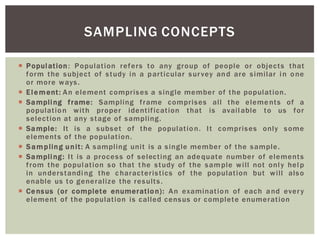
 Population: Population refers to any group of people or objects that
form the subject of study in a particular survey and are similar in one
or more ways.
 Element: An element comprises a single member of the population.
 Sampling frame: Sampling frame comprises all the elements of a
population with proper identification that is available to us for
selection at any stage of sampling.
 Sample: It is a subset of the population. It comprises only some
elements of the population.
 Sampling unit: A sampling unit is a single member of the sample.
 Sampling: It is a process of selecting an adequate number of elements
from the population so that t he study of the sample will not only help
in understanding the c haracteristics of the population but will also
enable us to generalize the results.
 Census (or complete enumeration): An examination of each and every
element of the population is called census or complete enumeration
SAMPLING CONCEPTS
 Sample saves time and cost.
 A decision-maker may not have too much of time to wait till
all the information is available.
 There are situations where a sample is the only option.
 The study of a sample instead of complete enumeration may,
at times, produce more reliable results.
A census is appropriate when the population size is small.
SAMPLE V/S CENSUS
 A representative sample is a small quantity of something that
accurately reflects the larger entity.
SAMPLE REPRESENTATIVENESS
 Sampling is a process used in statistical analysis in which a
predetermined number of observations are taken from a
larger population.
 Types
1. Probability sampling
2. Non-probability sampling
SAMPLING DESIGN
Probability Sampling Design - Probability sampling designs are
used in conclusive research. In a probability sampling design,
each and every element of the population has a known chance
of being selected in the sample.
Types of Probability Sampling Design
 Simple random sampling with replacement
 Simple random sampling without replacement
 Systematic sampling
 Stratified random sampling
 Cluster sampling
PROBABILITY SAMPLING
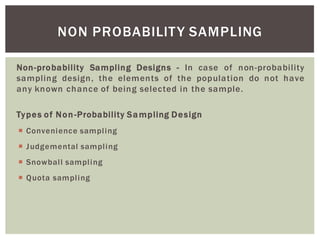
Non-probability Sampling Designs - In case of non-probability
sampling design, the elements of the population do not have
any known chance of being selected in the sample.
Types of Non-Probability Sampling Design
 Convenience sampling
 Judgemental sampling
 Snowball sampling
 Quota sampling
NON PROBABILITY SAMPLING
SAMPLING VS NON-SAMPLING ERROR
 Sampling error: This error arises when a sample is not representative
of the population.
 Non-sampling error: This error arises not because a sample is not a
representative of the population but because of ot her reasons. Some
of these reasons are listed below:
 Plain lying by the respondent.
 The error can arise while transferring the data from the
questionnaire to the spreadsheet on the computer.
 There can be errors at the time of coding, tabulation and
computation.
 Population of the study is not properly defined
 Respondent may refuse to be part of the study.
 There may be a sampling frame error.
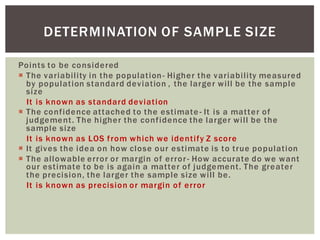
Points to be considered
 The variability in the population- Higher the variability measured
by population standard deviation , the larger will be the sample
size
It is known as standard deviation
 The confidence attached to the estimate - It is a matter of
judgement. The higher the confidence the larger will be the
sample size
It is known as LOS from which we identify Z score
 It gives the idea on how close our estimate is to true population
 The allowable error or margin of error- How accurate do we want
our estimate to be is again a matter of judgement. The greater
the precision, the larger the sample size will be.
It is known as precision or margin of error
DETERMINATION OF SAMPLE SIZE
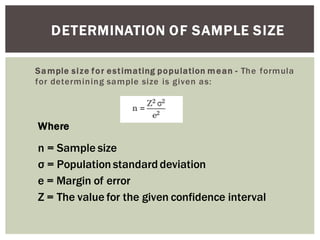
Sample size for estimating population mean - The formula
for determining sample size is given as:
Where
n = Sample size
σ = Population standard deviation
e = Margin of error
Z = The value for the given confidence interval
DETERMINATION OF SAMPLE SIZE
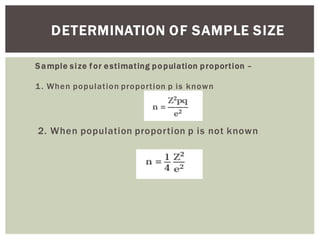
Sample size for estimating population proportion –
1. When population proportion p is known
2. When population proportion p is not known

chapter-16 Sampling considerations.pdf

  • 1.
  • 2.
     Sampling isa process used in statistical analysis in which a predetermined number of observations are taken from a larger population. SAMPLING
  • 3.
     Population: Populationrefers to any group of people or objects that form the subject of study in a particular survey and are similar in one or more ways.  Element: An element comprises a single member of the population.  Sampling frame: Sampling frame comprises all the elements of a population with proper identification that is available to us for selection at any stage of sampling.  Sample: It is a subset of the population. It comprises only some elements of the population.  Sampling unit: A sampling unit is a single member of the sample.  Sampling: It is a process of selecting an adequate number of elements from the population so that t he study of the sample will not only help in understanding the c haracteristics of the population but will also enable us to generalize the results.  Census (or complete enumeration): An examination of each and every element of the population is called census or complete enumeration SAMPLING CONCEPTS
  • 4.
     Sample savestime and cost.  A decision-maker may not have too much of time to wait till all the information is available.  There are situations where a sample is the only option.  The study of a sample instead of complete enumeration may, at times, produce more reliable results. A census is appropriate when the population size is small. SAMPLE V/S CENSUS
  • 5.
     A representativesample is a small quantity of something that accurately reflects the larger entity. SAMPLE REPRESENTATIVENESS
  • 6.
     Sampling isa process used in statistical analysis in which a predetermined number of observations are taken from a larger population.  Types 1. Probability sampling 2. Non-probability sampling SAMPLING DESIGN
  • 7.
    Probability Sampling Design- Probability sampling designs are used in conclusive research. In a probability sampling design, each and every element of the population has a known chance of being selected in the sample. Types of Probability Sampling Design  Simple random sampling with replacement  Simple random sampling without replacement  Systematic sampling  Stratified random sampling  Cluster sampling PROBABILITY SAMPLING
  • 8.
    Non-probability Sampling Designs- In case of non-probability sampling design, the elements of the population do not have any known chance of being selected in the sample. Types of Non-Probability Sampling Design  Convenience sampling  Judgemental sampling  Snowball sampling  Quota sampling NON PROBABILITY SAMPLING
  • 9.
    SAMPLING VS NON-SAMPLINGERROR  Sampling error: This error arises when a sample is not representative of the population.  Non-sampling error: This error arises not because a sample is not a representative of the population but because of ot her reasons. Some of these reasons are listed below:  Plain lying by the respondent.  The error can arise while transferring the data from the questionnaire to the spreadsheet on the computer.  There can be errors at the time of coding, tabulation and computation.  Population of the study is not properly defined  Respondent may refuse to be part of the study.  There may be a sampling frame error.
  • 10.
    Points to beconsidered  The variability in the population- Higher the variability measured by population standard deviation , the larger will be the sample size It is known as standard deviation  The confidence attached to the estimate - It is a matter of judgement. The higher the confidence the larger will be the sample size It is known as LOS from which we identify Z score  It gives the idea on how close our estimate is to true population  The allowable error or margin of error- How accurate do we want our estimate to be is again a matter of judgement. The greater the precision, the larger the sample size will be. It is known as precision or margin of error DETERMINATION OF SAMPLE SIZE
  • 11.
    DETERMINATION OF SAMPLESIZE Sample size for estimating population mean - The formula for determining sample size is given as: Where n = Sample size σ = Population standard deviation e = Margin of error Z = The value for the given confidence interval
  • 12.
    DETERMINATION OF SAMPLESIZE Sample size for estimating population proportion – 1. When population proportion p is known 2. When population proportion p is not known