Reentry into
the Community
Chapter 10
The Origins of Parole
PAROLE
The conditional release of an inmate from
incarceration, under supervision, after part of
the prison sentence has been served
The Origins of Parole
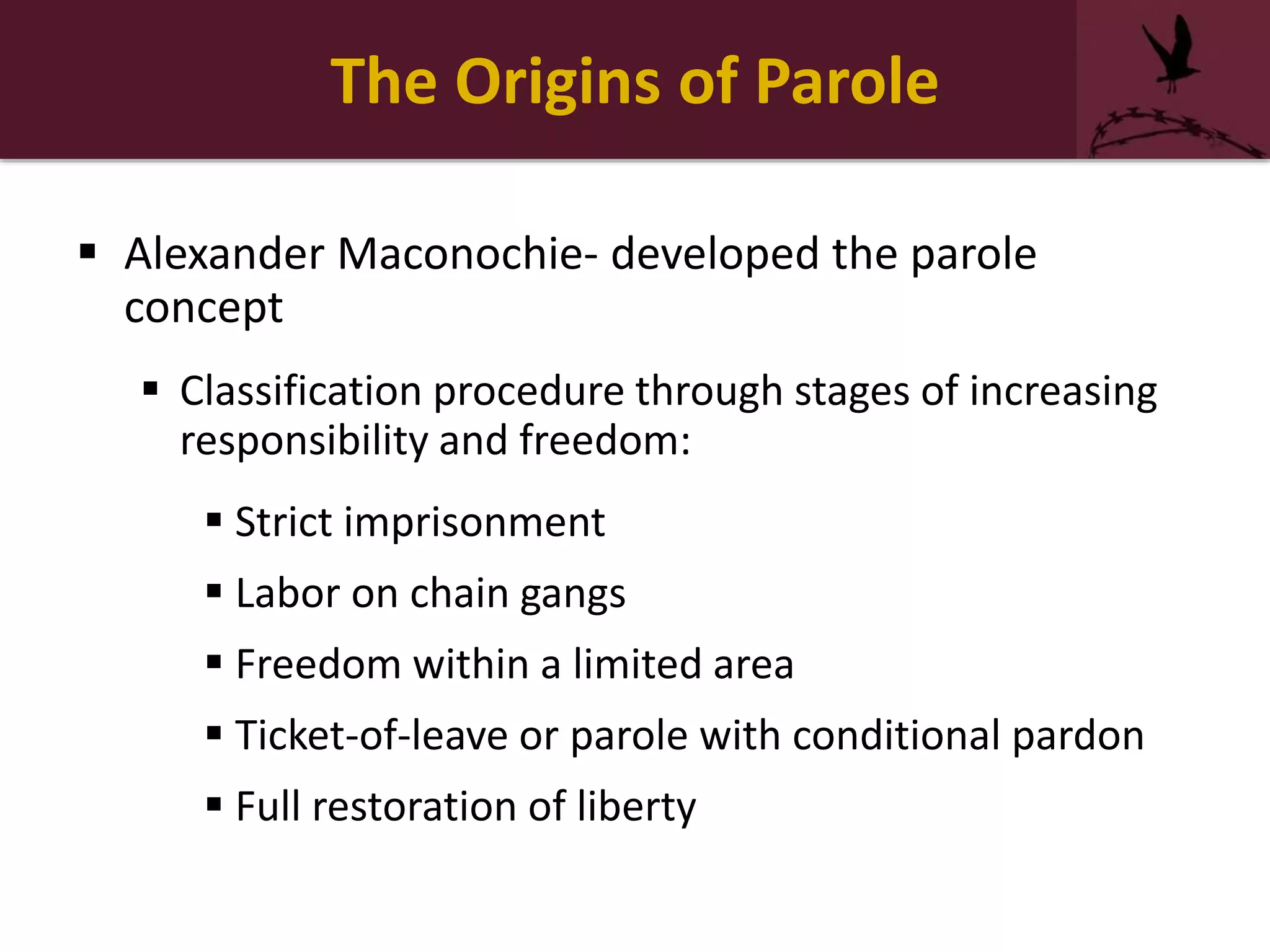
 Alexander Maconochie- developed the parole
concept
 Classification procedure through stages of increasing
responsibility and freedom:
 Strict imprisonment
 Labor on chain gangs
 Freedom within a limited area
 Ticket-of-leave or parole with conditional pardon
 Full restoration of liberty
The Origins of Parole
 Crofton
 Progress through prison and ticket-of-leave
linked
 Parole included a series of conditions
 Report monthly to police
The Origins of Parole
 United States
 Zebulon Brockway
 Elmira Reformatory
 Parole followed indeterminate sentencing
 By 1900, 20 states had parole systems
The Origins of Parole
 By 1925, 46 states had parole systems
 1910—each federal prison had a parole board
(warden, medical officer, superintendent of
prisons for Dept. of Justice)
 U.S. Board of Parole was developed
Release from One Part of the System to
Another
 Most Inmates Eventually Released into Society
 Over three-fourths will be on parole
 Parole- a form of conditional release
 Grace or privilege
 Contract of consent
 Custody
Release from One Part of the System to
Another
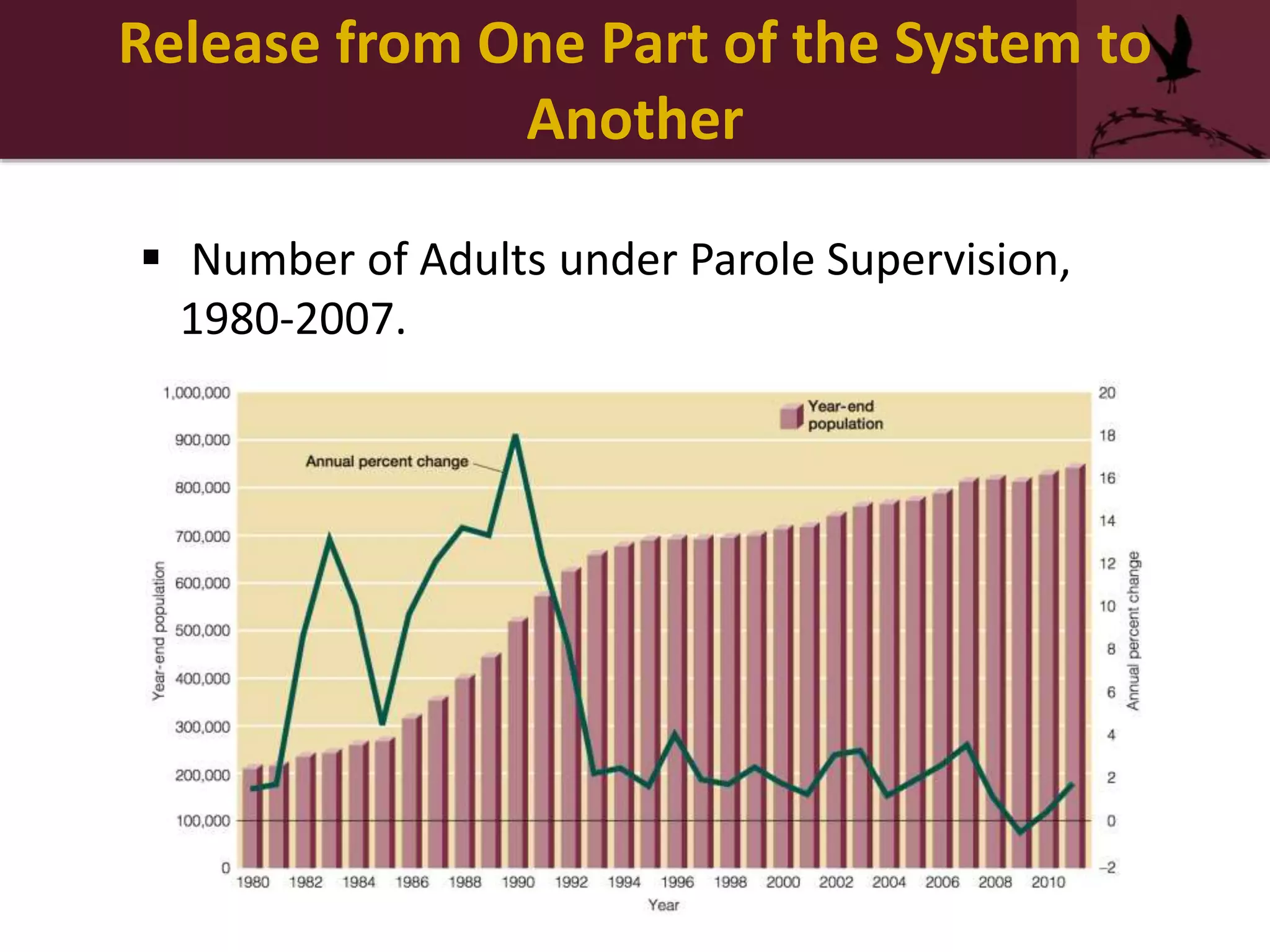
 Number of Adults under Parole Supervision,
1980-2007.
Discussion Question
Imagine you are an 88 year old man who has
served the last 50 years in prison for a murder
you committed. Your release date is upon
you… how do you think you will adjust to
society?
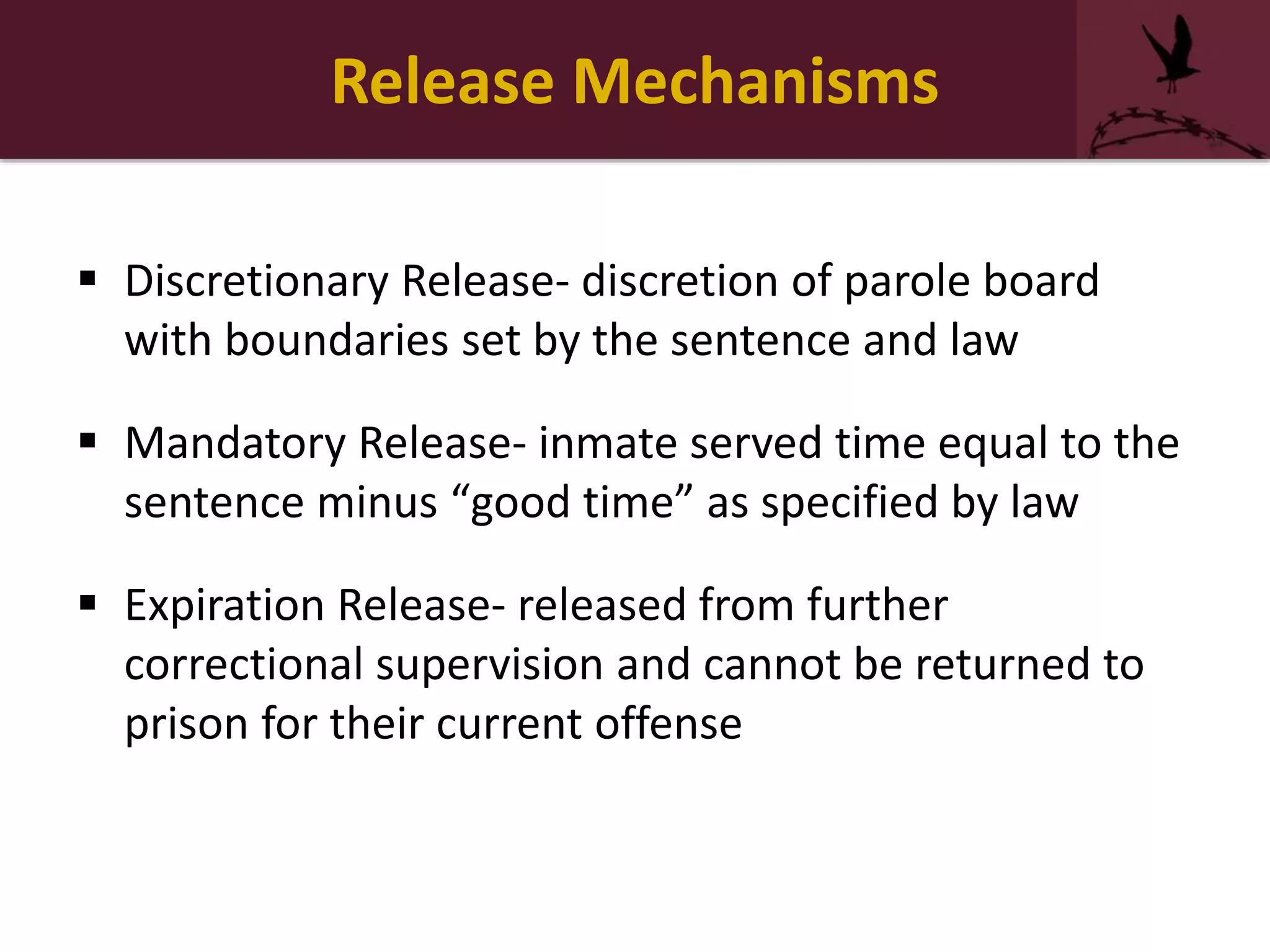
Release Mechanisms
 Methods of Release from State Prison
© Cengage Learning. All rights reserved.
Release Mechanisms
 Discretionary Release- discretion of parole board
with boundaries set by the sentence and law
 Mandatory Release- inmate served time equal to the
sentence minus “good time” as specified by law
 Expiration Release- released from further
correctional supervision and cannot be returned to
prison for their current offense
Release Mechanisms
 Probation Release- release from incarceration to
probation supervision as required by the
sentencing judge
 Reinstatement Release- offenders return to
parole after serving a time in prison for a parole
violation
 Other Conditional Releases- used to get around
mandatory sentencing and release to community
under supervision
The Decision to Release
 Procedure
 Eligibility
 Sentence
 Statutory criteria
 Conduct prior to incarceration
 Often minimum sentence minus good time
 Parole board discretion
 One-third to one-half of the maximum sentence
The Decision to Release
 Release Criteria
 Normally include at least eight factors
 Offense & inmate attitude towards offense
 Prior criminal record
 Attitude toward family, victim, authority
 Institutional adjustment/participation/progress
 History of community adjustment
 Physical, mental, and emotional health
 Insight into causes of past criminal conduct
 Adequacy of parole plan
The Decision to Release
 Release Criteria
 Discretionary
 Moral judgments
 Culpability
 Adequacy of sentence
 DNA
 Legal and ethical issues
The Decision to Release
 Structuring Parole Decisions
 Parole guidelines
 Three criteria
 Substantial observance of institutional rules
 Release will not devalue seriousness of offense or
promote disrespect for the law
 Release will not jeopardize public welfare
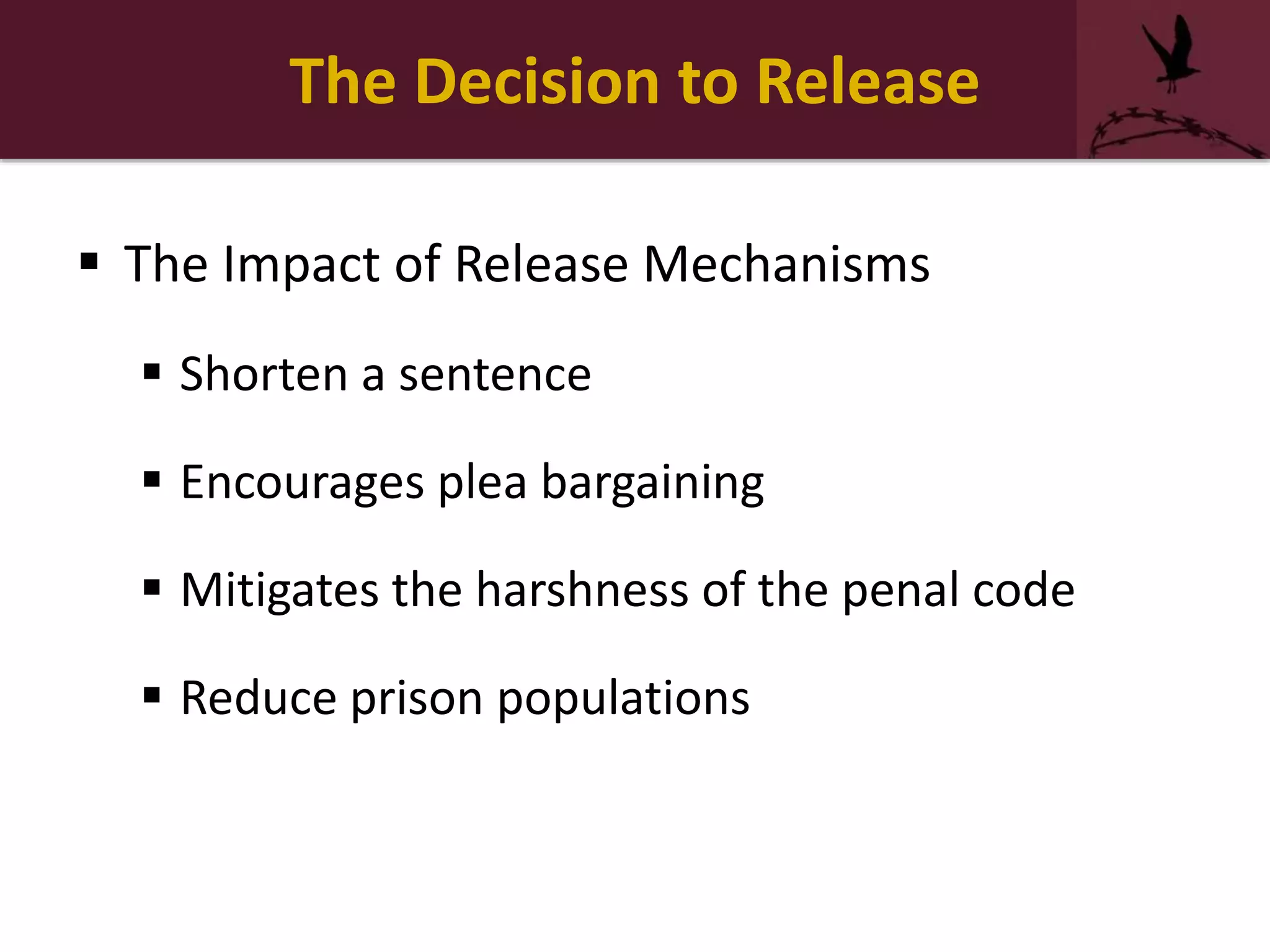
The Decision to Release
 The Impact of Release Mechanisms
 Shorten a sentence
 Encourages plea bargaining
 Mitigates the harshness of the penal code
 Reduce prison populations
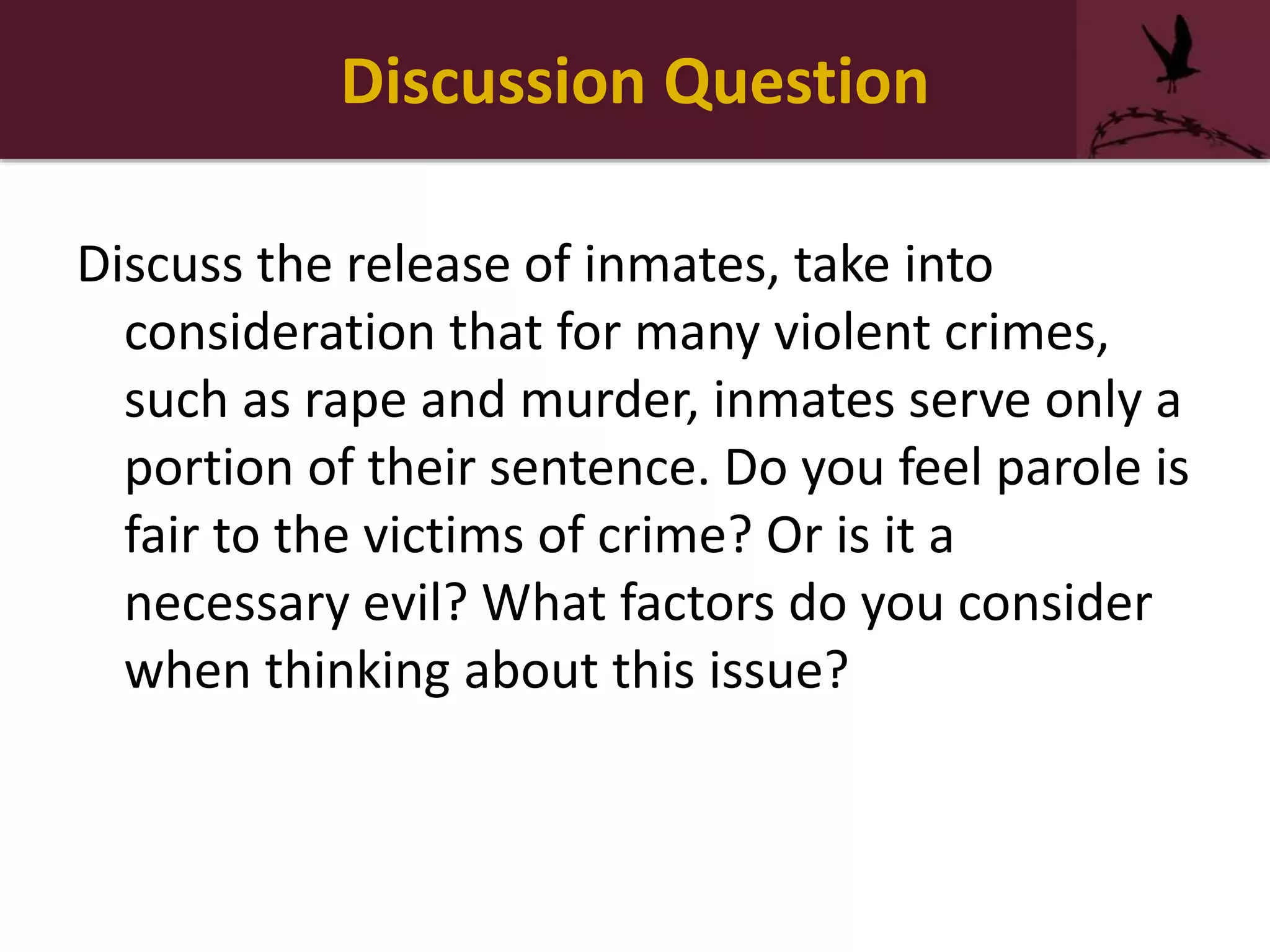
Discussion Question
Discuss the release of inmates, take into
consideration that for many violent crimes,
such as rape and murder, inmates serve only a
portion of their sentence. Do you feel parole is
fair to the victims of crime? Or is it a
necessary evil? What factors do you consider
when thinking about this issue?
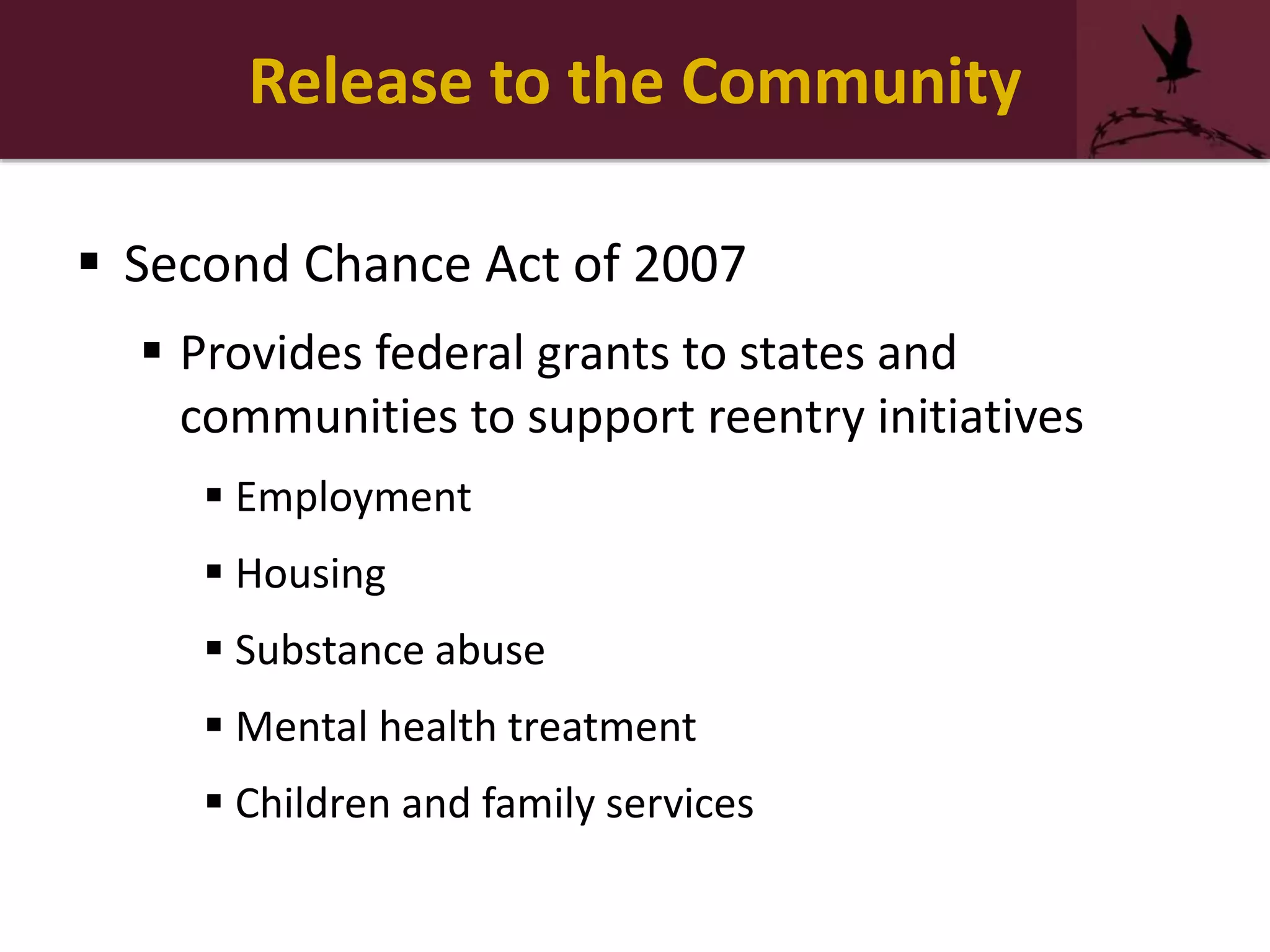
Release to the Community
 Second Chance Act of 2007
 Provides federal grants to states and
communities to support reentry initiatives
 Employment
 Housing
 Substance abuse
 Mental health treatment
 Children and family services
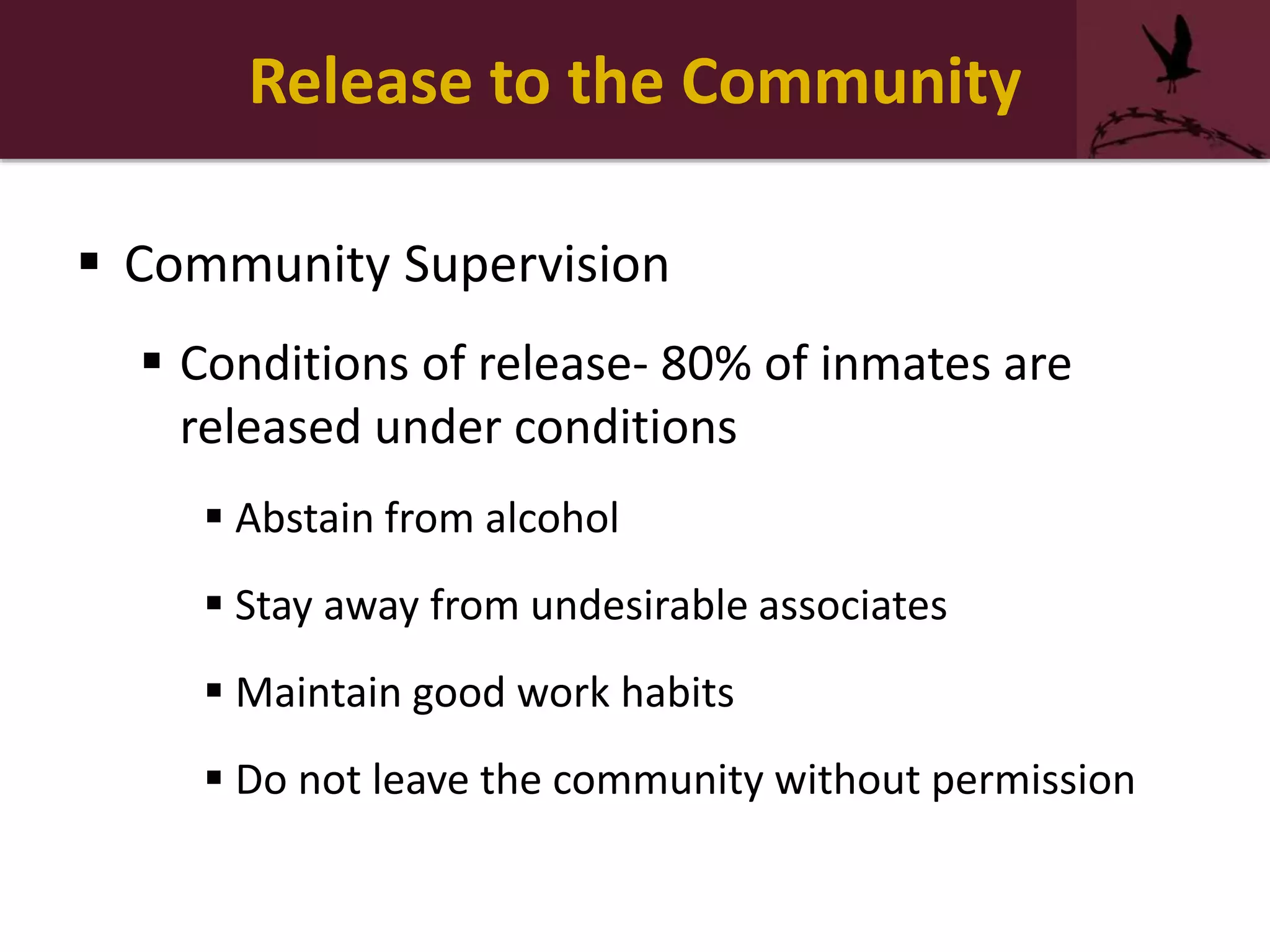
Release to the Community
 Community Supervision
 Conditions of release- 80% of inmates are
released under conditions
 Abstain from alcohol
 Stay away from undesirable associates
 Maintain good work habits
 Do not leave the community without permission
Release to the Community
 Revocation
 Parole can be revoked for two reasons
 Committing a new crime
 Violating conditions of parole (technical violation)
 In practice
 Usually requires persistent non-compliance or
 Arrest on a serious charge
 Supreme Court requires a two-stage
parole-revocation hearing
Release to the Community
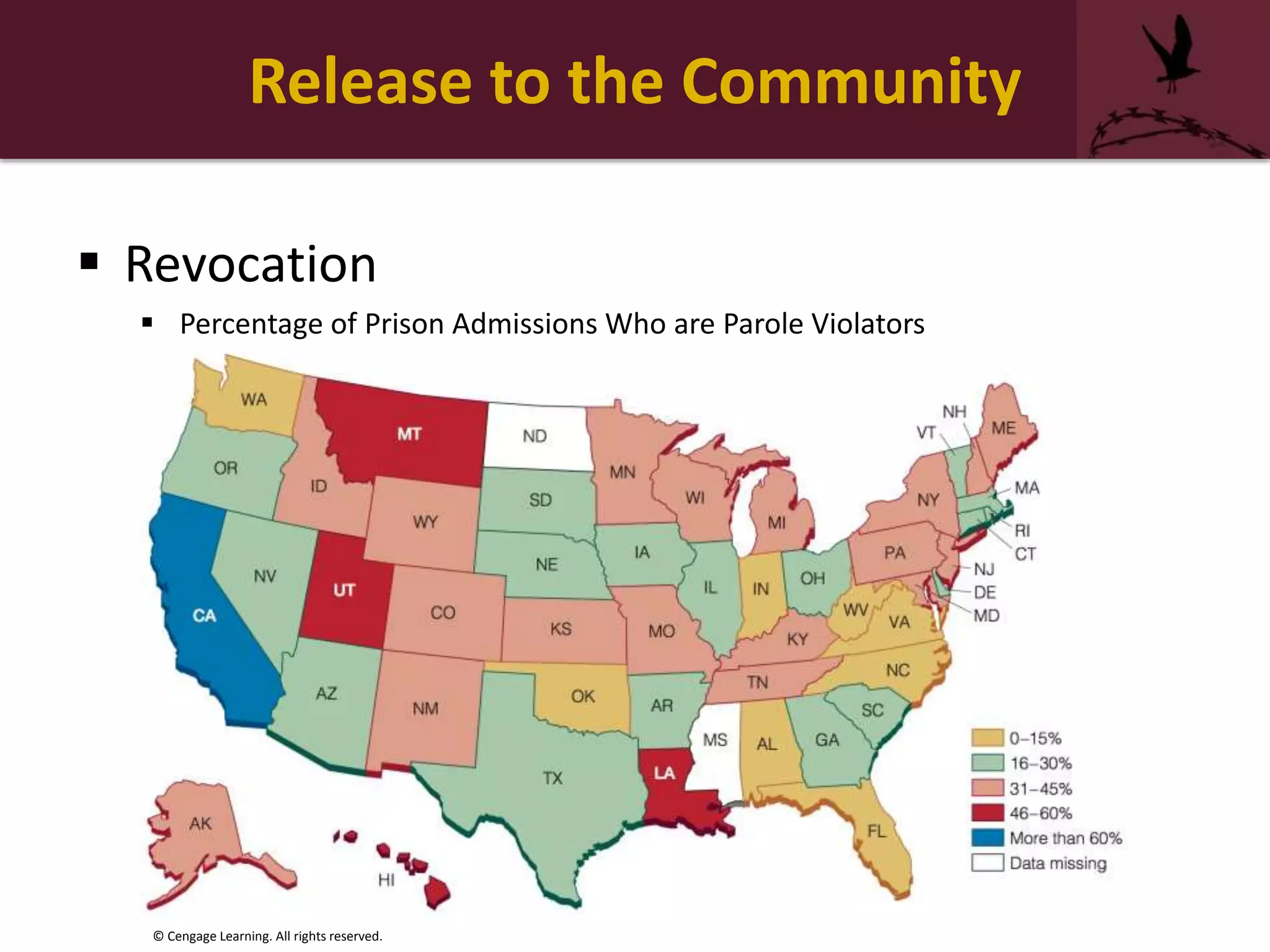
 Revocation
 Percentage of Prison Admissions Who are Parole Violators
© Cengage Learning. All rights reserved.
Discussion Question
What if you were recently release from prison
on parole, and the only job that pays a salary
you can live on requires you to attend college
and earn an associate’s degree in accounting;
is this something you really want to do? You
have no money and you cannot get student
loans. Would you consider a life of crime to
earn money illegally to pay for school to
better yourself down the road?
Agents of Community Supervision
 Parole Officer
 Surveillance
 Restriction
 Enforcement
 Revocation
 Assistance
 Jobs
 Families
 Human service agencies
The Offender’s Experience of
Postrelease Life
 The Strangeness of Reentry
 Changes
 Unfamiliar freedom
 Supervision and Surveillance
 Not really free
 Rules to follow and authority to heed
 The Problem of Unmet Personal Needs
 Education
 Money
 Job
 Drug and alcohol problems
 Mental health
 Housing
The Offender’s Experience of
Postrelease Life
 Barriers to Success
 Civil disabilities- right to vote/hold public office
 Employment
 Conviction viewed as untrustworthy
 Statutory bars on specific jobs
 Expungement
 Pardon
The Offender’s Experience of
Postrelease Life
 Barriers to Success
 Civil disabilities
 Right to vote and hold public office
 “War on Drugs”
 Access to public assistance and food stamps
 Living in public housing
 Having a driver’s license
 Being a foster parent or adopting children
 Receiving student loans
The Offender’s Experience of
Postrelease Life
Discussion Question
Discuss if it’s fair to punish inmates once they
are released with additional sanctions, such as
voting rights and student loans.
The Elements of Successful Reentry
 Pardons serve 3 main purposes:
 Remedy a miscarriage of justice
 Remove the stigma of a conviction
 Mitigate a penalty
The Elements of Successful Reentry
 Four Factors necessary for successful reentry:
 Get substance abuse under control.
 Get a job.
 Develop a support group of family and friends.
 Get a sense of “who I am.”
The Elements of Successful Reentry
 Reentry Courts
 Judicial supervision
 Emphasis on involvement of judicial and
correctional officials in
 Prerelease needs of prisoner
 Linkages to family
 Social services
 Housing
 Employment

Chapter10

  • 1.
  • 2.
    The Origins ofParole PAROLE The conditional release of an inmate from incarceration, under supervision, after part of the prison sentence has been served
  • 3.
    The Origins ofParole  Alexander Maconochie- developed the parole concept  Classification procedure through stages of increasing responsibility and freedom:  Strict imprisonment  Labor on chain gangs  Freedom within a limited area  Ticket-of-leave or parole with conditional pardon  Full restoration of liberty
  • 4.
    The Origins ofParole  Crofton  Progress through prison and ticket-of-leave linked  Parole included a series of conditions  Report monthly to police
  • 5.
    The Origins ofParole  United States  Zebulon Brockway  Elmira Reformatory  Parole followed indeterminate sentencing  By 1900, 20 states had parole systems
  • 6.
    The Origins ofParole  By 1925, 46 states had parole systems  1910—each federal prison had a parole board (warden, medical officer, superintendent of prisons for Dept. of Justice)  U.S. Board of Parole was developed
  • 7.
    Release from OnePart of the System to Another  Most Inmates Eventually Released into Society  Over three-fourths will be on parole  Parole- a form of conditional release  Grace or privilege  Contract of consent  Custody
  • 8.
    Release from OnePart of the System to Another  Number of Adults under Parole Supervision, 1980-2007.
  • 9.
    Discussion Question Imagine youare an 88 year old man who has served the last 50 years in prison for a murder you committed. Your release date is upon you… how do you think you will adjust to society?
  • 10.
    Release Mechanisms  Methodsof Release from State Prison © Cengage Learning. All rights reserved.
  • 11.
    Release Mechanisms  DiscretionaryRelease- discretion of parole board with boundaries set by the sentence and law  Mandatory Release- inmate served time equal to the sentence minus “good time” as specified by law  Expiration Release- released from further correctional supervision and cannot be returned to prison for their current offense
  • 12.
    Release Mechanisms  ProbationRelease- release from incarceration to probation supervision as required by the sentencing judge  Reinstatement Release- offenders return to parole after serving a time in prison for a parole violation  Other Conditional Releases- used to get around mandatory sentencing and release to community under supervision
  • 13.
    The Decision toRelease  Procedure  Eligibility  Sentence  Statutory criteria  Conduct prior to incarceration  Often minimum sentence minus good time  Parole board discretion  One-third to one-half of the maximum sentence
  • 14.
    The Decision toRelease  Release Criteria  Normally include at least eight factors  Offense & inmate attitude towards offense  Prior criminal record  Attitude toward family, victim, authority  Institutional adjustment/participation/progress  History of community adjustment  Physical, mental, and emotional health  Insight into causes of past criminal conduct  Adequacy of parole plan
  • 15.
    The Decision toRelease  Release Criteria  Discretionary  Moral judgments  Culpability  Adequacy of sentence  DNA  Legal and ethical issues
  • 16.
    The Decision toRelease  Structuring Parole Decisions  Parole guidelines  Three criteria  Substantial observance of institutional rules  Release will not devalue seriousness of offense or promote disrespect for the law  Release will not jeopardize public welfare
  • 17.
    The Decision toRelease  The Impact of Release Mechanisms  Shorten a sentence  Encourages plea bargaining  Mitigates the harshness of the penal code  Reduce prison populations
  • 18.
    Discussion Question Discuss therelease of inmates, take into consideration that for many violent crimes, such as rape and murder, inmates serve only a portion of their sentence. Do you feel parole is fair to the victims of crime? Or is it a necessary evil? What factors do you consider when thinking about this issue?
  • 19.
    Release to theCommunity  Second Chance Act of 2007  Provides federal grants to states and communities to support reentry initiatives  Employment  Housing  Substance abuse  Mental health treatment  Children and family services
  • 20.
    Release to theCommunity  Community Supervision  Conditions of release- 80% of inmates are released under conditions  Abstain from alcohol  Stay away from undesirable associates  Maintain good work habits  Do not leave the community without permission
  • 21.
    Release to theCommunity  Revocation  Parole can be revoked for two reasons  Committing a new crime  Violating conditions of parole (technical violation)  In practice  Usually requires persistent non-compliance or  Arrest on a serious charge  Supreme Court requires a two-stage parole-revocation hearing
  • 22.
    Release to theCommunity  Revocation  Percentage of Prison Admissions Who are Parole Violators © Cengage Learning. All rights reserved.
  • 23.
    Discussion Question What ifyou were recently release from prison on parole, and the only job that pays a salary you can live on requires you to attend college and earn an associate’s degree in accounting; is this something you really want to do? You have no money and you cannot get student loans. Would you consider a life of crime to earn money illegally to pay for school to better yourself down the road?
  • 24.
    Agents of CommunitySupervision  Parole Officer  Surveillance  Restriction  Enforcement  Revocation  Assistance  Jobs  Families  Human service agencies
  • 25.
    The Offender’s Experienceof Postrelease Life  The Strangeness of Reentry  Changes  Unfamiliar freedom  Supervision and Surveillance  Not really free  Rules to follow and authority to heed
  • 26.
     The Problemof Unmet Personal Needs  Education  Money  Job  Drug and alcohol problems  Mental health  Housing The Offender’s Experience of Postrelease Life
  • 27.
     Barriers toSuccess  Civil disabilities- right to vote/hold public office  Employment  Conviction viewed as untrustworthy  Statutory bars on specific jobs  Expungement  Pardon The Offender’s Experience of Postrelease Life
  • 28.
     Barriers toSuccess  Civil disabilities  Right to vote and hold public office  “War on Drugs”  Access to public assistance and food stamps  Living in public housing  Having a driver’s license  Being a foster parent or adopting children  Receiving student loans The Offender’s Experience of Postrelease Life
  • 29.
    Discussion Question Discuss ifit’s fair to punish inmates once they are released with additional sanctions, such as voting rights and student loans.
  • 30.
    The Elements ofSuccessful Reentry  Pardons serve 3 main purposes:  Remedy a miscarriage of justice  Remove the stigma of a conviction  Mitigate a penalty
  • 31.
    The Elements ofSuccessful Reentry  Four Factors necessary for successful reentry:  Get substance abuse under control.  Get a job.  Develop a support group of family and friends.  Get a sense of “who I am.”
  • 32.
    The Elements ofSuccessful Reentry  Reentry Courts  Judicial supervision  Emphasis on involvement of judicial and correctional officials in  Prerelease needs of prisoner  Linkages to family  Social services  Housing  Employment

Editor's Notes

  • #9 Source: Bureau of Justice Statistics, Annual Parole Survey, 1980–2011.
  • #11 Sources: BJS Bulletin, November 2012; Laura M. Maruschak and Erika Parks, 10% Probation and Parole in the United States, 2011.
  • #23 Source: Jeremy Travis and Sarah Lawrence, Beyond the Prison Gates: The State of Parole in America (Washington, DC: Urban Institute, 2002), 23.