Hay Job Evaluation

Foundations and Applications

The Hay Method of Job Evaluation continues to be the most widely accepted

worldwide, in use by over half of the world’s 50 largest companies as well as in

government, public, and not-for-profit institutions.


The process of evaluating jobs enables many important applications, such as
designing effective organizations; clarifying interdependencies and accountabilities;

managing succession and talent; and setting competitive, value-based pay policies.


WORKING
  P A P E R
Hay Job Evaluation

Foundations and Applications


Introduction                                             1

Hay Job Evaluation: Foundations                          2
   So, Who Is Accountable? [sidebar]

   Hay Job Evaluation Factors                            3
       Accountability
       Know-How
       Problem Solving

   Legal Aspects of Hay Job Evaluation [sidebar]         5

   Hay Guide Charts ®

   Job Size and Shape                                    7

Applications of Hay Job Evaluation                       8
   Organizational Design and Analysis
       Step Differences

   Job Design and Analysis                              10

   Job/Person Matching                                  11

   Succession Planning and Development                  12

   Pay Structures and Grading                           13

The Job Evaluation Process                              14

Conclusion                                              15

About Hay Group


Copyright © 2005 Hay Group, Inc. All rights reserved.
Introduction

         n the 1990s, the Internet and its parallel business boom fueled a war for

  I      talent, creating a belief that organizations either move at “e-speed” or risk
being passed by start-ups with radically different business models. As a result, many
organizations sacrificed disciplined processes that for years helped them control
costs—especially pay-related costs. The even more challenging post-tech boom
business environment, however, made those same organizations realize that any lost
                                                                                          To ensure a reasonable balance
discipline meant higher costs, inconsistency, and a potential loss of defensible
objectivity related to pay programs.                                                      between flexibility and control,

To ensure a reasonable balance between flexibility and control, Hay Group is working      many organizations are
with many organizations to revamp the processes through which those organizations
                                                                                          revamping the process through
value work. One key driver is the need to reestablish discipline within compensation
programs, and to better align pay with value creation—particularly at executive levels.   which they value work.

Beyond that, our job evaluation processes help well beyond defining appropriate
pay levels. Evaluating jobs not only provides consistent work value measurement,
it also gives organizations a common framework and language to design jobs,
define career progressions, analyze organization structures, and more strategically
manage human resources.

This paper provides an overview of the Hay Guide Chart®-Profile Method of Job
Evaluation and introduces a number of valuable applications. One key finding of
our research with WorldatWork and Loyola University of Chicago (of more than
1,200 organizations) indicates that between 82% and 96% of organizations evaluate
jobs, but only 18% proactively maintain their systems. Moreover, a majority reports
that they believe approximately 20% of jobs are incorrectly placed within the job
grading structure. As a result, we believe there is significant untapped potential to
leverage job evaluation efforts to optimize organizational structures, develop people
as key performers, and build employee commitment through reward programs that
are fair, motivational, and competitive.


                                                                                                   1
                                                                                          WORKING
                                                                                            P A P E R
So, Who Is Accountable?
                                                                                      Hay Job
                                   A clear understanding of impact and its            Evaluation:
                                   relation to overall accountability is critical
                                   when designing and evaluating jobs.                Foundations
                                   Consider the case of a major hotel chain
                                   CEO who ruled that the annual planning
                                   around “rack rates” for each property would
                                   be shared between the managers of national
                                   sales and operations. He reasoned that if he
                                   left it only to national sales, then the hotel
                                                                                      H         ay Group pioneered the “factor
                                                                                                comparison” job evaluation
                                                                                      method and modified it in its Guide
                                   managers would blame them if they did not
The Hay Guide Charts ® are our                                                        Charts in the early 1950s. The Hay Guide
                                   achieve their goals. Likewise, if he delegated
                                   it just to the hotel managers, then national
  proprietary instruments that                                                        Charts® are proprietary instruments that
                                   sales could blame the hotel managers if they
                                   failed to attract accounts to their properties.    yield consistent and legally defensible
yield efficient, consistent, and   Just when it looked like he had agreement,
                                                                                      work evaluations. Hay Group’s job
                                   the Finance Director complained that she
legally defensible evaluations.    had the most critical information on past          evaluation approach, in fact, is the world’s
                                   trends plus impact on profitability under
                                                                                      most widely accepted—used by an
                                   different scenarios. She believed she should
                                   share in—or maybe even drive—the decision.         estimated 8,000 organizations, including
                                   The CEO, however, wisely decided that three
                                   people responsible for making decisions            half of the Fortune 50 companies.
                                   would slow the process. In addition, having
                                   the Finance Director make the decision             Organizations use the Hay methodology
                                   would give the national sales reps and hotel
                                   managers an excuse to hide behind in not           to evaluate jobs against a set of common
                                   making their numbers.                              factors that measure inputs (required
                                   Clearly, the Finance Director had to contribute
                                                                                      knowledge, skills, and capabilities),
                                   to the decision. The national sales people and
                                   hotel managers could not make decisions            throughputs (processing of inputs to
                                   without relevant financial information. By
                                   properly defining concurrent accountability,       achieve results), and outputs (end result
                                   the CEO actually sped up decision-making           expectations from applying inputs
                                   and increased accountability for results.
                                   The “Impact” element when evaluating               constructively). During the evaluation
                                   accountability can be segmented along
                                                                                      process, each job’s content is analyzed
                                   four lines:
                                   I Ancillary. Informational, recording, or          relative to each factor and represented
                                      incidental services for use by others in        by a numerical value. These factor values
                                      relation to some important end result. Job
                                      activity may be complex, but impact on          are then totaled to determine the overall
                                      the overall organization is relatively minor.
                                                                                      job “size.” The various job size relation-
                                      These jobs are usually involved with
                                      collection, processing, and explanation of      ships, as well as the factor proportions
                                      information or data, typically required by
                                      others to make decisions impacting              associated with each job, can be useful
                                      organizational results.                         in a number of organizational and
                            2                                        (continued)
                  WORKING                                                             human resource planning applications.
                    P A P E R
Hay Job Evaluation:                           I Contributory. Interpretive, advisory, or
Factors                                          facilitating services for use by others in
                                                 taking action. This type of impact is
                                                 appropriate where jobs are accountable
The input-throughput-output model
                                                 for rendering significant “advice and
is reflected in the Hay Method as Know-          counsel” in addition to information and/or
                                                 analysis and when decisions are likely to
How, Problem Solving, and Accountability.        be made by virtue of that counsel. Such
Each grouping can be further broken              impacts are commonly found in staff
                                                 or support functions that significantly
down into eight elements for the work            influence decisions relative to the
                                                 magnitude of various resources.                 Every job exists to add value
value assessment.
                                              I Shared. Participating with peers, within
                                                 or outside the organization, in decision        to the organization through
The output factor—Accountability—
                                                 making. This impact is used to describe
is covered first, since every job is             horizontal, not vertical (hierarchical),
                                                 working relationships. This type of impact
                                                                                                 delivering some set of results.
designed to achieve predetermined                is not totally controlling relative to the
results. This factor typically receives the      magnitude of the result. Shared impacts
                                                 typically exist between peer jobs and/or
least attention and weight in many               functions, and suggest a degree of
other evaluation methodologies.                  “partnership” in, or “joint accountability”
                                                 for, the total result. For example, there
                                                 may be shared accountability between
                                                 engineering and manufacturing functions
Accountability
                                                 for a successful product. Sharing is also
Every job exists to add organizational           possible with “partners” outside the
                                                 organization (e.g., between project
value by delivering some set of results          manager and external contractor). When
                                                 this impact is selected, it is important to
(or outputs). Accountability measures
                                                 clarify specific role contributions and to
the type and level of value a job can add.       identify initiators as well as tie-breakers
                                                 for decision making.
In this sense, it is the job’s measured
                                              I Primary. Controlling impact on end
effect on an organization’s value chain.         results, where any contributing inputs are
                                                 secondary. Such impacts are commonly
It has three dimensions:
                                                 found in operations and managerial
1.   Freedom to Act: The degree of               positions that have “line accountability” for
                                                 key end-result areas, whether large or
     empowerment to take action and
                                                 small. For example, a supervisor may have
     the guidance provided to focus              “primary accountability” for the production
     decision-making.                            or output (value added) of a unit within
                                                 the context of available resources (e.g.,
                                                 personnel resources and controllable
2.   Scope: The business
                                                 expenses); whereas the head of manu-
     measure(s) the job is designed              facturing may have a primary impact on
     to positively impact.                       total value added in the manufacture of
                                                 products or on cost of goods manufac-
3.   Impact: The nature of the job’s             tured. The key here is that the job exists
                                                 to have the controlling impact upon
     influence on business results.              certain end results of a given magnitude,                3
                                                 and that accountability is not intended to      WORKING
                                                 be shared with others. I
                                                                                                   P A P E R
Know-How

                                  To achieve the accountabilities of a job requires “Know-How” (or inputs), which is the
                                  sum total of every capability or skill, however acquired, needed for fully competent job
                                  performance. Know-How has three dimensions:

                                  4.   Technical/Specialized Skills: Depth and breadth of technical or specialized
                                       knowledge needed to achieve desired results.

                                  5.   Managerial Skills: The requirement to undertake managerial functions,
Primary impacts are commonly           such as planning and organizing staff or directing and controlling
                                       resources, to achieve business results over time.
      found in operations and
                                  6.   Human Relations Skills: The interpersonal skills required for successful
managerial positions that have
                                       interaction with individuals and groups, inside and outside the organization.

  “line accountability” for key
                                  Problem Solving
     end result areas, whether
                                  The value of Know-How is in its application to achieve results. “Problem Solving”
                large or small.   (or throughputs) refers to the use of Know-How to identify, delineate, and resolve
                                  problems. We “think with what we know,” so Problem Solving is viewed as utilization
                                  of Know-How, and has two dimensions:

                                  7.   Thinking Environment: The job’s context and the degree to which problems
                                       and solutions are defined.

                                  8.   Thinking Challenge: The nature of addressable problems and the difficulty
                                       in identifying solutions that add value.

                                  Problem Solving measures the requirement to use Know-How conceptually,
                                  analytically, and productively.

                                  The above factors can be modified in specific client situations, but the pattern
                                  around the three clusters relates to the inputs, throughputs, and outputs of the
                                  defined position.

                                  Although the definitions of these job criteria have evolved over the more than 60
                                  years they have been used, the underlying principles of Know-How, Problem Solving,
                                  and Accountability have been timeless as a general foundation for valuing work.

                           4      Our factors have also been widely accepted as a basis for setting fair and equitable
                 WORKING
                   P A P E R      pay practices, and are compliant with the U.S. Equal Pay Act of 1963 and Canadian
provincial pay equity legislation. (For
                                            Legal Aspects of the Hay Guide Chart®-
more on this subject, see the sidebar on    Profile Method of Job Evaluation
the Legal Aspects of the Hay Method of      The Hay Method can be a useful tool in
                                            meeting a global employer’s legal and
Job Evaluation.)
                                            regulatory challenges. The Hay Guide Chart-
                                            Profile Method of Job Evaluation is gender-
                                            neutral and has not been found to be
The Hay Guide Charts®                       discriminatory or unlawful in any reported
                                            legal decision.
The Guide Charts are Hay Group’s            Our factors have also been widely accepted
proprietary instruments that enable         as a basis for setting fair and equitable pay     Our methodology can be
                                            practices, and are compliant with the U.S.
consistent work evaluations. Each           Equal Pay Act of 1963 and Canadian
                                                                                              calibrated to the value
of the above factors—Know-How,              provincial pay equity legislation, which
                                            refers to job-to-job comparisons based on
Problem Solving, and Accountability—        “skill, effort, and responsibility.” Our method   systems of other organizations
                                            has been court-tested time and again, and
has its own Guide Chart that reflects
                                            has proven to be legally defensible since         within the Hay databases.
the subelements identified above            its inception.

(see Figure 1).                             Working conditions such as physical
                                            environment, hazards, manual effort, and
                                            mental concentration can also be added to
Each Guide Chart scale is expandable to
                                            account for job-context factors. However,
account for the complexity and size of      many of these factors—unlike the three Hay
                                            factors identified above—can be potentially
the organization to which it is applied,
                                            discriminatory, so there needs to be a
and the scale descriptions can be           compliant process to design and utilize
                                            supplementary factors alongside the
modified when appropriate. An impor-        Guide Charts.
tant distinction is that the Hay            The Hay Method is the job evaluation method
                                            of choice of many public and private
Methodology can be calibrated to the
                                            employers, mainly because of the strong
value systems of other organizations        belief that the Hay Method will serve them
                                            best if legal challenges arise. For example,
within Hay’s compensation databases.
                                            the New Mexico State Supreme Court has
This enables a wide range of benchmark-     established a compensation plan for all
                                            judicial branch employees in New Mexico,
ing activities, potentially improving the
                                            and has mandated by Judicial Rule that all
accuracy of market pricing and increas-     such jobs must be evaluated in accordance
                                            with the Hay Guide Chart-Profile Method of
ing confidence in job evaluation results.   Job Evaluation, so as to provide each
                                            employee equitable compensation. I


                                                                                                       5
                                                                                              WORKING
                                                                                                P A P E R
Figure 1: Illustrative Guide Charts

                                                                        MANAGEMENT KNOW-HOW                        I. Minimal                              II. Related
                                                                                                                   Performance or supervision              Operational
                                       Segment of the KNOW-HOW Guide Chart®                                        of one or more activities that          integration o
                                                                                                                   are specific as to content              activities th
                                                                                                                   and objectives, with general            homogene
                                     SPECIALIZED KNOW-HOW                                                          awareness of related activities.        activities.
                                                                                THINKING CHALLENGE                     2. Patterned                3. Interpolative                  4.
                                                                                                                       Similar situations that Differing situations                  V
                                                                                                                   HR1          HR2           HR3           HR1
                                                                                                                       require discriminating that require searches                  th
                                     D. Advanced Vocational PROBLEM SOLVING Guide Chart
                                              Segment of the
                                                                                                                    115choices between
                                                                                                                                 132           152 for solutions or new
                                                                                                                                                             152                     ti
                                     Some specialized (generally non-theoretical) skills, acquired on or off        132learned things that 175 applications within 2
                                                                                                                                 152                         175                     c
                                           THINKING ENVIRONMENTor depth to a generally single function.
                                     the job, giving additional breadth                                             152usually fall into well- 200 areas of 200
                                                                                                                                 175                         learned     2           t
                                                                                                                       defined patterns.           things.
                                     E. Basic Specialized
                                                      Segment of the ACCOUNTABILITY Guide Chart                     152           175         200            200
                                     Sufficiency in a technique that requires a grasp either of involved            175           200         230            230
                                            C. Semi-Routine and/or of theory and principles of science.
                                     practices and precedents,                                           MAGNITUDE 19%                       2. Small
                                                                                                                                                  25%                                33% 3.        um
                                                                                                                    200           230      .01%-0.1% 264
                                                                                                                                              264
A 15% step-value progression by             Somewhat diversified procedures % ofprecedents.
                                                                               and a Large Organization's Results
                                                                                                                    200           230
                                                                                                                                          22%                            29%                .01
                                     F. Seasoned Specialized                                          Late 1990s US$                      $500M-$5MM 264
                                                                                                                                              264                                         $5M
                                                                                                                    230           264         304            304
                                            D. Standardized TO ACT
                                     Proficiency gained through wide exposure in a field that combines
                                                   FREEDOM                                                              22%        A.       C.350 29%S.                              38%
                                                                                                                    264           304                        350 P.            4A.
                                            Substantially diversified procedures and specialized standards.
                                     comprehension of involved practices and precedents, and/or theory and                                25%                            33%
job-evaluation factor represents     principles of science.
                                                    C. Standardized                                                                33       43         57          76      43                5
                                            E. Clearly Defined practices and procedures and/or general work instructions,
                                                    Established                                                         25%        38       50      25%66          87      50 33             66
                                            Clearlyand/or supervision of principles.and results.
                                                     defined policies and progress                                                 43     29%
                                                                                                                                            57         76          100 38% 57                76
 the “just noticeable” difference                                            1. Basic
                                                                             Routi
                                                    D. Regulated                                                                   50       66         87          115         66            87
                                                    Practices and procedures set precedents ro well-defined policies and/or        57       76         100         132         76            100
                                                    supervisory review.                                                            66       87         115         152         87            115
 between factors—especially as
                                                  E. Clearly Directed                                                              76       100        132         175         100           13
                                                  Broad practices and procedures set by functional precedents and policies,        87       115        152         200         115           152
      job content relates to pay.                 operational plans, and/or managerial direction.                                  100      132        175         230         132           175

                                                                                  Indirect                               Impact                                     Direct
                                                                        A. Ancillary                           2. Important                            S. Shared
                                                                        Informational, recording   r           Alternative or combined skills in       Particip
                                                                        other incidental ser                   und              and causing


                                    © 2004 Hay Group, Inc.


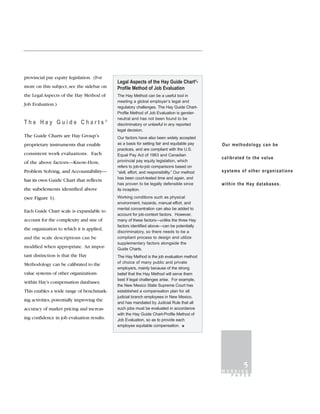
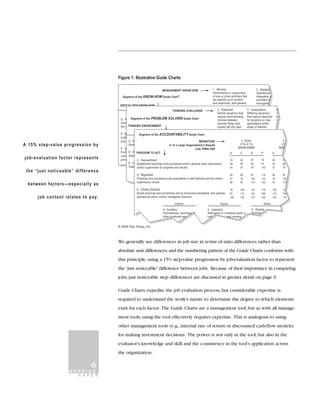
                                    We generally see differences in job size in terms of ratio differences rather than
                                    absolute unit differences, and the numbering pattern of the Guide Charts conforms with
                                    this principle, using a 15% step-value progression by job-evaluation factor to represent
                                    the “just noticeable” difference between jobs. Because of their importance in comparing
                                    jobs, just noticeable step differences are discussed in greater detail on page 9.

                                    Guide Charts expedite the job evaluation process, but considerable expertise is
                                    required to understand the work’s nature to determine the degree to which elements
                                    exist for each factor. The Guide Charts are a management tool, but as with all manage-
                                    ment tools, using the tool effectively requires expertise. This is analogous to using
                                    other management tools (e.g., internal rate of return or discounted cash-flow models)
                                    for making investment decisions. The power is not only in the tool, but also in the
                                    evaluator’s knowledge and skill and the consistency in the tool’s application across
                                    the organization.

                              6
                    WORKING
                      P A P E R
Job Size and Shape

The job’s size and shape serve as starting points for many job evaluation
applications. Job size is determined by the total of the factor point values for
Accountability, Know-How, and Problem Solving, and reflects the job’s relative
value to the organization. The relative proportions of Accountability, Know-How,
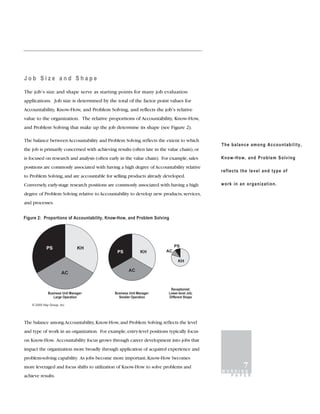
and Problem Solving that make up the job determine its shape (see Figure 2).

The balance between Accountability and Problem Solving reflects the extent to which
                                                                                            The balance among Accountability,
the job is primarily concerned with achieving results (often late in the value chain), or
is focused on research and analysis (often early in the value chain). For example, sales    Know-How, and Problem Solving
positions are commonly associated with having a high degree of Accountability relative
                                                                                            reflects the level and type of
to Problem Solving, and are accountable for selling products already developed.
Conversely, early-stage research positions are commonly associated with having a high       work in an organization.

degree of Problem Solving relative to Accountability to develop new products, services,
and processes.


Figure 2: Proportions of Accountability, Know-How, and Problem Solving


             PS                                                              PS
                                KH
                                               PS             KH        AC

                                                                               KH

                                                      AC
                       AC


                                                                          Receptionist:
              Business Unit Manager:          Business Unit Manager:     Lower-level Job,
                 Large Operation                Smaller Operation        Different Shape

    © 2005 Hay Group, Inc.


The balance among Accountability, Know-How, and Problem Solving reflects the level
and type of work in an organization. For example, entry-level positions typically focus
on Know-How. Accountability focus grows through career development into jobs that
impact the organization more broadly through application of acquired experience and
problem-solving capability. As jobs become more important, Know-How becomes
more leveraged and focus shifts to utilization of Know-How to solve problems and                      7
                                                                                            WORKING
achieve results.                                                                              P A P E R
In entry-level jobs, Know-How may account for 70% of job content, while at the
                                 CEO level Know-How may only be 30% of job content (even though, of course, it is
                                 significantly more important than Know-How for an entry-level position).

                                 The job shape concept is unique to the Hay Method of Job Evaluation. In addition to
                                 supporting job evaluation quality assurance, it enables further value-added applications
                                 of the job evaluation system—for example, providing a better understanding of how
                                 jobs fit into organizations, or better defining key work capability requirements.
    A rigorous job-evaluation

process gives organizations a
                                 Applications of Hay Job Evaluation
      common framework and

 language to more effectively

       design jobs within the
                                 T         he job evaluation process presents many other valuable insights, including a
                                           clearer understanding of the interrelationships of accountabilities, capability
                                 requirements, development needs, and, of course, setting competitive, value-based
                                 pay practices.
 structure that best supports

        its business strategy.
                                 Organizational Design and Analysis

                                 Many people presume that organizational structures are the result of systematic,
                                 methodical planning. However, in our experience, they evolve over time and are
                                 often shaped by personalities, politics, and compromise into complex mosaics of
                                 operating and support functions, business units, and internal alliances. The unintended
                                 consequence may be overlaps and/or gaps in key accountabilities necessary to meet
                                 core business objectives. In many organizations, jobs are designed with a functional
                                 bias rather than from an overall organizational perspective. Thus, when looking
                                 across an organization, accountabilities become unclear, important decisions flounder,
                                 and business processes bog down. The result: confusion and potential turf wars.

                                 A rigorous job analysis and job evaluation process provides organizations with a
                                 common framework and language to more effectively design jobs within the structure
                                 that best supports business strategy. Strategic goals and objectives can then be clarified
                                 and distributed into job-specific accountabilities, to ensure that there are no gaps or
                                 redundancies. It also enables organizations to identify and align key interrelationships
                          8      across critical business processes—especially when the benefits of doing so might
                 WORKING
                   P A P E R     not be immediately obvious to the parties involved. Organization and job design
must be integrally managed, just as automobile engine components must be designed
to mesh under a variety of circumstances. Improperly integrated designs may cause
an engine to fail. The same is true for organizations.


Step Differences

Steps of “just noticeable” difference can be used to analyze organizational hierarchy.
In this context, we can consider the consequences of changes that have occurred as
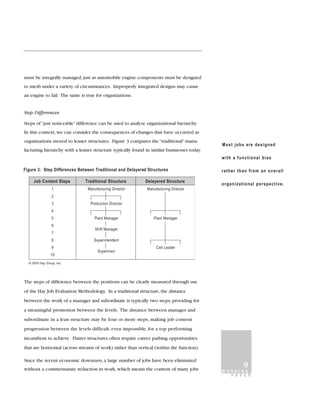
organizations moved to leaner structures. Figure 3 compares the “traditional” manu-
                                                                                           Most jobs are designed
facturing hierarchy with a leaner structure typically found in similar businesses today.
                                                                                           with a functional bias

Figure 3: Step Differences Between Traditional and Delayered Structures                    rather than from an overall

     Job Content Steps        Traditional Structure          Delayered Structure
                                                                                           organizational perspective.
                 1              Manufacturing Director       Manufacturing Director
                 2
                 3               Production Director
                 4
                 5                 Plant Manager                 Plant Manager
                 6
                                    Shift Manager
                 7
                 8                 Superintendent
                 9                                                Cell Leader
                                     Supervisor
                10
  © 2005 Hay Group, Inc.


The steps of difference between the positions can be clearly measured through use
of the Hay Job Evaluation Methodology. In a traditional structure, the distance
between the work of a manager and subordinate is typically two steps, providing for
a meaningful promotion between the levels. The distance between manager and
subordinate in a lean structure may be four or more steps, making job content
progression between the levels difficult, even impossible, for a top performing
incumbent to achieve. Flatter structures often require career pathing opportunities
that are horizontal (across streams of work) rather than vertical (within the function).

Since the recent economic downturn, a large number of jobs have been eliminated
without a commensurate reduction in work, which means the content of many jobs
                                                                                                    9
                                                                                           WORKING
                                                                                             P A P E R
may have increased. Plus, employees still with the company assume accountabilities
                                of remaining jobs, often without any rationalization or integration of existing
                                accountabilities. Adding too many and/or unrelated accountabilities often creates
                                distractions and confusion that limit job effectiveness.


                                Job Design and Analysis

                                When jobs are designed or changed, it is also important to determine whether or

  When jobs are designed or     not a job is, in fact,“doable” (see Figure 4). We often see jobs change when they
                                are designed around the unique capabilities of a star performer with high potential
changed, it is also important
                                seeking increased challenges.

to determine whether or not
                                Figure 4: Doable Roles
                                  Figure 4: Doable Roles                                                                              For example, to expect an individual

             a job is doable.                                                                                                         in a mid-sized organization to func-
                                                     H
                                                             G   Poor Performance
                                                             G   Bad Decisions                                                        tion as vice president of corporate
                                                             G   Stress
                                                             G   Depression                                                           development—setting new strategy,
                                Accountability and


                                                                                                                            y
                                                                                                                      lit
                                 Problem Solving


                                                             G   Diminished Initiative                            i
                                                             G   Terminations                                  ab                     negotiating deals, and driving a growth
                                                                                                           o
                                                                                                       D
                                                                                              J   ob                                  agenda—while also managing a
                                                                                                       G       Boredom
                                                                                         um                    Demotivation
                                                                                   tim
                                                                                                       G

                                                                               p
                                                                                                                                      marketing department’s day-to-day
                                                                           O                           G       Internal Competition
                                                                                                       G       Cynicism               operations, can lead to serious
                                                                                                       G       Dead Initiative
                                                                                                       G       Departures             problems. Although there is an apparent
                                                     L
                                                         L                                                                      H     link between corporate development
                                                                                     Know-How
                                                         © 2005 Hay Group, Inc.
                                                                                                                                      and marketing, the shapes of these
                                jobs—and thus the competencies necessary to achieve outstanding performance—
                                are quite different, and the complexity of this role is substantial. Either the person will
                                burn out, or let one or both jobs suffer. If unchanged, these jobs may be just too
                                overwhelming or complex for the newly promoted incumbent.

                                It is important, of course, to examine the relationship between an organization’s job
                                requirements and the job position to ensure it is doable. The role demands in Problem
                                Solving and Accountability need to be commensurate with the Know-How brought to
                                the role. If the demands are too overwhelming, failure is likely. The new person may
                                lack the credibility or experience required, and will likely become overwhelmed,
                                frustrated, or focused only on a subset of the job accountabilities the incumbent
                                can master.
                       10
                WORKING
                  P A P E R
Conversely, if the demands are minor relative to the incumbent’s capabilities, there is
a good chance that the incumbent will grow bored, demotivated, and/or push for
accountabilities in others’ domains and not add value commensurate to their pay level.


Job/Person Matching

Hay Group’s consulting experience and research reveals a strong link between
the nature and shape of executive jobs and the competencies required to achieve
outstanding performance. Understanding the work’s scope significantly increases           Hay Group’s research reveals
our ability to select and develop high-performing executives. Conversely, it also
                                                                                          a strong link between the
enables us to design jobs that increase the likelihood that the jobholder will succeed.

                                                                                          nature and shape of executive
Consider the role of country manager in a multinational corporation. Traditionally,
country managers were judged by profit-and-loss (P&L) responsibility, and enjoyed         jobs and the competencies
high degrees of autonomy and accountability. However, many highly complex
businesses have transformed that role into one focused on adapting products for           required to achieve

local markets and managing the political and regulatory landscape—with P&L now            outstanding performance.
in the global president’s hands. The country manager’s role has, therefore, changed.

When such transformations occur, it is important to revisit job requirements to
determine whether the incumbent remains a good fit. Focus then can turn to
aligning the job requirements with jobholder motives. Although designing jobs
around individuals is generally an ineffective practice, you must consider the
motivational profile of a typical person who would fill the job over time.

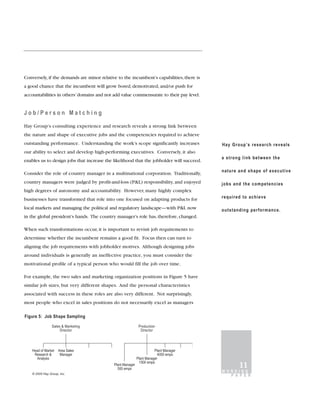
For example, the two sales and marketing organization positions in Figure 5 have
similar job sizes, but very different shapes. And the personal characteristics
associated with success in these roles are also very different. Not surprisingly,
most people who excel in sales positions do not necessarily excel as managers

Figure 5: Job Shape Sampling

                 Sales & Marketing                           Production
                      Director                                Director


    Head of Market   Area Sales                                        Plant Manager
     Research &       Manager                                            4000 emps
       Analysis                                             Plant Manager
                                                              1500 emps
                                            Plant Manager
                                              500 emps
                                                                                                 11
    © 2005 Hay Group, Inc.
                                                                                          WORKING
                                                                                            P A P E R
and vice versa—although both jobs add significant organizational value. On the
                                   other hand, our research and consulting experience reveals that the successful
                                   small plant manager has a high probability of also being successful at a similar, but
                                   larger plant. There are a finite number of job shapes that make it possible to use
                                   this concept to map role types across an organization.


                                   Succession Planning and Development

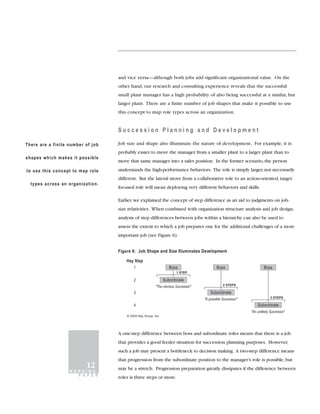
There are a finite number of job   Job size and shape also illuminate the nature of development. For example, it is
                                   probably easier to move the manager from a smaller plant to a larger plant than to
shapes which makes it possible
                                   move that same manager into a sales position. In the former scenario, the person
to use this concept to map role    understands the high-performance behaviors. The role is simply larger, not necessarily
                                   different. But the lateral move from a collaborative role to an action-oriented, target-
  types across an organization.
                                   focused role will mean deploying very different behaviors and skills.

                                   Earlier, we explained the concept of step difference as an aid to judgments on job-
                                   size relativities. When combined with organization structure analysis and job design,
                                   analysis of step differences between jobs within a hierarchy can also be used to
                                   assess the extent to which a job prepares one for the additional challenges of a more
                                   important job (see Figure 6).


                                   Figure 6: Job Shape and Size Illuminates Development

                                       Hay Step
                                           1                       Boss                     Boss                     Boss
                                                                       1 STEP

                                           2                    Subordinate
                                                                                                2 STEPS
                                                          "The obvious Successor"
                                           3                                            Subordinate
                                                                                                                          3 STEPS
                                                                                    "A possible Successor"
                                           4                                                                     Subordinate
                                                                                                             "An unlikely Successor"
                                       © 2005 Hay Group, Inc.


                                   A one-step difference between boss and subordinate roles means that there is a job
                                   that provides a good feeder situation for succession planning purposes. However,
                                   such a job may present a bottleneck to decision making. A two-step difference means
                                   that progression from the subordinate position to the manager’s role is possible, but
                          12       may be a stretch. Progression preparation greatly dissipates if the difference between
                   WORKING
                     P A P E R     roles is three steps or more.
“Traditional” line structures typically incorporate two-step differences between manager
and subordinate, with opportunities for internal succession. In leaner structures,
vertical progression is less possible, and career development and succession planning
should look to lateral moves and moves “outside the chimney” to secure future
leadership development.


Pay Structures and Grading

Job evaluation is often used for—and is primarily associated with—assessing internal       Analysis of step differences
relativities and developing compensation administration arrangements that reflect
                                                                                           between jobs within a hierarchy
the value-added contribution of specific roles. The relationship between job size and
pay can easily be demonstrated in Figure 7. For salary administration purposes, this       can also be used to assess the
provides the basis for grouping jobs into grades and/or bands.
                                                                                           extent to which a job prepares

Figure 7: Job Size Relative to Pay                                                         one for the additional
                                                             Bands
                                                                               A           challenges of a bigger job.
                                                                       B
                                                                C
       $                                           $
                                                         D


                         Job Content                             Job Content

           © 2005 Hay Group, Inc.


Debate continues over the relative merits of traditional grades and broad bands. In
the former, all positions are administered around a common midpoint or target
salary. On the other hand, broad-banded structures may provide greater flexibility
and often focus management’s pay decisions more on individual capability than job
size. Market anchors are often used for jobs within a band as a point of reference,
while midpoints are used in graded structures to reflect internal equity as well as
external competitiveness.

Note that broadbanding is likely to be more appropriate where a hierarchical
organization structure is either flat or deemphasized in favor of a team- or project-
based approach.                                                                                   13
                                                                                           WORKING
                                                                                             P A P E R
Using the Hay Guide Chart-Profile Method brings further advantages in this
                                  respect, since it provides direct access to comparable market data. We design quality
                                  assurance processes to guarantee our methodology’s consistent application, which
                                  also enables us to develop and maintain a compensation survey database that
                                  provides market comparisons by measured job size in addition to traditional job-
                                  model matching. Such comparisons prove far more accurate than comparisons
                                  based on job/title matching, even when controlling industry and organization size.

     The Hay Method provides

   market comparisons on the      The Job Evaluation Process
   basis of measured job size.

Such comparisons have proven

  to be far more accurate than
                                  A         s mentioned, our research shows that only 18% of organizations have
                                            proactive audit processes on maintaining job evaluation appropriateness.
                                  The balance of the organizations face inherent risks in using a reactive job evaluation
                                  review process—that is, responding to job evaluation change requests as they are made
        comparisons based on      by line management. Over time, job levels across the organization tend to creep up if
                                  there is not a proactive audit process.
            job/title matching.

                                  Job levels typically are easier to move up than down. In only responding to the
                                  so-called “squeaky wheels,” an organization runs the risk of job level inflation over
                                  time, as well as inconsistencies between business groups based on who more actively
                                  uses the job evaluation process. Rolling proactive reviews should be performed at a
                                  functional or business-unit level every few years. These can go a long way in improving
                                  a job evaluation program’s credibility and consistency, especially if it is performed in
                                  conjunction with a design and effectiveness review within the organization.

                                  In addition, our experience demonstrates that effective job evaluation processes also
                                  validate added accountabilities to jobs by defining the incremental business value of
                                  these new accountabilities and their degree of alignment to organization objectives. If
                                  you transfer accountabilities from other jobs, then these processes typically determine
                                  the impact of a loss of these accountabilities from those jobs.


                         14
                 WORKING
                   P A P E R
Conclusion


    J     ob evaluation is alive and well. Leading organizations use job evaluation as a
          source of competitive advantage by improving the organization’s ability to
manage its investment in human resources with greater credibility, discipline, and fairness.

Job evaluation is not only about maintaining internal equity in the compensation
program. It can facilitate organizational clarity, building capability, and establishing
commitment through culture and rewards. It is a critical management tool, extremely
useful in ensuring an organization’s proper integration of strategy, culture, structure,
process, people, and reward.


About Hay Group


H         ay Group is a global organizational and human resources consulting firm
          that helps its clients—Boards, CEOs, Executives, and HR Managers—on
virtually all aspects of their people-related business issues. Founded in 1943, Hay
Group has over 2,200 employees working from 77 offices in 42 countries. Our
areas of expertise include:

I   Design and analysis of organizations and jobs;
I   Talent management through assessment, selection, and development of
    executives, managers, and teams;
I   Compensation, benefits, and performance management;
I   Executive remuneration and corporate governance; and
I   Employee and customer attitude research.

Hay Group works with nearly three-quarters of FORTUNE’s top-50 Most Admired
Companies, as well as many mid-sized and non-profit corporations, public
institutions, and governments.


                                                                                                     15
                                                                                               WORKING
                                                                                                 P A P E R
www.haygroup.com   Hay Group Headquarters
                   100 Penn Square East
                   The Wanamaker Building
                   Philadelphia, PA 19107-3388
                   USA

                   Tel +215 861 2000
                   Fax +215 861 2111


                   Argentina           Czech Republic   Malaysia          Switzerland
                   Buenos Aires        Prague           Kuala Lumpur      Zurich

                   Australia           Finland          Mexico            Thailand
                   Brisbane            Helsinki         Mexico City       Bangkok
                   Melbourne
                                       France           The Netherlands   Turkey
                   Sydney
                                       Lille            Zeist             Istanbul
                   Austria             Lyon
                   Vienna              Paris            New Zealand       United Arab
                                       Strasbourg       Auckland          Emirates
                   Belgium                              Wellington        Dubai
                                       Germany
                   Brussels
                                       Berlin
                                                        Norway            United Kingdom
                   Brazil              Frankfurt
                                                        Oslo              Birmingham
                   Sao Paulo           Munich
                                                                          Bristol
                                       Greece           Poland            Glasgow
                   Canada                               Warsaw
                                       Athens                             London
                   Calgary
                                                                          Manchester
                   Edmonton            Hungary          Portugal
                   Halifax                                                Windsor
                                       Budapest         Lisbon
                   Montreal                                               United States
                   Ottawa              India            Russia
                                                                          Arlington, VA
                   Regina              Delhi            Moscow
                                                                          Atlanta
                   Toronto
                                       Indonesia        Singapore         Boston
                   Vancouver
                                       Jakarta                            Charlotte, NC
                   Chile                                Slovakia          Chicago
                                       Ireland          Bratislava        Dallas
                   Santiago
                                       Dublin                             Kansas City, MO
                   China                                South Africa      Los Angeles
                                       Israel           Johannesburg
                   Hong Kong           Tel Aviv                           New York Metro
                   Shanghai                                               Norwalk
                                                        Spain
                                       Italy                              Philadelphia
                   Colombia                             Barcelona
                                       Milan                              San Francisco Metro
                   Bogota                               Madrid
                                       Rome
                                                        Sweden            Venezuela
                   Costa Rica          Japan
                                                        Stockholm         Caracas
                   San Jose            Tokyo

Hay job evaluation wp from hay website

  • 1.
    Hay Job Evaluation Foundationsand Applications The Hay Method of Job Evaluation continues to be the most widely accepted worldwide, in use by over half of the world’s 50 largest companies as well as in government, public, and not-for-profit institutions. The process of evaluating jobs enables many important applications, such as designing effective organizations; clarifying interdependencies and accountabilities; managing succession and talent; and setting competitive, value-based pay policies. WORKING P A P E R
  • 2.
    Hay Job Evaluation Foundationsand Applications Introduction 1 Hay Job Evaluation: Foundations 2 So, Who Is Accountable? [sidebar] Hay Job Evaluation Factors 3 Accountability Know-How Problem Solving Legal Aspects of Hay Job Evaluation [sidebar] 5 Hay Guide Charts ® Job Size and Shape 7 Applications of Hay Job Evaluation 8 Organizational Design and Analysis Step Differences Job Design and Analysis 10 Job/Person Matching 11 Succession Planning and Development 12 Pay Structures and Grading 13 The Job Evaluation Process 14 Conclusion 15 About Hay Group Copyright © 2005 Hay Group, Inc. All rights reserved.
  • 3.
    Introduction n the 1990s, the Internet and its parallel business boom fueled a war for I talent, creating a belief that organizations either move at “e-speed” or risk being passed by start-ups with radically different business models. As a result, many organizations sacrificed disciplined processes that for years helped them control costs—especially pay-related costs. The even more challenging post-tech boom business environment, however, made those same organizations realize that any lost To ensure a reasonable balance discipline meant higher costs, inconsistency, and a potential loss of defensible objectivity related to pay programs. between flexibility and control, To ensure a reasonable balance between flexibility and control, Hay Group is working many organizations are with many organizations to revamp the processes through which those organizations revamping the process through value work. One key driver is the need to reestablish discipline within compensation programs, and to better align pay with value creation—particularly at executive levels. which they value work. Beyond that, our job evaluation processes help well beyond defining appropriate pay levels. Evaluating jobs not only provides consistent work value measurement, it also gives organizations a common framework and language to design jobs, define career progressions, analyze organization structures, and more strategically manage human resources. This paper provides an overview of the Hay Guide Chart®-Profile Method of Job Evaluation and introduces a number of valuable applications. One key finding of our research with WorldatWork and Loyola University of Chicago (of more than 1,200 organizations) indicates that between 82% and 96% of organizations evaluate jobs, but only 18% proactively maintain their systems. Moreover, a majority reports that they believe approximately 20% of jobs are incorrectly placed within the job grading structure. As a result, we believe there is significant untapped potential to leverage job evaluation efforts to optimize organizational structures, develop people as key performers, and build employee commitment through reward programs that are fair, motivational, and competitive. 1 WORKING P A P E R
  • 4.
    So, Who IsAccountable? Hay Job A clear understanding of impact and its Evaluation: relation to overall accountability is critical when designing and evaluating jobs. Foundations Consider the case of a major hotel chain CEO who ruled that the annual planning around “rack rates” for each property would be shared between the managers of national sales and operations. He reasoned that if he left it only to national sales, then the hotel H ay Group pioneered the “factor comparison” job evaluation method and modified it in its Guide managers would blame them if they did not The Hay Guide Charts ® are our Charts in the early 1950s. The Hay Guide achieve their goals. Likewise, if he delegated it just to the hotel managers, then national proprietary instruments that Charts® are proprietary instruments that sales could blame the hotel managers if they failed to attract accounts to their properties. yield consistent and legally defensible yield efficient, consistent, and Just when it looked like he had agreement, work evaluations. Hay Group’s job the Finance Director complained that she legally defensible evaluations. had the most critical information on past evaluation approach, in fact, is the world’s trends plus impact on profitability under most widely accepted—used by an different scenarios. She believed she should share in—or maybe even drive—the decision. estimated 8,000 organizations, including The CEO, however, wisely decided that three people responsible for making decisions half of the Fortune 50 companies. would slow the process. In addition, having the Finance Director make the decision Organizations use the Hay methodology would give the national sales reps and hotel managers an excuse to hide behind in not to evaluate jobs against a set of common making their numbers. factors that measure inputs (required Clearly, the Finance Director had to contribute knowledge, skills, and capabilities), to the decision. The national sales people and hotel managers could not make decisions throughputs (processing of inputs to without relevant financial information. By properly defining concurrent accountability, achieve results), and outputs (end result the CEO actually sped up decision-making expectations from applying inputs and increased accountability for results. The “Impact” element when evaluating constructively). During the evaluation accountability can be segmented along process, each job’s content is analyzed four lines: I Ancillary. Informational, recording, or relative to each factor and represented incidental services for use by others in by a numerical value. These factor values relation to some important end result. Job activity may be complex, but impact on are then totaled to determine the overall the overall organization is relatively minor. job “size.” The various job size relation- These jobs are usually involved with collection, processing, and explanation of ships, as well as the factor proportions information or data, typically required by others to make decisions impacting associated with each job, can be useful organizational results. in a number of organizational and 2 (continued) WORKING human resource planning applications. P A P E R
  • 5.
    Hay Job Evaluation: I Contributory. Interpretive, advisory, or Factors facilitating services for use by others in taking action. This type of impact is appropriate where jobs are accountable The input-throughput-output model for rendering significant “advice and is reflected in the Hay Method as Know- counsel” in addition to information and/or analysis and when decisions are likely to How, Problem Solving, and Accountability. be made by virtue of that counsel. Such Each grouping can be further broken impacts are commonly found in staff or support functions that significantly down into eight elements for the work influence decisions relative to the magnitude of various resources. Every job exists to add value value assessment. I Shared. Participating with peers, within or outside the organization, in decision to the organization through The output factor—Accountability— making. This impact is used to describe is covered first, since every job is horizontal, not vertical (hierarchical), working relationships. This type of impact delivering some set of results. designed to achieve predetermined is not totally controlling relative to the results. This factor typically receives the magnitude of the result. Shared impacts typically exist between peer jobs and/or least attention and weight in many functions, and suggest a degree of other evaluation methodologies. “partnership” in, or “joint accountability” for, the total result. For example, there may be shared accountability between engineering and manufacturing functions Accountability for a successful product. Sharing is also Every job exists to add organizational possible with “partners” outside the organization (e.g., between project value by delivering some set of results manager and external contractor). When this impact is selected, it is important to (or outputs). Accountability measures clarify specific role contributions and to the type and level of value a job can add. identify initiators as well as tie-breakers for decision making. In this sense, it is the job’s measured I Primary. Controlling impact on end effect on an organization’s value chain. results, where any contributing inputs are secondary. Such impacts are commonly It has three dimensions: found in operations and managerial 1. Freedom to Act: The degree of positions that have “line accountability” for key end-result areas, whether large or empowerment to take action and small. For example, a supervisor may have the guidance provided to focus “primary accountability” for the production decision-making. or output (value added) of a unit within the context of available resources (e.g., personnel resources and controllable 2. Scope: The business expenses); whereas the head of manu- measure(s) the job is designed facturing may have a primary impact on to positively impact. total value added in the manufacture of products or on cost of goods manufac- 3. Impact: The nature of the job’s tured. The key here is that the job exists to have the controlling impact upon influence on business results. certain end results of a given magnitude, 3 and that accountability is not intended to WORKING be shared with others. I P A P E R
  • 6.
    Know-How To achieve the accountabilities of a job requires “Know-How” (or inputs), which is the sum total of every capability or skill, however acquired, needed for fully competent job performance. Know-How has three dimensions: 4. Technical/Specialized Skills: Depth and breadth of technical or specialized knowledge needed to achieve desired results. 5. Managerial Skills: The requirement to undertake managerial functions, Primary impacts are commonly such as planning and organizing staff or directing and controlling resources, to achieve business results over time. found in operations and 6. Human Relations Skills: The interpersonal skills required for successful managerial positions that have interaction with individuals and groups, inside and outside the organization. “line accountability” for key Problem Solving end result areas, whether The value of Know-How is in its application to achieve results. “Problem Solving” large or small. (or throughputs) refers to the use of Know-How to identify, delineate, and resolve problems. We “think with what we know,” so Problem Solving is viewed as utilization of Know-How, and has two dimensions: 7. Thinking Environment: The job’s context and the degree to which problems and solutions are defined. 8. Thinking Challenge: The nature of addressable problems and the difficulty in identifying solutions that add value. Problem Solving measures the requirement to use Know-How conceptually, analytically, and productively. The above factors can be modified in specific client situations, but the pattern around the three clusters relates to the inputs, throughputs, and outputs of the defined position. Although the definitions of these job criteria have evolved over the more than 60 years they have been used, the underlying principles of Know-How, Problem Solving, and Accountability have been timeless as a general foundation for valuing work. 4 Our factors have also been widely accepted as a basis for setting fair and equitable WORKING P A P E R pay practices, and are compliant with the U.S. Equal Pay Act of 1963 and Canadian
  • 7.
    provincial pay equitylegislation. (For Legal Aspects of the Hay Guide Chart®- more on this subject, see the sidebar on Profile Method of Job Evaluation the Legal Aspects of the Hay Method of The Hay Method can be a useful tool in meeting a global employer’s legal and Job Evaluation.) regulatory challenges. The Hay Guide Chart- Profile Method of Job Evaluation is gender- neutral and has not been found to be The Hay Guide Charts® discriminatory or unlawful in any reported legal decision. The Guide Charts are Hay Group’s Our factors have also been widely accepted proprietary instruments that enable as a basis for setting fair and equitable pay Our methodology can be practices, and are compliant with the U.S. consistent work evaluations. Each Equal Pay Act of 1963 and Canadian calibrated to the value of the above factors—Know-How, provincial pay equity legislation, which refers to job-to-job comparisons based on Problem Solving, and Accountability— “skill, effort, and responsibility.” Our method systems of other organizations has been court-tested time and again, and has its own Guide Chart that reflects has proven to be legally defensible since within the Hay databases. the subelements identified above its inception. (see Figure 1). Working conditions such as physical environment, hazards, manual effort, and mental concentration can also be added to Each Guide Chart scale is expandable to account for job-context factors. However, account for the complexity and size of many of these factors—unlike the three Hay factors identified above—can be potentially the organization to which it is applied, discriminatory, so there needs to be a and the scale descriptions can be compliant process to design and utilize supplementary factors alongside the modified when appropriate. An impor- Guide Charts. tant distinction is that the Hay The Hay Method is the job evaluation method of choice of many public and private Methodology can be calibrated to the employers, mainly because of the strong value systems of other organizations belief that the Hay Method will serve them best if legal challenges arise. For example, within Hay’s compensation databases. the New Mexico State Supreme Court has This enables a wide range of benchmark- established a compensation plan for all judicial branch employees in New Mexico, ing activities, potentially improving the and has mandated by Judicial Rule that all accuracy of market pricing and increas- such jobs must be evaluated in accordance with the Hay Guide Chart-Profile Method of ing confidence in job evaluation results. Job Evaluation, so as to provide each employee equitable compensation. I 5 WORKING P A P E R
  • 8.
    Figure 1: IllustrativeGuide Charts MANAGEMENT KNOW-HOW I. Minimal II. Related Performance or supervision Operational Segment of the KNOW-HOW Guide Chart® of one or more activities that integration o are specific as to content activities th and objectives, with general homogene SPECIALIZED KNOW-HOW awareness of related activities. activities. THINKING CHALLENGE 2. Patterned 3. Interpolative 4. Similar situations that Differing situations V HR1 HR2 HR3 HR1 require discriminating that require searches th D. Advanced Vocational PROBLEM SOLVING Guide Chart Segment of the 115choices between 132 152 for solutions or new 152 ti Some specialized (generally non-theoretical) skills, acquired on or off 132learned things that 175 applications within 2 152 175 c THINKING ENVIRONMENTor depth to a generally single function. the job, giving additional breadth 152usually fall into well- 200 areas of 200 175 learned 2 t defined patterns. things. E. Basic Specialized Segment of the ACCOUNTABILITY Guide Chart 152 175 200 200 Sufficiency in a technique that requires a grasp either of involved 175 200 230 230 C. Semi-Routine and/or of theory and principles of science. practices and precedents, MAGNITUDE 19% 2. Small 25% 33% 3. um 200 230 .01%-0.1% 264 264 A 15% step-value progression by Somewhat diversified procedures % ofprecedents. and a Large Organization's Results 200 230 22% 29% .01 F. Seasoned Specialized Late 1990s US$ $500M-$5MM 264 264 $5M 230 264 304 304 D. Standardized TO ACT Proficiency gained through wide exposure in a field that combines FREEDOM 22% A. C.350 29%S. 38% 264 304 350 P. 4A. Substantially diversified procedures and specialized standards. comprehension of involved practices and precedents, and/or theory and 25% 33% job-evaluation factor represents principles of science. C. Standardized 33 43 57 76 43 5 E. Clearly Defined practices and procedures and/or general work instructions, Established 25% 38 50 25%66 87 50 33 66 Clearlyand/or supervision of principles.and results. defined policies and progress 43 29% 57 76 100 38% 57 76 the “just noticeable” difference 1. Basic Routi D. Regulated 50 66 87 115 66 87 Practices and procedures set precedents ro well-defined policies and/or 57 76 100 132 76 100 supervisory review. 66 87 115 152 87 115 between factors—especially as E. Clearly Directed 76 100 132 175 100 13 Broad practices and procedures set by functional precedents and policies, 87 115 152 200 115 152 job content relates to pay. operational plans, and/or managerial direction. 100 132 175 230 132 175 Indirect Impact Direct A. Ancillary 2. Important S. Shared Informational, recording r Alternative or combined skills in Particip other incidental ser und and causing © 2004 Hay Group, Inc. We generally see differences in job size in terms of ratio differences rather than absolute unit differences, and the numbering pattern of the Guide Charts conforms with this principle, using a 15% step-value progression by job-evaluation factor to represent the “just noticeable” difference between jobs. Because of their importance in comparing jobs, just noticeable step differences are discussed in greater detail on page 9. Guide Charts expedite the job evaluation process, but considerable expertise is required to understand the work’s nature to determine the degree to which elements exist for each factor. The Guide Charts are a management tool, but as with all manage- ment tools, using the tool effectively requires expertise. This is analogous to using other management tools (e.g., internal rate of return or discounted cash-flow models) for making investment decisions. The power is not only in the tool, but also in the evaluator’s knowledge and skill and the consistency in the tool’s application across the organization. 6 WORKING P A P E R
  • 9.
    Job Size andShape The job’s size and shape serve as starting points for many job evaluation applications. Job size is determined by the total of the factor point values for Accountability, Know-How, and Problem Solving, and reflects the job’s relative value to the organization. The relative proportions of Accountability, Know-How, and Problem Solving that make up the job determine its shape (see Figure 2). The balance between Accountability and Problem Solving reflects the extent to which The balance among Accountability, the job is primarily concerned with achieving results (often late in the value chain), or is focused on research and analysis (often early in the value chain). For example, sales Know-How, and Problem Solving positions are commonly associated with having a high degree of Accountability relative reflects the level and type of to Problem Solving, and are accountable for selling products already developed. Conversely, early-stage research positions are commonly associated with having a high work in an organization. degree of Problem Solving relative to Accountability to develop new products, services, and processes. Figure 2: Proportions of Accountability, Know-How, and Problem Solving PS PS KH PS KH AC KH AC AC Receptionist: Business Unit Manager: Business Unit Manager: Lower-level Job, Large Operation Smaller Operation Different Shape © 2005 Hay Group, Inc. The balance among Accountability, Know-How, and Problem Solving reflects the level and type of work in an organization. For example, entry-level positions typically focus on Know-How. Accountability focus grows through career development into jobs that impact the organization more broadly through application of acquired experience and problem-solving capability. As jobs become more important, Know-How becomes more leveraged and focus shifts to utilization of Know-How to solve problems and 7 WORKING achieve results. P A P E R
  • 10.
    In entry-level jobs,Know-How may account for 70% of job content, while at the CEO level Know-How may only be 30% of job content (even though, of course, it is significantly more important than Know-How for an entry-level position). The job shape concept is unique to the Hay Method of Job Evaluation. In addition to supporting job evaluation quality assurance, it enables further value-added applications of the job evaluation system—for example, providing a better understanding of how jobs fit into organizations, or better defining key work capability requirements. A rigorous job-evaluation process gives organizations a Applications of Hay Job Evaluation common framework and language to more effectively design jobs within the T he job evaluation process presents many other valuable insights, including a clearer understanding of the interrelationships of accountabilities, capability requirements, development needs, and, of course, setting competitive, value-based pay practices. structure that best supports its business strategy. Organizational Design and Analysis Many people presume that organizational structures are the result of systematic, methodical planning. However, in our experience, they evolve over time and are often shaped by personalities, politics, and compromise into complex mosaics of operating and support functions, business units, and internal alliances. The unintended consequence may be overlaps and/or gaps in key accountabilities necessary to meet core business objectives. In many organizations, jobs are designed with a functional bias rather than from an overall organizational perspective. Thus, when looking across an organization, accountabilities become unclear, important decisions flounder, and business processes bog down. The result: confusion and potential turf wars. A rigorous job analysis and job evaluation process provides organizations with a common framework and language to more effectively design jobs within the structure that best supports business strategy. Strategic goals and objectives can then be clarified and distributed into job-specific accountabilities, to ensure that there are no gaps or redundancies. It also enables organizations to identify and align key interrelationships 8 across critical business processes—especially when the benefits of doing so might WORKING P A P E R not be immediately obvious to the parties involved. Organization and job design
  • 11.
    must be integrallymanaged, just as automobile engine components must be designed to mesh under a variety of circumstances. Improperly integrated designs may cause an engine to fail. The same is true for organizations. Step Differences Steps of “just noticeable” difference can be used to analyze organizational hierarchy. In this context, we can consider the consequences of changes that have occurred as organizations moved to leaner structures. Figure 3 compares the “traditional” manu- Most jobs are designed facturing hierarchy with a leaner structure typically found in similar businesses today. with a functional bias Figure 3: Step Differences Between Traditional and Delayered Structures rather than from an overall Job Content Steps Traditional Structure Delayered Structure organizational perspective. 1 Manufacturing Director Manufacturing Director 2 3 Production Director 4 5 Plant Manager Plant Manager 6 Shift Manager 7 8 Superintendent 9 Cell Leader Supervisor 10 © 2005 Hay Group, Inc. The steps of difference between the positions can be clearly measured through use of the Hay Job Evaluation Methodology. In a traditional structure, the distance between the work of a manager and subordinate is typically two steps, providing for a meaningful promotion between the levels. The distance between manager and subordinate in a lean structure may be four or more steps, making job content progression between the levels difficult, even impossible, for a top performing incumbent to achieve. Flatter structures often require career pathing opportunities that are horizontal (across streams of work) rather than vertical (within the function). Since the recent economic downturn, a large number of jobs have been eliminated without a commensurate reduction in work, which means the content of many jobs 9 WORKING P A P E R
  • 12.
    may have increased.Plus, employees still with the company assume accountabilities of remaining jobs, often without any rationalization or integration of existing accountabilities. Adding too many and/or unrelated accountabilities often creates distractions and confusion that limit job effectiveness. Job Design and Analysis When jobs are designed or changed, it is also important to determine whether or When jobs are designed or not a job is, in fact,“doable” (see Figure 4). We often see jobs change when they are designed around the unique capabilities of a star performer with high potential changed, it is also important seeking increased challenges. to determine whether or not Figure 4: Doable Roles Figure 4: Doable Roles For example, to expect an individual a job is doable. in a mid-sized organization to func- H G Poor Performance G Bad Decisions tion as vice president of corporate G Stress G Depression development—setting new strategy, Accountability and y lit Problem Solving G Diminished Initiative i G Terminations ab negotiating deals, and driving a growth o D J ob agenda—while also managing a G Boredom um Demotivation tim G p marketing department’s day-to-day O G Internal Competition G Cynicism operations, can lead to serious G Dead Initiative G Departures problems. Although there is an apparent L L H link between corporate development Know-How © 2005 Hay Group, Inc. and marketing, the shapes of these jobs—and thus the competencies necessary to achieve outstanding performance— are quite different, and the complexity of this role is substantial. Either the person will burn out, or let one or both jobs suffer. If unchanged, these jobs may be just too overwhelming or complex for the newly promoted incumbent. It is important, of course, to examine the relationship between an organization’s job requirements and the job position to ensure it is doable. The role demands in Problem Solving and Accountability need to be commensurate with the Know-How brought to the role. If the demands are too overwhelming, failure is likely. The new person may lack the credibility or experience required, and will likely become overwhelmed, frustrated, or focused only on a subset of the job accountabilities the incumbent can master. 10 WORKING P A P E R
  • 13.
    Conversely, if thedemands are minor relative to the incumbent’s capabilities, there is a good chance that the incumbent will grow bored, demotivated, and/or push for accountabilities in others’ domains and not add value commensurate to their pay level. Job/Person Matching Hay Group’s consulting experience and research reveals a strong link between the nature and shape of executive jobs and the competencies required to achieve outstanding performance. Understanding the work’s scope significantly increases Hay Group’s research reveals our ability to select and develop high-performing executives. Conversely, it also a strong link between the enables us to design jobs that increase the likelihood that the jobholder will succeed. nature and shape of executive Consider the role of country manager in a multinational corporation. Traditionally, country managers were judged by profit-and-loss (P&L) responsibility, and enjoyed jobs and the competencies high degrees of autonomy and accountability. However, many highly complex businesses have transformed that role into one focused on adapting products for required to achieve local markets and managing the political and regulatory landscape—with P&L now outstanding performance. in the global president’s hands. The country manager’s role has, therefore, changed. When such transformations occur, it is important to revisit job requirements to determine whether the incumbent remains a good fit. Focus then can turn to aligning the job requirements with jobholder motives. Although designing jobs around individuals is generally an ineffective practice, you must consider the motivational profile of a typical person who would fill the job over time. For example, the two sales and marketing organization positions in Figure 5 have similar job sizes, but very different shapes. And the personal characteristics associated with success in these roles are also very different. Not surprisingly, most people who excel in sales positions do not necessarily excel as managers Figure 5: Job Shape Sampling Sales & Marketing Production Director Director Head of Market Area Sales Plant Manager Research & Manager 4000 emps Analysis Plant Manager 1500 emps Plant Manager 500 emps 11 © 2005 Hay Group, Inc. WORKING P A P E R
  • 14.
    and vice versa—althoughboth jobs add significant organizational value. On the other hand, our research and consulting experience reveals that the successful small plant manager has a high probability of also being successful at a similar, but larger plant. There are a finite number of job shapes that make it possible to use this concept to map role types across an organization. Succession Planning and Development There are a finite number of job Job size and shape also illuminate the nature of development. For example, it is probably easier to move the manager from a smaller plant to a larger plant than to shapes which makes it possible move that same manager into a sales position. In the former scenario, the person to use this concept to map role understands the high-performance behaviors. The role is simply larger, not necessarily different. But the lateral move from a collaborative role to an action-oriented, target- types across an organization. focused role will mean deploying very different behaviors and skills. Earlier, we explained the concept of step difference as an aid to judgments on job- size relativities. When combined with organization structure analysis and job design, analysis of step differences between jobs within a hierarchy can also be used to assess the extent to which a job prepares one for the additional challenges of a more important job (see Figure 6). Figure 6: Job Shape and Size Illuminates Development Hay Step 1 Boss Boss Boss 1 STEP 2 Subordinate 2 STEPS "The obvious Successor" 3 Subordinate 3 STEPS "A possible Successor" 4 Subordinate "An unlikely Successor" © 2005 Hay Group, Inc. A one-step difference between boss and subordinate roles means that there is a job that provides a good feeder situation for succession planning purposes. However, such a job may present a bottleneck to decision making. A two-step difference means that progression from the subordinate position to the manager’s role is possible, but 12 may be a stretch. Progression preparation greatly dissipates if the difference between WORKING P A P E R roles is three steps or more.
  • 15.
    “Traditional” line structurestypically incorporate two-step differences between manager and subordinate, with opportunities for internal succession. In leaner structures, vertical progression is less possible, and career development and succession planning should look to lateral moves and moves “outside the chimney” to secure future leadership development. Pay Structures and Grading Job evaluation is often used for—and is primarily associated with—assessing internal Analysis of step differences relativities and developing compensation administration arrangements that reflect between jobs within a hierarchy the value-added contribution of specific roles. The relationship between job size and pay can easily be demonstrated in Figure 7. For salary administration purposes, this can also be used to assess the provides the basis for grouping jobs into grades and/or bands. extent to which a job prepares Figure 7: Job Size Relative to Pay one for the additional Bands A challenges of a bigger job. B C $ $ D Job Content Job Content © 2005 Hay Group, Inc. Debate continues over the relative merits of traditional grades and broad bands. In the former, all positions are administered around a common midpoint or target salary. On the other hand, broad-banded structures may provide greater flexibility and often focus management’s pay decisions more on individual capability than job size. Market anchors are often used for jobs within a band as a point of reference, while midpoints are used in graded structures to reflect internal equity as well as external competitiveness. Note that broadbanding is likely to be more appropriate where a hierarchical organization structure is either flat or deemphasized in favor of a team- or project- based approach. 13 WORKING P A P E R
  • 16.
    Using the HayGuide Chart-Profile Method brings further advantages in this respect, since it provides direct access to comparable market data. We design quality assurance processes to guarantee our methodology’s consistent application, which also enables us to develop and maintain a compensation survey database that provides market comparisons by measured job size in addition to traditional job- model matching. Such comparisons prove far more accurate than comparisons based on job/title matching, even when controlling industry and organization size. The Hay Method provides market comparisons on the The Job Evaluation Process basis of measured job size. Such comparisons have proven to be far more accurate than A s mentioned, our research shows that only 18% of organizations have proactive audit processes on maintaining job evaluation appropriateness. The balance of the organizations face inherent risks in using a reactive job evaluation review process—that is, responding to job evaluation change requests as they are made comparisons based on by line management. Over time, job levels across the organization tend to creep up if there is not a proactive audit process. job/title matching. Job levels typically are easier to move up than down. In only responding to the so-called “squeaky wheels,” an organization runs the risk of job level inflation over time, as well as inconsistencies between business groups based on who more actively uses the job evaluation process. Rolling proactive reviews should be performed at a functional or business-unit level every few years. These can go a long way in improving a job evaluation program’s credibility and consistency, especially if it is performed in conjunction with a design and effectiveness review within the organization. In addition, our experience demonstrates that effective job evaluation processes also validate added accountabilities to jobs by defining the incremental business value of these new accountabilities and their degree of alignment to organization objectives. If you transfer accountabilities from other jobs, then these processes typically determine the impact of a loss of these accountabilities from those jobs. 14 WORKING P A P E R
  • 17.
    Conclusion J ob evaluation is alive and well. Leading organizations use job evaluation as a source of competitive advantage by improving the organization’s ability to manage its investment in human resources with greater credibility, discipline, and fairness. Job evaluation is not only about maintaining internal equity in the compensation program. It can facilitate organizational clarity, building capability, and establishing commitment through culture and rewards. It is a critical management tool, extremely useful in ensuring an organization’s proper integration of strategy, culture, structure, process, people, and reward. About Hay Group H ay Group is a global organizational and human resources consulting firm that helps its clients—Boards, CEOs, Executives, and HR Managers—on virtually all aspects of their people-related business issues. Founded in 1943, Hay Group has over 2,200 employees working from 77 offices in 42 countries. Our areas of expertise include: I Design and analysis of organizations and jobs; I Talent management through assessment, selection, and development of executives, managers, and teams; I Compensation, benefits, and performance management; I Executive remuneration and corporate governance; and I Employee and customer attitude research. Hay Group works with nearly three-quarters of FORTUNE’s top-50 Most Admired Companies, as well as many mid-sized and non-profit corporations, public institutions, and governments. 15 WORKING P A P E R
  • 18.
    www.haygroup.com Hay Group Headquarters 100 Penn Square East The Wanamaker Building Philadelphia, PA 19107-3388 USA Tel +215 861 2000 Fax +215 861 2111 Argentina Czech Republic Malaysia Switzerland Buenos Aires Prague Kuala Lumpur Zurich Australia Finland Mexico Thailand Brisbane Helsinki Mexico City Bangkok Melbourne France The Netherlands Turkey Sydney Lille Zeist Istanbul Austria Lyon Vienna Paris New Zealand United Arab Strasbourg Auckland Emirates Belgium Wellington Dubai Germany Brussels Berlin Norway United Kingdom Brazil Frankfurt Oslo Birmingham Sao Paulo Munich Bristol Greece Poland Glasgow Canada Warsaw Athens London Calgary Manchester Edmonton Hungary Portugal Halifax Windsor Budapest Lisbon Montreal United States Ottawa India Russia Arlington, VA Regina Delhi Moscow Atlanta Toronto Indonesia Singapore Boston Vancouver Jakarta Charlotte, NC Chile Slovakia Chicago Ireland Bratislava Dallas Santiago Dublin Kansas City, MO China South Africa Los Angeles Israel Johannesburg Hong Kong Tel Aviv New York Metro Shanghai Norwalk Spain Italy Philadelphia Colombia Barcelona Milan San Francisco Metro Bogota Madrid Rome Sweden Venezuela Costa Rica Japan Stockholm Caracas San Jose Tokyo