The Foundations: Logic and
Proofs
Chapter 1, Part I: Propositional Logic
With Question/Answer Animations
© 2019 McGraw-Hill Education. All rights reserved. Authorized only for instructor use in the classroom. No reproduction or further distribution permitted without the prior written consent of McGraw-Hill Education.
© 2019 McGraw-Hill Education
Chapter Summary
Propositional Logic
• The Language of Propositions
• Applications
• Logical Equivalences
Predicate Logic
• The Language of Quantifiers
• Logical Equivalences
• Nested Quantifiers
Proofs
• Rules of Inference
• Proof Methods
• Proof Strategy
© 2019 McGraw-Hill Education
Propositional Logic Summary
The Language of Propositions
• Connectives
• Truth Values
• Truth Tables
Applications
• Translating English Sentences
• System Specifications
• Logic Puzzles
• Logic Circuits
Logical Equivalences
• Important Equivalences
• Showing Equivalence
• Satisfiability
© 2019 McGraw-Hill Education
Propositional Logic
Section 1.1
© 2019 McGraw-Hill Education
Section Summary1
Propositions
Connectives
• Negation
• Conjunction
• Disjunction
• Implication; contrapositive, inverse, converse
• Biconditional
Truth Tables
© 2019 McGraw-Hill Education
Propositions
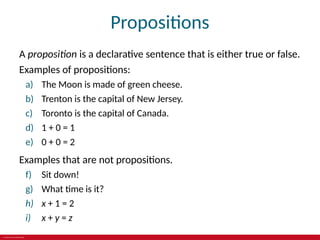
A proposition is a declarative sentence that is either true or false.
Examples of propositions:
a) The Moon is made of green cheese.
b) Trenton is the capital of New Jersey.
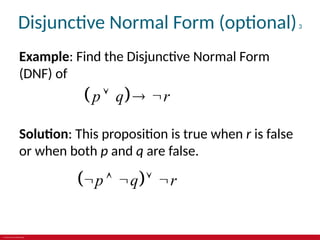
c) Toronto is the capital of Canada.
d) 1 + 0 = 1
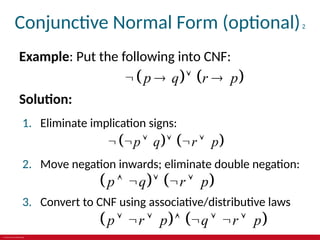
e) 0 + 0 = 2
Examples that are not propositions.
f) Sit down!
g) What time is it?
h) x + 1 = 2
i) x + y = z
© 2019 McGraw-Hill Education
Propositional Logic
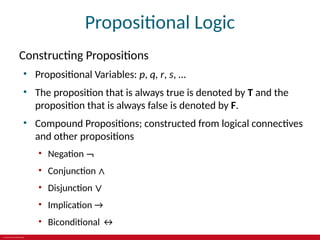
Constructing Propositions
• Propositional Variables: p, q, r, s, …
• The proposition that is always true is denoted by T and the
proposition that is always false is denoted by F.
• Compound Propositions; constructed from logical connectives
and other propositions
• Negation ¬
• Conjunction ∧
• Disjunction ∨
• Implication →
• Biconditional ↔
© 2019 McGraw-Hill Education
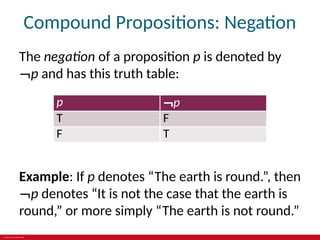
Compound Propositions: Negation
The negation of a proposition p is denoted by
¬p and has this truth table:
p ¬p
T F
F T
Example: If p denotes “The earth is round.”, then
¬p denotes “It is not the case that the earth is
round,” or more simply “The earth is not round.”
© 2019 McGraw-Hill Education
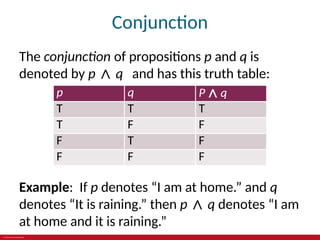
Conjunction
The conjunction of propositions p and q is
denoted by p ∧ q and has this truth table:
p q P ∧ q
T T T
T F F
F T F
F F F
Example: If p denotes “I am at home.” and q
denotes “It is raining.” then p ∧ q denotes “I am
at home and it is raining.”
© 2019 McGraw-Hill Education
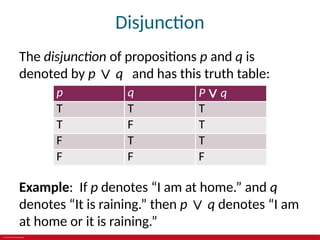
Disjunction
The disjunction of propositions p and q is
denoted by p ∨ q and has this truth table:
p q P ∨ q
T T T
T F T
F T T
F F F
Example: If p denotes “I am at home.” and q
denotes “It is raining.” then p ∨ q denotes “I am
at home or it is raining.”
© 2019 McGraw-Hill Education
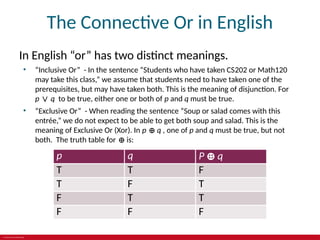
The Connective Or in English
In English “or” has two distinct meanings.
• “Inclusive Or” - In the sentence “Students who have taken CS202 or Math120
may take this class,” we assume that students need to have taken one of the
prerequisites, but may have taken both. This is the meaning of disjunction. For
p ∨ q to be true, either one or both of p and q must be true.
• “Exclusive Or” - When reading the sentence “Soup or salad comes with this
entrée,” we do not expect to be able to get both soup and salad. This is the
meaning of Exclusive Or (Xor). In p ⊕ q , one of p and q must be true, but not
both. The truth table for ⊕ is:
p q P ⊕ q
T T F
T F T
F T T
F F F
© 2019 McGraw-Hill Education
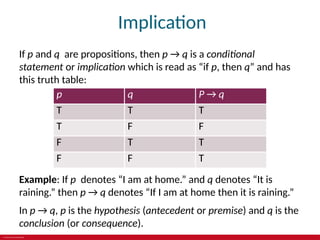
Implication
If p and q are propositions, then p → q is a conditional
statement or implication which is read as “if p, then q” and has
this truth table:
p q P → q
T T T
T F F
F T T
F F T
Example: If p denotes “I am at home.” and q denotes “It is
raining.” then p → q denotes “If I am at home then it is raining.”
In p → q, p is the hypothesis (antecedent or premise) and q is the
conclusion (or consequence).
© 2019 McGraw-Hill Education
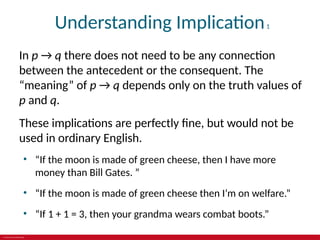
Understanding Implication1
In p → q there does not need to be any connection
between the antecedent or the consequent. The
“meaning” of p → q depends only on the truth values of
p and q.
These implications are perfectly fine, but would not be
used in ordinary English.
• “If the moon is made of green cheese, then I have more
money than Bill Gates. ”
• “If the moon is made of green cheese then I’m on welfare.”
• “If 1 + 1 = 3, then your grandma wears combat boots.”
© 2019 McGraw-Hill Education
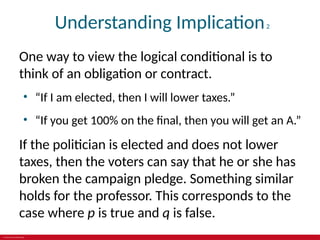
Understanding Implication2
One way to view the logical conditional is to
think of an obligation or contract.
• “If I am elected, then I will lower taxes.”
• “If you get 100% on the final, then you will get an A.”
If the politician is elected and does not lower
taxes, then the voters can say that he or she has
broken the campaign pledge. Something similar
holds for the professor. This corresponds to the
case where p is true and q is false.
© 2019 McGraw-Hill Education
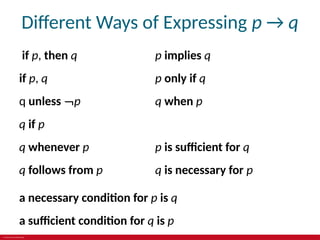
Different Ways of Expressing p → q
if p, then q
if p, q
q unless ¬p
q if p
q whenever p
q follows from p
p implies q
p only if q
q when p
p is sufficient for q
q is necessary for p
a necessary condition for p is q
a sufficient condition for q is p
© 2019 McGraw-Hill Education
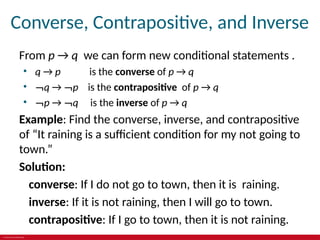
Converse, Contrapositive, and Inverse
From p → q we can form new conditional statements .
• q → p is the converse of p → q
• ¬q → ¬p is the contrapositive of p → q
• ¬p → ¬q is the inverse of p → q
Example: Find the converse, inverse, and contrapositive
of “It raining is a sufficient condition for my not going to
town.”
Solution:
converse: If I do not go to town, then it is raining.
inverse: If it is not raining, then I will go to town.
contrapositive: If I go to town, then it is not raining.
© 2019 McGraw-Hill Education
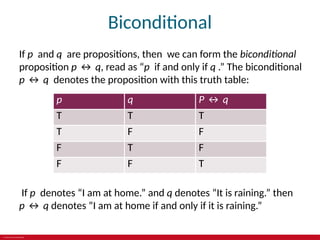
Biconditional
If p and q are propositions, then we can form the biconditional
proposition p ↔ q, read as “p if and only if q .” The biconditional
p ↔ q denotes the proposition with this truth table:
p q P ↔ q
T T T
T F F
F T F
F F T
If p denotes “I am at home.” and q denotes “It is raining.” then
p ↔ q denotes “I am at home if and only if it is raining.”
© 2019 McGraw-Hill Education
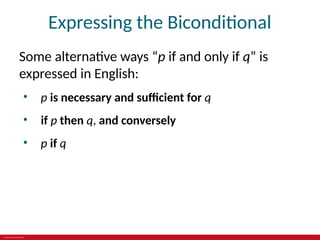
Expressing the Biconditional
Some alternative ways “p if and only if q” is
expressed in English:
• p is necessary and sufficient for q
• if p then q, and conversely
• p if q
© 2019 McGraw-Hill Education
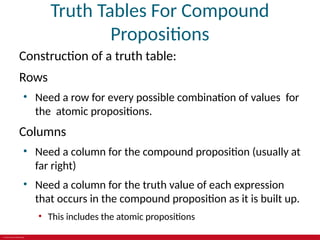
Truth Tables For Compound
Propositions
Construction of a truth table:
Rows
• Need a row for every possible combination of values for
the atomic propositions.
Columns
• Need a column for the compound proposition (usually at
far right)
• Need a column for the truth value of each expression
that occurs in the compound proposition as it is built up.
• This includes the atomic propositions
© 2019 McGraw-Hill Education
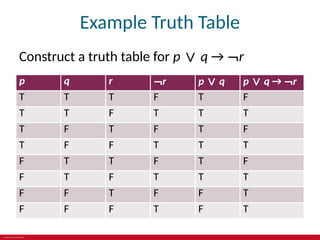
Example Truth Table
Construct a truth table for p ∨ q → ¬r
p q r ¬r p ∨ q p ∨ q → ¬r
T T T F T F
T T F T T T
T F T F T F
T F F T T T
F T T F T F
F T F T T T
F F T F F T
F F F T F T
© 2019 McGraw-Hill Education
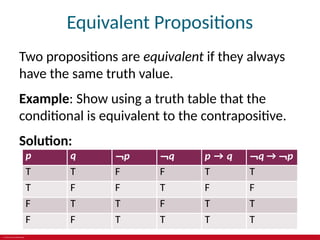
Equivalent Propositions
Two propositions are equivalent if they always
have the same truth value.
Example: Show using a truth table that the
conditional is equivalent to the contrapositive.
Solution:
p q ¬p ¬q p → q ¬q → ¬p
T T F F T T
T F F T F F
F T T F T T
F F T T T T
© 2019 McGraw-Hill Education
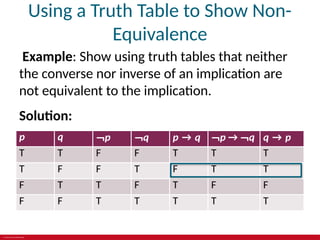
Using a Truth Table to Show Non-
Equivalence
Example: Show using truth tables that neither
the converse nor inverse of an implication are
not equivalent to the implication.
Solution:
p q ¬p ¬q p → q ¬p → ¬q q → p
T T F F T T T
T F F T F T T
F T T F T F F
F F T T T T T
© 2019 McGraw-Hill Education
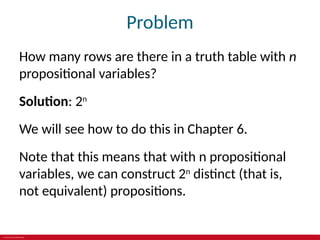
Problem
How many rows are there in a truth table with n
propositional variables?
Solution: 2n
We will see how to do this in Chapter 6.
Note that this means that with n propositional
variables, we can construct 2n
distinct (that is,
not equivalent) propositions.
© 2019 McGraw-Hill Education
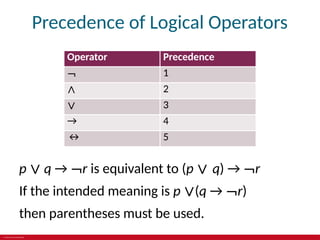
Precedence of Logical Operators
Operator Precedence
¬ 1
∧ 2
∨ 3
→ 4
↔ 5
p ∨ q → ¬r is equivalent to (p ∨ q) → ¬r
If the intended meaning is p ∨(q → ¬r)
then parentheses must be used.
© 2019 McGraw-Hill Education
Applications of
Propositional Logic
Section 1.2
© 2019 McGraw-Hill Education
Applications of Propositional Logic:
Summary
Translating English to Propositional Logic
System Specifications
Boolean Searching
Logic Puzzles
Logic Circuits
AI Diagnosis Method (Optional)
© 2019 McGraw-Hill Education
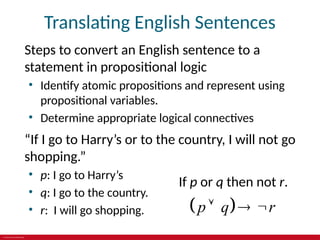
Translating English Sentences
Steps to convert an English sentence to a
statement in propositional logic
• Identify atomic propositions and represent using
propositional variables.
• Determine appropriate logical connectives
“If I go to Harry’s or to the country, I will not go
shopping.”
• p: I go to Harry’s
• q: I go to the country.
• r: I will go shopping.
If p or q then not r.
 
p q r
  
© 2019 McGraw-Hill Education
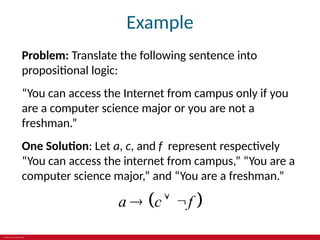
Example
Problem: Translate the following sentence into
propositional logic:
“You can access the Internet from campus only if you
are a computer science major or you are not a
freshman.”
One Solution: Let a, c, and f represent respectively
“You can access the internet from campus,” “You are a
computer science major,” and “You are a freshman.”
 
a c f
  
© 2019 McGraw-Hill Education
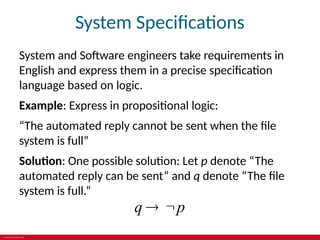
System Specifications
System and Software engineers take requirements in
English and express them in a precise specification
language based on logic.
Example: Express in propositional logic:
“The automated reply cannot be sent when the file
system is full”
Solution: One possible solution: Let p denote “The
automated reply can be sent” and q denote “The file
system is full.”
q p
 
© 2019 McGraw-Hill Education
Consistent System Specifications
Definition: A list of propositions is consistent if it is possible to
assign truth values to the proposition variables so that each
proposition is true.
Exercise: Are these specifications consistent?
• “The diagnostic message is stored in the buffer or it is retransmitted.”
• “The diagnostic message is stored in the buffer.”
• “If the diagnostic message is stored in the buffer, then it is retransmitted.”
Solution: Let p denote “The diagnostic message is stored in the buffer.” Let q
denote “The diagnostic message is retransmitted” The specification can be
written as: p ∨ q, ¬p, p → q. When p is false and q is true all three
statements are true. So the specification is consistent.
• What if “The diagnostic message is not retransmitted” is added.
Solution: Now we are adding ¬q and there is no satisfying assignment. So the
specification is not consistent.
© 2019 McGraw-Hill Education
Logic Puzzles
An island has two kinds of inhabitants, knights, who always tell the truth, and
knaves, who always lie.
You go to the island and meet A and B.
• A says “B is a knight.”
• B says “The two of us are of opposite types.”
Example: What are the types of A and B?
Solution: Let p and q be the statements that A is a knight and B is a knight,
respectively. So, then ¬p represents the proposition that A is a knave and ¬q
that B is a knave.
• If A is a knight, then p is true. Since knights tell the truth, q must also be true.
Then (p ∧ ¬ q) ∨ (¬ p ∧ q) would have to be true, but it is not. So, A is not a
knight and therefore ¬p must be true.
• If A is a knave, then B must not be a knight since knaves always lie. So, then both
¬p and ¬q hold since both are knaves.
© 2019 McGraw-Hill Education
Logic Circuits
(Studied in depth in Chapter 12)
Electronic circuits; each input/output signal can be viewed as a 0 or 1.
• 0 represents False
• 1 represents True
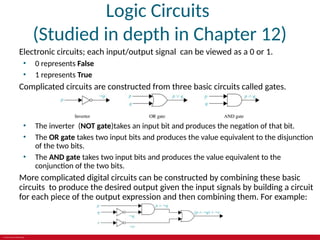
Complicated circuits are constructed from three basic circuits called gates.
• The inverter (NOT gate)takes an input bit and produces the negation of that bit.
• The OR gate takes two input bits and produces the value equivalent to the disjunction
of the two bits.
• The AND gate takes two input bits and produces the value equivalent to the
conjunction of the two bits.
More complicated digital circuits can be constructed by combining these basic
circuits to produce the desired output given the input signals by building a circuit
for each piece of the output expression and then combining them. For example:
© 2019 McGraw-Hill Education
Diagnosis of Faults in an Electrical
System (Optional)
AI Example (from Artificial Intelligence: Foundations of
Computational Agents by David Poole and Alan
Mackworth, 2010)
Need to represent in propositional logic the features of
a piece of machinery or circuitry that are required for
the operation to produce observable features. This is
called the Knowledge Base (KB).
We also have observations representing the features
that the system is exhibiting now.
© 2019 McGraw-Hill Education
Electrical System Diagram (optional)
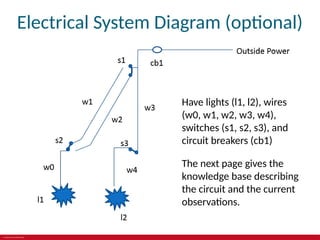
Have lights (l1, l2), wires
(w0, w1, w2, w3, w4),
switches (s1, s2, s3), and
circuit breakers (cb1)
The next page gives the
knowledge base describing
the circuit and the current
observations.
© 2019 McGraw-Hill Education
Representing the Electrical System in
Propositional Logic
We need to represent our common-sense
understanding of how the electrical system works in
propositional logic.
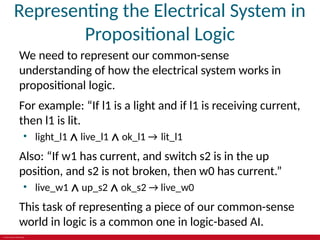
For example: “If l1 is a light and if l1 is receiving current,
then l1 is lit.
• light_l1 ∧ live_l1 ∧ ok_l1 → lit_l1
Also: “If w1 has current, and switch s2 is in the up
position, and s2 is not broken, then w0 has current.”
• live_w1 ∧ up_s2 ∧ ok_s2 → live_w0
This task of representing a piece of our common-sense
world in logic is a common one in logic-based AI.
© 2019 McGraw-Hill Education
Knowledge Base (opt)
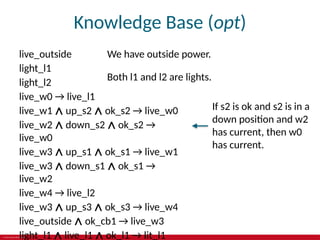
live_outside
light_l1
light_l2
live_w0 → live_l1
live_w1 ∧ up_s2 ∧ ok_s2 → live_w0
live_w2 ∧ down_s2 ∧ ok_s2 →
live_w0
live_w3 ∧ up_s1 ∧ ok_s1 → live_w1
live_w3 ∧ down_s1 ∧ ok_s1 →
live_w2
live_w4 → live_l2
live_w3 ∧ up_s3 ∧ ok_s3 → live_w4
live_outside ∧ ok_cb1 → live_w3
light_l1 ∧ live_l1 ∧ ok_l1 → lit_l1
We have outside power.
Both l1 and l2 are lights.
If s2 is ok and s2 is in a
down position and w2
has current, then w0
has current.
© 2019 McGraw-Hill Education
Observations (opt)
Observations need to be added to the KB
• Both Switches up
• up_s1
• up_s2
• Both lights are dark
• ¬ lit_l1
• ¬ lit_l2
© 2019 McGraw-Hill Education
Diagnosis (opt)
We assume that the components are working ok, unless we are
forced to assume otherwise. These atoms are called assumables.
The assumables (ok_cb1, ok_s1, ok_s2, ok_s3, ok_l1, ok_l2)
represent the assumption that we assume that the switches,
lights, and circuit breakers are ok.
If the system is working correctly (all assumables are true), the
observations and the knowledge base are consistent (i.e.,
satisfiable).
The augmented knowledge base is clearly not consistent if the
assumables are all true. The switches are both up, but the lights
are not lit. Some of the assumables must then be false. This is the
basis for the method to diagnose possible faults in the system.
A diagnosis is a minimal set of assumables which must be false to
explain the observations of the system.
© 2019 McGraw-Hill Education
Diagnostic Results (opt)
See Artificial Intelligence: Foundations of Computational Agents
(by David Poole and Alan Mackworth, 2010) for details on this
problem and how the method of consistency based diagnosis can
determine possible diagnoses for the electrical system.
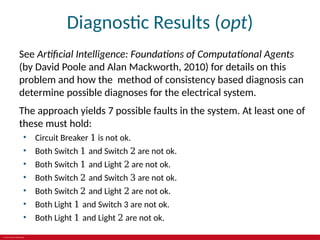
The approach yields 7 possible faults in the system. At least one of
these must hold:
• Circuit Breaker 1 is not ok.
• Both Switch 1 and Switch 2 are not ok.
• Both Switch 1 and Light 2 are not ok.
• Both Switch 2 and Switch 3 are not ok.
• Both Switch 2 and Light 2 are not ok.
• Both Light 1 and Switch 3 are not ok.
• Both Light 1 and Light 2 are not ok.
© 2019 McGraw-Hill Education
Propositional Equivalences
Section 1.3
© 2019 McGraw-Hill Education
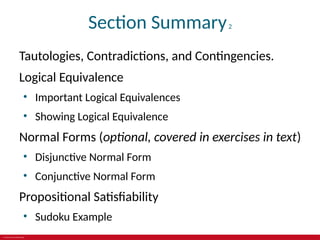
Section Summary2
Tautologies, Contradictions, and Contingencies.
Logical Equivalence
• Important Logical Equivalences
• Showing Logical Equivalence
Normal Forms (optional, covered in exercises in text)
• Disjunctive Normal Form
• Conjunctive Normal Form
Propositional Satisfiability
• Sudoku Example
© 2019 McGraw-Hill Education
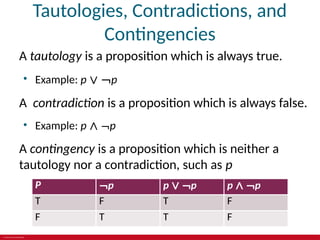
Tautologies, Contradictions, and
Contingencies
A tautology is a proposition which is always true.
• Example: p ∨ ¬p
A contradiction is a proposition which is always false.
• Example: p ∧ ¬p
A contingency is a proposition which is neither a
tautology nor a contradiction, such as p
P ¬p p ∨ ¬p p ∧ ¬p
T F T F
F T T F
© 2019 McGraw-Hill Education
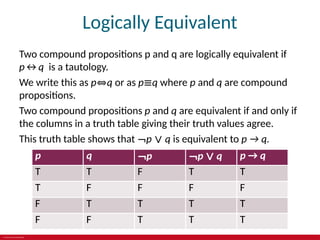
Logically Equivalent
Two compound propositions p and q are logically equivalent if
p↔q is a tautology.
We write this as p⇔q or as p≡q where p and q are compound
propositions.
Two compound propositions p and q are equivalent if and only if
the columns in a truth table giving their truth values agree.
This truth table shows that ¬p ∨ q is equivalent to p → q.
p q ¬p ¬p ∨ q p → q
T T F T T
T F F F F
F T T T T
F F T T T
© 2019 McGraw-Hill Education
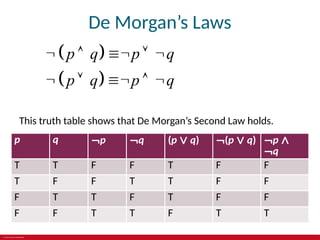
De Morgan’s Laws
 
 
p q p q
p q p q
    
    
This truth table shows that De Morgan’s Second Law holds.
p q ¬p ¬q (p ∨ q) ¬(p ∨ q) ¬p ∧
¬q
T T F F T F F
T F F T T F F
F T T F T F F
F F T T F T T
© 2019 McGraw-Hill Education
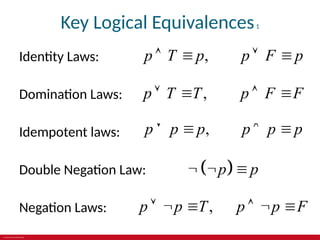
Key Logical Equivalences1
Identity Laws: ,
p T p p F p
   
Domination Laws: ,
p T T p F F
   
Idempotent laws: ,
p p p p p p
   
Double Negation Law:  
p p
  
Negation Laws: ,
p p T p p F
     
© 2019 McGraw-Hill Education
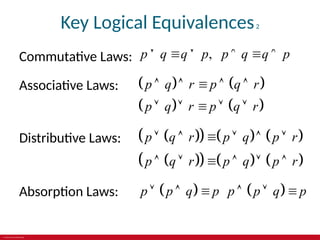
Key Logical Equivalences2
Commutative Laws: ,
p q q p p q q p
     
Associative Laws:    
   
p q r p q r
p q r p q r
    
    
Distributive Laws:  
     
 
     
p q r p q p r
p q r p q p r
     
     
Absorption Laws:    
p p q p p p q p
     
© 2019 McGraw-Hill Education
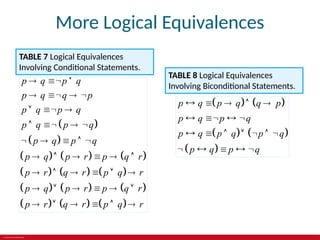
More Logical Equivalences
TABLE 7 Logical Equivalences
Involving Conditional Statements.
 
 
     
     
     
     
p q p q
p q q p
p q p q
p q p q
p q p q
p q p r p q r
p r q r p q r
p q p r p q r
p r q r p q r
  
   
  
   
    
     
     
     
     
TABLE 8 Logical Equivalences
Involving Biconditional Statements.
   
   
 
p q p q q p
p q p q
p q p q p q
p q p q
    
   
      
    
© 2019 McGraw-Hill Education
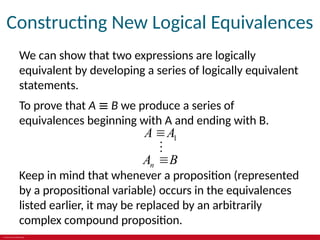
Constructing New Logical Equivalences
We can show that two expressions are logically
equivalent by developing a series of logically equivalent
statements.
To prove that A ≡ B we produce a series of
equivalences beginning with A and ending with B.
1
n
A A
A B



Keep in mind that whenever a proposition (represented
by a propositional variable) occurs in the equivalences
listed earlier, it may be replaced by an arbitrarily
complex compound proposition.
© 2019 McGraw-Hill Education
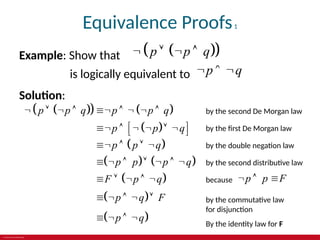
Equivalence Proofs1
Example: Show that  
 
p p q
   
is logically equivalent to p q
  
Solution:
 
   
p p q p p q
         by the second De Morgan law
 
p p q
      
  by the first De Morgan law
 
p p q
    by the double negation law
   
p p p q
       by the second distributive law
 
F p q
     because p p F
  
 
p q F
     by the commutative law
for disjunction
 
p q
   
By the identity law for F
© 2019 McGraw-Hill Education
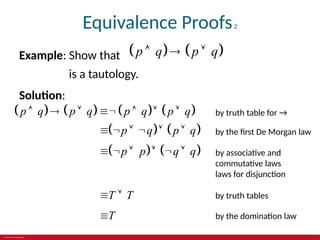
Equivalence Proofs2
Example: Show that    
p q p q
  
is a tautology.
Solution:
       
p q p q p q p q
       by truth table for →
   
p q p q
      by the first De Morgan law
   
p p q q
      by associative and
commutative laws
laws for disjunction
T T
  by truth tables
T
 by the domination law
© 2019 McGraw-Hill Education
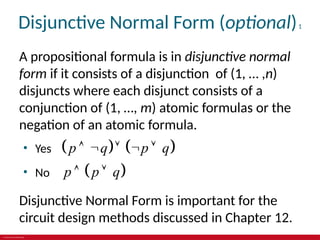
Disjunctive Normal Form (optional)1
A propositional formula is in disjunctive normal
form if it consists of a disjunction of (1, … ,n)
disjuncts where each disjunct consists of a
conjunction of (1, …, m) atomic formulas or the
negation of an atomic formula.
• Yes    
p q p q
    
• No  
p p q
 
Disjunctive Normal Form is important for the
circuit design methods discussed in Chapter 12.
© 2019 McGraw-Hill Education
Disjunctive Normal Form (optional)2
Example: Show that every compound proposition can be
put in disjunctive normal form.
Solution: Construct the truth table for the proposition.
Then an equivalent proposition is the disjunction with n
disjuncts (where n is the number of rows for which the
formula evaluates to T). Each disjunct has m conjuncts
where m is the number of distinct propositional variables.
Each conjunct includes the positive form of the
propositional variable if the variable is assigned T in that
row and the negated form if the variable is assigned F in
that row. This proposition is in disjunctive normal from.
© 2019 McGraw-Hill Education
Disjunctive Normal Form (optional)3
Example: Find the Disjunctive Normal Form
(DNF) of
 
p q r
  
Solution: This proposition is true when r is false
or when both p and q are false.
 
p q r
    
© 2019 McGraw-Hill Education
Conjunctive Normal Form (optional)1
A compound proposition is in Conjunctive Normal Form
(CNF) if it is a conjunction of disjunctions.
Every proposition can be put in an equivalent CNF.
Conjunctive Normal Form (CNF) can be obtained by
eliminating implications, moving negation inwards and
using the distributive and associative laws.
Important in resolution theorem proving used in
artificial Intelligence (AI).
A compound proposition can be put in conjunctive
normal form through repeated application of the logical
equivalences covered earlier.
© 2019 McGraw-Hill Education
Conjunctive Normal Form (optional)2
Example: Put the following into CNF:
   
p q r p
   
Solution:
1. Eliminate implication signs:
   
p q r p
     
2. Move negation inwards; eliminate double negation:
   
p q r p
    
3. Convert to CNF using associative/distributive laws
   
p r p q r p
       
© 2019 McGraw-Hill Education
Propositional Satisfiability
A compound proposition is satisfiable if there is
an assignment of truth values to its variables
that make it true. When no such assignments
exist, the compound proposition is unsatisfiable.
A compound proposition is unsatisfiable if and
only if its negation is a tautology.
© 2019 McGraw-Hill Education
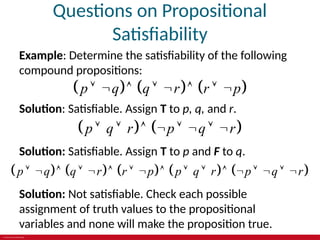
Questions on Propositional
Satisfiability
Example: Determine the satisfiability of the following
compound propositions:
     
p q q r r p
       
Solution: Satisfiable. Assign T to p, q, and r.
   
p q r p q r
       
Solution: Satisfiable. Assign T to p and F to q.
         
p q q r r p p q r p q r
                
Solution: Not satisfiable. Check each possible
assignment of truth values to the propositional
variables and none will make the proposition true.
© 2019 McGraw-Hill Education
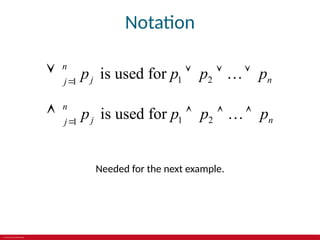
Notation
1 2
1
1 2
1
is used for
is used for
n
j n
j
n
j n
j
p p p p
p p p p


  
  




Needed for the next example.
© 2019 McGraw-Hill Education
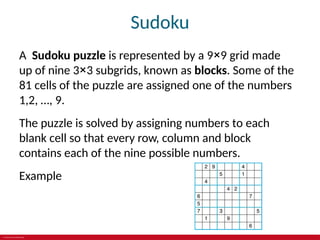
Sudoku
A Sudoku puzzle is represented by a 9×9 grid made
up of nine 3×3 subgrids, known as blocks. Some of the
81 cells of the puzzle are assigned one of the numbers
1,2, …, 9.
The puzzle is solved by assigning numbers to each
blank cell so that every row, column and block
contains each of the nine possible numbers.
Example
© 2019 McGraw-Hill Education
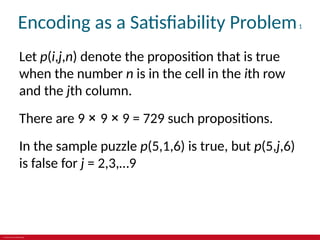
Encoding as a Satisfiability Problem1
Let p(i,j,n) denote the proposition that is true
when the number n is in the cell in the ith row
and the jth column.
There are 9 × 9 × 9 = 729 such propositions.
In the sample puzzle p(5,1,6) is true, but p(5,j,6)
is false for j = 2,3,…9
© 2019 McGraw-Hill Education
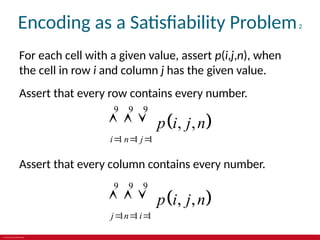
Encoding as a Satisfiability Problem2
For each cell with a given value, assert p(i,j,n), when
the cell in row i and column j has the given value.
Assert that every row contains every number.
 
9 9 9
1 1 1
, ,
i n j
p i j n
  
  
Assert that every column contains every number.
 
9 9 9
1 1 1
, ,
j n i
p i j n
  
  
© 2019 McGraw-Hill Education
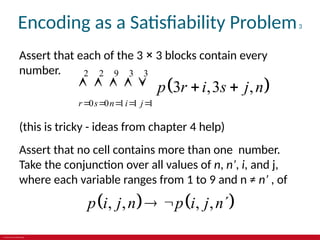
Encoding as a Satisfiability Problem3
Assert that each of the 3 × 3 blocks contain every
number.
 
2 2 9 3 3
0 0 1 1 1
3 ,3 ,
r s n i j
p r i s j n
    
 
    
(this is tricky - ideas from chapter 4 help)
Assert that no cell contains more than one number.
Take the conjunction over all values of n, n’, i, and j,
where each variable ranges from 1 to 9 and n ≠ n’ , of
   
, , , ,
p i j n p i j n
  
© 2019 McGraw-Hill Education
Solving Satisfiability Problems
To solve a Sudoku puzzle, we need to find an assignment of
truth values to the 729 variables of the form p(i,j,n) that
makes the conjunction of the assertions true. Those
variables that are assigned T yield a solution to the puzzle.
A truth table can always be used to determine the
satisfiability of a compound proposition. But this is too
complex even for modern computers for large problems.
There has been much work on developing efficient methods
for solving satisfiability problems as many practical
problems can be translated into satisfiability problems.

Chapter1 part1 : PROPOSITIONAL LOGIC || DISCRETE MATHEMATICS

  • 1.
    The Foundations: Logicand Proofs Chapter 1, Part I: Propositional Logic With Question/Answer Animations © 2019 McGraw-Hill Education. All rights reserved. Authorized only for instructor use in the classroom. No reproduction or further distribution permitted without the prior written consent of McGraw-Hill Education.
  • 2.
    © 2019 McGraw-HillEducation Chapter Summary Propositional Logic • The Language of Propositions • Applications • Logical Equivalences Predicate Logic • The Language of Quantifiers • Logical Equivalences • Nested Quantifiers Proofs • Rules of Inference • Proof Methods • Proof Strategy
  • 3.
    © 2019 McGraw-HillEducation Propositional Logic Summary The Language of Propositions • Connectives • Truth Values • Truth Tables Applications • Translating English Sentences • System Specifications • Logic Puzzles • Logic Circuits Logical Equivalences • Important Equivalences • Showing Equivalence • Satisfiability
  • 4.
    © 2019 McGraw-HillEducation Propositional Logic Section 1.1
  • 5.
    © 2019 McGraw-HillEducation Section Summary1 Propositions Connectives • Negation • Conjunction • Disjunction • Implication; contrapositive, inverse, converse • Biconditional Truth Tables
  • 6.
    © 2019 McGraw-HillEducation Propositions A proposition is a declarative sentence that is either true or false. Examples of propositions: a) The Moon is made of green cheese. b) Trenton is the capital of New Jersey. c) Toronto is the capital of Canada. d) 1 + 0 = 1 e) 0 + 0 = 2 Examples that are not propositions. f) Sit down! g) What time is it? h) x + 1 = 2 i) x + y = z
  • 7.
    © 2019 McGraw-HillEducation Propositional Logic Constructing Propositions • Propositional Variables: p, q, r, s, … • The proposition that is always true is denoted by T and the proposition that is always false is denoted by F. • Compound Propositions; constructed from logical connectives and other propositions • Negation ¬ • Conjunction ∧ • Disjunction ∨ • Implication → • Biconditional ↔
  • 8.
    © 2019 McGraw-HillEducation Compound Propositions: Negation The negation of a proposition p is denoted by ¬p and has this truth table: p ¬p T F F T Example: If p denotes “The earth is round.”, then ¬p denotes “It is not the case that the earth is round,” or more simply “The earth is not round.”
  • 9.
    © 2019 McGraw-HillEducation Conjunction The conjunction of propositions p and q is denoted by p ∧ q and has this truth table: p q P ∧ q T T T T F F F T F F F F Example: If p denotes “I am at home.” and q denotes “It is raining.” then p ∧ q denotes “I am at home and it is raining.”
  • 10.
    © 2019 McGraw-HillEducation Disjunction The disjunction of propositions p and q is denoted by p ∨ q and has this truth table: p q P ∨ q T T T T F T F T T F F F Example: If p denotes “I am at home.” and q denotes “It is raining.” then p ∨ q denotes “I am at home or it is raining.”
  • 11.
    © 2019 McGraw-HillEducation The Connective Or in English In English “or” has two distinct meanings. • “Inclusive Or” - In the sentence “Students who have taken CS202 or Math120 may take this class,” we assume that students need to have taken one of the prerequisites, but may have taken both. This is the meaning of disjunction. For p ∨ q to be true, either one or both of p and q must be true. • “Exclusive Or” - When reading the sentence “Soup or salad comes with this entrée,” we do not expect to be able to get both soup and salad. This is the meaning of Exclusive Or (Xor). In p ⊕ q , one of p and q must be true, but not both. The truth table for ⊕ is: p q P ⊕ q T T F T F T F T T F F F
  • 12.
    © 2019 McGraw-HillEducation Implication If p and q are propositions, then p → q is a conditional statement or implication which is read as “if p, then q” and has this truth table: p q P → q T T T T F F F T T F F T Example: If p denotes “I am at home.” and q denotes “It is raining.” then p → q denotes “If I am at home then it is raining.” In p → q, p is the hypothesis (antecedent or premise) and q is the conclusion (or consequence).
  • 13.
    © 2019 McGraw-HillEducation Understanding Implication1 In p → q there does not need to be any connection between the antecedent or the consequent. The “meaning” of p → q depends only on the truth values of p and q. These implications are perfectly fine, but would not be used in ordinary English. • “If the moon is made of green cheese, then I have more money than Bill Gates. ” • “If the moon is made of green cheese then I’m on welfare.” • “If 1 + 1 = 3, then your grandma wears combat boots.”
  • 14.
    © 2019 McGraw-HillEducation Understanding Implication2 One way to view the logical conditional is to think of an obligation or contract. • “If I am elected, then I will lower taxes.” • “If you get 100% on the final, then you will get an A.” If the politician is elected and does not lower taxes, then the voters can say that he or she has broken the campaign pledge. Something similar holds for the professor. This corresponds to the case where p is true and q is false.
  • 15.
    © 2019 McGraw-HillEducation Different Ways of Expressing p → q if p, then q if p, q q unless ¬p q if p q whenever p q follows from p p implies q p only if q q when p p is sufficient for q q is necessary for p a necessary condition for p is q a sufficient condition for q is p
  • 16.
    © 2019 McGraw-HillEducation Converse, Contrapositive, and Inverse From p → q we can form new conditional statements . • q → p is the converse of p → q • ¬q → ¬p is the contrapositive of p → q • ¬p → ¬q is the inverse of p → q Example: Find the converse, inverse, and contrapositive of “It raining is a sufficient condition for my not going to town.” Solution: converse: If I do not go to town, then it is raining. inverse: If it is not raining, then I will go to town. contrapositive: If I go to town, then it is not raining.
  • 17.
    © 2019 McGraw-HillEducation Biconditional If p and q are propositions, then we can form the biconditional proposition p ↔ q, read as “p if and only if q .” The biconditional p ↔ q denotes the proposition with this truth table: p q P ↔ q T T T T F F F T F F F T If p denotes “I am at home.” and q denotes “It is raining.” then p ↔ q denotes “I am at home if and only if it is raining.”
  • 18.
    © 2019 McGraw-HillEducation Expressing the Biconditional Some alternative ways “p if and only if q” is expressed in English: • p is necessary and sufficient for q • if p then q, and conversely • p if q
  • 19.
    © 2019 McGraw-HillEducation Truth Tables For Compound Propositions Construction of a truth table: Rows • Need a row for every possible combination of values for the atomic propositions. Columns • Need a column for the compound proposition (usually at far right) • Need a column for the truth value of each expression that occurs in the compound proposition as it is built up. • This includes the atomic propositions
  • 20.
    © 2019 McGraw-HillEducation Example Truth Table Construct a truth table for p ∨ q → ¬r p q r ¬r p ∨ q p ∨ q → ¬r T T T F T F T T F T T T T F T F T F T F F T T T F T T F T F F T F T T T F F T F F T F F F T F T
  • 21.
    © 2019 McGraw-HillEducation Equivalent Propositions Two propositions are equivalent if they always have the same truth value. Example: Show using a truth table that the conditional is equivalent to the contrapositive. Solution: p q ¬p ¬q p → q ¬q → ¬p T T F F T T T F F T F F F T T F T T F F T T T T
  • 22.
    © 2019 McGraw-HillEducation Using a Truth Table to Show Non- Equivalence Example: Show using truth tables that neither the converse nor inverse of an implication are not equivalent to the implication. Solution: p q ¬p ¬q p → q ¬p → ¬q q → p T T F F T T T T F F T F T T F T T F T F F F F T T T T T
  • 23.
    © 2019 McGraw-HillEducation Problem How many rows are there in a truth table with n propositional variables? Solution: 2n We will see how to do this in Chapter 6. Note that this means that with n propositional variables, we can construct 2n distinct (that is, not equivalent) propositions.
  • 24.
    © 2019 McGraw-HillEducation Precedence of Logical Operators Operator Precedence ¬ 1 ∧ 2 ∨ 3 → 4 ↔ 5 p ∨ q → ¬r is equivalent to (p ∨ q) → ¬r If the intended meaning is p ∨(q → ¬r) then parentheses must be used.
  • 25.
    © 2019 McGraw-HillEducation Applications of Propositional Logic Section 1.2
  • 26.
    © 2019 McGraw-HillEducation Applications of Propositional Logic: Summary Translating English to Propositional Logic System Specifications Boolean Searching Logic Puzzles Logic Circuits AI Diagnosis Method (Optional)
  • 27.
    © 2019 McGraw-HillEducation Translating English Sentences Steps to convert an English sentence to a statement in propositional logic • Identify atomic propositions and represent using propositional variables. • Determine appropriate logical connectives “If I go to Harry’s or to the country, I will not go shopping.” • p: I go to Harry’s • q: I go to the country. • r: I will go shopping. If p or q then not r.   p q r   
  • 28.
    © 2019 McGraw-HillEducation Example Problem: Translate the following sentence into propositional logic: “You can access the Internet from campus only if you are a computer science major or you are not a freshman.” One Solution: Let a, c, and f represent respectively “You can access the internet from campus,” “You are a computer science major,” and “You are a freshman.”   a c f   
  • 29.
    © 2019 McGraw-HillEducation System Specifications System and Software engineers take requirements in English and express them in a precise specification language based on logic. Example: Express in propositional logic: “The automated reply cannot be sent when the file system is full” Solution: One possible solution: Let p denote “The automated reply can be sent” and q denote “The file system is full.” q p  
  • 30.
    © 2019 McGraw-HillEducation Consistent System Specifications Definition: A list of propositions is consistent if it is possible to assign truth values to the proposition variables so that each proposition is true. Exercise: Are these specifications consistent? • “The diagnostic message is stored in the buffer or it is retransmitted.” • “The diagnostic message is stored in the buffer.” • “If the diagnostic message is stored in the buffer, then it is retransmitted.” Solution: Let p denote “The diagnostic message is stored in the buffer.” Let q denote “The diagnostic message is retransmitted” The specification can be written as: p ∨ q, ¬p, p → q. When p is false and q is true all three statements are true. So the specification is consistent. • What if “The diagnostic message is not retransmitted” is added. Solution: Now we are adding ¬q and there is no satisfying assignment. So the specification is not consistent.
  • 31.
    © 2019 McGraw-HillEducation Logic Puzzles An island has two kinds of inhabitants, knights, who always tell the truth, and knaves, who always lie. You go to the island and meet A and B. • A says “B is a knight.” • B says “The two of us are of opposite types.” Example: What are the types of A and B? Solution: Let p and q be the statements that A is a knight and B is a knight, respectively. So, then ¬p represents the proposition that A is a knave and ¬q that B is a knave. • If A is a knight, then p is true. Since knights tell the truth, q must also be true. Then (p ∧ ¬ q) ∨ (¬ p ∧ q) would have to be true, but it is not. So, A is not a knight and therefore ¬p must be true. • If A is a knave, then B must not be a knight since knaves always lie. So, then both ¬p and ¬q hold since both are knaves.
  • 32.
    © 2019 McGraw-HillEducation Logic Circuits (Studied in depth in Chapter 12) Electronic circuits; each input/output signal can be viewed as a 0 or 1. • 0 represents False • 1 represents True Complicated circuits are constructed from three basic circuits called gates. • The inverter (NOT gate)takes an input bit and produces the negation of that bit. • The OR gate takes two input bits and produces the value equivalent to the disjunction of the two bits. • The AND gate takes two input bits and produces the value equivalent to the conjunction of the two bits. More complicated digital circuits can be constructed by combining these basic circuits to produce the desired output given the input signals by building a circuit for each piece of the output expression and then combining them. For example:
  • 33.
    © 2019 McGraw-HillEducation Diagnosis of Faults in an Electrical System (Optional) AI Example (from Artificial Intelligence: Foundations of Computational Agents by David Poole and Alan Mackworth, 2010) Need to represent in propositional logic the features of a piece of machinery or circuitry that are required for the operation to produce observable features. This is called the Knowledge Base (KB). We also have observations representing the features that the system is exhibiting now.
  • 34.
    © 2019 McGraw-HillEducation Electrical System Diagram (optional) Have lights (l1, l2), wires (w0, w1, w2, w3, w4), switches (s1, s2, s3), and circuit breakers (cb1) The next page gives the knowledge base describing the circuit and the current observations.
  • 35.
    © 2019 McGraw-HillEducation Representing the Electrical System in Propositional Logic We need to represent our common-sense understanding of how the electrical system works in propositional logic. For example: “If l1 is a light and if l1 is receiving current, then l1 is lit. • light_l1 ∧ live_l1 ∧ ok_l1 → lit_l1 Also: “If w1 has current, and switch s2 is in the up position, and s2 is not broken, then w0 has current.” • live_w1 ∧ up_s2 ∧ ok_s2 → live_w0 This task of representing a piece of our common-sense world in logic is a common one in logic-based AI.
  • 36.
    © 2019 McGraw-HillEducation Knowledge Base (opt) live_outside light_l1 light_l2 live_w0 → live_l1 live_w1 ∧ up_s2 ∧ ok_s2 → live_w0 live_w2 ∧ down_s2 ∧ ok_s2 → live_w0 live_w3 ∧ up_s1 ∧ ok_s1 → live_w1 live_w3 ∧ down_s1 ∧ ok_s1 → live_w2 live_w4 → live_l2 live_w3 ∧ up_s3 ∧ ok_s3 → live_w4 live_outside ∧ ok_cb1 → live_w3 light_l1 ∧ live_l1 ∧ ok_l1 → lit_l1 We have outside power. Both l1 and l2 are lights. If s2 is ok and s2 is in a down position and w2 has current, then w0 has current.
  • 37.
    © 2019 McGraw-HillEducation Observations (opt) Observations need to be added to the KB • Both Switches up • up_s1 • up_s2 • Both lights are dark • ¬ lit_l1 • ¬ lit_l2
  • 38.
    © 2019 McGraw-HillEducation Diagnosis (opt) We assume that the components are working ok, unless we are forced to assume otherwise. These atoms are called assumables. The assumables (ok_cb1, ok_s1, ok_s2, ok_s3, ok_l1, ok_l2) represent the assumption that we assume that the switches, lights, and circuit breakers are ok. If the system is working correctly (all assumables are true), the observations and the knowledge base are consistent (i.e., satisfiable). The augmented knowledge base is clearly not consistent if the assumables are all true. The switches are both up, but the lights are not lit. Some of the assumables must then be false. This is the basis for the method to diagnose possible faults in the system. A diagnosis is a minimal set of assumables which must be false to explain the observations of the system.
  • 39.
    © 2019 McGraw-HillEducation Diagnostic Results (opt) See Artificial Intelligence: Foundations of Computational Agents (by David Poole and Alan Mackworth, 2010) for details on this problem and how the method of consistency based diagnosis can determine possible diagnoses for the electrical system. The approach yields 7 possible faults in the system. At least one of these must hold: • Circuit Breaker 1 is not ok. • Both Switch 1 and Switch 2 are not ok. • Both Switch 1 and Light 2 are not ok. • Both Switch 2 and Switch 3 are not ok. • Both Switch 2 and Light 2 are not ok. • Both Light 1 and Switch 3 are not ok. • Both Light 1 and Light 2 are not ok.
  • 40.
    © 2019 McGraw-HillEducation Propositional Equivalences Section 1.3
  • 41.
    © 2019 McGraw-HillEducation Section Summary2 Tautologies, Contradictions, and Contingencies. Logical Equivalence • Important Logical Equivalences • Showing Logical Equivalence Normal Forms (optional, covered in exercises in text) • Disjunctive Normal Form • Conjunctive Normal Form Propositional Satisfiability • Sudoku Example
  • 42.
    © 2019 McGraw-HillEducation Tautologies, Contradictions, and Contingencies A tautology is a proposition which is always true. • Example: p ∨ ¬p A contradiction is a proposition which is always false. • Example: p ∧ ¬p A contingency is a proposition which is neither a tautology nor a contradiction, such as p P ¬p p ∨ ¬p p ∧ ¬p T F T F F T T F
  • 43.
    © 2019 McGraw-HillEducation Logically Equivalent Two compound propositions p and q are logically equivalent if p↔q is a tautology. We write this as p⇔q or as p≡q where p and q are compound propositions. Two compound propositions p and q are equivalent if and only if the columns in a truth table giving their truth values agree. This truth table shows that ¬p ∨ q is equivalent to p → q. p q ¬p ¬p ∨ q p → q T T F T T T F F F F F T T T T F F T T T
  • 44.
    © 2019 McGraw-HillEducation De Morgan’s Laws     p q p q p q p q           This truth table shows that De Morgan’s Second Law holds. p q ¬p ¬q (p ∨ q) ¬(p ∨ q) ¬p ∧ ¬q T T F F T F F T F F T T F F F T T F T F F F F T T F T T
  • 45.
    © 2019 McGraw-HillEducation Key Logical Equivalences1 Identity Laws: , p T p p F p     Domination Laws: , p T T p F F     Idempotent laws: , p p p p p p     Double Negation Law:   p p    Negation Laws: , p p T p p F      
  • 46.
    © 2019 McGraw-HillEducation Key Logical Equivalences2 Commutative Laws: , p q q p p q q p       Associative Laws:         p q r p q r p q r p q r           Distributive Laws:                 p q r p q p r p q r p q p r             Absorption Laws:     p p q p p p q p      
  • 47.
    © 2019 McGraw-HillEducation More Logical Equivalences TABLE 7 Logical Equivalences Involving Conditional Statements.                             p q p q p q q p p q p q p q p q p q p q p q p r p q r p r q r p q r p q p r p q r p r q r p q r                                            TABLE 8 Logical Equivalences Involving Biconditional Statements.           p q p q q p p q p q p q p q p q p q p q                     
  • 48.
    © 2019 McGraw-HillEducation Constructing New Logical Equivalences We can show that two expressions are logically equivalent by developing a series of logically equivalent statements. To prove that A ≡ B we produce a series of equivalences beginning with A and ending with B. 1 n A A A B    Keep in mind that whenever a proposition (represented by a propositional variable) occurs in the equivalences listed earlier, it may be replaced by an arbitrarily complex compound proposition.
  • 49.
    © 2019 McGraw-HillEducation Equivalence Proofs1 Example: Show that     p p q     is logically equivalent to p q    Solution:       p p q p p q          by the second De Morgan law   p p q          by the first De Morgan law   p p q     by the double negation law     p p p q        by the second distributive law   F p q      because p p F      p q F      by the commutative law for disjunction   p q     By the identity law for F
  • 50.
    © 2019 McGraw-HillEducation Equivalence Proofs2 Example: Show that     p q p q    is a tautology. Solution:         p q p q p q p q        by truth table for →     p q p q       by the first De Morgan law     p p q q       by associative and commutative laws laws for disjunction T T   by truth tables T  by the domination law
  • 51.
    © 2019 McGraw-HillEducation Disjunctive Normal Form (optional)1 A propositional formula is in disjunctive normal form if it consists of a disjunction of (1, … ,n) disjuncts where each disjunct consists of a conjunction of (1, …, m) atomic formulas or the negation of an atomic formula. • Yes     p q p q      • No   p p q   Disjunctive Normal Form is important for the circuit design methods discussed in Chapter 12.
  • 52.
    © 2019 McGraw-HillEducation Disjunctive Normal Form (optional)2 Example: Show that every compound proposition can be put in disjunctive normal form. Solution: Construct the truth table for the proposition. Then an equivalent proposition is the disjunction with n disjuncts (where n is the number of rows for which the formula evaluates to T). Each disjunct has m conjuncts where m is the number of distinct propositional variables. Each conjunct includes the positive form of the propositional variable if the variable is assigned T in that row and the negated form if the variable is assigned F in that row. This proposition is in disjunctive normal from.
  • 53.
    © 2019 McGraw-HillEducation Disjunctive Normal Form (optional)3 Example: Find the Disjunctive Normal Form (DNF) of   p q r    Solution: This proposition is true when r is false or when both p and q are false.   p q r     
  • 54.
    © 2019 McGraw-HillEducation Conjunctive Normal Form (optional)1 A compound proposition is in Conjunctive Normal Form (CNF) if it is a conjunction of disjunctions. Every proposition can be put in an equivalent CNF. Conjunctive Normal Form (CNF) can be obtained by eliminating implications, moving negation inwards and using the distributive and associative laws. Important in resolution theorem proving used in artificial Intelligence (AI). A compound proposition can be put in conjunctive normal form through repeated application of the logical equivalences covered earlier.
  • 55.
    © 2019 McGraw-HillEducation Conjunctive Normal Form (optional)2 Example: Put the following into CNF:     p q r p     Solution: 1. Eliminate implication signs:     p q r p       2. Move negation inwards; eliminate double negation:     p q r p      3. Convert to CNF using associative/distributive laws     p r p q r p        
  • 56.
    © 2019 McGraw-HillEducation Propositional Satisfiability A compound proposition is satisfiable if there is an assignment of truth values to its variables that make it true. When no such assignments exist, the compound proposition is unsatisfiable. A compound proposition is unsatisfiable if and only if its negation is a tautology.
  • 57.
    © 2019 McGraw-HillEducation Questions on Propositional Satisfiability Example: Determine the satisfiability of the following compound propositions:       p q q r r p         Solution: Satisfiable. Assign T to p, q, and r.     p q r p q r         Solution: Satisfiable. Assign T to p and F to q.           p q q r r p p q r p q r                  Solution: Not satisfiable. Check each possible assignment of truth values to the propositional variables and none will make the proposition true.
  • 58.
    © 2019 McGraw-HillEducation Notation 1 2 1 1 2 1 is used for is used for n j n j n j n j p p p p p p p p             Needed for the next example.
  • 59.
    © 2019 McGraw-HillEducation Sudoku A Sudoku puzzle is represented by a 9×9 grid made up of nine 3×3 subgrids, known as blocks. Some of the 81 cells of the puzzle are assigned one of the numbers 1,2, …, 9. The puzzle is solved by assigning numbers to each blank cell so that every row, column and block contains each of the nine possible numbers. Example
  • 60.
    © 2019 McGraw-HillEducation Encoding as a Satisfiability Problem1 Let p(i,j,n) denote the proposition that is true when the number n is in the cell in the ith row and the jth column. There are 9 × 9 × 9 = 729 such propositions. In the sample puzzle p(5,1,6) is true, but p(5,j,6) is false for j = 2,3,…9
  • 61.
    © 2019 McGraw-HillEducation Encoding as a Satisfiability Problem2 For each cell with a given value, assert p(i,j,n), when the cell in row i and column j has the given value. Assert that every row contains every number.   9 9 9 1 1 1 , , i n j p i j n       Assert that every column contains every number.   9 9 9 1 1 1 , , j n i p i j n      
  • 62.
    © 2019 McGraw-HillEducation Encoding as a Satisfiability Problem3 Assert that each of the 3 × 3 blocks contain every number.   2 2 9 3 3 0 0 1 1 1 3 ,3 , r s n i j p r i s j n             (this is tricky - ideas from chapter 4 help) Assert that no cell contains more than one number. Take the conjunction over all values of n, n’, i, and j, where each variable ranges from 1 to 9 and n ≠ n’ , of     , , , , p i j n p i j n   
  • 63.
    © 2019 McGraw-HillEducation Solving Satisfiability Problems To solve a Sudoku puzzle, we need to find an assignment of truth values to the 729 variables of the form p(i,j,n) that makes the conjunction of the assertions true. Those variables that are assigned T yield a solution to the puzzle. A truth table can always be used to determine the satisfiability of a compound proposition. But this is too complex even for modern computers for large problems. There has been much work on developing efficient methods for solving satisfiability problems as many practical problems can be translated into satisfiability problems.