Human Resource Management
R. WAYNE MONDY
ROBERT M. NOE
Ninth Edition
Human Resource Management
2
Preface
 All managers are involved in human resource functions.
 The significance of HRM today: human resources make
the real difference in achieving organizational goals.
Employees are the most valuable asset in organizations.
 HRM a strategic function along with increasing
technological changes. HR strategic role in planning and
operating organizations will be elaborated in each of HR
functions.
3
HRM: a strategic perspective/the relation of
HCM to strategic HRM
 HRM: the management of the human capital
 HR executives can build a firm strategy map.
 Human Capital Management (HCM) is the task of measuring
the cause and effect relationship of various HR programs and
policies on the bottom line of the firm.
 To manage human capital is to measure the performance
and to put value. For example: does training or paying
employees make more productivity?
 Human capital management regards each individual as a
“unique” human capital.
 A basic difference between HCM and the old HR is that
there is “ no one form that fits all.”
 Is HCM a fad?
4
Human Resource Management
 Def: the utilization of a firm’s human resources to achieve
organizational objectives.
 Challenges facing individuals dealing with HR matters:
constantly changing workforce, government regulations,
technological changes, global competition, and the
awareness for costs and productivity.
 Top management has a major role in following the HR
issue.
5
Human Resource Management Functions
Fig. 1-1(p.6)
A.Staffing:
1. Job analysis
2. HR planning
3. Recruitment
4. Selection
B.Human Resource Development (HRD): a major HRM function that consists
of:
1.Training and Development (T&D)
2.Individual career planning and development activities
3.Organizational development (OD)
4.Performance Appraisal which emphasizes training and development
C. Compensation and Benefits
Compensation System: provides rewards (pay, benefits, non-financial rewards)
6
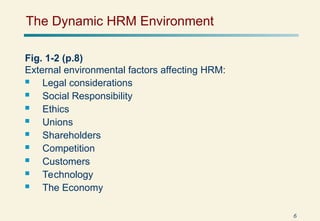
The Dynamic HRM Environment
Fig. 1-2 (p.8)
External environmental factors affecting HRM:
 Legal considerations
 Social Responsibility
 Ethics
 Unions
 Shareholders
 Competition
 Customers
 Technology
 The Economy
7
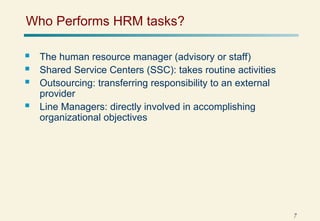
Who Performs HRM tasks?
 The human resource manager (advisory or staff)
 Shared Service Centers (SSC): takes routine activities
 Outsourcing: transferring responsibility to an external
provider
 Line Managers: directly involved in accomplishing
organizational objectives
8
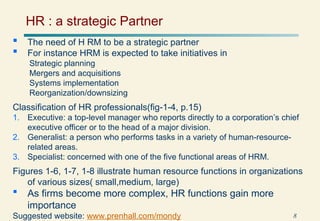
HR : a strategic Partner
 The need of H RM to be a strategic partner
 For instance HRM is expected to take initiatives in
Strategic planning
Mergers and acquisitions
Systems implementation
Reorganization/downsizing
Classification of HR professionals(fig-1-4, p.15)
1. Executive: a top-level manager who reports directly to a corporation’s chief
executive officer or to the head of a major division.
2. Generalist: a person who performs tasks in a variety of human-resource-
related areas.
3. Specialist: concerned with one of the five functional areas of HRM.
Figures 1-6, 1-7, 1-8 illustrate human resource functions in organizations
of various sizes( small,medium, large)
 As firms become more complex, HR functions gain more
importance
Suggested website: www.prenhall.com/mondy

Chapter1 - human resources management.ppt

  • 1.
    Human Resource Management R.WAYNE MONDY ROBERT M. NOE Ninth Edition Human Resource Management Human Resource Management
  • 2.
    2 Preface  All managersare involved in human resource functions.  The significance of HRM today: human resources make the real difference in achieving organizational goals. Employees are the most valuable asset in organizations.  HRM a strategic function along with increasing technological changes. HR strategic role in planning and operating organizations will be elaborated in each of HR functions.
  • 3.
    3 HRM: a strategicperspective/the relation of HCM to strategic HRM  HRM: the management of the human capital  HR executives can build a firm strategy map.  Human Capital Management (HCM) is the task of measuring the cause and effect relationship of various HR programs and policies on the bottom line of the firm.  To manage human capital is to measure the performance and to put value. For example: does training or paying employees make more productivity?  Human capital management regards each individual as a “unique” human capital.  A basic difference between HCM and the old HR is that there is “ no one form that fits all.”  Is HCM a fad?
  • 4.
    4 Human Resource Management Def: the utilization of a firm’s human resources to achieve organizational objectives.  Challenges facing individuals dealing with HR matters: constantly changing workforce, government regulations, technological changes, global competition, and the awareness for costs and productivity.  Top management has a major role in following the HR issue.
  • 5.
    5 Human Resource ManagementFunctions Fig. 1-1(p.6) A.Staffing: 1. Job analysis 2. HR planning 3. Recruitment 4. Selection B.Human Resource Development (HRD): a major HRM function that consists of: 1.Training and Development (T&D) 2.Individual career planning and development activities 3.Organizational development (OD) 4.Performance Appraisal which emphasizes training and development C. Compensation and Benefits Compensation System: provides rewards (pay, benefits, non-financial rewards)
  • 6.
    6 The Dynamic HRMEnvironment Fig. 1-2 (p.8) External environmental factors affecting HRM:  Legal considerations  Social Responsibility  Ethics  Unions  Shareholders  Competition  Customers  Technology  The Economy
  • 7.
    7 Who Performs HRMtasks?  The human resource manager (advisory or staff)  Shared Service Centers (SSC): takes routine activities  Outsourcing: transferring responsibility to an external provider  Line Managers: directly involved in accomplishing organizational objectives
  • 8.
    8 HR : astrategic Partner  The need of H RM to be a strategic partner  For instance HRM is expected to take initiatives in Strategic planning Mergers and acquisitions Systems implementation Reorganization/downsizing Classification of HR professionals(fig-1-4, p.15) 1. Executive: a top-level manager who reports directly to a corporation’s chief executive officer or to the head of a major division. 2. Generalist: a person who performs tasks in a variety of human-resource- related areas. 3. Specialist: concerned with one of the five functional areas of HRM. Figures 1-6, 1-7, 1-8 illustrate human resource functions in organizations of various sizes( small,medium, large)  As firms become more complex, HR functions gain more importance Suggested website: www.prenhall.com/mondy