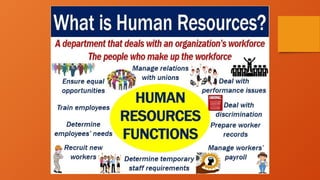
Human Resource Management is an ongoing, evolving process. It's about creatin a workplace where people feel valued, empowered and engaged, ultimately leading to the success of the organization.
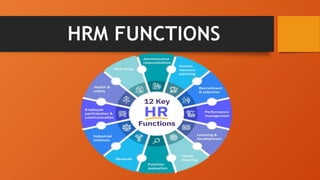
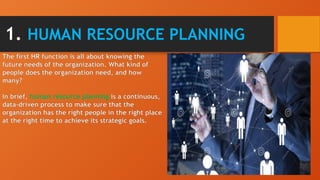
1. HUMAN RESOURCEPLANNING
The first HR function is all about knowing the
future needs of the organization. What kind of
people does the organization need, and how
many?
In brief, human resource planning is a continuous,
data-driven process to make sure that the
organization has the right people in the right place
at the right time to achieve its strategic goals.
7.
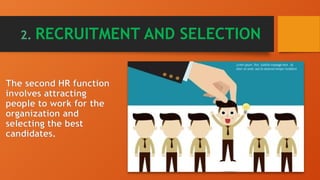
2. RECRUITMENT ANDSELECTION
The second HR function
involves attracting
people to work for the
organization and
selecting the best
candidates.
8.
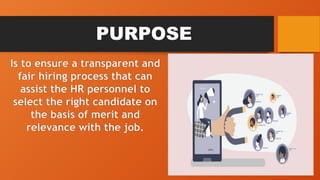
PURPOSE
Is to ensurea transparent and
fair hiring process that can
assist the HR personnel to
select the right candidate on
the basis of merit and
relevance with the job.
9.
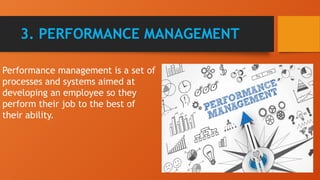
3. PERFORMANCE MANAGEMENT
Performancemanagement is a set of
processes and systems aimed at
developing an employee so they
perform their job to the best of
their ability.
10.
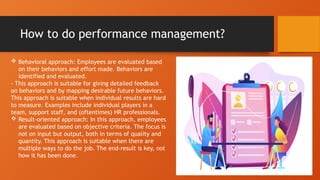
How to doperformance management?
Behavioral approach: Employees are evaluated based
on their behaviors and effort made. Behaviors are
identified and evaluated.
- This approach is suitable for giving detailed feedback
on behaviors and by mapping desirable future behaviors.
This approach is suitable when individual results are hard
to measure. Examples include individual players in a
team, support staff, and (oftentimes) HR professionals.
Result-oriented approach: In this approach, employees
are evaluated based on objective criteria. The focus is
not on input but output, both in terms of quality and
quantity. This approach is suitable when there are
multiple ways to do the job. The end-result is key, not
how it has been done.
11.
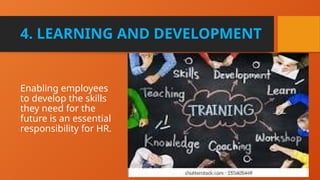
4. LEARNING ANDDEVELOPMENT
Click icon to add picture
Enabling employees
to develop the skills
they need for the
future is an essential
responsibility for HR.
12.
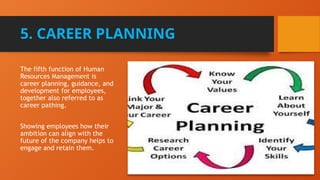
5. CAREER PLANNING
Thefifth function of Human
Resources Management is
career planning, guidance, and
development for employees,
together also referred to as
career pathing.
Showing employees how their
ambition can align with the
future of the company helps to
engage and retain them.
13.
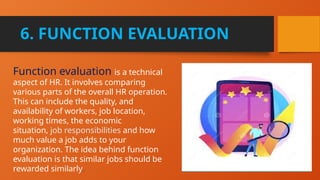
6. FUNCTION EVALUATION
Functionevaluation is a technical
aspect of HR. It involves comparing
various parts of the overall HR operation.
This can include the quality, and
availability of workers, job location,
working times, the economic
situation, job responsibilities and how
much value a job adds to your
organization. The idea behind function
evaluation is that similar jobs should be
rewarded similarly.
14.
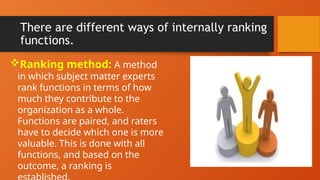
There are differentways of internally ranking
functions.
Ranking method: A method
in which subject matter experts
rank functions in terms of how
much they contribute to the
organization as a whole.
Functions are paired, and raters
have to decide which one is more
valuable. This is done with all
functions, and based on the
outcome, a ranking is
15.
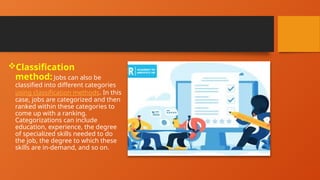
Classification
method: Jobs canalso be
classified into different categories
using classification methods. In this
case, jobs are categorized and then
ranked within these categories to
come up with a ranking.
Categorizations can include
education, experience, the degree
of specialized skills needed to do
the job, the degree to which these
skills are in-demand, and so on.
16.
Points method: Jobsare
categorized according to the factors
the organization believes contribute
most to its success. Points are then
awarded to each category for every
job. These categories can include key
competencies like problem-solving,
technical knowledge, communication
and influencing skills, innovative
capability, business acumen, and so
on.
17.
Personal method: In
thismethod, the job itself
is not evaluated but the
person doing the job is.
Here, employees are
rewarded based on their
skills and competencies.
18.
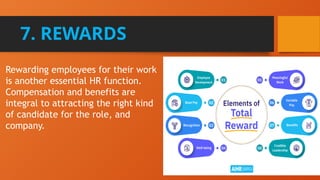
7. REWARDS
Rewarding employeesfor their work
is another essential HR function.
Compensation and benefits are
integral to attracting the right kind
of candidate for the role, and
company.
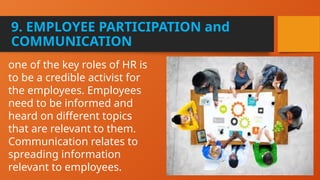
9. EMPLOYEE PARTICIPATIONand
COMMUNICATION
one of the key roles of HR is
to be a credible activist for
the employees. Employees
need to be informed and
heard on different topics
that are relevant to them.
Communication relates to
spreading information
relevant to employees.
22.
10. HEALTH ANDSAFETY
HR plays an important
role in creating and
implementing health and
safety regulations.
Making these regulations
part of the company
culture is one of the main
functions of HR.
23.
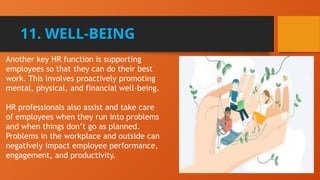
11. WELL-BEING
Another keyHR function is supporting
employees so that they can do their best
work. This involves proactively promoting
mental, physical, and financial well-being.
HR professionals also assist and take care
of employees when they run into problems
and when things don’t go as planned.
Problems in the workplace and outside can
negatively impact employee performance,
engagement, and productivity.
24.
12. ADMINISTRATIVE RESPONSIBILITIES
Thefinal function of HR is its
administrative responsibility. These
include personnel procedures and
Human Resource Information
Systems (HRIS).
Personnel procedures involve the
handling of promotions, relocations,
discipline, performance
improvement, illness, regulations,
cultural and racial diversity,
harassment, bullying, and so on.