IInnttrroodduuccttiioonn ttoo IInnffoorrmmaattiioonn TTeecchhnnoollooggyy 
Introduction to Information Technology, 2nd Edition 
Turban, Rainer & Potter 
© 2003 John Wiley & Sons, Inc. 
1-1 
22nndd EEddiittiioonn 
TTuurrbbaann,, RRaaiinneerr && PPootttteerr 
© 22000033 JJoohhnn WWiilleeyy && SSoonnss,, IInncc.. 
Chapter 1: 
Introduction: Business and Information Technology 
Modified: Mr Qasim Al-ajmi 
Source: Roberta M. Roth, Ph.D. University of Northern Iowa
Introduction to Information Technology, 2nd Edition 
Turban, Rainer & Potter 
© 2003 John Wiley & Sons, Inc. 
1-2 
CChhaapptteerr PPrreevviieeww 
In this chapter, we will study: 
◦ Marketplace pressures faced by today’s businesses and 
various tactical and strategic responses. 
◦ The distinction between data, information, and 
knowledge. 
◦ The characteristics of high quality information. 
◦ The components of an information system. 
◦ The capabilities organizations expect of information 
systems. 
◦ Opportunities to use information systems strategically.
TTooddaayy’’ss BBuussiinneessss EEnnvviirroonnmmeenntt 
Characterized by: 
◦ Rapid Change 
◦ Complexity 
◦ Global Economy 
◦ Hyper-competition 
◦ Customer Focus 
Businesses face pressure to produce 
more with fewer resources 
Introduction to Information Technology, 2nd Edition 
Turban, Rainer & Potter 
© 2003 John Wiley & Sons, Inc. 
1-3
Introduction to Information Technology, 2nd Edition 
Turban, Rainer & Potter 
© 2003 John Wiley & Sons, Inc. 
1-4 
CCaassee 11:: RReevveerrssee AAuuccttiioonn SSaavveess UUnniivveerrssiittyy MMoonneeyy 
Purchasing officials at a large university saved a surprising 
amount of money on their latest large purchase – a big 
order of lighting purchase. 
◦ They used a type of electronic auction called a reverse auction, 
which makes use of the Internet to bring all parties together for 
the bidding. 
◦ In a reverse auction, there is one buyer & many would-be sellers. 
The buyer invites sellers to bid on a proposal, and the lowest 
bidder wins. 
◦ The university paid $5,000 for the auction service but saved more 
than $30,000 on the purchase. 
◦ In the past, buying large quantities of electronic lighting equipment 
would have involved only two or three bidders and would have 
taken a week or two to complete. The reverse auction attracted 16 
bidders and took place in 30 minutes.
Case 1: Reverse Auction SSaavveess UUnniivveerrssiittyy MMoonneeyy 
Questions: 
◦ What other categories of products might be 
targets for this type of buying behavior? 
◦ What other impacts do you see the Internet 
having on the traditional purchasing process? 
Introduction to Information Technology, 2nd Edition 
Turban, Rainer & Potter 
© 2003 John Wiley & Sons, Inc. 
1-5
OOrrggaanniizzaattiioonnaall RReessppoonnsseess 
Pressures provoke proactive and reactive 
organizational responses. 
Business responses to pressures may 
involve use of Information Technology and 
Information Systems. 
In some cases, IT is the only solution to 
business pressures. 
Knowledge of IT capabilities is essential 
to today’s businesspeople. 
Introduction to Information Technology, 2nd Edition 
Turban, Rainer & Potter 
© 2003 John Wiley & Sons, Inc. 
1-6
Introduction to Information Technology, 2nd Edition 
Turban, Rainer & Potter 
© 2003 John Wiley & Sons, Inc. 
1-7 
CCaassee 22:: IIss tthhee TThhiirrdd TTiimmee tthhee CChhaarrmm ffoorr tthhee IIRRSS 
During the past 25 years, the IRS has twice failed to 
modernize its information systems. 
◦ In 1978, President Jimmy Carter halted a project to network the 
IRS’s central databases because the agency could not protect tax 
payer privacy. In 1995, Congress stopped a second effort, after the 
IRS had spent 10 years and over $2 billion on the project with little 
to show for the money. 
◦ The IRS has begun a $10 billion, 10-year IT modernization program 
to streamline interactions with tax payers and tax professionals. 
This program includes a secure Web Portal, a public information 
site, and an intranet to help the 90,000 IRS employees quickly gain 
access to technical, legal, procedural, and record information. 
◦ For the program to succeed, the IRS must master secure 
transactions over the Web, standardize data from a huge number of 
legacy databases, and overcome its history of failed information 
technology projects.
Introduction to Information Technology, 2nd Edition 
Turban, Rainer & Potter 
© 2003 John Wiley & Sons, Inc. 
1-8 
CCaassee 22:: IIss tthhee TThhiirrdd TTiimmee tthhee CChhaarrmm ffoorr tthhee IIRRSS 
◦ In addition to taking a public relations beating in recent years 
for overzealous auditing practices, the IRS has also been 
downsized, making it more difficult to collect taxes and catch 
tax evaders. 
◦ Information technology that automates tax-payers’ 
interactions would let the IRS redeploy resources now 
dedicated to customer service. 
Questions: 
◦ What factors make a government bureaucracy more or less 
susceptible to systems development failure compared to a 
private , for profit, organization? Why? 
◦ What should be the primary motive for developing a new 
information system in a government bureaucracy? In a 
private for-profit organization? Why?
WWhhyy SShhoouulldd YYoouu LLeeaarrnn AAbboouutt IITT?? 
What can be done with IT and the 
consequences of using IT are very interesting. 
Organizational structure, management, and 
business processes are often changed with IT. 
Career opportunities are abundant in IT. 
IT affects every business functional area. 
Introduction to Information Technology, 2nd Edition 
Turban, Rainer & Potter 
© 2003 John Wiley & Sons, Inc. 
1-9
SSoommee KKeeyy DDeeffiinniittiioonnss 
Data: raw facts; collected, not organized. 
Information: data organized in a 
meaningful way. 
Knowledge: information organized to 
convey understanding, experiences, 
accumulated learning, or expertise. 
Introduction to Information Technology, 2nd Edition 
Turban, Rainer & Potter 
© 2003 John Wiley & Sons, Inc. 
1-10
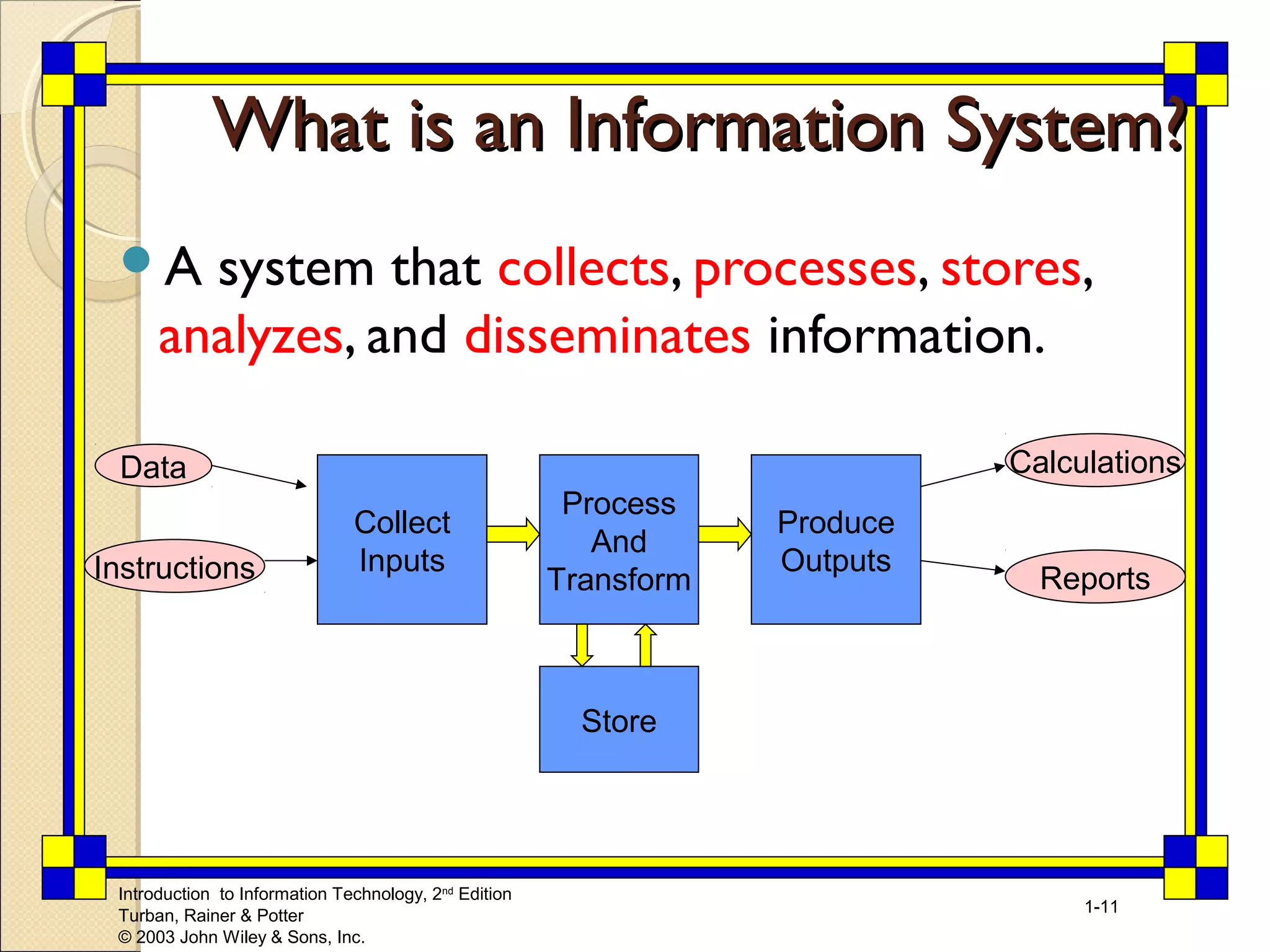
WWhhaatt iiss aann IInnffoorrmmaattiioonn SSyysstteemm?? 
A system that collects, processes, stores, 
analyzes, and disseminates information. 
Introduction to Information Technology, 2nd Edition 
Turban, Rainer & Potter 
© 2003 John Wiley & Sons, Inc. 
1-11 
Collect 
Inputs 
Process 
And 
Transform 
Produce 
Outputs 
Store 
Data 
Instructions 
Calculations 
Reports
WWhhaatt MMaakkeess IInnffoorrmmaattiioonn UUsseeffuull?? 
Introduction to Information Technology, 2nd Edition 
Turban, Rainer & Potter 
© 2003 John Wiley & Sons, Inc. 
1-12 
It is accurate 
◦ Free of errors 
It is complete 
◦ Includes everything needed 
It is flexible 
◦ Can be viewed in various 
ways 
It is reliable 
◦ Results are always 
consistent 
It is relevant 
◦ Applies to the issue under 
study 
It is timely 
◦ Available when needed 
It is verifiable 
◦ Basis for results can be 
traced 
It is accessible 
◦ All those who need the 
information can get to it 
It is secure 
◦ Free from contamination 
(accidental or deliberate)
WWhhaatt iiss MMeeaanntt bbyy aa 
““CCoommppuutteerr--BBaasseedd IInnffoorrmmaattiioonn SSyysstteemm””?? 
An information system using computer 
and telecommunications technology to 
perform its intended tasks. 
◦ Employs some combination of hardware, 
software, database, network, procedures, and 
people. 
An information system developed to 
provide a solution to a business problem. 
Introduction to Information Technology, 2nd Edition 
Turban, Rainer & Potter 
© 2003 John Wiley & Sons, Inc. 
1-13
Organizations Have HHiigghh EExxppeeccttaattiioonnss ooff 
TThheeiirr IInnffoorrmmaattiioonn SSyysstteemmss 
Fast, accurate processing of business 
transactions. 
Storage, retrieval, analysis, and data sharing to 
◦ Increase communication 
◦ Reduce overload 
◦ Span organizational boundaries 
◦ Support and improve decision making. 
Distinctive capabilities providing competitive 
advantage. 
Introduction to Information Technology, 2nd Edition 
Turban, Rainer & Potter 
© 2003 John Wiley & Sons, Inc. 
1-14
Introduction to Information Technology, 2nd Edition 
Turban, Rainer & Potter 
© 2003 John Wiley & Sons, Inc. 
1-15 
Case 33:: ““BBrriicckkss aanndd CClliicckkss”” 
aarree PPrroovviinngg ttoo bbee aa GGoooodd FFiitt 
Not too long ago, forecasters predicted that Internet 
companies selling everything from books to pet food 
would put traditional retailers “Out-of-Business”. 
◦ After all, why would anybody drive to the mall when they 
could shop online at any time of day? These predications 
have NOT turned out to be correct. 
◦ Giants such as Wal-Mart and Home Depot are expanding 
and refining their Internet Offerings. Federated 
Department Stores and Staples are combining Internet 
operations with their Catalog businesses. These firms are 
using an integrated, multi-channel marketing model where 
people can shop online and then walk into the stores as 
educated consumers.
Introduction to Information Technology, 2nd Edition 
Turban, Rainer & Potter 
© 2003 John Wiley & Sons, Inc. 
1-16 
Case 33:: ““BBrriicckkss aanndd CClliicckkss”” 
aarree PPrroovviinngg ttoo bbee aa GGoooodd FFiitt 
◦ For example, Target Stores <target.com> considers its Internet 
presence to be more valuable for marketing and customer 
relations than for sales. At Target’s Web site, the most popular area 
is its “Bridal Registry”, where visitors can print out prenuptial 
shopping lists, then go to their local Target and pick up the goods. 
About 10% of all visitors to Target’s Web Site simply want to find 
directions to the store. 
◦ Home Depot was criticized on Wall Street when the company did 
not quickly develop a full-scale Internet business. Instead of offering 
all its products for sale online nationwide, Home Depot ties its 
Internet shopping and Order Fulfillment to existing stores in only a 
few markets. Internet orders in these markets can be filled by a 
store’s regular staff during slow times. Home Depot says its 
objectives is not to maximize Internet sales, but to maximize the 
relationship with its customers.
Introduction to Information Technology, 2nd Edition 
Turban, Rainer & Potter 
© 2003 John Wiley & Sons, Inc. 
1-17 
Case 33:: ““BBrriicckkss aanndd CClliicckkss”” 
aarree PPrroovviinngg ttoo bbee aa GGoooodd FFiitt 
◦ At Borders, executives are hoping that customers will use its Web 
site and the 335 Super-stores and the 900 Waldenbooks stores it 
manages interchangeably. For instance, a customer might go online 
to see if her local Borders store has a book she wants, reserve it, 
then drive down to the store to pick it up and pay for it – sitting in 
on a poetry reading and buying a latte while she is in the store. 
Questions: 
◦ What appears to be the dominant strategy for established 
business that want to enter Electronic Commerce? 
◦ Electronic Commerce can be conducted by Virtual Companies 
that exist only as an Organized Network of Order-Filling suppliers 
and a Web-based Transaction entity – almost no “Brick and 
Mortar” infrastructure. Are the values of brand names more or less 
important to such companies to traditional companies?
Introduction to Information Technology, 2nd Edition 
Turban, Rainer & Potter 
© 2003 John Wiley & Sons, Inc. 
1-18 
Case 4: Business Intelligence aatt LL.. LL.. BBeeaann 
 A crucial element of E-Commerce is the creation of a unified, single 
view of the customer. That is, a customer’s online, catalog, and store-based 
retail activities are tracked, stored, and consolidated in one 
place; resulting in a better understanding of a buying patterns. 
◦ L. L Bean, the privately held 87-year old company, is best know for 
its mail-order catalog business. Top management at L. L. Bean 
decided that E-commerce was a necessary channel to reach 
customers. As a result, Bean launched <llbean.com> through 
which customers can choose from nearly 1000 out of 16000 
products that Bean offers in its print catalog. 
◦ L. L. Bean wanted the new sales channel to augment rather than 
cannibalize existing business. Bean developed a business intelligence 
(BI) system to understand the precise impact of the Web site on its 
sales and customer-base.
Introduction to Information Technology, 2nd Edition 
Turban, Rainer & Potter 
© 2003 John Wiley & Sons, Inc. 
1-19 
Case 4: Business Intelligence aatt LL.. LL.. BBeeaann 
◦ To apply BI system, Bean had to consolidate date from three 
sources – catalog, retail, and e-commerce – in one place 
(company’s data warehouse). 
◦ All customers’ orders and purchasing information is forwarded to 
the data warehouse. The company keeps track of such things as 
how many times customers have been contacted, from which retail 
store orders originate, the number of promotions received, and, of 
course, the items ordered. 
◦ The business intelligence system and the data warehouse have 
given L. L. Bean knowledge of the synergies between e-commerce 
site and catalog business. 
Questions: 
◦ Identify the benefits of the business intelligence system to the L. L. 
Bean? 
◦ How important is a unified and single view of the customer? Why? 
How do Data Warehouses contribute to such a view?
Introduction to Information Technology, 2nd Edition 
Turban, Rainer & Potter 
© 2003 John Wiley & Sons, Inc. 
1-20 
Key TTeecchhnniiccaall TTrreennddss ttoo MMoonniittoorr 
Constantly improving 
cost-performance ratio 
Increasing storage and 
memory 
User friendly interfaces 
Client/server architecture 
Network computers 
Enterprisewide 
computers 
Intranets and extranets 
Data warehousing 
Data mining 
Object-oriented 
environment 
Electronic document 
management 
Multimedia 
Intelligent systems 
Portable computing 
Internet expansion 
Electronic commerce 
Integrated home 
computing
CChhaapptteerr SSuummmmaarryy 
Today’s businesses face myriad pressures. 
Information technology provides tools 
and capabilities to respond to those 
pressures. 
Knowledge of IT and its applications 
helps businesspeople develop business 
strategies that effectively employ IT. 
Introduction to Information Technology, 2nd Edition 
Turban, Rainer & Potter 
© 2003 John Wiley & Sons, Inc. 
1-21
Copyright © 2003 John Wiley & Sons, Inc. All rights reserved. 
Reproduction 
or translation of this work beyond that permitted in Section 117 of the 
1976 
United Stated Copyright Act without the express written permission of 
the 
copyright owner is unlawful. Request for further information should be 
addressed to the Permissions Department, John Wiley & Sons, Inc. 
The 
purchaser may make back-up copies for his/her own use only and not 
for 
distribution or resale. The Publisher assumes no responsibility for 
errors, 
omissions, or damages, caused by the use of these programs or from 
the 
use of the information herein.

information technology

  • 1.
    IInnttrroodduuccttiioonn ttoo IInnffoorrmmaattiioonnTTeecchhnnoollooggyy Introduction to Information Technology, 2nd Edition Turban, Rainer & Potter © 2003 John Wiley & Sons, Inc. 1-1 22nndd EEddiittiioonn TTuurrbbaann,, RRaaiinneerr && PPootttteerr © 22000033 JJoohhnn WWiilleeyy && SSoonnss,, IInncc.. Chapter 1: Introduction: Business and Information Technology Modified: Mr Qasim Al-ajmi Source: Roberta M. Roth, Ph.D. University of Northern Iowa
  • 2.
    Introduction to InformationTechnology, 2nd Edition Turban, Rainer & Potter © 2003 John Wiley & Sons, Inc. 1-2 CChhaapptteerr PPrreevviieeww In this chapter, we will study: ◦ Marketplace pressures faced by today’s businesses and various tactical and strategic responses. ◦ The distinction between data, information, and knowledge. ◦ The characteristics of high quality information. ◦ The components of an information system. ◦ The capabilities organizations expect of information systems. ◦ Opportunities to use information systems strategically.
  • 3.
    TTooddaayy’’ss BBuussiinneessss EEnnvviirroonnmmeenntt Characterized by: ◦ Rapid Change ◦ Complexity ◦ Global Economy ◦ Hyper-competition ◦ Customer Focus Businesses face pressure to produce more with fewer resources Introduction to Information Technology, 2nd Edition Turban, Rainer & Potter © 2003 John Wiley & Sons, Inc. 1-3
  • 4.
    Introduction to InformationTechnology, 2nd Edition Turban, Rainer & Potter © 2003 John Wiley & Sons, Inc. 1-4 CCaassee 11:: RReevveerrssee AAuuccttiioonn SSaavveess UUnniivveerrssiittyy MMoonneeyy Purchasing officials at a large university saved a surprising amount of money on their latest large purchase – a big order of lighting purchase. ◦ They used a type of electronic auction called a reverse auction, which makes use of the Internet to bring all parties together for the bidding. ◦ In a reverse auction, there is one buyer & many would-be sellers. The buyer invites sellers to bid on a proposal, and the lowest bidder wins. ◦ The university paid $5,000 for the auction service but saved more than $30,000 on the purchase. ◦ In the past, buying large quantities of electronic lighting equipment would have involved only two or three bidders and would have taken a week or two to complete. The reverse auction attracted 16 bidders and took place in 30 minutes.
  • 5.
    Case 1: ReverseAuction SSaavveess UUnniivveerrssiittyy MMoonneeyy Questions: ◦ What other categories of products might be targets for this type of buying behavior? ◦ What other impacts do you see the Internet having on the traditional purchasing process? Introduction to Information Technology, 2nd Edition Turban, Rainer & Potter © 2003 John Wiley & Sons, Inc. 1-5
  • 6.
    OOrrggaanniizzaattiioonnaall RReessppoonnsseess Pressuresprovoke proactive and reactive organizational responses. Business responses to pressures may involve use of Information Technology and Information Systems. In some cases, IT is the only solution to business pressures. Knowledge of IT capabilities is essential to today’s businesspeople. Introduction to Information Technology, 2nd Edition Turban, Rainer & Potter © 2003 John Wiley & Sons, Inc. 1-6
  • 7.
    Introduction to InformationTechnology, 2nd Edition Turban, Rainer & Potter © 2003 John Wiley & Sons, Inc. 1-7 CCaassee 22:: IIss tthhee TThhiirrdd TTiimmee tthhee CChhaarrmm ffoorr tthhee IIRRSS During the past 25 years, the IRS has twice failed to modernize its information systems. ◦ In 1978, President Jimmy Carter halted a project to network the IRS’s central databases because the agency could not protect tax payer privacy. In 1995, Congress stopped a second effort, after the IRS had spent 10 years and over $2 billion on the project with little to show for the money. ◦ The IRS has begun a $10 billion, 10-year IT modernization program to streamline interactions with tax payers and tax professionals. This program includes a secure Web Portal, a public information site, and an intranet to help the 90,000 IRS employees quickly gain access to technical, legal, procedural, and record information. ◦ For the program to succeed, the IRS must master secure transactions over the Web, standardize data from a huge number of legacy databases, and overcome its history of failed information technology projects.
  • 8.
    Introduction to InformationTechnology, 2nd Edition Turban, Rainer & Potter © 2003 John Wiley & Sons, Inc. 1-8 CCaassee 22:: IIss tthhee TThhiirrdd TTiimmee tthhee CChhaarrmm ffoorr tthhee IIRRSS ◦ In addition to taking a public relations beating in recent years for overzealous auditing practices, the IRS has also been downsized, making it more difficult to collect taxes and catch tax evaders. ◦ Information technology that automates tax-payers’ interactions would let the IRS redeploy resources now dedicated to customer service. Questions: ◦ What factors make a government bureaucracy more or less susceptible to systems development failure compared to a private , for profit, organization? Why? ◦ What should be the primary motive for developing a new information system in a government bureaucracy? In a private for-profit organization? Why?
  • 9.
    WWhhyy SShhoouulldd YYoouuLLeeaarrnn AAbboouutt IITT?? What can be done with IT and the consequences of using IT are very interesting. Organizational structure, management, and business processes are often changed with IT. Career opportunities are abundant in IT. IT affects every business functional area. Introduction to Information Technology, 2nd Edition Turban, Rainer & Potter © 2003 John Wiley & Sons, Inc. 1-9
  • 10.
    SSoommee KKeeyy DDeeffiinniittiioonnss Data: raw facts; collected, not organized. Information: data organized in a meaningful way. Knowledge: information organized to convey understanding, experiences, accumulated learning, or expertise. Introduction to Information Technology, 2nd Edition Turban, Rainer & Potter © 2003 John Wiley & Sons, Inc. 1-10
  • 11.
    WWhhaatt iiss aannIInnffoorrmmaattiioonn SSyysstteemm?? A system that collects, processes, stores, analyzes, and disseminates information. Introduction to Information Technology, 2nd Edition Turban, Rainer & Potter © 2003 John Wiley & Sons, Inc. 1-11 Collect Inputs Process And Transform Produce Outputs Store Data Instructions Calculations Reports
  • 12.
    WWhhaatt MMaakkeess IInnffoorrmmaattiioonnUUsseeffuull?? Introduction to Information Technology, 2nd Edition Turban, Rainer & Potter © 2003 John Wiley & Sons, Inc. 1-12 It is accurate ◦ Free of errors It is complete ◦ Includes everything needed It is flexible ◦ Can be viewed in various ways It is reliable ◦ Results are always consistent It is relevant ◦ Applies to the issue under study It is timely ◦ Available when needed It is verifiable ◦ Basis for results can be traced It is accessible ◦ All those who need the information can get to it It is secure ◦ Free from contamination (accidental or deliberate)
  • 13.
    WWhhaatt iiss MMeeaannttbbyy aa ““CCoommppuutteerr--BBaasseedd IInnffoorrmmaattiioonn SSyysstteemm””?? An information system using computer and telecommunications technology to perform its intended tasks. ◦ Employs some combination of hardware, software, database, network, procedures, and people. An information system developed to provide a solution to a business problem. Introduction to Information Technology, 2nd Edition Turban, Rainer & Potter © 2003 John Wiley & Sons, Inc. 1-13
  • 14.
    Organizations Have HHiigghhEExxppeeccttaattiioonnss ooff TThheeiirr IInnffoorrmmaattiioonn SSyysstteemmss Fast, accurate processing of business transactions. Storage, retrieval, analysis, and data sharing to ◦ Increase communication ◦ Reduce overload ◦ Span organizational boundaries ◦ Support and improve decision making. Distinctive capabilities providing competitive advantage. Introduction to Information Technology, 2nd Edition Turban, Rainer & Potter © 2003 John Wiley & Sons, Inc. 1-14
  • 15.
    Introduction to InformationTechnology, 2nd Edition Turban, Rainer & Potter © 2003 John Wiley & Sons, Inc. 1-15 Case 33:: ““BBrriicckkss aanndd CClliicckkss”” aarree PPrroovviinngg ttoo bbee aa GGoooodd FFiitt Not too long ago, forecasters predicted that Internet companies selling everything from books to pet food would put traditional retailers “Out-of-Business”. ◦ After all, why would anybody drive to the mall when they could shop online at any time of day? These predications have NOT turned out to be correct. ◦ Giants such as Wal-Mart and Home Depot are expanding and refining their Internet Offerings. Federated Department Stores and Staples are combining Internet operations with their Catalog businesses. These firms are using an integrated, multi-channel marketing model where people can shop online and then walk into the stores as educated consumers.
  • 16.
    Introduction to InformationTechnology, 2nd Edition Turban, Rainer & Potter © 2003 John Wiley & Sons, Inc. 1-16 Case 33:: ““BBrriicckkss aanndd CClliicckkss”” aarree PPrroovviinngg ttoo bbee aa GGoooodd FFiitt ◦ For example, Target Stores <target.com> considers its Internet presence to be more valuable for marketing and customer relations than for sales. At Target’s Web site, the most popular area is its “Bridal Registry”, where visitors can print out prenuptial shopping lists, then go to their local Target and pick up the goods. About 10% of all visitors to Target’s Web Site simply want to find directions to the store. ◦ Home Depot was criticized on Wall Street when the company did not quickly develop a full-scale Internet business. Instead of offering all its products for sale online nationwide, Home Depot ties its Internet shopping and Order Fulfillment to existing stores in only a few markets. Internet orders in these markets can be filled by a store’s regular staff during slow times. Home Depot says its objectives is not to maximize Internet sales, but to maximize the relationship with its customers.
  • 17.
    Introduction to InformationTechnology, 2nd Edition Turban, Rainer & Potter © 2003 John Wiley & Sons, Inc. 1-17 Case 33:: ““BBrriicckkss aanndd CClliicckkss”” aarree PPrroovviinngg ttoo bbee aa GGoooodd FFiitt ◦ At Borders, executives are hoping that customers will use its Web site and the 335 Super-stores and the 900 Waldenbooks stores it manages interchangeably. For instance, a customer might go online to see if her local Borders store has a book she wants, reserve it, then drive down to the store to pick it up and pay for it – sitting in on a poetry reading and buying a latte while she is in the store. Questions: ◦ What appears to be the dominant strategy for established business that want to enter Electronic Commerce? ◦ Electronic Commerce can be conducted by Virtual Companies that exist only as an Organized Network of Order-Filling suppliers and a Web-based Transaction entity – almost no “Brick and Mortar” infrastructure. Are the values of brand names more or less important to such companies to traditional companies?
  • 18.
    Introduction to InformationTechnology, 2nd Edition Turban, Rainer & Potter © 2003 John Wiley & Sons, Inc. 1-18 Case 4: Business Intelligence aatt LL.. LL.. BBeeaann  A crucial element of E-Commerce is the creation of a unified, single view of the customer. That is, a customer’s online, catalog, and store-based retail activities are tracked, stored, and consolidated in one place; resulting in a better understanding of a buying patterns. ◦ L. L Bean, the privately held 87-year old company, is best know for its mail-order catalog business. Top management at L. L. Bean decided that E-commerce was a necessary channel to reach customers. As a result, Bean launched <llbean.com> through which customers can choose from nearly 1000 out of 16000 products that Bean offers in its print catalog. ◦ L. L. Bean wanted the new sales channel to augment rather than cannibalize existing business. Bean developed a business intelligence (BI) system to understand the precise impact of the Web site on its sales and customer-base.
  • 19.
    Introduction to InformationTechnology, 2nd Edition Turban, Rainer & Potter © 2003 John Wiley & Sons, Inc. 1-19 Case 4: Business Intelligence aatt LL.. LL.. BBeeaann ◦ To apply BI system, Bean had to consolidate date from three sources – catalog, retail, and e-commerce – in one place (company’s data warehouse). ◦ All customers’ orders and purchasing information is forwarded to the data warehouse. The company keeps track of such things as how many times customers have been contacted, from which retail store orders originate, the number of promotions received, and, of course, the items ordered. ◦ The business intelligence system and the data warehouse have given L. L. Bean knowledge of the synergies between e-commerce site and catalog business. Questions: ◦ Identify the benefits of the business intelligence system to the L. L. Bean? ◦ How important is a unified and single view of the customer? Why? How do Data Warehouses contribute to such a view?
  • 20.
    Introduction to InformationTechnology, 2nd Edition Turban, Rainer & Potter © 2003 John Wiley & Sons, Inc. 1-20 Key TTeecchhnniiccaall TTrreennddss ttoo MMoonniittoorr Constantly improving cost-performance ratio Increasing storage and memory User friendly interfaces Client/server architecture Network computers Enterprisewide computers Intranets and extranets Data warehousing Data mining Object-oriented environment Electronic document management Multimedia Intelligent systems Portable computing Internet expansion Electronic commerce Integrated home computing
  • 21.
    CChhaapptteerr SSuummmmaarryy Today’sbusinesses face myriad pressures. Information technology provides tools and capabilities to respond to those pressures. Knowledge of IT and its applications helps businesspeople develop business strategies that effectively employ IT. Introduction to Information Technology, 2nd Edition Turban, Rainer & Potter © 2003 John Wiley & Sons, Inc. 1-21
  • 22.
    Copyright © 2003John Wiley & Sons, Inc. All rights reserved. Reproduction or translation of this work beyond that permitted in Section 117 of the 1976 United Stated Copyright Act without the express written permission of the copyright owner is unlawful. Request for further information should be addressed to the Permissions Department, John Wiley & Sons, Inc. The purchaser may make back-up copies for his/her own use only and not for distribution or resale. The Publisher assumes no responsibility for errors, omissions, or damages, caused by the use of these programs or from the use of the information herein.