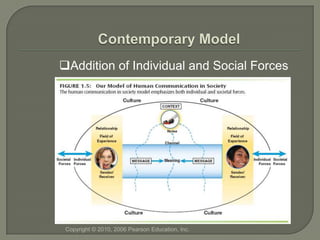
Addition of Individual and Social Forces


 Copyright © 2010, 2006 Pearson Education, Inc.
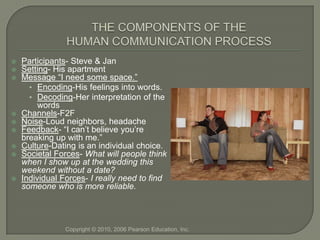
   Participants- Steve & Jan
   Setting- His apartment
   Message “I need some space.”
      • Encoding-His feelings into words.
      • Decoding-Her interpretation of the
         words
   Channels-F2F
   Noise-Loud neighbors, headache
   Feedback- “I can’t believe you’re
    breaking up with me.”
   Culture-Dating is an individual choice.
   Societal Forces- What will people think
    when I show up at the wedding this
    weekend without a date?
   Individual Forces- I really need to find
    someone who is more reliable.


                Copyright © 2010, 2006 Pearson Education, Inc.
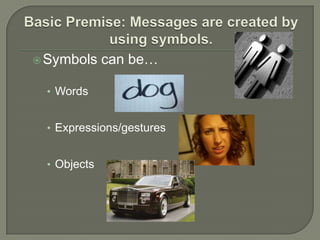
 Symbols     can be…

  • Words


  • Expressions/gestures


  • Objects
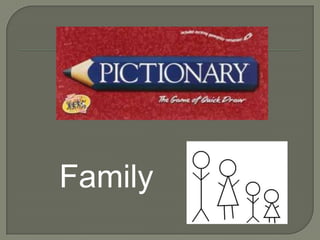
Family
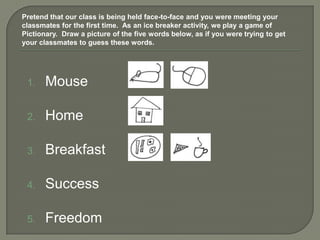
Pretend that our class is being held face-to-face and you were meeting your
classmates for the first time. As an ice breaker activity, we play a game of
Pictionary. Draw a picture of the five words below, as if you were trying to get
your classmates to guess these words.


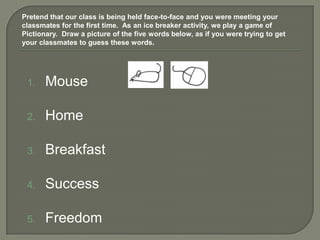
 1.    Mouse

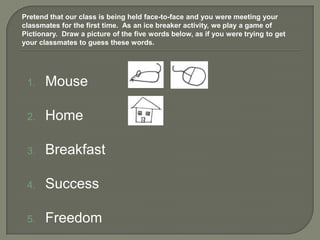
 2.    Home

 3.    Breakfast

 4.    Success

 5.    Freedom
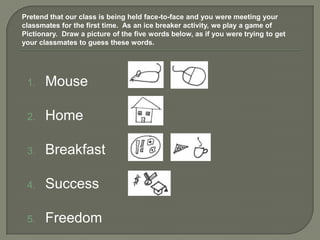
Pretend that our class is being held face-to-face and you were meeting your
classmates for the first time. As an ice breaker activity, we play a game of
Pictionary. Draw a picture of the five words below, as if you were trying to get
your classmates to guess these words.


 1.    Mouse

 2.    Home

 3.    Breakfast

 4.    Success

 5.    Freedom
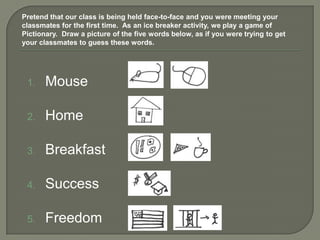
Pretend that our class is being held face-to-face and you were meeting your
classmates for the first time. As an ice breaker activity, we play a game of
Pictionary. Draw a picture of the five words below, as if you were trying to get
your classmates to guess these words.


 1.    Mouse

 2.    Home

 3.    Breakfast

 4.    Success

 5.    Freedom
Pretend that our class is being held face-to-face and you were meeting your
classmates for the first time. As an ice breaker activity, we play a game of
Pictionary. Draw a picture of the five words below, as if you were trying to get
your classmates to guess these words.


 1.    Mouse

 2.    Home

 3.    Breakfast

 4.    Success

 5.    Freedom
Pretend that our class is being held face-to-face and you were meeting your
classmates for the first time. As an ice breaker activity, we play a game of
Pictionary. Draw a picture of the five words below, as if you were trying to get
your classmates to guess these words.


 1.    Mouse

 2.    Home

 3.    Breakfast

 4.    Success

 5.    Freedom
Pretend that our class is being held face-to-face and you were meeting your
classmates for the first time. As an ice breaker activity, we play a game of
Pictionary. Draw a picture of the five words below, as if you were trying to get
your classmates to guess these words.


 1.    Mouse

 2.    Home

 3.    Breakfast

 4.    Success

 5.    Freedom
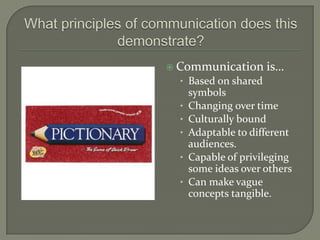
 Communication       is…
  • Based on shared
      symbols
  •   Changing over time
  •   Culturally bound
  •   Adaptable to different
      audiences.
  •   Capable of privileging
      some ideas over others
  •   Can make vague
      concepts tangible.
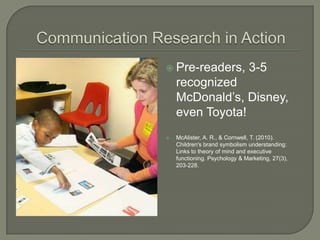
 Pre-readers,                  3-5
    recognized
    McDonald’s, Disney,
    even Toyota!
   McAlister, A. R., & Cornwell, T. (2010).
    Children's brand symbolism understanding:
    Links to theory of mind and executive
    functioning. Psychology & Marketing, 27(3),
    203-228.
Chapter1

Chapter1

  • 2.
    Addition of Individualand Social Forces Copyright © 2010, 2006 Pearson Education, Inc.
  • 3.
    Participants- Steve & Jan  Setting- His apartment  Message “I need some space.” • Encoding-His feelings into words. • Decoding-Her interpretation of the words  Channels-F2F  Noise-Loud neighbors, headache  Feedback- “I can’t believe you’re breaking up with me.”  Culture-Dating is an individual choice.  Societal Forces- What will people think when I show up at the wedding this weekend without a date?  Individual Forces- I really need to find someone who is more reliable. Copyright © 2010, 2006 Pearson Education, Inc.
  • 4.
     Symbols can be… • Words • Expressions/gestures • Objects
  • 5.
  • 6.
    Pretend that ourclass is being held face-to-face and you were meeting your classmates for the first time. As an ice breaker activity, we play a game of Pictionary. Draw a picture of the five words below, as if you were trying to get your classmates to guess these words. 1. Mouse 2. Home 3. Breakfast 4. Success 5. Freedom
  • 7.
    Pretend that ourclass is being held face-to-face and you were meeting your classmates for the first time. As an ice breaker activity, we play a game of Pictionary. Draw a picture of the five words below, as if you were trying to get your classmates to guess these words. 1. Mouse 2. Home 3. Breakfast 4. Success 5. Freedom
  • 8.
    Pretend that ourclass is being held face-to-face and you were meeting your classmates for the first time. As an ice breaker activity, we play a game of Pictionary. Draw a picture of the five words below, as if you were trying to get your classmates to guess these words. 1. Mouse 2. Home 3. Breakfast 4. Success 5. Freedom
  • 9.
    Pretend that ourclass is being held face-to-face and you were meeting your classmates for the first time. As an ice breaker activity, we play a game of Pictionary. Draw a picture of the five words below, as if you were trying to get your classmates to guess these words. 1. Mouse 2. Home 3. Breakfast 4. Success 5. Freedom
  • 10.
    Pretend that ourclass is being held face-to-face and you were meeting your classmates for the first time. As an ice breaker activity, we play a game of Pictionary. Draw a picture of the five words below, as if you were trying to get your classmates to guess these words. 1. Mouse 2. Home 3. Breakfast 4. Success 5. Freedom
  • 11.
    Pretend that ourclass is being held face-to-face and you were meeting your classmates for the first time. As an ice breaker activity, we play a game of Pictionary. Draw a picture of the five words below, as if you were trying to get your classmates to guess these words. 1. Mouse 2. Home 3. Breakfast 4. Success 5. Freedom
  • 12.
     Communication is… • Based on shared symbols • Changing over time • Culturally bound • Adaptable to different audiences. • Capable of privileging some ideas over others • Can make vague concepts tangible.
  • 13.
     Pre-readers, 3-5 recognized McDonald’s, Disney, even Toyota!  McAlister, A. R., & Cornwell, T. (2010). Children's brand symbolism understanding: Links to theory of mind and executive functioning. Psychology & Marketing, 27(3), 203-228.