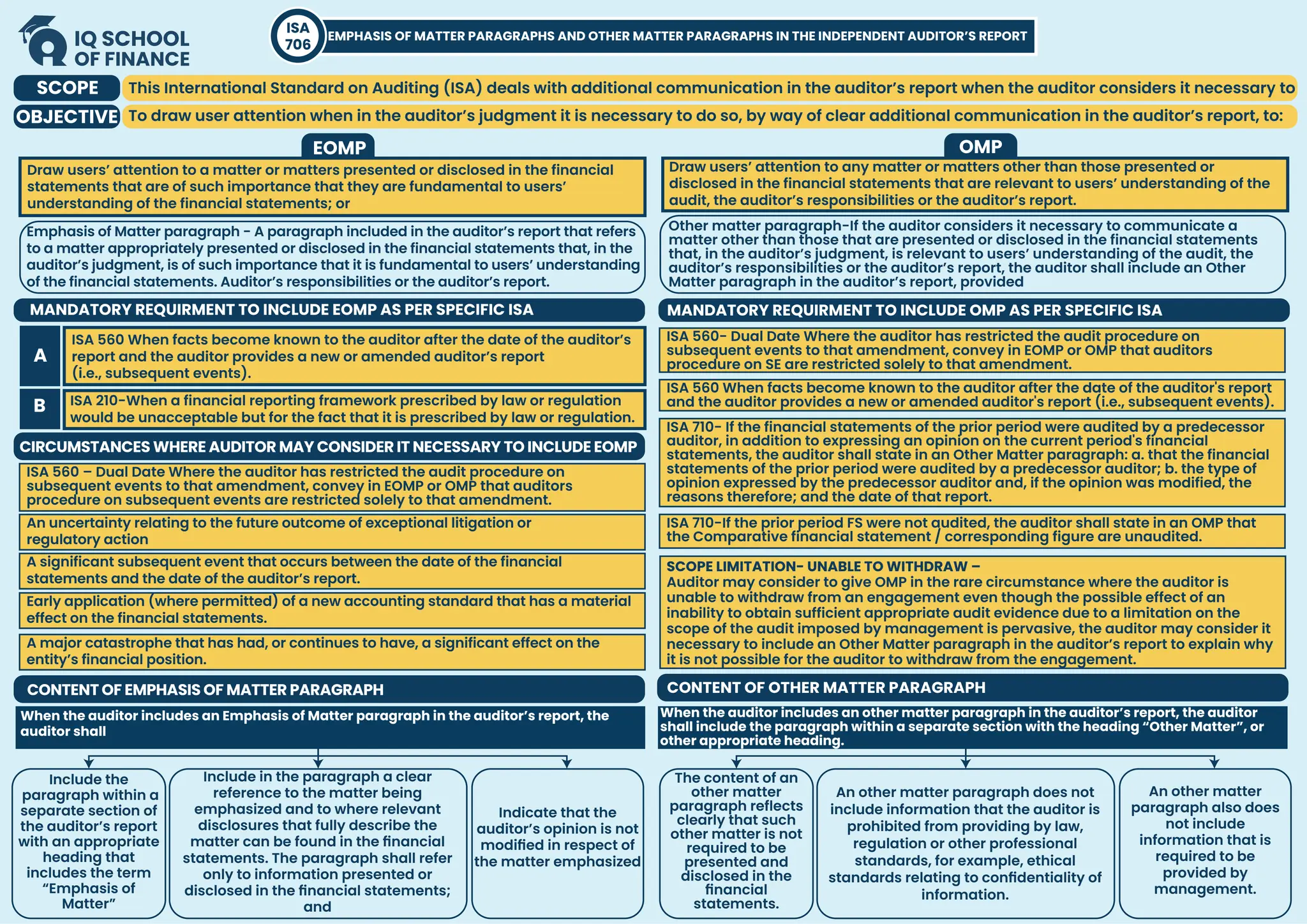
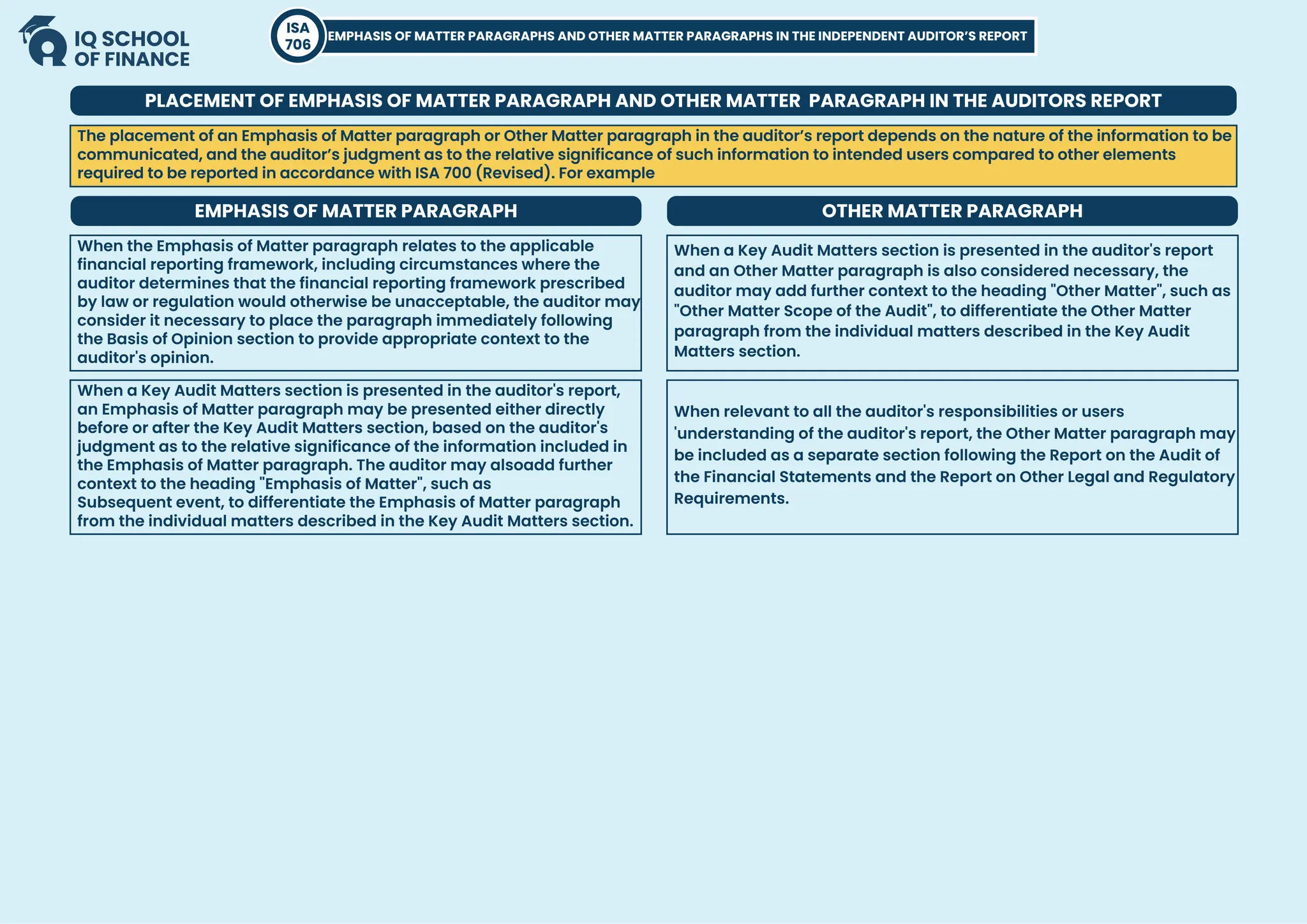
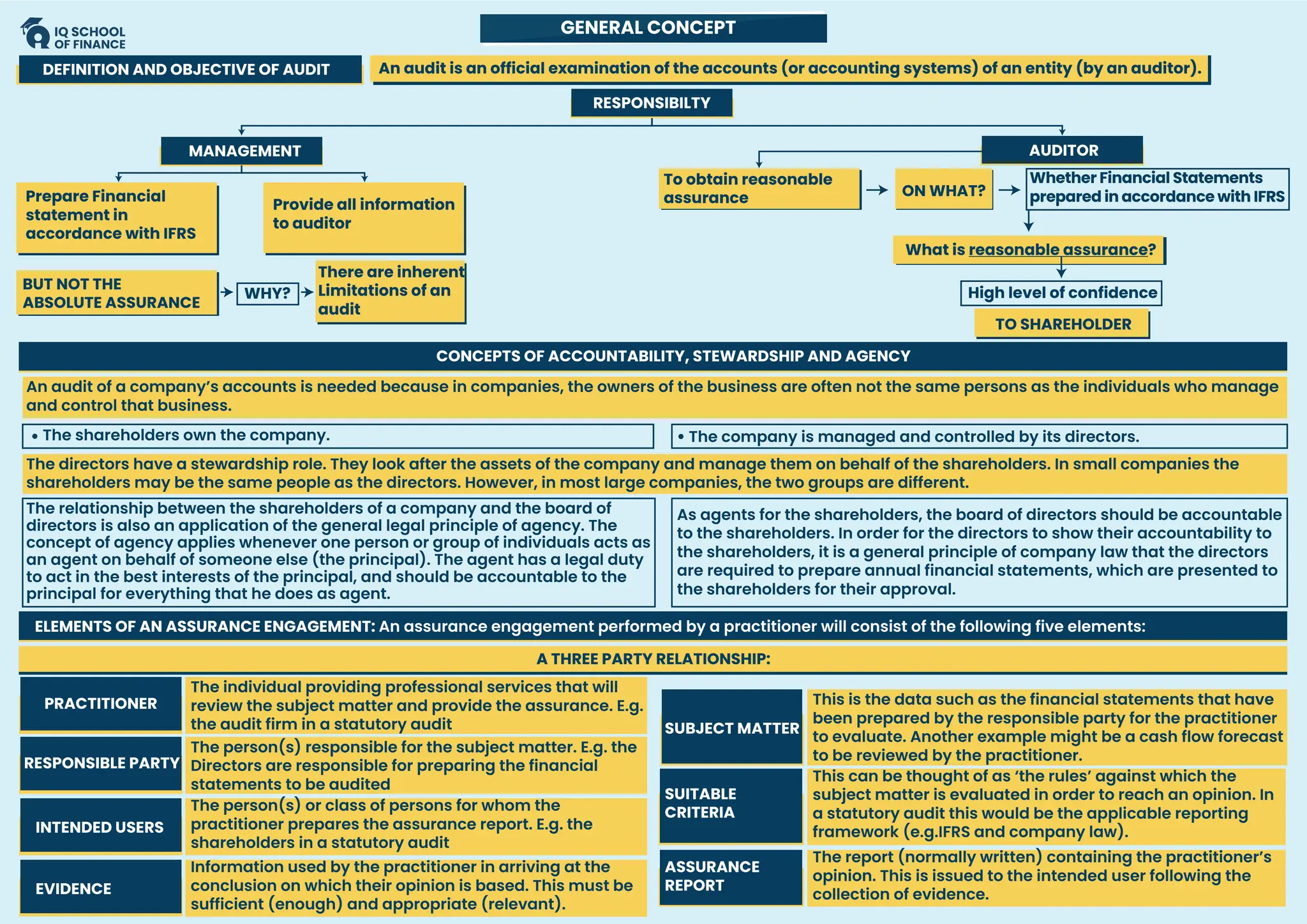
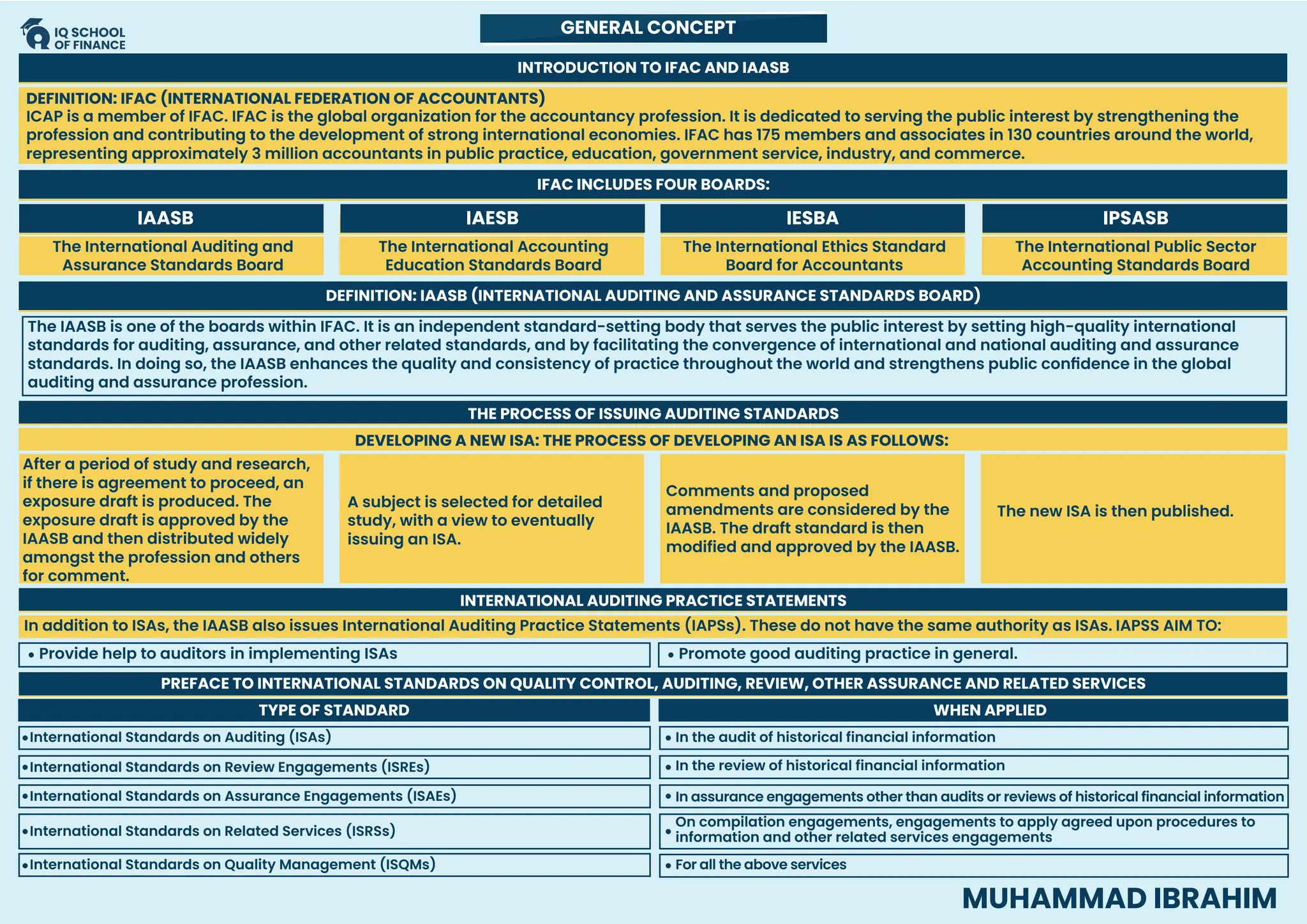
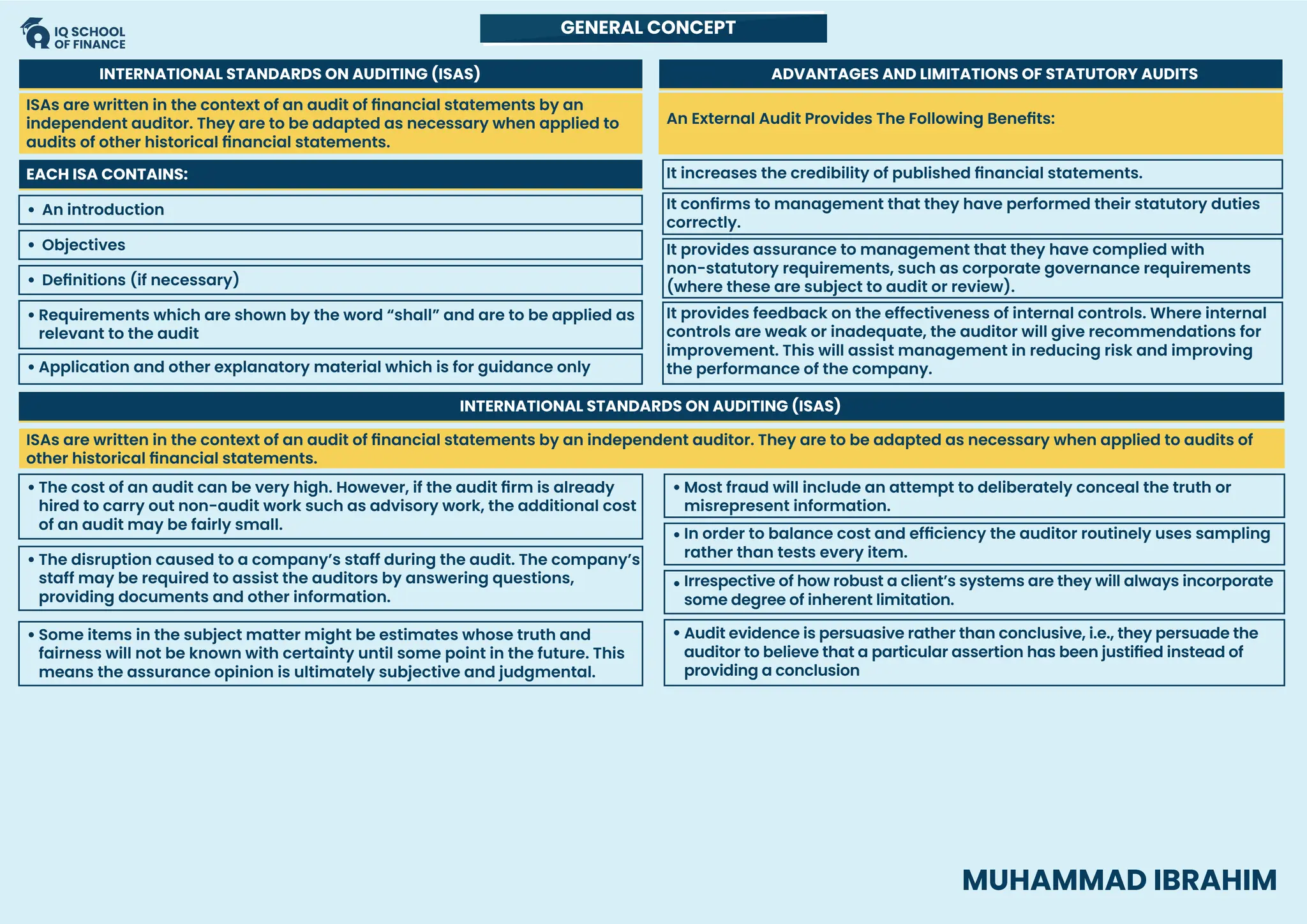
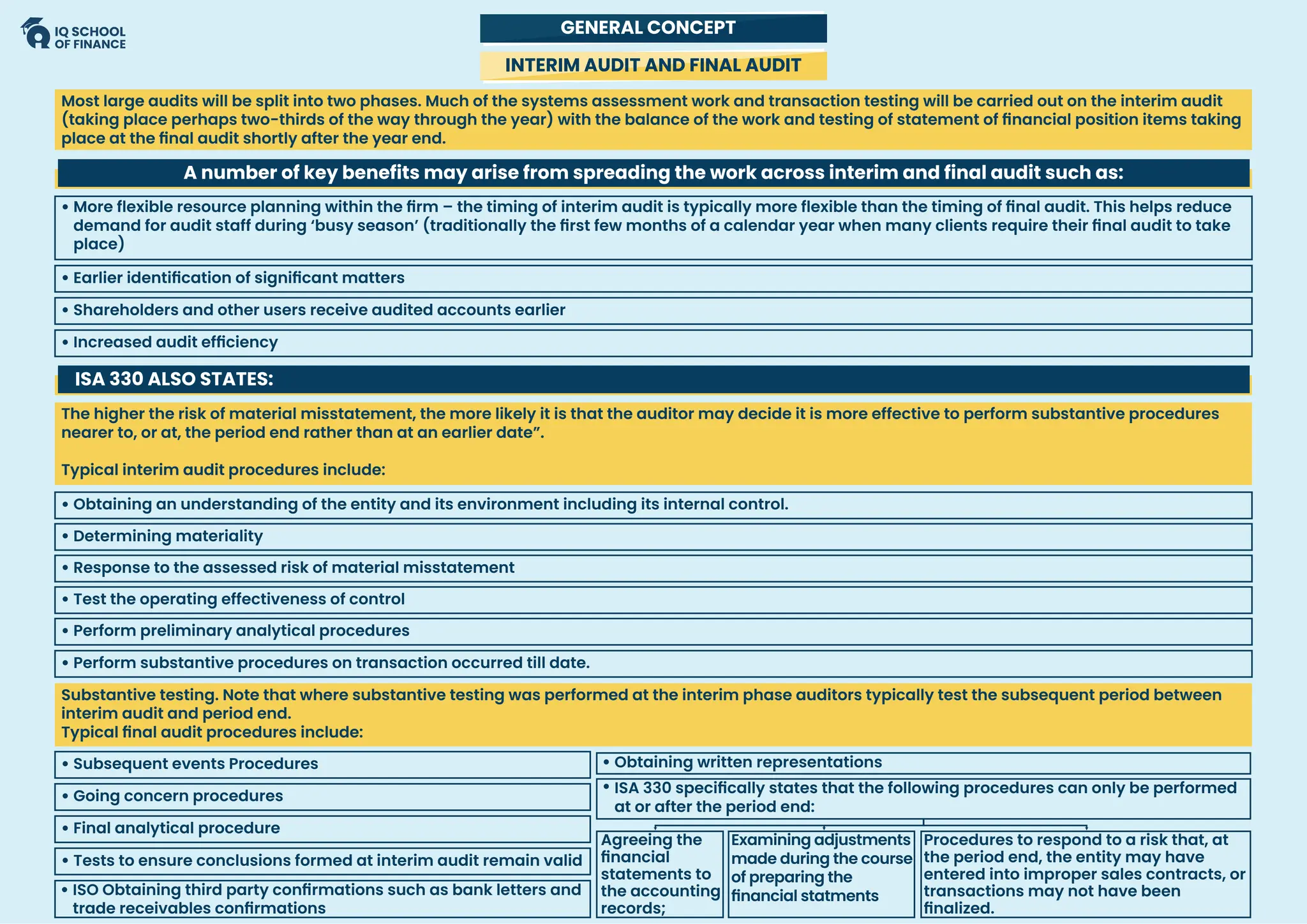
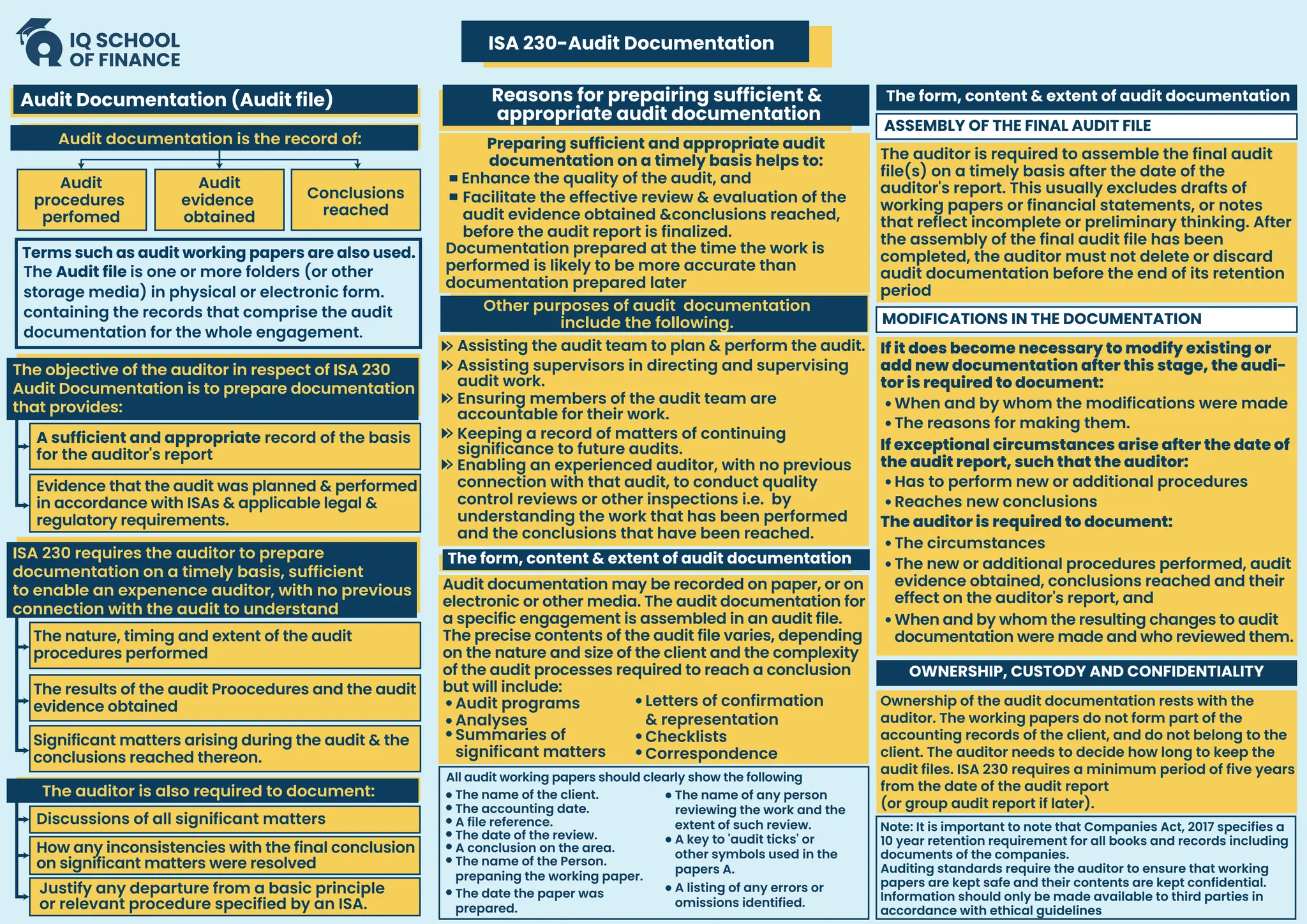
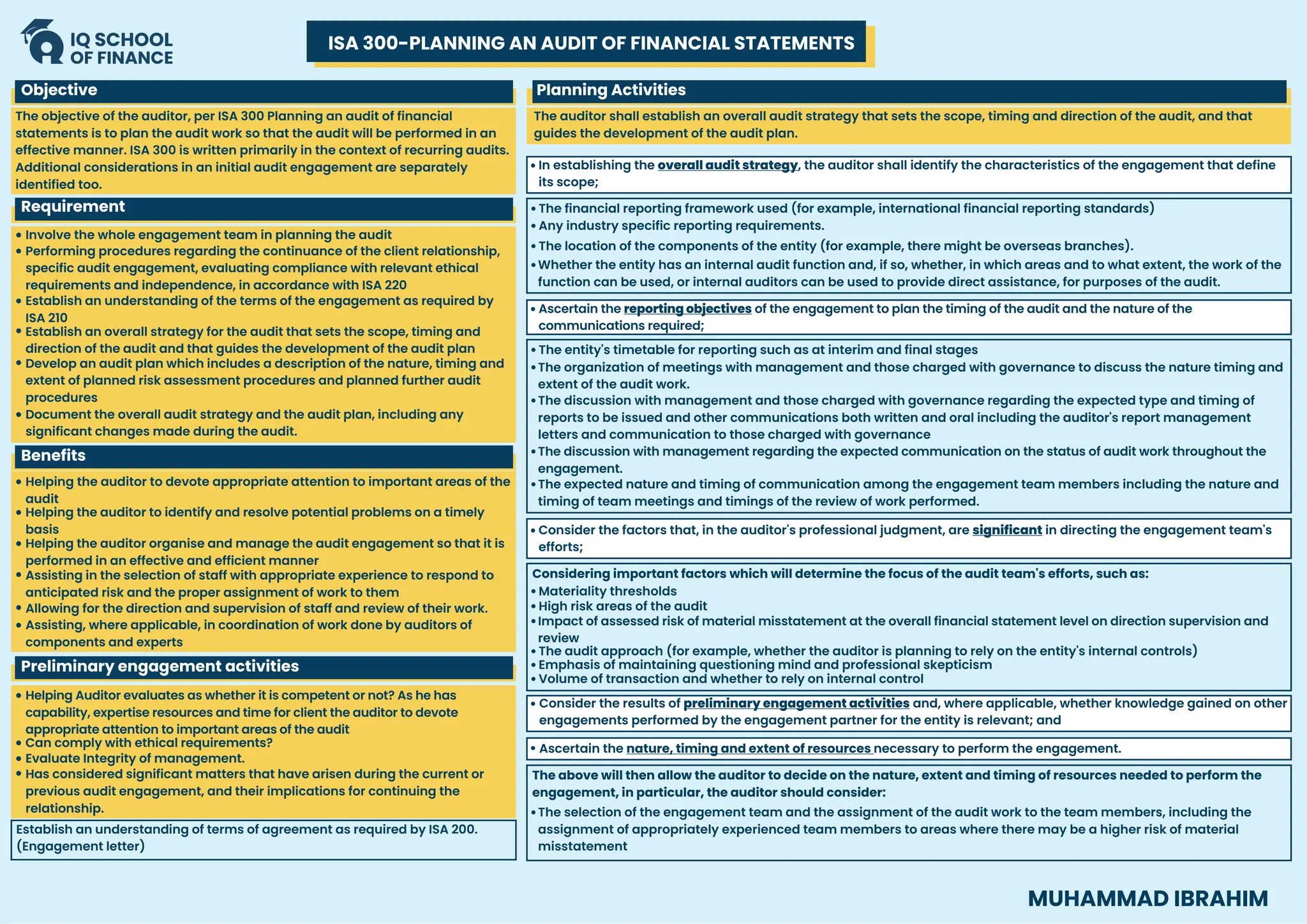
AUDIT ELEMENTS
FINANCIAL STATEMENTIFRS SAAE OPINION / REPORT
SHAREHOLDER MANAGEMENT AUDITOR
FRAUD
NOT PROVIDE
ALL
INFORMATION
SAMPLING
FS = IFRS?
ISA 200
FS May not be equal to IFRS
ISA 315
RESPONSIBILITIES RISK IDENTIFY & ASSESS
ISA 500
SUFFICIENT APPROPRIATE AUDIT
EVIDENCE
a.
a.
b.
c.
d.
b.
c.
To Prepare FS in A/C with IFRS
PROFESSIONAL SKEPTICISM
PROFESSIONAL JUDGEMENT
SAAE
INDEPENDENCE / ETHICAL REQUIREMENT
To Design & implement Internal
control
To Provide all information to
Auditors
INHERENT LIMITATION OF AUDIT
Ethical Assessment of Audit Evidence
Questioning Mind
Risk of fraud
Industry Regulation
Other
External
Factors
ENVIRONMENT
ENTITY
RISK ASSESSMENT PROCEDURE
ASSESSMENT OF RISK
Inquiry Analytical
Procedure
Observation
& Inspection
Normal
REVISION OF RISK ASSESSMENT
Significant
Complexity
Uncertainity
Subjectivity
Change
Management Biasness
QUALITY
ISA 530
RELEVANT
RELIABLE
Inquiry
Observation
Inspection
Recalculation
Reperformance
QUANTITY
AUDIT PROCEDURES
YES
YES
NO
NO
SAAE
FS = IFRS
Unmodified
Opinion
Material
Material
+
Pervasive
Adverse
Scope Limitation
PLANNING PERFORMANCE REPORTING
MUHAMMAD IBRAHIM
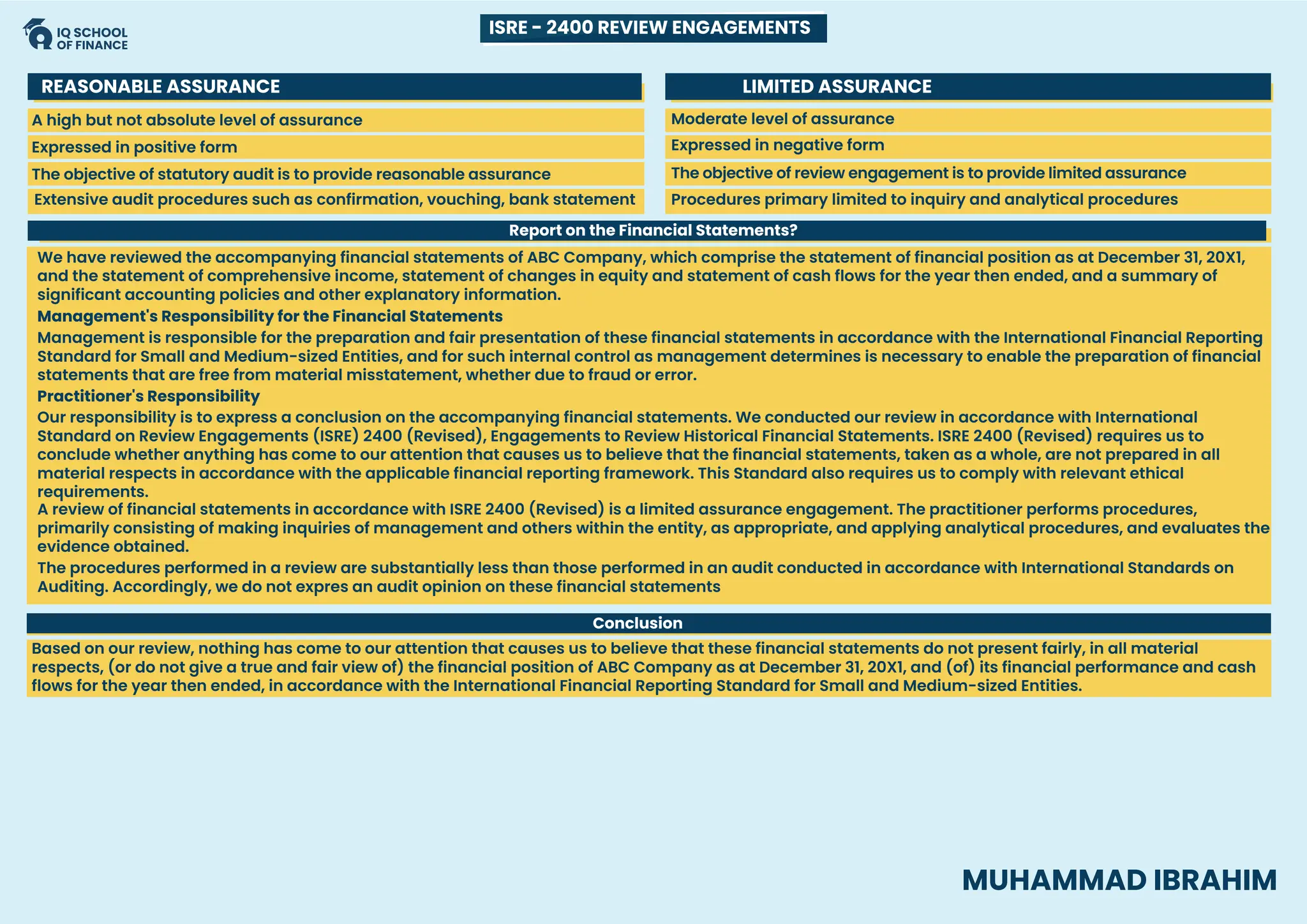
To obtain REASONABLE ASSURANCE
But not the absolute assurance
High Level
of
Confidence
Nature Ownership Finance Investing
New information + Inconsistent Audit
Evidence + Risk Assessment Revise +
Nature, Timing & Extent of Further
Audit Procedures
Assertion
under
consideration
Directional
of Testing
3RD Party
Directly
Written Form
Original
Qualified
Material
Material
+
Pervasive
Disclaimer
Qualified
MANAGEMENT
AUDITOR
WHY NOT ABSOLUTE ASSURANCE
HOW TO OBTAIN REASONABLE
ASSURANCE
OBTAIN AN UNDERSTANDING
OF
HOW TO OBTAIN AN
UNDERSTANDING
THREE PARTY RELATIONSHIP
ESTIMATES
2.
Management Responsibility Auditor’sResponsibility Why Not Absoloute Assurance?
How to obtain Reasonable Assurance?
To prepare FS in a/c with IFRS
To Design & Implement Internal Control
Provide all information to Auditor
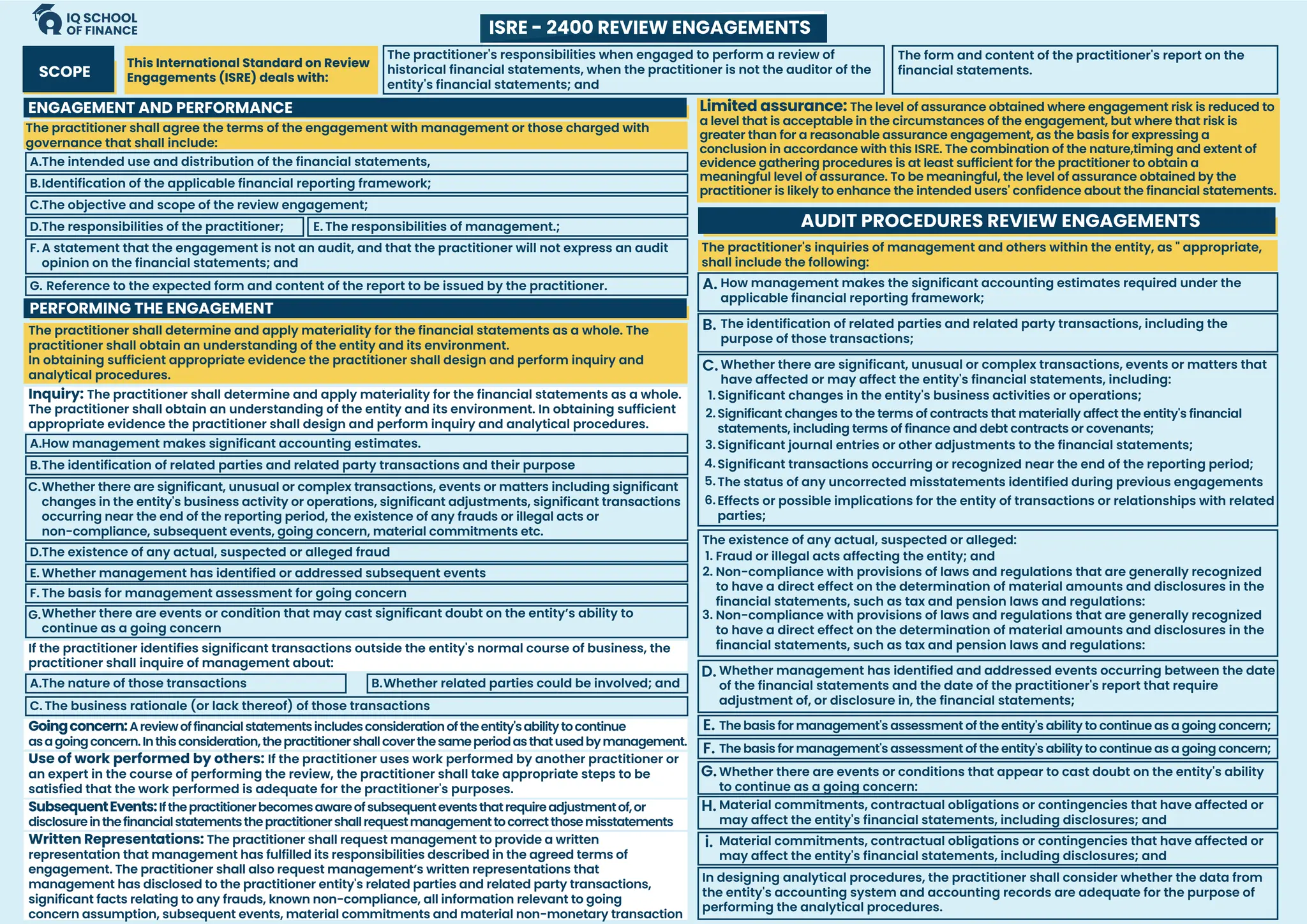
ISA 200 Overall Objective of an Audit and to conduct an Audit in Accordance with ISAs
Ethical Requirement Professional Skepticism Professional Judgement SAAE
Examples of Professional
Skepticism
Advantages of Professional Skepticism
To obtain Reasonable Assurance
High Level of assurance but not an absolute
assurance
Estimates
Fraud
Management may not provide all information
Sampling
Inherent limitation
Integrity
Audit evidence that
contradicts other
audit evidence
Information that
bring into question
the reliability of
documents
Condition that may
indicate possibility
of fraud
Overlooking unusual transaction
Over generalizing when drawing conclusion from audit observation
Using inappropriate assumptions in determining the N,T&E of audit
procedures and evaluating result thereof
An attitude that includes a questioning
mind,
Maintaining PS throughout the audit is necessary to reduce the risk of:
Refer ISA 500
Objectivity
Professional competence
and due care
Confidentiality
Professional behaviour
N,T&E of AP used to obtain AE
Materiality and audit risk
Evaluate whether SAAE has been obtained
Evaluation of management judgement in applying AFRF
Drawing conclusion based on audit evidence obtained.
For e.g. assessing the reasonableness of the estimates
by the management
The application of relevant
training, knowledge and
experience within the context
provided by auditing,
accounting and ethical
standards in making informed
decision about the courses of
action that are appropriate in
the circumstances
Being alert to conditions which may
indicate possible misstatement due to
error or fraud
Critical assessment of audit evidence
MUHAMMAD IBRAHIM
3.
ENGAGEMENT LETTER
ISA
210
Precondition
Primary Matters
Managementrequest to change Engagement Letter
Reason for Change
Change in circumstance affecting the needs for the service
Reasonable basis
Course of action if reasonable
Not Reasonable basis
Additional Matter Recurring Audit
Financial Reporting
Framework
Acceptable
Preparation of Financial Statements in accordance with AFRF for example IFRS
Inherent limitation
Objective and
scope of Audit of
Financial Statements
Responsibilities of
Auditor
Responsibilities
of Management
Reference to the expected
form and content
of Audit report
Identification of Applicable
Financial reporting framework
For Internal Control to prepare Financial Statements free from Material Misstatements whether due to error or fraud
To provide the auditor with all information
Premise
Management will
provide Written
Representation
To inform about SE
Basis of fees
To involve other auditor’s expert
Change in
Senior Management Legal or
regulatory
requirement
Other
reporting
requirement
Ownership
Financial Reporting
framework
Nature and size of
Entity’s business
Any revised or special terms of
engagement
To involve internal auditor
Arrangement to be made with
previous auditor
Obligation to provide written
presentation to others
A change may not be considered reasonable if it appears that change relates to
information that is incorrect, incomplete or otherwise unsatisfactory.
E.g: where auditor is unable to obtain SAAE regarding receivable and entity ask the
audit engagement to be changed to review engagement
Misunderstanding as to nature of an audit as originally requested
If the terms of the audit engagement are changed, the auditor
and management shall agree on and record the new terms of the
engagement in an engagement letter.
If the auditor is unable to agree to a change of the terms of the audit engagement
and is not permitted by management to continue the original audit engagement,
the auditor shall:
Withdraw from the audit engagement where possible under applicable law or
regulation; and
Determine whether there is any obligation, either contractual or otherwise, to
report the circumstances to other parties, such as those charged with
governance, owners or regulators
Course of action if reasonable
MUHAMMAD IBRAHIM
4.
ISA 240 -Fraudoverview & planning
Management Responsibility
•
•
•
•
•
•
•
•
•
•
•
•
•
•
Creating culture of Honesty and ethical behavior
Strong emphasis on fraud prevention
Consider the potential for override of control
Auditor’s Responsibility
Inherent Limitation of Fraud
Professional Skepticism
Discussion among Engagement Team
Maintain Professional Skepticism
Engagement team discussion
Identify and assess the ROMM
Response to those risk by performing audit
procedures to obtain SAAE
Respond if circumstances indicate the possibility
of fraud
Fraud is properly planned and organized
Collusion may cause the auditor to believe that
audit evidence is persuasive when it is, false.
Difficult to detect if senior management involved
Maintain Professional skepticism through out the
audit considering the potential for override of control
Irrespective of past experience and culture of
Honesty and Integrity of management, auditor
shall maintain Professional skepticism
Discussion among the engagement team member
about where the entity’s FS may be susceptible to
material misstatement due to fraud
•
•
•
•
•
•
•
Risk Assessment procedures and related
activities
Inquiry with Board Of Director
Inquiry with Internal Auditor
Inquiry with the management
Management process for identifying and
responding to the risk of fraud
Management assessment of the risk that FS are
materially misstated
Management communication to TCWG regarding
its process
Obtain an understanding – how TCWG exercise
oversight the management process for
identifying and responding to risk of fraud
Whether They have knowledge of any actual,
suspected or alleged fraud affecting the entity,
and to obtain its views about the risks of fraud
Unusual or unexpected relationship
identified
Perform preliminary analytical procedures to
identify unusual or unexpected relationship
Management communication to its employees
regarding business practice and ethical behavior
Fraud risk factors
•
•
•
•
•
•
Opportunities
Inadequate of monitoring of control
Transaction with Related Party
•
Estimates involved
Complex transaction
Ineffective oversight by Board Of Director
High turnover of Senior Management
Attitude / Rationalisation
Communicating inappropriate ethical values
•
• Management failed to remedy known deficiencies in
Internal control
Incentive or Pressure
Misappropriation of Assets
Recent or anticipated changes to employee compensation
Promotion or reward inconsistent with expectation
Known or anticipated future layoff
•
•
•
Opportunities
Large amount of cash
•
• Inventory items that are of small in size but possess
high value
Easily convertible asset
•
•
•
Fixed asset which are small in size
Inadequate internal control over asset
Attitude / Rationalisation
Disregarding the need for monitoring or reducing the
risk related to MOA disregard for IC over MOA
•
•
•
•
•
•
•
•
•
Fradulent Financial Reporting
High degree of competition
Changes in technology
Significant decline in customer demand
Operating losses threat to bankruptcy or hostile
takeover
Rapid growth or unusal profitability
Need to obtain additional financing
Listing requirement or debt covenants
Significant financial interest in entity
Significant portion of their compensation being
contingent upon achieving targets
Incentive or Pressure
MUHAMMAD IBRAHIM
5.
Fraud risk
ISA 240-Fraud overview & planning
MUHAMMAD IBRAHIM
Financial statement Level Assertion Level
Procedures against fraud risk
Management is in a unique position to perpetrate fraud because of
management’s ability to manipulate accounting records and prepare
fraudulent financial statements by overriding controls that otherwise
appear to be operating effectively. Due to the unpredictable way in which
such override could occur, it is a risk of material misstatement due to fraud
and thus a significant risk
Recording fictitious journal entries particularly close to the end of an
accounting period, to manipulate operating result
Concealing or not disclosing, facts that could affect the amounts
recorded in the financial statements
Altering records and terms related to significant and usual transactions
Inappropriately adjusting assumptions and changing judgments used to
estimate account balances
Engaging in complex transaction
Omitting, advancing or delaying recognition in the financial statements
of events and transactions that have occurred during the reporting period
Assign and supervise personnel having knowledge, skill and ability of the
individual
Incorporate element of unpredictability in the selection of nature, timing
and extent of audit procedures
Evaluate selection and application of Accounting policy
Test the appropriateness of Journal Entry
Evaluate business rational for significant transaction outside the normal
course of business
Review accounting estimate for bias
Management Override of Control
procedures against Management override of controls (MOC)
Techniques for Management Override of Control
Presumed Significant risk due to fraud on revenue recognition - Exception if
revenue recognition process is very simple
Revenue recognition
6.
Evaluation of auditevidence
MISSTATEMENT
YES NO
Error
circumstances indicate
the possibility of fraud
Re evaluate the assessment of Risk Of Material
Misstatement due to fraud
Its resulting impact on nature, timing and extent
of audit procedures to respond to the assessed risk
Reliability of evidence previously obtained may
be called into question
There maybe Doubts about the completeness
and truthfulness of the representation made
May consider to withdraw
Communicate to TCWG and regulatory authorities
after obtaining legal advice
Conflicting or missing evidence, including :
Missing documents.
Documents that appear to have been altered.
Unavailability of other than photocopied or
electronically transmitted documents when
documents in original form are expected to exist.
Significant unexplained items on reconciliations.
Unusual balance sheet changes, or changes in
trends or important financial statement ratios or
relationships, for example,receivables growing
faster than revenues.
Inconsistent, vague, or implausible responses from
management or employees arising from inquiries
or analytical procedures.
Unusual discrepancies between the entity's
records and confirmation replies.
Large numbers of credit entries and other
adjustments made to accounts receivable records.
Unexplained or inadequately explained differences
between the accounts receivable sub-ledger
between the customer statements and the
accounts receivable sub-ledger.
Missing inventory or physical assets of significant
magnitude.
Missing or non-existent cancelled checks in
circumstances where cancelled checks are
ordinarily returned the entity with the bank
statement.
Unavailable or missing electronic evidence,
inconsistent with the entity’s record retention
practices or policies.
Fewer responses to confirmation than anticipated
or a greater number of responses than anticipated.
Inability to produce evidence of key systems
development and program change testing and;
Implementation activities for current-year system
changes and deployments.
Discrepancies in the accounting records,
including :
Transactions that are not recorded in complete
or timely manner.
Last-minute adjustments thats ignificantly affect
financial results.
Evidence of employees access to systems and
records inconsistent with that necessary to
perform their authorized duties.
Tips or complaints to the auditor about alleged
fraud.
Unsupported or unauthorized balances or
transactions.
Problematic or unusual relationships
between the auditor and management,
including :
Denial of access to records, facilities, certain
employees, customers, vendors, or others from
whom audit evidence might be sought.
Undue time pressures imposed by management
to resolve complex or contentious issues.
Complaints by management about the conduct
of the audit or management intimidation of
engagement team members, particularly in
connection with the auditor’s critical assessment
of audit evidence or in the resolution of potential
disagreements with management.
Unusual delays by the entity in providing
requested information.
Unwillingness to facilitate auditor access to key
electronic files for testing throughthe use of
computer-assisted audit techniques.
Denial of access to key IT operations staff and
facilities, including security, operations, and
systems development personnel.
An unwillingness to add or revise disclosures in
the financial statements to make them more
complete and understandable.
ISA 240 -Fraud overview & planning
MUHAMMAD IBRAHIM
7.
To obtain anunderstanding
Entity
Environment
Industry
Regulatory
Other external factors
How to obtain an understanding
Observation &
Inspection
Analytical
procedure
These are procedure that assist Auditor in identifying and
assessing the risk of material misstatement at FS level or at
assertion level.
Inquiry
Risk Assessment Procedures
Assessment Of Risk
Complexity
Subjectivity
Change
Uncertainty
Management Bias
ISA 315: AUDIT RISK
Revision Of Risk Assessment
The auditor’s assessment of the risks of material
misstatement at the assertion level may change during
the course of the audit as additional audit evidence is
obtained. The auditor shall revise the assessment and
modify the further planned audit procedures accordingly.
Significant risk are
those risk that
requires special
audit consideration
Internal Control
Risk Factors
FS Level Assertion Level
MUHAMMAD IBRAHIM
Property Plant &
Equipment
Inventory
Revenue
Receivable
A/C Pay
Bank Loan
Security Deposit
Payable
Existance
Completeness
Rights & Obligations
Valuation
What is Audit risk?
Financial statements
may not be equal to
IFRS
IAS 02 Lower of cost
or NRV
IAS 36 PPE Impaired
IAS 36 P&M Impaired
Normal Risk Significant Risk
Operation
Ownership governance structure
Types of investment including
special purpose entities
The way that the entity is
structured & how it is financed
8.
In the eventof becoming aware of information
during the audit that would have caused the
auditor to have determined a different amount
(or amounts) initially
Change in circumstances
Changes in auditors understanding of entity and
operations
New Information
If lower materiality as compared to initially
determined the auditor shall determine whether it
is necessary to revise performance materiality, and
whether the nature, timing and extent of the
further audit procedures remain appropriate
Misstatement, including omissions, are
considered to be material if they, individually
or in aggregate, could reasonably be expected
to influence the economic decision of the users
taken on the basis of the Financial statement.
What is materiality?
Assumptions that user have an
understanding
Uses of Materiality
Concluding
Planning Performance
Nature,
Timing
&
Extent of
Further Audit
Procedures
Evaluation of
uncorrected
misstatement
Factors to considered determining
Performance Materiality
Revision of
Materiality
Reasons for
change in
materiality
Effect of
changes in
materiality
On particular item of FS
% apply to the benchmark
Benchmark Percentage
Profit Before Tax
Revenue
Total Asset
Net Asset
Expenses
Cash flow from operations
5%
1% to 5%
Up to 1%
Up to 3%
3% to 5%
3% to 5%
How to determine Materiality?
Nature
of entity
Ownership Finance Elements of FS
User
attention
Materiality
%
Listed 0
Profit Before
Tax
5%
Shareholders
0
Members
N.P.O
Expenses 3% to 5%
20%
Shareholders/
Banker
Listed
Revenue 1% to 5%
80%
Shareholders/
Banker
Non-
Listed
Cash flow from
operations
Up to 3%
3% to 5%
PPE
0
Shareholders
Listed
(starting
company)
Revenue 1% to 5%
Revenue
Purchase
Gross profit
Expenses
Profit before tax
PPE
INVENTORY
Total asset
Bank loan
Total Liabilities
Net Asset
Cash flow from,
Operatingactivities
Financingactivities
Investingactivities
Rs. 100 5% Rs. 5
Rs. 100 3% Rs. 3
Rs. 100 1% Rs. 1
Determining
the nature,
timing and
extent of RAP
Identifying
and assessing
the ROMM
Materiality level for particular class
of transaction, account balance or
disclosure
Law or regulation of FRF affect user
expectation regarding measurement or
disclosure of certain items such as RPT
Key disclosure in the respective industry
Attention to the particular aspect of entity’s
business
What is Performance Materiality?
The amount set by the auditor at less than
Materiality for the financial statement a whole to
reduce to an appropriately low level the probability
that the aggregate of uncorrected and undetected
misstatements exceeds materiality for the financial
statements as a whole. Planning the audit solely to
detect individually material misstatements
overlooks the fact that the aggregate of individually
immaterial misstatements may cause the financial
statements to be materially misstated, and leaves
no margin for possible undetected misstatements.
Auditor’s understanding of the entity updated
during the performance of risk assessment
procedures.
Nature and extent of misstatements identified in
previous audit sand there by auditors expectation
in relation to misstatements in the current period.
The reliability of Entity’s internal control over
financial reporting.
Increased engagement risk.
An expected increase in the complexity of the
business.
Documentation
Materiality for
A/C balance,
COT and
disclosure
Materiality
Performance
Materiality
Revision of
materiality
ISA 320 - Materiality
MUHAMMAD IBRAHIM
Have a reasonable knowledge of business and
economic activities and accounting.
Nature of an entity
Ownership / Shareholding
Finance
Elements of FS
User attention
Financial statements prepared and audited
based on materiality.
Use of estimates in the preparation of financial
statement make reasonable economic decision
9.
ISA 500: SUFFICIENTAPPROPRIATE AUDIT EVIDENCE
QUANTITY
SAAE IFRS
ISA 540
Accounting estimates
ISA 500
Management Expert
ISA 620
Auditor expert
ISA 501
Litigation and claims
ISA 505
External Confirmation
Internal Control
Risk assessment
Select sample from and Inspect
Quality of audit evidence
Materiality
QUALITY
TECHNIQUES FOR AUDIT PROCEDURES
Inquiry
Recalculation
Observation
Inspection
External confirmation
Reperformance
Substantive analytical
procedures
RELEVANT
Assetion
under
consideration
Directional
of
testing
RELIABLE
Original VS Photocopy
3rd party VS management
Directly VS Indirectly
Written form VS Oral form
Consider the requirement of IFRS
Obtain an understanding
of management process
to record estimates and
ensure that it is consistent
with the requirement of IFRS
Perform Test of Controls on
the amount of estimates
Ensure that assumptions
used by the management
are reasonable
Perform subsequent event
procedures such as
Evaluate the adequacy of
disclosure
Evaluate the competence,
capabilities and objectivity
of management expert
Obtain an understanding of
the work of that expert
Evaluate the adequacy of
the expert work by ensuring
that:
Finding and conclusion
are relevant and
reasonable
Assumptions are
reasonable
Source of data is complete
and accurate
Evaluate the competence,
capabilities and objectivity
of management expert
Inquiry of management
including in house legal
counsel
Select sample and send
confirmation
If confirmation received,
assess the reliability
If reliable match the
balance with the GL
If not matched, obtain
reconciliation from the
management
If not matched, obtain
reconciliation from the
management
Performed procedures on
reconciling items
If confirmation not received
– perform alternative audit
procedures
Reviewing minutes of the
meeting of TCWG
Correspondence between
entity and its external legal
counsel
Reviewing legal expense
account
Send confirmation to
external lawyer
Obtainwrittenrepresentation
frommanagementthatthey
haddisclosedtotheauditor
andaccountedforand
disclosedinaccordancewith
IFRS
Obtain an understanding of
the work of that expert
Evaluate the adequacy of
the expert work by ensuring
that:
Finding and conclusion
are relevant and
reasonable
Assumptions are
reasonable
Source of data is complete
and accurate
MUHAMMAD IBRAHIM
10.
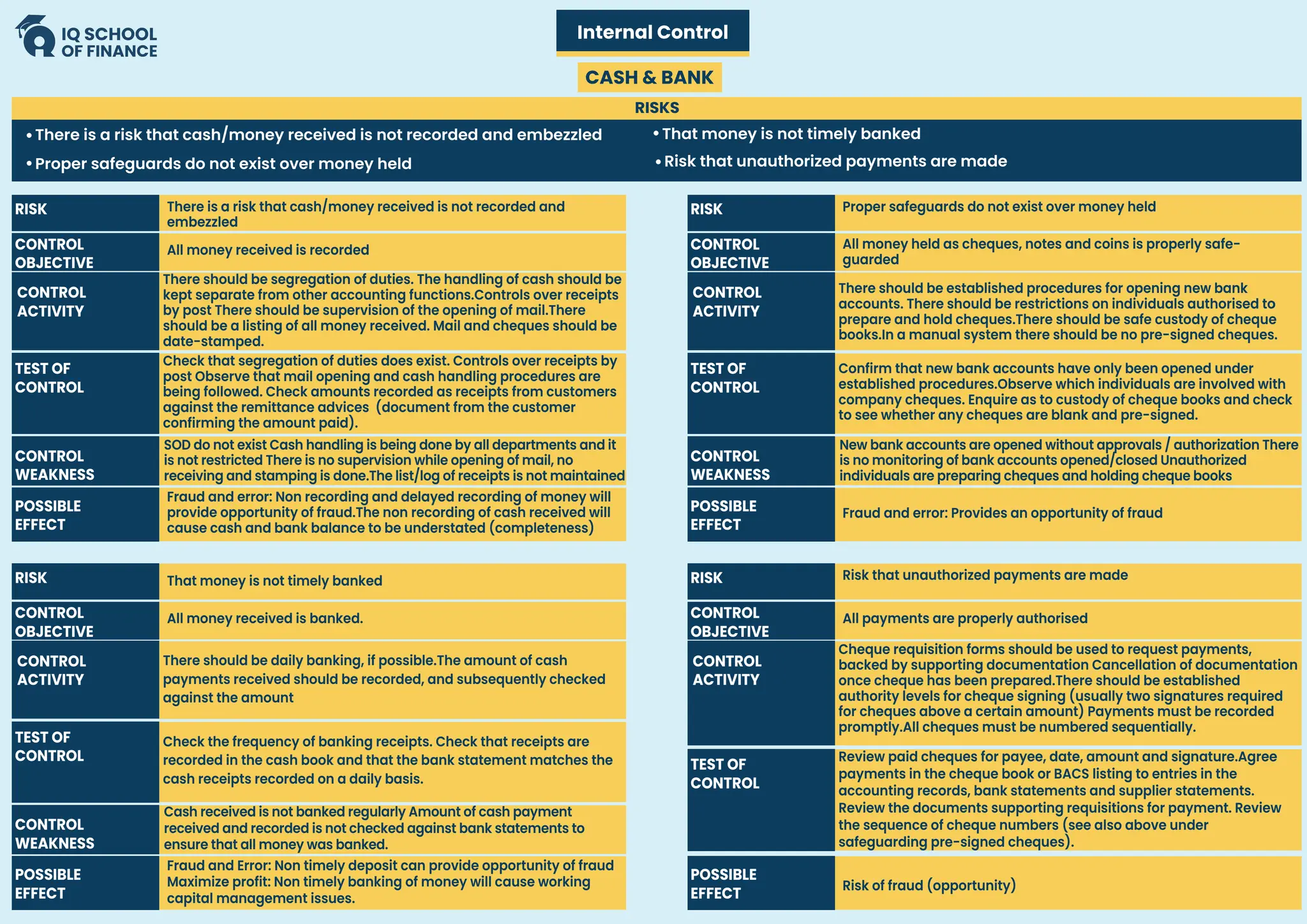
CASH AND BANKBALANCES
NON-CURRENT LIABILITIES- BANK LOAN
PREPAYMENTS
GENERAL PROCEDURES EXISTENCE COMPLETENESS RIGHTS & OBLIGATIONS VALUATION
GENERAL PROCEDURES
GENERAL PROCEDURES
EXISTENCE
RIGHTS & OBLIGATION
& VALUATION
RIGHTS & OBLIGATION
& VALUATION
COMPLETENESS
COMPLETENESS
Obtain a listing of all bank accounts which were open at any point during the period being audited
GENERAL PROCEDURES Obtain the schedule of prepayment as at year end and match the balance with the GL
EXISTENCE AND RIGHTS Select samples from prepayments and inspect supporting document such as agreement and bank statement
Perform recalculation to ensure that prepayment balances is correctly recorded
Obtain the schedule of bank loan as at
the year end
Match the opening balance with the Last
year audited FS
Match the closing balance with the GL
Send bank confirmation to 100% item
EXISTENCE
Inspect the approval from appropriate
authority for the loan obtained during the year
Match the amount appearing in GL. with the
Confirmation received
Make inquiries of management and search for any evidence.
additional debt such as review minutes of the meeting of BOD.
For the confirmation received, review the replies received to
evaluate whether outstanding debt as per the confirmation
agrees to the accounting records / GL
In case amount differ, obtain the
reconciliation from the management
Perform procedures on reconciling items
such as bank clearance
send confirmation to 100%
banks loan
For the confirmation reccived, assess the
integrity/reliability of the responses received
VALUATION Same procedures as above - confimation procedures
VALUATION Perform the covenant testing to ensure that loan is appropriately classified
Make inquiries of management / TCWG and search for any evidence of additional bank accounts such as review minutes of the
meeting of BOD
For the confirmation received, review the replies received to evaluate whether outstanding balance as per the confirmation
agrees to the accounting records/ GL
Match the amount of GL with the Confirmation In case of difference, obtain the reconciliation from the management
If the confirmation received, assess the reliability
Match the balance with the Gl
VALUATION
SUBSTANTIVE PROCEDURES
MUHAMMAD IBRAHIM
11.
EXISTENCE
Select the samplefrom receivable schedule and send
external confirmation
EXISTENCE
Select sample from trade payables listing (selection of nil
and low balances is important), send confirmation
For the responses received assess the reliability of confirmation
received
COMPLETENESS
Obtain the list of Goods Delivery Note which must be
sequentially numbered
Incase confirmation not received, perform alternative testing such
as subsequent receipt and invoices / GDN issued during the year
Same procedures as above - Confirmation Procedures
VALUATION
TRADE RECEIVABLE
ACCOUNTS PAYABLE
GENERAL PROCEDURES Obtain the list of receivable as at year end
GENERAL PROCEDURES
Match the receivable listing with the General Ledger
RIGHTS AND
OBLIGATION
VALUATION
PROCEDURES
FOR IRRECOVERABLE
RECEIVABLE
After assessing reliability, match the
balance with receivable listing
RIGHTS AND
OBLIGATION
& VALUATION
Obtain an understanding
of management process
to record provision and
ensure that it is
consistent with the AFRF
Obtain management working for
provision for doubtful debt
Review any correspondence of the
Company with the customers and lawyers
that deals with unpaid or disputed debts
Match the balance with the GL and
receivable listing
Perform test of
controls on
provision
recorded by the
management
Check that whether
assumption, estimates
and judgement used by
the management are
reasonable
Inspect subsequent
receipts to assess
the recoverability
of balance
Obtain
the aging
of
receivable
Recalculate the aging of
receivable
COMPLETENESS
In case of difference, obtain the
reconciliation from the management
Inspect supporting documents such as invoice, GDN,
credit note and bank statement to test reconciling items
For the sample selected from the list of Goods Delivery Note, trace
it to receivable listing
Obtain the list of trade creditors as at year end Match the balance with General Ledger
Match the creditor
list with the
General Ledger
Obtain the
list
of GRN
Select a sample from
GRN and trace it
to payable account
Review the list of account
balances who are not in the
listing of trade payables
but who could be expected
to be in the listing
Compare the list of
trade payables balances
with the listing that was
prepared for the previous
year audit
Perform test
of
unrecorded
liability
After assessing the reliability,
match the amount of
confirmation with the list of
creditors
In case of differences/exception,
obtain the reconciliation from
the management
Perform procedures on
reconciling items such as
Invoice, GRN and bank
statement
In case confirmation is not
received, perform alternative
testing (subsequent disbursement
and invoices)
SUBSTANTIVE PROCEDURES
MUHAMMAD IBRAHIM
12.
EXISTENCE
RIGHTS & OBLIGATION
COMPLETENESS
VALUATION
Selectsample from the inventory register andinspect the inventory at warehouse to determine whether the asset exists.
EXISTENCE
Select sample from warehouse and trace / inspect it to inventory register
Select sample from inventory register and forthe sample selected Inspect supporting documents such as invoices (to check company’s name), GRN and etc.
RIGHTS & OBLIGATION
INVENTORY
PPE
GENERAL PROCEDURES Obtain inventory register as at year end
GENERAL PROCEDURES
Obtain Fixed asset register/ schedule of
tangible non-current assets.
Match the balances appearing in the inventory register with the General Ledger and if not matching obtain the
reconciliation
Select a sample from inventory
register and inspect the relevant
documentation (agreement,
invoice (amount)etc.) to
evaluate whether the inventory
has been accurately recorded
in the inventory register
Obtaining an understanding of
management process related to
identifying, estimating and
recording impairment for
inventory to determine whether
it is consistent with the
requirement of IAS 02.
Test the operating
effectiveness of control
over recording of
impairment on inventory
Obtain management’s
calculation to impairment and
check that whether management
assumptions (estimated selling
price and estimated cost to make
sales are reasonable
Perform subsequent
event procedures such
as Inspect subsequent
sales register to verify
the subsequent sales
price.
VALUATION
REVALUATION
Match the balances appearing in the fixed asset register with the
General Ledger and if not matching obtain the reconciliation.
Match the opening balance with the last year
audited Financial statement.
Select sample from physical asset and
trace / inspect it to fixed asset register
Select sample from revenue expenditure account
and inspect the supporting documents such as
invoices to identify any such expenditure which
pertains to capital nature and therefore should be
capitalized.
COMPLETENESS
Select a sample of disposal and inspect the relevant
documentation such as invoices, authorization and approval to
ensure that disposal has not been recorded in error.
Select sample from the fixed asset register (closing asset) and inspect the asset to determine whether the asset exists.
Select sample from addition during the year and for the sample selected Inspect supporting documents such as invoices, title deeds and etc.
Select a sample of addition of
fixed assets from the fixed asset
register and inspect relevant
documents such as invoice to
evaluate whether the additions
pertains to capitalized nature.
Perform substantive analytical
procedures to testdepreciation expense
to evaluate whether the fixed assets
have been depreciated at the appropriate
rate and using the depreciation
methodology in accordance with the
entity's accounting policy.
Obtain an understanding
of the entity's
depreciation policy.
Review depreciation
rates for
reasonableness. Recalculate the depreciation.
Obtaining an understanding of
management process related to
identifying, estimating and
recording impairment for fixed
assets to determine whether it is
consistent with the requirement
of IAS 36.
Obtain management's calculation to
write down fixed asset to their recoverable
value and check that whether
management methods and assumptions
(discount rate, future cashflow etc)
are reasonable.
Test the operating
effectiveness of control
overrecording of
impairment.
Recalculate the impairment
working.
Ensure that disclosure are
adequate as per the
requirement of IAS 16
and IAS 36.
Match the
balance
appearing in
revaluation
report
with the Financial
statement / GL
Ensure that all the
assets for similar
class are
revalued
Evaluate the
competence,
capabilities and
objectivity of
management
expert
Evaluate the
adequacy
of the expert
work by
ensuring that:
Obtain an
understanding
of the work of
that expert
Considering the
need to use the
auditor expert
Obtain the
revaluation
report
Finding and conclusion are
relevant and reasonable
Assumptions are
reasonable
Source of date is complete
and accurate
SUBSTANTIVE PROCEDURES
13.
INTANGIBLE ASSETS
DEVELOP
GOODWILL
PURCHASE
GENERAL PROCEDURES
COMPLETENESS
VALUATION
Obtainthe detail of intangible
asset develop and match the
balance with the GL
GENERAL PROCEDURES
Obtain technical and feasibility study /
report to obtain evidence regarding
development phase as per IAS 38
EXISTENCE RIGHTS &
OBLIGATION
Select samples from development cost and inspect the
supporting document such as invoice (Company name)
to ensure that expenditure incurred by the company
Select sample from the development cost and
Inspect the supporting documents such as invoices
to check date and amount to ensure that
development cost has been capitalized only for
development phase as per IAS 38
Obtain the amortization working and check that
whether intangible asset has been amortised using
appropriate useful life
Select samples from revenue phase expenditure and inspect supporting documents such as invoice to assess the date and nature of expenditure to ensure that
expenditure does not pertains to development phase
COMPLETENESS
Obtain an understanding of management process
related to identifying , estimating and recording
impairments for intangible asset to determine whether
it is appropriate in the circumstances and in accordance
with the applicable financial reporting framework
Perform Test of controls over the recording of
impairment of intangible asset
Check the reasonableness of the assumption and
judgement used by the management such as
discount rate and future cash flows to assess
impairment if any
Perform subsequent event procedures such as
Inspection of subsequent interim FS to check the
revenue and cost of production to ensure that a
ssumption is reasonable
VALUATION
Business
combination
Inspect the purchase
agreement to check the:
Amount of consideration
Number of shares acquired
Acquisition date
Inspect the bank
statement to ensure
that amount has been
paid
Inspect the CDC statement
to ensure that shares exist
and are in the name of the
Company
Obtain valuation
report from the
management and
match the amount
Evaluate the competency,
capability and objectivity/
independence of the
Management expert
Evaluate the adequacy
of the expert work :
Relevance and reasonableness of the expert finding
Relevance and reasonableness of the assumption and methodology used
The relevance, completeness and accuracy of source data
May consider to
use the auditor
expert
Understand the management process
for recording impairment of goodwill
if any
Test operating effectiveness of controls
over recording of impairment
Ensure that assumption used by the
management are reasonable such as
discount rate and future cashflow
Ensure that fair value of NCI is
calculated correctly and accurately
by using appropriate rate
Obtain intangible asset register or schedule as at year
end Match the balance with GL/FS
Select samples from Intangible asset register and inspect supporting document
such as licensing agreement supplier invoice
EXISTENCE AND
RIGHTS
Obtain management’s calculation to write down fixed asset to their recoverable value
and check that whether management methods and assumptions (discount rate,
future cash flow etc are reasonable
Obtaining an understanding of management process related toidentifying,
estimating and recording impairment for intangible asset to determine
whether it is consistent with the requirement of IAS 36
Select samples from intangible
asset register and inspect
supplier invoice to verify cost
Recalculate the
amortization expense
Ensure that amortization
rate is reasonable
Test operating effectiveness
of control over recording of
impairment
Perform subsequent event procedures such as
inspection of subsequent interim FS to evaluate
the adequacy of impairment
Evaluate the understanding obtained during audit.
Compare the last year list with the current year.
SUBSTANTIVE PROCEDURES
Perform subsequent event
procedures such as inspection of
subsequent interim Financial
statement and compare the projected
result with the actual result
MUHAMMAD IBRAHIM
14.
ACCRUALS
PROVISION
CONTINGENT LIABILITIES
EXPENSES
WARRANTY
GENERAL PROCEDURES
GENERALPROCEDURES
EXISTENCE,
OBLIGATION
AND VALUATION
EXISTENCE,
OBLIGATION
AND VALUATION
Obtain the listing of
accruals as at year end
GENERAL
PROCEDURES
Obtain the schedule / working of provision as
at year end and match the balance with the GL
Obtain the listing of provision as at year end
GENERAL PROCEDURES Obtain the listing of provision as at year end
GENERAL PROCEDURES Obtain schedule of expenses for the year end
and match the balance with the GL
OCCURRENCE Select samples from schedule of expense and inspect supporting documents
such as agreement and invoice
Inquiry of management including
in-house legal counsel to obtain an
understanding of the legal cases
Inquiry of management including
in-house legal counsel to obtain an
understanding of the legal cases
Inspect correspondence between the
entity and its external legal counsel
Send direct confirmation to the external
legal counsel to know the outcome of
the case
Ensure that any contingent liabilities
has been appropriately recorded as
per IAS 37
Inspect correspondence between the
entity and its external legal counsel
Send direct confirmation to the
external legal counsel to know the
outcome of the case
Ensure that any provision has been
appropriately recorded as per IAS 37
Match the balance with the GL
Inspect the agreement to identify warranty clause to ensure that
company has an obligation to incur warranty expenditure
Inspect the subsequent invoice to trace the amount,date and client name to ensure the
existence, obligation and valuation of accruals
Match the balance
with the GL
Existence Rights and
obligation,Valuation
EXISTENCE AND
OBLIGATION
COMPLETENESS Compare the list of accruals with the list obtain in last years and inquire if
any accruals appearing in last year but not appearing in current year listing
COMPLETENESS Compare the list of contingencies with the list obtain in last years and inquire if any
contingencies appearing in last year but not appearing in current year listing
Inspect minutes of the
meeting of TCWG
Reviewing legal expense account to identify any other
litigation and claims
COMPLETENESS Compare the list of provisioning with the list obtain in last years and inquire
if any provision appearing in last year but not appearing in current year listing
COMPLETENESS
ACCURACY
CLASSIFICATION
CUTOFF
Compare the schedule of expense with the last year
Select samples from schedule of expense and inspect supporting document such as original supplier invoice to ensure that amount has been recorded at correct amount
Select samples from schedule of expense and inspect the JV to ensure that expenses has been recorded inappropriate general ledger.
Select samples near the year end and inspect supporting document such as supplier invoice date of service / goods received to ensure that expenses had been
recorded in the correct accounting period
Perform test of unrecorded liability
Inspect minutes of the meeting of
TCWG
Reviewing legal expense account to
identify any other litigation and claims
COMPLETENESS
Comparethelast
yearprovisionwith
thecurrentyear
Review the list of accrual based on auditor's knowledge of business
VALUATION
Ensure that assumption used by the
management such as number of claims, nature
of claims and expected cost to incurred are
reasonable
Perform subsequent event procedures to
compare the actual warranty claims
with projected warranty claims
Perform test of control on the
recording of warranty provision
Obtain an understanding of management
process to record warranty provision and
ensure that it is consistent with the
requirement of IFRS
SUBSTANTIVE PROCEDURES
15.
SALES
PURCHASE
GENERAL PROCEDURES Obtainthe schedule of sales
ledger / register
Match the amount with the
GL
GENERAL PROCEDURES Obtain the schedule of
purchase register
Match the balance with the
GL
COMPLETENESS Select a sample from GDN and trace it to sales register
OCCURRENCE
CLASSIFICATION
Select a sample from purchase register and inspect GRN
Select a sample from purchase register and inspect JV to ensure that
transaction has been recorded in purchase account
OCCURRENCE
ACCURACY
ACCURACY
CLASSIFICATION
CUTOFF
Understand the impact of significant accounting policies for sales balance and compliance with the applicable
financial reporting framework. Consider whether theaccounting policies and methods for revenue recognition
are appropriate and are applied consistently
Select sample from sales register and inspect goods
delivery note
Select a sample sales register.
For each selection, perform the
following:
Select sample from purchase register
and perform For each selection,
perform the following
Inspect sales invoice to
check quantity and rate
Inspect goods received note Inspect purchase invoice
Perform recalculation based
on GRN and purchase invoice
Inspect goods delivery
note to verify quantity
Agree the rate to approved
price list
Perform recalculation based
on GDN and Approved price
list
Select a sample from sales register and inspect JV to ensure that transaction has been recorded in sales account
Select few samplesbefore and after of last goods delivery note and check
whether it has been recorded in the correct accounting period
CUTOFF
Select few samples before and after of last goods received note and check
whether it has been recorded in the correct accounting period
Test whether the date of goods received note support the recognition of the revenue in
the correct period or not
COMPLETENESS Select a sample from GRN and trace it to purchase register
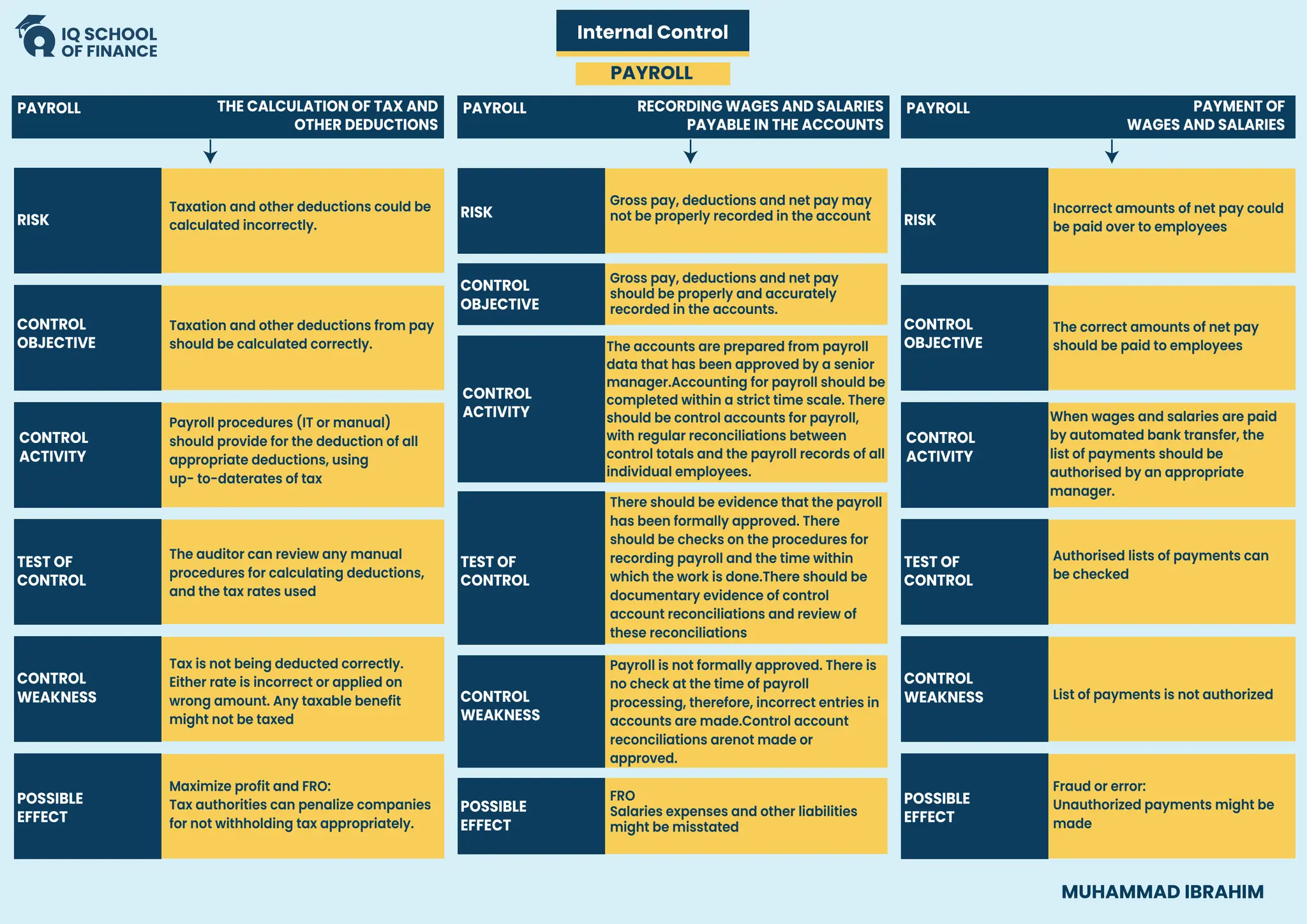
PAYROLL
GENERAL PROCEDURES Obtain the payroll register for the year ended and match the
balance with the GL
OCCURRENCE Select samples from payroll register and inspect employee personnel files
ACCURACY
Select samples from payroll
register and inspect payroll
slip
Perform substantive analytical procedures
on payroll expense
Verify hours from signed
timesheet
Verify hourly rate from
authorized rates / employee
personal files
Recalculate payroll expense
CUTOFF
Inspect JV to ensure that payroll expense has been correctly recorded in the appropriate general ledger
While recalculating payroll expense make sure that payroll has been recorded for the
whole year /upto year end
Perform substantive analytical procedures on payroll expense
COMPLETENESS Match the payroll register with the last year Select samples from employee personnel files and trace to payroll register
Test whether the date of goods delivery note support the recognition of the
revenue in the correct period or not
Select samples from employees present at
premises and trace to payroll register
CLASSIFICATION
SUBSTANTIVE PROCEDURES
MUHAMMAD IBRAHIM
16.
EQUITY
SHARE CAPITAL
The auditorwill
usually carry out
the following
substantive
procedures on
share capital:
Where local law requires that
companies should have an
authorised share capital, the
auditor should check that the
total authorised capital in the
draft financial statements is
consistent with the company’s
constitution.
The auditor should
check the nominal value of shares
issued during the year, by reading
the supporting documentation,
and should ensure terms of issue
were properly complied with.
If new shares were issued during
the year, check that cash received
for them has been properly
recorded in the main ledger.
Check that theamount reported as
issued share capital agrees with the
amount recorded in the register of
members/ shareholders, if the
company has such a register.
(In some countries there is a legal
requirement to maintain a register
of members).
RESERVES
THE AUDIT OF
STATUTORY BOOKS
The auditor will
usually carry out
the following
substantive
procedures on
reserves:
Most countries require companies to
maintain certain books or records
containing defined information, in
addition to their normal accounting
records. The nature of these ‘statutory
books’ varies from country to country,
but they may include the following:
The auditor should confirm that the
required statutory records are maintained
by the client company and are up-to-date.
Check the dividend
calculations and
check that the total
dividends paid are
consistent with
the amount of
issued share capital
at the relevant date.
Confirm that
dividends have
been deducted
only from those
reserves that are
legally distributable
(usually the
accumulated profits
reserve/retained
earnings).
Check the
authorisation for
the amount of
dividends paid.
Ensure that any
specific legal
requirements
relating to reserves
have been complied
with. (For example,
check that the entity
has not breached
legal restrictions on
use of the share
premium account).
Check the accuracy
of these movements
by checking
supporting
documentation.
Obtain an analysis
of movements on all
reserves during the
period.
Minutes of board
meetings and
minutes of general
meetings of the
company.
Register of
members/
shareholders.
Register of directors
and their interests in
the shares and loan
capital of
the company.
Register of charges
on the company’s
assets.
Copies of directors’
service contracts and
details of directors’
remuneration packages.
(Audit work on this area
can be included in
payroll testing
procedures. The auditor
should confirm that
national company law
disclosure requirements
are complied with.)
SUBSTANTIVE PROCEDURES
MUHAMMAD IBRAHIM
17.
ISA 505 EXTERNALCONFIRMATIONS
MUHAMMAD IBRAHIM
What is external confirmation?
External Confirmation Procedures
Types of confirmation
Auditor use of external confirmation procedures
to obtain audit evidence
Scope: Objective:
Audit evidence obtained as a direct written response to the auditor
from a third party in paper form, or by electronic or other medium.
Positive
Confirmation
Negative
Confirmation
Auditorshallmaintaincontroloverexternalconfirmationrequests,including:
Determining the information to be confirmed or requested
Selecting the appropriate confirming party i.e. knowledgeable
Designing confirmation requests such as properly addressed &
contain return information
Follow-up on confirmation requests
A request that the confirming party respond
directly to the auditor whether agrees or
disagrees with the information in the request.
A request that the confirming party respond
directly to the auditor only if disagrees with the
information provided in the request.
Negative confirmations provide less persuasive audit evidence than
positive confirmations. The auditor shall not use negative confirmation
requests as the sole substantive audit procedure to address an assessed
ROMM at the assertion level unless all of the following are present:
Design & perform external confirmation procedure to obtain
relevant and reliable audit evidence
Yes
Yes
No
No
Yes
Received
Reliability?
No
No Inquire as to management’s
reasons for the refusal, and seek
audit evidence as to their validity
and reasonableness (a common
reason is the existence of a legal
dispute or ongoing negotiation
with confirming party);Evaluate
the implications of
management’s refusal on ROMM
including the ROF, and on the N, T
and E of other audit procedure;
andPerform alternative audit
procedures to obtain relevant
and reliable audit evidence
Was received by the
auditor indirectly
Appeared not to come
from originally intended
confirming party
Responses received
electronically because
proof of origin & authority
of the respondent is
difficult to establish obtain
further audit evidence to
resolve those doubts
Request management for
direct confirmation
Contacting the CP – when CP
responds by electronic email
Encryption and other
information transmission
technology
In the case of
non-response (it
may indicate
previouly
unidentified
ROMM), the
auditor
shall perform
alternative audit
procedures to
obtain relevant &
reliable audit
evidence.
Exceptions
Doubts of reliability
Course of action
No further audit
procedures required
Yes
May indicate MM or
PMM. If MM then check
whether it is indicative
of fraud. Exception may
also indicate deficiency
in IC. Some exceptions
do not represent MM
due to timing and
measurement.
UnreasonableorUnable
toobtainSAAE
ISA 705
Material &
Pervasive
Material
but not
Pervasive
Management allowed to send confirmation?
Auditor has assessed the ROMM as low and has obtained SAAE regarding
the operating effectiveness of controls.
The population of items subject to negative confirmation procedure
comprises a large number of small, homogeneous account balances,
transactions or condition
Auditor is unaware of circumstances that would cause recipient to
disregard such request.
A very low exception rate is expected.
Disclaimer Qualified
18.
ISA 520 AnalyticalProcedures
Evaluations of financial information through analysis of plausible relationships among both financial and non-financial data. Analytical procedures
also encompass such investigation as is necessary of identified fluctuations or relationships that are inconsistent with other relevant information or
that differ from expected values by a significant amount.
This International Standard on Auditing (ISA) deals with the auditor’s use of analytical procedures as substantive procedures (“substantive analytical
procedures”). It also deals with the auditor’s responsibility to perform analytical procedures near the end of the audit that assist the auditor when
forming an overall conclusion on the financial statements.
To obtain relevant and reliable audit evidence when using substantive analytical procedures; and as to whether the financial statements are
consistent with the auditor’s understanding of the entity.
WHAT IS ANALYTICAL
PROCEDURES
SCOPE
OBJECTIVE
PLANNING
ISA 315 deals with the
use of analytical
procedures to identify
and assess risk
procedures
PERFORMANCE CONCLUDING
Steps / Requirements for performing substantive procedures as Analytical Procedures
Determine the suitability of particular substantive analytical procedures for given assertions,
taking account of the assessed risks of material misstatement and tests of details, if any, for the
assertions; how effective they will be in detecting particular type of material misstatements.
A
B Evaluate the reliability of data and for these auditor needs to consider the Following factors :
C
Source of information
Comparability of the information such as industry, data and budget
Nature and relevance of information available Controls over preparation of data
Develop an expectation of recorded amounts or ratios and evaluate whether the expectation is
sufficiently precise to identify a misstatement that, individually or when aggregated with other
misstatements, may cause the financial statements to be materially misstated; For these
auditor needs to consider the following factors
D
The conclusions drawn from the
results of analytical are intended
to corroborate conclusions formed
during the audit of individual
components or elements of the
financial statements. This assists
the auditor to draw reasonable
conclusions on which to base the
auditor’s opinion.
The results of such analytical
procedures may identify a
previously unrecognized risk of
material misstatement. In such
circumstances, ISA 315 (Revised)
requires the auditor to revise the
auditor’s assessment of the risks of
material misstatement and modify
the further planned audit
procedures accordingly.
Analytical Procedures
that Assist When Forming
an Overall Conclusion
The auditor shall design and perform
analytical procedures near the end of
the audit that assist the auditor when
forming an overall conclusion as to
whether the financial statements are
consistent with the auditor’s
understanding of the entity.
The accuracy with which the expected results of substantive analytical procedures can be predicted
The degree to which information can be disaggregated
The availability of the information, both financial and non-financial
Determine the amount of any difference of recorded amounts from expected values that
is acceptable without further investigation
The auditor’s determination of the amount of difference from the expectation that can be accepted without
further investigation is influenced by materiality and the consistency with the desired level of assurance, taking
account of the possibility that a misstatement individually or when aggregated with other misstatements, may
cause the financial statements to be materially misstated. ISA 330 requires the auditor to obtain more persuasive
audit evidence the higher the auditor’s assessment of risk. Accordingly, as the assessed risk increases, the
amount of difference considered acceptable without investigation decreases in order to achieve the desired level
of persuasive evidence.
If analytical procedures performed in accordance with this ISA identify fluctuations or relationships that are
inconsistent with other relevant information or that differ from expected values by a significant amount, the
auditor shall investigate such differences by:
(a) Inquiring of management and obtaining appropriate audit evidence relevant to management’s responses
(b) Performing other audit procedures as necessary in the circumstances.
The need to perform other audit procedures may arise when, for example, management is unable to provide an
explanation, other explanation, together with the audit evidence obtained relevant to management’s response, is
not considered adequate.
MUHAMMAD IBRAHIM
19.
ISA 530 AUDITSAMPLING
DESIGN OF SAMPLES
DEFINITIONS
MUHAMMAD IBRAHIM
Audit sampling (sampling)
The application of auditprocedures to less than 100% of items within
apopulation of audit relevance such that allsamplingunits haveachance of
selectioninorder to provide the auditor witha reasonable basis on which to
draw conclusions about the entire population.
POPULATION
The entire set of data from which a sample is selected and about which the
auditor wishes to draw conclusions.
SAMPLING RISK
The risk that the auditor’s conclusion based on a sample may be different
from the conclusion if the entire population were subjected to the same
audit procedure.
SAMPLE SIZE - TOD ( TEST OF DETAILS)
FACTOR
EFFECT ON
SAMPLE SIZE
Increase
Increase
Decrease
Decrease
An increase in the amount of misstatement the auditor expects
to find in the population
SAMPLE SIZE - TOD
The auditor shall determine a sample size sufficient to reduce sampling risk to
an acceptably low level. The level of sampling risk that the auditor is willing to
accept affects the sample size required. The lower the risk the auditor is willing
to accept, the greater the sample size will need to be.
An increase in the auditor’s
assessment of the risk of material misstatement
An increase in the use of other substantive
procedures directed at the same assertion
An increase in tolerable misstatement
FACTOR
EFFECT ON
SAMPLE SIZE
Increase
Increase
Increase
Negligible
effect
Decrease
An increase in the auditor’s desired level of assurance that the
tolerable rate of deviation is not exceeded by the actual rate of
deviation in the population
An increase in the number of sampling units in the population
SAMPLE SIZE - TOC
An increase in the extent to which the auditor’s risk assessment
takes into account relevant controls
An increase in the tolerable rate of deviation
An increase in the expected rate of deviation of the population
to be tested
It deals with the auditor’s use of statistical and non-statistical sampling when designing and selecting the audit sample, performing TOC and TOD, and
evaluating the results from the sample.
Auditor’s responsibility to design and perform audit procedures to obtain SAAE to be able to draw reasonable conclusions on which to base the auditor’s opinion
To provide a reasonable basis for the auditor to draw conclusions about the population from which the sample is selected.
SCOPE
OBJECTIVE
1. CHARACTERISTICS OF THE POPULATION
5. STATISTICAL & NON-STATISTICAL SAMPLING
7. DEFINE MISSTATEMENT
2. DEFINE AUDIT PROCEDURES
3. SAMPLE SIZE 4. SAMPLE SELECTION METHOD
6. STRATIFICATION
8. PROJECTION OF MISSTATEMENT
Audit efficiency may be improved if the auditor stratifies a population by
dividing it into discrete sub-populations which have an identifying
characteristics.
STRATIFICATION
The objective of stratification is to reduce the variability of items within each
stratum and therefore allow sample size to be reduced without increasing
sampling risk.
20.
ISA 530 AUDITSAMPLING
MUHAMMAD IBRAHIM
SELECTING ITEMS FOR TESTING TO OBTAIN AUDIT EVIDENCE
Selecting All Items (100% Examination) Selecting Specific Items Audit Sampling.
An effective test provides appropriate audit evidence to an extent that, taken with other audit evidence obtained or to be obtained, will be sufficient for the
auditor's purposes. In selecting items for testing, the auditor is required by paragraph 7 to determine the relevance and reliability of information to be used as
audit evidence; the other aspect of effectiveness (sufficiency) is an important consideration in selecting items to test. The means available to the auditor for
selecting items for testing are:
SELECTING ALL ITEMS
The auditor may decide that it will be most appropriate to examine the entire population of items that make up a class of transactions or account balance
(or a stratum within that population). 100% examination is unlikely in the case of tests of controls; however, it is more common for tests of details. 100% examination
may be appropriate when, for example:
The population constitutes a small number of large value items
There is a significant risk and other means do not provide sufficient appropriate audit evidence; or
The repetitive nature of a calculation or other process performed automatically by an information
system makes a 100% examination cost effective.
The auditor may decide to select specific items from a population. In making this decision, factors that may be relevant include the auditor's understanding of the
entity, the assessed risks of material misstatement, and the characteristics of the population being tested. The judgmental selection of specific items is subject to
non-sampling risk. Specific items selected may include:
While selective examination of specific items from a class of transactions or account balance will often be an efficient means of obtaining audit evidence, it does
not constitute audit sampling. The results of audit procedures applied to items selected in this way cannot be projected to the entire population; accordingly,
selective examination of specific items does not provide audit evidence concerning the remainder of the population.
Audit sampling is designed to enable conclusions to be drawn about an entire population on the basis of testing a sample drawn from it. Audit sampling is
discussed in ISA 530.17
SELECTING SPECIFIC ITEMS
High Value Or Key Items: The auditor may decide to select specific items within a population because they are of high value, or exhibit some other characteristic,
for example, items that are suspicious, unusual, particularly risk-prone or that have a history of error.
All Items Over A Certain Amount: The auditor may decideto examine items whose recorded values exceed a certain amount so as to verify a large proportion of
the total amount of a class of transactions or account balance.
Items To Obtain Information: The auditor may examine items to obtain information about matters such as the nature of the entity or the nature of transactions.
AUDIT SAMPLING
21.
ISA 530 AUDITSAMPLING
MUHAMMAD IBRAHIM
SAMPLE SELECTION METHOD
(Applied through random number generators, for example,random number
tables). All items in the population have an equal chance of selection
RANDOM SAMPLING:
MONETARY UNIT SAMPLING:
Is a type of value-weighted selection in which sample size, selection and
evaluation results in a conclusion in monetary amounts.
When performing tests of details it may beefficient to identify the sampling unit
as the individual monetary units that make up the population.
The auditor selects a complete block of sampling units from the population (for example all invoices of the month of May). The auditor can not project the
result of block sampling to the whole population.
When designing a sample, the auditor is required by ISA 530 to:
Perform appropriate audit procedures on each item selected
BLOCK SAMPLING:
This is not a scientifically valid method and the resulting sample may
contain a degree of bias
Haphazard selection is not appropriate when using statistical sampling.
SYSTEMATIC SAMPLING:
In which the number of sampling units in the population is divided by
the sample size to give a sampling interval.
The sample is more likely to be truly random if it is determined by use of
a computerized random number generator or random number tables.
Although the starting point may be determined haphazardly.
If the audit procedure is not applicable to the selected item, the auditor must perform the procedure on a replacement item. For example, the auditor might
select a sample of cheques to test for evidence of authorisation. One of these might be a cheque which has been cancelled. Provided the cheque has been
legitimately and properly cancelled then the auditor may choose another cheque number to test in its place.
Investigate the nature and cause of any misstatements/deviations and evaluate their possible effect on the purpose of the audit procedures and on the
other areas of audit. Investigation of the nature and cause of the misstatements/deviations may lead the auditor to conclude that the problem lies within
one time period, type of transaction, or location (for example, perhaps when a temporary member of staff was being employed). In this case he might
decide to extend audit procedures performed on that time-period/type of transaction/location.
If the auditor considers the misstatement or deviation to be an anomaly he must obtain a high degree of certainty about this and perform additional audit
procedures to obtain sufficient evidence that the misstatement or deviation does not affect the rest of the population.
If the auditor is unable to apply the procedure (or a suitable alterative) to the selected item (for example, because a document has been lost), that item
must be treated as a misstatement/deviation.
PERFORMING AUDIT PROCEDURES ON THE SAMPLE
HAPHAZARD SAMPLING:
In which the auditor selects the sample without following a structured
technique The auditor selects the sample on an arbitrary basis.
22.
ISA 530 AUDITSAMPLING
MUHAMMAD IBRAHIM
SAMPLE SELECTION METHOD
The auditor is required to evaluate
The results of the sample. For tests of details this will include projecting the misstatements found in the sample to the entire population. The auditor is
required to project misstatements for the population to obtain a broad view of the scale of misstatement but this projection may not be sufficient to deter-
mine an amount to be recorded. For TOC – No explicit projection of deviations is necessary since the sample deviation rate is also the projected deviation
rate for the population as a whole
If the auditor concludes that audit sampling has not provided a reasonable basis for conclusions about the population that has been tested, the auditor
may:
Request management to investigate misstatements that have been identified and the potential for further misstatements and to make any necessary
adjustments; or
When the projected misstatement plus anomalous misstatement, if any, exceeds tolerable misstatement, the sample does not provide a reasonable basis
for conclusions about the population that has been tested.
Tailor the nature, timing and extent of those further audit procedures to best achieve the required assurance.
23.
ISA 550: RELATEDPARTY
Planning
Risk Identify & Assess
Risk Assessment Procedures
Inquiry with management
Internal Control
Why High Risk of Material
Misstatement on Related Party
Related party may operates through extensive &
complex range of relationship & structure.
Information system may be ineffective.
May not be conducted under normal market
terms & conditions.
Completeness of all Related party
Outside the normal course of business
Related party transaction may not be disclosed
Investment Register + Share holder register + Minutes of the meeting of Board of Director’s
conflict statement + Legal confirmation
If new related party or new transaction with existing related party identified.
Communicate new related party to engagement team.
Request management to identify all transactions
with new related party.
Inquire why internal controls are ineffective.
Performed audit procedures on new related party.
Revise the risk assessment.
If intentionally, consider fraud.
Inspect the agreement to evaluate:
Business rationale.
RISK 1
RISK 2
Terms & conditions are consistent
with management explanation.
Transaction is appropriately accounted for & disclosed.
Transaction is appropriately authorized & approved.
RISK 3
RISK 4
Confirmation with related party.
Confirm with intermediaries such as banks.
If applicable, inspect the audited financialstatements of related party.
Related Party name
Relationship
Transaction
RP Identify
A/C For & Disclosed
Authorize & Approve
Authorize & Approve
ONCOB
Sharing RP information to engagement team
Fraud
Inquiry with MGT, TCWG, & RP.
Inspection of significant contracts.
RISK 5
Arms Length
Compare transaction with URP
Active Market
Engage expert
Management process
Assumption reasonable
MUHAMMAD IBRAHIM
24.
SCOPE Auditor’s responsibilitiesrelating
the event in an audit of the
financial statements.
OBJECTIVE
ISA 560 SUBSEQUENT EVENT
To obtain sufficient appropriate audit evidence about whether events occurring
between the date of the financial statements and the date of the auditor's report that
require adjustment of, or disclosure in the financial statements are appropriately
reflected in those financial statements in accordance with the applicable financial
reporting framework; and
To respond appropriately to facts that become known to the auditor after the date of
auditor's report, that, had they been known to the auditor at that date, may have
caused the auditor to amend the auditor's report.
The objectives of the auditor are:
FIRST OBJECTIVE
OCCURING BETWEEN THE DATE OF BALANCE SHEET AND THE DATE OF THE AUDITOR’S REPORT
The auditor shall perform audit procedures designed to obtain sufficient appropriate audit evidence that all events occurring between the date of the financial
statements and the date of the auditor’s report or as near as Practicable that require adjustment of, or disclosure in,the financial statements that have been
identified.
Obtaining an understanding of any procedures management has been established to ensure that subsequent events are identified.
Review or testing of accounting records or transactions occurring between the date of the financial statements and the date of the auditor’s report
Where no subsequent interim and Minutes are prepared – inspect available books and records including bank statement.
Read the entity’s latest available budgets, cashflow forecasts and other related management reports for periods after the date of the financial statements;
Inquire, or extend previous oral or written inquiries,of the entity’s legal counsel concerning litigation and claims
Inquiring of management and, where appropriate, those charged with governance as to whether any subsequent events have occurred which might affect the financial
statements
Reading the entity's latest subsequent interim financial statements, if any.
Reading minutes, if any, of the meetings of the entity's owners, management and those charged with governance that have been held after the date of the financial statements
and inquiring about matters discussed at any such meetings for which minutes are not yet available
The auditor shall request management and, where appropriate, those charged with governance, to provide a written representation in accordance with ISA 580 that all events
occurring subsequent to the date of the financial statements and for which the applicable financial reporting framework requires adjustment or disclosure have been adjusted or
disclosed.
ADDITIONAL AUDIT PROCEDURES OR ABOVE PROCEDURES COULD NOT BE PERFORMED
THE AUDITOR MAY INQUIRE AS TO THE CURRENT STATUS OF ITEMS THAT WERE ACCOUNTED FOR ON THE BASIS OF PRELIMINARY OR IN CONCLUSIVE DATA AND MAY
MAKE SPECIFIC INQUIRIES ABOUT THE FOLLOWING MATTERS:
Whether new commitments, borrowings or guarantees have been entered into
Whether sales or acquisitions of assets have occurred or are planned.
Whether there have been increases in capital or issuance of debt instruments, such as the issue of new shares or debentures, or an agreement to merge or liquidate hasbeen
made or is planned
Whether any assets have been appropriated by government or destroyed, for example, by fire or flood.
Whether any events have occurred or are likely to occur that will bring into question the appropriateness of accounting policies used in the financial statements, as would be
the case, for example, if such events call into question the validity of the going concern assumption.
Whether any unusual accounting adjustments have been made or are contemplated.
Whether there have been any developments regarding continencies.
Whether any events have occurred that are relevant to the measurement of estimates or provisions made in the financial statements.
Whether any events have occurred that are relevant to the recoverability of assets.
25.
SECOND OBJECTIVE
ISA 560SUBSEQUENT EVENT
The auditor has no obligation to perform any audit procedures regarding the financial statements after the date of the auditor’s report. However, if, after the
date of the auditor’s report but before the date the financial statements are issued, a fact becomes known to the auditor that, had it been known to the auditor at
the date of the auditor’s report, may have caused the auditor to amend the auditor’s report, the auditor shall.
IF MANAGEMENT AMENDS THE FINANCIAL STATEMENTS, THE AUDITOR SHALL:
FACTS WHICH BECOME KNOWN TO THE AUDITOR AFTER THE DATE OF THE AUDITOR’S REPORT BUT BEFORE THE DATE OF THE
FINANCIAL STATEMENTS ARE ISSUED
IF MANAGEMENT DOES NOT AMENDS THE FINANCIAL STATEMENTS, THE AUDITOR SHALL
AUDIT REPORT ISSUED
YES NO
Discuss the matter with management and, where appropriate, those charged with governance.
Determine whether the financial statements need amendment and, if so,
Inquire how management intends to address the matter in the financial statements
Important note: As explained in ISA 210, the terms of the audit engagement include the agreement of management to inform the auditor of facts that may affect
the financial statements, of which management may become aware during the period from the date of audit report to the date FS are issued.
Carry out the audit procedures necessary in the circumstances on the amendment.
Extend the audit procedures referred above to the date of the new auditor’s report; and
Provide a new auditor’s report on the amended financial statements. The new auditor’s report shall not be date dearlier than the date of approval of the
amended financial statements
Auditor shall modify opinion as required by ISA 705 and then provide
auditors report
Shall notify management and TCWG not to issue financial statement
to third parties before necessary amendments have been made.
If FS are never the less subsequently issued without the necessary
amendment, the uditor shall take appropriate action to seek, to prevent
reliance on auditor’s report.
The auditor’s course of action to prevent reliance on the auditor’s report on
the financial statement depends upon the auditor’s legal rights and
obligation. Consequently auditors may consider it appropriate to seek
legal advice MUHAMMAD IBRAHIM
26.
ISA 560 SUBSEQUENTEVENT
THIRD OBJECTIVE
MUHAMMAD IBRAHIM
FACTS WHICH BECOME KNOWN TO THE AUDITOR AFTER THE FINANCIAL STATEMENTS HAVE BEEN ISSUED:
Discuss the matter with management and, where appropriate, those charged with governance
Inquire how management intends to address the matter in the FS
Determine whether the financial statements need amendment and, if so
IF MANAGEMENT AMENDS THE FINANCIAL STATEMENTS, THE AUDITOR SHALL:
Carry out the audit procedures necessary in the circumstances on the amendment.
Extend the audit procedures referred above to the date of the new auditor’s report
Provide a new auditor’sr eport on the amended financial statements. The new auditor’s report shall not be dated earlier than the date of approval of the
amended FS.
The auditor shall include in the new or amended auditor’s report anemphasis of matter paragraph or other matter paragraph referring to a note to the financial
statements that more extensively discusses the reason for the amendment of the previously issued financial statements and to the earlier report provided by
the auditor
Review the steps taken by the management to ensure that anyone in receipt of the previously issued FS together with the auditors report thereon is informed of
the situation
IF MANAGEMENT DOES NOT TAKE NECESSARY STEPS TO ENSURE THAT ANYONE IN RECEIPT OF PREVIOUSLY ISSUED FS IS INFORMED
OF THE SITUATION AND DOES NOT AMEND THE FS, THE AUDITOR SHALL:
After the financial statements have been issued, the auditor has no obligation to perform any audit procedures regarding such financial statements. However, if,
after the financial statements have been issued,a fact becomes known to the auditor that, had it been known to the auditor at the date of fthe auditor’s report,
may have caused the auditor to amend the auditor’s report, the auditor shall:
Notify management and those charged with governance, that the auditor will seek to prevent future reliance on the auditor’s report. If, despite such
notification, management or those charged with governance do not take these necessary steps, the auditor shall take appropriate action to seek, to prevent
reliance on the auditor’s report. The auditor’s course of action depends upon the auditor’s legal rights and obligations. Consequently, the auditor may consider
it appropriate to seek legal advice
27.
ISA 570 Conceptof Going Concern
Objective
Scope
MUHAMMAD IBRAHIM
Auditors responsibility relationship to management use of Going
Concern assumption.
To obtain Sufficient Appropriate Audit Evidence (SAAE) going
concern assumption.
To conclude, whether a material uncertainty exists.
To determine Implication on the audit report.
Going Concern
Basis
Alternative
Basis
Management: Going
concern Assessment
atleast for the period
of 12 months
IAS 01
What is Going Concern?
Shareholder
Management
Auditor
Financial
Statements
Report /
Opinion
IFRS
Three Party
Relationship
Audit Elements
Sufficient
Appropriate
Audit Evidence
Continue business
for the foreseeable
future
28.
Banks Labor
Raw Material
COMPANY
FinishedGoods
Supplier
Manufacturing
Plant & Machinery Technical Issues
FIRE
Default
Covenant Breach
Additional
Financing
Bankrupt
Death
Credit to
Cash
Default
Strike
Shortage
Ban
Shortage
Ban
Dividend Bankrupt
Death
Agreement
Terminate
Shareholder Customer
Key Managerial
Personnel (KMP)
ISA 570 Going Concern
Events or Conditions
MUHAMMAD IBRAHIM
29.
Obtain going concernassessment at least for the period of 12 months.
Inspect cashflow and Profit & Loss forecast.
Inspect subsequent interim financial statements to compare projected result with actual result.
Audit Procedures
Inspect minutes of meetings of board of directors.
Inquiry with in house legal counsel.
Confirm existence, terms and adequacy of borrowing facilities
ISA 570 Concept of Going Concern
MUHAMMAD IBRAHIM
Going Concern
Assumption Appropriate
HAPPY ENDING
No
Yes
Material
Uncertainty Exist
Yes
Adverse Opinion
Adverse Opinion
Yes
No
Adequately
Disclosed Misstatement
Yes
Qualified Opinion Disclaimer
MURTGC
Qualified Opinion
Material + Pervasive
Adverse Opinion
+
Alternate Basis (AB)
Adequately Disclosed
(AD)
Material
Qualified
Opinion
Material
Adverse
Opinion
Material
+
Pervasive
Unmodified
Unmodified Opinion
No
Material + Pervasive
Material
Scope Limitation
No
Going Concern Assessment
AB + AD
AB + AD
AB + AD
AB + AD
30.
ISA 580 Writtenrepresentation
OBJECTIVE
To obtain written representations from
management and, where appropriate, TCWG
that they believe that they have fulfilled their
responsibility for the preparation of the FS and
for the completeness of the information
provided to the auditor.
To support other audit evidence relevant tothe
FS or specific assertions in the FS by means of
written representations if determined necessary
by the auditor or required by other ISAs.
To respond appropriately to written
representations provided by management
and, where appropriate, TCWG,or if
management or,where appropriate, TCWG
do not provide the written representations
requested by the auditor.
Written Representations
about Management’s
Responsibilities
Preparation of the Financial Statements
in accordance with IFRS
Preparation of the Financial Statements in accordance
with IFRS
YES
NO Disclaim
Information Provided and Completeness
of Transactions
To obtain written representation about specific ISAs and others
ISA 240 ISA 250 ISA 450 ISA 501 ISA 540 ISA 550 ISA 560 ISA 570
ISA FS = IFRS All Information
240
We have disclosed all information in relation to fraud that was communicated to
us by employee, analyst or regulator.
We have disclosed the result of our assessment of the risk that the Financial
Statements maybe materially misstated as a result of fraud
We have disclosed all information in relation to fraud or suspected fraud.
501
We have disclosed that all known actual or possible litigation and claims whose
effects should be considered when preparing the financial statements have
been disclosed to the auditor and accounted for and disclosed in accordance
with the applicable financial reporting framework.
540
Significant assumptions used by
us in making accounting
estimates are reasonable
Significant assumptions used by
us in making accounting
estimates are reasonable.
550
RPR&T are appropriately
accounted for and disclosed in
a/c with IAS 24.
We have disclosed you all the related party relationship and transaction of
which we are aware.
560
All subsequent events that
require adjustment or disclosure
has been adjusted or disclosed
in a/c with IAS 10.
570
We have disclosed managements plans for future actions in relation to its going
concern assessment and the feasibility of those plans.
250 We have disclosed all instances of non compliances with laws and regulation
450
Effect of Uncorreted misstatement are immaterial both individually and in the
aggregate
570
We have disclosed managements
plansfor future actions in relation
to its going concern assessment
and the feasibility of those plans.
GENERAL RULES
To whom representation is requested:
YES
Can CFO or CEO confirm or discuss with third
party or internally before giving representation?
Date and Period Covered by Written
Representation:
Can management modify the language of
written representation?
Shall not be dated after the date of Auditors report
At the date of audit report or as near as practicable
For all financial statement and period referred in auditors
report
Appropriate only in following circumstances:
Except for recording impairment – we have prepared the
FS in accodance with the IFRS.
Due to fire – management said that except for the
information destroyed in fire we have provided all the
information.
MUHAMMAD IBRAHIM
31.
Specific ISA andOthers
No
Yes Provided
Doubt over the
reliability of WR
If the auditor has concerns about the
competence, integrity, ethical values of
the management
No
Yes
The auditor shall determine the effect that
such concerns may have on the reliability
of representations (oral or written) and
audit evidence in general. It may cause the
auditor to conclude that the risk of
management misrepresentation in the
financial statements is such that an audit
cannot be conducted. In such a case, the
auditor may consider with drawing from
the engagement, where withdrawal is
possible under applicable law or
regulation, unless
the auditor shall perform
audit procedures to attempt
to resolve the matter.
Perform other audit procedures
(whether risk assessment
remain appropriate and if not
revise the risk assessment and
determine N,T and E of FAP) to
resolve the matter
TCW put in place appropriate
corrective measures
Such measures may not
be sufficient to enable
the auditor to issue an
unmodified audit opinion
Matter resolve Yes END
END
If the auditor concludes that the WR
are not reliable, the auditor shall take
appropriate actions, including
determining the possible effect on the
opinion in the auditor’s report having
regard to the requirement mention in
management responsibility
(Disclaimer).
Discuss the matter
with management
Re-evaluate the
integrity of management
and evaluate the effect
that this may have on the
reliability of
representations (oral or
written) and audit
evidence in general;
Take appropriate actions,
including determining the
possible effect on the
opinion in the auditor’s
report in a/c with ISA 705,
considering the
requirement of disclaimer
due to MR
The auditor shall reconsider the assessment of the
competence, integrity, ethical values of
management, the auditor shall determine the effect
that this may have on the reliability of
representations and audit evidence in general.
No
WR to support other audit evidence
Required by other ISA
If written representations are
inconsistent with other audit
evidence,
ISA 580 Written representation
MUHAMMAD IBRAHIM
32.
INTERNAL AUDITOR
ISA
610
Who isinternal auditor? Which areas and to what extent of IAF? Direct Assistance (DA)
Whether internal auditor can be used to
provide DA
Which areas and to what extent
Using internal auditors to provide DA
Direct supervise and review the work
Documentation
Evaluate the adequacy of work IAF
Work is not adequate for auditor’s purpose
Discussion & coordination with IAF
Evaluation of Internal audit function
Independence
Certain areas prohibited
Competence
SYSTEMATIC AND DISCIPLINED APPROACH
This International Standard on Auditing (ISA) deals
with additional communication in the auditor’s
report when the auditor considers it necessary to
Appointment
Complexity and judgement
Assessed ROMM
Organizational policies supporting independence
Competency
Testing operating effectiveness of IC
Substantive procedures involving limited judgement
Observation of inventory count
Compliance with laws and regulations
Documentation
If uses work of IAF auditor shall include in audit
documentation
Nature & Extent of work.
Basis for decision
Evaluation of C,O, S&D approach of IAF
AP performed by external auditor
Organizational policies support independence
Competency
Family and personal relationship
Previous association with any department
Any financial interest
Judgement
ROMM
Independence
Competence
Discussion of fraud risk
Unannounced audit procedures
High judgement and ROMM
relate to work with which the internal auditors have
been involved and which has already been, or will
be, reported to management or those charged with
governance by the internal audit function; or
from authorized representative of entity
from IA they will keep confidentiality
Use of IA to perform audit procedures
properly planned, performed, supervised, reviewed
and documented;
Sufficient Appropriate Audit Evidence obtained
Conclusion reached appropriate
Reports prepared consistent with work performed
Exception properly resolved
Auditor may:
Perform additional audit procedures
Agree with internal auditor on further work
Discussion on following matters if auditor plans to
use work of IAF:
Timing of work
Nature
Extent of coverage
Materiality
Performance materiality
Documentation
Review & reporting procedure
Remuneration - Determining the appropriate
remuneration policy by TCWG
Reporting - Reports to TCWG or an officer with
appropriate authority, or if the function reports to
management, whether it has direct access to TCWG
Managerial duties- Having managerial or
operational duties or responsibilities that are
outside of the internal audit function
Membership of PB that complies with ethical
requirement
Resources - Whether the function is adequately
and appropriately resourced compare to the size
of the entity and the nature of its operations
Hiring and training - Established policies for hiring,
training andassigning internal auditors to internal
audit engagements
Technical training - Adequate technical training
and proficiency in auditing
Industry specific knowledge - Possession of required
knowledgerelating to the entity’s financial reporting
and the applicable financial reporting framework
and industry-specific knowledge
Member of PB - Member of relevant professional
bodies that comply with the relevant professional
standards including continuing professional
development requirements
properly planned, supervised, reviewed and
documented
Appropriate quality control policies and
procedures
Examples:
External auditor obtain prior written agreement:
Judgement
ROMM
Independence
Competency
Depend on factors such as
Evaluation of independence and Competency
Basis of decision regarding nature and extent of work
Who reviewed the work, date and extent of review
Written agreements
Direct Assistance
33.
AUDITOR’S EXPERT
ISA
620
Definition Agreementwith auditor expert
Evaluate adequacy of work
Expert work not adequate
Reference of expert work in Audit Report
Use of expert
Assessing the need for an expert
Evaluate the Competency, Capability and Objectivity of AE
Individual or organization possessing expertise in field
Other than accounting auditing
Work used by auditor
To obtain Sufficient Appropriate Audit Evidence
Nature, scope & object of work
Roles & responsibility
Nature,Timing & Extent of communication
Observe confidentiality
Agree with expert on Nature & Extent of further work
Perform additional Audit Procedures
Hire another expert if Management Expert used
Required by law
Relevant to understand nature of modification
If reference included then auditor shall also include
Reference does not reduce auditor’s responsibility for audit opinion
Relevance and reasonableness of the expert finding
Relevance, completeness and accuracy of source data
The nature, significance and Complexity of the matter
Risk Of Material Misstatement
Whether management expert is used
Nature and scope of Management Expert
Nature and scope of Management Expert
Management influence Management Expert
Competence and capability
Obtain knowledge of expert qualification, experience expertise
Evaluation regarding objectivity:
Inquiry regarding interest
Relationship
Sources of knowledge:
Personal experience with expert
Discussion with expert
Discussion with other auditors
Knowledge of that expert qualification
Published papers or books written by that expert
Valuation of:
Complex financial instruments
Land and building
Plant and machinery
Estimation of oil and gas reserves Relevance and reasonableness of assumption
Inquiry, review, recalculation, analytical procedures, re performance and
observation
Consistent with the requirement of IFRS
• Test controls over data
• Review the data for completeness and internal consistency
34.
ISA 701 KEYAUDIT MATTERS
Those matters that in auditor’s professional judgement were of most significance in the audit of FS of Current period (even if comparative FS are presented). Key
audit matters are selected from matters communicated to those charged with governance.
How to determine Key Audit Matters ?
WHAT IS KEY AUDIT MATTERS?
Matters of most significance in
Audit Report
The nature and extent of communication with those charged
with governance provides an indication of which matters are of
most significance. Other consideration in determining the
relative significance of a matter include
Matters communicated with those
charged with governance
Areas of higher assessed risk of material
misstatement, or significant risks.
Significant auditor judgments relating to areas in the
financial statements that involved significant
management judgment, including accounting
estimates identified as having high estimation
uncertainty.
Effect on the audit of significant events or
transactions that occurred during the period.
Matters that required significant
auditor attention
Nature and extent of audit effort needed. to address the matter.
Nature and severity of difficulties in applying audit procedures
or obtaining relevant and reliable audit evidence.
Severity of any control deficiencies related to the matter.
Importance of the matter to intended users’ understanding
of the financial statements as a whole, in particular its
materiality to the financial statements.
Nature of the underlying accounting policy or complexity or
subjectivity in management’s selection of an appropriate
accounting policy.
Nature and materiality of corrected and uncorrected
misstatements related to the matter.
Communicating key audit matters in the auditor’s report is not:
KEY AUDIT MATTER IS NOT THE SUBSTITUE FOR
A substitute for the auditor expressing a modified opinion when required by the circumstances of a specific audit engagement in accordance with ISA 705
(Revised);
A substitute for disclosures in the financial statements that the applicable financial reporting framework requires management to make, or that are otherwise
necessary to achieve fair presentation
A substitute for reporting in accordance with ISA 570 (Revised) when a material uncertainty exists relating to events or conditions that may cast significant
doubt on an entity’s ability to continue as a going concern;
A separate opinion on individual matters.
35.
MUHAMMAD IBRAHIM
These matterswere addressed in the context of the audit of the financial
statements as a whole, and informing the auditor’s opinion thereon, and the
auditor does not provide a separate opinion on these matters.
The auditor shall describe each key audit matter in the auditor’s report unless:
How to communicate KAM?
Key Audit Matter
EXCEPTION TO COMMUNICATE KEY AUDIT MATTER
Law or regulation precludes public disclosure about the matter; or
In extremely rare circumstances
The auditor determines that the matter should not be communicated in the
auditor’s report because the adverse consequences of doing so would
reasonably be expected to outweigh the public interest benefits of such
communication. This shall not apply if the entity has publicly disclosed
information about the matter.
Key audit matters are those matters that, in the auditor’s professional judgment,
were of most significance in the audit of the financial statements [of the current
period]
Impairment of inventory
Include a refernce to a related disclosure, if any !
Why this matter was considered to be one of the most significant in the audit
of the financial statement ?
What are the key audit procedure and how they are addressed ?
Key Audit Matter applies to audit of complete set of general purpose financial
statements of listed entities.
Circumstances when the auditor otherwise decides to communicate key audit
matters in the auditor’s report.
APPLICABILITY OF KEY AUDIT MATTER
When the auditor is required by law or regulation to communicate key audit
matters in the auditor’s report.
KAM VS MURTGC
INTERACTION OF KAM WITH OTHER ELEMENTS OF AUDIT REPORT
Introductory paragraph
In addition to matter as described in material uncertainity relating to going
concern section, following are the key audit matters.
How to communicate Key Audit Matters ?
DOCUMENTATION
The matters that required significant auditor’s attention and the rationale for
the auditor’s determination as to whether or not each of these matters is a key
audit matter.
Where applicable, the rationale for the auditor’s determination not to
communicate in the auditor’s report a matter determined to be a key audit
matter.
Where applicable, the rationale for the auditor’s determination that there are
no key audit matters to communicate in the auditor’s report.
KAM VS QUALIFIED OPINION
KAM VS ADVERSE OPINION
ANY OTHER KAM
In addition to the matter as described in basis of qualified opinion section,
following are the key audit matters.
In addition to the matter as described
in basis for adverse opinion section,
following are key audit matters.
YES NO
In addition to the matter as described
in basis for adverse opinion section,
there are no other key audit matter to
communicate.
Unless required by law or regulation,when the auditor disclaims an opinion on the financial statements, the auditor’s report shall not include KAM section in
accordance with ISA 701.
Disclaimer
IF NO KAM
ISA 701 KEY AUDIT MATTERS
We have nothing to report in this regard. There are no KAM in this company.
36.
WHAT IS MISSTATEMENT?
A Difference between the reported amount, classification, presentation or
disclosure of a FS item and the amount, classification, presentation or
disclosure that is required for the item in accordance with AFRF
A term used in the context of:
MATERIAL MISSTATEMENT MAY ARISE
Appropriateness of selected accounting policies
Application of selected accounting policy
Appropriateness or adequacy of disclosure in the FS
If the impact is
MATERIAL + PERVASIVE
QUALIFIED OPINION
QUALIFIED OPINION
ADVERSE OPINION
DISCLAIMER OPINION
If the impact is material
If the impact is
MATERIAL + PERVASIVE
If the impact is material
WHAT IS PERVASIVE?
CONSEQUENCES OF AN INABILITY TO OBTAIN SAAE DUE TO MANAGEMENT
IMPOSED LIMITATION AFTER THE AUDIT HAS ACCEPTED ENGAGEMENT
Misstatement, to
describe the effect on
the financial statement
of misstatement
Possible effect on the
financial statements
of misstatements, if
any, that are
undetected due to the
inability to obtain SAAE
OR
Are not
confined to
specific
elements,
accounts or
item of FS
In relation to
disclosures,are
fundamental
to users
understanding
of FS
If so confined,
represent or
could represent
substantial
portion of FS
Pervasive effect on the Financial Statements are those that, in the auditors
judgement
SCOPE LIMITATION MAY ARISE
Circumstances beyond the control of the entity
Limitation imposed by the management
Circumstances relating to nature or timing of auditors work
If after accepting the engagement, the auditor becomes aware that
management has imposed a limitation on the scope of audit that the auditor
consider will likely to express a qualified or disclaimer – Shall request the
management remove limitation
If management refuse – communicate to TCWG and determine whether it is
possible to perform Alternative procedures to obtain SAAE
If unable to obtain SAAE the audits hall determine the following implications:
If possible effect is material – auditor shall qualify opinion
If possible effect is material and pervasive
Withdraw if withdraw is possible under applicable law or regulation. The
practicality of withdrawing from the audit may depends on the stage of
completion of the engagement at the time management imposes the scope
limitation.If the auditor withdraws, before withdrawing communicate to TCWG
any misstatement identified during the audit that would have given rise to
modification.
If the auditor has substantially completed the audit, the auditor may decide
to complete the audit to the extent possible, disclaim an opinion and explain
the scope limitation in the basis for disclaimer opinion
If withdrawal is not possible or practicable, disclaimer opinion on the FS
ISA
705
MODIFICATION
MUHAMMAD IBRAHIM
When the auditor concludes that withdrawal from the audit is necessary
because of a scope limitation,there may be a professional,legal or regulatory
requirement for the auditor to communicate matters relating to the
withdrawal from the engagement to regulators or the entity’s owners.
37.
ADVERSE - MISSTATEMENT
QUALIFIEDOPINION DUE TO MATERIAL MISSTATEMENT
Report on the Audit of the Financial Statements
INDEPENDENT AUDITOR'S REPORT
Report on the Audit of the Financial Statements
Qualified Opinion
Qualified Opinion
In our opinion, except for the effects of the matter described in the Basis for
Qualified Opinion section of our report, the accompanying financial statements
present fairly, in all material respects, (or give a true and fair view of) the
financial position of the Company as at December 31, 20X1.
Basis for Qualified Opinion
Basis for Qualified Opinion
We conducted our audit in accordance with International Standards on
Auditing (ISAs). Our responsibilities under those standards are further
described in the Auditor's Responsibilities for the Audit of the Financial
Statements section of our report.
Basis for Qualified Opinion
Misstatement
FS = IFRS
Reference from FS
Possible effect on FS
The Company's inventories are carried in the statement of financial position at
xxxx . Management has not stated the inventories at the lower of cost and net
realizable value but has stated them solely at cost, which constitutes a
departure from IFRSs.
Inventory = 1000
Impairment = (20) Not
recorded
980
Profit before tax = 100
Profit before tax = 80
Impaairment = (20)
Net Asset = 500
Impairment = (20)
480
The Company's records indicate that, had management stated the
inventories at the lower of cost and ne realizable value, an amount of xxx
would have been required to write the inventories down to their net realizable
value. Accordingly, cost of sales would have been increased by xxx, and
income tax, net income and shareholders' equity would havebeen reduced
by xxx, xxx and xxx, respectively
Report on the Audit of the Consolidated Financial Statements
In our opinion, because of the significance of the matter discussed in the Basis for Adverse Opinion
section of our report, the accompanying financial statements do not present fairly (or do not give a
true and fair view of) the financial position of the Group as at December 31, 20X1,
Adverse Opinion
Basis for Adverse Opinion
The Company's inventories are carried in the statement of financial position at xxx. Management
has not stated the inventories at the lower of cost and net realizable value but has stated them
solely at cost, which constitutes a departure from IFRSs. The Company's records indicate that, had
management stated the inventories at the lower of cost and net realizable value, an amount of xxx
would have been required to write the inventories down to their net realizable value. Accordingly,
cost of sales would have been increased by xxx, and income tax, net income and shareholders'
equity would have been reduced by xxx, xxx and xxx, respectively
QUALIFIED OPINION DUE TO SCOPE LIMITATION
In our opinion, except for the possible effects of the matter described in the Basis for Qualified
Opinion section of our report, the accompanying consolidated financial statements present fairly,
in all material respects, (or give a true and fair view of) the financial position of the Group as at
December 31, 20X1,
Misstatement FS = IFRS
Reference from FS (unable to perform procedure)
The company’s inventory are carried in the statement of financial statement at XXX. We were
unable to obtain sufficient appropriate audit evidence about the carrying amount of ABC's
inventory in XYZ as at December 31, 20X1 and ABC's share of XYZ's net income for the year
because we were denied access to the financial information,management, and the auditors of
XYZ. Consequently, we were unable to determine whether any adjustments to these amounts
were necessary.
Consequently we were unable to determine whether any adjustment to
these amount in necessary
DISCLAIMER SCOPE LIMITATION
Disclaimer of Opinion
We do not express an opinion on the accompanying financial statements of the Group. Because of
the significance of the matter described in the Basis for Disclaimer of Opinion section of our report,
we have not been able to obtain sufficient appropriate audit evidence to provide a basis for an audit
opinion on these consolidated financial statements.
Basis for Disclaimer of Opinion
The company’s inventory at the year end are carried in the statemnet of financial position at XXX.
Which represents over 90% of the Group's net assets as at December 31, 20X1. We were not allowed
access to the management and the auditors of XYZ Company, including XYZ Company's auditors
audit documentation. As a result, we were unable to determine whether any adjustments were
necessary in respect of the Group's proportional share of XYZ Company's assets that it controls jointly,
its proportional share of XYZ Company's liabilities for which it is jointly responsible, its proportional
share of XYZ's income and expenses for the year, and the elements making up the consolidated
statement of changes in equity and the consolidated cash flow statement.
Auditor's Responsibilities for the Audit of the Consolidated Financial Statement:
Our responsiolity is to conduct an aud of the Group's consolidarld frandal statement in accordance
with International Standards on Auditing and to issue an auditor's report. However, because of the
matter described in the Basis for Disclaimer of Opinion section of our report, we were not able to obtain
sufficient appropriate audit evidence to provide a basis for an audit opinion on these consolidated
financial statements.We are independent of the Group in accordance with the ethical requirements
that are relevant to our audit of the financial statements in [jurisdiction], and we have fulfilled our
other ethical responsibilities in accordance with these requirements.
ISA
705
MODIFICATION
38.
SCOPE This InternationalStandard on Auditing (ISA) deals with additional communication in the auditor’s report when the auditor considers it necessary to
OBJECTIVE To draw user attention when in the auditor’s judgment it is necessary to do so, by way of clear additional communication in the auditor’s report, to:
Draw users’ attention to a matter or matters presented or disclosed in the financial
statements that are of such importance that they are fundamental to users’
understanding of the financial statements; or
EOMP
Emphasis of Matter paragraph - A paragraph included in the auditor’s report that refers
to a matter appropriately presented or disclosed in the financial statements that, in the
auditor’s judgment, is of such importance that it is fundamental to users’ understanding
of the financial statements. Auditor’s responsibilities or the auditor’s report.
ISA 560 When facts become known to the auditor after the date of the auditor’s
report and the auditor provides a new or amended auditor’s report
(i.e., subsequent events).
MANDATORY REQUIRMENT TO INCLUDE EOMP AS PER SPECIFIC ISA
CIRCUMSTANCES WHERE AUDITOR MAY CONSIDER IT NECESSARY TO INCLUDE EOMP
A
B
ISA 560 – Dual Date Where the auditor has restricted the audit procedure on
subsequent events to that amendment, convey in EOMP or OMP that auditors
procedure on subsequent events are restricted solely to that amendment.
ISA 560- Dual Date Where the auditor has restricted the audit procedure on
subsequent events to that amendment, convey in EOMP or OMP that auditors
procedure on SE are restricted solely to that amendment.
ISA 560 When facts become known to the auditor after the date of the auditor's report
and the auditor provides a new or amended auditor's report (i.e., subsequent events).
ISA 710- If the financial statements of the prior period were audited by a predecessor
auditor, in addition to expressing an opinion on the current period's financial
statements, the auditor shall state in an Other Matter paragraph: a. that the financial
statements of the prior period were audited by a predecessor auditor; b. the type of
opinion expressed by the predecessor auditor and, if the opinion was modified, the
reasons therefore; and the date of that report.
ISA 710-If the prior period FS were not audited, the auditor shall state in an OMP that
the Comparative financial statement / corresponding figure are unaudited.
SCOPE LIMITATION- UNABLE TO WITHDRAW –
Auditor may consider to give OMP in the rare circumstance where the auditor is
unable to withdraw from an engagement even though the possible effect of an
inability to obtain sufficient appropriate audit evidence due to a limitation on the
scope of the audit imposed by management is pervasive, the auditor may consider it
necessary to include an Other Matter paragraph in the auditor’s report to explain why
it is not possible for the auditor to withdraw from the engagement.
An uncertainty relating to the future outcome of exceptional litigation or
regulatory action
A significant subsequent event that occurs between the date of the financial
statements and the date of the auditor’s report.
Early application (where permitted) of a new accounting standard that has a material
effect on the financial statements.
A major catastrophe that has had, or continues to have, a significant effect on the
entity’s financial position.
Include the
paragraph within a
separate section of
the auditor’s report
with an appropriate
heading that
includes the term
“Emphasis of
Matter”
Include in the paragraph a clear
reference to the matter being
emphasized and to where relevant
disclosures that fully describe the
matter can be found in the financial
statements. The paragraph shall refer
only to information presented or
disclosed in the financial statements;
and
Indicate that the
auditor’s opinion is not
modified in respect of
the matter emphasized
The content of an
other matter
paragraph reflects
clearly that such
other matter is not
required to be
presented and
disclosed in the
financial
statements.
An other matter paragraph does not
include information that the auditor is
prohibited from providing by law,
regulation or other professional
standards, for example, ethical
standards relating to confidentiality of
information.
An other matter
paragraph also does
not include
information that is
required to be
provided by
management.
When the auditor includes an Emphasis of Matter paragraph in the auditor’s report, the
auditor shall
CONTENT OF EMPHASIS OF MATTER PARAGRAPH
OMP
Draw users’ attention to any matter or matters other than those presented or
disclosed in the financial statements that are relevant to users’ understanding of the
audit, the auditor’s responsibilities or the auditor’s report.
Other matter paragraph-If the auditor considers it necessary to communicate a
matter other than those that are presented or disclosed in the financial statements
that, in the auditor’s judgment, is relevant to users’ understanding of the audit, the
auditor’s responsibilities or the auditor’s report, the auditor shall include an Other
Matter paragraph in the auditor’s report, provided
CONTENT OF OTHER MATTER PARAGRAPH
MANDATORY REQUIRMENT TO INCLUDE OMP AS PER SPECIFIC ISA
ISA 210-When a financial reporting framework prescribed by law or regulation
would be unacceptable but for the fact that it is prescribed by law or regulation.
EMPHASIS OF MATTER PARAGRAPHS AND OTHER MATTER PARAGRAPHS IN THE INDEPENDENT AUDITOR’S REPORT
ISA
706
When the auditor includes an other matter paragraph in the auditor’s report, the auditor
shall include the paragraph within a separate section with the heading “Other Matter”, or
other appropriate heading.
39.
EMPHASIS OF MATTERPARAGRAPHS AND OTHER MATTER PARAGRAPHS IN THE INDEPENDENT AUDITOR’S REPORT
ISA
706
The placement of an Emphasis of Matter paragraph or Other Matter paragraph in the auditor’s report depends on the nature of the information to be
communicated, and the auditor’s judgment as to the relative significance of such information to intended users compared to other elements
required to be reported in accordance with ISA 700 (Revised). For example
When the Emphasis of Matter paragraph relates to the applicable
financial reporting framework, including circumstances where the
auditor determines that the financial reporting framework prescribed
by law or regulation would otherwise be unacceptable, the auditor may
consider it necessary to place the paragraph immediately following
the Basis of Opinion section to provide appropriate context to the
auditor's opinion.
When a Key Audit Matters section is presented in the auditor's report,
an Emphasis of Matter paragraph may be presented either directly
before or after the Key Audit Matters section, based on the auditor's
judgment as to the relative significance of the information included in
the Emphasis of Matter paragraph. The auditor may alsoadd further
context to the heading "Emphasis of Matter", such as
Subsequent event, to differentiate the Emphasis of Matter paragraph
from the individual matters described in the Key Audit Matters section.
When a Key Audit Matters section is presented in the auditor's report
and an Other Matter paragraph is also considered necessary, the
auditor may add further context to the heading "Other Matter", such as
"Other Matter Scope of the Audit", to differentiate the Other Matter
paragraph from the individual matters described in the Key Audit
Matters section.
When relevant to all the auditor's responsibilities or users
'understanding of the auditor's report, the Other Matter paragraph may
be included as a separate section following the Report on the Audit of
the Financial Statements and the Report on Other Legal and Regulatory
Requirements.
PLACEMENT OF EMPHASIS OF MATTER PARAGRAPH AND OTHER MATTER PARAGRAPH IN THE AUDITORS REPORT
EMPHASIS OF MATTER PARAGRAPH OTHER MATTER PARAGRAPH
40.
GENERAL CONCEPT
DEFINITION ANDOBJECTIVE OF AUDIT
RESPONSIBILTY
MANAGEMENT
PRACTITIONER
RESPONSIBLE PARTY
INTENDED USERS
CONCEPTS OF ACCOUNTABILITY, STEWARDSHIP AND AGENCY
ELEMENTS OF AN ASSURANCE ENGAGEMENT: An assurance engagement performed by a practitioner will consist of the following five elements:
A THREE PARTY RELATIONSHIP:
AUDITOR
An audit is an official examination of the accounts (or accounting systems) of an entity (by an auditor).
Prepare Financial
statement in
accordance with IFRS
Provide all information
to auditor
To obtain reasonable
assurance ON WHAT?
Whether Financial Statements
prepared in accordance with IFRS
High level of confidence
WHY?
What is reasonable assurance?
BUT NOT THE
ABSOLUTE ASSURANCE
The individual providing professional services that will
review the subject matter and provide the assurance. E.g.
the audit firm in a statutory audit SUBJECT MATTER
This is the data such as the financial statements that have
been prepared by the responsible party for the practitioner
to evaluate. Another example might be a cash flow forecast
to be reviewed by the practitioner.
The person(s) responsible for the subject matter. E.g. the
Directors are responsible for preparing the financial
statements to be audited
The person(s) or class of persons for whom the
practitioner prepares the assurance report. E.g. the
shareholders in a statutory audit
SUITABLE
CRITERIA
This can be thought of as ‘the rules’ against which the
subject matter is evaluated in order to reach an opinion. In
a statutory audit this would be the applicable reporting
framework (e.g.IFRS and company law).
ASSURANCE
REPORT
The report (normally written) containing the practitioner’s
opinion. This is issued to the intended user following the
collection of evidence.
EVIDENCE
Information used by the practitioner in arriving at the
conclusion on which their opinion is based. This must be
sufficient (enough) and appropriate (relevant).
There are inherent
Limitations of an
audit
TO SHAREHOLDER
An audit of a company’s accounts is needed because in companies, the owners of the business are often not the same persons as the individuals who manage
and control that business.
The directors have a stewardship role. They look after the assets of the company and manage them on behalf of the shareholders. In small companies the
shareholders may be the same people as the directors. However, in most large companies, the two groups are different.
The relationship between the shareholders of a company and the board of
directors is also an application of the general legal principle of agency. The
concept of agency applies whenever one person or group of individuals acts as
an agent on behalf of someone else (the principal). The agent has a legal duty
to act in the best interests of the principal, and should be accountable to the
principal for everything that he does as agent.
As agents for the shareholders, the board of directors should be accountable
to the shareholders. In order for the directors to show their accountability to
the shareholders, it is a general principle of company law that the directors
are required to prepare annual financial statements, which are presented to
the shareholders for their approval.
The shareholders own the company. The company is managed and controlled by its directors.
41.
MUHAMMAD IBRAHIM
GENERAL CONCEPT
INTRODUCTIONTO IFAC AND IAASB
IFAC INCLUDES FOUR BOARDS:
DEFINITION: IAASB (INTERNATIONAL AUDITING AND ASSURANCE STANDARDS BOARD)
THE PROCESS OF ISSUING AUDITING STANDARDS
INTERNATIONAL AUDITING PRACTICE STATEMENTS
PREFACE TO INTERNATIONAL STANDARDS ON QUALITY CONTROL, AUDITING, REVIEW, OTHER ASSURANCE AND RELATED SERVICES
DEVELOPING A NEW ISA: THE PROCESS OF DEVELOPING AN ISA IS AS FOLLOWS:
DEFINITION: IFAC (INTERNATIONAL FEDERATION OF ACCOUNTANTS)
The International Auditing and
Assurance Standards Board
After a period of study and research,
if there is agreement to proceed, an
exposure draft is produced. The
exposure draft is approved by the
IAASB and then distributed widely
amongst the profession and others
for comment.
A subject is selected for detailed
study, with a view to eventually
issuing an ISA.
Comments and proposed
amendments are considered by the
IAASB. The draft standard is then
modified and approved by the IAASB.
The new ISA is then published.
The International Accounting
Education Standards Board
The International Ethics Standard
Board for Accountants
The International Public Sector
Accounting Standards Board
Provide help to auditors in implementing ISAs
International Standards on Auditing (ISAs) In the audit of historical financial information
In the review of historical financial information
In assurance engagements other than audits or reviews of historical financial information
For all the above services
On compilation engagements, engagements to apply agreed upon procedures to
information and other related services engagements
International Standards on Review Engagements (ISREs)
International Standards on Assurance Engagements (ISAEs)
International Standards on Related Services (ISRSs)
International Standards on Quality Management (ISQMs)
Promote good auditing practice in general.
ICAP is a member of IFAC. IFAC is the global organization for the accountancy profession. It is dedicated to serving the public interest by strengthening the
profession and contributing to the development of strong international economies. IFAC has 175 members and associates in 130 countries around the world,
representing approximately 3 million accountants in public practice, education, government service, industry, and commerce.
The IAASB is one of the boards within IFAC. It is an independent standard-setting body that serves the public interest by setting high-quality international
standards for auditing, assurance, and other related standards, and by facilitating the convergence of international and national auditing and assurance
standards. In doing so, the IAASB enhances the quality and consistency of practice throughout the world and strengthens public confidence in the global
auditing and assurance profession.
IAASB IAESB IESBA IPSASB
In addition to ISAs, the IAASB also issues International Auditing Practice Statements (IAPSs). These do not have the same authority as ISAs. IAPSS AIM TO:
TYPE OF STANDARD WHEN APPLIED
42.
MUHAMMAD IBRAHIM
GENERAL CONCEPT
ISAsare written in the context of an audit of financial statements by an
independent auditor. They are to be adapted as necessary when applied to
audits of other historical financial statements.
ISAs are written in the context of an audit of financial statements by an independent auditor. They are to be adapted as necessary when applied to audits of
other historical financial statements.
An External Audit Provides The Following Benefits:
It increases the credibility of published financial statements.
INTERNATIONAL STANDARDS ON AUDITING (ISAS)
INTERNATIONAL STANDARDS ON AUDITING (ISAS)
ADVANTAGES AND LIMITATIONS OF STATUTORY AUDITS
It confirms to management that they have performed their statutory duties
correctly.
It provides assurance to management that they have complied with
non-statutory requirements, such as corporate governance requirements
(where these are subject to audit or review).
It provides feedback on the effectiveness of internal controls. Where internal
controls are weak or inadequate, the auditor will give recommendations for
improvement. This will assist management in reducing risk and improving
the performance of the company.
EACH ISA CONTAINS:
An introduction
Objectives
Definitions (if necessary)
Requirements which are shown by the word “shall” and are to be applied as
relevant to the audit
Application and other explanatory material which is for guidance only
The cost of an audit can be very high. However, if the audit firm is already
hired to carry out non-audit work such as advisory work, the additional cost
of an audit may be fairly small.
The disruption caused to a company’s staff during the audit. The company’s
staff may be required to assist the auditors by answering questions,
providing documents and other information.
Some items in the subject matter might be estimates whose truth and
fairness will not be known with certainty until some point in the future. This
means the assurance opinion is ultimately subjective and judgmental.
Most fraud will include an attempt to deliberately conceal the truth or
misrepresent information.
In order to balance cost and efficiency the auditor routinely uses sampling
rather than tests every item.
Irrespective of how robust a client’s systems are they will always incorporate
some degree of inherent limitation.
Audit evidence is persuasive rather than conclusive, i.e., they persuade the
auditor to believe that a particular assertion has been justified instead of
providing a conclusion
43.
GENERAL CONCEPT
INTERIM AUDITAND FINAL AUDIT
Most large audits will be split into two phases. Much of the systems assessment work and transaction testing will be carried out on the interim audit
(taking place perhaps two-thirds of the way through the year) with the balance of the work and testing of statement of financial position items taking
place at the final audit shortly after the year end.
The higher the risk of material misstatement, the more likely it is that the auditor may decide it is more effective to perform substantive procedures
nearer to, or at, the period end rather than at an earlier date”.
Typical interim audit procedures include:
Substantive testing. Note that where substantive testing was performed at the interim phase auditors typically test the subsequent period between
interim audit and period end.
Typical final audit procedures include:
More flexible resource planning within the firm – the timing of interim audit is typically more flexible than the timing of final audit. This helps reduce
demand for audit staff during ‘busy season’ (traditionally the first few months of a calendar year when many clients require their final audit to take
place)
Earlier identification of significant matters
Shareholders and other users receive audited accounts earlier
Increased audit efficiency
Obtaining an understanding of the entity and its environment including its internal control.
Determining materiality
Response to the assessed risk of material misstatement
Test the operating effectiveness of control
Perform preliminary analytical procedures
Perform substantive procedures on transaction occurred till date.
Subsequent events Procedures
ISO Obtaining third party confirmations such as bank letters and
trade receivables confirmations
Going concern procedures
Final analytical procedure
Obtaining written representations
Agreeing the
financial
statements to
the accounting
records;
ISA 330 specifically states that the following procedures can only be performed
at or after the period end:
Examining adjustments
made during the course
of preparing the
financial statments
Procedures to respond to a risk that, at
the period end, the entity may have
entered into improper sales contracts, or
transactions may not have been
finalized.
Tests to ensure conclusions formed at interim audit remain valid
A number of key benefits may arise from spreading the work across interim and final audit such as:
ISA 330 ALSO STATES:
44.
ISA 230-Audit Documentation
Termssuch as audit working papers are also used.
Audit Documentation (Audit file)
Audit documentation is the record of:
Audit
procedures
perfomed
Audit
evidence
obtained
Conclusions
reached
The Audit file is one or more folders (or other
storage media) in physical or electronic form.
containing the records that comprise the audit
documentation for the whole engagement.
The objective of the auditor in respect of ISA 230
Audit Documentation is to prepare documentation
that provides:
A sufficient and appropriate record of the basis
for the auditor's report
Evidence that the audit was planned & performed
in accordance with ISAs & applicable legal &
regulatory requirements.
The nature, timing and extent of the audit
procedures performed
The results of the audit Proocedures and the audit
evidence obtained
Significant matters arising during the audit & the
conclusions reached thereon.
ISA 230 requires the auditor to prepare
documentation on a timely basis, sufficient
to enable an expenence auditor, with no previous
connection with the audit to understand
Discussions of all significant matters
Justify any departure from a basic principle
or relevant procedure specified by an ISA.
How any inconsistencies with the final conclusion
on significant matters were resolved
The auditor is also required to document:
Reasons for prepairing sufficient &
appropriate audit documentation
Preparing sufficient and appropriate audit
documentation on a timely basis helps to:
Enhance the quality of the audit, and
Facilitate the effective review & evaluation of the
audit evidence obtained &conclusions reached,
before the audit report is finalized.
The auditor is required to assemble the final audit
file(s) on a timely basis after the date of the
auditor's report. This usually excludes drafts of
working papers or financial statements, or notes
that reflect incomplete or preliminary thinking. After
the assembly of the final audit file has been
completed, the auditor must not delete or discard
audit documentation before the end of its retention
period
Ownership of the audit documentation rests with the
auditor. The working papers do not form part of the
accounting records of the client, and do not belong to the
client. The auditor needs to decide how long to keep the
audit files. ISA 230 requires a minimum period of five years
from the date of the audit report
(or group audit report if later).
If it does become necessary to modify existing or
add new documentation after this stage, the audi-
tor is required to document:
If exceptional circumstances arise after the date of
the audit report, such that the auditor:
The auditor is required to document:
When and by whom the modifications were made
Documentation prepared at the time the work is
performed is likely to be more accurate than
documentation prepared later
Other purposes of audit documentation
include the following.
Assisting the audit team to plan & perform the audit.
Assisting supervisors in directing and supervising
audit work.
Ensuring members of the audit team are
accountable for their work.
Keeping a record of matters of continuing
significance to future audits.
Enabling an experienced auditor, with no previous
connection with that audit, to conduct quality
control reviews or other inspections i.e. by
understanding the work that has been performed
and the conclusions that have been reached.
The form, content & extent of audit documentation
The form, content & extent of audit documentation
OWNERSHIP, CUSTODY AND CONFIDENTIALITY
Audit programs
Summaries of
significant matters
Analyses
Letters of confirmation
& representation
Correspondence
Checklists
Audit documentation may be recorded on paper, or on
electronic or other media. The audit documentation for
a specific engagement is assembled in an audit file.
The precise contents of the audit file varies, depending
on the nature and size of the client and the complexity
of the audit processes required to reach a conclusion
but will include:
All audit working papers should clearly show the following
The name of the client. The name of any person
reviewing the work and the
extent of such review.
A key to 'audit ticks' or
other symbols used in the
papers A.
A listing of any errors or
omissions identified.
The accounting date.
A file reference.
The date of the review.
A conclusion on the area.
The name of the Person.
prepaning the working paper.
The date the paper was
prepared.
ASSEMBLY OF THE FINAL AUDIT FILE
MODIFICATIONS IN THE DOCUMENTATION
Has to perform new or additional procedures
The circumstances
The new or additional procedures performed, audit
evidence obtained, conclusions reached and their
effect on the auditor's report, and
When and by whom the resulting changes to audit
documentation were made and who reviewed them.
Reaches new conclusions
The reasons for making them.
Note: It is important to note that Companies Act, 2017 specifies a
10 year retention requirement for all books and records including
documents of the companies.
Auditing standards require the auditor to ensure that working
papers are kept safe and their contents are kept confidential.
Information should only be made available to third parties in
accordance with ethical guidelines
45.
ISA 300-PLANNING ANAUDIT OF FINANCIAL STATEMENTS
Objective Planning Activities
Requirement
Benefits
Preliminary engagement activities
The objective of the auditor, per ISA 300 Planning an audit of financial
statements is to plan the audit work so that the audit will be performed in an
effective manner. ISA 300 is written primarily in the context of recurring audits.
Additional considerations in an initial audit engagement are separately
identified too.
The auditor shall establish an overall audit strategy that sets the scope, timing and direction of the audit, and that
guides the development of the audit plan.
In establishing the overall audit strategy, the auditor shall identify the characteristics of the engagement that define
its scope;
The financial reporting framework used (for example, international financial reporting standards)
Involve the whole engagement team in planning the audit
Performing procedures regarding the continuance of the client relationship,
specific audit engagement, evaluating compliance with relevant ethical
requirements and independence, in accordance with ISA 220
Establish an understanding of the terms of the engagement as required by
ISA 210
Establish an overall strategy for the audit that sets the scope, timing and
direction of the audit and that guides the development of the audit plan
Develop an audit plan which includes a description of the nature, timing and
extent of planned risk assessment procedures and planned further audit
procedures
Document the overall audit strategy and the audit plan, including any
significant changes made during the audit.
Helping the auditor to devote appropriate attention to important areas of the
audit
Helping the auditor to identify and resolve potential problems on a timely
basis
Helping the auditor organise and manage the audit engagement so that it is
performed in an effective and efficient manner
Assisting in the selection of staff with appropriate experience to respond to
anticipated risk and the proper assignment of work to them
Allowing for the direction and supervision of staff and review of their work.
Assisting, where applicable, in coordination of work done by auditors of
components and experts
Helping Auditor evaluates as whether it is competent or not? As he has
capability, expertise resources and time for client the auditor to devote
appropriate attention to important areas of the audit
Can comply with ethical requirements?
Evaluate Integrity of management.
Has considered significant matters that have arisen during the current or
previous audit engagement, and their implications for continuing the
relationship.
Establish an understanding of terms of agreement as required by ISA 200.
(Engagement letter)
The entity's timetable for reporting such as at interim and final stages
The organization of meetings with management and those charged with governance to discuss the nature timing and
extent of the audit work.
The discussion with management and those charged with governance regarding the expected type and timing of
reports to be issued and other communications both written and oral including the auditor's report management
letters and communication to those charged with governance
The discussion with management regarding the expected communication on the status of audit work throughout the
engagement.
The expected nature and timing of communication among the engagement team members including the nature and
timing of team meetings and timings of the review of work performed.
Considering important factors which will determine the focus of the audit team's efforts, such as:
Materiality thresholds
High risk areas of the audit
Impact of assessed risk of material misstatement at the overall financial statement level on direction supervision and
review
The audit approach (for example, whether the auditor is planning to rely on the entity's internal controls)
Emphasis of maintaining questioning mind and professional skepticism
Volume of transaction and whether to rely on internal control
The above will then allow the auditor to decide on the nature, extent and timing of resources needed to perform the
engagement, in particular, the auditor should consider:
The selection of the engagement team and the assignment of the audit work to the team members, including the
assignment of appropriately experienced team members to areas where there may be a higher risk of material
misstatement
Any industry specific reporting requirements.
The location of the components of the entity (for example, there might be overseas branches).
Whether the entity has an internal audit function and, if so, whether, in which areas and to what extent, the work of the
function can be used, or internal auditors can be used to provide direct assistance, for purposes of the audit.
Ascertain the reporting objectives of the engagement to plan the timing of the audit and the nature of the
communications required;
Consider the factors that, in the auditor's professional judgment, are significant in directing the engagement team's
efforts;
Consider the results of preliminary engagement activities and, where applicable, whether knowledge gained on other
engagements performed by the engagement partner for the entity is relevant; and
Ascertain the nature, timing and extent of resources necessary to perform the engagement.
MUHAMMAD IBRAHIM
46.
ISA 300-PLANNING ANAUDIT OF FINANCIAL STATEMENTS
THE AUDIT PLAN
DOCUMENTATION
ADDITIONAL CONSIDERATIONS IN INITIAL AUDIT ENGAGEMENTS
Once the overall audit strategy has been established the auditor can develop the more detailed audit plan.
The audit procedures to be performed by audit team members will be those needed in order to:
These procedures will be set out in a series of audit programs. Audit programs are sets of instructions to the audit team, specifying the audit procedures that
should be performed in each area of the audit
The audit plan will set out
The purpose and objective of planning the audit are the same whether the audit is an initial or recurring engagement. However, for an initial audit, the auditor
may need to expand the planning activities because the auditor does not ordinarily have the previous experience with the entity that is considered when
planning recurring engagements. For an initial audit engagement, additional matters the auditor may consider in establishing the overall audit strategy and
audit plan include the following:
The procedures to be used in order to assess the risk of misstatement in the entity's accounting records/financial statements, and
Unless prohibited by law or regulation, arrangements to be made with the predecessor auditor, for example, to review the predecessor auditor's working
papers
Any major issues (including the application of accounting principles or of auditing and reporting standards) discussed with management in connection with
the initial selection as auditor, the communication of these matters to those charged with governance and how these matters affect the overall audit strategy
and audit plan
Other procedures required by the firm's system of quality control for initial audit engagements (for example, the firm's system of quality control may require
the involvement of another partner or senior individual to review the overall audit strategy prior to commencing significant audit procedures or to review
reports prior to their issuance).
The audit procedures necessary to obtain sufficient appropriate audit evidence regarding opening balances
Planned further audit procedures for each material audit area. These audit procedures might be in response to the risks assessed, or specific procedures to be
carried out to ensure that the engagement complies with ISAs.
The overall audit strategy: The audit plan; and
Any significant changes made during the audit engagement to the overall strategy or the audit plan along with reasons thereof.
Obtain sufficient appropriate audit evidence, and Reduce audit risk to an acceptably low level
MUHAMMAD IBRAHIM
The auditor shall include in the audit documentation
47.
Internal Control
DEFINITION
COMPONENTS OFINTERNAL CONTROL
CONTROL ENVIRONMENT
Following are the elements of Internal Control:
Types of Control Activities:
The process designed, implemented and maintained
by the management and TCWG to provide
reasonable assurance about the achievement of the
entity’s objective with regard to the reliability of the
financial reporting, effectiveness and efficiency of
operations and compliance with applicable laws and
regulations.
INFORMATION SYSTEM
MONITORING OF CONTROLS
CONTROL ACTIVITIES
The auditor shall obtain an understanding of the Information
system including related business process including the
following areas:
Walkthrough: The process through which above
understanding is obtained is called Walkthrough.
Walk-through testing involves the auditor selecting a small
sample of transactions and following them through the
various stages in their processing in order to establish
whether his understanding of the process is correct.
Are the policies and procedures, other than the
control environment, used to ensure that the entity’s
objectives are achieved.
Once the auditor performed walkthrough, he identify
various controls, auditor needs to assess the design
and implementation of those controls
The design of the internal control system and the
individual internal controls. Is the control system able
to prevent material misstatements, or is it able to
detect and correct material misstatements if they
occur?
The degree of effectiveness of an internal control
system will depend on the following two factors:
• Classes of transaction
• Procedure by which transaction is initiated, processed and
recorded
• Related accounting records that are used to initiate,
processed and recording
• Process to prepare financial statement
• Controls surrounding Journal entries
ENTITY'S RISK ASSESSMENT PROCESS
Identify Business risk relevant to Financial reporting objective
•Change in operating environment
•New personnel
•Rapid growth
•New technology
•New products
•New accounting standard
Estimate the significance
Assess the likelihood of occurrence
Action to address those risk
Risk can arise due to circumstances such as:
General attitude towards internal control by
management and Those Charged With Governance
The control environment
The entity’s risk assessment process
The information system
Control activities (internal controls)
Monitoring of controls
Participation by Those Charged With Governance
Commitment to competence
Communication and enforcement of integrity and
ethical values
Organisation structure
Assignment of authority and responsibility
HR policies and practices
• Authorization and approval
• Segregation of duties
• Information processing
• Physical control
• Performance review
It is important within an internal control system that
management should review and monitor the
operation of the controls, on a systematic basis, to
satisfy themselves that the controls remain adequate
and that they are being applied properly, relevant to
the preparation of the financial statements. ISA 315
(revised 2019) requires the auditor to obtain an
understanding of this monitoring process.
MUHAMMAD IBRAHIM
48.
Internal Control
THE SALESSYSTEM
ELEMENTS OF THE SALES SYSTEM
Excluding the collection of payments from credit customers, the main elements of the sales accounting system may be classified as follows:
For each of these elements of the system, we can identify risks, control objectives, design internal controls and devise ways of checking whether the controls are
applied in practice (tests of control).
Receiving orders from customers
Dispatching the goods and invoicing customers
Recording sales and amounts receivable in the accounts
RECEIVING ORDERS FROM CUSTOMERS
Customers are not authorized
Customers should be authorized
Authorised customer list
Inspect sales order and trace the name
of customer to authorized customer list
Fraud – sales made to unauthorized
customer such as relatives, friends
on unfavourble terms.
No authorized customer list
RECOMMENDATION
There shall be an authorized
customer list
SALES CYCLE
RISK
CONTROL
OBJECTIVE
CONTROL
ACTIVITY
TEST OF
CONTROL
POSSIBLE
EFFECT
CONTROL
WEAKNESS
RECOMMENDATION
CONTROL
OBJECTIVE
CONTROL
ACTIVITY
TEST OF
CONTROL
POSSIBLE
EFFECT
CONTROL
WEAKNESS
RECOMMENDATION
CONTROL
OBJECTIVE
CONTROL
ACTIVITY
TEST OF
CONTROL
POSSIBLE
EFFECT
CONTROL
WEAKNESS
RECOMMENDATION
RISK
CONTROL
OBJECTIVE
CONTROL
ACTIVITY
TEST OF
CONTROL
POSSIBLE
EFFECT
CONTROL
WEAKNESS
Customers are authorized but sales
amount exceeding the credit limit
Amount of sales should be within
credit limit
Authorized credit limit which is
authorized and approved by higher
management other than sales
department.
Inspect sales order and trace the
name of customer to authorized
customer list
No authorized credit limit
Maximize profit -Customer may default
and may not be able to repay resulting
in a loss to the company
There shall be an authorized limit RECOMMENDATION
RISK
CONTROL
OBJECTIVE
CONTROL
ACTIVITY
TEST OF
CONTROL
POSSIBLE
EFFECT
CONTROL
WEAKNESS
RISK
CONTROL
OBJECTIVE
CONTROL
ACTIVITY
TEST OF
CONTROL
CONTROL
WEAKNESS
RISK RISK
There shall be an authorized limit
Customer maybe given price discount
without authorization
Customer should not given price
discount without authorisation
Authorized price list which is authorized
and approved by higher management
other than sales department.
Inspect sales order and trace the price
to authorized price list
No authorized price list or
discount is not authorized
Maximise profit – excessive discount or
lower price may be charged.
Each order should be processed only
once
Orders should be recorded on
sequentially- numbered sales order.
Inspect a series of sales order and
ensure that documents are
sequentially pre-numbered and
ensure that sales order is not duplicate
(or processed twice).
No sequential pre-numbering /
Overlapping or duplicate
sales order number
Orders are processed twice
Sales order might not be approved
Sales order should be authorized /approved
by salesmanager (or relevant hierarchy)
Segregation of Duties - All the sales order are
prepared by one person (sales clerk) and
approved by senior person (sales manager)
Obtain a sample of sales order and check
whether the orders are duly approved by the
sales manager
Sales order are not signed andapproved by
head of sales department.
Fraud and error – unauthorized sales might
be made without approval or there might be
an error in sales order which might go
undetected.
Sales order are signed and approved by
head of sale department
MUHAMMAD IBRAHIM
Orders are taken for goods not available in
inventory
Orders should only be confirmed if the
inventory is available
sales order shall only be approved if the
inventory is available.
Select sample from sales order and check
whether goods has been delivered by
inspecting GDN
Sales order is authorized without confirming
the inventory been delivered by inspecting
GDN
Maximise profit - Risk of losing customer
loyalty and revenue in future
There shall be an authorized limit
49.
MUHAMMAD IBRAHIM
Internal Control
THESALES SYSTEM
RECOMMENDATION
RISK
CONTROL OBJECTIVE
CONTROL ACTIVITY
TEST OF CONTROL
POSSIBLE EFFECT
CONTROL WEAKNESS
CONTROL
OBJECTIVE
CONTROL
ACTIVITY
TEST OF
CONTROL
POSSIBLE
EFFECT
CONTROL
WEAKNESS
RECEIVING ORDERS FROM CUSTOMERS
SALES CYCLE
DISPATCH OF GOODS AND INVOICING
SALES CYCLE
Every order should be duly processed.
Sales order are sequentially numbered.
Obtain a sample from purchase order and trace the orders to relevant sales order to ensure orders are processed.
Sales order shall be sequentially number
Orders are over looked and are not processed
For some sales order, goods are not
dispatched
Goods should be dispatched for every
sales order
Every sequentially sales order should be
attached to goods dispatch note to
ensure that no order has remained
undelivered therefore sequentially Sales
order shall be forward to warehouse
department
Obtain a sample of sales order and trace
the orders to relevant dispatch note to
ensure that goods are dispatched
Sales order are not forwarded to
Warehouse and are not sequentially
numbered
Maximize profit – risk of losing customer
and revenue will decline
CONTROL
OBJECTIVE
CONTROL
ACTIVITY
TEST OF
CONTROL
POSSIBLE
EFFECT
CONTROL
WEAKNESS
For some sales order, goods are
dispatched twice
Goods should not be dispatched for
same sales order
For every dispatch, there must be
sequentially pre-numbered GDN( Goods
delievery note) There must be a SOD
(Segregation of duties) i.e. every GDN
must be signed and approved by the
Warehouse manager
Inspect a series of GDNs and ensure that
documents are sequentially pre-numbered
signed by warehouse manager
GDN is not sequentially numbered and is
not signed by warehouse manager.
Maximise profit – customer will only pay
for goods which were ordered and
amount of extra goods despatched will
become a loss.
CONTROL
OBJECTIVE
CONTROL
ACTIVITY
TEST OF
CONTROL
POSSIBLE
EFFECT
CONTROL
WEAKNESS
sales order are not sequentially numbered
Maximise profit – Company might loose a customer and its reputation due to unprocessed sales order(unsatisfactory service)
RISK RISK RISK
Customer may claim that they not
receive goods
For every GDN there must be a
customer acknowledgement
Customer should sign the GDN as a
confirmation for the receipt of goods
Obtain a sample of GDNs and test
whether the GDNs are
acknowledged by the customer
The GDNs might not be signed by
the customer
Maximise profit- dispute with
customer may result in loss of
customer
50.
CONTROL
OBJECTIVE
CONTROL
ACTIVITY
TEST OF
CONTROL
POSSIBLE
EFFECT
CONTROL
WEAKNESS
There isa risk that invoices and credit
notes are recorded in the wrong
customer accounts.
Invocies and credit notes should be
posted in correct accounts and GLs
SOD– JV shoud be signed and approved
by head of finance department. Regular
statements should be sent to customers
and reconciliations should be prepared.
(control account reconciliation and
customer balance reconciliation)
The auditor can check that statements are
produced and despatched to customers.
Inspect JV to ensure that it is signed
No reconciliations are made or no
statements are sent to customers No
segregation of duties
Fraud and error
RISK
CONTROL
OBJECTIVE
CONTROL
ACTIVITY
TEST OF
CONTROL
POSSIBLE
EFFECT
CONTROL
WEAKNESS
There is a risk that debts may be written
off as uncollectable(“bad”) without
proper consideration
All bad debts write off must be autho-
rized and after due considerations
Bad debts must be authorised. There are
procedures for identification and
follow-up of overdue accounts and
unpaid invoices
There should be documentary evidence
that proper authorisation is given for a
debt to be written off as bad
Bad debts are not written off even though
past due. Or the bad debts are written off
without considerations and authorization
Fraud and FRO- bad debt expense may
be materially misstated
RISK
Internal Control
THE SALES SYSTEM
DISPATCH OF GOODS AND INVOICING
SALES CYCLE
CONTROL
OBJECTIVE
CONTROL
ACTIVITY
TEST OF
CONTROL
POSSIBLE
EFFECT
CONTROL
WEAKNESS
Invoices are not prepared for goods
dispatched
Invoice should be prepared for goods
dispatched
GDN shall be forward to accounts
department and AD shall prepare
sequentially sales invoice.
Obtain a sample of GDN and inspect
sales invoice prepared against each GDN
GDN is not forward to AD. Sales invoice
are not sequentially
numbered
Maximise profit– goods might be
despatched to customer and not billed
resulting in loss of inventory and loss of
revenue.
CONTROL
OBJECTIVE
CONTROL
ACTIVITY
TEST OF
CONTROL
POSSIBLE
EFFECT
CONTROL
WEAKNESS
CONTROL
OBJECTIVE
CONTROL
ACTIVITY
TEST OF
CONTROL
POSSIBLE
EFFECT
CONTROL
WEAKNESS
RISK RISK RISK
There is a risk that invoices and credit
notes may not be recorded in the
accounting system.
invoices and credit notes are
completely recorded in the
accounting system
Invoices and credit notes should be
sequentially numberedand forward
to finance department. FD shall
record the sales and receivable in JV
which is sequentially numbered SOD
–JV must be signed and approved by
Head of finance department
Inspect JV to ensure that it is
sequentially numbered and signed
by head of finance department.
JV is not prepared Not sequentially
numbered Not signed by Head of
finance department
FRO – Sales and account receivable
may be materially misstated
Returns of goods from customer are not
properly recorded
All goods return must be recorded
Credit notes should be sequentially
pre-numbered and signed/authorized
Obtain a sample of credit notes to check
whether these are duly authorized and
sequentially numbered
Credit notes being recorded but are not
authorized. Some credit notes might be
unrecorded
FRO– inventory, sales return and account
receivable might be materially
misstated.
51.
CONTROL
OBJECTIVE
CONTROL
ACTIVITY
TEST OF
CONTROL
POSSIBLE
EFFECT
CONTROL
WEAKNESS
RISK
PLACING ORDERSTO SUPPLIERS
PUCHASE CYCLE
Internal Control
PURCHASE CYCLE
RECOMMENDATION
CONTROL
OBJECTIVE
CONTROL
ACTIVITY
TEST OF
CONTROL
POSSIBLE
EFFECT
CONTROL
WEAKNESS
RISK
RECOMMENDATION
Suppliers are not authorized
Suppliers should be authorized
Authorised Supplier list. All purchase
orders should include reference to
approved supplier
Inspect purchase order and trace the
name of Supplier to authorized supplier
list
No authorized supplier list
There shall be an authorized supplier list
Fraud –purchases made from
unauthorized supplier such as relatives,
friends on unfavaourble terms.
Purchase order might not be approved
Purchase order should be duly authorized
/ approved by Purchase manager
(or relevant hierarchy)
Segregation of Duties - All the purchase
order are prepared by one person
(purchase clerk) and approved by senior
person (purchase manager)
Obtain a sample of purchase order and
check whether the orders are duly
approved by the purchase manager
Purchase order are not signed and
approved by head of purchase
department / manager
There must be a segregation duty every
purchase order authorised by the head
of the purchase department
Maximise profit and fraud – One purchase
order might be without approval or there
might be an error in purchase order which
might go undetected.
CONTROL
OBJECTIVE
CONTROL
ACTIVITY
TEST OF
CONTROL
POSSIBLE
EFFECT
CONTROL
WEAKNESS
RISK
RECOMMENDATION
Orders are over looked and are not
processed
Every order should be duly processed
Purchase orders are sequentially
numbered
Obtain a sample from purchase order
ensure that Purchase Order are
sequentially numbered
Purchase order are not sequentially
numbered
Purchase order should be sequentially
numbered
Maximise profit – Company might not
process the order timely and due to the
delay it can cause operational delays
and financial loss
CONTROL
OBJECTIVE
CONTROL
ACTIVITY
TEST OF
CONTROL
POSSIBLE
EFFECT
CONTROL
WEAKNESS
RISK
When suppliers are asked to submit tender,
the higher quotation might be selected
without any authentic and genuine reason
or approval.
Lowest price quotation should be selected
for optimized purchases unless specific
quality reason
The purchase manager should confirm that
the lowest price quotation is selected for
purchase order unless there is a specific
reason which is appropriately documented
andapproved by senior management
Obtain a sample of large purchase order
and check from bidding documents to
ensure that whether lowest price was
selected
Lowest price quotation might not be
selected
Profit maximization and fraud: Risk of
un-optimized purchases. Causing the
company for goods/services at higher
rates and low quality
CONTROL
OBJECTIVE
CONTROL
ACTIVITY
TEST OF
CONTROL
POSSIBLE
EFFECT
CONTROL
WEAKNESS
RISK
RECOMMENDATION
For large orders, suppliers are not
asked to submit tenders
Competitive tenders/quotation
should be sought from different
suppliers for optimum purchase cost
Obtain quotations /bidding from
suppliers
Obtain a sample of purchase order
and check whether orders are duly
approved and are supported by
competitive bids.
Quotations/biddings are not
obtained from suppliers
Quotations/biddings must obtained
from suppliers
Profit maximization and fraud: Risk
of un-optimized purchases. Causing
the company for goods/services at
higher rates and low quality
CONTROL
OBJECTIVE
CONTROL
ACTIVITY
TEST OF
CONTROL
POSSIBLE
EFFECT
CONTROL
WEAKNESS
RISK
RECOMMENDATION
Orders are processed twice
Each order should be processed
only once
Orders should be recorded on
sequentially numbered purchase
order.
Obtain a sample from purchase
order ensure that Purchase
Order are sequentially numbered.
No sequential pre- numbering /
Overlapping or duplicate
purchase order number
Purchase order should be
sequentially numbered
Maximise profit and fraud – One
purchase order might be processed
twice / supplier might send goods
twice. Excess holding cost and risk of
obsolete inventory
52.
RECORDING AND ACCOUNTINGFOR PURCHASES AND EXPENSES
PUCHASE CYCLE
PURCHASE CYCLE
Internal Control
RECEIVING GOODS AND INVOICING
PUCHASE CYCLE
CONTROL
OBJECTIVE
CONTROL
ACTIVITY
TEST OF
CONTROL
POSSIBLE
EFFECT
CONTROL
WEAKNESS
RISK
RECOMMENDATION
Goods may be accepted from a supplier
without having been ordered or suppliers
may claim to have delivered goods, but
may actually not have done
Goods only received from authorised
purchases
A copy of all delivery notes should be
retained, with a signature of the member of
staff who took receipt and checked the
goods. Sequentially pre-numbered goods
received notes should be produced for
eachdelivery, from the delivery note or
after a physical count of the items received
The auditor should check that segregation
of duties exist between the person
checking the goods against delivery note
and person preparing GRN. On a sample
basis check from a series of GRN that it is
sequentially pre-numbered. Observe the
last three receipts and check whether
Goods Receive Notes is being prepared for
every inward of stock
Goods Received Note is not prepared,
Goods Received Note is not sequentially
pre- numbered, No segregation of duties
GRN shall be prepared, authorized and
sequentially numbered
Maximize profit / Fraud or error – The
company might pay for goods / services
not received
CONTROL
OBJECTIVE
CONTROL
ACTIVITY
TEST OF
CONTROL
POSSIBLE
EFFECT
CONTROL
WEAKNESS
RISK
RECOMMENDATION
Suppliers may invoice for goods that have
not actually been provided
To prevent recording and payment of
invoices when goods / service not
received
All purchase invoices should be checked
against a valid and approved purchase
order and a signed goods received note,
before recording and payment
On sample basis, trace invoices to
corresponding GRN and PURCHASE ORDER
to ensure that payments are made
against those goods that has been
ordered and received.
Invoices are not matched with GRN and
PURCHASE ORDER by the accounts
department
Match supplier invoice with GRN and
purchase order
Maximise profit – Invoices might be
recorded and paid for goods /service not
received or recived less than ordered.
CONTROL
OBJECTIVE
CONTROL
ACTIVITY
TEST OF
CONTROL
POSSIBLE
EFFECT
CONTROL
WEAKNESS
RISK Purchase invoices will be incorrectly recorded in the accounts of suppliers
Purchase invoices should be recorded in the correct account of supplier
SOD + Regular statements should be received from suppliers, and the balance
on the statement should be checked against the account balance in the trade
payables ledger and regular control account reconciliations for trade payables
should be performed.
On a sample basis check whether supplier reconciliations and control account
reconciliations are regularly prepared and reviewed
Supplier statement not being requested. Reconciliations are not prepared and/or
reviewed. Reconciliations prepared but differences are not properly recorded.
Fraud or error– by posting invoices in other supplier account, the company
might pay a supplier for which the company is not obliged to pay for
CONTROL
OBJECTIVE
CONTROL
ACTIVITY
TEST OF
CONTROL
POSSIBLE
EFFECT
CONTROL
WEAKNESS
RISK
There is a risk that invoices and credit notes may not be recorded in the
accounting system.
Invoices and credit notes are completely recorded in the accounting system
Invoices and credit notes should be sequentially numbered and forward to
finance department. Finance Department shall record the sales and receivable
in Journal Vocher which is sequentially numbered Segregation of Duties – JV
must be signed and approved by Head of finance department.
Inspect Journal vocher to ensure that it is sequentially numbered and signed by
head of finance department.
Journal Vocher is not prepared Not sequentially numbered Not signed by Head of
finance department
FRO – Sales and account receivable may be materially misstated
CONTROL
OBJECTIVE
CONTROL
ACTIVITY
TEST OF
CONTROL
POSSIBLE
EFFECT
CONTROL
WEAKNESS
RISK
The Company may fail to claim
discounts from suppliers for orders
above a certain size, or as regular
customers of the supplier
Discounts are availed by company
where these are available
A member of the accounts staff or
purchasing staff must be
responsible for checking discounts
allowed by suppliers
On a sample basis check from
documentary evidence (i.e. supplier
agreement) that discounts are
checked and claimed from suppliers,
when available
Discounts available are not properly
monitored to be claimed
Maximize profit – Company will pay
more than what should be paid.
53.
MUHAMMAD IBRAHIM
CONTROL
OBJECTIVE
CONTROL
ACTIVITY
TEST OF
CONTROL
POSSIBLE
EFFECT
CONTROL
WEAKNESS
RISKWages and salaries may be paid to
individuals who are not employees.
Ensure that only real employees are paid.
I.e. former employees or ghost employees
should not be paid
There should be a segregation of duties:
the individual responsible for preparing
wages and salaries should not be the
person who actually pays them. The gross
pay for each individual employee should
be authorised by an appropriate person
There should be a formal authorization of
Incoming (new) and appropriate/
documentation & communication of
outgoing (leaving / resigning) employee
The auditor can check that the
segregation of duties does exist.The
auditor should check that departmental
payroll lists are properly authorised.
Documentation for authorising new
employees andputting themonthepayroll
file should bechecked. It should be
checked whether outgoing employee
during the period has been appropriately
removed from the system and payroll
records and salary processing has been
stopped.
The segregation of duties will not exist.
Departmental payroll list will not be
authorized. Lack of documentation or no
authorization for the new employees.
Outgoing employee is not removed timely
from the payroll lists.
Maximize profit and fraud The company
will be paying for services which have
not been received.Lack of segregation of
duties will provide opportunity to
commit fraud.
CONTROL
OBJECTIVE
CONTROL
ACTIVITY
TEST OF
CONTROL
POSSIBLE
EFFECT
CONTROL
WEAKNESS
RISK Gross wages and salaries could be calculated
incorrectly.
Salaries shoAuld be calculated correctly.
There should be formal personnel records, giving
details of each employee and his orherrate of
pay, and dates of starting and leaving
employment.
Check whether calculation is being done and
approved from payroll data and relevant data is
available with the payroll department i.e. rate of
pay, date or joining / leaving and other
benefits.On a sample basis check the validity of
the data from employee’s personal file
Gross salaries will be incorrectly calculated.
Complete datais not available with payroll
department. Information do not match with
employee’s personal file
Maximize profit and FRO: The company might
pay more or less than it should actually pay.In-
correct calculation may cause the salaries
expense to be misstated.
CONTROL
OBJECTIVE
CONTROL
ACTIVITY
TEST OF
CONTROL
POSSIBLE
EFFECT
CONTROL
WEAKNESS
RISK Employees may be paid for work they
have not done.
Employees paid time based wages should
only be paid for time they have worked
There should be time sheets for hourly-
based employees, and these should be
authorised by an appropriate
supervisor.Alternatively, a clock card
system might operate.
Time sheets can be checked. These should
include the signature of the manager or
supervisor confirming the
hours worked by the individual employee.
For a clock card system, the auditor will
need to test the controls in operation (such
as to ensure that employees cannot
clock in for each other).
Monitoring of hours is not being
made.Manager or supervisor do not
approve time sheets.Employees
might punch cards in the system for each
other.Employees might not punchcard at
all, when leaving.
Fraud – sales made to unauthorized
customer such as relatives, friends
on unfavourble terms.
Internal Control
PAYROLL
RISKS
Wages and salaries may be paid to individuals who are not employees.
Employees may be paid for work they have not done.
Payments should not be made except for work done and unless properly
authorised. Payroll calculations should be accurate
Incorrect amounts of net pay could be paid over to employees.
Gross pay, deductions and net pay may not be properly recorded
in the account
CALCULATING GROSS WAGES AND SALARIES
PAYROLL
54.
THE CALCULATION OFTAX AND
OTHER DEDUCTIONS
PAYROLL RECORDING WAGES AND SALARIES
PAYABLE IN THE ACCOUNTS
PAYROLL PAYMENT OF
WAGES AND SALARIES
PAYROLL
Internal Control
PAYROLL
CONTROL
OBJECTIVE
CONTROL
ACTIVITY
TEST OF
CONTROL
POSSIBLE
EFFECT
CONTROL
WEAKNESS
RISK
Taxation and other deductions could be
calculated incorrectly.
Taxation and other deductions from pay
should be calculated correctly.
Payroll procedures (IT or manual)
should provide for the deduction of all
appropriate deductions, using
up- to-daterates of tax
The auditor can review any manual
procedures for calculating deductions,
and the tax rates used
Tax is not being deducted correctly.
Either rate is incorrect or applied on
wrong amount. Any taxable benefit
might not be taxed
Maximize profit and FRO:
Tax authorities can penalize companies
for not withholding tax appropriately.
CONTROL
OBJECTIVE
CONTROL
ACTIVITY
TEST OF
CONTROL
POSSIBLE
EFFECT
CONTROL
WEAKNESS
RISK
Gross pay, deductions and net pay may
not be properly recorded in the account
Gross pay, deductions and net pay
should be properly and accurately
recorded in the accounts.
The accounts are prepared from payroll
data that has been approved by a senior
manager.Accounting for payroll should be
completed within a strict time scale. There
should be control accounts for payroll,
with regular reconciliations between
control totals and the payroll records of all
individual employees.
There should be evidence that the payroll
has been formally approved. There
should be checks on the procedures for
recording payroll and the time within
which the work is done.There should be
documentary evidence of control
account reconciliations and review of
these reconciliations
Payroll is not formally approved. There is
no check at the time of payroll
processing, therefore, incorrect entries in
accounts are made.Control account
reconciliations arenot made or
approved.
FRO
Salaries expenses and other liabilities
might be misstated
CONTROL
OBJECTIVE
CONTROL
ACTIVITY
TEST OF
CONTROL
POSSIBLE
EFFECT
CONTROL
WEAKNESS
RISK
Incorrect amounts of net pay could
be paid over to employees
The correct amounts of net pay
should be paid to employees
When wages and salaries are paid
by automated bank transfer, the
list of payments should be
authorised by an appropriate
manager.
Authorised lists of payments can
be checked
List of payments is not authorized
Fraud or error:
Unauthorized payments might be
made
MUHAMMAD IBRAHIM
55.
Internal Control
CASH &BANK
RISKS
There is a risk that cash/money received is not recorded and embezzled
Proper safeguards do not exist over money held
That money is not timely banked
Risk that unauthorized payments are made
CONTROL
OBJECTIVE
CONTROL
ACTIVITY
TEST OF
CONTROL
POSSIBLE
EFFECT
CONTROL
WEAKNESS
RISK There is a risk that cash/money received is not recorded and
embezzled
All money received is recorded
There should be segregation of duties. The handling of cash should be
kept separate from other accounting functions.Controls over receipts
by post There should be supervision of the opening of mail.There
should be a listing of all money received. Mail and cheques should be
date-stamped.
Check that segregation of duties does exist. Controls over receipts by
post Observe that mail opening and cash handling procedures are
being followed. Check amounts recorded as receipts from customers
against the remittance advices (document from the customer
confirming the amount paid).
SOD do not exist Cash handling is being done by all departments and it
is not restricted There is no supervision while opening of mail, no
receiving and stamping is done.The list/log of receipts is not maintained
Fraud and error: Non recording and delayed recording of money will
provide opportunity of fraud.The non recording of cash received will
cause cash and bank balance to be understated (completeness)
CONTROL
OBJECTIVE
CONTROL
ACTIVITY
TEST OF
CONTROL
POSSIBLE
EFFECT
CONTROL
WEAKNESS
RISK Proper safeguards do not exist over money held
All money held as cheques, notes and coins is properly safe-
guarded
There should be established procedures for opening new bank
accounts. There should be restrictions on individuals authorised to
prepare and hold cheques.There should be safe custody of cheque
books.In a manual system there should be no pre-signed cheques.
Confirm that new bank accounts have only been opened under
established procedures.Observe which individuals are involved with
company cheques. Enquire as to custody of cheque books and check
to see whether any cheques are blank and pre-signed.
New bank accounts are opened without approvals / authorization There
is no monitoring of bank accounts opened/closed Unauthorized
individuals are preparing cheques and holding cheque books
Fraud and error: Provides an opportunity of fraud
CONTROL
OBJECTIVE
CONTROL
ACTIVITY
TEST OF
CONTROL
POSSIBLE
EFFECT
CONTROL
WEAKNESS
RISK That money is not timely banked
All money received is banked.
There should be daily banking, if possible.The amount of cash
payments received should be recorded, and subsequently checked
against the amount
Check the frequency of banking receipts. Check that receipts are
recorded in the cash book and that the bank statement matches the
cash receipts recorded on a daily basis.
Cash received is not banked regularly Amount of cash payment
received and recorded is not checked against bank statements to
ensure that all money was banked.
Fraud and Error: Non timely deposit can provide opportunity of fraud
Maximize profit: Non timely banking of money will cause working
capital management issues.
CONTROL
OBJECTIVE
CONTROL
ACTIVITY
TEST OF
CONTROL
POSSIBLE
EFFECT
RISK Risk that unauthorized payments are made
All payments are properly authorised
Cheque requisition forms should be used to request payments,
backed by supporting documentation Cancellation of documentation
once cheque has been prepared.There should be established
authority levels for cheque signing (usually two signatures required
for cheques above a certain amount) Payments must be recorded
promptly.All cheques must be numbered sequentially.
Review paid cheques for payee, date, amount and signature.Agree
payments in the cheque book or BACS listing to entries in the
accounting records, bank statements and supplier statements.
Review the documents supporting requisitions for payment. Review
the sequence of cheque numbers (see also above under
safeguarding pre-signed cheques).
Risk of fraud (opportunity)
56.
Internal Control INVENTORYCOUNT
PHYSICAL INVENTORY COUNTS: PURPOSE AND RESPONSIBILITIES
POSSIBLE CONTROL WEAKNESSES IN AN INVENTORY COUNT
AUDIT WORK AFTER THE COUNT: FOLLOW UP
Many organisations rely on a physical inventory count at the end of their financial year in order to arrive at a figure for inventory in their financial statements. Even if an
entity maintains ‘sophisticated’ inventory records, with continuous accounting records for inventory, the accuracy of these records should be checked by means of regular
physical counts of inventory
The auditor’s attendance at the physical inventory count is covered by ISA 501 Audit evidence Additional considerations for specific items. The requirements of ISA 501 in
respect of inventory state that if inventory is material to the financial statements, the auditor should obtain sufficient appropriate audit evidence regarding the existence
and condition of inventory by attendance at physical inventory counting unless impracticable. The purpose of such attendance is given as being to:
It is important to appreciate the relative responsibilities of management and auditors with respect to inventory counts.
Control weaknesses in the client’s inventory counting procedures may be observed by the auditor. These might include:
The audit work involved in verifying inventory quantities will include the following:
Physical counts can be used by the entity to check the accuracy of its inventory
records, where it maintains continuous inventory records.
There are several reasons for physical counts of inventory:
Evaluate management’s instructions
and procedures for recording and
controlling the results of the count.
Failure to pre-number the count sheets.
All count sheets should be pre-num-
bered, so that they can all be accounted
for at the end of the count and none are
‘lost’ (and none are counted twice).
Obtaining the final
inventory sheets that
were prepared by the
client’s staff during their
inventory count.
Check the numerical
sequence of the sheets and
the auditor’s record of the
last sheet number, to
confirm that no sheets are
missing.
Check the
arithmetical
accuracy of the
calculations on the
sheets.
Confirm that inventory
belonging to the client, but
held by third parties, is
included on the inventory
sheets.
Confirm that inventory
belonging to third parties,
but on the client’s
premises at the date of the
count, is not included on
the inventory sheets.
Check that cut-off is correct.
This is done by reference to the
cut-off information recorded at
the time of the count.
Entering the quantities counted on
the count sheets in pencil. Entries in
pencil can be erased and altered
later, fraudulently, without leaving
trace of the alteration.
Inventory may not be marked when it
is counted. This gives rise to a risk that
items of inventory will be counted
twice, and possibly that some items
will not be counted at all.
Lack of precise instructions to the counting team. The counting team
must be given precise and specific instructions about how to perform
the count. If the counting team is left to decide itself how the count
should be conducted, this will increase the risk of mistakes in counting
– such as missing out some items and double counting others.
Observe the performance of
management’s count procedures.
Perform audit procedures over the final
inventory records to determine whether they
accurately reflect the results of the count.
Inspect the
inventory.
Perform tests
counts.
Discrepancies between the physical count of inventory and the entity’s inventory
records may indicate weaknesses in physical controls over inventory, and losses
due to theft or for losses from other causes.
It is the responsibility of management to arrange for physical counts to be made
and to establish appropriate procedures for counting, to ensure that a complete
and accurate count is taken. (It is the responsibility of the company’s directors to
ensure that the valuation of inventory in the financial statements is reliable.)
It is the responsibility of the auditor to gather evidence from which he can reach a
conclusion on the figure for inventory in the financial statements. Observation
and other audit procedures performed by the auditor at the inventory count
will provide some of this audit evidence
Where the entity does not have continuous inventory records, a physical count of
inventory is probably the only way of establishing the quantity of inventory at the
year-end.
A physical count of inventory can also be used to check the physical condition of
inventory, and whether there has been any deterioration in condition.
57.
MUHAMMAD IBRAHIM
Internal ControlINVENTORY COUNT AT THIRD PARTY
INHERENT LIMITATIONS OF INTERNAL CONTROL
AR = IR x CR x DR Internal Control Can never be zero
If inventory under the custody and control of a third party is material to the financial statements, the auditor shall obtain sufficient appropriate auditevidence
regarding the existence and condition of that inventory by performing one or both of the following:
OTHER
AUDIT
PROCEDURES
Request confirmation from the third party as to the quantities and condition of
inventory held on behalf of the entity
Human error may result in incomplete
or inaccurate processing which may
not be detected by control systems.
It may not be cost-effective to
establish certain types of controls
within an organisation.
Controls may be in place, but they
may be ignored or overridden by
employees or management.
Collusion may mean that segregation of duties is ineffective.
Collusion means that two or more people work together to
avoid a control, possibly for the purpose of committing fraud.
Attending, or arranging for another auditor
to attend, the third party's physical counting
of inventory, if practicable.
Obtaining another auditor's report, or a service
auditor's report, on the adequacy of the third party's
internal control for ensuring that Inventory is properly
counted and adequately safeguarded.
Inspecting
documentation
regarding inventory
held by third party
Requesting confirmation
from other parties when
inventory has been pledged
as collateral
Perform inspection or other audit procedures appropriate in the circumstances
Many of the control activities that are typically found in a large company may be
inappropriate for a small entity because they are too costly or impractical.
Segregation of duties is an obvious example of this. It is difficult to segregate
duties in a small company with only a few employees. The same individual has
to carry out a variety of different tasks.
There may be a lack of evidence as to how systems are supposed to operate. The
auditor will need to rely more on enquiry than on review of documentation.
There is unlikely to be any independent person within the management team as
there would be within "those charged with governance" in a large entity.
Often, control systems in small entities are based on a high level of involvement
by the directors or owners. Authorisation and performance review controls, with
the owner-manager personally authorising many transactions
However, because of the likely active involvement of the owner-manager the
attitudes and actions of that person will be key to the auditor's risk assessment.
PROBLEMS FOR SMALL ENTITIES
INVENTORY COUNT OTHER THAN BALANCE SHEET DATE
The auditor shall obtain an understanding of the Information system including related
business process including the following areas:
When auditing a small entity, the auditor needs to understand and evaluate whatever
controls are in place and plan his audit work accordingly. It is likely that a lower level of
reliance will be placed on controls in a smaller entity, and that a large amount of
substantive testing will therefore be required.
Obtain the sales register
What if physical inventory count conducted other than date of financial statement
Select sample from the sales register above and inspect the goods delivery notes
Select sample from purchase register above and inspect the original goods receive notes
Perform alternative audit procedures to obtain sufficient appropriate audit evidence
Recalculate and compare with balance sheet sate
Obtain the purchase register
58.
MUHAMMAD IBRAHIM
Internal Control
MANAGEMENTLETTER
RECORDING INTERNAL CONTROL SYSTEMS
1. Narrative notes
Narrative notes are a written description of the control system and the controls that are in place. They are used mainly to make a record of the control activities
involved in processing transactions. Narrative notes are simple to prepare, but can become lengthy. They may be time consuming to prepare initially. When
narrative notes are long, it may also be time-consuming to update them when the system or the controls change. Ideally, narrative notes should be written
clearly, but should not be longer than necessary to provide a full description.
3. Systems Flowcharts
Systems flowcharts provide a representation of accounting systems in the form of a diagram. For each type of transaction, they show the documents
generated, the processes applied to the documents and the flow of the documents between the various departments involved. Flowcharts therefore show the
flow of work by showing how documents are transferred within a system (and filed) and how they are used. As they are in the form of a diagram, flowcharts
present an immediate visual impact of the system. This can sometimes help the auditor to identify weaknesses in controls more easily than by reading
narrative notes.
Whilst the requirements of ISA 265 ‘Communicating Deficiencies in Internal Control to Those Charged with Governance and Management’ are outside the
scope of this syllabus you do need to know that it is common practice for the external auditor to prepare a ‘management letter’ for the client. A management
letter is a report typically presented in columnar fashion detailing weaknesses observed in the client’s system of internal controls. Remember though that the
identification of control weaknesses is a by-product of performing the external audit rather than the objective of an audit.
The principal methods available to the auditor for recording internal control systems are:
2. Questionnaires The internal control questionnaire (ICQ)
Do you have authorized customer list? Yes / No
Yes / No
Yes / No
Yes / No
Yes / No
Do you have authorized price list?
Do you have authorized credit limit?
Is there any authorization/segregation duty in sales department?
Is there reasonable assurance that goods can only be dispatched to authorised customers whose account balance is within their credit limit?
59.
INFORMATION TECHNOLOGY
INTERNAL CONTROLSIN IT SYSTEMS: GENERAL CONTROLS AND APPLICATION CONTROLS
INTERNAL CONTROLS ARE OF TWO TYPES: IT CONTROLS
(AUTOMATED CONTROL)
MANUAL CONTROLS
EXAMPLE
In a payroll system, input transactions may include a department code
for each employee. Department codes may be B, C and P. A program
check can be carried out on the department code for all input transactions,
and if the code is not B, C or P, an error report will be produced.
Data are entered correctly and agree with
valid predetermined criteria. An existence
check is similar, but the program checks
the actual existence of a particular code.
RANGE CHECK
Data should be
within a
predetermined
range of values.
SEQUENCE CHECK
The documents
are sequentially
numbered
COMPLETENESS CHECK
A filed should always
contain a data rather than
zero or blank
DUPLICATE CHECK
New transactions are
matched to those
previously input to
ensure that they have not
already been entered
CHECK DIGITS
Check digits are checks within a computer program on the validity of key numerical codes, such as customer codes, supplier codes and employee identification numbers.
When check digits are used, every code is given an extra digit, the check digit. This is a unique digit obtained from the otherdigits in the code.
EXAMPLES
In a Modulus 11 system, the check digit is given a weighting of 1, and it is calculated so that the total of all the digits in the code multiplied by their weightings will add up
to a multiple of 11. In this example, the multiple of 11 is 77, and the check digit 2 makes the total add up to 77.
A computer program can carry out a mathematical check on the code for every transaction input for processing. The program will check that the total of the
code diggs, when weighted as shown above, is a multiple of 11.
If the weighted total is not a multiple of 11, there must be an error in the code. This means that the computer program will detect any errors in input data for
the particular code,and will not process the transaction. Instead, the program will output an error report, so that the error can be investigated and corrected.
Application controls apply to the processing of individual applications(such as revenue, purchases or payroll). These controls help to ensure that transactions
occurred, are authorized and are completely and accurately recorded and processed. These controls could be manual or computerised, depending on the system in
question.
EXISTENCE CHECK EXAMPLE
A batch total is a form of control total. Transaction data is input to
the computer system in batches, and a control total is calculated.
It may simply be a total of the number of transactions in the batch.
The batch total is input to the computer system for processing, and
the computer program will check the batch total that has
been input with its own batch total count.
The basic coding system is for a five-digit code, and a sixth digit (the check digit) will be added to complete the code. Suppose that a customer's five-digit code is
23467. The check digit is calculatedas follows (in the Modulus 11 system).
BATCH TOTAL
MUHAMMAD IBRAHIM
APPLICATION CONTROL
60.
INFORMATION TECHNOLOGY
MUHAMMAD IBRAHIM
Themain categories of general controls that an auditor would expect to find in a
computer-based information system are:
Development of computer-based information systems and applications
Prevention of the use of incorrect programs or data files
In addition to the risk that there may be unauthorised access to program files and
unauthorised amendment of programs, there is also a risk that data files will be
accessed without authorisation (by an employee or an external ‘hacker’).
Prevention of unauthorised amendments to data files
Ensuring continuity of operations
Prevention or detection of unauthorised program changes
Documentation and testing of program changes
Controls over the development of new computer information systems and applications
Controls over the documentation and testing of changes to programs
The prevention or detection of unauthorized changes to programs (for example, by an employee
Committing fraud or by a ‘hacker’ accessing the system)
Controls to prevent the use of incorrect data files or programs
Controls to prevent unauthorized amendments to data files
Controls to ensure that there will be continuity in computer operations (and that the system will not
‘break down’ and cease to be operational)
New computer systems may be designed and developed for a‘computer user’ (the client company)
by an in-house IT department or by an external software company.
Appropriate IT Standards should be used when designing, developing, programming and
documenting a new computer system
There should be controls to ensure that tests are carried out on new systems before they are introduced.
A new computer system design should be formally approved by the system ‘user’.
There should be a segregation of duties between the designers and testers of systems.
Staff should be given training in the use of a new system before they use it for ‘live’ operations.
Whenacomputersystemisoperational,itmaybenecessarytoupdateandamendsomeoftheprograms
inthesystem.Thereshouldbesuitablegeneralcontrolsoverthedevelopmentofnewversionsofprograms.
There should be controls to ensure that tests are carried out on new systems before they are introduced.
All new versions of programs must be authorised at an appropriate level of management.
Staff should be given training, where appropriate, in the use of a new program version before they use it
for ‘live’ operations.
There is a risk that new programs will be introduced without proper authorisation. The risks are
particularly serious in companies that have large purpose-written computer systems, and where
the computer systems are operated on large computers (mainframe computers or
minicomputers) in a centralised computer centre.
There should be a segregation between the tasks of programmers (who write new programs) and
computer operators (who use the programs).
There should be full documentation of all program changes.
There should be restricted access to programs (program files), and only authorised programmers
should have access to them.
Program logs should be maintained, to record which programs and which versions are used.
There should be virus protection for programs (using anti-virus software) and there should be
back-up copies of all programs (in the event of ‘malicious’ changes to programs used in
operations).
In large computer systems, there may be several versions of a program at any time, not just one
‘current version’. For example, when a new version is written, the ‘old’ version may be kept. It is
important to ensure that the correct version of the program is used.
Computer operating staff should be suitably trained, and should follow standard operating
procedures for checking the version of the program they are using.
Job scheduling: there should be formal job scheduling in large computer centres, and a job
schedule should specify the version of the program to be used.
Supervision. Supervisors should monitor the activities of operating staff.
Reviews by management. Management should carry out periodic reviews, to make sure that the
correct versions of programs are being used.
Physical access to computer terminals may be restricted to authorised employees.
Access to programs and data files may be restricted using passwords. There should be rigorous
checks by management to ensure that a password system is being used effectively by employees
(so that passwords are not easy to ‘guess’)
Firewalls (software and hardware) can be used to prevent unauthorised external access via the
internet.
General IT controls are policies and procedures that relate to many different
applications (such as revenue, purchases and payroll). They support the
effective functioning of application controls (explained later) by ensuring the
continued proper operation of IT systems.
Because these general IT controls will apply to most or all of the entity’s IT
applications, if general IT controls are weak, it is unlikely that the processing
undertaken by the system will be complete and accurate.
When problems occur in a computer system, the system may be at risk of ceasing to function.
This could happen if there is physical damage to computer equipment or files, or if program files
or data files are ‘corrupted’ or altered without authorisation.
There should be controls over maintaining secure second copies of all programs and data files
(‘back-up copies’). The back-up copies can be used if the original copies are damaged or corrupted.
There should be measures for the protection of equipment against fire, power failure and other
hazards.
The company should have disaster recovery plans, such as an agreement with another entity to
make use of its computer centre in the event of a disaster such as a fire or flood.
The company should make suitable maintenance and service agreements with software
companies, to provide ‘technical support’ in the event of operating difficulties with the system.
General IT Controls
61.
System logs COMPUTER-ASSISTEDAUDIT TECHNIQUES
A log file is a file that records events taking place in the execution of a system.
This generates an audit trail that can be used to understand the activity of the
system and to diagnose problems.
Logs are essential for understanding the activities of complex systems and for
analysing a system’s performance, particularly where there is little user
interaction.
All of the above logs provide essential information that can assist in analysing and
improving a system’s performance.
CAATs are often necessary in the audit of IT systems because these
systems may not provide an adequate audit trail.
In addition, processing is ‘invisible’ because it is electronic.Therefore, the
auditor needs to ‘get inside the computer’ to check the completeness and
accuracy of the processing. CAATs allow the auditor to achieve this.
COMPUTER-ASSISTED AUDIT TECHNIQUES
Advantage
Disadvantage
Test Data Audit software
Two commonly used types of CAATs are:
Where systems are IT based, specialised techniques of obtaining audit
evidence may be required. These are known as computer-assisted audit
techniques (CAATs). CAATs can be defined as any technique that enables
the auditor to use IT systems as a source of generating audit evidence. They
involve the use of computer techniques by the auditor to obtain audit
evidence.
AUDIT SOFTWARE
Examples of system logs include:
The costs related to the use of CAATs may include:
Purchasing or
developing
the programs
Training audit staff in the use of computer
systemsto run the CAATs. CAATs are of no
value unless auditors are properly trained in
how to use them.
Keeping programs
up-to-date for
changes in hardware
and software
TEST DATA
INFORMATION TECHNOLOGY
1.
2.
MUHAMMAD IBRAHIM
Which user logged-in, when and where from
Failed log-in attempts
Who accessed and amended data in a file
Codes don't actually exist, e.g.customer,
supplier and employee;
Independently access computer data
Transactions above pre-set limits, e.g.
credit limits
Test the reliability of client software
Increase the accuracy of audit tests
Perform audit tests more efficiently
CAATs can be expensive and time consuming to set up
Client permission and cooperation may be difficult to obtain
Potential incompatibility with the client's computer system
The audit team may not have sufficient IT skills
Data may be corrupted or lost during the application of CAATs
Invoices with arithmetical errors
Changes made to a program – what, when and by whom
When employees entered and left the building
Black box flight recorders
CPU speed
Broadband speed
Which web pages a user accessed
Attempted cyber intrusions
Used for test of controls Used for test of details
Applying sampling techniques
Check calculations
Make aging report
Embedded Audit software –built into
client IT system to carry out test at the time
that transactions are being processed
62.
SCOPE
The practitioner shallagree the terms of the engagement with management or those charged with
governance that shall include:
The practitioner shall determine and apply materiality for the financial statements as a whole. The
practitioner shall obtain an understanding of the entity and its environment.
In obtaining sufficient appropriate evidence the practitioner shall design and perform inquiry and
analytical procedures.
Inquiry: The practitioner shall determine and apply materiality for the financial statements as a whole.
The practitioner shall obtain an understanding of the entity and its environment. In obtaining sufficient
appropriate evidence the practitioner shall design and perform inquiry and analytical procedures.
Goingconcern:Areviewoffinancialstatementsincludesconsiderationoftheentity'sabilitytocontinue
asagoingconcern.Inthisconsideration,thepractitionershallcoverthesameperiodasthatusedbymanagement.
SubsequentEvents:Ifthepractitionerbecomesawareofsubsequenteventsthatrequireadjustmentof,or
disclosureinthefinancialstatementsthepractitionershallrequestmanagementtocorrectthosemisstatements
Written Representations: The practitioner shall request management to provide a written
representation that management has fulfilled its responsibilities described in the agreed terms of
engagement. The practitioner shall also request management’s written representations that
management has disclosed to the practitioner entity's related parties and related party transactions,
significant facts relating to any frauds, known non-compliance, all information relevant to going
concern assumption, subsequent events, material commitments and material non-monetary transaction
Use of work performed by others: If the practitioner uses work performed by another practitioner or
an expert in the course of performing the review, the practitioner shall take appropriate steps to be
satisfied that the work performed is adequate for the practitioner's purposes.
If the practitioner identifies significant transactions outside the entity's normal course of business, the
practitioner shall inquire of management about:
The intended use and distribution of the financial statements,
ENGAGEMENT AND PERFORMANCE
PERFORMING THE ENGAGEMENT
This International Standard on Review
Engagements (ISRE) deals with:
The practitioner's responsibilities when engaged to perform a review of
historical financial statements, when the practitioner is not the auditor of the
entity's financial statements; and
The form and content of the practitioner's report on the
financial statements.
AUDIT PROCEDURES REVIEW ENGAGEMENTS
How management makes the significant accounting estimates required under the
applicable financial reporting framework;
A.
The identification of related parties and related party transactions, including the
purpose of those transactions;
The existence of any actual, suspected or alleged:
Fraud or illegal acts affecting the entity; and
B.
Whether there are significant, unusual or complex transactions, events or matters that
have affected or may affect the entity's financial statements, including:
Significant changes in the entity's business activities or operations;
C.
1.
Significant changes to the terms of contracts that materially affect the entity's financial
statements, including terms of finance and debt contracts or covenants;
2.
Significant journal entries or other adjustments to the financial statements;
3.
Significant transactions occurring or recognized near the end of the reporting period;
4.
The status of any uncorrected misstatements identified during previous engagements
5.
Effects or possible implications for the entity of transactions or relationships with related
parties;
6.
Whether management has identified and addressed events occurring between the date
of the financial statements and the date of the practitioner's report that require
adjustment of, or disclosure in, the financial statements;
D.
The basis for management's assessment of the entity's ability to continue as a going concern;
E.
The basis for management's assessment of the entity's ability to continue as a going concern;
F.
Whether there are events or conditions that appear to cast doubt on the entity's ability
to continue as a going concern:
G.
Material commitments, contractual obligations or contingencies that have affected or
may affect the entity's financial statements, including disclosures; and
H.
Material commitments, contractual obligations or contingencies that have affected or
may affect the entity's financial statements, including disclosures; and
In designing analytical procedures, the practitioner shall consider whether the data from
the entity's accounting system and accounting records are adequate for the purpose of
performing the analytical procedures.
i.
1.
Non-compliance with provisions of laws and regulations that are generally recognized
to have a direct effect on the determination of material amounts and disclosures in the
financial statements, such as tax and pension laws and regulations:
2.
Non-compliance with provisions of laws and regulations that are generally recognized
to have a direct effect on the determination of material amounts and disclosures in the
financial statements, such as tax and pension laws and regulations:
3.
The practitioner's inquiries of management and others within the entity, as " appropriate,
shall include the following:
ISRE - 2400 REVIEW ENGAGEMENTS
A.
Identification of the applicable financial reporting framework;
B.
The objective and scope of the review engagement;
C.
The responsibilities of the practitioner;
D. The responsibilities of management.;
E.
Reference to the expected form and content of the report to be issued by the practitioner.
G.
A statement that the engagement is not an audit, and that the practitioner will not express an audit
opinion on the financial statements; and
F.
How management makes significant accounting estimates.
A.
The nature of those transactions
A.
The business rationale (or lack thereof) of those transactions
C.
Whether related parties could be involved; and
B.
The identification of related parties and related party transactions and their purpose
B.
Whether there are significant, unusual or complex transactions, events or matters including significant
changes in the entity's business activity or operations, significant adjustments, significant transactions
occurring near the end of the reporting period, the existence of any frauds or illegal acts or
non-compliance, subsequent events, going concern, material commitments etc.
C.
The existence of any actual, suspected or alleged fraud
D.
The basis for management assessment for going concern
F.
Whether there are events or condition that may cast significant doubt on the entity’s ability to
continue as a going concern
G.
Whether management has identified or addressed subsequent events
E.
Limited assurance: The level of assurance obtained where engagement risk is reduced to
a level that is acceptable in the circumstances of the engagement, but where that risk is
greater than for a reasonable assurance engagement, as the basis for expressing a
conclusion in accordance with this ISRE. The combination of the nature,timing and extent of
evidence gathering procedures is at least sufficient for the practitioner to obtain a
meaningful level of assurance. To be meaningful, the level of assurance obtained by the
practitioner is likely to enhance the intended users' confidence about the financial statements.
63.
SCOPE
A high butnot absolute level of assurance
The objective of statutory audit is to provide reasonable assurance
Extensive audit procedures such as confirmation, vouching, bank statement
Expressed in positive form Expressed in negative form
Moderate level of assurance
The objective of review engagement is to provide limited assurance
Procedures primary limited to inquiry and analytical procedures
REASONABLE ASSURANCE LIMITED ASSURANCE
Report on the Financial Statements?
Conclusion
We have reviewed the accompanying financial statements of ABC Company, which comprise the statement of financial position as at December 31, 20X1,
and the statement of comprehensive income, statement of changes in equity and statement of cash flows for the year then ended, and a summary of
significant accounting policies and other explanatory information.
Management is responsible for the preparation and fair presentation of these financial statements in accordance with the International Financial Reporting
Standard for Small and Medium-sized Entities, and for such internal control as management determines is necessary to enable the preparation of financial
statements that are free from material misstatement, whether due to fraud or error.
Our responsibility is to express a conclusion on the accompanying financial statements. We conducted our review in accordance with International
Standard on Review Engagements (ISRE) 2400 (Revised), Engagements to Review Historical Financial Statements. ISRE 2400 (Revised) requires us to
conclude whether anything has come to our attention that causes us to believe that the financial statements, taken as a whole, are not prepared in all
material respects in accordance with the applicable financial reporting framework. This Standard also requires us to comply with relevant ethical
requirements.
A review of financial statements in accordance with ISRE 2400 (Revised) is a limited assurance engagement. The practitioner performs procedures,
primarily consisting of making inquiries of management and others within the entity, as appropriate, and applying analytical procedures, and evaluates the
evidence obtained.
The procedures performed in a review are substantially less than those performed in an audit conducted in accordance with International Standards on
Auditing. Accordingly, we do not expres an audit opinion on these financial statements
Based on our review, nothing has come to our attention that causes us to believe that these financial statements do not present fairly, in all material
respects, (or do not give a true and fair view of) the financial position of ABC Company as at December 31, 20X1, and (of) its financial performance and cash
flows for the year then ended, in accordance with the International Financial Reporting Standard for Small and Medium-sized Entities.
Management's Responsibility for the Financial Statements
Practitioner's Responsibility
ISRE - 2400 REVIEW ENGAGEMENTS
MUHAMMAD IBRAHIM
64.
NOT FOR PROFITORGANISATION
Auditing of not-for-profit organisations (NFPOs)
NFPOs: the audit approach
In any audit or review, it is
important to understand the
entity andits environment. A
key aspect of an audit or review
may be the objective that the
entity is trying to achieve.
In commercial organisations, the objective is to make a profit for the shareholders.
In the case of not-for-profit organisations (NFPOs), the objective is very different. It is usually the provision of a service to
society as a whole or to a group in society. Examples are charities, clubs and societies and publicly-owned organisations.
The service provided by an NFPO will have to be provided within the constraints of the resources it has at its disposal. In
other words, an NFPO will seek to achieve its objective as far as possible with the money and other resources available.
NFPOs may be required to have an audit performed under local law, or may choose to have an audit performed on a voluntary basis in order to add
credibility to their financial statements.
The difference in the objectives of an NFPO, compared with the objectives of a commercial company, will influence the approach to the audit.
In addition, there may be specific auditing and reporting requirements set out in local law for certain types of NFPOs. This may also influence the audit work
performed and the form and content of the opinion issued.
If the NFPO requests an audit to be performed on a voluntary basis, or requires a review to be carried out, the scope of the work and the nature of any report
issued will be agreed in advance between the auditor and the NFPO.
The auditor should recognise the specific features of the NFPO. However, it is important to realise that the auditor is still performing an audit, and the overall
structure of the audit of an NFPO will be similar to the audit of a commercial organisation. However, the detail of the audit will probably differ.
The main points to bear in mind with the audit of an NFPO are summarised below. These are general principles. They should be modified as appropriate to
reflect the circumstances of each particular NFPO.
Consider:
The objectives and scope of the audit work
Planning
Any local regulations that apply
The environment in which the organisation operates
The form and content of the final financial statements and the audit opinion
key audit areas, including risk.
Carry out an audit risk analysis under the usual headings of inherent risk, control risk and detection risk:
Inherent risk (reflecting the nature of the entity’s activities and the environment)
Risk Control risk (internal controls, and the risk that these may be inadequate: controls over cash collection and cash payments may be a key area for an
NFPO such as a charity, because large amounts of cash may be collected from the public by volunteers)
Detection risk (the risk that the auditor will fail to identify any material error or misstatement in performing the audit).
Key areas of internal control in an NFPO might include:
Segregation of duties (although this may be difficult
in a small NFPO with only a few employees)
Internal control Authorisation of spending Controls over income (donations, cash collections, membership
fees, grants) the use of funds only for authorised purposes.
Cash controls
A substantive testing approach (rather than a systems based approach) is likely to be necessary in a small NFPO, because of weaknesses in its internal
control system.
Audit evidence
Analytical procedures may be used to ‘make sense’ of the reported figures
There should be a review of the final financial statements, including a review of the appropriateness of the accounting policies.
Key areas may include:
The completeness of recording transactions, assets and liabilities
The possibility of misuse of funds.
If a report on an NFPO is required by law, the standard external audit report may be applicable.
Other factors to consider include:
Cash may be significant in small NFPOs and controls are likely to be limited.
Reporting
Income could be a risk area, particularly where money is donated or raised informally
There may be a limitation on the scope of the audit if obtaining audit evidence is a problem.
There may be a lack of predictable income or identifiable relationship between expenditure and income
which could make analytical review less appropriate.
Restricted funds may exist where the organisation is only allowed to use certain funds for specific purposes
There may be sensitivity to key statistics such as the proportion of revenue used in administration
(particularly for a charity).
If the audit is performed on a voluntary basis, the report needs to reflect the agreed objective of the audit. However, it is good practice for the report to
follow the general structure laid down by ISA 700 (see later chapter)
65.
Sec. 246 Appointment,removal & fee of auditor
Companies Act 2017
The first auditor or auditors of a company shall be appointed by the board within ninety days of the date of incorporation of the company; and the auditor or
auditors so appointed shall retire on the conclusion of the first annual general meeting.
1.
Subject to the provisions of sub-section (3), the subsequent auditor or auditors shall be appointed by the company in the annual general meeting on the
recommendation of the board after obtaining consent of the proposed auditors, a notice shall be given to the members with the notice of general meeting.
The auditor or auditors so appointed shall retire on the conclusion of the next annual general meeting.
2.
A member or members having not less than ten percent shareholding of the company shall also be entitled to propose any auditor or auditors for
appointment whose consent has been obtained by him and a notice in this regard has been given to the company not less than seven days before the date
of the annual general meeting. The company shall forthwith send a copy of such notice to the retiring auditor and shall also be posted on its website.
3.
Where an auditor, other than the retiring auditor is proposed to be appointed, the retiring auditor shall have a right to make a representation in writing to the
company at least two days before the date of general meeting. Such representation shall be read out at the meeting before taking up the agenda for
appointment of the auditor:
4.
The auditor or auditors appointed by the board or the members in an annual general meeting may be removed through a special resolution.
5.
Any casual vacancy of an auditor shall be filled by the board within thirty days from the date thereof. Any auditor appointed to fill in any casual vacancy
shall hold office until the conclusion of the next annual general meeting:
6.
7.
Provided that where such representation is made, it shall be mandatory for the auditor or a person authorized by him in writing to attend the general meeting in
person.
Provided that where the auditors are removed during their tenure, the board shall appoint the auditors with prior approval of the Commission
If the company, fails to appoint;
8.
The Commission may, of its own motion or on an application made to it by the company or any of its members direct to make good the default within such
time as may be specified in the order. In case the company fails to report compliance within the period so specified, the Commission shall appoint auditors
of the company who shall hold office till conclusion of the next annual general meeting:
9. The remuneration of the auditors of a company shall be fixed;
10.
Every company shall within fourteen days from the date of any appointment of an auditor, send to the registrar intimation thereof, together with the
consent in writing of the auditor concerned.
The first auditors within a period of
ninety days of the date of
incorporation of the company
by the company in the general meeting
by the board or by the Commission, if the auditors are appointed by the board or
the Commission, as the case may be
The auditors at an annual
general meeting
An auditor in the office to fill up a
casual vacancy within thirty days
after the occurrence of the vacancy
If the appointed auditors are unwilling
to act as auditors of the company.
66.
A company's auditorshall conduct the audit and prepare his report in compliance with the requirements of International Standards on Auditing as adopted by the Institute of
Chartered Accountants of Pakistan.
1.
2.
The auditor shall make out a report to the members of the company on the accounts and books of accounts of the company and on every financial statements and on every
other document forming part of such statements including notes, statements or schedules appended thereto, which are to be laid before the company in general meeting
and the report shall state
3.
Where any of the matters referred to in sub-section (2) or (3) is answered in the negative or with a qualification, the report shall state the reason for such answer along with
the factual position to the best of the auditor's information.
4.
The Commission may, by general or special order, direct that, in the case of all companies generally or such class or description of companies as may be specified in the
order, the auditor's report shall also include a statement of such additional matters as may be so specified.
5.
The auditor shall express unmodified or modified opinion in his report in compliance with the requirements of International Standards on Auditing as adopted by the Institute
of Chartered Accountants of Pakistan.
6.
The Commission may by general or special order, direct, that the statement of compliance as contained in sub-section (4) of section 227 of this Act, shall be reviewed by the
auditor who shall issue a review report to the members on the format specified by the Commission.
7.
The auditor of a company shall be entitled to attend any general meeting of the company, and to receive all notices of, and any communications relating to, any general
meeting which any member of the company is entitled to receive, and to be heard at any general meeting which he attends on any part of the business which concerns him
as auditor:
8.
A company's auditor must carry out such examination
to enable him to form an opinion as to;
An auditor of a
company
has a right of;
In the case of the statement of financial position, of the state
of affairs of the company as at the end of the financial year,
Provided that, in the case of a listed company, the auditor or a person authorised by him in writing shall be present in the general meeting in which the financial statements and the auditor's report are
to be considered.
Investments made, expenditure incurred and guarantees extended,
during the year, were for the purpose of company's business; and
zakat deductible at source under the Zakat and Usher Ordinance, 1980 (XVIII of 1980), was
deducted by the company and deposited in the Central Zakat Fund established under
section 7 of that Act.
In the case of the profit and loss account and other comprehensive income or the
income and expenditure account, of the profit or loss and other comprehensive
income or surplus or deficit, as the case may be, for its financial year; and
whether adequate accounting records have been kept by the company
and returnsadequate for their audit have been received from branches
not visited by him; and
whether the company's financial statements are in
agreement with the accounting records and returns.
Companies Act 2017 Sec. 248 Auditors' right to information
Sec. 249 Duties of auditor
Access at all times to the company's books, accounts and vouchers
(in whatever form they are held); and
Access to such copies of, an extracts from, the books and accounts of the
branch as have been transmitted to the principal office of the company;
To require any of the following persons to provide him with such
information or explanations as he thinks necessary for the performance
of his duties as auditor.
(i) Any director, officer or employee of the company;
Any person holding or accountable for any of the company's books,
accounts or vouchers;
Any subsidiary undertaking of the company; and
Any officer, employee or auditor of any such subsidiary undertaking
of the company or any person holding or accountable for any books,
accounts or vouchers of any such subsidiary undertaking of the
company.
(ii)
(iii)
(iv)
A.
whether or not they have obtained all the information and explanations which to the best
of their knowledge and belief were necessary for the purposes of the audit and if not, the
details thereof and the eflect of such information on the financial statements;
A. whether or not in their opinion proper books of accounts as required by this Act have
been kept by the company:
B.
whether or not in their opinion the statement of financial position and profit and loss account and other comprehensive income or the income and expenditure account and the cash flows have
been drawn up in conformity with the requirements of accounting and reporting standards as notified under this Act and are in agreement with the books of accounts and returns;
C.
whether or not in their opinion the statement of financial position and profit and loss accountand other comprehensive income or the income and expenditure account and the cash flows have
been drawn up in conformity with the requirements of accounting and reporting standards as notified under this Act and are in agreement with the books of accounts and returns;
D.
whether or not in their opinion;
E.
B.
In the case of statement of cash flows, of the generation
and utilisation of the cash and cash equivalents of the
company for its financial year;
Where the auditor's report contains a reference to any other report, statement or remarks which they have made on the financial statements examined by them, such
statement or remarks shall be annexed to the auditor's report and shall be deemed to be a part of the auditor's report.
67.
Provided that forthe purpose of clause (a) and (b), a firm whereof majority of practicing partners are qualified for appointment shall be appointed by its firm
name to be auditors of the company
Provided that if such a person holds shares prior to his appointment as auditor, whether as an individual or a partner in a firm the fact shall be disclosed on his
appointment as auditor and such person shall disinvest such shares within ninety days of such appointment.
Explanation: Reference in this section to an "officer" or "employee" shall be construed as not including reference to an auditor
Companies Act 2017
Sec. 247 Qualification and disqualification of auditors
A person shall not be qualified for appointment as an auditor;
1.
None of the following persons shall be appointed as auditor of a company, namely;
3.
For the purposes of clause (d) of sub-section (3) a person who owes;
4.
A person shall also not be qualified for appointment as auditor of a company if he is, by virtue of the provisions of sub-section (3), disqualified for appointment
as auditor of any other company which is that company's subsidiary or holding company or a subsidiary of that holding company
5.
If, after his appointment, an auditor becomes subject to any of the disqualifications specified in this section, he shall be deemed to have vacated
his office as auditor with effect from the date on which he becomes so disqualified.
6.
A person who, not being qualified to be an auditor of a company, or being or having become subject to any disqualification to act as such, acts as auditor
of a company shall be liable to a penalty of level 2 on the standard scale.
7.
The appointment as auditor of a company of an unqualified person, or of a person who is subject to any disqualifications to act as such, shall be void. and,
where such an appointment is made by a compary the commission may appoint a qualified person in place of the auditor appointed by the company.
8.
Where a partnership firm is appointed as auditor of a company only the partners who meet the qualification requirements as provided in sub sec. (1),
shall be authorized to act and sign on behalf of the firm.
2.
In the case of a public company or a private company which is subsidiary of
a public company or a private company having paid up capital of three
million rupees or more unless such person is a chartered accountant having
valid certificate of practice from the Institute of Chartered Accountants of
Pakistan or a firm of chartered accountants
In the case of a company other than specified in clause (a), unless such
person, is a chartered accountant or cost and management accountant
having valid certificate of practice from the respective institute or a firm of
Chartered Accountants or cost and management accountants, having such
criteria as may be specified:
A. B.
A person who is, or at any
time during the preceding
three years was, a director,
other officer or employee
of the company;
A person who is a partner of,
or in the employment of, a
director. officer or employee
of the company:
A sum of money not exceeding one million rupees to a credit card
issuer ; or
A sum to a utility company in the form of unpaid dues for a period not exceeding
ninety day shall not be deemed to be indebted to the company
The spouse
of a director
of the
company:
A person who is indebted to the
company other than in the
ordinary course of business of
such entities;
A person who has given a guarantee or
provided any security in connection with
the indebtedness of any third person to
the company other than in the ordinary
course of business of such entities;
A.
F.
A.
B. C. D. E.
A person or a firm who,
whether directly or indirectly,
has business relationship
with the company other
than in theordinary course of
business of such entities;
A person who has been
convicted by a court of an
offence involving fraud and
a period of ten years has not
elapsed from the date of
such conviction;
A body
corporate;
A person who is not eligible to act as
auditor under the code of ethics as
adopted by the Institute of Chartered
Accountants of Pakistan and the
Insitute of Cost and Management
Accountants of Pakistan
A person or his spouse or minor
children, or in case of a firm, all partners
of such firm who hold any shares of an
audit client or any of its associated
companies:
G. H.
B.
I. J.
68.
Where any companyor class of companies is required under first provison of sub-sec. 1 of sec. 220 to include in its books of account the particulars referred
to therein, the Commission may direct that an audit of cost accounts of the company shall be conducted in such manner and with such stipulations as may
be specified in the order by an auditor who is a chartered accountant within the meaning of the Chartered Accountants Ordinance, 1961 (X of 1961), or a cost
and management accountant within the meaning of the Cost and Management Accountants Act, 1966 (XIV of 1966); and such auditor shall have the same
powers, duties and liabilities as an auditor of a company and such other powers, duties and liabilities as may be specified.
1.
The audit of cost accounts of the company under sub-section (1) shall be directed by the Commission subject to the recommendation of the regulatory
authority supervising the business of relevant sector or any entity of the sector.
2.
The auditor's report must state the name of the auditor, engagement partner, be signed, dated and indicate the place at which it is signed.
1.
Where the auditor is an individual, the report must be signed by him.
2.
Where the auditor is a firm, the report must be signed by the partnership firm with the name of the engagement partner.
3.
Companies Act 2017
Sec. 250 Audit of Cost Accounts
Sec. 251 Signature of auditor's report
MUHAMMAD IBRAHIM
69.
ISA 220-QUALITY CONTROLFOR AN AUDIT OF FINANCIAL STATEMENTS
MUHAMMAD IBRAHIM
OBJECTIVE
The objective of the auditor is to manage quality at the engagement level to obtain reasonable assurance that quality has been achieved such that:
LEADERSHIP RESPONSIBILITIES FOR QUALITY ON
AUDITS
ACCEPTANCE AND CONTINUANCE OF CLIENT
RELATIONSHIPS AND AUDIT ENGAGEMENTS
ENGAGEMENT RESOURCES
RELEVANT ETHICAL REQUIREMENTS
(including those related to independence)
That all engagement team members are
responsible for contributing to the
management and achievement of quality at
the engagement level;
The importance of professional ethics, values
and attitudes to the members of the
engagement team;
The importance of open and robust
communication within the engagement
team, and supporting the ability of
engagement team members to raise
concerns without fear of reprisal; and
The importance of each engagement team
member exercising professional skepticism
throughout the audit engagement.
Have an understanding of the relevant ethical
requirements, including those related to
independence
Take responsibility for other members of the
engagement team
Remain alert throughout the audit
engagement. If matters come to the
engagement partner’s attention that indicate
that a threat to compliance with relevant
ethicalrequirements exists, the engagement
partner shall evaluate the threat and take
appropriate action.
Prior to dating the auditor’s report, take
responsibility for determining whether
relevant ethical requirements, including
those related to independence, have been
fulfilled.
Determine that the firm’s policies or
procedures for the acceptance and
continuance of client relationships and audit
engagements have been followed, and that
conclusions reached in this regard are
appropriate.
Take into account information obtained in
the acceptance and continuance process in
planning and performing the audit
engagement.
Communicate the information promptly to
the firm for taking necessary action, if the
engagement team becomes aware of
information that may have caused the firm to
decline the audit engagement if the firm had
that information prior to accepting or
continuing the client relationship or specific
engagement.
The engagement partner shall determine
that sufficient and appropriate resources to
perform the engagement are assigned or
made available to the engagement team in
a timely manner, taking into account the
nature and circumstances of the audit
engagement, the firm’s policies or
procedures, and any changes that may
arise during the engagement.
REVIEW
Determine that an engagement quality reviewer has been
appointed;
Cooperate with the engagement quality reviewer and
inform other members of the engagement team of their
responsibility to do so;
Discuss significant matters and significant judgments
arising during the audit engagement, including those
identified during the engagement quality review, with the
engagement quality reviewer; and
Not date the auditor’s report until the completion of the
engagement quality review
ENGAGEMENT PERFORMANCE
Direction, Supervision and Review
The engagement partner shall take responsibility for the
direction and supervision of the member of the engagement
team and review of their work
The engagement partner shall determine that nature, timing
and extent of direction, supervision of review is:
The engagement partner shall review audit documentation at
appropriate points in time during the audit engagement,
including audit documentation relating to:
Planned and performed in accordance with the firm’s policies
or procedures, professional standards and applicable legal
and regulatory requirements; and
Responsive to the nature and circumstances of the audit
engagement and the resources assigned or made available
to the engagement team by the firm.
Significant judgments, including those relating to
difficult or contentious matters identified during the
audit engagement, and the conclusions reached; and
Other matters that, in the engagement partner’s professional
judgment, are relevant to the engagement partner’s
Significant matters
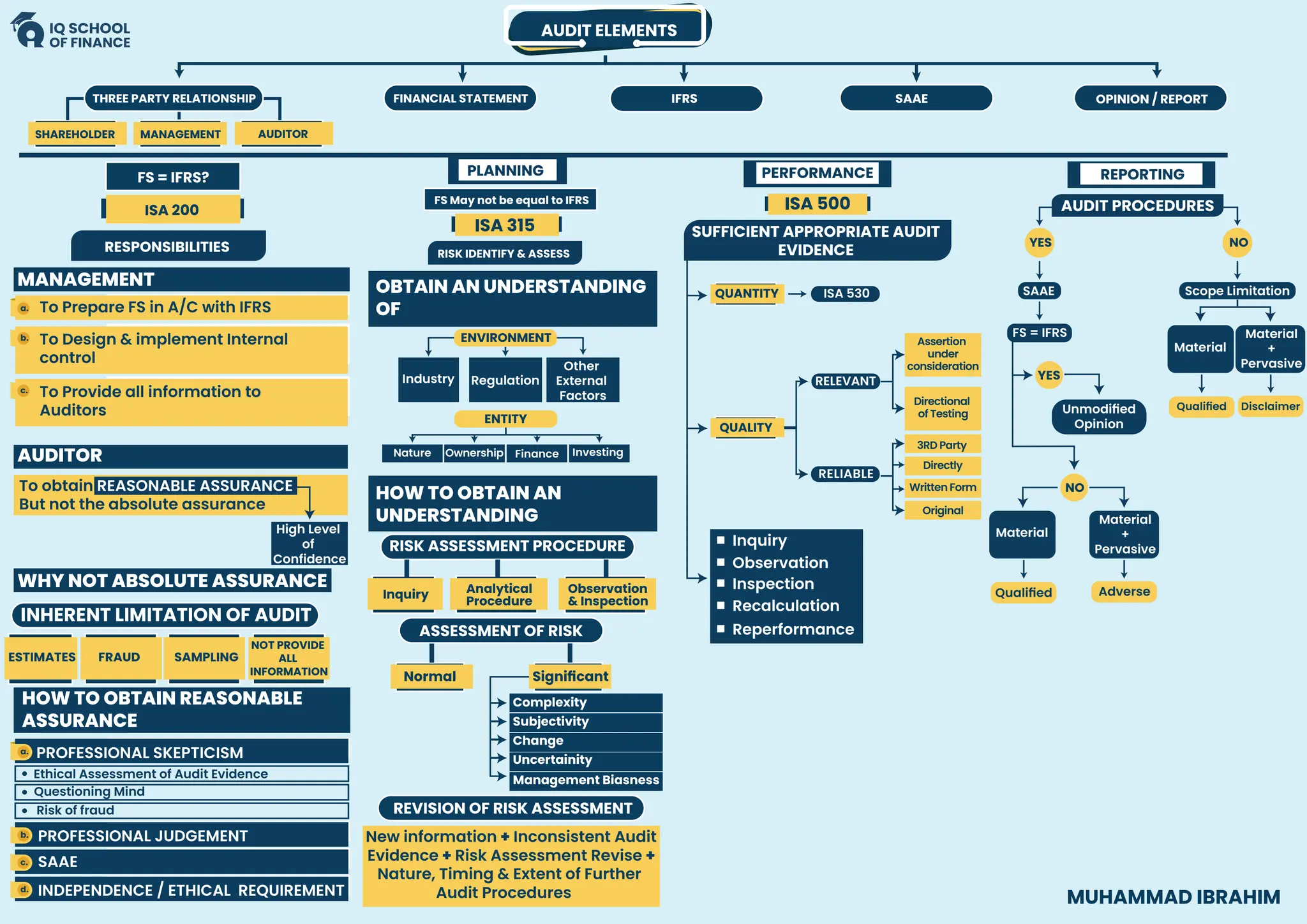
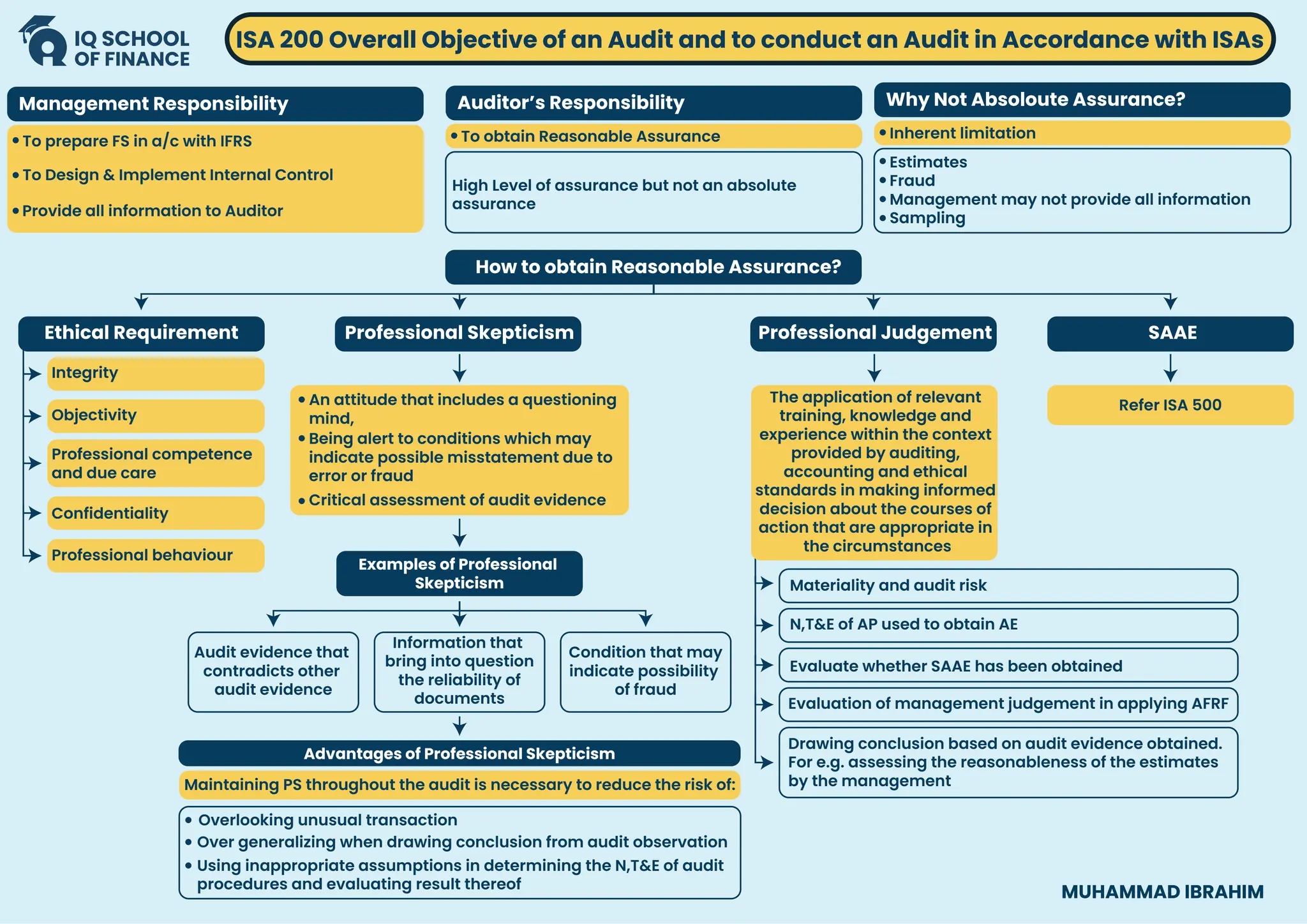
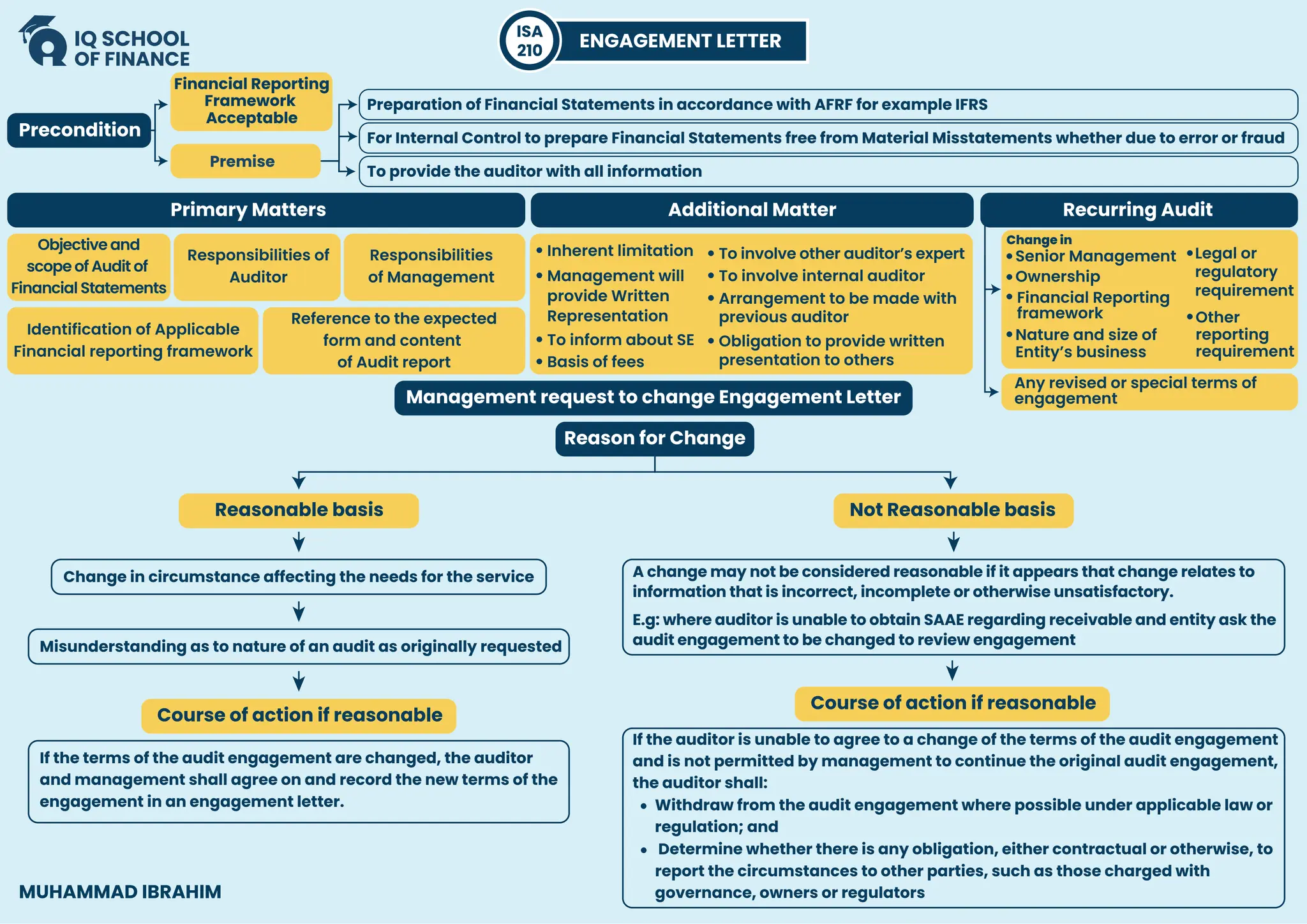
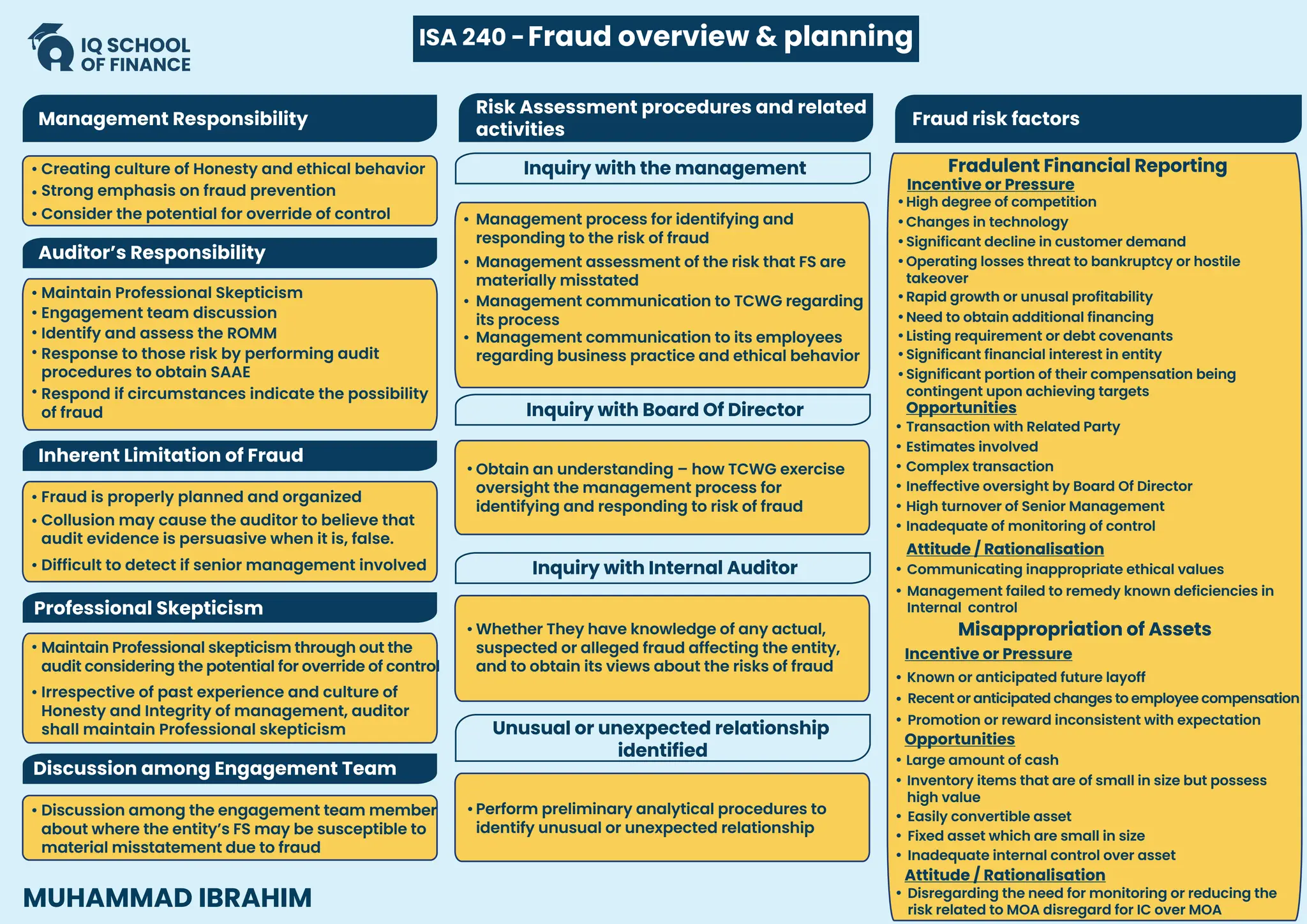
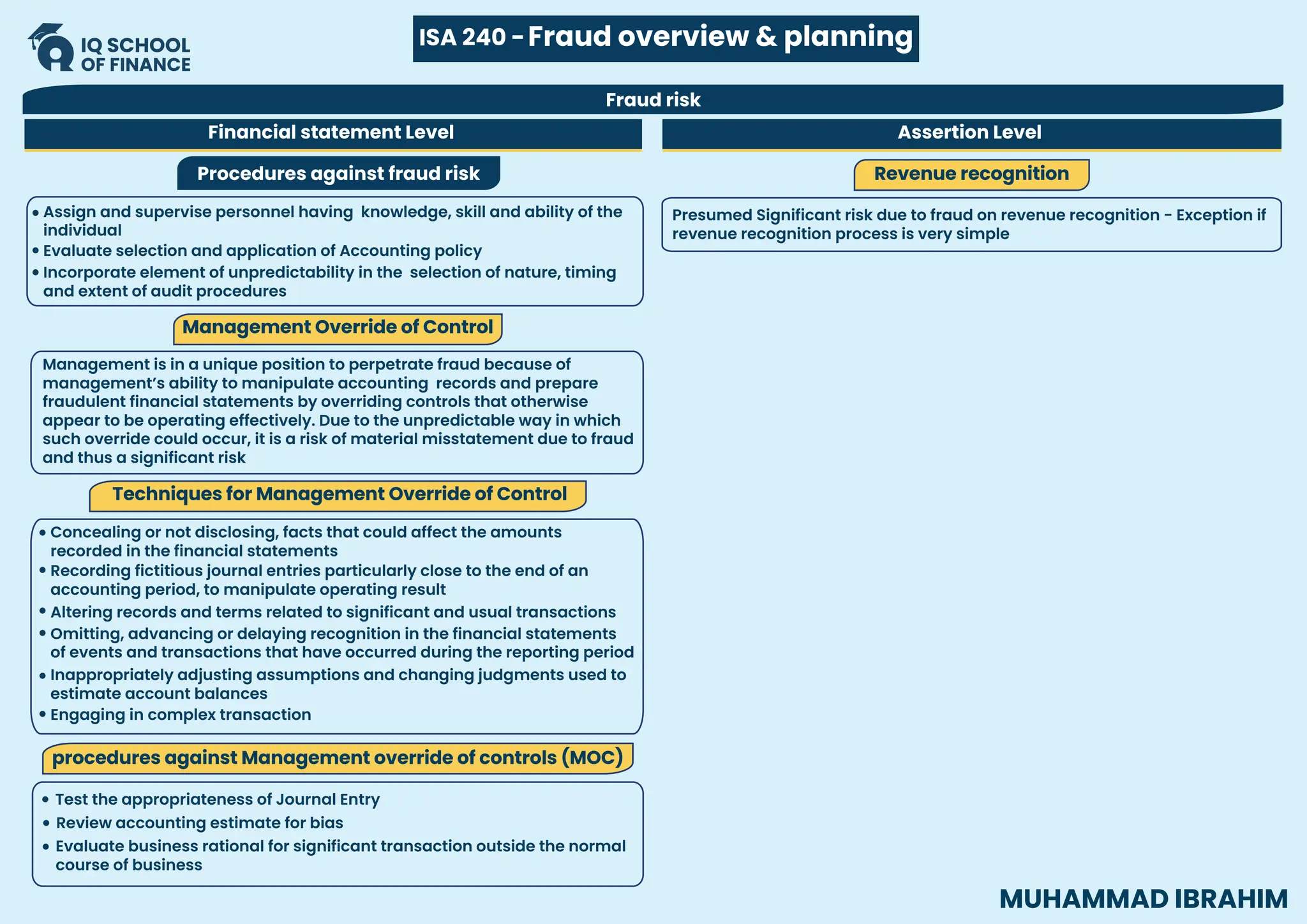
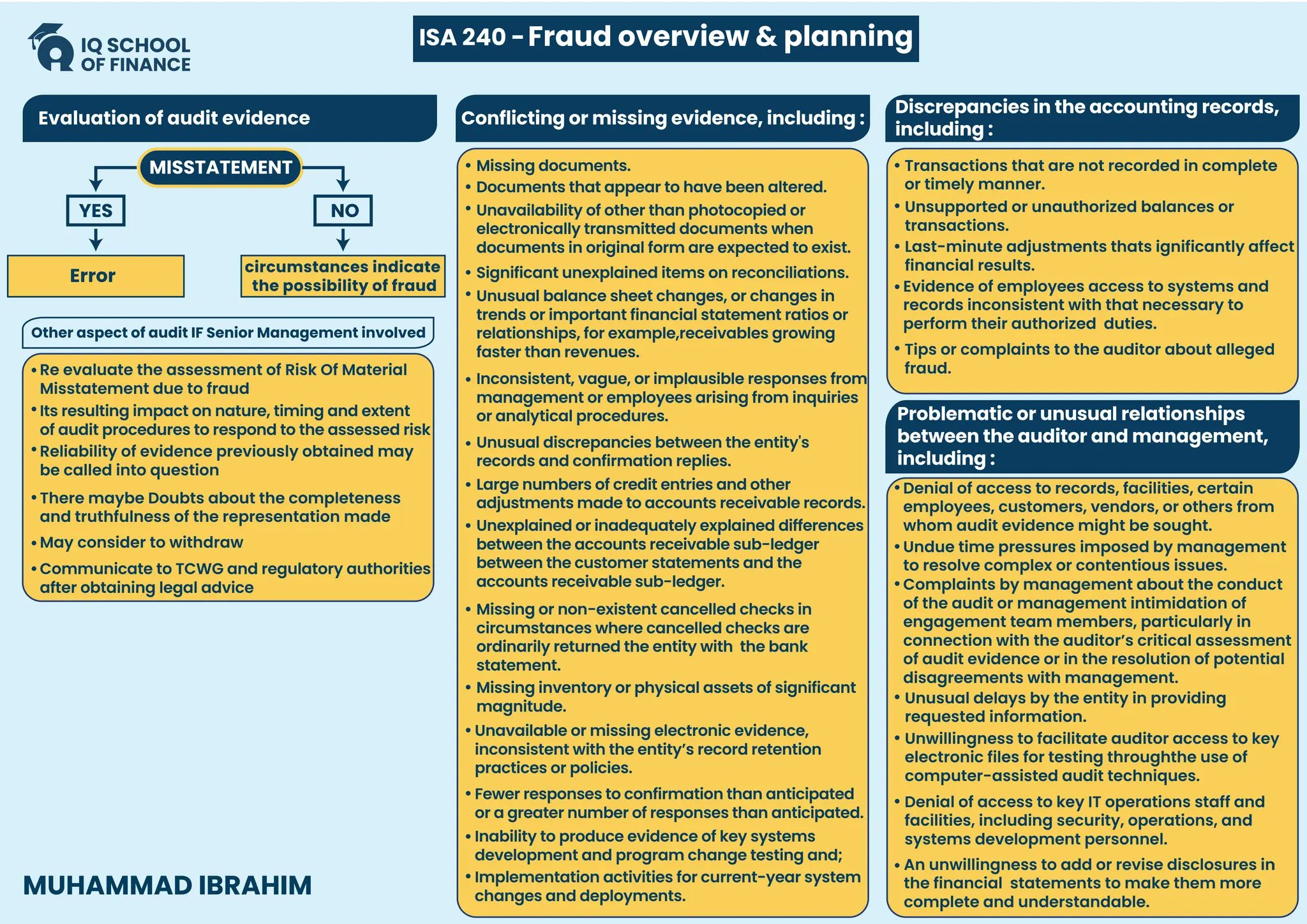
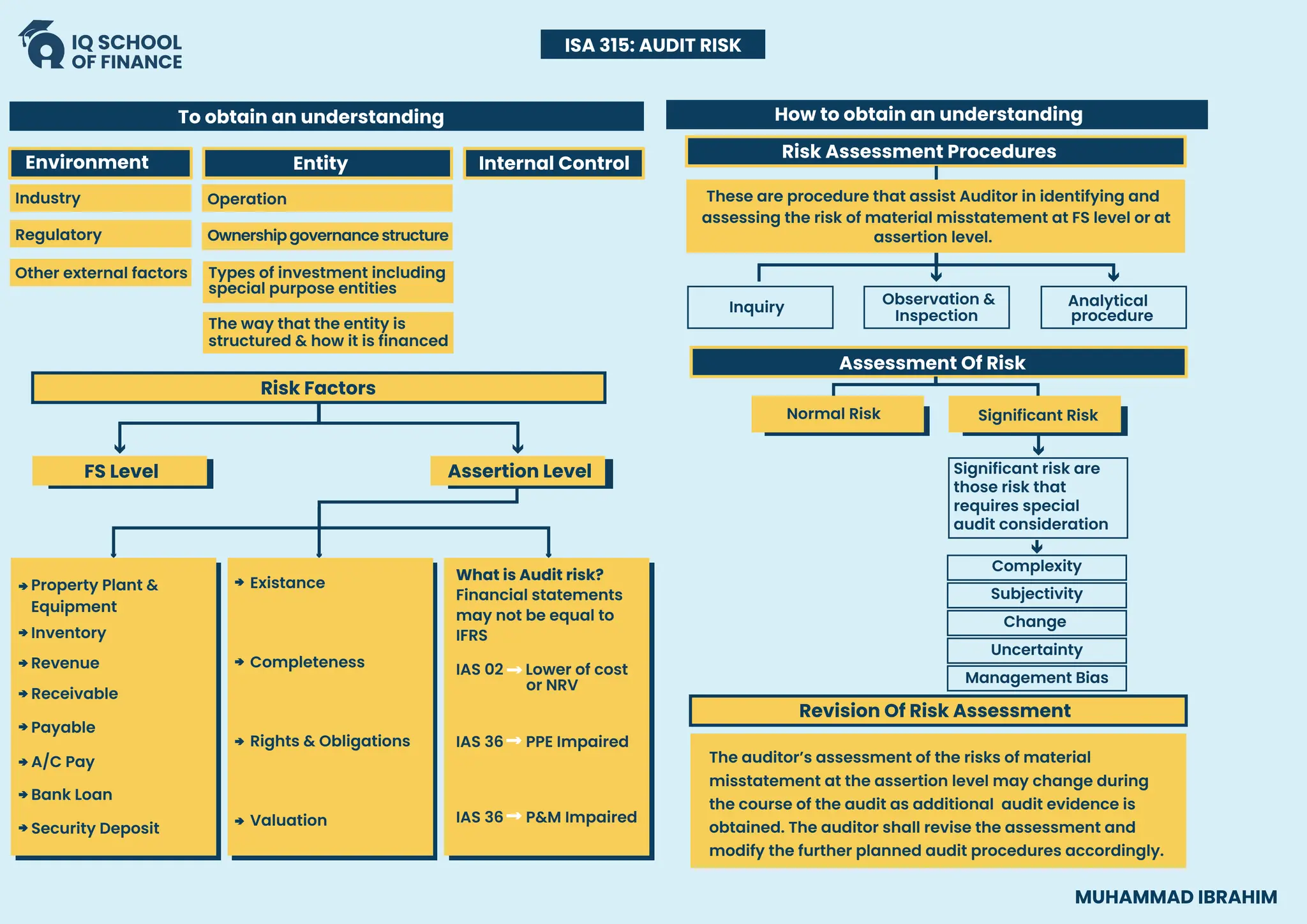
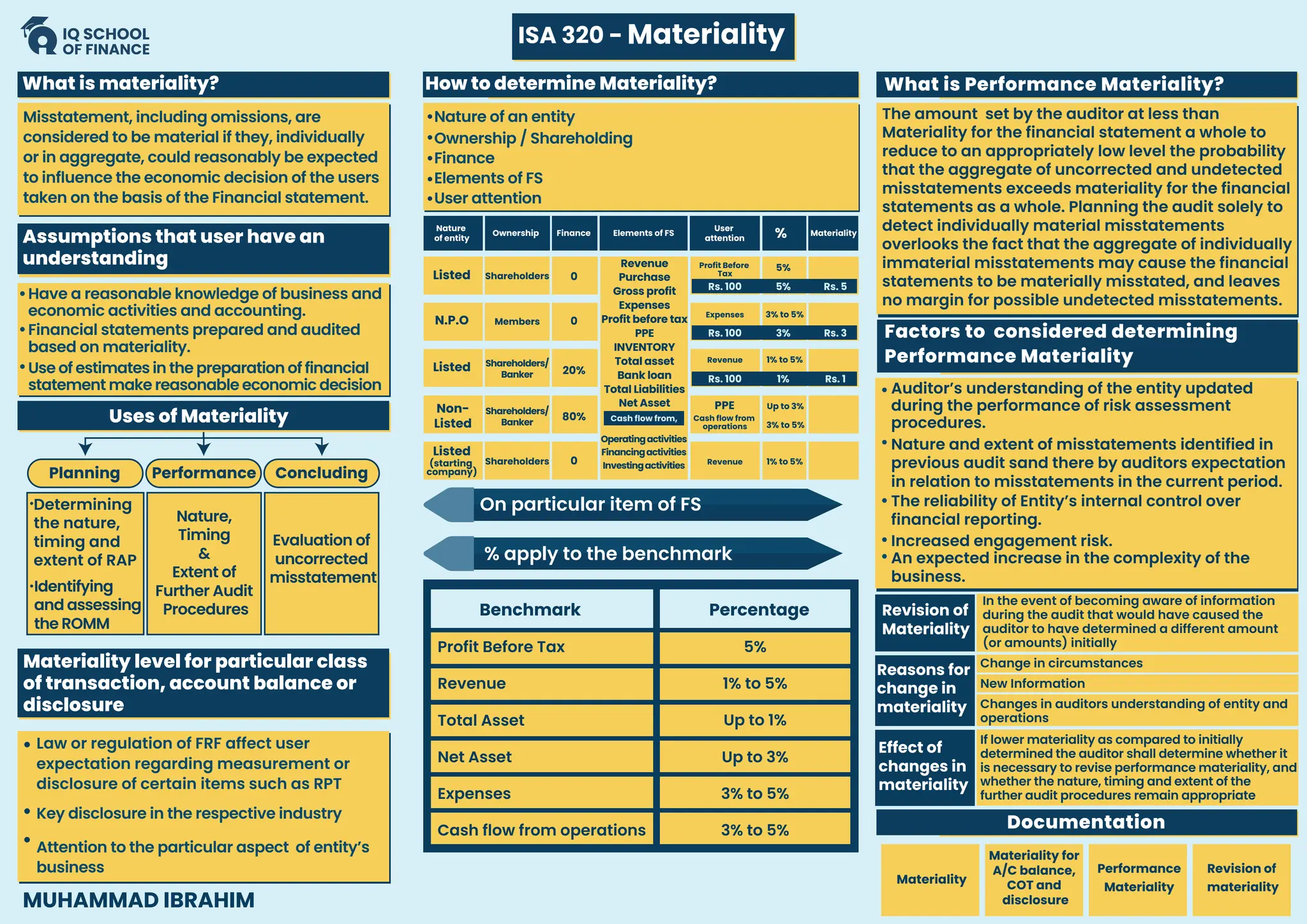
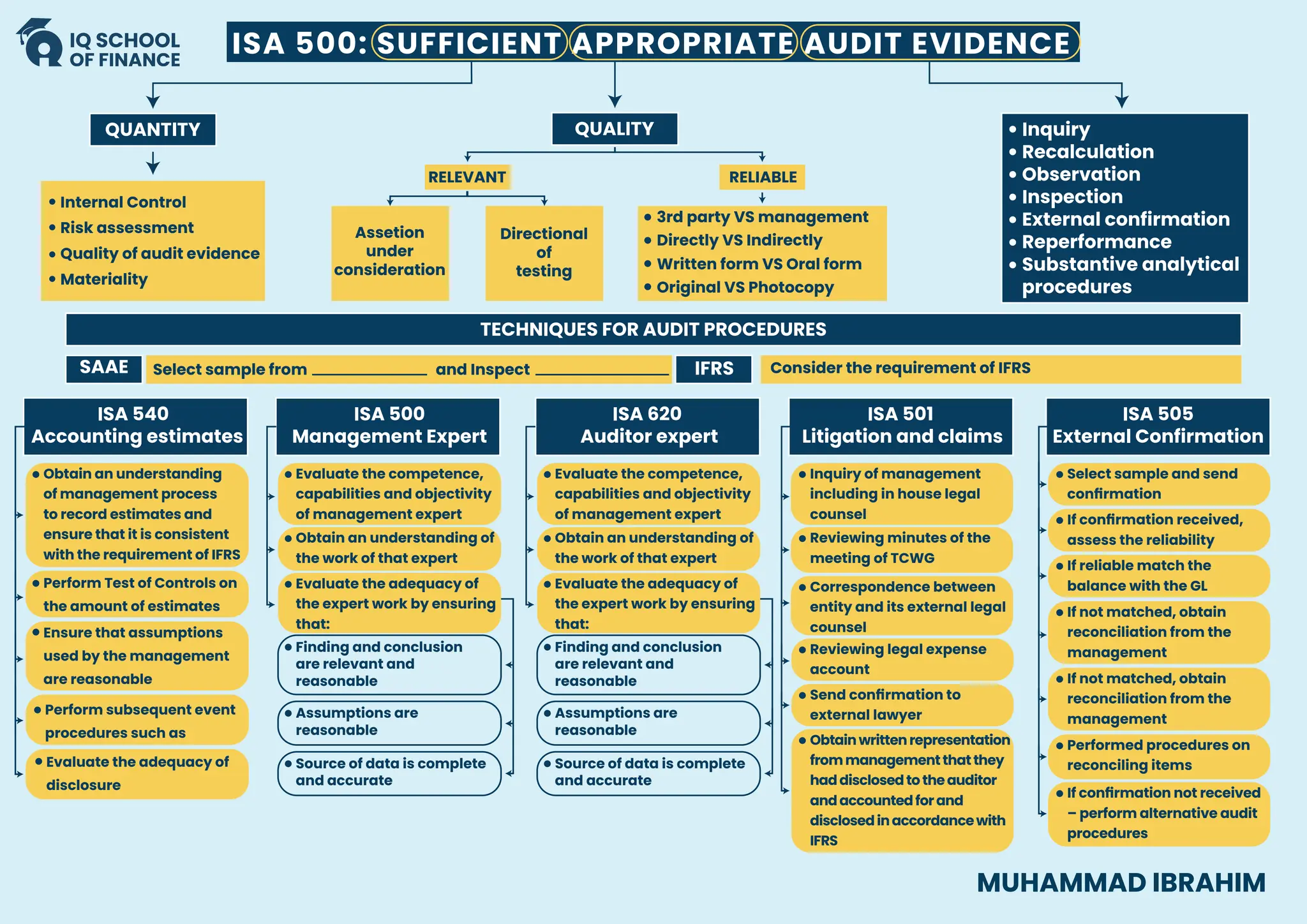
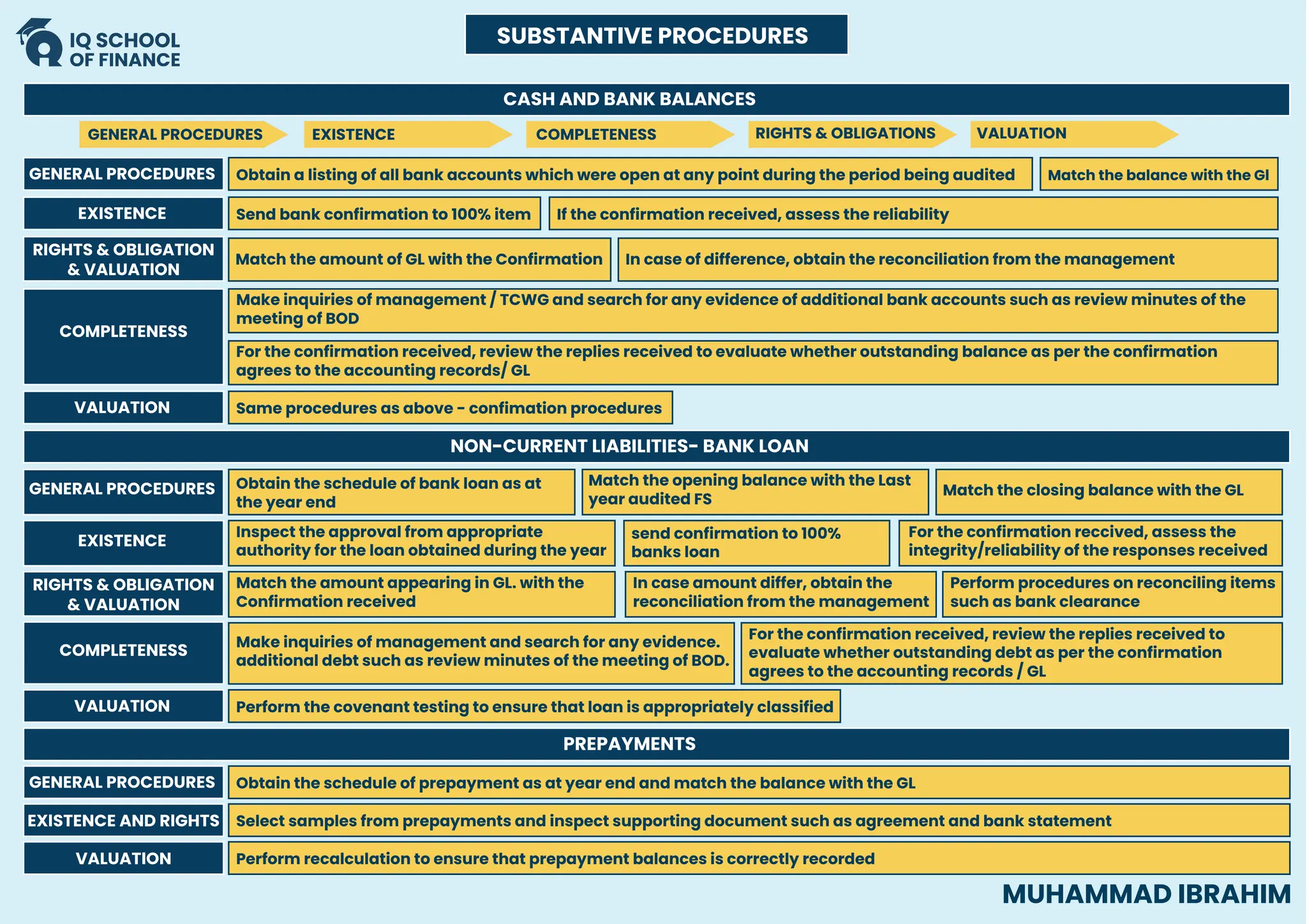
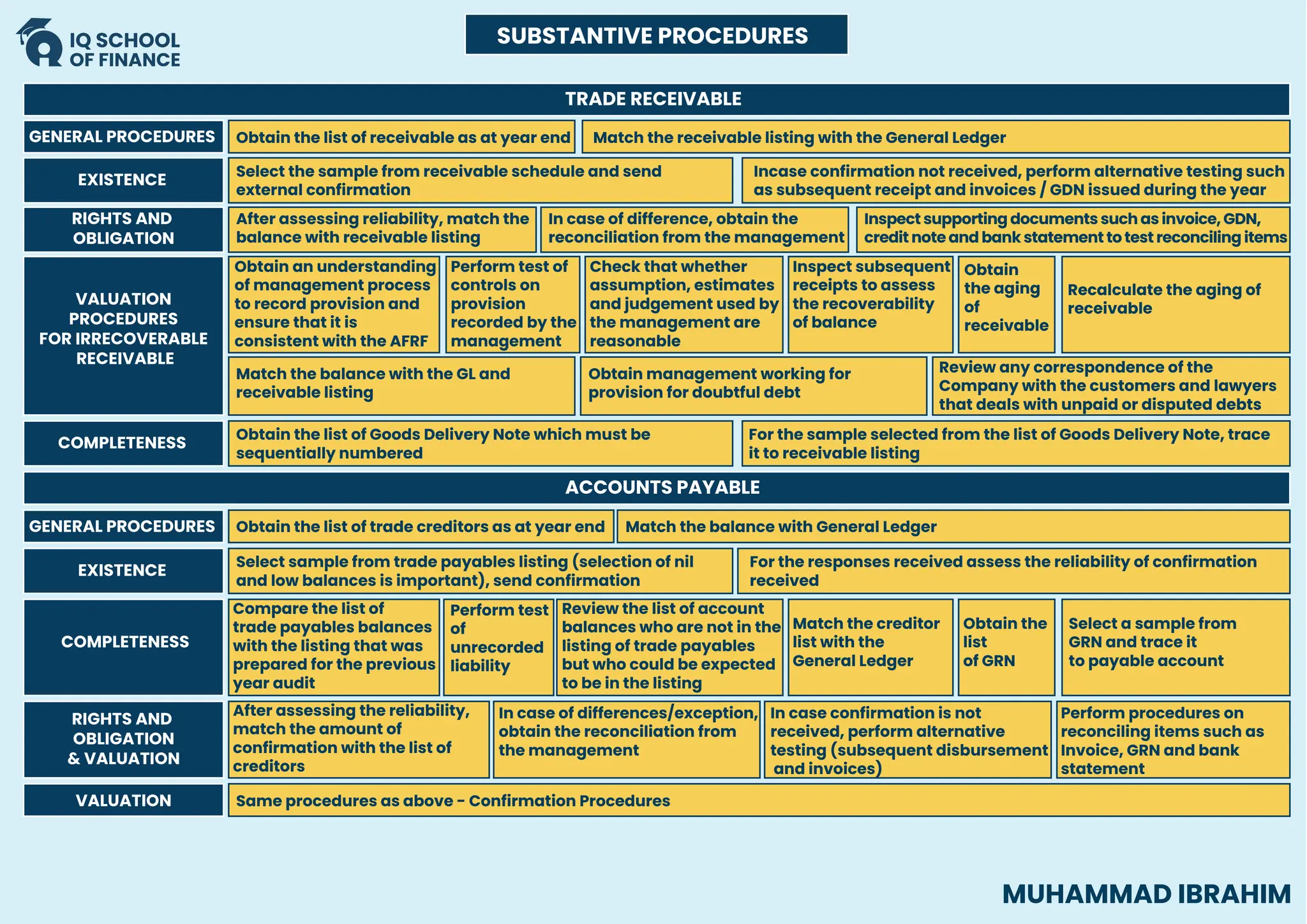
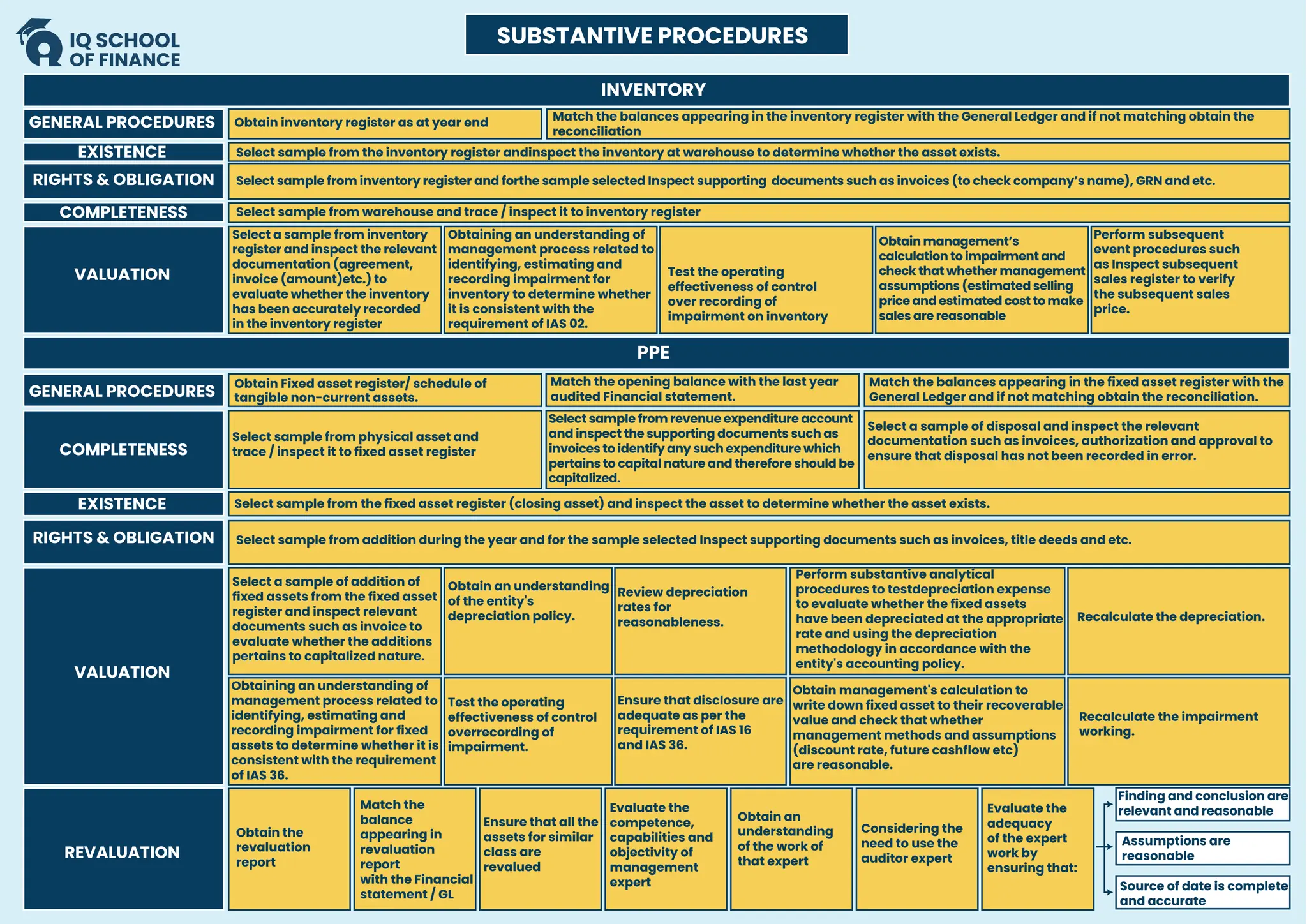
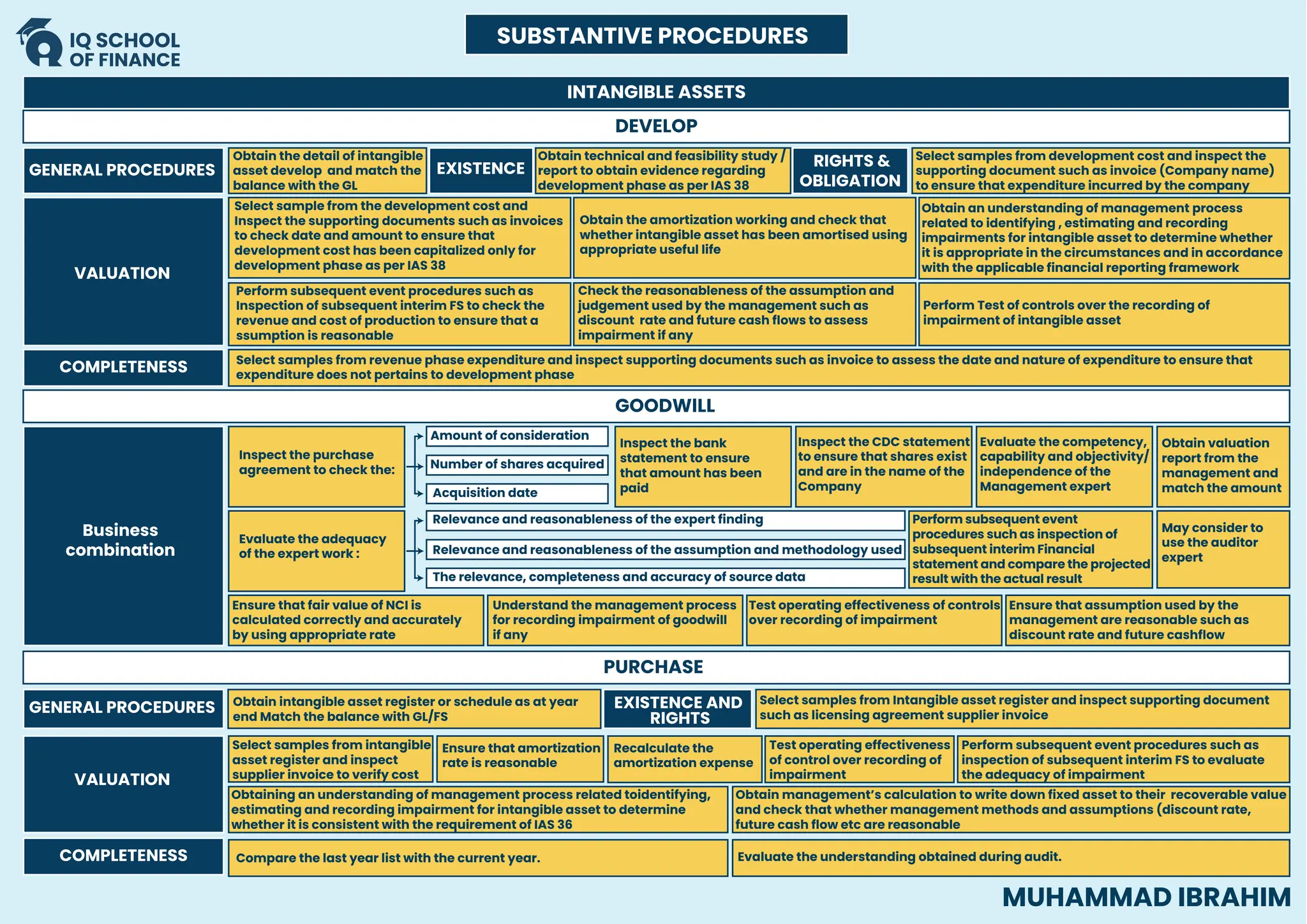
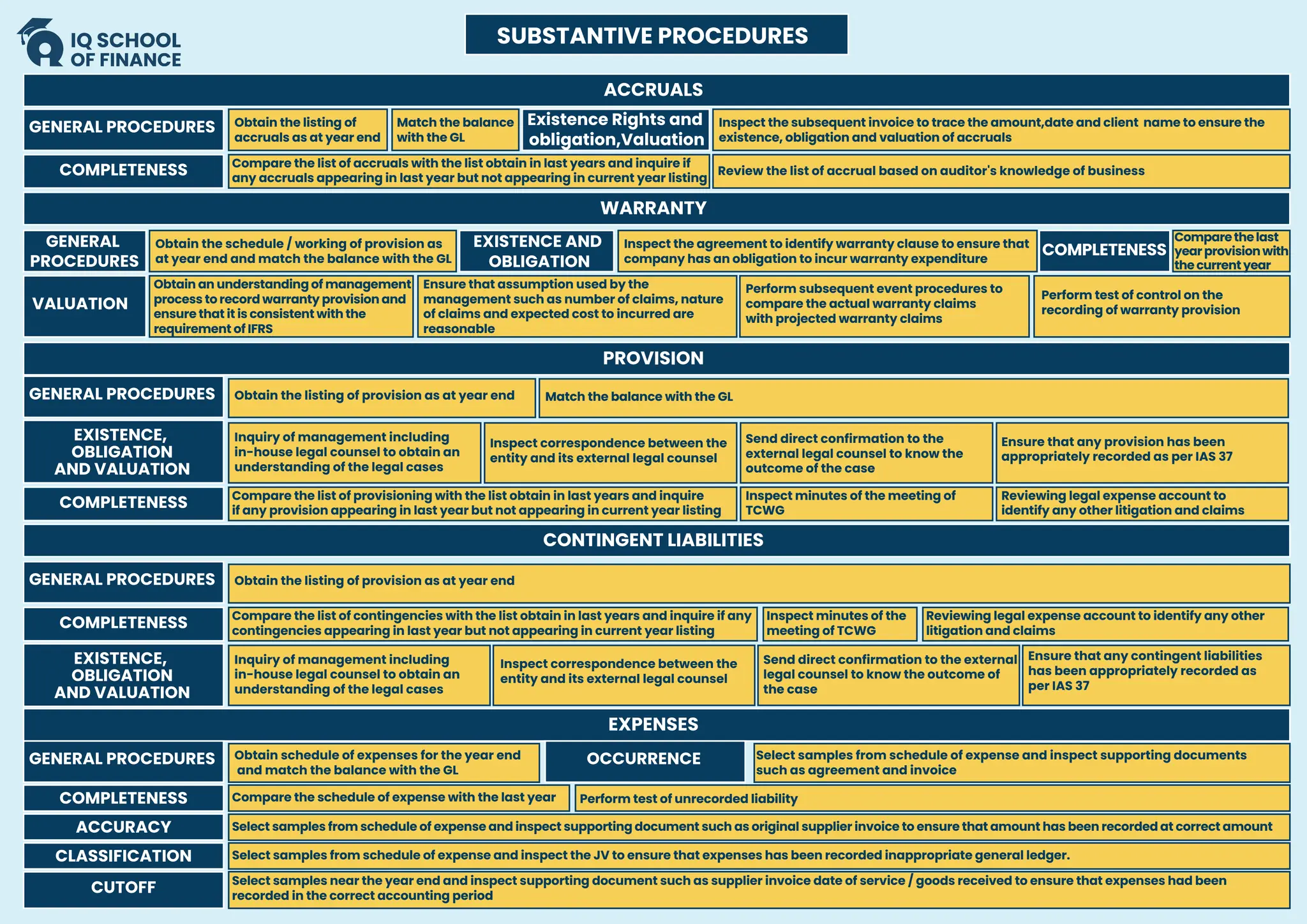
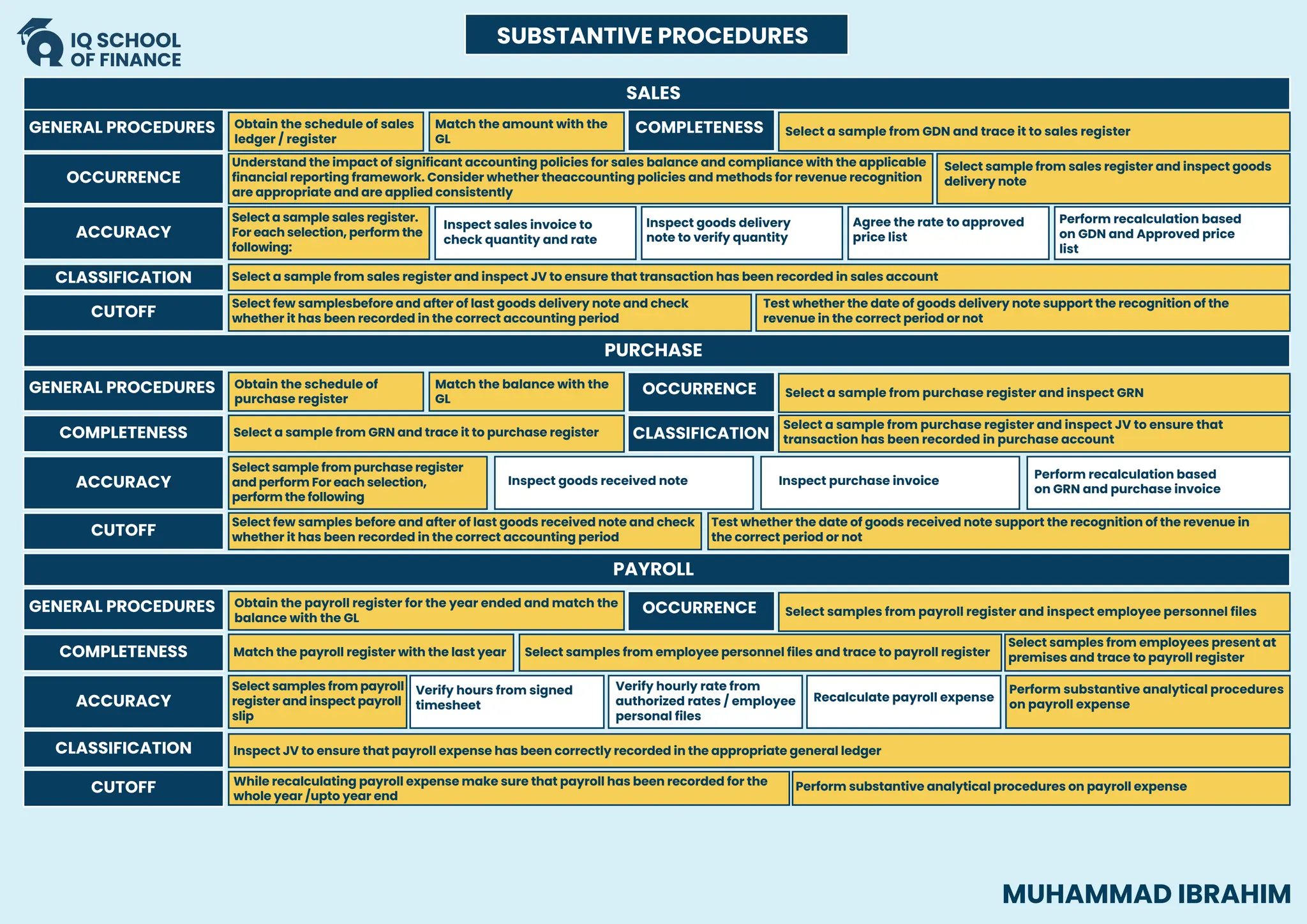
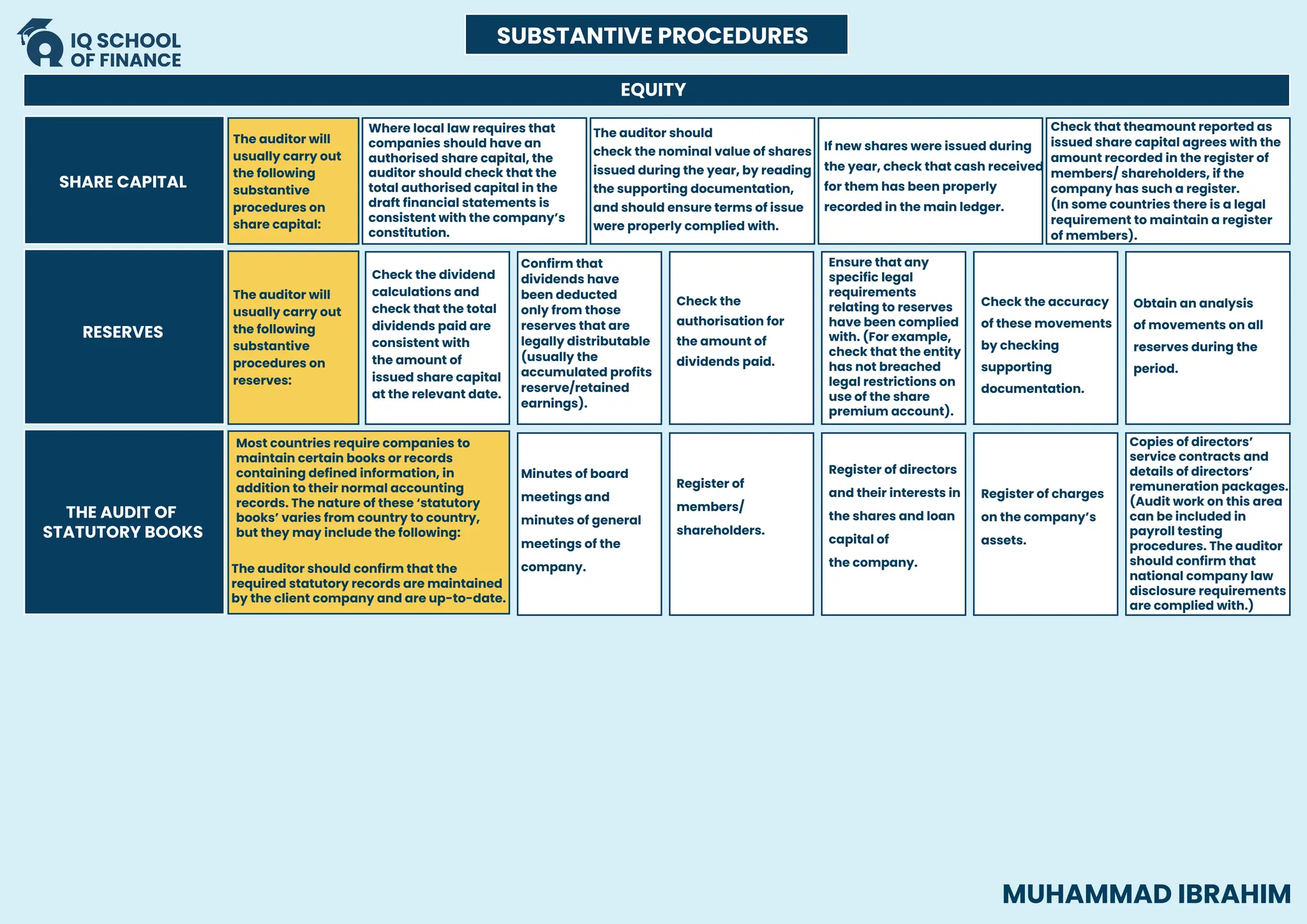
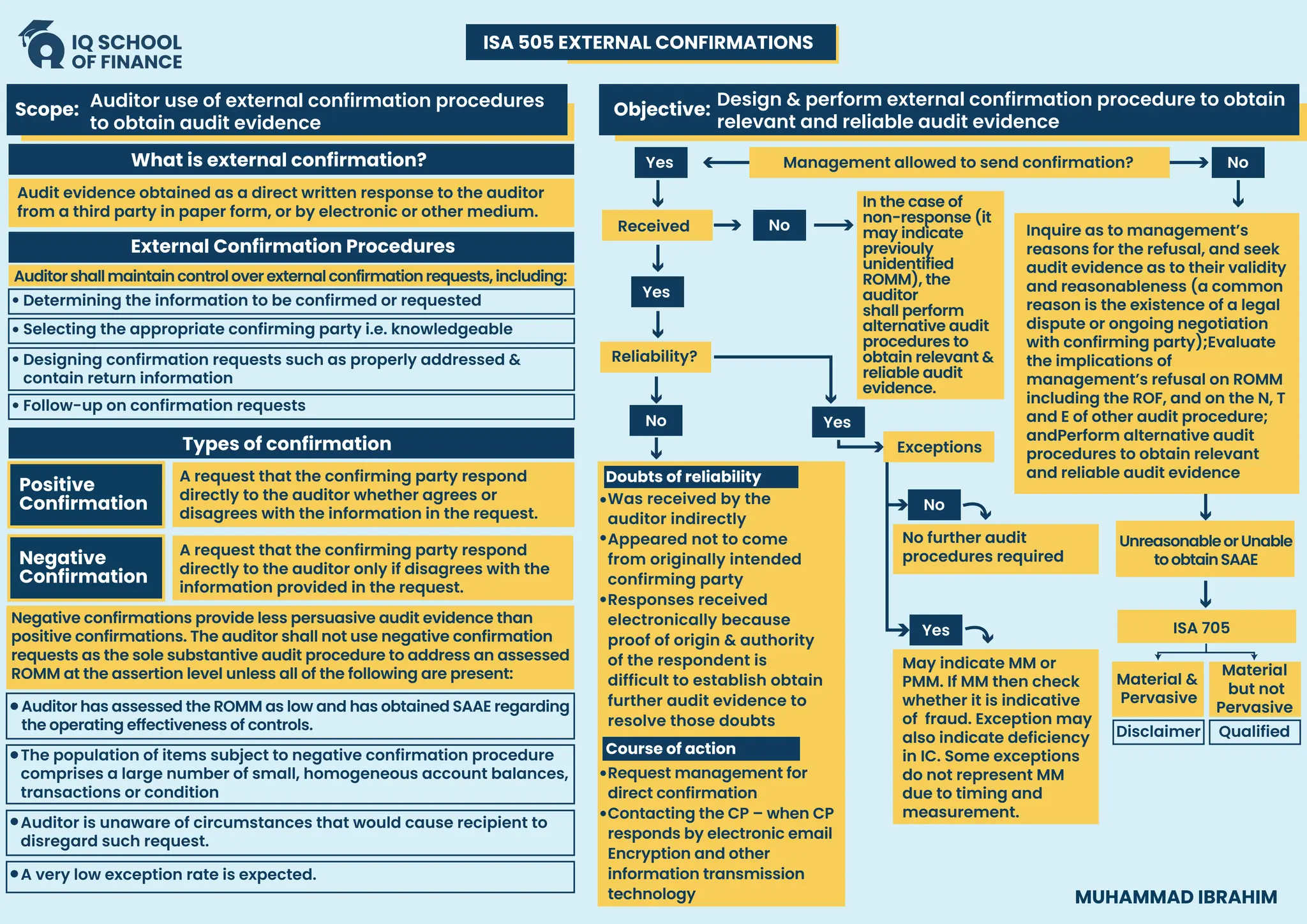
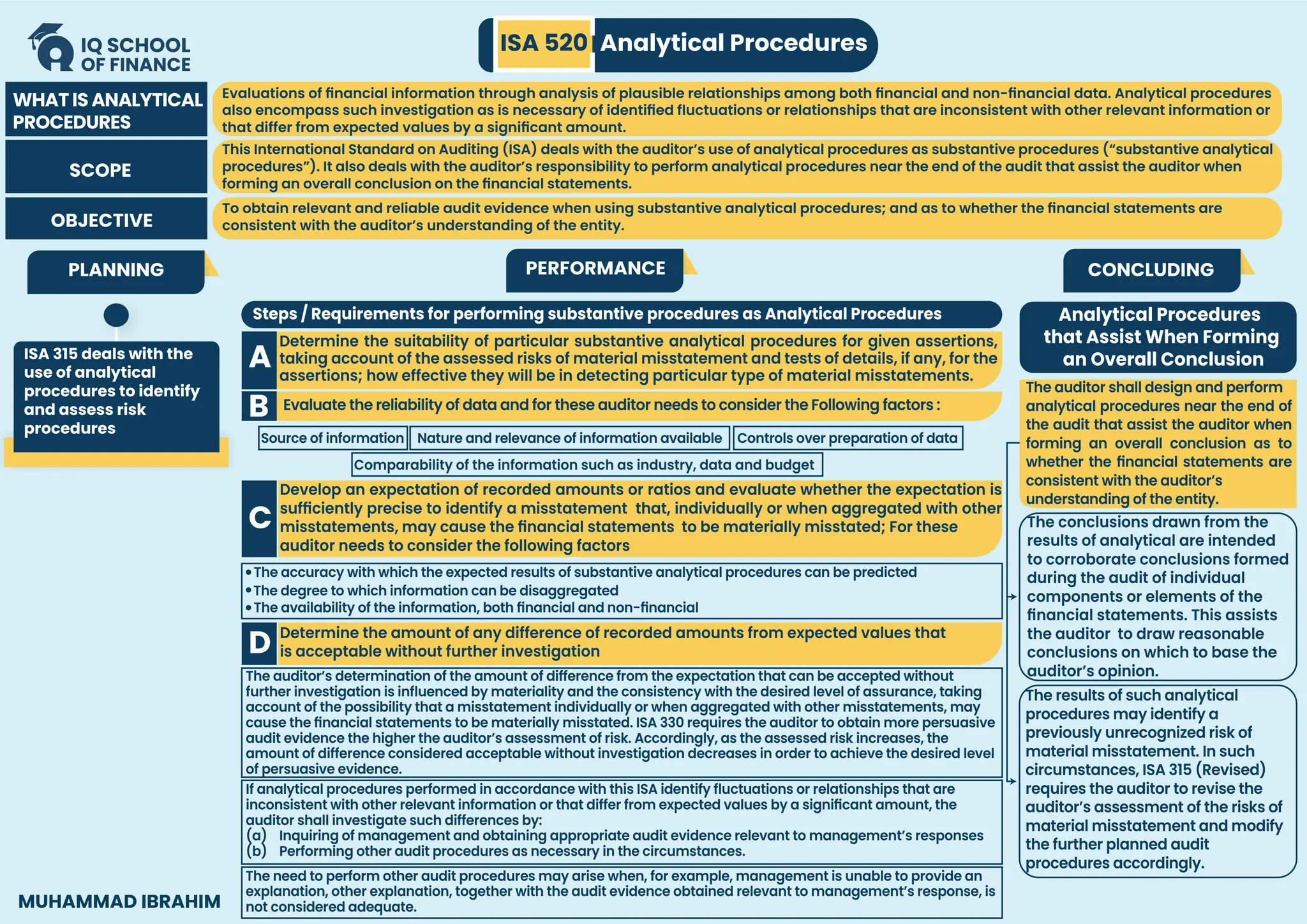
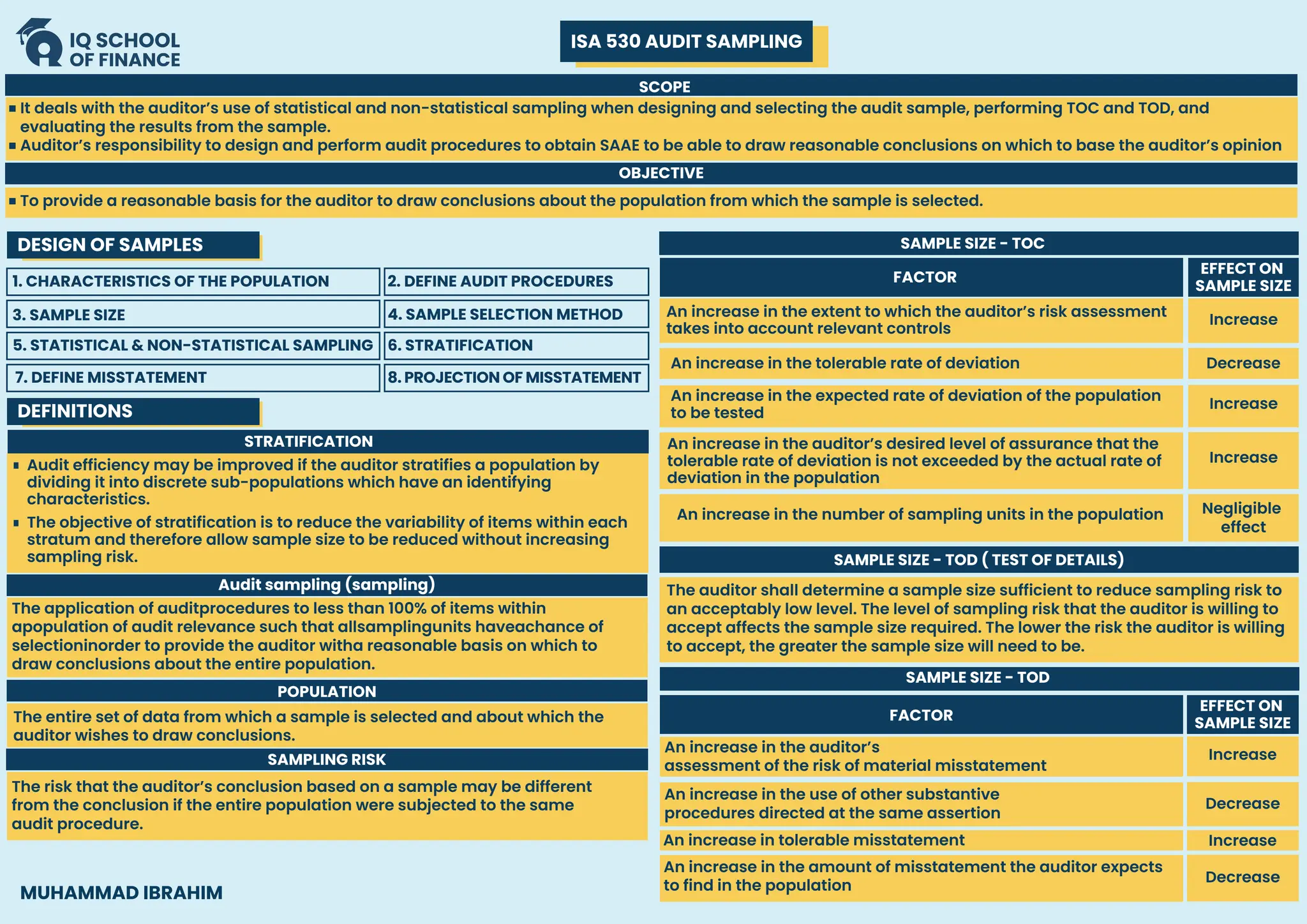
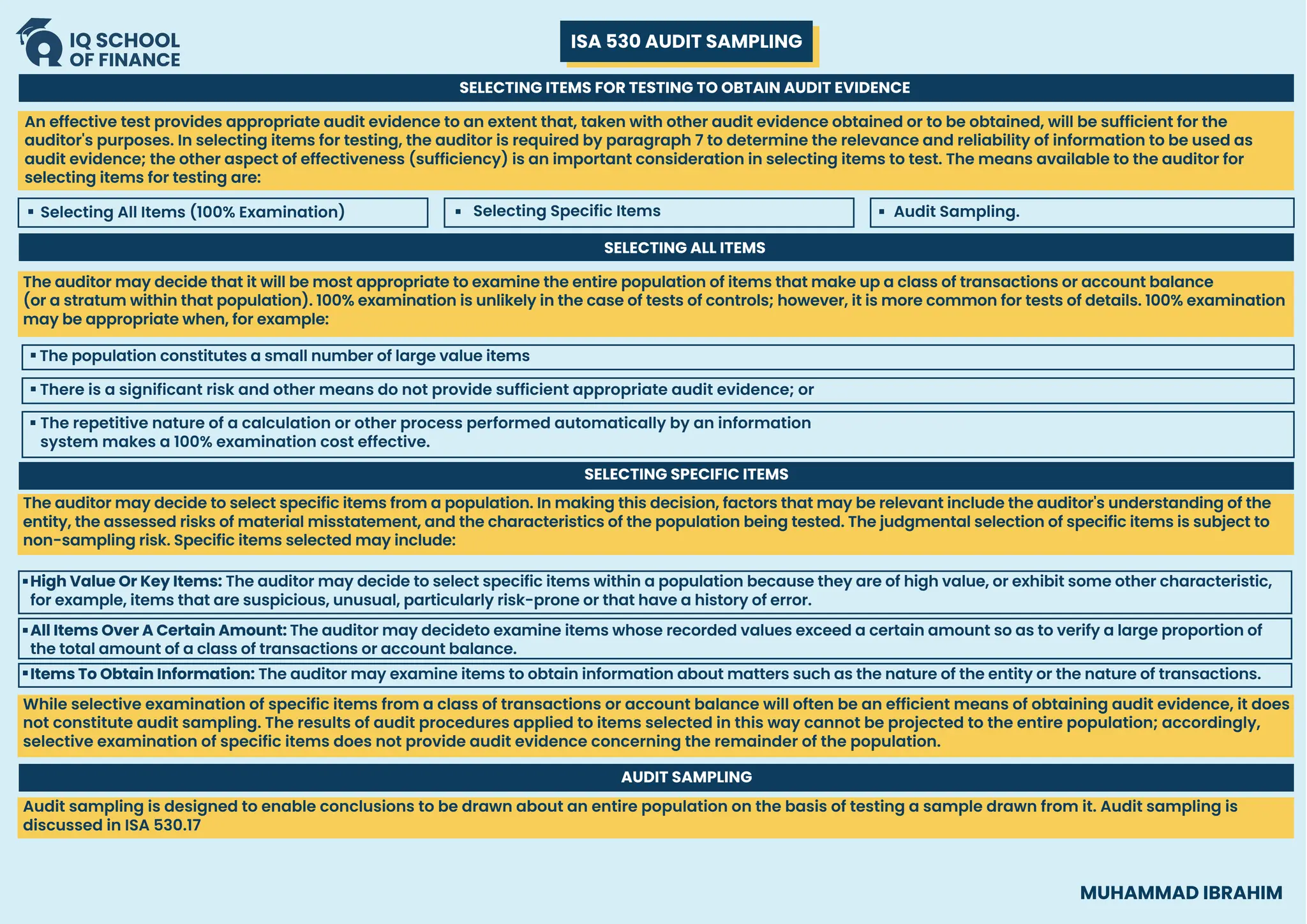
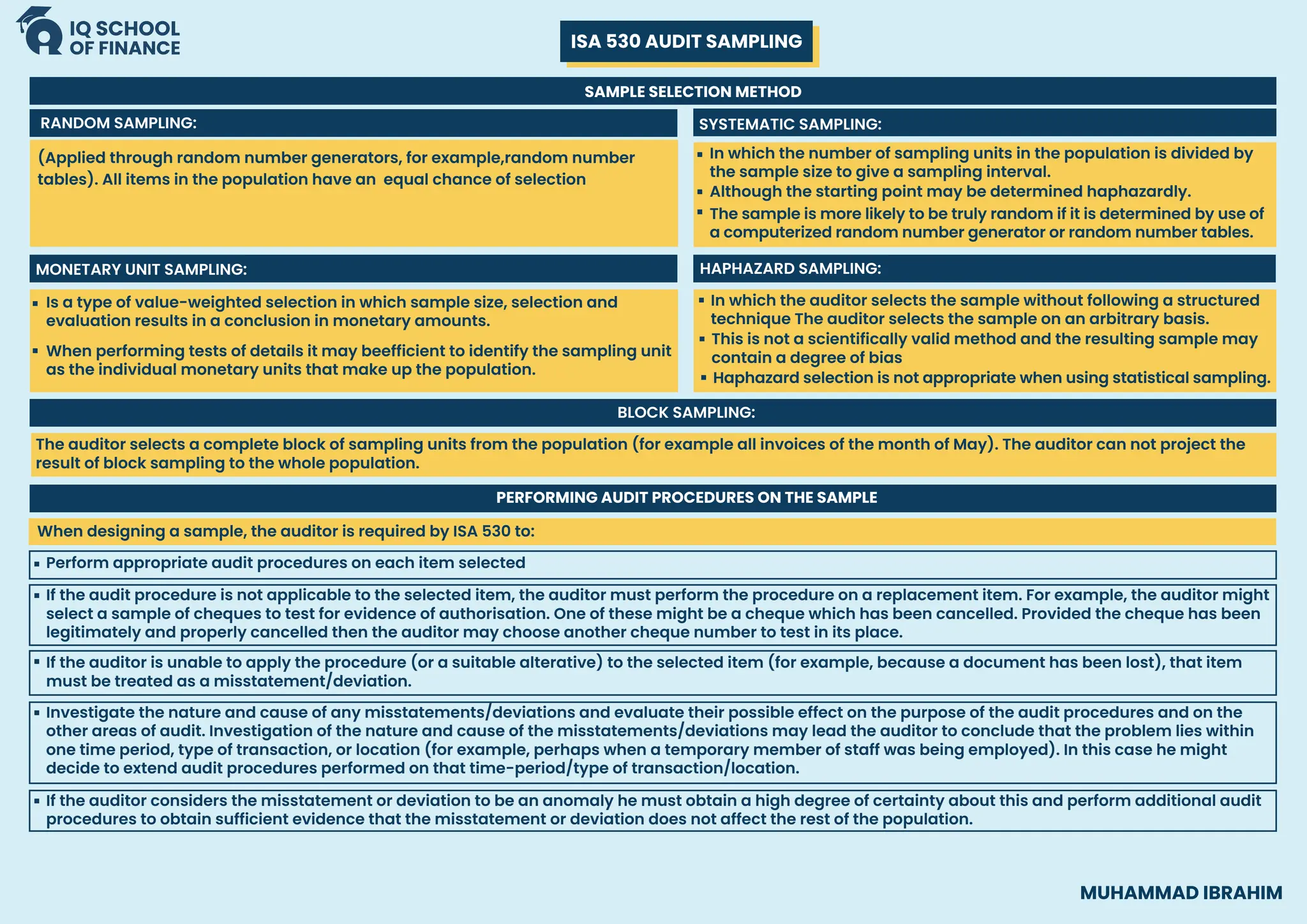
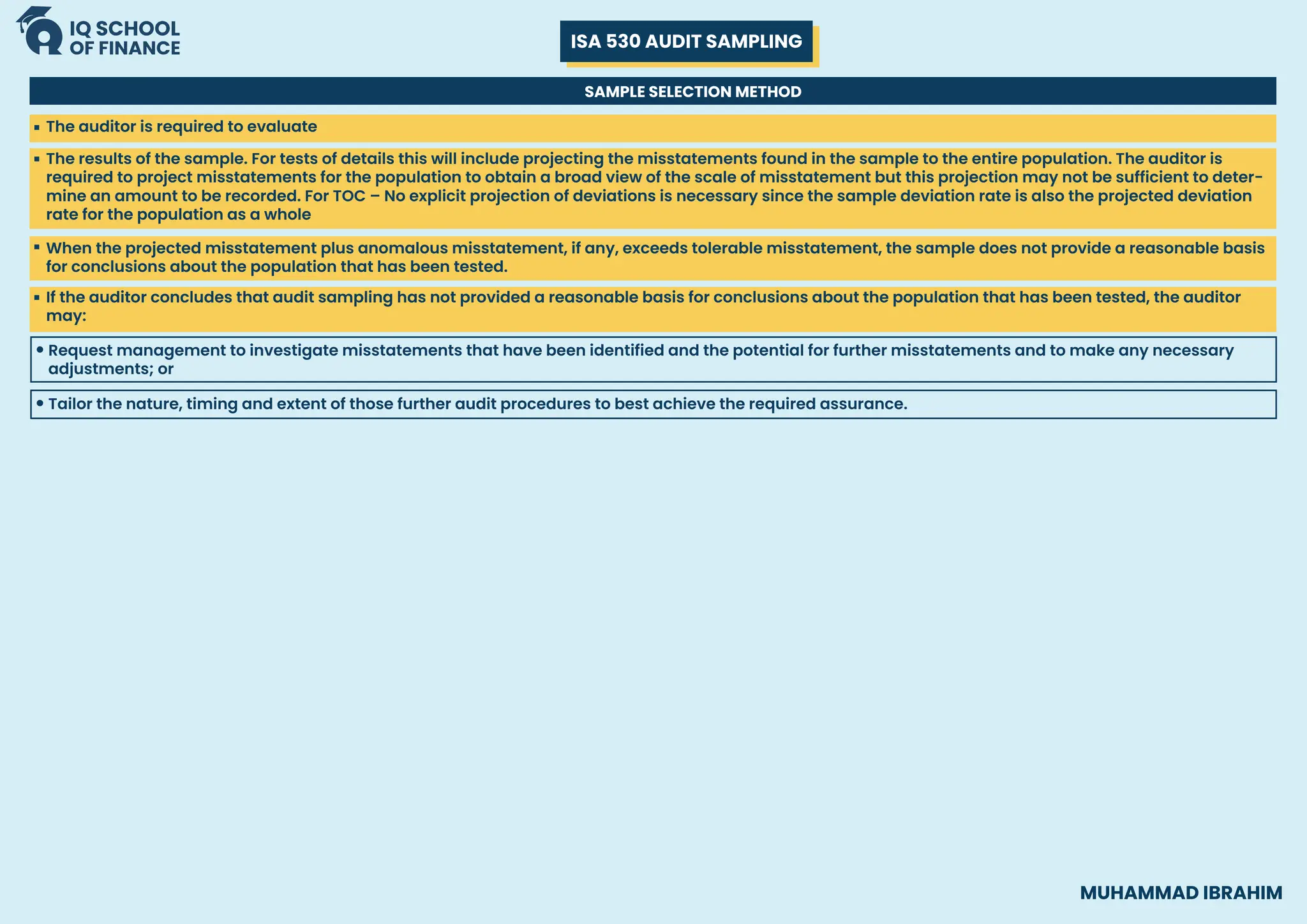
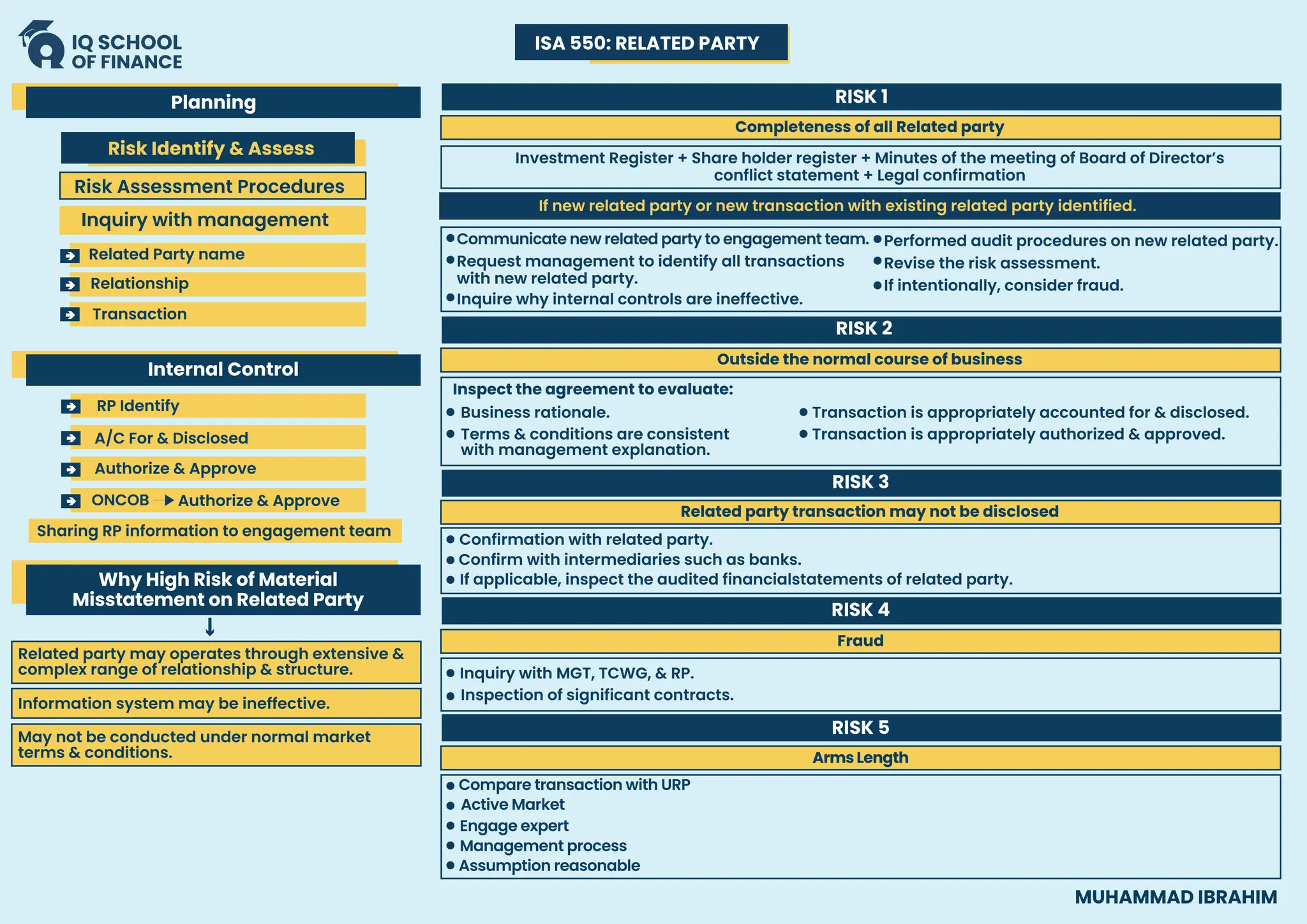
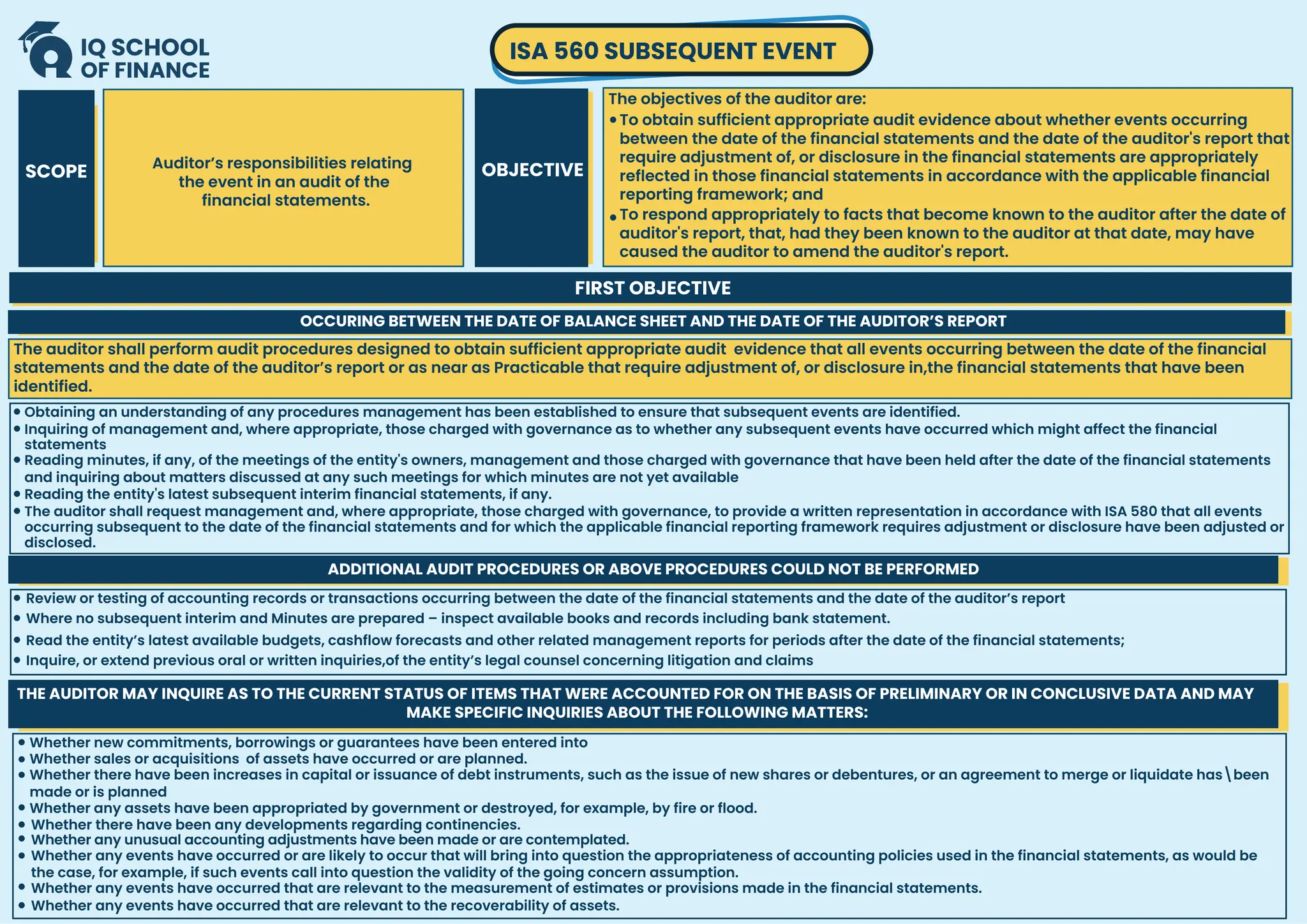
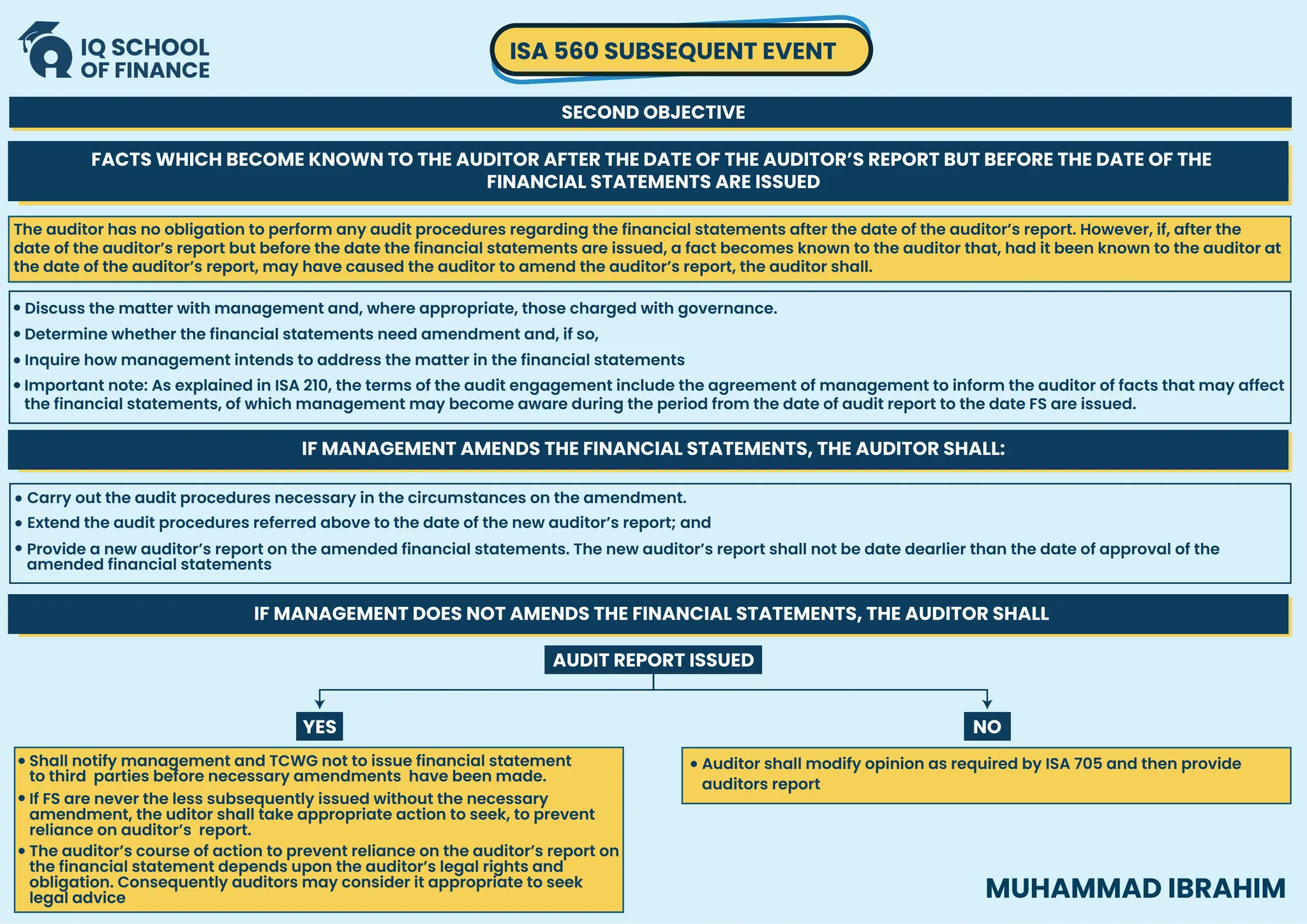
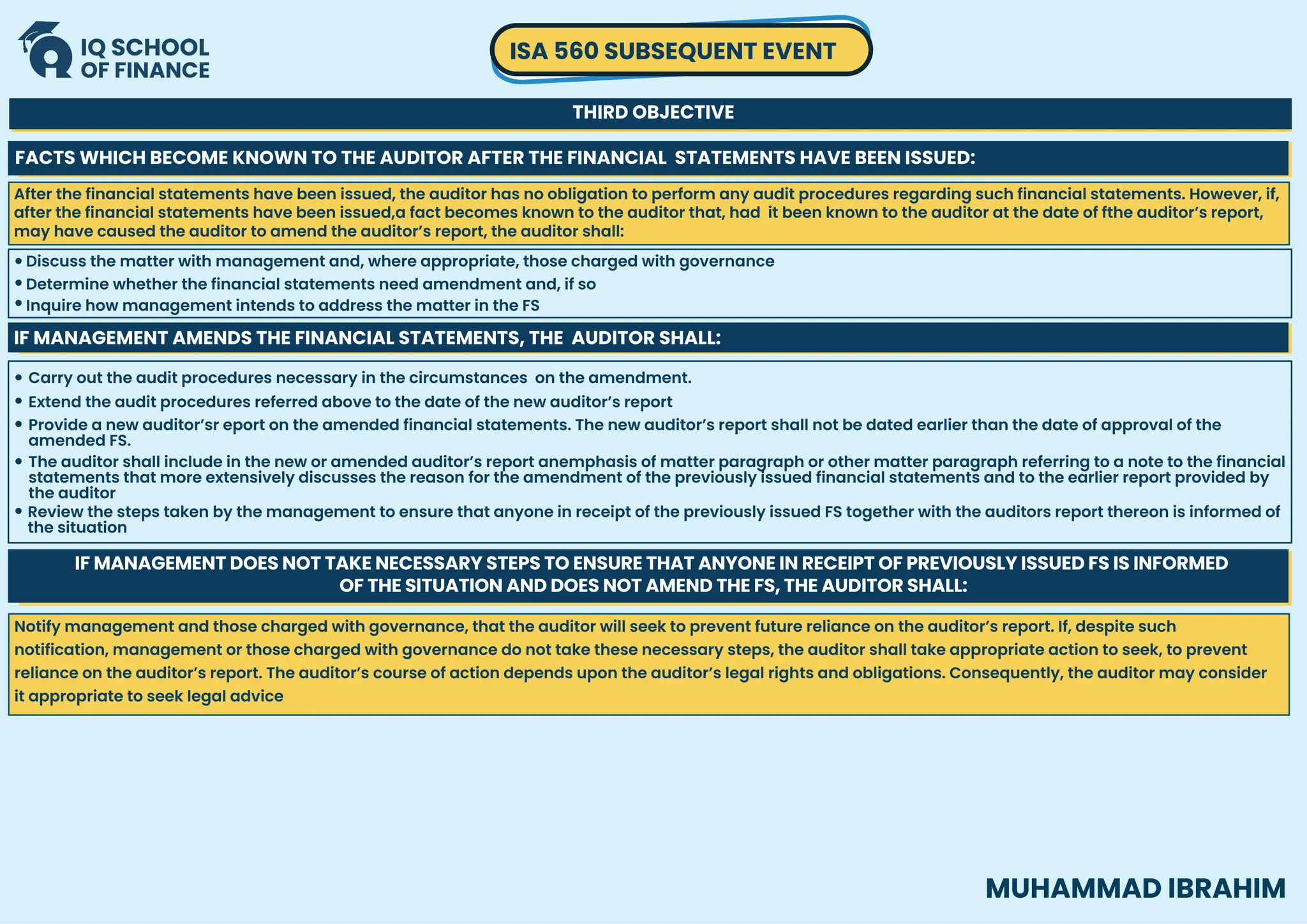
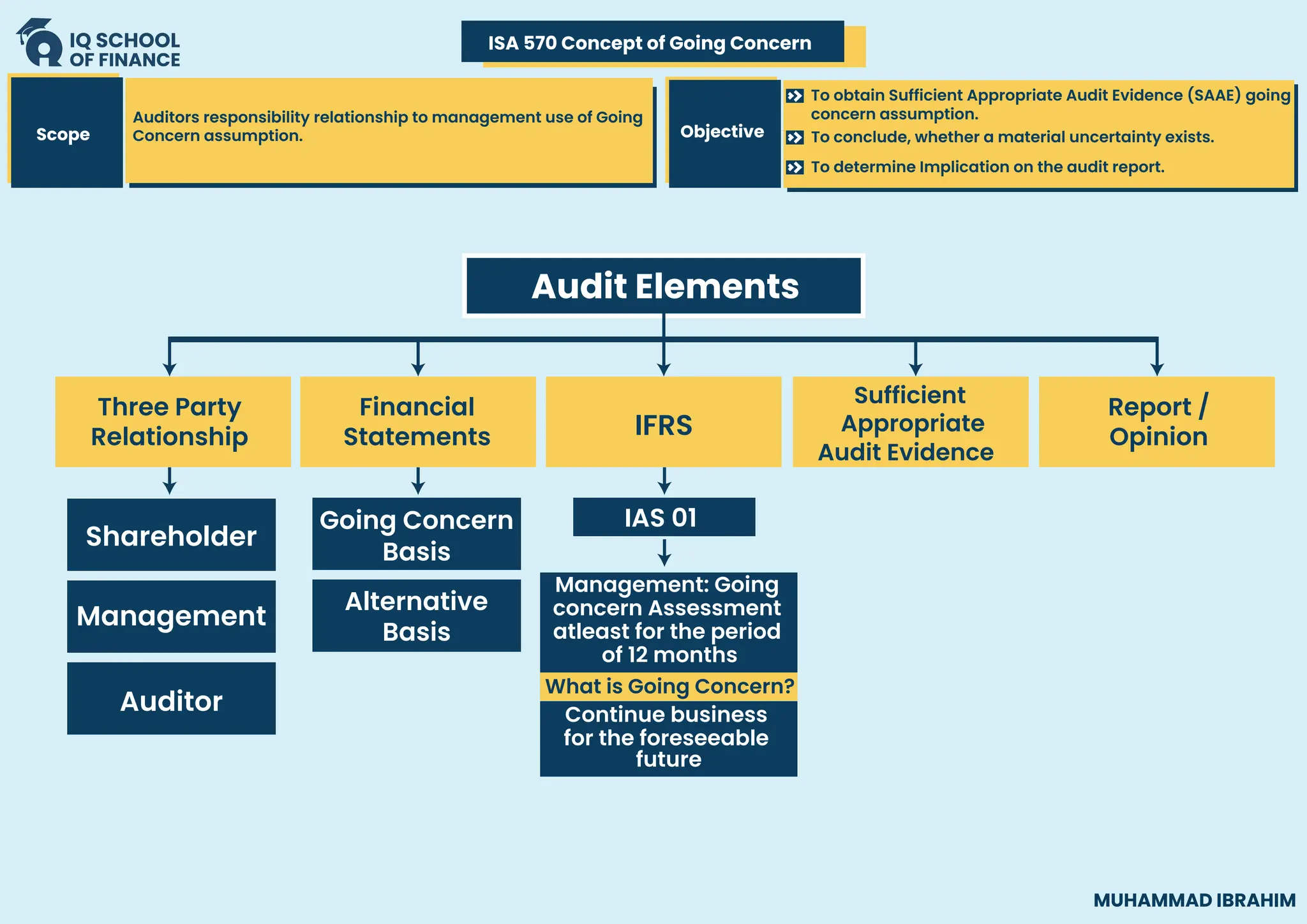
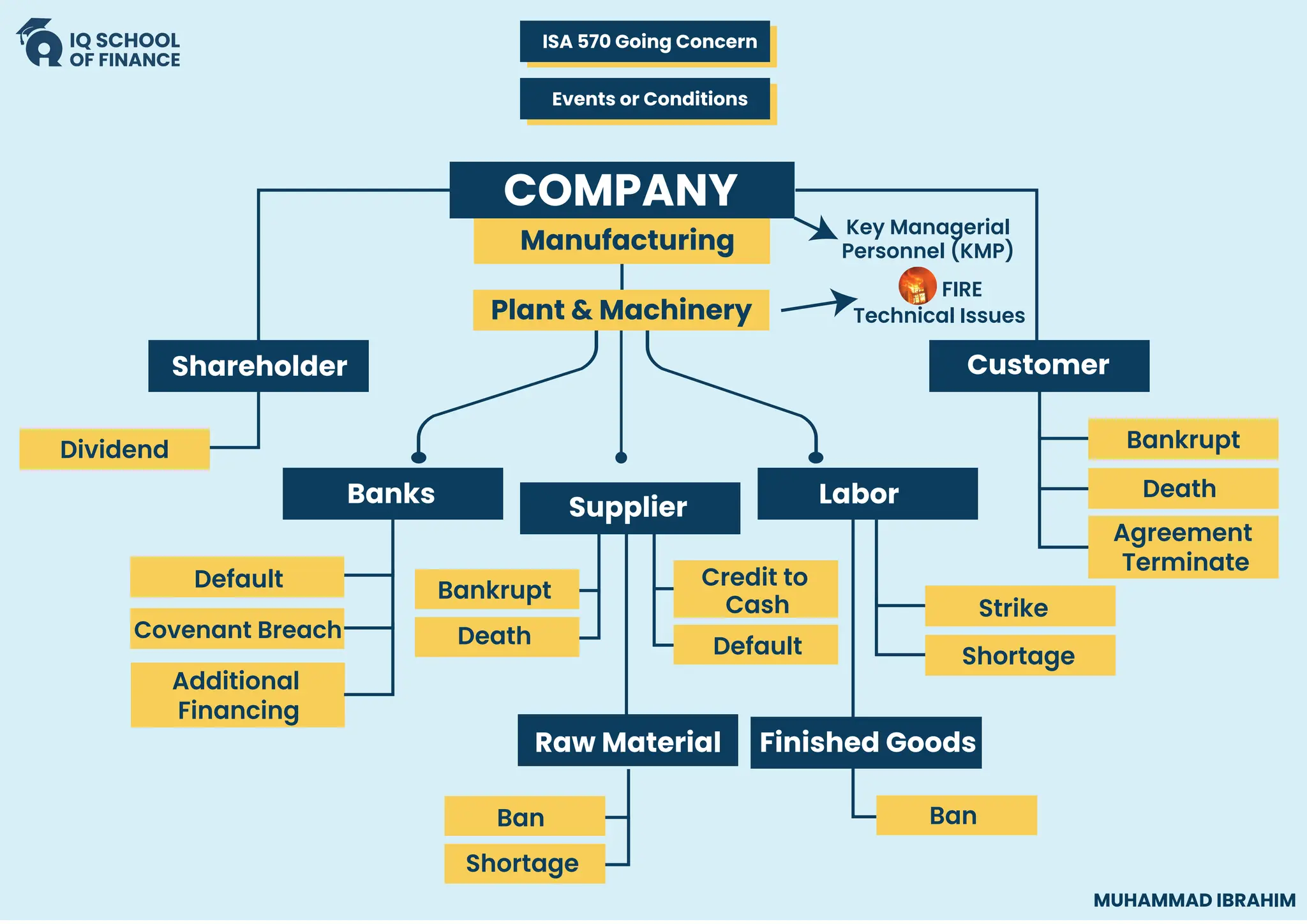
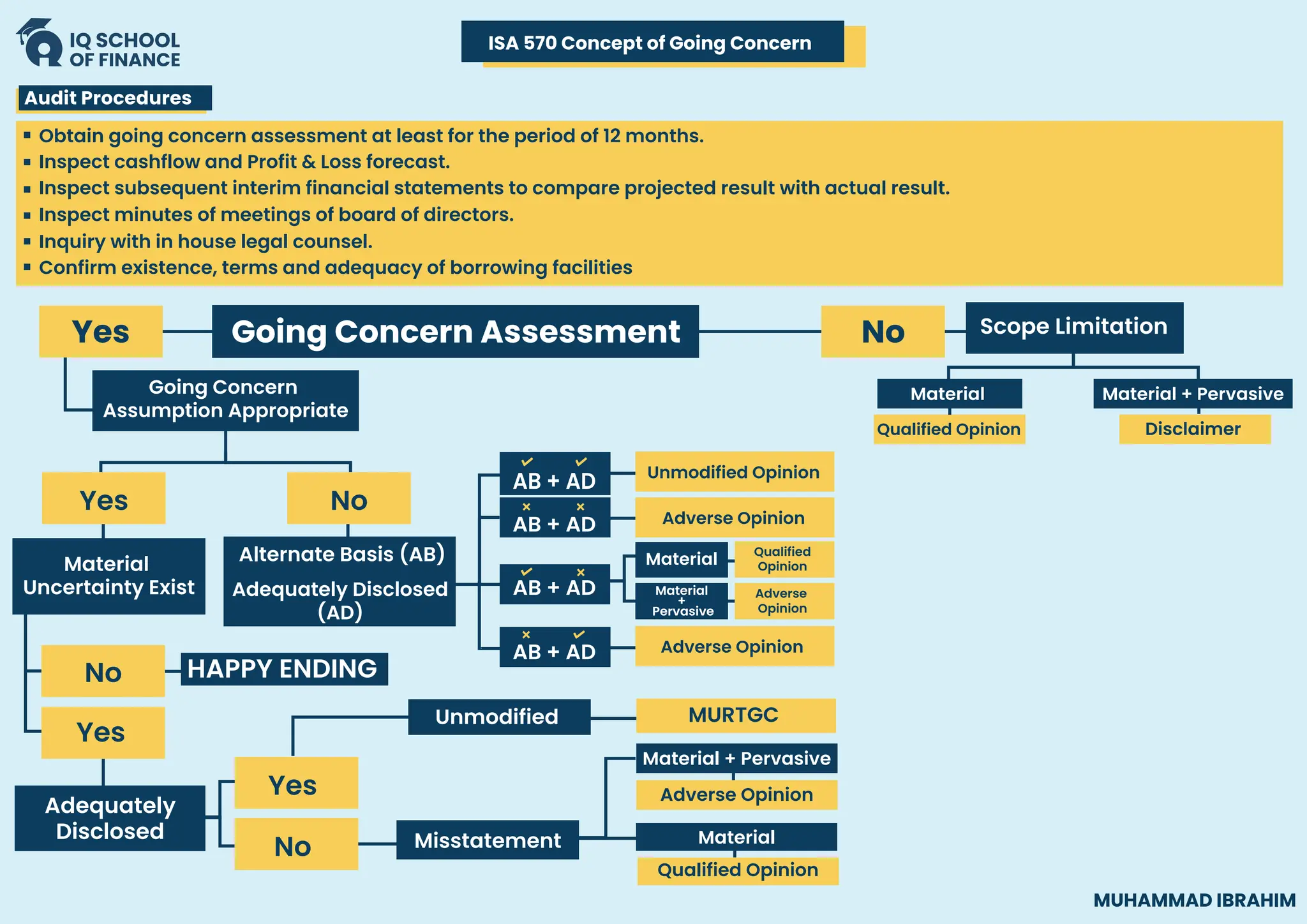
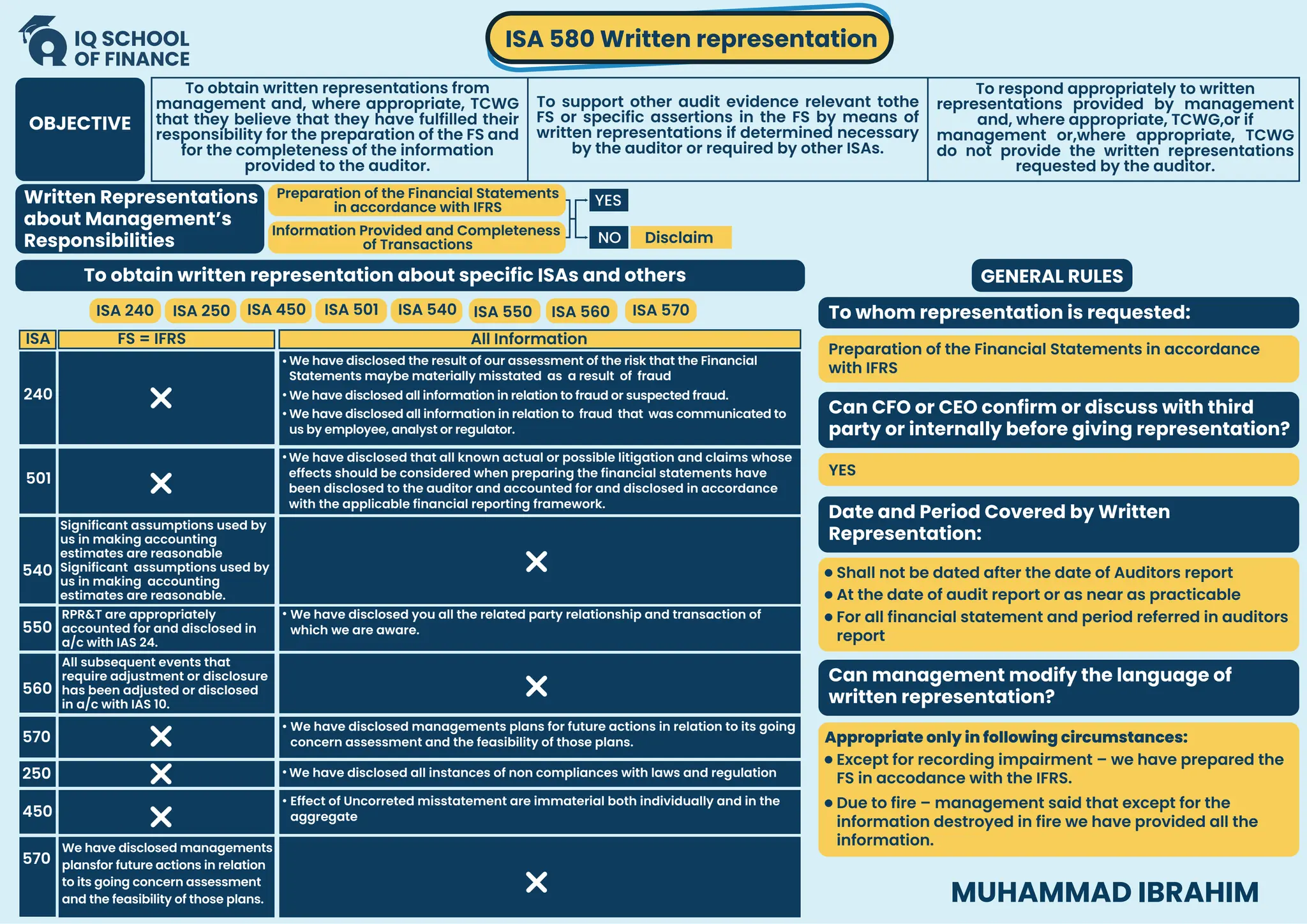
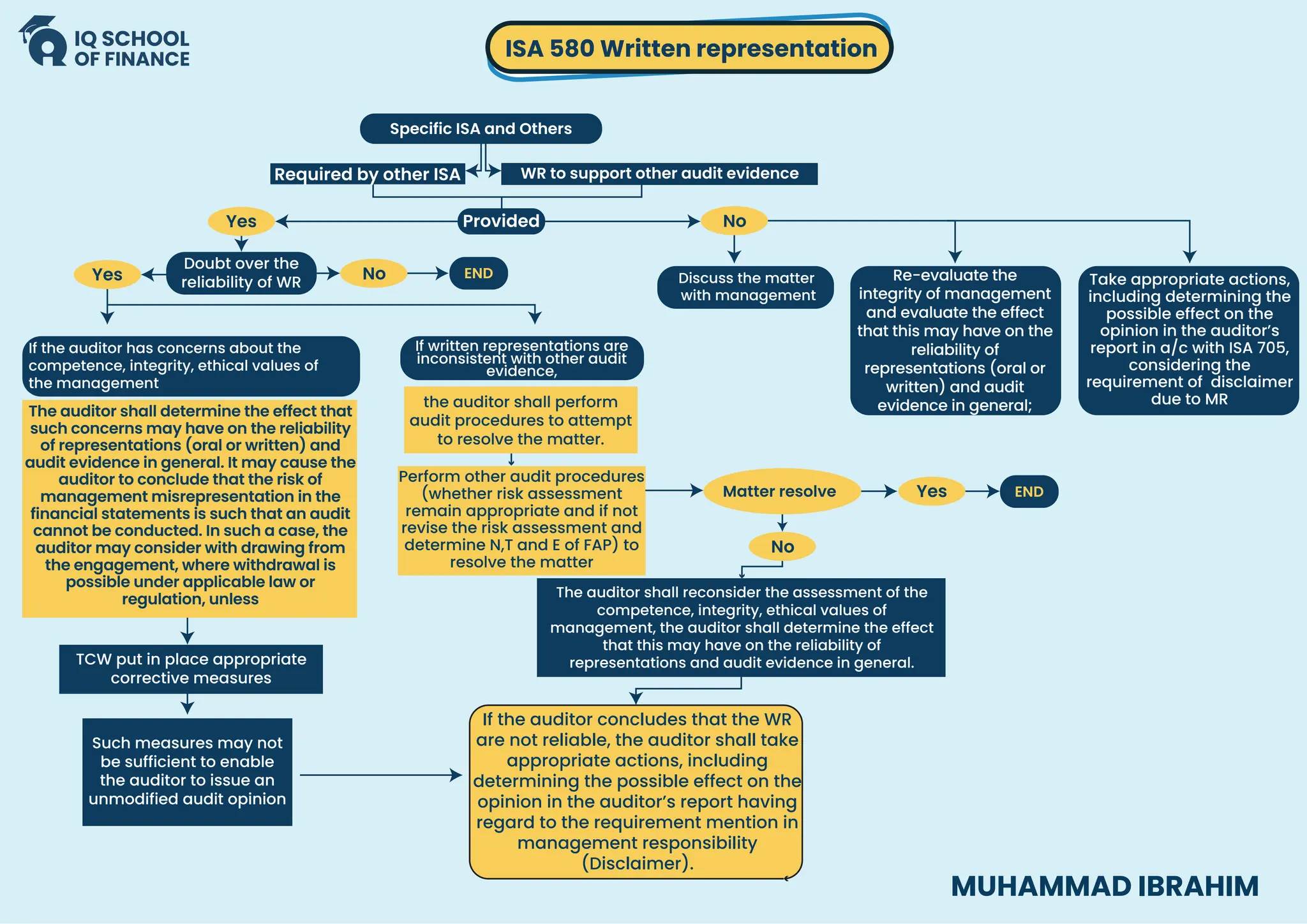
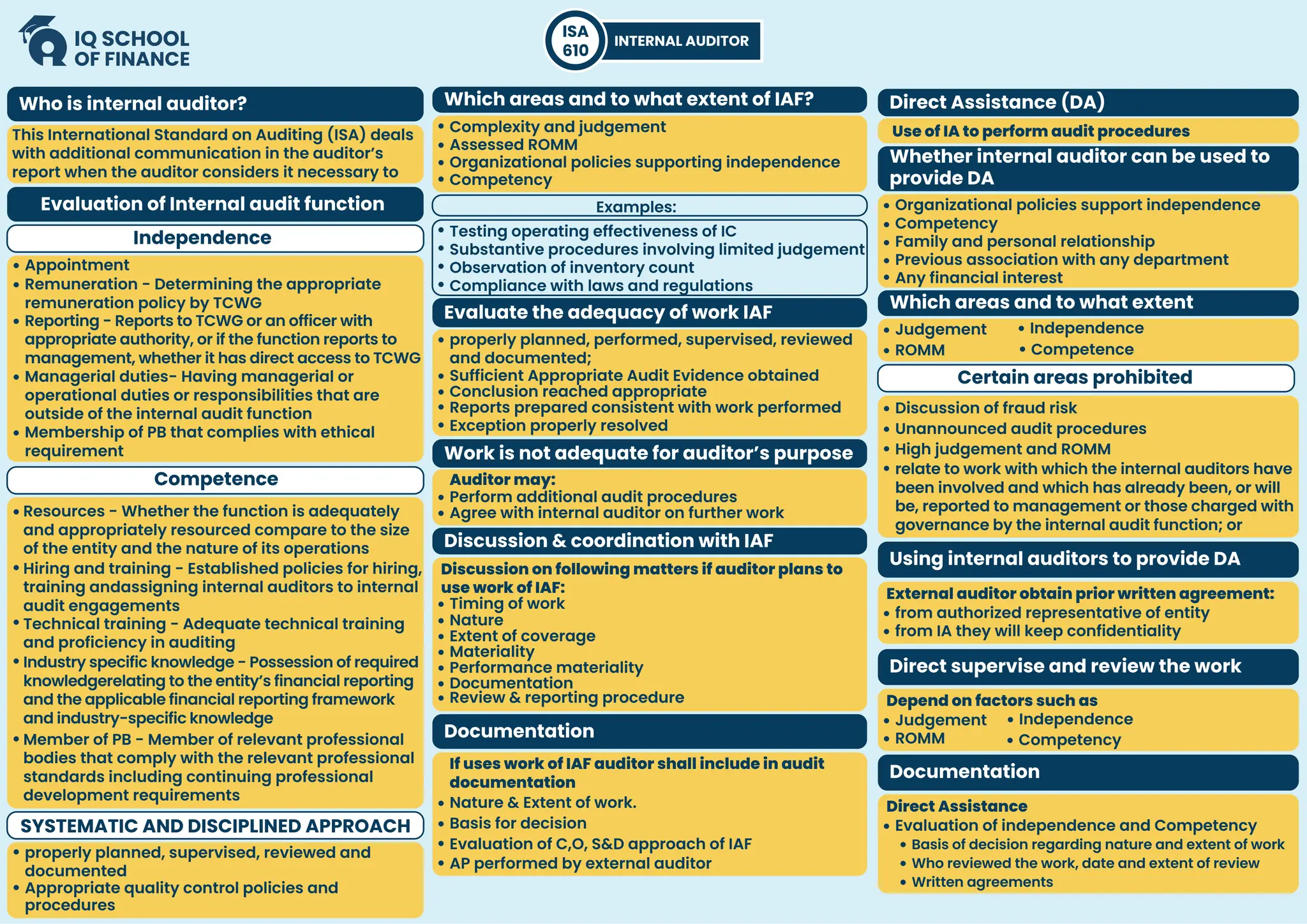
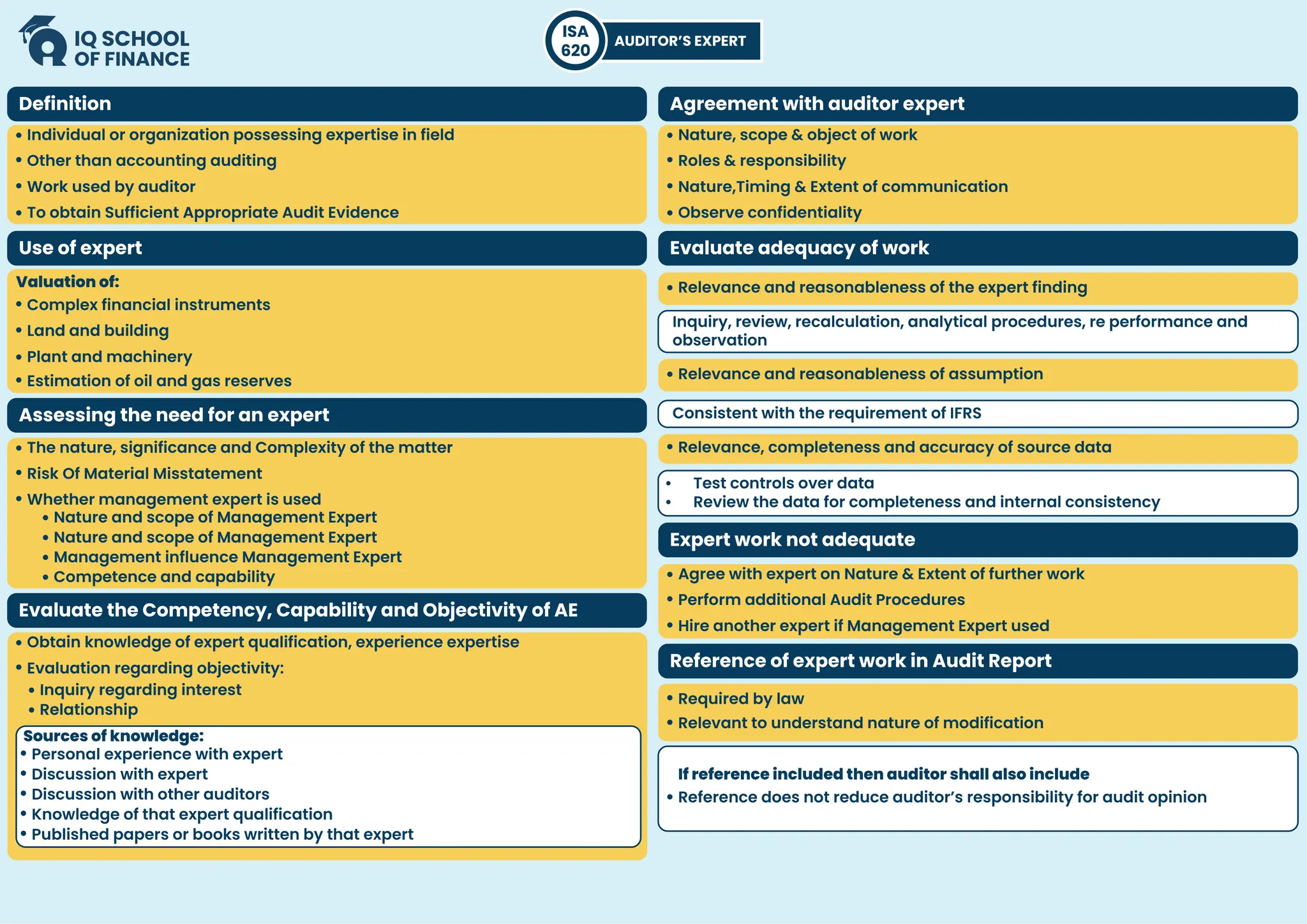
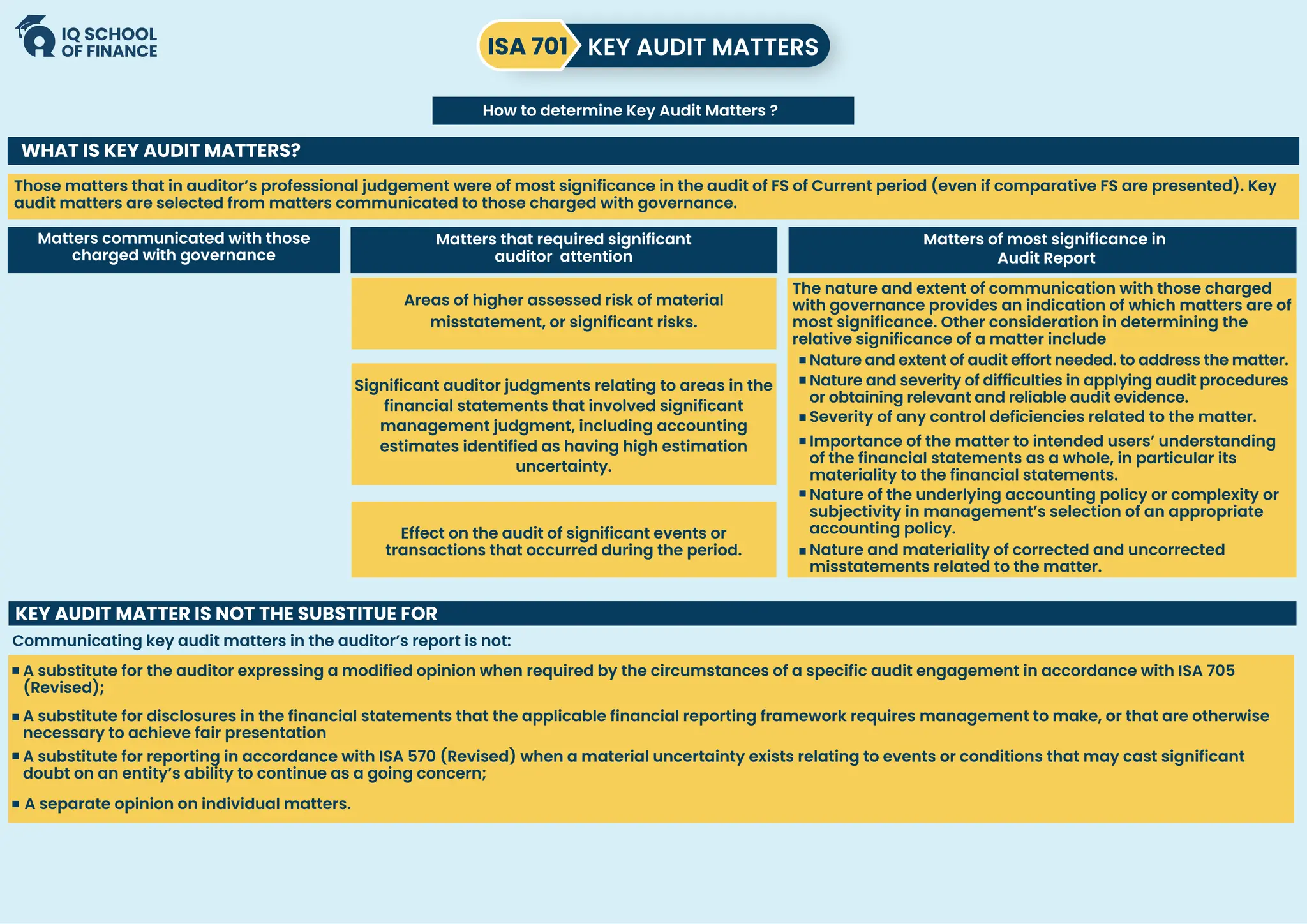
![MUHAMMAD IBRAHIM
These matters were addressed in the context of the audit of the financial
statements as a whole, and informing the auditor’s opinion thereon, and the
auditor does not provide a separate opinion on these matters.
The auditor shall describe each key audit matter in the auditor’s report unless:
How to communicate KAM?
Key Audit Matter
EXCEPTION TO COMMUNICATE KEY AUDIT MATTER
Law or regulation precludes public disclosure about the matter; or
In extremely rare circumstances
The auditor determines that the matter should not be communicated in the
auditor’s report because the adverse consequences of doing so would
reasonably be expected to outweigh the public interest benefits of such
communication. This shall not apply if the entity has publicly disclosed
information about the matter.
Key audit matters are those matters that, in the auditor’s professional judgment,
were of most significance in the audit of the financial statements [of the current
period]
Impairment of inventory
Include a refernce to a related disclosure, if any !
Why this matter was considered to be one of the most significant in the audit
of the financial statement ?
What are the key audit procedure and how they are addressed ?
Key Audit Matter applies to audit of complete set of general purpose financial
statements of listed entities.
Circumstances when the auditor otherwise decides to communicate key audit
matters in the auditor’s report.
APPLICABILITY OF KEY AUDIT MATTER
When the auditor is required by law or regulation to communicate key audit
matters in the auditor’s report.
KAM VS MURTGC
INTERACTION OF KAM WITH OTHER ELEMENTS OF AUDIT REPORT
Introductory paragraph
In addition to matter as described in material uncertainity relating to going
concern section, following are the key audit matters.
How to communicate Key Audit Matters ?
DOCUMENTATION
The matters that required significant auditor’s attention and the rationale for
the auditor’s determination as to whether or not each of these matters is a key
audit matter.
Where applicable, the rationale for the auditor’s determination not to
communicate in the auditor’s report a matter determined to be a key audit
matter.
Where applicable, the rationale for the auditor’s determination that there are
no key audit matters to communicate in the auditor’s report.
KAM VS QUALIFIED OPINION
KAM VS ADVERSE OPINION
ANY OTHER KAM
In addition to the matter as described in basis of qualified opinion section,
following are the key audit matters.
In addition to the matter as described
in basis for adverse opinion section,
following are key audit matters.
YES NO
In addition to the matter as described
in basis for adverse opinion section,
there are no other key audit matter to
communicate.
Unless required by law or regulation,when the auditor disclaims an opinion on the financial statements, the auditor’s report shall not include KAM section in
accordance with ISA 701.
Disclaimer
IF NO KAM
ISA 701 KEY AUDIT MATTERS
We have nothing to report in this regard. There are no KAM in this company.](https://image.slidesharecdn.com/1736312178297-250304011708-e4b0b0c9/75/Developed-audit-chart-for-visual-learners-35-2048.jpg)
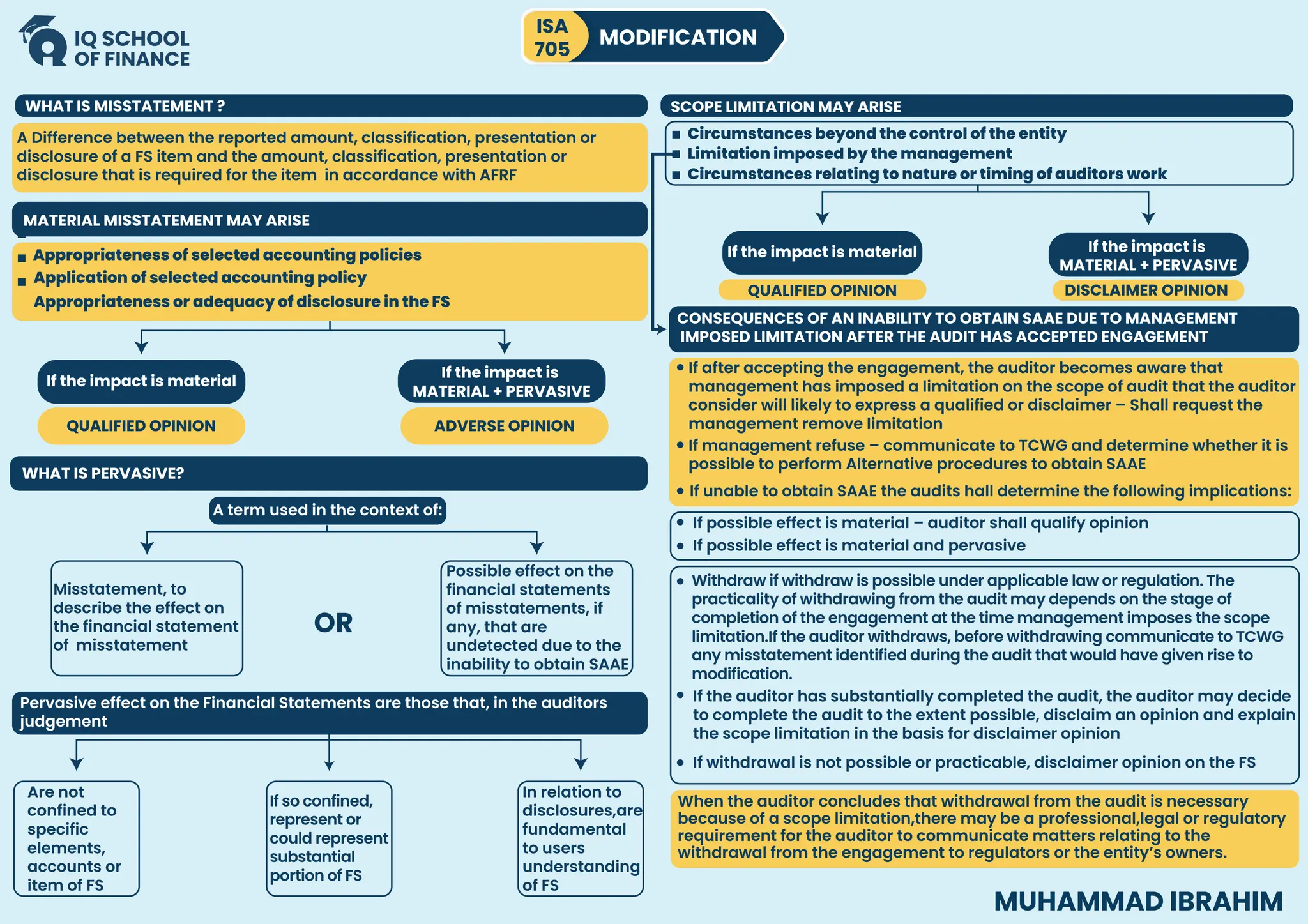
![ADVERSE - MISSTATEMENT
QUALIFIED OPINION DUE TO MATERIAL MISSTATEMENT
Report on the Audit of the Financial Statements
INDEPENDENT AUDITOR'S REPORT
Report on the Audit of the Financial Statements
Qualified Opinion
Qualified Opinion
In our opinion, except for the effects of the matter described in the Basis for
Qualified Opinion section of our report, the accompanying financial statements
present fairly, in all material respects, (or give a true and fair view of) the
financial position of the Company as at December 31, 20X1.
Basis for Qualified Opinion
Basis for Qualified Opinion
We conducted our audit in accordance with International Standards on
Auditing (ISAs). Our responsibilities under those standards are further
described in the Auditor's Responsibilities for the Audit of the Financial
Statements section of our report.
Basis for Qualified Opinion
Misstatement
FS = IFRS
Reference from FS
Possible effect on FS
The Company's inventories are carried in the statement of financial position at
xxxx . Management has not stated the inventories at the lower of cost and net
realizable value but has stated them solely at cost, which constitutes a
departure from IFRSs.
Inventory = 1000
Impairment = (20) Not
recorded
980
Profit before tax = 100
Profit before tax = 80
Impaairment = (20)
Net Asset = 500
Impairment = (20)
480
The Company's records indicate that, had management stated the
inventories at the lower of cost and ne realizable value, an amount of xxx
would have been required to write the inventories down to their net realizable
value. Accordingly, cost of sales would have been increased by xxx, and
income tax, net income and shareholders' equity would havebeen reduced
by xxx, xxx and xxx, respectively
Report on the Audit of the Consolidated Financial Statements
In our opinion, because of the significance of the matter discussed in the Basis for Adverse Opinion
section of our report, the accompanying financial statements do not present fairly (or do not give a
true and fair view of) the financial position of the Group as at December 31, 20X1,
Adverse Opinion
Basis for Adverse Opinion
The Company's inventories are carried in the statement of financial position at xxx. Management
has not stated the inventories at the lower of cost and net realizable value but has stated them
solely at cost, which constitutes a departure from IFRSs. The Company's records indicate that, had
management stated the inventories at the lower of cost and net realizable value, an amount of xxx
would have been required to write the inventories down to their net realizable value. Accordingly,
cost of sales would have been increased by xxx, and income tax, net income and shareholders'
equity would have been reduced by xxx, xxx and xxx, respectively
QUALIFIED OPINION DUE TO SCOPE LIMITATION
In our opinion, except for the possible effects of the matter described in the Basis for Qualified
Opinion section of our report, the accompanying consolidated financial statements present fairly,
in all material respects, (or give a true and fair view of) the financial position of the Group as at
December 31, 20X1,
Misstatement FS = IFRS
Reference from FS (unable to perform procedure)
The company’s inventory are carried in the statement of financial statement at XXX. We were
unable to obtain sufficient appropriate audit evidence about the carrying amount of ABC's
inventory in XYZ as at December 31, 20X1 and ABC's share of XYZ's net income for the year
because we were denied access to the financial information,management, and the auditors of
XYZ. Consequently, we were unable to determine whether any adjustments to these amounts
were necessary.
Consequently we were unable to determine whether any adjustment to
these amount in necessary
DISCLAIMER SCOPE LIMITATION
Disclaimer of Opinion
We do not express an opinion on the accompanying financial statements of the Group. Because of
the significance of the matter described in the Basis for Disclaimer of Opinion section of our report,
we have not been able to obtain sufficient appropriate audit evidence to provide a basis for an audit
opinion on these consolidated financial statements.
Basis for Disclaimer of Opinion
The company’s inventory at the year end are carried in the statemnet of financial position at XXX.
Which represents over 90% of the Group's net assets as at December 31, 20X1. We were not allowed
access to the management and the auditors of XYZ Company, including XYZ Company's auditors
audit documentation. As a result, we were unable to determine whether any adjustments were
necessary in respect of the Group's proportional share of XYZ Company's assets that it controls jointly,
its proportional share of XYZ Company's liabilities for which it is jointly responsible, its proportional
share of XYZ's income and expenses for the year, and the elements making up the consolidated
statement of changes in equity and the consolidated cash flow statement.
Auditor's Responsibilities for the Audit of the Consolidated Financial Statement:
Our responsiolity is to conduct an aud of the Group's consolidarld frandal statement in accordance
with International Standards on Auditing and to issue an auditor's report. However, because of the
matter described in the Basis for Disclaimer of Opinion section of our report, we were not able to obtain
sufficient appropriate audit evidence to provide a basis for an audit opinion on these consolidated
financial statements.We are independent of the Group in accordance with the ethical requirements
that are relevant to our audit of the financial statements in [jurisdiction], and we have fulfilled our
other ethical responsibilities in accordance with these requirements.
ISA
705
MODIFICATION](https://image.slidesharecdn.com/1736312178297-250304011708-e4b0b0c9/75/Developed-audit-chart-for-visual-learners-37-2048.jpg)