Chapter five
Networking devices
Abdi Aziz Hussein Ahmed
Copy right @Somali network classroom
Definition of networking
devices
 Network devices, or networking
hardware, are physical devices that are
required for communication and
interaction between hardware on a
computer network.
Types of networking devices
 Here is the common network device list:
1. Hub
2. Repeater
3. Bridge
4. Switch
5. Access-Point
6. Router
7. Network Interface Card
8. Multi-layer switch
9. Firewall
10. Intrusion Detection System
11. Intrusion Prevention System
12. server
1. Hub
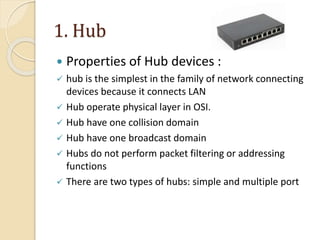
 Properties of Hub devices :
 hub is the simplest in the family of network connecting
devices because it connects LAN
 Hub operate physical layer in OSI.
 Hub have one collision domain
 Hub have one broadcast domain
 Hubs do not perform packet filtering or addressing
functions
 There are two types of hubs: simple and multiple port
2. Repeater
 Properties of repeater
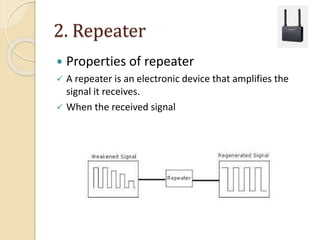
 A repeater is an electronic device that amplifies the
signal it receives.
 When the received signal
3. bridge
 Properties of bridge:
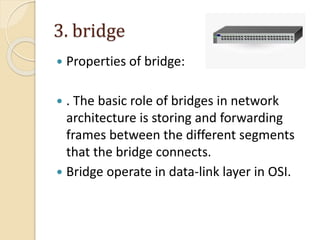
 . The basic role of bridges in network
architecture is storing and forwarding
frames between the different segments
that the bridge connects.
 Bridge operate in data-link layer in OSI.
4. Switch
 Properties of switch
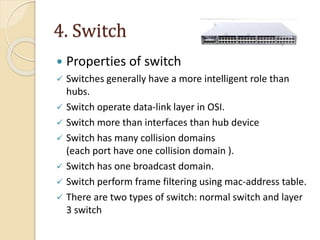
 Switches generally have a more intelligent role than
hubs.
 Switch operate data-link layer in OSI.
 Switch more than interfaces than hub device
 Switch has many collision domains
(each port have one collision domain ).
 Switch has one broadcast domain.
 Switch perform frame filtering using mac-address table.
 There are two types of switch: normal switch and layer
3 switch
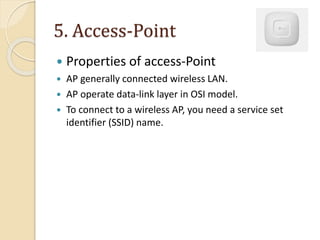
5. Access-Point
 Properties of access-Point
 AP generally connected wireless LAN.
 AP operate data-link layer in OSI model.
 To connect to a wireless AP, you need a service set
identifier (SSID) name.
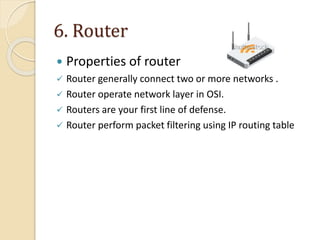
6. Router
 Properties of router
 Router generally connect two or more networks .
 Router operate network layer in OSI.
 Routers are your first line of defense.
 Router perform packet filtering using IP routing table
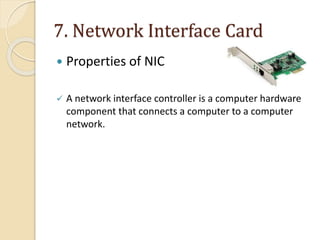
7. Network Interface Card
 Properties of NIC
 A network interface controller is a computer hardware
component that connects a computer to a computer
network.
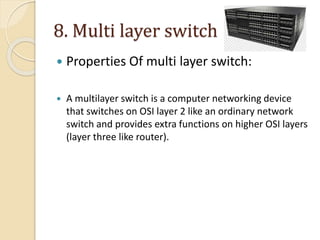
8. Multi layer switch
 Properties Of multi layer switch:
 A multilayer switch is a computer networking device
that switches on OSI layer 2 like an ordinary network
switch and provides extra functions on higher OSI layers
(layer three like router).
9. firewall
 Properties of firewall :
 In computing, a firewall is a network security system
that monitors and controls incoming and outgoing
network traffic based on predetermined security rules.
 A firewall typically establishes a barrier between a
trusted network and an untrusted network, such as the
Internet.
10. Intrusion Detection System
 Properties of IDS :
 An intrusion detection system is a device or software
application that monitors a network or systems for
malicious activity or policy violations.
11. Intrusion prevention
System
 Properties of IPS :
 An Intrusion Prevention System is a device or software
application that monitors and control a network or
systems for malicious activity or policy violations.
12.serve
 Properties of server
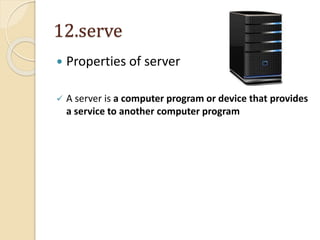
 A server is a computer program or device that provides
a service to another computer program

Chapter five.pptx

  • 1.
    Chapter five Networking devices AbdiAziz Hussein Ahmed Copy right @Somali network classroom
  • 2.
    Definition of networking devices Network devices, or networking hardware, are physical devices that are required for communication and interaction between hardware on a computer network.
  • 3.
    Types of networkingdevices  Here is the common network device list: 1. Hub 2. Repeater 3. Bridge 4. Switch 5. Access-Point 6. Router 7. Network Interface Card 8. Multi-layer switch 9. Firewall 10. Intrusion Detection System 11. Intrusion Prevention System 12. server
  • 4.
    1. Hub  Propertiesof Hub devices :  hub is the simplest in the family of network connecting devices because it connects LAN  Hub operate physical layer in OSI.  Hub have one collision domain  Hub have one broadcast domain  Hubs do not perform packet filtering or addressing functions  There are two types of hubs: simple and multiple port
  • 5.
    2. Repeater  Propertiesof repeater  A repeater is an electronic device that amplifies the signal it receives.  When the received signal
  • 6.
    3. bridge  Propertiesof bridge:  . The basic role of bridges in network architecture is storing and forwarding frames between the different segments that the bridge connects.  Bridge operate in data-link layer in OSI.
  • 7.
    4. Switch  Propertiesof switch  Switches generally have a more intelligent role than hubs.  Switch operate data-link layer in OSI.  Switch more than interfaces than hub device  Switch has many collision domains (each port have one collision domain ).  Switch has one broadcast domain.  Switch perform frame filtering using mac-address table.  There are two types of switch: normal switch and layer 3 switch
  • 8.
    5. Access-Point  Propertiesof access-Point  AP generally connected wireless LAN.  AP operate data-link layer in OSI model.  To connect to a wireless AP, you need a service set identifier (SSID) name.
  • 9.
    6. Router  Propertiesof router  Router generally connect two or more networks .  Router operate network layer in OSI.  Routers are your first line of defense.  Router perform packet filtering using IP routing table
  • 10.
    7. Network InterfaceCard  Properties of NIC  A network interface controller is a computer hardware component that connects a computer to a computer network.
  • 11.
    8. Multi layerswitch  Properties Of multi layer switch:  A multilayer switch is a computer networking device that switches on OSI layer 2 like an ordinary network switch and provides extra functions on higher OSI layers (layer three like router).
  • 12.
    9. firewall  Propertiesof firewall :  In computing, a firewall is a network security system that monitors and controls incoming and outgoing network traffic based on predetermined security rules.  A firewall typically establishes a barrier between a trusted network and an untrusted network, such as the Internet.
  • 13.
    10. Intrusion DetectionSystem  Properties of IDS :  An intrusion detection system is a device or software application that monitors a network or systems for malicious activity or policy violations.
  • 14.
    11. Intrusion prevention System Properties of IPS :  An Intrusion Prevention System is a device or software application that monitors and control a network or systems for malicious activity or policy violations.
  • 15.
    12.serve  Properties ofserver  A server is a computer program or device that provides a service to another computer program