Chapter 9
Conclusion: Lessons Learned and
Visions of Change
Lessons Learned:
Women and Welfare
Popular Perception of Women of Welfare..
A Video: http://www.youtube.com/watch?
v=wKBhF3Kx_UQ
Additional Videos:
http://www.youtube.com/watch?
v=dHIuXnNKKGo&feature=related
http://www.youtube.com/watch?v=ZbHZsx-
jIkY&feature=related
Women & Poverty
Poor women are criticized and stigmatized for
their status in society..
What are these criticisms (again?)
Lessons Learned
The Author’s Critique of the Welfare
System
Women & Poverty-Introduction
• Women’s lives are much more complex than is commonly thought (viewed more as a
personal problem or moral flaw). There are varied reasons for women going onto (and
remaining on) welfare .
• Social policy does not address causes, contributors or consequences of poverty (such as
economic conditions, divorce, medical health, etc.)
• Women in welfare are not able to survive on a “welfare check”, they rely on a valuable
network of formal and informal support.
• Welfare mothers share the same views on motherhood and work as their upper and middle-
class counterparts
• Attributing personal responsibility to welfare recipients, benefits upper/middle classes
– Decrease in members on “welfare rolls”
– Creates a separate “sub class” in society
– Video: http://www.youtube.com/watch?v=Hh-3L1HEBYU&feature=related
Women & Welfare-Barriers
Some of these barriers include:
1. Sexism
• Women assume the role of taking care of the family’s children;
yet their work is highly devalued as easy & not economically
valuable
• It is assumed now that day-care is the best option for lower-
income women to raise children than the mothers themselves
• Although great strides have been made for women in
workforce(economic conditions notwithstanding), these strides
lead to an expectation that women who don’t work are
stigmatized
• Women are expected to be the “superwoman” able to juggle
household work and outside employment. In most houses, this
can cause stress (pg. 216/217), it is even more so in homes with
limited resources and support and in an environment of
discrimination
• Working women are often blamed for youth problems-juvenile
delinquency, teen pregnancy and more…
Women & Welfare, Barriers cont’d.
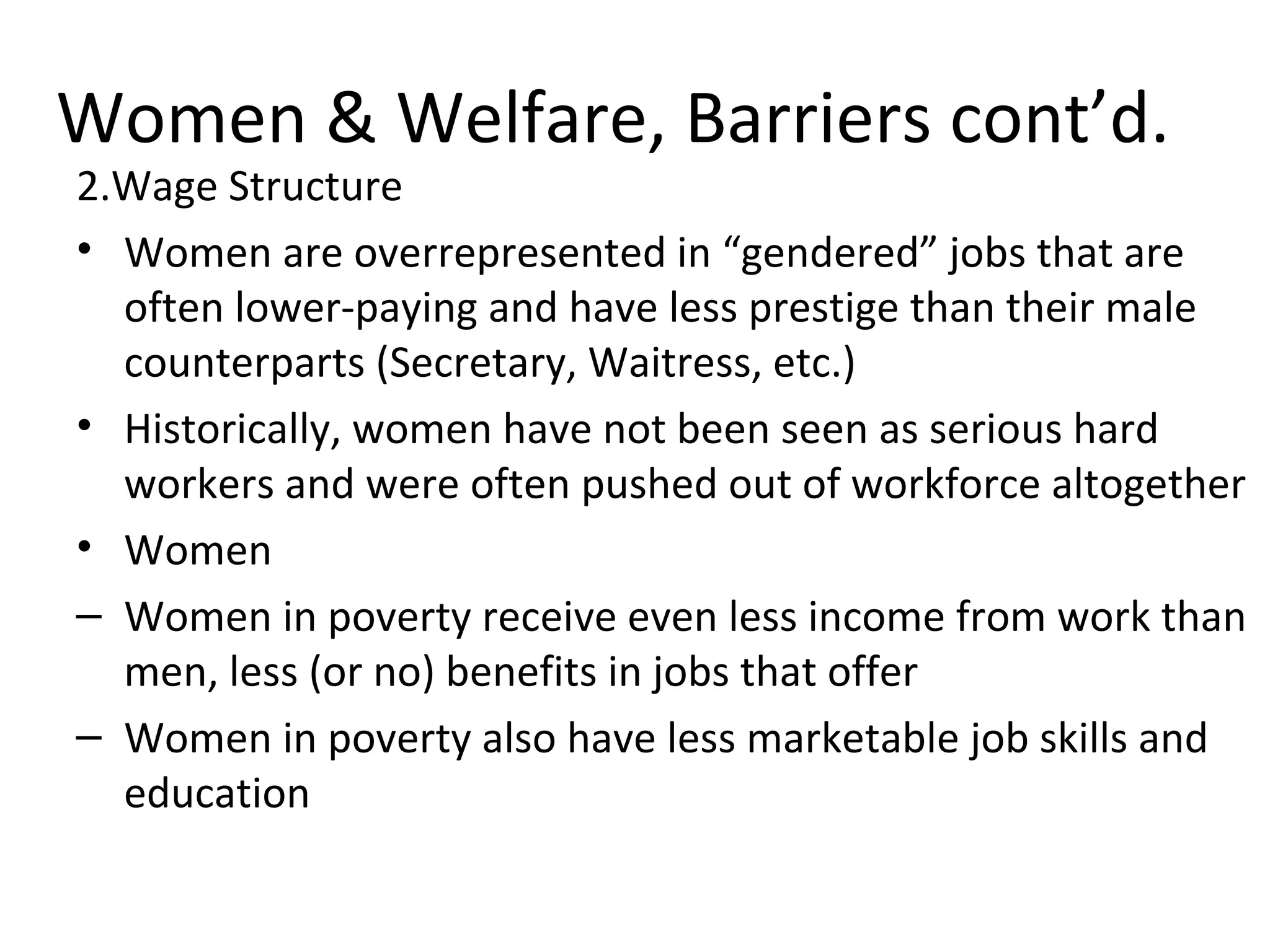
2.Wage Structure
• Women are overrepresented in “gendered” jobs that are
often lower-paying and have less prestige than their male
counterparts (Secretary, Waitress, etc.)
• Historically, women have not been seen as serious hard
workers and were often pushed out of workforce altogether
• Women
– Women in poverty receive even less income from work than
men, less (or no) benefits in jobs that offer
– Women in poverty also have less marketable job skills and
education
Women & Welfare, Barriers cont’d.
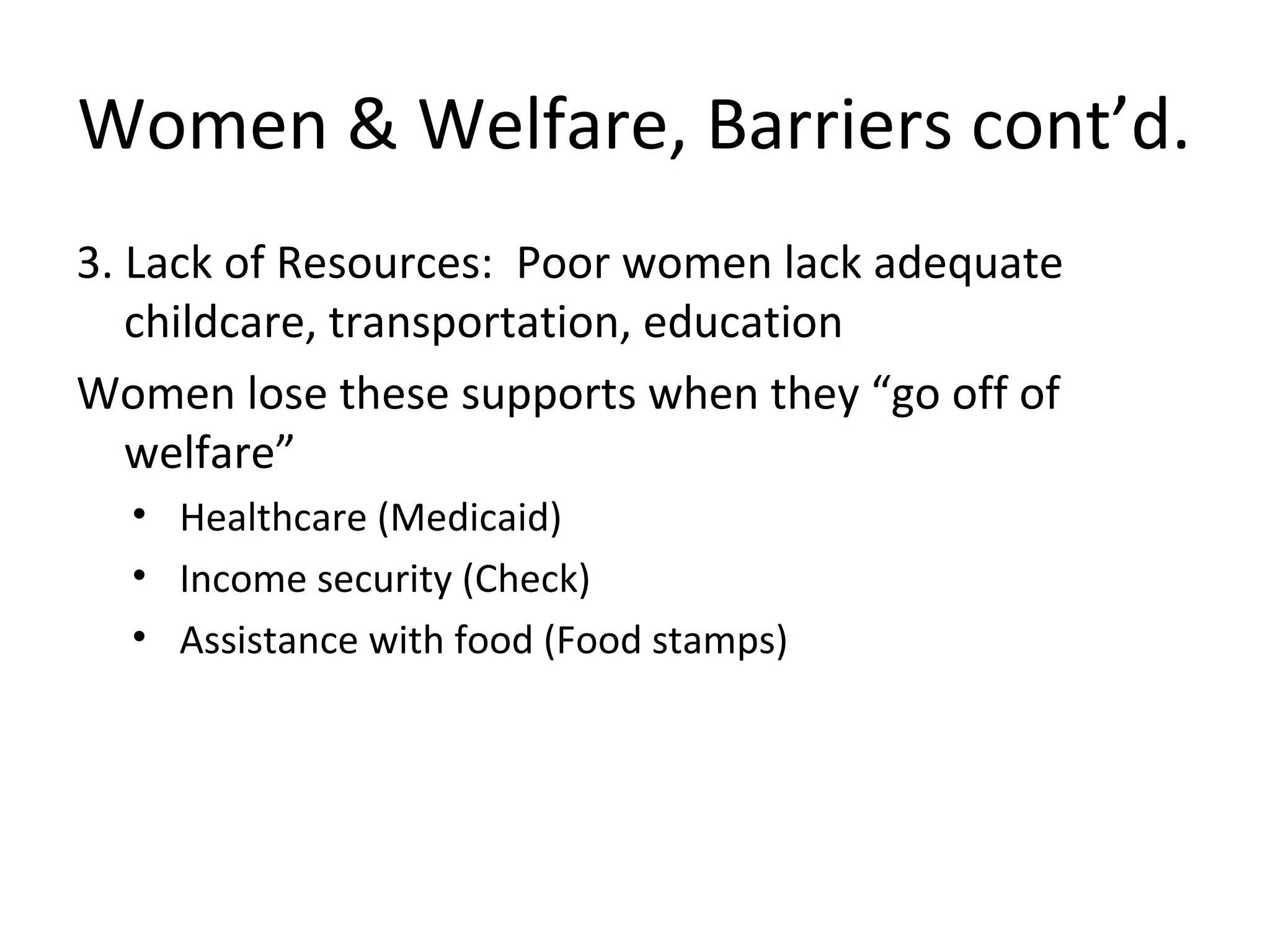
3. Lack of Resources: Poor women lack adequate
childcare, transportation, education
Women lose these supports when they “go off of
welfare”
• Healthcare (Medicaid)
• Income security (Check)
• Assistance with food (Food stamps)
Visions of Change: Reform
Welfare Reform-Success or Failure?
Welfare Reform-Success or
Failure?
Has welfare reform been a success?
What are some possible ways we can reform
current welfare policies in the United States?
Visions of Change
Welfare in Other Countries
Welfare Reform-Success or
Failure?Possible Suggestions for Future Reform
• Provide structural supports that provide security
– Higher wages/Living wage
– High-Quality daycare
– Transportation
– Education/Training
– Benefits that transfer from job to job
• Asset accumulation
– Basic Income Grant
– Individual Development Accounts (IDA’s)
Comparison Between US and
Foreign Countries Response to
Poverty
US poverty rate exceeds 17 other comparable
nations
Other countries provide the following for
poverty:
• Proactive, rather than reactive
• Not Means-tested
• Family/Child Allowances (around 10% of
average wages
• Universal
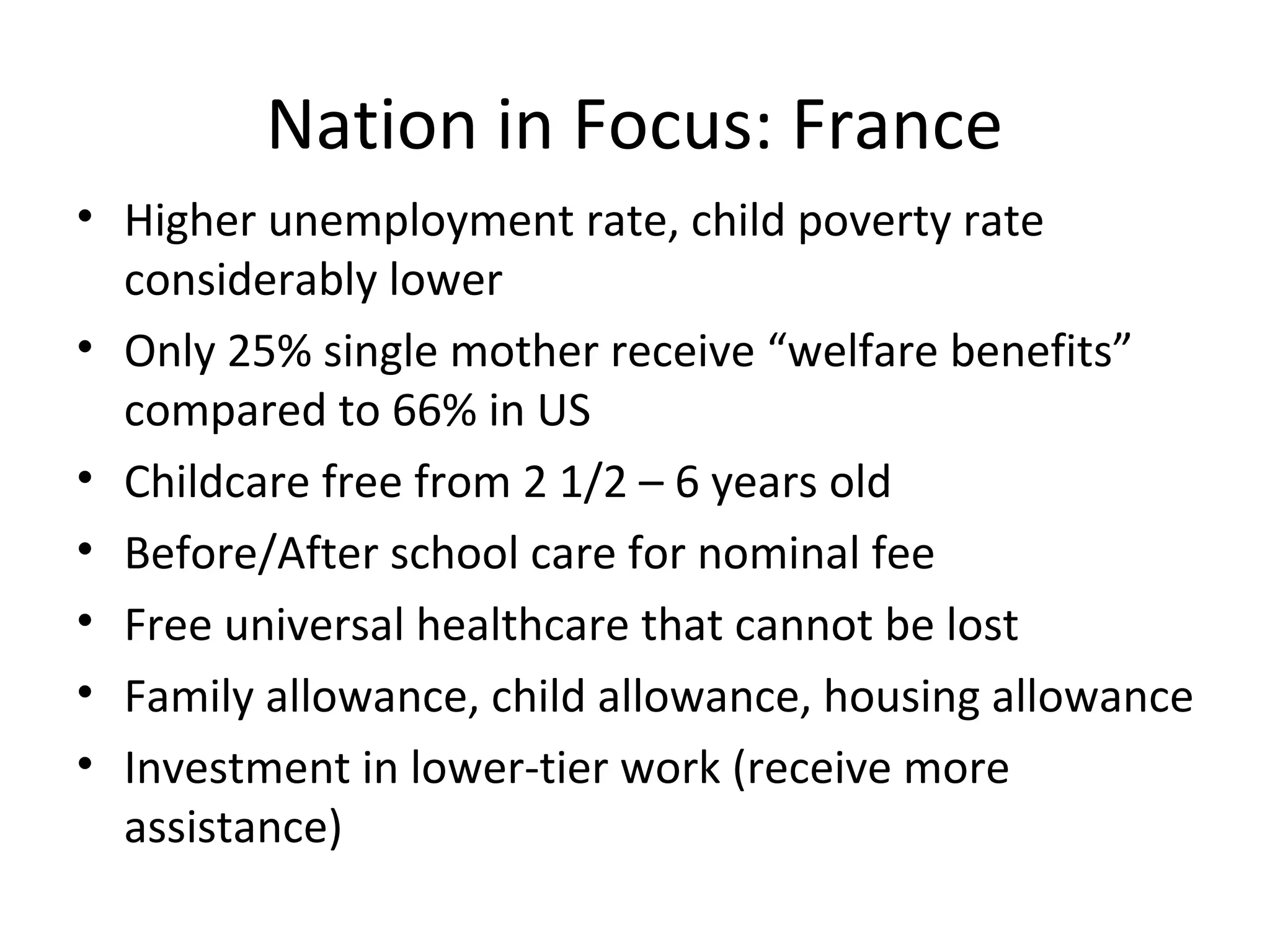
Nation in Focus: France
• Higher unemployment rate, child poverty rate
considerably lower
• Only 25% single mother receive “welfare benefits”
compared to 66% in US
• Childcare free from 2 1/2 – 6 years old
• Before/After school care for nominal fee
• Free universal healthcare that cannot be lost
• Family allowance, child allowance, housing allowance
• Investment in lower-tier work (receive more
assistance)
Now a short quiz to wrap up the text!

Women, Poverty & Welfare

  • 1.
    Chapter 9 Conclusion: LessonsLearned and Visions of Change
  • 2.
  • 3.
    Popular Perception ofWomen of Welfare.. A Video: http://www.youtube.com/watch? v=wKBhF3Kx_UQ Additional Videos: http://www.youtube.com/watch? v=dHIuXnNKKGo&feature=related http://www.youtube.com/watch?v=ZbHZsx- jIkY&feature=related
  • 4.
    Women & Poverty Poorwomen are criticized and stigmatized for their status in society.. What are these criticisms (again?)
  • 5.
    Lessons Learned The Author’sCritique of the Welfare System
  • 6.
    Women & Poverty-Introduction •Women’s lives are much more complex than is commonly thought (viewed more as a personal problem or moral flaw). There are varied reasons for women going onto (and remaining on) welfare . • Social policy does not address causes, contributors or consequences of poverty (such as economic conditions, divorce, medical health, etc.) • Women in welfare are not able to survive on a “welfare check”, they rely on a valuable network of formal and informal support. • Welfare mothers share the same views on motherhood and work as their upper and middle- class counterparts • Attributing personal responsibility to welfare recipients, benefits upper/middle classes – Decrease in members on “welfare rolls” – Creates a separate “sub class” in society – Video: http://www.youtube.com/watch?v=Hh-3L1HEBYU&feature=related
  • 7.
    Women & Welfare-Barriers Someof these barriers include: 1. Sexism • Women assume the role of taking care of the family’s children; yet their work is highly devalued as easy & not economically valuable • It is assumed now that day-care is the best option for lower- income women to raise children than the mothers themselves • Although great strides have been made for women in workforce(economic conditions notwithstanding), these strides lead to an expectation that women who don’t work are stigmatized • Women are expected to be the “superwoman” able to juggle household work and outside employment. In most houses, this can cause stress (pg. 216/217), it is even more so in homes with limited resources and support and in an environment of discrimination • Working women are often blamed for youth problems-juvenile delinquency, teen pregnancy and more…
  • 8.
    Women & Welfare,Barriers cont’d. 2.Wage Structure • Women are overrepresented in “gendered” jobs that are often lower-paying and have less prestige than their male counterparts (Secretary, Waitress, etc.) • Historically, women have not been seen as serious hard workers and were often pushed out of workforce altogether • Women – Women in poverty receive even less income from work than men, less (or no) benefits in jobs that offer – Women in poverty also have less marketable job skills and education
  • 9.
    Women & Welfare,Barriers cont’d. 3. Lack of Resources: Poor women lack adequate childcare, transportation, education Women lose these supports when they “go off of welfare” • Healthcare (Medicaid) • Income security (Check) • Assistance with food (Food stamps)
  • 10.
    Visions of Change:Reform Welfare Reform-Success or Failure?
  • 11.
    Welfare Reform-Success or Failure? Haswelfare reform been a success? What are some possible ways we can reform current welfare policies in the United States?
  • 12.
    Visions of Change Welfarein Other Countries
  • 13.
    Welfare Reform-Success or Failure?PossibleSuggestions for Future Reform • Provide structural supports that provide security – Higher wages/Living wage – High-Quality daycare – Transportation – Education/Training – Benefits that transfer from job to job • Asset accumulation – Basic Income Grant – Individual Development Accounts (IDA’s)
  • 14.
    Comparison Between USand Foreign Countries Response to Poverty US poverty rate exceeds 17 other comparable nations Other countries provide the following for poverty: • Proactive, rather than reactive • Not Means-tested • Family/Child Allowances (around 10% of average wages • Universal
  • 15.
    Nation in Focus:France • Higher unemployment rate, child poverty rate considerably lower • Only 25% single mother receive “welfare benefits” compared to 66% in US • Childcare free from 2 1/2 – 6 years old • Before/After school care for nominal fee • Free universal healthcare that cannot be lost • Family allowance, child allowance, housing allowance • Investment in lower-tier work (receive more assistance)
  • 16.
    Now a shortquiz to wrap up the text!