Enhancing Transparency and Equality
in the Electoral Process
Experiences in Voter Registration
4th Annual Meeting of Electoral Management Bodies
Tbilisi, Georgia
Feb. 25th, 2014
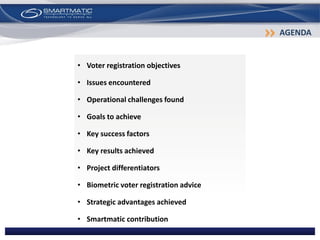
• Voter registration objectives
• Issues encountered
• Operational challenges found
• Goals to achieve
• Key success factors
• Key results achieved
• Project differentiators
• Biometric voter registration advice
• Strategic advantages achieved
• Smartmatic contribution
AGENDA
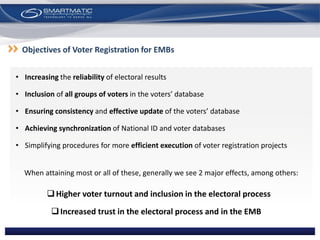
• Increasing the reliability of electoral results
• Inclusion of all groups of voters in the voters’ database
• Ensuring consistency and effective update of the voters’ database
• Achieving synchronization of National ID and voter databases
• Simplifying procedures for more efficient execution of voter registration projects
Objectives of Voter Registration for EMBs
When attaining most or all of these, generally we see 2 major effects, among others:
Higher voter turnout and inclusion in the electoral process
Increased trust in the electoral process and in the EMB
• Hard to motivate voters to register
• High complexity of registration operations in the countryside
• Short timeframe for voter registration/data validation
• Disparate features in existing biometric and non-biometric voter databases
• Insufficient or inflexible set of functionalities in voter registration applications
Issues Encountered by Election Management Bodies in this area
When not properly dealt with, these generally result in:
Missed registration targets or deadlines
Poor quality of voter databases
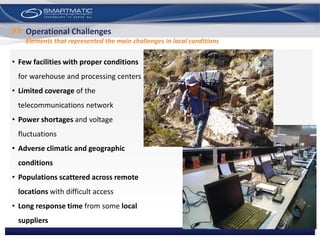
Operational Challenges
Elements that represented the main challenges in local conditions
• Few facilities with proper conditions
for warehouse and processing centers
• Limited coverage of the
telecommunications network
• Power shortages and voltage
fluctuations
• Adverse climatic and geographic
conditions
• Populations scattered across remote
locations with difficult access
• Long response time from some local
suppliers
 2009 Bolivia: Biometrically register from scratch 3.5 to 4 million citizens nationally and
up to 200 thousand living abroad in max 75 days
 2010 – 2011 Zambia: Update the Electoral Registry from 2.8 to 4.1 million voters.
Include biometric information ahead of the 2011 Elections
 2011 – 2012 Venezuela: Merge 3 different biometric voter databases. Generate a
consolidated one to use for voter authentication on Election Day, 2012
 2013 – 2014 Haiti: Biometrically register 3.5 million people and conduct a complete
technology transfer, as most vital records and equipment were lost during the 2010
earthquake.
Goals in Voter Registration Projects
Initial Expectations of the EMB’s
Key Success Factors Indentified
Voter Registration Projects – How they did it
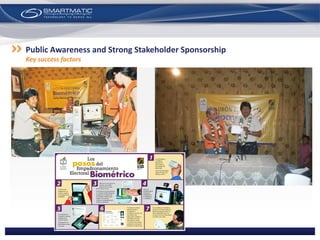
Public Awareness and Strong Stakeholder Sponsorship
Key success factors
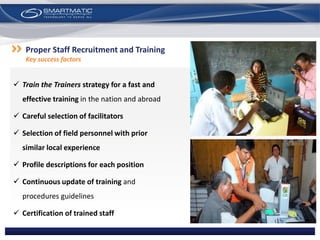
 Train the Trainers strategy for a fast and
effective training in the nation and abroad
 Careful selection of facilitators
 Selection of field personnel with prior
similar local experience
 Profile descriptions for each position
 Continuous update of training and
procedures guidelines
 Certification of trained staff
Proper Staff Recruitment and Training
Key success factors
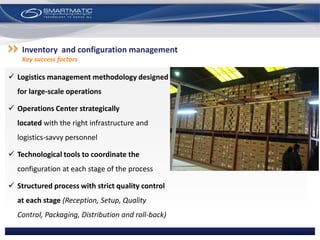
 Logistics management methodology designed
for large-scale operations
 Operations Center strategically
located with the right infrastructure and
logistics-savvy personnel
 Technological tools to coordinate the
configuration at each stage of the process
 Structured process with strict quality control
at each stage (Reception, Setup, Quality
Control, Packaging, Distribution and roll-back)
Inventory and configuration management
Key success factors
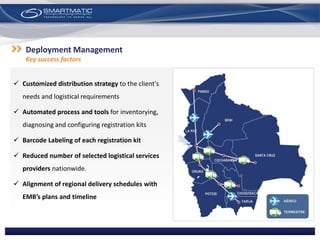
 Customized distribution strategy to the client's
needs and logistical requirements
 Automated process and tools for inventorying,
diagnosing and configuring registration kits
 Barcode Labeling of each registration kit
 Reduced number of selected logistical services
providers nationwide.
 Alignment of regional delivery schedules with
EMB’s plans and timeline
Deployment Management
Key success factors
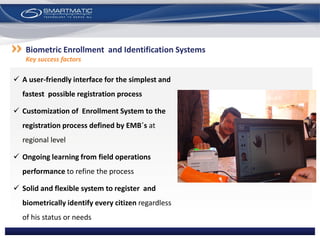
 A user-friendly interface for the simplest and
fastest possible registration process
 Customization of Enrollment System to the
registration process defined by EMB´s at
regional level
 Ongoing learning from field operations
performance to refine the process
 Solid and flexible system to register and
biometrically identify every citizen regardless
of his status or needs
Biometric Enrollment and Identification Systems
Key success factors
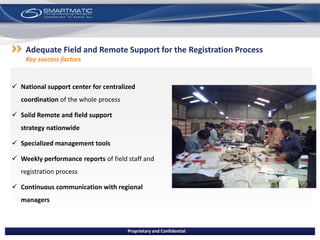
 National support center for centralized
coordination of the whole process
 Solid Remote and field support
strategy nationwide
 Specialized management tools
 Weekly performance reports of field staff and
registration process
 Continuous communication with regional
managers
Adequate Field and Remote Support for the Registration Process
Key success factors
Proprietary and Confidential
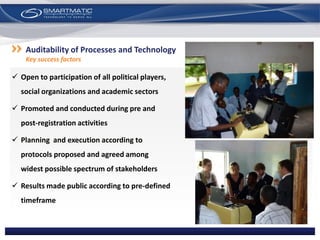
 Open to participation of all political players,
social organizations and academic sectors
 Promoted and conducted during pre and
post-registration activities
 Planning and execution according to
protocols proposed and agreed among
widest possible spectrum of stakeholders
 Results made public according to pre-defined
timeframe
Auditability of Processes and Technology
Key success factors
Voter Registration Projects
Key Results
 Bolivia:
 5.2 million people (37% more than expected) biometrically registered in 72 days,
with an average biometric registration time of just 3 minutes per citizen
 Increased inclusion in the Electoral Registry by 48.5% in less than 3 months
 Zambia:
 increased the National Voter Registry to 5.16 Million voters (exceeded
expectations by 26%), while including biometrics for the 1st time
 One of very few successful Biometric Voter Registration projects in Africa
 Venezuela:
 Increased the % of voters with biometric information from 63% to 95% in 1 year
 Consolidated and updated the Electoral Registry, enabling a seamless, real-time
biometric voter authentication at polling places for the 1st time in the World
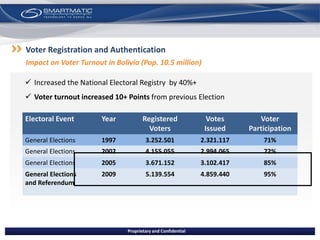
 Increased the National Electoral Registry by 40%+
 Voter turnout increased 10+ Points from previous Election
Voter Registration and Authentication
Impact on Voter Turnout in Bolivia (Pop. 10.5 million)
Electoral Event Year Registered
Voters
Votes
Issued
Voter
Participation
General Elections 1997 3.252.501 2.321.117 71%
General Elections 2002 4.155.055 2.994.065 72%
General Elections 2005 3.671.152 3.102.417 85%
General Elections
and Referendum
2009 5.139.554 4.859.440 95%
Proprietary and Confidential
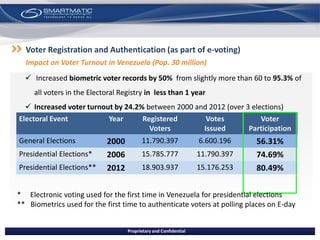
 Increased biometric voter records by 50% from slightly more than 60 to 95.3% of
all voters in the Electoral Registry in less than 1 year
 Increased voter turnout by 24.2% between 2000 and 2012 (over 3 elections)
Voter Registration and Authentication (as part of e-voting)
Impact on Voter Turnout in Venezuela (Pop. 30 million)
Electoral Event Year Registered
Voters
Votes
Issued
Voter
Participation
General Elections 2000 11.790.397 6.600.196 56.31%
Presidential Elections* 2006 15.785.777 11.790.397 74.69%
Presidential Elections** 2012 18.903.937 15.176.253 80.49%
Proprietary and Confidential
* Electronic voting used for the first time in Venezuela for presidential elections
** Biometrics used for the first time to authenticate voters at polling places on E-day
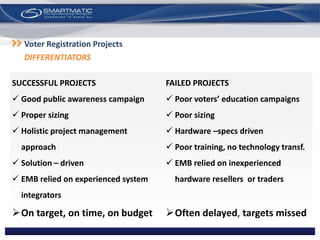
Voter Registration Projects
DIFFERENTIATORS
SUCCESSFUL PROJECTS
 Good public awareness campaign
 Proper sizing
 Holistic project management
approach
 Solution – driven
 EMB relied on experienced system
integrators
On target, on time, on budget
FAILED PROJECTS
 Poor voters’ education campaigns
 Poor sizing
 Hardware –specs driven
 Poor training, no technology transf.
 EMB relied on inexperienced
hardware resellers or traders
Often delayed, targets missed
Voter Registration Advice
AVOIDING THE “FEATURE”, PIECE-BY-PIECE APPROACH
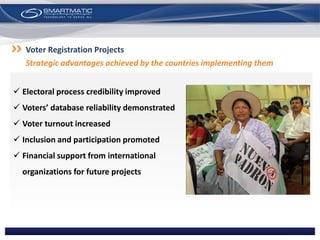
Voter Registration Projects
Strategic advantages achieved by the countries implementing them
 Electoral process credibility improved
 Voters’ database reliability demonstrated
 Voter turnout increased
 Inclusion and participation promoted
 Financial support from international
organizations for future projects
Smartmatic provides technology and integrated logistics and services for biometric registration:
1. Public / Voter Awareness Campaign consulting and planning
2. Needs and requirements analysis, definition of project approach and plan
3. Software application design and implementation for every need
4. Integrated Logistics Services and Support
 Mobile and fixed registration kits configuration and deployment
 National Support (Call) Center planning, setup and management
 Nationwide field technical support
 Comprehensive support to the registration process
 Personnel and management-level training
5. Project Management and continuous knowledge transfer to local authorities/personnel
6. Cutting-edge Biometric Voter Registration (BVR) technology
Voter Registration Projects
Smartmatic Contribution
Thank You...
Questions and Answers

Enhancing Transparency and Equality in the Electoral Process

  • 1.
    Enhancing Transparency andEquality in the Electoral Process Experiences in Voter Registration 4th Annual Meeting of Electoral Management Bodies Tbilisi, Georgia Feb. 25th, 2014
  • 2.
    • Voter registrationobjectives • Issues encountered • Operational challenges found • Goals to achieve • Key success factors • Key results achieved • Project differentiators • Biometric voter registration advice • Strategic advantages achieved • Smartmatic contribution AGENDA
  • 3.
    • Increasing thereliability of electoral results • Inclusion of all groups of voters in the voters’ database • Ensuring consistency and effective update of the voters’ database • Achieving synchronization of National ID and voter databases • Simplifying procedures for more efficient execution of voter registration projects Objectives of Voter Registration for EMBs When attaining most or all of these, generally we see 2 major effects, among others: Higher voter turnout and inclusion in the electoral process Increased trust in the electoral process and in the EMB
  • 4.
    • Hard tomotivate voters to register • High complexity of registration operations in the countryside • Short timeframe for voter registration/data validation • Disparate features in existing biometric and non-biometric voter databases • Insufficient or inflexible set of functionalities in voter registration applications Issues Encountered by Election Management Bodies in this area When not properly dealt with, these generally result in: Missed registration targets or deadlines Poor quality of voter databases
  • 5.
    Operational Challenges Elements thatrepresented the main challenges in local conditions • Few facilities with proper conditions for warehouse and processing centers • Limited coverage of the telecommunications network • Power shortages and voltage fluctuations • Adverse climatic and geographic conditions • Populations scattered across remote locations with difficult access • Long response time from some local suppliers
  • 6.
     2009 Bolivia:Biometrically register from scratch 3.5 to 4 million citizens nationally and up to 200 thousand living abroad in max 75 days  2010 – 2011 Zambia: Update the Electoral Registry from 2.8 to 4.1 million voters. Include biometric information ahead of the 2011 Elections  2011 – 2012 Venezuela: Merge 3 different biometric voter databases. Generate a consolidated one to use for voter authentication on Election Day, 2012  2013 – 2014 Haiti: Biometrically register 3.5 million people and conduct a complete technology transfer, as most vital records and equipment were lost during the 2010 earthquake. Goals in Voter Registration Projects Initial Expectations of the EMB’s
  • 7.
    Key Success FactorsIndentified Voter Registration Projects – How they did it
  • 8.
    Public Awareness andStrong Stakeholder Sponsorship Key success factors
  • 9.
     Train theTrainers strategy for a fast and effective training in the nation and abroad  Careful selection of facilitators  Selection of field personnel with prior similar local experience  Profile descriptions for each position  Continuous update of training and procedures guidelines  Certification of trained staff Proper Staff Recruitment and Training Key success factors
  • 10.
     Logistics managementmethodology designed for large-scale operations  Operations Center strategically located with the right infrastructure and logistics-savvy personnel  Technological tools to coordinate the configuration at each stage of the process  Structured process with strict quality control at each stage (Reception, Setup, Quality Control, Packaging, Distribution and roll-back) Inventory and configuration management Key success factors
  • 11.
     Customized distributionstrategy to the client's needs and logistical requirements  Automated process and tools for inventorying, diagnosing and configuring registration kits  Barcode Labeling of each registration kit  Reduced number of selected logistical services providers nationwide.  Alignment of regional delivery schedules with EMB’s plans and timeline Deployment Management Key success factors
  • 12.
     A user-friendlyinterface for the simplest and fastest possible registration process  Customization of Enrollment System to the registration process defined by EMB´s at regional level  Ongoing learning from field operations performance to refine the process  Solid and flexible system to register and biometrically identify every citizen regardless of his status or needs Biometric Enrollment and Identification Systems Key success factors
  • 13.
     National supportcenter for centralized coordination of the whole process  Solid Remote and field support strategy nationwide  Specialized management tools  Weekly performance reports of field staff and registration process  Continuous communication with regional managers Adequate Field and Remote Support for the Registration Process Key success factors Proprietary and Confidential
  • 14.
     Open toparticipation of all political players, social organizations and academic sectors  Promoted and conducted during pre and post-registration activities  Planning and execution according to protocols proposed and agreed among widest possible spectrum of stakeholders  Results made public according to pre-defined timeframe Auditability of Processes and Technology Key success factors
  • 15.
    Voter Registration Projects KeyResults  Bolivia:  5.2 million people (37% more than expected) biometrically registered in 72 days, with an average biometric registration time of just 3 minutes per citizen  Increased inclusion in the Electoral Registry by 48.5% in less than 3 months  Zambia:  increased the National Voter Registry to 5.16 Million voters (exceeded expectations by 26%), while including biometrics for the 1st time  One of very few successful Biometric Voter Registration projects in Africa  Venezuela:  Increased the % of voters with biometric information from 63% to 95% in 1 year  Consolidated and updated the Electoral Registry, enabling a seamless, real-time biometric voter authentication at polling places for the 1st time in the World
  • 16.
     Increased theNational Electoral Registry by 40%+  Voter turnout increased 10+ Points from previous Election Voter Registration and Authentication Impact on Voter Turnout in Bolivia (Pop. 10.5 million) Electoral Event Year Registered Voters Votes Issued Voter Participation General Elections 1997 3.252.501 2.321.117 71% General Elections 2002 4.155.055 2.994.065 72% General Elections 2005 3.671.152 3.102.417 85% General Elections and Referendum 2009 5.139.554 4.859.440 95% Proprietary and Confidential
  • 17.
     Increased biometricvoter records by 50% from slightly more than 60 to 95.3% of all voters in the Electoral Registry in less than 1 year  Increased voter turnout by 24.2% between 2000 and 2012 (over 3 elections) Voter Registration and Authentication (as part of e-voting) Impact on Voter Turnout in Venezuela (Pop. 30 million) Electoral Event Year Registered Voters Votes Issued Voter Participation General Elections 2000 11.790.397 6.600.196 56.31% Presidential Elections* 2006 15.785.777 11.790.397 74.69% Presidential Elections** 2012 18.903.937 15.176.253 80.49% Proprietary and Confidential * Electronic voting used for the first time in Venezuela for presidential elections ** Biometrics used for the first time to authenticate voters at polling places on E-day
  • 18.
    Voter Registration Projects DIFFERENTIATORS SUCCESSFULPROJECTS  Good public awareness campaign  Proper sizing  Holistic project management approach  Solution – driven  EMB relied on experienced system integrators On target, on time, on budget FAILED PROJECTS  Poor voters’ education campaigns  Poor sizing  Hardware –specs driven  Poor training, no technology transf.  EMB relied on inexperienced hardware resellers or traders Often delayed, targets missed
  • 19.
    Voter Registration Advice AVOIDINGTHE “FEATURE”, PIECE-BY-PIECE APPROACH
  • 20.
    Voter Registration Projects Strategicadvantages achieved by the countries implementing them  Electoral process credibility improved  Voters’ database reliability demonstrated  Voter turnout increased  Inclusion and participation promoted  Financial support from international organizations for future projects
  • 21.
    Smartmatic provides technologyand integrated logistics and services for biometric registration: 1. Public / Voter Awareness Campaign consulting and planning 2. Needs and requirements analysis, definition of project approach and plan 3. Software application design and implementation for every need 4. Integrated Logistics Services and Support  Mobile and fixed registration kits configuration and deployment  National Support (Call) Center planning, setup and management  Nationwide field technical support  Comprehensive support to the registration process  Personnel and management-level training 5. Project Management and continuous knowledge transfer to local authorities/personnel 6. Cutting-edge Biometric Voter Registration (BVR) technology Voter Registration Projects Smartmatic Contribution
  • 22.