Research Methodology
Chapter 5
Processing, Analysis and Interpretation of Data
Wondwossen Bogale (PhD)
Assistant Professor, AAiT, AAU
wondwossenboge@gmail.com
5. PROCESSING AND ANALYSIS OF DATA
• The data, after collection, has to be processed and
analyzed in accordance with the outline laid down
for the purpose at the time of developing the
research plan.
• Technically speaking, processing implies editing,
coding, classification and tabulation of collected
data so that they are ready for analysis.
• The term analysis refers to the computation of
certain measures along with searching for patterns
of relationship that exist among data groups.
2
5. PROCESSING AND ANALYSIS OF DATA
• Data analysis helps to answer the research
questions and to help determine the trends and
relations ship among variables.
• After data collection , the researcher should
accomplish the following : Process the data,
prepare tables and graphs, analyze and interpret
findings, prepare for editing and prepare
presentation.
3
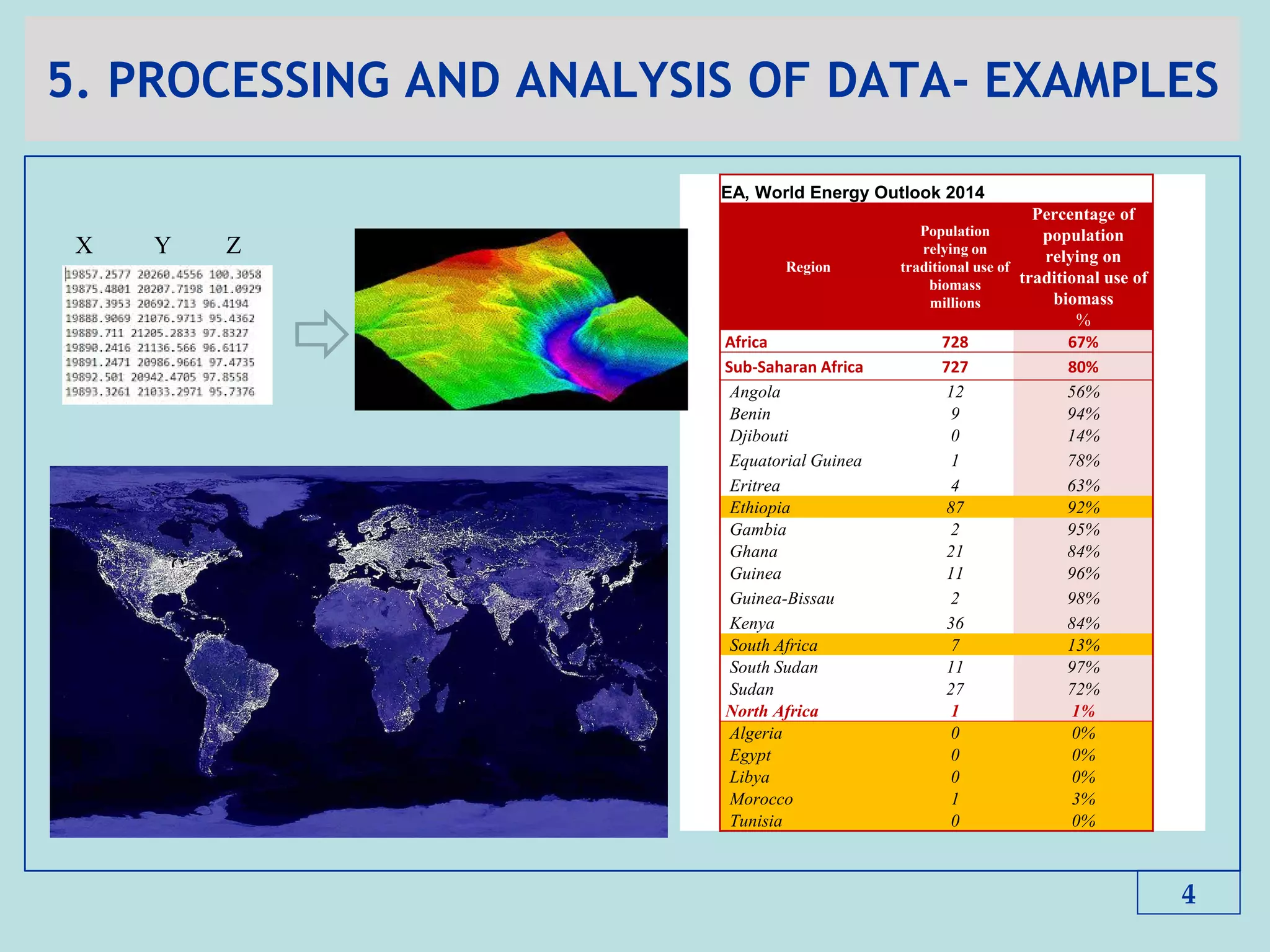
5. PROCESSING AND ANALYSIS OF DATA- EXAMPLES
4
EA, World Energy Outlook 2014
Region
Population
relying on
traditional use of
biomass
millions
Percentage of
population
relying on
traditional use of
biomass
%
Africa 728 67%
Sub-Saharan Africa 727 80%
Angola 12 56%
Benin 9 94%
Djibouti 0 14%
Equatorial Guinea 1 78%
Eritrea 4 63%
Ethiopia 87 92%
Gambia 2 95%
Ghana 21 84%
Guinea 11 96%
Guinea-Bissau 2 98%
Kenya 36 84%
South Africa 7 13%
South Sudan 11 97%
Sudan 27 72%
North Africa 1 1%
Algeria 0 0%
Egypt 0 0%
Libya 0 0%
Morocco 1 3%
Tunisia 0 0%
X Y Z
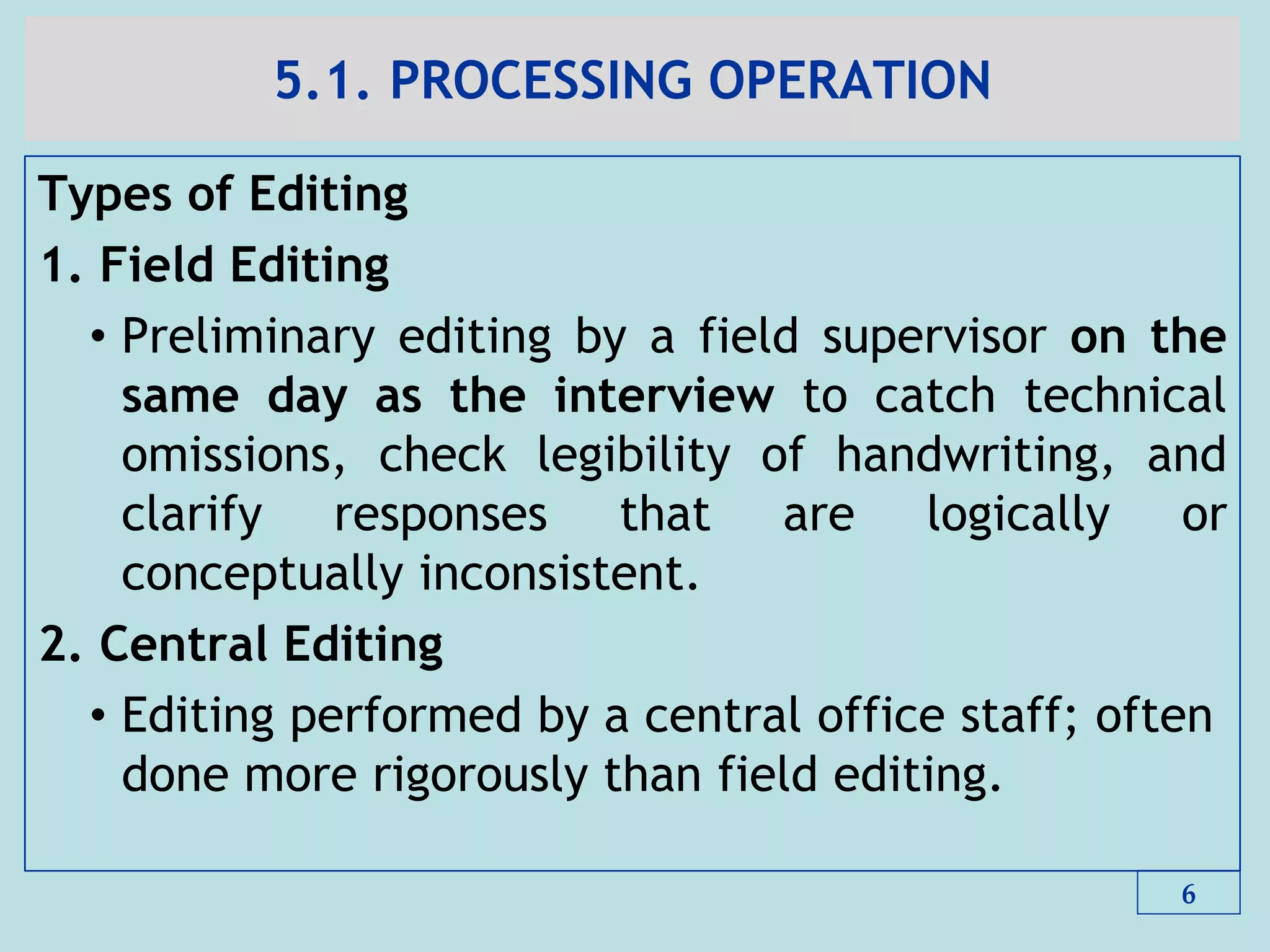
5.1. PROCESSING OPERATION
• With this brief introduction concerning the
concepts of processing and analysis, we can now
proceed with the explanation of all the processing
operations.
1. Editing: Editing of data is a process of examining
the collected raw data to detect errors and
omissions and to correct these when possible.
• Editing is done to assure that the data are
accurate, consistent with other facts gathered,
uniformly entered and have been well arranged
to facilitate coding and tabulation.
5
5.1. PROCESSING OPERATION
Types of Editing
1. Field Editing
• Preliminary editing by a field supervisor on the
same day as the interview to catch technical
omissions, check legibility of handwriting, and
clarify responses that are logically or
conceptually inconsistent.
2. Central Editing
• Editing performed by a central office staff; often
done more rigorously than field editing.
6
5.1. PROCESSING OPERATION
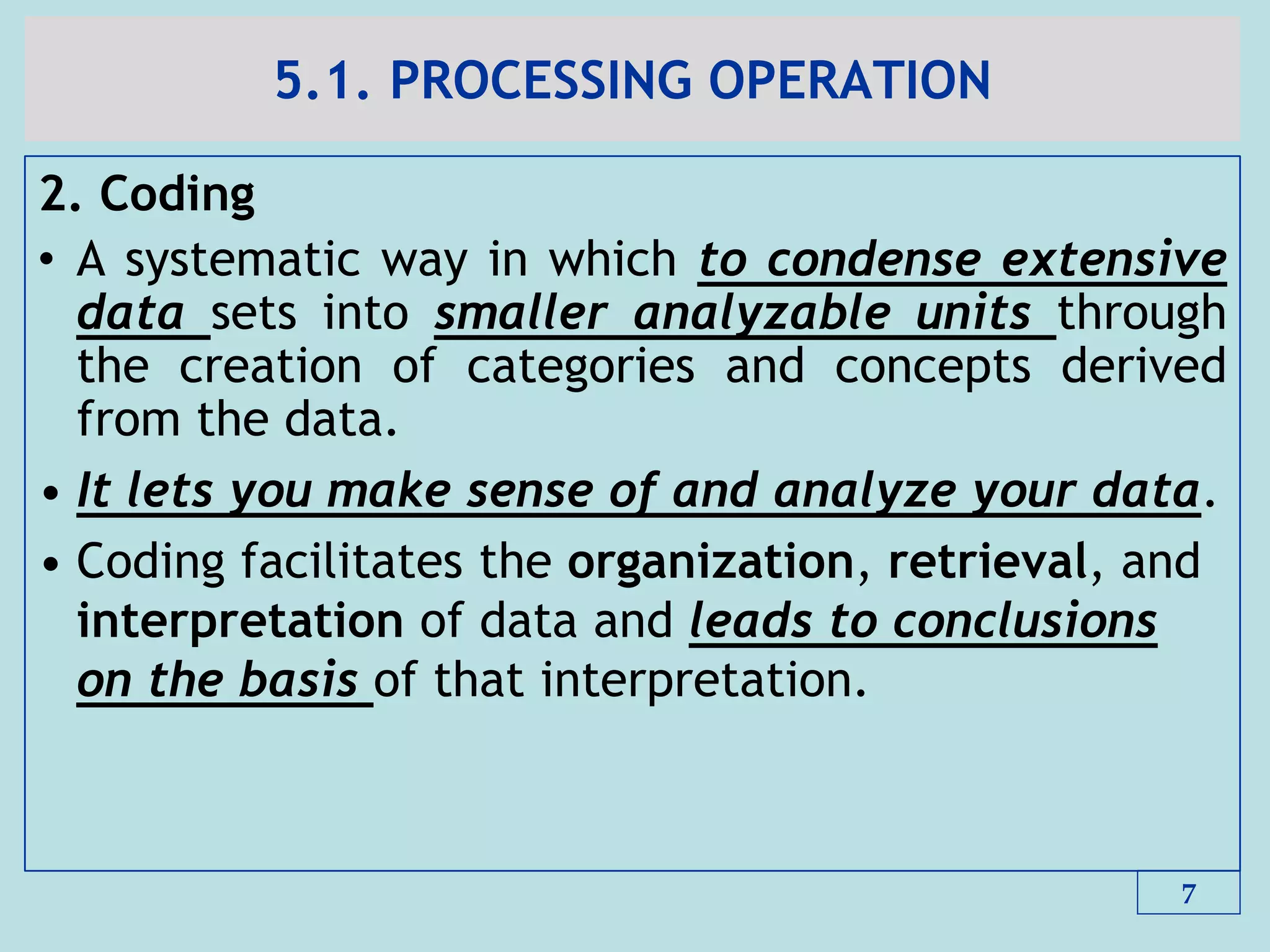
2. Coding
• A systematic way in which to condense extensive
data sets into smaller analyzable units through
the creation of categories and concepts derived
from the data.
• It lets you make sense of and analyze your data.
• Coding facilitates the organization, retrieval, and
interpretation of data and leads to conclusions
on the basis of that interpretation.
7
5.1. PROCESSING OPERATION
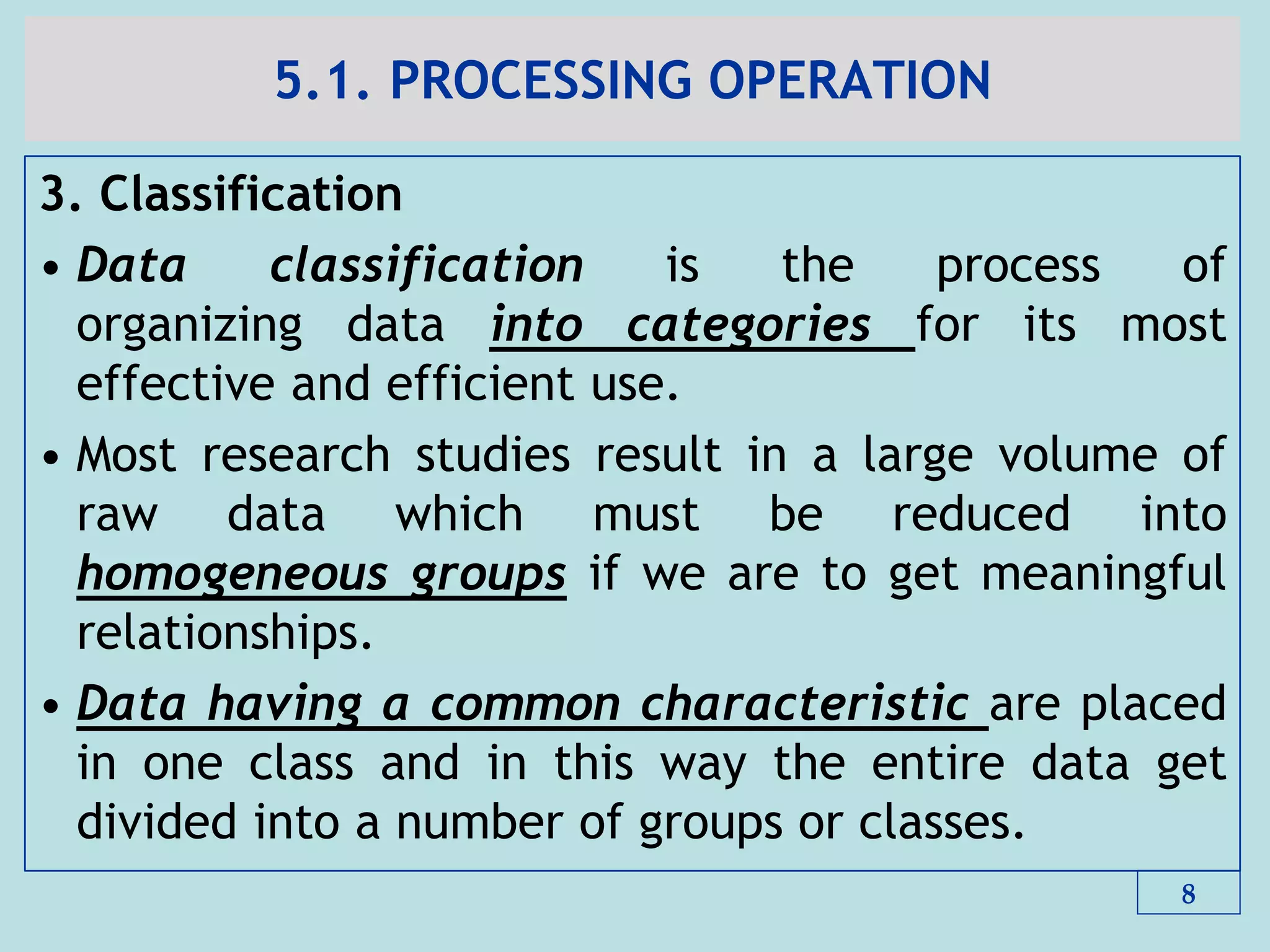
3. Classification
• Data classification is the process of
organizing data into categories for its most
effective and efficient use.
• Most research studies result in a large volume of
raw data which must be reduced into
homogeneous groups if we are to get meaningful
relationships.
• Data having a common characteristic are placed
in one class and in this way the entire data get
divided into a number of groups or classes.
8
5.1. PROCESSING OPERATION
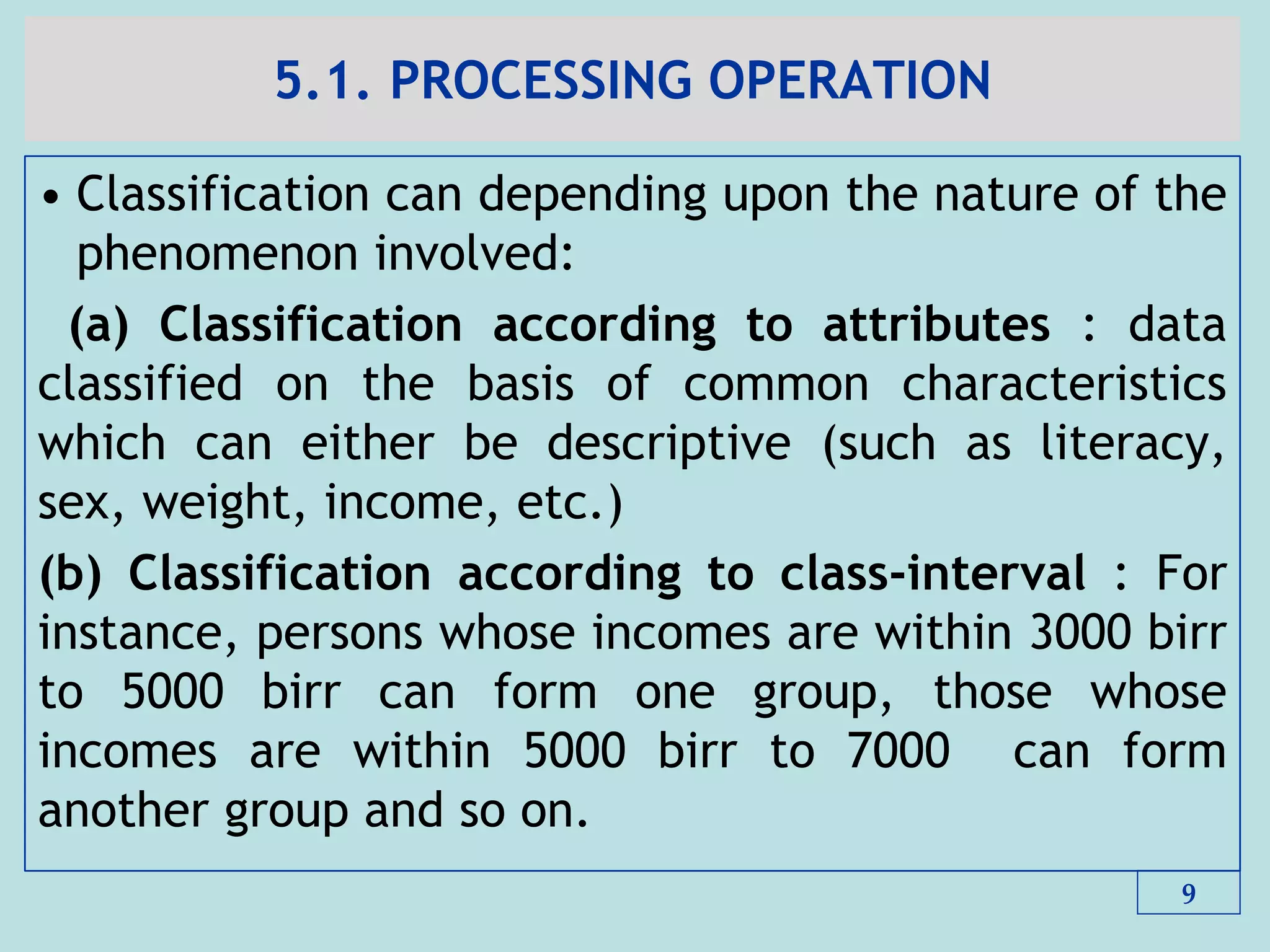
• Classification can depending upon the nature of the
phenomenon involved:
(a) Classification according to attributes : data
classified on the basis of common characteristics
which can either be descriptive (such as literacy,
sex, weight, income, etc.)
(b) Classification according to class-interval : For
instance, persons whose incomes are within 3000 birr
to 5000 birr can form one group, those whose
incomes are within 5000 birr to 7000 can form
another group and so on.
9
5.1. PROCESSING OPERATION
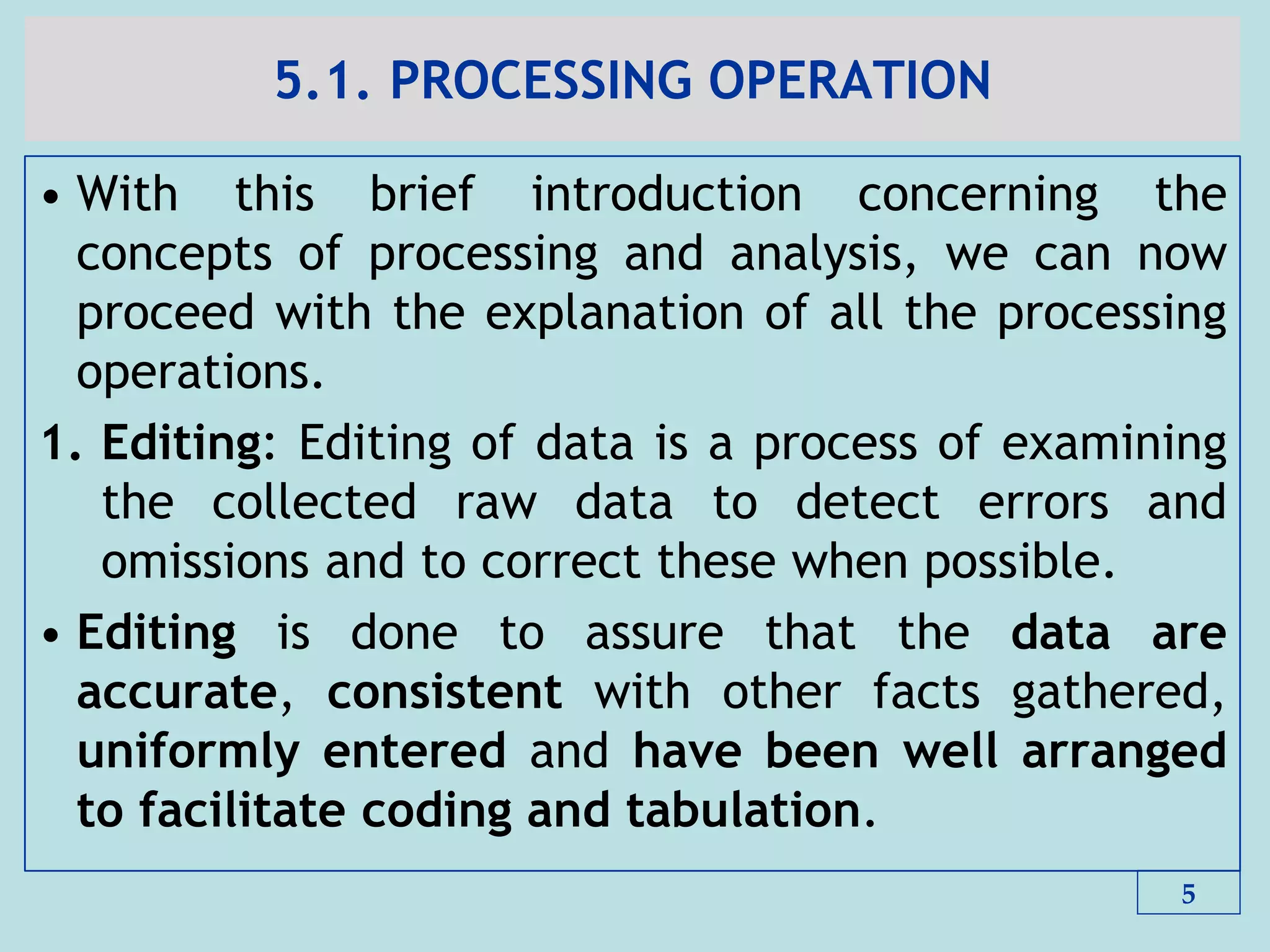
4. Tabulation
• The process of placing classified data into tabular
form is known as tabulation.
• Thus, tabulation is the process of summarizing
raw data and displaying them in compact form
Tabulation is useful due to the following reasons.
1. It conserves space
2. It facilitates the process of comparison
3. It facilitates summation of items
4. It provides a basis for statistical computations.
10
5.1. PROCESSING OPERATION
11
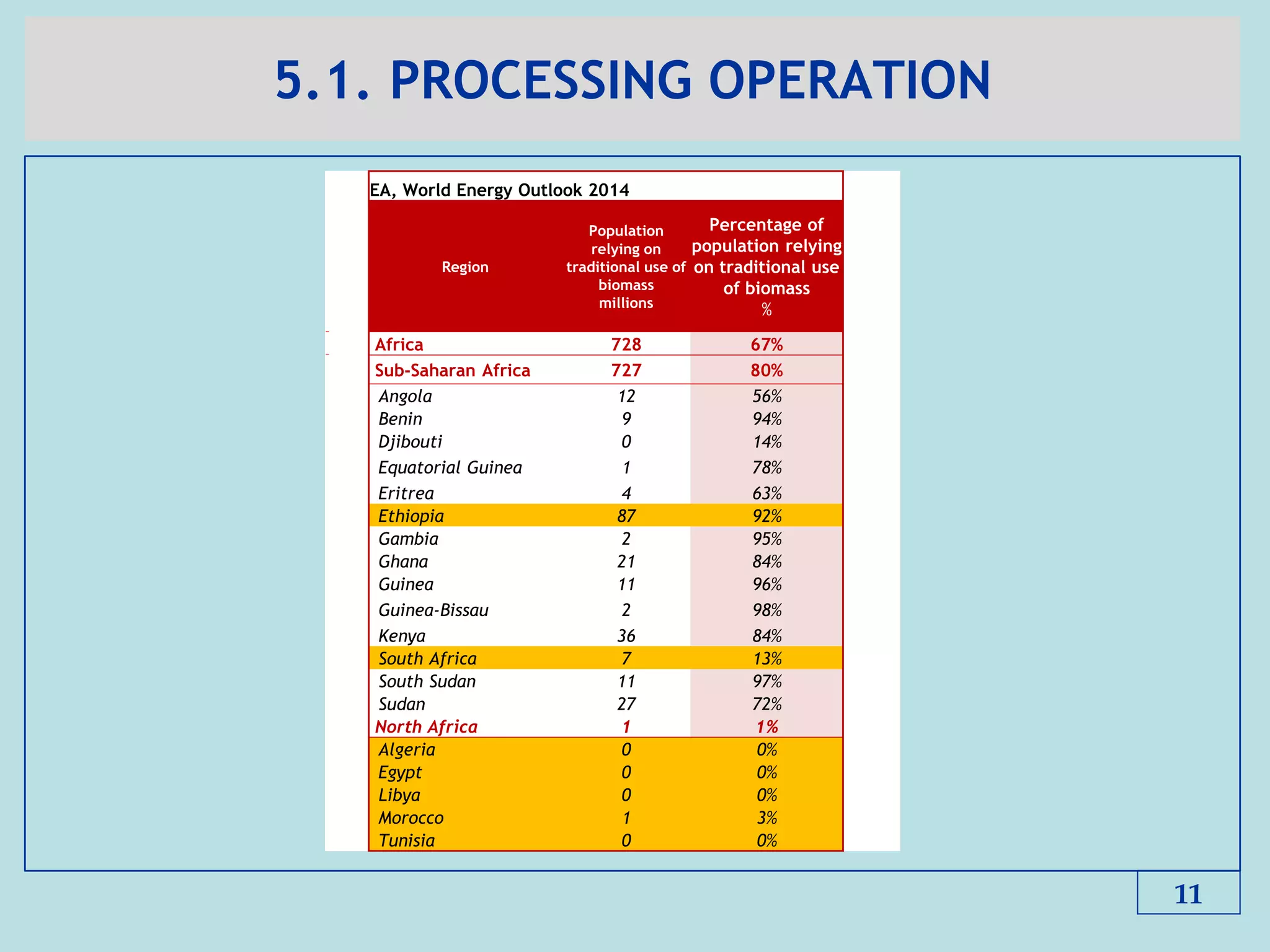
EA, World Energy Outlook 2014
Region
Population
relying on
traditional use of
biomass
millions
Percentage of
population relying
on traditional use
of biomass
%
Africa 728 67%
Sub-Saharan Africa 727 80%
Angola 12 56%
Benin 9 94%
Djibouti 0 14%
Equatorial Guinea 1 78%
Eritrea 4 63%
Ethiopia 87 92%
Gambia 2 95%
Ghana 21 84%
Guinea 11 96%
Guinea-Bissau 2 98%
Kenya 36 84%
South Africa 7 13%
South Sudan 11 97%
Sudan 27 72%
North Africa 1 1%
Algeria 0 0%
Egypt 0 0%
Libya 0 0%
Morocco 1 3%
Tunisia 0 0%
5. 2. MEANING OF INTERPRETATION
• Interpretation refers to the task of drawing
inferences from the collected facts after an
analytical and/or experimental study.
• Interpretation needs fair and carful
judgments.
• Often the same data can be interpreted in
different ways.
• So it is helpful to involve others or take time
to hear how different people interpret the
same information.
12
5.3.WHY INTERPRETATION?
• It is through interpretation that the researcher
can well understand the abstract principle that
works beneath his findings.
• Interpretation leads to the establishment of
explanatory concepts that can serve as a guide for
future research studies; it opens new avenues of
intellectual adventure
• Researcher can better appreciate only through
interpretation why his findings are what they
are and can make others to understand the real
significance of his research findings.
13
5.4. TECHNIQUE OF INTERPRETATION
Interpretation often involves the following steps:
( i ) Researcher must give reasonable explanations
(ii) Extraneous information
(iii) Consultation will result in correct
interpretation and, thus, will enhance the utility of
research results.
(iv) Researcher must accomplish the task of
interpretation only after considering all relevant
factors affecting the problem to avoid false
generalization.
14
5.5. PRECAUTIONS IN INTERPRETATION
Precautions in Interpretation Researcher must pay
attention to the following points for correct
interpretation:
( i ) (a ) The data are appropriate, trustworthy
and adequate for drawing inferences;
(b) The data reflect good homogeneity
(c) Proper analysis has been done through
statistical methods
(ii) The researcher must remain cautious about the
errors that can possibly arise in the process of
interpreting results.
15
5.5. PRECAUTIONS IN INTERPRETATION
(iv) He must never lose sight of the fact that his task
is not only to make sensitive observations of
relevant occurrences, but also to identify and
disengage the factors that are initially hidden to the
eye.
• Broad generalization should be avoided as most
research is not amenable to it because the
coverage may be restricted to a particular time, a
particular area and particular conditions.
16
5.5. PRECAUTIONS IN INTERPRETATION
(v) The researcher must remember hat ideally in the
course of a research study, there should be constant
interaction between initial hypothesis, empirical
observation and theoretical conceptions.
It is exactly in this area of interaction between
theoretical orientation and empirical observation
that opportunities for originality and creativity lie.
• He must pay special attention to this aspect while
engaged in the task of interpretation
17
Thank you !!!

Chapter 5_Scientific Research Methods_Processing , Analysis and Interpretation of Data.pdf

  • 1.
    Research Methodology Chapter 5 Processing,Analysis and Interpretation of Data Wondwossen Bogale (PhD) Assistant Professor, AAiT, AAU wondwossenboge@gmail.com
  • 2.
    5. PROCESSING ANDANALYSIS OF DATA • The data, after collection, has to be processed and analyzed in accordance with the outline laid down for the purpose at the time of developing the research plan. • Technically speaking, processing implies editing, coding, classification and tabulation of collected data so that they are ready for analysis. • The term analysis refers to the computation of certain measures along with searching for patterns of relationship that exist among data groups. 2
  • 3.
    5. PROCESSING ANDANALYSIS OF DATA • Data analysis helps to answer the research questions and to help determine the trends and relations ship among variables. • After data collection , the researcher should accomplish the following : Process the data, prepare tables and graphs, analyze and interpret findings, prepare for editing and prepare presentation. 3
  • 4.
    5. PROCESSING ANDANALYSIS OF DATA- EXAMPLES 4 EA, World Energy Outlook 2014 Region Population relying on traditional use of biomass millions Percentage of population relying on traditional use of biomass % Africa 728 67% Sub-Saharan Africa 727 80% Angola 12 56% Benin 9 94% Djibouti 0 14% Equatorial Guinea 1 78% Eritrea 4 63% Ethiopia 87 92% Gambia 2 95% Ghana 21 84% Guinea 11 96% Guinea-Bissau 2 98% Kenya 36 84% South Africa 7 13% South Sudan 11 97% Sudan 27 72% North Africa 1 1% Algeria 0 0% Egypt 0 0% Libya 0 0% Morocco 1 3% Tunisia 0 0% X Y Z
  • 5.
    5.1. PROCESSING OPERATION •With this brief introduction concerning the concepts of processing and analysis, we can now proceed with the explanation of all the processing operations. 1. Editing: Editing of data is a process of examining the collected raw data to detect errors and omissions and to correct these when possible. • Editing is done to assure that the data are accurate, consistent with other facts gathered, uniformly entered and have been well arranged to facilitate coding and tabulation. 5
  • 6.
    5.1. PROCESSING OPERATION Typesof Editing 1. Field Editing • Preliminary editing by a field supervisor on the same day as the interview to catch technical omissions, check legibility of handwriting, and clarify responses that are logically or conceptually inconsistent. 2. Central Editing • Editing performed by a central office staff; often done more rigorously than field editing. 6
  • 7.
    5.1. PROCESSING OPERATION 2.Coding • A systematic way in which to condense extensive data sets into smaller analyzable units through the creation of categories and concepts derived from the data. • It lets you make sense of and analyze your data. • Coding facilitates the organization, retrieval, and interpretation of data and leads to conclusions on the basis of that interpretation. 7
  • 8.
    5.1. PROCESSING OPERATION 3.Classification • Data classification is the process of organizing data into categories for its most effective and efficient use. • Most research studies result in a large volume of raw data which must be reduced into homogeneous groups if we are to get meaningful relationships. • Data having a common characteristic are placed in one class and in this way the entire data get divided into a number of groups or classes. 8
  • 9.
    5.1. PROCESSING OPERATION •Classification can depending upon the nature of the phenomenon involved: (a) Classification according to attributes : data classified on the basis of common characteristics which can either be descriptive (such as literacy, sex, weight, income, etc.) (b) Classification according to class-interval : For instance, persons whose incomes are within 3000 birr to 5000 birr can form one group, those whose incomes are within 5000 birr to 7000 can form another group and so on. 9
  • 10.
    5.1. PROCESSING OPERATION 4.Tabulation • The process of placing classified data into tabular form is known as tabulation. • Thus, tabulation is the process of summarizing raw data and displaying them in compact form Tabulation is useful due to the following reasons. 1. It conserves space 2. It facilitates the process of comparison 3. It facilitates summation of items 4. It provides a basis for statistical computations. 10
  • 11.
    5.1. PROCESSING OPERATION 11 EA,World Energy Outlook 2014 Region Population relying on traditional use of biomass millions Percentage of population relying on traditional use of biomass % Africa 728 67% Sub-Saharan Africa 727 80% Angola 12 56% Benin 9 94% Djibouti 0 14% Equatorial Guinea 1 78% Eritrea 4 63% Ethiopia 87 92% Gambia 2 95% Ghana 21 84% Guinea 11 96% Guinea-Bissau 2 98% Kenya 36 84% South Africa 7 13% South Sudan 11 97% Sudan 27 72% North Africa 1 1% Algeria 0 0% Egypt 0 0% Libya 0 0% Morocco 1 3% Tunisia 0 0%
  • 12.
    5. 2. MEANINGOF INTERPRETATION • Interpretation refers to the task of drawing inferences from the collected facts after an analytical and/or experimental study. • Interpretation needs fair and carful judgments. • Often the same data can be interpreted in different ways. • So it is helpful to involve others or take time to hear how different people interpret the same information. 12
  • 13.
    5.3.WHY INTERPRETATION? • Itis through interpretation that the researcher can well understand the abstract principle that works beneath his findings. • Interpretation leads to the establishment of explanatory concepts that can serve as a guide for future research studies; it opens new avenues of intellectual adventure • Researcher can better appreciate only through interpretation why his findings are what they are and can make others to understand the real significance of his research findings. 13
  • 14.
    5.4. TECHNIQUE OFINTERPRETATION Interpretation often involves the following steps: ( i ) Researcher must give reasonable explanations (ii) Extraneous information (iii) Consultation will result in correct interpretation and, thus, will enhance the utility of research results. (iv) Researcher must accomplish the task of interpretation only after considering all relevant factors affecting the problem to avoid false generalization. 14
  • 15.
    5.5. PRECAUTIONS ININTERPRETATION Precautions in Interpretation Researcher must pay attention to the following points for correct interpretation: ( i ) (a ) The data are appropriate, trustworthy and adequate for drawing inferences; (b) The data reflect good homogeneity (c) Proper analysis has been done through statistical methods (ii) The researcher must remain cautious about the errors that can possibly arise in the process of interpreting results. 15
  • 16.
    5.5. PRECAUTIONS ININTERPRETATION (iv) He must never lose sight of the fact that his task is not only to make sensitive observations of relevant occurrences, but also to identify and disengage the factors that are initially hidden to the eye. • Broad generalization should be avoided as most research is not amenable to it because the coverage may be restricted to a particular time, a particular area and particular conditions. 16
  • 17.
    5.5. PRECAUTIONS ININTERPRETATION (v) The researcher must remember hat ideally in the course of a research study, there should be constant interaction between initial hypothesis, empirical observation and theoretical conceptions. It is exactly in this area of interaction between theoretical orientation and empirical observation that opportunities for originality and creativity lie. • He must pay special attention to this aspect while engaged in the task of interpretation 17
  • 18.