Simple Interest and Compound
Interest

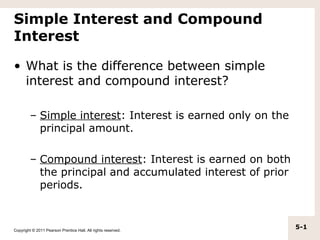
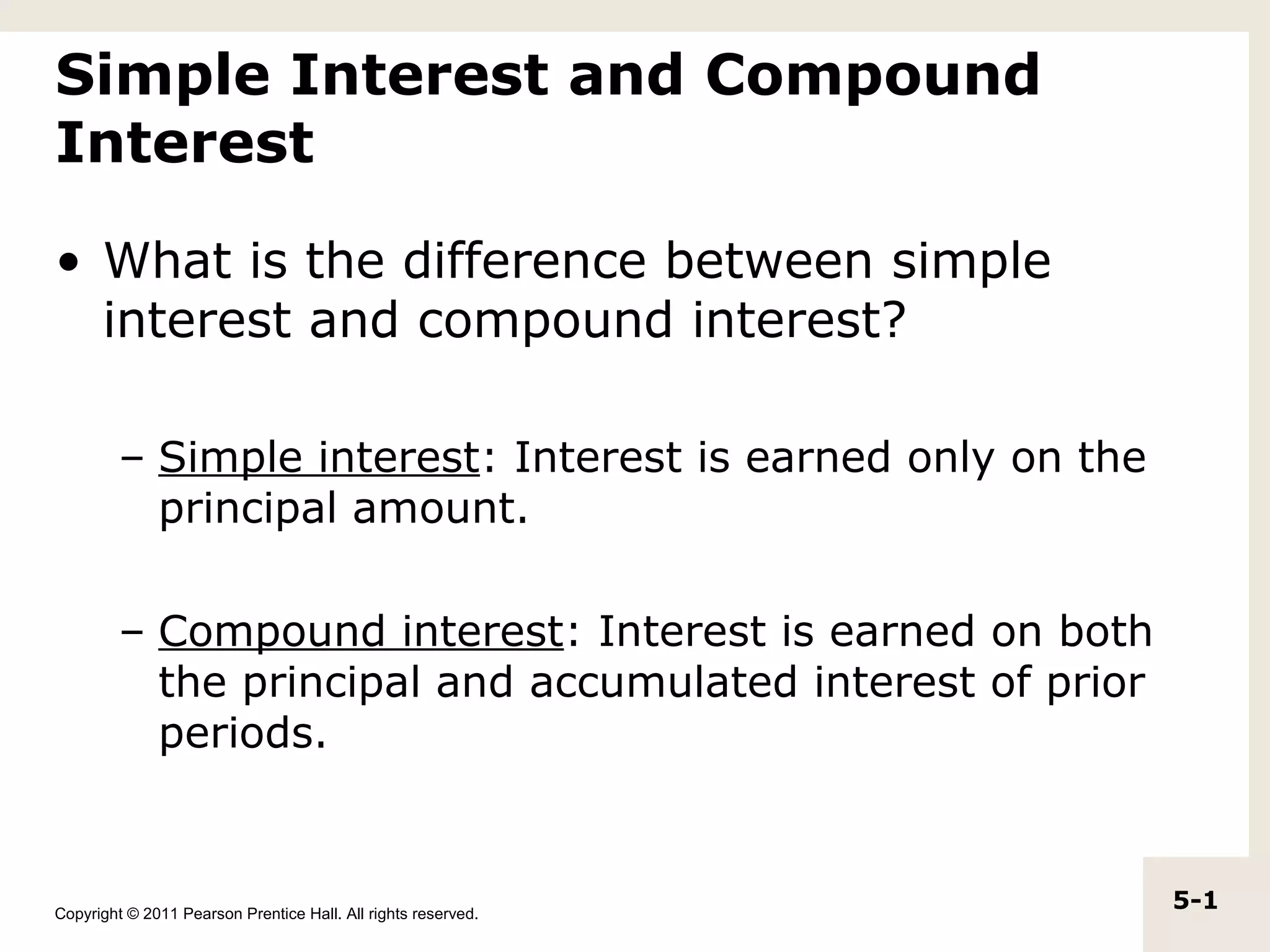
• What is the difference between simple
  interest and compound interest?

         – Simple interest: Interest is earned only on the
           principal amount.

         – Compound interest: Interest is earned on both
           the principal and accumulated interest of prior
           periods.


Copyright © 2011 Pearson Prentice Hall. All rights reserved.
                                                               5-1
Simple Interest and Compound Interest
(cont.)

• Example 5.1: Suppose that you deposited
  $500 in your savings account that earns
  5% annual interest. How much will you
  have in your account after two years using
  (a) simple interest and (b) compound
  interest?


Copyright © 2011 Pearson Prentice Hall. All rights reserved.
                                                               5-2
Simple Interest and Compound
Interest (cont.)

• Simple Interest
         – Interest earned
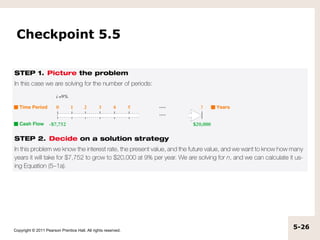
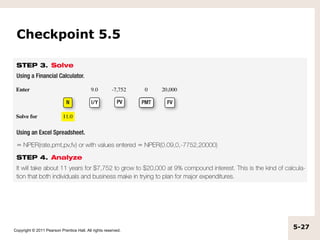
                  • = 5% of $500 = .05×500 = $25 per year
         – Total interest earned = $25×2 = $50
         – Balance in your savings account:
                  • = Principal + accumulated interest
                  • = $500 + $50 = $550


Copyright © 2011 Pearson Prentice Hall. All rights reserved.
                                                               5-3
Simple Interest and Compound
Interest (cont.)

 • Compound interest
          – Interest earned in Year 1
                   • = 5% of $500 = $25
          – Interest earned in Year 2
                   • = 5% of ($500 + accumulated interest)
                   • = 5% of ($500 + 25) = .05×525 = $26.25
          – Balance in your savings account:
                   • = Principal + interest earned
                   • = $500 + $25 + $26.25 = $551.25


Copyright © 2011 Pearson Prentice Hall. All rights reserved.
                                                               5-4
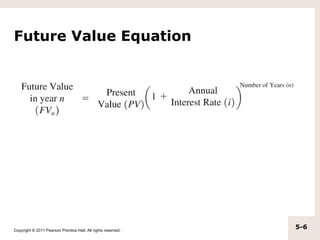
Present Value and Future Value

• Present value: what a cash flow would be
  worth to you today

• Future value: what a cash flow will be
  worth in the future


Copyright © 2011 Pearson Prentice Hall. All rights reserved.
                                                               5-5
Future Value Equation


Copyright © 2011 Pearson Prentice Hall. All rights reserved.
                                                               5-6
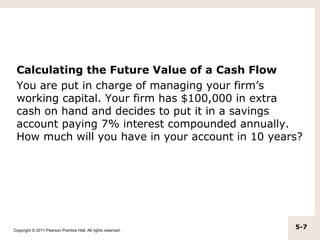
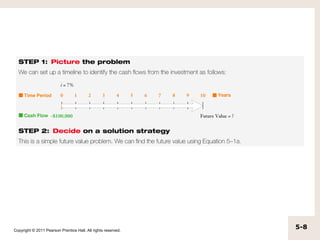
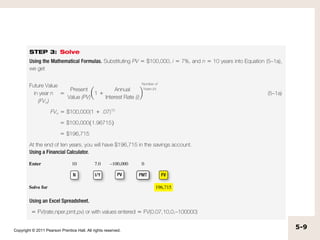
Calculating the Future Value of a Cash Flow
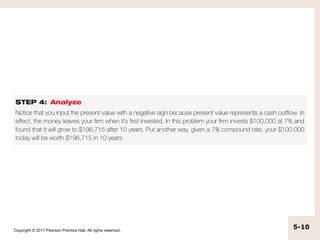
 You are put in charge of managing your firm’s
 working capital. Your firm has $100,000 in extra
 cash on hand and decides to put it in a savings
 account paying 7% interest compounded annually.
 How much will you have in your account in 10 years?


Copyright © 2011 Pearson Prentice Hall. All rights reserved.
                                                               5-7
Copyright © 2011 Pearson Prentice Hall. All rights reserved.
                                                               5-8
Copyright © 2011 Pearson Prentice Hall. All rights reserved.
                                                               5-9
Copyright © 2011 Pearson Prentice Hall. All rights reserved.
                                                               5-10
Compound Interest with Shorter
Compounding Periods

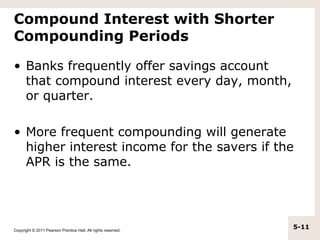
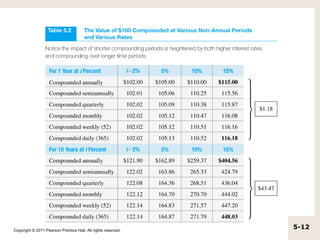
• Banks frequently offer savings account
  that compound interest every day, month,
  or quarter.

• More frequent compounding will generate
  higher interest income for the savers if the
  APR is the same.


Copyright © 2011 Pearson Prentice Hall. All rights reserved.
                                                               5-11
Copyright © 2011 Pearson Prentice Hall. All rights reserved.
                                                               5-12
The Key Question

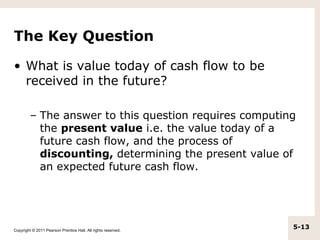
• What is value today of cash flow to be
  received in the future?

         – The answer to this question requires computing
           the present value i.e. the value today of a
           future cash flow, and the process of
           discounting, determining the present value of
           an expected future cash flow.


Copyright © 2011 Pearson Prentice Hall. All rights reserved.
                                                               5-13
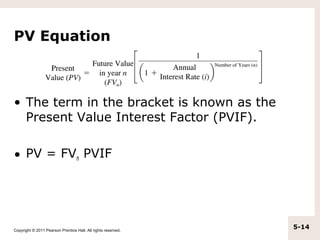
PV Equation


• The term in the bracket is known as the
  Present Value Interest Factor (PVIF).

• PV = FVn PVIF


Copyright © 2011 Pearson Prentice Hall. All rights reserved.
                                                               5-14
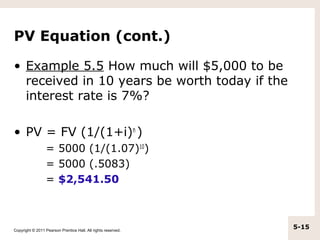
PV Equation (cont.)

• Example 5.5 How much will $5,000 to be
  received in 10 years be worth today if the
  interest rate is 7%?

• PV = FV (1/(1+i)n )
                  = 5000 (1/(1.07)10)
                  = 5000 (.5083)
                  = $2,541.50


Copyright © 2011 Pearson Prentice Hall. All rights reserved.
                                                               5-15
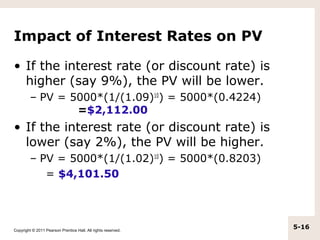
Impact of Interest Rates on PV

• If the interest rate (or discount rate) is
  higher (say 9%), the PV will be lower.
         – PV = 5000*(1/(1.09)10) = 5000*(0.4224)
                 =$2,112.00
• If the interest rate (or discount rate) is
  lower (say 2%), the PV will be higher.
         – PV = 5000*(1/(1.02)10) = 5000*(0.8203)
            = $4,101.50


Copyright © 2011 Pearson Prentice Hall. All rights reserved.
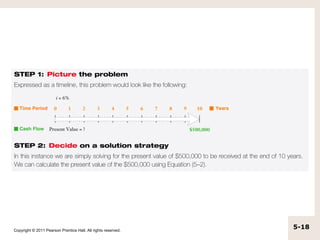
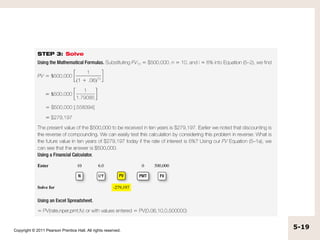
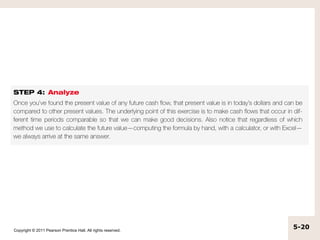
                                                               5-16
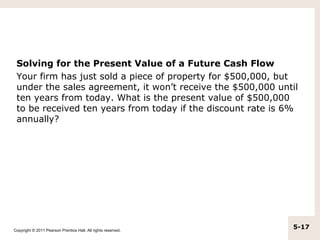
Solving for the Present Value of a Future Cash Flow
 Your firm has just sold a piece of property for $500,000, but
 under the sales agreement, it won’t receive the $500,000 until
 ten years from today. What is the present value of $500,000
 to be received ten years from today if the discount rate is 6%
 annually?


Copyright © 2011 Pearson Prentice Hall. All rights reserved.
                                                               5-17
Copyright © 2011 Pearson Prentice Hall. All rights reserved.
                                                               5-18
Copyright © 2011 Pearson Prentice Hall. All rights reserved.
                                                               5-19
Copyright © 2011 Pearson Prentice Hall. All rights reserved.
                                                               5-20
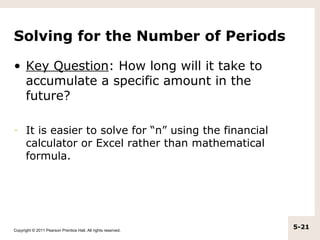
Solving for the Number of Periods

• Key Question: How long will it take to
  accumulate a specific amount in the
  future?

–     It is easier to solve for “n” using the financial
      calculator or Excel rather than mathematical
      formula.


Copyright © 2011 Pearson Prentice Hall. All rights reserved.
                                                               5-21
Solving for the Number of Periods
(cont.)

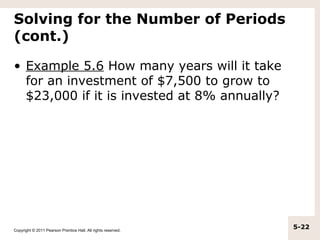
• Example 5.6 How many years will it take
  for an investment of $7,500 to grow to
  $23,000 if it is invested at 8% annually?


Copyright © 2011 Pearson Prentice Hall. All rights reserved.
                                                               5-22
Solving for the Number of Periods
(cont.)

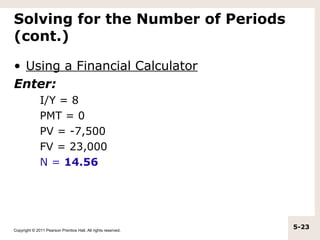
• Using a Financial Calculator
Enter:
              I/Y = 8
              PMT = 0
              PV = -7,500
              FV = 23,000
              N = 14.56


Copyright © 2011 Pearson Prentice Hall. All rights reserved.
                                                               5-23
Solving for the Number of Periods
(cont.)

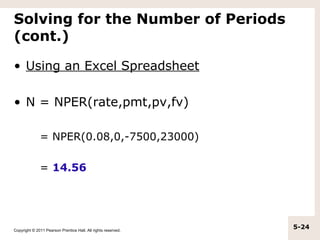
• Using an Excel Spreadsheet

• N = NPER(rate,pmt,pv,fv)

              = NPER(0.08,0,-7500,23000)

              = 14.56


Copyright © 2011 Pearson Prentice Hall. All rights reserved.
                                                               5-24
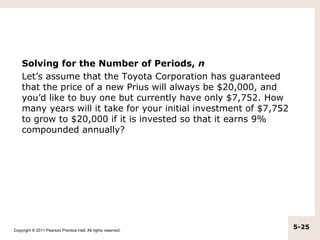
Solving for the Number of Periods, n
    Let’s assume that the Toyota Corporation has guaranteed
    that the price of a new Prius will always be $20,000, and
    you’d like to buy one but currently have only $7,752. How
    many years will it take for your initial investment of $7,752
    to grow to $20,000 if it is invested so that it earns 9%
    compounded annually?


Copyright © 2011 Pearson Prentice Hall. All rights reserved.
                                                                    5-25
Checkpoint 5.5


Copyright © 2011 Pearson Prentice Hall. All rights reserved.
                                                               5-26
Checkpoint 5.5


Copyright © 2011 Pearson Prentice Hall. All rights reserved.
                                                               5-27
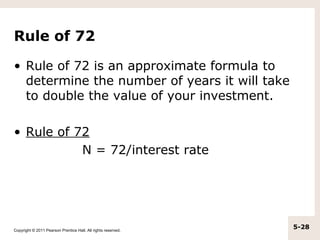
Rule of 72

• Rule of 72 is an approximate formula to
  determine the number of years it will take
  to double the value of your investment.

• Rule of 72
           N = 72/interest rate


Copyright © 2011 Pearson Prentice Hall. All rights reserved.
                                                               5-28
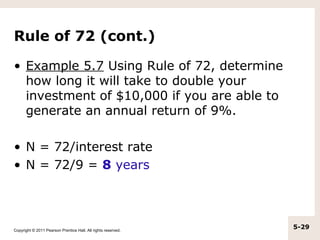
Rule of 72 (cont.)

• Example 5.7 Using Rule of 72, determine
  how long it will take to double your
  investment of $10,000 if you are able to
  generate an annual return of 9%.

• N = 72/interest rate
• N = 72/9 = 8 years


Copyright © 2011 Pearson Prentice Hall. All rights reserved.
                                                               5-29
Solving for Rate of Interest

• Key Question: What rate of interest will
  allow your investment to grow to a desired
  future value?

• We can determine the rate of interest
  using mathematical equation, the financial
  calculator or the Excel spread sheet.


Copyright © 2011 Pearson Prentice Hall. All rights reserved.
                                                               5-30
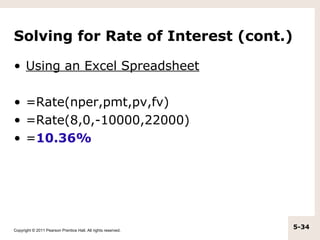
Solving for Rate of Interest (cont.)

• Example 5.8 At what rate of interest must
  your savings of $10,000 be compounded
  annually for it to grow to $22,000 in 8
  years?


Copyright © 2011 Pearson Prentice Hall. All rights reserved.
                                                               5-31
Solving for Rate of Interest (cont.)

• Using Mathematical Formula:
         I =         (FV/PV)1/n - 1
           =         (22000/10000)1/8 - 1
           =         (2.2).125 - 1
           =         1.1035 – 1
           =         .1035 or 10.35%


Copyright © 2011 Pearson Prentice Hall. All rights reserved.
                                                               5-32
Solving for Rate of Interest (cont.)

• Using Financial Calculator
Enter:
              N=8
              PMT = 0
              PV = -10,000
              FV = 22,000
              I/Y =10.36


Copyright © 2011 Pearson Prentice Hall. All rights reserved.
                                                               5-33
Solving for Rate of Interest (cont.)

• Using an Excel Spreadsheet

• =Rate(nper,pmt,pv,fv)
• =Rate(8,0,-10000,22000)
• =10.36%


Copyright © 2011 Pearson Prentice Hall. All rights reserved.
                                                               5-34
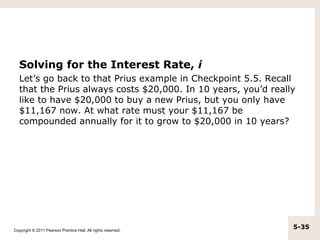
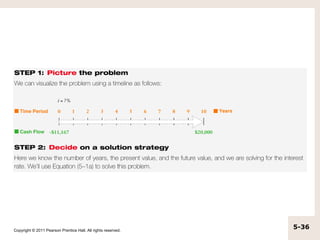
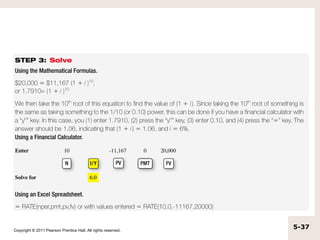
Solving for the Interest Rate, i
   Let’s go back to that Prius example in Checkpoint 5.5. Recall
   that the Prius always costs $20,000. In 10 years, you’d really
   like to have $20,000 to buy a new Prius, but you only have
   $11,167 now. At what rate must your $11,167 be
   compounded annually for it to grow to $20,000 in 10 years?


Copyright © 2011 Pearson Prentice Hall. All rights reserved.
                                                                5-35
Copyright © 2011 Pearson Prentice Hall. All rights reserved.
                                                               5-36
Copyright © 2011 Pearson Prentice Hall. All rights reserved.
                                                               5-37
Copyright © 2011 Pearson Prentice Hall. All rights reserved.
                                                               5-38
Annual Percentage Rate (APR)

• The annual percentage rate (APR)
  indicates the amount of interest paid or
  earned in one year without compounding.
  APR is also known as the nominal or stated
  interest rate. This is the rate required by
  law.


Copyright © 2011 Pearson Prentice Hall. All rights reserved.
                                                               5-39
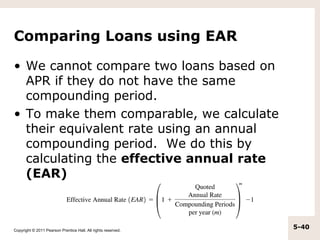
Comparing Loans using EAR

• We cannot compare two loans based on
  APR if they do not have the same
  compounding period.
• To make them comparable, we calculate
  their equivalent rate using an annual
  compounding period. We do this by
  calculating the effective annual rate
  (EAR)


Copyright © 2011 Pearson Prentice Hall. All rights reserved.
                                                               5-40
Comparing Loans using EAR (cont.)

• Example 5.9 Calculate the EAR for a loan
  that has a 5.45% quoted annual interest
  rate compounded monthly.

• EAR = [1+.0545/12]12 - 1
    =
      1.0558 – 1
    = .05588 or 5.59%


Copyright © 2011 Pearson Prentice Hall. All rights reserved.
                                                               5-41
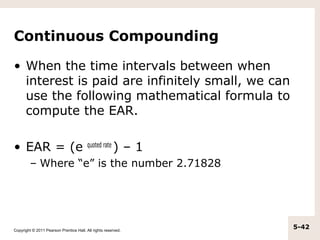
Continuous Compounding

• When the time intervals between when
  interest is paid are infinitely small, we can
  use the following mathematical formula to
  compute the EAR.

• EAR = (e                               quoted rate
                                                       )–1
         – Where “e” is the number 2.71828


Copyright © 2011 Pearson Prentice Hall. All rights reserved.
                                                               5-42
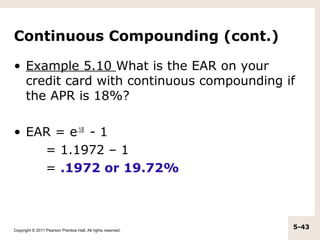
Continuous Compounding (cont.)

• Example 5.10 What is the EAR on your
  credit card with continuous compounding if
  the APR is 18%?

• EAR = e.18 - 1
    = 1.1972 – 1
    = .1972 or 19.72%


Copyright © 2011 Pearson Prentice Hall. All rights reserved.
                                                               5-43

Chapter 5 interest

  • 1.
    Simple Interest andCompound Interest • What is the difference between simple interest and compound interest? – Simple interest: Interest is earned only on the principal amount. – Compound interest: Interest is earned on both the principal and accumulated interest of prior periods. Copyright © 2011 Pearson Prentice Hall. All rights reserved. 5-1
  • 2.
    Simple Interest andCompound Interest (cont.) • Example 5.1: Suppose that you deposited $500 in your savings account that earns 5% annual interest. How much will you have in your account after two years using (a) simple interest and (b) compound interest? Copyright © 2011 Pearson Prentice Hall. All rights reserved. 5-2
  • 3.
    Simple Interest andCompound Interest (cont.) • Simple Interest – Interest earned • = 5% of $500 = .05×500 = $25 per year – Total interest earned = $25×2 = $50 – Balance in your savings account: • = Principal + accumulated interest • = $500 + $50 = $550 Copyright © 2011 Pearson Prentice Hall. All rights reserved. 5-3
  • 4.
    Simple Interest andCompound Interest (cont.) • Compound interest – Interest earned in Year 1 • = 5% of $500 = $25 – Interest earned in Year 2 • = 5% of ($500 + accumulated interest) • = 5% of ($500 + 25) = .05×525 = $26.25 – Balance in your savings account: • = Principal + interest earned • = $500 + $25 + $26.25 = $551.25 Copyright © 2011 Pearson Prentice Hall. All rights reserved. 5-4
  • 5.
    Present Value andFuture Value • Present value: what a cash flow would be worth to you today • Future value: what a cash flow will be worth in the future Copyright © 2011 Pearson Prentice Hall. All rights reserved. 5-5
  • 6.
    Future Value Equation Copyright© 2011 Pearson Prentice Hall. All rights reserved. 5-6
  • 7.
    Calculating the FutureValue of a Cash Flow You are put in charge of managing your firm’s working capital. Your firm has $100,000 in extra cash on hand and decides to put it in a savings account paying 7% interest compounded annually. How much will you have in your account in 10 years? Copyright © 2011 Pearson Prentice Hall. All rights reserved. 5-7
  • 8.
    Copyright © 2011Pearson Prentice Hall. All rights reserved. 5-8
  • 9.
    Copyright © 2011Pearson Prentice Hall. All rights reserved. 5-9
  • 10.
    Copyright © 2011Pearson Prentice Hall. All rights reserved. 5-10
  • 11.
    Compound Interest withShorter Compounding Periods • Banks frequently offer savings account that compound interest every day, month, or quarter. • More frequent compounding will generate higher interest income for the savers if the APR is the same. Copyright © 2011 Pearson Prentice Hall. All rights reserved. 5-11
  • 12.
    Copyright © 2011Pearson Prentice Hall. All rights reserved. 5-12
  • 13.
    The Key Question •What is value today of cash flow to be received in the future? – The answer to this question requires computing the present value i.e. the value today of a future cash flow, and the process of discounting, determining the present value of an expected future cash flow. Copyright © 2011 Pearson Prentice Hall. All rights reserved. 5-13
  • 14.
    PV Equation • Theterm in the bracket is known as the Present Value Interest Factor (PVIF). • PV = FVn PVIF Copyright © 2011 Pearson Prentice Hall. All rights reserved. 5-14
  • 15.
    PV Equation (cont.) •Example 5.5 How much will $5,000 to be received in 10 years be worth today if the interest rate is 7%? • PV = FV (1/(1+i)n ) = 5000 (1/(1.07)10) = 5000 (.5083) = $2,541.50 Copyright © 2011 Pearson Prentice Hall. All rights reserved. 5-15
  • 16.
    Impact of InterestRates on PV • If the interest rate (or discount rate) is higher (say 9%), the PV will be lower. – PV = 5000*(1/(1.09)10) = 5000*(0.4224) =$2,112.00 • If the interest rate (or discount rate) is lower (say 2%), the PV will be higher. – PV = 5000*(1/(1.02)10) = 5000*(0.8203) = $4,101.50 Copyright © 2011 Pearson Prentice Hall. All rights reserved. 5-16
  • 17.
    Solving for thePresent Value of a Future Cash Flow Your firm has just sold a piece of property for $500,000, but under the sales agreement, it won’t receive the $500,000 until ten years from today. What is the present value of $500,000 to be received ten years from today if the discount rate is 6% annually? Copyright © 2011 Pearson Prentice Hall. All rights reserved. 5-17
  • 18.
    Copyright © 2011Pearson Prentice Hall. All rights reserved. 5-18
  • 19.
    Copyright © 2011Pearson Prentice Hall. All rights reserved. 5-19
  • 20.
    Copyright © 2011Pearson Prentice Hall. All rights reserved. 5-20
  • 21.
    Solving for theNumber of Periods • Key Question: How long will it take to accumulate a specific amount in the future? – It is easier to solve for “n” using the financial calculator or Excel rather than mathematical formula. Copyright © 2011 Pearson Prentice Hall. All rights reserved. 5-21
  • 22.
    Solving for theNumber of Periods (cont.) • Example 5.6 How many years will it take for an investment of $7,500 to grow to $23,000 if it is invested at 8% annually? Copyright © 2011 Pearson Prentice Hall. All rights reserved. 5-22
  • 23.
    Solving for theNumber of Periods (cont.) • Using a Financial Calculator Enter: I/Y = 8 PMT = 0 PV = -7,500 FV = 23,000 N = 14.56 Copyright © 2011 Pearson Prentice Hall. All rights reserved. 5-23
  • 24.
    Solving for theNumber of Periods (cont.) • Using an Excel Spreadsheet • N = NPER(rate,pmt,pv,fv) = NPER(0.08,0,-7500,23000) = 14.56 Copyright © 2011 Pearson Prentice Hall. All rights reserved. 5-24
  • 25.
    Solving for theNumber of Periods, n Let’s assume that the Toyota Corporation has guaranteed that the price of a new Prius will always be $20,000, and you’d like to buy one but currently have only $7,752. How many years will it take for your initial investment of $7,752 to grow to $20,000 if it is invested so that it earns 9% compounded annually? Copyright © 2011 Pearson Prentice Hall. All rights reserved. 5-25
  • 26.
    Checkpoint 5.5 Copyright ©2011 Pearson Prentice Hall. All rights reserved. 5-26
  • 27.
    Checkpoint 5.5 Copyright ©2011 Pearson Prentice Hall. All rights reserved. 5-27
  • 28.
    Rule of 72 •Rule of 72 is an approximate formula to determine the number of years it will take to double the value of your investment. • Rule of 72 N = 72/interest rate Copyright © 2011 Pearson Prentice Hall. All rights reserved. 5-28
  • 29.
    Rule of 72(cont.) • Example 5.7 Using Rule of 72, determine how long it will take to double your investment of $10,000 if you are able to generate an annual return of 9%. • N = 72/interest rate • N = 72/9 = 8 years Copyright © 2011 Pearson Prentice Hall. All rights reserved. 5-29
  • 30.
    Solving for Rateof Interest • Key Question: What rate of interest will allow your investment to grow to a desired future value? • We can determine the rate of interest using mathematical equation, the financial calculator or the Excel spread sheet. Copyright © 2011 Pearson Prentice Hall. All rights reserved. 5-30
  • 31.
    Solving for Rateof Interest (cont.) • Example 5.8 At what rate of interest must your savings of $10,000 be compounded annually for it to grow to $22,000 in 8 years? Copyright © 2011 Pearson Prentice Hall. All rights reserved. 5-31
  • 32.
    Solving for Rateof Interest (cont.) • Using Mathematical Formula: I = (FV/PV)1/n - 1 = (22000/10000)1/8 - 1 = (2.2).125 - 1 = 1.1035 – 1 = .1035 or 10.35% Copyright © 2011 Pearson Prentice Hall. All rights reserved. 5-32
  • 33.
    Solving for Rateof Interest (cont.) • Using Financial Calculator Enter: N=8 PMT = 0 PV = -10,000 FV = 22,000 I/Y =10.36 Copyright © 2011 Pearson Prentice Hall. All rights reserved. 5-33
  • 34.
    Solving for Rateof Interest (cont.) • Using an Excel Spreadsheet • =Rate(nper,pmt,pv,fv) • =Rate(8,0,-10000,22000) • =10.36% Copyright © 2011 Pearson Prentice Hall. All rights reserved. 5-34
  • 35.
    Solving for theInterest Rate, i Let’s go back to that Prius example in Checkpoint 5.5. Recall that the Prius always costs $20,000. In 10 years, you’d really like to have $20,000 to buy a new Prius, but you only have $11,167 now. At what rate must your $11,167 be compounded annually for it to grow to $20,000 in 10 years? Copyright © 2011 Pearson Prentice Hall. All rights reserved. 5-35
  • 36.
    Copyright © 2011Pearson Prentice Hall. All rights reserved. 5-36
  • 37.
    Copyright © 2011Pearson Prentice Hall. All rights reserved. 5-37
  • 38.
    Copyright © 2011Pearson Prentice Hall. All rights reserved. 5-38
  • 39.
    Annual Percentage Rate(APR) • The annual percentage rate (APR) indicates the amount of interest paid or earned in one year without compounding. APR is also known as the nominal or stated interest rate. This is the rate required by law. Copyright © 2011 Pearson Prentice Hall. All rights reserved. 5-39
  • 40.
    Comparing Loans usingEAR • We cannot compare two loans based on APR if they do not have the same compounding period. • To make them comparable, we calculate their equivalent rate using an annual compounding period. We do this by calculating the effective annual rate (EAR) Copyright © 2011 Pearson Prentice Hall. All rights reserved. 5-40
  • 41.
    Comparing Loans usingEAR (cont.) • Example 5.9 Calculate the EAR for a loan that has a 5.45% quoted annual interest rate compounded monthly. • EAR = [1+.0545/12]12 - 1 = 1.0558 – 1 = .05588 or 5.59% Copyright © 2011 Pearson Prentice Hall. All rights reserved. 5-41
  • 42.
    Continuous Compounding • Whenthe time intervals between when interest is paid are infinitely small, we can use the following mathematical formula to compute the EAR. • EAR = (e quoted rate )–1 – Where “e” is the number 2.71828 Copyright © 2011 Pearson Prentice Hall. All rights reserved. 5-42
  • 43.
    Continuous Compounding (cont.) •Example 5.10 What is the EAR on your credit card with continuous compounding if the APR is 18%? • EAR = e.18 - 1 = 1.1972 – 1 = .1972 or 19.72% Copyright © 2011 Pearson Prentice Hall. All rights reserved. 5-43