© 2006 Cisco Systems, Inc. All rights reserved. Cisco Public 1Version 4.0
Creating the Network
Design
Designing and Supporting Computer Networks – Chapter 5
© 2006 Cisco Systems, Inc. All rights reserved. Cisco Public 2
Objectives
 Analyze business goals and application requirements
to determine what factors affect the network design
 Utilize the hierarchical design model to develop a
cost-effective network design that matches the
organization’s requirements
 Select the appropriate WAN connectivity option to
meet the organization’s requirements
 Incorporate wireless connectivity into the LAN design,
based on the results of the wireless survey
 Incorporate security into the LAN/WAN design,
including placement of firewalls, IDS, and ACLs
© 2006 Cisco Systems, Inc. All rights reserved. Cisco Public 3
Analyze Business Goals and Application
Requirements
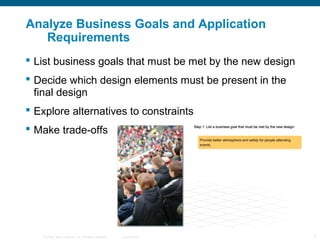
 List business goals that must be met by the new design
 Decide which design elements must be present in the
final design
 Explore alternatives to constraints
 Make trade-offs
© 2006 Cisco Systems, Inc. All rights reserved. Cisco Public 4
Analyze Business Goals and Application
Requirements
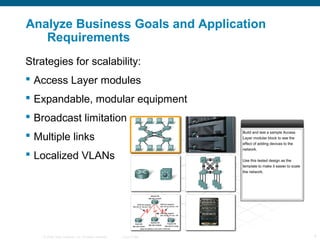
Strategies for scalability:
 Access Layer modules
 Expandable, modular equipment
 Broadcast limitation
 Multiple links
 Localized VLANs
© 2006 Cisco Systems, Inc. All rights reserved. Cisco Public 5
Analyze Business Goals and Application
Requirements
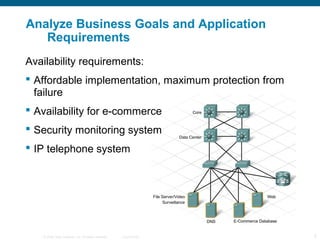
Availability requirements:
 Affordable implementation, maximum protection from
failure
 Availability for e-commerce
 Security monitoring system
 IP telephone system
© 2006 Cisco Systems, Inc. All rights reserved. Cisco Public 6
Analyze Business Goals and Application
Requirements
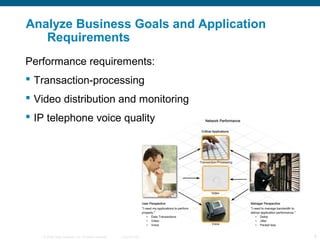
Performance requirements:
 Transaction-processing
 Video distribution and monitoring
 IP telephone voice quality
© 2006 Cisco Systems, Inc. All rights reserved. Cisco Public 7
Analyze Business Goals and Application
Requirements
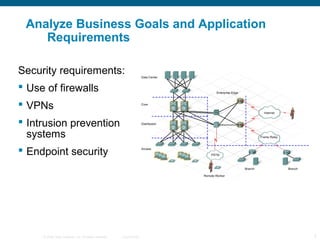
Security requirements:
 Use of firewalls
 VPNs
 Intrusion prevention
systems
 Endpoint security
© 2006 Cisco Systems, Inc. All rights reserved. Cisco Public 8
Analyze Business Goals and Application
Requirements
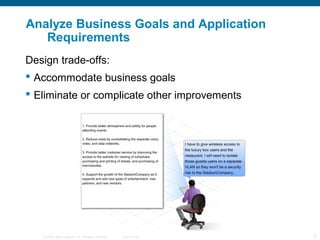
Design trade-offs:
 Accommodate business goals
 Eliminate or complicate other improvements
© 2006 Cisco Systems, Inc. All rights reserved. Cisco Public 9
Utilize the Hierarchical Design Model to
Develop a Cost-Effective Network Design
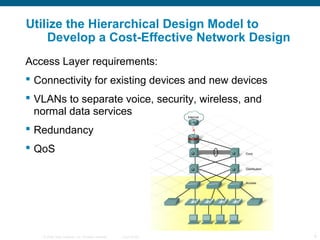
Access Layer requirements:
 Connectivity for existing devices and new devices
 VLANs to separate voice, security, wireless, and
normal data services
 Redundancy
 QoS
© 2006 Cisco Systems, Inc. All rights reserved. Cisco Public 10
Utilize the Hierarchical Design Model to
Develop a Cost-Effective Network Design
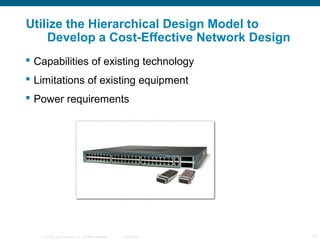
 Capabilities of existing technology
 Limitations of existing equipment
 Power requirements
© 2006 Cisco Systems, Inc. All rights reserved. Cisco Public 11
Utilize the Hierarchical Design Model to
Develop a Cost-Effective Network Design
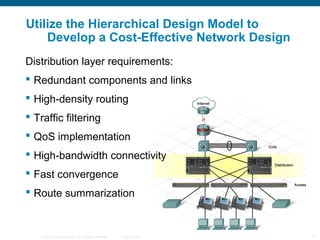
Distribution layer requirements:
 Redundant components and links
 High-density routing
 Traffic filtering
 QoS implementation
 High-bandwidth connectivity
 Fast convergence
 Route summarization
© 2006 Cisco Systems, Inc. All rights reserved. Cisco Public 12
Utilize the Hierarchical Design Model to
Develop a Cost-Effective Network Design
Core Layer requirements:
 High-speed connectivity
 Routed interconnections
 High-speed redundant
links
© 2006 Cisco Systems, Inc. All rights reserved. Cisco Public 13
Utilize the Hierarchical Design Model to
Develop a Cost-Effective Network Design
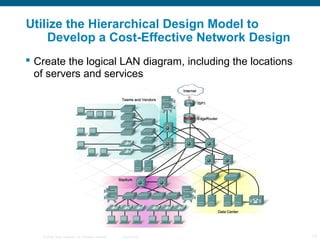
 Create the logical LAN diagram, including the locations
of servers and services
© 2006 Cisco Systems, Inc. All rights reserved. Cisco Public 14
Select the Appropriate WAN Connectivity
Option
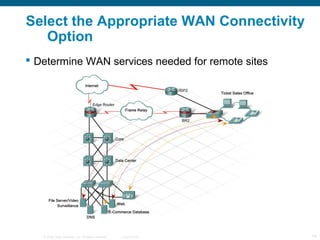
 Determine WAN services needed for remote sites
© 2006 Cisco Systems, Inc. All rights reserved. Cisco Public 15
Select the Appropriate WAN Connectivity
Option
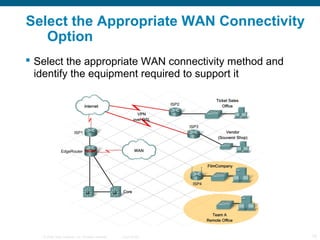
 Select the appropriate WAN connectivity method and
identify the equipment required to support it
© 2006 Cisco Systems, Inc. All rights reserved. Cisco Public 16
Select the Appropriate WAN Connectivity
Option
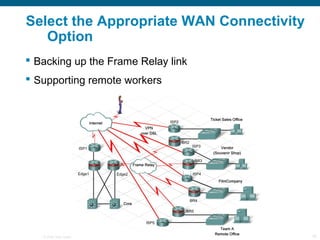
 Backing up the Frame Relay link
 Supporting remote workers
© 2006 Cisco Systems, Inc. All rights reserved. Cisco Public 17
Select the Appropriate WAN Connectivity
Option
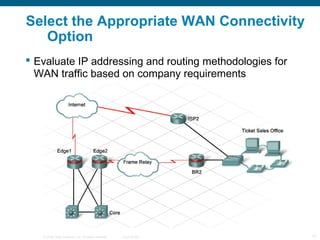
 Evaluate IP addressing and routing methodologies for
WAN traffic based on company requirements
© 2006 Cisco Systems, Inc. All rights reserved. Cisco Public 18
Incorporate Wireless Connectivity into
the LAN Design
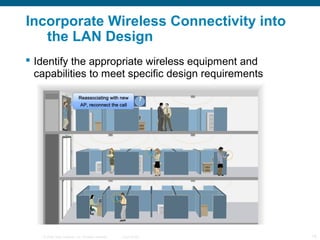
 Identify the appropriate wireless equipment and
capabilities to meet specific design requirements
© 2006 Cisco Systems, Inc. All rights reserved. Cisco Public 19
Incorporate Wireless Connectivity into
the LAN Design
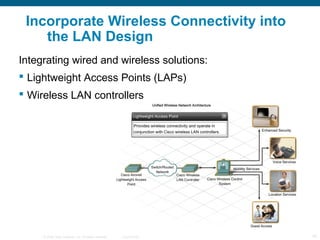
Integrating wired and wireless solutions:
 Lightweight Access Points (LAPs)
 Wireless LAN controllers
© 2006 Cisco Systems, Inc. All rights reserved. Cisco Public 20
Incorporate Wireless Connectivity into
the LAN Design
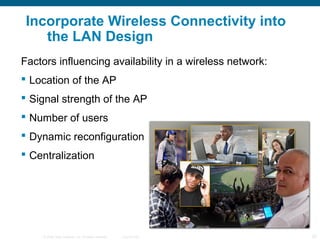
Factors influencing availability in a wireless network:
 Location of the AP
 Signal strength of the AP
 Number of users
 Dynamic reconfiguration
 Centralization
© 2006 Cisco Systems, Inc. All rights reserved. Cisco Public 21
Incorporate Wireless Connectivity into
the LAN Design
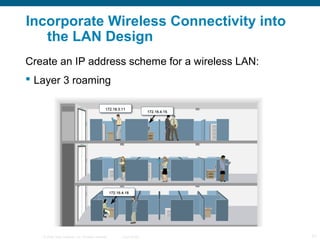
Create an IP address scheme for a wireless LAN:
 Layer 3 roaming
© 2006 Cisco Systems, Inc. All rights reserved. Cisco Public 22
Incorporate Security into the LAN/WAN
Design
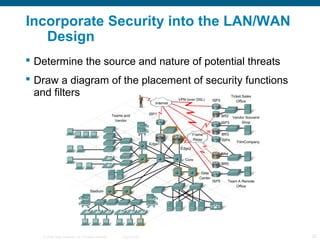
 Determine the source and nature of potential threats
 Draw a diagram of the placement of security functions
and filters
© 2006 Cisco Systems, Inc. All rights reserved. Cisco Public 23
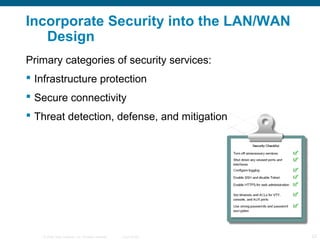
Primary categories of security services:
 Infrastructure protection
 Secure connectivity
 Threat detection, defense, and mitigation
Incorporate Security into the LAN/WAN
Design
© 2006 Cisco Systems, Inc. All rights reserved. Cisco Public 24
Incorporate Security into the LAN/WAN
Design
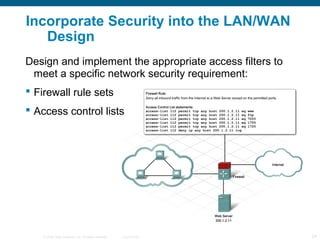
Design and implement the appropriate access filters to
meet a specific network security requirement:
 Firewall rule sets
 Access control lists
© 2006 Cisco Systems, Inc. All rights reserved. Cisco Public 25
Incorporate Security into the LAN/WAN
Design
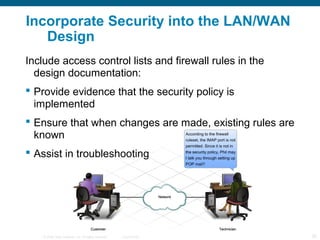
Include access control lists and firewall rules in the
design documentation:
 Provide evidence that the security policy is
implemented
 Ensure that when changes are made, existing rules are
known
 Assist in troubleshooting
© 2006 Cisco Systems, Inc. All rights reserved. Cisco Public 26
Summary
 For each business goal, the designer determines what
network changes are necessary.
 Converged networks carry a combination of data, voice,
and video traffic.
 Designing WAN connectivity requires evaluation of the
telecommunications services available in the
customer’s area.
 Unified wireless network solutions offer advanced
features.
 The network designer must identify which data is at risk
and what the potential sources of attacks are.
© 2006 Cisco Systems, Inc. All rights reserved. Cisco Public 27

Chapter 5

  • 1.
    © 2006 CiscoSystems, Inc. All rights reserved. Cisco Public 1Version 4.0 Creating the Network Design Designing and Supporting Computer Networks – Chapter 5
  • 2.
    © 2006 CiscoSystems, Inc. All rights reserved. Cisco Public 2 Objectives  Analyze business goals and application requirements to determine what factors affect the network design  Utilize the hierarchical design model to develop a cost-effective network design that matches the organization’s requirements  Select the appropriate WAN connectivity option to meet the organization’s requirements  Incorporate wireless connectivity into the LAN design, based on the results of the wireless survey  Incorporate security into the LAN/WAN design, including placement of firewalls, IDS, and ACLs
  • 3.
    © 2006 CiscoSystems, Inc. All rights reserved. Cisco Public 3 Analyze Business Goals and Application Requirements  List business goals that must be met by the new design  Decide which design elements must be present in the final design  Explore alternatives to constraints  Make trade-offs
  • 4.
    © 2006 CiscoSystems, Inc. All rights reserved. Cisco Public 4 Analyze Business Goals and Application Requirements Strategies for scalability:  Access Layer modules  Expandable, modular equipment  Broadcast limitation  Multiple links  Localized VLANs
  • 5.
    © 2006 CiscoSystems, Inc. All rights reserved. Cisco Public 5 Analyze Business Goals and Application Requirements Availability requirements:  Affordable implementation, maximum protection from failure  Availability for e-commerce  Security monitoring system  IP telephone system
  • 6.
    © 2006 CiscoSystems, Inc. All rights reserved. Cisco Public 6 Analyze Business Goals and Application Requirements Performance requirements:  Transaction-processing  Video distribution and monitoring  IP telephone voice quality
  • 7.
    © 2006 CiscoSystems, Inc. All rights reserved. Cisco Public 7 Analyze Business Goals and Application Requirements Security requirements:  Use of firewalls  VPNs  Intrusion prevention systems  Endpoint security
  • 8.
    © 2006 CiscoSystems, Inc. All rights reserved. Cisco Public 8 Analyze Business Goals and Application Requirements Design trade-offs:  Accommodate business goals  Eliminate or complicate other improvements
  • 9.
    © 2006 CiscoSystems, Inc. All rights reserved. Cisco Public 9 Utilize the Hierarchical Design Model to Develop a Cost-Effective Network Design Access Layer requirements:  Connectivity for existing devices and new devices  VLANs to separate voice, security, wireless, and normal data services  Redundancy  QoS
  • 10.
    © 2006 CiscoSystems, Inc. All rights reserved. Cisco Public 10 Utilize the Hierarchical Design Model to Develop a Cost-Effective Network Design  Capabilities of existing technology  Limitations of existing equipment  Power requirements
  • 11.
    © 2006 CiscoSystems, Inc. All rights reserved. Cisco Public 11 Utilize the Hierarchical Design Model to Develop a Cost-Effective Network Design Distribution layer requirements:  Redundant components and links  High-density routing  Traffic filtering  QoS implementation  High-bandwidth connectivity  Fast convergence  Route summarization
  • 12.
    © 2006 CiscoSystems, Inc. All rights reserved. Cisco Public 12 Utilize the Hierarchical Design Model to Develop a Cost-Effective Network Design Core Layer requirements:  High-speed connectivity  Routed interconnections  High-speed redundant links
  • 13.
    © 2006 CiscoSystems, Inc. All rights reserved. Cisco Public 13 Utilize the Hierarchical Design Model to Develop a Cost-Effective Network Design  Create the logical LAN diagram, including the locations of servers and services
  • 14.
    © 2006 CiscoSystems, Inc. All rights reserved. Cisco Public 14 Select the Appropriate WAN Connectivity Option  Determine WAN services needed for remote sites
  • 15.
    © 2006 CiscoSystems, Inc. All rights reserved. Cisco Public 15 Select the Appropriate WAN Connectivity Option  Select the appropriate WAN connectivity method and identify the equipment required to support it
  • 16.
    © 2006 CiscoSystems, Inc. All rights reserved. Cisco Public 16 Select the Appropriate WAN Connectivity Option  Backing up the Frame Relay link  Supporting remote workers
  • 17.
    © 2006 CiscoSystems, Inc. All rights reserved. Cisco Public 17 Select the Appropriate WAN Connectivity Option  Evaluate IP addressing and routing methodologies for WAN traffic based on company requirements
  • 18.
    © 2006 CiscoSystems, Inc. All rights reserved. Cisco Public 18 Incorporate Wireless Connectivity into the LAN Design  Identify the appropriate wireless equipment and capabilities to meet specific design requirements
  • 19.
    © 2006 CiscoSystems, Inc. All rights reserved. Cisco Public 19 Incorporate Wireless Connectivity into the LAN Design Integrating wired and wireless solutions:  Lightweight Access Points (LAPs)  Wireless LAN controllers
  • 20.
    © 2006 CiscoSystems, Inc. All rights reserved. Cisco Public 20 Incorporate Wireless Connectivity into the LAN Design Factors influencing availability in a wireless network:  Location of the AP  Signal strength of the AP  Number of users  Dynamic reconfiguration  Centralization
  • 21.
    © 2006 CiscoSystems, Inc. All rights reserved. Cisco Public 21 Incorporate Wireless Connectivity into the LAN Design Create an IP address scheme for a wireless LAN:  Layer 3 roaming
  • 22.
    © 2006 CiscoSystems, Inc. All rights reserved. Cisco Public 22 Incorporate Security into the LAN/WAN Design  Determine the source and nature of potential threats  Draw a diagram of the placement of security functions and filters
  • 23.
    © 2006 CiscoSystems, Inc. All rights reserved. Cisco Public 23 Primary categories of security services:  Infrastructure protection  Secure connectivity  Threat detection, defense, and mitigation Incorporate Security into the LAN/WAN Design
  • 24.
    © 2006 CiscoSystems, Inc. All rights reserved. Cisco Public 24 Incorporate Security into the LAN/WAN Design Design and implement the appropriate access filters to meet a specific network security requirement:  Firewall rule sets  Access control lists
  • 25.
    © 2006 CiscoSystems, Inc. All rights reserved. Cisco Public 25 Incorporate Security into the LAN/WAN Design Include access control lists and firewall rules in the design documentation:  Provide evidence that the security policy is implemented  Ensure that when changes are made, existing rules are known  Assist in troubleshooting
  • 26.
    © 2006 CiscoSystems, Inc. All rights reserved. Cisco Public 26 Summary  For each business goal, the designer determines what network changes are necessary.  Converged networks carry a combination of data, voice, and video traffic.  Designing WAN connectivity requires evaluation of the telecommunications services available in the customer’s area.  Unified wireless network solutions offer advanced features.  The network designer must identify which data is at risk and what the potential sources of attacks are.
  • 27.
    © 2006 CiscoSystems, Inc. All rights reserved. Cisco Public 27