
“ A written account of goods shipped by
   any person signed by the agent of the
        owner of the vessel, or by its
   master, acknowledging receipt of the
goods, and promising to deliver them safe
  at the port directed, damages of the sea
                  excepted.”
http://en.wikipedia.org/wiki/Bill_of_lading


Description
The Bill of Lading is issued by a carrier, which details
a shipment of merchandise, gives title, and requires a carrier to deliver
the merchandise to the appropriate party.
History
The Bill of Lading evolved with the growth of shipping in the medieval
world. Merchants needed a way of knowing what had been loaded onto
ships, and began to issue signed receipts to certify the loading of
goods, and the condition of those goods at the time of loading. With the
growth of mercantilism these receipts began to be used as the title to the
goods.
1.   It conveys title to the merchandise;

2. It is the receipt of acknowledgement of the
   goods signed by the carrier;

3. It serves as a contract of transportation
   between the shipper and the carrier.
http://en.wikipedia.org/wiki/Bill_of_lading


      Bill of Lading as Receipt
      The principal use of the Bill of Lading is
as a receipt issued by the carrier once the
goods have been loaded onto the vessel. This
receipt is used as proof of shipment for
customs and insurance purposes, and also as
commercial proof of completing a contractual
obligation.
http://en.wikipedia.org/wiki/Bill_of_lading


     Bill of Lading as Title

     The Bill of Lading confers title to the
goods to the consignee noted on the Bill of
Lading. The Bill of Lading may also be
made out "To Order", which confers title to
the goods to the holder of the Bill of Lading.
http://en.wikipedia.org/wiki/Bill_of_lading


    Bill of Lading as Negotiable
             Instrument

     Because the Bill of Lading
represents title to the goods detailed
upon it, the BoL can be traded in much
the same way as the goods may be, and
even borrowed upon if desired.
“A conditional conveyance of property as
security for the payment of the debt or the
   performance of some other obligation.”
 A mortgage loan is a loan secured by real property through
the use of a mortgage note which evidences the existence of
  the loan and the encumbrance of that realty through the
granting of a mortgage which secures the loan. However, the
word mortgage alone, in everyday usage, is most often used to
                    mean mortgage loan.
                http://en.wikipedia.org/wiki/Mortgage_loan
From the Latin “mortus” meaning dead, and “vas” signifying a
 pledge. And the Old French mortgage, literally a deathgage or
pledge is a conveyance of property as security for a debt, which
    is lost or becomes dead to the debtor if the money or the
        interest due thereupon is not paid on a certain day.

  The word mortgage is a French Law term meaning
"death contract", meaning that the pledge ends (dies)
when either the obligation is fulfilled or the property
            is taken through foreclosure.
                http://en.wikipedia.org/wiki/Mortgage_loan
a. Immovables
b. Alienable real
                rights in
  accordance with the laws
  imposed upon immovables.
  Nevertheless, movables may be
  the object of chattel mortgage.
CHATTEL MORTGAGE AND MORTGAGE ON REAL
                     PROPERTY
By Chattel Mortgage:

      Personal property is recorded in the Chattel Mortgage
Register as the security for the performance of an obligation.

Example:
An automobile which is pledged as a security of a loan obtained
by a mortgagor. If the movable instead of being recorded, is
delivered to the creditor or third person, the contract is
pledged and not a chattel mortgage.
By Mortgage on personal or real
             property
          It may be on land and
 building, factories, machinery, and the
like. Torrens title on real estate may be
pledged to secure loans. To secure loans
  bonds and stocks may also be pledged.
Close-end Mortgage and Open-end Mortgage


Close-end mortgage
     It is used to refer to mortgage by a corporation
used as collateral security for a loan of a fixed
amount.

Open-end mortgage
      It permits the sale of additional bonds at a
later date under original mortgage.
Devised purposely to eliminate
   the shortcomings that are
 present in both the close-end
mortgage and open-end mortgage
•(Pledge  or pawn) in law, is “bailment of
goods” by a debtor to his creditor to be
kept till the debt is discharged.
•Itis also used to denote the property
which constitutes the security.
•Itis the pignus of Roman Law from which
most of the modern law on the subject is
derived.
“all movables which are within
the commerce of man may be
   pledge, provided they are
  susceptible of possession.”
1. That they be constituted to secure the fulfillment
   of a principal obligation;
2. That the pledgor or mortgagor be the absolute
   owner of the thing pledged or mortgaged;
3. That the persons constituting the pledge or
   mortgage have the free disposal of their
   property, and in the absence thereof, that they
   may be legally authorized for the purpose.
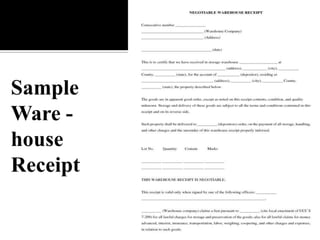
A warehouse receipt is a document that provides proof of
ownership of commodities (e.g., bars of copper) that are stored
in a warehouse, vault, or depository for safekeeping.
       Warehouse receipts may be negotiable or non-negotiable.
Negotiable warehouse receipts allow transfer of ownership of
that commodity without having to deliver the physical
commodity.
       Most warehouse receipts are issued in negotiable
form, making them eligible as collateral for loans. Non-
negotiable receipts must be endorsed upon transfer. Warehouse
receipts are regulated by the Uniform Warehouse Receipts Act.
Warehouse receipts also guarantee existence and
availability of a commodity of a particular quantity, type, and
quality in a named storage facility. It may also show transfer of
ownership for immediate delivery or for delivery at a future
date. Rather than delivering the actual commodity, negotiable
warehouse receipts are used to settle expiring futures contracts.
       Warehouse receipts may also indicate ownership of
inventory goods and/or unfinished goods stored in a warehouse
by a manufacturer or distributor.
A trust receipt
need not be in any form but it must substantially
contain the following:
1. A description of the goods, documents or instruments
subject of the trust receipt

2. The total invoice value of the goods and the amount of
the draft to be paid by the
entrustee
3. An undertaking or a commitment of the entrustee:
a. to hold in trust for the entruster the goods, documents or
instruments therein described
b. to dispose of them in the manner provided for in the trust receipt;
and
c. to turn over the proceeds of the sale of the goods, documents or
instruments to the entruster to the extent of the amount owing to the
entruster or as appears in the trust receipt or to return the
goods, documents or instruments in the event of their non-sale
within the period specified therein.
4. The trust receipt may contain other terms and conditions agreed
upon by the parties in
addition to those hereinabove enumerated provided that such terms
and conditions shall
not be contrary to the provisions of this Decree, any existing
laws, public policy or morals, public order or good customs.

5. Trust receipts are denominated in Philippine currency or
acceptable and eligible foreign
currency.
Chapter 5

Chapter 5

  • 2.
    “ A writtenaccount of goods shipped by any person signed by the agent of the owner of the vessel, or by its master, acknowledging receipt of the goods, and promising to deliver them safe at the port directed, damages of the sea excepted.”
  • 3.
    http://en.wikipedia.org/wiki/Bill_of_lading Description The Bill ofLading is issued by a carrier, which details a shipment of merchandise, gives title, and requires a carrier to deliver the merchandise to the appropriate party. History The Bill of Lading evolved with the growth of shipping in the medieval world. Merchants needed a way of knowing what had been loaded onto ships, and began to issue signed receipts to certify the loading of goods, and the condition of those goods at the time of loading. With the growth of mercantilism these receipts began to be used as the title to the goods.
  • 4.
    1. It conveys title to the merchandise; 2. It is the receipt of acknowledgement of the goods signed by the carrier; 3. It serves as a contract of transportation between the shipper and the carrier.
  • 5.
    http://en.wikipedia.org/wiki/Bill_of_lading Bill of Lading as Receipt The principal use of the Bill of Lading is as a receipt issued by the carrier once the goods have been loaded onto the vessel. This receipt is used as proof of shipment for customs and insurance purposes, and also as commercial proof of completing a contractual obligation.
  • 6.
    http://en.wikipedia.org/wiki/Bill_of_lading Bill of Lading as Title The Bill of Lading confers title to the goods to the consignee noted on the Bill of Lading. The Bill of Lading may also be made out "To Order", which confers title to the goods to the holder of the Bill of Lading.
  • 7.
    http://en.wikipedia.org/wiki/Bill_of_lading Bill of Lading as Negotiable Instrument Because the Bill of Lading represents title to the goods detailed upon it, the BoL can be traded in much the same way as the goods may be, and even borrowed upon if desired.
  • 9.
    “A conditional conveyanceof property as security for the payment of the debt or the performance of some other obligation.” A mortgage loan is a loan secured by real property through the use of a mortgage note which evidences the existence of the loan and the encumbrance of that realty through the granting of a mortgage which secures the loan. However, the word mortgage alone, in everyday usage, is most often used to mean mortgage loan. http://en.wikipedia.org/wiki/Mortgage_loan
  • 10.
    From the Latin“mortus” meaning dead, and “vas” signifying a pledge. And the Old French mortgage, literally a deathgage or pledge is a conveyance of property as security for a debt, which is lost or becomes dead to the debtor if the money or the interest due thereupon is not paid on a certain day. The word mortgage is a French Law term meaning "death contract", meaning that the pledge ends (dies) when either the obligation is fulfilled or the property is taken through foreclosure. http://en.wikipedia.org/wiki/Mortgage_loan
  • 11.
    a. Immovables b. Alienablereal rights in accordance with the laws imposed upon immovables. Nevertheless, movables may be the object of chattel mortgage.
  • 12.
    CHATTEL MORTGAGE ANDMORTGAGE ON REAL PROPERTY By Chattel Mortgage: Personal property is recorded in the Chattel Mortgage Register as the security for the performance of an obligation. Example: An automobile which is pledged as a security of a loan obtained by a mortgagor. If the movable instead of being recorded, is delivered to the creditor or third person, the contract is pledged and not a chattel mortgage.
  • 13.
    By Mortgage onpersonal or real property It may be on land and building, factories, machinery, and the like. Torrens title on real estate may be pledged to secure loans. To secure loans bonds and stocks may also be pledged.
  • 14.
    Close-end Mortgage andOpen-end Mortgage Close-end mortgage It is used to refer to mortgage by a corporation used as collateral security for a loan of a fixed amount. Open-end mortgage It permits the sale of additional bonds at a later date under original mortgage.
  • 15.
    Devised purposely toeliminate the shortcomings that are present in both the close-end mortgage and open-end mortgage
  • 16.
    •(Pledge orpawn) in law, is “bailment of goods” by a debtor to his creditor to be kept till the debt is discharged. •Itis also used to denote the property which constitutes the security. •Itis the pignus of Roman Law from which most of the modern law on the subject is derived.
  • 17.
    “all movables whichare within the commerce of man may be pledge, provided they are susceptible of possession.”
  • 18.
    1. That theybe constituted to secure the fulfillment of a principal obligation; 2. That the pledgor or mortgagor be the absolute owner of the thing pledged or mortgaged; 3. That the persons constituting the pledge or mortgage have the free disposal of their property, and in the absence thereof, that they may be legally authorized for the purpose.
  • 19.
    A warehouse receiptis a document that provides proof of ownership of commodities (e.g., bars of copper) that are stored in a warehouse, vault, or depository for safekeeping. Warehouse receipts may be negotiable or non-negotiable. Negotiable warehouse receipts allow transfer of ownership of that commodity without having to deliver the physical commodity. Most warehouse receipts are issued in negotiable form, making them eligible as collateral for loans. Non- negotiable receipts must be endorsed upon transfer. Warehouse receipts are regulated by the Uniform Warehouse Receipts Act.
  • 20.
    Warehouse receipts alsoguarantee existence and availability of a commodity of a particular quantity, type, and quality in a named storage facility. It may also show transfer of ownership for immediate delivery or for delivery at a future date. Rather than delivering the actual commodity, negotiable warehouse receipts are used to settle expiring futures contracts. Warehouse receipts may also indicate ownership of inventory goods and/or unfinished goods stored in a warehouse by a manufacturer or distributor.
  • 22.
    A trust receipt neednot be in any form but it must substantially contain the following: 1. A description of the goods, documents or instruments subject of the trust receipt 2. The total invoice value of the goods and the amount of the draft to be paid by the entrustee
  • 23.
    3. An undertakingor a commitment of the entrustee: a. to hold in trust for the entruster the goods, documents or instruments therein described b. to dispose of them in the manner provided for in the trust receipt; and c. to turn over the proceeds of the sale of the goods, documents or instruments to the entruster to the extent of the amount owing to the entruster or as appears in the trust receipt or to return the goods, documents or instruments in the event of their non-sale within the period specified therein.
  • 24.
    4. The trustreceipt may contain other terms and conditions agreed upon by the parties in addition to those hereinabove enumerated provided that such terms and conditions shall not be contrary to the provisions of this Decree, any existing laws, public policy or morals, public order or good customs. 5. Trust receipts are denominated in Philippine currency or acceptable and eligible foreign currency.