Experiential Approach to Organization Development 8th edition
Copyright ©2011 Pearson Education, Inc. Publishing as Prentice Hall
Chapter 4
Slide 1
Chapter 4
Diagnostic Process
Experiential Approach to Organization Development 8th edition
Copyright ©2011 Pearson Education, Inc. Publishing as Prentice Hall
Chapter 4
Slide 2
Learning Objectives
• Identify system parameters and recognize the
symptoms, problems, and causes of
organizational ineffectiveness.
• Recognize the various techniques for
gathering information from client systems.
• Describe the major diagnostic models and
techniques used in OD programs.
• Apply a systematic diagnosis to organizational
situations.
Experiential Approach to Organization Development 8th edition
Copyright ©2011 Pearson Education, Inc. Publishing as Prentice Hall
Chapter 4
Slide 3
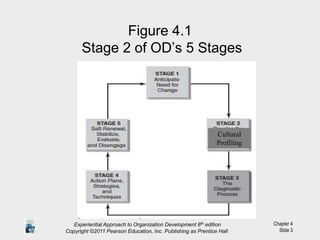
Figure 4.1
Stage 2 of OD’s 5 Stages
Cultural
Profiling
Chapter 4
Slide 4
Data Mining at McDonald’s?
(part 1 of 2)
McDonald’s has new method of gathering
data from customers.
Sends mystery-diners to restaurants.
Collects data useful to individual store.
Evaluators trained so there was consistency
in grading.
Experiential Approach to Organization Development 8th edition
Copyright ©2011 Pearson Education, Inc. Publishing as Prentice Hall
Chapter 4
Slide 5
Data Mining at McDonald’s?
(part 2 of 2)
Stores evaluated every six months.
Simultaneously conducts in-depth
interviews with repeat customers.
Experiential Approach to Organization Development 8th edition
Copyright ©2011 Pearson Education, Inc. Publishing as Prentice Hall
Chapter 4
Slide 6
Diagnosing Problem Areas
(part 1 of 2)
Identification of areas for improvement.
Assess organization’s current
performance and desired level of
quality.
Experiential Approach to Organization Development 8th edition
Copyright ©2011 Pearson Education, Inc. Publishing as Prentice Hall
Chapter 4
Slide 7
Diagnosing Problem Areas
(part 2 of 2)
Provides information that allows for faster-
reacting organization.
Analyzes data on structure,
administration, interaction, and other
elements.
Experiential Approach to Organization Development 8th edition
Copyright ©2011 Pearson Education, Inc. Publishing as Prentice Hall
Chapter 4
Slide 8
What is Diagnosis?
A systematic approach to understand
present state of organization.
Specifies nature of problem, causes, and
provide basis for selecting strategies.
Involves systematic analysis of data.
Experiential Approach to Organization Development 8th edition
Copyright ©2011 Pearson Education, Inc. Publishing as Prentice Hall
Chapter 4
Slide 9
Critical Issues in Diagnosis
Simplicity.
Visibility.
Involvement.
Primary factors.
Measure what’s
important.
Sense of urgency.
Experiential Approach to Organization Development 8th edition
Copyright ©2011 Pearson Education, Inc. Publishing as Prentice Hall
Chapter 4
Slide 10
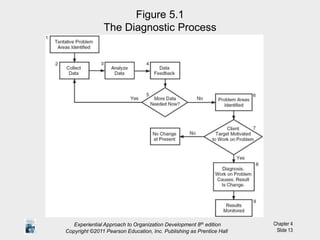
The Process
Diagnosis is cyclical process involving:
• Data gathering.
• Identification of
problem areas.
• Interpretation.
• Potential action
programs.
Experiential Approach to Organization Development 8th edition
Copyright ©2011 Pearson Education, Inc. Publishing as Prentice Hall
Chapter 4
Slide 11
Steps in Diagnosis (part 1 of 2)
Step 1: Tentative problem identified.
Step 2: Collect data.
Step 3: Analyze data.
Step 4: Feedback data.
Step 5: More data needed?
Experiential Approach to Organization Development 8th edition
Copyright ©2011 Pearson Education, Inc. Publishing as Prentice Hall
Chapter 4
Slide 12
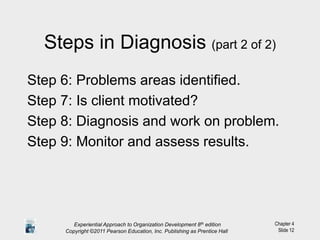
Steps in Diagnosis (part 2 of 2)
Step 6: Problems areas identified.
Step 7: Is client motivated?
Step 8: Diagnosis and work on problem.
Step 9: Monitor and assess results.
Experiential Approach to Organization Development 8th edition
Copyright ©2011 Pearson Education, Inc. Publishing as Prentice Hall
Chapter 4
Slide 13
Figure 5.1
The Diagnostic Process
Experiential Approach to Organization Development 8th edition
Copyright ©2011 Pearson Education, Inc. Publishing as Prentice Hall
Chapter 4
Slide 14
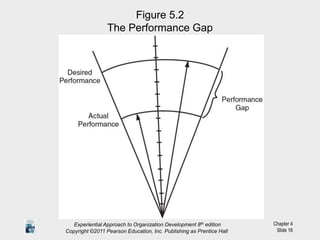
Performance Gap
Difference between what organization
could do and what organization is doing.
Experiential Approach to Organization Development 8th edition
Copyright ©2011 Pearson Education, Inc. Publishing as Prentice Hall
Chapter 4
Slide 15
Self-Assessment Gap
Analysis
of Four Key Areas
1. Organization’s strengths.
2. What can be done to take advantage
of strengths.
3. Organization’s weaknesses.
4. What can be done to alleviate
weaknesses.
Experiential Approach to Organization Development 8th edition
Copyright ©2011 Pearson Education, Inc. Publishing as Prentice Hall
Chapter 4
Slide 16
Figure 5.2
The Performance Gap
Experiential Approach to Organization Development 8th edition
Copyright ©2011 Pearson Education, Inc. Publishing as Prentice Hall
Experiential Approach to Organization Development 7th edition Chapter 4
Slide 17
OD in Practice:
Diagnosis For Kodak (part 1 of 3)
Kodak is attempting to transform to
cutting edge of digital revolution.
Kodak surveyed managers.
Rearranged business in late 1990s.
Limited in its scope and of little benefit.
Chapter 4
Slide 18
OD in Practice (part 2 of 3)
Kodak known to favor caution over risk-
taking.
Kodak is chemical company that must
transform into electronics company.
Electronics highly competitive and Kodak
has little experience with electronics.
Experiential Approach to Organization Development 8th edition
Copyright ©2011 Pearson Education, Inc. Publishing as Prentice Hall
Chapter 4
Slide 19
OD in Practice (part 3 of 3)
New products and change.
Kodak focuses attention on nonconsumer
applications.
• Experiencing strong growth.
• New managers have proven track
records.
Experiential Approach to Organization Development 8th edition
Copyright ©2011 Pearson Education, Inc. Publishing as Prentice Hall
Chapter 4
Slide 20
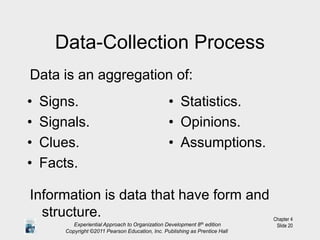
Data-Collection Process
Data is an aggregation of:
• Statistics.
• Opinions.
• Assumptions.
• Signs.
• Signals.
• Clues.
• Facts.
Information is data that have form and
structure.
Experiential Approach to Organization Development 8th edition
Copyright ©2011 Pearson Education, Inc. Publishing as Prentice Hall
Chapter 4
Slide 21
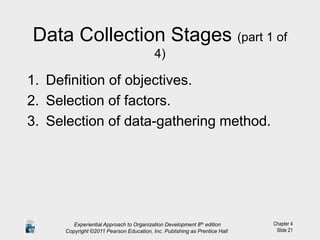
Data Collection Stages (part 1 of
4)
1. Definition of objectives.
2. Selection of factors.
3. Selection of data-gathering method.
Experiential Approach to Organization Development 8th edition
Copyright ©2011 Pearson Education, Inc. Publishing as Prentice Hall
Chapter 4
Slide 22
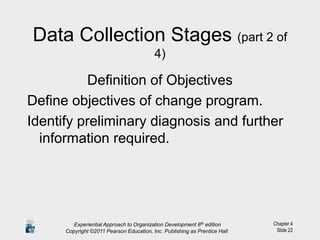
Data Collection Stages (part 2 of
4)
Definition of Objectives
Define objectives of change program.
Identify preliminary diagnosis and further
information required.
Experiential Approach to Organization Development 8th edition
Copyright ©2011 Pearson Education, Inc. Publishing as Prentice Hall
Chapter 4
Slide 23
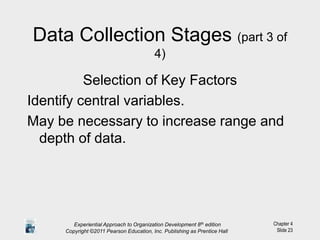
Data Collection Stages (part 3 of
4)
Selection of Key Factors
Identify central variables.
May be necessary to increase range and
depth of data.
Experiential Approach to Organization Development 8th edition
Copyright ©2011 Pearson Education, Inc. Publishing as Prentice Hall
Chapter 4
Slide 24
Data Collection Stages (part 4 of
4)
Selection of Data-Gathering Method
Selection of one or more methods of
gathering data.
Nature of the problem helps determine
method.
Variety of methods may be used.
Experiential Approach to Organization Development 8th edition
Copyright ©2011 Pearson Education, Inc. Publishing as Prentice Hall
Chapter 4
Slide 25
Types of Methods (part 1 of 4)
1. Secondary sources.
2. Organization and industry data.
3. Employee surveys or questionnaires.
Useful with a large number of people.
Data may lack “richness.”
Experiential Approach to Organization Development 8th edition
Copyright ©2011 Pearson Education, Inc. Publishing as Prentice Hall
Chapter 4
Slide 26
Types of Methods (part 2 of 4)
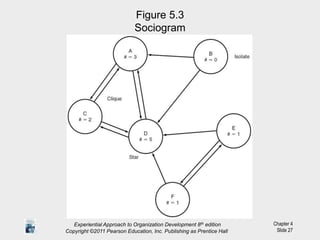
Sociogram
Visual method of recording and analyzing
preferences in a group.
Each member represented by circle.
Communication represented by arrows
indicating direction of choice.
Experiential Approach to Organization Development 8th edition
Copyright ©2011 Pearson Education, Inc. Publishing as Prentice Hall
Chapter 4
Slide 27
Figure 5.3
Sociogram
Experiential Approach to Organization Development 8th edition
Copyright ©2011 Pearson Education, Inc. Publishing as Prentice Hall
Chapter 4
Slide 28
Types of Methods (part 3 of 4)
• Direct observation.
Observing how people go about tasks.
• Interviews.
One of most widely used methods.
Direct, personal, and flexible.
Experiential Approach to Organization Development 8th edition
Copyright ©2011 Pearson Education, Inc. Publishing as Prentice Hall
Chapter 4
Slide 29
Types of Methods (part 4 of 4)
• Directed interview.
• Open-ended questions.
• Closed questions.
• Nondirected interview.
Experiential Approach to Organization Development 8th edition
Copyright ©2011 Pearson Education, Inc. Publishing as Prentice Hall
Chapter 4
Slide 30
Implementation of
Data Collection
Decide from whom data will be obtained.
Select appropriate technique.
Implement data-collection program.
Experiential Approach to Organization Development 8th edition
Copyright ©2011 Pearson Education, Inc. Publishing as Prentice Hall
Chapter 4
Slide 31
Analysis of Data
Techniques used to analyze data dictated
by method used to gather data.
Experiential Approach to Organization Development 8th edition
Copyright ©2011 Pearson Education, Inc. Publishing as Prentice Hall
Chapter 4
Slide 32
Guidelines for Evaluating
Effectiveness of Data
Collection
Validity of data.
Time to collect data.
Cost of data collection.
Organization culture and norms.
Hawthorne effect in data collecting.
(tendency for people to modify their behavior because they know
they are being studied)
Experiential Approach to Organization Development 8th edition
Copyright ©2011 Pearson Education, Inc. Publishing as Prentice Hall
Chapter 4
Slide 33
Our Changing World:
eBay, Center for Global
Commerce (part 1 of 2)
eBay has become marketplace of world.
eBay driven by understanding data.
CEO Whitman says, “If you can’t measure
it, you can’t control it.”
Understanding data is how eBay learns
about its customers.
Experiential Approach to Organization Development 8th edition
Copyright ©2011 Pearson Education, Inc. Publishing as Prentice Hall
Chapter 4
Slide 34
Our Changing World (part 2 of 2)
Changes at eBay are like needle-moving.
Make small changes to make small gains.
Danger is that eBay becomes obsessed
with data and measurements.
“You have to be careful because you
could measure too much,” Whitman
says.
Experiential Approach to Organization Development 8th edition
Copyright ©2011 Pearson Education, Inc. Publishing as Prentice Hall
Chapter 4
Slide 35
Diagnostic Models
Of OD practitioners, 70% reported using a
model to assist in identifying problems.
Models may be used to analyze structure,
culture, and behavior of organization.
Experiential Approach to Organization Development 8th edition
Copyright ©2011 Pearson Education, Inc. Publishing as Prentice Hall
Chapter 4
Slide 36
Types of Diagnostic Models
• Analytical
• Emergent-group
behavior
• Management
practitioner
• Sociotechnical systems
• Cause maps and social
network analysis
• Force-field analysis
Experiential Approach to Organization Development 8th edition
Copyright ©2011 Pearson Education, Inc. Publishing as Prentice Hall
Chapter 4
Slide 37
Analytical Model
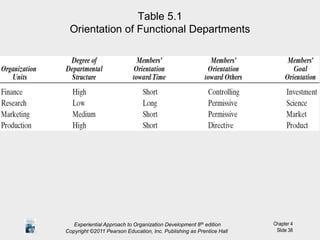
Used for interdepartmental issues.
Examines characteristics of departments.
Objective to help departments achieve
integration.
Experiential Approach to Organization Development 8th edition
Copyright ©2011 Pearson Education, Inc. Publishing as Prentice Hall
Chapter 4
Slide 38
Table 5.1
Orientation of Functional Departments
Experiential Approach to Organization Development 8th edition
Copyright ©2011 Pearson Education, Inc. Publishing as Prentice Hall
Chapter 4
Slide 39
Emergent-Group Behavior
Model
Used to analyze interdependence of
groups.
Collects data on activities, interactions,
and norms.
Experiential Approach to Organization Development 8th edition
Copyright ©2011 Pearson Education, Inc. Publishing as Prentice Hall
Chapter 4
Slide 40
Management Practitioner
Model
• Basic planning.
• General business
practices.
• Finance.
• Advertising and
promotion.
• Market research.
• Personnel.
Six basic factors are analyzed:
Experiential Approach to Organization Development 8th edition
Copyright ©2011 Pearson Education, Inc. Publishing as Prentice Hall
Chapter 4
Slide 41
Sociotechnical Systems Model
Two interrelated systems in organization:
Social system. Technical system.
The 2 systems are interrelated.
Diagnosis determines interrelationships
and type of feedback required.
Experiential Approach to Organization Development 8th edition
Copyright ©2011 Pearson Education, Inc. Publishing as Prentice Hall
Chapter 4
Slide 42
Cause Maps and Social
Network Analysis Models
Cause maps—mathematical
representations of relationships among
variables.
Social network analysis—mathematical
representation of individual and group.
Analysis reveals important
interdependencies.
Experiential Approach to Organization Development 8th edition
Copyright ©2011 Pearson Education, Inc. Publishing as Prentice Hall
Chapter 4
Slide 43
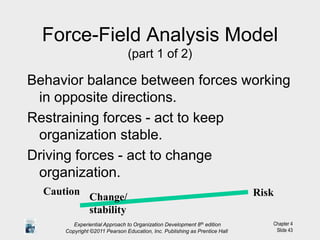
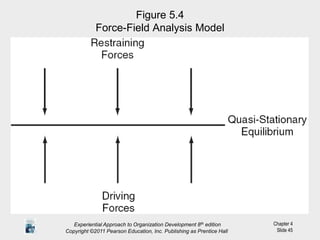
Force-Field Analysis Model
(part 1 of 2)
Behavior balance between forces working
in opposite directions.
Restraining forces - act to keep
organization stable.
Driving forces - act to change
organization.
Experiential Approach to Organization Development 8th edition
Copyright ©2011 Pearson Education, Inc. Publishing as Prentice Hall
Risk
Caution
Change/
stability
Chapter 4
Slide 44
Force-Field Analysis Model
(part 2 of 2)
When forces equal, organization in quasi-
stationary state of equilibrium.
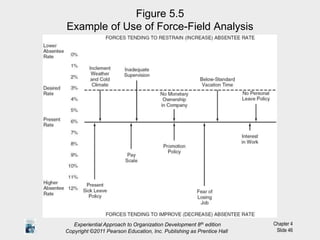
Analysis determines forces to increase or
decrease.
Experiential Approach to Organization Development 8th edition
Copyright ©2011 Pearson Education, Inc. Publishing as Prentice Hall
Chapter 4
Slide 45
Figure 5.4
Force-Field Analysis Model
Experiential Approach to Organization Development 8th edition
Copyright ©2011 Pearson Education, Inc. Publishing as Prentice Hall
Chapter 4
Slide 46
Figure 5.5
Example of Use of Force-Field Analysis
Experiential Approach to Organization Development 8th edition
Copyright ©2011 Pearson Education, Inc. Publishing as Prentice Hall
Chapter 4
Slide 47
Red Flags in Diagnosis
Confidentiality of data.
Over diagnosis.
Crisis diagnosis.
Overwhelming diagnosis.
Practitioner’s favorite diagnosis.
Diagnosis of symptom.
Experiential Approach to Organization Development 8th edition
Copyright ©2011 Pearson Education, Inc. Publishing as Prentice Hall

Chapter 4.ppt

  • 1.
    Experiential Approach toOrganization Development 8th edition Copyright ©2011 Pearson Education, Inc. Publishing as Prentice Hall Chapter 4 Slide 1 Chapter 4 Diagnostic Process
  • 2.
    Experiential Approach toOrganization Development 8th edition Copyright ©2011 Pearson Education, Inc. Publishing as Prentice Hall Chapter 4 Slide 2 Learning Objectives • Identify system parameters and recognize the symptoms, problems, and causes of organizational ineffectiveness. • Recognize the various techniques for gathering information from client systems. • Describe the major diagnostic models and techniques used in OD programs. • Apply a systematic diagnosis to organizational situations.
  • 3.
    Experiential Approach toOrganization Development 8th edition Copyright ©2011 Pearson Education, Inc. Publishing as Prentice Hall Chapter 4 Slide 3 Figure 4.1 Stage 2 of OD’s 5 Stages Cultural Profiling
  • 4.
    Chapter 4 Slide 4 DataMining at McDonald’s? (part 1 of 2) McDonald’s has new method of gathering data from customers. Sends mystery-diners to restaurants. Collects data useful to individual store. Evaluators trained so there was consistency in grading. Experiential Approach to Organization Development 8th edition Copyright ©2011 Pearson Education, Inc. Publishing as Prentice Hall
  • 5.
    Chapter 4 Slide 5 DataMining at McDonald’s? (part 2 of 2) Stores evaluated every six months. Simultaneously conducts in-depth interviews with repeat customers. Experiential Approach to Organization Development 8th edition Copyright ©2011 Pearson Education, Inc. Publishing as Prentice Hall
  • 6.
    Chapter 4 Slide 6 DiagnosingProblem Areas (part 1 of 2) Identification of areas for improvement. Assess organization’s current performance and desired level of quality. Experiential Approach to Organization Development 8th edition Copyright ©2011 Pearson Education, Inc. Publishing as Prentice Hall
  • 7.
    Chapter 4 Slide 7 DiagnosingProblem Areas (part 2 of 2) Provides information that allows for faster- reacting organization. Analyzes data on structure, administration, interaction, and other elements. Experiential Approach to Organization Development 8th edition Copyright ©2011 Pearson Education, Inc. Publishing as Prentice Hall
  • 8.
    Chapter 4 Slide 8 Whatis Diagnosis? A systematic approach to understand present state of organization. Specifies nature of problem, causes, and provide basis for selecting strategies. Involves systematic analysis of data. Experiential Approach to Organization Development 8th edition Copyright ©2011 Pearson Education, Inc. Publishing as Prentice Hall
  • 9.
    Chapter 4 Slide 9 CriticalIssues in Diagnosis Simplicity. Visibility. Involvement. Primary factors. Measure what’s important. Sense of urgency. Experiential Approach to Organization Development 8th edition Copyright ©2011 Pearson Education, Inc. Publishing as Prentice Hall
  • 10.
    Chapter 4 Slide 10 TheProcess Diagnosis is cyclical process involving: • Data gathering. • Identification of problem areas. • Interpretation. • Potential action programs. Experiential Approach to Organization Development 8th edition Copyright ©2011 Pearson Education, Inc. Publishing as Prentice Hall
  • 11.
    Chapter 4 Slide 11 Stepsin Diagnosis (part 1 of 2) Step 1: Tentative problem identified. Step 2: Collect data. Step 3: Analyze data. Step 4: Feedback data. Step 5: More data needed? Experiential Approach to Organization Development 8th edition Copyright ©2011 Pearson Education, Inc. Publishing as Prentice Hall
  • 12.
    Chapter 4 Slide 12 Stepsin Diagnosis (part 2 of 2) Step 6: Problems areas identified. Step 7: Is client motivated? Step 8: Diagnosis and work on problem. Step 9: Monitor and assess results. Experiential Approach to Organization Development 8th edition Copyright ©2011 Pearson Education, Inc. Publishing as Prentice Hall
  • 13.
    Chapter 4 Slide 13 Figure5.1 The Diagnostic Process Experiential Approach to Organization Development 8th edition Copyright ©2011 Pearson Education, Inc. Publishing as Prentice Hall
  • 14.
    Chapter 4 Slide 14 PerformanceGap Difference between what organization could do and what organization is doing. Experiential Approach to Organization Development 8th edition Copyright ©2011 Pearson Education, Inc. Publishing as Prentice Hall
  • 15.
    Chapter 4 Slide 15 Self-AssessmentGap Analysis of Four Key Areas 1. Organization’s strengths. 2. What can be done to take advantage of strengths. 3. Organization’s weaknesses. 4. What can be done to alleviate weaknesses. Experiential Approach to Organization Development 8th edition Copyright ©2011 Pearson Education, Inc. Publishing as Prentice Hall
  • 16.
    Chapter 4 Slide 16 Figure5.2 The Performance Gap Experiential Approach to Organization Development 8th edition Copyright ©2011 Pearson Education, Inc. Publishing as Prentice Hall
  • 17.
    Experiential Approach toOrganization Development 7th edition Chapter 4 Slide 17 OD in Practice: Diagnosis For Kodak (part 1 of 3) Kodak is attempting to transform to cutting edge of digital revolution. Kodak surveyed managers. Rearranged business in late 1990s. Limited in its scope and of little benefit.
  • 18.
    Chapter 4 Slide 18 ODin Practice (part 2 of 3) Kodak known to favor caution over risk- taking. Kodak is chemical company that must transform into electronics company. Electronics highly competitive and Kodak has little experience with electronics. Experiential Approach to Organization Development 8th edition Copyright ©2011 Pearson Education, Inc. Publishing as Prentice Hall
  • 19.
    Chapter 4 Slide 19 ODin Practice (part 3 of 3) New products and change. Kodak focuses attention on nonconsumer applications. • Experiencing strong growth. • New managers have proven track records. Experiential Approach to Organization Development 8th edition Copyright ©2011 Pearson Education, Inc. Publishing as Prentice Hall
  • 20.
    Chapter 4 Slide 20 Data-CollectionProcess Data is an aggregation of: • Statistics. • Opinions. • Assumptions. • Signs. • Signals. • Clues. • Facts. Information is data that have form and structure. Experiential Approach to Organization Development 8th edition Copyright ©2011 Pearson Education, Inc. Publishing as Prentice Hall
  • 21.
    Chapter 4 Slide 21 DataCollection Stages (part 1 of 4) 1. Definition of objectives. 2. Selection of factors. 3. Selection of data-gathering method. Experiential Approach to Organization Development 8th edition Copyright ©2011 Pearson Education, Inc. Publishing as Prentice Hall
  • 22.
    Chapter 4 Slide 22 DataCollection Stages (part 2 of 4) Definition of Objectives Define objectives of change program. Identify preliminary diagnosis and further information required. Experiential Approach to Organization Development 8th edition Copyright ©2011 Pearson Education, Inc. Publishing as Prentice Hall
  • 23.
    Chapter 4 Slide 23 DataCollection Stages (part 3 of 4) Selection of Key Factors Identify central variables. May be necessary to increase range and depth of data. Experiential Approach to Organization Development 8th edition Copyright ©2011 Pearson Education, Inc. Publishing as Prentice Hall
  • 24.
    Chapter 4 Slide 24 DataCollection Stages (part 4 of 4) Selection of Data-Gathering Method Selection of one or more methods of gathering data. Nature of the problem helps determine method. Variety of methods may be used. Experiential Approach to Organization Development 8th edition Copyright ©2011 Pearson Education, Inc. Publishing as Prentice Hall
  • 25.
    Chapter 4 Slide 25 Typesof Methods (part 1 of 4) 1. Secondary sources. 2. Organization and industry data. 3. Employee surveys or questionnaires. Useful with a large number of people. Data may lack “richness.” Experiential Approach to Organization Development 8th edition Copyright ©2011 Pearson Education, Inc. Publishing as Prentice Hall
  • 26.
    Chapter 4 Slide 26 Typesof Methods (part 2 of 4) Sociogram Visual method of recording and analyzing preferences in a group. Each member represented by circle. Communication represented by arrows indicating direction of choice. Experiential Approach to Organization Development 8th edition Copyright ©2011 Pearson Education, Inc. Publishing as Prentice Hall
  • 27.
    Chapter 4 Slide 27 Figure5.3 Sociogram Experiential Approach to Organization Development 8th edition Copyright ©2011 Pearson Education, Inc. Publishing as Prentice Hall
  • 28.
    Chapter 4 Slide 28 Typesof Methods (part 3 of 4) • Direct observation. Observing how people go about tasks. • Interviews. One of most widely used methods. Direct, personal, and flexible. Experiential Approach to Organization Development 8th edition Copyright ©2011 Pearson Education, Inc. Publishing as Prentice Hall
  • 29.
    Chapter 4 Slide 29 Typesof Methods (part 4 of 4) • Directed interview. • Open-ended questions. • Closed questions. • Nondirected interview. Experiential Approach to Organization Development 8th edition Copyright ©2011 Pearson Education, Inc. Publishing as Prentice Hall
  • 30.
    Chapter 4 Slide 30 Implementationof Data Collection Decide from whom data will be obtained. Select appropriate technique. Implement data-collection program. Experiential Approach to Organization Development 8th edition Copyright ©2011 Pearson Education, Inc. Publishing as Prentice Hall
  • 31.
    Chapter 4 Slide 31 Analysisof Data Techniques used to analyze data dictated by method used to gather data. Experiential Approach to Organization Development 8th edition Copyright ©2011 Pearson Education, Inc. Publishing as Prentice Hall
  • 32.
    Chapter 4 Slide 32 Guidelinesfor Evaluating Effectiveness of Data Collection Validity of data. Time to collect data. Cost of data collection. Organization culture and norms. Hawthorne effect in data collecting. (tendency for people to modify their behavior because they know they are being studied) Experiential Approach to Organization Development 8th edition Copyright ©2011 Pearson Education, Inc. Publishing as Prentice Hall
  • 33.
    Chapter 4 Slide 33 OurChanging World: eBay, Center for Global Commerce (part 1 of 2) eBay has become marketplace of world. eBay driven by understanding data. CEO Whitman says, “If you can’t measure it, you can’t control it.” Understanding data is how eBay learns about its customers. Experiential Approach to Organization Development 8th edition Copyright ©2011 Pearson Education, Inc. Publishing as Prentice Hall
  • 34.
    Chapter 4 Slide 34 OurChanging World (part 2 of 2) Changes at eBay are like needle-moving. Make small changes to make small gains. Danger is that eBay becomes obsessed with data and measurements. “You have to be careful because you could measure too much,” Whitman says. Experiential Approach to Organization Development 8th edition Copyright ©2011 Pearson Education, Inc. Publishing as Prentice Hall
  • 35.
    Chapter 4 Slide 35 DiagnosticModels Of OD practitioners, 70% reported using a model to assist in identifying problems. Models may be used to analyze structure, culture, and behavior of organization. Experiential Approach to Organization Development 8th edition Copyright ©2011 Pearson Education, Inc. Publishing as Prentice Hall
  • 36.
    Chapter 4 Slide 36 Typesof Diagnostic Models • Analytical • Emergent-group behavior • Management practitioner • Sociotechnical systems • Cause maps and social network analysis • Force-field analysis Experiential Approach to Organization Development 8th edition Copyright ©2011 Pearson Education, Inc. Publishing as Prentice Hall
  • 37.
    Chapter 4 Slide 37 AnalyticalModel Used for interdepartmental issues. Examines characteristics of departments. Objective to help departments achieve integration. Experiential Approach to Organization Development 8th edition Copyright ©2011 Pearson Education, Inc. Publishing as Prentice Hall
  • 38.
    Chapter 4 Slide 38 Table5.1 Orientation of Functional Departments Experiential Approach to Organization Development 8th edition Copyright ©2011 Pearson Education, Inc. Publishing as Prentice Hall
  • 39.
    Chapter 4 Slide 39 Emergent-GroupBehavior Model Used to analyze interdependence of groups. Collects data on activities, interactions, and norms. Experiential Approach to Organization Development 8th edition Copyright ©2011 Pearson Education, Inc. Publishing as Prentice Hall
  • 40.
    Chapter 4 Slide 40 ManagementPractitioner Model • Basic planning. • General business practices. • Finance. • Advertising and promotion. • Market research. • Personnel. Six basic factors are analyzed: Experiential Approach to Organization Development 8th edition Copyright ©2011 Pearson Education, Inc. Publishing as Prentice Hall
  • 41.
    Chapter 4 Slide 41 SociotechnicalSystems Model Two interrelated systems in organization: Social system. Technical system. The 2 systems are interrelated. Diagnosis determines interrelationships and type of feedback required. Experiential Approach to Organization Development 8th edition Copyright ©2011 Pearson Education, Inc. Publishing as Prentice Hall
  • 42.
    Chapter 4 Slide 42 CauseMaps and Social Network Analysis Models Cause maps—mathematical representations of relationships among variables. Social network analysis—mathematical representation of individual and group. Analysis reveals important interdependencies. Experiential Approach to Organization Development 8th edition Copyright ©2011 Pearson Education, Inc. Publishing as Prentice Hall
  • 43.
    Chapter 4 Slide 43 Force-FieldAnalysis Model (part 1 of 2) Behavior balance between forces working in opposite directions. Restraining forces - act to keep organization stable. Driving forces - act to change organization. Experiential Approach to Organization Development 8th edition Copyright ©2011 Pearson Education, Inc. Publishing as Prentice Hall Risk Caution Change/ stability
  • 44.
    Chapter 4 Slide 44 Force-FieldAnalysis Model (part 2 of 2) When forces equal, organization in quasi- stationary state of equilibrium. Analysis determines forces to increase or decrease. Experiential Approach to Organization Development 8th edition Copyright ©2011 Pearson Education, Inc. Publishing as Prentice Hall
  • 45.
    Chapter 4 Slide 45 Figure5.4 Force-Field Analysis Model Experiential Approach to Organization Development 8th edition Copyright ©2011 Pearson Education, Inc. Publishing as Prentice Hall
  • 46.
    Chapter 4 Slide 46 Figure5.5 Example of Use of Force-Field Analysis Experiential Approach to Organization Development 8th edition Copyright ©2011 Pearson Education, Inc. Publishing as Prentice Hall
  • 47.
    Chapter 4 Slide 47 RedFlags in Diagnosis Confidentiality of data. Over diagnosis. Crisis diagnosis. Overwhelming diagnosis. Practitioner’s favorite diagnosis. Diagnosis of symptom. Experiential Approach to Organization Development 8th edition Copyright ©2011 Pearson Education, Inc. Publishing as Prentice Hall