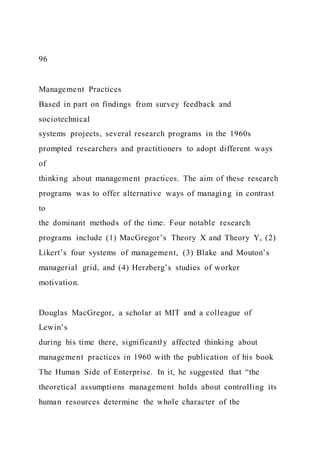
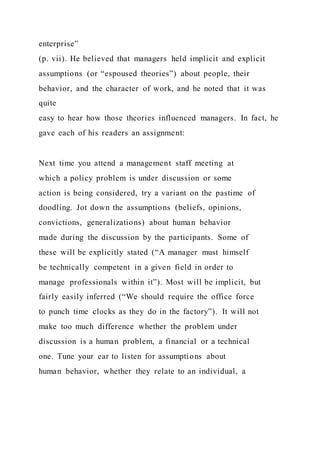
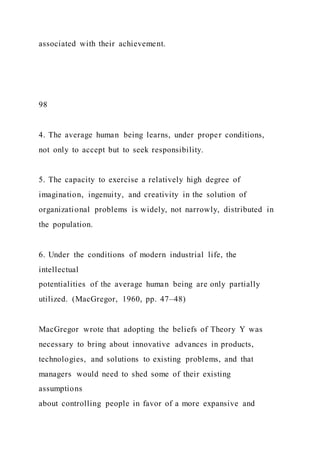
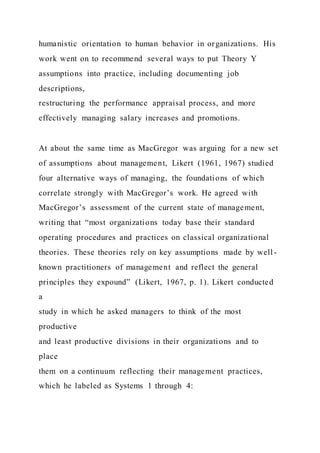
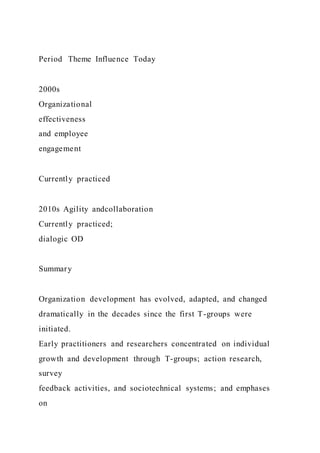
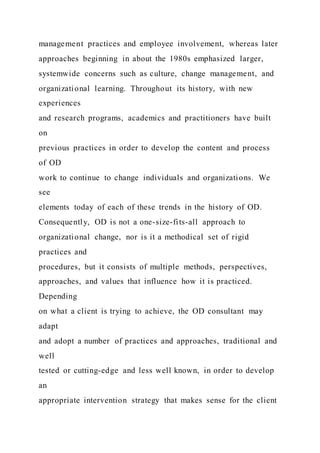
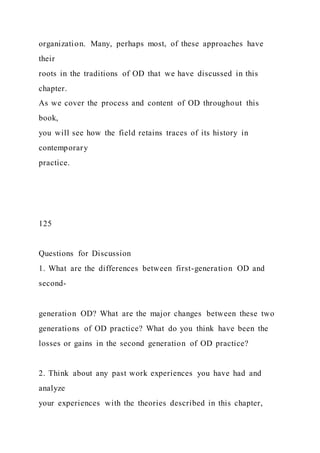
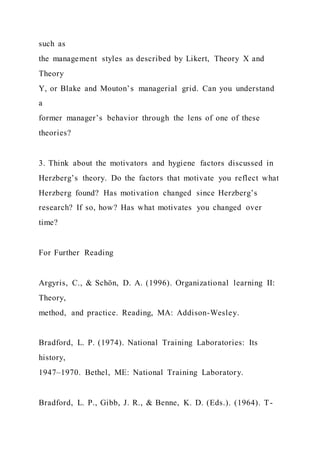
1
2
Organization Development
Fifth Edition
3
4
5
Organization Development
The Process of Leading Organizational
Change
Fifth Edition
Donald L. Anderson
University of Denver
Los Angeles
London
New Delhi
Singapore
Washington DC
Melbourne
6
FOR INFORMATION:
SAGE Publications, Inc.
2455 Teller Road
Thousand Oaks, California 91320
E-mail: [email protected]
SAGE Publications Ltd.
1 Oliver’s Yard
55 City Road
London EC1Y 1SP
United Kingdom
SAGE Publications India Pvt. Ltd.
B 1/I 1 Mohan Cooperative Industrial Area
Mathura Road, New Delhi 110 044
India
SAGE Publications Asia-Pacific Pte. Ltd.
18 Cross Street #10-10/11/12
China Square Central
Singapore 048423
Copyright © 2020 by SAGE Publications, Inc.
All rights reserved. Except as permitted by U.S. copyright law,
no
part of this work may be reproduced or distributed in any form
or
by any means, or stored in a database or retrieval system,
without
permission in writing from the publisher.
7
All third party trademarks referenced or depicted herein are
included solely for the purpose of illustration and are the
property
of their respective owners. Reference to these trademarks in no
way indicates any relationship with, or endorsement by, the
trademark owner.
Printed in the United States of America
Library of Congress Cataloging-in-Publication Data
Names: Anderson, Donald L., 1971- author.
Title: Organization development : the process of leading
organizational change
/ Donald L. Anderson, University of Denver.
Description: Fifth edition. | Los Angeles : SAGE, [2020] |
Includes
bibliographical references and index.
Identifiers: LCCN 2019028212 | ISBN 9781544333021
(paperback) | ISBN
9781544333007 (epub) | ISBN 9781544333038 (pdf)
Subjects: LCSH: Organizational change.
Classification: LCC HD58.8 .A68144 2020 | DDC 658.4/06—
dc23
LC record available at https://lccn.loc.gov/2019028212
This book is printed on acid-free paper.
Acquisitions Editor: Maggie Stanley
Editorial Assistant: Janeane Calderon
Marketing Manager: Sarah Panella
Production Editor: Veronica Stapleton Hooper
Copy Editor: Sheree Van Vreede
Typesetter: C&M Digitals (P) Ltd.
Proofreader: Dennis W. Webb
Indexer: Will Ragsdale
Cover Designer: Dally Verghese
https://lccn.loc.gov/2019028212
8
9
Brief Contents
1. Preface
2. Acknowledgments
3. Chapter 1 • What Is Organization Development?
4. Chapter 2 • History of Organization Development
5. Chapter 3 • Core Values and Ethics of Organization
Development
6. Chapter 4 • Foundations of Organizational Change
7. Chapter 5 • The Organization Development Practitioner and
the OD Process
8. Chapter 6 • Entry and Contracting
9. Chapter 7 • Data Gathering
10. Chapter 8 • Diagnosis and Feedback
11. Chapter 9 • An Introduction to Interventions
12. Chapter 10 • Individual Interventions
13. Chapter 11 • Team Interventions
14. Chapter 12 • Whole Organization and Multiple Organization
Interventions
15. Chapter 13 • Organization Culture and Design Interventions
16. Chapter 14 • Sustaining Change, Evaluating, and Ending an
Engagement
17. Chapter 15 • Global Issues in Organization Development
18. Chapter 16 • The Future of Organization Development
19. References
20. Author Index
21. Subject Index
22. About the Author
10
11
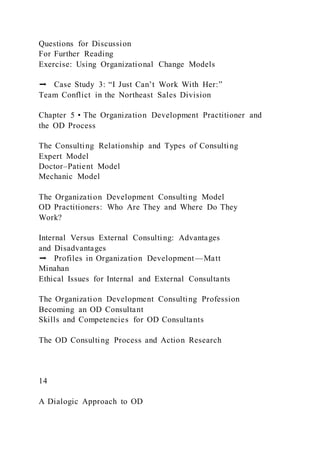
Detailed Contents
Preface
Exercises and Activities
Ancillaries
Acknowledgments
Chapter 1 • What Is Organization Development?
Organization Development Defined
Making the Case for Organization Development
What Organization Development Looks Like
Example 1: Increasing Employee Participation in a
Public Sector Organization
Example 2: Senior Management Coaching at
Vodaphone
Example 3: Team Development in a Cancer Center
Example 4: A Future Search Conference in a
Northern California Community
Example 5: A Long-Term Strategic Change
Engagement
➡ Profiles in Organization Development—Marvin
Weisbord
What Organization Development Is Not
Management Consulting
Training and Development
Short Term
The Application of a Toolkit
Who This Book Is For
Overview of the Book
Analyzing Case Studies
Summary
Questions for Discussion
For Further Reading
➡ Case Study 1: Every Coin Has Two Sides
Chapter 2 • History of Organization Development
Laboratory Training and T-Groups
Action Research, Survey Feedback, and Sociotechnical
Systems
Survey Feedback
Sociotechnical Systems
12
Management Practices
Quality and Employee Involvement
➡ Profiles in Organization Development—Robert
J. Marshak
Organizational Culture
Change Management, Strategic Change, and
Reengineering
Organizational Learning
Organizational Effectiveness and Employee Engagement
Agility and Collaboration
Summary
Questions for Discussion
For Further Reading
Chapter 3 • Core Values and Ethics of Organization
Development
Defining Values
Why Are Values Important to the OD Practitioner?
Core Values of Organization Development
Participation, Involvement, and Empowerment
The Importance of Groups and Teams
Growth, Development, and Learning
Valuing the Whole Person
➡ Profiles in Organization Development—
Frederick A. Miller
Dialogue and Collaboration
Authenticity, Openness, and Trust
Changes to OD Values Over Time and the Values
Debate
Challenges to Holding Organization Development Values
Statement of Organization Development Ethics
Summary
Questions for Discussion
For Further Reading
Exercise: What Would You Do?
Appendix
➡ Case Study 2: Analyzing Opportunities for
Organization Development Work at Northern County
Legal Services
Chapter 4 • Foundations of Organizational Change
13
Levels and Characteristics of Organizational Change
Models of Organizational Change: Systems Theory and
Social Construction Approaches
Organizations as Systems
The Value of Systems Theory for OD Practitioners
Models of Organizational Change Consistent With a
Systems Theory Approach
➡ Profiles in Organization Development—W.
Warner Burke
Organizations as Socially Constructed
The Value of the Social Construction Approach for
OD Practitioners
Approaches to Organizational Change Consistent
With a Social Construction Perspective
New Paradigms in OD
Summary
Questions for Discussion
For Further Reading
Exercise: Using Organizational Change Models
➡ Case Study 3: “I Just Can’t Work With Her:”
Team Conflict in the Northeast Sales Division
Chapter 5 • The Organization Development Practitioner and
the OD Process
The Consulting Relationship and Types of Consulting
Expert Model
Doctor–Patient Model
Mechanic Model
The Organization Development Consulting Model
OD Practitioners: Who Are They and Where Do They
Work?
Internal Versus External Consulting: Advantages
and Disadvantages
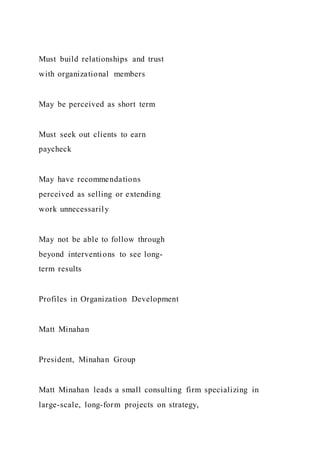
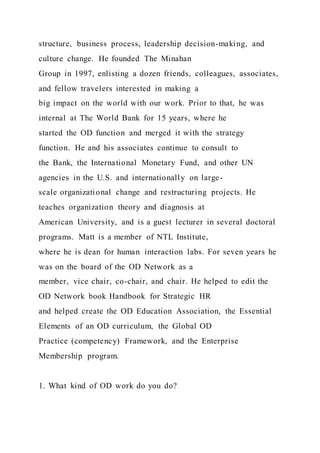
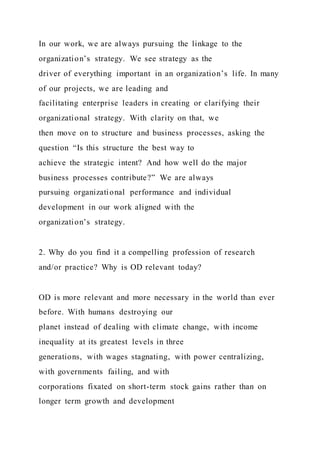
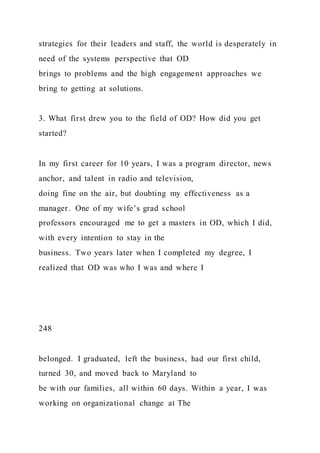
➡ Profiles in Organization Development—Matt
Minahan
Ethical Issues for Internal and External Consultants
The Organization Development Consulting Profession
Becoming an OD Consultant
Skills and Competencies for OD Consultants
The OD Consulting Process and Action Research
14
A Dialogic Approach to OD
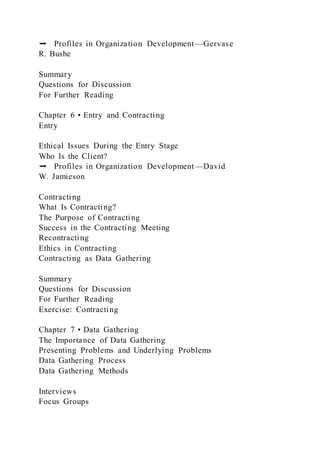
➡ Profiles in Organization Development—Gervase
R. Bushe
Summary
Questions for Discussion
For Further Reading
Chapter 6 • Entry and Contracting
Entry
Ethical Issues During the Entry Stage
Who Is the Client?
➡ Profiles in Organization Development—David
W. Jamieson
Contracting
What Is Contracting?
The Purpose of Contracting
Success in the Contracting Meeting
Recontracting
Ethics in Contracting
Contracting as Data Gathering
Summary
Questions for Discussion
For Further Reading
Exercise: Contracting
Chapter 7 • Data Gathering
The Importance of Data Gathering
Presenting Problems and Underlying Problems
Data Gathering Process
Data Gathering Methods
Interviews
Focus Groups
Surveys/Questionnaires
Observations
Unobtrusive Measures
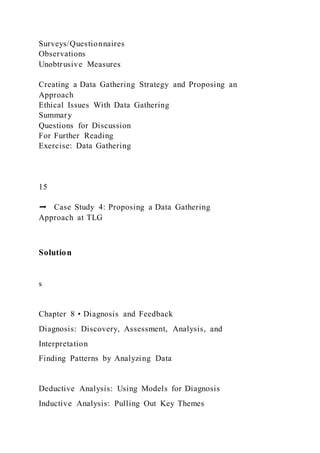
Creating a Data Gathering Strategy and Proposing an
Approach
Ethical Issues With Data Gathering
Summary
Questions for Discussion
For Further Reading
Exercise: Data Gathering
15
➡ Case Study 4: Proposing a Data Gathering
Approach at TLG
Solution
s
Chapter 8 • Diagnosis and Feedback
Diagnosis: Discovery, Assessment, Analysis, and
Interpretation
Finding Patterns by Analyzing Data
Deductive Analysis: Using Models for Diagnosis
Inductive Analysis: Pulling Out Key Themes
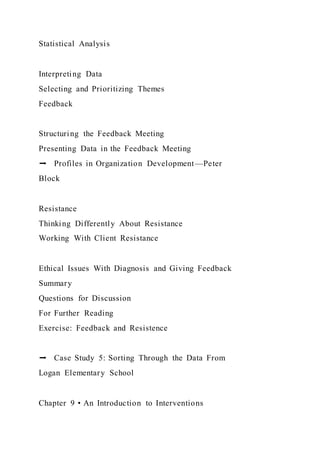
Statistical Analysis
Interpreting Data
Selecting and Prioritizing Themes
Feedback
Structuring the Feedback Meeting
Presenting Data in the Feedback Meeting
➡ Profiles in Organization Development—Peter
Block
Resistance
Thinking Differently About Resistance
Working With Client Resistance
Ethical Issues With Diagnosis and Giving Feedback
Summary
Questions for Discussion
For Further Reading
Exercise: Feedback and Resistence
➡ Case Study 5: Sorting Through the Data From
Logan Elementary School
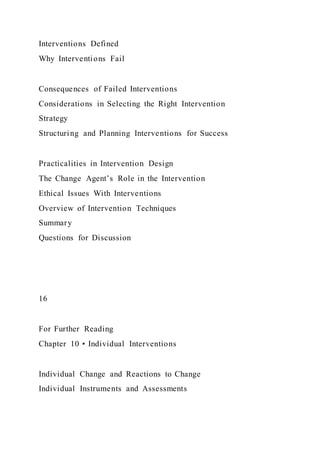
Chapter 9 • An Introduction to Interventions
Interventions Defined
Why Interventions Fail
Consequences of Failed Interventions
Considerations in Selecting the Right Intervention
Strategy
Structuring and Planning Interventions for Success
Practicalities in Intervention Design
The Change Agent’s Role in the Intervention
Ethical Issues With Interventions
Overview of Intervention Techniques
Summary
Questions for Discussion
16
For Further Reading
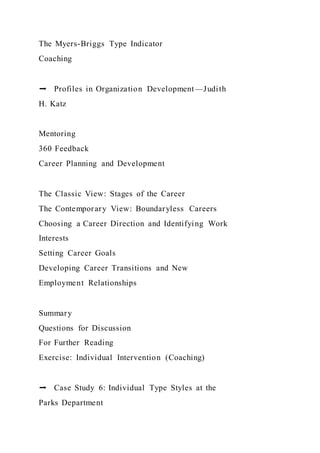
Chapter 10 • Individual Interventions
Individual Change and Reactions to Change
Individual Instruments and Assessments
The Myers-Briggs Type Indicator
Coaching
➡ Profiles in Organization Development—Judith
H. Katz
Mentoring
360 Feedback
Career Planning and Development
The Classic View: Stages of the Career
The Contemporary View: Boundaryless Careers
Choosing a Career Direction and Identifying Work
Interests
Setting Career Goals
Developing Career Transitions and New
Employment Relationships
Summary
Questions for Discussion
For Further Reading
Exercise: Individual Intervention (Coaching)
➡ Case Study 6: Individual Type Styles at the
Parks Department
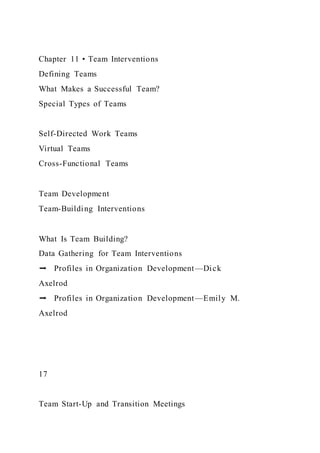
Chapter 11 • Team Interventions
Defining Teams
What Makes a Successful Team?
Special Types of Teams
Self-Directed Work Teams
Virtual Teams
Cross-Functional Teams
Team Development
Team-Building Interventions
What Is Team Building?
Data Gathering for Team Interventions
➡ Profiles in Organization Development—Dick
Axelrod
➡ Profiles in Organization Development—Emily M.
Axelrod
17
Team Start-Up and Transition Meetings
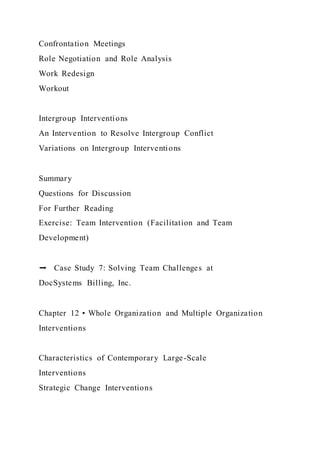
Confrontation Meetings
Role Negotiation and Role Analysis
Work Redesign
Workout
Intergroup Interventions
An Intervention to Resolve Intergroup Conflict
Variations on Intergroup Interventions
Summary
Questions for Discussion
For Further Reading
Exercise: Team Intervention (Facilitation and Team
Development)
➡ Case Study 7: Solving Team Challenges at
DocSystems Billing, Inc.
Chapter 12 • Whole Organization and Multiple Organization
Interventions
Characteristics of Contemporary Large-Scale
Interventions
Strategic Change Interventions
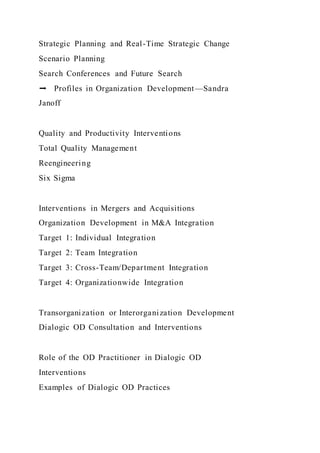
Strategic Planning and Real-Time Strategic Change
Scenario Planning
Search Conferences and Future Search
➡ Profiles in Organization Development—Sandra
Janoff
Quality and Productivity Interventions
Total Quality Management
Reengineering
Six Sigma
Interventions in Mergers and Acquisitions
Organization Development in M&A Integration
Target 1: Individual Integration
Target 2: Team Integration
Target 3: Cross-Team/Department Integration
Target 4: Organizationwide Integration
Transorganization or Interorganization Development
Dialogic OD Consultation and Interventions
Role of the OD Practitioner in Dialogic OD
Interventions
Examples of Dialogic OD Practices
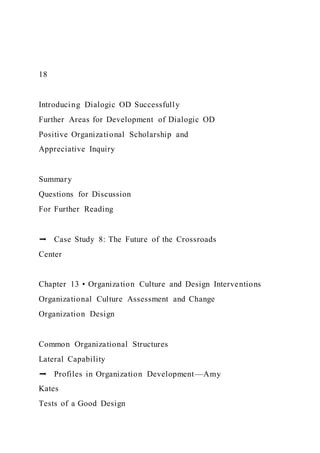
18
Introducing Dialogic OD Successfully
Further Areas for Development of Dialogic OD
Positive Organizational Scholarship and
Appreciative Inquiry
Summary
Questions for Discussion
For Further Reading
➡ Case Study 8: The Future of the Crossroads
Center
Chapter 13 • Organization Culture and Design Interventions
Organizational Culture Assessment and Change
Organization Design
Common Organizational Structures
Lateral Capability
➡ Profiles in Organization Development—Amy
Kates
Tests of a Good Design
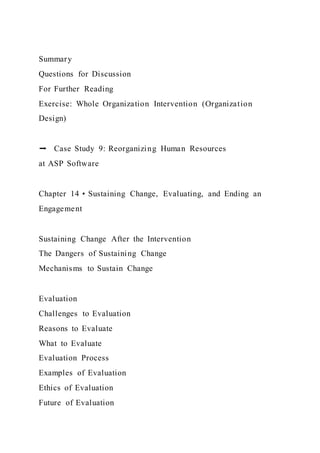
Summary
Questions for Discussion
For Further Reading
Exercise: Whole Organization Intervention (Organization
Design)
➡ Case Study 9: Reorganizing Human Resources
at ASP Software
Chapter 14 • Sustaining Change, Evaluating, and Ending an
Engagement
Sustaining Change After the Intervention
The Dangers of Sustaining Change
Mechanisms to Sustain Change
Evaluation
Challenges to Evaluation
Reasons to Evaluate
What to Evaluate
Evaluation Process
Examples of Evaluation
Ethics of Evaluation
Future of Evaluation
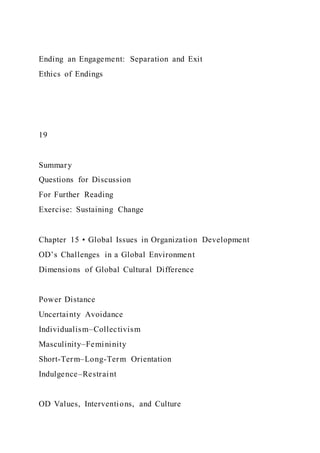
Ending an Engagement: Separation and Exit
Ethics of Endings
19
Summary
Questions for Discussion
For Further Reading
Exercise: Sustaining Change
Chapter 15 • Global Issues in Organization Development
OD’s Challenges in a Global Environment
Dimensions of Global Cultural Difference
Power Distance
Uncertainty Avoidance
Individualism–Collectivism
Masculinity–Femininity
Short-Term–Long-Term Orientation
Indulgence–Restraint
OD Values, Interventions, and Culture
➡ Profiles in Organization Development—Peter F.
Sorensen, Jr.
Case Examples and Research Findings
China
Hong Kong
Japan
Taiwan
India
Africa and the Middle East
Ghana
Egypt
South Africa
Latin America
United Kingdom and Ireland
Beyond Single Cultures: Multicultural OD
➡ Profiles in Organization Development—Therese
Yaeger
Advice for the Global OD Practitioner
Summary
Questions for Discussion
For Further Reading
➡ Case Study 10: A Global Partnership at GFAC
Consulting
Chapter 16 • The Future of Organization Development
Increasing Complexity of Change
20
Changing Workforce Demographics
Changing Nature of Work
The Current State of OD: Strengths, Weaknesses, and
Opportunities
Profiles in Organization Development—Allan H. Church
Strengths of OD Practice Today
Weaknesses in OD Practice Today
Opportunities for OD in the Future
Conclusion: The Future of OD
Summary
Questions for Discussion
For Further Reading
References
Author Index
Subject Index
About the Author
21
22
Preface
In 2018, the World Economic Forum issued its Future of Jobs
Report. Perhaps not surprisingly, the report noted an increase in
jobs focused on robotics and automation, Big Data, artificial
intelligence, and data science, whereas it also noted that jobs
focused on data entry and factory work will likely be in decline.
The report authors predicted that more than half of all jobs will
require significant reskilling by 2022, making lifelong learning
an
increasing necessity. Yet against the backdrop of this focus on
technology, the report authors also made a specific mention of
the
increasing influence of the field of organization development
(OD).
The report concluded:
Also expected to grow are roles that leverage
distinctively “human” skills, such as . . . Training and
Development, People and Culture, and Organizational
Development Specialists (World Economic Forum, 2018,
p. viii).
It seems that every few years, the field of organization
development (OD) finds itself at a crossroads. Some feel that
the
field has strayed too far from its founding humanistic values of
democracy, diversity, autonomy, collaboration, and choice.
They
argue that OD is in danger of being diluted or collapsed into
human resources roles, leadership development, and talent
management. Others feel that the “touchy feely” old values
deserve a fresh update and that OD practitioners have a great
deal to contribute to organizational efficiency, effectiveness,
and
enhanced performance in ways that helps both organization and
individual. They see the role of the practitioner as a business
adviser who can incorporate humanistic values without being
hypocritical.
I wrote (and continue to update) this book because, like the
World
Economic Forum, I firmly believe that OD as a field of research
and practice has much to offer to people in contemporary
23
organizations who are struggling with an incredible amount of
change. Old management styles no longer fit the needs of
today’s
workplace and workers. New organizational forms are emerging
to
cope with the increasing pace of change, globalization,
digitization
and the latest technologies, economic pressures, and the
expectations of the contemporary workforce. Managers struggle
to
engage employees despite ever-present threats of downsizing
and outsourcing. In such an environment, many employees find
work to be less personally satisfying than they did before.
Skilled OD practitioners understand the dynamics of human
systems and can intervene to encourage a healthy, engaging, and
productive environment. Unfortunately, it has been challenging
for
many students to develop these skills. It generally requires
“breaking in” to an OD department, finding a (hopefully
skilled)
mentor, and learning as much as possible through academic
courses or self-discovery. While they are regularly tested on the
job, managers and executives have few opportunities to develop
their skills as change agents as well. Project managers, IT
professionals, educators, and health care administrators all
report
that the skills of OD are applicable to their jobs.
My hope is that this book will provide theoretical and practical
background in OD to give you an introduction to the basic
processes of organization development and change. It will also
give you a chance to practice in a safe environment where you
can develop your skills. I hope you find the book to be readable
but rigorous—practical and relevant but with a solid academic
foundation—and comprehensive enough without being
exhausting.
For this fifth edition, I have updated many sections of the book
to
reflect recent research and advances in practice while retaining
classic approaches and foundational theories with which most
practitioners ought to be familiar. Highlights of this new edition
include the following:
A new feature, “Profiles in Organization Development,” that
showcases practitioners and researchers to highlight their
24
experience, different paths to and histories in the field, and
the diverse types of OD that are practiced today
Additional case studies to allow you to practice using OD
concepts and skills
A revision to Chapters 12 and 13 to highlight the growing
importance of organization design and culture interventions
Additional examples of global issues in organization
development
New readings at the end of each chapter, where appropriate
My continued thanks to the students at the University of Denver
as well as to the clients who share with me their struggles in
achieving change at work. Reviewers and readers of prior
editions
continued to share ideas to improve this volume. As always, I
am
grateful to my family and friends, especially my wife, Jennifer,
for
their patience, support, and encouragement.
25
Exercises and Activities
Many chapters contain exercises, activities, and role plays that
can be used to practice skills and apply concepts developed in
several chapters of the book. This chart details which exercises
and activities accompany which chapter and topic.
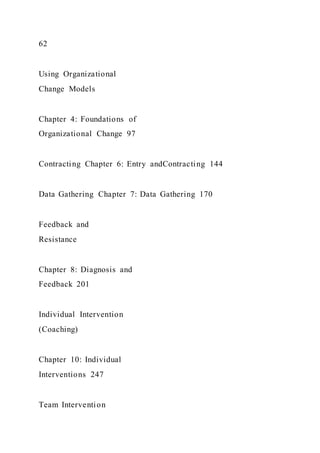
Exercise Chapter Topic Page
What Would You Do?
Chapter 3: Core Values and
Ethics of Organization
Development
62
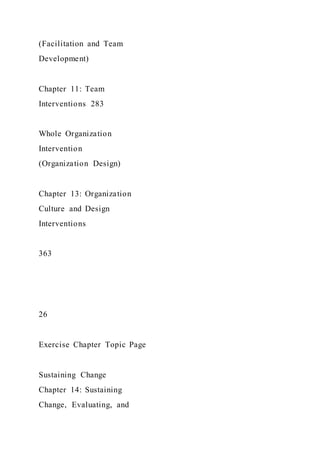
Using Organizational
Change Models
Chapter 4: Foundations of
Organizational Change 97
Contracting Chapter 6: Entry andContracting 144
Data Gathering Chapter 7: Data Gathering 170
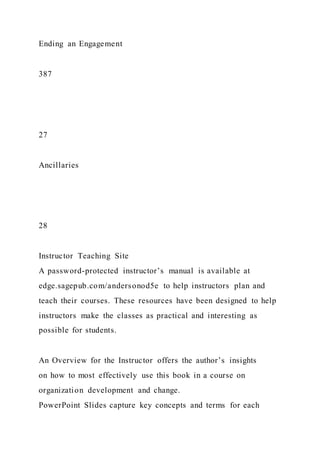
Feedback and
Resistance
Chapter 8: Diagnosis and
Feedback 201
Individual Intervention
(Coaching)
Chapter 10: Individual
Interventions 247
Team Intervention
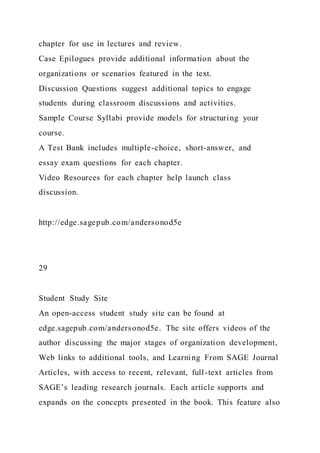
(Facilitation and Team
Development)
Chapter 11: Team
Interventions 283
Whole Organization
Intervention
(Organization Design)
Chapter 13: Organization
Culture and Design
Interventions
363
26
Exercise Chapter Topic Page
Sustaining Change
Chapter 14: Sustaining
Change, Evaluating, and
Ending an Engagement
387
27
Ancillaries
28
Instructor Teaching Site
A password-protected instructor’s manual is available at
edge.sagepub.com/andersonod5e to help instructors plan and
teach their courses. These resources have been designed to help
instructors make the classes as practical and interesting as
possible for students.
An Overview for the Instructor offers the author’s insights
on how to most effectively use this book in a course on
organization development and change.
PowerPoint Slides capture key concepts and terms for each
chapter for use in lectures and review.
Case Epilogues provide additional information about the
organizations or scenarios featured in the text.
Discussion Questions suggest additional topics to engage
students during classroom discussions and activities.
Sample Course Syllabi provide models for structuring your
course.
A Test Bank includes multiple-choice, short-answer, and
essay exam questions for each chapter.
Video Resources for each chapter help launch class
discussion.
http://edge.sagepub.com/andersonod5e
29
Student Study Site
An open-access student study site can be found at
edge.sagepub.com/andersonod5e. The site offers videos of the
author discussing the major stages of organization development,
Web links to additional tools, and Learning From SAGE Journal
Articles, with access to recent, relevant, full-text articles from
SAGE’s leading research journals. Each article supports and
expands on the concepts presented in the book. This feature also
provides discussion questions to focus and guide student
interpretation.
This text is accompanied by Cases and Exercises in
Organization
Development & Change, Second Edition (ISBN 978–1-5063–
4447
–8), which follows the same chapter organization as this text. A
bundle of this text with the cases and exercises book is also
available.
http://edge.sagepub.com/andersonod5e
30
31
Acknowledgments
SAGE Publishing would like to thank the following reviewers
for
their contributions to the manuscript:
Barry Davis, Tri-State Bible College and Graduate School
Drew Thomas Foley, California State University, Northridge
Dawn M. Newman, Saint Louis University
Peter F. Sorensen Jr., Benedictine University
Dr. Barbara S. Wallace, Webster University
T. Craig Williams, East Carolina University
32
33
Chapter One What Is Organization
Development?
Think for a moment about the organizations to which you
belong.
You probably have many to name, such as the company where
you work, a school, perhaps a volunteer organization, or a
reading
group. You are undoubtedly influenced by many other
organizations in your life, such as a health care organization
like a
doctor’s office or hospital, a church group, a child’s school, a
bank, or the local city council or state government. Using an
expansive definition of organization, you could name your own
family or a group of friends as an organization that you belong
to
as well. With just a few moments’ reflection, you are likely to
be
able to name dozens of organizations that you belong to or that
influence you.
Now consider an organization that you currently do not belong
to,
but one that you were dissatisfied with at some point in the
past.
What was it about that organization that made the experience
dissatisfying? Perhaps you left a job because you did not have
the
opportunity to contribute in the way that you would have liked.
Maybe it was a dissatisfying team atmosphere, or you were not
appreciated or recognized for the time and energy that you
dedicated to the job. It could have been a change to your
responsibilities, the team, or the organization’s processes. Some
people report that they did not feel a larger sense of purpose at
work, they did not have control or autonomy over their work, or
they did not find an acceptable path to growth and career
development. Perhaps you’ve witnessed or been part of an
organization that has failed for some reason. Perhaps it went out
of business or it disbanded because it could no longer reach its
goals.
You’ve likely had some excellent experiences in organizations,
too. You may have had a job that was especially fulfilling or
where
you learned a great deal and coworkers became good friends.
Maybe your local volunteer organization helped a number of
people through organized fundraisers or other social services
34
activities. Perhaps you joined or started a local community
group
to successfully campaign against the decision of your local city
council or school board.
All of this is to demonstrate what you already know intuitively,
that
we spend a great deal of our lives working in, connected to, and
affected by organizations. Some of these organizations function
quite well, whereas others struggle. Some are quite rewarding
environments in which to work or participate, but in others,
organizational members are frustrated, neglected, and
disengaged.
The purpose of this book is to introduce you to the field of
organization development, an area of academic study and
professional practice focused on making organizations better —
that is, more effective and productive and at the same time more
rewarding, satisfying, and engaging places in which to work and
participate. By learning about the field of organization
development and the process by which it is conducted, you will
be
a more effective change agent inside the organizations to which
you belong.
Master the content at edge.sagepub.com/andersonod5e
http://edge.sagepub.com/andersonod5e
35
Organization Development Defined
Organization development (OD) is an interdisciplinary field
with
contributions from business, industrial/organizati onal
psychology,
human resources management, communication, sociology, and
many other disciplines. Not surprisingly, for a field with such
diverse intellectual roots, there are many definitions of
organization development. Definitions can be illuminating, as
they
point us in a direction and provide a shared context for mutual
discussion, but they can also be constraining, as certain
concepts
are inevitably left out, with boundaries drawn to exclude some
activities. What counts as OD thus depends on the practitioner
and the definition, and these definitions have changed over
time.
In a study of 27 definitions of organization development
published
since 1969, Egan (2002) found that there were as many as 60
different variables listed in those definitions. Nonetheless, there
are some points on which definitions converge.
One of the most frequently cited definitions of OD comes from
Richard Beckhard (1969), an early leader in the field of OD:
Organization development is an effort (1) planned, (2)
organizationwide, and (3) managed from the top, to (4)
increase organization effectiveness and health through
(5) planned interventions in the organization’s
“processes,” using behavioral-science knowledge. (p. 9)
Beckhard’s definition has many points that have survived the
test
of time, including his emphasis on organizational effectiveness,
the use of behavioral science knowledge, and the inclusion of
planned interventions in the organization’s functions. Some
critique this definition, however, for its emphasis on planned
change (many organizational changes, and thus OD efforts, are
in
response to environmental threats that are not so neatly
planned)
and its emphasis on the need to drive organizational change
through top management. Many contemporary OD activities do
not necessarily happen at the top management level, as
36
increasingly organizations are developing less hierarchical
structures.
A more recent definition comes from Burke and Bradford
(2005):
Based on (1) a set of values, largely humanistic; (2)
application of the behavioral sciences; and (3) open
systems theory, organization development is a
systemwide process of planned change aimed toward
improving overall organization effectiveness by way of
enhanced congruence of such key organizational
dimensions as external environment, mission, strategy,
leadership, culture, structure, information and reward
systems, and work policies and procedures. (p. 12)
Finally, I offer a third:
Organization development is the process of increasing
organizational effectiveness and facilitating personal and
organizational change through the use of interventions
driven by social and behavioral science knowledge.
These definitions include a number of consistent themes about
what constitutes organization development. They propose that
an
outcome of OD activities is organizational effectiveness. They
also
each stress the applicability of knowledge gained through the
social and behavioral sciences (such as sociology, business and
management, psychology, and more) to organizational settings.
37
Making the Case for Organization
Development
Perhaps the point on which most definitions agree is that the
backdrop and purpose of organization development is change.
As
you have no doubt personally experienced, large-scale
organizational change is rarely simple and met without
skepticism.
As Peter Senge and colleagues (1999) write, “Most of us know
firsthand that change programs fail. We’ve seen enough ‘flavor
of
the month’ programs ‘rolled out’ from top management to last a
lifetime” (p. 6). Because of its impact on the organizational
culture
and potential importance to the organization’s success,
organizational change has been a frequent topic of interest to
both
academic and popular management thinkers. With change as the
overriding context for OD work, OD practitioners develop
interventions so that change can be developed and integrated
into
the organization’s functioning. Significant changes today are
facing organizations and their teams and individual employees.
To become effective, productive, and satisfying to members,
organizations need to change. It will come as no surprise to any
observer of today’s organizations that change is a significant
part
of organizational life. Change is required at the organizational
level as customers demand more, technologies are developed
with a rapidly changing life cycle (especially high-tech
products;
Wilhelm, Damodaran, & Li, 2003), and investors demand
results.
As Rita McGrath (2013) writes, “Music, high technology,
travel,
communication, consumer electronics, the automobile business,
and even education are facing situations in which advantages
are
copied quickly, technology changes, or customers seek other
alternatives and things move on” (p. 7). This requires that
organizations develop new strategies, economic structures,
technologies, organizational structures, and processes.
Change is required of team members, who now are likely to
work
virtually in collaboration with members from around the globe.
Cultural differences, changes in communication technologies,
and
38
a changing diverse workforce all combine to complicate how
team
members work together. Role conflict and confusion in decision
processes and decision authority are common when members
who have never worked together are thrown into an ad hoc team
that is responsible for rapid change and innovation.
Change is also required of individuals. Employees learn new
skills
as jobs change or are eliminated. Organizational members are
expected to quickly and flexibly adapt to the newest di rection.
Best-selling business books such as Who Moved My Cheese?
teach lessons in ensuring that one’s skills are current and that
being comfortable and reluctant to adapt is a fatal flaw. Leaders
today need to adapt to matrix organizational structures and new
participative styles of leadership rather than old hierarchical
patterns and command and control leadership (Holbeche, 2015).
For organizational members, change can be enlightening and
exciting, and it can be hurtful, stressful, and frustrating.
Whether or not we agree with the values behind “change as a
constant,” it is likely to continue for the foreseeable future.
Whereas some decry an overabundance of change in
organizations (Zorn, Christensen, & Cheney, 1999), others note
that it is the defining characteristic of the current era in
organizations and that becoming competent at organizational
change is a necessary and distinguishing characteristic of
successful organizations (Lawler & Worley, 2006).
There are, however, more and less effective ways to manage
change. Creating and managing change in order to create
higher-
performing organizations in which individuals can grow and
develop is a central theme of the field of OD. When we speak of
organization development, we are referring to the management
of
certain kinds of these changes, especially how people
implement
and are affected by them.
39
What Organization Development
Looks Like
It may be easiest to understand what organization development
is
by understanding what forms it takes and how it is practiced.
The
following are five examples of published case studies of OD in
action.
40
Example 1: Increasing Employee Participation
in a Public Sector Organization
Public sector organizations, it has been noted (Coram & Burns,
2001), often face additional special challenges in the
management
of change. Bureaucratic structures, interfaces with regional
governments and legislatures, political pressures, and
legislative
policies all complicate the implementation of new processes and
changes to organizational practices. In the Republic of Ireland,
a
special initiative aimed to reduce bureaucracy in the public
sector
to gain efficiency, improve customer service, and improve
interdepartmental coordination (O’Brien, 2002). Many programs
of
this type have been launched in other organizations as top-down
mandates from senior management, causing frustration and
decreased commitment among staff members who resisted the
mandated changes.
One department wanted to do things differently. The offices
were
in the division of Social Welfare Services, a community welfare
organization of 4,000 employees. Two Dublin offices (50
employees each) became the focus of this case. These offices
chose to involve employees in the development of an initiative
that
would improve working conditions in the department as well as
increase the employees’ capacity for managing changes. A
project steering team was formed, and it began by administering
an employee survey to inquire about working relationships,
career
development, training, technology, and management. Follow-up
data gathering occurred in focus groups and individual
interviews.
The tremendous response rate of more than 90 percent gave the
steering team a positive feeling about the engagement of the
population, but the results of the survey indicated that a great
deal
of improvement was necessary. Many employees felt
underappreciated, distrusted, and not included in key decisions
or
changes. Relationships with management were also a concern as
employees indicated few opportunities for communication with
management and that jobs had become routine and dull.
The steering team invited volunteers (employees and their
management) to work on several of the central problems. One
41
team worked on the problem of communication and proposed
many changes that were later implemented, including a redesign
of the office layout to improve circulation and contact among
employees. As the teams continued discussions, they began to
question standard practices and inefficiencies and to suggest
improvements, eventually devising a list of almost 30 actions
that
they could take. Managers listened to employee suggestions,
impressed by their insights. As one manager put it, “I have
learned that a little encouragement goes a long way and people
are capable of much more than given credit for in their normal
everyday routine” (O’Brien, 2002, p. 450).
The joint management–employee working teams had begun to
increase collaboration and interaction among the two groups,
with
each reaching new insights about the other. As a result of the
increased participation, “There appeared to be an enhanced
acceptance of the change process, coupled with demands for
better communications, increased involvement in decision
making,
changed relationships with supervisors and improved access to
training and development opportunities” (O’Brien, 2002, p.
451).
42
Example 2: Senior Management Coaching at
Vodaphone
Vodaphone is a multibillion-dollar global communications
technology company headquartered in the United Kingdom and
was an early leader in the mobile telephone market (Eaton &
Brown, 2002). Faced with increasing competition, the company
realized that in order to remain innovative and a leader in a
challenging market, the culture of the organization would need
to
adapt accordingly. Specifically, senior management realized
that
its current “command and control” culture of blame and
political
games would hinder the collaboration and mutual accountability
needed to succeed in a competitive environment. Instead, the
company wanted to encourage a culture of empowered teams
that
made their own decisions and shared learning and development,
speed, and accountability.
Several culture initiatives were implemented, including the
development of shared values, the introduction of IT systems
that
shared and exchanged information across major divisions that
had hindered cross-functional learning, and the establishment of
teams and a team-building program.
To support the initiatives and encourage a new, collaborative
management style, Vodaphone implemented a leadership
coaching program. Top managers attended the program to learn
skills in conducting performance reviews, helping employees set
goals, and coaching teams. Following the program, managers
had
one-on-one coaching sessions with a professional coach who
worked with participants to help them set coaching goals and
reflect on how successfully they were able to implement the
skills
learned in the program.
As a result of the program, managers began to delegate more as
teams started to solve problems themselves. Teams began to feel
more confident in their decisions as managers trusted them.
Eaton and Brown (2002) attribute several subsequent company
successes to the program, noting that it was critical that the
coaching program was integrated with the other culture change
43
initiatives that it supported. “Cultural change takes time,” they
note, and “traditional attitudes to management do not die away
overnight” (p. 287). However, they point out that a gradual
evolution took place and the new cultural values are now the
standard.
44
Example 3: Team Development in a Cancer
Center
Health care workers who have the challenge of caring for
critically
ill patients experience stress, emotional exhaustion, and burnout
at very high rates compared with workers in other fields.
Without
social support from friends or other coworkers, many workers
seek to leave the field or to reduce hours to cope with the
emotional exhaustion of such a demanding occupation.
Consequently, many researchers have found that health care
workers in particular need clear roles, professional autonomy,
and
social support to reduce burnout and turnover.
In one Canadian cancer center (Black & Westwood, 2004), a
senior administrator sought to address some of these needs by
creating a leadership team that could manage its own work in a
multidisciplinary team environment. Team members would have
professional autonomy and would provide social support to one
another. Leaders volunteered or were chosen from each of the
center’s main disciplines, such as oncology, surgery, nursing,
and
more. Organization development consultants were invited to
lead
workshops in which the team could develop cohesive trusting
relationships and agree on working conditions that would reduce
the potential for conflict among disciplines.
In a series of three 2-day workshops over 3 months, the team
participated in a number of important activities. Members did
role
play and dramatic exercises in which they took on one another’s
roles in order to be able to see how others see them. They
completed surveys of their personal working styles to
understand
their own communication and behavior patterns. The team
learned problem-solving techniques, they clarified roles, and
they
established group goals.
Three months after the final workshop was conducted, the
facilitators conducted interviews to assess the progress of the
group. All of the participants reported a better sense of
belonging,
a feeling of trust and safety with the team, and a better
understanding of themselves and others with whom they
worked.
45
One participant said about a coworker, “I felt that [the
workshops]
connected me far differently to [a coworker] than I would have
ever had an opportunity to do otherwise, you know, in a normal
work setting” (Black & Westwood, 2004, p. 584). The
consultants
noted that participants wanted to continue group development
on
an ongoing basis.
46
Example 4: A Future Search Conference in a
Northern California Community
Santa Cruz County is located in Northern California, about an
hour south of San Francisco. In the 1960s, the county had
approximately 25,000 residents in an agricultural region and in
a
small retirement community. In the late 1960s, the University of
California, Santa Cruz, opened its doors, and in the following
years the county began to experience a demographic shift as
people began to move to the area and real estate prices
skyrocketed. By 1990, the population had reached 250,000
residents, and increasingly expensive real estate prices meant
that many residents could no longer afford to live there.
Affordable
housing was especially a problem for the agricultural
community.
A local leadership group had convened several conferences but
could never agree on an approach to the housing problem.
In the mid-1990s, a consortium of leaders representing different
community groups decided to explore the problem further by
holding a future search conference (Blue Sky Productions,
1996).
They invited 72 diverse citizens to a 3-day conference not only
to
explore the problem of affordable housing but also to address
other issues that they had in common. The citizen groups
represented a cross-section of the community—from young to
old,
executives to farmworkers—and social services agencies.
Attendees were chosen to try to mirror the community as a
“vertical slice” of the population. They called the conference
“Coming Together as a Community Around Housing: A Search
for
Our Future in Santa Cruz County.”
At the conference, attendees explored their shared past as
individuals and residents of the county. They discussed the
history
of the county and their own place in it. Next, they described the
current state of the county and the issues that were currently
being addressed by the stakeholder groups in attendance. The
process was a collaborative one; as one attendee said, “What
one
person would raise as an issue, another person would add to,
and
another person would add to.” There were also some surprises
as
new information was shared. One county social services
47
employee realized, “There were a couple of things that I
contributed that I thought everyone in the county knew about,
and
[I] listen[ed] to people respond to my input, [and say] ‘Oh,
really?’”
Finally, the attendees explored what they wanted to work on in
their stakeholder groups. They described a future county
environment 10 years out and presented scenarios that took a
creative form as imaginary TV shows and board of supervisors
meetings. Group members committed to action plans, including
short- and long-term goals.
Eighteen months later, attendees had reached a number of
important goals that had been discussed at the conference. Not
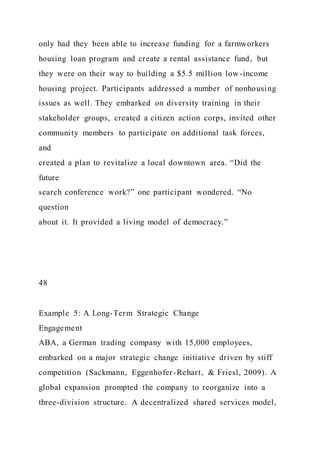
only had they been able to increase funding for a farmworkers
housing loan program and create a rental assistance fund, but
they were on their way to building a $5.5 million low -income
housing project. Participants addressed a number of nonhousing
issues as well. They embarked on diversity training in their
stakeholder groups, created a citizen action corps, invited other
community members to participate on additional task forces,
and
created a plan to revitalize a local downtown area. “Did the
future
search conference work?” one participant wondered. “No
question
about it. It provided a living model of democracy.”
48
Example 5: A Long-Term Strategic Change
Engagement
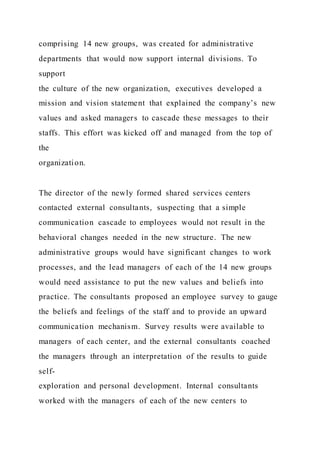
ABA, a German trading company with 15,000 employees,
embarked on a major strategic change initiative driven by stiff
competition (Sackmann, Eggenhofer-Rehart, & Friesl, 2009). A
global expansion prompted the company to reorganize into a
three-division structure. A decentralized shared services model,
comprising 14 new groups, was created for administrative
departments that would now support internal divisions. To
support
the culture of the new organization, executives developed a
mission and vision statement that explained the company’s new
values and asked managers to cascade these messages to their
staffs. This effort was kicked off and managed from the top of
the
organization.
The director of the newly formed shared services centers
contacted external consultants, suspecting that a simple
communication cascade to employees would not result in the
behavioral changes needed in the new structure. The new
administrative groups would have significant changes to work
processes, and the lead managers of each of the 14 new groups
would need assistance to put the new values and beliefs into
practice. The consultants proposed an employee survey to gauge
the beliefs and feelings of the staff and to provide an upward
communication mechanism. Survey results were available to
managers of each center, and the external consultants coached
the managers through an interpretation of the results to guide
self-
exploration and personal development. Internal consultants
worked with the managers of each of the new centers to
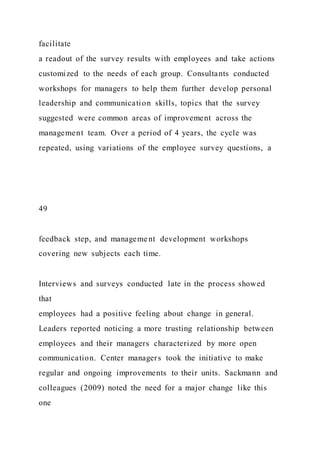
facilitate
a readout of the survey results with employees and take actions
customized to the needs of each group. Consultants conducted
workshops for managers to help them further develop personal
leadership and communication skills, topics that the survey
suggested were common areas of improvement across the
management team. Over a period of 4 years, the cycle was
repeated, using variations of the employee survey questions, a
49
feedback step, and management development workshops
covering new subjects each time.
Interviews and surveys conducted late in the process showed
that
employees had a positive feeling about change in general.
Leaders reported noticing a more trusting relationship between
employees and their managers characterized by more open
communication. Center managers took the initiative to make
regular and ongoing improvements to their units. Sackmann and
colleagues (2009) noted the need for a major change like this
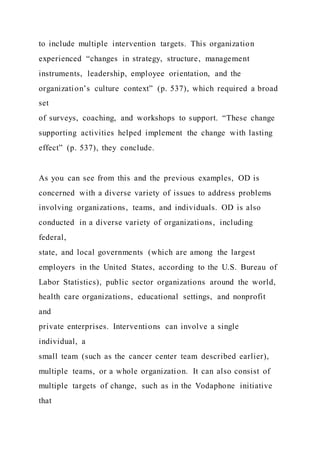
one
to include multiple intervention targets. This organization
experienced “changes in strategy, structure, management
instruments, leadership, employee orientation, and the
organization’s culture context” (p. 537), which required a broad
set
of surveys, coaching, and workshops to support. “These change
supporting activities helped implement the change with lasting
effect” (p. 537), they conclude.
As you can see from this and the previous examples, OD is
concerned with a diverse variety of issues to address problems
involving organizations, teams, and individuals. OD is also
conducted in a diverse variety of organizations, including
federal,
state, and local governments (which are among the largest
employers in the United States, according to the U.S. Bureau of
Labor Statistics), public sector organizations around the world,
health care organizations, educational settings, and nonprofit
and
private enterprises. Interventions can involve a single
individual, a
small team (such as the cancer center team described earlier),
multiple teams, or a whole organization. It can also consist of
multiple targets of change, such as in the Vodaphone initiative
that
involved not only large-scale culture change but also the
implementation of teams and individual coaching. OD can also
deal with multiorganization efforts, such as in the case of Santa
Cruz County, or it can involve multiple national governments.
The
target of change can be something as seemingly simple as
increasing employee involvement or developing coworker
relationships, or it can be as potentially large as creating the
vision or strategy of an entire organization or documenting the
10-
year future of a large county.
50
Profiles in Organization Development
Marvin Weisbord
Marvin Weisbord had a 50-year career as manager, writer,
researcher, and consultant to corporations and medical schools.
He
was a founder and co-director of Future Search Network, a
global
nonprofit whose members manage strategic planning meetings
for
communities worldwide. He received a lifetime achievement
award
from the Organization Development Network, which voted his
book
Productive Workplaces one of the “Top Five Most Influential
OD
books of the Past 40 Years.” For 20 years, he was a partner in
the
consulting firm Block Petrella Weisbord, a member of the NTL
Institute for Applied Behavioral Science, and a member of the
European Institute for Transnational Studies (ITS).
1. How did you get started in OD? What favorite lessons stand
out
about your work with people and organizations?
I learned to do organization development (OD) by doing it. I
became an advocate for projects to help people learn from their
own experience. Most people know more about their work than
they realize. They rarely have a chance to discover it. Given
time to educate one another, people always learn more about
the whole than any one person knew before. Given influence
over policies and work systems, people perform better than
they think they can. This has occurred for decades regardless
of culture, age, class, gender, ethnicity or “personal style.” I
learned that “sustainable change” was an oxymoron! The best
we could hope to sustain was peoples’ commitment from one
meeting to the next. That is a priceless change worth having. If
you want a new culture, make every meeting congruent with the
culture you want. You’ll never do better than that.
I learned the power of applying systems thinking to complex
tasks. Getting from Point A to Point B means paying attention
all at once to economics, technology, and people. Such was the
origin of my 6-box organizational diagnosis model. I imagined
it
as an aircraft’s instrument panel. I likened leadership to
scanning the dials, keeping all the instruments in balance,
mindful that you never can change just one thing.
For two decades after leaving the consulting business, I ran
and taught a three-day planning event called “Future Search.”
Indeed, Sandra Janoff and I showed more than 4,000 people
around the world how to do effective large group strategic
planning for themselves. I liked that work because it required
all
51
the key players in the same room. Whatever did or did not
happen was up to them. We saw people who had never worked
together do things in a few hours that none believed possible.
We documented positive results from Future Searches all over
the world.
2. What other jobs or experiences helped you as an OD
practitioner?
I could not have become an OD consultant had I not worked for
a decade in a business forms company. I could not have written
up my OD cases had I not been a magazine writer. Nor would I
have gotten into the NTL Institute, a group dynamics pioneer. I
could not have learned to function in groups, nor how to do
action research, without being an NTL workshop leader for 20
years. I could not have learned the nuts and bolts of
collaborative consulting without partnering with Peter Block
and
Tony Petrella. Had it not been for research in medical schools
with Paul Lawrence and D-I (differentiation-integration theory),
I
might never have got how behavior change follows structural
change more often than vice versa.
I could not have appreciated the unity of human experience but
for Sandra Janoff’s and my shared interest in applying D-I
theory to strategic planning. Nor could I have freed myself to
work easily anywhere in the world without John and Joyce
Weir’s gift of owning my experience without needing to deny
anybody else’s. In the long run, I integrated everything I
learned
into a dance that included human relations, socio-technical
systems design, and personal growth.
3. What do you think are the most important skills for a student
of
OD to develop?
If you want to help others, do what they never did before: Start
with yourself. You cannot get too much self-knowledge. That
requires finding parts of yourself you didn’t know existed.
There
is a lifetime of work for each of us in finding our “shadows,”
harmonizing inner voices that tear us apart. We’re never
finished, and the right time to do it is every day.
When you walk into a meeting, imagine everyone doing their
best with what they have. Then deal with people the way you
find them. Realize that you can’t change them. You can learn to
do things you never did before—even accepting others the way
you find them. You can give people opportunities they never
had. You will not discover this in power points and executive
summaries.
52
4. Can you comment on the future of organizations and the field
of
OD?
After 30 years of Future Searches, I believe that the best way to
manage the future is to understand that it happens now. Both
past and future exist only in the present. Today is yesterday’s
future. It’s dissolving into the past by the second. Learning that
is the best asset a consultant can acquire. Look around you.
Whatever people are doing today was yesterday’s future. We
cannot solve novel problems before we have them. Improving
companies and communities can be satisfying work if you avoid
thinking you build for the ages. You can only do “future” work
in
today’s meetings. You can only capitalize on the expertise,
experience, hopes, fears, and dreams of those doing the work.
Figure how to get everybody improving whole systems. If you
put energy into doing that you can make a difference, not
someday, but every day.
53
What Organization Development Is
Not
Despite this seemingly expansive definition of what
organization
development is and what issues and problems it addresses, it is
also limited. OD is not any of the following.
54
Management Consulting
OD can be distinguished from management consulting in
specific
functional areas such as finance, marketing, corporate strategy,
or
supply chain management. It is also distinguished from
information technology applications. Yet OD is applicable to
any of
these areas. When organizations attempt a conscious change,
whether it involves implementing a new IT system; making
changes in strategy, goals, or direction; or adapting to a new
team
leader, OD offers relevant processes and techniques to make the
change function effectively. An OD practitioner would not
likely
use expertise in one of these content areas (for example, best
practices in financial structures of supplier relationships or
contemporary marketing analysis) to make recommendations
about how an organization does this activity. Instead, an OD
practitioner would be more likely to assist the organization in
implementation of the kinds of changes that management
consultants would advise them to make. Thus, OD makes a
distinction between partnerships with a client where the
consultant
offers content advice and those where the consultant offers
process advice. Consulting where the practitioner offers content
advice falls under the heading of management consulting,
whereas OD offers consultation on the process used to reach a
desired goal. Most management consulting also is not based on
OD’s set of foundational values (a topic that we will take up in
detail in Chapter 3). In Chapter 5 we will discuss OD consulting
in
particular and differentiate it from management consulting
activities with which you may be familiar.
55
Training and Development
While individual and organization learning is a part of OD and a
key value we will discuss in a later chapter, OD work is not
confined to training activities. OD is not generally the context
in
situations in which learning is the sole objective, such as
learning
a new skill, system, or procedure. OD deals with organizational
change efforts that may or may not involve members of the
organization needing to learn specific new skills or systems.
Many
training and development professionals are gravitating toward
OD
to enhance their skills in identifying the structural elements of
organizations that need to be changed or enhanced for training
and new skills to be effective. Other aspects of the training and
development profession, however, such as needs assessment,
course development, the use of technology, or on-the-job
training,
are not central to the job of the OD practitioner.
In addition, most training programs are developed for a large
audience, often independent of how the program would be
applied
in any given organization. While some OD interventions do
incorporate training programs and skill building, OD is more
centrally concerned with the systemic context that would make
a
training program successful, such as management support, job
role clarification, process design, and more. As Burke (2008)
writes, “Individual development cannot be separated from OD,
but
to be OD, individual development must be in the service of or
leverage for system-wide change, an integral aspect of OD’s
definition” (p. 23).
56
Short Term
OD is intended to address long-term change. Even in cases in
which the intervention is carried out over a short period (such
as
the several-day workshops conducted at the cancer center
described earlier), the change is intended to be a long-term or
permanent one. OD efforts are intended to develop systemic
changes that are long lasting. In the contemporary environment,
in
which changes are constantly being made, this can be
particularly
challenging.
57
The Application of a Toolkit
Many OD practitioners speak of the OD “toolkit.” It is true that
OD
does occasionally involve the application of an instrumented
training or standard models, but it is also more than that. To
confuse OD with a toolkit is to deny that it also has values that
complement its science and that each OD engagement has
somewhat unique applications. As Feyerherm and Worley
(2008)
write,
Too many clients ask, “How do I do x?” or “What tools
are available to change y?” and too many OD
practitioners, in an effort to be helpful, give the client
what they want instead of what they need. The “tool”
focus ignores assessment and risks, providing a band-
aid in organizations without attacking core problems. (p.
4)
Students of OD who seek out tools without being
knowledgeable
about the OD process and the reasons for the use of the tools are
likely to find themselves having learned how to use a hammer
and
enthusiastically go around looking for nails (only to realize that
not
every problem looks like the same nail). As Schein (1999) puts
it,
Knowledge of many different kinds of interventions does
not substitute for the knowhow of sensing what is needed
“right now.” . . . In fact, having a skillset of interventions
“at the ready” makes it harder to stay in the current
reality because one is always looking for opportunities to
use what one believes oneself to be good at. (p. 245)
OD is more than a rigid procedure for moving an organization,
team, or individual from point A to point B. It involves being
attuned to the social and personal dynamics of the client
organization that usually require flexibility in problem solving,
not a
standardized set of procedures or tools. In Chapter 3 we will
discuss the values that underlie OD to better understand the
58
fundamental concepts that explain how and why OD
practitioners
make the choices they do.
59
Who This Book Is For
This book is for students, practitioners, and managers who seek
to learn more about the process of organizational change
following organization development values and practices. We
will
use the term organization development, as most academic
audiences prefer, over the term organizational development,
which seems to dominate spoken and written practitioner
communication. We will also refer to the organization
development
practitioner, consultant, and change agent in this book as a
single
general audience, because these terms emphasize that OD is
practiced by a large community that can include more than just
internal and external paid OD consultants.
OD includes (and the book is written for) anyone who must lead
organizational change as a part of his or her role. With the
magnitude and frequency of organizational change occurring
today, this encompasses a wide variety of roles and is an
increasingly diverse and growing community. The OD
practitioner
can include the internal or external organization development
consultant, but also managers and executives; human resources
and training professionals; quality managers; project managers
and information technology specialists; educators; health care
administrators; directors of nonprofit organizations; leaders in
state, local, and federal government agencies; and many more.
We will also more frequently discuss organizational members
than
employees, which is a more inclusive term that includes
volunteers in nonprofit groups and others who are connected to
organizations but may not have an employment relationship
with
them. The term also is intended to include not just leaders,
executives, and managers but also employees at all levels.
60
Overview of the Book
This book provides an overview of the content of organization
development, including theories and models used by change
agents and OD practitioners. It also explores the process by
which
OD is practiced. The objective of the book is to acquaint you
with
the field of OD and the process of organization development
consulting. The goal is to develop your analytic, consulting, and
practitioner skills so that you can apply the concepts of OD to
real
situations. We will simulate these consulting situations through
detailed case studies, which follow many of the skill
development
chapters, in which you will be able to immediately practice
what
you have learned in the chapter.
Chapters 2 through 5 will explore the foundations of the field,
including its history, values, and an overview of the key
concepts
and research in organizational change. In these chapters you
will
learn how OD began as a field, how it has evolved over the past
decades, and how most practitioners think of the field today. In
Chapter 3 we will discuss the underlying values and ethical
beliefs
that influence choices that practitioners must make in working
with
clients. Chapter 4 provides a foundation in research into
organizational change from a systems perspective, a common
way of thinking about organizations. We will also discuss a
social
construction perspective on organizational change. In this
chapter
you will be exposed to models of organizational systems and
organizational change that have influenced the development of
many OD interventions. In Chapter 5 we will define the role of
the
OD consultant, differentiating the OD consultant from other
kinds
of consultants, and describing the specific advantages and
disadvantages to the OD consultant when the consultant is
internal or external to the organization.
Beginning with Chapter 6, the book follows an action research
and
consulting model (entry, contracting, data gathering, data
analysis/diagnosis, feedback, interventions, and evaluation). We
will discuss the major actions that practitioners take in each of
these stages and describe the potential pitfalls to the internal
and
61
external consultant. Chapter 6 describes the early stages of the
consulting engagement, including entry and contracting. You
will
learn how a consultant contracts with a client and explores what
problems the client is experiencing, how those problems are
being
managed, and how problems can be (re)defined for a client. In
Chapter 7 we will cover how practitioners gather data, as well
as
assess the advantages and disadvantages of various methods for
gathering data about the organization. Chapter 8 describes what
OD practitioners do with the data they have gathered by
exploring
the dynamics of the feedback and joint diagnosis processes.
This
stage of the consulting process is especially important as it
constitutes the point at which the client and consultant define
what
interventions will best address the problems that have been
described.
Chapter 9 begins by describing the most visible aspect of an OD
engagement—the intervention. We will discuss the components
of
interventions and describe the decisions that practitioners must
make in grappling with how to structure them for maximum
effectiveness. Chapters 10 through 13 address the traditional
OD
practices with which most practitioners ought to be familiar,
including interventions such as organization design, strategic
planning, quality interventions, team building, survey feedback,
individual instruments, and coaching and mentoring. These
chapters also incorporate practices such as appreciative inquiry,
future search, and Six Sigma. These interventions are organized
according to the target of the intervention, whether it be the
whole
organization, multiple groups, single groups, or individuals. In
Chapter 14 we will conclude our discussion of the OD process
by
exploring how organization development practitioners separate
themselves from client engagements and evaluate the results of
their efforts. In Chapter 15 we will examine the practice of OD
in
different cultures and geographies by discussing how
globalization
impacts organization development. The book concludes in
Chapter 16 with a discussion of the future of OD, where we will
discuss the applicability and relevance of OD to contemporary
organizations, given trends in demographics, working
conditions,
and organizational environments.
62
Following trends in the corporate world, ethical issues in OD
are
gaining the attention of academics, clients, and practitioners.
While we will discuss values and ethics in Chapter 3, rather
than
leave ethical dilemmas to that chapter alone, we will also
discuss
ethical issues in organization development at relevant points
throughout the book, when appropriate for the stage in the OD
process being described.
Many chapters begin with an opening vignette and thought
questions to set the stage for the topics covered in those
chapters. Some of these vignettes present published case studies
of successful and unsuccessful OD efforts. As you read the
vignette and the chapter, consider what factors made the case
more or less successful and what lessons the practitioner may
have learned from the experience. You may wish to find the
published case and read it for additional details not presented in
the vignette. Reading published cases can help you develop a
deeper appreciation for the complexities of OD work and learn
from the successes and struggles that others have experienced.
At the end of each chapter you will find questions for
discussion,
exercises, activities, and/or role-play simulations that can help
you
develop your OD skills through realistic scenarios where you
can
practice in a safe environment.
63
Analyzing Case Studies
The case studies included in this book are intended to help you
learn the role and thought process of an OD consultant or
change
agent through realistic examples. By reading and analyzing case
studies, you will actively participate in applying the theory and
concepts of OD to complex, real-life situations that consultants
find themselves in every day. These cases are all based in
practitioners’ real experiences—names and some details have
been changed to protect the client’s and practitioner’s
anonymity.
By stepping into a practitioner’s shoes, you will be challenged
to
make the tradeoffs and choices that managers and consultants
are asked to make. The cases will help you develop the
problem-
solving and critical-thinking skills that are central to the value
that
a practitioner brings to a client. Ideally you can discuss thes e
cases with others who have analyzed them as well, and together
you can identify the central issues in the cases and debate the
most appropriate response. In this way, you will be assimilating
knowledge that you have about organizations, change, human
dynamics, and the concepts and theories of OD. You will learn
the
logic behind the choices that managers and practitioners make,
and you will gain practice in making your thought processes
explicit. The cases in the book will build on one another in
complexity, so you will need to integrate what you have learned
from previous chapters as you analyze each case.
The case studies in this book are written as mini-plays or scenes
to provide a richly detailed scenario in which you can imagine
yourself playing a part, in contrast to many commonly published
case studies in which a few short paragraphs provide all of the
detail available for analysis. Since a good deal of OD and
change
management involves noticing and responding to the human and
relational dynamics of a situation in addition to the task and
content issues, the scenes in this book provide both in order to
give you practice in becoming an observer of people during the
process of organizational change. The cases in this book also
are
situated in a number of diverse types of organizations in which
OD
is practiced, including educational environments, health care
and
64
nonprofit organizations, and for-profit businesses. Each of these
types of organizations brings with it unique challenges and
opportunities for the OD practitioner.
Each case provides a slice of organizational life, constructed as
a
brief scene in which you can imagine yourself playing a part,
but
which will require your conscious thinking and reflection. Cases
present situations with many options. As Ellet (2007) writes, “A
case is a text that refuses to explain itself” (p. 19). It requires
you
to take an active role to interpret it and discover its meaning.
Fortunately, unlike the passage of time in real life, in written
cases
time is momentarily paused to give you the chance to consider a
response. While you do not have the opportunity to gather
additional data or ask questions of participants, you do have the
ability to flip back a few pages, read the situation again, and
contemplate. You can carefully consider alternate courses of
action, weigh the pros and cons of each, and clarify why you
would choose one option over another.
As a result of having to make these choices, you will hone your
ability to communicate your rationale for your decisions.
Classmates will make different choices, each with his or her
own
well-reasoned rationales. Through discussion you will sharpen
your ability to solve problems, understanding the principles
behind
the decisions that you and your classmates have made. You will
learn about how your own experiences shape your assumptions
and approaches to problems. You will be challenged to develop
your skills to provide evidence for your reasoning, defend your
analyses, and explain your thinking in clear and concise ways
for
fellow practitioners and clients alike. You may find that these
discussions prompt you to change your mind about the approach
you would take, becoming convinced by a classmate’s well -
reasoned proposal, or you may find that your reasoning
persuades others that your approach has the greater advantages.
Regardless, you will learn that there is no single right answer at
the back of the book or to be shared by your instructor after you
have struggled. For some of the cases in this book, your
instructor
may share with you what happened after the case concluded.
This
information may provide support for the approach you would
have
65
taken, or it may make you think that your approach was
incorrect.
Instead of seeking the right or wrong answer, however, asking
yourself whether your proposal was well reasoned given the
circumstances is more important than knowing the exact
outcome
of the case. While you have the opportunity to do so, use the
occasion of the case study and the discussion to play with
various
alternatives. Here, the process may be more important than the
outcome.
The following tips will help you get started with case study
analysis:
1. Read the entire case first, and resist the temptation to come
to any conclusions the first time you read it. Allow yourself to
first gather all of the relevant data about the situation before
you propose any solutions or make any judgments about
what is happening or what the client needs to do.
2. Use the tools and methods outlined in each chapter to help
you think through the issues presented by the case. You will
find worksheets, models, principles, and outlines that can
assist you in identifying and categorizing problems, selecting
and prioritizing interventions, and organizing ideas to respond
to the client. Use charts and diagrams to map out
organizational structures and underline key phrases and
issues. Write questions that come to mind in the margins.
Read the case multiple times to ensure that you have not
missed a key detail that would indicate to a client that you
had not been paying close attention.
3. Realize that like real life, case studies contain many extra
details and describe multiple issues. Organizational life is
messy and complex, and not all of these details are helpful or
necessary to the consultant or change agent. A consultant
helping a team redefine roles and responsibilities may be
doing so in an environment in which the company has
acquired a competitor or quarterly results were disappointing.
Part of the practitioner’s role is to sort the useful primary
information from the unnecessary secondary information (or
information that is unnecessary for the immediate problem).
This is part of the value of these case exercises and a logic
and intuition that you will develop as your skills and
66
experience grow. Ask yourself what the client is trying to
achieve, what he or she has asked of you, and what the core
issues and central facts are.
4. Similarly, in any response to a client or reaction to a case,
resist the temptation to comment on everything. An OD
practitioner can help to prioritize the most pressing issues
and help the client sort through the complexities of
organizational life. It could be that part of the reason the client
has asked for help is that the number of possibilities for action
are too overwhelming to decide what to do next.
5. When you are prepared to write a response or an analysis,
ask yourself whether you have addressed the central
questions asked by the case and whether you have clearly
stated the issues to the client. Once your response is written,
could you send that, in its present form, to the client
described in the case? In that regard, is the analysis
professionally written and well organized to communicate
unambiguously to the client? Will the client understand how
and why you reached these conclusions?
6. As you write your analysis, ask yourself how you know any
particular fact or interpretation to be true and whether you
have sufficiently justified your interpretation with actual data.
Instead of boldly stating that “managers are not trained for
their roles,” you could write, “Only 2 of 10 managers had
attended a management training course in the past 5 years,
leading me to conclude that management training has not
been given a high priority.” The latter uses data and makes
the interpretation explicit; the former is likely to invite
criticism
or defensiveness from a client. This does not mean that
directness is not appropriate, only that it must follow from the
evidence. We will describe the considerations of the feedback
process in depth in this book.
7. When you have finished your own thinking and writing about
the case, and after you have had the opportunity to discuss
the case and options for action with classmates, take the time
to write down your reflections from the experience (Ellet,
2007). What did you learn? What principles might apply for
the next time you are confronted with these choices?
67
Summary
Today’s organizations are experiencing an incredible amount of
change. Organization development is a field of academic study
and
professional practice that uses social and behavioral science
knowledge to develop interventions that help organizations and
individuals change successfully. It is a field practiced in almost
all
kinds of organizations that you can imagine, from education to
health
care, from government to small and large businesses. Changes
that
OD practitioners address are diverse as well, including
organizational
structures and strategies, team effectiveness, leadership
coaching,
and much more. OD is not management consulting or training
and
development, and it is neither short term nor the mere
application of
a standard procedure or toolkit. OD practitioners can include
many
kinds of people for whom organizational change is a pri ority,
such as
managers and executives, project managers, and organizational
members in a variety of roles.
68
Questions for Discussion
1. Think of a job that you have held. It may be your current job,
or it
may be a job that you had in the past. Now take a few moments
and
write down several reasons why you found that job or work
environment to be a positive or rewarding experience, or several
reasons why you found it to be a negative or unrewarding
experience. Share your ideas with a classmate. Did you note any
similarities or differences? What OD interventions discussed in
Chapter 1 do you think might have been helpful in this
organization?
2. Without looking back at the definitions in this chapter, how
would
you describe organization development to a friend, colleague, or
potential client? Now compare your description to the
definitions in
the chapter. How is your definition different?
3. Have you ever participated in an organization development
project
or intervention? What was your experience?
For Further Reading
Beckhard, R. (1969). Organization development: Strategies and
models. Reading, MA: Addison-Wesley.
Burke, W. W. (2008). A contemporary view of organization
development. In T. G. Cummings (Ed.), Handbook of
organization
development (pp. 13–38). Thousand Oaks, CA: Sage.
Egan, T. M. (2002). Organization development: An examination
of
definitions and dependent variables. Organization Development
Journal, 20(2), 59–71.
Marshak, R. J. (2006). Organization development as a
profession
and a field. In B. B. Jones & R. Brazzel (Eds.), The NTL
handbook of
organization development and change: Principles, practices, and
perspectives (pp. 13–27). San Francisco, CA: Pfeiffer.
69
Case Study 1: Every Coin Has Two Sides
Read the case below and consider the following questions:
1. What are the sources of conflict on this team? Which of the
issues
are personal or interpersonal versus systemic or organizational?
2. If you were to summarize the issues for Tom or Jared, how
would
you present the data back?
3. Do you think this team can reconcile this conflict, or has this
team
reached a point where it is beyond repair?
4. What do you think an organization development practitioner
could
do to help Jared and this team?
70
In Tom’s Office
“I have a strange situation, and I’m not sure why it’s happening.
I
have done some investigating myself, but I’m perplexed about
what
do to next, which is why I reached out to you,” Tom began.
“Tell me more about it,” Paul asked. As an internal organization
development consultant to Tom, he was used to perplexing
situations
and eager to hear more.
“One of the managers on my team, Jared, is relatively new. I
have
four other managers who are much more tenured in my
organization,
but he’s been part of my group for only about 7 months. About
3
months ago, I started getting complaints from his team,” Tom
said.
“Remind me what Jared’s team does?” Paul asked.
“Jared’s team is responsible for the relationships with our
suppliers.
Any time we work with a supplier to buy parts from them, we
have a
supplier agreement that shows their agreed service levels to us,
pricing, quality levels, shipping time expectations, and so on.
Jared’s
team members work closely with our suppliers to monitor the
quality
of the products they are shipping to us and whether the supplier
metrics are meeting our agreements,” Tom explained.
“That helps. What kinds of complaints were you hearing from
Jared’s
team?” Paul asked.
“At first I was hearing general comments such as ‘he doesn’t
listen to
us.’ I take that with a grain of salt because to be honest, we
have
implemented a lot of changes in the last year, and I hear that
complaint a lot. Plus people just don’t like change, so they say
that
we’re not listening just because they don’t like what we are
saying or
we made a decision they don’t like. About a year ago, we
reduced
our number of suppliers. We also centralized our supplier
review
teams into four locations in the U.S.: north, east, west, and
south,
and reduced staff by about 20%. While I tried to hold a lot of
town
hall meetings to communicate the centralization and the
progress of
our initiatives, I know that it wasn’t a popular change with
employees.
We worked through it and tried to be patient, and I think that
generally speaking morale is on the upswing,” Tom said.
“But back to Jared’s team,” Paul prodded, returning Tom to the
reason for the meeting.
71
“Yes, right. At first it was just one or two people that were the
source
of the complaints, but then I gradually started to hear other
voices
chime in. Jared’s team has about 10 members, so I interviewed
each
one of them in a ‘skip level’ meeting, where I met one on one
with
each person. Employees were very frank with me about their
feedback for Jared. They weren’t sugarcoating. The themes
centered
on a couple of issues. In addition to listening, which was a
pervasive
comment, employees complained of not being taken seriously,
being
treated as incompetent, not having their ideas listened to, and
being
‘talked down to’ in a condescending way,” Tom said.
“That sounds like honest and tough feedback,” Paul said. “Were
you
able to share with Jared what people generally said?”
“I did more than provide general feedback. I met with Jared and
shared the very specific feedback with him. I told him that I had
met
with his team and they had some concerns about his
management of
them. I shared all that I’ve just said to you, about listening,
taking
people seriously, treating people as competent, and so on,” Tom
said.
“How did he respond?” Paul asked.
“He was embarrassed that I was confronting him with that data,
and
he wants to do something about it,” Tom said. “But this is
where it
gets confusing. He said that he had no idea that his team felt
this
way. He told me about regular one-on-one meetings he has with
the
members of the team and how he frequently invites their
feedback to
him directly. He showed me a survey he did of the team and the
written feedback they gave him as well, which was filled with
positive
comments. He was right that none of the concerns I brought to
him
had appeared on any of the feedback he had received directly,”
Tom
said. “It just seems like such an odd disconnect between a group
that
has consistent negative feedback about his behavior but where
Jared says he has absolutely no idea why people are saying
those
things about him.”
“Thinking about the feedback you heard, have you ever heard
similar
points about your other managers? Is this type of feedback
widespread throughout the organization?” Paul wondered.
“No. I’ve never heard anything like this about any of my other
managers. This is a pretty friendly department, overall. This is
the
kind of place where people throw foam footballs around the
cubicles
at lunchtime and have summer picnics with each other’s
families,”
Tom said. “But with Jared, it seems like some kind of mob
mentality
is forming, where the group is nice to Jared directly but they
spiral
72
into an angry crowd that feeds off of one another when he isn’t
around. At first I was thinking that maybe it’s just growing
pains since
Jared has a very different style than the former manager of this
group, Brad.”
“Tell me about the former manager,” Paul asked.
“Brad got promoted and left the group, but he’s still around the
company. In fact it was from him that I originally started
hearing
about the complaints because the team was going to their old
boss
and he was sharing their feedback with me. I told him that he
needed
to get out of the team dynamic now and leave it to me. I don’t
think
that’s healthy. But he was popular with the team, he’s laid back
but
insistent on high-quality work, and the team respected him, so I
can
see why they were trying to get him on their side,” Tom said.
“How would you describe Brad’s style?” Paul asked.
“He treats people as equals. He doesn’t assume that he always
has
the answers, and he’s open to suggestions if his team members
think
they have a good suggestion or innovation to propose. He’s
described as open, warm, and friendly. It’s probably due to him
that
we have the friendly collegial atmosphere that we have here. At
the
same time, you can’t get away with anything like slacking off or
quality mistakes if you’re a member of his team. Brad really
works to
develop a team mentality where everyone is in it together and
not out
for their own personal achievements at the expense of the
group. If
someone has a problem on Brad’s team, they generally turn to
the
whole group to ask for input and not just assume that Brad will
solve
it. Frequent communicator, positive, team-oriented,” Tom
concluded.
“In hindsight, is Jared able to identify any time when he had a
feeling
or intuition that something might be going wrong? And is the
team
able to look at a specific example and point out why they felt
like they
weren’t being taken seriously or being listened to?” Paul asked.
“I hadn’t thought of that,” Tom admitted. “Maybe we can ask
the
employees to share more specific examples. And that’s a good
action for Jared, too.”
“Have there been any other performance-related concerns with
Jared
or his team?” Paul inquired.
“The thing is, I can’t emphasize enough that Jared is a very
smart
individual. He’s always in my office sharing progress on the
team’s
work, he knows the content of the job really well, and he always
has
an answer to every question. I have a great deal of respect for
his
73
knowledge and expertise. That’s why I hired him. But now that
you
mention it, there is another unusual situation we had. It’s not a
performance concern, but there was another situation. There was
a
big problem with three of our suppliers that took everyone’s
work to
address. After the team got the supplier back on track and
quality
concerns diminished, Jared took the three employees who were
assigned to those suppliers out to lunch to celebrate their
success. It
caused some hurt feelings among other members of the team
because it was widely recognized that everyone participated on
the
project, not just those that were assigned to the supplier,” Tom
said.
“Jared told me later that he wanted to hold up those three as
role
models in working with their suppliers. And then there are the
gifts.”
“Gifts?” Paul asked, puzzled.
“Around the holidays, Jared’s team started giving him gifts.
They
started out as nominal sorts of things like pen and pencil sets or
a
desk clock,” Tom said. “Then someone gave him a generous gift
card, another gave him a new briefcase, and another gave him
an
expensive bottle of wine. It turned into some kind of
competition.
Jared pointed to that as an example of his good relationship
with the
team, but we finally had to ask employees to stop. It’s strange
because we don’t usually share gifts like that here. It’s never
happened,” Tom said.
“That really sounds like an odd situation. Why would employees
give
lavish gifts to a manager they reportedly dislike?” Paul
wondered.
“Agreed. When I asked them about it, they said they felt
obligated
and actually complained about that, too. But I can’t figure out
how
they would feel obligated when no employees across any of my
other
groups have ever given a gift to a manager. I don’t really want
to
open up that whole gift situation again with employees, but I
mention
it just as background. You see how confused I am,” Tom stated,
exasperated. “My gut feeling is that there is some element of
truth on
both sides or some kind of deep misunderstanding. I need your
help
figuring out what that is and what to do about it.”
“Let’s start with Jared,” Paul said.
74
Meeting With Jared
“Hi Jared, I’m Paul.” Paul introduced himself and sat down at
the
table in Jared’s office.
“I can’t thank you enough for your time on this project,” Jared
said. “I
am really hoping that you can help me understand how I can
improve
my relationships on this team and my management skills.”
“I’m glad to help,” Paul said. “I’d like to learn a little more
about your
transition to leading this team and how that went from your
perspective.”
“Absolutely. I have worked for the company for the past five
years but
only for the past six months on this team. I transferred from our
east
coast office to take over for Brad after his promotion,” Jared
said.
“When I began, my first order of business was to improve
productivity
on the team. I took a look at the projects per employee as well
as the
weekly hours spent per employee with suppliers. Both of those
were
significant metrics for me to look at, and both were about 20%
lower
than I would have expected based on my experience. In my first
few
weeks, I had a meeting with the team where I asked them to
identify
initiatives that would help us improve our numbers. We came up
with
four initiatives as a group, and we chose project teams and team
leaders for each initiative. Employees volunteered for the
initiatives,
and I have always said that the team owns them.”
“Tell me how those initiatives have been progressing,” Paul
asked.
“I believe in empowering the team and giving them the
authority to
make decisions,” Jared explained. “I asked them to come up
with
timelines, milestones, and deliverables, and for each project, we
have a weekly review with me and the team. I’ll admit that I did
push
them on some of the timelines, but in general, the whole team is
doing incredible work. Our numbers are already up from the
initial
baselines.”
“How do you see morale on the team right now?” Paul asked.
“It’s not where I want it to be, but that is to be expected in the
middle
of a transition. That’s why I’ve already started a recognition
program
to thank employees for reaching major milestones. I take the
supplier
leads out to lunch when they reach a level of quality that I’ve
publicized to everyone. As a manager, my style is to push hard
to
accomplish our team objectives but to then recognize people
when
they succeed. Too many leaders just push people to get the work
75
done but forget to say thank you, and any time you are trying to
promote a change, it’s important to celebrate the small wins,”
Jared
said. “You asked me to think of specific examples of where
misunderstanding could have occurred. I think my first attempt
at
recognition may have rubbed some people the wrong way, but
when
other team members reach their milestones, I will recognize
them,
too. It will take time for everyone to buy in to the change.”
“Tell me about team meetings and how you interact with the
team,”
Paul inquired.
“I think our team meetings are very productive. It’s a light
atmosphere, we joke around, and yet we also get the work done.
I
have regular one-on-one meetings each week with each member
of
the team, and these are really their time to bring up personal
concerns, get career advice or coaching, or get feedback. I’m a
strong believer in constructive feedback and coaching. A
manager
should praise in public and critique in private, so if I have
direct
feedback about an area that is an opportunity for improvement
for
someone on the team, I will wait to tell them that in a private
setting,”
Jared explained. “I also try to coach employees as much as I
can. I
want them to know that they are in charge of their own careers,
and I
can help them grow their skills and experience so when they are
ready to tackle the next challenge in their careers, they can set
themselves apart.”
“I have heard from Tom about some of the feedback the team
has
had, but I’d like to hear your perspective on that as well. Can
you
share with me what you have heard and what you think needs to
be
done?” Paul asked.
“Some of the complaints are about the workload and how
strapped
people are for time. I get that. I’m not entirely going to
apologize for
trying to push the team a little, but I also work hard to find
additional
resources when I can. So when someone is having trouble on a
project, I try to create an environment where people want to
help
each other out. A great example of that comes from a recent
meeting
with Beth. She was struggling with her workload, so I asked
other
team members to jump in. Collaboration across a team is one of
the
most important factors in a team’s success, and I believe that
we
succeed as a team or fail as a team,” Jared said.
“Have you taken any action so far?” Paul asked.
“Yes. One comment Tom shared was that people felt like I was
not
recognizing the fact that they were skilled professionals.
Recently I
wanted to commend a real superstar on the team, Nadia. She had
76
done an exceptional supplier review that caught a number of
errors
that would have been very upsetting to our customers. I sent a
note
to the team to showcase Nadia’s work so that everyone would
know
of the importance of conducting high-quality reviews and how
thorough she was,” Jared noted.
“What needs to be done, in your view?” Paul concluded.
“I am at a loss. But I will commit to listening to every piece of
feedback that I need to hear, and to doing what is needed,”
Jared
said firmly. “I have no doubt that we all probably need to take
action,
and I want everyone to know that they can give me any direct
feedback that they want. No one but Tom has mentioned
anything to
me directly, so I hope you can help.”
“I’m going to talk to the team next, and then I will be better
prepared
to share specific thoughts with you about our next steps,” Paul
said.
77
Excerpts From Meetings With Jared’s
Team
“You wanted a specific example, so I found one that illustrates
a
common scenario,” Beth explained. “I’m sure he’s told you
about the
initiatives that he assigned us to. Well, we have weekly project
reviews to share our progress on each initiative. I’m one of the
team
leads for Supplier Quality, but I also have six suppliers of my
own to
manage on a regular basis outside of the initiative. Last week
we had
an initiative review with Jared, but there honestly wasn’t much
to
share. One of my suppliers had a huge problem that required me
to
spend the entire week sorting out why they were not able to get
us
enough products in time for us to make our customer shipments.
Customers have to be our top priority. I had no time to spend on
the
initiative since I was prioritizing my time on the supplier
problem. So
in this week’s review, I told Jared that we didn’t make as much
progress as I would have liked. His first response was, ‘What
have
you been doing all week? I wish I had that much free time,’ and
then
immediately sent an e-mail to the entire team that read, ‘Beth
obviously needs help on her project since she was unable to
make
any progress this week. Please volunteer to help her
immediately.’
There was no recognition that I was doing other critical work,
and it
was offensive to point me out in front of my peers like that.”
“I’m sure you’ve heard about our first employee meeting with
Jared,”
Luke pointed out. “He told us how he looks at employee
performance. He told us, ‘You need to set yourself apart from
the
others if you want to succeed around here.’ That’s a direct
quote.
Then he took a few people out to lunch when we had all helped
them
succeed, so we quickly learned that it wasn’t worth helping out
our
peers. It’s hard to get a raise or a promotion in this company, so
everybody has started competing with each other a little. You
have to
be on Jared’s good side. If you’re one of his favorites, it is clear
that
you’ll be taken care of.”
“You asked me if I have ever given Jared direct feedback,” Mia
said.
“The answer is yes. Let me tell you how that went. I lead the
team
initiative on reporting where we are trying to organize a
standard set
of supplier reports so everyone has access to accurate data on a
weekly basis. In one of our meetings, Jared said that he wanted
to
have a dashboard display different data than what we were
planning.
In fact, he was proposing changing the standard calculations
that we
have used for years. What he was proposing didn’t make any
sense,
78
and no one spoke up. In my next one on one with him, he asked
me
if I had any feedback for him about how the project was going,
so I
told him. I said that his calculations could cause us a lot of
problems.
He immediately got defensive and told me that he was in charge
and
that if I didn’t like that I could find a job somewhere else. I
learned
that whatever Jared says is the right answer. It’s just not worth
it to
argue with him.”
“Our team meetings? I would say that they are like going to the
principal’s office,” Nick said. “Initially we just acted like we
did with
Brad. Everyone spoke up, and we had free-flowing discussions.
But
then Jared started getting really serious. He brought charts
showing
how poorly we were performing as a team, and he started
calling out
certain people by name who he felt weren’t performing up to his
expectations. A bunch of us think that is ironic considering how
we
are more productive as a team than we have ever been. It just
got
really negative, and we all feel like we’re a bunch of losers who
can’t
get anything done. Now we just all stare down at our papers and
take
notes.”
“I’ll tell you what happens when we try to be resourceful and
innovative,” Olivia said. “I am on the initiative team that is
redesigning our new product supplier process. Basically this is
how
we start to work with new suppliers for our newest products.
Our
team had the idea to start participating in some of the marketing
product meetings so that we would have advance notice of any
new
work coming to our group. If we had one person responsible for
monitoring new products, we could get ahead of the curve and
plan
our work more accurately. We went to the head of marketing
and got
invited to the next meeting. At the meeting, everyone was really
enthusiastic about this partnership and we all agreed it would be
a
huge time saver for everyone. Well, I was really proud of what
we
had done, and I made the mistake of telling Jared about this
hugely
successful meeting with marketing. His first statement to me
was,
‘Who told you to do that?’ in a really angry tone. I said that it
was part
of our initiative, and he just cut me off and told me that any
meetings
outside our group needed to be authorized by him first.”
“I’ll show you an example of one of the ways that he is always
slighting us or getting a dig in,” Nadia said as she pulled up an
e-mail
on her computer. “Just a week ago I finished conducting a
supplier
review that was a real headache to pull off and somehow Jared
found out about it. He sent this e-mail on Monday and copied
everyone on our team. It’s short, so I’ll read it to you.
‘Everyone,
Nadia has finally completed a supplier review and did an
excellent
79
job in uncovering major errors. This is why I insist on accurate
metrics.’ Who would send a message like that? First, what does
he
mean by ‘finally completed’? Is he saying it took me too long or
something? And then he adds his point about metrics, which is a
clear insult to me because he mentioned one of my errors in a
staff
meeting last month. He didn’t mention my name then, but I’m
sure
everyone knows. These kinds of comments are really
demoralizing.
You can’t trust anything he says.”
80
Back in Tom’s Office
“So that’s about it,” Paul concluded.
“I had a feeling some of this was going on from my
conversations
with employees,” Tom admitted. “But you’ve found some
surprising
details. Now the question is, any ideas about what to do next?”
Visit edge.sagepub.com/andersonod5e to help you accomplish
your coursework goals in an easy-to-use learning environment.
http://edge.sagepub.com/andersonod5e
81
82
Chapter Two History of Organization
Development
If you have just heard the term organization development (OD)
used recently, you may be surprised to learn that the practice of
OD is now entering into its eighth decade (even though the term
itself first began to be used in the 1960s; see Sashkin & Burke,
1987). Like the business and organizational environments where
it
is practiced, OD has grown and changed significantly during
this
time. This chapter highlights different strands of research and
practice to illustrate how each of these traditions of OD can be
seen, explicitly and implicitly, in how it is practiced today.
Nine
major traditions of OD research and practice are described here,
though these blend together and intersect one another, and the
themes in these nine traditions can be seen throughout later
chapters. These trends follow one another more or less
historically, though there is significant overlap and influence
among each of them.
By becoming aware of the history of OD, you will be more
aware
of how it has been defined throughout its life, as well as the
changes that the field has undergone from its historical roots. In
addition, you will better understand how today’s practice of OD
has undergone many years of research and practice to reach its
current state.
The nine strands of OD research and practice discussed in this
chapter are as follows:
1. Laboratory training and T-groups
2. Action research, survey feedback, and sociotechnical
systems
3. Management practices
4. Quality and employee involvement
5. Organizational culture
6. Change management, strategic change, and reengineering
7. Organizational learning
8. Organizational effectiveness and employee engage ment
83
9. Agility and collaboration
Master the content at edge.sagepub.com/andersonod5e
http://edge.sagepub.com/andersonod5e
84
Laboratory Training and T-Groups
By most accounts, what has come to be known as organization
development can be traced back to a training laboratory effort
that
began in 1946–1947 in Bethel, Maine, at what was then known
as
the National Training Laboratory (NTL) in Group Development.
The laboratory’s founders, Kenneth Benne, Leland Bradford,
and
Ronald Lippitt, were inspired to develop NTL by the dedicated
work of a fourth scholar and their predecessor, Kurt Lewin. A
German immigrant who had arrived in the United States in the
early 1930s to escape the sociopolitical environment of his
home
country, Lewin was a social psychologist on the faculty at the
University of Iowa. His interest was in studying patterns of
group
behavior, social problems, and the influence of leadership on a
group. At its core, Lewin’s work was an effort to understand
and
create personal and social change, with the objective of building
and growing democracy in society (see Benne, 1964; L. P.
Bradford, 1974; Hirsch, 1987; Kleiner, 1996).
In the 1940s, with his graduate student, Ron Lippitt, Lewin
studied
boys’ clubs, specifically boys’ reactions to different styles
adopted
by group leaders. Spurred on by the implications of these
results,
in 1945 Lewin established a Research Center for Group
Dynamics
(a phrase Lewin invented; see L. P. Bradford, 1974) at the
Massachusetts Institute of Technology (MIT).
In the summer of 1946, a significant and unexpected finding
occurred that dramatically changed the research and practitioner
landscape at the time. It was at this time that the practices that
became the T-group were discovered by Lewin and his students.
The Connecticut Interracial Commission had asked Kurt Lewin
to
develop a workshop for community leaders in association with
the
Commission on Community Interrelations of the American
Jewish
Congress. The objective of the workshop was to assist
community
leaders in developing solutions to problems that they faced in
their
communities, specifically addressing problems in the
implementation of the Fair Employment Practices Act.
Participants
included not only community leaders but also businesspeople,
85
social workers, teachers, and other interested citizens. Instead
of
making attendees passively sit through lengthy lectures,
speeches, and presentations by experts, which many of them had
been expecting, organizers developed a workshop in which
participatory group discussion, role playing, and teamwork
would
be the primary activities (Hirsch, 1987). Group leaders debated
whether subgroups should be homogeneous (e.g., all teachers,
all
social workers) or mixed (Lippitt, 1949). These two
considerations
(group participation and composition) continue as key questions
for the OD practitioner today.
For the researchers at the Research Center for Group Dynamics,
it was an unusual opportunity to observe group processes and to
understand how participants learned from their experiences in
order to develop new skills that they could use when they
returned
to their communities. In addition, the workshop fit with the
values
that the researchers had espoused at the time. Kenneth Benne
would later say,
I saw it was an effort to help volunteers from various
parts of Connecticut to begin to see themselves as
agents of change in their responsible roles as citizens. . .
. It seemed to me that this was research designed to
serve both the purposes of social action and the
purposes of more refined and powerful methods of
training people for action. (quoted in L. P. Bradford, 1974,
p. 19)
As a workshop designed for both social change and social
research, each subgroup had a researcher assigned to it for note -
taking and observation purposes.
Each evening, following the discussion session, the researchers
convened to discuss the day’s events to document observations,
code interaction, and interpret group behavior. A few of the
participants in the day workshops learned of these resear cher
meetings and asked if they could sit in and observe. The
researchers agreed and opened the sessions to other participants
who were free to attend if they wished.1 The researchers
86
continued their process of reflecting on and interpreting the
participants’ actions during the day while the participants
listened.
At one point, one of the researchers stated that he had seen one
woman, who had been a cautious and quiet participant earlier,
become a more lively contributor that day as a result of being
assigned to a leadership role during a role-playing activity.
Rather
than allowing this observation to pass without comment, the
researchers invited the woman (who was present at that
evening’s
discussion, listening to the observation being shared) to dis cuss
the hypothesis and to share her own interpretation. The woman
agreed that, yes, it had been more enjoyable to participate as a
result of being assigned to the leadership role. She found
herself
surprised by how much she was energized by the discussion and
how much she changed from initially being uncomfortable
participating to being disappointed when the discussion came to
an end (Lippitt, 1949). This exchange led to a promising new
pattern in which researchers reported on their observations and
the participants listened, reflected, and shared their own
interpretations of their own behavior.
Attendance at the evening sessions soared in subsequent days,
with almost all participants attending, and this led to the
researchers’ conclusion:
Group members, if they were confronted more or less
objectively with data concerning their own behavior and
its effects, and if they came to participate nondefensively
in thinking about these data, might achieve highly
meaningful learnings about themselves, about the
responses of others to them, and about group behavior
and group development in general. (Benne, 1964, p. 83)
Lewin seemed to know instinctively that this was a potentially
powerful finding, remarking that “we may be getting hold of a
principle here that may have rather wide application in our work
with groups” (quoted in Lippitt, 1949, p. 116). The training
group
(or T-group) was born.
87
The following year, 1947, the first T-group session took place
at
the National Training Laboratory in Bethel, Maine. T-group
sessions were designed to last 3 weeks and comprised
approximately 10 to 15 participants and one or two trainers. In
open and honest sessions in which authenticity and forthright
communication were prized, group members spent time
analyzing
their own and others’ contributions, as well as the group’s
processes. Regardless of whatever process the groups followed,
the common objective of each T-group was to create
interpersonal
change by allowing individuals to learn about their own and
others’ behavior, so that this education could be translated into
more effective behavior when the participants returned home.
As
the word spread about the effectiveness of the T-group
laboratory
method, managers and leaders began to attend to learn how to
increase their effectiveness in their own organizations.
Attendance
was aided by a BusinessWeek article in 1955 that promoted
“unlock[ing] more of the potential” of employees and teams
(“What
Makes a Small Group Tick,” 1955, p. 40). By the mid-1960s,
more
than 20,000 businesspeople had attended the workshop (which
had been reduced to a 2-week session), in what may be
considered one of the earliest fads in the field of management
(Kleiner, 1996).
The research that Lewin began has had a significant influence
on
OD and leadership and management research. His research on
leadership styles (such as autocratic, democratic, and laissez-
faire) profoundly shaped academic and practitioner thinking
about
groups and their leaders. His influence on his students Benne,
Bradford, and Lippitt in creating the National Training
Laboratory
has left a legacy that lives on today as NTL continues to offer
sessions in interpersonal relationships, group dynamics, and
leadership development. The fields of small-group research and
leadership development owe a great deal to Lewin’s pioneering
work in these areas. Though the T-group no longer represents
mainstream OD practice, we see the roots of this method today
in
organization development in team-building interventions (a
topic
addressed in detail in Chapter 11). Lewin’s research also
influenced another tradition in the history of organization
development—action research and survey feedback.
88
Action Research, Survey Feedback,
and Sociotechnical Systems
Lewin’s objective at MIT was to develop research findings and
translate them into practical, actionable knowledge that could
be
used by practitioners to improve groups and solve their
problems.
Lewin called this model action research to capture the idea that
the research projects at their core always had both pragmatic
and
theoretical components and that rigorous scientific methods
could
be used to gather data about groups and to intervene in their
processes (Cunningham, 1993). Two important developments
during this time were a survey feedback process and the field of
sociotechnical systems.
89
Survey Feedback
While Lewin and his colleagues were developing the T-group
methodology, an effort was taking place at the University of
Michigan, where a Survey Research Center was founded in 1946
under the direction of Rensis Likert. In his Ph.D. dissertation at
Columbia in 1932, Likert had developed a 5-point scale for
measuring attitudes (a scale known today as the Likert scale).
One of the first “clients” brought to Michigan was that of the
Office
of Naval Research, which was “focused on the underlying
principles of organizing and managing human activity and on
researching techniques to increase productivity and job
satisfaction” (Frantilla, 1998, p. 21). The contract with the
Office of
Naval Research provided needed and important funding for
Likert’s work on management practices in particular,
culminating in
a 1961 book, New Patterns of Management, which reported the
results of his funded research. (These findings are discussed in
the next section.)
The Survey Research Center’s goal was to create a hub for
social
science research, specifically with survey research expertise.
Sensing an opportunity to improve their organizations, derive
economic success, and develop a competitive advantage, some
organizations proposed survey research projects to the center
but
were denied because the center aimed to focus on larger
projects
of significant importance beyond a single organization and to
share the results publicly. These two criteria (addressing
questions of larger significance and making the results known to
other researchers and practitioners) formed the core of the
action
research process. One such project that met these criteria was a
survey feedback project at Detroit Edison.
Members of the Survey Research Center conducted a 2-year
study at Detroit Edison from 1948 to 1950. The survey of 8,000
employees and managers was administered to understand
perceptions, opinions, and attitudes about a variety of aspects of
the company, such as career progression and opportunities for
advancement, opinions about managers and colleagues, and the
work content and work environment itself. The survey also
asked
90
supervisors specifically about their opinions about managing at
the company, and invited senior leaders and executives to offer
additional perceptions from the perspective of top management.
The researchers sought to understand not only how employees at
Detroit Edison felt about the organization but also how the
results
of this project could be used to understand, instigate, and lead
change in other organizations. There were four objectives of the
research project:
1. To develop through first-hand experience an understanding of
the problems of producing change
2. To improve relationships
3. To identify factors that affected the extent of the change
4. To develop working hypotheses for later, more directed
research. (Mann, 1957, p. 158)
Following the initial data collection, feedback was given to
leaders
and organizational members about the survey results. Mann
(1957) described the process of sharing this feedback as an
“interlocking chain of conferences” (p. 158) in which initially
the
results were shared with the top management, assisted by a
member of the research team. At this meeting, participants
discussed the results, possible actions, and how the results
would
be shared with the next level of the organization. Next, each of
those participants led a feedback discussion with his or her team
about the research results, also conducting action planning and
discussing how the results would be shared with the next level.
This pattern continued throughout the organization. At each
level,
the data relevant to that specific group were discussed. Mann
noted that the leaders in each case had the responsibility of
presenting the data, prioritizing tasks, taking action, and
reporting
to their supervisors when they had reached an impasse and
needed additional assistance to produce change. The researchers
observed that this series of feedback meetings had a very
positive
influence on initiating and leading change in the organization,
but
they had been unable to substantiate this observation with data.
In 1950 that changed with a second study conducted in eight
accounting departments at Detroit Edison that had partici pated
in
the first survey. In four of the eight departments, after the
initial
91
feedback meeting, no action was taken based on the survey
results (two intentionally as “control” departments; two due to
personnel changes that made it impossible to continue to
include
them in the experiment). In the four departments that did take
action, managers developed action planning programs that
differed significantly from one another. Some programs took as
long as 33 weeks, while others took 13; some departments met
as
frequently as 65 times, while others met as few as 9. Some
department action programs involved all employees, while
others
were limited to the management team. Almost 2 years after the
programs were initiated, a third survey was conducted in 1952
to
compare the data for groups that had taken significant action
and
those that had taken no action.
The researchers found that among the groups that had taken
action based on the survey results, employees reported a
positive
change in perceptions about their jobs (such as how important it
was and how interested they were in the job), their supervisors
(such as the manager’s ability to supervise and give praise), and
the company work environment (such as opportunities for
promotion or the group’s productivity) compared to the groups
that
had taken no action. Moreover, Mann (1957) reported,
Employees in the experimental departments saw
changes in (1) how well the supervisors in their
department got along together; (2) how often their
supervisors held meetings; (3) how effective these
meetings were; (4) how much their supervisor
understood the way employees looked at and felt about
things. (p. 161)
Mann added that the change was even stronger in groups that
involved all levels and employees in the action planning
process.
The researchers then could conclude that the conference
feedback model they had developed was an effective one, in
which data were collected and fed back to organizational
members who took action to initiate changes based on the data
and discussion of it.
92
Today, action research, following a model similar to what was
done at Detroit Edison, is the foundation and underlying
philosophy of the majority of OD work, particularly survey
feedback methodologies. This model forms the basis of the OD
process that we will discuss in greater detail in Chapter 5.
Employee surveys are now a common strategy in almost all
large
organizations, and action research feedback programs have
become one of the most prevalent OD interventions (Church,
Burke, & Van Eynde, 1994). We will discuss the use of survey
methodologies specifically as a data gathering strategy again in
Chapter 7.
93
Sociotechnical Systems
Sociotechnical systems (STS) was developed in the 1950s,
driven
by the action research philosophy described earlier, at about the
same time as the Detroit Edison survey research project was
taking place. The concept of sociotechnical systems is generally
traced to a study of work groups in a British coal mine reported
by
Trist and Bamforth (1951), and was further pioneered at the
Tavistock Institute of Human Relations in London by Fred
Emery
(1959). The Trist and Bamforth study outlined social and
psychological changes in work groups that occurred during a
transition to more mechanized (versus manual) methods of
extracting coal. They write that the study of coal workers shows
that there is both a technological system (the mechanics) and a
social system (relationships in work groups) in organizations
that
exert forces on an individual worker, and that the health of the
system must take into account these two factors. The
technological system consists of not just information technology
as we might think of it today, but the skills, knowledge,
procedures, and tools that employees use to do their jobs. The
social system consists of the relationships between coworkers
and supervisors, communication and information flow, values
and
attitudes, and motivation. In STS, OD interventions examine
more
than the social system, but in addition “arrangements of people
and technology are examined to find ways to redesign each
system for the benefit of the other in the context of the
organizational mission and needs for survival” (Pasmore,
Francis,
Haldeman, & Shani, 1982, p. 1182). Cherns (1976), in
describing
and summarizing common sociotechnical design principles,
acknowledged that those involved in work design often focused
heavily on only one of the two systems, writing “that what they
are
designing is a sociotechnical system built around much
knowledge and thought on the technical and little on the social
side of the system” (p. 784).
Importantly, the technological system and social system interact
with one another. An important principle of STS is that of joint
optimization, which explains that “an organization will function
optimally only if the social and technological systems of the
94
organization are designed to fit the demands of each other and
the environment” (Pasmore et al., 1982, p. 1182). One method
by
which joint optimization can be achieved is through an
autonomous or semiautonomous work group, where members
have some degree of ownership, control, and responsibility for
the
tasks that need to be performed. To jointly optimize both the
social
and technical systems of the organization requires an
understanding of
1. the social processes that occur in organizations and the
variety of theories and methods that exist to make more
efficient use of human resources;
2. the technological processes used by the organization and the
constraints that it places on the design and operations of the
social system;
3. the theory of open systems, because no two organizations
are exactly alike or are faced with the same environmental
demands; and
4. the mechanics of change, both in the execution of the initial
sociotechnical system design and in provision for the
continual adaptation of the organization to new environmental
demands. (Pasmore & Sherwood, 1978, p. 3)
Once a thorough diagnostic stage is completed to understand the
social and technical system, the practitioner might propose
interventions that could include “restructuring of work methods,
rearrangements of technology, or the redesign of organizational
social structures” (Pasmore & Sherwood, 1978, p. 3). As we
will
learn about more in the next section, findings of studies
conducted
at the time provided empirical evidence that involvement and
participation in both the social and technical systems
contributed
to employee motivation and productivity.
Sociotechnical systems theory and practices are followed today
by OD practitioners. Several global versions or variants have
been
developed as North American STS, Scandinavian STS,
Australian
STS, and Dutch STS, all with foundationally similar yet distinct
approaches and philosophies (van Eijnatten, Shani, & Leary,
2008). Despite the fact that early studies of STS may have
concentrated on manufacturing or physical production
95
environments, there is increasing recognition that STS concepts
have an important role to play today in our understanding of
knowledge work, or how information technology and
automation
combine with social collaboration practices to affect our work
environments.
96
Management Practices
Based in part on findings from survey feedback and
sociotechnical
systems projects, several research programs in the 1960s
prompted researchers and practitioners to adopt different ways
of
thinking about management practices. The aim of these research
programs was to offer alternative ways of managing in contrast
to
the dominant methods of the time. Four notable research
programs include (1) MacGregor’s Theory X and Theory Y, (2)
Likert’s four systems of management, (3) Blake and Mouton’s
managerial grid, and (4) Herzberg’s studies of worker
motivation.
Douglas MacGregor, a scholar at MIT and a colleague of
Lewin’s
during his time there, significantly affected thinking about
management practices in 1960 with the publication of his book
The Human Side of Enterprise. In it, he suggested that “the
theoretical assumptions management holds about controlling its
human resources determine the whole character of the
enterprise”
(p. vii). He believed that managers held implicit and explicit
assumptions (or “espoused theories”) about people, their
behavior, and the character of work, and he noted that it was
quite
easy to hear how those theories influenced managers. In fact, he
gave each of his readers an assignment:
Next time you attend a management staff meeting at
which a policy problem is under discussion or some
action is being considered, try a variant on the pastime of
doodling. Jot down the assumptions (beliefs, opinions,
convictions, generalizations) about human behavior
made during the discussion by the participants. Some of
these will be explicitly stated (“A manager must himself
be technically competent in a given field in order to
manage professionals within it”). Most will be implicit, but
fairly easily inferred (“We should require the office force
to punch time clocks as they do in the factory”). It will not
make too much difference whether the problem under
discussion is a human problem, a financial or a technical
one. Tune your ear to listen for assumptions about
human behavior, whether they relate to an individual, a
97
particular group, or people in general. The length and
variety of your list will surprise you. (MacGregor, 1960,
pp. 6–7)
MacGregor argued that managers often were not conscious of
the
theories that influenced them (remarking that they would likely
disavow their theories if confronted with them), and he noted
that
in many cases these theories were contradictory. Not only do all
actions and behaviors of managers reflect these theories,
MacGregor believed, but the then-current literature in
management and organizational studies also echoed these
assumptions. He categorized the elements of the most
commonly
espoused assumptions about people and work and labeled them
Theory X and Theory Y.
Theory X can be summarized as follows:
1. The average human being has an inherent dislike of work and
will avoid it if [possible].
2. Because of this human characteristic of dislike of work, most
people must be coerced, controlled, directed, threatened with
punishment to get them to put forth adequate effort toward
the achievement of organizational objectives.
3. The average human being prefers to be directed, wishes to
avoid responsibility, has relatively little ambition, wants
security above all. (MacGregor, 1960, pp. 33–34)
In contrast to the assumptions about personal motivation
inherent
in Theory X, Theory Y articulates what many see as a more
optimistic view of people and work:
1. The expenditure of physical and mental effort in work is as
natural as play or rest.
2. External control and the threat of punishment are not the only
means for bringing about effort toward organizational
objectives. [People] will exercise self-direction and self-
control in the service of objectives to which [they are]
committed.
3. Commitment to objectives is a function of the rewards
associated with their achievement.
98
4. The average human being learns, under proper conditions,
not only to accept but to seek responsibility.
5. The capacity to exercise a relatively high degree of
imagination, ingenuity, and creativity in the solution of
organizational problems is widely, not narrowly, distributed in
the population.
6. Under the conditions of modern industrial life, the
intellectual
potentialities of the average human being are only partially
utilized. (MacGregor, 1960, pp. 47–48)
MacGregor wrote that adopting the beliefs of Theory Y was
necessary to bring about innovative advances in products,
technologies, and solutions to existing problems, and that
managers would need to shed some of their existing
assumptions
about controlling people in favor of a more expansive and
humanistic orientation to human behavior in organizations. His
work went on to recommend several ways to put Theory Y
assumptions into practice, including documenting job
descriptions,
restructuring the performance appraisal process, and more
effectively managing salary increases and promotions.
At about the same time as MacGregor was arguing for a new set
of assumptions about management, Likert (1961, 1967) studied
four alternative ways of managing, the foundations of which
correlate strongly with MacGregor’s work. He agreed with
MacGregor’s assessment of the current state of management,
writing that “most organizations today base their standard
operating procedures and practices on classical organizational
theories. These theories rely on key assumptions made by well -
known practitioners of management and reflect the general
principles they expound” (Likert, 1967, p. 1). Likert conducted
a
study in which he asked managers to think of the most
productive
and least productive divisions in their organizations and to
place
them on a continuum reflecting their management practices,
which he labeled as Systems 1 through 4:
System 1: Exploitative authoritative. Managers use fear,
threats, and intimidation to coerce employees to act.
Information flow is downward and comprises orders being
issued to subordinates. Upward communication is distorted
99
due to fear of punishment. Decisions are made at the top of
the organization. No teamwork is present.
System 2: Benevolent authoritative. Managers occasionally
use rewards but also punishment. Information flow is mostly
downward. Most decisions are made at highest levels, but
some decision making within a narrow set of guidelines is
made at lower levels. Some teamwork is present.
System 3: Consultative. Managers use rewards and
occasional punishment. Information flow is both downward
and upward. Many decisions are made at the top but are left
open for decision making at lower levels. Teamwork is
frequently present. Goals are set after discussion of problems
and potential solutions.
System 4: Participative group. Managers involve groups in
setting and measuring goals. Information flow is downward,
upward, and horizontal. Decision making is done throughout
the organization and is characterized by involvement and
participation. Teamwork is substantial. Members take on
significant ownership to set rigorous goals and objectives.
Likert (1961, 1967) found that managers reported that the most
productive departments were run using a participative group
management style, and that the least productive departments
were led by managers who modeled an exploitative authoritative
style. Despite this finding, Likert reported that most managers
adopted the latter, not the former, style. To stress the point
more
forcefully, Likert (1967) followed up this perception data with
quantitative data that showed a rise in productivity after a
manager began to increasingly adopt the System 4 behaviors of
participative management.
A third research program attempting to demonstrate a new set of
management values and practices was that of Blake and Mouton.
In The Managerial Grid, Blake and Mouton (1964) noticed that
management practices could be plotted on a chart where the
manager demonstrated a degree of “concern for production” and
a
“concern for people.” Each of these could be mapped on a gri d,
with a score from 1 (low) to 9 (high). A high concern for
production
but a low concern for people was referred to as a “9,1 style.” A
manager adopting this style would demonstrate behaviors such
as
100
watching and monitoring employees, correcting mistakes,
articulating policies and procedures, specifying deadlines, and
devoting little time to motivation or employee development.
Blake
and Mouton advocate a 9,9 approach to management in which
managers demonstrate both a high concern for production and a
high concern for people, noting that one value of this style is
that
there is no inherent conflict between allowing the organization
to
reach its goals and demonstrating a concern for people at the
same time. The 9,9 style, they argue, creates a healthier
environment, because “people can work together better in the
solutions of problems and reach production goals as a team or
as
individuals when there is trust and mutual support than when
distrust, disrespect, and tensions surround their interactions”
(Blake & Mouton, 1964, pp. 158–159). Blake and Mouton’s grid
OD program, detailed in subsequent volumes (Blake & Mouton,
1968, 1978), defined a five-phase intervention program in which
managers are trained on the grid concept and complete team-
building activities, work on intergroup coordination, and build
and
implement the ideal organization.
As a fourth example of research in management practices, in a
research program beginning in the late 1950s, Frederick
Herzberg
began to explore the attitudes that people had about their jobs in
order to better understand what motivates people at work. A
number of studies had sought to answer the question “What do
workers want from their jobs?” throughout the previous
decades,
with contradictory results. In interpreting the studies, Herzberg
suspected that job satisfaction was not the opposite of job
dissatisfaction. In other words, he believed that different factors
might be at play when workers were satisfied with their jobs
than
when they reported being dissatisfied with their jobs.
Through a series of in-depth interviews, Herzberg and a team of
researchers set out to investigate. They asked people to reflect
on
important incidents that had occurred to them in their jobs—
both
positive and negative—and asked participants to explain what it
was about that event that made them feel especially good or bad
about the job.
101
The results showed that people are made dissatisfied by
bad environment, the extrinsics of the job. But they are
seldom made satisfied by good environment, what I
called the hygienes. They are made satisfied by the
intrinsics of what they do, what I call the motivators.
(Herzberg, 1993, pp. xiii–xiv)
In the initial 1959 publication and through subsequent studies,
Herzberg explained the key motivators that contributed to job
enrichment, in what has been called his motivation-hygiene
theory:
Achievement and quality performance
Recognition for achievement and feedback on performance
Work itself and the client relationship
Responsibility
Advancement, growth, and learning
At the same time, Herzberg, Mausner, and Snyderman (1959)
point out that hygiene factors will not necessarily contribute to
job
satisfaction, but can cause job dissatisfaction. “When feelings
of
unhappiness were reported, they were not associated with the
job
itself but with conditions that surround the doing of the job” (p.
113), such as
Supervision
Interpersonal relationships
Physical working conditions
Salary
Company policies and administrative practices
Benefits
Job security
Herzberg, Mausner, and Snyderman explain that their research
on
motivation illustrates why contemporary managers had such a
difficult time motivating employees. Then-popular management
programs for supervisors and wage incentive programs
addressed
hygiene factors of supervision and monetary compensation, but
did little to address the factors such as achievement and work
itself that truly motivated employees.
102
The work of MacGregor, Likert, Blake and Mouton, and
Herzberg
is illustrative of an era of research in which scholars and
practitioners began to rethink commonly held assumptions about
management and human behavior. In many ways it is
remarkable
how MacGregor’s optimistic views of human nature and
motivation in Theory Y, in contrast to what he saw as the
dominant
view of managerial control articulated in Theory X, continue to
be
as relevant to conversations today as they were more than 40
years ago. At the time, OD had not yet made significant inroads
into organizations. Managers strongly held negative
assumptions
about human behavior characteristic of MacGregor’s Theory X
or
Likert’s exploitative authoritative style, and while there was
already evidence that alternative styles worked more
effectively,
executives continued to seek proof of OD’s effective ness
(Mirvis,
1988). Consequently, these writers sought to persuade the
practitioner community that there was a more optimistic and
humanistic alternative to management. Some of the assumptions
inherent in these three research programs have become
dominant
values in OD. The foundational values inherent in the
humanistic
orientation articulated in Likert’s participative management
style
and Blake and Mouton’s 9,9 style strongly influenced the field
of
OD. These values remain as hallmarks of OD practice today,
and
they are discussed in greater detail in the next chapter.
103
Quality and Employee Involvement
A fourth historical tradition in the development of the field of
OD
evolved as organizations began to increasingly adopt some of
the
management styles described in the previous section, involving
employees more in the management and operations of the
organization, beginning particularly in manufacturing and
industrial
environments. This development appeared to be more strongly
embraced in the late 1970s and 1980s, when industry firms
realized a growing competitive threat to the U.S. manufacturing
industry as a result of developments in Japan (G. S. Benson &
Lawler, 2003). As firms realized that the quality of the product
strongly impacted the profitability and competitiveness of the
organization, they began to pay attention to management styles
that would increase workers’ ability and motivation to improve
quality. As a result, they began to involve employees in
noticing
defects and taking action to prevent them or to correct them.
After World War II, Japan began to invest in increasing its
manufacturing capabilities and quality programs (Cole, 1999).
Two
important authors who were instrumental in the development of
quality practices in Japan (and subsequently the United States)
were W. Edwards Deming and Joseph M. Juran.
Deming had been invited to Japan in 1950 for a series of 12
lectures on process control. Deming’s quality control method
(later
called “total quality control” and then adapted to “total quality
management,” according to Sato, 2012) emphasized statistical
methods by which processes could be measured. Thus, a
manufacturing system could measure and control processes to
result in a narrow range of acceptable defects in the end
product.
Deming’s (1986) work Out of the Crisis brought many of his
ideas
to an American audience, famously condensed into his “14
points,” which he described as “the basis for transformation of
American industry” (p. 23). Among his 14 points were such
recommendations as “minimize total cost,” “institute training on
the job,” “drive out fear, so that everyone may work effectively
for
the company,” “break down barriers between departments,” and
104
“put everybody in the company to work to accomplish the
transformation. The transformation is everybody’s job” (pp. 23–
24).
Like Deming, Juran also lectured on quality in Japan in the
1950s,
where he was invited after the publication of his Quality
Control
Handbook (1951). Juran argued that quality had two main
characteristics: fitness for use and freedom from defects. Juran
popularized the Pareto Principle, the idea that explains 80
percent
of quality defects by 20 percent of the causes. In addition, Juran
developed a perspective on quality termed the Juran Trilogy,
where quality is the result of quality planning, quality control,
and
quality improvement (Godfrey & Kenett, 2007).
Partly inspired by the work of Deming and Juran, Japanese
manufacturing firms created the quality circle in the 1950s and
1960s as a method to involve employees in improving quality in
their organizations. Thompson (1982) explains:
A quality circle is a small group of employees and their
supervisor from the same work area, who voluntarily
meet on a regular basis to study quality control and
productivity improvement techniques, to apply these
techniques to identify and solve work-related problems,
to present their solutions to management for approval,
and to monitor the implementation of these solutions to
ensure that they work. (p. 3)
The assumption is that typically employees understand the work
in their immediate area best and have the most knowledge about
how it can be improved. Quality circles involve employees in
improving the work environment and the quality of the output
by
making suggestions to upper management for areas of
improvement. Upper management then is free to accept or
decline
the suggestions. Employees participate of their own accord but
are usually given additional compensation or incentives when
they
do contribute. Research on the effectiveness of quality circles
shows mixed results in terms of productivity and improved
output
(Cotton, 1993), but it is clear that the use of quality circles in
105
American companies reflected an interest in increasing quality,
motivation, and participation through employee involvement
(Manchus, 1983).
Also taking a cue from Japan’s success, in 1981, after studying
and observing Japanese management styles that appeared to
result in higher productivity and greater quality, William Ouchi
proposed Theory Z (a concept modeled after MacGregor’s
Theories X and Y) in which he suggested that “involved
workers
are the key to increased productivity” (Ouchi, 1981, p. 4).
Ouchi’s
book described to Americans how the Japanese style of
management worked, with long-term or even lifetime
employment
for workers, performance reviews and promotions or career
movement after only a very lengthy observation period, and
shared decision making and responsibility. These values were
directly contrary to those held by American managers and made
the American values more explicit by comparison. Thus,
Ouchi’s
argument is a follow-up to the management practices arguments
made in earlier decades but also took advantage of American
business’s interest in Japanese management styles and improved
competitiveness through employee involvement practices.
Quality circles are part of a family of approaches known as
employee involvement practices. Employee involvement
generally
describes any attempt to include workers in order to develop
greater commitment, productivity, and quality by granting them
decision-making authority, giving them information about the
organization (such as goals and finances), and providing
incentives (Cotton, 1993).
The quality tradition continued throughout the 1980s and 1990s,
manifested in quality programs such as ISO 9000; Total Quality
Management; and in the late 1990s and early 2000s, Six Sigma.
Quality programs such as these, while not always characterized
as OD programs, are important to the OD practitioner as they
almost always involve some degree of personal and
organizational cultural change and often involve an OD
practitioner or change agent to help facilitate this change.
Today
we see evidence of this trend in OD through the pervasive use
of
self-managed work teams that are given control and ownership
of
106
their work as well as how the team functions and is managed.
We
will discuss some of these programs in Chapters 11 and 12.
Up to this point in its history, OD focused on solving internal
problems in the organization, centered on change first and
foremost at the individual level. Seo, Putnam, and Bartunek
(2004) contrast this phase, which they call first-generation OD,
with second-generation OD, which they argue consisted of
approaches that gave “explicit attention to the organizational
environment and the organization’s alignment with it” (p. 85).
Beginning in the 1980s, with an increasingly global and more
frequently and rapidly changing environment, along with
advances
in technology, organizations were forced to more quickly adapt
to
new market conditions. As a result, OD interventions became
more highly focused on systemwide concerns rather than on
those of individuals. Seo et al. write that first-generation OD
approaches assumed that changing the individual (through T-
groups, survey feedback mechanisms, changing a manager’s
assumptions or behaviors, or increasing employee involvement
in
teams) would gradually mushroom into change at a system
level.
They write that “in the turbulent environments of the 1980s and
1990s, however, individual and group development became less
important to organizational effectiveness unless the
organization
as a whole continued to be attuned to its rapidly changing
environment” (p. 86). Burnes and Cooke (2012) have noted that
this period represented a shift from an academic focus on OD to
a
“practitioner OD” (p. 1405).
Even in the 1970s, some writers began to criticize the “soft” T-
group model as the foundation for OD work, and OD became
more focused on applications in business settings to further
business objectives (Mirvis, 1988). With the challenges
prompted
by a new environment in the 1980s, second-generation OD
approaches began to target changes at the level of the entire
system. Increasingly, OD practitioners began to look externally
at
the organization’s connection to its environment and to conduct
transformative change at the structural and system level. OD
interventions became more oriented to strategic change with
specific goals for the intervention, in contrast to earlier, open-
ended interventions most evident in the T-groups of the 1940s
and
107
1950s. This trend toward using OD efforts to result in strategic
change and increased productivity became most evident in the
popularization in the early 1980s in a tradition of work in
organizational or corporate culture.
Profiles in Organization Development
Robert J. Marshak
Distinguished Scholar in Residence Emeritus, School of Public
Affairs, American University, Washington, DC
Bob Marshak has been involved with OD through three different
careers since 1974. Initially his intended career was in public
service
starting as a management analyst in a U.S. government
scientific
agency. Early on he incorporated OD principles into his work,
and the
success of those efforts led to rapid promotions into executive-
level
science policy positions. He left government service to start his
own
independent consulting practice in 1983. In addition to
consulting on
organizational strategy, structure, and change, he taught OD as
an
adjunct professor at American University where he had received
his
Ph.D. in public administration in 1977. In the 1990s, his
intellectual
curiosity led him to contribute writings to both academic and
practitioner publications and was named “acting editor” of the
Journal
of Applied Behavioral Science in 2004. In 2006, he started his
third
career with his appointment as a full-time scholar in residence
at
American University and was named “emeritus” in 2017. Bob is
known for his pioneering ideas about Dialogic OD; covert
processes;
and the use of metaphors in consulting and change. He is an
award-
winning author, educator, and consultant and has published
three
books and more than 100 articles and book chapters on
consulting
and change.
1. What kind of OD work do you do? (Please describe your
research or practitioner area of interest). Do you have a certain
specialization, style, or approach that is unique?
I have always considered myself a theory-based consultant. By
that, I mean my work has always been guided by explicit
theories and concepts. In my early years, the concepts came
from my graduate studies and attending NTL workshops. In
later years, I developed my own conceptual explanations for
what I was experiencing and contributed them to others through
my own workshops and writings, for example, about such topics
108
as covert processes in organizational change, organizational
discourse, and Dialogic OD.
2. Why do you find it a compelling profession of research
and/or
practice? Why is OD relevant today?
OD is based on a broad set of values such as democracy,
humanism, inquiry, respect, and choice that have enduring
import for collective experience. OD and its values may be
challenged in favor of other values at different times but never
lose importance and relevance.
3. What first drew you to the field of OD? How did you get
started?
Can you briefly describe an initial project, course, mentor, or
event that you found compelling and led you to the profession?
I started out as a management analyst charged with doing
expert studies to improve organizational operations. Despite
what was called “excellent work,” my recommendations sat on
shelves and were not implemented. That frustrated me. At the
same time I was learning about OD in my part-time graduate
studies and began to introduce OD practices into my work to
see if I could get better results. It worked, and I continued
adding to what I did. The rest as they say is history.
4. Can you give an example of a recent OD project (research or
practice) that you completed?
My most recent and continuing work has been conceptualizing
with my colleague Gervase Bushe the theory and practice of
Dialogic OD. Separately and together we have conducted
workshops and published articles, book chapters, and an edited
book on the subject.
The background to this is that in the 1990s my work with
colleagues in the new academic field of organizational
discourse studies expanded my thinking about organizational
change to include ideas about social constructionism, the
influence of storylines and metaphors on thinking and acting,
the role of power and politics in determining preferred
storylines
and word images, and how transformational change required
changes in the explicit and implicit metaphors and storylines
guiding people’s thinking and acting.
By the start of the new century, the combination of my own
experiences and reflections on developments in OD theory and
practice since the 1980s led me to conclude that a newer form
of OD was emerging that did not fit the textbook descriptions of
OD and importantly drew on more recent ideas from the
interpretive and complexity sciences.
109
Reflecting now on that formative period, I would say I was
teaching myself a form of “Dialogic Process Consultation”
where my dominant focus became how metaphors, storylines,
and discursive processes shape individual and organizational
realities and responses. I now find myself more interested in,
and most effective, when I am drawing attention to and
confronting deeply held conceptual metaphors or storylines that
are implicitly framing experience. I also find that I am listening
differently and raising alternative framings from the very first
client contact. These early conversational “interventions” often
serve to help reshape the direction of a consultation and may
suggest where deeply held implicit beliefs are preventing
innovation and new possibilities to emerge.
5. What do you think are the most important skills for a student
of
OD to develop?
Conceptual skills in a wide range of topics; how to establish
client-centered trusting relationships; clarity and succinctness
in
oral and written presentations and explanations; (psychological)
contracting with clients; how to provide direct and supportive
feedback; how to facilitate at least one OD intervention process;
use of self; to name a few.
6. Many students say that OD is a difficult profession to “break
in”
to. What advice do you have for students wishing to get started
in the field?
OD in my experience has always been hard to break into
mainly because there are no really entry-level jobs with most
employers or clients wanting at least 3–5 years’ experience.
What most people have done is start doing some OD projects
or approaches while in their current position and if successful
expand that over time until ready or able to do it fulltime. I
started as an internal expert management analyst. Colleagues
of mine started as trainers in HRD. I know lawyers and
managers who have changed careers after some initial
exposure to experiencing and then doing OD. In my beginning
days, I also volunteered to work for free with some experienced
OD folks as a way to gain experience.
110
Organizational Culture
A 1980 BusinessWeek article brought the concept of corporate
culture into the popular vocabulary of managers and executives
searching for a competitive advantage. It reviewed such well -
known companies as AT&T, IBM, and PepsiCo, highlighting the
corporate values that drove their success and promoting the idea
that a company’s strategy and culture must be in alignment for
the
organization to succeed, directly linking corporate results with
organizational culture. The article concluded that if strategy and
culture were not in alignment, either the strategy or the
corporate
culture must change (“Corporate Culture,” 1980).
The concept of a “culture” predominantly originates from the
field
of anthropology and conjures images of social scientists
observing
distant countries and social groups. Similarly, OD practitioners
and
those who study corporate or organizational cultures have been
called “organizational anthropologists” (Smircich, 1985, p. 65),
whose task it is to decipher not only “how things are done
around
here” (a common definition of culture) but also the hidden
meanings and assumptions that characterize how organizational
members interpret and make sense of what is happening, or
“how
people think around here.”
Culture has been defined in various ways, but most agree that a
shorthand definition of culture is “the shared attitudes, values,
beliefs, and customs of members of a social unit or
organization”
(Walter, 1985, p. 301). Schein (2004) provides a more detailed
definition:
A pattern of shared basic assumptions that was learned
by a group as it solved its problems of external
adaptation and internal integration, that has worked well
enough to be considered valued and, therefore, to be
taught to new members as the correct way to perceive,
think, and feel in relation to those problems. (p. 17)
111
Culture consists of symbols and the shared rules and norms that
comprise a collective mind-set within the organization. For
example, an announcement that a senior vice president is
leaving
the company ostensibly to “pursue other opportunities” could be
interpreted by organizational members as a sign that the
company’s future is questionable or that the division led by the
senior vice president is not meeting its goals, or it could instill
confidence that senior leaders are held accountable, bolstering
morale in the division. What may appear to be a bizarre
interpretation from an outsider’s point of view often makes
perfect
sense to those well versed in the cultural norms and interpretive
patterns that have been adopted by someone inside the
organization. These cultural patterns become easier to identify
and read the longer the time spent in the organization. Cultures
perpetuate themselves through socialization, particularly when
new members to the culture are reprimanded for violating
cultural
norms or rewarded for assimilation (Schein, 2004).
Two popular books from 1982 called attention to the concept of
culture and its importance to managers and executives. Peters
and Waterman’s (1982) book In Search of Excellence
documented the cultural values of the most successful business
firms of the time, such as a bias for action and being close to
the
customer. They argued, as did Deal and Kennedy (1982) in
Corporate Cultures, that organizations can improve productivity
and profits by changing the culture, accomplished by changing
cultural values. Some organizational values, such as believing
that the organization is impervious to competitive threats,
jeopardize certain adaptive behaviors (such as environmental
scanning and a drive toward transformative change). Values
changes can be accomplished by reinforcing new patterns,
telling
new stories, using different language and communication
patterns, and adopting a different decision-making style.
The commonsense culture perspective as a lens on
organizational
life began to dominate practitioner and academic literature as
managers and consultants became interested in strategies to
intervene in and change organizational culture. Managers began
to search for the magical elements of the “right” culture that
would
be the key to success, while some writers debated w hether
112
intentional culture change was possible (Martin, 1985) or
ethical
(Deetz, 1985). Among academic audiences, the culture
perspective, as it came to be known, spread quickly because it
resonated with those researchers dissatisfied with quantita tive
and experimental methods and who were interested in
alternative
ways of understanding organizations (Eisenberg & Riley, 2001;
Ott, 1989). Some critiqued the organizational culture concept,
arguing that conceiving of an organization as a single,
monolithic
culture ignores organizational subcultures that have their own
shared meanings, one possible explanation for within-
organization
conflicts.
Organizational cultures also exist within local or national
cultures
that have their own influences on the behaviors of
organizational
members. Consequently, “culture” as an explanation for
behavior
or as a target for change can be limiting. For example, is an
engineering manager in Singapore who works late into the
evening doing so because that is how things are done in
Singapore, because that is how things are done at this particular
company, because that is how engineers work, or for some other
reason? Culture may be a useful concept as a lens on what is
happening, but it is clear that it is not the only explanation.
Nevertheless, to the OD consultant, symbolic and cultural
observations about an organization remain a powerful source of
data (we will consider the role of culture in data gathering in
Chapter 7). Honing one’s skill in observing and understanding
organizational culture allows the OD consultant to better
understand potential obstacles and areas of resistance to any
change. It focuses the practitioner on underlying assumptions
and
implicit meanings that organizational members cannot always
articulate explicitly. We will discuss the concept of culture
change
in organizations in more detail in Chapters 12 and 13, especially
as culture has become a relevant concept in mergers and
acquisitions.
113
Change Management, Strategic
Change, and Reengineering
A sixth strand of organization development practice grew
rapidly
in the 1980s and 1990s. It went by several labels, such as
strategic change and change management, and manifested in
part in the practice of transformational change, or
reengineering.
OD practitioners began to connect their work to larger,
organizationwide goals, with a firm foundation in theories and
research in organizational change. Change has always been a
central theme in OD, but it was in the 1980s that academic
research and practice increasingly began to adopt the language
of
strategic change. It was at this time that practitioners began to
realize that change was at the center of organizations. It was
more frequently a part of conversations among executives and
employees, becoming a hallmark of how organizations function
and the rationale for many decisions. Writers and practitioners
alike noticed that the best organizational strategy would make
little
difference unless it was implemented effectively. The ability to
effectively adopt change became the difference between
successful and mediocre organizations.
The use of OD theories and concepts made sense to those
involved in strategic change efforts. Not only do organizations
need to focus attention on such external issues as market
conditions, customer needs, competitive positioning, and
financial
concerns, they also must manage change internally.
Traditionally,
strategic planning has a history in economics and finance, and it
is
focused on the organization and its environment. OD has been
more focused on people with a history in the social sciences. In
the 1990s and 2000s, practitioners increasingly saw that the two
fields have much to offer one another. When a corporation must
shift its strategy to better position itself competitively, the
change
required is both external and internal, as employees must be
informed, involved, and motivated to help make this shift
(Worley,
Hitchin, & Ross, 1996). Even writers who direct their work to
business executives and who focus on the economics of strategy
114
also often include sections on communication, education, goals,
objectives, and rewards, admitting that even the best strategy is
of
little use unless executed properly, and that the alignment of
employees and strategy is critical (e.g., R. S. Kaplan & Norton,
2001). Many writers see that the field of OD offers the field of
strategic planning the ability to address the human and personal
aspects of organizational change, while a focus on strategy
requires OD practitioners to better understand the business,
internally and externally, and the context for change.
The change management movement encouraged practitioners to
address the organization’s vision, mission, goals, and strategy.
Practitioners connected this vision and goals to the
organization’s
social, political, technological, and cultural elements to ensure
consistency, remove barriers, and involve multiple levels of the
organization. This has had a significant influence on how OD is
done today, as it has required that OD practitioners understand
the environment and its challenges to the organization (whether
it
be a business, educational system, nonprofit organization, or
government entity). Models and theories of organizational
change
are such a foundation of organization development w ork and
such
an important background for the OD practitioner that we devote
our entire attention to them in Chapter 4, and we discuss the
reengineering movement more specifically in Chapter 12.
115
Organizational Learning
Personal learning and development has been a theme of
organization development work since the first T-groups were
run
in the 1940s, and researchers had been writing about
organizational learning since that time. Arguably the major
contributor to the field of organizational learning has been
Chris
Argyris. Argyris (2008) writes that organization learning is
defined
as “the detection and correction of error” (p. 53), which many
people erroneously define as problem solving. To truly be
learning, Argyris (1991) argues,
managers and employees must also look inward. They
need to reflect critically on their own behavior, identify the
ways they often inadvertently contribute to the
organization’s problems, and then change how they act.
In particular, they must learn how the very way they go
about defining and solving problems can be a source of
problems in its own right. (p. 100)
To help understand the process of organizational learning,
Argyris
introduces the concepts of single-loop learning (correcting
mistakes as they occur) and double-loop learning (in which we
question or modify policies, objectives, or practices to prevent
errors the next time; Argyris & Schön, 1978). Still a third kind
of
learning, deutero-learning, occurs when organizational members
understand how and when they learn, and develop an
environment in which learning can occur (Argyris & Schön,
1978).
Argyris notes that many professionals are skilled and rewarded
for
single-loop learning but that these same skills often inhibit
them
from double-loop learning. When solutions to problems fail, our
defensive mechanisms prevent us from stopping to question,
analyze, and therefore learn.
To illustrate why organizations often fail to learn and explain
the
defensive mechanisms that inhibit learning, he defines two
implicit
models of managerial thinking, called Model I and Model II
116
(Argyris & Schön, 1996). Managers who adopt Model I thinking
set their objectives and work at them, strive to win and curtail
losses, reduce the expression of feelings (particularly negative
ones that would be embarrassing to oneself), and take an
objective, rational stance. Such thinking, Argyris and Schön
point
out, encourages the manager to behave as an individual in a
self-
protective manner, resulting in defensiveness and blame of
others
in a competitive, political environment. When this behavior is
widespread, managers (and the organization as a whole) fail to
explore issues at any deeper level, insulating the manager from
information that contradicts beliefs already held and promoting
a
failure to learn from mistakes. By contrast, managers adopting
Model II thinking promote “valid information, free and
informed
choice, and internal commitment” (p. 117). That is, they take a
stance of inquiry from a cooperative standpoint rather than a
stance of advocacy from a competitive one. This results in a
less
defensive position and creates a spirit of joint problem solving
where learning can take place.
In the 1990s, organizational learning became popularized with
practitioner audiences with the publication of Peter Senge’s
(1990) book The Fifth Discipline. The popularity of the concept
was due, in part, to some of the same reasons why strategic
change became a concept of interest. Organizations were
changing rapidly, with new markets, rising customer
expectations,
and shorter product life cycles, and the most successful
organizations were also those that were able to learn from
previous mistakes and to adapt to new routines. Some have
argued that the concept of organizational learning is also highly
connected to and grew quickly as a result of interest in
organizational culture, as cultural understanding (how we work
here and what we know about how this organization functions)
is
really a manifestation of what the organization has learned
about
itself (Normann, 1985; Weick & Ashford, 2001). In addition,
culture
is not just composed of the beliefs that people have about the
organization, but the ways that they behave. These behaviors
are
learned, relearned, and changed over time. Thus, organizational
learning is also connected to the cultural stories that help
organizational members interpret their history and apply it to
present problems (Levitt & March, 1988).
117
Reflecting the trend in thinking about larger, systemwide
concerns
in organizations, Senge (1990) wrote that many organizations
have a “learning disability” in that they fail to think
systemically
about problems. He argued that learning could occur more
quickly
if individuals in organizations were to build capacity in the
following five areas:
Systems thinking. The ability to see the organization as a
system, to see how parts interrelate and affect one another,
and to see how structures and systems influence behavior
Personal mastery. The choice to engage in and commit to a
personal vision, goals, and development
Mental models. Learning to recognize the unarticulated ideas
and ideologies that comprise our worldviews and color our
interpretations
Building shared vision. The leadership ability and
responsibility to rally organizational members around a single
vision that motivates action
Team learning. The ability to engage in a dialogue among
team members so that the team can recognize patterns that
hinder their productivity
Though some argue that many of the concepts in Senge’s work
are not new, just restatements of historical OD concepts (Weick
&
Ashford, 2001), it is clear that this restatement garnered the
attention of many managers and OD practitioners.
Researchers and writers quickly picked up on organizational
learning as interest in the concept blossomed after publication
of
Senge’s book. An initial challenge was how to recognize when
and how an organization actually learned. Outcome-based
theories of learning were prevalent, as one could notice when an
organization had chosen a different path from a previous one.
But
how could a manager or OD practitioner promote learning in a
team or organization? An outcome-based definition of learning
gave way to concerns about the process by which learning is
encouraged and practiced (Dodgson, 1993).
As the concept of organizational learning became more well
known and adopted among OD practitioners, several techniques
118
were developed to promote organizational learning. One of the
most commonly used has been a learning history (Roth &
Kleiner,
1998), in which organizational members discuss and document
problems, choices, solutions, and thinking in a narrative
document. In addition, Argyris and Schön (1996) advocate an
exercise in which managers write down a conversation in two
columns: on the right side they write what was said, and on the
left they write what they were thinking during the conversation.
The result is a rich intervention in which managers can see the
ways in which they might more effectively move to Model II
thinking and behavior.
The concept of organizational learning gained a following in
OD
because its primary concern, growth and development of
individuals and teams, resonated strongly with the founding
rationale and values of the field. Organizational learning has
now
become both an evaluation mechanism of OD effectiveness and
an intervention in itself. An international academic and
practitioner
community now comprises the Society for Organizational
Learning, which evolved from a center founded in the early
1990s
by Senge. Organizational learning plays a major part in both the
values of OD and the practices that we will discuss in later
chapters on values and intervention strategies.
119
Organizational Effectiveness and
Employee Engagement
Many practitioners are directing their attention toward
conceiving
of OD as organizational effectiveness, although the academic
literature does not appear to be making this same shift. In some
practitioner circles, organizational effectiveness is supplanting
organization development as a preferred term, perhaps because
of the continued perception today that OD is a “soft” practice
not
connected to the organization’s business objectives. It is not
entirely clear whether in this new term organizational
effectiveness differs substantially from OD as practitioners
define
it, though the former expression stresses the results the
organization obtains from an intervention, but at the expense of
the emphasis on personal and organizational growth that comes
from the term development. The term organizational
effectiveness
is not a new one, clearly, as you will recall its inclusion in
Beckhard’s (1969) well-known definition of organization
development. Indeed, academic researchers have been working
to define the characteristics, precursors, and determinants of OE
for many years (see Cameron & Whetten, 1981). Many early
studies of OE concentrated on quantitative and objective
measures on outcomes of what constitutes an effective
organization. Thus, by adopting this term and referencing this
research history, we may be seeing a shift in the practitioner
community away from the qualitative (interpersonal, cultural,
growth, and learning) aspects of OD toward being able to
quantitatively prove the value of an OD intervention.
To contrast with this organizationwide view of effectiveness,
employee engagement is a second term that has been widely
adopted by managers and OD practitioners. The term “refers to
the individual’s involvement and satisfaction with as well as
enthusiasm for work” (Harter, Schmidt, & Hayes, 2002, p. 269).
Literature on an individual’s job satisfaction, productivity, and
motivation is substantial. Some see engagement as a broader
concept than these others, however, suggesting that “employees
120
who know what is expected of them, who form strong
relationships with co-workers and managers, or who in other
ways
experience meaning in their work, are engaged” (Luthans &
Peterson, 2001, p. 378). The current interest in employee
engagement may be reflective of a return to a concern with the
health of the individual to complement the emphasis on
organizational concerns and outcomes. Thus, the current
reference to employee engagement may be a counter-response to
the quantitative movement in organizational effectiveness,
resurrecting what is lost by substituting the bottom-line
business
connotation of OE for OD. Today, the Gallup organization
conducts a widely used employee engagement survey called the
Q12.
121
Agility and Collaboration
Today there is great interest in the field of organization
development to improve organizational agility and
collaboration.
Driven by rapid changes in technology, new competitive
environments, and business strategy trends, organizations have
sought to improve agility. Consider that Netflix began as a
DVD-
by-mail service to compete with Blockbuster but subsequently
reinvented itself to offer live streaming and eventually produce
original content. Upstart competitors can invent a new iPhone
app
and suddenly compete in significant ways with long-established
market leaders. New organizational models such as AirBnB and
Uber, the gig economy, and the blurring of industries are all
disrupting established enterprises (Anderson, 2019).
Agility “captures an organization’s ability to develop and
quickly
apply flexible, nimble and dynamic capabilities” (Holbeche,
2015,
p. 11). It is also the “capability to make timely, effective, and
sustained organization changes” (Worley, Williams, & Lawler,
2014, p. 26). More importantly, agility is an organization design
capability “that can sense the need for change from both
internal
and external sources, carry out those changes routinely, and
sustain above-average performance” (Worley & Lawler, 2010,
p.
194). These definitions stress three key characteristics of agility
(Horney, Pasmore, & O’Shea, 2010):
Fast: Agile organizations operate with speed, making rapid
decisions and moving quickly.
Flexible: Agile organizations pivot as needed to take
advantage of opportunities as they sense them.
Focused: Being fast and flexible is a recipe for whiplash and
chaos unless the organization is also focused. Agile
organizations do not pursue every idea, they “do a better job
of selecting the ones that will deliver on environmental
demands” (Worley, Williams, & Lawler, 2014, pp. 26–27).
Alongside the great interest in organizational agility has been
the
increasing capability of employees to collaborate with
colleagues
122
around the world. High-quality video streaming, instant
messaging, and collaboration software allow for more rapid and
substantive collaboration than ever before. Researchers have
explored alternative organization designs that improve agility
and
collaboration through means such as alternative structures like
holacracies (Robertson, 2015) and global collaborative networks
and operating models (Kesler & Kates, 2016).
Moreover, this need for rapid change has changed the nature of
organizational change itself. Rather than solely focus on top-
down, leadership-driven, planned, and mandated change, OD
practitioners increasingly focus on enlisting a wide range of
stakeholders throughout the organization to build the
organization’s capacity for responsive and adaptive change.
This
new view of change, called generative change or dialogic
organization development (Marshak & Bushe, 2018), will be
discussed in Chapters 5 and 12.
As you can see, threads of OD’s history remain with us in
contemporary practice. Table 2.1 summarizes the strands of OD
reviewed in this chapter and shows how OD’s history influences
the field today. Throughout the book, we will see examples of
these practices today and learn more about them in detail, and
in
Chapter 16, we will examine future trends in organization
development.
Table 2.1 History of Organization Development
Period Theme Influence Today
1940s
First-
Generation
OD
Laboratory
training and T-
groups
Small-group research
Leadership styles
Team building
123
Period Theme Influence Today
1950s
Action
research,
survey
feedback, and
sociotechnical
systems
Employee surveys
Organization
development
processes
Sociotechnical
systems theory and
design
1960s Managementpractices
Participative
management
1970s
Quality and
employee
involvement
Quality programs
such as Six Sigma,
Total Quality
Management, and
self-managed or
employee-directed
teams
1980s
Second-
Generation
OD
Organizational
culture
Culture work,
specifically in mergers
and acquisitions
1980s
–
1990s
Change
management,
strategic
change, and
reengineering
Systems theory, large-
scale and whole-
organization
interventions
1990s Organizationallearning
Currently practiced;
appreciative inquiry
124
Period Theme Influence Today
2000s
Organizational
effectiveness
and employee
engagement
Currently practiced
2010s Agility andcollaboration
Currently practiced;
dialogic OD
Summary
Organization development has evolved, adapted, and changed
dramatically in the decades since the first T-groups were
initiated.
Early practitioners and researchers concentrated on individual
growth and development through T-groups; action research,
survey
feedback activities, and sociotechnical systems; and emphases
on
management practices and employee involvement, whereas later
approaches beginning in about the 1980s emphasized larger,
systemwide concerns such as culture, change management, and
organizational learning. Throughout its history, with new
experiences
and research programs, academics and practitioners have built
on
previous practices in order to develop the content and process
of OD
work to continue to change individuals and organizations. We
see
elements today of each of these trends in the history of OD.
Consequently, OD is not a one-size-fits-all approach to
organizational change, nor is it a methodical set of rigid
practices and
procedures, but it consists of multiple methods, perspectives,
approaches, and values that influence how it is practiced.
Depending
on what a client is trying to achieve, the OD consultant may
adapt
and adopt a number of practices and approaches, traditional and
well
tested or cutting-edge and less well known, in order to develop
an
appropriate intervention strategy that makes sense for the client
organization. Many, perhaps most, of these approaches have
their
roots in the traditions of OD that we have discussed in this
chapter.
As we cover the process and content of OD throughout this
book,
you will see how the field retains traces of its history in
contemporary
practice.
125
Questions for Discussion
1. What are the differences between first-generation OD and
second-
generation OD? What are the major changes between these two
generations of OD practice? What do you think have been the
losses or gains in the second generation of OD practice?
2. Think about any past work experiences you have had and
analyze
your experiences with the theories described in this chapter,
such as
the management styles as described by Likert, Theory X and
Theory
Y, or Blake and Mouton’s managerial grid. Can you understand
a
former manager’s behavior through the lens of one of these
theories?
3. Think about the motivators and hygiene factors discussed in
Herzberg’s theory. Do the factors that motivate you reflect what
Herzberg found? Has motivation changed since Herzberg’s
research? If so, how? Has what motivates you changed over
time?
For Further Reading
Argyris, C., & Schön, D. A. (1996). Organizational learning II:
Theory,
method, and practice. Reading, MA: Addison-Wesley.
Bradford, L. P. (1974). National Training Laboratories: Its
history,
1947–1970. Bethel, ME: National Training Laboratory.
Bradford, L. P., Gibb, J. R., & Benne, K. D. (Eds.). (1964). T-
group
theory and laboratory method. New York, NY: Wiley.
Burnes, B., & Cooke, B. (2012). The past, present and future of
OD:
Taking the long view. Human Relations, 65, 1395–1429.
Kleiner, A. (1996). The age of heretics: Heroes, outlaws, and
the
forerunners of corporate change. New York, NY: Doubleday.
Lewin, K. (1951). Field theory in social science. New York,
NY:
Harper & Brothers.
Likert, R. (1961). New patterns of management. New York, NY:
McGraw-Hill.
MacGregor, D. (1960). The human side of enterprise. New
York, NY:
McGraw-Hill.
126
Seo, M., Putnam, L. L., & Bartunek, J. M. (2004). Dualities and
tensions of planned organizational change. In M. S. Poole & A.
H.
Van den Ven (Eds.), Handbook of organizational change and
innovation (pp. 73–107). New York, NY: Oxford University
Press.
127
Note
1. The historical record differs as to how enthusiastic the
researchers were about this development. Some have written
that
the participants were “encouraged” to sit in on the sessions by
the
researchers (French & Bell, 1999, p. 33), some remark that the
request to sit in was simply “assented to” (Hirsch, 1987, p. 18),
and others emphasize the “anxiety” (L. P. Bradford, 1974, p.
35)
and “misgivings” (Lippitt, 1949, p. 114) that the researchers felt
by
the request.
Visit edge.sagepub.com/andersonod5e to help you accomplish
your coursework goals in an easy-to-use learning environment.
http://edge.sagepub.com/andersonod5e
128
129
Chapter Three Core Values and
Ethics of Organization
Development
As we discussed in the previous chapter, organization
development (OD) consists of more than just the application of
surveys and tools or facilitating meetings, though these are all
general activities that can fall within the scope of an OD
engagement. As each client application of OD principles and
practices is somewhat unique, OD is not the rigid following of a
systematic procedure. It involves the kinds of assessments,
dialogues, and decisions that we cover in detail throughout this
book. Consequently, developing OD skills is less about learning
a
standard toolkit and more about internalizing the factors that
influence an OD practitioner’s decisions. Those decisions are
guided by a set of values and ethical beliefs about how
organizations should be run, how people should be treated, and
how organizational change should be managed. OD values and
ethics help to direct choices about what client engagements to
accept, what data gathering strategy to employ, how feedback to
the client should be managed, what interventions to select, and
how the intervention should be structured. In this chapter, we
will
define the core values held by OD practitioners and describe the
ethical beliefs that influence their choices and decisions.
The values that have been adopted by OD practitioners have
been formed and shaped by its history, so many of the
pronouncements of OD values that you will see in this chapter
will
resonate with what you read in Chapter 2. The work of
MacGregor, Likert, and others resulted in a series of statements
about the best ways to manage people in organizations, and over
time these have been internalized and shaped into a series of
explicit values for the field of OD.
130
Defining Values
A great deal of psychological research and writing has defined
and examined the concept of values and how values affect our
thinking and behavior.1 Rokeach (1973) defined a value as “an
enduring belief that a specific mode of conduct or end-state of
existence is personally or socially preferable to an opposite or
converse mode of conduct or end-state of existence” (p. 5).
Values express what a person believes should happen or ought
to
happen, and they are relatively stable and enduring from
situation
to situation, though they can also change and become more
complex, particularly as a person gains more experience. Value
statements are organized into a person’s value system, which is
“a learned organization of rules for making choices and for
resolving conflicts” (Rokeach, 1968, p. 161). As a system,
values
help us decide what action to take and how to assess both our
actions and the actions of others.
Master the content at edge.sagepub.com/andersonod5e
http://edge.sagepub.com/andersonod5e
131
Why Are Values Important to the OD
Practitioner?
Values are significant for organization development because
they
are the underlying beliefs that are enduring and broader than
any
single consulting engagement or intervention. Values have been
a
part of the field since its founding, and they have held such an
important place in the practice of OD that the field has been
somewhat derisively referred to as a “religious movement”
(Harvey, 1974). Yet failing to take values into account leaves
OD
as a list of intervention techniques to be studied without
understanding the reasons why those interventions were
developed or when the practitioner should apply them.
Management scholar Edgar Schein (1990a) wrote of his
frustration in completing a questionnaire about OD intervention
techniques that “I did not see OD as a set of techniques at all,
but
as a philosophy or attitude toward how one can best work with
organizations” (p. 13). Margulies and Raia (1990) put the point
more bluntly, noting that OD
is value-based and more importantly its core values
provide the guiding light for both the OD process and its
technology. The very identity of the field is reflected in the
existence and application of the values it advocates.
Without them, OD represents nothing more than a set of
techniques. (p. 39)
Others agree, going so far as to predict that the future of OD
rests
on the applicability of its core values to practitioners and
clients
(Wooten & White, 1999).
Values are important to OD practitioners for the following
reasons:
1. They guide choices about how to proceed. Returning to
our
values helps to guide us when we are uncertain how to proceed
with a client or when we have multiple courses of action that
are
possible. When a client does not know which solution is best,
for
132
example, the OD value of participation and involvement may
encourage the practitioner to recommend including organization
members in the decision about which solution is most desirable.
OD values can give direction and tend to specify guiding
principles rather than exact behavior.
2. They provide a larger vision that extends beyond any
individual intervention. For the OD practitioner, values provide
a
constancy of purpose that is greater than any single consulting
engagement, providing a larger mission for one’s career. Many
OD practitioners hold values of environmental and social
responsibility and social justice, and they see results in those
areas as enduring effects of their work. Developing better
working
conditions in more humanistic and democratic organizations is
an
overarching value that many practitioners hold, core beliefs that
endure regardless of the situation.
3. They distinguish OD from other methods of consulting
and
change. OD and other types of management consulting share
important similarities but also important differences. One of
these
differences relates to the values of OD work. Focusing
interventions and the consulting process to ensure growth,
development, and learning is a key value that does not show up
as a purpose of most other management consulting activities. “It
is
the humanistic value structure and concern for people that
differentiates organization development from many of its
competing disciplines” (Church, Hurley, & Burke, 1992, p. 14).
4. They can help to prompt dialogue and clarify positions.
Being explicit about our values and the choices they prompt can
help OD practitioners and clients understand one another’s
behavior. The OD practitioner can explain why he or she
believes
in a certain course of action by articulating the values
underlying
this choice, and the manager or client can do the same. We can
learn from one another’s perspectives and discover underlying
similarities and differences (as well as avoid repeating the same
conflicts over and over). A client who decides not to implement
a
mentoring program may still believe in the value of individual
growth and shared learning, but may believe that the time is not
right for this particular program. The consultant can then work
with
133
the client to develop another program that meets the client’s
needs and also maintains the same objectives and underlying
values.
5. They can help us evaluate how we did. Values can be a
starting point for evaluation of an engagement (as we will
discover
in Chapter 14) or a point for personal reflection and self-
evaluation
as a consultant. Whether we acted in accordance with our values
and helped to further those values is an important point of
learning
and evaluation after any engagement.
134
Core Values of Organization
Development
Several humanistic assumptions underlie the core values of the
field. By humanistic we mean that individuals deserve respect,
are
trustworthy, and want to achieve personal growth and
satisfaction
(Wooten & White, 1999). Humanistic values also include a
belief
in the equity and equality of people, democratic principles, and
a
belief in human dignity and worth. “Broadly defined, this
humanistic orientation can be summed up as ‘improving
organizational life for all members’” (Church et al., 1992, p.
11).
Adapting from predecessors Likert, MacGregor, and Blake and
Mouton, Tannenbaum and Davis (1969) articulated the
transition
in values taking hold in organizations at the time. Table 3.1
summarizes the alternative values espoused by OD practitioners.
Expanding on the definitions listed on the right side of Table
3.1,
Margulies and Raia (1972) were among early proponents of
OD’s
humanistic values, which they described as follows:
1. Providing opportunities for people to function as human
beings rather than as resources in the productive process.
2. Providing opportunities for each organization member, as
well
as for the organization itself, to develop to his [or her] full
potential.
3. Seeking to increase the effectiveness of the organization in
terms of all of its goals.
4. Attempting to create an environment in which it is possible to
find exciting and challenging work.
5. Providing opportunities for people in organizations to
influence the way in which they relate to work, the
organization, and the environment.
6. Treating each human being as a person with a complex set of
needs, all of which are important in his [or her] work and in
his [or her] life. (p. 3)
Table 3.1 Organization Development Values
135
Table 3.1 Organization Development Values
Away From . . . Toward . . .
A view of people as
essentially bad
A view of people as
essentially good
Avoidance of negative
evaluation of individuals
Confirming them as human
beings
Seeing individuals as fixed Seeing them as being inprocess
Resisting and fearing
individual differences
Accepting and utilizing
them
Utilizing an individual primarily
with reference to his or her job
description
Viewing him or her as a
whole person
Walling-off the expression of
feelings
Making possible both
appropriate expression and
effective use
Game-playing Authentic behavior
Use of status for maintaining
power and personal prestige
Use of status for
organizationally relevant
purposes
Distrusting people Trusting them
Avoiding facing others with
relevant data
Making appropriate
confrontation
Avoidance of risk taking Willingness to risk
136
Away From . . . Toward . . .
View of process work as
being unproductive effort
Seeing process work as
essential to effective task
accomplishment
Primary emphasis on
competition
Greater emphasis on
collaboration
Source: Tannenbaum, R., & Davis, S. A. (1969). Values, man,
and
organizations. Industrial Management Review, 10(2), 67–86.
© 1969 from MIT Sloan Management Review/Massachusetts
Institute of
Technology.
Many who read this list of humanistic values for the first time
have
an initial feeling that they are worthy values to hold, but they
see
them as too idealistic to implement in practice, specifically in a
competitive organizational environment in which business
results
are necessary. The OD practitioner sees the possibilities for an
improved organizational life in which personal and
organizational
goals are not at odds. This means, perhaps most fundamentally
to
OD’s values, that personal effectiveness, challenge, learning,
fulfillment, and satisfaction can be gained at the same time that
the organization’s effectiveness and objectives are also realized.
We will return to this point later in the chapter.
In the next sections we will examine several of OD’s current
values in more detail, summarized in Table 3.2.
137
Participation, Involvement, and Empowerment
Participation is perhaps the most foundational of OD’s
democratic
values. Recall the discussion of Likert’s participative
management
strategy described in Chapter 2. Participative management, and
OD activities that support it, offer the ability for employees to
contribute to the decision-making process and to have more
control and autonomy over their work (Skelley, 1989). This
value
means that organizational members should be involved and
included in decisions and organizational changes that impact
them, because “people support what they help create”
(Beckhard,
1969, p. 27; Wooten & White, 1999, p. 11). Schein (1990a)
writes
that the essence of OD is “that change in human systems will
not
come about without the active involvement of the members of
the
system who will undergo the change” (p. 16). Change, in this
respect, is not imposed on a group or demanded of an
individual.
Instead, the practitioner’s charge is to help the organization
develop and manage the change that it seeks to create, giving
the
opportunity for participation and thereby transitioning
ownership to
organization members. Creating occasions for participation in
decision making means giving employees a choice to contribute
(for example, to offer an opinion or to express a perspective)
but
stops short of mandating it. Providing opportunities for
involvement and participation does not necessarily mean that all
organizational members will be enthusias tic about the outcome,
but it does mean that they will have had an opportunity to
express
an opinion and potentially to shape it. In this respect,
participation
is a very important aspect of organizational members’ being
able
to express themselves and achieve personal fulfillment through
membership.
Table 3.2 Current Values in Organization
Development
Table 3.2 Current Values in Organization
Development
Participation, involvement, and empowerment
The importance of groups and teams
138
Growth, development, and learning
Valuing the whole person
Dialogue and collaboration
Authenticity, openness, and trust
Participation is not, however, a silver bullet to eliminate all
organizational problems. As Pasmore and Fagans (1992) argue,
“One cannot conclude based on any reasonable review of the
literature . . . that simply involving people in decision making
will
produce positive benefits to either those involved or the
organization as a whole” (p. 378). Instead, more complex
factors
are at play. Organizational members may not be prepared or
trained to participate. For example, inviting employees to solve
complex problems may not be effective if they do not have the
skills to do so. Moreover, participation can be a risky prospect
in
many organizations, where members can feel suspicious of
being
asked to step outside of long-held hierarchical patterns. This is
true particularly since organizations have not created the
conditions in which members can participate competently, as
Argyris (1957) noted a half-century ago. Characteristics of
organizational structure (e.g., a tall organization), relationships
(e.g., expectations of who may participate given what status),
and
societal expectations (e.g., values of not being confrontational
or
oppositional) all inhibit an individual’s choice to participate
(Neumann, 1989). Finally, increasing participation can actually
be
detrimental to members if it is not authentic. Organizational
leaders must not choose to involve employees solely for
symbolic
reasons. Instead, they must develop an environment in which
authentic participation is possible and organizational members
can have a legitimate impact.
139
The Importance of Groups and Teams
Beckhard (1969) writes that “the basic building blocks of an
organization are groups (teams)” (p. 26). They are central
categories in the organizational system and, as a result, the
major
target for many interventions. Organizational members almost
always belong to at least one, if not several, interdependent
teams, organized by function (e.g., marketing, human resources)
or level (e.g., vice presidents, second-shift managers), for
example. French (1969) writes that organization members
generally want to participate in at least one group of this type
(the
immediate department being the most common), to both
contribute and to be accepted, and that group effectiveness is at
least in some way dependent on the group’s taking some of the
major task and maintenance responsibilities of the leader. These
groups both reflect and affect the larger organization’s
functioning,
since the successful functioning of finance, marketing, or sales
affects other departments that depend on them. Therefore,
successful team functioning is essential to larger systemwide
success. Coghlan (1994) concludes, “As the success of an
organization’s change endeavors depends on an effective
utilization of teams and groups to move the change through an
organization, skills at understanding and facilitating groups and
teams are essential for the management of change” (p. 22).
Because of their prevalence and importance, paying attention to
the health of groups and teams is a key value in OD.
In addition to formal groups and teams, individuals are also
members of informal groups of colleagues, friends, and
associates, often from multiple departments, that exert a
powerful
impact on an individual’s behavior. Formal and informal group
norms and cultural beliefs of groups comprise the unwritten
code
of behavior, and these codes are taught to new members.
Understanding these norms and codes, what they tell individuals
about how to behave, and what impact they have on the
organization is an important part of understanding the group’s
ability to contribute to organizational change.
140
Growth, Development, and Learning
Perhaps the value that differentiates organization development
from most other management and consulting work is its
emphasis
on growth, development, and learning. Think about your own
beliefs, skills, and attitudes compared to what they were 5 or 10
years ago. In small or perhaps more significant ways, you are
likely to be different. You have learned from mistakes or
perhaps
changed a belief or habit based on experience. In organizational
settings, people are no different. They are, and the organization
itself is, “in process,” meaning that we see people and
organizations as constantly evolving and changing. For OD
consultants, this value implies that we choose not to give up on
a
person or group during challenging times, instead finding ways
to
help them grow and develop. This runs counter to the notion
that
unsuccessful people should be terminated and unsuccessful
departments should be disbanded. Instead, it means first
understanding the factors inhibiting success and then providing
opportunities for change. This optimistic view of people and
groups also implies that engagements and interventions should
be
constructed as opportunities for learning, so that the
organization
can learn not only to solve the immediate problem but also to
learn how problems or situations like this one can be addressed
next time, without fostering dependence on a consultant.
Ideally,
this learning process will become ingrained into the
organization
itself so that learning is increasingly a normal part of leadership
and management (Schein, 1987).
141
Valuing the Whole Person
Recognizing and valuing a person as a “whole person” means
three things. First, it is often the case that a person who has
been
in a job or followed an educational path for any length of time
can
become typecast or pigeonholed by professional category, as an
accountant, a marketing person, a receptionist, a manufacturing
line employee, and so on. Consequently, work assignments and
problems are brought to that person in accordance with people’s
existing labels for him or her and assumptions about
professional
knowledge and interests. The accountant will not be brought a
customer service problem, the receptionist will not be invited to
contribute to a public relations problem, and the manufacturing
line employee will not be asked for an opinion on an
engineering
problem. Presumably, this is because this is how labor is
organized, but it is also due to assumptions about what kinds of
work people want to do. People also want variety, or perhaps
may
be interested in a career change, and organizations can structure
opportunities to recognize organizational members’ multiple
interests and skills. Consider what a manufacturing employee
knows about the construction and engineering of products or
what
a receptionist knows about customer service and public
relations
problems. They can be very knowledgeable about areas outside
their immediate job descriptions. It is also true that “most
people
desire to make, and are capable of making, a much higher level
of
contribution to the attainment of organization goals than most
organizational environments will permit” (French, 1969, p. 24).
Unfortunately, many organizations hold their members back
from
greater contributions. Organizations can provide support for
learning, growth, and development that recognizes that people
can make contributions beyond those for which they were
originally hired.
Second, recognizing organizational members as whole people
respects their feelings as people. They may be especially
enthusiastic about a recent success and deserve genuine
congratulations, or they may desire an opportunity to celebrate
the
organization’s success with colleagues. They may be worried
about taking on new responsibilities, concerned about new
142
expectations, or angry at a policy change. OD interventions aim
to
respect these expressions of emotion and to acknowledge them.
The expression of anger and conflict is a natural and normal
reaction to organizational change and ought not to be ignored or
suppressed.
Finally, respecting the whole person means acknowledging and
recognizing diversity and the benefits that individual
differences
bring to an organization. We come to organizations with
multiple
identities—gender, age, race, national origin, religion,
disability,
economic background, and so on. Many organizational practices
have historically resulted in ignoring or silencing alternative
voices
(Prasad, Pringle, & Konrad, 2006). This has been especially true
for members whose identities were not identical to those of
management. The result has been that ideas and contributions
from members with rich backgrounds and experiences have
frequently not been heard or included. Recognizing the diverse
identities of organizational members implies paying explicit
attention to, valuing, and respecting the unique contributions of
all
members.
Profiles in Organization Development
Frederick A. Miller
CEO and Lead Client Strategist, Kaleel Jamison Consulting
Group
A recipient of an Honorary Doctorate of Humane Letters from
The
Sage Colleges, Fred specializes in developing workforce
utilization
strategies that accelerate results to deliver higher individual,
team,
and organizational performance. A past member of the board of
directors of Ben & Jerry’s Homemade, Inc., he currently serves
on
the boards of Day & Zimmermann (a $3 billion family-owned
business), Rensselaer Polytechnic Institute’s Center for
Automated
Technology Systems, and Hudson Partners (a real estate
investment
trust fund). Fred was the first person to serve on all three
boards of
the most prestigious organizations in his field—ATD (formerly
ASTD),
Organization Development Network, and National Training
Labs
(NTL). He recently completed terms for Pinchot (one of the first
graduate schools focused on sustainability), The Sage Colleges,
and
One World Everybody Eats (pay-what-you-can community
cafes).
His experience includes partnering with organizations to
accelerate
growth, enhance bottom-line results, and work through
turnaround
143
situations, as well as positioning leaders for success in star t-
ups,
entrepreneurial ventures, and transitioning from founder-led
companies to the next generation of leadership. In the 1970s, as
an
officer with the Connecticut General Life Insurance Company
(now
CIGNA), he helped pioneer one of the nation’s first corporate
diversity and inclusion efforts.
1. What kind of OD work do you do? (Please describe your
research or practitioner area of interest). Do you have a certain
specialization, style, or approach that is unique?
Large systems change ensuring that diversity is leveraged and
that there is a culture of inclusion.
2. Why do you find it a compelling profession of research
and/or
practice? Why is OD relevant today?
OD is about the people of the organization being able to bring
their humanness to a workplace where they are heard, cared
about, and do their best work in service of the organization’s
mission and strategies.
3. What first drew you to the field of OD? How did you get
started?
Can you briefly describe an initial project, course, mentor, or
event that you found compelling and led you to the profession?
Seeing Tony Petrella, Billie Alban, and Barbara Bunker and
working with Herb Shepherd, John Weir, Edie Seashore, Kaleel
Jamison, Peter Block, and other pioneers both inspired me and
drew me to OD.
I started in the field of OD when I was employed by the
Connecticut General Life Insurance Company (now CIGNA) in
the 1970s. After I left Connecticut General, I joined Kaleel
Jamison as her partner in Kaleel Jamison Associates. After
Kaleel’s death in 1985, Judith H. Katz joined me as a partner
and in the leadership of The Kaleel Jamison Consulting Group,
Inc.
4. Can you give an example of a recent OD project (research or
practice) that you completed?
Over a five-year period, myself, Judith Katz, and other
members of KJCG were involved in a transformational effort in
the manufacturing division of a major pharmaceutical company.
Our client (the president of the division) hired us because
although he felt like he had managers who had very good
technical skills, they did not know how to engage their people.
The impact was major quality issues in production due to
human error, missing targets for delivery, and safety was
144
slipping. During the time that we were there, the organization
also went through a major acquisition doubling the organization
from 11,000 to 29,000 people; given the acquisition, there were
major issues related to developing one consistent culture.
Our work over five years created a common language and
culture; ensured all leaders and managers developed skills to
effectively engage with people at all levels, especially inspiring
and ensuring work effectively on the shop floor; enabled the
shop floor members to lean in and speak up; and did this in a
global organization with over 90 plants and operations
worldwide. Through our interventions we were able to link our
work on inclusion to the on-going work on lean Six Sigma (lean
eliminates waste in the processes); inclusion was how they
achieved results—inclusion eliminates waste in interaction as
people speak a common language and work in collaboration.
Among other skills, our interventions focused on creating
internal change agents and peer-to-peer development. We
were also able to document real shifts in the ROI, in measures
that mattered for the organization—time to market, reduction in
human errors, improved safety records, and significantly
increased numbers of innovative ideas that were suggested,
implemented, and reduced cost. [For more information on ROI,
see Katz & Miller, 2017.]
5. What do you think are the most important skills for a student
of
OD to develop?
Knowing self and being a lifelong learner about self, others, and
organizations.
6. Many students say that OD is a difficult profession to “break
in”
to. What advice do you have for students wishing to get started
in the field?
Find a partner or team; do not work alone.
7. Feel free to include here any other information (about you,
the
current or future state of OD, etc.) that you would like students
to know.
The Kaleel Jamison Consulting Group, Inc. (1970–present) is
the oldest OD consulting and the oldest diversity firm. We have
been various sizes throughout the years and are now 12
people. However, when the consultants were employees, the
firm was 48 people. Many of our clients have been Fortune 100
companies; however, we have a wide range of backgrounds,
including work in manufacturing, industrial, sales, retail,
energy,
transportation, consumer goods and services,
145
telecommunications, media, technology, education, finance,
insurance, health services, government, and nonprofits.
I see one of the new frontiers of the field will be the work
interactions between people and AI.
146
Dialogue and Collaboration
As early as 1969, Beckhard noticed that “one of the major
problems affecting organizational effectiveness is the amount of
dysfunctional energy expended in inappropriate competition and
fighting between groups that should be collaborating” (p. 33).
Indeed, the same can be said of individuals. A key value in
organization development is the creation of healthy
environments
that promote collaboration rather than competition, with the
assumption that a win-win solution is both possible and more
desirable than conflict. This does not mean that the suppression
of conflict is desired; in fact, the opposite is true. OD
interventions
seek to bring conflicts to light where they can be addressed in a
healthy manner through open dialogue, rather than to allow the
suppression of conflict that continues to fester unspoken.
Moreover, the goal is for organizational members to learn how
to
recognize hidden conflict and to deal with it in an appropriate
manner.
147
Authenticity, Openness, and Trust
According to Burke (1977), in a review of organization
development trends, authenticity was on its way to overtaking
democracy as a primary value in the field. When we create
competitive environments, organizations develop as contexts in
which it is valued and rewarded to withhold information or
mislead
to gain status and authority. Collaborative practices cannot
succeed in that environment. Instead, they demand that we act
in
an authentic manner. Being authentic means being
straightforward, genuine, honest, and truthful about one’s plans,
opinions, and motivations. This has implications for how
managers communicate with employees, for example, in
providing
an honest explanation for a project (what the project is intended
to
accomplish and why) as well as one’s own opinions and beliefs
about it. Authentic leadership demands consistency in words
and
actions as followers look to leaders’ behavior to assess whether
their talk is forthright and can be trusted (Goffee & Jones,
2005).
Leaders demonstrate trust by giving employees information;
explaining organizational direction, values, principles, and
rationales; including them in dialogues and discussions; and
allowing them to make decisions. This value applies not only to
organizational members but also to OD practitioners, who must
be
authentic with clients in order to expect the same in return. This
means confronting clients where appropriate and being honest
with the client in the assessment of the data and one’s own
feelings.
No intervention or organization holds to all of the values listed
here as static entities. In fact, it is probably not useful to think
of
values as categories, but instead to think of them as a project or
objective. Many practitioners think of OD values not as states
(e.g., an organization is or is not participative, is team-oriented
or
individual-oriented), but rather as a continuum or direction.
They
represent movement away from traditional notions about
organizational bureaucracy and human behavior (like Theory X,
discussed in Chapter 2) and toward alternative humanistic views
about individuals and groups. Any consulting engagement or
intervention strategy successfully modeling OD’s core values
can
148
be seen as moving an organization toward these values rather
than turning on one value and turning off another as you would
a
light switch. This belief demonstrates the value of being “in
process,” that organizations and individuals are continually
growing and changing.
149
Changes to OD Values Over Time
and the Values Debate
The humanistic roots of organization development began with
its
foundation as a field interested in individual growth and self-
awareness. OD has always had theoretical, practical, and
humanistic components, with focus varying in one of these three
areas at times in its history (Friedlander, 1976). Recently,
however, as we discussed in Chapter 2, the movement toward
organization effectiveness has taken a greater hold in OD as
practitioners are more frequently asked to consult on
organizationwide changes.
Two surveys of OD practitioners (one in the early 1990s, the
other
in 2012) can provide some insight into how OD practitioners see
the importance of values to their work. In the first of these,
Church, Burke, and Van Eynde (1994) found an increase in
practitioners’ values toward achieving business effectiveness
outcomes (such as increasing productivity, enhancing quality, or
developing a competitive advantage) over traditional humanistic
values (such as openness, collaboration, and other values
described above). (Compared with these first two categories,
practitioners ranked lower on the list those values related to the
external environment, such as caring for the natural
environment
and enhancing corporate citizenship.) In fact, the major values
in
both categories (business effectiveness and humanistic
concerns)
were ranked almost equally in their importance to practitioners.
The researchers noted that contemporary practice deals much
more frequently with organizationwide, bottom-line results and
that experiential activities for individuals and groups are no
longer
the mainstream of organization development practice.
In the follow-up survey 20 years later, Shull, Church, and Burke
(2013) noted quite a few similarities in the results. Practitioners
continue to be focused on business effectiveness, but not to the
detriment of humanistic values. They write that “OD
practitioners
remain largely focused on employee welfare and driving
positive
150
change in the workplace. Humanistic values such as
empowering
employees, creating openness of communication, promoting
ownership and participation, and continuous learning remain
strong” (Shull, Church, & Burke, 2014, p. 25). Fewer
practitioners
reported that OD has a “touchy feely” reputation, but they also
noted a perception that the traditional values of the field are
weakening (a perception that was held most strongly by newer
practitioners).
This business results in emphasis in organization development
targets bottom-line results that can involve downsizing and job
changes for individuals. Many observers have sounded a note of
alarm about the business effectiveness addition to OD’s
humanistic values (see Nicoll, 1998), noting that if OD were to
move significantly away from its humanistic roots in favor of
organization efficiency and productivity, OD would be
“unrecognizable from its origins” (Church et al., 1992, p. 14)
and
that “a realization of this trend in the extreme . . . would mean
the
end of OD as a distinct field” (p. 7). However, not all agree that
a
focus on business effectiveness is harmful to the field of OD.
Some have argued that the humanistic values of OD have
adapted pragmatically to contemporary organizational
challenges
(Margulies & Raia, 1990) and that this is just another adaptation
to
needs. Others note that there may be a generational gap
developing between those who have been in the field for a long
time, who lament the addition of efficiency and profitability to
OD’s
foundational values (and the concomitant watering down of its
humanistic roots), and those who are new to practicing OD, who
see OD interventions as a means to help clients achieve the
business outcomes they seek (Hultman, 2002). David Bradford
and Warner Burke (2005) write that there is a downside to OD’s
insistence on humanistic values, noting that they produce a
group
of practitioners advocating for their own values and who are
perhaps naive about the varying circumstances in which certain
values should be emphasized over others.
Implemented appropriately, humanistic concerns and business
effectiveness need not be always contradictory objectives, since
“we must be concerned with both the people being affected and
the way in which they work (the process), as well as what they
151
actually produce (the outcome)” (Church et al., 1994, p. 35).
Ultimately, if the job of the OD practitioner is to assist the
client in
helping them achieve what they desire to achieve, this can be
done within the broad context of OD’s core values and ethical
beliefs. This is not to say that there are no challenges or
tensions,
however, to holding to these beliefs. For example, what is the
consultant’s responsibility in helping a client redefine job
responsibilities for employees who do not desire to change job
tasks? The OD practitioner must hold to the conviction that
achieving personal effectiveness and business outcomes are not
always by necessity contradictory ends, and the practitioner
must
therefore learn to navigate the challenges and tensions to
holding
OD values, being conscious of the choices being made.
152
Challenges to Holding Organization
Development Values
Schein (1990a) and Church et al. (1992) see tensions and
challenges to the practitioner in holding to the values described
above:
1. Financial and economic tensions. OD practitioners are
frequently either external consultants needing to sell clients on
an
approach or internal practitioners working with managers of the
same organization. In either case, it is easier to describe
approaches to solving a problem than to engage in a
philosophical
statement about values to a potential client. External
consultants
making a living in OD may find it easier to talk with clients
about
OD techniques versus holding nebulous values-based dialogues.
They may decide to accept an engagement that does not fit with
their values over declining the invitation of a paying client.
Church
et al. (1992) refer to this as a “tension of being driven by ego
gratification, personal success, and financial rewards versus
championing traditional humanistic values in the consulting
process” (p. 20).
2. The push to see OD as technology. OD practitioners find
it
tempting to quickly and arbitrarily use favorite tools or the
latest
technique in an attempt to be cutting edge. Businesses and
consulting practices have evolved that promote specific OD
techniques so that both consultants and clients may be enamored
with a popular approach or a sales pitch. In any case, the
excitement over a new technique may overshadow the values on
which it is based or the necessity of implementing it in the first
place. Margulies and Raia (1990) write, “Many practitioners
have
become routine in their applications; they have succumbed to
management pressure for the quick fix, the emphasis on the
bottom line, and the cure-all mentality. . . . They seem to have
lost
sight of the core values of the field” (p. 38). Many students and
new practitioners of OD in particular become enamored with
153
books outlining “101 new OD interventions” without full
knowledge
of when and why they would be applied.
3. Management culture and expectations. Speed and
productivity are key values of business culture in the United
States. Managers seek rapid solutions to immediate problems
and
want to be able to quantitatively prove the value of spending
money on a consultant. A consultant who spends time with
surveys, conducting interviews, giving feedback, or facilitating
meetings may appear to be producing very little and taking a
long
time to do so. This culture of productivity and expectations of
speed pushes OD practitioners away from the rigor of values-
based diagnostic processes and into rapid discussions of
solutions and intervention programs. This creates a “tension
between projecting one’s own values and normative beliefs onto
client organizations versus being only a facilitator for serving
management’s interests” (Church et al., 1992, p. 20). Managers
may see a practitioner who discusses values as out of touch with
contemporary organizational challenges.
4. Research. Academic research projects that sought to
compare and contrast methods and techniques used in OD work
have pushed practitioners to see OD (and the field to evolve) as
a
set of techniques that resulted in certain outcomes rather than to
examine whether those techniques appropriately applied the
core
values of the field (Schein, 1990a).
154
Statement of Organization
Development Ethics
Ethics follow from values in guiding practitioners in how to
implement and enact values. Ethical beliefs outline more and
less
desirable behaviors, based on a set of underlying values such as
those defined above (White & Wooten, 1985). In a survey of
organization development and human resources professionals in
the early 1980s, practitioners admitted that there was no
widespread definition of ethics for the field. Several scholars
collaborated on an early draft of a statement, which was further
revised. An annotated version was published in a book in 1990
by
William Gellermann, Mark Frankel, and Robert Ladenson. The
statement of ethical guidelines for OD professionals is reprinted
in
the appendix to this chapter. This statement contains many of
the
categories of OD values discussed earlier in this chapter,
including client-centered values.
This clear statement of ethics has many followers and will be a
useful guide for you throughout this book. Ethical conflicts do
occur for OD professionals, and we will explore some of them
in
later chapters.
Summary
The values of organization development are a significant part of
its
identity, and they distinguish OD from other methods of
consulting.
Its values help practitioners with making choices about how to
proceed in an intervention. They clarify our thinking and help to
establish a dialogue with clients about what we value and why.
They
also provide a method for evaluating our work and give
practitioners
a larger purpose for their work. OD’s values include
participation,
involvement, empowerment, groups and teams, growth,
development, learning, thinking of organizational members as
whole
people, dialogue, collaboration, authenticity, openness, and
trust.
Recently, business effectiveness has been added to this list of
humanistic concerns to include values such as quality,
productivity,
and efficiency, which some highlight as a potential conflict with
OD’s
155
humanistic values tradition. In any case, values conflicts do
occur as
OD practitioners must cope with economic and cultural forces
that
push them to see OD as a set of tools or intervention techniques
and
to neglect the values that underlie these techniques. Finally, a
statement of OD ethics has been developed as an explicit
statement
of desired practitioner behaviors that are based on OD’s values.
156
Questions for Discussion
1. List four or five of your own personal values. How do these
affect
your actions? How do your values relate to the values of OD
covered in this chapter?
2. Of the OD values listed in Chapter 3, are there any that you
think
should carry greater weight than others? Which ones? Why?
3. Think of an organization of which you have been a member.
Did that
organization model any of the values in this chapter well? How
so?
For Further Reading
Gellermann, W., Frankel, M. S., & Ladenson, R. F. (1990).
Values
and ethics in organization and human systems development:
Responding to dilemmas in professional life. San Francisco,
CA:
Jossey-Bass.
Margulies, N., & Raia, A. P. (1972). Organizational
development:
Values, process, and technology. New York, NY: McGraw -Hill.
White, L. P., & Wooten, K. C. (1985). Professional ethics and
practice
in organizational development. New York, NY: Praeger.
Exercise: What Would You Do?
Consider the statement of ethical guidelines for OD practice in
this
chapter’s appendix. What do you think a practitioner should do
when
confronted with these scenarios? Identify the item(s) in the
ethical
statement related to each situation.
1. You have learned of a possible project that would allow you
to
practice your new OD skills with a nonprofit organization.
While
you have not led a workshop like this before, you are
enthusiastic about the opportunity, and this could be a great
career move that would also help a deserving organization. You
would agree not to charge the group for your services. What
ethical considerations exist for your participation? Would it
matter if this group would compensate you for your time?
Would it matter if this was a private company and you were
already employed there?
2. As the manager of corporate quality, you ask members of
your
staff to interview 15 key stakeholders to determine their support
157
for a new training initiative. Your staff summarized the data for
you and reviewed the summary in a staff meeting. It becomes
clear that two of the executives are strongly opposed to the
initiative, and two are strongly in favor of it. It occurs to you
that
you could benefit from knowing who the supporters are so that
they could convince the opponents to support your initiative.
What ethical considerations exist in this situation? Can you
ethically ask your staff to share the names of the supporters?
What if your staff offered no promises of anonymity to the
interviewees? Would it matter if the subject was a sensitive
one?
3. As a favor to a friend who manages a small team of six
professionals, you agree to facilitate a team meeting. Fearing
that the meeting would become contentious, your friend asks
you to steer the discussion away from several issues that she
knows will cause an argument. Knowing that these conflicts are
the source of the team’s troubles and are necessary discussion
points to help the team improve, should you bring up the issues
anyway and help the group resolve them, or should you heed
your friend’s request?
4. You are the director of operations for the emergency
department of a local hospital. Recent state regulations now
mandate that certain paperwork be completed before and after
each patient’s visit, and you have redesigned the intake
processes to adjust for these requirements. You need the
administrative and nursing staff to be on board with these
changes, and you know they will be resistant. How might OD
values of participation, involvement, empowerment,
collaboration, and openness suggest what to do next?
Appendix
158
Statement of Ethical Guidelines for
Practice for OD-HSD (Organization
Development–Human Systems
Development)
We commit ourselves to acting in accordance with the following
guidelines:
I. Responsibility to Ourselves
A. Act with integrity; be authentic and true to ourselves.
B. Strive continually for self-knowledge and personal growth.
C. Recognize our personal needs and desires and, when
they conflict with other responsibilities, seek whole-win
resolutions.
D. Assert our own interests in ways that are fair and
equitable to us as well as to our clients and their
stakeholders.
II. Responsibility for Professional Development and
Competence
A. Accept responsibility for the consequences of our actions
and make reasonable efforts to ensure that our services
are properly used; terminate our services if they are not
properly used and do what we can to see that any abuses
are corrected.
B. Develop and maintain our individual competence and
establish cooperative relationships with other
professionals.
1. Develop the broad range of our own competencies.
These include:
a. Knowledge of theory and practice in
i. Applied behavioral science generally
ii. Leadership, management, administration,
organizational behavior, system behavior,
and organization/system development
specifically
iii. Labor union issues, such as collective
bargaining, contracting, and quality of
working life (QWL)
iv. Multicultural issues, including issues of
color and gender
v. Cross-cultural issues, including issues
related to our own ethnocentric
tendencies and to differences and
diversity within and between countries
159
vi. Values and ethics in general and how
they apply to both the behavior of our
client system and our own practice
vii. Other fields of knowledge and practice
relevant to the area(s) within OD-HSD on
which we individually concentrate
b. Ability to
i. Act effectively with individuals; groups;
and large, complex systems.
ii. Provide consultation using theory and
methods of the applied behavioral
sciences.
iii. Cope with the apparent contradiction in
applying behavioral science that arises
when our “science” is too particular or
theoretical to be applicable or when our
real approach is intuitive and not clearly
grounded in science.
iv. Articulate theory and direct its application,
including creation of learning experiences
for individual; small and large groups; and
large, complex systems.
2. Establish collegial and cooperate relations with other
OD-HSD professionals. These include:
a. Using colleagues as consultants to provide
ourselves with feedback or suggestions about
our own development and to minimize the
effects of our blind spots.
b. Creating partnerships with colleagues to
enhance our effectiveness in serving clients
whose needs are greater than we can serve
alone.
C. Recognize our personal needs and desires and deal with
them in the performance of our professional roles and
duties.
D. Practice within the limits of our competence, culture, and
experience in providing services and using techniques.
1. Neither seek nor accept assignments outside our
limits without clear understanding by clients when
exploration at the edge of our competence is
reasonable.
2. Refer clients to other professionals when
appropriate.
3. Consult with people who are knowledgeable about
the unique conditions of clients whose activities
160
involve specific areas in which we are inexperienced
or not knowledgeable:
a. In special functional areas (such as marketing,
engineering, or R&D)
b. In certain industries or institutions (such as
mining, aerospace, health care, education, or
government)
c. In multicultural settings (such as when we
practice in settings in which there is significant
diversity in the race, ethnicity, or gender of the
people involved)
E. Practice in cultures different from our own only with
consultation from people native to or knowledgeable about
those specific cultures.
III. Responsibility to Clients and Significant Others
A. Serve the long-term well-being of our client systems and
their stakeholders.
1. Be aware of the beliefs and values relevant to
serving our clients, including our own, our
profession’s, our culture’s, and those of the people
with whom we work (personal, organizational, and
cultural).
2. Be prepared to make explicit our beliefs, values, and
ethics as OD-HSD professionals.
3. Avoid automatic confirmation of predetermined
conclusions about the client’s situation or what
needs to be done by either the client or ourselves.
4. Explore the possible implications of any OD-HSD
intervention for all stakeholders likely to be
significantly affected; help all stakeholders while
developing and implementing OD-HSD approaches,
programs, and the like, if they wish help and we are
able to give it.
5. Maintain balance in the timing, pace, and magnitude
of planned change so as to support a mutually
beneficial relationship between the system and its
environment.
B. Conduct any professional activity, program, or relationship
in ways that are honest, responsible, and appropriately
open.
1. Inform people with whom we work about any activity
or procedure in which we ask their participation.
a. Inform them about sponsorship, purpose and
goals, our role and strategy, costs, anticipated
outcomes, limitations, and risks.
161
b. Inform them in a way that supports their
freedom of choice about their participation in
activities initiated by us; also acknowledge that
it may be appropriate for us to undertake
activities initiated by recognized authorities in
which participants do not have full freedom of
choice.
c. Alert them to implications and risks when they
are from cultures other than our own or when
we are at the edge of our competence.
d. Ask help of the client system in making
relevant cultural differences explicit.
2. Seek optimum participation by people with whom we
work at every step of the process, including
managers, labor unions, and workers’
representatives.
3. Encourage and enable people to provide for
themselves the services we provide rather than
foster continued reliance on us; encourage, foster,
and support self-education and self-development by
individuals, groups, and all other human systems.
4. Develop, publish, and use assessment techniques
that promote the welfare and best interests of clients
and participants; guard against the misuse of
assessment techniques and results.
5. Provide for our own accountability by evaluating and
assessing the effects of our work.
a. Make all reasonable efforts to determine if our
activities have accomplished the agreed-upon
goals and have not had any undesirable
consequences; seek to undo any undesirable
consequences, and do not attempt to cover
them up; use such experiences as learning
opportunities.
b. Actively solicit and respond with an open mind
to feedback regarding our work and seek to
improve our work accordingly.
6. Cease work with a client when it becomes clear that
the client is not benefiting or the contract has been
completed; do not accept or continue work under a
contract if we cannot do so in ways consistent with
the values and ethics outlined in this Statement.
C. Establish mutual agreement on a fair contract covering
services and remuneration.
1. Ensure mutual understanding and agreement about
the service to be performed; do not shift from that
162
agreement without both a clearly defined
professional rationale for making the shift and the
informed consent of the clients and participants;
withdraw from the agreement if circumstances
beyond our control prevent proper fulfillment.
2. Ensure mutual understanding and agreement by
putting the contract in writing to the extent feasible,
yet recognize that:
a. The spirit of professional responsibility
encompasses more than the letter of the
contract.
b. Some contracts are necessarily incomplete
because complete information is not available
at the outset.
c. Putting the contract in writing may be neither
necessary nor desirable.
3. Safeguard the best interests of the client, the
profession, and the public by making sure that
financial arrangements are fair and in keeping with
appropriate statutes, regulations, and professional
standards.
D. Deal with conflicts constructively and minimize conflicts of
interest.
1. Fully inform the client of our opinions about serving
similar or competing organizations; be clear with
ourselves, our clients, and other concerned
stakeholders about our loyalties and responsibilities
when conflicts of interest arise; keep parties
informed of these conflicts; cease work with the
client if the conflicts cannot be adequately resolved.
2. Seek to act impartially when involved in conflicts
among parties in the client system; help them
resolve their conflicts themselves, without taking
sides; if it becomes necessary to change our role
from that of impartial consultant, do so explicitly;
cease work with the client if necessary.
3. Identify and respond to any major differences in
professionally relevant values or ethics between
ourselves and our clients; be prepared to cease
work, with explanation of our reasons, if necessary.
4. Accept differences in the expectations and interests
of different stakeholders and realize that those
differences cannot always be reconciled; take a
whole-win approach to the resolution of differences
whenever possible so that the greatest good of the
163
whole is served, but allow for exceptions based on
more fundamental principles.
5. Work cooperatively with other internal and external
consultants serving the same client systems and
resolve conflicts in terms of the balanced best
interests of the client system and all its stakeholders;
make appropriate arrangements with other internal
and external consultants about how to share
responsibilities.
6. Seek consultation and feedback from neutral third
parties in cases of conflict involving ourselves, our
clients, other consultants, or any of the systems’
various stakeholders.
E. Define and protect confidentiality in our client
relationships.
1. Make limits of confidentiality clear to clients and
participants.
2. Reveal information accepted in confidence only to
appropriate or agreed-upon recipients or authorities.
3. Use information obtained during professional work in
writings, lectures, or other public forums only with
prior consent or when disguised so that it is
impossible from our presentations alone to identify
the individuals or systems with whom we have
worked.
4. Make adequate provisions for maintaining
confidentiality in the storage and disposal of records;
make provisions for responsibly preserving records
in the event of our retirement or disability.
F. Make public statements of all kinds accurately, including
promotion and advertising, and give service as advertised.
1. Base public statements providing professional
opinions or information on scientifically acceptable
findings and techniques as much as possible, with
full recognition of the limits and uncertainties of such
evidence.
2. Seek to help people make informed choices when
they refer to statements we make as part of
promotion or advertising.
3. Deliver services as advertised and do not shift
without a clear professional rationale and the
informed consent of the participants or clients.
IV. Responsibility to the OD-HSD Profession
A. Contribute to the continuing professional development of
other practitioners and of the profession as a whole.
164
1. Support the development of other professionals by
various means, including:
a. Mentoring with less experienced professionals.
b. Consulting with other colleagues.
c. Participating in reviews of others’ practices.
2. Contribute to the body of professional knowledge
and skill, including:
a. Sharing ideas, methods, and findings about the
effects of our work.
b. Keeping our use of copyright and trade secrets
to an appropriate minimum.
B. Promote the sharing of professional knowledge and skill.
1. Grant use of our copyrighted material as freely as
possible, subject to a minimum of conditions,
including a reasonable price based on professional
as well as commercial values.
2. Give credit for the ideas and products of others.
3. Respect the rights of others in the materials they
have created.
C. Work with other OD-HSD professionals in ways that
exemplify what the OD-HSD profession stands for.
1. Establish mutual understanding and agreement
about our relationships, including purposes and
goals, roles and responsibilities, fees, and income
distribution.
2. Avoid conflicts of interest when possible and resolve
conflicts that do arise constructively.
D. Work actively for ethical practice by individuals and
organizations engaged in OD-HSD activities and, in case
of questionable practice, use appropriate channels for
dealing with it.
1. Discuss directly and constructively when possible.
2. Use other means when necessary, including:
a. Joint consultation and feedback (with another
professional as a third party)
b. Enforcement procedures of existing
professional organizations
c. Public confrontation
E. Act in ways that bring credit to the OD-HSD profession
and with due regard for colleagues in other professions.
1. Act with sensitivity to the effects our behavior may
have on the ability of colleagues to perform as
professionals, individually and collectively.
2. Act with due regard for the needs, special
competencies, and obligations of colleagues in other
professions.
165
3. Respect the prerogatives and obligations of the
institutions or organizations with which these
colleagues are associated.
V. Social Responsibility
A. Accept responsibility for and act with sensitivity to the fact
that our recommendations and actions may alter the lives
and well-being of people within our client systems and
within the larger systems of which they are subsystems.
B. Act with awareness of our own cultural filters and with
sensitivity to international and multicultural differences and
their implications.
1. Respect the cultural orientations of the individuals,
organizations, communities, countries, and other
human systems within which we work, including their
customers, beliefs, values, morals, and ethics.
2. Recognize and constructively confront the
counterproductive aspects of those cultures
whenever feasible, but be alert to the effects our own
cultural orientation may have on our judgments.
C. Promote justice and serve the well-being of all life on
earth.
1. Act assertively with our clients to promote justice
and well-being, including:
a. Constructively confronting discrimination
whenever possible.
b. Promoting affirmative action in dealing with the
effects of past discrimination.
c. Encouraging fairness in the distribution of the
fruits of the system’s productivity.
2. Contribute knowledge, skill, and other resources in
support of organizations, programs, and activities
that seek to improve human welfare.
3. Accept some clients who do not have sufficient
resources to pay our full fees and allow them to pay
reduced fees or nothing when possible.
4. Engage in self-generated or cooperative endeavors
to develop means for helping across cultures.
5. Support the creation and maintenance of cultures
that value freedom, responsibility, integrity, self-
control, mutual respect, love, trust, openness,
authenticity in relationships, empowerment,
participation, and respect for fundamental human
rights.
D. Withhold service from clients whose purpose(s) we
consider immoral, yet recognize that such service may
166
serve a greater good in the longer run and therefore be
acceptable.
E. Act consistently with the ethics of the global scientific
community of which our OD-HSD community is a part.
Finally, we recognize that accepting this Statement as a guide
for our
behavior involves holding ourselves to standards that may be
more
exacting than the laws of any countries in which we practice,
the
ethics of any professional associations to which we belong, or
the
expectations of any of our clients.
Source: Gellermann, W., Frankel, M. S., & Ladenson, R. F.
(1990).
Values and Ethics in Organization and Human Systems
Development: Responding to Dilemmas in Professional Life.
San
Francisco, CA: Jossey-Bass. Reprinted with permission.
167
Case Study 2: Analyzing Opportunities for
Organization Development Work at Northern
County Legal Services
Read the Northern County Legal Services case and consider the
following
questions:
1. What is it like to work in this environment? How do you
respond to
Julie as a leader? Compare Julie as a leader with some of the
descriptions of leadership styles provided in Chapter 2.
2. What organizational, team, and individual problems can you
identify? What opportunities for organization development work
do
you see?
3. How do the opportunities you have identified illustrate the
values
and ethical beliefs of organization development identified in
this
chapter?
“Good morning. Northern County Legal Services,” Christina
said.
“How can I help you? Yes, I see. Okay, why don’t I schedule a
time
for you to stop by and talk with one of us about your situation
and we
can see how we can help? I’m free on the 12th at 3:30 p.m.
Does
that work for you? Excellent. And you know where our office is
located? Yes, right across the street. Good. I’ll look forward to
speaking with you then.”
It was already packed in the office of Northern County Legal
Services
(NCLS), a nonprofit organization located just outside the
downtown
district. In the small waiting room, nearly 20 clients waited for
assistance while a team of staff members handled walk-in
visitors
and made appointments. With no air-conditioning, the room was
starting to get hot on the sunny August afternoon as the chairs
filled
up.
“I’m sorry. Mr. Gaines? I think you’re next.” Christina looked
at the
growing crowd.
“Oh, no, no, no, no.” A tall woman rose from her chair and
stepped
forward, raising her voice. “I’ve been here since 10 a.m. and I
was
here first. I’m next. He needs to wait his turn.” She looked
around the
room for support, and some heads nodded as those waiting
began to
look at one another in frustration.
168
“Yes, I’m sorry that you’ve waited so long, but Mr. Gaines had
made
an appointment,” Christina said.
“Yeah, for 11:30,” Mr. Gaines scoffed.
“It will only be a few more minutes until someone is with you,”
Christina offered.
“You need to get more organized,” the woman said as she rolled
her
eyes. She returned to her seat, fanning herself with a 2-year-old
copy
of an entertainment magazine.
Christina looked her watch: 12:20. Her parking meter was
already
expired. “Have a seat, sir, and I’ll be right with you.” She
grabbed her
purse and quickly headed to the front door. “And just where do
you
think you’re going, Miss?” a voice came from the waiting room.
“She
can’t take it anymore,” another voice offered, as laughter rose
from
the corner.
Christina ran the four blocks to where her car was parked. There
was
already a yellow envelope with a $25 parking ticket lodged
under her
windshield wiper.
Northern County Legal Service’s mission is to match clients
who
cannot afford legal counsel with a lawyer willing to offer pro
bono
services. NCLS specializes in housing and employment law but
also
matches clients with attorneys who assist with almost any legal
need,
including domestic violence and family law. The service is free
to
clients (though some pay for some services on a sliding scale
based
on their income). The remainder of the funding comes from
grants,
and the center is staffed almost entirely by a group of 15
volunteers
and law school students. Students form the majority of the staff,
and
they receive internship credit, usually volunteering at the center
during their third year of law school. Most students participate
in the
center only for one semester, and competition among students is
tough to receive one of the volunteer slots.
The one full-time employee is a director, Julie, who has been at
the
center for about 2 years. Aside from running the office,
managing
volunteers and students, finding attorneys, and conducting
training
workshops for both students and volunteer attorneys, Julie’s
main
concern is funding, which is a constant issue.
The small office where NCLS is housed consists of a waiting
room
and four offices. Julie keeps one of the four offices as her own,
and
the other three are taken by students or volunteers who work for
10
to 20 hours per week, usually in 4- to 6-hour shifts. Each of the
four
169
offices has a computer, and there is one printer shared by the
center.
At any given time, there might be as many as eight volunteers
who
share the three offices, meeting with clients to perform the
“intake”
functions.
The intake process begins with a client who arrives on a walk-in
or
appointment basis, and the initial meeting usually lasts for
about an
hour. Depending on the client’s need, the intake paperwork
consists
of three to six pages of single-spaced questions that the staff
members ask clients in order to be able to provide the most
help.
Intake forms also contain client demographic data, such as
household income and household size, which is needed for the
center to compile monthly, quarterly, and annual statistics that
grant
funders require in order to measure the center’s progress.
It was 7:30 a.m. as Julie walked into the office. The phone was
already ringing, but she let it go to voice mail as she turned on
her
computer and quickly sorted through the phone messages that
had
piled up since she left yesterday afternoon. Nothing that
couldn’t wait
until later in the morning, she thought. In the waiting room, the
staff
began to gather for the monthly staff meeting. This is the time
when
Julie covers the statistics for the prior month with the staff,
gives
updates, and answers questions.
“Good morning.” Julie looked around the room. About two-
thirds of
the staff were seated in the uncomfortable assorted chairs,
which
had been donated or purchased at minimal cost over the past
several years. “Today I want to cover a few things. First, the
importance of getting the intake paperwork complete; second,
scheduling; and third, timely filings.” She looked around the
room at
the bleary-eyed group, many of whom held coffee cups as they
avoided eye contact.
“Fine? Good. Melinda? I noticed that many of you are making
the
same mistake as Melinda in failing to fully complete page 6 of
the
housing intake form. For example, here’s the copy of the one
you
completed last week. Where the form asks for service date, we
really
need that to complete the filing motion for the client. If we
don’t have
it, we have to call them to get it. I’ve noticed a few of these that
have
been blank in the past week or two. Does everyone understand
that?” Heads nodded in agreement.
“Where do we put the intake form for housing after it’s done?”
Eric
asked.
“In the intake inbox on the filing cabinet in Julie’s office,”
Monica
offered.
170
“I thought that was only for urgent motions,” Eric said. “I’ve
been
putting the nonurgent ones in the inbox in the hallway.”
“That’s right,” Julie said. “Actually I’d prefer it if you handed
the
urgent ones directly to me and put the nonurgent ones in the
hallway
box. You can put the urgent ones in my box if I’m not here.”
“What’s urgent?” Monica asked.
“Urgent means if it’s been 4 or 5 days since the client received
an
eviction notice,” Julie said. “The fifth day is the most critical.”
“What do we do if you aren’t here but it’s been 5 days?”
Monica
asked.
“Then you can either call my cell phone and let me know that
it’s
waiting, or you can call an attorney from the list,” Julie said.
“Or you
can do it yourself but wait to file it until I can verify it after
you’re
done.”
“Do we do that for the domestic violence restraining order
requests
also?” Annette asked.
“No, those should be filed in the top drawer of the cabinet until
another staff member can take the intake form and call a
volunteer
attorney to take the case,” Julie said.
“Why can’t I just call immediately to get the process started
more
quickly?” Annette said. “If I’ve done the intake, why can’t I
just
continue to the next step?”
Julie was beginning to get frustrated. “Look, everyone, we went
over
this in training. It’s important that this all be handled as we
discussed
it before.”
Julie continued as, out of earshot, Annette leaned over and
whispered to Monica, “Yeah, training was what, like an hour? I
still
don’t understand why there are so many procedures.”
“I know,” Monica said, “and I feel so incompetent about
housing law.
My specialty has been family law. I’d rather learn about that
part of
the center, but I keep getting these eviction intakes. And the
paperwork is incredible. I spent an hour with a client yesterday
and
only got about two pages’ worth of information. I ran over my
next
appointment trying to get the rest.”
“I had the same experience,” Annette said. “The clients have
such
detailed histories, and they need to share their whole story. I
talked
171
to a woman whose boyfriend shoved her against a wall and
broke
her wrist. She started to cry, and I was thinking that I can’t very
well
interrupt her and say, ‘Sorry, ma’am, but that’s Question 65.
We’re
still on Question 14, so can you tell me your combined annual
income?’ And I had three of those same intakes yesterday. I
went
home completely drained last night.”
Monica nodded. “I’ve heard stories like that, too. The part I
hate is
when I have to pick up the paperwork out of the inbox and file
the
motion when I didn’t do the intake. The other day Julie started
shouting at me because I missed a note on an intake that
Christina
did and I had to refile the motion. I almost missed the deadline
but I
stayed 2 hours later than usual and got it all done. It was
gratifying
but emotionally exhausting. It’s hard even to come in
sometimes. I
wonder, are we even making progress here?”
“Now what’s she talking about?” Annette looked up at Julie.
“So that’s why you need to make sure that Dave has your
weekly
schedule, so he can keep the appointment schedule accurate
with
hourly time blocks for intakes,” Julie concluded.
Julie returned to her office. There were two messages from the
Dylan
Foundation president wanting to know about last quarter’s
statistics.
He had threatened to pull funding for next year unless the center
began to show more progress in winning cases where disabled
clients were about to be evicted. She knew that the staff had
done
great work recently, but they had only begun to compile the
statistics
and she could not yet prove it with charts and graphs. He’d be
fine
after she met with him, she thought. She made a mental note to
bring
two recent success story case studies to her meeting with him.
Rafael appeared in the doorway. “Julie, what do we do when the
service date on the subpoena doesn’t match the date on the
submission form? Can you show me how we address that in the
reply?”
“Yes. Well, actually, ask Kyle because I showed him the same
thing
last week,” Julie answered.
“Kyle’s not here until 3, and I have to have the motion done for
the
client to pick up at noon,” Rafael said.
“Okay. Just give me a few minutes and I’ll be right there,” Julie
replied.
“Thanks,” Rafael said.
172
Jean was right behind him. “Julie, I have an urgent housing
motion
here that needs to be filed. Do you want this now?”
Julie took the intake form and looked through it. A woman with
a
$900 monthly income and an infant son and 2-year-old daughter
received an eviction notice for being one day late on her $800
rent. A
court filing would be due tomorrow.
“I have a meeting this afternoon and can’t do it today. Why
don’t you
put it in the hallway box and maybe someone can get to it
today?
Otherwise, I’ll get to it tomorrow,” Julie said.
Jean paused for a moment. “Okay, I’ll do that,” she said.
173
Note
1. Rokeach (1973) and other psychologists over the past decades
have done a great deal of work to distinguish among values,
attitudes, beliefs, assumptions, and so on. For our purposes in
this chapter, these distinctions are not critical.
Visit edge.sagepub.com/andersonod5e to help you accomplish
your coursework goals in an easy-to-use learning environment.
http://edge.sagepub.com/andersonod5e
174
175
Chapter Four Foundations of
Organizational Change
In 1996, the St. Louis Post-Dispatch hired a new editor, Cole
Campbell, to address declining readership and increased
competition. Among the changes instituted in the newsroom was
a
shift away from reporters being assigned to beats and toward
journalistic reporting teams. The staff was generally
enthusiastic and
optimistic that this change would be a positive one that would
increase the paper’s quality, and they welcomed the team-based
governance structure. The vision was that teams comprising
members from the news and business divisions would
collaborate on
customer-focus and problem-solving initiatives to improve the
paper.
As the change was instituted, however, morale declined. Several
mid-level editor and reporter positions were eliminated or
restructured, and both reporters and editors had to reapply for
jobs
as team members or leaders in the new structure. Many staff
members were frustrated that they were not consulted or
involved in
making the changes successful. Soon reporters began to dislike
working in teams and declared that nothing had actually
changed in
the quality of the paper. Many award-winning and highly
respected
journalists left the paper voluntarily, citing the changes in the
newsroom. In 2000, Campbell resigned. Circulation had
declined
from 320,000 to less than 295,000 during his 4-year tenure
(Gade &
Perry, 2003).
What could have been done differently to make this change
successful?
What factors do you think contribute to making a successful
change?
As you have no doubt experienced, achieving change is
difficult.
This story of organizational change at the St. Louis Post-
Dispatch
has likely been replicated at countless organizations. While it
may
be tempting to blame the leader and to dismiss failed attempts
as
yet another example of poorly managed change, it is beneficial
to
understand what happened in situations like this one and what
other explanations are possible. They can teach us about where
176
attempts at change go wrong and how organizational change
should be managed differently.
Master the content at edge.sagepub.com/andersonod5e
As we have discussed in previous chapters, organization
development (OD) was primarily concerned early on with
incremental changes that organizations could experience
through
interventions that targeted individual development. In recent
years, with an emphasis on organizational effectiveness, OD has
directed attention toward larger-scale and strategic change.
Organizational change is the context (and purpose) of OD work,
and a key competency of OD professionals is understanding the
nature of organizational change, including what factors help to
make changes succeed and what factors cause them to fail. In
this chapter we will explore the nature of organizational change,
including how researchers and practitioners think about change.
We will explore the levels and characteristics of changes that
organizations seek to make, and we will look at the research and
writings of scholars and practitioners that develop theoretical
models for how changes occur, as well as the fundamental
issues
that make changes successful.
To do that, we will also delve briefly into organizational theory.
We
will discuss two ways of looking at organizations: as systems
and
as they are socially constructed. The organization-as-system
model has evolved from general systems theory over the past 50
to 60 years. Organizations-as-socially-constructed is a relatively
more recent evolution of organizational theory, becoming
prominent in the past 20 to 30 years. While these approaches
are
contradictory in some respects, containing some fundamentally
different assumptions at their core, these ways of looking at
organizations offer useful and different insights. They suggest
approaches to organizational change that can help practitioners
as they interpret how to best help a client achieve change in a
particular organization. As you learn about these perspectives
and
models of organizational change in this chapter, keep in mind
the
practical challenges faced by those who lead organizational
http://edge.sagepub.com/andersonod5e
177
change and whether there is one perspective or approach that
resonates more with you and your experiences.
You may be wondering why we need to delve into such
theoretical
detail just to understand how to manage organizational change
at
a practical level. The answer is that our approach to change
depends on the underlying assumptions and beliefs that we have
about how organizations work. In other words, “The way change
facilitators think about causes of change determines how they
contract, assess, intervene, and evaluate during their
interactions
with client organizations” (Olson & Eoyang, 2001, p. 7). As we
have noted in previous chapters, it is important for OD
practitioners to be conscious and intentional about the choices
they make and to avoid adopting an intervention or model
simply
because it is fashionable. By learning more about the
assumptions behind the models, you will be a more thoughtful
and
successful practitioner of organizational change.
178
Levels and Characteristics of
Organizational Change
When we talk about organizational change, we are referring to
many different kinds of changes that occur at many levels.
Changes can occur at the individual level when people learn
new
skills or develop new ways of working through mentoring,
coaching, or education and training. Changes can occur at the
group or team level as teams develop new ways of working with
one another, define their goals and objectives, and learn ways of
addressing conflict. Groups can also learn how to work more
effectively with other groups (intergroup change) to solve
problems or address interdependencies. Changes occur at the
organizational level through the development of new strategies
and processes, visions for a new desired future, and major
system
practices that affect all organizational members. Changes can
also occur at suprasystem levels, where multiple organizations
are implicated. These can involve changes, for example,
between
multiple organizations (such as mergers and acquisitions);
between organizations and government agencies; or between
cities, states, or nations.
Practitioners and scholars have noticed that organizational
changes differ on a number of dimensions. Changes vary in
several ways:
1. Planning. Organizational change can be planned or
unplanned. Organizational members can be conscious and
intentional about the changes that they want to make, often due
to
environmental factors, strategic or market needs, or other
influences. Changes can also be unplanned, perhaps in response
to an immediate threat or crisis. Weick (2000) contrasts planned
changes with emergent changes, which are the “ongoing
accommodations, adaptations, and alterations that produce
fundamental change without a priori intentions to do so” (p.
237).
Organization development as a field has primarily been
concerned
with the successful implementation of planned organizational
179
change (Beckhard, 1969) or intentional change programs
developed intentionally to improve the organization or address a
deficiency.
2. Magnitude. OD literature differentiates between first-
order
and second-order change (Watzlawick, Weakland, & Fisch,
1974).
First-order change consists of “incremental modifications that
make sense within an established framework or method of
operating,” and second-order change is defined as
transformational changes that “are modifications in the
frameworks themselves” (Bartunek & Moch, 1987, p. 484).
First-
order changes tend to be alterations or changes to existing
practices rather than a rethinking or reinvention of the practice.
Implementation of a computer system that simply automates
existing work practices is an example of first-order change,
where
existing work practices are modified within the existing
understanding of how the work is done, maintaining its current
purposes, objectives, and processes. First-order change reflects
an evolution of existing definitions rather than a revolution or
redefinition. Rethinking how the entire organization used the
computer system, including redefining roles, processes, values,
and implicit meanings, would be considered second-order
change.
Because second-order change tends to reflect a more substantial
shift, some refer to this type of change as “organizational
transformation” (Bartunek & Louis, 1988). Chapman (2002)
writes
that, historically, most OD models reflect concerns with first-
order
change rather than second-order change. Others refer to
differences in magnitude of organizational change by the labels
transactional or transformational (Burke & Litwin, 1992),
evolutionary or revolutionary (Burke, 2002), and incremental or
transformational (Kindler, 1979).
3. Continuity. Weick and Quinn (1999) distinguish between
episodic and continuous change. Episodic change is defined as
distinct periods of change, usually infrequent and explicitly
defined. When seen in this way, episodic change is usually
framed
as a response to a stable condition in which adverse conditions
are present that force a change. Continuous change, on the other
hand, reflects the idea that the organization is never truly out of
a
180
state of change, and that even in minute ways, change is always
occurring.
181
Models of Organizational Change:
Systems Theory and Social
Construction Approaches
Scholars and practitioners have developed a number of models
to
explain how change occurs. Some of these models are based on
years of empirical research, whereas others are based in
practitioners’ experiences of witnessing and implementing
change
in organizations. These models explain change differently based
on different underlying theoretical assumptions about
organizations, people, and work. In the first section, we will
examine systems theory and models of organizations and
organizational change that share systems theory’s assumptions;
in the second, we will discuss the social construction
perspective
and models of organizational change consistent with that
approach.
182
Organizations as Systems
The first lens that we will use to look at an organization is as a
system. Systems theory can be traced to an Austrian biologist,
Ludwig von Bertlanffy, who wrote a series of books and articles
beginning in the 1940s (see Bertlanffy, 1968) about the
systemic
interconnections of the natural world. Living organisms and the
physical environment, Bertlanffy noted, displayed
interconnectedness among their various parts. Fruit trees under
stress due to weather conditions such as drought or extreme
heat,
for example, produce less fruit in order to conserve energy.
General systems theory, according to Bertlanffy, was about
understanding the characteristics of these natural systems and
the underlying laws that defined their interconnections. Rather
than investigate only the subparts of these organisms in
isolation
from one another, general systems theory tried to understand
how
the subparts related to one another.
Katz and Kahn (1966) were among the first to adapt this
perspective to organizational theory. “All social systems,
including
organizations,” they wrote, “consist of the patterned activities
of a
number of individuals” (p. 17). They argued that open systems
(natural and organizational) displayed common characteristics,
such as the importation of energy or inputs, a throughput or
transformation process, an output, feedback, homeostasis or
equilibrium, and others. Systems theorists refer to these systems
as “open” versus “closed” because the system is interconnected
with its environment (Kast & Rosenzweig, 1972). Most theorists
emphasize, however, that the natural system metaphor for
organizations can be taken too far, since “social structures are
essentially contrived systems” (Katz & Kahn, 1966, p. 33). See
Figure 4.1 for a visual depiction of an organizational system.
To better understand these characteristics of a system, consider
an automobile factory as an example. Inputs consist of raw
materials such as the engine, doors, tires, and so on (or even
more fundamental inputs such as sheet metal, plastic, or glass).
The factory works with these raw materials through assembly,
183
painting, and other construction processes. The output is a
functioning automobile of a certain kind with certain
characteristics. The cars are sold for money, which is used to
purchase more raw materials, create new car designs, open more
factories, and so on. Feedback processes (such as inventory
numbers, sales rates, and sales revenue) create information that
is fed back into the system to ensure that the system maintains
equilibrium and that it can adapt appropriately to environmental
conditions.
Figure 4.1 An Organization as a System
The system maintains equilibrium through market and consumer
demands. For example, if cars are not being sold (for example,
due to competition, economic conditions, or other
environmental
factors) and too much inventory exists, the factory will slow
down
production to adapt to these conditions. If demand is high,
feedback to the factory will result in higher production rates
(again
adapting to what is demanded by the environment). When
demand declines, without storage or conservation of resources
(for example, retaining some money so that the organization can
still function even when sales rates are lower than expected),
the
organization will cease to exist. Systems theorists call this
property of systems “negative entropy,” meaning the system
needs to cope with expended energy without any incoming
energy
to assist the system in surviving. Moreover, all of these parts
and
functions are internally interdependent, so that changes in one
part of the system will result in changes in other parts of the
system (Nadler & Tushman, 1983).
Within these systems, certain functional specialized roles and
procedures exist to aid the system in functioning properly.
Production workers, for example, work on a specific component
of
the assembly process. Managers and executives help the
184
system’s parts to function effectively and monitor the feedback
from the internal and external environment. Procedures help the
system to reproduce its processes in standardized ways. The
overall organizational system also consists of a variety of
interconnected subsystems that depend on one another. For
example, the factory depends on human resources to hire and
train employees properly. The entire system depends on finance
to pay employees, to provide budgets used to purchase raw
materials, and to collect money from customers. These
departments exist as subsystems within the overall
organizational
system.
Open systems thinking is the process of considering how
people,
processes, structures, and policies all exist in an interconnected
web of relationships. Systems thinkers see the whole of an
organism or organization as larger than the sum of its parts, and
as systems that exist within other systems of which they are a
part
(Burke, 2002). Mayhew (2006) writes that systems thinking is
about analyzing the organization on three levels: events,
patterns,
and structure. Whereas events are single occurrences of an
episode, patterns are the multiple and repetitive “archetypes”
(Senge, 1990) that allow events to happen in the same way time
after time. These patterns exist in structures that support and
reinforce them. Systems thinking, as Senge (1990) describes it,
consists of seeing the interrelationship of structures and
components rather than simple and “linear cause-effect chains”
(p. 71). Correcting organizational problems requires systems
thinking rather than simple linear thinking (A caused B to
happen)
in order to solve the root of the problem rather than correcting
the
immediate, surface-level symptoms of the problem (asking
questions such as “What caused A? Are there other causes?”).
In
other words, it requires analyzing structures and patterns rather
than isolated events.
Systems theory has been a popular approach in organizational
studies because it resonates with how we understand
organizations to work at the most general level. Organizations
produce something—whether it is a product, such as cars or
breakfast cereal, or a service, such as financial consulting or
providing Internet access. Changes in the environment, such as
185
legislative or regulatory changes, cause organizations to adapt
to
new rules. Poor quality inputs lead to problems in
transformation
processes and result in poor quality outputs. Erroneous
information in the feedback process creates unnecessary or
problematic changes in the system. Aspects of the system are
interdependent on one another, and problems in one part of the
system create problems in other parts of the system. These
statements about organizational systems provide a commonsense
explanation for how organizations and their subsystems seem to
us to work.
186
The Value of Systems Theory for OD
Practitioners
For OD practitioners, systems theory offers a number of
benefits.
First, it can offer useful explanations for human behavior in
organizations with attention to roles and structures rather than
individual idiosyncrasies. Instead of seeing individual
differences,
OD practitioners can note where systems may encourage certain
behavior patterns, usually subtly and without conscious
decision.
If a call center regularly measures the number of calls
completed
per hour, then call-takers may be motivated to quickly complete
calls at the expense of careful diagnosis and resolution of
customer problems. Service managers may be motivated to
dispatch replacement parts for customers via overnight mail
(thereby inappropriately increasing expenses) in order to
increase
customer satisfaction (for which they will receive a bonus). The
measurement and rewards system in both cases directs a certain
behavior on the part of call-takers and service managers.
Narrow
job definitions and roles in one division may result in no
employee
taking responsibility for a certain problem as employees act in
accordance with what the system has asked them to do in
defining the role they occupy. Structured role definitions can
explain how and why certain people interact with each other in
patterned ways (for example, the emergency room nurse may
take instructions from the attending physician). The systems
theory perspective helps us see role-based interactional patterns
rather than isolated actions of single individuals.
Second, understanding the system and its dynamics gives OD
practitioners a more appropriate place to begin interventions for
change, since the object of change is often best directed at the
system level rather than the individual level (Burke, 2002). For
example, inadequately maintained or broken equipment can
reduce factory output levels. Instead of blaming the production
manager’s poor management skills for low factory production
yields, or placing blame on factory workers for slow work, the
systemic issue is a more direct cause. When an organization has
unhappy customers due to a quality problem, instead of
187
conducting training for customer service representatives on how
to deal with angry customers, the quality problem should be
addressed as the source of the problem. Katz and Kahn (1966)
wrote that this attention on training was a common error in
organizations—and little change results from it:
It is common practice to pull foremen or officials out of
their organizational roles and give them training in
human relations. Then they return to their customary
positions with the same role expectations from their
subordinates, the same pressures from their superiors,
and the same functions to perform as before their special
training. (p. 390)
An organization that fires an unproductive employee and hires a
highly paid, skilled replacement often discovers that the new
employee is no more successful because the role exists in a
structure (say, low budget, little decision-making authority)
where
virtually no employee could succeed. As Senge (1990) puts it,
“When placed in the same system, people, however different,
tend
to produce similar results” (p. 42). OD practitioners can delve
more deeply into the causes of problems and interconnections
among groups, looking at systemic problems rather than at
individuals or individual components of the system as the
primary
sources of error (M. I. Harrison & Shirom, 1999). This can lead
to
more fruitful targets for change.
Third, because changing one part of the system also results in
changes to another part of the system, OD practitioners can be
more deliberate about changes that are being proposed, and
possible negative results can be predicted. If bonuses are given
to
sales executives who sell a certain product, the factory likely
will
need to produce more of that product than others. If computer
equipment is not replaced in order to reduce expenses, then
additional expenses likely will be incurred in repairing
equipment.
If insurance claim application processing can be completed 2
days
more quickly after a work process redesign, then the payment
processing department that processes approved claims may have
more work to complete more quickly than it can handle. Taking
188
systemic issues into account may mean a more successful
organizational change, as undesirable or “downstream”
outcomes
can be predicted and addressed before they become problems of
their own. The organization as a whole can be internally
consistent about the changes it wants to make.
189
Models of Organizational Change Consistent
With a Systems Theory Approach
As might be expected given its popularity as a theoretical model
for organizations, models of organizational change consistent
with
a systems theory approach predominate. What they may lack in
specificity, they make up in helping the practitioner to see
patterns
and their relationships in a broader sense. We can thus see
patterns in a large volume of data (in fact, we can use these
models to analyze data, a point we will return to in a later
chapter). They can help us see possible relationships that we
may
have missed, and they can help us see missing pieces that we
might have expected to see but did not. Finally, they can help us
see possible areas for change (Burke, 2002). The model may
point out the influence of one area on another that may prompt
us
to note that we devote too much attention to the first topic and
not
enough to the latter. In short, models are like colored lenses
that
highlight some aspects of the terrain while they may obscure
others, but in any case, they will help us see new things that we
may not have seen before.
Four common models of organizational behavior and change
consistent with a systems theory perspective are Lewin’s three-
phase model, the Nadler-Tushman congruence model, the
Burke-
Litwin model, and the Weisbord Six-Box Model. Each of these
offers a different perspective on organizational analysis,
highlighting a different approach to organizational change.
Lewin’s Three-Phase Model of Change and
Force Field Analysis
Kurt Lewin (1951) offered a three-phase model of
organizational
change in which he described change as a process of (1)
unfreezing, (2) moving, and (3) refreezing. Current
organizational
practices need to be released (or unfrozen) to be changed. Once
they are changed, they need to be refrozen as newly adopted
regular practices. Lewin pointed out that two forces worked
together to maintain equilibrium in an organization: forces
190
promoting a change and forces promoting the status quo.
Change
can occur only when forces of change are greater than forces
maintaining the status quo. This can happen in two ways: if
forces
promoting change are increased or forces maintaining the status
quo are decreased.
For example, imagine that a company is going to introduce a
new
financial software system. Forces supporting the change might
be
that (1) the new system will permit a more sophisticated
analysis
of the company’s financial results, (2) the new system will be
more
accurate than the current system, and (3) the system can be
integrated into the current contracts and manufacturing systems.
Forces resisting the change might be (1) the need for extensive
employee training, (2) the cost of implementing the system, and
(3) the reluctance on the part of employees who have had a bad
experience with similar implementations. Lewin’s model points
out
that change will not occur if the training, cost, and resistance
are
greater than the benefits that the system offers (see Figure 4.2).
Lewin’s is an easily grasped description of change that has been
widely adopted by managers and practitioners. It explains that
to
embrace something new, something else must be left behind.
The
organization must be freed from prior practices and must work
to
sustain the change when it is implemented. The model also
reminds us that organizational members must be prepared for a
change, and that levels of resistance can mean that the
organization remains in a frozen state until we work to unfreeze
it.
Members must be practically or symbolically released from
previous practices in order to change them, and following a
change, conscious attention must be paid to reinforcing the
change in order to help it stick. A popular adaptation of Lewin’s
model refers to an organization’s current state, a transition
state,
and a desired state (Beckhard & Harris, 1977). Despite its
popularity among practitioners, many scholars have noted that
an
“organization-as-ice-cube” model is, however, an
oversimplification of a much more complex process,
particularly
since organizational practices are never exactly frozen (Kanter,
Stein, & Jick, 1992).
Figure 4.2 Kurt Lewin’s Force Field Analysis
191
Lewin’s concept of force field analysis has become a useful tool
for OD practitioners to use with clients. The tool can help
organizational members understand what factors would support
a
given change effort and what resistance might prevent the
change
from being adopted. Some practitioners use the model as a
formal
assessment, asking team members (separately or in groups) to
rate the strength of the forces for and against change on a scale
from 1 to 5 to prioritize actions where energy should be directed
(see Schwering, 2003, for a variation on this approach).
The Nadler-Tushman Congruence Model
Noting that systems theory is “too abstract to be used for day-
to-
day organizational behavior-problem analysis” (Nadler &
Tushman, 1983, p. 114), Nadler and Tushman have offered an
expanded version of systems theory that contains additional
concepts intended to be more useful to practitioners (see Figure
4.3). Nadler (1981) also explains that this model is particularly
useful for organizational change. The premise behind the model
is
this:
The model puts its greatest emphasis on the
transformation process and in particular reflects the
critical system property of interdependence. It views
organizations as made up of components or parts which
interact with each other. These components exist in
states of relative balance, consistency, or “fit” with each
other. The different parts of an organization can fit well
together and thus function effectively, or fit poorly, thus
leading to problems, dysfunctions, or performance below
192
potential. Given the central nature of these “fits” among
components in the model, we will talk about it as a
congruence model of organizational behavior, since
effectiveness is a function of the congruence among the
various components. (Nadler & Tushman, 1983, p. 114)
Like the traditional model of systems theory described earlier,
notice that inputs, transformation processes, outputs, and
feedback are also included as part of the congruence model.
Each
of these has been expanded in this model. Inputs include
environment, resources, and history, and are merged with
organizational strategy to influence transformation processes.
Market demands, human resources, technology, capital,
information, and prior patterns all comprise the organization’s
inputs. Strategy is included in the congruence model as it
determines what the organization will work on and how the
organization must work to achieve its outputs. Outputs are now
more specifically defined not only as the “tangible” product of
the
organization’s processes, but outputs also consist of
organizational, group, and individual performance. Nadler and
Tushman include job satisfaction, stress, and other individual
outputs as products of the work environment as well.
Transformation processes have been expanded in the congruence
model to include four important elements that relate to one
another: task, individual, formal organizational arrangements,
and
informal organization. The task component encompasses the
work to be done, but also the skills and knowledge required to
do
it and the degree of independence or judgment required. The
individual component includes employees’ knowledge and
skills,
engagement and motivation, preferences and attitudes, and other
influences on individual behavior. Formal organizational
arrangements include explicitly defined processes and
organizational structures, job definition, metrics, the physical
layout and environment, and other officially specified aspects of
the work. Informal organization is defined as the less explicitly
defined or tacit understandings, processes, methods, and norms
that comprise how work is actually done.
193
Figure 4.3 The Nadler-Tushman Congruence
Model
Source: Nadler, D. A., & Tushman, M. L. (1997). Competing
by Design. Oxford, p. 38.
Together, these four elements are defined as the primary
components of the organization. They interact together in more
or
less consistent ways as the organization produces its outputs.
Nadler (1981) writes about a fundamental notion of the
congruence model:
At the core of this systems-based perspective is the
assumption that the interaction among the organizational
components is perhaps more critical than the
characteristics of the components themselves, and that
as systems, organizations fundamentally work better
when the pieces fit together. (p. 194)
Nadler and Tushman (1983) refer to this as the “congruence
hypothesis,” or the idea that the better the congruence between
components, the more effective the organization. When an
organization has a market demand to produce a new product
(new input and new output), that demand requires a specific
task
to produce the output. If the task’s demands require skills and
knowledge that individuals do not possess, then there will be a
194
congruence gap (or low “fit”) between task and individuals.
Organizational effectiveness can be achieved only if the fit is
increased.
The model points to areas that affect one another so that
changes
in other parts of the system can be noted and controlled. Nadler
(1981) explains that when parts of a system are changed, they
may increase or decrease the “fit” or congruence with other
parts
of the system. When change happens, other components of the
organization may resist the change and encourage regression to
the prior state. Thus, Nadler points to the need to motivate
change
(the individual component), manage transitions, and pay
attention
to political dynamics of change as well.
The Burke-Litwin Model of Organizational
Performance and Change
Burke and Litwin (1992) praised many of the models of
organizational change that had been developed up to the early
1990s, but they also saw them as overly simplistic. Many of
these
models had real-world proven utility and had been developed
from
practitioners’ own experiences. Some prior models could not,
however, predict the impact of an organizational change with
certainty on other elements of the organization, and other
models
lacked empirical testing. Burke and Litwin developed their
model
of organizational performance and change as a causal model
that
could be empirically tested, that would specify the variables
that
would be affected by a given change, and that would take into
account both first-order (transactional) and second-order
(transformational) change (see Figure 4.4). Theirs is explicitly a
model of organizational change based in systems theory that is
intended to follow from its basic tenets.
Figure 4.4 The Burke-Litwin Model of
Organizational Performance and Change
195
Source: Burke, W. W., & Litwin, G. H. (1992). A causal mode
of organizational performance and change. Journal of
Management, 18, 523–545. Reprinted with permission from
SAGE Publications, Inc.
Many observers have remarked on the complexity of this model
and express confusion about the number and direction of the
arrows. Burke and Litwin acknowledge that the model is
complex
but state that change is such a complex phenomenon, the model
is still likely a simplified version of what actually occurs during
change. Similar to systems theory, the external environment at
the
top of the model represents inputs, the individual and
organizational performance box at the bottom of the model
represents the output, and all other boxes between these
represent the throughput processes. Arrows indicate the greatest
directions of influence among the variables, but the downward
arrows, they believe, have greater influence on lower boxes than
196
do the upward arrows to the variables above them. Burke and
Litwin write that all boxes generally affect all others, but the
arrows
in the model represent the most important causal links. They
define each component as follows:
External environment. Any outside condition or situation that
influences the performance of the organization
Mission and strategy. What employees believe is the central
purpose of the organization and how the organization intends
to achieve that purpose over an extended period of time
Leadership. Executive behavior that provides direction and
encourages others to take needed action
Culture. “The way we do things around here”; culture is the
collection of overt and covert rules, values, and principles that
guide organizational behavior and that have been strongly
influenced by history, custom, and practice
Structure. The arrangement of functions and people into
specific areas and levels of responsibility, decision-making
authority, and relationships
Management practices. What managers do in the normal
course of events to use the human and material resources at
their disposal to carry out the organization’s strategy
Systems. Standardized policies and mechanisms that are
designed to facilitate work
Climate. The collective current impressions, expectations,
and feelings of the members of local work units
Task requirements and individual skills/abilities. The behavior
required for task effectiveness, including specific skills and
knowledge required for people to accomplish the work
assigned and for which they feel directly responsible
Individual needs and values. The specific psychological
factors that provide desire and worth for individual actions or
thoughts
Motivation. Aroused behavioral tendencies to move toward
goals, take needed action, and persist until satisfaction is
attained
Individual and organizational performance. The outcomes or
results, with indicators of effort and achievement; such
indicators might include productivity, customer or staff
197
satisfaction, profit, and service quality (Burke, 1993, pp. 130–
132)
Burke and Litwin write that the model attempts to integrate
notions
of transformational and transactional change. The factors most
influential in transformational change are due to environmental
causes, so the top four boxes (external environment, mission
and
strategy, leadership, and organization culture) have the greatest
influence on performance. During transactional change, the
other
boxes below this level (structure, management practices, and so
on) are the major factors of interest. Burke (2002) has described
several cases in which applications of the model have been
successfully tested.
Profiles in Organization Development
W. Warner Burke
E. L. Thorndike Professor of Psychology and Education
W. Warner Burke, Ph.D., is the E.L. Thorndike Professor of
Psychology and Education at Teachers College, Columbia
University,
where he has been since 1979. He teaches leadership and
organization change and development. His research focuses on
learning agility, multi-rater feedback, and leadership. He has
authored, co-authored, edited, and co-edited 21 books and
written
over 200 articles and book chapters. He has received several
lifetime
achievement awards and NASA’s Public Service Medal, The
Outstanding Civilian Service Medal from the U.S. Army, the
Distinguished Scholar-Practitioner Award from the Academy of
Management, and the Distinguished Professional Contributions
Award from the Society of Industrial and Organizational
Psychology.
1. What kind of OD work do you do?
Large-scale organization change such as the transition of
British Airways (BA) from a government owned and operated
airline to a private enterprise. The change, including the culture
of BA, took five years starting with a costly drain on the British
government, i.e., hemorrhaging money, to the most profitable
airline in the world by 1990. A primary intervention was multi -
rater feedback followed with coaching. I worked closely with
the
head of HR and the CEO.
198
Another example would be the merger of Smithkline
Pharmaceuticals based in Philadelphia and Beecham, Ltd
based in London. Two primary interventions were teambuilding
with the newly formed C Suite of the merged companies and
application of the Burke-Litwin Model and survey—time 1
compared with time 2 about 18 months later showed significant
performance increases.
2. Why do you find it a compelling profession of research
and/or
practice?
With more than a 70% failure rate regarding organization
change efforts—defined as not accomplishing the goals
established for the change—OD is highly relevant and a much-
needed profession of applied research and practice. Few
endeavors in the so-called “real world” are more compelling.
Yes, medical practice saves lives, yet OD saves the livelihood
of work life. Moreover, OD is a way to humanize capitalism and
augment democracy.
3. What first drew you to the field of OD?
In the summer of 1965 I was awarded an NIMH scholarship to
attend the “Applied Behavioral Science Intern Program” of
eight
weeks in Bethel, Maine, sponsored by the National Training
Laboratories (NTL) to learn about the T-Group (T for training)
and how to conduct one. The T-Group is all about becoming
more interpersonally sensitive and thereby increasing one’s
self-awareness and emotional intelligence. The vehicle for this
training comprises having adults in a small group combined
with a trainer/facilitator. My learning objective was to become a
proficient T-Group facilitator. This form of training, later
perfected by Edgar Schein, became known as “process
consultation,” a bedrock of OD work. I had become so
enamored with this form of adult learning that when offered a
full-time job with NTL (then an arm of NEA, the National
Education Association), I never looked back and stayed for
eight years, the most significant learning and growth period of
my life. NTL also spawned the beginnings of OD built heavily
on process consultation. Thus I was involved in OD almost at
its beginning. I consider myself as “2nd generation.”
4. What do you think are the most important skills for a student
of
OD to develop?
The most important skills for a student of OD to develop
include
first and foremost the self-awareness aspects of interpersonal
sensitivity, that is, empathy, superb listening abilities, being
comfortable at expressing one’s own and accepting others’
emotions, e.g., helping to resolve conflicts, and providing
199
feedback to others, being open yet kind in so doing. The
second most important set of skills begins with understanding
organizational dynamics and theory and then applying that
understanding to interventions for change, e.g., the use of a
framework like the Burke-Litwin model for diagnosis followed
by
data-driven interventions.
A third set of skill development is learning how to “see” what is
not obvious, that is, feelings, attitudes, and motives that are
unspoken and perhaps not entirely at a conscious level, such
as beneath the surface, and this covert rather than overt, yet
drive behavior in the organization, behavior that is often not
understood and puzzling. These covert processes largely
compose the organization’s culture, and it is “just the way we
do things here” but cannot be explained as to why. The skill for
development is therefore helping people to raise to the surface
for discussion the “undiscussables.” Think of the iceberg and
the volume of ice that is below the surface compared with how
much is above the surface. Thus, OD begins with the
development of oneself and continues with agile learning—
experimenting, being flexible, taking risks, seeking feedback,
and being far more collaborative than competitive.
5. What advice do you have for students wishing to get started
in
the field?
Part of the “break-in” problem is that many places in the
country
especially the east and west coasts have more aspirants than
there are positions to fill. Also, there are many independent,
lone practitioners competing for work. In any case, my advice is
the following: (a) Find an experienced mentor who will allow
you to “shadow” her or him and learn from observations; (b) go
to professional meetings, especially the OD Network (ODN)
meetings. Besides the national network, there are a number of
local networks such as the one in the NYC area; (c) rather than
“go it alone” in the early stages, look for job opportunities with
some of the big firms to gain quick experience such as
Accenture, Deloitte, E&Y, etc. and be willing to travel; (d)
continue with your education and get a Master’s degree in OD
or a broader approach such as organizational psychology; and
(e) find a friend and colleague or two that you can share your
failures and frustrations with. In the early days of the ODN
when I was the executive director, at meetings we would set
aside time to discuss our failures as practitioners—what went
wrong and why? These discussions, and admissions, were
fertile ground for learning quickly.
200
Remember the bedrock of the field is process consultation. This
fundamental practice comes from research and theory
concerning group dynamics. As soon as feasible learn about
group dynamics and how to apply the learning to work groups
and teams in organizations. Learn about the corporation. OD
grew up on work (training, group facilitation, team building,
conflict resolution) conducted in business enterprises. An MBA
degree is not necessary, but knowing how business operates at
the organizational level, e.g., the important strategy of and what
it entails, and two additional and critical functions—
information
technology and human resources particularly talent
management—is necessary. For now and in the immediate
future the organizational area that needs the most help that OD
can provide is health care. There will be job and learning
opportunities in this organizational domain, for sure, and what
an important array of organizational types to make a difference.
Weisbord’s Six-Box Model
Strictly speaking, Weisbord’s Six-Box Model, first elaborated
in a
1976 article, was not explicitly articulated as a model of
organizational change (see Figure 4.5). In later years, however,
Weisbord’s model has become a popular diagnostic model to
illustrate elements of a system that are out of sync with other
parts
of the system, in particular to explore how formal and informal
systems are often misaligned or contradictory. Consequently, it
has become a popular model among practitioners for analyzing
and conducting organizational change (Birnbaum, 1984; M. W.
Ford & Evans, 2001).
Weisbord refers to the model as a “radar screen” (Weisbord,
1976, p. 431) depicting the interrelationships among six of an
organization’s component parts. Based on his experience, the
model categorizes six common problem areas in an organization
and helps to illustrate how symptoms can be seen in a systemic
light. Each of the boxes has both formal (espoused and official)
and informal (how things work in practice) components, and a
complete diagnosis must attend to both. The model’s six boxes
are as follows:
201
Purposes. This box includes formal goal clarity (how well the
goals are explained) and informal goal agreement (how well
the goals are truly understood and acted upon).
Structure. How well does the organizational structure match
the needed outputs? Is the organizational structure followed
or undermined in daily practice?
Rewards. Does a (formal) reward system exist, and does it
actually produce results, making employees feel as if their
contributions are being rewarded (informal)?
Relationships. This concerns the degree to which people can
work interdependently and manage conflict successfully.
Helpful mechanisms. What formal mechanisms exist to
facilitate work, such as budget processes, meetings, reviews,
or other communications? How well do these helpful
mechanisms meet their objectives?
Leadership. How do leaders lead? What do they state as their
formal expectations? What norms do leaders informally role
model or informally communicate?
Figure 4.5 Weisbord’s Six-Box Model
202
Source: Weisbord, M. R. (1976). Organizational diagnosis:
Six places to look for trouble with or without a theory. Group &
Organization Studies, 1, 430–447. Reprinted with permission.
When formal and informal components of the boxes are not in
alignment, the organization may be expending energy
maintaining
both a formal system and an informal one that may or may not
be
functioning as needed. It is not the case that one of these
systems
is better than the other, but understanding how these six boxes
function formally and informally can give insight into why an
organization may be experiencing problems and where to begin
interventions for change (Weisbord, 1976). Additional gaps may
exist between the organization and its environment, between
individual work and the organization’s goals, or between
different
203
organizational units. It is this formal and informal gap analysis
that
Weisbord and others have noted is an especially important
aspect
of the model. Weisbord’s Six-Box Model thus gives great
insight
into the internal functioning of a system. As some have noted,
this
advantage of the Six-Box Model may be its drawback as well, as
it
attends less to elements of the external environment and issues
such as scarce resources or demands of external stakeholders
(M. I. Harrison & Shirom, 1999). It also gives less insight into
which gaps may be more serious than others. By placing
leadership in the center of the model, it may also overemphasize
the role of leadership and understate the role of individual
employees in the functioning of the organization.
This model, like the other three models, is consistent with the
approach suggested by systems theory, that an organization
exists in interaction with its environment, and that managing
problems, misalignments, and holes between various
components
is a key to successful organizational functioning. This has been
the dominant approach in OD and organization theory (Shaw,
1997). Assumptions about organizational components and
analysis of “fit” remain a key feature of diagnostic
recommendations in the practitioner literature (e.g., M. I.
Harrison
& Shirom, 1999). This approach can be enhanced, however, by
another perspective, to which we now turn.
204
Organizations as Socially
Constructed
The story goes that three umpires disagreed about the
task of calling balls and strikes. The first one said, “I calls
them as they is.” The second one said, “I calls them as I
sees them.” The third and cleverest umpire said, “They
ain’t nothin’ till I calls them.”
—Simons (1976; cited in Weick, 1979, p. 1)
A second view of organizations is a more recent evolution in
organizational theory, and it offers a different perspective on
change than the models we have just seen. The intellectual
history of the idea of social construction in organizational
studies
is usually traced to Berger and Luckmann’s (1967) seminal
work
The Social Construction of Reality, and it has been particularly
influential in organizational theory over the past 3 decades.
Consider that in our everyday language, or even in texts such as
this one, organizations are frequently personified as actors in
their
own right. We speak of working “in” an organization, thinking
of an
organization as a container or physical environment. We speak
of
organizations “adapting” to their environment, or the production
department “deciding” to increase output. Classical
organizational
theory actually considered organizations to be “living things”
with
“a concrete social environment, a formal structure, recognized
goals, and a variety of needs” (Wolf, 1958, p. 14). Yet
organizations are not people, and a number of important ideas
are
obscured when we personify them.
The social construction view argues that organizations are not
exactly things at all, but that the organization is really a concept
developed out of our own actions and language. Some scholars
suggest that the study of organizations is really the study of the
process of organizing, with the verb form emphasizing the
active
role we take in creating our organizations. If you consider an
205
organization that you know well and try to point to what “it” is,
you
may point to a building to show where it is located or show an
organizational chart as an abstract representation of how that
organization is structured, but you will not have pointed to the
organization. (The building could still exist without the
organization, for example.) Drawing boundaries between the
organization and its environment can be an equally challenging
exercise. Consider the city in which you live as an organization
and try to delineate what is “inside” and what is “outside” it.
There
is city hall and its employees, but what about the citizens, or
those
who do business in the city but live in another, or the
developers
who built the local shopping mall? Are they to be considered
part
of the organization as well, or do they belong in the
environment
category? From this perspective, the boundary between the
organization and its environment is not a sharp or easily defined
one, and can even sometimes be fluid from interaction to
interaction. Weick (1995) writes that “environment and
organization conceal the fact that organizing is about flows,
change, and process” (p. 187). The terms organization,
boundary,
and environment in systems theory become more complex and
perhaps less meaningful when we start to delve more deeply
into
how to define them.
The view of organizations as socially constructed differs
sharply
from the systems theory perspective in many respects. It
challenges the prevailing assumptions of systems theory that
organizational environments, inputs, processes, outputs,
feedback, and so on are self-evident concepts and categories
with
predefined singular meanings on which we all agree. Instead, it
sees those concepts and categories as created, developed, and
infused with meaning by organizational members. The quote
above about baseball umpires illustrates the primary difference
between systems theory and social construction. In systems
theory, the process of pitching to a batter, calling balls and
strikes,
and tallying outs and so forth would describe a subprocess in a
baseball game. While accurate on its surface, it omits the
process
of constructing meaning (defining what count as balls, strikes,
and
outs) from an umpire’s perspective that actually creates the
possibility of the game existing (imagine if all umpires agreed
to
refuse to interpret a pitch!).
206
As a second example, let’s return to the illustration ci ted
previously about the automobile factory and feedback processes,
where information such as sales revenue figures fed back into
the
factory tells them to build more cars. The revenue figures
themselves, as numbers, mean nothing on their own. Instead,
they must gain meaning through the process of interpretation.
An
organizational member (a manager or executive, presumably)
must interpret the sales figures and decide (based upon a
preexisting agreement, past experience, or even just a hunch)
that
the numbers mean that enough cars have been sold that
additional inventory will be needed. Here, it is the manager’s
interpretation and judgment that give the data meaning for the
organization. Indeed, an incredible amount of information exists
in
organizational environments that must be given meaning (think,
for example, of the competitive landscape, Wall Street
expectations, financial performance, past history of the firm,
union
agreements and employment conditions, customer expectations,
and much, much more). To say, as systems theory does, that the
environment specifies how the organization must act to achieve
equilibrium omits the process of making and creating meaning,
and developing and sharing interpretations, that explains how
and
why organizational members decide to take action. (Notice how
few organizational members are mentioned in the descriptions
of
systems theory.) One could never gather all relevant
information
before a decision. Instead, information is selectively gathered,
made sense of, and shared to create a socially constructed truth
that organizational members will use for decisions and action
(March, 1994). The category of “environment” is thus invented
and
invested with meaning by organizational members, and it does
not
exist outside of their interpretation. Weick (1995) calls this
concept
sensemaking, which he defines as “placement of items into
frameworks, comprehending, redressing surprise, constructing
meaning, interacting in pursuit of mutual understanding, and
patterning” (p. 6).
Interactions and language are important areas of attention in the
social construction perspective because it is through regular
interaction and dialogue that organizations are developed and
change can occur. As J. Kenneth Benson (1977) wrote, “People
are continually constructing the social world. Through their
207
interactions with each other social patterns are gradually built
and
eventually a set of institutional arrangements is established.
Through continued interactions the arrangements previously
constructed are gradually modified or replaced” (p. 3). Thus,
sensemaking is an ongoing process, not something with a
defined
beginning or ending (Weick, 1995). (This idea reinforces the
value
of OD, discussed in the previous chapter, that organizations and
individuals are always in process.)
The social construction perspective has become an attractive
one
for both researchers and practitioners because it resonates with
what we experience in organizations as we make sense of our
activities and the actions of others. It also respects the
ambiguity
and multiple meanings that many organizational members
experience and the necessary interpretive processes that
characterize much of organizational life. Decisions are
considered
and rationalized based on complex and contradictory facts.
Roles
are negotiated and enacted, not predetermined by job
descriptions. Press releases and executive communications are
scrutinized, debated, and examined for hidden meanings. We
leave conversations with colleagues to begin other
conversations,
sharing information and interpretations in each conversation.
Multiple contexts and facts can be brought to bear on any
situation to result in ambiguous and inconsistent interpretations.
For many students of organizational studies, the social
construction perspective fills in the missing elements of systems
theory to provide a richer and more dynamic view of how
organizations work. It describes how members experience
organizations as social environments where interaction is
fundamentally how work is accomplished and sensemaking is
how
it is understood and experienced. Particularly in less
mechanistic,
manufacturing-oriented environments, in today’s knowledge-
intensive organizations, the machine view of organizations
assumed by systems theory seems less accurate when applied to
the globalized and fragmented “postmodern” organization of the
21st century. Many believe that the social construction approach
more effectively captures this new reality (Bergquist, 1993).
208
The Value of the Social Construction Approach
for OD Practitioners
The social construction perspective has gained a following
among
organization development practitioners because it offers several
distinct benefits. First, like systems theory it offers a useful
(but
different) explanation for human behavior. It explains why, for
example, organizational members would be less willing to take
risks after witnessing a layoff in another division in which risk
taking was common. Perhaps a logic has been developed in
which members believe that taking risks means that losing one’s
job is likely. As a second example, consider that perhaps an
executive decides to terminate a product line that is losing
money.
Instead of seeing this as a one-dimensional decision based on
input from the environment, the social construction perspective
helps to articulate the complexities in collecting, interpreting,
and
sharing the information used to make and communicate the
decision. The social construction perspective directs the OD
practitioner’s attention to the cultural processes of sensemaking
that result in action.
Second, the social construction perspective emphasizes the
active role that members take in creating the organization.
Members may decide to create a new department, change a
structure, adopt new titles, or change a process. While an
individual member may not have the choice to change a certain
policy, the policy is one developed by organizational members
and
created for the organization’s benefit. Relationships among
supervisors and employees are not confined to rigid role-based
interactions, but are multidimensional and can be friendly, cold,
formal, sociable, and so on. Relationships between coworkers or
departments are more complex than simply sharing orders or
instructions between them and can be cooperative or
contentious,
relaxed or rigid. The social construction perspective illustrates
the
active choice that we make in creating these systems and
relationships. This implies that OD practitioners should create
situations in which people can choose a different organization
to
create, such as new policies, processes, roles, or relationships.
209
Accepting this adaptability gives practitioners and
organizational
members the freedom to create changes that they desire to see
(within boundaries, frequently, that we also agree to respect).
While this does not deny the importance of leadership in change
or the financial or environmental realities, it places an equal
emphasis on everyday conversations that occur in the
organizational network among all participants.
Third, the social construction perspective helps OD
practitioners
to see the importance of communication in creating change (J.
D.
Ford & Ford, 1995):
Stories, myths, rituals, and language use are not simply
reflections of organizational meanings; they are the
ongoing dynamics that constitute organizational life.
Meanings, then, do not reside in messages, channels, or
perceptual filters. Rather, they evolve from interaction
processes and the ways that individuals make sense of
their talk. (Putnam, 1983, p. 40)
Words and their context are important, and the interpretive
processes that we use to make sense of words often go
unexplored. Consider a situation in which an organization,
under
financial pressure and rumors of layoffs, is required by law to
send
out an annual benefits notice to all employees. The notice states
that following an involuntary termination, employees are
eligible
for continued medical benefits for a length of time following
termination. From the perspective of the human resources
benefits department, this is an ordinary compliance activity, but
from an employee’s perspective, it could be alarming to receive
such a notice unexpectedly mailed to one’s home, considering
the
context. OD practitioners can become attuned to context,
language, and interpretation mechanisms and help
organizational
members become more explicit about their interpretations. They
can understand the context for interpretation of any particular
message and make better recommendations about how
communication will be received. Jeffrey and Laurie Ford (1995)
write that communication is not just another part of change, but
it
is the primary means by which change occurs.
210
Finally, the social construction perspective stresses that
organizational change has as its foundation a change in
meaning.
Sensemaking logics lie beneath values, beliefs, and attitudes, as
well as organizational practices, identities, and processes.
Simply
changing a practice, a role, a title, or a department name does
not
always change the underlying interpretive processes that
members have adopted. Consequently, the approach assumes
that change can best be accomplished when organizational
members have the opportunity to work together to define new
practices (Weick, 1995).
211
Approaches to Organizational Change
Consistent With a Social Construction
Perspective
Approaches to organizational change consistent with a social
construction perspective look quite different from those
explained
earlier that are consistent with a systems theory perspective, as
they recognize that change is a “messy” and unpredictable
phenomenon (Shaw, 1997). Calling these approaches “models,”
in
the sense that we have just seen, is also misleading because they
question the very structures that systems theory assumes.
Instead
of locating organizational change in categories such as
leadership, strategy, or rewards, the social construction
perspective explains change as a change in interpretive
mechanisms, conversations, communication, meaning, and
cognitive schema. “This, in turn, implies that a primary way to
effect change in social systems is by changing the prevailing
discourse,” write Marshak and Grant (2008, p. 39).
In fact, the very idea of organizational change is rethought in
this
perspective. Weick (2000) argues that “the breathless rhetoric
of
planned transformational change, complete with talk of
revolution,
discontinuity, and upheaval, presents a distorted view of how
successful change works” (p. 223). He argues that most models
contrast change with inertia, whereas if we recognize that
organizations are never really in inert states at all, we become
more interested in the ongoing “ebb and flow” (p. 230) of
organizational life. As Jeffrey Ford (1999) points out, what
constitutes a change is ambiguous and can mean different things
to different people. Most change models tend to presume that a
change is a single, easily identifiable phenomenon that members
could point to and identify as “the change.” Most practitioners
and
organizational members, however, recognize that change has
multiple parts, some of which may or may not be successful,
and
that these have multiple meanings for various audiences. A
widespread organizational change affects different employee
groups in different ways, so a single definition of the change
may
not be possible. Instead, as we have learned, the social
212
construction approach is interested in what the change means to
people, recognizing that this meaning may shift and adapt at
various points in time. Consequently, social construction
approaches to change tend to emphasize continuous change
rather than episodic change, privileging the role of language
and
discourse in change (Weick & Quinn, 1999).
Jeffrey Ford (1999), for example, argued for a definition of
organizational change as “shifting conversations,” in which
people
use different language to understand and accomplish change.
When change occurs, it does so “when one way of talking
replaces another way of talking” (Barrett, Thomas, & Hocevar,
1995, p. 370). Jeffrey and Laurie Ford (1995) describe four
different kinds of conversations that occur during organizational
change: conversations that initiate change, conversations that
seek to understand change, conversations for performance, and
conversations for closure. No one mix of conversational types is
right for every change, they note:
The successful implementation of change is a function of
conversations that reflect the evolving context and
progress of the change, including the results produced
and breakdowns to be resolved. Identifying an
appropriate conversational pattern, therefore, is a
pragmatic issue of determining which type of
conversation is most likely to work in the current
situation, trying it, seeing what happens, and making
adjustments in and to subsequent conversations. What
this means is that change managers may find a
conversational mix that is effective in one change but
ineffective in another. (J. D. Ford & L. W. Ford, 2008, p.
448)
This approach can explain how, when change does not proceed
as expected, certain conversations may not have taken place at
all, or may have taken place unsuccessfully.
This model of change-as-communication calls into question the
categories discussed in earlier models (e.g., structure, systems,
213
leadership, culture), because those factors are only relevant to
the
extent that organizational members draw upon them in
conversation. Understanding how a change is proceeding
depends on careful study and attentive listening to how
language
has changed (Anderson, 2005b). Echoing MacGregor’s
recommendation to listen carefully to managers’ implicit
theories,
Jeffrey and Laurie Ford (1995) write, “Managers’ assumptions
about how ideas are related can be discovered through a study
of
their conversations about change, particularly during
conversations for understanding” (p. 563). Thus, this approach
sees change not as an abstract set of influences among boxes,
but as a series of conversations where change can be discussed
and debated, and new ideas can emerge.
Also proposing a social construction model for change in their
popular work How the Way We Talk Can Change the Way We
Work, Kegan and Lahey (2001) have written about seven new
language shifts that leaders can encourage to support change:
1. From the language of complaint to the language of
commitment
2. From the language of blame to the language of personal
responsibility
3. From the language of “New Year’s Resolutions” to the
language of competing commitments
4. From the language of big assumptions that hold us to the
language of assumptions that we hold
5. From the language of prizes and praising to the language of
ongoing regard
6. From the language of rules and policies to the language of
public agreement
7. From the language of constructive criticism to the language
of
deconstructive criticism (pp. 8–9)
They argue that these seven languages play a role in
conversations that we have at individual, team, and
organizational
levels, and that they often inhibit us from making the changes
we
seek to make. New conversations can encourage greater learning
and achieve change.
214
The role of the change agent implied by social construction
models of change is to facilitate an appropriate environment for
these conversations. Managing change in this vein is more like
coaching an improvisational jazz band than turning a series of
levers and dials on a machine. Creating change does not mean
rigidly following the same set of rules through a well-defined
process no matter what is trying to be changed, but being
inventive and creative with how it is achieved, negotiating
among
different stakeholders to produce the dialogues that need to
happen for change to succeed. In this approach, “the job of a
change agent . . . is to initiate, maintain, and complete
conversations so as to bring into existence a new conversational
reality in which new opportunities for action are created and
effective action takes place” (J. D. Ford, 1999, p. 492). How
effective change is depends on how well new conversations are
initiated and adopted. Marshak and Grant (2011) argue that
multiple levels of conversation exist at which to intervene to
accomplish change: the intrapersonal (cognitive frames and
schema), the personal (one’s own language choices), the
interpersonal and the small group (conversations occurring
between individuals or in groups), and the organizational level
(official discourses and statements of mission and values). Each
of these conversations is in some way implicated in effective
change.
Jeffrey and Laurie Ford (2008) have developed a practical tool
called the conversational profile for change managers to use in
analyzing and interpreting the four kinds of change
conversations
described earlier. They invite managers to log their
conversations
during a period of 2 weeks or so. Managers write, as in a
journal,
who participated in the conversation and what was said, as close
to a verbatim record of the conversation as they can recollect.
Managers then identify which types of change conversations
they
have engaged in most frequently, and they can then alter their
approach if the results of those conversations have not resulted
in
the outcome they expected or desired.
After seeing analysis of their conversations and results,
managers come to their own conclusions about what
215
might be missing or not working; that is, develop a
hypothesis, which they can then test by altering either
the type of conversations they use or the content of
those conversations. (p. 455)
Managers might realize, for example, that they engage in
conversations for understanding, assuming that action will
follow,
but that they have not been explicitly engaging in conversations
for performance in which actions are discussed.
216
New Paradigms in OD
In addition, related to the social construction approach to
change,
new paradigms are emerging in organization development that
take the social construction philosophy quite seriously. One of
these has been influenced by the study of self-organizing
systems
in biology and other disciplines. The complex adaptive systems
perspective, like the social construction approach reviewed
above,
rejects the notion of the organization as a machinelike set of
interconnected and systematized parts that form a predictable
whole. Instead, this view sees the organization as ever-changing
based on emerging patterns of self-organization created by the
interactions of those agents acting as part of it (Olson &
Eoyang,
2001). This approach rejects the belief inherent in systems
theory
that systems are generally alike and general principles can be
applied to predict how they will react and respond. Instead,
complex adaptive systems thinking believes that individuals and
organizations respond differently depending on the
circumstances, so behavior cannot be predicted and controlled
so
systematically. This implies that managing change does not
work
from a top-down perspective, as in systems theory, but instead,
“the role of the change agent is to use an understanding of the
evolving patterns to . . . affect the self-organizing path, to
observe
how the system responds, and to design the next intervention”
(Olson & Eoyang, 2001, p. 16). For many observers, this
approach resonates because it highlights how changes can adapt
and spread throughout a system to illustrate how even small
changes made to a single project team can have expansive
effects across the organization.
Another of these emerging paradigms, a dialogic approach to
OD,
similarly supports the notion that changes in an organization
can
be continuous and emergent, and that they are based in the
narratives and changing conversations of organizational
members. This view also takes seriously the notion that the
organization and its changes are not objectively real phenomena
(nor that there is agreement about them) that exist apart from
the
reality defined and ascribed to them by organizational members.
In fact, there are likely to be multiple and competing discourses
217
about change circulating at any given time. What does this view
imply about the role of the OD practitioner? To fully appreciate
the
implications of the dialogic perspective on OD, we will
postpone a
more complete description of this perspective until the next
chapter, when it can be effectively contrasted with a classic
diagnostic OD process.
At this point, you may be wondering which of these
explanations
of organizational change is the most appropriate one to use.
Each
offers benefits and contains drawbacks, making some elements
of
the organization visible while it obscures others. From a
philosophical perspective, there are some fundamentally
incongruous assumptions between the two schools of thought,
so
buying into multiple perspectives would seem impossible (e.g.,
the
nature of organizational structure as representing an empirical
reality versus being socially constructed).
From a practitioner’s pragmatic view, however, each of these
models offers unique insight into a client’s environment. For
some,
what matters is not so much which model is right, but instead
which model helps to facilitate additional understanding and is
most consistent with both a practitioner’s approach and the
client’s need. For example, in a highly structured hierarchical
environment or in a stable organization not experiencing rapid
change, clients may be more drawn to systems theory
approaches. Alternately, in a rapidly changing or uncertain
environment, practitioners may find it enlightening to examine a
team’s language during meetings to better understand how the
team is arriving at decisions or how team member conflicts
reflect
different underlying assumptions. Using multiple models may
also
help to illuminate new aspects of a situation, since being overly
wedded to one particular model may blind the practitioner to
important information (Burke, 1993). What is important is to be
conscious of the assumptions of the approach being taken and
the consequences of those assumptions.
Practices in Leading Change
No matter the model of change that guides it, many scholars and
practitioners believe that there are several practical steps and
ideal
218
leadership practices that will facilitate change. Kotter (1996)
has
outlined eight steps that leaders should follow in instituting a
major
change in their organizations:
1. Establishing a sense of urgency. Fight complacency about
current performance by examining current performance and
measuring it against competitors or other benchmarks.
2. Creating the guiding coalition. Build a team of energetic,
capable leaders who have expertise and credibility to lead the
change.
3. Developing a vision and strategy. Create an engaging
description of the future and the path that will be taken to get
there.
4. Communicating the change vision. Communicate regularly,
using multiple media, in jargon-free language, what the change
will mean and why organizational members should be
enthusiastic.
5. Empowering broad-based action. Remove organizational,
systemic, skill, and policy barriers to making the change
successful.
6. Generating short-term wins. Implement a number of
immediate
and visible changes to prove the success of the change effort
and provide motivation.
7. Consolidating gains and producing more change. Overcome
the tendency to become complacent and continue to promote
even greater changes.
8. Anchoring new approaches in the culture. Ensure that new
employees and new leaders represent the desired culture. (p.
21)
Summary
Organizational change is the explicit purpose of most
organization
development work. Practitioners intervene in organizations at
the
individual level, at the level of group or team, with multiple
groups or
teams, at the whole organization level, and between
organizations,
states, or nations. Change can be planned or unplanned, one-
time or
continuous. It can also be first-order change, or minor
modifications
within existing patterns, or it can be second-order change,
which is a
creation of new frameworks and patterns.
Scholars and practitioners have developed models and
approaches
to explain how change occurs, and each model has benefits and
drawbacks. Some of these models are based in systems theory,
219
seeing an organization as a set of input, throughput, output, and
feedback processes. Lewin’s three-phase approach to change as
unfreezing, moving, and refreezing, as well as the Nadler-
Tushman
congruence model, the Burke-Litwin model of change, and
Weisbord’s Six-Box Model all are consistent with the basic
tenets of
systems theory. These models explain how change can be
successful when the basic components of the organization fit
together effectively, and that changes to one area often result in
necessary and perhaps unintended changes to another area. A
different approach to change has a social construction
perspective at
its core, which sees organizations as they emerge and unfold in
communication patterns. This approach sees change as a
continuous process rather than a specific project.
With a good understanding of organizational change, the OD
practitioner can be more conscious of the most appropriate
interventions that will help produce change. In the next chapter
we
will focus more specifically on the practitioner’s role, how an
OD
practitioner works with a client, and the process that the OD
practitioner follows during change.
220
Questions for Discussion
1. The chapter lists a number of models for organization and
approaches to organizational change. Which model or approach
appeals to you most? For example, are you drawn to a systems
theory or social construction approach? Why?
2. Considering these models, and your own knowledge of
organizations, develop your own model that could inform an OD
practitioner leading an organizational change. What does your
model include or leave out, and how does it differ from those in
this
chapter?
3. Search the Internet for the websites of organization
development
and other management consultants. Try to find an explicit or
implicit
model of organization or organizational change that they
recommend. How do these relate to the approaches presented in
this chapter?
For Further Reading
Burke, W. W. (2002). Organization change: Theory and
practice.
Thousand Oaks, CA: Sage.
Ford, J. D. (1999). Organizational change as shifting
conversations.
Journal of Organizational Change Management, 12, 480–500.
Ford, J. D., & Ford, L. W. (1995). The role of conversations in
producing intentional change in organizations. Academy of
Management Review, 20, 541–570.
Holbeche, L. (2006). Understanding change: Theory,
implementation
and success. Amsterdam, Netherlands: Elsevier.
Hosking, D. M., & McNamee, S. (Eds.). (2006). The social
construction of organization. Herndon, VA: Copenhagen
Business
School Press.
Exercise: Using Organizational Change Models
Read the three descriptions below of organizational change
projects.
Use any of the models of or approaches to organizational
change
described in this chapter to analyze the situations.
221
Example 1
The director of the training department decided to implement an
online system for tracking different projects that trainers were
working on. Management wanted to use reports from the system
for
two reasons: first, to prove to senior executives that more
trainers
were needed, and second, to measure the productivity of the
trainers. Trainers were asked to log in to the system every week
to
describe the project, estimate how long it was anticipated to
take,
and update current progress on the project. Many employees
were
angry at having their work monitored so closely, and many
believed
that it was an attempt by management to determine which
trainers
were unproductive and could be laid off. Trainers responded by
dividing projects into subprojects, and they began adding those
subprojects into the system to demonstrate that they had more
work
to do than their colleagues. When three or four colleagues
would
collaborate on a project, each entered the work separately,
making it
appear that multiple projects were being worked on even though
all
entries referred to the same project. Eventually the system was
shut
down because it was not providing accurate information about
the
status of the department’s workload.
222
Example 2
Committed to a “strengths-based” approach to education, one
middle
school principal announced that all students should have an
opportunity to learn in a way that reflected their own learning
styles.
In an unprecedented move, she asked that all teachers reexamine
their curricula to find ways to implement the new philosophy.
This
took teachers by surprise in a school that generally had a
traditional
and conservative approach to instruction. Many teachers at the
school were unfamiliar with this approach, and no training was
provided except for a brief overview given by the principal
herself.
Some teachers were reluctant to try what they termed “fringe”
and
“untested” techniques, while others felt that the approach was
inconsistent with their personal teaching philosophy. Still
others felt
that the investment of time to do curriculum revisions would not
be
worth it. No teacher brought these concerns out into the open
for fear
of engaging in conflict with the principal. Teachers who did
adopt the
new method found that students appreciated the changes.
Parents
who found out about the approach began to complain to the
principal
that not enough classic “reading, writing, and arithmetic” work
was
being done in the classroom.
223
Example 3
Owners of a block of condominium units in a suburban city
were
struggling to find buyers for units in a building that had
recently been
completed. Market research from the owners, which was
supported
by statistics from the city planning department, indicated that
new,
younger residents to the city could not afford the sales price and
that
they preferred rental units as well. Owners petitioned the city to
change one of the condominium buildings to an apartment
building.
In addition, to take advantage of government incentives, they
wanted
to make it the city’s first affordable housing complex. At the
city
council meeting, residents who lived close to the building
complained
that they did not want “low income” housing in the city. Some
argued
that rental units would eventually become “run down” by
careless
short-term residents. Other citizens supported the proposal’s
attempt
to bring a diverse energy to the city that would become popular
with
local artists and students. The city council decided to convene a
task
force to study the city’s policies and practices with respect to
affordable housing. Current and prospective residents came
together
in a series of forums sponsored by the city to agree on a plan
that
had the support of both groups.
224
Case Study 3: “I Just Can’t Work With Her:”
Team Conflict in the Northeast Sales
Division
Read the following case and consider the following questions:
1. Explain the conflict on this case from a systems theory
perspective.
Apply the Nadler-Tushman congruence model, Burke-Litwin
model,
or Weisbord Six-Box Model to help understand what is
happening in
this organization.
2. Now examine the conflict from a social construction
perspective.
What similarities or differences do you notice about the case
when
viewing it from a different perspective?
3. What would you do to address the conflict in this case?
225
Meeting With Neil
“Well hello, Freda! Come in, come in. I’ve been anxiously
awaiting
this meeting,” said Neil Bass, vice president of sales for the
northeast
division of Widget Tech Industries (WTI), as he welcomed his
human
resources partner into his office.
Freda Robinson first met Neil more than five years ago when
she
joined the company. Neil, however, has had a long career at
WTI,
evidenced by the visible display of his crystal “20 year ” plaque
on the
wall. Freda sat down. As Neil’s human-resources partner, Freda
was
responsible for not only the day-to-day employee problems, but
also
for organizational effectiveness.
“I know how busy you are, Neil, and I was pleasantly surprised
to get
your call. But it sounded urgent, too,” Freda hinted. “What
seems to
be going on?”
“We’ve had conversations about my team before, so none of this
will
come as a surprise. Last year we completed the 360 assessment
where each team member gave the others individual feedback on
their strengths and weaknesses as part of the assessment. My
hope
in doing this was that they would grow to appreciate the
challenges
that other members have to face because we’re all under
incredible
pressure. For a time, things were better. But lately, it’s the
worst it’s
ever been,” Neil sat back in his chair and sighed.
“Remind me who the team members are and what they do?”
Freda
inquired.
“Sure. As you know, I have an organization of more than 400
sales
executives in the entire northeast, from New York and
Pennsylvania
to Maine. My management team each handles a set of states in
our
region, and I also have a sales operations division to support the
whole team. Here, it might just be easier to walk through the
organizational chart.” Neil swiveled his chair around to pull a
binder
off of his shelf. He tore out the first page and handed it to Freda
(Figure 1).
“I’ll cut to the chase. My biggest problem is with Renee. She’s
incredibly difficult. At times, I would say she is toxic to this
organization. In our staff meetings, she will start yelling at
people,
saying that they are purposefully getting in her way.” Neil
paused.
226
“Can you give me an example?” Freda asked.
“Sure. In fact, this happened just the other day. She came to me
complaining that Melissa’s operations team was incompetent.
Her
specific complaint was that the sales reports from each of the
last
several months contained serious errors. It seems like Renee
and
Melissa are a case of oil and water. The two just don’t get
along.
Melissa happened to walk by my office when Renee was having
one
of her tirades, and Renee yelled out ‘you might as well come in
here
because I’m talking about you.’ Then Melissa walked in, and
Renee
proceeded to rip into her right in my office.” Neil said.
“Based on what you’ve said, using descriptors such as difficult,
toxic,
yelling, and tirades, this is a serious issue. What have you said
to her
so far?” Freda asked.
“Well, this was one of the reasons why I wanted everyone to get
feedback from their peers a year ago. I wanted Renee to know
what
effect she was having on the rest of the team. She calmed down
for
a few months, and we didn’t see much in the way of outbursts.
But
then it all started up again heading into the last months of our
fiscal
year. I told her that if she couldn’t manage to improve her
behavior,
we were going to do something,” Neil said confidently.
Figure 1 Organization Chart
“My first reaction is that she might need more specific
direction, Neil.
Words such as ‘improve’ and ‘going to do something’ are vague
threats. But this is similar to what you mentioned a year ago, so
why
has this been tolerated for so long?” Freda asked pointedly.
“I know what you’re saying, Freda. Renee has been with me for
years and is my top salesperson. She runs the largest territory in
my
division. Her team overachieves their sales every year without
question. It’s fair to say that our entire region’s sales bonuses
last
227
year came directly from the success that her team had with new
customer accounts in New York and Pennsylvania. If we asked
her to
leave, the company would quite literally suffer. I mentioned
Renee’s
latest incident to Avery, our global head of sales, to see what he
thought, and I got the clear message that I had better not fire
her. I
just keep hoping that she will improve the sharp sides of her
personality,” Neil admitted.
“Apart from the interpersonal conflict between Renee and
Melissa,
how does the rest of the team work together?” Freda asked.
“Well, Al, Tracey, and Leo all have their complaints about
Melissa,
too. Mostly, they get worked out among the group. It’s Renee
who
seems to be unable to get along with Melissa,” Neil said.
“What can you tell me about Melissa?” Freda asked.
“Melissa has been in this job for about 18 months. Her
predecessor,
Savanna, could not take the stress of the role, and I promoted
Melissa to the operations and compensation job. She is
determined,
process-oriented, and a stick-to-the-books kind of person, which
is
why I promoted her. We needed more discipline in my
organization,”
Neil said.
“Tell me more about the responsibilities of her team,” Freda
asked.
“Her team plays two major roles. Part of her team is responsible
for
sales operations, meaning that they ensure that all of our sales
orders go into the order entry system with the correct approvals
and
processes followed accurately. Every order that a salesperson
places
must have a hard copy customer signature in place, an accurate
purchase order number from the customer, a credit check, no
inappropriate discounts without my permission, and approval
from
the sales director on my staff. Melissa’s team also handles the
distribution of sales compensation and they conduct audit
checks on
the entire process. Our salespeople are paid their sales
commissions
when they meet their quotas and when they meet the approval
conditions. If they miss any of the items that I have just
mentioned,
they will not be paid, or they will have a payment penalty. For
example, they get paid 20% less if they fail to conduct a credit
check
or if they do not have the purchase order from the customer.
They
get no commission at all if they discount the product without
my
approval. I am proud to say that when I put those rules into
place in
my region two years ago, we made a huge improvement in our
discipline. We are now the top performing region in our annual
compliance audits,” Neil said proudly.
228
“I’d like to learn more about this situation from other members
of the
team,” Freda said. “Would you mind if I set up some time to
speak
with each one of them?”
“Please do,” Neil said, relieved. “I’m eager to hear more about
what
you learn.”
229
Meeting With Al Perez
“My perspective is that there are a lot of areas where this team
could
improve. The operations team is, frankly, a disaster. On average
I
think they return back to us roughly 75% of the sales orders that
we
put in the system. For example, this just happened an hour ago.
My
sales rep put a purchase order number in the system as required,
but
because it did not have a dash between the first two numbers,
the
system called it an error. The operations rep on Melissa’s team
could
have hit one button and sent it through. Instead, he rejected the
entire order and told us to go back and resubmit it, which
wasted
about an hour of my salesperson’s time. Sometimes it feels like
they
are treating us like children.”
“Another time our salesperson put the customer credit check
through
for $100,000, but our order was for two shipments of $50,000.
So,
Melissa’s team wants us to do the credit check twice. Some of
their
rules make no sense.”
“When we bring this up to Neil, he says that he will deal with
it, but
he never does. He refuses to control Melissa’s team. I’ve
worked
with Neil for 10 years, so I expect nothing because I know his
preference is to avoid conflict. He has delegated complete
oversight
to that team so he has no idea what we are all dealing with on a
daily
basis. When this all first started about a year ago, I tried to talk
to
Melissa rationally to ask her to tell her team to help us rather
than
just add process steps. We just ended up arguing about it, and
she
refused to take any ownership or even take the feedback and
consider making changes. Now I just try not to engage her at
all. She
sends me demands by e-mail, and I respond by e-mail. I don’t
think
we’ve spoken since last summer.”
230
Meeting With Tracey
“Part of my compensation every week is based on profitability
of
team sales, which means my team’s sales revenue minus the
cost of
my team’s compensation and other costs. You know what else
gets
counted in the costs of all of the sales teams? The cost of
Melissa’s
team because they do nothing to make sales. Why do I get
punished
because of how many people Melissa has? All of us are
wondering
what that team does because we are paying for them out of our
own
pockets.”
“Because I am paying them, I am their customer. As the
operations
team, they should be asking me how they can help and what else
they can do to make it easier on us. It would be nice if we at
least
received proactive and customer-focused support because that is
what we are apparently paying for. They should be asking me
‘how
can I serve you better?’”
“Look, I’m here because of Neil. His vision and the way he
makes
our mission so compelling is inspiring. But he also needs to
start to
deal with Melissa, who is running out of control. It feels like we
work
for her and not Neil. She knows how much money I make and
she
controls whether I get paid or not. She is the final decision
maker on
almost every order and payment that goes out.”
“Clearly, Renee is not going about it in the right way, but she’s
just
saying what the rest of us are all thinking.”
231
Meeting With Renee
“Freda, I’ll be honest because that’s the only way I know how
to
approach this. I have a huge territory to deal with and I am
under a
massive workload. Our entire northeast division hangs on the
success of my team, which is clear to anyone who is looking at
our
numbers. I have loyal and demanding customers, and we put in
more
orders than any team in this company. I’m incredibly busy.”
“That’s why I need the partnership of our operations team. We
don’t
need police or judges or audits, we need them on our side. I
need
their advice on how to move orders through the system in a way
that
meets whatever their requirements are. The rules change every
day
and it’s hard for all of us to follow. I’m constantly on the road,
usually
online in a hotel room at midnight trying to sort through
Melissa’s
confusing e-mails. She’ll send an audit report to Neil showing
how
my team is out of compliance with some random rule that she
made
up last month. He’ll send me an angry note demanding to know
what
is going on, and then I’m stuck trying to examine 500 lines on a
spreadsheet to figure out which of my sales reps isn’t going to
get
paid and defend my team. It just feels like they are intentionally
putting barriers in my way, with an overarching suspicion that I
am
trying to cheat.”
“What’s more frustrating is that our internal information
technology
systems are not accurate at all. On Melissa’s report of current
open
orders, more than 25% of them have already been filled, but for
some reason the system doesn’t show that correctly. She asks
me
for details about sales reps that quit a year ago. Why is
everything on
my shoulders to resolve?”
“I know that I’ve been inconsiderate and I have said some
inappropriate things. I also know that Neil is complaining about
me to
Avery, so I am watching my back and trying to lay low. I bet
Neil can’t
stand it that Avery will back me up. Avery knows that if I walk
away,
our customers will, too. Avery has told me that I’m in line for
Neil’s
job, and Neil knows it, so I’m sure that’s why he wants to make
me
look bad.”
“Also, Melissa hates that I make more money than she does.
Someone on my team told me that he overheard Melissa say to
Neil
that she wanted to find a way to reduce our sales commission
expenses, especially for directors, and I know that I’m the
highest
paid director because my territory is so big and I exceed my
annual
quotas.”
232
“I now spend every weekend working on her requests and I’ve
started setting up my own internal team to keep track of our
own data
because hers is so questionable. I’m not sure I can continue
working
at this pace of 7 days a week. The bottom line is that something
needs to change. I just can’t work with her.”
233
Meeting With Leo
“I have the most states to cover, but the smallest team and
lowest
number of customers, so I really don’t have that much of an
issue
with Melissa or her team. We did have one issue about three
months
ago where my team was complaining that they did not
understand
the new rule about needing to prove customer order acceptance
with
a copy of an e-mail uploaded into the system. We invited a
person on
Melissa’s team to our next staff meeting, and she walked us
through
the reason for the new rule. We asked questions to clarify, and
my
team was satisfied.
“I have learned how to play the political part of the game to
make
sure that Melissa likes us. I think there is a conflict of interest
on
Melissa’s team. The same people that are supposed to help us
move
orders through the system are also the people who audit against
those requirements and deny our paychecks. They make the
rules
and then judge against the rules. There are no checks and
balances
on whether the rules make sense or whether they are interpreted
correctly, so anything that her team decrees is the law. If you
complain about unnecessary rules, you get slapped with another
audit on you.”
234
Meeting With Melissa
“It was about a year ago when the first rumblings started of ‘I
hate
Melissa.’ Now it’s a daily occurrence. I’m sure they are all
complaining about how unhelpful I am, but in some respects, I
don’t
really care. When I first took this job, we had lawsuits going on
because of our failure to have accurate compensation practices.
That’s also when the internal audit department started
investigating
us. People were getting paid inappropriately when they never
made
any sales at all. Salespeople were putting through discounts that
were costing the company millions of dollars. We were shipping
products to customers that never ordered them, paying the
salesperson’s commission, and then paying for return shipments
and
apologizing to customers. That’s why we now require purchase
order
numbers so no one can game the system. I’m not going to go so
far
as to say that there was illegal activity happening, but that’s
only
because I can’t prove it. By law, we must have a customer
signature
on every sales order. That’s not a personal attack I’m making on
them.”
“What they really hate is the fact that they can’t get away with
anything anymore. We now have controls and processes in place
to
make sure that I can confidently stand behind every order that
goes
through and every sales commission that gets paid. They may
hate
it, but that’s what’s best for the company. It’s like dealing with
a child
that doesn’t want to do his homework or take her medicine.
Someone has to be the adult around here, and that’s me. I’m the
bad
guy, and that’s fine, I can take it. What they really want is to
boss me
around like they did Savanna, and for me to be their
administrative
help, cleaning up their errors behind them, wiping up their
messes.
Sorry, I’m not going to do that. Maybe if they experience the
pain of
going back and doing it again correctly, they will pay more
attention
and do it right next time.”
“They think that somehow I have Neil’s ear and his attention
more
than they do. That’s not true. I have had knock-down, drag-out
arguments with Neil, but he’s the boss and he makes the final
call.
Every single rule and process in place today is with Neil’s
support
and approval. He delegates implementation of those rules to my
team and expects everyone to comply. When the compliance
reports
show any discrepancy, I’m the one answering to Neil as to why
I let
someone get away with an order that has a compliance problem.
There is pressure on me, too.”
235
“What we can all agree on is that our systems are very poor.
The day
I started, I put together a quality team to clean up the incorrect
data
in our database and get it right. Unfortunately, that requires the
time
and help of the other directors. I don’t know everyone in this
entire
organization or the history of every sale that they made. In the
past
year, we have cleaned up 11 of the top 20 most common reports
that
we publish. Things are getting better.”
“I can work with the others, but Renee is a different story. She
has
had members of my team in tears. My best systems analyst,
Olivia,
quit last month because of her. I know that I’ve made her life
more
difficult because of some of the things she’s done to me and my
team. The rest of my peers are reasonable, but Renee, I just
can’t
work with her.”
236
Further Reading
Dyer, W. G., Dyer, W. G., Jr., & Dyer, J. H. (2007). Team
building:
Proven strategies for improving team performance (4th ed.). San
Francisco, CA: Jossey-Bass.
Katzenbach, J. R., & Smith, D. K. (1993). The wisdom of
teams:
Creating the high-performance organization. Boston, MA:
Harvard
Business Review Press.
Lencioni, P. (2002). The five dysfunctions of a team: A
leadership
fable. San Francisco, CA: Jossey-Bass.
Levi, D. (2001). Group dynamics for teams (2nd ed.). Thousand
Oaks, CA: SAGE Publications.
Wheelan, S. A. (2012). Creating effective teams: A guide for
members and their leaders (4th ed.). Thousand Oaks, CA: SAGE
Publications.
Source: Anderson, Donald L. 2017. “I Just Can’t Work With
Her:
Team Conflict in the Northeast Sales Division”—SAGE
Business
Cases Originals, http://dx.doi.org/10.4135/9781526429360
Visit edge.sagepub.com/andersonod5e to help you accomplish
your coursework goals in an easy-to-use learning environment.
http://dx.doi.org/10.4135/9781526429360
http://edge.sagepub.com/andersonod5e
237
238
Chapter Five The Organization Development
Practitioner and the OD Process
Once upon a time, I did a wild and crazy thing. I accepted an
offer from one of my clients to become their
senior vice president for organization development. Because
most of my career has been as an outside
consultant and I had never even been a junior vice president of
anything, this was quite a leap. But, because I
had worked for almost a year with the management team of
which I would be a part, and I respected, liked,
and trusted the other members of the team, particularly the COO
and the soon-to-be-my-boss CEO, I decided
to take the leap. . . . Every day is a new game, and well,
marriage changes everything. (O’Connell, 2001, p.
274)
What do you think are the greatest differences between being an
internal and external organization
development practitioner?
To this point, we have discussed the history and foundations of
the field of organization development
(OD). We have also explored the values and ethics of OD
practitioners and described how the
process of organizational change is the general context for most
OD work. In this chapter, we will
explore the practitioner’s role in the OD process more deeply
and begin to introduce some of the
common issues in practitioner–client relationships that we will
explore throughout the book. We will
differentiate OD consulting from other types of consulting that
you may be familiar with, we will
explore internal and external consulting relationships, and we
will identify the profile of an OD
consultant, including the educational background, experience,
skills, and competencies needed to
be a successful consultant. We will conclude this chapter by
discussing the OD consulting process
in detail, following an action research model that will become
the outline for subsequent chapters in
the book.
239
The Consulting Relationship and Types of Consulting
As we have already discussed, OD practitioners include a much
larger group than those who hold
the title of consultant. They include executives, managers,
project managers, and others who devise
and implement organizational change, no matter the role.
Hanson and Lubin (1995) believe that OD
work is highly consistent with a manager’s work, from a
manager’s role as an administrator and
supervisor, to a manager’s work in promoting learning,
development, problem solving, teamwork,
and more. “Fundamental to their work are their skills and
competencies as social change agents” (p.
87). OD can provide concepts, tools, theories, and techniques
that help managers, executives, and
other organizational members in implementing change.
Master the content atedge.sagepub.com/andersonod5e
In addition to these groups, many organizations employ OD
consultants to assist with change.
Consultants work closely with managers and executives as
change agent partners to help the
organization accomplish its objectives. This consulting
relationship can be defined as follows:
A voluntary relationship between a professional helper
(consultant) and a help-needing
system (client), in which the consultant is attempting to give
help to the client in the solving
of some current or potential problem and the relationship is
perceived as temporary by both
parties. (Lippitt, 1959, p. 5)
The consultant’s role generally exists as an outsider to the
client’s system. Less formally, in popular
terminology a consultant is someone who gives advice,
opinions, counsel, or mentoring, typically in
an area of specialized expertise. This definition is both
applicable and misleading when applied to
the role of the OD consultant.
An OD consultant has a particular kind of role and
responsibility in a consulting engagement. Schein
(1969, 1999) has described common consulting models or
approaches, those of the expert and
doctor–patient, that are familiar to many readers (to this I add
the mechanic model). By models, we
mean that these are common perspectives or assumptions that
clients have about consulting and
consultants. Each of these models of consulting differs in
important ways from the role of the OD
consultant. As a result, it is important for OD practitioners to
understand what expectations and
assumptions the client may be bringing to the consulting
relationship.
http://edge.sagepub.com/andersonod5e
240
Expert Model
Schein (1999) refers to the expert consultant as the “purchase of
expertise” or “selling and telling”
(p. 7) model of consulting. This is a common consulting role
among information technology
consultants, financial consultants, strategists, supply chain
consultants, and others who are hired by
a client specifically for knowledge and expertise in a narrow
subject area. An expert consultant is
often hired when an organization does not possess resources
internally to complete a project.
Expert consultants are usually hired to solve a specific problem
or implement a solution that the
client has chosen. Consequently, expert consultants often enter
situations in which clients have
already identified a problem and perhaps may have even chosen
a solution to be implemented by
the expert. A client who hires a technology consultant, for
example, has already decided that
technology is the problem. Not surprisingly, technology
solutions will be the only ones offered by the
consultant. The client hiring an expert consultant has often
already framed the problem as a gap in
knowledge that the expert can fulfill. This approach presents
several difficulties. Since the
consultant’s specialized knowledge is usually greater than the
client’s, supervising the consultant’s
work is especially challenging (Freedman & Zackrison, 2001).
As a result, “the client gives away
power” and “is vulnerable to being misled” (Schein, 1999, p. 8).
For this model to work effectively,
Schein notes that the client must have already conducted an
accurate assessment and clearly
defined the problem for the consultant.
241
Doctor–Patient Model
Most of us have experienced what happens when we visit a
physician for an unknown medical
problem. Typically, the doctor asks a number of questions that
the patient answers, with the patient
unaware of the implications of the question or the response:
“Where does it hurt?” “When did you
first notice it?” “How often have you felt this way?” “Is the
pain isolated to this one area or does it
spread?” Following this diagnostic series of questions asked for
the doctor’s benefit, the doctor
announces the result and the solution: “I think you have
sprained your ankle. Take one of these
twice a day, elevate your ankle, and place ice on it for 20
minutes at a time until healed.” The patient
leaves satisfied that the problem has been solved, and the doctor
is satisfied to leave the patient
once the solution has been identified.
Though it is a very popular and easily assumed model of
consulting, it presents several problems.
When clients adopt the doctor–patient consulting model, they
are looking for someone who will
analyze their situation and prescribe a solution to the problem.
The responsibility for gathering data,
processing information, making a diagnosis, and choosing
solutions rests on the consultant. The
primary responsibility for implementing the solution relies on
the patient/client. While the doctor–
patient model is a less time-consuming model (Cash & Minter,
1979), success in this model relies on
the ability of the consultant to accurately gather information
about the client’s situation, diagnose the
underlying problem, and prescribe an appropriate intervention.
Rarely can the consultant alone do
this accurately, however. Members of the organization may not
know how or may not want to give
accurate information to the consultant. In addition, the doctor –
patient model frequently results in low
success following implementation. Often no one other than the
consultant has seen the data or
believes that the diagnosis is the correct one. As a result,
interventions that are completed tend to
be for the consultant’s benefit, not the client’s, so long-term
change is unlikely. Even when the
problem is successfully solved, clients likely will not know how
to solve the problem themselves
(Schein, 1987). The next time a problem occurs, the client is
forced to call the consultant again.
242
Mechanic Model
Related to the doctor–patient model is a third popular model for
consultants, called the mechanic
model (Kahnweiler, 2002). Many who visit an auto mechanic,
for example, have little interest in the
technical details involved in the inner workings of their cars.
When we have a problem, we often tell
the mechanic something like “It’s making a grinding noise when
I turn left,” and we want to pick up
our car a few hours later, pay the bill, and leave. The mechanic
is responsible for figuring out what is
wrong and fixing it. If the repair does not successfully solve the
problem, the responsibility is the
mechanic’s, not ours. We do not want to see complicated
diagrams or explanations of how the
mechanic discovered the source of the problem, removed the
broken part, replaced it, and verified
that the solution worked. Most of all, we do not want to get our
hands dirty under the hood,
inspecting parts and learning more about the car’s functions. It
is good enough for us when the
problem has been fixed.
The mechanic model underlies interaction with clients who have
little patience or time to deal with
problems. It is rarely a successful consultant role. It is
occasionally the result of a client’s actively
chosen ignorance of the details of a problem or a solution.
Clients preferring a mechanic-consultant
would prefer to place a phone call to a consultant, describe a
problem (“Jim and Ted can’t get
along”; “Our team never gets anything done”), and wait for the
consultant to return to report that the
problem has been fixed. The mechanic model gives the
consultant responsibility over virtually every
aspect of the problem and the solution, and it permits the client
to relinquish both accountability and
responsibility for the problem. Unsuccessful solutions or
problems that recur can be blamed on a
poor consultant. Clients avoid the messy and sometimes
uncomfortable processes “under the hood”
and are not forced to confront their own role in the problem
being experienced. It goes without
saying that in this consulting model the client rarely gains any
insight into the process of assessing
problems and implementing solutions.
243
The Organization Development Consulting Model
Organization development consulting differs in significant ways
from each of the three models just
described, even though clients frequently approach an OD
consultant with one of these alternative
models in mind. Consequently it is the consulta nt’s
responsibility to invite the client to share
expectations about roles and working expectations early on so
that misunderstandings can be
corrected and implicit expectations can be made explicit. We
will discuss in greater detail in the next
chapter how consultants do this when we discuss the process of
contracting. Table 5.1 compares
organization development consulting with the three models
discussed here.
Table 5.1 How Organization Development Consulting Differs
From Other
Approaches
Table 5.1 How Organization Development Consulting Differs
From Other Approaches
Expert Doctor–Patient Mechanic
Organization
Development
Responsibility for data
gathering Primarily client Consultant Consultant Shared
Responsibility for
diagnosis
Client, with consultant
recommendations Consultant Consultant Shared
Responsibility for
selecting interventions Primarily consultant Consultant
Consultant Shared
Responsibility for
implementing change
Client, with consultant
recommendations Client Consultant Shared
In contrast to the expert model of consulting, OD consultants
are hired as experts in process
consulting and human systems rather than in specific content
areas, though content expertise in
areas such as operations, finance, marketing, or strategy can
help a consultant more quickly identify
with the client. Schein (1969, 1999) calls OD consulting
“process consulting” to set it apart from
consulting in which the practitioner offers content expertise. In
general, however, OD consultants
view clients as the experts, because they are the most
knowledgeable about the organization,
people, culture, processes, problems, and history of the
organization. They are generally more
knowledgeable than the practitioner about what interventions
may or may not work best, in what
order the activities should be conducted, who should be
interviewed or surveyed, where the most
fruitful data may be gathered, and how data should be
interpreted for subtle and underlying cues.
Seeing the client as the expert puts the consultant in a more
humble position in which he or she can
ask the client relevant questions to unleash the client’s hidden
knowledge and then offer useful
insights from an outsider’s perspective (Schein, 1999).
In contrast to the doctor–patient model, OD consultants often
prefer to conduct data gathering and
decide on a diagnosis jointly with a client. OD consultants
prefer an equal relationship in which the
client has primary responsibility for the problem and the
solution as opposed to the consultant taking
ownership of the problem and solution. As a result, the
consultant’s role is to assist the client in the
diagnostic process in a partnership. As Schein (1987) notes,
joint diagnosis is important for the
following reason:
The consultant can seldom learn enough about any given
organization to really know what
a better course of action would be or even what information
would really help. . . . However,
the consultant can help the client to become a sufficiently good
diagnostician. (p. 9)
Moreover, the success of an intervention tends to be greater
when clients and consultants jointly
agree upon a diagnosis and intervention strategy. This is being
addressed more frequently in real
244
doctor–patient interactions as well, as research has indicated
that when physicians and patients
agree on a medical diagnosis, patients are more satisfied with
the interaction and are more likely to
adopt the physician’s treatment recommendations (Bass et al.,
1986; Stewart et al., 2000).
In contrast to the mechanic model, in OD engagements the
client has a significant role to play in
understanding and making sense of the problem and in
implementing the solution. The client’s
active participation is necessary to ensure that once the
consultant leaves the engagement, the
intervention can be a sustained change. Without a client’s active
participation, the results are likely
to be short lived.
In contrast to both the doctor–patient and mechanic models, a
primary objective of any consulting
engagement is for the client to learn the OD process so that
problem-solving skills (including
gathering data, diagnosis, and interventions) are transferred to
the client. In fact, Schein (1999)
writes, “Unless clients learn to see problems for themselves and
think through their own remedies,
they will be less likely to implement the solution and less likely
to learn how to fix such problems
should they recur” (p. 18). Some beginning consultants see
perpetuation of a client’s ignorance as
advantageous. After all, they think, if I teach clients how to
solve these problems themselves, won’t
my own services be obsolete and I will be out of a job? There
are several problems with this view. It
goes against one of OD’s core values to contribute to growth,
learning, and development. When a
consultant holds this belief and acts upon it, it contributes to a
power imbalance in which the client is
encouraged to be helpless, needy, and reactive, while the
consultant maintains power and control.
In many organizations, this relationship imbalance is typical
among organizational members and it
often contributes to some of the conflicts and organizational
problems that the consultant has been
brought in to help solve. It is therefore hypocritical for the
consultant to advocate a new kind of
relationship among organizational members when the client–
consultant relationship is not a role
model for it. Last, the OD process is not a set of secrets that are
closely guarded and revealed only
to paying clients. Clients who do not see progress are less likely
to call a consultant back to solve
the same problem, but clients who have learned how to address
problems on their own are more
likely to call a consultant again to solve a different problem and
to recommend a consultant to
colleagues and friends. You might have noticed in the
description of OD consulting that the
relationship between the client and the consultant is especially
significant. Indeed, Schein writes that
this is the “decisive factor” (p. 242) as to whether the
engagement will be helpful to the client.
In summary, the OD consultant is a different kind of consultant,
one who maintains multiple and
unique roles and deals with a diverse set of circumstances and
problems. For many practitioners
this is why it is an interesting and rewarding profession. The
OD consultant, according to Marshak
(2006), must be a professional practitioner who is also a skilled
diagnostician, social scientist
researcher, interventionist, educator or trainer, facilitator, and
coach. Learning to successfully
perform these roles in a consulting engagement requires content
knowledge, process knowledge,
and interpersonal skills. In the next section we will explore the
profile of the OD practitioner in
greater depth.
245
OD Practitioners: Who Are They and Where Do They
Work?
As we noted in Chapter 1, change agents who do OD work are a
diverse community, consisting of
managers, HR professionals, IT project managers, and more.
Some organizations employ internal
consultants who hold the titles of organization development
consultant, organizational effectiveness
consultant, or human resources specialist. These are generally
roles in which the practitioner is
hired as a full-time employee to provide internal consulting to
managers, executives, and teams that
are experiencing problems or implementing change. OD
consultants who work as internal
practitioners in an employee capacity generally work in the
human resources department, but larger
organizations may also have OD consultants reporting to a
business area instead, particularly in
business areas in which implementing change is a frequent
project, such as in information
technology.
Some observers have noted that where an organization has an
internal OD function, it is often
“buried within HR,” where internal consultants lack access to
executive clients and “it is difficult for
OD practitioners to experience positive regard, much less have
organizational influence” (Burke &
Bradford, 2005, p. 9). Burke (2004) has described the
advantages and disadvantages of five
possible scenarios in which the OD function is (1) a division of
HR, (2) a freestanding unit in the
organization, (3) a decentralized function where OD
practitioners report to business units, (4) an
integrated part of every HR function (such as compensation,
benefits, etc.), and (5) a part of the
strategic planning function. He concludes that while the latter
two are not common structures for an
OD function, there may be benefits to strengthening the
organization and the field by integrating OD
with both human resources and strategic planning for
systemwide change.
Organizations also employ external OD consultants who work
independently or as part of a larger
consulting practice. Often the external consultant is contacted
directly by an executive or manager,
generally establishing a contract with the external consultant on
a per-project basis, even if the
consultant has a long-term relationship with the client
organization. These consultants may have
several client engagements at any given time, sometimes
travelling between sites, depending on the
magnitude and time commitment required of the engagement.
246
Internal Versus External Consulting: Advantages and
Disadvantages
In the chapter’s opening vignette, one consultant made a career
transition from being an external to
an internal consultant. Whether one chooses a career path as (or
to hire) an internal or external
consultant, there are many advantages and disadvantages to
either role. Table 5.2 explores some of
the pros and cons of holding these two roles.
Clearly these advantages and disadvantages will vary among
consultants and among organizations.
Some organizational members, for example, place a high degree
of trust in an outsider’s
perspective and may discount the recommendations of those
inside the organization, assuming that
consultants must be more skilled if they maintain client
relationships and earn a salary as an
independent consultant. In other organizations the opposite is
true: Internal perspectives are more
valued than external ones, and those solutions “not invented
here” are suspect. In some
organizations, internal consultants may be trusted with
confidential information more easily, and
external consultants may find it hard to draw out information
from organizational members. In other
organizations, internal consultants may be perceived as already
taking on management’s side, and
external consultants may be seen as more neutral and a positive
symbol of “change to come”
(Kaarst-Brown, 1999). Internal consultants may face increased
pressure to avoid being honest with
clients for fear that they will retaliate. These consultants do
themselves and their clients a disservice
when they “collude” with clients by refusing to confront
difficult issues (Scott, 2000). External
consultants may do the same to avoid angering a client who may
be important to future business.
Indeed, some challenges are common to both roles.
Because there is no perfect scenario, organizations can
sometimes reap advantages by having both
an internal and external consultant work together throughout a
project, from data gathering through
interventions. An internal consultant can provide background
information to the external consultant
throughout the project, and the external consultant can point out
issues that the internal consultant
may have missed.
Table 5.2 Advantages and Disadvantages of Internal and
External
Consulting
Table 5.2 Advantages and Disadvantages of Internal and
External Consulting
Internal Consulting External Consulting
Advantages
More knowledge of organizational
culture, history, and practices
Already has relationships with
organizational members
Perceived as having a longer-term view
and potentially greater stake in success
of outcome
Earns a regular salary
Less need to market services
More experience with a variety of
clients
Does not enter organization with
bias from past experience with
organizational members
Less political involvement; can be
truthful with less consequence
May have greater “star power”
Organizational members may feel
more comfortable sharing
confidential information without
fear of leaks
247
Internal Consulting External Consulting
Disadvantages
May be blind to seeing some issues
because of history with culture
Less variety in clients, industries, and
issues
May be presented with ethical
challenges where it is hard to refuse
May be confronted with confidentiality
concerns, particularly with an internal
manager
Organizational members may be
reluctant to share sensitive information
for fear that it may leak internally to
colleagues
May be seen as an agent for
management
May have trouble seeing the
hidden meanings or subtle issues
Must build relationships and trust
with organizational members
May be perceived as short term
Must seek out clients to earn
paycheck
May have recommendations
perceived as selling or extending
work unnecessarily
May not be able to follow through
beyond interventions to see long-
term results
Profiles in Organization Development
Matt Minahan
President, Minahan Group
Matt Minahan leads a small consulting firm specializing in
large-scale, long-form projects on strategy,
structure, business process, leadership decision-making, and
culture change. He founded The Minahan
Group in 1997, enlisting a dozen friends, colleagues, associates,
and fellow travelers interested in making a
big impact on the world with our work. Prior to that, he was
internal at The World Bank for 15 years, where he
started the OD function and merged it with the strategy
function. He and his associates continue to consult to
the Bank, the International Monetary Fund, and other UN
agencies in the U.S. and internationally on large-
scale organizational change and restructuring projects. He
teaches organization theory and diagnosis at
American University, and is a guest lecturer in several doctoral
programs. Matt is a member of NTL Institute,
where he is dean for human interaction labs. For seven years he
was on the board of the OD Network as a
member, vice chair, co-chair, and chair. He helped to edit the
OD Network book Handbook for Strategic HR
and helped create the OD Education Association, the Essential
Elements of an OD curriculum, the Global OD
Practice (competency) Framework, and the Enterprise
Membership program.
1. What kind of OD work do you do?
In our work, we are always pursuing the linkage to the
organization’s strategy. We see strategy as the
driver of everything important in an organization’s life. In many
of our projects, we are leading and
facilitating enterprise leaders in creating or clarifying their
organizational strategy. With clarity on that, we
then move on to structure and business processes, asking the
question “Is this structure the best way to
achieve the strategic intent? And how well do the major
business processes contribute?” We are always
pursuing organizational performance and individual
development in our work aligned with the
organization’s strategy.
2. Why do you find it a compelling profession of research
and/or practice? Why is OD relevant today?
OD is more relevant and more necessary in the world than ever
before. With humans destroying our
planet instead of dealing with climate change, with income
inequality at its greatest levels in three
generations, with wages stagnating, with power centralizing,
with governments failing, and with
corporations fixated on short-term stock gains rather than on
longer term growth and development
strategies for their leaders and staff, the world is desperately in
need of the systems perspective that OD
brings to problems and the high engagement approaches we
bring to getting at solutions.
3. What first drew you to the field of OD? How did you get
started?
In my first career for 10 years, I was a program director, news
anchor, and talent in radio and television,
doing fine on the air, but doubting my effectiveness as a
manager. One of my wife’s grad school
professors encouraged me to get a masters in OD, which I did,
with every intention to stay in the
business. Two years later when I completed my degree, I
realized that OD was who I was and where I
248
belonged. I graduated, left the business, had our first child,
turned 30, and moved back to Maryland to
be with our families, all within 60 days. Within a year, I was
working on organizational change at The
World Bank.
4. Can you give an example of a recent OD project (research or
practice) that you completed? We’re in
year 5 of an engagement with astronomers and engineers who
design, launch, and manage satellites
that research distant stars and galaxies. It started as a skills mix
problem in the public affairs division. It
grew into a high engagement strategy project for the whole
institute. We helped them create a
benchmarking project to discover how other scientific agencies
lead and manage. Based upon the data
they brought back, we worked with them to restructure the
leadership teams and create business
processes for doing and planning their work. We led them
through a values exercise. We continue to
work with them on establishing priorities, the creation of a
project management office, and the effective
operation of their matrix structure, clarifying roles and
simplifying operations along the way.
5. What do you think are the most important skills for a student
of OD to develop? I think skills need be
based in knowledge, so I suggest OD folks be able to see the
details and understand and intervene in
the various levels of the whole system, being able to see both
the forest and the trees view of the
organization. OD practitioners need a solid understanding of the
dynamics of the business in order to be
a credible and trusted advisor to senior manage ment and
contribute to leadership and management
decision-making in the organization. OD practitioners need a
solid understanding of change and how it
happens, designing interventions and facilitating groups to
support it. Cultural awareness, both at the
organizational and global levels are key. Finally, OD folks need
to be constant and eager students of
themselves and their interactions with others, or how they use
themselves in doing the work, always
looking for ways to improve our effectiveness and increase our
impact.
6. What advice do you have for students wishing to get started
in the field? Join the OD Network, your local
OD Network, and the ODNetList on Google Groups. That’s
where professionals meet, discuss, work
together, and share ideas. If, as you read this, the economy is
still strong, then global management
consulting firms, your best employment option, are likely still
growing, which means they are likely hiring
OD graduates who might not have much experience. They don’t
often hire jobs as narrowly defined as
OD, but there are often jobs in related fields such as change
management, Six Sigma, business process
re-engineering, etc. All of these jobs are within easy reach for
anyone with an OD degree. I advise
students to get in, land on your feet, bring all of your OD
knowledge and skills to whatever this job will
be, then look around for roles that require ever more OD-related
content. A second option is to link up
with a smaller, boutique firm where you’ll get to do anything
and everything, learning by working beside a
more seasoned practitioner.
The 2018 Global Economic Forum identified “organization
development specialist” as the ninth-most job
in demand in the next five years. Much of that growth will
occur in Europe and Asia, so be a citizen of
the world, be portable, and go to where the work is. OD is
exploding in China, and by the time you read
this, there will be dozens of OD certificate programs in China
alone. Be global, be agile, and learn
languages to support your work wherever it is that you land.
249
Ethical Issues for Internal and External Consultants
Ethical issues differ for internal and external consultants. For
example, internal consultants may face
increased pressure from peers or coworkers to violate a client’s
confidentiality by disclosing the
existence or purpose of an engagement, what participants said
during an interview or in a focus
group, or even simply to disclose what problem the consultant
was contacted to discuss. An internal
client may not want information shared widely about the
existence of an executive team-building
engagement, a reorganization, or a merger/acquisition, and the
consultant has the ethical
responsibility to maintain this confidentiality. While it may be
awkward to respond to a colleague that
those areas are confidential, it can be especially challenging for
an internal consultant to deal with
when the consultant’s manager or the vice president of human
resources is asking. The most
effective way to deal with this challenge is to predict it and to
develop working agreements between
consultants and managers about what information will be or
cannot be shared. Block (2011) calls
this “contracting with your boss” to clarify expectations and
assumptions and to anticipate the issue
before it becomes a problem.
250
The Organization Development Consulting Profession
A number of professional associations have been formed for OD
practitioners. The National Training
Laboratories, the Association for Talent Development (formerly
the American Society for Training
and Development, which hosts Communities of Practice of
interest to OD practitioners), the
Organization Development Network, and the OD Institute are
targeted toward the practitioner
community. Among academic associations, the most popular are
the Organization Development and
Change division of the Academy of Management and the
Society for Industrial and Organizational
Psychology. Academic journals such as the Journal of Applied
Behavioral Science, Human
Relations, and Leadership and Organization Development
Journal frequently publish articles of
interest to both practitioners and academic readers. Practitioner -
oriented journals include
Organization Development Review and Organization
Development Journal.
A sample of about 400 members in these groups was studied by
Church, Burke, and Van Eynde
(1994), who found that practitioners were about equally split
between being internal and external
consultants. The majority held master’s or doctoral degrees, had
been practicing in the field of OD
for just over 11 years, represented a wide variety of industries
(including real estate, health care,
education, military, and automotive), and had diverse
educational backgrounds. Many (over half of
those surveyed) maintained active relationships with the
academic world through teaching,
administration, or participation on advisory boards. A new
version of the study published in 2013
reported similar demographic characteristics of OD
practitioners (Shull, Church, & Burke, 2013).
251
Becoming an OD Consultant
While there are an increasing number of academic and
professional programs that teach OD
concepts and practices, not much has changed since Burke
(1993) wrote that “there simply is no
clear and systematic career path for becoming an OD
consultant” (p. 185). There is not yet a single,
universally accepted certification or degree that would qualify
one to be an OD consultant. In fact,
skills and levels of experience differ greatly among OD
practitioners, who may specialize in certain
intervention types such as coaching, team building, strategic
planning, or organization design.
Bunker, Alban, and Lewicki (2005) note that “knowing that
someone is an ‘OD practitioner’ does not
tell you much about the person’s training, preparation,
background or expertise and skill base” (p.
165). Like our clients, OD practitioners are a diverse
community. The profiles featured throughout
the text attest to the diverse paths into the field.
Most observers agree that a background in the social and
behavioral sciences is a good starting
point to expose beginners to introductory OD concepts. Burke
(1993) recommends academic
training in areas such as organizational psychology, group
dynamics, research methods, adult
learning, career development, counseling, OD, and
organizational theory. Head, Armstrong, and
Preston (1996) and McLean (2006) also recommend courses in
business, since most OD work is
done in that context, a point echoed by Burke and Bradford
(2005), who concur that the OD
consultant needs to “understand the language and how profit is
made and costs contained
according to various business models” (p. 8). Supplementary
study in areas such as organizational
communication, sociology, public administration, and political
science can also provide useful
concepts that can add to a practitioner’s theoretical and
practical knowledge. Participation in groups
such as professional associations, conferences, and training
courses offered by those associations
can be good ways to increase one’s knowledge of OD concepts
and to expand a professional
network. Practical experience, however, is a prerequisite to
successful consulting, so shadow
consulting with a skilled mentor is among the best ways to gain
experience. Those wanting to break
into the field might volunteer to help an internal consultant with
a project at work. Assisting an
internal consultant with data gathering, data analysis, taking
notes during interviews, or simply
sitting in on a workshop or facilitated meeting can be excellent
ways to watch OD work in action. In
addition, a popular way to gain experience is to seek pro bono
opportunities to work with a nonprofit
group. One caveat: Because it is important to present oneself
ethically and not to overstate one’s
level of knowledge, working with an experienced consultant is
usually necessary until the beginning
consultant gains enough experience to be able to take on the
engagement alone.
Individual development and growth is a personal exercise.
Different individuals will need and want to
develop in different areas of competency and skill. As Varney
(1980) put it, “Professional
development comes through a variety of different kinds of
experiences” (p. 34) that are customized
to the individual. Participating in a program or activity because
it is popular or because it is available
may not be the best choice. Reading journals, attending
conferences, observing other consultants,
and obtaining an advanced degree are all possible options
depending on the practitioner. In
summary, while there are multiple paths to a career in OD, there
are also many opportunities for
those eager and motivated to develop the necessary knowledge,
skills, and experience.
252
Skills and Competencies for OD Consultants
There have been many attempts to define the set of skills and
competencies that a practitioner
needs to be considered a fully competent organization
development professional.1 Some of these
efforts have been conducted by individual researchers, some
have been sponsored by professional
associations, and some have been associated with a college or
university OD program. Each has
offered a different set of skills and competencies, and a single
approach has not yet been adopted
(Eubanks, Marshall, & O’Driscoll, 1990). Moreover, these skill
and competency definitions differ in
whether they describe interpersonal skills, behavioral skills, or
knowledge of content areas needed
to be successful (O’Driscoll & Eubanks, 1993). Varney (1980),
for example, describes three areas in
which OD practitioners need to be skilled: (1) self and impact
awareness; (2) conceptual, analytical,
and research skills; and (3) organizational change and influence
skills. Focusing on behaviors that
contribute to successful results, Eubanks et al. (1990) list six
competency categories: using
interpersonal skills, managing group process, using data,
contracting, implementing the intervention,
and maintaining the client relationship. Sullivan and Sullivan
(1995) present no fewer than 187
essential competencies for internal and external OD consultants
in a list that has been revised more
than a dozen times since the late 1970s.
Table 5.3 presents a subset of core and advanced skills
contained in many of these surveys of OD
competencies. The list is indeed daunting, but rest assured that
it is unlikely that any single
practitioner will be highly skilled in all of these areas. Some
practitioners choose deep expertise in a
number of these areas instead of breadth in all of them
(McLean, 2006). Nonetheless, most of the
interpersonal skills on this list are needed, whether one
specializes in large-group interventions or
one-on-one coaching. Many of the intervention areas described
in this chart are covered later in this
book.
Table 5.3 Example Competencies for Success as an
Organization
Development Consultant
Table 5.3 Example Competencies for Success as an
Organization Developmen
Interpersonal Skills
and Personal
Characteristics
Organizational
Behavior
Data
Collection
and Analysis
Training and
Development
Business
and
Management
Knowledge
Areas
General
Professional
Skills
253
Interpersonal Skills
and Personal
Characteristics
Organizational
Behavior
Data
Collection
and Analysis
Training and
Development
Business
and
Management
Knowledge
Areas
General
Professional
Skills
Self-awareness and
self-management
Objectivity/neutrality
Imagination
Flexibility, dealing
with ambiguity
Honesty/integrity
Consistency
Building trust and
rapport
Open-mindedness
Listening
Sense of humor
Risk taking
Political awareness
Persuasiveness
Collaboration
Tact and diplomacy
Role modeling
Rational-emotional
balance
Negotiation
Managing stress
Organizational
theory
Strategy
Open systems
Motivation and
rewards
Change theory
Organization
design
Power
Leadership
Conflict
Organizational
culture
Mergers and
acquisitions
Group
development
Change
management
Change
resistance and
stakeholder
engagement
Communication
(metaphors,
stories, etc.)
Research
design
Interviewing
skills
Survey
preparation
Data analysis
(quantitative
and
qualitative)
Statistical
analysis
Participant
observation
Interpreting
and reporting
results
Measurement
and testing
Adult
learning
Instructional
design
Training
delivery skills
Assessment
of learning
Performance
management
Technology
and learning
Finance and
accounting
Human
resources
management
Sales and
marketing
Information
systems and
technology
Operations
and
production
Legal issues
Public
speaking
Written
communicatio
Translating
theory into
practice
Project
management
Ethical issues
for OD
consultants
Cross-cultura
knowledge
254
The OD Consulting Process and Action Research
Recall from Chapter 2 that action research was the name that
Kurt Lewin gave to the process of
using social scientific research practices to gather data about
groups, intervene in their processes,
and evaluate the results of the intervention. Action research is
described as follows:
A participatory democratic process concerned with developing
practical knowing in the
pursuit of worthwhile human purposes. . . . It seeks to bring
together action and reflection,
theory and practice, in participation with others, in the pursuit
of practical solutions to
issues of pressing concern to people, and more generally the
flourishing of individual
personas and their communities. (Reason & Bradbury, 2001, p.
1)
Lewin envisioned that research findings would not only improve
practices in the immediate
organization but also be shared widely to improve theory, which
would be used by other
practitioners in their own organizations. Thus, action research
projects owe a debt not only to the
organization and its sponsor but also to other practitioners and
to the research community at large
(Clark, 1972; Greenwood & Levin, 1998). The term action
research encompasses a number of
activities, such as defining the problem, planning a research
process, understanding and evaluating
theory, and more. In its ideal form, action research is a
scientific process (Cunningham, 1993) in
which the researcher is actively engaged with those
experiencing the problem versus conducting
research on them (Heron & Reason, 2001). Thus, participation
by organizational members in
diagnosing the issues and solving the problem is a key feature
of action research. Action research
projects generally proceed in the manner described in Figure
5.1, where an initial problem prompts
diagnosis, planning action, taking action, and evaluating results.
Once results are evaluated, the
cycle begins again.
Traditional action research programs strive to contribute to both
theory and practice, bridging the
divide between them, and this has been a central objective of
OD throughout its history. The
purpose is not just to create new theory but to create new
possibilities for action where theory and
action are closely intertwined (Coghlan & Brannick, 2001): The
two components of action (practice)
and research (theory) are combined in practice as they are in the
name.
Over time, however, many believe that the gap between theory
and practice has widened as
practitioners have devoted less attention to contributing to
theoretical knowledge (Bunker et al.,
2005). Regardless, action research and OD consulting share
similar objectives in developing a
participative and inclusive process where practitioners and
organizational members jointly explore
problems, initiate action, and evaluate outcomes, and where the
overall purpose is social or
organizational change. What is also similar in both OD
consulting and action research is the
disciplined reexamination and analysis of actions and data to
evaluate results (Freedman, 2006).
Figure 5.1 A General Action Research Cycle
Though practitioners today may not necessarily see
contributions to theoretical knowledge to be a
central objective of every OD project, practitioners have
adopted an OD consulting process that
generally follows an action research model, borrowing the
major tenets of action research. While
different practitioners may label the phases differently, the
consulting process in Figure 5.2 is
generally consistent with what most OD practitioners do.
255
Let’s look at each of these stages in turn:
Entry. The first stage of the consulting process is entry, which
begins with an initial contact
between a consultant and a client.
Contracting. Next, the consultant and client come to agreement
on what work will be
accomplished. The client makes the request by describing the
problem or OD consulting
opportunity, and the client and consultant discuss the
engagement and how to create a
successful consulting relationship. The consultant responds with
a formal or informal proposal
about what he or she will do.
Data gathering. Third, data are gathered about the situation, the
client, the organization, and
other relevant aspects of the problem. This can involve one or
more methods or sources of
information.
Diagnosis and feedback. Next, the client and consultant jointly
analyze and interpret the data.
The consultant engages with the client in a dialogue to make
sense of the feedback from the
data gathering stage. The problem may be reevaluated,
additional data may be gathered, or an
intervention strategy may be developed.
Intervention. The consultant and client agree on what
intervention(s) would best address the
problem or opportunity, and the intervention strategy is carried
out.
Evaluation and exit. The consultant and client evaluate the
outcomes of the intervention(s) and
whether the intervention(s) have resulted in the desired change.
Figure 5.2 Stages of the Consulting Process
Additional data are gathered at this point and the client and
consultant may agree to terminate the
engagement or to begin the cycle again (reentry, recontracting,
etc.).
The consulting model looks like a linear process, but most
consulting engagements rarely proceed
in such a step-by-step manner. The process is more iterative
than linear. In other words, this
diagram displays the OD process as a sequential organized
process, but these points are better
thought of as topic areas rather than stages of a process.
Consultants and action researchers both
return to different stages throughout the engagement, gathering
additional data where needed, or
validating the process with the client and recontracting as new
issues emerge. During the
intervention stage, more data may be gathered, returning to a
previous point in the process.
Feedback and discussion about an intervention plan may prompt
the consultant and client to return
to the contract and renegotiate mutual needs.
256
A Dialogic Approach to OD
In the past several years, the social construction approach to
organizational change described in
Chapter 4 has been extended in OD. Reflecting on the influence
that the social construction
approach has had, some authors argue that OD must be
fundamentally different from a social
construction perspective, contrasting the classic six-stage
diagnostic approach to OD reviewed
above with an alternative dialogic approach. This dialogic
approach reflects a different underlying
philosophical foundation from the diagnostic or classic
approach.
Consider that the classic approach described above in many
ways reflects the philosophy of
systems theory approaches to change reviewed in Chapter 4. A
practitioner enters the system to
discover what is happening in it, presents the facts back to the
client, and makes recommendations
for change, typically attempting to directly change the behavior
of the individuals in the organization.
Little is acknowledged about the practitioner’s own role or the
process of jointly making sense of the
data by practitioners, clients, and organizational members. This
model assumes a relatively stable
system until the intervention stage that directly attempts to
change some aspect of the system, after
which the time comes to “refreeze” the system in its new form.
The ability of the practitioner to arrive
at a kind of “truth” about the reality of the system and present
these findings back to the client is
assumed. This approach to OD works for certain kinds of
problems, ones in which analysis and
rational logic are required to develop lasting solutions.
From a dialogic approach, these assumptions do not resonate.
Marshak and Bushe (2018) contrast
the traditional model of planned change with one they call
“generative change.” Whereas traditional
planned change focuses on rational solutions to logical
problems, generative change of the kind in a
dialogic OD project focuses on adaptive challenges. Bushe
(2019) gives the example of a hospital
system struggling with fast growth, a large and global customer
segment, complex conditions
requiring collaboration across medical practice areas, and
unacceptable error rates. With adaptive
challenges, the problem itself is difficult to define and requires
multiple stakeholder groups to be
involved in both the problem definition and the solution.

12Organization DevelopmentFifth Edition

  • 1.
    1 2 Organization Development Fifth Edition 3 4 5 OrganizationDevelopment The Process of Leading Organizational Change Fifth Edition Donald L. Anderson University of Denver
  • 2.
    Los Angeles London New Delhi Singapore WashingtonDC Melbourne 6 FOR INFORMATION: SAGE Publications, Inc. 2455 Teller Road Thousand Oaks, California 91320 E-mail: [email protected] SAGE Publications Ltd. 1 Oliver’s Yard 55 City Road London EC1Y 1SP United Kingdom SAGE Publications India Pvt. Ltd. B 1/I 1 Mohan Cooperative Industrial Area
  • 3.
    Mathura Road, NewDelhi 110 044 India SAGE Publications Asia-Pacific Pte. Ltd. 18 Cross Street #10-10/11/12 China Square Central Singapore 048423 Copyright © 2020 by SAGE Publications, Inc. All rights reserved. Except as permitted by U.S. copyright law, no part of this work may be reproduced or distributed in any form or by any means, or stored in a database or retrieval system, without permission in writing from the publisher. 7 All third party trademarks referenced or depicted herein are included solely for the purpose of illustration and are the property of their respective owners. Reference to these trademarks in no way indicates any relationship with, or endorsement by, the trademark owner. Printed in the United States of America
  • 4.
    Library of CongressCataloging-in-Publication Data Names: Anderson, Donald L., 1971- author. Title: Organization development : the process of leading organizational change / Donald L. Anderson, University of Denver. Description: Fifth edition. | Los Angeles : SAGE, [2020] | Includes bibliographical references and index. Identifiers: LCCN 2019028212 | ISBN 9781544333021 (paperback) | ISBN 9781544333007 (epub) | ISBN 9781544333038 (pdf) Subjects: LCSH: Organizational change. Classification: LCC HD58.8 .A68144 2020 | DDC 658.4/06— dc23 LC record available at https://lccn.loc.gov/2019028212 This book is printed on acid-free paper. Acquisitions Editor: Maggie Stanley Editorial Assistant: Janeane Calderon Marketing Manager: Sarah Panella Production Editor: Veronica Stapleton Hooper Copy Editor: Sheree Van Vreede Typesetter: C&M Digitals (P) Ltd.
  • 5.
    Proofreader: Dennis W.Webb Indexer: Will Ragsdale Cover Designer: Dally Verghese https://lccn.loc.gov/2019028212 8 9 Brief Contents 1. Preface 2. Acknowledgments 3. Chapter 1 • What Is Organization Development? 4. Chapter 2 • History of Organization Development 5. Chapter 3 • Core Values and Ethics of Organization Development 6. Chapter 4 • Foundations of Organizational Change 7. Chapter 5 • The Organization Development Practitioner and the OD Process 8. Chapter 6 • Entry and Contracting 9. Chapter 7 • Data Gathering 10. Chapter 8 • Diagnosis and Feedback 11. Chapter 9 • An Introduction to Interventions 12. Chapter 10 • Individual Interventions 13. Chapter 11 • Team Interventions 14. Chapter 12 • Whole Organization and Multiple Organization
  • 6.
    Interventions 15. Chapter 13• Organization Culture and Design Interventions 16. Chapter 14 • Sustaining Change, Evaluating, and Ending an Engagement 17. Chapter 15 • Global Issues in Organization Development 18. Chapter 16 • The Future of Organization Development 19. References 20. Author Index 21. Subject Index 22. About the Author 10 11 Detailed Contents Preface Exercises and Activities Ancillaries Acknowledgments Chapter 1 • What Is Organization Development? Organization Development Defined Making the Case for Organization Development What Organization Development Looks Like Example 1: Increasing Employee Participation in a Public Sector Organization
  • 7.
    Example 2: SeniorManagement Coaching at Vodaphone Example 3: Team Development in a Cancer Center Example 4: A Future Search Conference in a Northern California Community Example 5: A Long-Term Strategic Change Engagement ➡ Profiles in Organization Development—Marvin Weisbord What Organization Development Is Not Management Consulting Training and Development Short Term The Application of a Toolkit Who This Book Is For Overview of the Book Analyzing Case Studies Summary Questions for Discussion For Further Reading ➡ Case Study 1: Every Coin Has Two Sides Chapter 2 • History of Organization Development Laboratory Training and T-Groups Action Research, Survey Feedback, and Sociotechnical Systems Survey Feedback Sociotechnical Systems 12
  • 8.
    Management Practices Quality andEmployee Involvement ➡ Profiles in Organization Development—Robert J. Marshak Organizational Culture Change Management, Strategic Change, and Reengineering Organizational Learning Organizational Effectiveness and Employee Engagement Agility and Collaboration Summary Questions for Discussion For Further Reading Chapter 3 • Core Values and Ethics of Organization Development Defining Values Why Are Values Important to the OD Practitioner? Core Values of Organization Development Participation, Involvement, and Empowerment The Importance of Groups and Teams Growth, Development, and Learning Valuing the Whole Person ➡ Profiles in Organization Development— Frederick A. Miller Dialogue and Collaboration Authenticity, Openness, and Trust Changes to OD Values Over Time and the Values Debate Challenges to Holding Organization Development Values
  • 9.
    Statement of OrganizationDevelopment Ethics Summary Questions for Discussion For Further Reading Exercise: What Would You Do? Appendix ➡ Case Study 2: Analyzing Opportunities for Organization Development Work at Northern County Legal Services Chapter 4 • Foundations of Organizational Change 13 Levels and Characteristics of Organizational Change Models of Organizational Change: Systems Theory and Social Construction Approaches Organizations as Systems The Value of Systems Theory for OD Practitioners Models of Organizational Change Consistent With a Systems Theory Approach ➡ Profiles in Organization Development—W. Warner Burke Organizations as Socially Constructed The Value of the Social Construction Approach for OD Practitioners Approaches to Organizational Change Consistent With a Social Construction Perspective New Paradigms in OD Summary
  • 10.
    Questions for Discussion ForFurther Reading Exercise: Using Organizational Change Models ➡ Case Study 3: “I Just Can’t Work With Her:” Team Conflict in the Northeast Sales Division Chapter 5 • The Organization Development Practitioner and the OD Process The Consulting Relationship and Types of Consulting Expert Model Doctor–Patient Model Mechanic Model The Organization Development Consulting Model OD Practitioners: Who Are They and Where Do They Work? Internal Versus External Consulting: Advantages and Disadvantages ➡ Profiles in Organization Development—Matt Minahan Ethical Issues for Internal and External Consultants The Organization Development Consulting Profession Becoming an OD Consultant Skills and Competencies for OD Consultants The OD Consulting Process and Action Research 14 A Dialogic Approach to OD
  • 11.
    ➡ Profiles inOrganization Development—Gervase R. Bushe Summary Questions for Discussion For Further Reading Chapter 6 • Entry and Contracting Entry Ethical Issues During the Entry Stage Who Is the Client? ➡ Profiles in Organization Development—David W. Jamieson Contracting What Is Contracting? The Purpose of Contracting Success in the Contracting Meeting Recontracting Ethics in Contracting Contracting as Data Gathering Summary Questions for Discussion For Further Reading Exercise: Contracting Chapter 7 • Data Gathering The Importance of Data Gathering Presenting Problems and Underlying Problems Data Gathering Process Data Gathering Methods Interviews Focus Groups
  • 12.
    Surveys/Questionnaires Observations Unobtrusive Measures Creating aData Gathering Strategy and Proposing an Approach Ethical Issues With Data Gathering Summary Questions for Discussion For Further Reading Exercise: Data Gathering 15 ➡ Case Study 4: Proposing a Data Gathering Approach at TLG Solution s Chapter 8 • Diagnosis and Feedback Diagnosis: Discovery, Assessment, Analysis, and Interpretation Finding Patterns by Analyzing Data Deductive Analysis: Using Models for Diagnosis Inductive Analysis: Pulling Out Key Themes
  • 13.
    Statistical Analysis Interpreting Data Selectingand Prioritizing Themes Feedback Structuring the Feedback Meeting Presenting Data in the Feedback Meeting ➡ Profiles in Organization Development—Peter Block Resistance Thinking Differently About Resistance Working With Client Resistance Ethical Issues With Diagnosis and Giving Feedback Summary Questions for Discussion For Further Reading Exercise: Feedback and Resistence ➡ Case Study 5: Sorting Through the Data From Logan Elementary School Chapter 9 • An Introduction to Interventions
  • 14.
    Interventions Defined Why InterventionsFail Consequences of Failed Interventions Considerations in Selecting the Right Intervention Strategy Structuring and Planning Interventions for Success Practicalities in Intervention Design The Change Agent’s Role in the Intervention Ethical Issues With Interventions Overview of Intervention Techniques Summary Questions for Discussion 16 For Further Reading Chapter 10 • Individual Interventions Individual Change and Reactions to Change Individual Instruments and Assessments
  • 15.
    The Myers-Briggs TypeIndicator Coaching ➡ Profiles in Organization Development—Judith H. Katz Mentoring 360 Feedback Career Planning and Development The Classic View: Stages of the Career The Contemporary View: Boundaryless Careers Choosing a Career Direction and Identifying Work Interests Setting Career Goals Developing Career Transitions and New Employment Relationships Summary Questions for Discussion For Further Reading Exercise: Individual Intervention (Coaching) ➡ Case Study 6: Individual Type Styles at the Parks Department
  • 16.
    Chapter 11 •Team Interventions Defining Teams What Makes a Successful Team? Special Types of Teams Self-Directed Work Teams Virtual Teams Cross-Functional Teams Team Development Team-Building Interventions What Is Team Building? Data Gathering for Team Interventions ➡ Profiles in Organization Development—Dick Axelrod ➡ Profiles in Organization Development—Emily M. Axelrod 17 Team Start-Up and Transition Meetings
  • 17.
    Confrontation Meetings Role Negotiationand Role Analysis Work Redesign Workout Intergroup Interventions An Intervention to Resolve Intergroup Conflict Variations on Intergroup Interventions Summary Questions for Discussion For Further Reading Exercise: Team Intervention (Facilitation and Team Development) ➡ Case Study 7: Solving Team Challenges at DocSystems Billing, Inc. Chapter 12 • Whole Organization and Multiple Organization Interventions Characteristics of Contemporary Large-Scale Interventions Strategic Change Interventions
  • 18.
    Strategic Planning andReal-Time Strategic Change Scenario Planning Search Conferences and Future Search ➡ Profiles in Organization Development—Sandra Janoff Quality and Productivity Interventions Total Quality Management Reengineering Six Sigma Interventions in Mergers and Acquisitions Organization Development in M&A Integration Target 1: Individual Integration Target 2: Team Integration Target 3: Cross-Team/Department Integration Target 4: Organizationwide Integration Transorganization or Interorganization Development Dialogic OD Consultation and Interventions Role of the OD Practitioner in Dialogic OD Interventions Examples of Dialogic OD Practices
  • 19.
    18 Introducing Dialogic ODSuccessfully Further Areas for Development of Dialogic OD Positive Organizational Scholarship and Appreciative Inquiry Summary Questions for Discussion For Further Reading ➡ Case Study 8: The Future of the Crossroads Center Chapter 13 • Organization Culture and Design Interventions Organizational Culture Assessment and Change Organization Design Common Organizational Structures Lateral Capability ➡ Profiles in Organization Development—Amy Kates Tests of a Good Design
  • 20.
    Summary Questions for Discussion ForFurther Reading Exercise: Whole Organization Intervention (Organization Design) ➡ Case Study 9: Reorganizing Human Resources at ASP Software Chapter 14 • Sustaining Change, Evaluating, and Ending an Engagement Sustaining Change After the Intervention The Dangers of Sustaining Change Mechanisms to Sustain Change Evaluation Challenges to Evaluation Reasons to Evaluate What to Evaluate Evaluation Process Examples of Evaluation Ethics of Evaluation Future of Evaluation
  • 21.
    Ending an Engagement:Separation and Exit Ethics of Endings 19 Summary Questions for Discussion For Further Reading Exercise: Sustaining Change Chapter 15 • Global Issues in Organization Development OD’s Challenges in a Global Environment Dimensions of Global Cultural Difference Power Distance Uncertainty Avoidance Individualism–Collectivism Masculinity–Femininity Short-Term–Long-Term Orientation Indulgence–Restraint OD Values, Interventions, and Culture
  • 22.
    ➡ Profiles inOrganization Development—Peter F. Sorensen, Jr. Case Examples and Research Findings China Hong Kong Japan Taiwan India Africa and the Middle East Ghana Egypt South Africa Latin America United Kingdom and Ireland Beyond Single Cultures: Multicultural OD ➡ Profiles in Organization Development—Therese Yaeger Advice for the Global OD Practitioner Summary Questions for Discussion For Further Reading ➡ Case Study 10: A Global Partnership at GFAC
  • 23.
    Consulting Chapter 16 •The Future of Organization Development Increasing Complexity of Change 20 Changing Workforce Demographics Changing Nature of Work The Current State of OD: Strengths, Weaknesses, and Opportunities Profiles in Organization Development—Allan H. Church Strengths of OD Practice Today Weaknesses in OD Practice Today Opportunities for OD in the Future Conclusion: The Future of OD Summary Questions for Discussion For Further Reading References
  • 24.
    Author Index Subject Index Aboutthe Author 21 22 Preface In 2018, the World Economic Forum issued its Future of Jobs Report. Perhaps not surprisingly, the report noted an increase in jobs focused on robotics and automation, Big Data, artificial intelligence, and data science, whereas it also noted that jobs focused on data entry and factory work will likely be in decline. The report authors predicted that more than half of all jobs will require significant reskilling by 2022, making lifelong learning an increasing necessity. Yet against the backdrop of this focus on technology, the report authors also made a specific mention of the
  • 25.
    increasing influence ofthe field of organization development (OD). The report concluded: Also expected to grow are roles that leverage distinctively “human” skills, such as . . . Training and Development, People and Culture, and Organizational Development Specialists (World Economic Forum, 2018, p. viii). It seems that every few years, the field of organization development (OD) finds itself at a crossroads. Some feel that the field has strayed too far from its founding humanistic values of democracy, diversity, autonomy, collaboration, and choice. They argue that OD is in danger of being diluted or collapsed into human resources roles, leadership development, and talent management. Others feel that the “touchy feely” old values deserve a fresh update and that OD practitioners have a great deal to contribute to organizational efficiency, effectiveness, and enhanced performance in ways that helps both organization and individual. They see the role of the practitioner as a business adviser who can incorporate humanistic values without being
  • 26.
    hypocritical. I wrote (andcontinue to update) this book because, like the World Economic Forum, I firmly believe that OD as a field of research and practice has much to offer to people in contemporary 23 organizations who are struggling with an incredible amount of change. Old management styles no longer fit the needs of today’s workplace and workers. New organizational forms are emerging to cope with the increasing pace of change, globalization, digitization and the latest technologies, economic pressures, and the expectations of the contemporary workforce. Managers struggle to engage employees despite ever-present threats of downsizing and outsourcing. In such an environment, many employees find work to be less personally satisfying than they did before.
  • 27.
    Skilled OD practitionersunderstand the dynamics of human systems and can intervene to encourage a healthy, engaging, and productive environment. Unfortunately, it has been challenging for many students to develop these skills. It generally requires “breaking in” to an OD department, finding a (hopefully skilled) mentor, and learning as much as possible through academic courses or self-discovery. While they are regularly tested on the job, managers and executives have few opportunities to develop their skills as change agents as well. Project managers, IT professionals, educators, and health care administrators all report that the skills of OD are applicable to their jobs. My hope is that this book will provide theoretical and practical background in OD to give you an introduction to the basic processes of organization development and change. It will also give you a chance to practice in a safe environment where you can develop your skills. I hope you find the book to be readable but rigorous—practical and relevant but with a solid academic foundation—and comprehensive enough without being exhausting. For this fifth edition, I have updated many sections of the book
  • 28.
    to reflect recent researchand advances in practice while retaining classic approaches and foundational theories with which most practitioners ought to be familiar. Highlights of this new edition include the following: A new feature, “Profiles in Organization Development,” that showcases practitioners and researchers to highlight their 24 experience, different paths to and histories in the field, and the diverse types of OD that are practiced today Additional case studies to allow you to practice using OD concepts and skills A revision to Chapters 12 and 13 to highlight the growing importance of organization design and culture interventions Additional examples of global issues in organization development New readings at the end of each chapter, where appropriate My continued thanks to the students at the University of Denver as well as to the clients who share with me their struggles in
  • 29.
    achieving change atwork. Reviewers and readers of prior editions continued to share ideas to improve this volume. As always, I am grateful to my family and friends, especially my wife, Jennifer, for their patience, support, and encouragement. 25 Exercises and Activities Many chapters contain exercises, activities, and role plays that can be used to practice skills and apply concepts developed in several chapters of the book. This chart details which exercises and activities accompany which chapter and topic. Exercise Chapter Topic Page What Would You Do? Chapter 3: Core Values and Ethics of Organization Development
  • 30.
    62 Using Organizational Change Models Chapter4: Foundations of Organizational Change 97 Contracting Chapter 6: Entry andContracting 144 Data Gathering Chapter 7: Data Gathering 170 Feedback and Resistance Chapter 8: Diagnosis and Feedback 201 Individual Intervention (Coaching) Chapter 10: Individual Interventions 247 Team Intervention
  • 31.
    (Facilitation and Team Development) Chapter11: Team Interventions 283 Whole Organization Intervention (Organization Design) Chapter 13: Organization Culture and Design Interventions 363 26 Exercise Chapter Topic Page Sustaining Change Chapter 14: Sustaining Change, Evaluating, and
  • 32.
    Ending an Engagement 387 27 Ancillaries 28 InstructorTeaching Site A password-protected instructor’s manual is available at edge.sagepub.com/andersonod5e to help instructors plan and teach their courses. These resources have been designed to help instructors make the classes as practical and interesting as possible for students. An Overview for the Instructor offers the author’s insights on how to most effectively use this book in a course on organization development and change. PowerPoint Slides capture key concepts and terms for each
  • 33.
    chapter for usein lectures and review. Case Epilogues provide additional information about the organizations or scenarios featured in the text. Discussion Questions suggest additional topics to engage students during classroom discussions and activities. Sample Course Syllabi provide models for structuring your course. A Test Bank includes multiple-choice, short-answer, and essay exam questions for each chapter. Video Resources for each chapter help launch class discussion. http://edge.sagepub.com/andersonod5e 29 Student Study Site An open-access student study site can be found at edge.sagepub.com/andersonod5e. The site offers videos of the author discussing the major stages of organization development, Web links to additional tools, and Learning From SAGE Journal Articles, with access to recent, relevant, full-text articles from SAGE’s leading research journals. Each article supports and expands on the concepts presented in the book. This feature also
  • 34.
    provides discussion questionsto focus and guide student interpretation. This text is accompanied by Cases and Exercises in Organization Development & Change, Second Edition (ISBN 978–1-5063– 4447 –8), which follows the same chapter organization as this text. A bundle of this text with the cases and exercises book is also available. http://edge.sagepub.com/andersonod5e 30 31 Acknowledgments SAGE Publishing would like to thank the following reviewers for their contributions to the manuscript:
  • 35.
    Barry Davis, Tri-StateBible College and Graduate School Drew Thomas Foley, California State University, Northridge Dawn M. Newman, Saint Louis University Peter F. Sorensen Jr., Benedictine University Dr. Barbara S. Wallace, Webster University T. Craig Williams, East Carolina University 32 33 Chapter One What Is Organization Development? Think for a moment about the organizations to which you belong. You probably have many to name, such as the company where you work, a school, perhaps a volunteer organization, or a reading group. You are undoubtedly influenced by many other
  • 36.
    organizations in yourlife, such as a health care organization like a doctor’s office or hospital, a church group, a child’s school, a bank, or the local city council or state government. Using an expansive definition of organization, you could name your own family or a group of friends as an organization that you belong to as well. With just a few moments’ reflection, you are likely to be able to name dozens of organizations that you belong to or that influence you. Now consider an organization that you currently do not belong to, but one that you were dissatisfied with at some point in the past. What was it about that organization that made the experience dissatisfying? Perhaps you left a job because you did not have the opportunity to contribute in the way that you would have liked. Maybe it was a dissatisfying team atmosphere, or you were not appreciated or recognized for the time and energy that you dedicated to the job. It could have been a change to your responsibilities, the team, or the organization’s processes. Some people report that they did not feel a larger sense of purpose at
  • 37.
    work, they didnot have control or autonomy over their work, or they did not find an acceptable path to growth and career development. Perhaps you’ve witnessed or been part of an organization that has failed for some reason. Perhaps it went out of business or it disbanded because it could no longer reach its goals. You’ve likely had some excellent experiences in organizations, too. You may have had a job that was especially fulfilling or where you learned a great deal and coworkers became good friends. Maybe your local volunteer organization helped a number of people through organized fundraisers or other social services 34 activities. Perhaps you joined or started a local community group to successfully campaign against the decision of your local city council or school board. All of this is to demonstrate what you already know intuitively, that
  • 38.
    we spend agreat deal of our lives working in, connected to, and affected by organizations. Some of these organizations function quite well, whereas others struggle. Some are quite rewarding environments in which to work or participate, but in others, organizational members are frustrated, neglected, and disengaged. The purpose of this book is to introduce you to the field of organization development, an area of academic study and professional practice focused on making organizations better — that is, more effective and productive and at the same time more rewarding, satisfying, and engaging places in which to work and participate. By learning about the field of organization development and the process by which it is conducted, you will be a more effective change agent inside the organizations to which you belong. Master the content at edge.sagepub.com/andersonod5e http://edge.sagepub.com/andersonod5e 35
  • 39.
    Organization Development Defined Organizationdevelopment (OD) is an interdisciplinary field with contributions from business, industrial/organizati onal psychology, human resources management, communication, sociology, and many other disciplines. Not surprisingly, for a field with such diverse intellectual roots, there are many definitions of organization development. Definitions can be illuminating, as they point us in a direction and provide a shared context for mutual discussion, but they can also be constraining, as certain concepts are inevitably left out, with boundaries drawn to exclude some activities. What counts as OD thus depends on the practitioner and the definition, and these definitions have changed over time. In a study of 27 definitions of organization development published since 1969, Egan (2002) found that there were as many as 60 different variables listed in those definitions. Nonetheless, there are some points on which definitions converge. One of the most frequently cited definitions of OD comes from Richard Beckhard (1969), an early leader in the field of OD:
  • 40.
    Organization development isan effort (1) planned, (2) organizationwide, and (3) managed from the top, to (4) increase organization effectiveness and health through (5) planned interventions in the organization’s “processes,” using behavioral-science knowledge. (p. 9) Beckhard’s definition has many points that have survived the test of time, including his emphasis on organizational effectiveness, the use of behavioral science knowledge, and the inclusion of planned interventions in the organization’s functions. Some critique this definition, however, for its emphasis on planned change (many organizational changes, and thus OD efforts, are in response to environmental threats that are not so neatly planned) and its emphasis on the need to drive organizational change through top management. Many contemporary OD activities do not necessarily happen at the top management level, as 36
  • 41.
    increasingly organizations aredeveloping less hierarchical structures. A more recent definition comes from Burke and Bradford (2005): Based on (1) a set of values, largely humanistic; (2) application of the behavioral sciences; and (3) open systems theory, organization development is a systemwide process of planned change aimed toward improving overall organization effectiveness by way of enhanced congruence of such key organizational dimensions as external environment, mission, strategy, leadership, culture, structure, information and reward systems, and work policies and procedures. (p. 12) Finally, I offer a third: Organization development is the process of increasing organizational effectiveness and facilitating personal and organizational change through the use of interventions driven by social and behavioral science knowledge. These definitions include a number of consistent themes about what constitutes organization development. They propose that
  • 42.
    an outcome of ODactivities is organizational effectiveness. They also each stress the applicability of knowledge gained through the social and behavioral sciences (such as sociology, business and management, psychology, and more) to organizational settings. 37 Making the Case for Organization Development Perhaps the point on which most definitions agree is that the backdrop and purpose of organization development is change. As you have no doubt personally experienced, large-scale organizational change is rarely simple and met without skepticism. As Peter Senge and colleagues (1999) write, “Most of us know firsthand that change programs fail. We’ve seen enough ‘flavor of the month’ programs ‘rolled out’ from top management to last a lifetime” (p. 6). Because of its impact on the organizational culture
  • 43.
    and potential importanceto the organization’s success, organizational change has been a frequent topic of interest to both academic and popular management thinkers. With change as the overriding context for OD work, OD practitioners develop interventions so that change can be developed and integrated into the organization’s functioning. Significant changes today are facing organizations and their teams and individual employees. To become effective, productive, and satisfying to members, organizations need to change. It will come as no surprise to any observer of today’s organizations that change is a significant part of organizational life. Change is required at the organizational level as customers demand more, technologies are developed with a rapidly changing life cycle (especially high-tech products; Wilhelm, Damodaran, & Li, 2003), and investors demand results. As Rita McGrath (2013) writes, “Music, high technology, travel, communication, consumer electronics, the automobile business, and even education are facing situations in which advantages are
  • 44.
    copied quickly, technologychanges, or customers seek other alternatives and things move on” (p. 7). This requires that organizations develop new strategies, economic structures, technologies, organizational structures, and processes. Change is required of team members, who now are likely to work virtually in collaboration with members from around the globe. Cultural differences, changes in communication technologies, and 38 a changing diverse workforce all combine to complicate how team members work together. Role conflict and confusion in decision processes and decision authority are common when members who have never worked together are thrown into an ad hoc team that is responsible for rapid change and innovation. Change is also required of individuals. Employees learn new skills as jobs change or are eliminated. Organizational members are
  • 45.
    expected to quicklyand flexibly adapt to the newest di rection. Best-selling business books such as Who Moved My Cheese? teach lessons in ensuring that one’s skills are current and that being comfortable and reluctant to adapt is a fatal flaw. Leaders today need to adapt to matrix organizational structures and new participative styles of leadership rather than old hierarchical patterns and command and control leadership (Holbeche, 2015). For organizational members, change can be enlightening and exciting, and it can be hurtful, stressful, and frustrating. Whether or not we agree with the values behind “change as a constant,” it is likely to continue for the foreseeable future. Whereas some decry an overabundance of change in organizations (Zorn, Christensen, & Cheney, 1999), others note that it is the defining characteristic of the current era in organizations and that becoming competent at organizational change is a necessary and distinguishing characteristic of successful organizations (Lawler & Worley, 2006). There are, however, more and less effective ways to manage change. Creating and managing change in order to create higher- performing organizations in which individuals can grow and develop is a central theme of the field of OD. When we speak of organization development, we are referring to the management
  • 46.
    of certain kinds ofthese changes, especially how people implement and are affected by them. 39 What Organization Development Looks Like It may be easiest to understand what organization development is by understanding what forms it takes and how it is practiced. The following are five examples of published case studies of OD in action. 40 Example 1: Increasing Employee Participation in a Public Sector Organization Public sector organizations, it has been noted (Coram & Burns,
  • 47.
    2001), often faceadditional special challenges in the management of change. Bureaucratic structures, interfaces with regional governments and legislatures, political pressures, and legislative policies all complicate the implementation of new processes and changes to organizational practices. In the Republic of Ireland, a special initiative aimed to reduce bureaucracy in the public sector to gain efficiency, improve customer service, and improve interdepartmental coordination (O’Brien, 2002). Many programs of this type have been launched in other organizations as top-down mandates from senior management, causing frustration and decreased commitment among staff members who resisted the mandated changes. One department wanted to do things differently. The offices were in the division of Social Welfare Services, a community welfare organization of 4,000 employees. Two Dublin offices (50 employees each) became the focus of this case. These offices chose to involve employees in the development of an initiative that
  • 48.
    would improve workingconditions in the department as well as increase the employees’ capacity for managing changes. A project steering team was formed, and it began by administering an employee survey to inquire about working relationships, career development, training, technology, and management. Follow-up data gathering occurred in focus groups and individual interviews. The tremendous response rate of more than 90 percent gave the steering team a positive feeling about the engagement of the population, but the results of the survey indicated that a great deal of improvement was necessary. Many employees felt underappreciated, distrusted, and not included in key decisions or changes. Relationships with management were also a concern as employees indicated few opportunities for communication with management and that jobs had become routine and dull. The steering team invited volunteers (employees and their management) to work on several of the central problems. One 41
  • 49.
    team worked onthe problem of communication and proposed many changes that were later implemented, including a redesign of the office layout to improve circulation and contact among employees. As the teams continued discussions, they began to question standard practices and inefficiencies and to suggest improvements, eventually devising a list of almost 30 actions that they could take. Managers listened to employee suggestions, impressed by their insights. As one manager put it, “I have learned that a little encouragement goes a long way and people are capable of much more than given credit for in their normal everyday routine” (O’Brien, 2002, p. 450). The joint management–employee working teams had begun to increase collaboration and interaction among the two groups, with each reaching new insights about the other. As a result of the increased participation, “There appeared to be an enhanced acceptance of the change process, coupled with demands for better communications, increased involvement in decision making, changed relationships with supervisors and improved access to training and development opportunities” (O’Brien, 2002, p. 451).
  • 50.
    42 Example 2: SeniorManagement Coaching at Vodaphone Vodaphone is a multibillion-dollar global communications technology company headquartered in the United Kingdom and was an early leader in the mobile telephone market (Eaton & Brown, 2002). Faced with increasing competition, the company realized that in order to remain innovative and a leader in a challenging market, the culture of the organization would need to adapt accordingly. Specifically, senior management realized that its current “command and control” culture of blame and political games would hinder the collaboration and mutual accountability needed to succeed in a competitive environment. Instead, the company wanted to encourage a culture of empowered teams that made their own decisions and shared learning and development, speed, and accountability.
  • 51.
    Several culture initiativeswere implemented, including the development of shared values, the introduction of IT systems that shared and exchanged information across major divisions that had hindered cross-functional learning, and the establishment of teams and a team-building program. To support the initiatives and encourage a new, collaborative management style, Vodaphone implemented a leadership coaching program. Top managers attended the program to learn skills in conducting performance reviews, helping employees set goals, and coaching teams. Following the program, managers had one-on-one coaching sessions with a professional coach who worked with participants to help them set coaching goals and reflect on how successfully they were able to implement the skills learned in the program. As a result of the program, managers began to delegate more as teams started to solve problems themselves. Teams began to feel more confident in their decisions as managers trusted them. Eaton and Brown (2002) attribute several subsequent company successes to the program, noting that it was critical that the coaching program was integrated with the other culture change
  • 52.
    43 initiatives that itsupported. “Cultural change takes time,” they note, and “traditional attitudes to management do not die away overnight” (p. 287). However, they point out that a gradual evolution took place and the new cultural values are now the standard. 44 Example 3: Team Development in a Cancer Center Health care workers who have the challenge of caring for critically ill patients experience stress, emotional exhaustion, and burnout at very high rates compared with workers in other fields. Without social support from friends or other coworkers, many workers seek to leave the field or to reduce hours to cope with the emotional exhaustion of such a demanding occupation.
  • 53.
    Consequently, many researchershave found that health care workers in particular need clear roles, professional autonomy, and social support to reduce burnout and turnover. In one Canadian cancer center (Black & Westwood, 2004), a senior administrator sought to address some of these needs by creating a leadership team that could manage its own work in a multidisciplinary team environment. Team members would have professional autonomy and would provide social support to one another. Leaders volunteered or were chosen from each of the center’s main disciplines, such as oncology, surgery, nursing, and more. Organization development consultants were invited to lead workshops in which the team could develop cohesive trusting relationships and agree on working conditions that would reduce the potential for conflict among disciplines. In a series of three 2-day workshops over 3 months, the team participated in a number of important activities. Members did role play and dramatic exercises in which they took on one another’s roles in order to be able to see how others see them. They completed surveys of their personal working styles to
  • 54.
    understand their own communicationand behavior patterns. The team learned problem-solving techniques, they clarified roles, and they established group goals. Three months after the final workshop was conducted, the facilitators conducted interviews to assess the progress of the group. All of the participants reported a better sense of belonging, a feeling of trust and safety with the team, and a better understanding of themselves and others with whom they worked. 45 One participant said about a coworker, “I felt that [the workshops] connected me far differently to [a coworker] than I would have ever had an opportunity to do otherwise, you know, in a normal work setting” (Black & Westwood, 2004, p. 584). The consultants noted that participants wanted to continue group development
  • 55.
    on an ongoing basis. 46 Example4: A Future Search Conference in a Northern California Community Santa Cruz County is located in Northern California, about an hour south of San Francisco. In the 1960s, the county had approximately 25,000 residents in an agricultural region and in a small retirement community. In the late 1960s, the University of California, Santa Cruz, opened its doors, and in the following years the county began to experience a demographic shift as people began to move to the area and real estate prices skyrocketed. By 1990, the population had reached 250,000 residents, and increasingly expensive real estate prices meant that many residents could no longer afford to live there. Affordable housing was especially a problem for the agricultural community. A local leadership group had convened several conferences but could never agree on an approach to the housing problem.
  • 56.
    In the mid-1990s,a consortium of leaders representing different community groups decided to explore the problem further by holding a future search conference (Blue Sky Productions, 1996). They invited 72 diverse citizens to a 3-day conference not only to explore the problem of affordable housing but also to address other issues that they had in common. The citizen groups represented a cross-section of the community—from young to old, executives to farmworkers—and social services agencies. Attendees were chosen to try to mirror the community as a “vertical slice” of the population. They called the conference “Coming Together as a Community Around Housing: A Search for Our Future in Santa Cruz County.” At the conference, attendees explored their shared past as individuals and residents of the county. They discussed the history of the county and their own place in it. Next, they described the current state of the county and the issues that were currently being addressed by the stakeholder groups in attendance. The process was a collaborative one; as one attendee said, “What
  • 57.
    one person would raiseas an issue, another person would add to, and another person would add to.” There were also some surprises as new information was shared. One county social services 47 employee realized, “There were a couple of things that I contributed that I thought everyone in the county knew about, and [I] listen[ed] to people respond to my input, [and say] ‘Oh, really?’” Finally, the attendees explored what they wanted to work on in their stakeholder groups. They described a future county environment 10 years out and presented scenarios that took a creative form as imaginary TV shows and board of supervisors meetings. Group members committed to action plans, including short- and long-term goals. Eighteen months later, attendees had reached a number of important goals that had been discussed at the conference. Not
  • 58.
    only had theybeen able to increase funding for a farmworkers housing loan program and create a rental assistance fund, but they were on their way to building a $5.5 million low -income housing project. Participants addressed a number of nonhousing issues as well. They embarked on diversity training in their stakeholder groups, created a citizen action corps, invited other community members to participate on additional task forces, and created a plan to revitalize a local downtown area. “Did the future search conference work?” one participant wondered. “No question about it. It provided a living model of democracy.” 48 Example 5: A Long-Term Strategic Change Engagement ABA, a German trading company with 15,000 employees, embarked on a major strategic change initiative driven by stiff competition (Sackmann, Eggenhofer-Rehart, & Friesl, 2009). A global expansion prompted the company to reorganize into a three-division structure. A decentralized shared services model,
  • 59.
    comprising 14 newgroups, was created for administrative departments that would now support internal divisions. To support the culture of the new organization, executives developed a mission and vision statement that explained the company’s new values and asked managers to cascade these messages to their staffs. This effort was kicked off and managed from the top of the organization. The director of the newly formed shared services centers contacted external consultants, suspecting that a simple communication cascade to employees would not result in the behavioral changes needed in the new structure. The new administrative groups would have significant changes to work processes, and the lead managers of each of the 14 new groups would need assistance to put the new values and beliefs into practice. The consultants proposed an employee survey to gauge the beliefs and feelings of the staff and to provide an upward communication mechanism. Survey results were available to managers of each center, and the external consultants coached the managers through an interpretation of the results to guide self- exploration and personal development. Internal consultants worked with the managers of each of the new centers to
  • 60.
    facilitate a readout ofthe survey results with employees and take actions customized to the needs of each group. Consultants conducted workshops for managers to help them further develop personal leadership and communication skills, topics that the survey suggested were common areas of improvement across the management team. Over a period of 4 years, the cycle was repeated, using variations of the employee survey questions, a 49 feedback step, and management development workshops covering new subjects each time. Interviews and surveys conducted late in the process showed that employees had a positive feeling about change in general. Leaders reported noticing a more trusting relationship between employees and their managers characterized by more open communication. Center managers took the initiative to make regular and ongoing improvements to their units. Sackmann and colleagues (2009) noted the need for a major change like this one
  • 61.
    to include multipleintervention targets. This organization experienced “changes in strategy, structure, management instruments, leadership, employee orientation, and the organization’s culture context” (p. 537), which required a broad set of surveys, coaching, and workshops to support. “These change supporting activities helped implement the change with lasting effect” (p. 537), they conclude. As you can see from this and the previous examples, OD is concerned with a diverse variety of issues to address problems involving organizations, teams, and individuals. OD is also conducted in a diverse variety of organizations, including federal, state, and local governments (which are among the largest employers in the United States, according to the U.S. Bureau of Labor Statistics), public sector organizations around the world, health care organizations, educational settings, and nonprofit and private enterprises. Interventions can involve a single individual, a small team (such as the cancer center team described earlier), multiple teams, or a whole organization. It can also consist of multiple targets of change, such as in the Vodaphone initiative that
  • 62.
    involved not onlylarge-scale culture change but also the implementation of teams and individual coaching. OD can also deal with multiorganization efforts, such as in the case of Santa Cruz County, or it can involve multiple national governments. The target of change can be something as seemingly simple as increasing employee involvement or developing coworker relationships, or it can be as potentially large as creating the vision or strategy of an entire organization or documenting the 10- year future of a large county. 50 Profiles in Organization Development Marvin Weisbord Marvin Weisbord had a 50-year career as manager, writer, researcher, and consultant to corporations and medical schools. He was a founder and co-director of Future Search Network, a global
  • 63.
    nonprofit whose membersmanage strategic planning meetings for communities worldwide. He received a lifetime achievement award from the Organization Development Network, which voted his book Productive Workplaces one of the “Top Five Most Influential OD books of the Past 40 Years.” For 20 years, he was a partner in the consulting firm Block Petrella Weisbord, a member of the NTL Institute for Applied Behavioral Science, and a member of the European Institute for Transnational Studies (ITS). 1. How did you get started in OD? What favorite lessons stand out about your work with people and organizations? I learned to do organization development (OD) by doing it. I became an advocate for projects to help people learn from their own experience. Most people know more about their work than they realize. They rarely have a chance to discover it. Given time to educate one another, people always learn more about the whole than any one person knew before. Given influence over policies and work systems, people perform better than
  • 64.
    they think theycan. This has occurred for decades regardless of culture, age, class, gender, ethnicity or “personal style.” I learned that “sustainable change” was an oxymoron! The best we could hope to sustain was peoples’ commitment from one meeting to the next. That is a priceless change worth having. If you want a new culture, make every meeting congruent with the culture you want. You’ll never do better than that. I learned the power of applying systems thinking to complex tasks. Getting from Point A to Point B means paying attention all at once to economics, technology, and people. Such was the origin of my 6-box organizational diagnosis model. I imagined it as an aircraft’s instrument panel. I likened leadership to scanning the dials, keeping all the instruments in balance, mindful that you never can change just one thing. For two decades after leaving the consulting business, I ran and taught a three-day planning event called “Future Search.” Indeed, Sandra Janoff and I showed more than 4,000 people around the world how to do effective large group strategic planning for themselves. I liked that work because it required all
  • 65.
    51 the key playersin the same room. Whatever did or did not happen was up to them. We saw people who had never worked together do things in a few hours that none believed possible. We documented positive results from Future Searches all over the world. 2. What other jobs or experiences helped you as an OD practitioner? I could not have become an OD consultant had I not worked for a decade in a business forms company. I could not have written up my OD cases had I not been a magazine writer. Nor would I have gotten into the NTL Institute, a group dynamics pioneer. I could not have learned to function in groups, nor how to do action research, without being an NTL workshop leader for 20 years. I could not have learned the nuts and bolts of collaborative consulting without partnering with Peter Block and Tony Petrella. Had it not been for research in medical schools with Paul Lawrence and D-I (differentiation-integration theory), I might never have got how behavior change follows structural
  • 66.
    change more oftenthan vice versa. I could not have appreciated the unity of human experience but for Sandra Janoff’s and my shared interest in applying D-I theory to strategic planning. Nor could I have freed myself to work easily anywhere in the world without John and Joyce Weir’s gift of owning my experience without needing to deny anybody else’s. In the long run, I integrated everything I learned into a dance that included human relations, socio-technical systems design, and personal growth. 3. What do you think are the most important skills for a student of OD to develop? If you want to help others, do what they never did before: Start with yourself. You cannot get too much self-knowledge. That requires finding parts of yourself you didn’t know existed. There is a lifetime of work for each of us in finding our “shadows,” harmonizing inner voices that tear us apart. We’re never finished, and the right time to do it is every day. When you walk into a meeting, imagine everyone doing their
  • 67.
    best with whatthey have. Then deal with people the way you find them. Realize that you can’t change them. You can learn to do things you never did before—even accepting others the way you find them. You can give people opportunities they never had. You will not discover this in power points and executive summaries. 52 4. Can you comment on the future of organizations and the field of OD? After 30 years of Future Searches, I believe that the best way to manage the future is to understand that it happens now. Both past and future exist only in the present. Today is yesterday’s future. It’s dissolving into the past by the second. Learning that is the best asset a consultant can acquire. Look around you. Whatever people are doing today was yesterday’s future. We cannot solve novel problems before we have them. Improving companies and communities can be satisfying work if you avoid thinking you build for the ages. You can only do “future” work in
  • 68.
    today’s meetings. Youcan only capitalize on the expertise, experience, hopes, fears, and dreams of those doing the work. Figure how to get everybody improving whole systems. If you put energy into doing that you can make a difference, not someday, but every day. 53 What Organization Development Is Not Despite this seemingly expansive definition of what organization development is and what issues and problems it addresses, it is also limited. OD is not any of the following. 54 Management Consulting OD can be distinguished from management consulting in specific functional areas such as finance, marketing, corporate strategy,
  • 69.
    or supply chain management.It is also distinguished from information technology applications. Yet OD is applicable to any of these areas. When organizations attempt a conscious change, whether it involves implementing a new IT system; making changes in strategy, goals, or direction; or adapting to a new team leader, OD offers relevant processes and techniques to make the change function effectively. An OD practitioner would not likely use expertise in one of these content areas (for example, best practices in financial structures of supplier relationships or contemporary marketing analysis) to make recommendations about how an organization does this activity. Instead, an OD practitioner would be more likely to assist the organization in implementation of the kinds of changes that management consultants would advise them to make. Thus, OD makes a distinction between partnerships with a client where the consultant offers content advice and those where the consultant offers process advice. Consulting where the practitioner offers content advice falls under the heading of management consulting, whereas OD offers consultation on the process used to reach a desired goal. Most management consulting also is not based on
  • 70.
    OD’s set offoundational values (a topic that we will take up in detail in Chapter 3). In Chapter 5 we will discuss OD consulting in particular and differentiate it from management consulting activities with which you may be familiar. 55 Training and Development While individual and organization learning is a part of OD and a key value we will discuss in a later chapter, OD work is not confined to training activities. OD is not generally the context in situations in which learning is the sole objective, such as learning a new skill, system, or procedure. OD deals with organizational change efforts that may or may not involve members of the organization needing to learn specific new skills or systems. Many training and development professionals are gravitating toward OD to enhance their skills in identifying the structural elements of organizations that need to be changed or enhanced for training
  • 71.
    and new skillsto be effective. Other aspects of the training and development profession, however, such as needs assessment, course development, the use of technology, or on-the-job training, are not central to the job of the OD practitioner. In addition, most training programs are developed for a large audience, often independent of how the program would be applied in any given organization. While some OD interventions do incorporate training programs and skill building, OD is more centrally concerned with the systemic context that would make a training program successful, such as management support, job role clarification, process design, and more. As Burke (2008) writes, “Individual development cannot be separated from OD, but to be OD, individual development must be in the service of or leverage for system-wide change, an integral aspect of OD’s definition” (p. 23). 56
  • 72.
    Short Term OD isintended to address long-term change. Even in cases in which the intervention is carried out over a short period (such as the several-day workshops conducted at the cancer center described earlier), the change is intended to be a long-term or permanent one. OD efforts are intended to develop systemic changes that are long lasting. In the contemporary environment, in which changes are constantly being made, this can be particularly challenging. 57 The Application of a Toolkit Many OD practitioners speak of the OD “toolkit.” It is true that OD does occasionally involve the application of an instrumented training or standard models, but it is also more than that. To confuse OD with a toolkit is to deny that it also has values that complement its science and that each OD engagement has somewhat unique applications. As Feyerherm and Worley
  • 73.
    (2008) write, Too many clientsask, “How do I do x?” or “What tools are available to change y?” and too many OD practitioners, in an effort to be helpful, give the client what they want instead of what they need. The “tool” focus ignores assessment and risks, providing a band- aid in organizations without attacking core problems. (p. 4) Students of OD who seek out tools without being knowledgeable about the OD process and the reasons for the use of the tools are likely to find themselves having learned how to use a hammer and enthusiastically go around looking for nails (only to realize that not every problem looks like the same nail). As Schein (1999) puts it, Knowledge of many different kinds of interventions does not substitute for the knowhow of sensing what is needed “right now.” . . . In fact, having a skillset of interventions “at the ready” makes it harder to stay in the current
  • 74.
    reality because oneis always looking for opportunities to use what one believes oneself to be good at. (p. 245) OD is more than a rigid procedure for moving an organization, team, or individual from point A to point B. It involves being attuned to the social and personal dynamics of the client organization that usually require flexibility in problem solving, not a standardized set of procedures or tools. In Chapter 3 we will discuss the values that underlie OD to better understand the 58 fundamental concepts that explain how and why OD practitioners make the choices they do. 59 Who This Book Is For This book is for students, practitioners, and managers who seek
  • 75.
    to learn moreabout the process of organizational change following organization development values and practices. We will use the term organization development, as most academic audiences prefer, over the term organizational development, which seems to dominate spoken and written practitioner communication. We will also refer to the organization development practitioner, consultant, and change agent in this book as a single general audience, because these terms emphasize that OD is practiced by a large community that can include more than just internal and external paid OD consultants. OD includes (and the book is written for) anyone who must lead organizational change as a part of his or her role. With the magnitude and frequency of organizational change occurring today, this encompasses a wide variety of roles and is an increasingly diverse and growing community. The OD practitioner can include the internal or external organization development consultant, but also managers and executives; human resources and training professionals; quality managers; project managers and information technology specialists; educators; health care administrators; directors of nonprofit organizations; leaders in
  • 76.
    state, local, andfederal government agencies; and many more. We will also more frequently discuss organizational members than employees, which is a more inclusive term that includes volunteers in nonprofit groups and others who are connected to organizations but may not have an employment relationship with them. The term also is intended to include not just leaders, executives, and managers but also employees at all levels. 60 Overview of the Book This book provides an overview of the content of organization development, including theories and models used by change agents and OD practitioners. It also explores the process by which OD is practiced. The objective of the book is to acquaint you with the field of OD and the process of organization development consulting. The goal is to develop your analytic, consulting, and practitioner skills so that you can apply the concepts of OD to real
  • 77.
    situations. We willsimulate these consulting situations through detailed case studies, which follow many of the skill development chapters, in which you will be able to immediately practice what you have learned in the chapter. Chapters 2 through 5 will explore the foundations of the field, including its history, values, and an overview of the key concepts and research in organizational change. In these chapters you will learn how OD began as a field, how it has evolved over the past decades, and how most practitioners think of the field today. In Chapter 3 we will discuss the underlying values and ethical beliefs that influence choices that practitioners must make in working with clients. Chapter 4 provides a foundation in research into organizational change from a systems perspective, a common way of thinking about organizations. We will also discuss a social construction perspective on organizational change. In this chapter you will be exposed to models of organizational systems and
  • 78.
    organizational change thathave influenced the development of many OD interventions. In Chapter 5 we will define the role of the OD consultant, differentiating the OD consultant from other kinds of consultants, and describing the specific advantages and disadvantages to the OD consultant when the consultant is internal or external to the organization. Beginning with Chapter 6, the book follows an action research and consulting model (entry, contracting, data gathering, data analysis/diagnosis, feedback, interventions, and evaluation). We will discuss the major actions that practitioners take in each of these stages and describe the potential pitfalls to the internal and 61 external consultant. Chapter 6 describes the early stages of the consulting engagement, including entry and contracting. You will learn how a consultant contracts with a client and explores what
  • 79.
    problems the clientis experiencing, how those problems are being managed, and how problems can be (re)defined for a client. In Chapter 7 we will cover how practitioners gather data, as well as assess the advantages and disadvantages of various methods for gathering data about the organization. Chapter 8 describes what OD practitioners do with the data they have gathered by exploring the dynamics of the feedback and joint diagnosis processes. This stage of the consulting process is especially important as it constitutes the point at which the client and consultant define what interventions will best address the problems that have been described. Chapter 9 begins by describing the most visible aspect of an OD engagement—the intervention. We will discuss the components of interventions and describe the decisions that practitioners must make in grappling with how to structure them for maximum effectiveness. Chapters 10 through 13 address the traditional OD practices with which most practitioners ought to be familiar,
  • 80.
    including interventions suchas organization design, strategic planning, quality interventions, team building, survey feedback, individual instruments, and coaching and mentoring. These chapters also incorporate practices such as appreciative inquiry, future search, and Six Sigma. These interventions are organized according to the target of the intervention, whether it be the whole organization, multiple groups, single groups, or individuals. In Chapter 14 we will conclude our discussion of the OD process by exploring how organization development practitioners separate themselves from client engagements and evaluate the results of their efforts. In Chapter 15 we will examine the practice of OD in different cultures and geographies by discussing how globalization impacts organization development. The book concludes in Chapter 16 with a discussion of the future of OD, where we will discuss the applicability and relevance of OD to contemporary organizations, given trends in demographics, working conditions, and organizational environments.
  • 81.
    62 Following trends inthe corporate world, ethical issues in OD are gaining the attention of academics, clients, and practitioners. While we will discuss values and ethics in Chapter 3, rather than leave ethical dilemmas to that chapter alone, we will also discuss ethical issues in organization development at relevant points throughout the book, when appropriate for the stage in the OD process being described. Many chapters begin with an opening vignette and thought questions to set the stage for the topics covered in those chapters. Some of these vignettes present published case studies of successful and unsuccessful OD efforts. As you read the vignette and the chapter, consider what factors made the case more or less successful and what lessons the practitioner may have learned from the experience. You may wish to find the published case and read it for additional details not presented in the vignette. Reading published cases can help you develop a deeper appreciation for the complexities of OD work and learn from the successes and struggles that others have experienced. At the end of each chapter you will find questions for
  • 82.
    discussion, exercises, activities, and/orrole-play simulations that can help you develop your OD skills through realistic scenarios where you can practice in a safe environment. 63 Analyzing Case Studies The case studies included in this book are intended to help you learn the role and thought process of an OD consultant or change agent through realistic examples. By reading and analyzing case studies, you will actively participate in applying the theory and concepts of OD to complex, real-life situations that consultants find themselves in every day. These cases are all based in practitioners’ real experiences—names and some details have been changed to protect the client’s and practitioner’s anonymity. By stepping into a practitioner’s shoes, you will be challenged to make the tradeoffs and choices that managers and consultants
  • 83.
    are asked tomake. The cases will help you develop the problem- solving and critical-thinking skills that are central to the value that a practitioner brings to a client. Ideally you can discuss thes e cases with others who have analyzed them as well, and together you can identify the central issues in the cases and debate the most appropriate response. In this way, you will be assimilating knowledge that you have about organizations, change, human dynamics, and the concepts and theories of OD. You will learn the logic behind the choices that managers and practitioners make, and you will gain practice in making your thought processes explicit. The cases in the book will build on one another in complexity, so you will need to integrate what you have learned from previous chapters as you analyze each case. The case studies in this book are written as mini-plays or scenes to provide a richly detailed scenario in which you can imagine yourself playing a part, in contrast to many commonly published case studies in which a few short paragraphs provide all of the detail available for analysis. Since a good deal of OD and change management involves noticing and responding to the human and relational dynamics of a situation in addition to the task and
  • 84.
    content issues, thescenes in this book provide both in order to give you practice in becoming an observer of people during the process of organizational change. The cases in this book also are situated in a number of diverse types of organizations in which OD is practiced, including educational environments, health care and 64 nonprofit organizations, and for-profit businesses. Each of these types of organizations brings with it unique challenges and opportunities for the OD practitioner. Each case provides a slice of organizational life, constructed as a brief scene in which you can imagine yourself playing a part, but which will require your conscious thinking and reflection. Cases present situations with many options. As Ellet (2007) writes, “A case is a text that refuses to explain itself” (p. 19). It requires you
  • 85.
    to take anactive role to interpret it and discover its meaning. Fortunately, unlike the passage of time in real life, in written cases time is momentarily paused to give you the chance to consider a response. While you do not have the opportunity to gather additional data or ask questions of participants, you do have the ability to flip back a few pages, read the situation again, and contemplate. You can carefully consider alternate courses of action, weigh the pros and cons of each, and clarify why you would choose one option over another. As a result of having to make these choices, you will hone your ability to communicate your rationale for your decisions. Classmates will make different choices, each with his or her own well-reasoned rationales. Through discussion you will sharpen your ability to solve problems, understanding the principles behind the decisions that you and your classmates have made. You will learn about how your own experiences shape your assumptions and approaches to problems. You will be challenged to develop your skills to provide evidence for your reasoning, defend your analyses, and explain your thinking in clear and concise ways for fellow practitioners and clients alike. You may find that these
  • 86.
    discussions prompt youto change your mind about the approach you would take, becoming convinced by a classmate’s well - reasoned proposal, or you may find that your reasoning persuades others that your approach has the greater advantages. Regardless, you will learn that there is no single right answer at the back of the book or to be shared by your instructor after you have struggled. For some of the cases in this book, your instructor may share with you what happened after the case concluded. This information may provide support for the approach you would have 65 taken, or it may make you think that your approach was incorrect. Instead of seeking the right or wrong answer, however, asking yourself whether your proposal was well reasoned given the circumstances is more important than knowing the exact outcome of the case. While you have the opportunity to do so, use the
  • 87.
    occasion of thecase study and the discussion to play with various alternatives. Here, the process may be more important than the outcome. The following tips will help you get started with case study analysis: 1. Read the entire case first, and resist the temptation to come to any conclusions the first time you read it. Allow yourself to first gather all of the relevant data about the situation before you propose any solutions or make any judgments about what is happening or what the client needs to do. 2. Use the tools and methods outlined in each chapter to help you think through the issues presented by the case. You will find worksheets, models, principles, and outlines that can assist you in identifying and categorizing problems, selecting and prioritizing interventions, and organizing ideas to respond to the client. Use charts and diagrams to map out organizational structures and underline key phrases and issues. Write questions that come to mind in the margins. Read the case multiple times to ensure that you have not missed a key detail that would indicate to a client that you had not been paying close attention.
  • 88.
    3. Realize thatlike real life, case studies contain many extra details and describe multiple issues. Organizational life is messy and complex, and not all of these details are helpful or necessary to the consultant or change agent. A consultant helping a team redefine roles and responsibilities may be doing so in an environment in which the company has acquired a competitor or quarterly results were disappointing. Part of the practitioner’s role is to sort the useful primary information from the unnecessary secondary information (or information that is unnecessary for the immediate problem). This is part of the value of these case exercises and a logic and intuition that you will develop as your skills and 66 experience grow. Ask yourself what the client is trying to achieve, what he or she has asked of you, and what the core issues and central facts are. 4. Similarly, in any response to a client or reaction to a case, resist the temptation to comment on everything. An OD practitioner can help to prioritize the most pressing issues
  • 89.
    and help theclient sort through the complexities of organizational life. It could be that part of the reason the client has asked for help is that the number of possibilities for action are too overwhelming to decide what to do next. 5. When you are prepared to write a response or an analysis, ask yourself whether you have addressed the central questions asked by the case and whether you have clearly stated the issues to the client. Once your response is written, could you send that, in its present form, to the client described in the case? In that regard, is the analysis professionally written and well organized to communicate unambiguously to the client? Will the client understand how and why you reached these conclusions? 6. As you write your analysis, ask yourself how you know any particular fact or interpretation to be true and whether you have sufficiently justified your interpretation with actual data. Instead of boldly stating that “managers are not trained for their roles,” you could write, “Only 2 of 10 managers had attended a management training course in the past 5 years, leading me to conclude that management training has not been given a high priority.” The latter uses data and makes the interpretation explicit; the former is likely to invite criticism
  • 90.
    or defensiveness froma client. This does not mean that directness is not appropriate, only that it must follow from the evidence. We will describe the considerations of the feedback process in depth in this book. 7. When you have finished your own thinking and writing about the case, and after you have had the opportunity to discuss the case and options for action with classmates, take the time to write down your reflections from the experience (Ellet, 2007). What did you learn? What principles might apply for the next time you are confronted with these choices? 67 Summary Today’s organizations are experiencing an incredible amount of change. Organization development is a field of academic study and professional practice that uses social and behavioral science knowledge to develop interventions that help organizations and individuals change successfully. It is a field practiced in almost all
  • 91.
    kinds of organizationsthat you can imagine, from education to health care, from government to small and large businesses. Changes that OD practitioners address are diverse as well, including organizational structures and strategies, team effectiveness, leadership coaching, and much more. OD is not management consulting or training and development, and it is neither short term nor the mere application of a standard procedure or toolkit. OD practitioners can include many kinds of people for whom organizational change is a pri ority, such as managers and executives, project managers, and organizational members in a variety of roles. 68 Questions for Discussion 1. Think of a job that you have held. It may be your current job,
  • 92.
    or it may bea job that you had in the past. Now take a few moments and write down several reasons why you found that job or work environment to be a positive or rewarding experience, or several reasons why you found it to be a negative or unrewarding experience. Share your ideas with a classmate. Did you note any similarities or differences? What OD interventions discussed in Chapter 1 do you think might have been helpful in this organization? 2. Without looking back at the definitions in this chapter, how would you describe organization development to a friend, colleague, or potential client? Now compare your description to the definitions in the chapter. How is your definition different? 3. Have you ever participated in an organization development project or intervention? What was your experience? For Further Reading
  • 93.
    Beckhard, R. (1969).Organization development: Strategies and models. Reading, MA: Addison-Wesley. Burke, W. W. (2008). A contemporary view of organization development. In T. G. Cummings (Ed.), Handbook of organization development (pp. 13–38). Thousand Oaks, CA: Sage. Egan, T. M. (2002). Organization development: An examination of definitions and dependent variables. Organization Development Journal, 20(2), 59–71. Marshak, R. J. (2006). Organization development as a profession and a field. In B. B. Jones & R. Brazzel (Eds.), The NTL handbook of organization development and change: Principles, practices, and perspectives (pp. 13–27). San Francisco, CA: Pfeiffer. 69 Case Study 1: Every Coin Has Two Sides
  • 94.
    Read the casebelow and consider the following questions: 1. What are the sources of conflict on this team? Which of the issues are personal or interpersonal versus systemic or organizational? 2. If you were to summarize the issues for Tom or Jared, how would you present the data back? 3. Do you think this team can reconcile this conflict, or has this team reached a point where it is beyond repair? 4. What do you think an organization development practitioner could do to help Jared and this team? 70 In Tom’s Office “I have a strange situation, and I’m not sure why it’s happening. I
  • 95.
    have done someinvestigating myself, but I’m perplexed about what do to next, which is why I reached out to you,” Tom began. “Tell me more about it,” Paul asked. As an internal organization development consultant to Tom, he was used to perplexing situations and eager to hear more. “One of the managers on my team, Jared, is relatively new. I have four other managers who are much more tenured in my organization, but he’s been part of my group for only about 7 months. About 3 months ago, I started getting complaints from his team,” Tom said. “Remind me what Jared’s team does?” Paul asked. “Jared’s team is responsible for the relationships with our suppliers. Any time we work with a supplier to buy parts from them, we have a supplier agreement that shows their agreed service levels to us,
  • 96.
    pricing, quality levels,shipping time expectations, and so on. Jared’s team members work closely with our suppliers to monitor the quality of the products they are shipping to us and whether the supplier metrics are meeting our agreements,” Tom explained. “That helps. What kinds of complaints were you hearing from Jared’s team?” Paul asked. “At first I was hearing general comments such as ‘he doesn’t listen to us.’ I take that with a grain of salt because to be honest, we have implemented a lot of changes in the last year, and I hear that complaint a lot. Plus people just don’t like change, so they say that we’re not listening just because they don’t like what we are saying or we made a decision they don’t like. About a year ago, we reduced our number of suppliers. We also centralized our supplier review teams into four locations in the U.S.: north, east, west, and
  • 97.
    south, and reduced staffby about 20%. While I tried to hold a lot of town hall meetings to communicate the centralization and the progress of our initiatives, I know that it wasn’t a popular change with employees. We worked through it and tried to be patient, and I think that generally speaking morale is on the upswing,” Tom said. “But back to Jared’s team,” Paul prodded, returning Tom to the reason for the meeting. 71 “Yes, right. At first it was just one or two people that were the source of the complaints, but then I gradually started to hear other voices chime in. Jared’s team has about 10 members, so I interviewed each one of them in a ‘skip level’ meeting, where I met one on one with
  • 98.
    each person. Employeeswere very frank with me about their feedback for Jared. They weren’t sugarcoating. The themes centered on a couple of issues. In addition to listening, which was a pervasive comment, employees complained of not being taken seriously, being treated as incompetent, not having their ideas listened to, and being ‘talked down to’ in a condescending way,” Tom said. “That sounds like honest and tough feedback,” Paul said. “Were you able to share with Jared what people generally said?” “I did more than provide general feedback. I met with Jared and shared the very specific feedback with him. I told him that I had met with his team and they had some concerns about his management of them. I shared all that I’ve just said to you, about listening, taking people seriously, treating people as competent, and so on,” Tom said.
  • 99.
    “How did herespond?” Paul asked. “He was embarrassed that I was confronting him with that data, and he wants to do something about it,” Tom said. “But this is where it gets confusing. He said that he had no idea that his team felt this way. He told me about regular one-on-one meetings he has with the members of the team and how he frequently invites their feedback to him directly. He showed me a survey he did of the team and the written feedback they gave him as well, which was filled with positive comments. He was right that none of the concerns I brought to him had appeared on any of the feedback he had received directly,” Tom said. “It just seems like such an odd disconnect between a group that has consistent negative feedback about his behavior but where Jared says he has absolutely no idea why people are saying those things about him.”
  • 100.
    “Thinking about thefeedback you heard, have you ever heard similar points about your other managers? Is this type of feedback widespread throughout the organization?” Paul wondered. “No. I’ve never heard anything like this about any of my other managers. This is a pretty friendly department, overall. This is the kind of place where people throw foam footballs around the cubicles at lunchtime and have summer picnics with each other’s families,” Tom said. “But with Jared, it seems like some kind of mob mentality is forming, where the group is nice to Jared directly but they spiral 72 into an angry crowd that feeds off of one another when he isn’t around. At first I was thinking that maybe it’s just growing pains since
  • 101.
    Jared has avery different style than the former manager of this group, Brad.” “Tell me about the former manager,” Paul asked. “Brad got promoted and left the group, but he’s still around the company. In fact it was from him that I originally started hearing about the complaints because the team was going to their old boss and he was sharing their feedback with me. I told him that he needed to get out of the team dynamic now and leave it to me. I don’t think that’s healthy. But he was popular with the team, he’s laid back but insistent on high-quality work, and the team respected him, so I can see why they were trying to get him on their side,” Tom said. “How would you describe Brad’s style?” Paul asked. “He treats people as equals. He doesn’t assume that he always has the answers, and he’s open to suggestions if his team members
  • 102.
    think they have agood suggestion or innovation to propose. He’s described as open, warm, and friendly. It’s probably due to him that we have the friendly collegial atmosphere that we have here. At the same time, you can’t get away with anything like slacking off or quality mistakes if you’re a member of his team. Brad really works to develop a team mentality where everyone is in it together and not out for their own personal achievements at the expense of the group. If someone has a problem on Brad’s team, they generally turn to the whole group to ask for input and not just assume that Brad will solve it. Frequent communicator, positive, team-oriented,” Tom concluded. “In hindsight, is Jared able to identify any time when he had a feeling or intuition that something might be going wrong? And is the team able to look at a specific example and point out why they felt
  • 103.
    like they weren’t beingtaken seriously or being listened to?” Paul asked. “I hadn’t thought of that,” Tom admitted. “Maybe we can ask the employees to share more specific examples. And that’s a good action for Jared, too.” “Have there been any other performance-related concerns with Jared or his team?” Paul inquired. “The thing is, I can’t emphasize enough that Jared is a very smart individual. He’s always in my office sharing progress on the team’s work, he knows the content of the job really well, and he always has an answer to every question. I have a great deal of respect for his 73
  • 104.
    knowledge and expertise.That’s why I hired him. But now that you mention it, there is another unusual situation we had. It’s not a performance concern, but there was another situation. There was a big problem with three of our suppliers that took everyone’s work to address. After the team got the supplier back on track and quality concerns diminished, Jared took the three employees who were assigned to those suppliers out to lunch to celebrate their success. It caused some hurt feelings among other members of the team because it was widely recognized that everyone participated on the project, not just those that were assigned to the supplier,” Tom said. “Jared told me later that he wanted to hold up those three as role models in working with their suppliers. And then there are the gifts.” “Gifts?” Paul asked, puzzled. “Around the holidays, Jared’s team started giving him gifts.
  • 105.
    They started out asnominal sorts of things like pen and pencil sets or a desk clock,” Tom said. “Then someone gave him a generous gift card, another gave him a new briefcase, and another gave him an expensive bottle of wine. It turned into some kind of competition. Jared pointed to that as an example of his good relationship with the team, but we finally had to ask employees to stop. It’s strange because we don’t usually share gifts like that here. It’s never happened,” Tom said. “That really sounds like an odd situation. Why would employees give lavish gifts to a manager they reportedly dislike?” Paul wondered. “Agreed. When I asked them about it, they said they felt obligated and actually complained about that, too. But I can’t figure out how they would feel obligated when no employees across any of my other
  • 106.
    groups have evergiven a gift to a manager. I don’t really want to open up that whole gift situation again with employees, but I mention it just as background. You see how confused I am,” Tom stated, exasperated. “My gut feeling is that there is some element of truth on both sides or some kind of deep misunderstanding. I need your help figuring out what that is and what to do about it.” “Let’s start with Jared,” Paul said. 74 Meeting With Jared “Hi Jared, I’m Paul.” Paul introduced himself and sat down at the table in Jared’s office. “I can’t thank you enough for your time on this project,” Jared said. “I am really hoping that you can help me understand how I can
  • 107.
    improve my relationships onthis team and my management skills.” “I’m glad to help,” Paul said. “I’d like to learn a little more about your transition to leading this team and how that went from your perspective.” “Absolutely. I have worked for the company for the past five years but only for the past six months on this team. I transferred from our east coast office to take over for Brad after his promotion,” Jared said. “When I began, my first order of business was to improve productivity on the team. I took a look at the projects per employee as well as the weekly hours spent per employee with suppliers. Both of those were significant metrics for me to look at, and both were about 20% lower than I would have expected based on my experience. In my first few weeks, I had a meeting with the team where I asked them to
  • 108.
    identify initiatives that wouldhelp us improve our numbers. We came up with four initiatives as a group, and we chose project teams and team leaders for each initiative. Employees volunteered for the initiatives, and I have always said that the team owns them.” “Tell me how those initiatives have been progressing,” Paul asked. “I believe in empowering the team and giving them the authority to make decisions,” Jared explained. “I asked them to come up with timelines, milestones, and deliverables, and for each project, we have a weekly review with me and the team. I’ll admit that I did push them on some of the timelines, but in general, the whole team is doing incredible work. Our numbers are already up from the initial baselines.” “How do you see morale on the team right now?” Paul asked.
  • 109.
    “It’s not whereI want it to be, but that is to be expected in the middle of a transition. That’s why I’ve already started a recognition program to thank employees for reaching major milestones. I take the supplier leads out to lunch when they reach a level of quality that I’ve publicized to everyone. As a manager, my style is to push hard to accomplish our team objectives but to then recognize people when they succeed. Too many leaders just push people to get the work 75 done but forget to say thank you, and any time you are trying to promote a change, it’s important to celebrate the small wins,” Jared said. “You asked me to think of specific examples of where misunderstanding could have occurred. I think my first attempt at recognition may have rubbed some people the wrong way, but when
  • 110.
    other team membersreach their milestones, I will recognize them, too. It will take time for everyone to buy in to the change.” “Tell me about team meetings and how you interact with the team,” Paul inquired. “I think our team meetings are very productive. It’s a light atmosphere, we joke around, and yet we also get the work done. I have regular one-on-one meetings each week with each member of the team, and these are really their time to bring up personal concerns, get career advice or coaching, or get feedback. I’m a strong believer in constructive feedback and coaching. A manager should praise in public and critique in private, so if I have direct feedback about an area that is an opportunity for improvement for someone on the team, I will wait to tell them that in a private setting,” Jared explained. “I also try to coach employees as much as I can. I
  • 111.
    want them toknow that they are in charge of their own careers, and I can help them grow their skills and experience so when they are ready to tackle the next challenge in their careers, they can set themselves apart.” “I have heard from Tom about some of the feedback the team has had, but I’d like to hear your perspective on that as well. Can you share with me what you have heard and what you think needs to be done?” Paul asked. “Some of the complaints are about the workload and how strapped people are for time. I get that. I’m not entirely going to apologize for trying to push the team a little, but I also work hard to find additional resources when I can. So when someone is having trouble on a project, I try to create an environment where people want to help each other out. A great example of that comes from a recent meeting
  • 112.
    with Beth. Shewas struggling with her workload, so I asked other team members to jump in. Collaboration across a team is one of the most important factors in a team’s success, and I believe that we succeed as a team or fail as a team,” Jared said. “Have you taken any action so far?” Paul asked. “Yes. One comment Tom shared was that people felt like I was not recognizing the fact that they were skilled professionals. Recently I wanted to commend a real superstar on the team, Nadia. She had 76 done an exceptional supplier review that caught a number of errors that would have been very upsetting to our customers. I sent a note to the team to showcase Nadia’s work so that everyone would
  • 113.
    know of the importanceof conducting high-quality reviews and how thorough she was,” Jared noted. “What needs to be done, in your view?” Paul concluded. “I am at a loss. But I will commit to listening to every piece of feedback that I need to hear, and to doing what is needed,” Jared said firmly. “I have no doubt that we all probably need to take action, and I want everyone to know that they can give me any direct feedback that they want. No one but Tom has mentioned anything to me directly, so I hope you can help.” “I’m going to talk to the team next, and then I will be better prepared to share specific thoughts with you about our next steps,” Paul said. 77
  • 114.
    Excerpts From MeetingsWith Jared’s Team “You wanted a specific example, so I found one that illustrates a common scenario,” Beth explained. “I’m sure he’s told you about the initiatives that he assigned us to. Well, we have weekly project reviews to share our progress on each initiative. I’m one of the team leads for Supplier Quality, but I also have six suppliers of my own to manage on a regular basis outside of the initiative. Last week we had an initiative review with Jared, but there honestly wasn’t much to share. One of my suppliers had a huge problem that required me to spend the entire week sorting out why they were not able to get us enough products in time for us to make our customer shipments. Customers have to be our top priority. I had no time to spend on the initiative since I was prioritizing my time on the supplier problem. So in this week’s review, I told Jared that we didn’t make as much
  • 115.
    progress as Iwould have liked. His first response was, ‘What have you been doing all week? I wish I had that much free time,’ and then immediately sent an e-mail to the entire team that read, ‘Beth obviously needs help on her project since she was unable to make any progress this week. Please volunteer to help her immediately.’ There was no recognition that I was doing other critical work, and it was offensive to point me out in front of my peers like that.” “I’m sure you’ve heard about our first employee meeting with Jared,” Luke pointed out. “He told us how he looks at employee performance. He told us, ‘You need to set yourself apart from the others if you want to succeed around here.’ That’s a direct quote. Then he took a few people out to lunch when we had all helped them succeed, so we quickly learned that it wasn’t worth helping out our peers. It’s hard to get a raise or a promotion in this company, so
  • 116.
    everybody has startedcompeting with each other a little. You have to be on Jared’s good side. If you’re one of his favorites, it is clear that you’ll be taken care of.” “You asked me if I have ever given Jared direct feedback,” Mia said. “The answer is yes. Let me tell you how that went. I lead the team initiative on reporting where we are trying to organize a standard set of supplier reports so everyone has access to accurate data on a weekly basis. In one of our meetings, Jared said that he wanted to have a dashboard display different data than what we were planning. In fact, he was proposing changing the standard calculations that we have used for years. What he was proposing didn’t make any sense, 78
  • 117.
    and no onespoke up. In my next one on one with him, he asked me if I had any feedback for him about how the project was going, so I told him. I said that his calculations could cause us a lot of problems. He immediately got defensive and told me that he was in charge and that if I didn’t like that I could find a job somewhere else. I learned that whatever Jared says is the right answer. It’s just not worth it to argue with him.” “Our team meetings? I would say that they are like going to the principal’s office,” Nick said. “Initially we just acted like we did with Brad. Everyone spoke up, and we had free-flowing discussions. But then Jared started getting really serious. He brought charts showing how poorly we were performing as a team, and he started calling out certain people by name who he felt weren’t performing up to his
  • 118.
    expectations. A bunchof us think that is ironic considering how we are more productive as a team than we have ever been. It just got really negative, and we all feel like we’re a bunch of losers who can’t get anything done. Now we just all stare down at our papers and take notes.” “I’ll tell you what happens when we try to be resourceful and innovative,” Olivia said. “I am on the initiative team that is redesigning our new product supplier process. Basically this is how we start to work with new suppliers for our newest products. Our team had the idea to start participating in some of the marketing product meetings so that we would have advance notice of any new work coming to our group. If we had one person responsible for monitoring new products, we could get ahead of the curve and plan our work more accurately. We went to the head of marketing and got invited to the next meeting. At the meeting, everyone was really
  • 119.
    enthusiastic about thispartnership and we all agreed it would be a huge time saver for everyone. Well, I was really proud of what we had done, and I made the mistake of telling Jared about this hugely successful meeting with marketing. His first statement to me was, ‘Who told you to do that?’ in a really angry tone. I said that it was part of our initiative, and he just cut me off and told me that any meetings outside our group needed to be authorized by him first.” “I’ll show you an example of one of the ways that he is always slighting us or getting a dig in,” Nadia said as she pulled up an e-mail on her computer. “Just a week ago I finished conducting a supplier review that was a real headache to pull off and somehow Jared found out about it. He sent this e-mail on Monday and copied everyone on our team. It’s short, so I’ll read it to you. ‘Everyone, Nadia has finally completed a supplier review and did an excellent
  • 120.
    79 job in uncoveringmajor errors. This is why I insist on accurate metrics.’ Who would send a message like that? First, what does he mean by ‘finally completed’? Is he saying it took me too long or something? And then he adds his point about metrics, which is a clear insult to me because he mentioned one of my errors in a staff meeting last month. He didn’t mention my name then, but I’m sure everyone knows. These kinds of comments are really demoralizing. You can’t trust anything he says.” 80 Back in Tom’s Office “So that’s about it,” Paul concluded.
  • 121.
    “I had afeeling some of this was going on from my conversations with employees,” Tom admitted. “But you’ve found some surprising details. Now the question is, any ideas about what to do next?” Visit edge.sagepub.com/andersonod5e to help you accomplish your coursework goals in an easy-to-use learning environment. http://edge.sagepub.com/andersonod5e 81 82 Chapter Two History of Organization Development If you have just heard the term organization development (OD) used recently, you may be surprised to learn that the practice of OD is now entering into its eighth decade (even though the term itself first began to be used in the 1960s; see Sashkin & Burke,
  • 122.
    1987). Like thebusiness and organizational environments where it is practiced, OD has grown and changed significantly during this time. This chapter highlights different strands of research and practice to illustrate how each of these traditions of OD can be seen, explicitly and implicitly, in how it is practiced today. Nine major traditions of OD research and practice are described here, though these blend together and intersect one another, and the themes in these nine traditions can be seen throughout later chapters. These trends follow one another more or less historically, though there is significant overlap and influence among each of them. By becoming aware of the history of OD, you will be more aware of how it has been defined throughout its life, as well as the changes that the field has undergone from its historical roots. In addition, you will better understand how today’s practice of OD has undergone many years of research and practice to reach its current state. The nine strands of OD research and practice discussed in this chapter are as follows:
  • 123.
    1. Laboratory trainingand T-groups 2. Action research, survey feedback, and sociotechnical systems 3. Management practices 4. Quality and employee involvement 5. Organizational culture 6. Change management, strategic change, and reengineering 7. Organizational learning 8. Organizational effectiveness and employee engage ment 83 9. Agility and collaboration Master the content at edge.sagepub.com/andersonod5e http://edge.sagepub.com/andersonod5e 84
  • 124.
    Laboratory Training andT-Groups By most accounts, what has come to be known as organization development can be traced back to a training laboratory effort that began in 1946–1947 in Bethel, Maine, at what was then known as the National Training Laboratory (NTL) in Group Development. The laboratory’s founders, Kenneth Benne, Leland Bradford, and Ronald Lippitt, were inspired to develop NTL by the dedicated work of a fourth scholar and their predecessor, Kurt Lewin. A German immigrant who had arrived in the United States in the early 1930s to escape the sociopolitical environment of his home country, Lewin was a social psychologist on the faculty at the University of Iowa. His interest was in studying patterns of group behavior, social problems, and the influence of leadership on a group. At its core, Lewin’s work was an effort to understand and create personal and social change, with the objective of building and growing democracy in society (see Benne, 1964; L. P. Bradford, 1974; Hirsch, 1987; Kleiner, 1996). In the 1940s, with his graduate student, Ron Lippitt, Lewin
  • 125.
    studied boys’ clubs, specificallyboys’ reactions to different styles adopted by group leaders. Spurred on by the implications of these results, in 1945 Lewin established a Research Center for Group Dynamics (a phrase Lewin invented; see L. P. Bradford, 1974) at the Massachusetts Institute of Technology (MIT). In the summer of 1946, a significant and unexpected finding occurred that dramatically changed the research and practitioner landscape at the time. It was at this time that the practices that became the T-group were discovered by Lewin and his students. The Connecticut Interracial Commission had asked Kurt Lewin to develop a workshop for community leaders in association with the Commission on Community Interrelations of the American Jewish Congress. The objective of the workshop was to assist community leaders in developing solutions to problems that they faced in their communities, specifically addressing problems in the
  • 126.
    implementation of theFair Employment Practices Act. Participants included not only community leaders but also businesspeople, 85 social workers, teachers, and other interested citizens. Instead of making attendees passively sit through lengthy lectures, speeches, and presentations by experts, which many of them had been expecting, organizers developed a workshop in which participatory group discussion, role playing, and teamwork would be the primary activities (Hirsch, 1987). Group leaders debated whether subgroups should be homogeneous (e.g., all teachers, all social workers) or mixed (Lippitt, 1949). These two considerations (group participation and composition) continue as key questions for the OD practitioner today. For the researchers at the Research Center for Group Dynamics, it was an unusual opportunity to observe group processes and to
  • 127.
    understand how participantslearned from their experiences in order to develop new skills that they could use when they returned to their communities. In addition, the workshop fit with the values that the researchers had espoused at the time. Kenneth Benne would later say, I saw it was an effort to help volunteers from various parts of Connecticut to begin to see themselves as agents of change in their responsible roles as citizens. . . . It seemed to me that this was research designed to serve both the purposes of social action and the purposes of more refined and powerful methods of training people for action. (quoted in L. P. Bradford, 1974, p. 19) As a workshop designed for both social change and social research, each subgroup had a researcher assigned to it for note - taking and observation purposes. Each evening, following the discussion session, the researchers convened to discuss the day’s events to document observations, code interaction, and interpret group behavior. A few of the participants in the day workshops learned of these resear cher
  • 128.
    meetings and askedif they could sit in and observe. The researchers agreed and opened the sessions to other participants who were free to attend if they wished.1 The researchers 86 continued their process of reflecting on and interpreting the participants’ actions during the day while the participants listened. At one point, one of the researchers stated that he had seen one woman, who had been a cautious and quiet participant earlier, become a more lively contributor that day as a result of being assigned to a leadership role during a role-playing activity. Rather than allowing this observation to pass without comment, the researchers invited the woman (who was present at that evening’s discussion, listening to the observation being shared) to dis cuss the hypothesis and to share her own interpretation. The woman agreed that, yes, it had been more enjoyable to participate as a result of being assigned to the leadership role. She found herself surprised by how much she was energized by the discussion and
  • 129.
    how much shechanged from initially being uncomfortable participating to being disappointed when the discussion came to an end (Lippitt, 1949). This exchange led to a promising new pattern in which researchers reported on their observations and the participants listened, reflected, and shared their own interpretations of their own behavior. Attendance at the evening sessions soared in subsequent days, with almost all participants attending, and this led to the researchers’ conclusion: Group members, if they were confronted more or less objectively with data concerning their own behavior and its effects, and if they came to participate nondefensively in thinking about these data, might achieve highly meaningful learnings about themselves, about the responses of others to them, and about group behavior and group development in general. (Benne, 1964, p. 83) Lewin seemed to know instinctively that this was a potentially powerful finding, remarking that “we may be getting hold of a principle here that may have rather wide application in our work with groups” (quoted in Lippitt, 1949, p. 116). The training group (or T-group) was born.
  • 130.
    87 The following year,1947, the first T-group session took place at the National Training Laboratory in Bethel, Maine. T-group sessions were designed to last 3 weeks and comprised approximately 10 to 15 participants and one or two trainers. In open and honest sessions in which authenticity and forthright communication were prized, group members spent time analyzing their own and others’ contributions, as well as the group’s processes. Regardless of whatever process the groups followed, the common objective of each T-group was to create interpersonal change by allowing individuals to learn about their own and others’ behavior, so that this education could be translated into more effective behavior when the participants returned home. As the word spread about the effectiveness of the T-group laboratory method, managers and leaders began to attend to learn how to increase their effectiveness in their own organizations.
  • 131.
    Attendance was aided bya BusinessWeek article in 1955 that promoted “unlock[ing] more of the potential” of employees and teams (“What Makes a Small Group Tick,” 1955, p. 40). By the mid-1960s, more than 20,000 businesspeople had attended the workshop (which had been reduced to a 2-week session), in what may be considered one of the earliest fads in the field of management (Kleiner, 1996). The research that Lewin began has had a significant influence on OD and leadership and management research. His research on leadership styles (such as autocratic, democratic, and laissez- faire) profoundly shaped academic and practitioner thinking about groups and their leaders. His influence on his students Benne, Bradford, and Lippitt in creating the National Training Laboratory has left a legacy that lives on today as NTL continues to offer sessions in interpersonal relationships, group dynamics, and leadership development. The fields of small-group research and leadership development owe a great deal to Lewin’s pioneering work in these areas. Though the T-group no longer represents
  • 132.
    mainstream OD practice,we see the roots of this method today in organization development in team-building interventions (a topic addressed in detail in Chapter 11). Lewin’s research also influenced another tradition in the history of organization development—action research and survey feedback. 88 Action Research, Survey Feedback, and Sociotechnical Systems Lewin’s objective at MIT was to develop research findings and translate them into practical, actionable knowledge that could be used by practitioners to improve groups and solve their problems. Lewin called this model action research to capture the idea that the research projects at their core always had both pragmatic and theoretical components and that rigorous scientific methods could be used to gather data about groups and to intervene in their
  • 133.
    processes (Cunningham, 1993).Two important developments during this time were a survey feedback process and the field of sociotechnical systems. 89 Survey Feedback While Lewin and his colleagues were developing the T-group methodology, an effort was taking place at the University of Michigan, where a Survey Research Center was founded in 1946 under the direction of Rensis Likert. In his Ph.D. dissertation at Columbia in 1932, Likert had developed a 5-point scale for measuring attitudes (a scale known today as the Likert scale). One of the first “clients” brought to Michigan was that of the Office of Naval Research, which was “focused on the underlying principles of organizing and managing human activity and on researching techniques to increase productivity and job satisfaction” (Frantilla, 1998, p. 21). The contract with the Office of Naval Research provided needed and important funding for Likert’s work on management practices in particular, culminating in
  • 134.
    a 1961 book,New Patterns of Management, which reported the results of his funded research. (These findings are discussed in the next section.) The Survey Research Center’s goal was to create a hub for social science research, specifically with survey research expertise. Sensing an opportunity to improve their organizations, derive economic success, and develop a competitive advantage, some organizations proposed survey research projects to the center but were denied because the center aimed to focus on larger projects of significant importance beyond a single organization and to share the results publicly. These two criteria (addressing questions of larger significance and making the results known to other researchers and practitioners) formed the core of the action research process. One such project that met these criteria was a survey feedback project at Detroit Edison. Members of the Survey Research Center conducted a 2-year study at Detroit Edison from 1948 to 1950. The survey of 8,000 employees and managers was administered to understand perceptions, opinions, and attitudes about a variety of aspects of
  • 135.
    the company, suchas career progression and opportunities for advancement, opinions about managers and colleagues, and the work content and work environment itself. The survey also asked 90 supervisors specifically about their opinions about managing at the company, and invited senior leaders and executives to offer additional perceptions from the perspective of top management. The researchers sought to understand not only how employees at Detroit Edison felt about the organization but also how the results of this project could be used to understand, instigate, and lead change in other organizations. There were four objectives of the research project: 1. To develop through first-hand experience an understanding of the problems of producing change 2. To improve relationships 3. To identify factors that affected the extent of the change 4. To develop working hypotheses for later, more directed
  • 136.
    research. (Mann, 1957,p. 158) Following the initial data collection, feedback was given to leaders and organizational members about the survey results. Mann (1957) described the process of sharing this feedback as an “interlocking chain of conferences” (p. 158) in which initially the results were shared with the top management, assisted by a member of the research team. At this meeting, participants discussed the results, possible actions, and how the results would be shared with the next level of the organization. Next, each of those participants led a feedback discussion with his or her team about the research results, also conducting action planning and discussing how the results would be shared with the next level. This pattern continued throughout the organization. At each level, the data relevant to that specific group were discussed. Mann noted that the leaders in each case had the responsibility of presenting the data, prioritizing tasks, taking action, and reporting to their supervisors when they had reached an impasse and needed additional assistance to produce change. The researchers
  • 137.
    observed that thisseries of feedback meetings had a very positive influence on initiating and leading change in the organization, but they had been unable to substantiate this observation with data. In 1950 that changed with a second study conducted in eight accounting departments at Detroit Edison that had partici pated in the first survey. In four of the eight departments, after the initial 91 feedback meeting, no action was taken based on the survey results (two intentionally as “control” departments; two due to personnel changes that made it impossible to continue to include them in the experiment). In the four departments that did take action, managers developed action planning programs that differed significantly from one another. Some programs took as long as 33 weeks, while others took 13; some departments met as
  • 138.
    frequently as 65times, while others met as few as 9. Some department action programs involved all employees, while others were limited to the management team. Almost 2 years after the programs were initiated, a third survey was conducted in 1952 to compare the data for groups that had taken significant action and those that had taken no action. The researchers found that among the groups that had taken action based on the survey results, employees reported a positive change in perceptions about their jobs (such as how important it was and how interested they were in the job), their supervisors (such as the manager’s ability to supervise and give praise), and the company work environment (such as opportunities for promotion or the group’s productivity) compared to the groups that had taken no action. Moreover, Mann (1957) reported, Employees in the experimental departments saw changes in (1) how well the supervisors in their department got along together; (2) how often their supervisors held meetings; (3) how effective these
  • 139.
    meetings were; (4)how much their supervisor understood the way employees looked at and felt about things. (p. 161) Mann added that the change was even stronger in groups that involved all levels and employees in the action planning process. The researchers then could conclude that the conference feedback model they had developed was an effective one, in which data were collected and fed back to organizational members who took action to initiate changes based on the data and discussion of it. 92 Today, action research, following a model similar to what was done at Detroit Edison, is the foundation and underlying philosophy of the majority of OD work, particularly survey feedback methodologies. This model forms the basis of the OD process that we will discuss in greater detail in Chapter 5. Employee surveys are now a common strategy in almost all large organizations, and action research feedback programs have
  • 140.
    become one ofthe most prevalent OD interventions (Church, Burke, & Van Eynde, 1994). We will discuss the use of survey methodologies specifically as a data gathering strategy again in Chapter 7. 93 Sociotechnical Systems Sociotechnical systems (STS) was developed in the 1950s, driven by the action research philosophy described earlier, at about the same time as the Detroit Edison survey research project was taking place. The concept of sociotechnical systems is generally traced to a study of work groups in a British coal mine reported by Trist and Bamforth (1951), and was further pioneered at the Tavistock Institute of Human Relations in London by Fred Emery (1959). The Trist and Bamforth study outlined social and psychological changes in work groups that occurred during a transition to more mechanized (versus manual) methods of extracting coal. They write that the study of coal workers shows that there is both a technological system (the mechanics) and a
  • 141.
    social system (relationshipsin work groups) in organizations that exert forces on an individual worker, and that the health of the system must take into account these two factors. The technological system consists of not just information technology as we might think of it today, but the skills, knowledge, procedures, and tools that employees use to do their jobs. The social system consists of the relationships between coworkers and supervisors, communication and information flow, values and attitudes, and motivation. In STS, OD interventions examine more than the social system, but in addition “arrangements of people and technology are examined to find ways to redesign each system for the benefit of the other in the context of the organizational mission and needs for survival” (Pasmore, Francis, Haldeman, & Shani, 1982, p. 1182). Cherns (1976), in describing and summarizing common sociotechnical design principles, acknowledged that those involved in work design often focused heavily on only one of the two systems, writing “that what they are designing is a sociotechnical system built around much knowledge and thought on the technical and little on the social
  • 142.
    side of thesystem” (p. 784). Importantly, the technological system and social system interact with one another. An important principle of STS is that of joint optimization, which explains that “an organization will function optimally only if the social and technological systems of the 94 organization are designed to fit the demands of each other and the environment” (Pasmore et al., 1982, p. 1182). One method by which joint optimization can be achieved is through an autonomous or semiautonomous work group, where members have some degree of ownership, control, and responsibility for the tasks that need to be performed. To jointly optimize both the social and technical systems of the organization requires an understanding of 1. the social processes that occur in organizations and the variety of theories and methods that exist to make more
  • 143.
    efficient use ofhuman resources; 2. the technological processes used by the organization and the constraints that it places on the design and operations of the social system; 3. the theory of open systems, because no two organizations are exactly alike or are faced with the same environmental demands; and 4. the mechanics of change, both in the execution of the initial sociotechnical system design and in provision for the continual adaptation of the organization to new environmental demands. (Pasmore & Sherwood, 1978, p. 3) Once a thorough diagnostic stage is completed to understand the social and technical system, the practitioner might propose interventions that could include “restructuring of work methods, rearrangements of technology, or the redesign of organizational social structures” (Pasmore & Sherwood, 1978, p. 3). As we will learn about more in the next section, findings of studies conducted at the time provided empirical evidence that involvement and participation in both the social and technical systems
  • 144.
    contributed to employee motivationand productivity. Sociotechnical systems theory and practices are followed today by OD practitioners. Several global versions or variants have been developed as North American STS, Scandinavian STS, Australian STS, and Dutch STS, all with foundationally similar yet distinct approaches and philosophies (van Eijnatten, Shani, & Leary, 2008). Despite the fact that early studies of STS may have concentrated on manufacturing or physical production 95 environments, there is increasing recognition that STS concepts have an important role to play today in our understanding of knowledge work, or how information technology and automation combine with social collaboration practices to affect our work environments.
  • 145.
    96 Management Practices Based inpart on findings from survey feedback and sociotechnical systems projects, several research programs in the 1960s prompted researchers and practitioners to adopt different ways of thinking about management practices. The aim of these research programs was to offer alternative ways of managing in contrast to the dominant methods of the time. Four notable research programs include (1) MacGregor’s Theory X and Theory Y, (2) Likert’s four systems of management, (3) Blake and Mouton’s managerial grid, and (4) Herzberg’s studies of worker motivation. Douglas MacGregor, a scholar at MIT and a colleague of Lewin’s during his time there, significantly affected thinking about management practices in 1960 with the publication of his book The Human Side of Enterprise. In it, he suggested that “the theoretical assumptions management holds about controlling its human resources determine the whole character of the
  • 146.
    enterprise” (p. vii). Hebelieved that managers held implicit and explicit assumptions (or “espoused theories”) about people, their behavior, and the character of work, and he noted that it was quite easy to hear how those theories influenced managers. In fact, he gave each of his readers an assignment: Next time you attend a management staff meeting at which a policy problem is under discussion or some action is being considered, try a variant on the pastime of doodling. Jot down the assumptions (beliefs, opinions, convictions, generalizations) about human behavior made during the discussion by the participants. Some of these will be explicitly stated (“A manager must himself be technically competent in a given field in order to manage professionals within it”). Most will be implicit, but fairly easily inferred (“We should require the office force to punch time clocks as they do in the factory”). It will not make too much difference whether the problem under discussion is a human problem, a financial or a technical one. Tune your ear to listen for assumptions about human behavior, whether they relate to an individual, a
  • 147.
    97 particular group, orpeople in general. The length and variety of your list will surprise you. (MacGregor, 1960, pp. 6–7) MacGregor argued that managers often were not conscious of the theories that influenced them (remarking that they would likely disavow their theories if confronted with them), and he noted that in many cases these theories were contradictory. Not only do all actions and behaviors of managers reflect these theories, MacGregor believed, but the then-current literature in management and organizational studies also echoed these assumptions. He categorized the elements of the most commonly espoused assumptions about people and work and labeled them Theory X and Theory Y. Theory X can be summarized as follows: 1. The average human being has an inherent dislike of work and will avoid it if [possible].
  • 148.
    2. Because ofthis human characteristic of dislike of work, most people must be coerced, controlled, directed, threatened with punishment to get them to put forth adequate effort toward the achievement of organizational objectives. 3. The average human being prefers to be directed, wishes to avoid responsibility, has relatively little ambition, wants security above all. (MacGregor, 1960, pp. 33–34) In contrast to the assumptions about personal motivation inherent in Theory X, Theory Y articulates what many see as a more optimistic view of people and work: 1. The expenditure of physical and mental effort in work is as natural as play or rest. 2. External control and the threat of punishment are not the only means for bringing about effort toward organizational objectives. [People] will exercise self-direction and self- control in the service of objectives to which [they are] committed. 3. Commitment to objectives is a function of the rewards
  • 149.
    associated with theirachievement. 98 4. The average human being learns, under proper conditions, not only to accept but to seek responsibility. 5. The capacity to exercise a relatively high degree of imagination, ingenuity, and creativity in the solution of organizational problems is widely, not narrowly, distributed in the population. 6. Under the conditions of modern industrial life, the intellectual potentialities of the average human being are only partially utilized. (MacGregor, 1960, pp. 47–48) MacGregor wrote that adopting the beliefs of Theory Y was necessary to bring about innovative advances in products, technologies, and solutions to existing problems, and that managers would need to shed some of their existing assumptions about controlling people in favor of a more expansive and
  • 150.
    humanistic orientation tohuman behavior in organizations. His work went on to recommend several ways to put Theory Y assumptions into practice, including documenting job descriptions, restructuring the performance appraisal process, and more effectively managing salary increases and promotions. At about the same time as MacGregor was arguing for a new set of assumptions about management, Likert (1961, 1967) studied four alternative ways of managing, the foundations of which correlate strongly with MacGregor’s work. He agreed with MacGregor’s assessment of the current state of management, writing that “most organizations today base their standard operating procedures and practices on classical organizational theories. These theories rely on key assumptions made by well - known practitioners of management and reflect the general principles they expound” (Likert, 1967, p. 1). Likert conducted a study in which he asked managers to think of the most productive and least productive divisions in their organizations and to place them on a continuum reflecting their management practices, which he labeled as Systems 1 through 4:
  • 151.
    System 1: Exploitativeauthoritative. Managers use fear, threats, and intimidation to coerce employees to act. Information flow is downward and comprises orders being issued to subordinates. Upward communication is distorted 99 due to fear of punishment. Decisions are made at the top of the organization. No teamwork is present. System 2: Benevolent authoritative. Managers occasionally use rewards but also punishment. Information flow is mostly downward. Most decisions are made at highest levels, but some decision making within a narrow set of guidelines is made at lower levels. Some teamwork is present. System 3: Consultative. Managers use rewards and occasional punishment. Information flow is both downward and upward. Many decisions are made at the top but are left open for decision making at lower levels. Teamwork is frequently present. Goals are set after discussion of problems and potential solutions. System 4: Participative group. Managers involve groups in setting and measuring goals. Information flow is downward, upward, and horizontal. Decision making is done throughout
  • 152.
    the organization andis characterized by involvement and participation. Teamwork is substantial. Members take on significant ownership to set rigorous goals and objectives. Likert (1961, 1967) found that managers reported that the most productive departments were run using a participative group management style, and that the least productive departments were led by managers who modeled an exploitative authoritative style. Despite this finding, Likert reported that most managers adopted the latter, not the former, style. To stress the point more forcefully, Likert (1967) followed up this perception data with quantitative data that showed a rise in productivity after a manager began to increasingly adopt the System 4 behaviors of participative management. A third research program attempting to demonstrate a new set of management values and practices was that of Blake and Mouton. In The Managerial Grid, Blake and Mouton (1964) noticed that management practices could be plotted on a chart where the manager demonstrated a degree of “concern for production” and a “concern for people.” Each of these could be mapped on a gri d, with a score from 1 (low) to 9 (high). A high concern for production
  • 153.
    but a lowconcern for people was referred to as a “9,1 style.” A manager adopting this style would demonstrate behaviors such as 100 watching and monitoring employees, correcting mistakes, articulating policies and procedures, specifying deadlines, and devoting little time to motivation or employee development. Blake and Mouton advocate a 9,9 approach to management in which managers demonstrate both a high concern for production and a high concern for people, noting that one value of this style is that there is no inherent conflict between allowing the organization to reach its goals and demonstrating a concern for people at the same time. The 9,9 style, they argue, creates a healthier environment, because “people can work together better in the solutions of problems and reach production goals as a team or as individuals when there is trust and mutual support than when distrust, disrespect, and tensions surround their interactions”
  • 154.
    (Blake & Mouton,1964, pp. 158–159). Blake and Mouton’s grid OD program, detailed in subsequent volumes (Blake & Mouton, 1968, 1978), defined a five-phase intervention program in which managers are trained on the grid concept and complete team- building activities, work on intergroup coordination, and build and implement the ideal organization. As a fourth example of research in management practices, in a research program beginning in the late 1950s, Frederick Herzberg began to explore the attitudes that people had about their jobs in order to better understand what motivates people at work. A number of studies had sought to answer the question “What do workers want from their jobs?” throughout the previous decades, with contradictory results. In interpreting the studies, Herzberg suspected that job satisfaction was not the opposite of job dissatisfaction. In other words, he believed that different factors might be at play when workers were satisfied with their jobs than when they reported being dissatisfied with their jobs. Through a series of in-depth interviews, Herzberg and a team of researchers set out to investigate. They asked people to reflect
  • 155.
    on important incidents thathad occurred to them in their jobs— both positive and negative—and asked participants to explain what it was about that event that made them feel especially good or bad about the job. 101 The results showed that people are made dissatisfied by bad environment, the extrinsics of the job. But they are seldom made satisfied by good environment, what I called the hygienes. They are made satisfied by the intrinsics of what they do, what I call the motivators. (Herzberg, 1993, pp. xiii–xiv) In the initial 1959 publication and through subsequent studies, Herzberg explained the key motivators that contributed to job enrichment, in what has been called his motivation-hygiene theory: Achievement and quality performance Recognition for achievement and feedback on performance
  • 156.
    Work itself andthe client relationship Responsibility Advancement, growth, and learning At the same time, Herzberg, Mausner, and Snyderman (1959) point out that hygiene factors will not necessarily contribute to job satisfaction, but can cause job dissatisfaction. “When feelings of unhappiness were reported, they were not associated with the job itself but with conditions that surround the doing of the job” (p. 113), such as Supervision Interpersonal relationships Physical working conditions Salary Company policies and administrative practices Benefits Job security Herzberg, Mausner, and Snyderman explain that their research on motivation illustrates why contemporary managers had such a
  • 157.
    difficult time motivatingemployees. Then-popular management programs for supervisors and wage incentive programs addressed hygiene factors of supervision and monetary compensation, but did little to address the factors such as achievement and work itself that truly motivated employees. 102 The work of MacGregor, Likert, Blake and Mouton, and Herzberg is illustrative of an era of research in which scholars and practitioners began to rethink commonly held assumptions about management and human behavior. In many ways it is remarkable how MacGregor’s optimistic views of human nature and motivation in Theory Y, in contrast to what he saw as the dominant view of managerial control articulated in Theory X, continue to be as relevant to conversations today as they were more than 40 years ago. At the time, OD had not yet made significant inroads into organizations. Managers strongly held negative
  • 158.
    assumptions about human behaviorcharacteristic of MacGregor’s Theory X or Likert’s exploitative authoritative style, and while there was already evidence that alternative styles worked more effectively, executives continued to seek proof of OD’s effective ness (Mirvis, 1988). Consequently, these writers sought to persuade the practitioner community that there was a more optimistic and humanistic alternative to management. Some of the assumptions inherent in these three research programs have become dominant values in OD. The foundational values inherent in the humanistic orientation articulated in Likert’s participative management style and Blake and Mouton’s 9,9 style strongly influenced the field of OD. These values remain as hallmarks of OD practice today, and they are discussed in greater detail in the next chapter.
  • 159.
    103 Quality and EmployeeInvolvement A fourth historical tradition in the development of the field of OD evolved as organizations began to increasingly adopt some of the management styles described in the previous section, involving employees more in the management and operations of the organization, beginning particularly in manufacturing and industrial environments. This development appeared to be more strongly embraced in the late 1970s and 1980s, when industry firms realized a growing competitive threat to the U.S. manufacturing industry as a result of developments in Japan (G. S. Benson & Lawler, 2003). As firms realized that the quality of the product strongly impacted the profitability and competitiveness of the organization, they began to pay attention to management styles that would increase workers’ ability and motivation to improve quality. As a result, they began to involve employees in noticing defects and taking action to prevent them or to correct them. After World War II, Japan began to invest in increasing its manufacturing capabilities and quality programs (Cole, 1999).
  • 160.
    Two important authors whowere instrumental in the development of quality practices in Japan (and subsequently the United States) were W. Edwards Deming and Joseph M. Juran. Deming had been invited to Japan in 1950 for a series of 12 lectures on process control. Deming’s quality control method (later called “total quality control” and then adapted to “total quality management,” according to Sato, 2012) emphasized statistical methods by which processes could be measured. Thus, a manufacturing system could measure and control processes to result in a narrow range of acceptable defects in the end product. Deming’s (1986) work Out of the Crisis brought many of his ideas to an American audience, famously condensed into his “14 points,” which he described as “the basis for transformation of American industry” (p. 23). Among his 14 points were such recommendations as “minimize total cost,” “institute training on the job,” “drive out fear, so that everyone may work effectively for the company,” “break down barriers between departments,” and
  • 161.
    104 “put everybody inthe company to work to accomplish the transformation. The transformation is everybody’s job” (pp. 23– 24). Like Deming, Juran also lectured on quality in Japan in the 1950s, where he was invited after the publication of his Quality Control Handbook (1951). Juran argued that quality had two main characteristics: fitness for use and freedom from defects. Juran popularized the Pareto Principle, the idea that explains 80 percent of quality defects by 20 percent of the causes. In addition, Juran developed a perspective on quality termed the Juran Trilogy, where quality is the result of quality planning, quality control, and quality improvement (Godfrey & Kenett, 2007). Partly inspired by the work of Deming and Juran, Japanese manufacturing firms created the quality circle in the 1950s and 1960s as a method to involve employees in improving quality in their organizations. Thompson (1982) explains:
  • 162.
    A quality circleis a small group of employees and their supervisor from the same work area, who voluntarily meet on a regular basis to study quality control and productivity improvement techniques, to apply these techniques to identify and solve work-related problems, to present their solutions to management for approval, and to monitor the implementation of these solutions to ensure that they work. (p. 3) The assumption is that typically employees understand the work in their immediate area best and have the most knowledge about how it can be improved. Quality circles involve employees in improving the work environment and the quality of the output by making suggestions to upper management for areas of improvement. Upper management then is free to accept or decline the suggestions. Employees participate of their own accord but are usually given additional compensation or incentives when they do contribute. Research on the effectiveness of quality circles shows mixed results in terms of productivity and improved output (Cotton, 1993), but it is clear that the use of quality circles in
  • 163.
    105 American companies reflectedan interest in increasing quality, motivation, and participation through employee involvement (Manchus, 1983). Also taking a cue from Japan’s success, in 1981, after studying and observing Japanese management styles that appeared to result in higher productivity and greater quality, William Ouchi proposed Theory Z (a concept modeled after MacGregor’s Theories X and Y) in which he suggested that “involved workers are the key to increased productivity” (Ouchi, 1981, p. 4). Ouchi’s book described to Americans how the Japanese style of management worked, with long-term or even lifetime employment for workers, performance reviews and promotions or career movement after only a very lengthy observation period, and shared decision making and responsibility. These values were directly contrary to those held by American managers and made the American values more explicit by comparison. Thus,
  • 164.
    Ouchi’s argument is afollow-up to the management practices arguments made in earlier decades but also took advantage of American business’s interest in Japanese management styles and improved competitiveness through employee involvement practices. Quality circles are part of a family of approaches known as employee involvement practices. Employee involvement generally describes any attempt to include workers in order to develop greater commitment, productivity, and quality by granting them decision-making authority, giving them information about the organization (such as goals and finances), and providing incentives (Cotton, 1993). The quality tradition continued throughout the 1980s and 1990s, manifested in quality programs such as ISO 9000; Total Quality Management; and in the late 1990s and early 2000s, Six Sigma. Quality programs such as these, while not always characterized as OD programs, are important to the OD practitioner as they almost always involve some degree of personal and organizational cultural change and often involve an OD practitioner or change agent to help facilitate this change. Today we see evidence of this trend in OD through the pervasive use
  • 165.
    of self-managed work teamsthat are given control and ownership of 106 their work as well as how the team functions and is managed. We will discuss some of these programs in Chapters 11 and 12. Up to this point in its history, OD focused on solving internal problems in the organization, centered on change first and foremost at the individual level. Seo, Putnam, and Bartunek (2004) contrast this phase, which they call first-generation OD, with second-generation OD, which they argue consisted of approaches that gave “explicit attention to the organizational environment and the organization’s alignment with it” (p. 85). Beginning in the 1980s, with an increasingly global and more frequently and rapidly changing environment, along with advances in technology, organizations were forced to more quickly adapt to new market conditions. As a result, OD interventions became
  • 166.
    more highly focusedon systemwide concerns rather than on those of individuals. Seo et al. write that first-generation OD approaches assumed that changing the individual (through T- groups, survey feedback mechanisms, changing a manager’s assumptions or behaviors, or increasing employee involvement in teams) would gradually mushroom into change at a system level. They write that “in the turbulent environments of the 1980s and 1990s, however, individual and group development became less important to organizational effectiveness unless the organization as a whole continued to be attuned to its rapidly changing environment” (p. 86). Burnes and Cooke (2012) have noted that this period represented a shift from an academic focus on OD to a “practitioner OD” (p. 1405). Even in the 1970s, some writers began to criticize the “soft” T- group model as the foundation for OD work, and OD became more focused on applications in business settings to further business objectives (Mirvis, 1988). With the challenges prompted by a new environment in the 1980s, second-generation OD approaches began to target changes at the level of the entire
  • 167.
    system. Increasingly, ODpractitioners began to look externally at the organization’s connection to its environment and to conduct transformative change at the structural and system level. OD interventions became more oriented to strategic change with specific goals for the intervention, in contrast to earlier, open- ended interventions most evident in the T-groups of the 1940s and 107 1950s. This trend toward using OD efforts to result in strategic change and increased productivity became most evident in the popularization in the early 1980s in a tradition of work in organizational or corporate culture. Profiles in Organization Development Robert J. Marshak Distinguished Scholar in Residence Emeritus, School of Public Affairs, American University, Washington, DC
  • 168.
    Bob Marshak hasbeen involved with OD through three different careers since 1974. Initially his intended career was in public service starting as a management analyst in a U.S. government scientific agency. Early on he incorporated OD principles into his work, and the success of those efforts led to rapid promotions into executive- level science policy positions. He left government service to start his own independent consulting practice in 1983. In addition to consulting on organizational strategy, structure, and change, he taught OD as an adjunct professor at American University where he had received his Ph.D. in public administration in 1977. In the 1990s, his intellectual curiosity led him to contribute writings to both academic and practitioner publications and was named “acting editor” of the Journal of Applied Behavioral Science in 2004. In 2006, he started his third career with his appointment as a full-time scholar in residence
  • 169.
    at American University andwas named “emeritus” in 2017. Bob is known for his pioneering ideas about Dialogic OD; covert processes; and the use of metaphors in consulting and change. He is an award- winning author, educator, and consultant and has published three books and more than 100 articles and book chapters on consulting and change. 1. What kind of OD work do you do? (Please describe your research or practitioner area of interest). Do you have a certain specialization, style, or approach that is unique? I have always considered myself a theory-based consultant. By that, I mean my work has always been guided by explicit theories and concepts. In my early years, the concepts came from my graduate studies and attending NTL workshops. In later years, I developed my own conceptual explanations for what I was experiencing and contributed them to others through my own workshops and writings, for example, about such topics
  • 170.
    108 as covert processesin organizational change, organizational discourse, and Dialogic OD. 2. Why do you find it a compelling profession of research and/or practice? Why is OD relevant today? OD is based on a broad set of values such as democracy, humanism, inquiry, respect, and choice that have enduring import for collective experience. OD and its values may be challenged in favor of other values at different times but never lose importance and relevance. 3. What first drew you to the field of OD? How did you get started? Can you briefly describe an initial project, course, mentor, or event that you found compelling and led you to the profession? I started out as a management analyst charged with doing expert studies to improve organizational operations. Despite what was called “excellent work,” my recommendations sat on shelves and were not implemented. That frustrated me. At the
  • 171.
    same time Iwas learning about OD in my part-time graduate studies and began to introduce OD practices into my work to see if I could get better results. It worked, and I continued adding to what I did. The rest as they say is history. 4. Can you give an example of a recent OD project (research or practice) that you completed? My most recent and continuing work has been conceptualizing with my colleague Gervase Bushe the theory and practice of Dialogic OD. Separately and together we have conducted workshops and published articles, book chapters, and an edited book on the subject. The background to this is that in the 1990s my work with colleagues in the new academic field of organizational discourse studies expanded my thinking about organizational change to include ideas about social constructionism, the influence of storylines and metaphors on thinking and acting, the role of power and politics in determining preferred storylines and word images, and how transformational change required changes in the explicit and implicit metaphors and storylines guiding people’s thinking and acting.
  • 172.
    By the startof the new century, the combination of my own experiences and reflections on developments in OD theory and practice since the 1980s led me to conclude that a newer form of OD was emerging that did not fit the textbook descriptions of OD and importantly drew on more recent ideas from the interpretive and complexity sciences. 109 Reflecting now on that formative period, I would say I was teaching myself a form of “Dialogic Process Consultation” where my dominant focus became how metaphors, storylines, and discursive processes shape individual and organizational realities and responses. I now find myself more interested in, and most effective, when I am drawing attention to and confronting deeply held conceptual metaphors or storylines that are implicitly framing experience. I also find that I am listening differently and raising alternative framings from the very first client contact. These early conversational “interventions” often serve to help reshape the direction of a consultation and may suggest where deeply held implicit beliefs are preventing innovation and new possibilities to emerge.
  • 173.
    5. What doyou think are the most important skills for a student of OD to develop? Conceptual skills in a wide range of topics; how to establish client-centered trusting relationships; clarity and succinctness in oral and written presentations and explanations; (psychological) contracting with clients; how to provide direct and supportive feedback; how to facilitate at least one OD intervention process; use of self; to name a few. 6. Many students say that OD is a difficult profession to “break in” to. What advice do you have for students wishing to get started in the field? OD in my experience has always been hard to break into mainly because there are no really entry-level jobs with most employers or clients wanting at least 3–5 years’ experience. What most people have done is start doing some OD projects or approaches while in their current position and if successful expand that over time until ready or able to do it fulltime. I started as an internal expert management analyst. Colleagues of mine started as trainers in HRD. I know lawyers and
  • 174.
    managers who havechanged careers after some initial exposure to experiencing and then doing OD. In my beginning days, I also volunteered to work for free with some experienced OD folks as a way to gain experience. 110 Organizational Culture A 1980 BusinessWeek article brought the concept of corporate culture into the popular vocabulary of managers and executives searching for a competitive advantage. It reviewed such well - known companies as AT&T, IBM, and PepsiCo, highlighting the corporate values that drove their success and promoting the idea that a company’s strategy and culture must be in alignment for the organization to succeed, directly linking corporate results with organizational culture. The article concluded that if strategy and culture were not in alignment, either the strategy or the corporate culture must change (“Corporate Culture,” 1980). The concept of a “culture” predominantly originates from the field
  • 175.
    of anthropology andconjures images of social scientists observing distant countries and social groups. Similarly, OD practitioners and those who study corporate or organizational cultures have been called “organizational anthropologists” (Smircich, 1985, p. 65), whose task it is to decipher not only “how things are done around here” (a common definition of culture) but also the hidden meanings and assumptions that characterize how organizational members interpret and make sense of what is happening, or “how people think around here.” Culture has been defined in various ways, but most agree that a shorthand definition of culture is “the shared attitudes, values, beliefs, and customs of members of a social unit or organization” (Walter, 1985, p. 301). Schein (2004) provides a more detailed definition: A pattern of shared basic assumptions that was learned by a group as it solved its problems of external adaptation and internal integration, that has worked well enough to be considered valued and, therefore, to be
  • 176.
    taught to newmembers as the correct way to perceive, think, and feel in relation to those problems. (p. 17) 111 Culture consists of symbols and the shared rules and norms that comprise a collective mind-set within the organization. For example, an announcement that a senior vice president is leaving the company ostensibly to “pursue other opportunities” could be interpreted by organizational members as a sign that the company’s future is questionable or that the division led by the senior vice president is not meeting its goals, or it could instill confidence that senior leaders are held accountable, bolstering morale in the division. What may appear to be a bizarre interpretation from an outsider’s point of view often makes perfect sense to those well versed in the cultural norms and interpretive patterns that have been adopted by someone inside the organization. These cultural patterns become easier to identify and read the longer the time spent in the organization. Cultures perpetuate themselves through socialization, particularly when new members to the culture are reprimanded for violating
  • 177.
    cultural norms or rewardedfor assimilation (Schein, 2004). Two popular books from 1982 called attention to the concept of culture and its importance to managers and executives. Peters and Waterman’s (1982) book In Search of Excellence documented the cultural values of the most successful business firms of the time, such as a bias for action and being close to the customer. They argued, as did Deal and Kennedy (1982) in Corporate Cultures, that organizations can improve productivity and profits by changing the culture, accomplished by changing cultural values. Some organizational values, such as believing that the organization is impervious to competitive threats, jeopardize certain adaptive behaviors (such as environmental scanning and a drive toward transformative change). Values changes can be accomplished by reinforcing new patterns, telling new stories, using different language and communication patterns, and adopting a different decision-making style. The commonsense culture perspective as a lens on organizational life began to dominate practitioner and academic literature as managers and consultants became interested in strategies to
  • 178.
    intervene in andchange organizational culture. Managers began to search for the magical elements of the “right” culture that would be the key to success, while some writers debated w hether 112 intentional culture change was possible (Martin, 1985) or ethical (Deetz, 1985). Among academic audiences, the culture perspective, as it came to be known, spread quickly because it resonated with those researchers dissatisfied with quantita tive and experimental methods and who were interested in alternative ways of understanding organizations (Eisenberg & Riley, 2001; Ott, 1989). Some critiqued the organizational culture concept, arguing that conceiving of an organization as a single, monolithic culture ignores organizational subcultures that have their own shared meanings, one possible explanation for within- organization conflicts.
  • 179.
    Organizational cultures alsoexist within local or national cultures that have their own influences on the behaviors of organizational members. Consequently, “culture” as an explanation for behavior or as a target for change can be limiting. For example, is an engineering manager in Singapore who works late into the evening doing so because that is how things are done in Singapore, because that is how things are done at this particular company, because that is how engineers work, or for some other reason? Culture may be a useful concept as a lens on what is happening, but it is clear that it is not the only explanation. Nevertheless, to the OD consultant, symbolic and cultural observations about an organization remain a powerful source of data (we will consider the role of culture in data gathering in Chapter 7). Honing one’s skill in observing and understanding organizational culture allows the OD consultant to better understand potential obstacles and areas of resistance to any change. It focuses the practitioner on underlying assumptions and implicit meanings that organizational members cannot always articulate explicitly. We will discuss the concept of culture change
  • 180.
    in organizations inmore detail in Chapters 12 and 13, especially as culture has become a relevant concept in mergers and acquisitions. 113 Change Management, Strategic Change, and Reengineering A sixth strand of organization development practice grew rapidly in the 1980s and 1990s. It went by several labels, such as strategic change and change management, and manifested in part in the practice of transformational change, or reengineering. OD practitioners began to connect their work to larger, organizationwide goals, with a firm foundation in theories and research in organizational change. Change has always been a central theme in OD, but it was in the 1980s that academic research and practice increasingly began to adopt the language of strategic change. It was at this time that practitioners began to realize that change was at the center of organizations. It was more frequently a part of conversations among executives and
  • 181.
    employees, becoming ahallmark of how organizations function and the rationale for many decisions. Writers and practitioners alike noticed that the best organizational strategy would make little difference unless it was implemented effectively. The ability to effectively adopt change became the difference between successful and mediocre organizations. The use of OD theories and concepts made sense to those involved in strategic change efforts. Not only do organizations need to focus attention on such external issues as market conditions, customer needs, competitive positioning, and financial concerns, they also must manage change internally. Traditionally, strategic planning has a history in economics and finance, and it is focused on the organization and its environment. OD has been more focused on people with a history in the social sciences. In the 1990s and 2000s, practitioners increasingly saw that the two fields have much to offer one another. When a corporation must shift its strategy to better position itself competitively, the change required is both external and internal, as employees must be informed, involved, and motivated to help make this shift
  • 182.
    (Worley, Hitchin, & Ross,1996). Even writers who direct their work to business executives and who focus on the economics of strategy 114 also often include sections on communication, education, goals, objectives, and rewards, admitting that even the best strategy is of little use unless executed properly, and that the alignment of employees and strategy is critical (e.g., R. S. Kaplan & Norton, 2001). Many writers see that the field of OD offers the field of strategic planning the ability to address the human and personal aspects of organizational change, while a focus on strategy requires OD practitioners to better understand the business, internally and externally, and the context for change. The change management movement encouraged practitioners to address the organization’s vision, mission, goals, and strategy. Practitioners connected this vision and goals to the organization’s social, political, technological, and cultural elements to ensure consistency, remove barriers, and involve multiple levels of the
  • 183.
    organization. This hashad a significant influence on how OD is done today, as it has required that OD practitioners understand the environment and its challenges to the organization (whether it be a business, educational system, nonprofit organization, or government entity). Models and theories of organizational change are such a foundation of organization development w ork and such an important background for the OD practitioner that we devote our entire attention to them in Chapter 4, and we discuss the reengineering movement more specifically in Chapter 12. 115 Organizational Learning Personal learning and development has been a theme of organization development work since the first T-groups were run in the 1940s, and researchers had been writing about organizational learning since that time. Arguably the major contributor to the field of organizational learning has been Chris
  • 184.
    Argyris. Argyris (2008)writes that organization learning is defined as “the detection and correction of error” (p. 53), which many people erroneously define as problem solving. To truly be learning, Argyris (1991) argues, managers and employees must also look inward. They need to reflect critically on their own behavior, identify the ways they often inadvertently contribute to the organization’s problems, and then change how they act. In particular, they must learn how the very way they go about defining and solving problems can be a source of problems in its own right. (p. 100) To help understand the process of organizational learning, Argyris introduces the concepts of single-loop learning (correcting mistakes as they occur) and double-loop learning (in which we question or modify policies, objectives, or practices to prevent errors the next time; Argyris & Schön, 1978). Still a third kind of learning, deutero-learning, occurs when organizational members understand how and when they learn, and develop an environment in which learning can occur (Argyris & Schön, 1978).
  • 185.
    Argyris notes thatmany professionals are skilled and rewarded for single-loop learning but that these same skills often inhibit them from double-loop learning. When solutions to problems fail, our defensive mechanisms prevent us from stopping to question, analyze, and therefore learn. To illustrate why organizations often fail to learn and explain the defensive mechanisms that inhibit learning, he defines two implicit models of managerial thinking, called Model I and Model II 116 (Argyris & Schön, 1996). Managers who adopt Model I thinking set their objectives and work at them, strive to win and curtail losses, reduce the expression of feelings (particularly negative ones that would be embarrassing to oneself), and take an objective, rational stance. Such thinking, Argyris and Schön point out, encourages the manager to behave as an individual in a
  • 186.
    self- protective manner, resultingin defensiveness and blame of others in a competitive, political environment. When this behavior is widespread, managers (and the organization as a whole) fail to explore issues at any deeper level, insulating the manager from information that contradicts beliefs already held and promoting a failure to learn from mistakes. By contrast, managers adopting Model II thinking promote “valid information, free and informed choice, and internal commitment” (p. 117). That is, they take a stance of inquiry from a cooperative standpoint rather than a stance of advocacy from a competitive one. This results in a less defensive position and creates a spirit of joint problem solving where learning can take place. In the 1990s, organizational learning became popularized with practitioner audiences with the publication of Peter Senge’s (1990) book The Fifth Discipline. The popularity of the concept was due, in part, to some of the same reasons why strategic change became a concept of interest. Organizations were changing rapidly, with new markets, rising customer expectations,
  • 187.
    and shorter productlife cycles, and the most successful organizations were also those that were able to learn from previous mistakes and to adapt to new routines. Some have argued that the concept of organizational learning is also highly connected to and grew quickly as a result of interest in organizational culture, as cultural understanding (how we work here and what we know about how this organization functions) is really a manifestation of what the organization has learned about itself (Normann, 1985; Weick & Ashford, 2001). In addition, culture is not just composed of the beliefs that people have about the organization, but the ways that they behave. These behaviors are learned, relearned, and changed over time. Thus, organizational learning is also connected to the cultural stories that help organizational members interpret their history and apply it to present problems (Levitt & March, 1988). 117 Reflecting the trend in thinking about larger, systemwide
  • 188.
    concerns in organizations, Senge(1990) wrote that many organizations have a “learning disability” in that they fail to think systemically about problems. He argued that learning could occur more quickly if individuals in organizations were to build capacity in the following five areas: Systems thinking. The ability to see the organization as a system, to see how parts interrelate and affect one another, and to see how structures and systems influence behavior Personal mastery. The choice to engage in and commit to a personal vision, goals, and development Mental models. Learning to recognize the unarticulated ideas and ideologies that comprise our worldviews and color our interpretations Building shared vision. The leadership ability and responsibility to rally organizational members around a single vision that motivates action Team learning. The ability to engage in a dialogue among team members so that the team can recognize patterns that hinder their productivity Though some argue that many of the concepts in Senge’s work
  • 189.
    are not new,just restatements of historical OD concepts (Weick & Ashford, 2001), it is clear that this restatement garnered the attention of many managers and OD practitioners. Researchers and writers quickly picked up on organizational learning as interest in the concept blossomed after publication of Senge’s book. An initial challenge was how to recognize when and how an organization actually learned. Outcome-based theories of learning were prevalent, as one could notice when an organization had chosen a different path from a previous one. But how could a manager or OD practitioner promote learning in a team or organization? An outcome-based definition of learning gave way to concerns about the process by which learning is encouraged and practiced (Dodgson, 1993). As the concept of organizational learning became more well known and adopted among OD practitioners, several techniques 118
  • 190.
    were developed topromote organizational learning. One of the most commonly used has been a learning history (Roth & Kleiner, 1998), in which organizational members discuss and document problems, choices, solutions, and thinking in a narrative document. In addition, Argyris and Schön (1996) advocate an exercise in which managers write down a conversation in two columns: on the right side they write what was said, and on the left they write what they were thinking during the conversation. The result is a rich intervention in which managers can see the ways in which they might more effectively move to Model II thinking and behavior. The concept of organizational learning gained a following in OD because its primary concern, growth and development of individuals and teams, resonated strongly with the founding rationale and values of the field. Organizational learning has now become both an evaluation mechanism of OD effectiveness and an intervention in itself. An international academic and practitioner community now comprises the Society for Organizational Learning, which evolved from a center founded in the early 1990s
  • 191.
    by Senge. Organizationallearning plays a major part in both the values of OD and the practices that we will discuss in later chapters on values and intervention strategies. 119 Organizational Effectiveness and Employee Engagement Many practitioners are directing their attention toward conceiving of OD as organizational effectiveness, although the academic literature does not appear to be making this same shift. In some practitioner circles, organizational effectiveness is supplanting organization development as a preferred term, perhaps because of the continued perception today that OD is a “soft” practice not connected to the organization’s business objectives. It is not entirely clear whether in this new term organizational effectiveness differs substantially from OD as practitioners define it, though the former expression stresses the results the organization obtains from an intervention, but at the expense of the emphasis on personal and organizational growth that comes
  • 192.
    from the termdevelopment. The term organizational effectiveness is not a new one, clearly, as you will recall its inclusion in Beckhard’s (1969) well-known definition of organization development. Indeed, academic researchers have been working to define the characteristics, precursors, and determinants of OE for many years (see Cameron & Whetten, 1981). Many early studies of OE concentrated on quantitative and objective measures on outcomes of what constitutes an effective organization. Thus, by adopting this term and referencing this research history, we may be seeing a shift in the practitioner community away from the qualitative (interpersonal, cultural, growth, and learning) aspects of OD toward being able to quantitatively prove the value of an OD intervention. To contrast with this organizationwide view of effectiveness, employee engagement is a second term that has been widely adopted by managers and OD practitioners. The term “refers to the individual’s involvement and satisfaction with as well as enthusiasm for work” (Harter, Schmidt, & Hayes, 2002, p. 269). Literature on an individual’s job satisfaction, productivity, and motivation is substantial. Some see engagement as a broader concept than these others, however, suggesting that “employees
  • 193.
    120 who know whatis expected of them, who form strong relationships with co-workers and managers, or who in other ways experience meaning in their work, are engaged” (Luthans & Peterson, 2001, p. 378). The current interest in employee engagement may be reflective of a return to a concern with the health of the individual to complement the emphasis on organizational concerns and outcomes. Thus, the current reference to employee engagement may be a counter-response to the quantitative movement in organizational effectiveness, resurrecting what is lost by substituting the bottom-line business connotation of OE for OD. Today, the Gallup organization conducts a widely used employee engagement survey called the Q12. 121 Agility and Collaboration Today there is great interest in the field of organization
  • 194.
    development to improveorganizational agility and collaboration. Driven by rapid changes in technology, new competitive environments, and business strategy trends, organizations have sought to improve agility. Consider that Netflix began as a DVD- by-mail service to compete with Blockbuster but subsequently reinvented itself to offer live streaming and eventually produce original content. Upstart competitors can invent a new iPhone app and suddenly compete in significant ways with long-established market leaders. New organizational models such as AirBnB and Uber, the gig economy, and the blurring of industries are all disrupting established enterprises (Anderson, 2019). Agility “captures an organization’s ability to develop and quickly apply flexible, nimble and dynamic capabilities” (Holbeche, 2015, p. 11). It is also the “capability to make timely, effective, and sustained organization changes” (Worley, Williams, & Lawler, 2014, p. 26). More importantly, agility is an organization design capability “that can sense the need for change from both internal and external sources, carry out those changes routinely, and
  • 195.
    sustain above-average performance”(Worley & Lawler, 2010, p. 194). These definitions stress three key characteristics of agility (Horney, Pasmore, & O’Shea, 2010): Fast: Agile organizations operate with speed, making rapid decisions and moving quickly. Flexible: Agile organizations pivot as needed to take advantage of opportunities as they sense them. Focused: Being fast and flexible is a recipe for whiplash and chaos unless the organization is also focused. Agile organizations do not pursue every idea, they “do a better job of selecting the ones that will deliver on environmental demands” (Worley, Williams, & Lawler, 2014, pp. 26–27). Alongside the great interest in organizational agility has been the increasing capability of employees to collaborate with colleagues 122 around the world. High-quality video streaming, instant
  • 196.
    messaging, and collaborationsoftware allow for more rapid and substantive collaboration than ever before. Researchers have explored alternative organization designs that improve agility and collaboration through means such as alternative structures like holacracies (Robertson, 2015) and global collaborative networks and operating models (Kesler & Kates, 2016). Moreover, this need for rapid change has changed the nature of organizational change itself. Rather than solely focus on top- down, leadership-driven, planned, and mandated change, OD practitioners increasingly focus on enlisting a wide range of stakeholders throughout the organization to build the organization’s capacity for responsive and adaptive change. This new view of change, called generative change or dialogic organization development (Marshak & Bushe, 2018), will be discussed in Chapters 5 and 12. As you can see, threads of OD’s history remain with us in contemporary practice. Table 2.1 summarizes the strands of OD reviewed in this chapter and shows how OD’s history influences the field today. Throughout the book, we will see examples of these practices today and learn more about them in detail, and in
  • 197.
    Chapter 16, wewill examine future trends in organization development. Table 2.1 History of Organization Development Table 2.1 History of Organization Development Period Theme Influence Today 1940s First- Generation OD Laboratory training and T- groups Small-group research Leadership styles Team building
  • 198.
    123 Period Theme InfluenceToday 1950s Action research, survey feedback, and sociotechnical systems Employee surveys Organization development processes Sociotechnical systems theory and design 1960s Managementpractices
  • 199.
    Participative management 1970s Quality and employee involvement Quality programs suchas Six Sigma, Total Quality Management, and self-managed or employee-directed teams 1980s Second- Generation OD Organizational culture Culture work,
  • 200.
    specifically in mergers andacquisitions 1980s – 1990s Change management, strategic change, and reengineering Systems theory, large- scale and whole- organization interventions 1990s Organizationallearning Currently practiced; appreciative inquiry 124
  • 201.
    Period Theme InfluenceToday 2000s Organizational effectiveness and employee engagement Currently practiced 2010s Agility andcollaboration Currently practiced; dialogic OD Summary Organization development has evolved, adapted, and changed dramatically in the decades since the first T-groups were initiated. Early practitioners and researchers concentrated on individual growth and development through T-groups; action research, survey feedback activities, and sociotechnical systems; and emphases on
  • 202.
    management practices andemployee involvement, whereas later approaches beginning in about the 1980s emphasized larger, systemwide concerns such as culture, change management, and organizational learning. Throughout its history, with new experiences and research programs, academics and practitioners have built on previous practices in order to develop the content and process of OD work to continue to change individuals and organizations. We see elements today of each of these trends in the history of OD. Consequently, OD is not a one-size-fits-all approach to organizational change, nor is it a methodical set of rigid practices and procedures, but it consists of multiple methods, perspectives, approaches, and values that influence how it is practiced. Depending on what a client is trying to achieve, the OD consultant may adapt and adopt a number of practices and approaches, traditional and well tested or cutting-edge and less well known, in order to develop an appropriate intervention strategy that makes sense for the client
  • 203.
    organization. Many, perhapsmost, of these approaches have their roots in the traditions of OD that we have discussed in this chapter. As we cover the process and content of OD throughout this book, you will see how the field retains traces of its history in contemporary practice. 125 Questions for Discussion 1. What are the differences between first-generation OD and second- generation OD? What are the major changes between these two generations of OD practice? What do you think have been the losses or gains in the second generation of OD practice? 2. Think about any past work experiences you have had and analyze your experiences with the theories described in this chapter,
  • 204.
    such as the managementstyles as described by Likert, Theory X and Theory Y, or Blake and Mouton’s managerial grid. Can you understand a former manager’s behavior through the lens of one of these theories? 3. Think about the motivators and hygiene factors discussed in Herzberg’s theory. Do the factors that motivate you reflect what Herzberg found? Has motivation changed since Herzberg’s research? If so, how? Has what motivates you changed over time? For Further Reading Argyris, C., & Schön, D. A. (1996). Organizational learning II: Theory, method, and practice. Reading, MA: Addison-Wesley. Bradford, L. P. (1974). National Training Laboratories: Its history, 1947–1970. Bethel, ME: National Training Laboratory. Bradford, L. P., Gibb, J. R., & Benne, K. D. (Eds.). (1964). T-
  • 205.
    group theory and laboratorymethod. New York, NY: Wiley. Burnes, B., & Cooke, B. (2012). The past, present and future of OD: Taking the long view. Human Relations, 65, 1395–1429. Kleiner, A. (1996). The age of heretics: Heroes, outlaws, and the forerunners of corporate change. New York, NY: Doubleday. Lewin, K. (1951). Field theory in social science. New York, NY: Harper & Brothers. Likert, R. (1961). New patterns of management. New York, NY: McGraw-Hill. MacGregor, D. (1960). The human side of enterprise. New York, NY: McGraw-Hill. 126
  • 206.
    Seo, M., Putnam,L. L., & Bartunek, J. M. (2004). Dualities and tensions of planned organizational change. In M. S. Poole & A. H. Van den Ven (Eds.), Handbook of organizational change and innovation (pp. 73–107). New York, NY: Oxford University Press. 127 Note 1. The historical record differs as to how enthusiastic the researchers were about this development. Some have written that the participants were “encouraged” to sit in on the sessions by the researchers (French & Bell, 1999, p. 33), some remark that the request to sit in was simply “assented to” (Hirsch, 1987, p. 18), and others emphasize the “anxiety” (L. P. Bradford, 1974, p. 35) and “misgivings” (Lippitt, 1949, p. 114) that the researchers felt by the request.
  • 207.
    Visit edge.sagepub.com/andersonod5e tohelp you accomplish your coursework goals in an easy-to-use learning environment. http://edge.sagepub.com/andersonod5e 128 129 Chapter Three Core Values and Ethics of Organization Development As we discussed in the previous chapter, organization development (OD) consists of more than just the application of surveys and tools or facilitating meetings, though these are all general activities that can fall within the scope of an OD engagement. As each client application of OD principles and practices is somewhat unique, OD is not the rigid following of a systematic procedure. It involves the kinds of assessments, dialogues, and decisions that we cover in detail throughout this
  • 208.
    book. Consequently, developingOD skills is less about learning a standard toolkit and more about internalizing the factors that influence an OD practitioner’s decisions. Those decisions are guided by a set of values and ethical beliefs about how organizations should be run, how people should be treated, and how organizational change should be managed. OD values and ethics help to direct choices about what client engagements to accept, what data gathering strategy to employ, how feedback to the client should be managed, what interventions to select, and how the intervention should be structured. In this chapter, we will define the core values held by OD practitioners and describe the ethical beliefs that influence their choices and decisions. The values that have been adopted by OD practitioners have been formed and shaped by its history, so many of the pronouncements of OD values that you will see in this chapter will resonate with what you read in Chapter 2. The work of MacGregor, Likert, and others resulted in a series of statements about the best ways to manage people in organizations, and over time these have been internalized and shaped into a series of explicit values for the field of OD.
  • 209.
    130 Defining Values A greatdeal of psychological research and writing has defined and examined the concept of values and how values affect our thinking and behavior.1 Rokeach (1973) defined a value as “an enduring belief that a specific mode of conduct or end-state of existence is personally or socially preferable to an opposite or converse mode of conduct or end-state of existence” (p. 5). Values express what a person believes should happen or ought to happen, and they are relatively stable and enduring from situation to situation, though they can also change and become more complex, particularly as a person gains more experience. Value statements are organized into a person’s value system, which is “a learned organization of rules for making choices and for resolving conflicts” (Rokeach, 1968, p. 161). As a system, values help us decide what action to take and how to assess both our actions and the actions of others. Master the content at edge.sagepub.com/andersonod5e
  • 210.
    http://edge.sagepub.com/andersonod5e 131 Why Are ValuesImportant to the OD Practitioner? Values are significant for organization development because they are the underlying beliefs that are enduring and broader than any single consulting engagement or intervention. Values have been a part of the field since its founding, and they have held such an important place in the practice of OD that the field has been somewhat derisively referred to as a “religious movement” (Harvey, 1974). Yet failing to take values into account leaves OD as a list of intervention techniques to be studied without understanding the reasons why those interventions were developed or when the practitioner should apply them. Management scholar Edgar Schein (1990a) wrote of his frustration in completing a questionnaire about OD intervention techniques that “I did not see OD as a set of techniques at all,
  • 211.
    but as a philosophyor attitude toward how one can best work with organizations” (p. 13). Margulies and Raia (1990) put the point more bluntly, noting that OD is value-based and more importantly its core values provide the guiding light for both the OD process and its technology. The very identity of the field is reflected in the existence and application of the values it advocates. Without them, OD represents nothing more than a set of techniques. (p. 39) Others agree, going so far as to predict that the future of OD rests on the applicability of its core values to practitioners and clients (Wooten & White, 1999). Values are important to OD practitioners for the following reasons: 1. They guide choices about how to proceed. Returning to our values helps to guide us when we are uncertain how to proceed with a client or when we have multiple courses of action that
  • 212.
    are possible. When aclient does not know which solution is best, for 132 example, the OD value of participation and involvement may encourage the practitioner to recommend including organization members in the decision about which solution is most desirable. OD values can give direction and tend to specify guiding principles rather than exact behavior. 2. They provide a larger vision that extends beyond any individual intervention. For the OD practitioner, values provide a constancy of purpose that is greater than any single consulting engagement, providing a larger mission for one’s career. Many OD practitioners hold values of environmental and social responsibility and social justice, and they see results in those areas as enduring effects of their work. Developing better working conditions in more humanistic and democratic organizations is an
  • 213.
    overarching value thatmany practitioners hold, core beliefs that endure regardless of the situation. 3. They distinguish OD from other methods of consulting and change. OD and other types of management consulting share important similarities but also important differences. One of these differences relates to the values of OD work. Focusing interventions and the consulting process to ensure growth, development, and learning is a key value that does not show up as a purpose of most other management consulting activities. “It is the humanistic value structure and concern for people that differentiates organization development from many of its competing disciplines” (Church, Hurley, & Burke, 1992, p. 14). 4. They can help to prompt dialogue and clarify positions. Being explicit about our values and the choices they prompt can help OD practitioners and clients understand one another’s behavior. The OD practitioner can explain why he or she believes in a certain course of action by articulating the values underlying this choice, and the manager or client can do the same. We can
  • 214.
    learn from oneanother’s perspectives and discover underlying similarities and differences (as well as avoid repeating the same conflicts over and over). A client who decides not to implement a mentoring program may still believe in the value of individual growth and shared learning, but may believe that the time is not right for this particular program. The consultant can then work with 133 the client to develop another program that meets the client’s needs and also maintains the same objectives and underlying values. 5. They can help us evaluate how we did. Values can be a starting point for evaluation of an engagement (as we will discover in Chapter 14) or a point for personal reflection and self- evaluation as a consultant. Whether we acted in accordance with our values and helped to further those values is an important point of learning
  • 215.
    and evaluation afterany engagement. 134 Core Values of Organization Development Several humanistic assumptions underlie the core values of the field. By humanistic we mean that individuals deserve respect, are trustworthy, and want to achieve personal growth and satisfaction (Wooten & White, 1999). Humanistic values also include a belief in the equity and equality of people, democratic principles, and a belief in human dignity and worth. “Broadly defined, this humanistic orientation can be summed up as ‘improving organizational life for all members’” (Church et al., 1992, p. 11). Adapting from predecessors Likert, MacGregor, and Blake and Mouton, Tannenbaum and Davis (1969) articulated the transition in values taking hold in organizations at the time. Table 3.1
  • 216.
    summarizes the alternativevalues espoused by OD practitioners. Expanding on the definitions listed on the right side of Table 3.1, Margulies and Raia (1972) were among early proponents of OD’s humanistic values, which they described as follows: 1. Providing opportunities for people to function as human beings rather than as resources in the productive process. 2. Providing opportunities for each organization member, as well as for the organization itself, to develop to his [or her] full potential. 3. Seeking to increase the effectiveness of the organization in terms of all of its goals. 4. Attempting to create an environment in which it is possible to find exciting and challenging work. 5. Providing opportunities for people in organizations to influence the way in which they relate to work, the organization, and the environment.
  • 217.
    6. Treating eachhuman being as a person with a complex set of needs, all of which are important in his [or her] work and in his [or her] life. (p. 3) Table 3.1 Organization Development Values 135 Table 3.1 Organization Development Values Away From . . . Toward . . . A view of people as essentially bad A view of people as essentially good Avoidance of negative evaluation of individuals Confirming them as human
  • 218.
    beings Seeing individuals asfixed Seeing them as being inprocess Resisting and fearing individual differences Accepting and utilizing them Utilizing an individual primarily with reference to his or her job description Viewing him or her as a whole person Walling-off the expression of feelings Making possible both appropriate expression and effective use Game-playing Authentic behavior
  • 219.
    Use of statusfor maintaining power and personal prestige Use of status for organizationally relevant purposes Distrusting people Trusting them Avoiding facing others with relevant data Making appropriate confrontation Avoidance of risk taking Willingness to risk 136 Away From . . . Toward . . . View of process work as
  • 220.
    being unproductive effort Seeingprocess work as essential to effective task accomplishment Primary emphasis on competition Greater emphasis on collaboration Source: Tannenbaum, R., & Davis, S. A. (1969). Values, man, and organizations. Industrial Management Review, 10(2), 67–86. © 1969 from MIT Sloan Management Review/Massachusetts Institute of Technology. Many who read this list of humanistic values for the first time have an initial feeling that they are worthy values to hold, but they see them as too idealistic to implement in practice, specifically in a competitive organizational environment in which business
  • 221.
    results are necessary. TheOD practitioner sees the possibilities for an improved organizational life in which personal and organizational goals are not at odds. This means, perhaps most fundamentally to OD’s values, that personal effectiveness, challenge, learning, fulfillment, and satisfaction can be gained at the same time that the organization’s effectiveness and objectives are also realized. We will return to this point later in the chapter. In the next sections we will examine several of OD’s current values in more detail, summarized in Table 3.2. 137 Participation, Involvement, and Empowerment Participation is perhaps the most foundational of OD’s democratic values. Recall the discussion of Likert’s participative management strategy described in Chapter 2. Participative management, and OD activities that support it, offer the ability for employees to
  • 222.
    contribute to thedecision-making process and to have more control and autonomy over their work (Skelley, 1989). This value means that organizational members should be involved and included in decisions and organizational changes that impact them, because “people support what they help create” (Beckhard, 1969, p. 27; Wooten & White, 1999, p. 11). Schein (1990a) writes that the essence of OD is “that change in human systems will not come about without the active involvement of the members of the system who will undergo the change” (p. 16). Change, in this respect, is not imposed on a group or demanded of an individual. Instead, the practitioner’s charge is to help the organization develop and manage the change that it seeks to create, giving the opportunity for participation and thereby transitioning ownership to organization members. Creating occasions for participation in decision making means giving employees a choice to contribute (for example, to offer an opinion or to express a perspective) but
  • 223.
    stops short ofmandating it. Providing opportunities for involvement and participation does not necessarily mean that all organizational members will be enthusias tic about the outcome, but it does mean that they will have had an opportunity to express an opinion and potentially to shape it. In this respect, participation is a very important aspect of organizational members’ being able to express themselves and achieve personal fulfillment through membership. Table 3.2 Current Values in Organization Development Table 3.2 Current Values in Organization Development Participation, involvement, and empowerment The importance of groups and teams 138
  • 224.
    Growth, development, andlearning Valuing the whole person Dialogue and collaboration Authenticity, openness, and trust Participation is not, however, a silver bullet to eliminate all organizational problems. As Pasmore and Fagans (1992) argue, “One cannot conclude based on any reasonable review of the literature . . . that simply involving people in decision making will produce positive benefits to either those involved or the organization as a whole” (p. 378). Instead, more complex factors are at play. Organizational members may not be prepared or trained to participate. For example, inviting employees to solve complex problems may not be effective if they do not have the skills to do so. Moreover, participation can be a risky prospect in many organizations, where members can feel suspicious of being asked to step outside of long-held hierarchical patterns. This is true particularly since organizations have not created the conditions in which members can participate competently, as Argyris (1957) noted a half-century ago. Characteristics of organizational structure (e.g., a tall organization), relationships
  • 225.
    (e.g., expectations ofwho may participate given what status), and societal expectations (e.g., values of not being confrontational or oppositional) all inhibit an individual’s choice to participate (Neumann, 1989). Finally, increasing participation can actually be detrimental to members if it is not authentic. Organizational leaders must not choose to involve employees solely for symbolic reasons. Instead, they must develop an environment in which authentic participation is possible and organizational members can have a legitimate impact. 139 The Importance of Groups and Teams Beckhard (1969) writes that “the basic building blocks of an organization are groups (teams)” (p. 26). They are central categories in the organizational system and, as a result, the major target for many interventions. Organizational members almost always belong to at least one, if not several, interdependent
  • 226.
    teams, organized byfunction (e.g., marketing, human resources) or level (e.g., vice presidents, second-shift managers), for example. French (1969) writes that organization members generally want to participate in at least one group of this type (the immediate department being the most common), to both contribute and to be accepted, and that group effectiveness is at least in some way dependent on the group’s taking some of the major task and maintenance responsibilities of the leader. These groups both reflect and affect the larger organization’s functioning, since the successful functioning of finance, marketing, or sales affects other departments that depend on them. Therefore, successful team functioning is essential to larger systemwide success. Coghlan (1994) concludes, “As the success of an organization’s change endeavors depends on an effective utilization of teams and groups to move the change through an organization, skills at understanding and facilitating groups and teams are essential for the management of change” (p. 22). Because of their prevalence and importance, paying attention to the health of groups and teams is a key value in OD. In addition to formal groups and teams, individuals are also members of informal groups of colleagues, friends, and associates, often from multiple departments, that exert a
  • 227.
    powerful impact on anindividual’s behavior. Formal and informal group norms and cultural beliefs of groups comprise the unwritten code of behavior, and these codes are taught to new members. Understanding these norms and codes, what they tell individuals about how to behave, and what impact they have on the organization is an important part of understanding the group’s ability to contribute to organizational change. 140 Growth, Development, and Learning Perhaps the value that differentiates organization development from most other management and consulting work is its emphasis on growth, development, and learning. Think about your own beliefs, skills, and attitudes compared to what they were 5 or 10 years ago. In small or perhaps more significant ways, you are likely to be different. You have learned from mistakes or perhaps changed a belief or habit based on experience. In organizational settings, people are no different. They are, and the organization
  • 228.
    itself is, “inprocess,” meaning that we see people and organizations as constantly evolving and changing. For OD consultants, this value implies that we choose not to give up on a person or group during challenging times, instead finding ways to help them grow and develop. This runs counter to the notion that unsuccessful people should be terminated and unsuccessful departments should be disbanded. Instead, it means first understanding the factors inhibiting success and then providing opportunities for change. This optimistic view of people and groups also implies that engagements and interventions should be constructed as opportunities for learning, so that the organization can learn not only to solve the immediate problem but also to learn how problems or situations like this one can be addressed next time, without fostering dependence on a consultant. Ideally, this learning process will become ingrained into the organization itself so that learning is increasingly a normal part of leadership and management (Schein, 1987).
  • 229.
    141 Valuing the WholePerson Recognizing and valuing a person as a “whole person” means three things. First, it is often the case that a person who has been in a job or followed an educational path for any length of time can become typecast or pigeonholed by professional category, as an accountant, a marketing person, a receptionist, a manufacturing line employee, and so on. Consequently, work assignments and problems are brought to that person in accordance with people’s existing labels for him or her and assumptions about professional knowledge and interests. The accountant will not be brought a customer service problem, the receptionist will not be invited to contribute to a public relations problem, and the manufacturing line employee will not be asked for an opinion on an engineering problem. Presumably, this is because this is how labor is organized, but it is also due to assumptions about what kinds of work people want to do. People also want variety, or perhaps may
  • 230.
    be interested ina career change, and organizations can structure opportunities to recognize organizational members’ multiple interests and skills. Consider what a manufacturing employee knows about the construction and engineering of products or what a receptionist knows about customer service and public relations problems. They can be very knowledgeable about areas outside their immediate job descriptions. It is also true that “most people desire to make, and are capable of making, a much higher level of contribution to the attainment of organization goals than most organizational environments will permit” (French, 1969, p. 24). Unfortunately, many organizations hold their members back from greater contributions. Organizations can provide support for learning, growth, and development that recognizes that people can make contributions beyond those for which they were originally hired. Second, recognizing organizational members as whole people respects their feelings as people. They may be especially enthusiastic about a recent success and deserve genuine congratulations, or they may desire an opportunity to celebrate
  • 231.
    the organization’s success withcolleagues. They may be worried about taking on new responsibilities, concerned about new 142 expectations, or angry at a policy change. OD interventions aim to respect these expressions of emotion and to acknowledge them. The expression of anger and conflict is a natural and normal reaction to organizational change and ought not to be ignored or suppressed. Finally, respecting the whole person means acknowledging and recognizing diversity and the benefits that individual differences bring to an organization. We come to organizations with multiple identities—gender, age, race, national origin, religion, disability, economic background, and so on. Many organizational practices have historically resulted in ignoring or silencing alternative voices
  • 232.
    (Prasad, Pringle, &Konrad, 2006). This has been especially true for members whose identities were not identical to those of management. The result has been that ideas and contributions from members with rich backgrounds and experiences have frequently not been heard or included. Recognizing the diverse identities of organizational members implies paying explicit attention to, valuing, and respecting the unique contributions of all members. Profiles in Organization Development Frederick A. Miller CEO and Lead Client Strategist, Kaleel Jamison Consulting Group A recipient of an Honorary Doctorate of Humane Letters from The Sage Colleges, Fred specializes in developing workforce utilization strategies that accelerate results to deliver higher individual, team, and organizational performance. A past member of the board of directors of Ben & Jerry’s Homemade, Inc., he currently serves
  • 233.
    on the boards ofDay & Zimmermann (a $3 billion family-owned business), Rensselaer Polytechnic Institute’s Center for Automated Technology Systems, and Hudson Partners (a real estate investment trust fund). Fred was the first person to serve on all three boards of the most prestigious organizations in his field—ATD (formerly ASTD), Organization Development Network, and National Training Labs (NTL). He recently completed terms for Pinchot (one of the first graduate schools focused on sustainability), The Sage Colleges, and One World Everybody Eats (pay-what-you-can community cafes). His experience includes partnering with organizations to accelerate growth, enhance bottom-line results, and work through turnaround 143
  • 234.
    situations, as wellas positioning leaders for success in star t- ups, entrepreneurial ventures, and transitioning from founder-led companies to the next generation of leadership. In the 1970s, as an officer with the Connecticut General Life Insurance Company (now CIGNA), he helped pioneer one of the nation’s first corporate diversity and inclusion efforts. 1. What kind of OD work do you do? (Please describe your research or practitioner area of interest). Do you have a certain specialization, style, or approach that is unique? Large systems change ensuring that diversity is leveraged and that there is a culture of inclusion. 2. Why do you find it a compelling profession of research and/or practice? Why is OD relevant today? OD is about the people of the organization being able to bring their humanness to a workplace where they are heard, cared about, and do their best work in service of the organization’s
  • 235.
    mission and strategies. 3.What first drew you to the field of OD? How did you get started? Can you briefly describe an initial project, course, mentor, or event that you found compelling and led you to the profession? Seeing Tony Petrella, Billie Alban, and Barbara Bunker and working with Herb Shepherd, John Weir, Edie Seashore, Kaleel Jamison, Peter Block, and other pioneers both inspired me and drew me to OD. I started in the field of OD when I was employed by the Connecticut General Life Insurance Company (now CIGNA) in the 1970s. After I left Connecticut General, I joined Kaleel Jamison as her partner in Kaleel Jamison Associates. After Kaleel’s death in 1985, Judith H. Katz joined me as a partner and in the leadership of The Kaleel Jamison Consulting Group, Inc. 4. Can you give an example of a recent OD project (research or practice) that you completed? Over a five-year period, myself, Judith Katz, and other members of KJCG were involved in a transformational effort in
  • 236.
    the manufacturing divisionof a major pharmaceutical company. Our client (the president of the division) hired us because although he felt like he had managers who had very good technical skills, they did not know how to engage their people. The impact was major quality issues in production due to human error, missing targets for delivery, and safety was 144 slipping. During the time that we were there, the organization also went through a major acquisition doubling the organization from 11,000 to 29,000 people; given the acquisition, there were major issues related to developing one consistent culture. Our work over five years created a common language and culture; ensured all leaders and managers developed skills to effectively engage with people at all levels, especially inspiring and ensuring work effectively on the shop floor; enabled the shop floor members to lean in and speak up; and did this in a global organization with over 90 plants and operations worldwide. Through our interventions we were able to link our work on inclusion to the on-going work on lean Six Sigma (lean eliminates waste in the processes); inclusion was how they
  • 237.
    achieved results—inclusion eliminateswaste in interaction as people speak a common language and work in collaboration. Among other skills, our interventions focused on creating internal change agents and peer-to-peer development. We were also able to document real shifts in the ROI, in measures that mattered for the organization—time to market, reduction in human errors, improved safety records, and significantly increased numbers of innovative ideas that were suggested, implemented, and reduced cost. [For more information on ROI, see Katz & Miller, 2017.] 5. What do you think are the most important skills for a student of OD to develop? Knowing self and being a lifelong learner about self, others, and organizations. 6. Many students say that OD is a difficult profession to “break in” to. What advice do you have for students wishing to get started in the field? Find a partner or team; do not work alone. 7. Feel free to include here any other information (about you,
  • 238.
    the current or futurestate of OD, etc.) that you would like students to know. The Kaleel Jamison Consulting Group, Inc. (1970–present) is the oldest OD consulting and the oldest diversity firm. We have been various sizes throughout the years and are now 12 people. However, when the consultants were employees, the firm was 48 people. Many of our clients have been Fortune 100 companies; however, we have a wide range of backgrounds, including work in manufacturing, industrial, sales, retail, energy, transportation, consumer goods and services, 145 telecommunications, media, technology, education, finance, insurance, health services, government, and nonprofits. I see one of the new frontiers of the field will be the work interactions between people and AI.
  • 239.
    146 Dialogue and Collaboration Asearly as 1969, Beckhard noticed that “one of the major problems affecting organizational effectiveness is the amount of dysfunctional energy expended in inappropriate competition and fighting between groups that should be collaborating” (p. 33). Indeed, the same can be said of individuals. A key value in organization development is the creation of healthy environments that promote collaboration rather than competition, with the assumption that a win-win solution is both possible and more desirable than conflict. This does not mean that the suppression of conflict is desired; in fact, the opposite is true. OD interventions seek to bring conflicts to light where they can be addressed in a healthy manner through open dialogue, rather than to allow the suppression of conflict that continues to fester unspoken. Moreover, the goal is for organizational members to learn how to recognize hidden conflict and to deal with it in an appropriate manner.
  • 240.
    147 Authenticity, Openness, andTrust According to Burke (1977), in a review of organization development trends, authenticity was on its way to overtaking democracy as a primary value in the field. When we create competitive environments, organizations develop as contexts in which it is valued and rewarded to withhold information or mislead to gain status and authority. Collaborative practices cannot succeed in that environment. Instead, they demand that we act in an authentic manner. Being authentic means being straightforward, genuine, honest, and truthful about one’s plans, opinions, and motivations. This has implications for how managers communicate with employees, for example, in providing an honest explanation for a project (what the project is intended to accomplish and why) as well as one’s own opinions and beliefs about it. Authentic leadership demands consistency in words and actions as followers look to leaders’ behavior to assess whether
  • 241.
    their talk isforthright and can be trusted (Goffee & Jones, 2005). Leaders demonstrate trust by giving employees information; explaining organizational direction, values, principles, and rationales; including them in dialogues and discussions; and allowing them to make decisions. This value applies not only to organizational members but also to OD practitioners, who must be authentic with clients in order to expect the same in return. This means confronting clients where appropriate and being honest with the client in the assessment of the data and one’s own feelings. No intervention or organization holds to all of the values listed here as static entities. In fact, it is probably not useful to think of values as categories, but instead to think of them as a project or objective. Many practitioners think of OD values not as states (e.g., an organization is or is not participative, is team-oriented or individual-oriented), but rather as a continuum or direction. They represent movement away from traditional notions about organizational bureaucracy and human behavior (like Theory X, discussed in Chapter 2) and toward alternative humanistic views
  • 242.
    about individuals andgroups. Any consulting engagement or intervention strategy successfully modeling OD’s core values can 148 be seen as moving an organization toward these values rather than turning on one value and turning off another as you would a light switch. This belief demonstrates the value of being “in process,” that organizations and individuals are continually growing and changing. 149 Changes to OD Values Over Time and the Values Debate The humanistic roots of organization development began with its foundation as a field interested in individual growth and self- awareness. OD has always had theoretical, practical, and
  • 243.
    humanistic components, withfocus varying in one of these three areas at times in its history (Friedlander, 1976). Recently, however, as we discussed in Chapter 2, the movement toward organization effectiveness has taken a greater hold in OD as practitioners are more frequently asked to consult on organizationwide changes. Two surveys of OD practitioners (one in the early 1990s, the other in 2012) can provide some insight into how OD practitioners see the importance of values to their work. In the first of these, Church, Burke, and Van Eynde (1994) found an increase in practitioners’ values toward achieving business effectiveness outcomes (such as increasing productivity, enhancing quality, or developing a competitive advantage) over traditional humanistic values (such as openness, collaboration, and other values described above). (Compared with these first two categories, practitioners ranked lower on the list those values related to the external environment, such as caring for the natural environment and enhancing corporate citizenship.) In fact, the major values in both categories (business effectiveness and humanistic concerns) were ranked almost equally in their importance to practitioners.
  • 244.
    The researchers notedthat contemporary practice deals much more frequently with organizationwide, bottom-line results and that experiential activities for individuals and groups are no longer the mainstream of organization development practice. In the follow-up survey 20 years later, Shull, Church, and Burke (2013) noted quite a few similarities in the results. Practitioners continue to be focused on business effectiveness, but not to the detriment of humanistic values. They write that “OD practitioners remain largely focused on employee welfare and driving positive 150 change in the workplace. Humanistic values such as empowering employees, creating openness of communication, promoting ownership and participation, and continuous learning remain strong” (Shull, Church, & Burke, 2014, p. 25). Fewer practitioners reported that OD has a “touchy feely” reputation, but they also
  • 245.
    noted a perceptionthat the traditional values of the field are weakening (a perception that was held most strongly by newer practitioners). This business results in emphasis in organization development targets bottom-line results that can involve downsizing and job changes for individuals. Many observers have sounded a note of alarm about the business effectiveness addition to OD’s humanistic values (see Nicoll, 1998), noting that if OD were to move significantly away from its humanistic roots in favor of organization efficiency and productivity, OD would be “unrecognizable from its origins” (Church et al., 1992, p. 14) and that “a realization of this trend in the extreme . . . would mean the end of OD as a distinct field” (p. 7). However, not all agree that a focus on business effectiveness is harmful to the field of OD. Some have argued that the humanistic values of OD have adapted pragmatically to contemporary organizational challenges (Margulies & Raia, 1990) and that this is just another adaptation to needs. Others note that there may be a generational gap developing between those who have been in the field for a long
  • 246.
    time, who lamentthe addition of efficiency and profitability to OD’s foundational values (and the concomitant watering down of its humanistic roots), and those who are new to practicing OD, who see OD interventions as a means to help clients achieve the business outcomes they seek (Hultman, 2002). David Bradford and Warner Burke (2005) write that there is a downside to OD’s insistence on humanistic values, noting that they produce a group of practitioners advocating for their own values and who are perhaps naive about the varying circumstances in which certain values should be emphasized over others. Implemented appropriately, humanistic concerns and business effectiveness need not be always contradictory objectives, since “we must be concerned with both the people being affected and the way in which they work (the process), as well as what they 151 actually produce (the outcome)” (Church et al., 1994, p. 35). Ultimately, if the job of the OD practitioner is to assist the client in
  • 247.
    helping them achievewhat they desire to achieve, this can be done within the broad context of OD’s core values and ethical beliefs. This is not to say that there are no challenges or tensions, however, to holding to these beliefs. For example, what is the consultant’s responsibility in helping a client redefine job responsibilities for employees who do not desire to change job tasks? The OD practitioner must hold to the conviction that achieving personal effectiveness and business outcomes are not always by necessity contradictory ends, and the practitioner must therefore learn to navigate the challenges and tensions to holding OD values, being conscious of the choices being made. 152 Challenges to Holding Organization Development Values Schein (1990a) and Church et al. (1992) see tensions and challenges to the practitioner in holding to the values described above:
  • 248.
    1. Financial andeconomic tensions. OD practitioners are frequently either external consultants needing to sell clients on an approach or internal practitioners working with managers of the same organization. In either case, it is easier to describe approaches to solving a problem than to engage in a philosophical statement about values to a potential client. External consultants making a living in OD may find it easier to talk with clients about OD techniques versus holding nebulous values-based dialogues. They may decide to accept an engagement that does not fit with their values over declining the invitation of a paying client. Church et al. (1992) refer to this as a “tension of being driven by ego gratification, personal success, and financial rewards versus championing traditional humanistic values in the consulting process” (p. 20). 2. The push to see OD as technology. OD practitioners find it tempting to quickly and arbitrarily use favorite tools or the latest technique in an attempt to be cutting edge. Businesses and
  • 249.
    consulting practices haveevolved that promote specific OD techniques so that both consultants and clients may be enamored with a popular approach or a sales pitch. In any case, the excitement over a new technique may overshadow the values on which it is based or the necessity of implementing it in the first place. Margulies and Raia (1990) write, “Many practitioners have become routine in their applications; they have succumbed to management pressure for the quick fix, the emphasis on the bottom line, and the cure-all mentality. . . . They seem to have lost sight of the core values of the field” (p. 38). Many students and new practitioners of OD in particular become enamored with 153 books outlining “101 new OD interventions” without full knowledge of when and why they would be applied. 3. Management culture and expectations. Speed and productivity are key values of business culture in the United States. Managers seek rapid solutions to immediate problems
  • 250.
    and want to beable to quantitatively prove the value of spending money on a consultant. A consultant who spends time with surveys, conducting interviews, giving feedback, or facilitating meetings may appear to be producing very little and taking a long time to do so. This culture of productivity and expectations of speed pushes OD practitioners away from the rigor of values- based diagnostic processes and into rapid discussions of solutions and intervention programs. This creates a “tension between projecting one’s own values and normative beliefs onto client organizations versus being only a facilitator for serving management’s interests” (Church et al., 1992, p. 20). Managers may see a practitioner who discusses values as out of touch with contemporary organizational challenges. 4. Research. Academic research projects that sought to compare and contrast methods and techniques used in OD work have pushed practitioners to see OD (and the field to evolve) as a set of techniques that resulted in certain outcomes rather than to examine whether those techniques appropriately applied the core values of the field (Schein, 1990a).
  • 251.
    154 Statement of Organization DevelopmentEthics Ethics follow from values in guiding practitioners in how to implement and enact values. Ethical beliefs outline more and less desirable behaviors, based on a set of underlying values such as those defined above (White & Wooten, 1985). In a survey of organization development and human resources professionals in the early 1980s, practitioners admitted that there was no widespread definition of ethics for the field. Several scholars collaborated on an early draft of a statement, which was further revised. An annotated version was published in a book in 1990 by William Gellermann, Mark Frankel, and Robert Ladenson. The statement of ethical guidelines for OD professionals is reprinted in the appendix to this chapter. This statement contains many of the categories of OD values discussed earlier in this chapter, including client-centered values.
  • 252.
    This clear statementof ethics has many followers and will be a useful guide for you throughout this book. Ethical conflicts do occur for OD professionals, and we will explore some of them in later chapters. Summary The values of organization development are a significant part of its identity, and they distinguish OD from other methods of consulting. Its values help practitioners with making choices about how to proceed in an intervention. They clarify our thinking and help to establish a dialogue with clients about what we value and why. They also provide a method for evaluating our work and give practitioners a larger purpose for their work. OD’s values include participation, involvement, empowerment, groups and teams, growth, development, learning, thinking of organizational members as whole people, dialogue, collaboration, authenticity, openness, and trust.
  • 253.
    Recently, business effectivenesshas been added to this list of humanistic concerns to include values such as quality, productivity, and efficiency, which some highlight as a potential conflict with OD’s 155 humanistic values tradition. In any case, values conflicts do occur as OD practitioners must cope with economic and cultural forces that push them to see OD as a set of tools or intervention techniques and to neglect the values that underlie these techniques. Finally, a statement of OD ethics has been developed as an explicit statement of desired practitioner behaviors that are based on OD’s values. 156
  • 254.
    Questions for Discussion 1.List four or five of your own personal values. How do these affect your actions? How do your values relate to the values of OD covered in this chapter? 2. Of the OD values listed in Chapter 3, are there any that you think should carry greater weight than others? Which ones? Why? 3. Think of an organization of which you have been a member. Did that organization model any of the values in this chapter well? How so? For Further Reading Gellermann, W., Frankel, M. S., & Ladenson, R. F. (1990). Values and ethics in organization and human systems development: Responding to dilemmas in professional life. San Francisco, CA: Jossey-Bass.
  • 255.
    Margulies, N., &Raia, A. P. (1972). Organizational development: Values, process, and technology. New York, NY: McGraw -Hill. White, L. P., & Wooten, K. C. (1985). Professional ethics and practice in organizational development. New York, NY: Praeger. Exercise: What Would You Do? Consider the statement of ethical guidelines for OD practice in this chapter’s appendix. What do you think a practitioner should do when confronted with these scenarios? Identify the item(s) in the ethical statement related to each situation. 1. You have learned of a possible project that would allow you to practice your new OD skills with a nonprofit organization. While you have not led a workshop like this before, you are enthusiastic about the opportunity, and this could be a great
  • 256.
    career move thatwould also help a deserving organization. You would agree not to charge the group for your services. What ethical considerations exist for your participation? Would it matter if this group would compensate you for your time? Would it matter if this was a private company and you were already employed there? 2. As the manager of corporate quality, you ask members of your staff to interview 15 key stakeholders to determine their support 157 for a new training initiative. Your staff summarized the data for you and reviewed the summary in a staff meeting. It becomes clear that two of the executives are strongly opposed to the initiative, and two are strongly in favor of it. It occurs to you that you could benefit from knowing who the supporters are so that they could convince the opponents to support your initiative. What ethical considerations exist in this situation? Can you ethically ask your staff to share the names of the supporters? What if your staff offered no promises of anonymity to the
  • 257.
    interviewees? Would itmatter if the subject was a sensitive one? 3. As a favor to a friend who manages a small team of six professionals, you agree to facilitate a team meeting. Fearing that the meeting would become contentious, your friend asks you to steer the discussion away from several issues that she knows will cause an argument. Knowing that these conflicts are the source of the team’s troubles and are necessary discussion points to help the team improve, should you bring up the issues anyway and help the group resolve them, or should you heed your friend’s request? 4. You are the director of operations for the emergency department of a local hospital. Recent state regulations now mandate that certain paperwork be completed before and after each patient’s visit, and you have redesigned the intake processes to adjust for these requirements. You need the administrative and nursing staff to be on board with these changes, and you know they will be resistant. How might OD values of participation, involvement, empowerment, collaboration, and openness suggest what to do next? Appendix
  • 258.
    158 Statement of EthicalGuidelines for Practice for OD-HSD (Organization Development–Human Systems Development) We commit ourselves to acting in accordance with the following guidelines: I. Responsibility to Ourselves A. Act with integrity; be authentic and true to ourselves. B. Strive continually for self-knowledge and personal growth. C. Recognize our personal needs and desires and, when they conflict with other responsibilities, seek whole-win resolutions. D. Assert our own interests in ways that are fair and equitable to us as well as to our clients and their stakeholders. II. Responsibility for Professional Development and Competence
  • 259.
    A. Accept responsibilityfor the consequences of our actions and make reasonable efforts to ensure that our services are properly used; terminate our services if they are not properly used and do what we can to see that any abuses are corrected. B. Develop and maintain our individual competence and establish cooperative relationships with other professionals. 1. Develop the broad range of our own competencies. These include: a. Knowledge of theory and practice in i. Applied behavioral science generally ii. Leadership, management, administration, organizational behavior, system behavior, and organization/system development specifically iii. Labor union issues, such as collective bargaining, contracting, and quality of working life (QWL)
  • 260.
    iv. Multicultural issues,including issues of color and gender v. Cross-cultural issues, including issues related to our own ethnocentric tendencies and to differences and diversity within and between countries 159 vi. Values and ethics in general and how they apply to both the behavior of our client system and our own practice vii. Other fields of knowledge and practice relevant to the area(s) within OD-HSD on which we individually concentrate b. Ability to i. Act effectively with individuals; groups; and large, complex systems.
  • 261.
    ii. Provide consultationusing theory and methods of the applied behavioral sciences. iii. Cope with the apparent contradiction in applying behavioral science that arises when our “science” is too particular or theoretical to be applicable or when our real approach is intuitive and not clearly grounded in science. iv. Articulate theory and direct its application, including creation of learning experiences for individual; small and large groups; and large, complex systems. 2. Establish collegial and cooperate relations with other OD-HSD professionals. These include: a. Using colleagues as consultants to provide ourselves with feedback or suggestions about our own development and to minimize the effects of our blind spots.
  • 262.
    b. Creating partnershipswith colleagues to enhance our effectiveness in serving clients whose needs are greater than we can serve alone. C. Recognize our personal needs and desires and deal with them in the performance of our professional roles and duties. D. Practice within the limits of our competence, culture, and experience in providing services and using techniques. 1. Neither seek nor accept assignments outside our limits without clear understanding by clients when exploration at the edge of our competence is reasonable. 2. Refer clients to other professionals when appropriate. 3. Consult with people who are knowledgeable about the unique conditions of clients whose activities
  • 263.
    160 involve specific areasin which we are inexperienced or not knowledgeable: a. In special functional areas (such as marketing, engineering, or R&D) b. In certain industries or institutions (such as mining, aerospace, health care, education, or government) c. In multicultural settings (such as when we practice in settings in which there is significant diversity in the race, ethnicity, or gender of the people involved) E. Practice in cultures different from our own only with consultation from people native to or knowledgeable about those specific cultures. III. Responsibility to Clients and Significant Others A. Serve the long-term well-being of our client systems and their stakeholders.
  • 264.
    1. Be awareof the beliefs and values relevant to serving our clients, including our own, our profession’s, our culture’s, and those of the people with whom we work (personal, organizational, and cultural). 2. Be prepared to make explicit our beliefs, values, and ethics as OD-HSD professionals. 3. Avoid automatic confirmation of predetermined conclusions about the client’s situation or what needs to be done by either the client or ourselves. 4. Explore the possible implications of any OD-HSD intervention for all stakeholders likely to be significantly affected; help all stakeholders while developing and implementing OD-HSD approaches, programs, and the like, if they wish help and we are able to give it. 5. Maintain balance in the timing, pace, and magnitude of planned change so as to support a mutually beneficial relationship between the system and its environment.
  • 265.
    B. Conduct anyprofessional activity, program, or relationship in ways that are honest, responsible, and appropriately open. 1. Inform people with whom we work about any activity or procedure in which we ask their participation. a. Inform them about sponsorship, purpose and goals, our role and strategy, costs, anticipated outcomes, limitations, and risks. 161 b. Inform them in a way that supports their freedom of choice about their participation in activities initiated by us; also acknowledge that it may be appropriate for us to undertake activities initiated by recognized authorities in which participants do not have full freedom of choice. c. Alert them to implications and risks when they
  • 266.
    are from culturesother than our own or when we are at the edge of our competence. d. Ask help of the client system in making relevant cultural differences explicit. 2. Seek optimum participation by people with whom we work at every step of the process, including managers, labor unions, and workers’ representatives. 3. Encourage and enable people to provide for themselves the services we provide rather than foster continued reliance on us; encourage, foster, and support self-education and self-development by individuals, groups, and all other human systems. 4. Develop, publish, and use assessment techniques that promote the welfare and best interests of clients and participants; guard against the misuse of assessment techniques and results. 5. Provide for our own accountability by evaluating and assessing the effects of our work.
  • 267.
    a. Make allreasonable efforts to determine if our activities have accomplished the agreed-upon goals and have not had any undesirable consequences; seek to undo any undesirable consequences, and do not attempt to cover them up; use such experiences as learning opportunities. b. Actively solicit and respond with an open mind to feedback regarding our work and seek to improve our work accordingly. 6. Cease work with a client when it becomes clear that the client is not benefiting or the contract has been completed; do not accept or continue work under a contract if we cannot do so in ways consistent with the values and ethics outlined in this Statement. C. Establish mutual agreement on a fair contract covering services and remuneration. 1. Ensure mutual understanding and agreement about the service to be performed; do not shift from that
  • 268.
    162 agreement without botha clearly defined professional rationale for making the shift and the informed consent of the clients and participants; withdraw from the agreement if circumstances beyond our control prevent proper fulfillment. 2. Ensure mutual understanding and agreement by putting the contract in writing to the extent feasible, yet recognize that: a. The spirit of professional responsibility encompasses more than the letter of the contract. b. Some contracts are necessarily incomplete because complete information is not available at the outset. c. Putting the contract in writing may be neither necessary nor desirable. 3. Safeguard the best interests of the client, the
  • 269.
    profession, and thepublic by making sure that financial arrangements are fair and in keeping with appropriate statutes, regulations, and professional standards. D. Deal with conflicts constructively and minimize conflicts of interest. 1. Fully inform the client of our opinions about serving similar or competing organizations; be clear with ourselves, our clients, and other concerned stakeholders about our loyalties and responsibilities when conflicts of interest arise; keep parties informed of these conflicts; cease work with the client if the conflicts cannot be adequately resolved. 2. Seek to act impartially when involved in conflicts among parties in the client system; help them resolve their conflicts themselves, without taking sides; if it becomes necessary to change our role from that of impartial consultant, do so explicitly; cease work with the client if necessary. 3. Identify and respond to any major differences in professionally relevant values or ethics between
  • 270.
    ourselves and ourclients; be prepared to cease work, with explanation of our reasons, if necessary. 4. Accept differences in the expectations and interests of different stakeholders and realize that those differences cannot always be reconciled; take a whole-win approach to the resolution of differences whenever possible so that the greatest good of the 163 whole is served, but allow for exceptions based on more fundamental principles. 5. Work cooperatively with other internal and external consultants serving the same client systems and resolve conflicts in terms of the balanced best interests of the client system and all its stakeholders; make appropriate arrangements with other internal and external consultants about how to share responsibilities. 6. Seek consultation and feedback from neutral third
  • 271.
    parties in casesof conflict involving ourselves, our clients, other consultants, or any of the systems’ various stakeholders. E. Define and protect confidentiality in our client relationships. 1. Make limits of confidentiality clear to clients and participants. 2. Reveal information accepted in confidence only to appropriate or agreed-upon recipients or authorities. 3. Use information obtained during professional work in writings, lectures, or other public forums only with prior consent or when disguised so that it is impossible from our presentations alone to identify the individuals or systems with whom we have worked. 4. Make adequate provisions for maintaining confidentiality in the storage and disposal of records; make provisions for responsibly preserving records in the event of our retirement or disability.
  • 272.
    F. Make publicstatements of all kinds accurately, including promotion and advertising, and give service as advertised. 1. Base public statements providing professional opinions or information on scientifically acceptable findings and techniques as much as possible, with full recognition of the limits and uncertainties of such evidence. 2. Seek to help people make informed choices when they refer to statements we make as part of promotion or advertising. 3. Deliver services as advertised and do not shift without a clear professional rationale and the informed consent of the participants or clients. IV. Responsibility to the OD-HSD Profession A. Contribute to the continuing professional development of other practitioners and of the profession as a whole. 164
  • 273.
    1. Support thedevelopment of other professionals by various means, including: a. Mentoring with less experienced professionals. b. Consulting with other colleagues. c. Participating in reviews of others’ practices. 2. Contribute to the body of professional knowledge and skill, including: a. Sharing ideas, methods, and findings about the effects of our work. b. Keeping our use of copyright and trade secrets to an appropriate minimum. B. Promote the sharing of professional knowledge and skill. 1. Grant use of our copyrighted material as freely as possible, subject to a minimum of conditions, including a reasonable price based on professional as well as commercial values. 2. Give credit for the ideas and products of others.
  • 274.
    3. Respect therights of others in the materials they have created. C. Work with other OD-HSD professionals in ways that exemplify what the OD-HSD profession stands for. 1. Establish mutual understanding and agreement about our relationships, including purposes and goals, roles and responsibilities, fees, and income distribution. 2. Avoid conflicts of interest when possible and resolve conflicts that do arise constructively. D. Work actively for ethical practice by individuals and organizations engaged in OD-HSD activities and, in case of questionable practice, use appropriate channels for dealing with it. 1. Discuss directly and constructively when possible. 2. Use other means when necessary, including: a. Joint consultation and feedback (with another professional as a third party)
  • 275.
    b. Enforcement proceduresof existing professional organizations c. Public confrontation E. Act in ways that bring credit to the OD-HSD profession and with due regard for colleagues in other professions. 1. Act with sensitivity to the effects our behavior may have on the ability of colleagues to perform as professionals, individually and collectively. 2. Act with due regard for the needs, special competencies, and obligations of colleagues in other professions. 165 3. Respect the prerogatives and obligations of the institutions or organizations with which these colleagues are associated.
  • 276.
    V. Social Responsibility A.Accept responsibility for and act with sensitivity to the fact that our recommendations and actions may alter the lives and well-being of people within our client systems and within the larger systems of which they are subsystems. B. Act with awareness of our own cultural filters and with sensitivity to international and multicultural differences and their implications. 1. Respect the cultural orientations of the individuals, organizations, communities, countries, and other human systems within which we work, including their customers, beliefs, values, morals, and ethics. 2. Recognize and constructively confront the counterproductive aspects of those cultures whenever feasible, but be alert to the effects our own cultural orientation may have on our judgments. C. Promote justice and serve the well-being of all life on earth. 1. Act assertively with our clients to promote justice
  • 277.
    and well-being, including: a.Constructively confronting discrimination whenever possible. b. Promoting affirmative action in dealing with the effects of past discrimination. c. Encouraging fairness in the distribution of the fruits of the system’s productivity. 2. Contribute knowledge, skill, and other resources in support of organizations, programs, and activities that seek to improve human welfare. 3. Accept some clients who do not have sufficient resources to pay our full fees and allow them to pay reduced fees or nothing when possible. 4. Engage in self-generated or cooperative endeavors to develop means for helping across cultures. 5. Support the creation and maintenance of cultures that value freedom, responsibility, integrity, self- control, mutual respect, love, trust, openness,
  • 278.
    authenticity in relationships,empowerment, participation, and respect for fundamental human rights. D. Withhold service from clients whose purpose(s) we consider immoral, yet recognize that such service may 166 serve a greater good in the longer run and therefore be acceptable. E. Act consistently with the ethics of the global scientific community of which our OD-HSD community is a part. Finally, we recognize that accepting this Statement as a guide for our behavior involves holding ourselves to standards that may be more exacting than the laws of any countries in which we practice, the ethics of any professional associations to which we belong, or the
  • 279.
    expectations of anyof our clients. Source: Gellermann, W., Frankel, M. S., & Ladenson, R. F. (1990). Values and Ethics in Organization and Human Systems Development: Responding to Dilemmas in Professional Life. San Francisco, CA: Jossey-Bass. Reprinted with permission. 167 Case Study 2: Analyzing Opportunities for Organization Development Work at Northern County Legal Services Read the Northern County Legal Services case and consider the following questions: 1. What is it like to work in this environment? How do you respond to Julie as a leader? Compare Julie as a leader with some of the descriptions of leadership styles provided in Chapter 2.
  • 280.
    2. What organizational,team, and individual problems can you identify? What opportunities for organization development work do you see? 3. How do the opportunities you have identified illustrate the values and ethical beliefs of organization development identified in this chapter? “Good morning. Northern County Legal Services,” Christina said. “How can I help you? Yes, I see. Okay, why don’t I schedule a time for you to stop by and talk with one of us about your situation and we can see how we can help? I’m free on the 12th at 3:30 p.m. Does that work for you? Excellent. And you know where our office is located? Yes, right across the street. Good. I’ll look forward to speaking with you then.” It was already packed in the office of Northern County Legal Services
  • 281.
    (NCLS), a nonprofitorganization located just outside the downtown district. In the small waiting room, nearly 20 clients waited for assistance while a team of staff members handled walk-in visitors and made appointments. With no air-conditioning, the room was starting to get hot on the sunny August afternoon as the chairs filled up. “I’m sorry. Mr. Gaines? I think you’re next.” Christina looked at the growing crowd. “Oh, no, no, no, no.” A tall woman rose from her chair and stepped forward, raising her voice. “I’ve been here since 10 a.m. and I was here first. I’m next. He needs to wait his turn.” She looked around the room for support, and some heads nodded as those waiting began to look at one another in frustration.
  • 282.
    168 “Yes, I’m sorrythat you’ve waited so long, but Mr. Gaines had made an appointment,” Christina said. “Yeah, for 11:30,” Mr. Gaines scoffed. “It will only be a few more minutes until someone is with you,” Christina offered. “You need to get more organized,” the woman said as she rolled her eyes. She returned to her seat, fanning herself with a 2-year-old copy of an entertainment magazine. Christina looked her watch: 12:20. Her parking meter was already expired. “Have a seat, sir, and I’ll be right with you.” She grabbed her purse and quickly headed to the front door. “And just where do you think you’re going, Miss?” a voice came from the waiting room.
  • 283.
    “She can’t take itanymore,” another voice offered, as laughter rose from the corner. Christina ran the four blocks to where her car was parked. There was already a yellow envelope with a $25 parking ticket lodged under her windshield wiper. Northern County Legal Service’s mission is to match clients who cannot afford legal counsel with a lawyer willing to offer pro bono services. NCLS specializes in housing and employment law but also matches clients with attorneys who assist with almost any legal need, including domestic violence and family law. The service is free to clients (though some pay for some services on a sliding scale based on their income). The remainder of the funding comes from grants,
  • 284.
    and the centeris staffed almost entirely by a group of 15 volunteers and law school students. Students form the majority of the staff, and they receive internship credit, usually volunteering at the center during their third year of law school. Most students participate in the center only for one semester, and competition among students is tough to receive one of the volunteer slots. The one full-time employee is a director, Julie, who has been at the center for about 2 years. Aside from running the office, managing volunteers and students, finding attorneys, and conducting training workshops for both students and volunteer attorneys, Julie’s main concern is funding, which is a constant issue. The small office where NCLS is housed consists of a waiting room and four offices. Julie keeps one of the four offices as her own, and the other three are taken by students or volunteers who work for
  • 285.
    10 to 20 hoursper week, usually in 4- to 6-hour shifts. Each of the four 169 offices has a computer, and there is one printer shared by the center. At any given time, there might be as many as eight volunteers who share the three offices, meeting with clients to perform the “intake” functions. The intake process begins with a client who arrives on a walk-in or appointment basis, and the initial meeting usually lasts for about an hour. Depending on the client’s need, the intake paperwork consists of three to six pages of single-spaced questions that the staff members ask clients in order to be able to provide the most help.
  • 286.
    Intake forms alsocontain client demographic data, such as household income and household size, which is needed for the center to compile monthly, quarterly, and annual statistics that grant funders require in order to measure the center’s progress. It was 7:30 a.m. as Julie walked into the office. The phone was already ringing, but she let it go to voice mail as she turned on her computer and quickly sorted through the phone messages that had piled up since she left yesterday afternoon. Nothing that couldn’t wait until later in the morning, she thought. In the waiting room, the staff began to gather for the monthly staff meeting. This is the time when Julie covers the statistics for the prior month with the staff, gives updates, and answers questions. “Good morning.” Julie looked around the room. About two- thirds of the staff were seated in the uncomfortable assorted chairs, which
  • 287.
    had been donatedor purchased at minimal cost over the past several years. “Today I want to cover a few things. First, the importance of getting the intake paperwork complete; second, scheduling; and third, timely filings.” She looked around the room at the bleary-eyed group, many of whom held coffee cups as they avoided eye contact. “Fine? Good. Melinda? I noticed that many of you are making the same mistake as Melinda in failing to fully complete page 6 of the housing intake form. For example, here’s the copy of the one you completed last week. Where the form asks for service date, we really need that to complete the filing motion for the client. If we don’t have it, we have to call them to get it. I’ve noticed a few of these that have been blank in the past week or two. Does everyone understand that?” Heads nodded in agreement. “Where do we put the intake form for housing after it’s done?” Eric
  • 288.
    asked. “In the intakeinbox on the filing cabinet in Julie’s office,” Monica offered. 170 “I thought that was only for urgent motions,” Eric said. “I’ve been putting the nonurgent ones in the inbox in the hallway.” “That’s right,” Julie said. “Actually I’d prefer it if you handed the urgent ones directly to me and put the nonurgent ones in the hallway box. You can put the urgent ones in my box if I’m not here.” “What’s urgent?” Monica asked. “Urgent means if it’s been 4 or 5 days since the client received an eviction notice,” Julie said. “The fifth day is the most critical.”
  • 289.
    “What do wedo if you aren’t here but it’s been 5 days?” Monica asked. “Then you can either call my cell phone and let me know that it’s waiting, or you can call an attorney from the list,” Julie said. “Or you can do it yourself but wait to file it until I can verify it after you’re done.” “Do we do that for the domestic violence restraining order requests also?” Annette asked. “No, those should be filed in the top drawer of the cabinet until another staff member can take the intake form and call a volunteer attorney to take the case,” Julie said. “Why can’t I just call immediately to get the process started more quickly?” Annette said. “If I’ve done the intake, why can’t I
  • 290.
    just continue to thenext step?” Julie was beginning to get frustrated. “Look, everyone, we went over this in training. It’s important that this all be handled as we discussed it before.” Julie continued as, out of earshot, Annette leaned over and whispered to Monica, “Yeah, training was what, like an hour? I still don’t understand why there are so many procedures.” “I know,” Monica said, “and I feel so incompetent about housing law. My specialty has been family law. I’d rather learn about that part of the center, but I keep getting these eviction intakes. And the paperwork is incredible. I spent an hour with a client yesterday and only got about two pages’ worth of information. I ran over my next appointment trying to get the rest.”
  • 291.
    “I had thesame experience,” Annette said. “The clients have such detailed histories, and they need to share their whole story. I talked 171 to a woman whose boyfriend shoved her against a wall and broke her wrist. She started to cry, and I was thinking that I can’t very well interrupt her and say, ‘Sorry, ma’am, but that’s Question 65. We’re still on Question 14, so can you tell me your combined annual income?’ And I had three of those same intakes yesterday. I went home completely drained last night.” Monica nodded. “I’ve heard stories like that, too. The part I hate is when I have to pick up the paperwork out of the inbox and file the motion when I didn’t do the intake. The other day Julie started
  • 292.
    shouting at mebecause I missed a note on an intake that Christina did and I had to refile the motion. I almost missed the deadline but I stayed 2 hours later than usual and got it all done. It was gratifying but emotionally exhausting. It’s hard even to come in sometimes. I wonder, are we even making progress here?” “Now what’s she talking about?” Annette looked up at Julie. “So that’s why you need to make sure that Dave has your weekly schedule, so he can keep the appointment schedule accurate with hourly time blocks for intakes,” Julie concluded. Julie returned to her office. There were two messages from the Dylan Foundation president wanting to know about last quarter’s statistics. He had threatened to pull funding for next year unless the center began to show more progress in winning cases where disabled clients were about to be evicted. She knew that the staff had
  • 293.
    done great work recently,but they had only begun to compile the statistics and she could not yet prove it with charts and graphs. He’d be fine after she met with him, she thought. She made a mental note to bring two recent success story case studies to her meeting with him. Rafael appeared in the doorway. “Julie, what do we do when the service date on the subpoena doesn’t match the date on the submission form? Can you show me how we address that in the reply?” “Yes. Well, actually, ask Kyle because I showed him the same thing last week,” Julie answered. “Kyle’s not here until 3, and I have to have the motion done for the client to pick up at noon,” Rafael said. “Okay. Just give me a few minutes and I’ll be right there,” Julie replied.
  • 294.
    “Thanks,” Rafael said. 172 Jeanwas right behind him. “Julie, I have an urgent housing motion here that needs to be filed. Do you want this now?” Julie took the intake form and looked through it. A woman with a $900 monthly income and an infant son and 2-year-old daughter received an eviction notice for being one day late on her $800 rent. A court filing would be due tomorrow. “I have a meeting this afternoon and can’t do it today. Why don’t you put it in the hallway box and maybe someone can get to it today? Otherwise, I’ll get to it tomorrow,” Julie said. Jean paused for a moment. “Okay, I’ll do that,” she said.
  • 295.
    173 Note 1. Rokeach (1973)and other psychologists over the past decades have done a great deal of work to distinguish among values, attitudes, beliefs, assumptions, and so on. For our purposes in this chapter, these distinctions are not critical. Visit edge.sagepub.com/andersonod5e to help you accomplish your coursework goals in an easy-to-use learning environment. http://edge.sagepub.com/andersonod5e 174 175 Chapter Four Foundations of Organizational Change
  • 296.
    In 1996, theSt. Louis Post-Dispatch hired a new editor, Cole Campbell, to address declining readership and increased competition. Among the changes instituted in the newsroom was a shift away from reporters being assigned to beats and toward journalistic reporting teams. The staff was generally enthusiastic and optimistic that this change would be a positive one that would increase the paper’s quality, and they welcomed the team-based governance structure. The vision was that teams comprising members from the news and business divisions would collaborate on customer-focus and problem-solving initiatives to improve the paper. As the change was instituted, however, morale declined. Several mid-level editor and reporter positions were eliminated or restructured, and both reporters and editors had to reapply for jobs as team members or leaders in the new structure. Many staff members were frustrated that they were not consulted or involved in making the changes successful. Soon reporters began to dislike working in teams and declared that nothing had actually changed in the quality of the paper. Many award-winning and highly
  • 297.
    respected journalists left thepaper voluntarily, citing the changes in the newsroom. In 2000, Campbell resigned. Circulation had declined from 320,000 to less than 295,000 during his 4-year tenure (Gade & Perry, 2003). What could have been done differently to make this change successful? What factors do you think contribute to making a successful change? As you have no doubt experienced, achieving change is difficult. This story of organizational change at the St. Louis Post- Dispatch has likely been replicated at countless organizations. While it may be tempting to blame the leader and to dismiss failed attempts as yet another example of poorly managed change, it is beneficial to understand what happened in situations like this one and what other explanations are possible. They can teach us about where
  • 298.
    176 attempts at changego wrong and how organizational change should be managed differently. Master the content at edge.sagepub.com/andersonod5e As we have discussed in previous chapters, organization development (OD) was primarily concerned early on with incremental changes that organizations could experience through interventions that targeted individual development. In recent years, with an emphasis on organizational effectiveness, OD has directed attention toward larger-scale and strategic change. Organizational change is the context (and purpose) of OD work, and a key competency of OD professionals is understanding the nature of organizational change, including what factors help to make changes succeed and what factors cause them to fail. In this chapter we will explore the nature of organizational change, including how researchers and practitioners think about change. We will explore the levels and characteristics of changes that organizations seek to make, and we will look at the research and
  • 299.
    writings of scholarsand practitioners that develop theoretical models for how changes occur, as well as the fundamental issues that make changes successful. To do that, we will also delve briefly into organizational theory. We will discuss two ways of looking at organizations: as systems and as they are socially constructed. The organization-as-system model has evolved from general systems theory over the past 50 to 60 years. Organizations-as-socially-constructed is a relatively more recent evolution of organizational theory, becoming prominent in the past 20 to 30 years. While these approaches are contradictory in some respects, containing some fundamentally different assumptions at their core, these ways of looking at organizations offer useful and different insights. They suggest approaches to organizational change that can help practitioners as they interpret how to best help a client achieve change in a particular organization. As you learn about these perspectives and models of organizational change in this chapter, keep in mind the practical challenges faced by those who lead organizational
  • 300.
    http://edge.sagepub.com/andersonod5e 177 change and whetherthere is one perspective or approach that resonates more with you and your experiences. You may be wondering why we need to delve into such theoretical detail just to understand how to manage organizational change at a practical level. The answer is that our approach to change depends on the underlying assumptions and beliefs that we have about how organizations work. In other words, “The way change facilitators think about causes of change determines how they contract, assess, intervene, and evaluate during their interactions with client organizations” (Olson & Eoyang, 2001, p. 7). As we have noted in previous chapters, it is important for OD practitioners to be conscious and intentional about the choices they make and to avoid adopting an intervention or model simply because it is fashionable. By learning more about the
  • 301.
    assumptions behind themodels, you will be a more thoughtful and successful practitioner of organizational change. 178 Levels and Characteristics of Organizational Change When we talk about organizational change, we are referring to many different kinds of changes that occur at many levels. Changes can occur at the individual level when people learn new skills or develop new ways of working through mentoring, coaching, or education and training. Changes can occur at the group or team level as teams develop new ways of working with one another, define their goals and objectives, and learn ways of addressing conflict. Groups can also learn how to work more effectively with other groups (intergroup change) to solve problems or address interdependencies. Changes occur at the organizational level through the development of new strategies and processes, visions for a new desired future, and major system practices that affect all organizational members. Changes can
  • 302.
    also occur atsuprasystem levels, where multiple organizations are implicated. These can involve changes, for example, between multiple organizations (such as mergers and acquisitions); between organizations and government agencies; or between cities, states, or nations. Practitioners and scholars have noticed that organizational changes differ on a number of dimensions. Changes vary in several ways: 1. Planning. Organizational change can be planned or unplanned. Organizational members can be conscious and intentional about the changes that they want to make, often due to environmental factors, strategic or market needs, or other influences. Changes can also be unplanned, perhaps in response to an immediate threat or crisis. Weick (2000) contrasts planned changes with emergent changes, which are the “ongoing accommodations, adaptations, and alterations that produce fundamental change without a priori intentions to do so” (p. 237). Organization development as a field has primarily been concerned with the successful implementation of planned organizational
  • 303.
    179 change (Beckhard, 1969)or intentional change programs developed intentionally to improve the organization or address a deficiency. 2. Magnitude. OD literature differentiates between first- order and second-order change (Watzlawick, Weakland, & Fisch, 1974). First-order change consists of “incremental modifications that make sense within an established framework or method of operating,” and second-order change is defined as transformational changes that “are modifications in the frameworks themselves” (Bartunek & Moch, 1987, p. 484). First- order changes tend to be alterations or changes to existing practices rather than a rethinking or reinvention of the practice. Implementation of a computer system that simply automates existing work practices is an example of first-order change, where existing work practices are modified within the existing
  • 304.
    understanding of howthe work is done, maintaining its current purposes, objectives, and processes. First-order change reflects an evolution of existing definitions rather than a revolution or redefinition. Rethinking how the entire organization used the computer system, including redefining roles, processes, values, and implicit meanings, would be considered second-order change. Because second-order change tends to reflect a more substantial shift, some refer to this type of change as “organizational transformation” (Bartunek & Louis, 1988). Chapman (2002) writes that, historically, most OD models reflect concerns with first- order change rather than second-order change. Others refer to differences in magnitude of organizational change by the labels transactional or transformational (Burke & Litwin, 1992), evolutionary or revolutionary (Burke, 2002), and incremental or transformational (Kindler, 1979). 3. Continuity. Weick and Quinn (1999) distinguish between episodic and continuous change. Episodic change is defined as distinct periods of change, usually infrequent and explicitly defined. When seen in this way, episodic change is usually framed as a response to a stable condition in which adverse conditions
  • 305.
    are present thatforce a change. Continuous change, on the other hand, reflects the idea that the organization is never truly out of a 180 state of change, and that even in minute ways, change is always occurring. 181 Models of Organizational Change: Systems Theory and Social Construction Approaches Scholars and practitioners have developed a number of models to explain how change occurs. Some of these models are based on years of empirical research, whereas others are based in practitioners’ experiences of witnessing and implementing change in organizations. These models explain change differently based
  • 306.
    on different underlyingtheoretical assumptions about organizations, people, and work. In the first section, we will examine systems theory and models of organizations and organizational change that share systems theory’s assumptions; in the second, we will discuss the social construction perspective and models of organizational change consistent with that approach. 182 Organizations as Systems The first lens that we will use to look at an organization is as a system. Systems theory can be traced to an Austrian biologist, Ludwig von Bertlanffy, who wrote a series of books and articles beginning in the 1940s (see Bertlanffy, 1968) about the systemic interconnections of the natural world. Living organisms and the physical environment, Bertlanffy noted, displayed interconnectedness among their various parts. Fruit trees under stress due to weather conditions such as drought or extreme heat, for example, produce less fruit in order to conserve energy.
  • 307.
    General systems theory,according to Bertlanffy, was about understanding the characteristics of these natural systems and the underlying laws that defined their interconnections. Rather than investigate only the subparts of these organisms in isolation from one another, general systems theory tried to understand how the subparts related to one another. Katz and Kahn (1966) were among the first to adapt this perspective to organizational theory. “All social systems, including organizations,” they wrote, “consist of the patterned activities of a number of individuals” (p. 17). They argued that open systems (natural and organizational) displayed common characteristics, such as the importation of energy or inputs, a throughput or transformation process, an output, feedback, homeostasis or equilibrium, and others. Systems theorists refer to these systems as “open” versus “closed” because the system is interconnected with its environment (Kast & Rosenzweig, 1972). Most theorists emphasize, however, that the natural system metaphor for organizations can be taken too far, since “social structures are essentially contrived systems” (Katz & Kahn, 1966, p. 33). See Figure 4.1 for a visual depiction of an organizational system.
  • 308.
    To better understandthese characteristics of a system, consider an automobile factory as an example. Inputs consist of raw materials such as the engine, doors, tires, and so on (or even more fundamental inputs such as sheet metal, plastic, or glass). The factory works with these raw materials through assembly, 183 painting, and other construction processes. The output is a functioning automobile of a certain kind with certain characteristics. The cars are sold for money, which is used to purchase more raw materials, create new car designs, open more factories, and so on. Feedback processes (such as inventory numbers, sales rates, and sales revenue) create information that is fed back into the system to ensure that the system maintains equilibrium and that it can adapt appropriately to environmental conditions. Figure 4.1 An Organization as a System The system maintains equilibrium through market and consumer demands. For example, if cars are not being sold (for example,
  • 309.
    due to competition,economic conditions, or other environmental factors) and too much inventory exists, the factory will slow down production to adapt to these conditions. If demand is high, feedback to the factory will result in higher production rates (again adapting to what is demanded by the environment). When demand declines, without storage or conservation of resources (for example, retaining some money so that the organization can still function even when sales rates are lower than expected), the organization will cease to exist. Systems theorists call this property of systems “negative entropy,” meaning the system needs to cope with expended energy without any incoming energy to assist the system in surviving. Moreover, all of these parts and functions are internally interdependent, so that changes in one part of the system will result in changes in other parts of the system (Nadler & Tushman, 1983). Within these systems, certain functional specialized roles and procedures exist to aid the system in functioning properly. Production workers, for example, work on a specific component
  • 310.
    of the assembly process.Managers and executives help the 184 system’s parts to function effectively and monitor the feedback from the internal and external environment. Procedures help the system to reproduce its processes in standardized ways. The overall organizational system also consists of a variety of interconnected subsystems that depend on one another. For example, the factory depends on human resources to hire and train employees properly. The entire system depends on finance to pay employees, to provide budgets used to purchase raw materials, and to collect money from customers. These departments exist as subsystems within the overall organizational system. Open systems thinking is the process of considering how people, processes, structures, and policies all exist in an interconnected web of relationships. Systems thinkers see the whole of an organism or organization as larger than the sum of its parts, and
  • 311.
    as systems thatexist within other systems of which they are a part (Burke, 2002). Mayhew (2006) writes that systems thinking is about analyzing the organization on three levels: events, patterns, and structure. Whereas events are single occurrences of an episode, patterns are the multiple and repetitive “archetypes” (Senge, 1990) that allow events to happen in the same way time after time. These patterns exist in structures that support and reinforce them. Systems thinking, as Senge (1990) describes it, consists of seeing the interrelationship of structures and components rather than simple and “linear cause-effect chains” (p. 71). Correcting organizational problems requires systems thinking rather than simple linear thinking (A caused B to happen) in order to solve the root of the problem rather than correcting the immediate, surface-level symptoms of the problem (asking questions such as “What caused A? Are there other causes?”). In other words, it requires analyzing structures and patterns rather than isolated events. Systems theory has been a popular approach in organizational studies because it resonates with how we understand
  • 312.
    organizations to workat the most general level. Organizations produce something—whether it is a product, such as cars or breakfast cereal, or a service, such as financial consulting or providing Internet access. Changes in the environment, such as 185 legislative or regulatory changes, cause organizations to adapt to new rules. Poor quality inputs lead to problems in transformation processes and result in poor quality outputs. Erroneous information in the feedback process creates unnecessary or problematic changes in the system. Aspects of the system are interdependent on one another, and problems in one part of the system create problems in other parts of the system. These statements about organizational systems provide a commonsense explanation for how organizations and their subsystems seem to us to work. 186
  • 313.
    The Value ofSystems Theory for OD Practitioners For OD practitioners, systems theory offers a number of benefits. First, it can offer useful explanations for human behavior in organizations with attention to roles and structures rather than individual idiosyncrasies. Instead of seeing individual differences, OD practitioners can note where systems may encourage certain behavior patterns, usually subtly and without conscious decision. If a call center regularly measures the number of calls completed per hour, then call-takers may be motivated to quickly complete calls at the expense of careful diagnosis and resolution of customer problems. Service managers may be motivated to dispatch replacement parts for customers via overnight mail (thereby inappropriately increasing expenses) in order to increase customer satisfaction (for which they will receive a bonus). The measurement and rewards system in both cases directs a certain behavior on the part of call-takers and service managers. Narrow job definitions and roles in one division may result in no
  • 314.
    employee taking responsibility fora certain problem as employees act in accordance with what the system has asked them to do in defining the role they occupy. Structured role definitions can explain how and why certain people interact with each other in patterned ways (for example, the emergency room nurse may take instructions from the attending physician). The systems theory perspective helps us see role-based interactional patterns rather than isolated actions of single individuals. Second, understanding the system and its dynamics gives OD practitioners a more appropriate place to begin interventions for change, since the object of change is often best directed at the system level rather than the individual level (Burke, 2002). For example, inadequately maintained or broken equipment can reduce factory output levels. Instead of blaming the production manager’s poor management skills for low factory production yields, or placing blame on factory workers for slow work, the systemic issue is a more direct cause. When an organization has unhappy customers due to a quality problem, instead of 187
  • 315.
    conducting training forcustomer service representatives on how to deal with angry customers, the quality problem should be addressed as the source of the problem. Katz and Kahn (1966) wrote that this attention on training was a common error in organizations—and little change results from it: It is common practice to pull foremen or officials out of their organizational roles and give them training in human relations. Then they return to their customary positions with the same role expectations from their subordinates, the same pressures from their superiors, and the same functions to perform as before their special training. (p. 390) An organization that fires an unproductive employee and hires a highly paid, skilled replacement often discovers that the new employee is no more successful because the role exists in a structure (say, low budget, little decision-making authority) where virtually no employee could succeed. As Senge (1990) puts it, “When placed in the same system, people, however different, tend to produce similar results” (p. 42). OD practitioners can delve more deeply into the causes of problems and interconnections among groups, looking at systemic problems rather than at
  • 316.
    individuals or individualcomponents of the system as the primary sources of error (M. I. Harrison & Shirom, 1999). This can lead to more fruitful targets for change. Third, because changing one part of the system also results in changes to another part of the system, OD practitioners can be more deliberate about changes that are being proposed, and possible negative results can be predicted. If bonuses are given to sales executives who sell a certain product, the factory likely will need to produce more of that product than others. If computer equipment is not replaced in order to reduce expenses, then additional expenses likely will be incurred in repairing equipment. If insurance claim application processing can be completed 2 days more quickly after a work process redesign, then the payment processing department that processes approved claims may have more work to complete more quickly than it can handle. Taking
  • 317.
    188 systemic issues intoaccount may mean a more successful organizational change, as undesirable or “downstream” outcomes can be predicted and addressed before they become problems of their own. The organization as a whole can be internally consistent about the changes it wants to make. 189 Models of Organizational Change Consistent With a Systems Theory Approach As might be expected given its popularity as a theoretical model for organizations, models of organizational change consistent with a systems theory approach predominate. What they may lack in specificity, they make up in helping the practitioner to see patterns and their relationships in a broader sense. We can thus see patterns in a large volume of data (in fact, we can use these models to analyze data, a point we will return to in a later chapter). They can help us see possible relationships that we
  • 318.
    may have missed, andthey can help us see missing pieces that we might have expected to see but did not. Finally, they can help us see possible areas for change (Burke, 2002). The model may point out the influence of one area on another that may prompt us to note that we devote too much attention to the first topic and not enough to the latter. In short, models are like colored lenses that highlight some aspects of the terrain while they may obscure others, but in any case, they will help us see new things that we may not have seen before. Four common models of organizational behavior and change consistent with a systems theory perspective are Lewin’s three- phase model, the Nadler-Tushman congruence model, the Burke- Litwin model, and the Weisbord Six-Box Model. Each of these offers a different perspective on organizational analysis, highlighting a different approach to organizational change. Lewin’s Three-Phase Model of Change and Force Field Analysis Kurt Lewin (1951) offered a three-phase model of
  • 319.
    organizational change in whichhe described change as a process of (1) unfreezing, (2) moving, and (3) refreezing. Current organizational practices need to be released (or unfrozen) to be changed. Once they are changed, they need to be refrozen as newly adopted regular practices. Lewin pointed out that two forces worked together to maintain equilibrium in an organization: forces 190 promoting a change and forces promoting the status quo. Change can occur only when forces of change are greater than forces maintaining the status quo. This can happen in two ways: if forces promoting change are increased or forces maintaining the status quo are decreased. For example, imagine that a company is going to introduce a new financial software system. Forces supporting the change might be
  • 320.
    that (1) thenew system will permit a more sophisticated analysis of the company’s financial results, (2) the new system will be more accurate than the current system, and (3) the system can be integrated into the current contracts and manufacturing systems. Forces resisting the change might be (1) the need for extensive employee training, (2) the cost of implementing the system, and (3) the reluctance on the part of employees who have had a bad experience with similar implementations. Lewin’s model points out that change will not occur if the training, cost, and resistance are greater than the benefits that the system offers (see Figure 4.2). Lewin’s is an easily grasped description of change that has been widely adopted by managers and practitioners. It explains that to embrace something new, something else must be left behind. The organization must be freed from prior practices and must work to sustain the change when it is implemented. The model also reminds us that organizational members must be prepared for a change, and that levels of resistance can mean that the
  • 321.
    organization remains ina frozen state until we work to unfreeze it. Members must be practically or symbolically released from previous practices in order to change them, and following a change, conscious attention must be paid to reinforcing the change in order to help it stick. A popular adaptation of Lewin’s model refers to an organization’s current state, a transition state, and a desired state (Beckhard & Harris, 1977). Despite its popularity among practitioners, many scholars have noted that an “organization-as-ice-cube” model is, however, an oversimplification of a much more complex process, particularly since organizational practices are never exactly frozen (Kanter, Stein, & Jick, 1992). Figure 4.2 Kurt Lewin’s Force Field Analysis 191 Lewin’s concept of force field analysis has become a useful tool for OD practitioners to use with clients. The tool can help
  • 322.
    organizational members understandwhat factors would support a given change effort and what resistance might prevent the change from being adopted. Some practitioners use the model as a formal assessment, asking team members (separately or in groups) to rate the strength of the forces for and against change on a scale from 1 to 5 to prioritize actions where energy should be directed (see Schwering, 2003, for a variation on this approach). The Nadler-Tushman Congruence Model Noting that systems theory is “too abstract to be used for day- to- day organizational behavior-problem analysis” (Nadler & Tushman, 1983, p. 114), Nadler and Tushman have offered an expanded version of systems theory that contains additional concepts intended to be more useful to practitioners (see Figure 4.3). Nadler (1981) also explains that this model is particularly useful for organizational change. The premise behind the model is this: The model puts its greatest emphasis on the transformation process and in particular reflects the
  • 323.
    critical system propertyof interdependence. It views organizations as made up of components or parts which interact with each other. These components exist in states of relative balance, consistency, or “fit” with each other. The different parts of an organization can fit well together and thus function effectively, or fit poorly, thus leading to problems, dysfunctions, or performance below 192 potential. Given the central nature of these “fits” among components in the model, we will talk about it as a congruence model of organizational behavior, since effectiveness is a function of the congruence among the various components. (Nadler & Tushman, 1983, p. 114) Like the traditional model of systems theory described earlier, notice that inputs, transformation processes, outputs, and feedback are also included as part of the congruence model. Each of these has been expanded in this model. Inputs include environment, resources, and history, and are merged with organizational strategy to influence transformation processes.
  • 324.
    Market demands, humanresources, technology, capital, information, and prior patterns all comprise the organization’s inputs. Strategy is included in the congruence model as it determines what the organization will work on and how the organization must work to achieve its outputs. Outputs are now more specifically defined not only as the “tangible” product of the organization’s processes, but outputs also consist of organizational, group, and individual performance. Nadler and Tushman include job satisfaction, stress, and other individual outputs as products of the work environment as well. Transformation processes have been expanded in the congruence model to include four important elements that relate to one another: task, individual, formal organizational arrangements, and informal organization. The task component encompasses the work to be done, but also the skills and knowledge required to do it and the degree of independence or judgment required. The individual component includes employees’ knowledge and skills, engagement and motivation, preferences and attitudes, and other influences on individual behavior. Formal organizational arrangements include explicitly defined processes and organizational structures, job definition, metrics, the physical
  • 325.
    layout and environment,and other officially specified aspects of the work. Informal organization is defined as the less explicitly defined or tacit understandings, processes, methods, and norms that comprise how work is actually done. 193 Figure 4.3 The Nadler-Tushman Congruence Model Source: Nadler, D. A., & Tushman, M. L. (1997). Competing by Design. Oxford, p. 38. Together, these four elements are defined as the primary components of the organization. They interact together in more or less consistent ways as the organization produces its outputs. Nadler (1981) writes about a fundamental notion of the congruence model: At the core of this systems-based perspective is the assumption that the interaction among the organizational components is perhaps more critical than the
  • 326.
    characteristics of thecomponents themselves, and that as systems, organizations fundamentally work better when the pieces fit together. (p. 194) Nadler and Tushman (1983) refer to this as the “congruence hypothesis,” or the idea that the better the congruence between components, the more effective the organization. When an organization has a market demand to produce a new product (new input and new output), that demand requires a specific task to produce the output. If the task’s demands require skills and knowledge that individuals do not possess, then there will be a 194 congruence gap (or low “fit”) between task and individuals. Organizational effectiveness can be achieved only if the fit is increased. The model points to areas that affect one another so that changes in other parts of the system can be noted and controlled. Nadler (1981) explains that when parts of a system are changed, they
  • 327.
    may increase ordecrease the “fit” or congruence with other parts of the system. When change happens, other components of the organization may resist the change and encourage regression to the prior state. Thus, Nadler points to the need to motivate change (the individual component), manage transitions, and pay attention to political dynamics of change as well. The Burke-Litwin Model of Organizational Performance and Change Burke and Litwin (1992) praised many of the models of organizational change that had been developed up to the early 1990s, but they also saw them as overly simplistic. Many of these models had real-world proven utility and had been developed from practitioners’ own experiences. Some prior models could not, however, predict the impact of an organizational change with certainty on other elements of the organization, and other models lacked empirical testing. Burke and Litwin developed their model of organizational performance and change as a causal model
  • 328.
    that could be empiricallytested, that would specify the variables that would be affected by a given change, and that would take into account both first-order (transactional) and second-order (transformational) change (see Figure 4.4). Theirs is explicitly a model of organizational change based in systems theory that is intended to follow from its basic tenets. Figure 4.4 The Burke-Litwin Model of Organizational Performance and Change 195 Source: Burke, W. W., & Litwin, G. H. (1992). A causal mode of organizational performance and change. Journal of Management, 18, 523–545. Reprinted with permission from SAGE Publications, Inc. Many observers have remarked on the complexity of this model and express confusion about the number and direction of the arrows. Burke and Litwin acknowledge that the model is complex
  • 329.
    but state thatchange is such a complex phenomenon, the model is still likely a simplified version of what actually occurs during change. Similar to systems theory, the external environment at the top of the model represents inputs, the individual and organizational performance box at the bottom of the model represents the output, and all other boxes between these represent the throughput processes. Arrows indicate the greatest directions of influence among the variables, but the downward arrows, they believe, have greater influence on lower boxes than 196 do the upward arrows to the variables above them. Burke and Litwin write that all boxes generally affect all others, but the arrows in the model represent the most important causal links. They define each component as follows: External environment. Any outside condition or situation that influences the performance of the organization Mission and strategy. What employees believe is the central purpose of the organization and how the organization intends
  • 330.
    to achieve thatpurpose over an extended period of time Leadership. Executive behavior that provides direction and encourages others to take needed action Culture. “The way we do things around here”; culture is the collection of overt and covert rules, values, and principles that guide organizational behavior and that have been strongly influenced by history, custom, and practice Structure. The arrangement of functions and people into specific areas and levels of responsibility, decision-making authority, and relationships Management practices. What managers do in the normal course of events to use the human and material resources at their disposal to carry out the organization’s strategy Systems. Standardized policies and mechanisms that are designed to facilitate work Climate. The collective current impressions, expectations, and feelings of the members of local work units Task requirements and individual skills/abilities. The behavior required for task effectiveness, including specific skills and knowledge required for people to accomplish the work assigned and for which they feel directly responsible Individual needs and values. The specific psychological factors that provide desire and worth for individual actions or thoughts Motivation. Aroused behavioral tendencies to move toward
  • 331.
    goals, take neededaction, and persist until satisfaction is attained Individual and organizational performance. The outcomes or results, with indicators of effort and achievement; such indicators might include productivity, customer or staff 197 satisfaction, profit, and service quality (Burke, 1993, pp. 130– 132) Burke and Litwin write that the model attempts to integrate notions of transformational and transactional change. The factors most influential in transformational change are due to environmental causes, so the top four boxes (external environment, mission and strategy, leadership, and organization culture) have the greatest influence on performance. During transactional change, the other boxes below this level (structure, management practices, and so on) are the major factors of interest. Burke (2002) has described several cases in which applications of the model have been
  • 332.
    successfully tested. Profiles inOrganization Development W. Warner Burke E. L. Thorndike Professor of Psychology and Education W. Warner Burke, Ph.D., is the E.L. Thorndike Professor of Psychology and Education at Teachers College, Columbia University, where he has been since 1979. He teaches leadership and organization change and development. His research focuses on learning agility, multi-rater feedback, and leadership. He has authored, co-authored, edited, and co-edited 21 books and written over 200 articles and book chapters. He has received several lifetime achievement awards and NASA’s Public Service Medal, The Outstanding Civilian Service Medal from the U.S. Army, the Distinguished Scholar-Practitioner Award from the Academy of Management, and the Distinguished Professional Contributions Award from the Society of Industrial and Organizational Psychology.
  • 333.
    1. What kindof OD work do you do? Large-scale organization change such as the transition of British Airways (BA) from a government owned and operated airline to a private enterprise. The change, including the culture of BA, took five years starting with a costly drain on the British government, i.e., hemorrhaging money, to the most profitable airline in the world by 1990. A primary intervention was multi - rater feedback followed with coaching. I worked closely with the head of HR and the CEO. 198 Another example would be the merger of Smithkline Pharmaceuticals based in Philadelphia and Beecham, Ltd based in London. Two primary interventions were teambuilding with the newly formed C Suite of the merged companies and application of the Burke-Litwin Model and survey—time 1 compared with time 2 about 18 months later showed significant performance increases. 2. Why do you find it a compelling profession of research
  • 334.
    and/or practice? With more thana 70% failure rate regarding organization change efforts—defined as not accomplishing the goals established for the change—OD is highly relevant and a much- needed profession of applied research and practice. Few endeavors in the so-called “real world” are more compelling. Yes, medical practice saves lives, yet OD saves the livelihood of work life. Moreover, OD is a way to humanize capitalism and augment democracy. 3. What first drew you to the field of OD? In the summer of 1965 I was awarded an NIMH scholarship to attend the “Applied Behavioral Science Intern Program” of eight weeks in Bethel, Maine, sponsored by the National Training Laboratories (NTL) to learn about the T-Group (T for training) and how to conduct one. The T-Group is all about becoming more interpersonally sensitive and thereby increasing one’s self-awareness and emotional intelligence. The vehicle for this training comprises having adults in a small group combined with a trainer/facilitator. My learning objective was to become a proficient T-Group facilitator. This form of training, later
  • 335.
    perfected by EdgarSchein, became known as “process consultation,” a bedrock of OD work. I had become so enamored with this form of adult learning that when offered a full-time job with NTL (then an arm of NEA, the National Education Association), I never looked back and stayed for eight years, the most significant learning and growth period of my life. NTL also spawned the beginnings of OD built heavily on process consultation. Thus I was involved in OD almost at its beginning. I consider myself as “2nd generation.” 4. What do you think are the most important skills for a student of OD to develop? The most important skills for a student of OD to develop include first and foremost the self-awareness aspects of interpersonal sensitivity, that is, empathy, superb listening abilities, being comfortable at expressing one’s own and accepting others’ emotions, e.g., helping to resolve conflicts, and providing 199
  • 336.
    feedback to others,being open yet kind in so doing. The second most important set of skills begins with understanding organizational dynamics and theory and then applying that understanding to interventions for change, e.g., the use of a framework like the Burke-Litwin model for diagnosis followed by data-driven interventions. A third set of skill development is learning how to “see” what is not obvious, that is, feelings, attitudes, and motives that are unspoken and perhaps not entirely at a conscious level, such as beneath the surface, and this covert rather than overt, yet drive behavior in the organization, behavior that is often not understood and puzzling. These covert processes largely compose the organization’s culture, and it is “just the way we do things here” but cannot be explained as to why. The skill for development is therefore helping people to raise to the surface for discussion the “undiscussables.” Think of the iceberg and the volume of ice that is below the surface compared with how much is above the surface. Thus, OD begins with the development of oneself and continues with agile learning— experimenting, being flexible, taking risks, seeking feedback, and being far more collaborative than competitive. 5. What advice do you have for students wishing to get started
  • 337.
    in the field? Part ofthe “break-in” problem is that many places in the country especially the east and west coasts have more aspirants than there are positions to fill. Also, there are many independent, lone practitioners competing for work. In any case, my advice is the following: (a) Find an experienced mentor who will allow you to “shadow” her or him and learn from observations; (b) go to professional meetings, especially the OD Network (ODN) meetings. Besides the national network, there are a number of local networks such as the one in the NYC area; (c) rather than “go it alone” in the early stages, look for job opportunities with some of the big firms to gain quick experience such as Accenture, Deloitte, E&Y, etc. and be willing to travel; (d) continue with your education and get a Master’s degree in OD or a broader approach such as organizational psychology; and (e) find a friend and colleague or two that you can share your failures and frustrations with. In the early days of the ODN when I was the executive director, at meetings we would set aside time to discuss our failures as practitioners—what went wrong and why? These discussions, and admissions, were fertile ground for learning quickly.
  • 338.
    200 Remember the bedrockof the field is process consultation. This fundamental practice comes from research and theory concerning group dynamics. As soon as feasible learn about group dynamics and how to apply the learning to work groups and teams in organizations. Learn about the corporation. OD grew up on work (training, group facilitation, team building, conflict resolution) conducted in business enterprises. An MBA degree is not necessary, but knowing how business operates at the organizational level, e.g., the important strategy of and what it entails, and two additional and critical functions— information technology and human resources particularly talent management—is necessary. For now and in the immediate future the organizational area that needs the most help that OD can provide is health care. There will be job and learning opportunities in this organizational domain, for sure, and what an important array of organizational types to make a difference. Weisbord’s Six-Box Model Strictly speaking, Weisbord’s Six-Box Model, first elaborated in a
  • 339.
    1976 article, wasnot explicitly articulated as a model of organizational change (see Figure 4.5). In later years, however, Weisbord’s model has become a popular diagnostic model to illustrate elements of a system that are out of sync with other parts of the system, in particular to explore how formal and informal systems are often misaligned or contradictory. Consequently, it has become a popular model among practitioners for analyzing and conducting organizational change (Birnbaum, 1984; M. W. Ford & Evans, 2001). Weisbord refers to the model as a “radar screen” (Weisbord, 1976, p. 431) depicting the interrelationships among six of an organization’s component parts. Based on his experience, the model categorizes six common problem areas in an organization and helps to illustrate how symptoms can be seen in a systemic light. Each of the boxes has both formal (espoused and official) and informal (how things work in practice) components, and a complete diagnosis must attend to both. The model’s six boxes are as follows: 201
  • 340.
    Purposes. This boxincludes formal goal clarity (how well the goals are explained) and informal goal agreement (how well the goals are truly understood and acted upon). Structure. How well does the organizational structure match the needed outputs? Is the organizational structure followed or undermined in daily practice? Rewards. Does a (formal) reward system exist, and does it actually produce results, making employees feel as if their contributions are being rewarded (informal)? Relationships. This concerns the degree to which people can work interdependently and manage conflict successfully. Helpful mechanisms. What formal mechanisms exist to facilitate work, such as budget processes, meetings, reviews, or other communications? How well do these helpful mechanisms meet their objectives? Leadership. How do leaders lead? What do they state as their formal expectations? What norms do leaders informally role model or informally communicate? Figure 4.5 Weisbord’s Six-Box Model 202
  • 341.
    Source: Weisbord, M.R. (1976). Organizational diagnosis: Six places to look for trouble with or without a theory. Group & Organization Studies, 1, 430–447. Reprinted with permission. When formal and informal components of the boxes are not in alignment, the organization may be expending energy maintaining both a formal system and an informal one that may or may not be functioning as needed. It is not the case that one of these systems is better than the other, but understanding how these six boxes function formally and informally can give insight into why an organization may be experiencing problems and where to begin interventions for change (Weisbord, 1976). Additional gaps may exist between the organization and its environment, between individual work and the organization’s goals, or between different 203 organizational units. It is this formal and informal gap analysis that
  • 342.
    Weisbord and othershave noted is an especially important aspect of the model. Weisbord’s Six-Box Model thus gives great insight into the internal functioning of a system. As some have noted, this advantage of the Six-Box Model may be its drawback as well, as it attends less to elements of the external environment and issues such as scarce resources or demands of external stakeholders (M. I. Harrison & Shirom, 1999). It also gives less insight into which gaps may be more serious than others. By placing leadership in the center of the model, it may also overemphasize the role of leadership and understate the role of individual employees in the functioning of the organization. This model, like the other three models, is consistent with the approach suggested by systems theory, that an organization exists in interaction with its environment, and that managing problems, misalignments, and holes between various components is a key to successful organizational functioning. This has been the dominant approach in OD and organization theory (Shaw, 1997). Assumptions about organizational components and analysis of “fit” remain a key feature of diagnostic
  • 343.
    recommendations in thepractitioner literature (e.g., M. I. Harrison & Shirom, 1999). This approach can be enhanced, however, by another perspective, to which we now turn. 204 Organizations as Socially Constructed The story goes that three umpires disagreed about the task of calling balls and strikes. The first one said, “I calls them as they is.” The second one said, “I calls them as I sees them.” The third and cleverest umpire said, “They ain’t nothin’ till I calls them.” —Simons (1976; cited in Weick, 1979, p. 1) A second view of organizations is a more recent evolution in organizational theory, and it offers a different perspective on change than the models we have just seen. The intellectual history of the idea of social construction in organizational studies
  • 344.
    is usually tracedto Berger and Luckmann’s (1967) seminal work The Social Construction of Reality, and it has been particularly influential in organizational theory over the past 3 decades. Consider that in our everyday language, or even in texts such as this one, organizations are frequently personified as actors in their own right. We speak of working “in” an organization, thinking of an organization as a container or physical environment. We speak of organizations “adapting” to their environment, or the production department “deciding” to increase output. Classical organizational theory actually considered organizations to be “living things” with “a concrete social environment, a formal structure, recognized goals, and a variety of needs” (Wolf, 1958, p. 14). Yet organizations are not people, and a number of important ideas are obscured when we personify them. The social construction view argues that organizations are not exactly things at all, but that the organization is really a concept developed out of our own actions and language. Some scholars
  • 345.
    suggest that thestudy of organizations is really the study of the process of organizing, with the verb form emphasizing the active role we take in creating our organizations. If you consider an 205 organization that you know well and try to point to what “it” is, you may point to a building to show where it is located or show an organizational chart as an abstract representation of how that organization is structured, but you will not have pointed to the organization. (The building could still exist without the organization, for example.) Drawing boundaries between the organization and its environment can be an equally challenging exercise. Consider the city in which you live as an organization and try to delineate what is “inside” and what is “outside” it. There is city hall and its employees, but what about the citizens, or those who do business in the city but live in another, or the developers who built the local shopping mall? Are they to be considered
  • 346.
    part of the organizationas well, or do they belong in the environment category? From this perspective, the boundary between the organization and its environment is not a sharp or easily defined one, and can even sometimes be fluid from interaction to interaction. Weick (1995) writes that “environment and organization conceal the fact that organizing is about flows, change, and process” (p. 187). The terms organization, boundary, and environment in systems theory become more complex and perhaps less meaningful when we start to delve more deeply into how to define them. The view of organizations as socially constructed differs sharply from the systems theory perspective in many respects. It challenges the prevailing assumptions of systems theory that organizational environments, inputs, processes, outputs, feedback, and so on are self-evident concepts and categories with predefined singular meanings on which we all agree. Instead, it sees those concepts and categories as created, developed, and infused with meaning by organizational members. The quote
  • 347.
    above about baseballumpires illustrates the primary difference between systems theory and social construction. In systems theory, the process of pitching to a batter, calling balls and strikes, and tallying outs and so forth would describe a subprocess in a baseball game. While accurate on its surface, it omits the process of constructing meaning (defining what count as balls, strikes, and outs) from an umpire’s perspective that actually creates the possibility of the game existing (imagine if all umpires agreed to refuse to interpret a pitch!). 206 As a second example, let’s return to the illustration ci ted previously about the automobile factory and feedback processes, where information such as sales revenue figures fed back into the factory tells them to build more cars. The revenue figures themselves, as numbers, mean nothing on their own. Instead, they must gain meaning through the process of interpretation.
  • 348.
    An organizational member (amanager or executive, presumably) must interpret the sales figures and decide (based upon a preexisting agreement, past experience, or even just a hunch) that the numbers mean that enough cars have been sold that additional inventory will be needed. Here, it is the manager’s interpretation and judgment that give the data meaning for the organization. Indeed, an incredible amount of information exists in organizational environments that must be given meaning (think, for example, of the competitive landscape, Wall Street expectations, financial performance, past history of the firm, union agreements and employment conditions, customer expectations, and much, much more). To say, as systems theory does, that the environment specifies how the organization must act to achieve equilibrium omits the process of making and creating meaning, and developing and sharing interpretations, that explains how and why organizational members decide to take action. (Notice how few organizational members are mentioned in the descriptions of systems theory.) One could never gather all relevant information
  • 349.
    before a decision.Instead, information is selectively gathered, made sense of, and shared to create a socially constructed truth that organizational members will use for decisions and action (March, 1994). The category of “environment” is thus invented and invested with meaning by organizational members, and it does not exist outside of their interpretation. Weick (1995) calls this concept sensemaking, which he defines as “placement of items into frameworks, comprehending, redressing surprise, constructing meaning, interacting in pursuit of mutual understanding, and patterning” (p. 6). Interactions and language are important areas of attention in the social construction perspective because it is through regular interaction and dialogue that organizations are developed and change can occur. As J. Kenneth Benson (1977) wrote, “People are continually constructing the social world. Through their 207 interactions with each other social patterns are gradually built
  • 350.
    and eventually a setof institutional arrangements is established. Through continued interactions the arrangements previously constructed are gradually modified or replaced” (p. 3). Thus, sensemaking is an ongoing process, not something with a defined beginning or ending (Weick, 1995). (This idea reinforces the value of OD, discussed in the previous chapter, that organizations and individuals are always in process.) The social construction perspective has become an attractive one for both researchers and practitioners because it resonates with what we experience in organizations as we make sense of our activities and the actions of others. It also respects the ambiguity and multiple meanings that many organizational members experience and the necessary interpretive processes that characterize much of organizational life. Decisions are considered and rationalized based on complex and contradictory facts. Roles are negotiated and enacted, not predetermined by job descriptions. Press releases and executive communications are
  • 351.
    scrutinized, debated, andexamined for hidden meanings. We leave conversations with colleagues to begin other conversations, sharing information and interpretations in each conversation. Multiple contexts and facts can be brought to bear on any situation to result in ambiguous and inconsistent interpretations. For many students of organizational studies, the social construction perspective fills in the missing elements of systems theory to provide a richer and more dynamic view of how organizations work. It describes how members experience organizations as social environments where interaction is fundamentally how work is accomplished and sensemaking is how it is understood and experienced. Particularly in less mechanistic, manufacturing-oriented environments, in today’s knowledge- intensive organizations, the machine view of organizations assumed by systems theory seems less accurate when applied to the globalized and fragmented “postmodern” organization of the 21st century. Many believe that the social construction approach more effectively captures this new reality (Bergquist, 1993). 208
  • 352.
    The Value ofthe Social Construction Approach for OD Practitioners The social construction perspective has gained a following among organization development practitioners because it offers several distinct benefits. First, like systems theory it offers a useful (but different) explanation for human behavior. It explains why, for example, organizational members would be less willing to take risks after witnessing a layoff in another division in which risk taking was common. Perhaps a logic has been developed in which members believe that taking risks means that losing one’s job is likely. As a second example, consider that perhaps an executive decides to terminate a product line that is losing money. Instead of seeing this as a one-dimensional decision based on input from the environment, the social construction perspective helps to articulate the complexities in collecting, interpreting, and sharing the information used to make and communicate the decision. The social construction perspective directs the OD practitioner’s attention to the cultural processes of sensemaking that result in action.
  • 353.
    Second, the socialconstruction perspective emphasizes the active role that members take in creating the organization. Members may decide to create a new department, change a structure, adopt new titles, or change a process. While an individual member may not have the choice to change a certain policy, the policy is one developed by organizational members and created for the organization’s benefit. Relationships among supervisors and employees are not confined to rigid role-based interactions, but are multidimensional and can be friendly, cold, formal, sociable, and so on. Relationships between coworkers or departments are more complex than simply sharing orders or instructions between them and can be cooperative or contentious, relaxed or rigid. The social construction perspective illustrates the active choice that we make in creating these systems and relationships. This implies that OD practitioners should create situations in which people can choose a different organization to create, such as new policies, processes, roles, or relationships. 209
  • 354.
    Accepting this adaptabilitygives practitioners and organizational members the freedom to create changes that they desire to see (within boundaries, frequently, that we also agree to respect). While this does not deny the importance of leadership in change or the financial or environmental realities, it places an equal emphasis on everyday conversations that occur in the organizational network among all participants. Third, the social construction perspective helps OD practitioners to see the importance of communication in creating change (J. D. Ford & Ford, 1995): Stories, myths, rituals, and language use are not simply reflections of organizational meanings; they are the ongoing dynamics that constitute organizational life. Meanings, then, do not reside in messages, channels, or perceptual filters. Rather, they evolve from interaction processes and the ways that individuals make sense of their talk. (Putnam, 1983, p. 40) Words and their context are important, and the interpretive
  • 355.
    processes that weuse to make sense of words often go unexplored. Consider a situation in which an organization, under financial pressure and rumors of layoffs, is required by law to send out an annual benefits notice to all employees. The notice states that following an involuntary termination, employees are eligible for continued medical benefits for a length of time following termination. From the perspective of the human resources benefits department, this is an ordinary compliance activity, but from an employee’s perspective, it could be alarming to receive such a notice unexpectedly mailed to one’s home, considering the context. OD practitioners can become attuned to context, language, and interpretation mechanisms and help organizational members become more explicit about their interpretations. They can understand the context for interpretation of any particular message and make better recommendations about how communication will be received. Jeffrey and Laurie Ford (1995) write that communication is not just another part of change, but it is the primary means by which change occurs.
  • 356.
    210 Finally, the socialconstruction perspective stresses that organizational change has as its foundation a change in meaning. Sensemaking logics lie beneath values, beliefs, and attitudes, as well as organizational practices, identities, and processes. Simply changing a practice, a role, a title, or a department name does not always change the underlying interpretive processes that members have adopted. Consequently, the approach assumes that change can best be accomplished when organizational members have the opportunity to work together to define new practices (Weick, 1995). 211 Approaches to Organizational Change Consistent With a Social Construction Perspective
  • 357.
    Approaches to organizationalchange consistent with a social construction perspective look quite different from those explained earlier that are consistent with a systems theory perspective, as they recognize that change is a “messy” and unpredictable phenomenon (Shaw, 1997). Calling these approaches “models,” in the sense that we have just seen, is also misleading because they question the very structures that systems theory assumes. Instead of locating organizational change in categories such as leadership, strategy, or rewards, the social construction perspective explains change as a change in interpretive mechanisms, conversations, communication, meaning, and cognitive schema. “This, in turn, implies that a primary way to effect change in social systems is by changing the prevailing discourse,” write Marshak and Grant (2008, p. 39). In fact, the very idea of organizational change is rethought in this perspective. Weick (2000) argues that “the breathless rhetoric of planned transformational change, complete with talk of revolution, discontinuity, and upheaval, presents a distorted view of how
  • 358.
    successful change works”(p. 223). He argues that most models contrast change with inertia, whereas if we recognize that organizations are never really in inert states at all, we become more interested in the ongoing “ebb and flow” (p. 230) of organizational life. As Jeffrey Ford (1999) points out, what constitutes a change is ambiguous and can mean different things to different people. Most change models tend to presume that a change is a single, easily identifiable phenomenon that members could point to and identify as “the change.” Most practitioners and organizational members, however, recognize that change has multiple parts, some of which may or may not be successful, and that these have multiple meanings for various audiences. A widespread organizational change affects different employee groups in different ways, so a single definition of the change may not be possible. Instead, as we have learned, the social 212 construction approach is interested in what the change means to people, recognizing that this meaning may shift and adapt at
  • 359.
    various points intime. Consequently, social construction approaches to change tend to emphasize continuous change rather than episodic change, privileging the role of language and discourse in change (Weick & Quinn, 1999). Jeffrey Ford (1999), for example, argued for a definition of organizational change as “shifting conversations,” in which people use different language to understand and accomplish change. When change occurs, it does so “when one way of talking replaces another way of talking” (Barrett, Thomas, & Hocevar, 1995, p. 370). Jeffrey and Laurie Ford (1995) describe four different kinds of conversations that occur during organizational change: conversations that initiate change, conversations that seek to understand change, conversations for performance, and conversations for closure. No one mix of conversational types is right for every change, they note: The successful implementation of change is a function of conversations that reflect the evolving context and progress of the change, including the results produced and breakdowns to be resolved. Identifying an appropriate conversational pattern, therefore, is a pragmatic issue of determining which type of
  • 360.
    conversation is mostlikely to work in the current situation, trying it, seeing what happens, and making adjustments in and to subsequent conversations. What this means is that change managers may find a conversational mix that is effective in one change but ineffective in another. (J. D. Ford & L. W. Ford, 2008, p. 448) This approach can explain how, when change does not proceed as expected, certain conversations may not have taken place at all, or may have taken place unsuccessfully. This model of change-as-communication calls into question the categories discussed in earlier models (e.g., structure, systems, 213 leadership, culture), because those factors are only relevant to the extent that organizational members draw upon them in conversation. Understanding how a change is proceeding depends on careful study and attentive listening to how language
  • 361.
    has changed (Anderson,2005b). Echoing MacGregor’s recommendation to listen carefully to managers’ implicit theories, Jeffrey and Laurie Ford (1995) write, “Managers’ assumptions about how ideas are related can be discovered through a study of their conversations about change, particularly during conversations for understanding” (p. 563). Thus, this approach sees change not as an abstract set of influences among boxes, but as a series of conversations where change can be discussed and debated, and new ideas can emerge. Also proposing a social construction model for change in their popular work How the Way We Talk Can Change the Way We Work, Kegan and Lahey (2001) have written about seven new language shifts that leaders can encourage to support change: 1. From the language of complaint to the language of commitment 2. From the language of blame to the language of personal responsibility 3. From the language of “New Year’s Resolutions” to the language of competing commitments
  • 362.
    4. From thelanguage of big assumptions that hold us to the language of assumptions that we hold 5. From the language of prizes and praising to the language of ongoing regard 6. From the language of rules and policies to the language of public agreement 7. From the language of constructive criticism to the language of deconstructive criticism (pp. 8–9) They argue that these seven languages play a role in conversations that we have at individual, team, and organizational levels, and that they often inhibit us from making the changes we seek to make. New conversations can encourage greater learning and achieve change. 214
  • 363.
    The role ofthe change agent implied by social construction models of change is to facilitate an appropriate environment for these conversations. Managing change in this vein is more like coaching an improvisational jazz band than turning a series of levers and dials on a machine. Creating change does not mean rigidly following the same set of rules through a well-defined process no matter what is trying to be changed, but being inventive and creative with how it is achieved, negotiating among different stakeholders to produce the dialogues that need to happen for change to succeed. In this approach, “the job of a change agent . . . is to initiate, maintain, and complete conversations so as to bring into existence a new conversational reality in which new opportunities for action are created and effective action takes place” (J. D. Ford, 1999, p. 492). How effective change is depends on how well new conversations are initiated and adopted. Marshak and Grant (2011) argue that multiple levels of conversation exist at which to intervene to accomplish change: the intrapersonal (cognitive frames and schema), the personal (one’s own language choices), the interpersonal and the small group (conversations occurring between individuals or in groups), and the organizational level (official discourses and statements of mission and values). Each of these conversations is in some way implicated in effective
  • 364.
    change. Jeffrey and LaurieFord (2008) have developed a practical tool called the conversational profile for change managers to use in analyzing and interpreting the four kinds of change conversations described earlier. They invite managers to log their conversations during a period of 2 weeks or so. Managers write, as in a journal, who participated in the conversation and what was said, as close to a verbatim record of the conversation as they can recollect. Managers then identify which types of change conversations they have engaged in most frequently, and they can then alter their approach if the results of those conversations have not resulted in the outcome they expected or desired. After seeing analysis of their conversations and results, managers come to their own conclusions about what 215
  • 365.
    might be missingor not working; that is, develop a hypothesis, which they can then test by altering either the type of conversations they use or the content of those conversations. (p. 455) Managers might realize, for example, that they engage in conversations for understanding, assuming that action will follow, but that they have not been explicitly engaging in conversations for performance in which actions are discussed. 216 New Paradigms in OD In addition, related to the social construction approach to change, new paradigms are emerging in organization development that take the social construction philosophy quite seriously. One of these has been influenced by the study of self-organizing systems in biology and other disciplines. The complex adaptive systems perspective, like the social construction approach reviewed
  • 366.
    above, rejects the notionof the organization as a machinelike set of interconnected and systematized parts that form a predictable whole. Instead, this view sees the organization as ever-changing based on emerging patterns of self-organization created by the interactions of those agents acting as part of it (Olson & Eoyang, 2001). This approach rejects the belief inherent in systems theory that systems are generally alike and general principles can be applied to predict how they will react and respond. Instead, complex adaptive systems thinking believes that individuals and organizations respond differently depending on the circumstances, so behavior cannot be predicted and controlled so systematically. This implies that managing change does not work from a top-down perspective, as in systems theory, but instead, “the role of the change agent is to use an understanding of the evolving patterns to . . . affect the self-organizing path, to observe how the system responds, and to design the next intervention” (Olson & Eoyang, 2001, p. 16). For many observers, this approach resonates because it highlights how changes can adapt and spread throughout a system to illustrate how even small
  • 367.
    changes made toa single project team can have expansive effects across the organization. Another of these emerging paradigms, a dialogic approach to OD, similarly supports the notion that changes in an organization can be continuous and emergent, and that they are based in the narratives and changing conversations of organizational members. This view also takes seriously the notion that the organization and its changes are not objectively real phenomena (nor that there is agreement about them) that exist apart from the reality defined and ascribed to them by organizational members. In fact, there are likely to be multiple and competing discourses 217 about change circulating at any given time. What does this view imply about the role of the OD practitioner? To fully appreciate the implications of the dialogic perspective on OD, we will postpone a
  • 368.
    more complete descriptionof this perspective until the next chapter, when it can be effectively contrasted with a classic diagnostic OD process. At this point, you may be wondering which of these explanations of organizational change is the most appropriate one to use. Each offers benefits and contains drawbacks, making some elements of the organization visible while it obscures others. From a philosophical perspective, there are some fundamentally incongruous assumptions between the two schools of thought, so buying into multiple perspectives would seem impossible (e.g., the nature of organizational structure as representing an empirical reality versus being socially constructed). From a practitioner’s pragmatic view, however, each of these models offers unique insight into a client’s environment. For some, what matters is not so much which model is right, but instead which model helps to facilitate additional understanding and is most consistent with both a practitioner’s approach and the
  • 369.
    client’s need. Forexample, in a highly structured hierarchical environment or in a stable organization not experiencing rapid change, clients may be more drawn to systems theory approaches. Alternately, in a rapidly changing or uncertain environment, practitioners may find it enlightening to examine a team’s language during meetings to better understand how the team is arriving at decisions or how team member conflicts reflect different underlying assumptions. Using multiple models may also help to illuminate new aspects of a situation, since being overly wedded to one particular model may blind the practitioner to important information (Burke, 1993). What is important is to be conscious of the assumptions of the approach being taken and the consequences of those assumptions. Practices in Leading Change No matter the model of change that guides it, many scholars and practitioners believe that there are several practical steps and ideal 218
  • 370.
    leadership practices thatwill facilitate change. Kotter (1996) has outlined eight steps that leaders should follow in instituting a major change in their organizations: 1. Establishing a sense of urgency. Fight complacency about current performance by examining current performance and measuring it against competitors or other benchmarks. 2. Creating the guiding coalition. Build a team of energetic, capable leaders who have expertise and credibility to lead the change. 3. Developing a vision and strategy. Create an engaging description of the future and the path that will be taken to get there. 4. Communicating the change vision. Communicate regularly, using multiple media, in jargon-free language, what the change will mean and why organizational members should be enthusiastic. 5. Empowering broad-based action. Remove organizational,
  • 371.
    systemic, skill, andpolicy barriers to making the change successful. 6. Generating short-term wins. Implement a number of immediate and visible changes to prove the success of the change effort and provide motivation. 7. Consolidating gains and producing more change. Overcome the tendency to become complacent and continue to promote even greater changes. 8. Anchoring new approaches in the culture. Ensure that new employees and new leaders represent the desired culture. (p. 21) Summary Organizational change is the explicit purpose of most organization development work. Practitioners intervene in organizations at the individual level, at the level of group or team, with multiple groups or teams, at the whole organization level, and between
  • 372.
    organizations, states, or nations.Change can be planned or unplanned, one- time or continuous. It can also be first-order change, or minor modifications within existing patterns, or it can be second-order change, which is a creation of new frameworks and patterns. Scholars and practitioners have developed models and approaches to explain how change occurs, and each model has benefits and drawbacks. Some of these models are based in systems theory, 219 seeing an organization as a set of input, throughput, output, and feedback processes. Lewin’s three-phase approach to change as unfreezing, moving, and refreezing, as well as the Nadler- Tushman congruence model, the Burke-Litwin model of change, and Weisbord’s Six-Box Model all are consistent with the basic tenets of
  • 373.
    systems theory. Thesemodels explain how change can be successful when the basic components of the organization fit together effectively, and that changes to one area often result in necessary and perhaps unintended changes to another area. A different approach to change has a social construction perspective at its core, which sees organizations as they emerge and unfold in communication patterns. This approach sees change as a continuous process rather than a specific project. With a good understanding of organizational change, the OD practitioner can be more conscious of the most appropriate interventions that will help produce change. In the next chapter we will focus more specifically on the practitioner’s role, how an OD practitioner works with a client, and the process that the OD practitioner follows during change. 220 Questions for Discussion 1. The chapter lists a number of models for organization and
  • 374.
    approaches to organizationalchange. Which model or approach appeals to you most? For example, are you drawn to a systems theory or social construction approach? Why? 2. Considering these models, and your own knowledge of organizations, develop your own model that could inform an OD practitioner leading an organizational change. What does your model include or leave out, and how does it differ from those in this chapter? 3. Search the Internet for the websites of organization development and other management consultants. Try to find an explicit or implicit model of organization or organizational change that they recommend. How do these relate to the approaches presented in this chapter? For Further Reading Burke, W. W. (2002). Organization change: Theory and practice. Thousand Oaks, CA: Sage.
  • 375.
    Ford, J. D.(1999). Organizational change as shifting conversations. Journal of Organizational Change Management, 12, 480–500. Ford, J. D., & Ford, L. W. (1995). The role of conversations in producing intentional change in organizations. Academy of Management Review, 20, 541–570. Holbeche, L. (2006). Understanding change: Theory, implementation and success. Amsterdam, Netherlands: Elsevier. Hosking, D. M., & McNamee, S. (Eds.). (2006). The social construction of organization. Herndon, VA: Copenhagen Business School Press. Exercise: Using Organizational Change Models Read the three descriptions below of organizational change projects. Use any of the models of or approaches to organizational change described in this chapter to analyze the situations.
  • 376.
    221 Example 1 The directorof the training department decided to implement an online system for tracking different projects that trainers were working on. Management wanted to use reports from the system for two reasons: first, to prove to senior executives that more trainers were needed, and second, to measure the productivity of the trainers. Trainers were asked to log in to the system every week to describe the project, estimate how long it was anticipated to take, and update current progress on the project. Many employees were angry at having their work monitored so closely, and many believed that it was an attempt by management to determine which trainers were unproductive and could be laid off. Trainers responded by dividing projects into subprojects, and they began adding those
  • 377.
    subprojects into thesystem to demonstrate that they had more work to do than their colleagues. When three or four colleagues would collaborate on a project, each entered the work separately, making it appear that multiple projects were being worked on even though all entries referred to the same project. Eventually the system was shut down because it was not providing accurate information about the status of the department’s workload. 222 Example 2 Committed to a “strengths-based” approach to education, one middle school principal announced that all students should have an opportunity to learn in a way that reflected their own learning styles. In an unprecedented move, she asked that all teachers reexamine
  • 378.
    their curricula tofind ways to implement the new philosophy. This took teachers by surprise in a school that generally had a traditional and conservative approach to instruction. Many teachers at the school were unfamiliar with this approach, and no training was provided except for a brief overview given by the principal herself. Some teachers were reluctant to try what they termed “fringe” and “untested” techniques, while others felt that the approach was inconsistent with their personal teaching philosophy. Still others felt that the investment of time to do curriculum revisions would not be worth it. No teacher brought these concerns out into the open for fear of engaging in conflict with the principal. Teachers who did adopt the new method found that students appreciated the changes. Parents who found out about the approach began to complain to the principal that not enough classic “reading, writing, and arithmetic” work was
  • 379.
    being done inthe classroom. 223 Example 3 Owners of a block of condominium units in a suburban city were struggling to find buyers for units in a building that had recently been completed. Market research from the owners, which was supported by statistics from the city planning department, indicated that new, younger residents to the city could not afford the sales price and that they preferred rental units as well. Owners petitioned the city to change one of the condominium buildings to an apartment building. In addition, to take advantage of government incentives, they wanted to make it the city’s first affordable housing complex. At the city council meeting, residents who lived close to the building
  • 380.
    complained that they didnot want “low income” housing in the city. Some argued that rental units would eventually become “run down” by careless short-term residents. Other citizens supported the proposal’s attempt to bring a diverse energy to the city that would become popular with local artists and students. The city council decided to convene a task force to study the city’s policies and practices with respect to affordable housing. Current and prospective residents came together in a series of forums sponsored by the city to agree on a plan that had the support of both groups. 224 Case Study 3: “I Just Can’t Work With Her:” Team Conflict in the Northeast Sales Division
  • 381.
    Read the followingcase and consider the following questions: 1. Explain the conflict on this case from a systems theory perspective. Apply the Nadler-Tushman congruence model, Burke-Litwin model, or Weisbord Six-Box Model to help understand what is happening in this organization. 2. Now examine the conflict from a social construction perspective. What similarities or differences do you notice about the case when viewing it from a different perspective? 3. What would you do to address the conflict in this case? 225 Meeting With Neil “Well hello, Freda! Come in, come in. I’ve been anxiously awaiting
  • 382.
    this meeting,” saidNeil Bass, vice president of sales for the northeast division of Widget Tech Industries (WTI), as he welcomed his human resources partner into his office. Freda Robinson first met Neil more than five years ago when she joined the company. Neil, however, has had a long career at WTI, evidenced by the visible display of his crystal “20 year ” plaque on the wall. Freda sat down. As Neil’s human-resources partner, Freda was responsible for not only the day-to-day employee problems, but also for organizational effectiveness. “I know how busy you are, Neil, and I was pleasantly surprised to get your call. But it sounded urgent, too,” Freda hinted. “What seems to be going on?” “We’ve had conversations about my team before, so none of this
  • 383.
    will come as asurprise. Last year we completed the 360 assessment where each team member gave the others individual feedback on their strengths and weaknesses as part of the assessment. My hope in doing this was that they would grow to appreciate the challenges that other members have to face because we’re all under incredible pressure. For a time, things were better. But lately, it’s the worst it’s ever been,” Neil sat back in his chair and sighed. “Remind me who the team members are and what they do?” Freda inquired. “Sure. As you know, I have an organization of more than 400 sales executives in the entire northeast, from New York and Pennsylvania to Maine. My management team each handles a set of states in our region, and I also have a sales operations division to support the whole team. Here, it might just be easier to walk through the
  • 384.
    organizational chart.” Neilswiveled his chair around to pull a binder off of his shelf. He tore out the first page and handed it to Freda (Figure 1). “I’ll cut to the chase. My biggest problem is with Renee. She’s incredibly difficult. At times, I would say she is toxic to this organization. In our staff meetings, she will start yelling at people, saying that they are purposefully getting in her way.” Neil paused. 226 “Can you give me an example?” Freda asked. “Sure. In fact, this happened just the other day. She came to me complaining that Melissa’s operations team was incompetent. Her specific complaint was that the sales reports from each of the last several months contained serious errors. It seems like Renee and
  • 385.
    Melissa are acase of oil and water. The two just don’t get along. Melissa happened to walk by my office when Renee was having one of her tirades, and Renee yelled out ‘you might as well come in here because I’m talking about you.’ Then Melissa walked in, and Renee proceeded to rip into her right in my office.” Neil said. “Based on what you’ve said, using descriptors such as difficult, toxic, yelling, and tirades, this is a serious issue. What have you said to her so far?” Freda asked. “Well, this was one of the reasons why I wanted everyone to get feedback from their peers a year ago. I wanted Renee to know what effect she was having on the rest of the team. She calmed down for a few months, and we didn’t see much in the way of outbursts. But then it all started up again heading into the last months of our fiscal
  • 386.
    year. I toldher that if she couldn’t manage to improve her behavior, we were going to do something,” Neil said confidently. Figure 1 Organization Chart “My first reaction is that she might need more specific direction, Neil. Words such as ‘improve’ and ‘going to do something’ are vague threats. But this is similar to what you mentioned a year ago, so why has this been tolerated for so long?” Freda asked pointedly. “I know what you’re saying, Freda. Renee has been with me for years and is my top salesperson. She runs the largest territory in my division. Her team overachieves their sales every year without question. It’s fair to say that our entire region’s sales bonuses last 227 year came directly from the success that her team had with new
  • 387.
    customer accounts inNew York and Pennsylvania. If we asked her to leave, the company would quite literally suffer. I mentioned Renee’s latest incident to Avery, our global head of sales, to see what he thought, and I got the clear message that I had better not fire her. I just keep hoping that she will improve the sharp sides of her personality,” Neil admitted. “Apart from the interpersonal conflict between Renee and Melissa, how does the rest of the team work together?” Freda asked. “Well, Al, Tracey, and Leo all have their complaints about Melissa, too. Mostly, they get worked out among the group. It’s Renee who seems to be unable to get along with Melissa,” Neil said. “What can you tell me about Melissa?” Freda asked. “Melissa has been in this job for about 18 months. Her predecessor, Savanna, could not take the stress of the role, and I promoted
  • 388.
    Melissa to theoperations and compensation job. She is determined, process-oriented, and a stick-to-the-books kind of person, which is why I promoted her. We needed more discipline in my organization,” Neil said. “Tell me more about the responsibilities of her team,” Freda asked. “Her team plays two major roles. Part of her team is responsible for sales operations, meaning that they ensure that all of our sales orders go into the order entry system with the correct approvals and processes followed accurately. Every order that a salesperson places must have a hard copy customer signature in place, an accurate purchase order number from the customer, a credit check, no inappropriate discounts without my permission, and approval from the sales director on my staff. Melissa’s team also handles the distribution of sales compensation and they conduct audit checks on
  • 389.
    the entire process.Our salespeople are paid their sales commissions when they meet their quotas and when they meet the approval conditions. If they miss any of the items that I have just mentioned, they will not be paid, or they will have a payment penalty. For example, they get paid 20% less if they fail to conduct a credit check or if they do not have the purchase order from the customer. They get no commission at all if they discount the product without my approval. I am proud to say that when I put those rules into place in my region two years ago, we made a huge improvement in our discipline. We are now the top performing region in our annual compliance audits,” Neil said proudly. 228 “I’d like to learn more about this situation from other members of the team,” Freda said. “Would you mind if I set up some time to
  • 390.
    speak with each oneof them?” “Please do,” Neil said, relieved. “I’m eager to hear more about what you learn.” 229 Meeting With Al Perez “My perspective is that there are a lot of areas where this team could improve. The operations team is, frankly, a disaster. On average I think they return back to us roughly 75% of the sales orders that we put in the system. For example, this just happened an hour ago. My sales rep put a purchase order number in the system as required, but because it did not have a dash between the first two numbers, the system called it an error. The operations rep on Melissa’s team
  • 391.
    could have hit onebutton and sent it through. Instead, he rejected the entire order and told us to go back and resubmit it, which wasted about an hour of my salesperson’s time. Sometimes it feels like they are treating us like children.” “Another time our salesperson put the customer credit check through for $100,000, but our order was for two shipments of $50,000. So, Melissa’s team wants us to do the credit check twice. Some of their rules make no sense.” “When we bring this up to Neil, he says that he will deal with it, but he never does. He refuses to control Melissa’s team. I’ve worked with Neil for 10 years, so I expect nothing because I know his preference is to avoid conflict. He has delegated complete oversight to that team so he has no idea what we are all dealing with on a daily
  • 392.
    basis. When thisall first started about a year ago, I tried to talk to Melissa rationally to ask her to tell her team to help us rather than just add process steps. We just ended up arguing about it, and she refused to take any ownership or even take the feedback and consider making changes. Now I just try not to engage her at all. She sends me demands by e-mail, and I respond by e-mail. I don’t think we’ve spoken since last summer.” 230 Meeting With Tracey “Part of my compensation every week is based on profitability of team sales, which means my team’s sales revenue minus the cost of my team’s compensation and other costs. You know what else gets counted in the costs of all of the sales teams? The cost of
  • 393.
    Melissa’s team because theydo nothing to make sales. Why do I get punished because of how many people Melissa has? All of us are wondering what that team does because we are paying for them out of our own pockets.” “Because I am paying them, I am their customer. As the operations team, they should be asking me how they can help and what else they can do to make it easier on us. It would be nice if we at least received proactive and customer-focused support because that is what we are apparently paying for. They should be asking me ‘how can I serve you better?’” “Look, I’m here because of Neil. His vision and the way he makes our mission so compelling is inspiring. But he also needs to start to deal with Melissa, who is running out of control. It feels like we work
  • 394.
    for her andnot Neil. She knows how much money I make and she controls whether I get paid or not. She is the final decision maker on almost every order and payment that goes out.” “Clearly, Renee is not going about it in the right way, but she’s just saying what the rest of us are all thinking.” 231 Meeting With Renee “Freda, I’ll be honest because that’s the only way I know how to approach this. I have a huge territory to deal with and I am under a massive workload. Our entire northeast division hangs on the success of my team, which is clear to anyone who is looking at our numbers. I have loyal and demanding customers, and we put in more orders than any team in this company. I’m incredibly busy.”
  • 395.
    “That’s why Ineed the partnership of our operations team. We don’t need police or judges or audits, we need them on our side. I need their advice on how to move orders through the system in a way that meets whatever their requirements are. The rules change every day and it’s hard for all of us to follow. I’m constantly on the road, usually online in a hotel room at midnight trying to sort through Melissa’s confusing e-mails. She’ll send an audit report to Neil showing how my team is out of compliance with some random rule that she made up last month. He’ll send me an angry note demanding to know what is going on, and then I’m stuck trying to examine 500 lines on a spreadsheet to figure out which of my sales reps isn’t going to get paid and defend my team. It just feels like they are intentionally putting barriers in my way, with an overarching suspicion that I am
  • 396.
    trying to cheat.” “What’smore frustrating is that our internal information technology systems are not accurate at all. On Melissa’s report of current open orders, more than 25% of them have already been filled, but for some reason the system doesn’t show that correctly. She asks me for details about sales reps that quit a year ago. Why is everything on my shoulders to resolve?” “I know that I’ve been inconsiderate and I have said some inappropriate things. I also know that Neil is complaining about me to Avery, so I am watching my back and trying to lay low. I bet Neil can’t stand it that Avery will back me up. Avery knows that if I walk away, our customers will, too. Avery has told me that I’m in line for Neil’s job, and Neil knows it, so I’m sure that’s why he wants to make me look bad.”
  • 397.
    “Also, Melissa hatesthat I make more money than she does. Someone on my team told me that he overheard Melissa say to Neil that she wanted to find a way to reduce our sales commission expenses, especially for directors, and I know that I’m the highest paid director because my territory is so big and I exceed my annual quotas.” 232 “I now spend every weekend working on her requests and I’ve started setting up my own internal team to keep track of our own data because hers is so questionable. I’m not sure I can continue working at this pace of 7 days a week. The bottom line is that something needs to change. I just can’t work with her.”
  • 398.
    233 Meeting With Leo “Ihave the most states to cover, but the smallest team and lowest number of customers, so I really don’t have that much of an issue with Melissa or her team. We did have one issue about three months ago where my team was complaining that they did not understand the new rule about needing to prove customer order acceptance with a copy of an e-mail uploaded into the system. We invited a person on Melissa’s team to our next staff meeting, and she walked us through the reason for the new rule. We asked questions to clarify, and my team was satisfied. “I have learned how to play the political part of the game to make sure that Melissa likes us. I think there is a conflict of interest on
  • 399.
    Melissa’s team. Thesame people that are supposed to help us move orders through the system are also the people who audit against those requirements and deny our paychecks. They make the rules and then judge against the rules. There are no checks and balances on whether the rules make sense or whether they are interpreted correctly, so anything that her team decrees is the law. If you complain about unnecessary rules, you get slapped with another audit on you.” 234 Meeting With Melissa “It was about a year ago when the first rumblings started of ‘I hate Melissa.’ Now it’s a daily occurrence. I’m sure they are all complaining about how unhelpful I am, but in some respects, I don’t really care. When I first took this job, we had lawsuits going on because of our failure to have accurate compensation practices. That’s also when the internal audit department started
  • 400.
    investigating us. People weregetting paid inappropriately when they never made any sales at all. Salespeople were putting through discounts that were costing the company millions of dollars. We were shipping products to customers that never ordered them, paying the salesperson’s commission, and then paying for return shipments and apologizing to customers. That’s why we now require purchase order numbers so no one can game the system. I’m not going to go so far as to say that there was illegal activity happening, but that’s only because I can’t prove it. By law, we must have a customer signature on every sales order. That’s not a personal attack I’m making on them.” “What they really hate is the fact that they can’t get away with anything anymore. We now have controls and processes in place to make sure that I can confidently stand behind every order that goes through and every sales commission that gets paid. They may
  • 401.
    hate it, but that’swhat’s best for the company. It’s like dealing with a child that doesn’t want to do his homework or take her medicine. Someone has to be the adult around here, and that’s me. I’m the bad guy, and that’s fine, I can take it. What they really want is to boss me around like they did Savanna, and for me to be their administrative help, cleaning up their errors behind them, wiping up their messes. Sorry, I’m not going to do that. Maybe if they experience the pain of going back and doing it again correctly, they will pay more attention and do it right next time.” “They think that somehow I have Neil’s ear and his attention more than they do. That’s not true. I have had knock-down, drag-out arguments with Neil, but he’s the boss and he makes the final call. Every single rule and process in place today is with Neil’s support
  • 402.
    and approval. Hedelegates implementation of those rules to my team and expects everyone to comply. When the compliance reports show any discrepancy, I’m the one answering to Neil as to why I let someone get away with an order that has a compliance problem. There is pressure on me, too.” 235 “What we can all agree on is that our systems are very poor. The day I started, I put together a quality team to clean up the incorrect data in our database and get it right. Unfortunately, that requires the time and help of the other directors. I don’t know everyone in this entire organization or the history of every sale that they made. In the past year, we have cleaned up 11 of the top 20 most common reports that we publish. Things are getting better.”
  • 403.
    “I can workwith the others, but Renee is a different story. She has had members of my team in tears. My best systems analyst, Olivia, quit last month because of her. I know that I’ve made her life more difficult because of some of the things she’s done to me and my team. The rest of my peers are reasonable, but Renee, I just can’t work with her.” 236 Further Reading Dyer, W. G., Dyer, W. G., Jr., & Dyer, J. H. (2007). Team building: Proven strategies for improving team performance (4th ed.). San Francisco, CA: Jossey-Bass. Katzenbach, J. R., & Smith, D. K. (1993). The wisdom of teams: Creating the high-performance organization. Boston, MA:
  • 404.
    Harvard Business Review Press. Lencioni,P. (2002). The five dysfunctions of a team: A leadership fable. San Francisco, CA: Jossey-Bass. Levi, D. (2001). Group dynamics for teams (2nd ed.). Thousand Oaks, CA: SAGE Publications. Wheelan, S. A. (2012). Creating effective teams: A guide for members and their leaders (4th ed.). Thousand Oaks, CA: SAGE Publications. Source: Anderson, Donald L. 2017. “I Just Can’t Work With Her: Team Conflict in the Northeast Sales Division”—SAGE Business Cases Originals, http://dx.doi.org/10.4135/9781526429360 Visit edge.sagepub.com/andersonod5e to help you accomplish your coursework goals in an easy-to-use learning environment. http://dx.doi.org/10.4135/9781526429360 http://edge.sagepub.com/andersonod5e
  • 405.
    237 238 Chapter Five TheOrganization Development Practitioner and the OD Process Once upon a time, I did a wild and crazy thing. I accepted an offer from one of my clients to become their senior vice president for organization development. Because most of my career has been as an outside consultant and I had never even been a junior vice president of anything, this was quite a leap. But, because I had worked for almost a year with the management team of which I would be a part, and I respected, liked, and trusted the other members of the team, particularly the COO and the soon-to-be-my-boss CEO, I decided to take the leap. . . . Every day is a new game, and well, marriage changes everything. (O’Connell, 2001, p. 274)
  • 406.
    What do youthink are the greatest differences between being an internal and external organization development practitioner? To this point, we have discussed the history and foundations of the field of organization development (OD). We have also explored the values and ethics of OD practitioners and described how the process of organizational change is the general context for most OD work. In this chapter, we will explore the practitioner’s role in the OD process more deeply and begin to introduce some of the common issues in practitioner–client relationships that we will explore throughout the book. We will differentiate OD consulting from other types of consulting that you may be familiar with, we will explore internal and external consulting relationships, and we will identify the profile of an OD consultant, including the educational background, experience, skills, and competencies needed to be a successful consultant. We will conclude this chapter by discussing the OD consulting process in detail, following an action research model that will become the outline for subsequent chapters in the book.
  • 407.
    239 The Consulting Relationshipand Types of Consulting As we have already discussed, OD practitioners include a much larger group than those who hold the title of consultant. They include executives, managers, project managers, and others who devise and implement organizational change, no matter the role. Hanson and Lubin (1995) believe that OD work is highly consistent with a manager’s work, from a manager’s role as an administrator and supervisor, to a manager’s work in promoting learning, development, problem solving, teamwork, and more. “Fundamental to their work are their skills and competencies as social change agents” (p. 87). OD can provide concepts, tools, theories, and techniques that help managers, executives, and other organizational members in implementing change. Master the content atedge.sagepub.com/andersonod5e In addition to these groups, many organizations employ OD
  • 408.
    consultants to assistwith change. Consultants work closely with managers and executives as change agent partners to help the organization accomplish its objectives. This consulting relationship can be defined as follows: A voluntary relationship between a professional helper (consultant) and a help-needing system (client), in which the consultant is attempting to give help to the client in the solving of some current or potential problem and the relationship is perceived as temporary by both parties. (Lippitt, 1959, p. 5) The consultant’s role generally exists as an outsider to the client’s system. Less formally, in popular terminology a consultant is someone who gives advice, opinions, counsel, or mentoring, typically in an area of specialized expertise. This definition is both applicable and misleading when applied to the role of the OD consultant. An OD consultant has a particular kind of role and responsibility in a consulting engagement. Schein (1969, 1999) has described common consulting models or
  • 409.
    approaches, those ofthe expert and doctor–patient, that are familiar to many readers (to this I add the mechanic model). By models, we mean that these are common perspectives or assumptions that clients have about consulting and consultants. Each of these models of consulting differs in important ways from the role of the OD consultant. As a result, it is important for OD practitioners to understand what expectations and assumptions the client may be bringing to the consulting relationship. http://edge.sagepub.com/andersonod5e 240 Expert Model Schein (1999) refers to the expert consultant as the “purchase of expertise” or “selling and telling” (p. 7) model of consulting. This is a common consulting role among information technology consultants, financial consultants, strategists, supply chain consultants, and others who are hired by a client specifically for knowledge and expertise in a narrow
  • 410.
    subject area. Anexpert consultant is often hired when an organization does not possess resources internally to complete a project. Expert consultants are usually hired to solve a specific problem or implement a solution that the client has chosen. Consequently, expert consultants often enter situations in which clients have already identified a problem and perhaps may have even chosen a solution to be implemented by the expert. A client who hires a technology consultant, for example, has already decided that technology is the problem. Not surprisingly, technology solutions will be the only ones offered by the consultant. The client hiring an expert consultant has often already framed the problem as a gap in knowledge that the expert can fulfill. This approach presents several difficulties. Since the consultant’s specialized knowledge is usually greater than the client’s, supervising the consultant’s work is especially challenging (Freedman & Zackrison, 2001). As a result, “the client gives away power” and “is vulnerable to being misled” (Schein, 1999, p. 8). For this model to work effectively, Schein notes that the client must have already conducted an accurate assessment and clearly
  • 411.
    defined the problemfor the consultant. 241 Doctor–Patient Model Most of us have experienced what happens when we visit a physician for an unknown medical problem. Typically, the doctor asks a number of questions that the patient answers, with the patient unaware of the implications of the question or the response: “Where does it hurt?” “When did you first notice it?” “How often have you felt this way?” “Is the pain isolated to this one area or does it spread?” Following this diagnostic series of questions asked for the doctor’s benefit, the doctor announces the result and the solution: “I think you have sprained your ankle. Take one of these twice a day, elevate your ankle, and place ice on it for 20 minutes at a time until healed.” The patient leaves satisfied that the problem has been solved, and the doctor is satisfied to leave the patient once the solution has been identified.
  • 412.
    Though it isa very popular and easily assumed model of consulting, it presents several problems. When clients adopt the doctor–patient consulting model, they are looking for someone who will analyze their situation and prescribe a solution to the problem. The responsibility for gathering data, processing information, making a diagnosis, and choosing solutions rests on the consultant. The primary responsibility for implementing the solution relies on the patient/client. While the doctor– patient model is a less time-consuming model (Cash & Minter, 1979), success in this model relies on the ability of the consultant to accurately gather information about the client’s situation, diagnose the underlying problem, and prescribe an appropriate intervention. Rarely can the consultant alone do this accurately, however. Members of the organization may not know how or may not want to give accurate information to the consultant. In addition, the doctor – patient model frequently results in low success following implementation. Often no one other than the consultant has seen the data or believes that the diagnosis is the correct one. As a result, interventions that are completed tend to be for the consultant’s benefit, not the client’s, so long-term
  • 413.
    change is unlikely.Even when the problem is successfully solved, clients likely will not know how to solve the problem themselves (Schein, 1987). The next time a problem occurs, the client is forced to call the consultant again. 242 Mechanic Model Related to the doctor–patient model is a third popular model for consultants, called the mechanic model (Kahnweiler, 2002). Many who visit an auto mechanic, for example, have little interest in the technical details involved in the inner workings of their cars. When we have a problem, we often tell the mechanic something like “It’s making a grinding noise when I turn left,” and we want to pick up our car a few hours later, pay the bill, and leave. The mechanic is responsible for figuring out what is wrong and fixing it. If the repair does not successfully solve the problem, the responsibility is the mechanic’s, not ours. We do not want to see complicated diagrams or explanations of how the
  • 414.
    mechanic discovered thesource of the problem, removed the broken part, replaced it, and verified that the solution worked. Most of all, we do not want to get our hands dirty under the hood, inspecting parts and learning more about the car’s functions. It is good enough for us when the problem has been fixed. The mechanic model underlies interaction with clients who have little patience or time to deal with problems. It is rarely a successful consultant role. It is occasionally the result of a client’s actively chosen ignorance of the details of a problem or a solution. Clients preferring a mechanic-consultant would prefer to place a phone call to a consultant, describe a problem (“Jim and Ted can’t get along”; “Our team never gets anything done”), and wait for the consultant to return to report that the problem has been fixed. The mechanic model gives the consultant responsibility over virtually every aspect of the problem and the solution, and it permits the client to relinquish both accountability and responsibility for the problem. Unsuccessful solutions or problems that recur can be blamed on a poor consultant. Clients avoid the messy and sometimes
  • 415.
    uncomfortable processes “underthe hood” and are not forced to confront their own role in the problem being experienced. It goes without saying that in this consulting model the client rarely gains any insight into the process of assessing problems and implementing solutions. 243 The Organization Development Consulting Model Organization development consulting differs in significant ways from each of the three models just described, even though clients frequently approach an OD consultant with one of these alternative models in mind. Consequently it is the consulta nt’s responsibility to invite the client to share expectations about roles and working expectations early on so that misunderstandings can be corrected and implicit expectations can be made explicit. We will discuss in greater detail in the next chapter how consultants do this when we discuss the process of contracting. Table 5.1 compares organization development consulting with the three models
  • 416.
    discussed here. Table 5.1How Organization Development Consulting Differs From Other Approaches Table 5.1 How Organization Development Consulting Differs From Other Approaches Expert Doctor–Patient Mechanic Organization Development Responsibility for data gathering Primarily client Consultant Consultant Shared Responsibility for diagnosis Client, with consultant recommendations Consultant Consultant Shared Responsibility for selecting interventions Primarily consultant Consultant Consultant Shared
  • 417.
    Responsibility for implementing change Client,with consultant recommendations Client Consultant Shared In contrast to the expert model of consulting, OD consultants are hired as experts in process consulting and human systems rather than in specific content areas, though content expertise in areas such as operations, finance, marketing, or strategy can help a consultant more quickly identify with the client. Schein (1969, 1999) calls OD consulting “process consulting” to set it apart from consulting in which the practitioner offers content expertise. In general, however, OD consultants view clients as the experts, because they are the most knowledgeable about the organization, people, culture, processes, problems, and history of the organization. They are generally more knowledgeable than the practitioner about what interventions may or may not work best, in what order the activities should be conducted, who should be interviewed or surveyed, where the most
  • 418.
    fruitful data maybe gathered, and how data should be interpreted for subtle and underlying cues. Seeing the client as the expert puts the consultant in a more humble position in which he or she can ask the client relevant questions to unleash the client’s hidden knowledge and then offer useful insights from an outsider’s perspective (Schein, 1999). In contrast to the doctor–patient model, OD consultants often prefer to conduct data gathering and decide on a diagnosis jointly with a client. OD consultants prefer an equal relationship in which the client has primary responsibility for the problem and the solution as opposed to the consultant taking ownership of the problem and solution. As a result, the consultant’s role is to assist the client in the diagnostic process in a partnership. As Schein (1987) notes, joint diagnosis is important for the following reason: The consultant can seldom learn enough about any given organization to really know what a better course of action would be or even what information would really help. . . . However, the consultant can help the client to become a sufficiently good
  • 419.
    diagnostician. (p. 9) Moreover,the success of an intervention tends to be greater when clients and consultants jointly agree upon a diagnosis and intervention strategy. This is being addressed more frequently in real 244 doctor–patient interactions as well, as research has indicated that when physicians and patients agree on a medical diagnosis, patients are more satisfied with the interaction and are more likely to adopt the physician’s treatment recommendations (Bass et al., 1986; Stewart et al., 2000). In contrast to the mechanic model, in OD engagements the client has a significant role to play in understanding and making sense of the problem and in implementing the solution. The client’s active participation is necessary to ensure that once the consultant leaves the engagement, the intervention can be a sustained change. Without a client’s active
  • 420.
    participation, the resultsare likely to be short lived. In contrast to both the doctor–patient and mechanic models, a primary objective of any consulting engagement is for the client to learn the OD process so that problem-solving skills (including gathering data, diagnosis, and interventions) are transferred to the client. In fact, Schein (1999) writes, “Unless clients learn to see problems for themselves and think through their own remedies, they will be less likely to implement the solution and less likely to learn how to fix such problems should they recur” (p. 18). Some beginning consultants see perpetuation of a client’s ignorance as advantageous. After all, they think, if I teach clients how to solve these problems themselves, won’t my own services be obsolete and I will be out of a job? There are several problems with this view. It goes against one of OD’s core values to contribute to growth, learning, and development. When a consultant holds this belief and acts upon it, it contributes to a power imbalance in which the client is encouraged to be helpless, needy, and reactive, while the consultant maintains power and control.
  • 421.
    In many organizations,this relationship imbalance is typical among organizational members and it often contributes to some of the conflicts and organizational problems that the consultant has been brought in to help solve. It is therefore hypocritical for the consultant to advocate a new kind of relationship among organizational members when the client– consultant relationship is not a role model for it. Last, the OD process is not a set of secrets that are closely guarded and revealed only to paying clients. Clients who do not see progress are less likely to call a consultant back to solve the same problem, but clients who have learned how to address problems on their own are more likely to call a consultant again to solve a different problem and to recommend a consultant to colleagues and friends. You might have noticed in the description of OD consulting that the relationship between the client and the consultant is especially significant. Indeed, Schein writes that this is the “decisive factor” (p. 242) as to whether the engagement will be helpful to the client. In summary, the OD consultant is a different kind of consultant, one who maintains multiple and
  • 422.
    unique roles anddeals with a diverse set of circumstances and problems. For many practitioners this is why it is an interesting and rewarding profession. The OD consultant, according to Marshak (2006), must be a professional practitioner who is also a skilled diagnostician, social scientist researcher, interventionist, educator or trainer, facilitator, and coach. Learning to successfully perform these roles in a consulting engagement requires content knowledge, process knowledge, and interpersonal skills. In the next section we will explore the profile of the OD practitioner in greater depth. 245 OD Practitioners: Who Are They and Where Do They Work? As we noted in Chapter 1, change agents who do OD work are a diverse community, consisting of managers, HR professionals, IT project managers, and more. Some organizations employ internal consultants who hold the titles of organization development
  • 423.
    consultant, organizational effectiveness consultant,or human resources specialist. These are generally roles in which the practitioner is hired as a full-time employee to provide internal consulting to managers, executives, and teams that are experiencing problems or implementing change. OD consultants who work as internal practitioners in an employee capacity generally work in the human resources department, but larger organizations may also have OD consultants reporting to a business area instead, particularly in business areas in which implementing change is a frequent project, such as in information technology. Some observers have noted that where an organization has an internal OD function, it is often “buried within HR,” where internal consultants lack access to executive clients and “it is difficult for OD practitioners to experience positive regard, much less have organizational influence” (Burke & Bradford, 2005, p. 9). Burke (2004) has described the advantages and disadvantages of five possible scenarios in which the OD function is (1) a division of HR, (2) a freestanding unit in the
  • 424.
    organization, (3) adecentralized function where OD practitioners report to business units, (4) an integrated part of every HR function (such as compensation, benefits, etc.), and (5) a part of the strategic planning function. He concludes that while the latter two are not common structures for an OD function, there may be benefits to strengthening the organization and the field by integrating OD with both human resources and strategic planning for systemwide change. Organizations also employ external OD consultants who work independently or as part of a larger consulting practice. Often the external consultant is contacted directly by an executive or manager, generally establishing a contract with the external consultant on a per-project basis, even if the consultant has a long-term relationship with the client organization. These consultants may have several client engagements at any given time, sometimes travelling between sites, depending on the magnitude and time commitment required of the engagement.
  • 425.
    246 Internal Versus ExternalConsulting: Advantages and Disadvantages In the chapter’s opening vignette, one consultant made a career transition from being an external to an internal consultant. Whether one chooses a career path as (or to hire) an internal or external consultant, there are many advantages and disadvantages to either role. Table 5.2 explores some of the pros and cons of holding these two roles. Clearly these advantages and disadvantages will vary among consultants and among organizations. Some organizational members, for example, place a high degree of trust in an outsider’s perspective and may discount the recommendations of those inside the organization, assuming that consultants must be more skilled if they maintain client relationships and earn a salary as an independent consultant. In other organizations the opposite is true: Internal perspectives are more valued than external ones, and those solutions “not invented here” are suspect. In some organizations, internal consultants may be trusted with
  • 426.
    confidential information moreeasily, and external consultants may find it hard to draw out information from organizational members. In other organizations, internal consultants may be perceived as already taking on management’s side, and external consultants may be seen as more neutral and a positive symbol of “change to come” (Kaarst-Brown, 1999). Internal consultants may face increased pressure to avoid being honest with clients for fear that they will retaliate. These consultants do themselves and their clients a disservice when they “collude” with clients by refusing to confront difficult issues (Scott, 2000). External consultants may do the same to avoid angering a client who may be important to future business. Indeed, some challenges are common to both roles. Because there is no perfect scenario, organizations can sometimes reap advantages by having both an internal and external consultant work together throughout a project, from data gathering through interventions. An internal consultant can provide background information to the external consultant throughout the project, and the external consultant can point out issues that the internal consultant
  • 427.
    may have missed. Table5.2 Advantages and Disadvantages of Internal and External Consulting Table 5.2 Advantages and Disadvantages of Internal and External Consulting Internal Consulting External Consulting Advantages More knowledge of organizational culture, history, and practices Already has relationships with organizational members Perceived as having a longer-term view and potentially greater stake in success of outcome Earns a regular salary
  • 428.
    Less need tomarket services More experience with a variety of clients Does not enter organization with bias from past experience with organizational members Less political involvement; can be truthful with less consequence May have greater “star power” Organizational members may feel more comfortable sharing confidential information without fear of leaks 247 Internal Consulting External Consulting
  • 429.
    Disadvantages May be blindto seeing some issues because of history with culture Less variety in clients, industries, and issues May be presented with ethical challenges where it is hard to refuse May be confronted with confidentiality concerns, particularly with an internal manager Organizational members may be reluctant to share sensitive information for fear that it may leak internally to colleagues May be seen as an agent for management May have trouble seeing the hidden meanings or subtle issues
  • 430.
    Must build relationshipsand trust with organizational members May be perceived as short term Must seek out clients to earn paycheck May have recommendations perceived as selling or extending work unnecessarily May not be able to follow through beyond interventions to see long- term results Profiles in Organization Development Matt Minahan President, Minahan Group Matt Minahan leads a small consulting firm specializing in large-scale, long-form projects on strategy,
  • 431.
    structure, business process,leadership decision-making, and culture change. He founded The Minahan Group in 1997, enlisting a dozen friends, colleagues, associates, and fellow travelers interested in making a big impact on the world with our work. Prior to that, he was internal at The World Bank for 15 years, where he started the OD function and merged it with the strategy function. He and his associates continue to consult to the Bank, the International Monetary Fund, and other UN agencies in the U.S. and internationally on large- scale organizational change and restructuring projects. He teaches organization theory and diagnosis at American University, and is a guest lecturer in several doctoral programs. Matt is a member of NTL Institute, where he is dean for human interaction labs. For seven years he was on the board of the OD Network as a member, vice chair, co-chair, and chair. He helped to edit the OD Network book Handbook for Strategic HR and helped create the OD Education Association, the Essential Elements of an OD curriculum, the Global OD Practice (competency) Framework, and the Enterprise Membership program. 1. What kind of OD work do you do?
  • 432.
    In our work,we are always pursuing the linkage to the organization’s strategy. We see strategy as the driver of everything important in an organization’s life. In many of our projects, we are leading and facilitating enterprise leaders in creating or clarifying their organizational strategy. With clarity on that, we then move on to structure and business processes, asking the question “Is this structure the best way to achieve the strategic intent? And how well do the major business processes contribute?” We are always pursuing organizational performance and individual development in our work aligned with the organization’s strategy. 2. Why do you find it a compelling profession of research and/or practice? Why is OD relevant today? OD is more relevant and more necessary in the world than ever before. With humans destroying our planet instead of dealing with climate change, with income inequality at its greatest levels in three generations, with wages stagnating, with power centralizing, with governments failing, and with corporations fixated on short-term stock gains rather than on longer term growth and development
  • 433.
    strategies for theirleaders and staff, the world is desperately in need of the systems perspective that OD brings to problems and the high engagement approaches we bring to getting at solutions. 3. What first drew you to the field of OD? How did you get started? In my first career for 10 years, I was a program director, news anchor, and talent in radio and television, doing fine on the air, but doubting my effectiveness as a manager. One of my wife’s grad school professors encouraged me to get a masters in OD, which I did, with every intention to stay in the business. Two years later when I completed my degree, I realized that OD was who I was and where I 248 belonged. I graduated, left the business, had our first child, turned 30, and moved back to Maryland to be with our families, all within 60 days. Within a year, I was working on organizational change at The
  • 434.
    World Bank. 4. Canyou give an example of a recent OD project (research or practice) that you completed? We’re in year 5 of an engagement with astronomers and engineers who design, launch, and manage satellites that research distant stars and galaxies. It started as a skills mix problem in the public affairs division. It grew into a high engagement strategy project for the whole institute. We helped them create a benchmarking project to discover how other scientific agencies lead and manage. Based upon the data they brought back, we worked with them to restructure the leadership teams and create business processes for doing and planning their work. We led them through a values exercise. We continue to work with them on establishing priorities, the creation of a project management office, and the effective operation of their matrix structure, clarifying roles and simplifying operations along the way. 5. What do you think are the most important skills for a student of OD to develop? I think skills need be based in knowledge, so I suggest OD folks be able to see the details and understand and intervene in
  • 435.
    the various levelsof the whole system, being able to see both the forest and the trees view of the organization. OD practitioners need a solid understanding of the dynamics of the business in order to be a credible and trusted advisor to senior manage ment and contribute to leadership and management decision-making in the organization. OD practitioners need a solid understanding of change and how it happens, designing interventions and facilitating groups to support it. Cultural awareness, both at the organizational and global levels are key. Finally, OD folks need to be constant and eager students of themselves and their interactions with others, or how they use themselves in doing the work, always looking for ways to improve our effectiveness and increase our impact. 6. What advice do you have for students wishing to get started in the field? Join the OD Network, your local OD Network, and the ODNetList on Google Groups. That’s where professionals meet, discuss, work together, and share ideas. If, as you read this, the economy is still strong, then global management consulting firms, your best employment option, are likely still growing, which means they are likely hiring
  • 436.
    OD graduates whomight not have much experience. They don’t often hire jobs as narrowly defined as OD, but there are often jobs in related fields such as change management, Six Sigma, business process re-engineering, etc. All of these jobs are within easy reach for anyone with an OD degree. I advise students to get in, land on your feet, bring all of your OD knowledge and skills to whatever this job will be, then look around for roles that require ever more OD-related content. A second option is to link up with a smaller, boutique firm where you’ll get to do anything and everything, learning by working beside a more seasoned practitioner. The 2018 Global Economic Forum identified “organization development specialist” as the ninth-most job in demand in the next five years. Much of that growth will occur in Europe and Asia, so be a citizen of the world, be portable, and go to where the work is. OD is exploding in China, and by the time you read this, there will be dozens of OD certificate programs in China alone. Be global, be agile, and learn languages to support your work wherever it is that you land.
  • 437.
    249 Ethical Issues forInternal and External Consultants Ethical issues differ for internal and external consultants. For example, internal consultants may face increased pressure from peers or coworkers to violate a client’s confidentiality by disclosing the existence or purpose of an engagement, what participants said during an interview or in a focus group, or even simply to disclose what problem the consultant was contacted to discuss. An internal client may not want information shared widely about the existence of an executive team-building engagement, a reorganization, or a merger/acquisition, and the consultant has the ethical responsibility to maintain this confidentiality. While it may be awkward to respond to a colleague that those areas are confidential, it can be especially challenging for an internal consultant to deal with when the consultant’s manager or the vice president of human resources is asking. The most effective way to deal with this challenge is to predict it and to develop working agreements between consultants and managers about what information will be or
  • 438.
    cannot be shared.Block (2011) calls this “contracting with your boss” to clarify expectations and assumptions and to anticipate the issue before it becomes a problem. 250 The Organization Development Consulting Profession A number of professional associations have been formed for OD practitioners. The National Training Laboratories, the Association for Talent Development (formerly the American Society for Training and Development, which hosts Communities of Practice of interest to OD practitioners), the Organization Development Network, and the OD Institute are targeted toward the practitioner community. Among academic associations, the most popular are the Organization Development and Change division of the Academy of Management and the Society for Industrial and Organizational Psychology. Academic journals such as the Journal of Applied Behavioral Science, Human Relations, and Leadership and Organization Development
  • 439.
    Journal frequently publisharticles of interest to both practitioners and academic readers. Practitioner - oriented journals include Organization Development Review and Organization Development Journal. A sample of about 400 members in these groups was studied by Church, Burke, and Van Eynde (1994), who found that practitioners were about equally split between being internal and external consultants. The majority held master’s or doctoral degrees, had been practicing in the field of OD for just over 11 years, represented a wide variety of industries (including real estate, health care, education, military, and automotive), and had diverse educational backgrounds. Many (over half of those surveyed) maintained active relationships with the academic world through teaching, administration, or participation on advisory boards. A new version of the study published in 2013 reported similar demographic characteristics of OD practitioners (Shull, Church, & Burke, 2013).
  • 440.
    251 Becoming an ODConsultant While there are an increasing number of academic and professional programs that teach OD concepts and practices, not much has changed since Burke (1993) wrote that “there simply is no clear and systematic career path for becoming an OD consultant” (p. 185). There is not yet a single, universally accepted certification or degree that would qualify one to be an OD consultant. In fact, skills and levels of experience differ greatly among OD practitioners, who may specialize in certain intervention types such as coaching, team building, strategic planning, or organization design. Bunker, Alban, and Lewicki (2005) note that “knowing that someone is an ‘OD practitioner’ does not tell you much about the person’s training, preparation, background or expertise and skill base” (p. 165). Like our clients, OD practitioners are a diverse community. The profiles featured throughout the text attest to the diverse paths into the field. Most observers agree that a background in the social and behavioral sciences is a good starting
  • 441.
    point to exposebeginners to introductory OD concepts. Burke (1993) recommends academic training in areas such as organizational psychology, group dynamics, research methods, adult learning, career development, counseling, OD, and organizational theory. Head, Armstrong, and Preston (1996) and McLean (2006) also recommend courses in business, since most OD work is done in that context, a point echoed by Burke and Bradford (2005), who concur that the OD consultant needs to “understand the language and how profit is made and costs contained according to various business models” (p. 8). Supplementary study in areas such as organizational communication, sociology, public administration, and political science can also provide useful concepts that can add to a practitioner’s theoretical and practical knowledge. Participation in groups such as professional associations, conferences, and training courses offered by those associations can be good ways to increase one’s knowledge of OD concepts and to expand a professional network. Practical experience, however, is a prerequisite to successful consulting, so shadow consulting with a skilled mentor is among the best ways to gain
  • 442.
    experience. Those wantingto break into the field might volunteer to help an internal consultant with a project at work. Assisting an internal consultant with data gathering, data analysis, taking notes during interviews, or simply sitting in on a workshop or facilitated meeting can be excellent ways to watch OD work in action. In addition, a popular way to gain experience is to seek pro bono opportunities to work with a nonprofit group. One caveat: Because it is important to present oneself ethically and not to overstate one’s level of knowledge, working with an experienced consultant is usually necessary until the beginning consultant gains enough experience to be able to take on the engagement alone. Individual development and growth is a personal exercise. Different individuals will need and want to develop in different areas of competency and skill. As Varney (1980) put it, “Professional development comes through a variety of different kinds of experiences” (p. 34) that are customized to the individual. Participating in a program or activity because it is popular or because it is available may not be the best choice. Reading journals, attending
  • 443.
    conferences, observing otherconsultants, and obtaining an advanced degree are all possible options depending on the practitioner. In summary, while there are multiple paths to a career in OD, there are also many opportunities for those eager and motivated to develop the necessary knowledge, skills, and experience. 252 Skills and Competencies for OD Consultants There have been many attempts to define the set of skills and competencies that a practitioner needs to be considered a fully competent organization development professional.1 Some of these efforts have been conducted by individual researchers, some have been sponsored by professional associations, and some have been associated with a college or university OD program. Each has offered a different set of skills and competencies, and a single approach has not yet been adopted (Eubanks, Marshall, & O’Driscoll, 1990). Moreover, these skill and competency definitions differ in
  • 444.
    whether they describeinterpersonal skills, behavioral skills, or knowledge of content areas needed to be successful (O’Driscoll & Eubanks, 1993). Varney (1980), for example, describes three areas in which OD practitioners need to be skilled: (1) self and impact awareness; (2) conceptual, analytical, and research skills; and (3) organizational change and influence skills. Focusing on behaviors that contribute to successful results, Eubanks et al. (1990) list six competency categories: using interpersonal skills, managing group process, using data, contracting, implementing the intervention, and maintaining the client relationship. Sullivan and Sullivan (1995) present no fewer than 187 essential competencies for internal and external OD consultants in a list that has been revised more than a dozen times since the late 1970s. Table 5.3 presents a subset of core and advanced skills contained in many of these surveys of OD competencies. The list is indeed daunting, but rest assured that it is unlikely that any single practitioner will be highly skilled in all of these areas. Some practitioners choose deep expertise in a number of these areas instead of breadth in all of them
  • 445.
    (McLean, 2006). Nonetheless,most of the interpersonal skills on this list are needed, whether one specializes in large-group interventions or one-on-one coaching. Many of the intervention areas described in this chart are covered later in this book. Table 5.3 Example Competencies for Success as an Organization Development Consultant Table 5.3 Example Competencies for Success as an Organization Developmen Interpersonal Skills and Personal Characteristics Organizational Behavior Data Collection and Analysis
  • 446.
  • 447.
    Collection and Analysis Training and Development Business and Management Knowledge Areas General Professional Skills Self-awarenessand self-management Objectivity/neutrality Imagination Flexibility, dealing with ambiguity
  • 448.
    Honesty/integrity Consistency Building trust and rapport Open-mindedness Listening Senseof humor Risk taking Political awareness Persuasiveness Collaboration Tact and diplomacy Role modeling
  • 449.
  • 450.
  • 451.
  • 452.
    and testing Adult learning Instructional design Training delivery skills Assessment oflearning Performance management Technology and learning Finance and accounting Human resources
  • 453.
    management Sales and marketing Information systems and technology Operations and production Legalissues Public speaking Written communicatio Translating theory into practice
  • 454.
    Project management Ethical issues for OD consultants Cross-cultura knowledge 254 TheOD Consulting Process and Action Research Recall from Chapter 2 that action research was the name that Kurt Lewin gave to the process of using social scientific research practices to gather data about groups, intervene in their processes, and evaluate the results of the intervention. Action research is described as follows: A participatory democratic process concerned with developing practical knowing in the pursuit of worthwhile human purposes. . . . It seeks to bring
  • 455.
    together action andreflection, theory and practice, in participation with others, in the pursuit of practical solutions to issues of pressing concern to people, and more generally the flourishing of individual personas and their communities. (Reason & Bradbury, 2001, p. 1) Lewin envisioned that research findings would not only improve practices in the immediate organization but also be shared widely to improve theory, which would be used by other practitioners in their own organizations. Thus, action research projects owe a debt not only to the organization and its sponsor but also to other practitioners and to the research community at large (Clark, 1972; Greenwood & Levin, 1998). The term action research encompasses a number of activities, such as defining the problem, planning a research process, understanding and evaluating theory, and more. In its ideal form, action research is a scientific process (Cunningham, 1993) in which the researcher is actively engaged with those experiencing the problem versus conducting research on them (Heron & Reason, 2001). Thus, participation
  • 456.
    by organizational membersin diagnosing the issues and solving the problem is a key feature of action research. Action research projects generally proceed in the manner described in Figure 5.1, where an initial problem prompts diagnosis, planning action, taking action, and evaluating results. Once results are evaluated, the cycle begins again. Traditional action research programs strive to contribute to both theory and practice, bridging the divide between them, and this has been a central objective of OD throughout its history. The purpose is not just to create new theory but to create new possibilities for action where theory and action are closely intertwined (Coghlan & Brannick, 2001): The two components of action (practice) and research (theory) are combined in practice as they are in the name. Over time, however, many believe that the gap between theory and practice has widened as practitioners have devoted less attention to contributing to theoretical knowledge (Bunker et al., 2005). Regardless, action research and OD consulting share
  • 457.
    similar objectives indeveloping a participative and inclusive process where practitioners and organizational members jointly explore problems, initiate action, and evaluate outcomes, and where the overall purpose is social or organizational change. What is also similar in both OD consulting and action research is the disciplined reexamination and analysis of actions and data to evaluate results (Freedman, 2006). Figure 5.1 A General Action Research Cycle Though practitioners today may not necessarily see contributions to theoretical knowledge to be a central objective of every OD project, practitioners have adopted an OD consulting process that generally follows an action research model, borrowing the major tenets of action research. While different practitioners may label the phases differently, the consulting process in Figure 5.2 is generally consistent with what most OD practitioners do. 255
  • 458.
    Let’s look ateach of these stages in turn: Entry. The first stage of the consulting process is entry, which begins with an initial contact between a consultant and a client. Contracting. Next, the consultant and client come to agreement on what work will be accomplished. The client makes the request by describing the problem or OD consulting opportunity, and the client and consultant discuss the engagement and how to create a successful consulting relationship. The consultant responds with a formal or informal proposal about what he or she will do. Data gathering. Third, data are gathered about the situation, the client, the organization, and other relevant aspects of the problem. This can involve one or more methods or sources of information. Diagnosis and feedback. Next, the client and consultant jointly analyze and interpret the data. The consultant engages with the client in a dialogue to make sense of the feedback from the data gathering stage. The problem may be reevaluated,
  • 459.
    additional data maybe gathered, or an intervention strategy may be developed. Intervention. The consultant and client agree on what intervention(s) would best address the problem or opportunity, and the intervention strategy is carried out. Evaluation and exit. The consultant and client evaluate the outcomes of the intervention(s) and whether the intervention(s) have resulted in the desired change. Figure 5.2 Stages of the Consulting Process Additional data are gathered at this point and the client and consultant may agree to terminate the engagement or to begin the cycle again (reentry, recontracting, etc.). The consulting model looks like a linear process, but most consulting engagements rarely proceed in such a step-by-step manner. The process is more iterative than linear. In other words, this diagram displays the OD process as a sequential organized process, but these points are better thought of as topic areas rather than stages of a process. Consultants and action researchers both
  • 460.
    return to differentstages throughout the engagement, gathering additional data where needed, or validating the process with the client and recontracting as new issues emerge. During the intervention stage, more data may be gathered, returning to a previous point in the process. Feedback and discussion about an intervention plan may prompt the consultant and client to return to the contract and renegotiate mutual needs. 256 A Dialogic Approach to OD In the past several years, the social construction approach to organizational change described in Chapter 4 has been extended in OD. Reflecting on the influence that the social construction approach has had, some authors argue that OD must be fundamentally different from a social construction perspective, contrasting the classic six-stage diagnostic approach to OD reviewed above with an alternative dialogic approach. This dialogic approach reflects a different underlying
  • 461.
    philosophical foundation fromthe diagnostic or classic approach. Consider that the classic approach described above in many ways reflects the philosophy of systems theory approaches to change reviewed in Chapter 4. A practitioner enters the system to discover what is happening in it, presents the facts back to the client, and makes recommendations for change, typically attempting to directly change the behavior of the individuals in the organization. Little is acknowledged about the practitioner’s own role or the process of jointly making sense of the data by practitioners, clients, and organizational members. This model assumes a relatively stable system until the intervention stage that directly attempts to change some aspect of the system, after which the time comes to “refreeze” the system in its new form. The ability of the practitioner to arrive at a kind of “truth” about the reality of the system and present these findings back to the client is assumed. This approach to OD works for certain kinds of problems, ones in which analysis and rational logic are required to develop lasting solutions.
  • 462.
    From a dialogicapproach, these assumptions do not resonate. Marshak and Bushe (2018) contrast the traditional model of planned change with one they call “generative change.” Whereas traditional planned change focuses on rational solutions to logical problems, generative change of the kind in a dialogic OD project focuses on adaptive challenges. Bushe (2019) gives the example of a hospital system struggling with fast growth, a large and global customer segment, complex conditions requiring collaboration across medical practice areas, and unacceptable error rates. With adaptive challenges, the problem itself is difficult to define and requires multiple stakeholder groups to be involved in both the problem definition and the solution.