Evolution
of
HRM
Group 2
Akanksha
Bansal
Atul Kumar
Mishra
Kartik
PGDM-HR 2011-
2013
Internationa
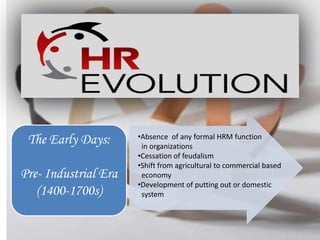
The Early Days:
Pre- Industrial Era
(1400-1700s)
•Absence of any formal HRM function
in organizations
•Cessation of feudalism
•Shift from agricultural to commercial based
economy
•Development of putting out or domestic
system
• Shift from agricultural society to industrial
society.
• Replaced human effort and workers skill by
machines.
• Autocratic rule was followed.
• Total neglect of the human effort.
Industrial
Revolution and the
Factory System
• Set the stage for partnership and business
enterprise.
• To improve the production size and
technology.
• No improvement in human resource
management.
The emergence of
Modern Corporation
and Managerial
Capitalism
• Science, not the rule of thumb & Co-
operation not individualism .
• Maximum output, in place of restricted
output & Each worker gets compensated
according to their output.
• SM represented a new attitude towards
management & Functional Management
as a part of SM.
Scientific
Management,
Welfare Work &
Industrial
Psychology
• Scientific personnel administration and
centralizing.
• Labour turnover increased & Labour
shortage, increased wages and demand for
employees for war production.
• In UK and USA firms established personnel
departments in between 1920 & 1950.
• Unsystemised HRM practices.
World War 1 &
The emergence of
HRM as a
profession
(1911-1914)
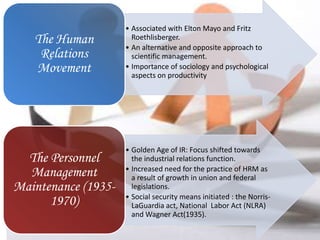
• Associated with Elton Mayo and Fritz
Roethlisberger.
• An alternative and opposite approach to
scientific management.
• Importance of sociology and psychological
aspects on productivity
The Human
Relations
Movement
• Golden Age of IR: Focus shifted towards
the industrial relations function.
• Increased need for the practice of HRM as
a result of growth in union and federal
legislations.
• Social security means initiated : the Norris-
LaGuardia act, National Labor Act (NLRA)
and Wagner Act(1935).
The Personnel
Management
Maintenance (1935-
1970)
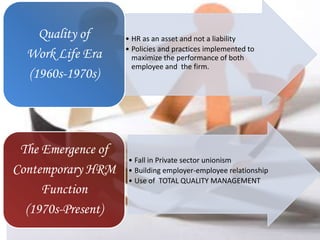
• HR as an asset and not a liability
• Policies and practices implemented to
maximize the performance of both
employee and the firm.
Quality of
Work Life Era
(1960s-1970s)
• Fall in Private sector unionism
• Building employer-employee relationship
• Use of TOTAL QUALITY MANAGEMENT
The Emergence of
Contemporary HRM
Function
(1970s-Present)
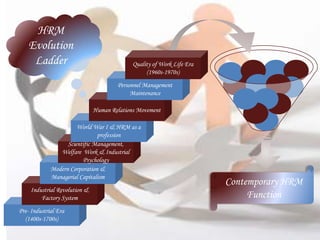
Pre- Industrial Era
(1400s-1700s)
Industrial Revolution &
Factory System
Modern Corporation &
Managerial Capitalism
Scientific Management,
Welfare Work & Industrial
Psychology
World War I & HRM as a
profession
Human Relations Movement
Personnel Management
Maintenance
Quality of Work Life Era
(1960s-1970s)
Contemporary HRM
Function
HRM
Evolution
Ladder
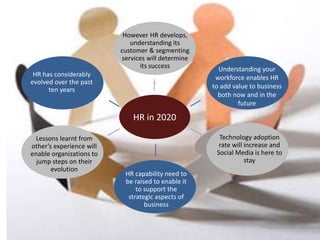
HR in 2020
However HR develops,
understanding its
customer & segmenting
services will determine
its success Understanding your
workforce enables HR
to add value to business
both now and in the
future
Technology adoption
rate will increase and
Social Media is here to
stay
HR capability need to
be raised to enable it
to support the
strategic aspects of
business
Lessons learnt from
other’s experience will
enable organizations to
jump steps on their
evolution
HR has considerably
evolved over the past
ten years
Thank
You!

Evolution of hr

  • 1.
  • 2.
    The Early Days: Pre-Industrial Era (1400-1700s) •Absence of any formal HRM function in organizations •Cessation of feudalism •Shift from agricultural to commercial based economy •Development of putting out or domestic system
  • 3.
    • Shift fromagricultural society to industrial society. • Replaced human effort and workers skill by machines. • Autocratic rule was followed. • Total neglect of the human effort. Industrial Revolution and the Factory System • Set the stage for partnership and business enterprise. • To improve the production size and technology. • No improvement in human resource management. The emergence of Modern Corporation and Managerial Capitalism
  • 4.
    • Science, notthe rule of thumb & Co- operation not individualism . • Maximum output, in place of restricted output & Each worker gets compensated according to their output. • SM represented a new attitude towards management & Functional Management as a part of SM. Scientific Management, Welfare Work & Industrial Psychology • Scientific personnel administration and centralizing. • Labour turnover increased & Labour shortage, increased wages and demand for employees for war production. • In UK and USA firms established personnel departments in between 1920 & 1950. • Unsystemised HRM practices. World War 1 & The emergence of HRM as a profession (1911-1914)
  • 5.
    • Associated withElton Mayo and Fritz Roethlisberger. • An alternative and opposite approach to scientific management. • Importance of sociology and psychological aspects on productivity The Human Relations Movement • Golden Age of IR: Focus shifted towards the industrial relations function. • Increased need for the practice of HRM as a result of growth in union and federal legislations. • Social security means initiated : the Norris- LaGuardia act, National Labor Act (NLRA) and Wagner Act(1935). The Personnel Management Maintenance (1935- 1970)
  • 6.
    • HR asan asset and not a liability • Policies and practices implemented to maximize the performance of both employee and the firm. Quality of Work Life Era (1960s-1970s) • Fall in Private sector unionism • Building employer-employee relationship • Use of TOTAL QUALITY MANAGEMENT The Emergence of Contemporary HRM Function (1970s-Present)
  • 7.
    Pre- Industrial Era (1400s-1700s) IndustrialRevolution & Factory System Modern Corporation & Managerial Capitalism Scientific Management, Welfare Work & Industrial Psychology World War I & HRM as a profession Human Relations Movement Personnel Management Maintenance Quality of Work Life Era (1960s-1970s) Contemporary HRM Function HRM Evolution Ladder
  • 8.
    HR in 2020 HoweverHR develops, understanding its customer & segmenting services will determine its success Understanding your workforce enables HR to add value to business both now and in the future Technology adoption rate will increase and Social Media is here to stay HR capability need to be raised to enable it to support the strategic aspects of business Lessons learnt from other’s experience will enable organizations to jump steps on their evolution HR has considerably evolved over the past ten years
  • 9.