1
CLINICAL ASSESSMENT OF MTP PATIENT
DR ALKA MUKHERJEE
MBBS DGO FICOG FICMCH PGDCR PGDMLS
MA(PSY)
DR ALKA MUKHERJEE
MBBS DGO FICOG FICMCH PGDCR PGDMLS MA(PSY)
Director & Consultant At Mukherjee Multispecialty
Hospital
MMC ACCREDITATED SPEAKER
MMC OBSERVER MMC MAO – 01017 / 2016
Present Position
 Director of Mukherjee Multispecialty Hospital
 Hon.Secretary INTERNATIONAL COUNCIL FOR HUMAN
RIGHTS
 Hon.Secretary NARCHI NAGPUR CHAPTER (2018-2020)
 Hon.Secretary AMWN (2018-2021)
 Hon.Secretary ISOPARB (2019-2021)
 Organizing secretary AMWICON – 2019
 Life member, IMA, NOGS, NARCHI, AMWN &
Menopause Society, India, Indian medico-legal &
ethics association(IMLEA), ISOPARB, HUMAN RIGHTS
 Founder Member of South Rapid Action Group,
Nagpur.
 On Board of Super Specialty, GMC, IGGMC, AIIMS
Nagpur, NKPSIMS, ESIS and Treasury, Nagpur for “
WOMEN SEXUAL HARASSMENT COMMITTEE.”
mukherjeehospital@yahoo.com
www.mukherjeehospital.com
https://www.facebook.com/
Mukherjee Multispeciality
https://www.instagram.com/
Achievement
 Winner of NOGS GOLD MEDAL – 2017-18
 Winner of BEST COUPLE AWARD in Social
Work - 2014
 VIDARBHA RATNA PURASKAR - 2019
Past Position
 Vice President of NOGS(2016-2017)
 Organizing joint secretary ENDO-GYN
 Vice President IMA Nagpur (2017-2018)
 Organizing joint secretary ENDO-GYN 2019
2DR ALKA MUKHERJEE
CLINICAL ASSESSMENT
• Clinical assessment for suitability to undergo termination
of pregnancy is critical to avoid complications while
providing abortion services. The assessment helps to
identify the woman who needs referral for the procedure
at a higher level of facility, which is better equipped and
can handle complications, if any.
• Clinical assessment provides the following information:
• Confirmation of pregnancy
• Exact period of gestation
• Woman’s general health condition
• Associated gynaecological disorders and infection
• Associated medical problems
3DR ALKA MUKHERJEE
COMPONENTS OF CLINICAL ASSESSMENT
• (A) History taking
• (B) Physical examination
• (C) Pelvic examination
• (D) Laboratory investigations
• Note: The assessment should preferably be
conducted in a place where the woman and the
provider cannot be seen or heard by others.
4DR ALKA MUKHERJEE
HISTORY TAKING
• The following should be included in the history:
• Personal details: age, religion, address
• Menstrual history: length and duration of cycle, flow (excess
or normal), last menstrual period (LMP)
• Obstetric history: parity, live births, abortions (induced and
spontaneous), previous caesarean
• section (if any), last child birth/abortion
• History of any interference/drugs taken during this pregnancy
to attempt termination
• Contraceptive history: type of contraceptive used, how long
• Status of tetanus immunisation: last dose received
• Psychosocial assessment to assess family support
• Sexual/domestic violence
5DR ALKA MUKHERJEE
• Medical history should include:
• hypertension
• heart disease
• diabetes mellitus
• epilepsy
• asthma
• drug allergies
• bleeding disorders
• renal disease
• thyroid disease
6DR ALKA MUKHERJEE
• Physical examination
• General examination
• Check pulse, blood pressure and temperature, if
indicated
• Look for pallor/icterus
• Systemic examination
• Examine chest and cardiovascular system
• Examine the abdomen for abdominal mass, scars and
distension. Also check for rigidity and rebound
tenderness
7DR ALKA MUKHERJEE
• Pelvic examination
• Before starting the pelvic examination, inform the woman and
take verbal consent from her. Also, ensure: Privacy is
maintained Equipment is ready Woman has emptied her
bladder
• Examination of external genitalia
• Inspect the external genitalia: labia (majora, minora) and
introitus for redness, ulcer, growth, warts, swelling and
discharge
• Speculum examination
• lInspect the vagina and cervix for ulcer, foul smelling discharge
and bleeding if there is an erosion, cervix bleeds on touch, or
a growth, investigate further or refer appropriately
• If there is any evidence of infection, perform the procedure
under antibiotic cover
8DR ALKA MUKHERJEE
BIMANUAL EXAMINATION
• This is one of the critical steps, helpful in comparing the size
of the uterus to the period of amenorrhea. During bimanual
examination:
• Feel the cervix for consistency and tenderness on movement.
A soft cervix is indicative of pregnancy. Tenderness on
cervical movement is indicative of ectopic pregnancy
• Feel the position of the uterus (whether anteverted or
retroverted) and assess the size of the uterus. Also feel for
shape, consistency and mobility of the uterus
• Feel through the fornices. Fullness or tenderness in the
fornices is indicative of pelvic inflammatory disease (PID) or
ectopic pregnancy
9DR ALKA MUKHERJEE
CALCULATING GESTATION AGE:
• LMP known: calculate the number of days since the last
menstrual period and divide by 7.
• This will give the gestation age in weeks. For example: 49 days
from LMP will mean 7 weeks gestation age
• LMP not known or conception in lactational amenorrhea:
gestation age estimated by pelvic bimanual examination
• Establishing the period of gestation may be difficult in cases
where:
• 1. The woman does not remember the date of her last
menstrual period
• 2. Conception occurred during lactational amenorrhea
• 3. Wrong dates were provided intentionally by the woman
• 4. Missed or incomplete abortions
10DR ALKA MUKHERJEE
Caution should be exercised in the
following situations:
Uterine Size Possible Conditions Line of Action
Bigger than expected,
irregular and firm
Presence of fibroids
with pregnancy
USG, if available, or
refer to an appropriate
centre
Smaller than expected Wrong dates l Non
pregnant uterus l
Ectopic pregnancy l
Products of conception
(POCs) partially
expelled as in a
spontaneous/incomple
te abortion
USG, if available, or
refer to an appropriate
centre
Bigger than expected
but has a smooth and
soft surface l
Molar pregnancy l
Multiple pregnancy l
Wrong dates
USG, if available, or
refer to an appropriate
centre
DR ALKA MUKHERJEE 11
ROLE OF ULTRASOUND EXAMINATION
• An ultrasound may be helpful for accurate dating when
there is a discrepancy in the size of the
• uterus by LMP and bimanual examination. However, this
test is not a mandatory requirement for the
• provision of MTP. Where it is available, it can also be
used to detect ectopic pregnancies along with
• quantitative βHCG measurements. Since it is an
obstetric USG, it must be done in accordance with the
• Pre-Conception Pre-Natal Diagnostic Techniques
(PCPNDT) Act.
12DR ALKA MUKHERJEE
LABORATORY INVESTIGATIONS
• Haemoglobin
• Urine for albumin and sugar
• Blood group/Rh
• Urine for pregnancy test with Nischay kit
(wherever required)
• In case of existing infections, samples should be
taken for culture for a final diagnosis of the type
of infection.23
13DR ALKA MUKHERJEE
MTP IN WOMEN WITH VARIOUS MEDICAL
CONDITIONS
• None of the conditions mentioned below is a
contraindication to the abortion procedure.
However,
• precautions need to be taken while performing
a procedure on women with these conditions. If
the
• facilities to handle these cases are not available,
refer to the next level of facility
14DR ALKA MUKHERJEE
• Anaemia
• Heart disease
• Asthma
• If very low haematocrit or haemoglobin,
be prepared to treat appropriately. In
casesof Hb < 7gm%, MTP should be done
at a higher centre with appropriate
facilities.
• Refer to an appropriate higher facility.
• PGE1 analogues should be used in case of
post-abortal atony, excessive bleeding or
cervical priming
• The woman should be stable and not
have an acute asthmatic attack prior to
the procedure
DR ALKA MUKHERJEE 15
MTP IN WOMEN WITH VARIOUS MEDICAL
CONDITIONS
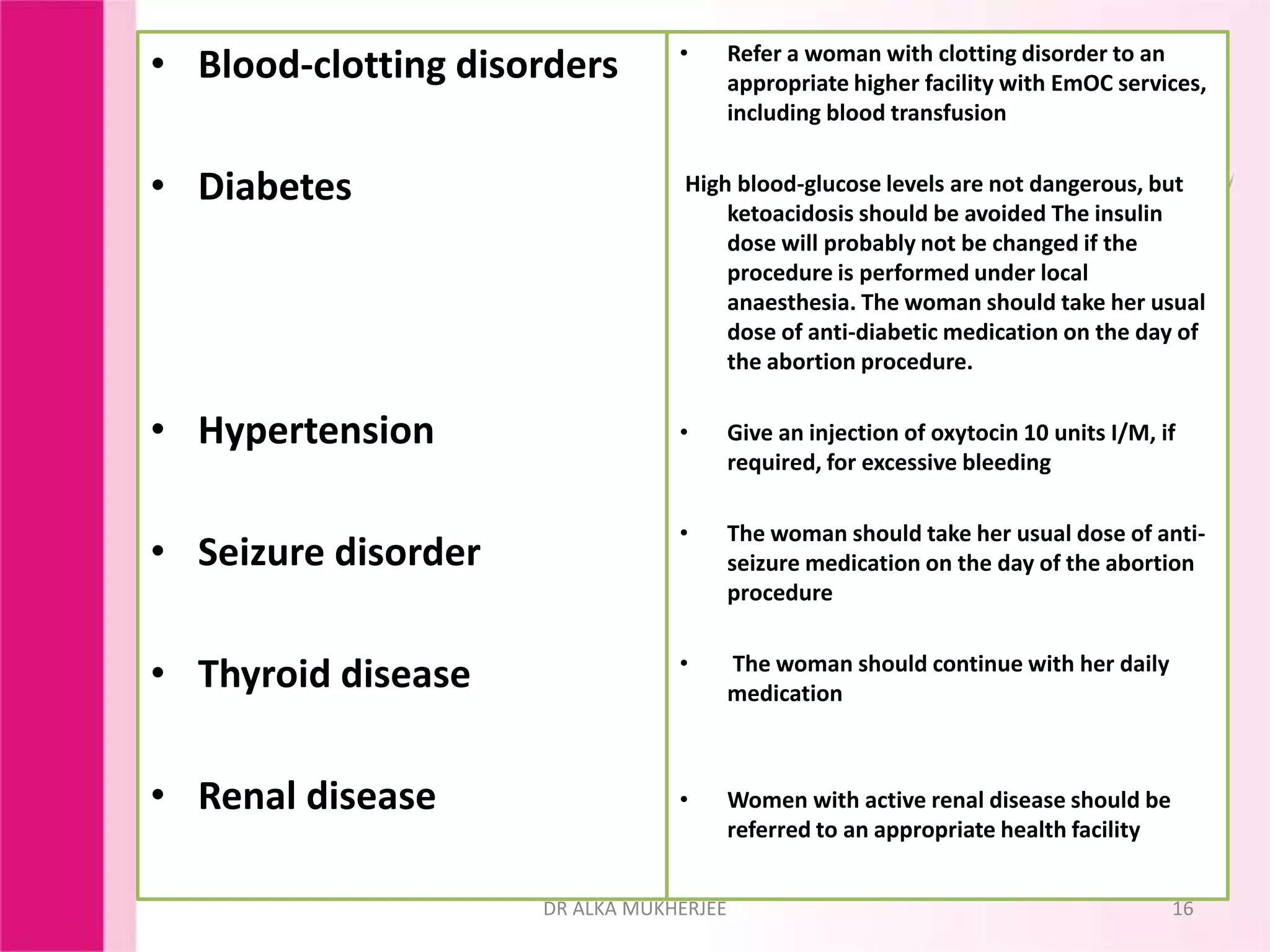
• Blood-clotting disorders
• Diabetes
• Hypertension
• Seizure disorder
• Thyroid disease
• Renal disease
• Refer a woman with clotting disorder to an
appropriate higher facility with EmOC services,
including blood transfusion
High blood-glucose levels are not dangerous, but
ketoacidosis should be avoided The insulin
dose will probably not be changed if the
procedure is performed under local
anaesthesia. The woman should take her usual
dose of anti-diabetic medication on the day of
the abortion procedure.
• Give an injection of oxytocin 10 units I/M, if
required, for excessive bleeding
• The woman should take her usual dose of anti-
seizure medication on the day of the abortion
procedure
• The woman should continue with her daily
medication
• Women with active renal disease should be
referred to an appropriate health facility
DR ALKA MUKHERJEE 16
17DR ALKA MUKHERJEE

clinical assessment BY DR ALKA MUKHERJEE NAGPUR M.S. INDIA

  • 1.
    1 CLINICAL ASSESSMENT OFMTP PATIENT DR ALKA MUKHERJEE MBBS DGO FICOG FICMCH PGDCR PGDMLS MA(PSY)
  • 2.
    DR ALKA MUKHERJEE MBBSDGO FICOG FICMCH PGDCR PGDMLS MA(PSY) Director & Consultant At Mukherjee Multispecialty Hospital MMC ACCREDITATED SPEAKER MMC OBSERVER MMC MAO – 01017 / 2016 Present Position  Director of Mukherjee Multispecialty Hospital  Hon.Secretary INTERNATIONAL COUNCIL FOR HUMAN RIGHTS  Hon.Secretary NARCHI NAGPUR CHAPTER (2018-2020)  Hon.Secretary AMWN (2018-2021)  Hon.Secretary ISOPARB (2019-2021)  Organizing secretary AMWICON – 2019  Life member, IMA, NOGS, NARCHI, AMWN & Menopause Society, India, Indian medico-legal & ethics association(IMLEA), ISOPARB, HUMAN RIGHTS  Founder Member of South Rapid Action Group, Nagpur.  On Board of Super Specialty, GMC, IGGMC, AIIMS Nagpur, NKPSIMS, ESIS and Treasury, Nagpur for “ WOMEN SEXUAL HARASSMENT COMMITTEE.” mukherjeehospital@yahoo.com www.mukherjeehospital.com https://www.facebook.com/ Mukherjee Multispeciality https://www.instagram.com/ Achievement  Winner of NOGS GOLD MEDAL – 2017-18  Winner of BEST COUPLE AWARD in Social Work - 2014  VIDARBHA RATNA PURASKAR - 2019 Past Position  Vice President of NOGS(2016-2017)  Organizing joint secretary ENDO-GYN  Vice President IMA Nagpur (2017-2018)  Organizing joint secretary ENDO-GYN 2019 2DR ALKA MUKHERJEE
  • 3.
    CLINICAL ASSESSMENT • Clinicalassessment for suitability to undergo termination of pregnancy is critical to avoid complications while providing abortion services. The assessment helps to identify the woman who needs referral for the procedure at a higher level of facility, which is better equipped and can handle complications, if any. • Clinical assessment provides the following information: • Confirmation of pregnancy • Exact period of gestation • Woman’s general health condition • Associated gynaecological disorders and infection • Associated medical problems 3DR ALKA MUKHERJEE
  • 4.
    COMPONENTS OF CLINICALASSESSMENT • (A) History taking • (B) Physical examination • (C) Pelvic examination • (D) Laboratory investigations • Note: The assessment should preferably be conducted in a place where the woman and the provider cannot be seen or heard by others. 4DR ALKA MUKHERJEE
  • 5.
    HISTORY TAKING • Thefollowing should be included in the history: • Personal details: age, religion, address • Menstrual history: length and duration of cycle, flow (excess or normal), last menstrual period (LMP) • Obstetric history: parity, live births, abortions (induced and spontaneous), previous caesarean • section (if any), last child birth/abortion • History of any interference/drugs taken during this pregnancy to attempt termination • Contraceptive history: type of contraceptive used, how long • Status of tetanus immunisation: last dose received • Psychosocial assessment to assess family support • Sexual/domestic violence 5DR ALKA MUKHERJEE
  • 6.
    • Medical historyshould include: • hypertension • heart disease • diabetes mellitus • epilepsy • asthma • drug allergies • bleeding disorders • renal disease • thyroid disease 6DR ALKA MUKHERJEE
  • 7.
    • Physical examination •General examination • Check pulse, blood pressure and temperature, if indicated • Look for pallor/icterus • Systemic examination • Examine chest and cardiovascular system • Examine the abdomen for abdominal mass, scars and distension. Also check for rigidity and rebound tenderness 7DR ALKA MUKHERJEE
  • 8.
    • Pelvic examination •Before starting the pelvic examination, inform the woman and take verbal consent from her. Also, ensure: Privacy is maintained Equipment is ready Woman has emptied her bladder • Examination of external genitalia • Inspect the external genitalia: labia (majora, minora) and introitus for redness, ulcer, growth, warts, swelling and discharge • Speculum examination • lInspect the vagina and cervix for ulcer, foul smelling discharge and bleeding if there is an erosion, cervix bleeds on touch, or a growth, investigate further or refer appropriately • If there is any evidence of infection, perform the procedure under antibiotic cover 8DR ALKA MUKHERJEE
  • 9.
    BIMANUAL EXAMINATION • Thisis one of the critical steps, helpful in comparing the size of the uterus to the period of amenorrhea. During bimanual examination: • Feel the cervix for consistency and tenderness on movement. A soft cervix is indicative of pregnancy. Tenderness on cervical movement is indicative of ectopic pregnancy • Feel the position of the uterus (whether anteverted or retroverted) and assess the size of the uterus. Also feel for shape, consistency and mobility of the uterus • Feel through the fornices. Fullness or tenderness in the fornices is indicative of pelvic inflammatory disease (PID) or ectopic pregnancy 9DR ALKA MUKHERJEE
  • 10.
    CALCULATING GESTATION AGE: •LMP known: calculate the number of days since the last menstrual period and divide by 7. • This will give the gestation age in weeks. For example: 49 days from LMP will mean 7 weeks gestation age • LMP not known or conception in lactational amenorrhea: gestation age estimated by pelvic bimanual examination • Establishing the period of gestation may be difficult in cases where: • 1. The woman does not remember the date of her last menstrual period • 2. Conception occurred during lactational amenorrhea • 3. Wrong dates were provided intentionally by the woman • 4. Missed or incomplete abortions 10DR ALKA MUKHERJEE
  • 11.
    Caution should beexercised in the following situations: Uterine Size Possible Conditions Line of Action Bigger than expected, irregular and firm Presence of fibroids with pregnancy USG, if available, or refer to an appropriate centre Smaller than expected Wrong dates l Non pregnant uterus l Ectopic pregnancy l Products of conception (POCs) partially expelled as in a spontaneous/incomple te abortion USG, if available, or refer to an appropriate centre Bigger than expected but has a smooth and soft surface l Molar pregnancy l Multiple pregnancy l Wrong dates USG, if available, or refer to an appropriate centre DR ALKA MUKHERJEE 11
  • 12.
    ROLE OF ULTRASOUNDEXAMINATION • An ultrasound may be helpful for accurate dating when there is a discrepancy in the size of the • uterus by LMP and bimanual examination. However, this test is not a mandatory requirement for the • provision of MTP. Where it is available, it can also be used to detect ectopic pregnancies along with • quantitative βHCG measurements. Since it is an obstetric USG, it must be done in accordance with the • Pre-Conception Pre-Natal Diagnostic Techniques (PCPNDT) Act. 12DR ALKA MUKHERJEE
  • 13.
    LABORATORY INVESTIGATIONS • Haemoglobin •Urine for albumin and sugar • Blood group/Rh • Urine for pregnancy test with Nischay kit (wherever required) • In case of existing infections, samples should be taken for culture for a final diagnosis of the type of infection.23 13DR ALKA MUKHERJEE
  • 14.
    MTP IN WOMENWITH VARIOUS MEDICAL CONDITIONS • None of the conditions mentioned below is a contraindication to the abortion procedure. However, • precautions need to be taken while performing a procedure on women with these conditions. If the • facilities to handle these cases are not available, refer to the next level of facility 14DR ALKA MUKHERJEE
  • 15.
    • Anaemia • Heartdisease • Asthma • If very low haematocrit or haemoglobin, be prepared to treat appropriately. In casesof Hb < 7gm%, MTP should be done at a higher centre with appropriate facilities. • Refer to an appropriate higher facility. • PGE1 analogues should be used in case of post-abortal atony, excessive bleeding or cervical priming • The woman should be stable and not have an acute asthmatic attack prior to the procedure DR ALKA MUKHERJEE 15 MTP IN WOMEN WITH VARIOUS MEDICAL CONDITIONS
  • 16.
    • Blood-clotting disorders •Diabetes • Hypertension • Seizure disorder • Thyroid disease • Renal disease • Refer a woman with clotting disorder to an appropriate higher facility with EmOC services, including blood transfusion High blood-glucose levels are not dangerous, but ketoacidosis should be avoided The insulin dose will probably not be changed if the procedure is performed under local anaesthesia. The woman should take her usual dose of anti-diabetic medication on the day of the abortion procedure. • Give an injection of oxytocin 10 units I/M, if required, for excessive bleeding • The woman should take her usual dose of anti- seizure medication on the day of the abortion procedure • The woman should continue with her daily medication • Women with active renal disease should be referred to an appropriate health facility DR ALKA MUKHERJEE 16
  • 17.