Chapter 3
Healey, Race, Ethnicity, Gender, and Class 8e. © SAGE
Publishing, 2018.
Prejudice and Discrimination
2
2
Individual prejudice is a set of feelings or emotions that people
attach to groups, including their own
For example, someone may have a negative view of the Irish
and call them “drunks”
This is a generalized association with an entire group
Several psychological and social-psychological research
traditions focus on the emotional or affective aspect of
prejudice
The scapegoat hypothesis and the theory of the authoritarian
personality
Healey, Race, Ethnicity, Gender, and Class 8e. © SAGE
Publishing, 2018.
Prejudice
3
Instructor’s Note: Ask students about a time in which they
experienced prejudice.
3
The Scapegoat Hypothesis holds that people sometimes express
their frustrations against substitute targets
When the substitutes are other groups, prejudice increases
Researchers have used this theory to explain a variety of
political, social, and economic events
For example, the rise of the Nazi Party in Germany in the 1930s
Healey, Race, Ethnicity, Gender, and Class 8e. © SAGE
Publishing, 2018.
Prejudice
4
Instructor’s Note: Ask students to provide another example.
4
The theory of the authoritarian personality links prejudice to
childhood experiences with stern, severe parents
On the surface, children of authoritarian families respect and
love their parents
Internally, they resent and fear their severe and distant parents
Prejudice provides people with authoritarian personaliti es a way
of coping with their conflicted feelings
Healey, Race, Ethnicity, Gender, and Class 8e. © SAGE
Publishing, 2018.
Prejudice
5
The cognitive dimension of prejudice includes stereotypes about
people in other groups
Stereotypes are over-simplified generalizations that are said to
apply to all group members
For example, all feminists, Christians, or Southerners
Selective perception is the tendency to see only what one
expects to see
Healey, Race, Ethnicity, Gender, and Class 8e. © SAGE
Publishing, 2018.
Prejudice
6
Instructor’s Note: What is an example of selective perception?
6
Individual prejudice has an affective dimension in addition to
the cognitive
Robert Merton (1968) makes this distinction between
dimensions dramatically
Merton analyzed stereotypical perceptions of Abraham Lincoln,
Jews, and Japanese
The three “stereotypes” are identical in content but different in
emotional shading
Healey, Race, Ethnicity, Gender, and Class 8e. © SAGE
Publishing, 2018.
Prejudice
7
Instructor’s Note: What is meant by emotional shading?
7
The affective and cognitive dimensions of prejudice vary not
only by race and ethnicity but also by gender and class
For example, the stereotypes and feelings attached to Black men
differ from those attached to Black women
Feelings about lower-class Mexican Americans are different
from those evoked by upper-class members of the same group
Healey, Race, Ethnicity, Gender, and Class 8e. © SAGE
Publishing, 2018.
Prejudice
8
Every form of prejudice started at some specific point in history
If we go back far enough, we can always find some instance in
which one group successfully dominates or eliminates a
perceived threat by another group
Group competition is associated with the emergence of
prejudice
Typically, prejudice doesn’t cause group competition, it results
from it
Healey, Race, Ethnicity, Gender, and Class 8e. © SAGE
Publishing, 2018.
Prejudice
9
Prejudice functions to mobilize emotional energy for conflict,
justify attack, and rationalize structures of domination
The relationship between prejudice and competition has been
demonstrated in a variety of settings and situations ranging
from labor strikes to international war to psychology labs
To illustrate, we will examine a classic experiment known as
Robber’s Cave
Healey, Race, Ethnicity, Gender, and Class 8e. © SAGE
Publishing, 2018.
Prejudice
10
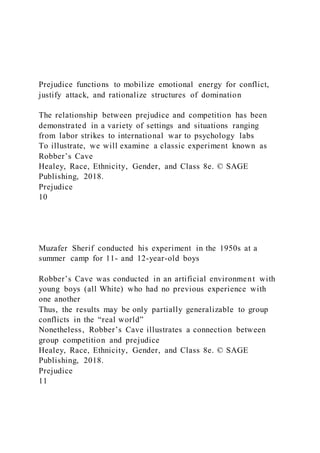
Muzafer Sherif conducted his experiment in the 1950s at a
summer camp for 11- and 12-year-old boys
Robber’s Cave was conducted in an artificial environment with
young boys (all White) who had no previous experience with
one another
Thus, the results may be only partially generalizable to group
conflicts in the “real world”
Nonetheless, Robber’s Cave illustrates a connection between
group competition and prejudice
Healey, Race, Ethnicity, Gender, and Class 8e. © SAGE
Publishing, 2018.
Prejudice
11
Instructor’s Note: What does generalizability mean and why is
it important in research?
11
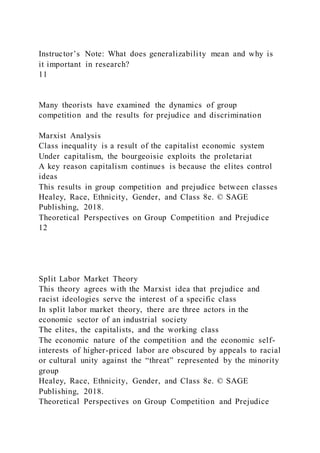
Many theorists have examined the dynamics of group
competition and the results for prejudice and discrimination
Marxist Analysis
Class inequality is a result of the capitalist economic system
Under capitalism, the bourgeoisie exploits the proletariat
A key reason capitalism continues is because the elites control
ideas
This results in group competition and prejudice between classes
Healey, Race, Ethnicity, Gender, and Class 8e. © SAGE
Publishing, 2018.
Theoretical Perspectives on Group Competition and Prejudice
12
Split Labor Market Theory
This theory agrees with the Marxist idea that prejudice and
racist ideologies serve the interest of a specific class
In split labor market theory, there are three actors in the
economic sector of an industrial society
The elites, the capitalists, and the working class
The economic nature of the competition and the economic self-
interests of higher-priced labor are obscured by appeals to racial
or cultural unity against the “threat” represented by the minority
group
Healey, Race, Ethnicity, Gender, and Class 8e. © SAGE
Publishing, 2018.
Theoretical Perspectives on Group Competition and Prejudice
13
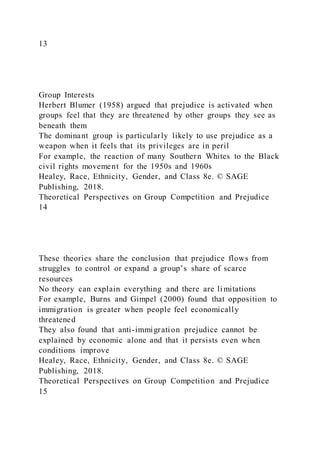
Group Interests
Herbert Blumer (1958) argued that prejudice is activated when
groups feel that they are threatened by other groups they see as
beneath them
The dominant group is particularly likely to use prejudice as a
weapon when it feels that its privileges are in peril
For example, the reaction of many Southern Whites to the Black
civil rights movement for the 1950s and 1960s
Healey, Race, Ethnicity, Gender, and Class 8e. © SAGE
Publishing, 2018.
Theoretical Perspectives on Group Competition and Prejudice
14
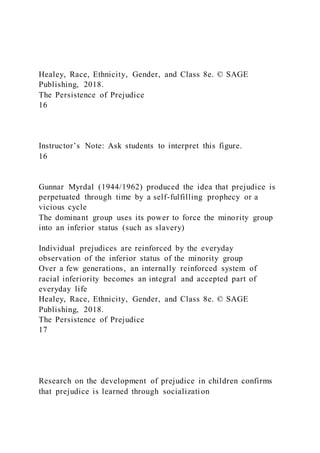
These theories share the conclusion that prejudice flows from
struggles to control or expand a group’s share of scarce
resources
No theory can explain everything and there are limitations
For example, Burns and Gimpel (2000) found that opposition to
immigration is greater when people feel economically
threatened
They also found that anti-immigration prejudice cannot be
explained by economic alone and that it persists even when
conditions improve
Healey, Race, Ethnicity, Gender, and Class 8e. © SAGE
Publishing, 2018.
Theoretical Perspectives on Group Competition and Prejudice
15
Healey, Race, Ethnicity, Gender, and Class 8e. © SAGE
Publishing, 2018.
The Persistence of Prejudice
16
Instructor’s Note: Ask students to interpret this figure.
16
Gunnar Myrdal (1944/1962) produced the idea that prejudice is
perpetuated through time by a self-fulfilling prophecy or a
vicious cycle
The dominant group uses its power to force the minority group
into an inferior status (such as slavery)
Individual prejudices are reinforced by the everyday
observation of the inferior status of the minority group
Over a few generations, an internally reinforced system of
racial inferiority becomes an integral and accepted part of
everyday life
Healey, Race, Ethnicity, Gender, and Class 8e. © SAGE
Publishing, 2018.
The Persistence of Prejudice
17
Research on the development of prejudice in children confirms
that prejudice is learned through socialization
This prejudice may be acquired through direct and indirect
socialization
By age 3 or younger, children recognize the significance of
racial groups
Healey, Race, Ethnicity, Gender, and Class 8e. © SAGE
Publishing, 2018.
The Persistence of Prejudice
18
Doyle and Aboud (1995) found that prejudice is highest for
younger children and decreases between kindergarten and the
third grade
This is related to increased awareness of racial similarities and
perspectives on race
Changing levels of prejudice in children may reflect an
interaction between children’s changing mental capacities and
their environment rather than a simple learning of racist cultural
values
Healey, Race, Ethnicity, Gender, and Class 8e. © SAGE
Publishing, 2018.
The Persistence of Prejudice
19
Further evidence for the cultural nature of prejudice is provided
by research on the concept of social distance
Social distance is the degree of intimacy that a person is willing
to accept in his or her relations with members of other groups
Research using social distance scales demonstrates that
Americans rank other groups in similar ways across time period
and geographic location
Healey, Race, Ethnicity, Gender, and Class 8e. © SAGE
Publishing, 2018.
The Persistence of Prejudice
20
A sense of social distance is part of the cultural package of
intergroup prejudices we acquire from socialization
Socialization is the process of psychological and social
development by which a person learns his or her culture
It is important to note the importanc e of the social situation in
which attitudes are expressed and behavior occurs
What people think and what they do is not always the same
Robert LaPiere’s (1934) work exemplifies this
Healey, Race, Ethnicity, Gender, and Class 8e. © SAGE
Publishing, 2018.
The Persistence of Prejudice
21
Many social scientists argue that racism has not declined, but
has evolved
This new form of prejudice refers to modern racism, color -blind
racism, and symbolic racism
Prejudice can take forms that seem positive such as
“affectionate paternalism”
People may treat an adult with “special” care suggesting they
are weaker or less competent
Healey, Race, Ethnicity, Gender, and Class 8e. © SAGE
Publishing, 2018.
Recent Trends: Traditional Prejudice and Modern Racism
22
Instructor’s Note: What is color-blind racism?
22
Some of the strongest evidence that traditional prejudice is
declining comes from public opinion research
The figure on the next slide shows data gathered from White
Americans who participated in several research studies over a
64-year period
The poll shows that prejudice has not vanished
Healey, Race, Ethnicity, Gender, and Class 8e. © SAGE
Publishing, 2018.
Recent Trends: Traditional Prejudice and Modern Racism
23
Healey, Race, Ethnicity, Gender, and Class 8e. © SAGE
Publishing, 2018.
Recent Trends: Traditional Prejudice and Modern Racism
24
One possible cause of declining prejudice is education
Education is said to broaden perspectives and encourage a more
sophisticated view of human affairs
The figure on the next slide demonstrates the role that education
may play in decreased prejudice
It is important to remember that correlation does not equal
causation
Education and prejudice may be statistically associated, but this
does not prove that one is causing change in the other
Healey, Race, Ethnicity, Gender, and Class 8e. © SAGE
Publishing, 2018.
Recent Trends: Traditional Prejudice and Modern Racism
25
Healey, Race, Ethnicity, Gender, and Class 8e. © SAGE
Publishing, 2018.
Recent Trends: Traditional Prejudice and Modern Racism
26
Similar to education, contact and increased communication
between groups has often been suggested as remedies for
prejudice
Contact between groups is not an automatic antidote for
prejudice
The equal status contact hypothesis argues that, under certain
conditions, cooperative contacts between groups will tend to
reduce prejudice
Healey, Race, Ethnicity, Gender, and Class 8e. © SAGE
Publishing, 2018.
Recent Trends: Traditional Prejudice and Modern Racism
27
Equal status contact hypothesis specifies four conditions under
which intergroup contact can reduce prejudice:
Equal status
Common goals
They must interact intensively in noncompetitive, cooperative
tasks
Have the active endorsement of authority figures
Healey, Race, Ethnicity, Gender, and Class 8e. © SAGE
Publishing, 2018.
Recent Trends: Traditional Prejudice and Modern Racism
28
Modern racism rationalizes the status quo, thereby not just
permitting inequality, but reproducing it
Modern racists believe:
They are not prejudiced
Discrimination in American society no longer exists
Efforts to reduce inequality are unjustified and unfair because
inequality no longer exists
Any remaining racial or ethnic inequality is the fault of the
members of the minority group
Healey, Race, Ethnicity, Gender, and Class 8e. © SAGE
Publishing, 2018.
Modern Racism: The New Face of Prejudice?
29
Instructor’s Note: Do you know a modern racist?
29
Hate crimes are attacks or other acts of intimidation motivated
by the group membership of the victim or victims
Targets increasingly include the gay community in addition to
racial, ethnic, and religious minorities
Not all hate crimes are reported
Contemporary White supremacist groups commonly use modern
communications technology
Healey, Race, Ethnicity, Gender, and Class 8e. © SAGE
Publishing, 2018.
Hate Crimes
30
Instructor’s Note: Why aren’t all hate crimes reported?
30
Healey, Race, Ethnicity, Gender, and Class 8e. © SAGE
Publishing, 2018.
Hate Crimes
31
Healey, Race, Ethnicity, Gender, and Class 8e. © SAGE
Publishing, 2018.
Hate Crimes
32
Hate crimes are often fueled by:
Perceived threats, frustration, fear, anger, and scapegoating
An undeserved rise in the status of minority groups
Fear of job loss, decreased income, deteriorated neighborhoods,
and inferior schools
The idea that many hate crimes involve scapegoating is
supported by the spontaneous, unplanned, and highly emotional
nature of these crimes
Healey, Race, Ethnicity, Gender, and Class 8e. © SAGE
Publishing, 2018.
Hate Crimes
33
Prejudice is more a result of group competition, rather than a
cause
Personality-centered prejudice is difficult to reduce and likely
impossible to eliminate
Culture-based or “traditional” prejudice differs not in intensity
but in the extent to which it is resistant to change
It is easier for a person to unlearn prejudice through education
and contact with members of other groups
Healey, Race, Ethnicity, Gender, and Class 8e. © SAGE
Publishing, 2018.
The Sociology of Prejudice
34
The reduction of intergroup conflict for societal resources by
reducing inequities in the distribution of resources and
opportunities can prove most beneficial for reducing stereotypes
and negative attitudes
Reducing prejudice will not necessarily change the situation of
minority groups
Individual prejudice and discrimination are not the same as
ideological racism and institutional discrimination
Healey, Race, Ethnicity, Gender, and Class 8e. © SAGE
Publishing, 2018.
The Sociology of Prejudice
35
Chapter 3
Healey, Race, Ethnicity, Gender, and Class 8e. © SAGE
Publishing, 2018.
Prejudice and Discrimination
2
2
Individual prejudice is a set of feelings or emotions that people
attach to groups, including their own
For example, someone may have a negative view of the Irish
and call them “drunks”
This is a generalized association with an entire group
Several psychological and social-psychological research
traditions focus on the emotional or affective aspect of
prejudice
The scapegoat hypothesis and the theory of the authoritarian
personality
Healey, Race, Ethnicity, Gender, and Class 8e. © SAGE
Publishing, 2018.
Prejudice
3
Instructor’s Note: Ask students about a time in which they
experienced prejudice.
3
The Scapegoat Hypothesis holds that people sometimes express
their frustrations against substitute targets
When the substitutes are other groups, prejudice increases
Researchers have used this theory to explain a variety of
political, social, and economic events
For example, the rise of the Nazi Party in Germany in the 1930s
Healey, Race, Ethnicity, Gender, and Class 8e. © SAGE
Publishing, 2018.
Prejudice
4
Instructor’s Note: Ask students to provide another example.
4
The theory of the authoritarian personality links prejudice to
childhood experiences with stern, severe parents
On the surface, children of authoritarian families respect and
love their parents
Internally, they resent and fear their severe and distant parents
Prejudice provides people with authoritarian personalities a way
of coping with their conflicted feelings
Healey, Race, Ethnicity, Gender, and Class 8e. © SAGE
Publishing, 2018.
Prejudice
5
The cognitive dimension of prejudice includes stereotypes about
people in other groups
Stereotypes are over-simplified generalizations that are said to
apply to all group members
For example, all feminists, Christians, or Southerners
Selective perception is the tendency to see only what one
expects to see
Healey, Race, Ethnicity, Gender, and Class 8e. © SAGE
Publishing, 2018.
Prejudice
6
Instructor’s Note: What is an example of selective perception?
6
Individual prejudice has an affective dimension in addition to
the cognitive
Robert Merton (1968) makes this distinction between
dimensions dramatically
Merton analyzed stereotypical perceptions of Abraham Lincoln,
Jews, and Japanese
The three “stereotypes” are identical in content but different in
emotional shading
Healey, Race, Ethnicity, Gender, and Class 8e. © SAGE
Publishing, 2018.
Prejudice
7
Instructor’s Note: What is meant by emotional shading?
7
The affective and cognitive dimensions of prejudice vary not
only by race and ethnicity but also by gender and class
For example, the stereotypes and feelings attached to Black men
differ from those attached to Black women
Feelings about lower-class Mexican Americans are different
from those evoked by upper-class members of the same group
Healey, Race, Ethnicity, Gender, and Class 8e. © SAGE
Publishing, 2018.
Prejudice
8
Every form of prejudice started at some specific point in history
If we go back far enough, we can always find some instance in
which one group successfully dominates or eliminates a
perceived threat by another group
Group competition is associated with the emergence of
prejudice
Typically, prejudice doesn’t cause group competition, it results
from it
Healey, Race, Ethnicity, Gender, and Class 8e. © SAGE
Publishing, 2018.
Prejudice
9
Prejudice functions to mobilize emotional energy for conflict,
justify attack, and rationalize structures of domination
The relationship between prejudice and competition has been
demonstrated in a variety of settings and situations ranging
from labor strikes to international war to psychology labs
To illustrate, we will examine a classic experiment known as
Robber’s Cave
Healey, Race, Ethnicity, Gender, and Class 8e. © SAGE
Publishing, 2018.
Prejudice
10
Muzafer Sherif conducted his experiment in the 1950s at a
summer camp for 11- and 12-year-old boys
Robber’s Cave was conducted in an artificial environment with
young boys (all White) who had no previous experience with
one another
Thus, the results may be only partially generalizable to group
conflicts in the “real world”
Nonetheless, Robber’s Cave illustrates a connection between
group competition and prejudice
Healey, Race, Ethnicity, Gender, and Class 8e. © SAGE
Publishing, 2018.
Prejudice
11
Instructor’s Note: What does generalizability mean and why is
it important in research?
11
Many theorists have examined the dynamics of group
competition and the results for prejudice and discrimination
Marxist Analysis
Class inequality is a result of the capitalist economic system
Under capitalism, the bourgeoisie exploits the proletariat
A key reason capitalism continues is because the elites control
ideas
This results in group competition and prejudice between classes
Healey, Race, Ethnicity, Gender, and Class 8e. © SAGE
Publishing, 2018.
Theoretical Perspectives on Group Competition and Prejudice
12
Split Labor Market Theory
This theory agrees with the Marxist idea that prejudice and
racist ideologies serve the interest of a specific class
In split labor market theory, there are three actors in the
economic sector of an industrial society
The elites, the capitalists, and the working class
The economic nature of the competition and the economic self-
interests of higher-priced labor are obscured by appeals to racial
or cultural unity against the “threat” represented by the minority
group
Healey, Race, Ethnicity, Gender, and Class 8e. © SAGE
Publishing, 2018.
Theoretical Perspectives on Group Competition and Prejudice
13
Group Interests
Herbert Blumer (1958) argued that prejudice is activated when
groups feel that they are threatened by other groups they see as
beneath them
The dominant group is particularly likely to use prejudice as a
weapon when it feels that its privileges are in peril
For example, the reaction of many Southern Whites to the Black
civil rights movement for the 1950s and 1960s
Healey, Race, Ethnicity, Gender, and Class 8e. © SAGE
Publishing, 2018.
Theoretical Perspectives on Group Competition and Prejudice
14
These theories share the conclusion that prejudice flows from
struggles to control or expand a group’s share of scarce
resources
No theory can explain everything and there are limitations
For example, Burns and Gimpel (2000) found that opposition to
immigration is greater when people feel economically
threatened
They also found that anti-immigration prejudice cannot be
explained by economic alone and that it persists even when
conditions improve
Healey, Race, Ethnicity, Gender, and Class 8e. © SAGE
Publishing, 2018.
Theoretical Perspectives on Group Competition and Prejudice
15
Healey, Race, Ethnicity, Gender, and Class 8e. © SAGE
Publishing, 2018.
The Persistence of Prejudice
16
Instructor’s Note: Ask students to interpret this figure.
16
Gunnar Myrdal (1944/1962) produced the idea that prejudice is
perpetuated through time by a self-fulfilling prophecy or a
vicious cycle
The dominant group uses its power to force the minority group
into an inferior status (such as slavery)
Individual prejudices are reinforced by the everyday
observation of the inferior status of the minority group
Over a few generations, an internally reinforced system of
racial inferiority becomes an integral and accepted part of
everyday life
Healey, Race, Ethnicity, Gender, and Class 8e. © SAGE
Publishing, 2018.
The Persistence of Prejudice
17
Research on the development of prejudice in children confirms
that prejudice is learned through socialization
This prejudice may be acquired through direct and indirect
socialization
By age 3 or younger, children recognize the significance of
racial groups
Healey, Race, Ethnicity, Gender, and Class 8e. © SAGE
Publishing, 2018.
The Persistence of Prejudice
18
Doyle and Aboud (1995) found that prejudice is highest for
younger children and decreases between kindergarten and the
third grade
This is related to increased awareness of racial similarities and
perspectives on race
Changing levels of prejudice in children may reflect an
interaction between children’s changing mental capacities and
their environment rather than a simple learning of racist cultural
values
Healey, Race, Ethnicity, Gender, and Class 8e. © SAGE
Publishing, 2018.
The Persistence of Prejudice
19
Further evidence for the cultural nature of prejudice is provided
by research on the concept of social distance
Social distance is the degree of intimacy that a person is willing
to accept in his or her relations with members of other groups
Research using social distance scales demonstrates that
Americans rank other groups in similar ways across time period
and geographic location
Healey, Race, Ethnicity, Gender, and Class 8e. © SAGE
Publishing, 2018.
The Persistence of Prejudice
20
A sense of social distance is part of the cultural package of
intergroup prejudices we acquire from socialization
Socialization is the process of psychological and social
development by which a person learns his or her culture
It is important to note the importance of the social situation in
which attitudes are expressed and behavior occurs
What people think and what they do is not always the same
Robert LaPiere’s (1934) work exemplifies this
Healey, Race, Ethnicity, Gender, and Class 8e. © SAGE
Publishing, 2018.
The Persistence of Prejudice
21
Many social scientists argue that racism has not declined, but
has evolved
This new form of prejudice refers to modern racism, color -blind
racism, and symbolic racism
Prejudice can take forms that seem positive such as
“affectionate paternalism”
People may treat an adult with “special” care suggesting they
are weaker or less competent
Healey, Race, Ethnicity, Gender, and Class 8e. © SAGE
Publishing, 2018.
Recent Trends: Traditional Prejudice and Modern Racism
22
Instructor’s Note: What is color-blind racism?
22
Some of the strongest evidence that traditional prejudice is
declining comes from public opinion research
The figure on the next slide shows data gathered from White
Americans who participated in several research studies over a
64-year period
The poll shows that prejudice has not vanished
Healey, Race, Ethnicity, Gender, and Class 8e. © SAGE
Publishing, 2018.
Recent Trends: Traditional Prejudice and Modern Racism
23
Healey, Race, Ethnicity, Gender, and Class 8e. © SAGE
Publishing, 2018.
Recent Trends: Traditional Prejudice and Modern Racism
24
One possible cause of declining prejudice is education
Education is said to broaden perspectives and encourage a more
sophisticated view of human affairs
The figure on the next slide demonstrates the role that education
may play in decreased prejudice
It is important to remember that correlation does not equal
causation
Education and prejudice may be statistically associated, but this
does not prove that one is causing change in the other
Healey, Race, Ethnicity, Gender, and Class 8e. © SAGE
Publishing, 2018.
Recent Trends: Traditional Prejudice and Modern Racism
25
Healey, Race, Ethnicity, Gender, and Class 8e. © SAGE
Publishing, 2018.
Recent Trends: Traditional Prejudice and Modern Racism
26
Similar to education, contact and increased communication
between groups has often been suggested as remedies for
prejudice
Contact between groups is not an automatic antidote for
prejudice
The equal status contact hypothesis argues that, under certain
conditions, cooperative contacts between groups will tend to
reduce prejudice
Healey, Race, Ethnicity, Gender, and Class 8e. © SAGE
Publishing, 2018.
Recent Trends: Traditional Prejudice and Modern Racism
27
Equal status contact hypothesis specifies four conditions under
which intergroup contact can reduce prejudice:
Equal status
Common goals
They must interact intensively in noncompetitive, cooperative
tasks
Have the active endorsement of authority figures
Healey, Race, Ethnicity, Gender, and Class 8e. © SAGE
Publishing, 2018.
Recent Trends: Traditional Prejudice and Modern Racism
28
Modern racism rationalizes the status quo, thereby not just
permitting inequality, but reproducing it
Modern racists believe:
They are not prejudiced
Discrimination in American society no longer exists
Efforts to reduce inequality are unjustified and unfair because
inequality no longer exists
Any remaining racial or ethnic inequality is the fault of the
members of the minority group
Healey, Race, Ethnicity, Gender, and Class 8e. © SAGE
Publishing, 2018.
Modern Racism: The New Face of Prejudice?
29
Instructor’s Note: Do you know a modern racist?
29
Hate crimes are attacks or other acts of intimidation motivated
by the group membership of the victim or victims
Targets increasingly include the gay community in addition to
racial, ethnic, and religious minorities
Not all hate crimes are reported
Contemporary White supremacist groups commonly use modern
communications technology
Healey, Race, Ethnicity, Gender, and Class 8e. © SAGE
Publishing, 2018.
Hate Crimes
30
Instructor’s Note: Why aren’t all hate crimes reported?
30
Healey, Race, Ethnicity, Gender, and Class 8e. © SAGE
Publishing, 2018.
Hate Crimes
31
Healey, Race, Ethnicity, Gender, and Class 8e. © SAGE
Publishing, 2018.
Hate Crimes
32
Hate crimes are often fueled by:
Perceived threats, frustration, fear, anger, and scapegoating
An undeserved rise in the status of minority groups
Fear of job loss, decreased income, deteriorated neighborhoods,
and inferior schools
The idea that many hate crimes involve scapegoating is
supported by the spontaneous, unplanned, and highly emotional
nature of these crimes
Healey, Race, Ethnicity, Gender, and Class 8e. © SAGE
Publishing, 2018.
Hate Crimes
33
Prejudice is more a result of group competition, rather than a
cause
Personality-centered prejudice is difficult to reduce and likely
impossible to eliminate
Culture-based or “traditional” prejudice differs not in intensity
but in the extent to which it is resistant to change
It is easier for a person to unlearn prejudice through education
and contact with members of other groups
Healey, Race, Ethnicity, Gender, and Class 8e. © SAGE
Publishing, 2018.
The Sociology of Prejudice
34
The reduction of intergroup conflict for societal resources by
reducing inequities in the distribution of resources and
opportunities can prove most beneficial for reducing stereotypes
and negative attitudes
Reducing prejudice will not necessarily change the situation of
minority groups
Individual prejudice and discrimination are not the same as
ideological racism and institutional discrimination
Healey, Race, Ethnicity, Gender, and Class 8e. © SAGE
Publishing, 2018.
The Sociology of Prejudice
35
Chapter 3
Healey, Race, Ethnicity, Gender, and Class 8e. © SAGE
Publishing, 2018.
Prejudice and Discrimination
2
2
Individual prejudice is a set of feelings or emotions that people
attach to groups, including their own
For example, someone may have a negative view of the Irish
and call them “drunks”
This is a generalized association with an entire group
Several psychological and social-psychological research
traditions focus on the emotional or affective aspect of
prejudice
The scapegoat hypothesis and the theory of the authoritarian
personality
Healey, Race, Ethnicity, Gender, and Class 8e. © SAGE
Publishing, 2018.
Prejudice
3
Instructor’s Note: Ask students about a time in which they
experienced prejudice.
3
The Scapegoat Hypothesis holds that people sometimes express
their frustrations against substitute targets
When the substitutes are other groups, prejudice increases
Researchers have used this theory to explain a variety of
political, social, and economic events
For example, the rise of the Nazi Party in Germany in the 1930s
Healey, Race, Ethnicity, Gender, and Class 8e. © SAGE
Publishing, 2018.
Prejudice
4
Instructor’s Note: Ask students to provide another example.
4
The theory of the authoritarian personality links prejudice to
childhood experiences with stern, severe parents
On the surface, children of authoritarian families respect and
love their parents
Internally, they resent and fear their severe and distant parents
Prejudice provides people with authoritarian personalities a way
of coping with their conflicted feelings
Healey, Race, Ethnicity, Gender, and Class 8e. © SAGE
Publishing, 2018.
Prejudice
5
The cognitive dimension of prejudice includes stereotypes about
people in other groups
Stereotypes are over-simplified generalizations that are said to
apply to all group members
For example, all feminists, Christians, or Southerners
Selective perception is the tendency to see only what one
expects to see
Healey, Race, Ethnicity, Gender, and Class 8e. © SAGE
Publishing, 2018.
Prejudice
6
Instructor’s Note: What is an example of selective perception?
6
Individual prejudice has an affective dimension in addition to
the cognitive
Robert Merton (1968) makes this distinction between
dimensions dramatically
Merton analyzed stereotypical perceptions of Abraham Lincoln,
Jews, and Japanese
The three “stereotypes” are identical in content but different in
emotional shading
Healey, Race, Ethnicity, Gender, and Class 8e. © SAGE
Publishing, 2018.
Prejudice
7
Instructor’s Note: What is meant by emotional shading?
7
The affective and cognitive dimensions of prejudice vary not
only by race and ethnicity but also by gender and class
For example, the stereotypes and feelings attached to Black men
differ from those attached to Black women
Feelings about lower-class Mexican Americans are different
from those evoked by upper-class members of the same group
Healey, Race, Ethnicity, Gender, and Class 8e. © SAGE
Publishing, 2018.
Prejudice
8
Every form of prejudice started at some specific point in history
If we go back far enough, we can always find some instance in
which one group successfully dominates or eliminates a
perceived threat by another group
Group competition is associated with the emergence of
prejudice
Typically, prejudice doesn’t cause group competition, it results
from it
Healey, Race, Ethnicity, Gender, and Class 8e. © SAGE
Publishing, 2018.
Prejudice
9
Prejudice functions to mobilize emotional energy for conflict,
justify attack, and rationalize structures of domination
The relationship between prejudice and competition has been
demonstrated in a variety of settings and situations ranging
from labor strikes to international war to psychology labs
To illustrate, we will examine a classic experiment known as
Robber’s Cave
Healey, Race, Ethnicity, Gender, and Class 8e. © SAGE
Publishing, 2018.
Prejudice
10
Muzafer Sherif conducted his experiment in the 1950s at a
summer camp for 11- and 12-year-old boys
Robber’s Cave was conducted in an artificial environment with
young boys (all White) who had no previous experience with
one another
Thus, the results may be only partially generalizable to group
conflicts in the “real world”
Nonetheless, Robber’s Cave illustrates a connection between
group competition and prejudice
Healey, Race, Ethnicity, Gender, and Class 8e. © SAGE
Publishing, 2018.
Prejudice
11
Instructor’s Note: What does generalizability mean and why is
it important in research?
11
Many theorists have examined the dynamics of group
competition and the results for prejudice and discrimination
Marxist Analysis
Class inequality is a result of the capitalist economic system
Under capitalism, the bourgeoisie exploits the proletariat
A key reason capitalism continues is because the elites control
ideas
This results in group competition and prejudice between classes
Healey, Race, Ethnicity, Gender, and Class 8e. © SAGE
Publishing, 2018.
Theoretical Perspectives on Group Competition and Prejudice
12
Split Labor Market Theory
This theory agrees with the Marxist idea that prejudice and
racist ideologies serve the interest of a specific class
In split labor market theory, there are three actors in the
economic sector of an industrial society
The elites, the capitalists, and the working class
The economic nature of the competition and the economic self-
interests of higher-priced labor are obscured by appeals to racial
or cultural unity against the “threat” represented by the minority
group
Healey, Race, Ethnicity, Gender, and Class 8e. © SAGE
Publishing, 2018.
Theoretical Perspectives on Group Competition and Prejudice
13
Group Interests
Herbert Blumer (1958) argued that prejudice is activated when
groups feel that they are threatened by other groups they see as
beneath them
The dominant group is particularly likely to use prejudice as a
weapon when it feels that its privileges are in peril
For example, the reaction of many Southern Whites to the Black
civil rights movement for the 1950s and 1960s
Healey, Race, Ethnicity, Gender, and Class 8e. © SAGE
Publishing, 2018.
Theoretical Perspectives on Group Competition and Prejudice
14
These theories share the conclusion that prejudice flows from
struggles to control or expand a group’s share of scarce
resources
No theory can explain everything and there are limitations
For example, Burns and Gimpel (2000) found that opposition to
immigration is greater when people feel economically
threatened
They also found that anti-immigration prejudice cannot be
explained by economic alone and that it persists even when
conditions improve
Healey, Race, Ethnicity, Gender, and Class 8e. © SAGE
Publishing, 2018.
Theoretical Perspectives on Group Competition and Prejudice
15
Healey, Race, Ethnicity, Gender, and Class 8e. © SAGE
Publishing, 2018.
The Persistence of Prejudice
16
Instructor’s Note: Ask students to interpret this figure.
16
Gunnar Myrdal (1944/1962) produced the idea that prejudice is
perpetuated through time by a self-fulfilling prophecy or a
vicious cycle
The dominant group uses its power to force the minority group
into an inferior status (such as slavery)
Individual prejudices are reinforced by the everyday
observation of the inferior status of the minority group
Over a few generations, an internally reinforced system of
racial inferiority becomes an integral and accepted part of
everyday life
Healey, Race, Ethnicity, Gender, and Class 8e. © SAGE
Publishing, 2018.
The Persistence of Prejudice
17
Research on the development of prejudice in children confirms
that prejudice is learned through socialization
This prejudice may be acquired through direct and indirect
socialization
By age 3 or younger, children recognize the significance of
racial groups
Healey, Race, Ethnicity, Gender, and Class 8e. © SAGE
Publishing, 2018.
The Persistence of Prejudice
18
Doyle and Aboud (1995) found that prejudice is highest for
younger children and decreases between kindergarten and the
third grade
This is related to increased awareness of racial similarities and
perspectives on race
Changing levels of prejudice in children may reflect an
interaction between children’s changing mental capacities and
their environment rather than a simple learning of racist cultural
values
Healey, Race, Ethnicity, Gender, and Class 8e. © SAGE
Publishing, 2018.
The Persistence of Prejudice
19
Further evidence for the cultural nature of prejudice is provided
by research on the concept of social distance
Social distance is the degree of intimacy that a person is willing
to accept in his or her relations with members of other groups
Research using social distance scales demonstrates that
Americans rank other groups in similar ways across time period
and geographic location
Healey, Race, Ethnicity, Gender, and Class 8e. © SAGE
Publishing, 2018.
The Persistence of Prejudice
20
A sense of social distance is part of the cultural package of
intergroup prejudices we acquire from socialization
Socialization is the process of psychological and social
development by which a person learns his or her culture
It is important to note the importance of the social situation in
which attitudes are expressed and behavior occurs
What people think and what they do is not always the same
Robert LaPiere’s (1934) work exemplifies this
Healey, Race, Ethnicity, Gender, and Class 8e. © SAGE
Publishing, 2018.
The Persistence of Prejudice
21
Many social scientists argue that racism has not declined, but
has evolved
This new form of prejudice refers to modern racism, color -blind
racism, and symbolic racism
Prejudice can take forms that seem positive such as
“affectionate paternalism”
People may treat an adult with “special” care suggesting they
are weaker or less competent
Healey, Race, Ethnicity, Gender, and Class 8e. © SAGE
Publishing, 2018.
Recent Trends: Traditional Prejudice and Modern Racism
22
Instructor’s Note: What is color-blind racism?
22
Some of the strongest evidence that traditional prejudice is
declining comes from public opinion research
The figure on the next slide shows data gathered from White
Americans who participated in several research studies over a
64-year period
The poll shows that prejudice has not vanished
Healey, Race, Ethnicity, Gender, and Class 8e. © SAGE
Publishing, 2018.
Recent Trends: Traditional Prejudice and Modern Racism
23
Healey, Race, Ethnicity, Gender, and Class 8e. © SAGE
Publishing, 2018.
Recent Trends: Traditional Prejudice and Modern Racism
24
One possible cause of declining prejudice is education
Education is said to broaden perspectives and encourage a more
sophisticated view of human affairs
The figure on the next slide demonstrates the role that education
may play in decreased prejudice
It is important to remember that correlation does not equal
causation
Education and prejudice may be statistically associated, but this
does not prove that one is causing change in the other
Healey, Race, Ethnicity, Gender, and Class 8e. © SAGE
Publishing, 2018.
Recent Trends: Traditional Prejudice and Modern Racism
25
Healey, Race, Ethnicity, Gender, and Class 8e. © SAGE
Publishing, 2018.
Recent Trends: Traditional Prejudice and Modern Racism
26
Similar to education, contact and increased communication
between groups has often been suggested as remedies for
prejudice
Contact between groups is not an automatic antidote for
prejudice
The equal status contact hypothesis argues that, under certain
conditions, cooperative contacts between groups will tend to
reduce prejudice
Healey, Race, Ethnicity, Gender, and Class 8e. © SAGE
Publishing, 2018.
Recent Trends: Traditional Prejudice and Modern Racism
27
Equal status contact hypothesis specifies four conditions under
which intergroup contact can reduce prejudice:
Equal status
Common goals
They must interact intensively in noncompetitive, cooperative
tasks
Have the active endorsement of authority figures
Healey, Race, Ethnicity, Gender, and Class 8e. © SAGE
Publishing, 2018.
Recent Trends: Traditional Prejudice and Modern Racism
28
Modern racism rationalizes the status quo, thereby not just
permitting inequality, but reproducing it
Modern racists believe:
They are not prejudiced
Discrimination in American society no longer exists
Efforts to reduce inequality are unjustified and unfair because
inequality no longer exists
Any remaining racial or ethnic inequality is the fault of the
members of the minority group
Healey, Race, Ethnicity, Gender, and Class 8e. © SAGE
Publishing, 2018.
Modern Racism: The New Face of Prejudice?
29
Instructor’s Note: Do you know a modern racist?
29
Hate crimes are attacks or other acts of intimidation motivated
by the group membership of the victim or victims
Targets increasingly include the gay community in addition to
racial, ethnic, and religious minorities
Not all hate crimes are reported
Contemporary White supremacist groups commonly use modern
communications technology
Healey, Race, Ethnicity, Gender, and Class 8e. © SAGE
Publishing, 2018.
Hate Crimes
30
Instructor’s Note: Why aren’t all hate crimes reported?
30
Healey, Race, Ethnicity, Gender, and Class 8e. © SAGE
Publishing, 2018.
Hate Crimes
31
Healey, Race, Ethnicity, Gender, and Class 8e. © SAGE
Publishing, 2018.
Hate Crimes
32
Hate crimes are often fueled by:
Perceived threats, frustration, fear, anger, and scapegoating
An undeserved rise in the status of minority groups
Fear of job loss, decreased income, deteriorated neighborhoods,
and inferior schools
The idea that many hate crimes involve scapegoating is
supported by the spontaneous, unplanned, and highly emotional
nature of these crimes
Healey, Race, Ethnicity, Gender, and Class 8e. © SAGE
Publishing, 2018.
Hate Crimes
33
Prejudice is more a result of group competition, rather than a
cause
Personality-centered prejudice is difficult to reduce and likely
impossible to eliminate
Culture-based or “traditional” prejudice differs not in intensity
but in the extent to which it is resistant to change
It is easier for a person to unlearn prejudice through education
and contact with members of other groups
Healey, Race, Ethnicity, Gender, and Class 8e. © SAGE
Publishing, 2018.
The Sociology of Prejudice
34
The reduction of intergroup conflict for societal resources by
reducing inequities in the distribution of resources and
opportunities can prove most beneficial for reducing stereotypes
and negative attitudes
Reducing prejudice will not necessarily change the situation of
minority groups
Individual prejudice and discrimination are not the same as
ideological racism and institutional discrimination
Healey, Race, Ethnicity, Gender, and Class 8e. © SAGE
Publishing, 2018.
The Sociology of Prejudice
35

Chapter 3Healey, Race, Ethnicity, Gender, and Class 8e.

  • 1.
    Chapter 3 Healey, Race,Ethnicity, Gender, and Class 8e. © SAGE Publishing, 2018. Prejudice and Discrimination 2 2 Individual prejudice is a set of feelings or emotions that people attach to groups, including their own For example, someone may have a negative view of the Irish and call them “drunks” This is a generalized association with an entire group Several psychological and social-psychological research traditions focus on the emotional or affective aspect of prejudice The scapegoat hypothesis and the theory of the authoritarian personality Healey, Race, Ethnicity, Gender, and Class 8e. © SAGE Publishing, 2018. Prejudice 3
  • 2.
    Instructor’s Note: Askstudents about a time in which they experienced prejudice. 3 The Scapegoat Hypothesis holds that people sometimes express their frustrations against substitute targets When the substitutes are other groups, prejudice increases Researchers have used this theory to explain a variety of political, social, and economic events For example, the rise of the Nazi Party in Germany in the 1930s Healey, Race, Ethnicity, Gender, and Class 8e. © SAGE Publishing, 2018. Prejudice 4 Instructor’s Note: Ask students to provide another example. 4 The theory of the authoritarian personality links prejudice to childhood experiences with stern, severe parents On the surface, children of authoritarian families respect and love their parents Internally, they resent and fear their severe and distant parents Prejudice provides people with authoritarian personaliti es a way of coping with their conflicted feelings Healey, Race, Ethnicity, Gender, and Class 8e. © SAGE Publishing, 2018. Prejudice
  • 3.
    5 The cognitive dimensionof prejudice includes stereotypes about people in other groups Stereotypes are over-simplified generalizations that are said to apply to all group members For example, all feminists, Christians, or Southerners Selective perception is the tendency to see only what one expects to see Healey, Race, Ethnicity, Gender, and Class 8e. © SAGE Publishing, 2018. Prejudice 6 Instructor’s Note: What is an example of selective perception? 6 Individual prejudice has an affective dimension in addition to the cognitive Robert Merton (1968) makes this distinction between dimensions dramatically Merton analyzed stereotypical perceptions of Abraham Lincoln, Jews, and Japanese The three “stereotypes” are identical in content but different in emotional shading Healey, Race, Ethnicity, Gender, and Class 8e. © SAGE Publishing, 2018. Prejudice
  • 4.
    7 Instructor’s Note: Whatis meant by emotional shading? 7 The affective and cognitive dimensions of prejudice vary not only by race and ethnicity but also by gender and class For example, the stereotypes and feelings attached to Black men differ from those attached to Black women Feelings about lower-class Mexican Americans are different from those evoked by upper-class members of the same group Healey, Race, Ethnicity, Gender, and Class 8e. © SAGE Publishing, 2018. Prejudice 8 Every form of prejudice started at some specific point in history If we go back far enough, we can always find some instance in which one group successfully dominates or eliminates a perceived threat by another group Group competition is associated with the emergence of prejudice Typically, prejudice doesn’t cause group competition, it results from it Healey, Race, Ethnicity, Gender, and Class 8e. © SAGE Publishing, 2018. Prejudice 9
  • 5.
    Prejudice functions tomobilize emotional energy for conflict, justify attack, and rationalize structures of domination The relationship between prejudice and competition has been demonstrated in a variety of settings and situations ranging from labor strikes to international war to psychology labs To illustrate, we will examine a classic experiment known as Robber’s Cave Healey, Race, Ethnicity, Gender, and Class 8e. © SAGE Publishing, 2018. Prejudice 10 Muzafer Sherif conducted his experiment in the 1950s at a summer camp for 11- and 12-year-old boys Robber’s Cave was conducted in an artificial environment with young boys (all White) who had no previous experience with one another Thus, the results may be only partially generalizable to group conflicts in the “real world” Nonetheless, Robber’s Cave illustrates a connection between group competition and prejudice Healey, Race, Ethnicity, Gender, and Class 8e. © SAGE Publishing, 2018. Prejudice 11
  • 6.
    Instructor’s Note: Whatdoes generalizability mean and why is it important in research? 11 Many theorists have examined the dynamics of group competition and the results for prejudice and discrimination Marxist Analysis Class inequality is a result of the capitalist economic system Under capitalism, the bourgeoisie exploits the proletariat A key reason capitalism continues is because the elites control ideas This results in group competition and prejudice between classes Healey, Race, Ethnicity, Gender, and Class 8e. © SAGE Publishing, 2018. Theoretical Perspectives on Group Competition and Prejudice 12 Split Labor Market Theory This theory agrees with the Marxist idea that prejudice and racist ideologies serve the interest of a specific class In split labor market theory, there are three actors in the economic sector of an industrial society The elites, the capitalists, and the working class The economic nature of the competition and the economic self- interests of higher-priced labor are obscured by appeals to racial or cultural unity against the “threat” represented by the minority group Healey, Race, Ethnicity, Gender, and Class 8e. © SAGE Publishing, 2018. Theoretical Perspectives on Group Competition and Prejudice
  • 7.
    13 Group Interests Herbert Blumer(1958) argued that prejudice is activated when groups feel that they are threatened by other groups they see as beneath them The dominant group is particularly likely to use prejudice as a weapon when it feels that its privileges are in peril For example, the reaction of many Southern Whites to the Black civil rights movement for the 1950s and 1960s Healey, Race, Ethnicity, Gender, and Class 8e. © SAGE Publishing, 2018. Theoretical Perspectives on Group Competition and Prejudice 14 These theories share the conclusion that prejudice flows from struggles to control or expand a group’s share of scarce resources No theory can explain everything and there are limitations For example, Burns and Gimpel (2000) found that opposition to immigration is greater when people feel economically threatened They also found that anti-immigration prejudice cannot be explained by economic alone and that it persists even when conditions improve Healey, Race, Ethnicity, Gender, and Class 8e. © SAGE Publishing, 2018. Theoretical Perspectives on Group Competition and Prejudice 15
  • 8.
    Healey, Race, Ethnicity,Gender, and Class 8e. © SAGE Publishing, 2018. The Persistence of Prejudice 16 Instructor’s Note: Ask students to interpret this figure. 16 Gunnar Myrdal (1944/1962) produced the idea that prejudice is perpetuated through time by a self-fulfilling prophecy or a vicious cycle The dominant group uses its power to force the minority group into an inferior status (such as slavery) Individual prejudices are reinforced by the everyday observation of the inferior status of the minority group Over a few generations, an internally reinforced system of racial inferiority becomes an integral and accepted part of everyday life Healey, Race, Ethnicity, Gender, and Class 8e. © SAGE Publishing, 2018. The Persistence of Prejudice 17 Research on the development of prejudice in children confirms that prejudice is learned through socialization
  • 9.
    This prejudice maybe acquired through direct and indirect socialization By age 3 or younger, children recognize the significance of racial groups Healey, Race, Ethnicity, Gender, and Class 8e. © SAGE Publishing, 2018. The Persistence of Prejudice 18 Doyle and Aboud (1995) found that prejudice is highest for younger children and decreases between kindergarten and the third grade This is related to increased awareness of racial similarities and perspectives on race Changing levels of prejudice in children may reflect an interaction between children’s changing mental capacities and their environment rather than a simple learning of racist cultural values Healey, Race, Ethnicity, Gender, and Class 8e. © SAGE Publishing, 2018. The Persistence of Prejudice 19 Further evidence for the cultural nature of prejudice is provided by research on the concept of social distance Social distance is the degree of intimacy that a person is willing to accept in his or her relations with members of other groups Research using social distance scales demonstrates that Americans rank other groups in similar ways across time period
  • 10.
    and geographic location Healey,Race, Ethnicity, Gender, and Class 8e. © SAGE Publishing, 2018. The Persistence of Prejudice 20 A sense of social distance is part of the cultural package of intergroup prejudices we acquire from socialization Socialization is the process of psychological and social development by which a person learns his or her culture It is important to note the importanc e of the social situation in which attitudes are expressed and behavior occurs What people think and what they do is not always the same Robert LaPiere’s (1934) work exemplifies this Healey, Race, Ethnicity, Gender, and Class 8e. © SAGE Publishing, 2018. The Persistence of Prejudice 21 Many social scientists argue that racism has not declined, but has evolved This new form of prejudice refers to modern racism, color -blind racism, and symbolic racism Prejudice can take forms that seem positive such as “affectionate paternalism” People may treat an adult with “special” care suggesting they are weaker or less competent Healey, Race, Ethnicity, Gender, and Class 8e. © SAGE
  • 11.
    Publishing, 2018. Recent Trends:Traditional Prejudice and Modern Racism 22 Instructor’s Note: What is color-blind racism? 22 Some of the strongest evidence that traditional prejudice is declining comes from public opinion research The figure on the next slide shows data gathered from White Americans who participated in several research studies over a 64-year period The poll shows that prejudice has not vanished Healey, Race, Ethnicity, Gender, and Class 8e. © SAGE Publishing, 2018. Recent Trends: Traditional Prejudice and Modern Racism 23 Healey, Race, Ethnicity, Gender, and Class 8e. © SAGE Publishing, 2018. Recent Trends: Traditional Prejudice and Modern Racism 24 One possible cause of declining prejudice is education Education is said to broaden perspectives and encourage a more sophisticated view of human affairs
  • 12.
    The figure onthe next slide demonstrates the role that education may play in decreased prejudice It is important to remember that correlation does not equal causation Education and prejudice may be statistically associated, but this does not prove that one is causing change in the other Healey, Race, Ethnicity, Gender, and Class 8e. © SAGE Publishing, 2018. Recent Trends: Traditional Prejudice and Modern Racism 25 Healey, Race, Ethnicity, Gender, and Class 8e. © SAGE Publishing, 2018. Recent Trends: Traditional Prejudice and Modern Racism 26 Similar to education, contact and increased communication between groups has often been suggested as remedies for prejudice Contact between groups is not an automatic antidote for prejudice The equal status contact hypothesis argues that, under certain conditions, cooperative contacts between groups will tend to reduce prejudice Healey, Race, Ethnicity, Gender, and Class 8e. © SAGE Publishing, 2018.
  • 13.
    Recent Trends: TraditionalPrejudice and Modern Racism 27 Equal status contact hypothesis specifies four conditions under which intergroup contact can reduce prejudice: Equal status Common goals They must interact intensively in noncompetitive, cooperative tasks Have the active endorsement of authority figures Healey, Race, Ethnicity, Gender, and Class 8e. © SAGE Publishing, 2018. Recent Trends: Traditional Prejudice and Modern Racism 28 Modern racism rationalizes the status quo, thereby not just permitting inequality, but reproducing it Modern racists believe: They are not prejudiced Discrimination in American society no longer exists Efforts to reduce inequality are unjustified and unfair because inequality no longer exists Any remaining racial or ethnic inequality is the fault of the members of the minority group Healey, Race, Ethnicity, Gender, and Class 8e. © SAGE Publishing, 2018. Modern Racism: The New Face of Prejudice? 29
  • 14.
    Instructor’s Note: Doyou know a modern racist? 29 Hate crimes are attacks or other acts of intimidation motivated by the group membership of the victim or victims Targets increasingly include the gay community in addition to racial, ethnic, and religious minorities Not all hate crimes are reported Contemporary White supremacist groups commonly use modern communications technology Healey, Race, Ethnicity, Gender, and Class 8e. © SAGE Publishing, 2018. Hate Crimes 30 Instructor’s Note: Why aren’t all hate crimes reported? 30 Healey, Race, Ethnicity, Gender, and Class 8e. © SAGE Publishing, 2018. Hate Crimes 31
  • 15.
    Healey, Race, Ethnicity,Gender, and Class 8e. © SAGE Publishing, 2018. Hate Crimes 32 Hate crimes are often fueled by: Perceived threats, frustration, fear, anger, and scapegoating An undeserved rise in the status of minority groups Fear of job loss, decreased income, deteriorated neighborhoods, and inferior schools The idea that many hate crimes involve scapegoating is supported by the spontaneous, unplanned, and highly emotional nature of these crimes Healey, Race, Ethnicity, Gender, and Class 8e. © SAGE Publishing, 2018. Hate Crimes 33 Prejudice is more a result of group competition, rather than a cause Personality-centered prejudice is difficult to reduce and likely impossible to eliminate Culture-based or “traditional” prejudice differs not in intensity but in the extent to which it is resistant to change It is easier for a person to unlearn prejudice through education and contact with members of other groups Healey, Race, Ethnicity, Gender, and Class 8e. © SAGE
  • 16.
    Publishing, 2018. The Sociologyof Prejudice 34 The reduction of intergroup conflict for societal resources by reducing inequities in the distribution of resources and opportunities can prove most beneficial for reducing stereotypes and negative attitudes Reducing prejudice will not necessarily change the situation of minority groups Individual prejudice and discrimination are not the same as ideological racism and institutional discrimination Healey, Race, Ethnicity, Gender, and Class 8e. © SAGE Publishing, 2018. The Sociology of Prejudice 35 Chapter 3 Healey, Race, Ethnicity, Gender, and Class 8e. © SAGE Publishing, 2018. Prejudice and Discrimination 2
  • 17.
    2 Individual prejudice isa set of feelings or emotions that people attach to groups, including their own For example, someone may have a negative view of the Irish and call them “drunks” This is a generalized association with an entire group Several psychological and social-psychological research traditions focus on the emotional or affective aspect of prejudice The scapegoat hypothesis and the theory of the authoritarian personality Healey, Race, Ethnicity, Gender, and Class 8e. © SAGE Publishing, 2018. Prejudice 3 Instructor’s Note: Ask students about a time in which they experienced prejudice. 3 The Scapegoat Hypothesis holds that people sometimes express their frustrations against substitute targets When the substitutes are other groups, prejudice increases Researchers have used this theory to explain a variety of political, social, and economic events For example, the rise of the Nazi Party in Germany in the 1930s Healey, Race, Ethnicity, Gender, and Class 8e. © SAGE Publishing, 2018. Prejudice
  • 18.
    4 Instructor’s Note: Askstudents to provide another example. 4 The theory of the authoritarian personality links prejudice to childhood experiences with stern, severe parents On the surface, children of authoritarian families respect and love their parents Internally, they resent and fear their severe and distant parents Prejudice provides people with authoritarian personalities a way of coping with their conflicted feelings Healey, Race, Ethnicity, Gender, and Class 8e. © SAGE Publishing, 2018. Prejudice 5 The cognitive dimension of prejudice includes stereotypes about people in other groups Stereotypes are over-simplified generalizations that are said to apply to all group members For example, all feminists, Christians, or Southerners Selective perception is the tendency to see only what one expects to see Healey, Race, Ethnicity, Gender, and Class 8e. © SAGE Publishing, 2018.
  • 19.
    Prejudice 6 Instructor’s Note: Whatis an example of selective perception? 6 Individual prejudice has an affective dimension in addition to the cognitive Robert Merton (1968) makes this distinction between dimensions dramatically Merton analyzed stereotypical perceptions of Abraham Lincoln, Jews, and Japanese The three “stereotypes” are identical in content but different in emotional shading Healey, Race, Ethnicity, Gender, and Class 8e. © SAGE Publishing, 2018. Prejudice 7 Instructor’s Note: What is meant by emotional shading? 7 The affective and cognitive dimensions of prejudice vary not only by race and ethnicity but also by gender and class For example, the stereotypes and feelings attached to Black men differ from those attached to Black women Feelings about lower-class Mexican Americans are different from those evoked by upper-class members of the same group
  • 20.
    Healey, Race, Ethnicity,Gender, and Class 8e. © SAGE Publishing, 2018. Prejudice 8 Every form of prejudice started at some specific point in history If we go back far enough, we can always find some instance in which one group successfully dominates or eliminates a perceived threat by another group Group competition is associated with the emergence of prejudice Typically, prejudice doesn’t cause group competition, it results from it Healey, Race, Ethnicity, Gender, and Class 8e. © SAGE Publishing, 2018. Prejudice 9 Prejudice functions to mobilize emotional energy for conflict, justify attack, and rationalize structures of domination The relationship between prejudice and competition has been demonstrated in a variety of settings and situations ranging from labor strikes to international war to psychology labs To illustrate, we will examine a classic experiment known as Robber’s Cave Healey, Race, Ethnicity, Gender, and Class 8e. © SAGE Publishing, 2018. Prejudice
  • 21.
    10 Muzafer Sherif conductedhis experiment in the 1950s at a summer camp for 11- and 12-year-old boys Robber’s Cave was conducted in an artificial environment with young boys (all White) who had no previous experience with one another Thus, the results may be only partially generalizable to group conflicts in the “real world” Nonetheless, Robber’s Cave illustrates a connection between group competition and prejudice Healey, Race, Ethnicity, Gender, and Class 8e. © SAGE Publishing, 2018. Prejudice 11 Instructor’s Note: What does generalizability mean and why is it important in research? 11 Many theorists have examined the dynamics of group competition and the results for prejudice and discrimination Marxist Analysis Class inequality is a result of the capitalist economic system Under capitalism, the bourgeoisie exploits the proletariat A key reason capitalism continues is because the elites control ideas This results in group competition and prejudice between classes
  • 22.
    Healey, Race, Ethnicity,Gender, and Class 8e. © SAGE Publishing, 2018. Theoretical Perspectives on Group Competition and Prejudice 12 Split Labor Market Theory This theory agrees with the Marxist idea that prejudice and racist ideologies serve the interest of a specific class In split labor market theory, there are three actors in the economic sector of an industrial society The elites, the capitalists, and the working class The economic nature of the competition and the economic self- interests of higher-priced labor are obscured by appeals to racial or cultural unity against the “threat” represented by the minority group Healey, Race, Ethnicity, Gender, and Class 8e. © SAGE Publishing, 2018. Theoretical Perspectives on Group Competition and Prejudice 13 Group Interests Herbert Blumer (1958) argued that prejudice is activated when groups feel that they are threatened by other groups they see as beneath them The dominant group is particularly likely to use prejudice as a weapon when it feels that its privileges are in peril For example, the reaction of many Southern Whites to the Black civil rights movement for the 1950s and 1960s Healey, Race, Ethnicity, Gender, and Class 8e. © SAGE Publishing, 2018.
  • 23.
    Theoretical Perspectives onGroup Competition and Prejudice 14 These theories share the conclusion that prejudice flows from struggles to control or expand a group’s share of scarce resources No theory can explain everything and there are limitations For example, Burns and Gimpel (2000) found that opposition to immigration is greater when people feel economically threatened They also found that anti-immigration prejudice cannot be explained by economic alone and that it persists even when conditions improve Healey, Race, Ethnicity, Gender, and Class 8e. © SAGE Publishing, 2018. Theoretical Perspectives on Group Competition and Prejudice 15 Healey, Race, Ethnicity, Gender, and Class 8e. © SAGE Publishing, 2018. The Persistence of Prejudice 16 Instructor’s Note: Ask students to interpret this figure. 16 Gunnar Myrdal (1944/1962) produced the idea that prejudice is
  • 24.
    perpetuated through timeby a self-fulfilling prophecy or a vicious cycle The dominant group uses its power to force the minority group into an inferior status (such as slavery) Individual prejudices are reinforced by the everyday observation of the inferior status of the minority group Over a few generations, an internally reinforced system of racial inferiority becomes an integral and accepted part of everyday life Healey, Race, Ethnicity, Gender, and Class 8e. © SAGE Publishing, 2018. The Persistence of Prejudice 17 Research on the development of prejudice in children confirms that prejudice is learned through socialization This prejudice may be acquired through direct and indirect socialization By age 3 or younger, children recognize the significance of racial groups Healey, Race, Ethnicity, Gender, and Class 8e. © SAGE Publishing, 2018. The Persistence of Prejudice 18 Doyle and Aboud (1995) found that prejudice is highest for younger children and decreases between kindergarten and the third grade
  • 25.
    This is relatedto increased awareness of racial similarities and perspectives on race Changing levels of prejudice in children may reflect an interaction between children’s changing mental capacities and their environment rather than a simple learning of racist cultural values Healey, Race, Ethnicity, Gender, and Class 8e. © SAGE Publishing, 2018. The Persistence of Prejudice 19 Further evidence for the cultural nature of prejudice is provided by research on the concept of social distance Social distance is the degree of intimacy that a person is willing to accept in his or her relations with members of other groups Research using social distance scales demonstrates that Americans rank other groups in similar ways across time period and geographic location Healey, Race, Ethnicity, Gender, and Class 8e. © SAGE Publishing, 2018. The Persistence of Prejudice 20 A sense of social distance is part of the cultural package of intergroup prejudices we acquire from socialization Socialization is the process of psychological and social development by which a person learns his or her culture It is important to note the importance of the social situation in
  • 26.
    which attitudes areexpressed and behavior occurs What people think and what they do is not always the same Robert LaPiere’s (1934) work exemplifies this Healey, Race, Ethnicity, Gender, and Class 8e. © SAGE Publishing, 2018. The Persistence of Prejudice 21 Many social scientists argue that racism has not declined, but has evolved This new form of prejudice refers to modern racism, color -blind racism, and symbolic racism Prejudice can take forms that seem positive such as “affectionate paternalism” People may treat an adult with “special” care suggesting they are weaker or less competent Healey, Race, Ethnicity, Gender, and Class 8e. © SAGE Publishing, 2018. Recent Trends: Traditional Prejudice and Modern Racism 22 Instructor’s Note: What is color-blind racism? 22 Some of the strongest evidence that traditional prejudice is declining comes from public opinion research The figure on the next slide shows data gathered from White Americans who participated in several research studies over a
  • 27.
    64-year period The pollshows that prejudice has not vanished Healey, Race, Ethnicity, Gender, and Class 8e. © SAGE Publishing, 2018. Recent Trends: Traditional Prejudice and Modern Racism 23 Healey, Race, Ethnicity, Gender, and Class 8e. © SAGE Publishing, 2018. Recent Trends: Traditional Prejudice and Modern Racism 24 One possible cause of declining prejudice is education Education is said to broaden perspectives and encourage a more sophisticated view of human affairs The figure on the next slide demonstrates the role that education may play in decreased prejudice It is important to remember that correlation does not equal causation Education and prejudice may be statistically associated, but this does not prove that one is causing change in the other Healey, Race, Ethnicity, Gender, and Class 8e. © SAGE Publishing, 2018. Recent Trends: Traditional Prejudice and Modern Racism 25
  • 28.
    Healey, Race, Ethnicity,Gender, and Class 8e. © SAGE Publishing, 2018. Recent Trends: Traditional Prejudice and Modern Racism 26 Similar to education, contact and increased communication between groups has often been suggested as remedies for prejudice Contact between groups is not an automatic antidote for prejudice The equal status contact hypothesis argues that, under certain conditions, cooperative contacts between groups will tend to reduce prejudice Healey, Race, Ethnicity, Gender, and Class 8e. © SAGE Publishing, 2018. Recent Trends: Traditional Prejudice and Modern Racism 27 Equal status contact hypothesis specifies four conditions under which intergroup contact can reduce prejudice: Equal status Common goals They must interact intensively in noncompetitive, cooperative tasks Have the active endorsement of authority figures Healey, Race, Ethnicity, Gender, and Class 8e. © SAGE
  • 29.
    Publishing, 2018. Recent Trends:Traditional Prejudice and Modern Racism 28 Modern racism rationalizes the status quo, thereby not just permitting inequality, but reproducing it Modern racists believe: They are not prejudiced Discrimination in American society no longer exists Efforts to reduce inequality are unjustified and unfair because inequality no longer exists Any remaining racial or ethnic inequality is the fault of the members of the minority group Healey, Race, Ethnicity, Gender, and Class 8e. © SAGE Publishing, 2018. Modern Racism: The New Face of Prejudice? 29 Instructor’s Note: Do you know a modern racist? 29 Hate crimes are attacks or other acts of intimidation motivated by the group membership of the victim or victims Targets increasingly include the gay community in addition to racial, ethnic, and religious minorities Not all hate crimes are reported
  • 30.
    Contemporary White supremacistgroups commonly use modern communications technology Healey, Race, Ethnicity, Gender, and Class 8e. © SAGE Publishing, 2018. Hate Crimes 30 Instructor’s Note: Why aren’t all hate crimes reported? 30 Healey, Race, Ethnicity, Gender, and Class 8e. © SAGE Publishing, 2018. Hate Crimes 31 Healey, Race, Ethnicity, Gender, and Class 8e. © SAGE Publishing, 2018. Hate Crimes 32 Hate crimes are often fueled by: Perceived threats, frustration, fear, anger, and scapegoating An undeserved rise in the status of minority groups Fear of job loss, decreased income, deteriorated neighborhoods, and inferior schools The idea that many hate crimes involve scapegoating is
  • 31.
    supported by thespontaneous, unplanned, and highly emotional nature of these crimes Healey, Race, Ethnicity, Gender, and Class 8e. © SAGE Publishing, 2018. Hate Crimes 33 Prejudice is more a result of group competition, rather than a cause Personality-centered prejudice is difficult to reduce and likely impossible to eliminate Culture-based or “traditional” prejudice differs not in intensity but in the extent to which it is resistant to change It is easier for a person to unlearn prejudice through education and contact with members of other groups Healey, Race, Ethnicity, Gender, and Class 8e. © SAGE Publishing, 2018. The Sociology of Prejudice 34 The reduction of intergroup conflict for societal resources by reducing inequities in the distribution of resources and opportunities can prove most beneficial for reducing stereotypes and negative attitudes Reducing prejudice will not necessarily change the situation of minority groups Individual prejudice and discrimination are not the same as ideological racism and institutional discrimination
  • 32.
    Healey, Race, Ethnicity,Gender, and Class 8e. © SAGE Publishing, 2018. The Sociology of Prejudice 35 Chapter 3 Healey, Race, Ethnicity, Gender, and Class 8e. © SAGE Publishing, 2018. Prejudice and Discrimination 2 2 Individual prejudice is a set of feelings or emotions that people attach to groups, including their own For example, someone may have a negative view of the Irish and call them “drunks” This is a generalized association with an entire group Several psychological and social-psychological research traditions focus on the emotional or affective aspect of prejudice The scapegoat hypothesis and the theory of the authoritarian personality Healey, Race, Ethnicity, Gender, and Class 8e. © SAGE
  • 33.
    Publishing, 2018. Prejudice 3 Instructor’s Note:Ask students about a time in which they experienced prejudice. 3 The Scapegoat Hypothesis holds that people sometimes express their frustrations against substitute targets When the substitutes are other groups, prejudice increases Researchers have used this theory to explain a variety of political, social, and economic events For example, the rise of the Nazi Party in Germany in the 1930s Healey, Race, Ethnicity, Gender, and Class 8e. © SAGE Publishing, 2018. Prejudice 4 Instructor’s Note: Ask students to provide another example. 4 The theory of the authoritarian personality links prejudice to childhood experiences with stern, severe parents On the surface, children of authoritarian families respect and love their parents Internally, they resent and fear their severe and distant parents
  • 34.
    Prejudice provides peoplewith authoritarian personalities a way of coping with their conflicted feelings Healey, Race, Ethnicity, Gender, and Class 8e. © SAGE Publishing, 2018. Prejudice 5 The cognitive dimension of prejudice includes stereotypes about people in other groups Stereotypes are over-simplified generalizations that are said to apply to all group members For example, all feminists, Christians, or Southerners Selective perception is the tendency to see only what one expects to see Healey, Race, Ethnicity, Gender, and Class 8e. © SAGE Publishing, 2018. Prejudice 6 Instructor’s Note: What is an example of selective perception? 6 Individual prejudice has an affective dimension in addition to the cognitive Robert Merton (1968) makes this distinction between dimensions dramatically Merton analyzed stereotypical perceptions of Abraham Lincoln,
  • 35.
    Jews, and Japanese Thethree “stereotypes” are identical in content but different in emotional shading Healey, Race, Ethnicity, Gender, and Class 8e. © SAGE Publishing, 2018. Prejudice 7 Instructor’s Note: What is meant by emotional shading? 7 The affective and cognitive dimensions of prejudice vary not only by race and ethnicity but also by gender and class For example, the stereotypes and feelings attached to Black men differ from those attached to Black women Feelings about lower-class Mexican Americans are different from those evoked by upper-class members of the same group Healey, Race, Ethnicity, Gender, and Class 8e. © SAGE Publishing, 2018. Prejudice 8 Every form of prejudice started at some specific point in history If we go back far enough, we can always find some instance in which one group successfully dominates or eliminates a perceived threat by another group Group competition is associated with the emergence of prejudice
  • 36.
    Typically, prejudice doesn’tcause group competition, it results from it Healey, Race, Ethnicity, Gender, and Class 8e. © SAGE Publishing, 2018. Prejudice 9 Prejudice functions to mobilize emotional energy for conflict, justify attack, and rationalize structures of domination The relationship between prejudice and competition has been demonstrated in a variety of settings and situations ranging from labor strikes to international war to psychology labs To illustrate, we will examine a classic experiment known as Robber’s Cave Healey, Race, Ethnicity, Gender, and Class 8e. © SAGE Publishing, 2018. Prejudice 10 Muzafer Sherif conducted his experiment in the 1950s at a summer camp for 11- and 12-year-old boys Robber’s Cave was conducted in an artificial environment with young boys (all White) who had no previous experience with one another Thus, the results may be only partially generalizable to group conflicts in the “real world” Nonetheless, Robber’s Cave illustrates a connection between group competition and prejudice
  • 37.
    Healey, Race, Ethnicity,Gender, and Class 8e. © SAGE Publishing, 2018. Prejudice 11 Instructor’s Note: What does generalizability mean and why is it important in research? 11 Many theorists have examined the dynamics of group competition and the results for prejudice and discrimination Marxist Analysis Class inequality is a result of the capitalist economic system Under capitalism, the bourgeoisie exploits the proletariat A key reason capitalism continues is because the elites control ideas This results in group competition and prejudice between classes Healey, Race, Ethnicity, Gender, and Class 8e. © SAGE Publishing, 2018. Theoretical Perspectives on Group Competition and Prejudice 12 Split Labor Market Theory This theory agrees with the Marxist idea that prejudice and racist ideologies serve the interest of a specific class In split labor market theory, there are three actors in the economic sector of an industrial society The elites, the capitalists, and the working class The economic nature of the competition and the economic self-
  • 38.
    interests of higher-pricedlabor are obscured by appeals to racial or cultural unity against the “threat” represented by the minority group Healey, Race, Ethnicity, Gender, and Class 8e. © SAGE Publishing, 2018. Theoretical Perspectives on Group Competition and Prejudice 13 Group Interests Herbert Blumer (1958) argued that prejudice is activated when groups feel that they are threatened by other groups they see as beneath them The dominant group is particularly likely to use prejudice as a weapon when it feels that its privileges are in peril For example, the reaction of many Southern Whites to the Black civil rights movement for the 1950s and 1960s Healey, Race, Ethnicity, Gender, and Class 8e. © SAGE Publishing, 2018. Theoretical Perspectives on Group Competition and Prejudice 14 These theories share the conclusion that prejudice flows from struggles to control or expand a group’s share of scarce resources No theory can explain everything and there are limitations For example, Burns and Gimpel (2000) found that opposition to immigration is greater when people feel economically threatened They also found that anti-immigration prejudice cannot be explained by economic alone and that it persists even when
  • 39.
    conditions improve Healey, Race,Ethnicity, Gender, and Class 8e. © SAGE Publishing, 2018. Theoretical Perspectives on Group Competition and Prejudice 15 Healey, Race, Ethnicity, Gender, and Class 8e. © SAGE Publishing, 2018. The Persistence of Prejudice 16 Instructor’s Note: Ask students to interpret this figure. 16 Gunnar Myrdal (1944/1962) produced the idea that prejudice is perpetuated through time by a self-fulfilling prophecy or a vicious cycle The dominant group uses its power to force the minority group into an inferior status (such as slavery) Individual prejudices are reinforced by the everyday observation of the inferior status of the minority group Over a few generations, an internally reinforced system of racial inferiority becomes an integral and accepted part of everyday life Healey, Race, Ethnicity, Gender, and Class 8e. © SAGE Publishing, 2018. The Persistence of Prejudice 17
  • 40.
    Research on thedevelopment of prejudice in children confirms that prejudice is learned through socialization This prejudice may be acquired through direct and indirect socialization By age 3 or younger, children recognize the significance of racial groups Healey, Race, Ethnicity, Gender, and Class 8e. © SAGE Publishing, 2018. The Persistence of Prejudice 18 Doyle and Aboud (1995) found that prejudice is highest for younger children and decreases between kindergarten and the third grade This is related to increased awareness of racial similarities and perspectives on race Changing levels of prejudice in children may reflect an interaction between children’s changing mental capacities and their environment rather than a simple learning of racist cultural values Healey, Race, Ethnicity, Gender, and Class 8e. © SAGE Publishing, 2018. The Persistence of Prejudice 19 Further evidence for the cultural nature of prejudice is provided
  • 41.
    by research onthe concept of social distance Social distance is the degree of intimacy that a person is willing to accept in his or her relations with members of other groups Research using social distance scales demonstrates that Americans rank other groups in similar ways across time period and geographic location Healey, Race, Ethnicity, Gender, and Class 8e. © SAGE Publishing, 2018. The Persistence of Prejudice 20 A sense of social distance is part of the cultural package of intergroup prejudices we acquire from socialization Socialization is the process of psychological and social development by which a person learns his or her culture It is important to note the importance of the social situation in which attitudes are expressed and behavior occurs What people think and what they do is not always the same Robert LaPiere’s (1934) work exemplifies this Healey, Race, Ethnicity, Gender, and Class 8e. © SAGE Publishing, 2018. The Persistence of Prejudice 21 Many social scientists argue that racism has not declined, but has evolved This new form of prejudice refers to modern racism, color -blind racism, and symbolic racism
  • 42.
    Prejudice can takeforms that seem positive such as “affectionate paternalism” People may treat an adult with “special” care suggesting they are weaker or less competent Healey, Race, Ethnicity, Gender, and Class 8e. © SAGE Publishing, 2018. Recent Trends: Traditional Prejudice and Modern Racism 22 Instructor’s Note: What is color-blind racism? 22 Some of the strongest evidence that traditional prejudice is declining comes from public opinion research The figure on the next slide shows data gathered from White Americans who participated in several research studies over a 64-year period The poll shows that prejudice has not vanished Healey, Race, Ethnicity, Gender, and Class 8e. © SAGE Publishing, 2018. Recent Trends: Traditional Prejudice and Modern Racism 23 Healey, Race, Ethnicity, Gender, and Class 8e. © SAGE Publishing, 2018. Recent Trends: Traditional Prejudice and Modern Racism 24
  • 43.
    One possible causeof declining prejudice is education Education is said to broaden perspectives and encourage a more sophisticated view of human affairs The figure on the next slide demonstrates the role that education may play in decreased prejudice It is important to remember that correlation does not equal causation Education and prejudice may be statistically associated, but this does not prove that one is causing change in the other Healey, Race, Ethnicity, Gender, and Class 8e. © SAGE Publishing, 2018. Recent Trends: Traditional Prejudice and Modern Racism 25 Healey, Race, Ethnicity, Gender, and Class 8e. © SAGE Publishing, 2018. Recent Trends: Traditional Prejudice and Modern Racism 26 Similar to education, contact and increased communication between groups has often been suggested as remedies for prejudice Contact between groups is not an automatic antidote for prejudice
  • 44.
    The equal statuscontact hypothesis argues that, under certain conditions, cooperative contacts between groups will tend to reduce prejudice Healey, Race, Ethnicity, Gender, and Class 8e. © SAGE Publishing, 2018. Recent Trends: Traditional Prejudice and Modern Racism 27 Equal status contact hypothesis specifies four conditions under which intergroup contact can reduce prejudice: Equal status Common goals They must interact intensively in noncompetitive, cooperative tasks Have the active endorsement of authority figures Healey, Race, Ethnicity, Gender, and Class 8e. © SAGE Publishing, 2018. Recent Trends: Traditional Prejudice and Modern Racism 28 Modern racism rationalizes the status quo, thereby not just permitting inequality, but reproducing it Modern racists believe: They are not prejudiced Discrimination in American society no longer exists Efforts to reduce inequality are unjustified and unfair because inequality no longer exists
  • 45.
    Any remaining racialor ethnic inequality is the fault of the members of the minority group Healey, Race, Ethnicity, Gender, and Class 8e. © SAGE Publishing, 2018. Modern Racism: The New Face of Prejudice? 29 Instructor’s Note: Do you know a modern racist? 29 Hate crimes are attacks or other acts of intimidation motivated by the group membership of the victim or victims Targets increasingly include the gay community in addition to racial, ethnic, and religious minorities Not all hate crimes are reported Contemporary White supremacist groups commonly use modern communications technology Healey, Race, Ethnicity, Gender, and Class 8e. © SAGE Publishing, 2018. Hate Crimes 30 Instructor’s Note: Why aren’t all hate crimes reported? 30 Healey, Race, Ethnicity, Gender, and Class 8e. © SAGE Publishing, 2018.
  • 46.
    Hate Crimes 31 Healey, Race,Ethnicity, Gender, and Class 8e. © SAGE Publishing, 2018. Hate Crimes 32 Hate crimes are often fueled by: Perceived threats, frustration, fear, anger, and scapegoating An undeserved rise in the status of minority groups Fear of job loss, decreased income, deteriorated neighborhoods, and inferior schools The idea that many hate crimes involve scapegoating is supported by the spontaneous, unplanned, and highly emotional nature of these crimes Healey, Race, Ethnicity, Gender, and Class 8e. © SAGE Publishing, 2018. Hate Crimes 33 Prejudice is more a result of group competition, rather than a cause Personality-centered prejudice is difficult to reduce and likely impossible to eliminate
  • 47.
    Culture-based or “traditional”prejudice differs not in intensity but in the extent to which it is resistant to change It is easier for a person to unlearn prejudice through education and contact with members of other groups Healey, Race, Ethnicity, Gender, and Class 8e. © SAGE Publishing, 2018. The Sociology of Prejudice 34 The reduction of intergroup conflict for societal resources by reducing inequities in the distribution of resources and opportunities can prove most beneficial for reducing stereotypes and negative attitudes Reducing prejudice will not necessarily change the situation of minority groups Individual prejudice and discrimination are not the same as ideological racism and institutional discrimination Healey, Race, Ethnicity, Gender, and Class 8e. © SAGE Publishing, 2018. The Sociology of Prejudice 35