C H A P   T   E R
                                          16
                                          Writing


A verbal contract isn’t
worth the paper it’s
written on.

Samuel Goldwyn
quoted in The Great
Goldwyn by Alva Johnson,
1937


                                                16-1
Learning Objectives

• List contracts that must be written to
  satisfy the Statute of Frauds
• Identify exceptions to the Statute of
  Frauds
• Compare UCC with the Statute of
  Frauds under common law
• Describe the Parole Evidence Rule

                                           16-2
Basics

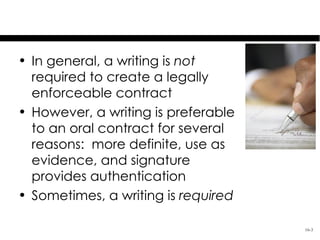
• In general, a writing is not
  required to create a legally
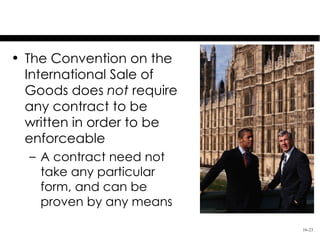
  enforceable contract
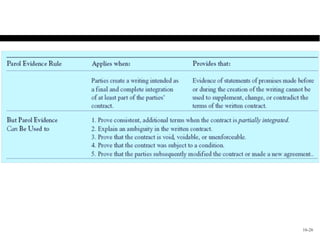
• However, a writing is preferable
  to an oral contract for several
  reasons: more definite, use as
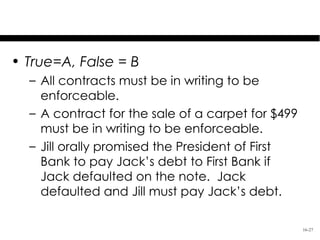
  evidence, and signature
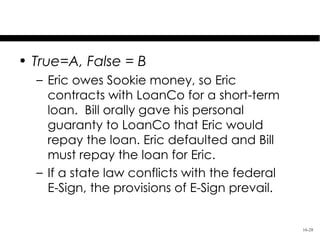
  provides authentication
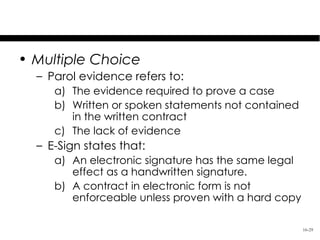
• Sometimes, a writing is required

                                     16-3
The Statute of Frauds
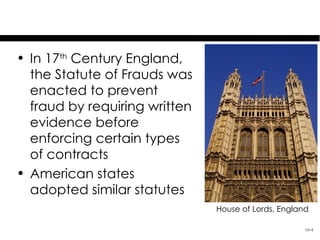
• In 17th Century England,
  the Statute of Frauds was
  enacted to prevent
  fraud by requiring written
  evidence before
  enforcing certain types
  of contracts
• American states
  adopted similar statutes
                               House of Lords, England

                                                     16-4
Consequences

• If a covered contract does not satisfy
  the requirements of the statute of
  frauds, the contract is unenforceable
• A person injured by the unenforceable
  contract may pursue an action based
  on quasi-contract or promissory
  estoppel


                                           16-5
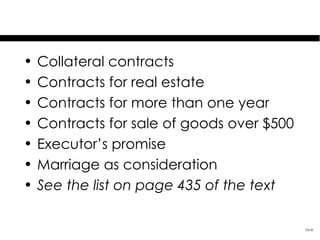
Covered Contracts

•   Collateral contracts
•   Contracts for real estate
•   Contracts for more than one year
•   Contracts for sale of goods over $500
•   Executor’s promise
•   Marriage as consideration
•   See the list on page 435 of the text

                                            16-6
Covered Contracts:
          Collateral Contracts
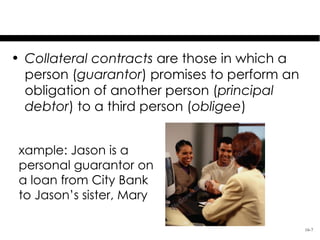
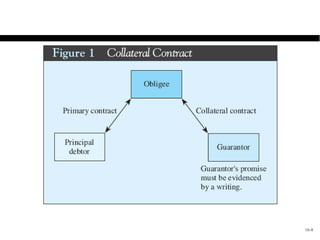
• Collateral contracts are those in which a
  person (guarantor) promises to perform an
  obligation of another person (principal
  debtor) to a third person (obligee)


 xample: Jason is a
 personal guarantor on
 a loan from City Bank
 to Jason’s sister, Mary

                                              16-7
The Collateral Contract


                          16-8
Dynegy, Inc. v. Yates

• Facts & Procedural History:
  – 2002: Dynegy board passed resolution authorizing
    payment of attorney's fees and expenses to
    certain officers and directors, including Olis, if Olis
    signed statement that he acted in good faith and
    in corporation's best interests, "with no reasonable
    cause to believe his conduct was unlawful."
  – 06/03: federal grand jury returned an indictment
    against Olis, who hired Yates to defend him
     • Olis signed written fee agreement with Yates
       with no mention of Dynegy

                                                              16-9
Dynegy, Inc. v. Yates

• Facts & Procedural History:
  – 08/03: Dynegy gave letter to Yates stating that
    Dynegy would pay Yates directly for legal fees
    billed through 8/17/03 and made two payments,
    but refused to pay Yates' final invoice
  – Yates sued Dynegy in 2005 alleging breach of
    contract and fraudulent inducement
  – Dynegy argued it never had an oral or written
    agreement with Yates to pay Olis' bill
  – Jury found for Yates and Dynergy appealed


                                                      16-10
Dynegy, Inc. v. Yates

• Legal Reasoning:
  – Dynegy promised to pay for legal services that
    Yates was to provide Olis because Olis was an
    officer of Dynegy
     • Olis was under investigation for actions taken in
       connection with his work for Dynegy that provided
       substantial benefits to Dynegy
  – Dynegy’s promise was a primary obligation and
    not a promise to pay the debt of another, thus
    statute of frauds is inapplicable
  – Breach of contract claim affirmed in favor of Yates


                                                           16-11
Exception to
      Collateral Contract Rule
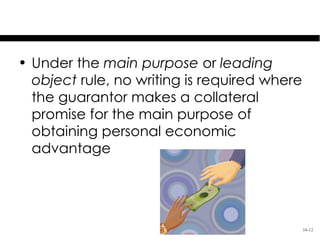
• Under the main purpose or leading
  object rule, no writing is required where
  the guarantor makes a collateral
  promise for the main purpose of
  obtaining personal economic
  advantage


                                              16-12
Covered Contracts: Real Estate
• Contracts for the transfer or sale of an
  interest in real estate
  – Some states require a writing for leases
    and certain easements on real property
  – Exception: if vendor fully performed on
    the contract or vendee reasonably relied
    on the contract to his/her detriment
     • Then statute of frauds does not apply


                                               16-13
Covered Contracts: One Year Rule

• Bilateral contracts that cannot be
  performed within a year from the date
  of their formation (one year rule)
   – Is performance possible within year?
     • Probability of performance irrelevant
  – Example: Jack signs contract to consult
    with Company X for 13 months, so the
    contract must be in writing


                                               16-14
Schaadt v. St. Jude Medical S.C., Inc.

 • Facts & Reasoning:
   – Schaadt fired by St. Jude before end of
     alleged one-year employment contract
     and filed suit
   – Question is whether parties can fully
     perform their obligations under contract
     within one year if those obligations are
     not excused
     • Schaadt’s obligations begin after St. Jude’s
       employment of Schaadt for one year

                                                      16-15
Schaadt v. St. Jude Medical S.C., Inc.

• Reasoning and Holding:
   – Since obligations cannot
     be fulfilled within one year,
     Statute of Frauds requires
     a writing
   – St. Jude (party charged
     with breach) did not sign
     the contract, thus the
     contract is unenforceable
     at St. Jude’s option

                                     16-16
Covered Contracts: $500+ in Goods

 • UCC 2-201: contracts for the sale of
   goods for a price of $500 or more
 • Includes agreements to modify existing
   sales contracts if contract as modified is
   for a price of $500 or more [UCC section
   2–209(3)]
 • Example: Pam buys a refrigerator for $501,
   thus a writing is required to be enforceable
    – No writing required for <$500 refrigerator

                                                   16-17
Other Covered Contracts
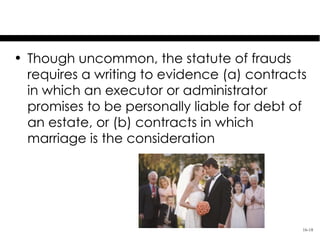
• Though uncommon, the statute of frauds
  requires a writing to evidence (a) contracts
  in which an executor or administrator
  promises to be personally liable for debt of
  an estate, or (b) contracts in which
  marriage is the consideration


                                             16-18
Satisfying the Statute of Frauds

• Most states require only a signed
  memorandum of the parties’
  agreement stating the essential terms:
  – (a) identity of parties, (b) subject matter
    identified with reasonable certainty, and
    (c) signed by the party to be charged
  – The memorandum need not be made
    at the same time the contract comes
    into being

                                                  16-19
Satisfying the Statute of Frauds
• UCC 2–201: writing must be sufficient to
  indicate a contract for sale has been made
  between the parties, but must indicate the
  quantity of goods to be sold
   – A sales receipt may satisfy the requirement
• Sufficient writing includes: (a) confirmatory
  memorandum between merchants, (b) part
  payment or part delivery, (c) admission in
  pleadings or court, and (d) specially
  manufactured goods

                                                   16-20
Green Garden Packaging Co., Inc. v. Schoen

• Decision:
  – Summary judgment evidence conclusively
    established that alleged agreement that
    Green Garden seeks to enforce against
    Schoenmann was for a sale of goods over
    $500, so UCC § 2.201 applies to bar breach
    of contract claim unless exception applies
  – Mere provision of information and samples
    does not constitute partial performance
    and no other exception applies; affirmed

                                                 16-21
Cyberlaw

• Electronic Signatures in Global and
  National Commerce Act (E-Sign) of 2000
  provides that in interstate commerce
  transactions, an electronic signature has
  the same legal effect as a handwritten
  signature, and an electronic contract has
  the same legal effect as a traditionally-
  printed contract


                                              16-22
The CISG and a Writing
• The Convention on the
  International Sale of
  Goods does not require
  any contract to be
  written in order to be
  enforceable
  – A contract need not
    take any particular
    form, and can be
    proven by any means

                               16-23
The Parol Evidence Rule

• Parol evidence rule provides that, when
  parties enter a written contract that they
  intend as a complete integration (final
  statement of agreement), a court will not
  permit evidence of contemporaneous or
  prior statements to contradict, add to, or
  alter the terms of the written contract
• Example:
  Hinkel v. Sataria Distribution & Packaging

                                               16-24
More on Parol Evidence

• UCC 2-202 includes parol evidence rule
• Admissible parol evidence:
  – Additional terms in partially integrated
    contracts
  – Explaining ambiguities
  – Circumstances invalidating contract
  – Existence of condition
  – Subsequent agreements


                                               16-25
Parol Evidence Chart


                       16-26
Test Your Knowledge
• True=A, False = B
  – All contracts must be in writing to be
    enforceable.
  – A contract for the sale of a carpet for $499
    must be in writing to be enforceable.
  – Jill orally promised the President of First
    Bank to pay Jack’s debt to First Bank if
    Jack defaulted on the note. Jack
    defaulted and Jill must pay Jack’s debt.

                                                   16-27
Test Your Knowledge
• True=A, False = B
  – Eric owes Sookie money, so Eric
    contracts with LoanCo for a short-term
    loan. Bill orally gave his personal
    guaranty to LoanCo that Eric would
    repay the loan. Eric defaulted and Bill
    must repay the loan for Eric.
  – If a state law conflicts with the federal
    E-Sign, the provisions of E-Sign prevail.


                                                16-28
Test Your Knowledge
• Multiple Choice
  – Parol evidence refers to:
     a) The evidence required to prove a case
     b) Written or spoken statements not contained
        in the written contract
     c) The lack of evidence
  – E-Sign states that:
     a) An electronic signature has the same legal
        effect as a handwritten signature.
     b) A contract in electronic form is not
        enforceable unless proven with a hard copy

                                                     16-29
Test Your Knowledge
• Multiple Choice
  – Keisha agreed to sell Susan her Picasso
    painting. She wrote the name of the painting
    and $600 on a napkin. Both Keisha & Susan
    signed the napkin. Susan paid Keisha the
    money and Keisha:
     a) May refuse to hand over the painting since
        contract was on a napkin and is
        unenforceable
     b) Must give Susan the painting since the
        contract satisfies the statute of frauds

                                                     16-30
Thought Question
• Do the Statute of
  Frauds and parol
  evidence rule –
  legal principles from
  the 1600s – still make
  sense in today’s
  commercial world?


                             16-31

Chapter 16 – Writing

  • 1.
    C H AP T E R 16 Writing A verbal contract isn’t worth the paper it’s written on. Samuel Goldwyn quoted in The Great Goldwyn by Alva Johnson, 1937 16-1
  • 2.
    Learning Objectives • Listcontracts that must be written to satisfy the Statute of Frauds • Identify exceptions to the Statute of Frauds • Compare UCC with the Statute of Frauds under common law • Describe the Parole Evidence Rule 16-2
  • 3.
    Basics • In general,a writing is not required to create a legally enforceable contract • However, a writing is preferable to an oral contract for several reasons: more definite, use as evidence, and signature provides authentication • Sometimes, a writing is required 16-3
  • 4.
    The Statute ofFrauds • In 17th Century England, the Statute of Frauds was enacted to prevent fraud by requiring written evidence before enforcing certain types of contracts • American states adopted similar statutes House of Lords, England 16-4
  • 5.
    Consequences • If acovered contract does not satisfy the requirements of the statute of frauds, the contract is unenforceable • A person injured by the unenforceable contract may pursue an action based on quasi-contract or promissory estoppel 16-5
  • 6.
    Covered Contracts • Collateral contracts • Contracts for real estate • Contracts for more than one year • Contracts for sale of goods over $500 • Executor’s promise • Marriage as consideration • See the list on page 435 of the text 16-6
  • 7.
    Covered Contracts: Collateral Contracts • Collateral contracts are those in which a person (guarantor) promises to perform an obligation of another person (principal debtor) to a third person (obligee) xample: Jason is a personal guarantor on a loan from City Bank to Jason’s sister, Mary 16-7
  • 8.
  • 9.
    Dynegy, Inc. v.Yates • Facts & Procedural History: – 2002: Dynegy board passed resolution authorizing payment of attorney's fees and expenses to certain officers and directors, including Olis, if Olis signed statement that he acted in good faith and in corporation's best interests, "with no reasonable cause to believe his conduct was unlawful." – 06/03: federal grand jury returned an indictment against Olis, who hired Yates to defend him • Olis signed written fee agreement with Yates with no mention of Dynegy 16-9
  • 10.
    Dynegy, Inc. v.Yates • Facts & Procedural History: – 08/03: Dynegy gave letter to Yates stating that Dynegy would pay Yates directly for legal fees billed through 8/17/03 and made two payments, but refused to pay Yates' final invoice – Yates sued Dynegy in 2005 alleging breach of contract and fraudulent inducement – Dynegy argued it never had an oral or written agreement with Yates to pay Olis' bill – Jury found for Yates and Dynergy appealed 16-10
  • 11.
    Dynegy, Inc. v.Yates • Legal Reasoning: – Dynegy promised to pay for legal services that Yates was to provide Olis because Olis was an officer of Dynegy • Olis was under investigation for actions taken in connection with his work for Dynegy that provided substantial benefits to Dynegy – Dynegy’s promise was a primary obligation and not a promise to pay the debt of another, thus statute of frauds is inapplicable – Breach of contract claim affirmed in favor of Yates 16-11
  • 12.
    Exception to Collateral Contract Rule • Under the main purpose or leading object rule, no writing is required where the guarantor makes a collateral promise for the main purpose of obtaining personal economic advantage 16-12
  • 13.
    Covered Contracts: RealEstate • Contracts for the transfer or sale of an interest in real estate – Some states require a writing for leases and certain easements on real property – Exception: if vendor fully performed on the contract or vendee reasonably relied on the contract to his/her detriment • Then statute of frauds does not apply 16-13
  • 14.
    Covered Contracts: OneYear Rule • Bilateral contracts that cannot be performed within a year from the date of their formation (one year rule) – Is performance possible within year? • Probability of performance irrelevant – Example: Jack signs contract to consult with Company X for 13 months, so the contract must be in writing 16-14
  • 15.
    Schaadt v. St.Jude Medical S.C., Inc. • Facts & Reasoning: – Schaadt fired by St. Jude before end of alleged one-year employment contract and filed suit – Question is whether parties can fully perform their obligations under contract within one year if those obligations are not excused • Schaadt’s obligations begin after St. Jude’s employment of Schaadt for one year 16-15
  • 16.
    Schaadt v. St.Jude Medical S.C., Inc. • Reasoning and Holding: – Since obligations cannot be fulfilled within one year, Statute of Frauds requires a writing – St. Jude (party charged with breach) did not sign the contract, thus the contract is unenforceable at St. Jude’s option 16-16
  • 17.
    Covered Contracts: $500+in Goods • UCC 2-201: contracts for the sale of goods for a price of $500 or more • Includes agreements to modify existing sales contracts if contract as modified is for a price of $500 or more [UCC section 2–209(3)] • Example: Pam buys a refrigerator for $501, thus a writing is required to be enforceable – No writing required for <$500 refrigerator 16-17
  • 18.
    Other Covered Contracts •Though uncommon, the statute of frauds requires a writing to evidence (a) contracts in which an executor or administrator promises to be personally liable for debt of an estate, or (b) contracts in which marriage is the consideration 16-18
  • 19.
    Satisfying the Statuteof Frauds • Most states require only a signed memorandum of the parties’ agreement stating the essential terms: – (a) identity of parties, (b) subject matter identified with reasonable certainty, and (c) signed by the party to be charged – The memorandum need not be made at the same time the contract comes into being 16-19
  • 20.
    Satisfying the Statuteof Frauds • UCC 2–201: writing must be sufficient to indicate a contract for sale has been made between the parties, but must indicate the quantity of goods to be sold – A sales receipt may satisfy the requirement • Sufficient writing includes: (a) confirmatory memorandum between merchants, (b) part payment or part delivery, (c) admission in pleadings or court, and (d) specially manufactured goods 16-20
  • 21.
    Green Garden PackagingCo., Inc. v. Schoen • Decision: – Summary judgment evidence conclusively established that alleged agreement that Green Garden seeks to enforce against Schoenmann was for a sale of goods over $500, so UCC § 2.201 applies to bar breach of contract claim unless exception applies – Mere provision of information and samples does not constitute partial performance and no other exception applies; affirmed 16-21
  • 22.
    Cyberlaw • Electronic Signaturesin Global and National Commerce Act (E-Sign) of 2000 provides that in interstate commerce transactions, an electronic signature has the same legal effect as a handwritten signature, and an electronic contract has the same legal effect as a traditionally- printed contract 16-22
  • 23.
    The CISG anda Writing • The Convention on the International Sale of Goods does not require any contract to be written in order to be enforceable – A contract need not take any particular form, and can be proven by any means 16-23
  • 24.
    The Parol EvidenceRule • Parol evidence rule provides that, when parties enter a written contract that they intend as a complete integration (final statement of agreement), a court will not permit evidence of contemporaneous or prior statements to contradict, add to, or alter the terms of the written contract • Example: Hinkel v. Sataria Distribution & Packaging 16-24
  • 25.
    More on ParolEvidence • UCC 2-202 includes parol evidence rule • Admissible parol evidence: – Additional terms in partially integrated contracts – Explaining ambiguities – Circumstances invalidating contract – Existence of condition – Subsequent agreements 16-25
  • 26.
  • 27.
    Test Your Knowledge •True=A, False = B – All contracts must be in writing to be enforceable. – A contract for the sale of a carpet for $499 must be in writing to be enforceable. – Jill orally promised the President of First Bank to pay Jack’s debt to First Bank if Jack defaulted on the note. Jack defaulted and Jill must pay Jack’s debt. 16-27
  • 28.
    Test Your Knowledge •True=A, False = B – Eric owes Sookie money, so Eric contracts with LoanCo for a short-term loan. Bill orally gave his personal guaranty to LoanCo that Eric would repay the loan. Eric defaulted and Bill must repay the loan for Eric. – If a state law conflicts with the federal E-Sign, the provisions of E-Sign prevail. 16-28
  • 29.
    Test Your Knowledge •Multiple Choice – Parol evidence refers to: a) The evidence required to prove a case b) Written or spoken statements not contained in the written contract c) The lack of evidence – E-Sign states that: a) An electronic signature has the same legal effect as a handwritten signature. b) A contract in electronic form is not enforceable unless proven with a hard copy 16-29
  • 30.
    Test Your Knowledge •Multiple Choice – Keisha agreed to sell Susan her Picasso painting. She wrote the name of the painting and $600 on a napkin. Both Keisha & Susan signed the napkin. Susan paid Keisha the money and Keisha: a) May refuse to hand over the painting since contract was on a napkin and is unenforceable b) Must give Susan the painting since the contract satisfies the statute of frauds 16-30
  • 31.
    Thought Question • Dothe Statute of Frauds and parol evidence rule – legal principles from the 1600s – still make sense in today’s commercial world? 16-31

Editor's Notes

  • #5 Contracts covered by the Statute of Frauds: 1. Collateral contracts in which a person promises to perform the obligation of another person. 2. Contracts for the sale of an interest in real estate. 3. Bilateral contracts that cannot be performed within a year from the date of their formation. 4. Contracts for the sale of goods for a price of $500 or more. 5. Contracts in which an executor or administrator promises to be personally liable for the debt of an estate. 6. Contracts in which marriage is the consideration.
  • #7 Contracts covered by the Statute of Frauds: 1. Collateral contracts in which a person promises to perform the obligation of another person. 2. Contracts for the sale of an interest in real estate. 3. Bilateral contracts that cannot be performed within a year from the date of their formation. 4. Contracts for the sale of goods for a price of $500 or more. 5. Contracts in which an executor or administrator promises to be personally liable for the debt of an estate. 6. Contracts in which marriage is the consideration.
  • #10 The hyperlink is to the opinion on the Findlaw.com website.
  • #11 Odd procedural history: Dynegy appealed trial court&apos;s judgment to Houston&apos;s 1st Court of Appeals, but 1st Court Chief Justice Sherry Radack requested the case transferred in Dec. 2009 to Texas Supreme Court Chief Justice Wallace Jefferson. Radack noted in letter requesting transfer that the justice originally assigned to the case had resigned and eight other justices on the 1st Court &amp;quot;are disqualified or have recused pursuant to Texas Rule of Civil Procedure 18(b).“ Specifically, Yates is the husband of Houston&apos;s 14th Court of Appeals Justice Leslie Brock Yates and a factor in the disqualification or recusal of eight 1st Court justices from the appeal. On Jan. 14, 2010, Supreme Court transferred Dynegy to the 4th Court of Appeals.
  • #12 Interestingly, at November 2003 trial, Olis was convicted. Dynegy’s board had determined that he had not acted in good faith and Dynegy was not obligated to indemnify him or release the escrowed money.
  • #21 See flowchart on page 445 of the text.
  • #22 The hyperlink is to the court’s opinion in pdf.
  • #25 Parol evidence literally means written or spoken statements not contained in the written contract The hyperlink is to the court’s opinion in pdf.
  • #28 False. Oral contracts are enforceable unless they are the types of contracts that fall within the scope of the statute of frauds. False. Contracts must be in writing to be enforceable if the contract concerns a sale of goods over $500. False. This is a collateral contract and, according to the statute of frauds, it must be in writing to be enforceable. Jill need not pay Jack’s debt.
  • #29 True. This is an example of a situation in which the main purpose or leading object rule applies: no writing is required where the guarantor makes a collateral promise for the main purpose of obtaining personal economic advantage. Since Joey took out the loan to repay Chandler, Chandler made the collateral promise for personal economic advantage. Even though the contract was oral, Chandler must repay the loan for Joey. True. The Supremacy Clause of the U.S. Constitution applies, thus federal law prevails.
  • #30 The correct answer is (b). The correct answer is (a).
  • #31 The correct answer is (b). This is a similar situation to the famed Rosenfeld v. Basquiat case (Rosenfeld v. Basquiat, 78 F.3d 84 (2d Cir. 1996)).
  • #32 Opportunity for discussion about logic and fairness of the Statute of Frauds and/or the parol evidence rule.