Business Law Chapter 4 Mr. Whisel
Section 4.1 Goals Explain how disputes can be settled without resort to the courts Name the different levels of courts and describe their powers
What’s Your Verdict? 7-Eleven sells franchises for stores bearing its name. The franchise agreement specifies that disputes between 7-Eleven and those who buy a franchise should be settled by arbitration rather than by a trial in court. Can 7-Eleven compel its franchise to use arbitration instead of litigation?
Why Arbitration for 7-Eleven? The disputing parties avoid costs, delays, and difficulties of a court trial. Even before arbitration the best way might be to just talk to the people involved. Too often people quickly litigate
Litigation  Taking a dispute to court. Mediator Third party who tries to develop a solution acceptable to both sides of a dispute. Does not bind either party. Arbitrator Person holding an informal hearing to determine what happened. Unlike mediation, arbitration is binding for both parties, enforceable by the courts
Levels of Courts Court Government forum that administers justice under the law. Both Civil and Criminal Award Damages- Civil Impose Imprisonment- Criminal Impartial and Thorough Procedures to make a decision Witness- Person who gives an account of how they perceived the incident. Equal opportunity for Plaintiff and Defendant Two types of Courts Trial Courts Appellate Courts
What’s Your Verdict? Doyle made and illegal U-turn. A police officer saw it and gave him a citation (order to appear in court).  Doyle claimed that the sign forbidding a U-turn at that intersection was obstructed by a tree branch. The officer replied, “Sorry, Sir Tell it to the judge in court.” Why is a court necessary in this situation?
Why courts? Necessary to decide whether Doyle is telling the truth and whether the blocked sign would be a valid defense.
Trial Courts First Court to hear a dispute Original Jurisdiction Power to hear a case in full for the first time. Information is presented at this level to prove alleged facts Consists of Judges and Lawyers Other people involved in the court Clerks, Sheriffs, Marshalls, Bailiffs, and Jury Members
Operation Clerks Enter cases on the court calendar Keep Records of Proceedings Compute Court Costs Sheriffs and Marshalls (Federal) Summon Witnesses Keep Court in order Carryout Judgments Juries Sworn in citizens by the court to decide issues of fact in court cases.
Appellate Courts Review the decisions of the lower courts when a party claims an error was made during the previous proceeding Do not hear witnesses (generally) Do not accept new evidence (generally) Concerned with errors in law Examine the Transcript A verbatim record of what went on at trial. Appellate Briefs Written arguments on the issues of laws submitted by attorneys After case make decision whether the lower court should be affirmed, reversed, or remanded (sent back to lower court).
Page 54 Think About Legal Concepts Think Critically About Evidence
Section 4.1 Goals Explain how disputes can be settled without resort to the courts Name the different levels of courts and describe their powers
Section 4.2 Goals Identify the source of power of the federal courts Name the various levels of federal courts and describe their jurisdictions
What’s Your Verdict? Jim and Marla were discussing how U.S. Bankruptcy Courts were empowered to decide cases. Jim said that federal courts received their power from the U.S. Constitution. Marla thought Congress had created and empowered the bankruptcy courts. Who is correct?
Who is Correct? Both Federal Courts receive power from the Constitution Constitution granted Congress to divide powers
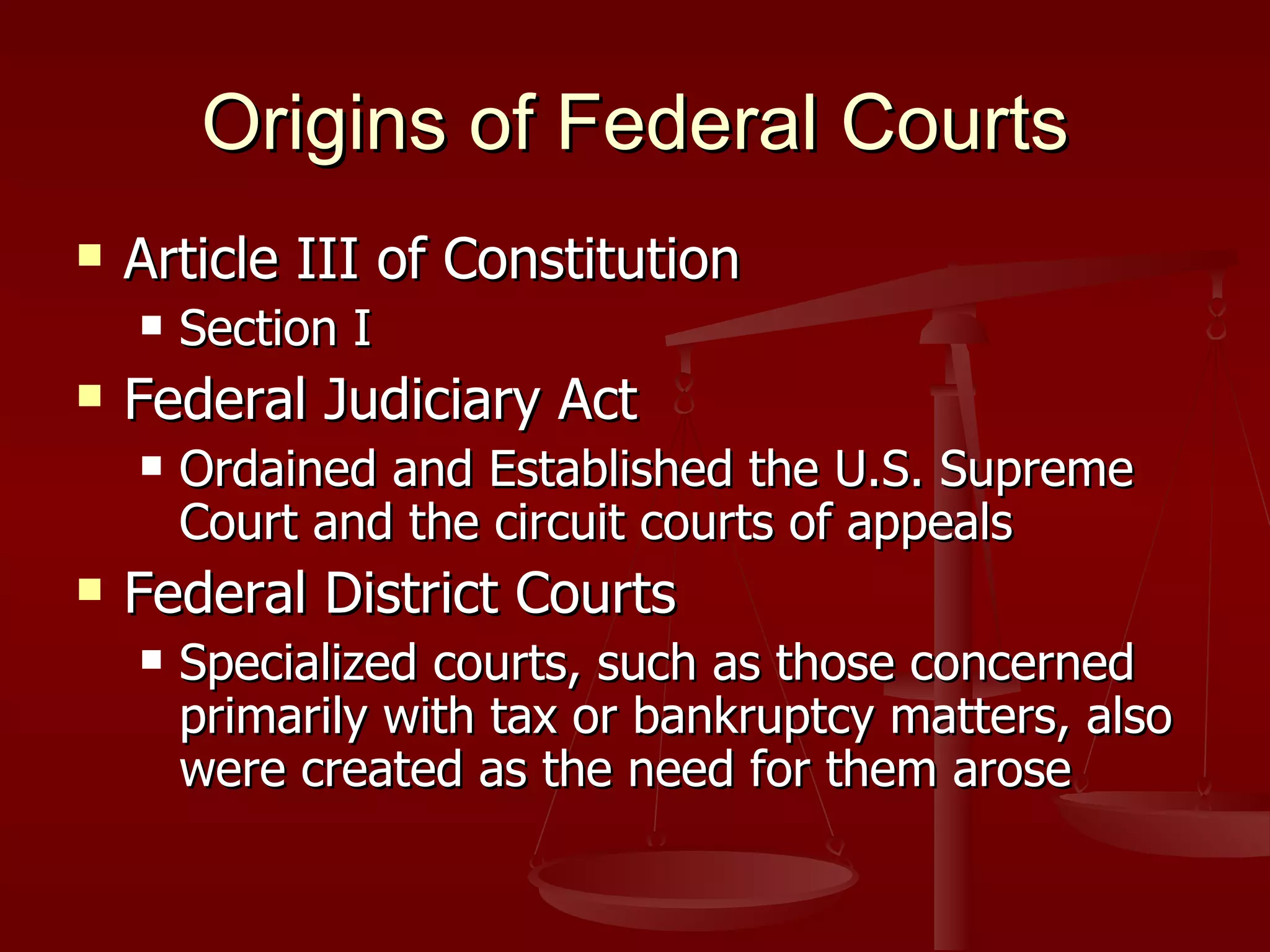
Origins of Federal Courts Article III of Constitution Section I Federal Judiciary Act Ordained and Established the U.S. Supreme Court and the circuit courts of appeals Federal District Courts Specialized courts, such as those concerned primarily with tax or bankruptcy matters, also were created as the need for them arose
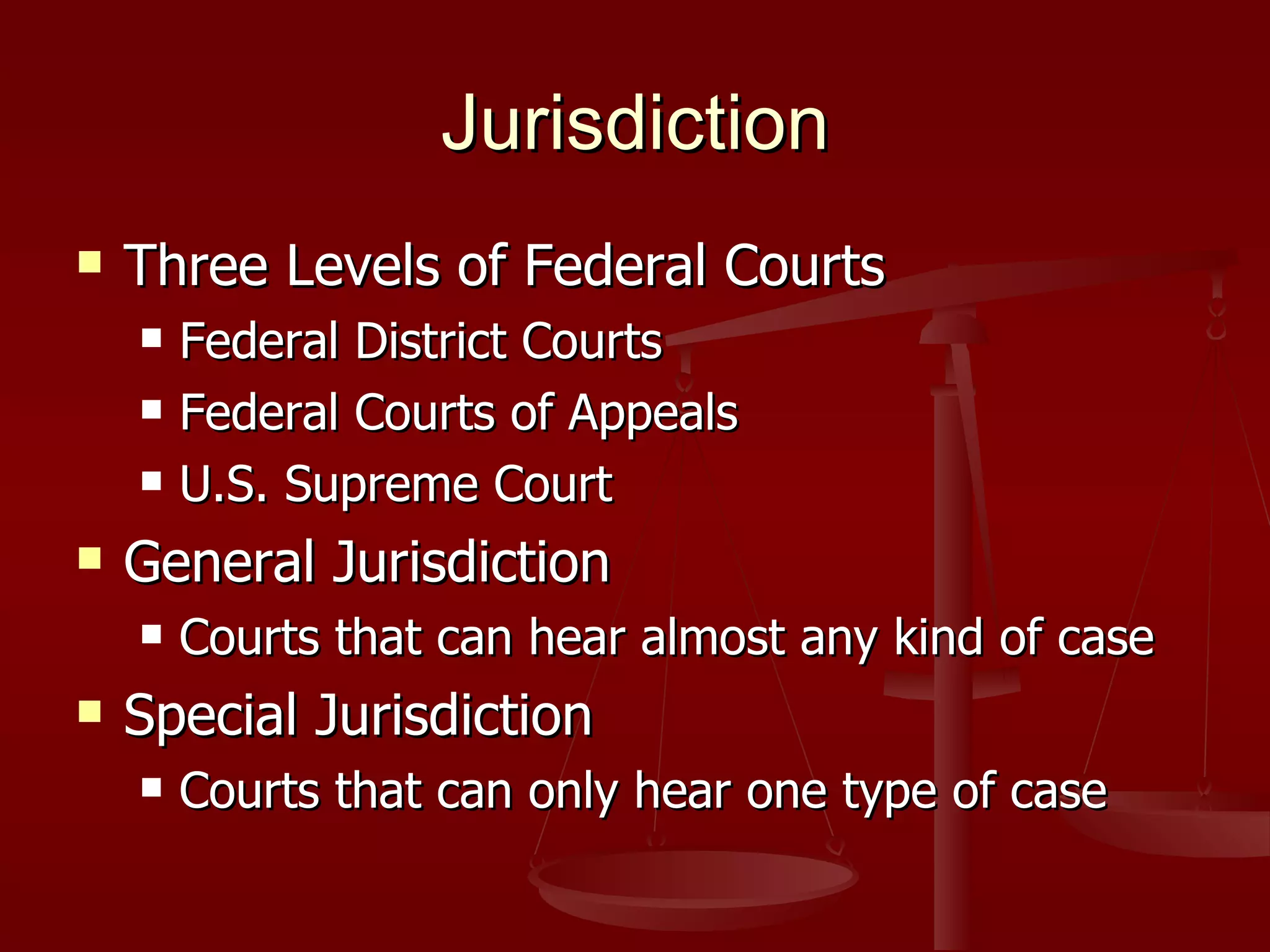
Jurisdiction Three Levels of Federal Courts Federal District Courts Federal Courts of Appeals U.S. Supreme Court General Jurisdiction Courts that can hear almost any kind of case Special Jurisdiction Courts that can only hear one type of case
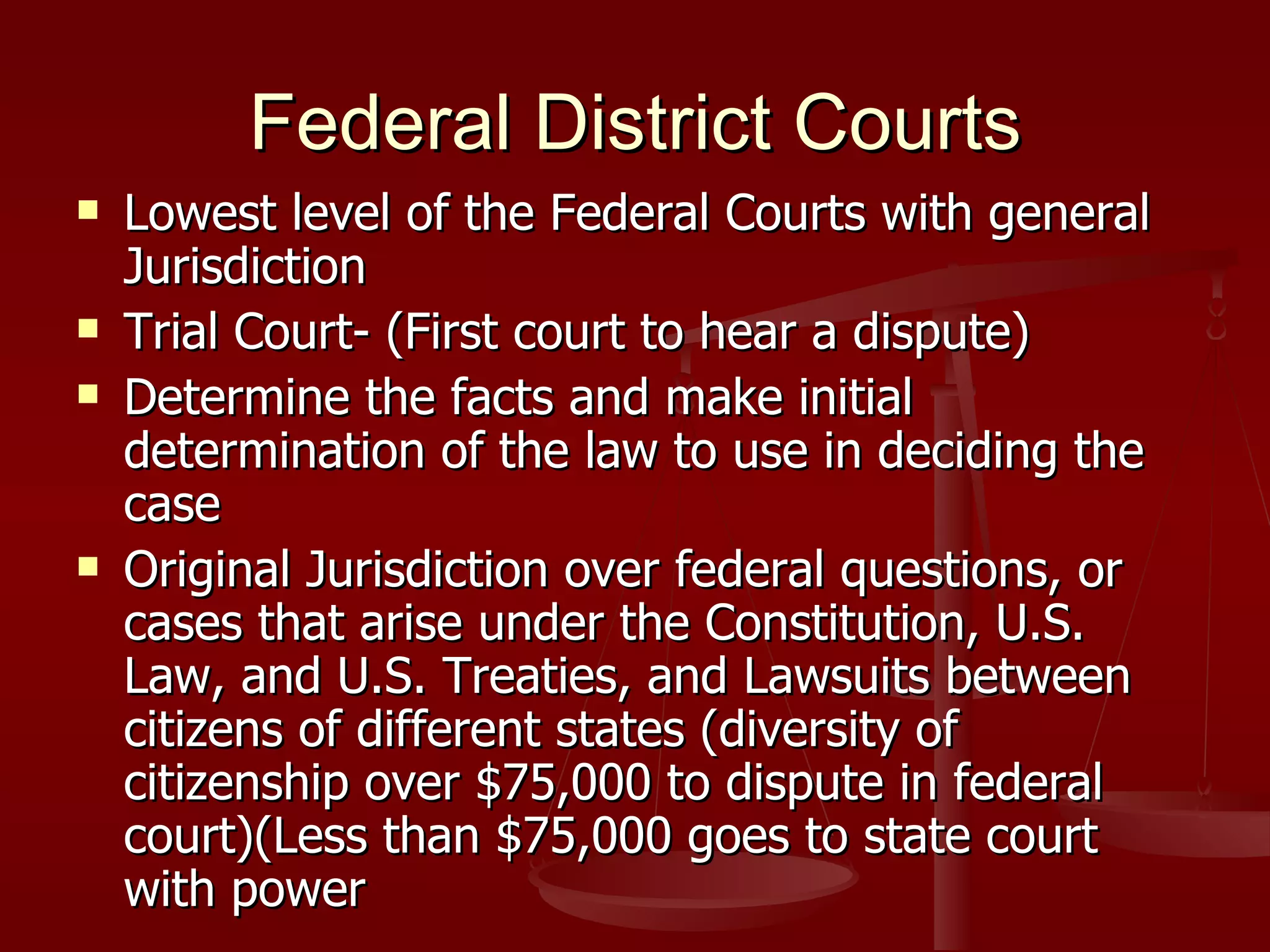
Federal District Courts Lowest level of the Federal Courts with general Jurisdiction Trial Court- (First court to hear a dispute) Determine the facts and make initial determination of the law to use in deciding the case Original Jurisdiction over federal questions, or cases that arise under the Constitution, U.S. Law, and U.S. Treaties, and Lawsuits between citizens of different states (diversity of citizenship over $75,000 to dispute in federal court)(Less than $75,000 goes to state court with power
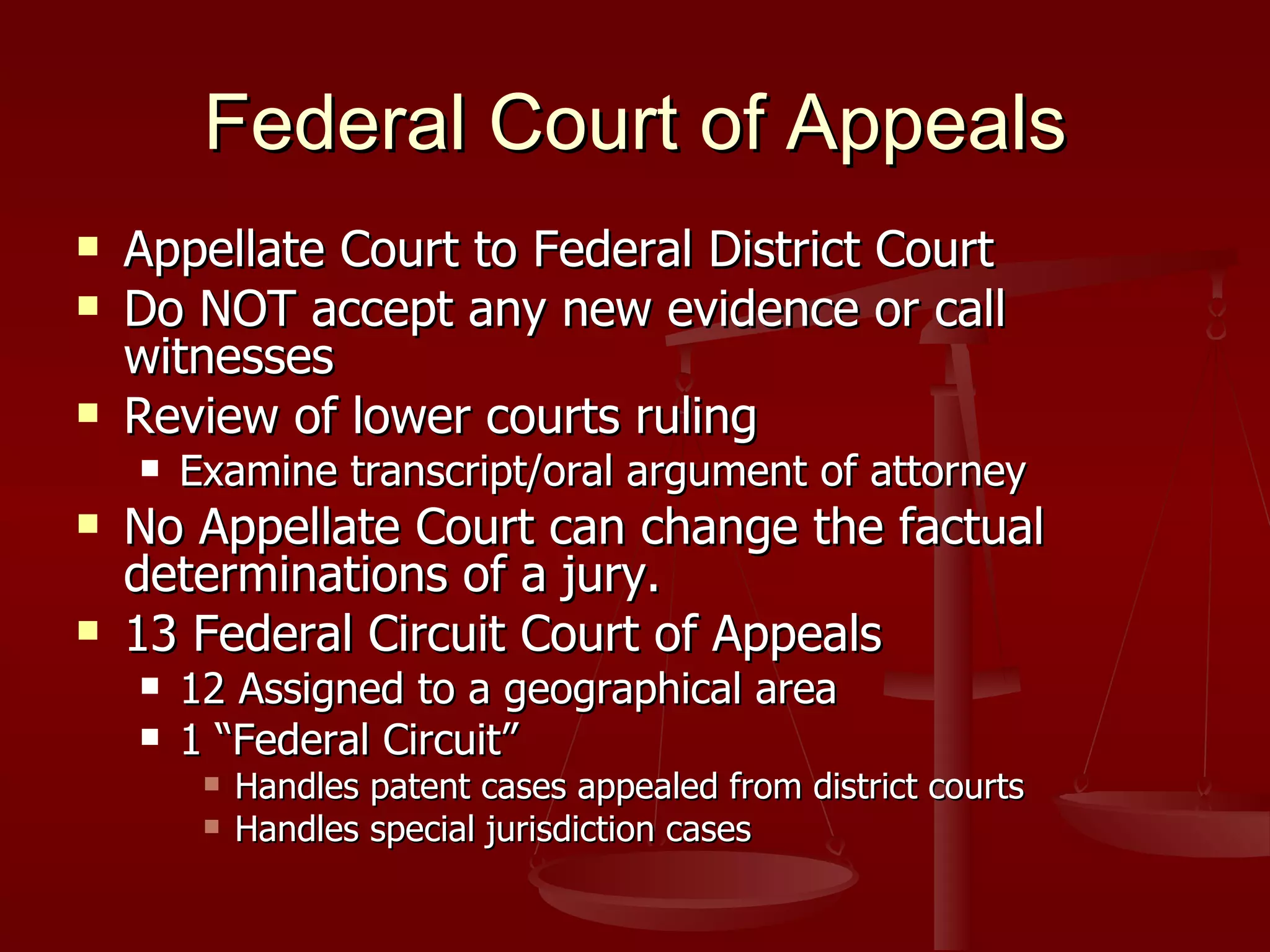
Federal Court of Appeals Appellate Court to Federal District Court Do NOT accept any new evidence or call witnesses Review of lower courts ruling Examine transcript/oral argument of attorney No Appellate Court can change the factual determinations of a jury. 13 Federal Circuit Court of Appeals 12 Assigned to a geographical area 1 “Federal Circuit” Handles patent cases appealed from district courts  Handles special jurisdiction cases
United States Supreme Court Original ( State Supreme Courts) and Appellate Jurisdiction (District Court of Appeals Highest form of Court Must find an issue with Constitution (if proven request a Writ of Certiorari) Writ of Certiorari Turning over the record of the case for review
Page 57 Think About Legal Concepts Think Critically About Evidence
Section 4.2 Goals Identify the source of power of the federal courts Name the various levels of federal courts and describe their jurisdictions
Section 4.3 Goals Compare the structure of a typical state court with the structure of the federal courts Identify typical state courts of specialized jurisdiction Discuss the jurisdiction of the various typical state courts
State Legal System Resembles Federal Three Tiers Geographical based Trial Courts Appellate Level of Courts State Supreme Courts
State Trial Courts Known as Circuit Courts, District Courts, or Court of Common Pleas Court of Record Keeps an exact account of what goes on at trial Accuracy Vital Also known as a transcript Original Jurisdiction
State Court of Appeals Panel of Judges No more than three Examine Transcript and Oral Argument No new evidence or witnesses If find that wrong law used, sent back down to trial court to be retried
State Supreme Courts Case that involves the most complex legal issues are taken to the justices of the state Justice Title given to Judge that sits on State and Federal Supreme Court Review legal issues at hand and oral argument Final measure in the states unless Constitution or Federal issues are involved, next step U.S. Supreme Court
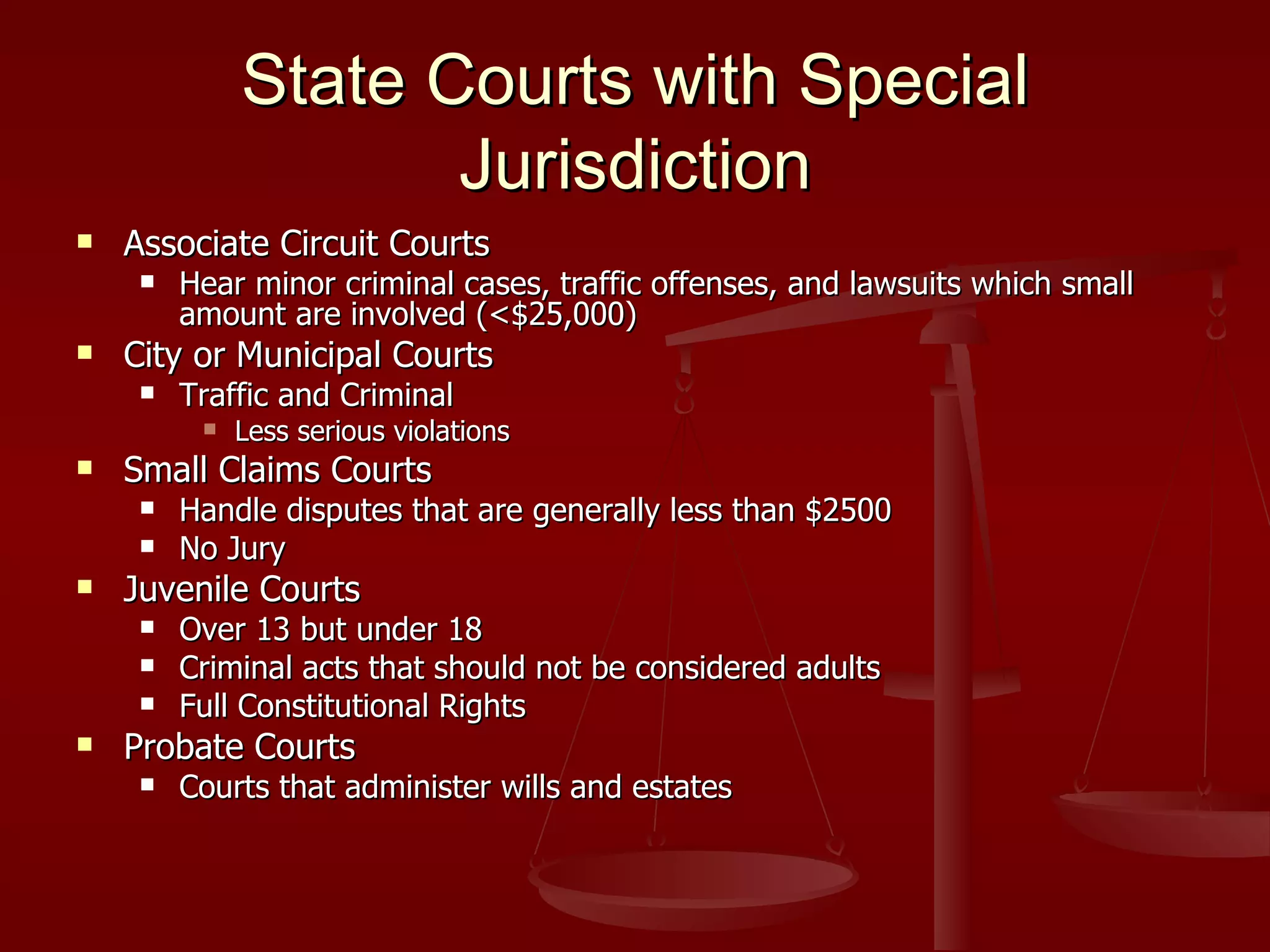
State Courts with Special Jurisdiction Associate Circuit Courts Hear minor criminal cases, traffic offenses, and lawsuits which small amount are involved (<$25,000) City or Municipal Courts Traffic and Criminal  Less serious violations Small Claims Courts Handle disputes that are generally less than $2500 No Jury Juvenile Courts Over 13 but under 18 Criminal acts that should not be considered adults Full Constitutional Rights Probate Courts Courts that administer wills and estates
Page 61 Think About Legal Concepts Think Critically About Evidence Do all What’s Your Verdicts?
Section 4.3 Goals Compare the structure of a typical state court with the structure of the federal courts Identify typical state courts of specialized jurisdiction Discuss the jurisdiction of the various typical state courts
Chapter in Review Page 62-65

Chapter 4 Detailed

  • 1.
  • 2.
    Section 4.1 GoalsExplain how disputes can be settled without resort to the courts Name the different levels of courts and describe their powers
  • 3.
    What’s Your Verdict?7-Eleven sells franchises for stores bearing its name. The franchise agreement specifies that disputes between 7-Eleven and those who buy a franchise should be settled by arbitration rather than by a trial in court. Can 7-Eleven compel its franchise to use arbitration instead of litigation?
  • 4.
    Why Arbitration for7-Eleven? The disputing parties avoid costs, delays, and difficulties of a court trial. Even before arbitration the best way might be to just talk to the people involved. Too often people quickly litigate
  • 5.
    Litigation Takinga dispute to court. Mediator Third party who tries to develop a solution acceptable to both sides of a dispute. Does not bind either party. Arbitrator Person holding an informal hearing to determine what happened. Unlike mediation, arbitration is binding for both parties, enforceable by the courts
  • 6.
    Levels of CourtsCourt Government forum that administers justice under the law. Both Civil and Criminal Award Damages- Civil Impose Imprisonment- Criminal Impartial and Thorough Procedures to make a decision Witness- Person who gives an account of how they perceived the incident. Equal opportunity for Plaintiff and Defendant Two types of Courts Trial Courts Appellate Courts
  • 7.
    What’s Your Verdict?Doyle made and illegal U-turn. A police officer saw it and gave him a citation (order to appear in court). Doyle claimed that the sign forbidding a U-turn at that intersection was obstructed by a tree branch. The officer replied, “Sorry, Sir Tell it to the judge in court.” Why is a court necessary in this situation?
  • 8.
    Why courts? Necessaryto decide whether Doyle is telling the truth and whether the blocked sign would be a valid defense.
  • 9.
    Trial Courts FirstCourt to hear a dispute Original Jurisdiction Power to hear a case in full for the first time. Information is presented at this level to prove alleged facts Consists of Judges and Lawyers Other people involved in the court Clerks, Sheriffs, Marshalls, Bailiffs, and Jury Members
  • 10.
    Operation Clerks Entercases on the court calendar Keep Records of Proceedings Compute Court Costs Sheriffs and Marshalls (Federal) Summon Witnesses Keep Court in order Carryout Judgments Juries Sworn in citizens by the court to decide issues of fact in court cases.
  • 11.
    Appellate Courts Reviewthe decisions of the lower courts when a party claims an error was made during the previous proceeding Do not hear witnesses (generally) Do not accept new evidence (generally) Concerned with errors in law Examine the Transcript A verbatim record of what went on at trial. Appellate Briefs Written arguments on the issues of laws submitted by attorneys After case make decision whether the lower court should be affirmed, reversed, or remanded (sent back to lower court).
  • 12.
    Page 54 ThinkAbout Legal Concepts Think Critically About Evidence
  • 13.
    Section 4.1 GoalsExplain how disputes can be settled without resort to the courts Name the different levels of courts and describe their powers
  • 14.
    Section 4.2 GoalsIdentify the source of power of the federal courts Name the various levels of federal courts and describe their jurisdictions
  • 15.
    What’s Your Verdict?Jim and Marla were discussing how U.S. Bankruptcy Courts were empowered to decide cases. Jim said that federal courts received their power from the U.S. Constitution. Marla thought Congress had created and empowered the bankruptcy courts. Who is correct?
  • 16.
    Who is Correct?Both Federal Courts receive power from the Constitution Constitution granted Congress to divide powers
  • 17.
    Origins of FederalCourts Article III of Constitution Section I Federal Judiciary Act Ordained and Established the U.S. Supreme Court and the circuit courts of appeals Federal District Courts Specialized courts, such as those concerned primarily with tax or bankruptcy matters, also were created as the need for them arose
  • 18.
    Jurisdiction Three Levelsof Federal Courts Federal District Courts Federal Courts of Appeals U.S. Supreme Court General Jurisdiction Courts that can hear almost any kind of case Special Jurisdiction Courts that can only hear one type of case
  • 19.
    Federal District CourtsLowest level of the Federal Courts with general Jurisdiction Trial Court- (First court to hear a dispute) Determine the facts and make initial determination of the law to use in deciding the case Original Jurisdiction over federal questions, or cases that arise under the Constitution, U.S. Law, and U.S. Treaties, and Lawsuits between citizens of different states (diversity of citizenship over $75,000 to dispute in federal court)(Less than $75,000 goes to state court with power
  • 20.
    Federal Court ofAppeals Appellate Court to Federal District Court Do NOT accept any new evidence or call witnesses Review of lower courts ruling Examine transcript/oral argument of attorney No Appellate Court can change the factual determinations of a jury. 13 Federal Circuit Court of Appeals 12 Assigned to a geographical area 1 “Federal Circuit” Handles patent cases appealed from district courts Handles special jurisdiction cases
  • 21.
    United States SupremeCourt Original ( State Supreme Courts) and Appellate Jurisdiction (District Court of Appeals Highest form of Court Must find an issue with Constitution (if proven request a Writ of Certiorari) Writ of Certiorari Turning over the record of the case for review
  • 22.
    Page 57 ThinkAbout Legal Concepts Think Critically About Evidence
  • 23.
    Section 4.2 GoalsIdentify the source of power of the federal courts Name the various levels of federal courts and describe their jurisdictions
  • 24.
    Section 4.3 GoalsCompare the structure of a typical state court with the structure of the federal courts Identify typical state courts of specialized jurisdiction Discuss the jurisdiction of the various typical state courts
  • 25.
    State Legal SystemResembles Federal Three Tiers Geographical based Trial Courts Appellate Level of Courts State Supreme Courts
  • 26.
    State Trial CourtsKnown as Circuit Courts, District Courts, or Court of Common Pleas Court of Record Keeps an exact account of what goes on at trial Accuracy Vital Also known as a transcript Original Jurisdiction
  • 27.
    State Court ofAppeals Panel of Judges No more than three Examine Transcript and Oral Argument No new evidence or witnesses If find that wrong law used, sent back down to trial court to be retried
  • 28.
    State Supreme CourtsCase that involves the most complex legal issues are taken to the justices of the state Justice Title given to Judge that sits on State and Federal Supreme Court Review legal issues at hand and oral argument Final measure in the states unless Constitution or Federal issues are involved, next step U.S. Supreme Court
  • 29.
    State Courts withSpecial Jurisdiction Associate Circuit Courts Hear minor criminal cases, traffic offenses, and lawsuits which small amount are involved (<$25,000) City or Municipal Courts Traffic and Criminal Less serious violations Small Claims Courts Handle disputes that are generally less than $2500 No Jury Juvenile Courts Over 13 but under 18 Criminal acts that should not be considered adults Full Constitutional Rights Probate Courts Courts that administer wills and estates
  • 30.
    Page 61 ThinkAbout Legal Concepts Think Critically About Evidence Do all What’s Your Verdicts?
  • 31.
    Section 4.3 GoalsCompare the structure of a typical state court with the structure of the federal courts Identify typical state courts of specialized jurisdiction Discuss the jurisdiction of the various typical state courts
  • 32.