CHAPTER 3:
The Nature of
Decision Making
FUNDAMENTALS OF
MANAGEMENT (MGT 162)
LEARNING
OBJECTIVES
◦ Definition of decision making
◦ Types of decision making
◦ Programmed decision
◦ Non-programmed decision
◦ Characteristics of decision making
◦ Decision making process
◦ Group decision making techniques
DEFINITION
◦ The process through which managers
identify and resolve problems and capitalize
on opportunities.
◦ The process by which a course of action is
selected as the way to deal with a specific
problem.
TYPES OF
DECISION
MAKING
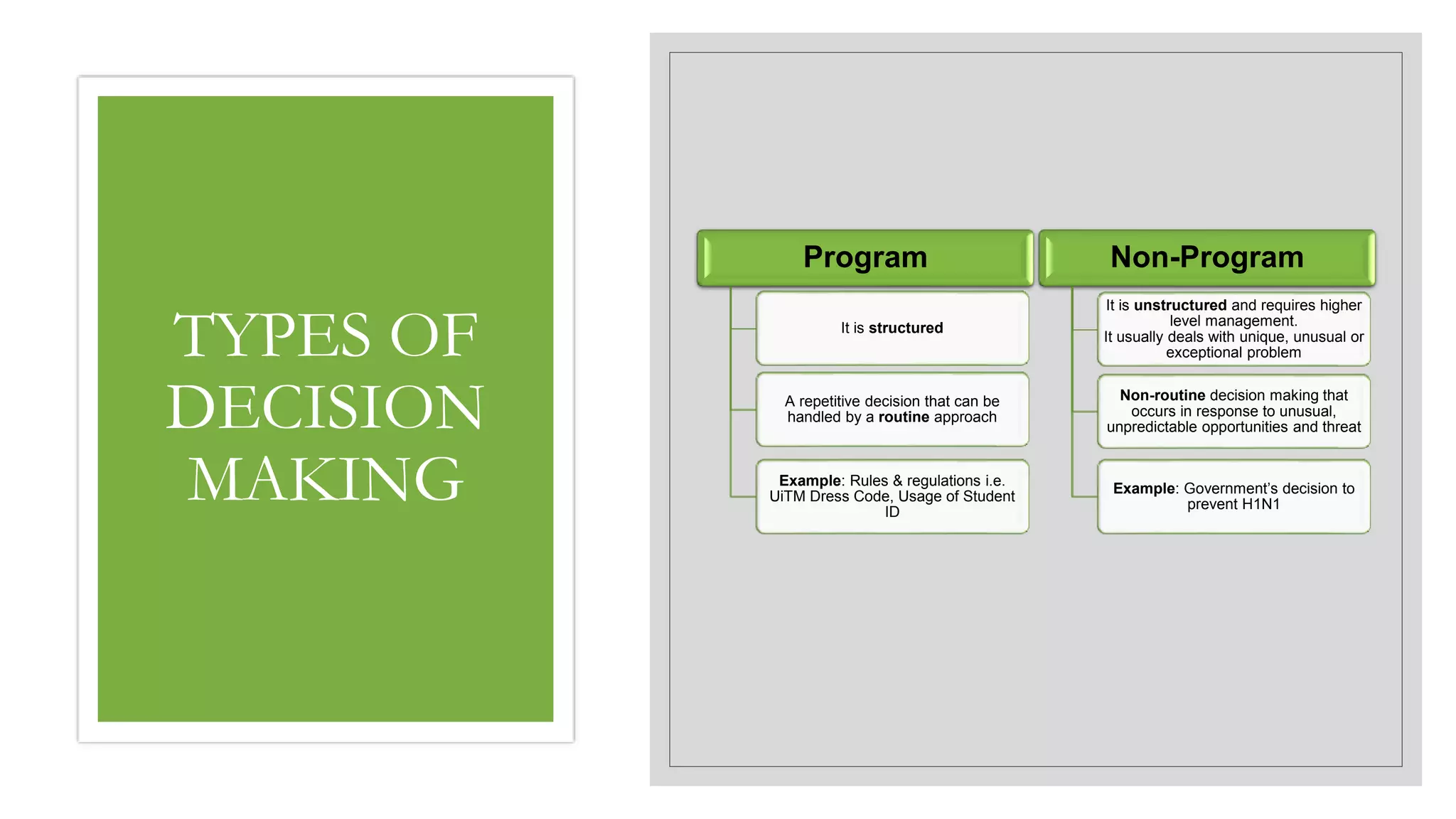
Program
It is structured
A repetitive decision that can be
handled by a routine approach
Example: Rules & regulations i.e.
UiTM Dress Code, Usage of Student
ID
Non-Program
It is unstructured and requires higher
level management.
It usually deals with unique, unusual or
exceptional problem
Non-routine decision making that
occurs in response to unusual,
unpredictable opportunities and threat
Example: Government’s decision to
prevent H1N1
CHARACTERISTICS OF DECISION
MAKING
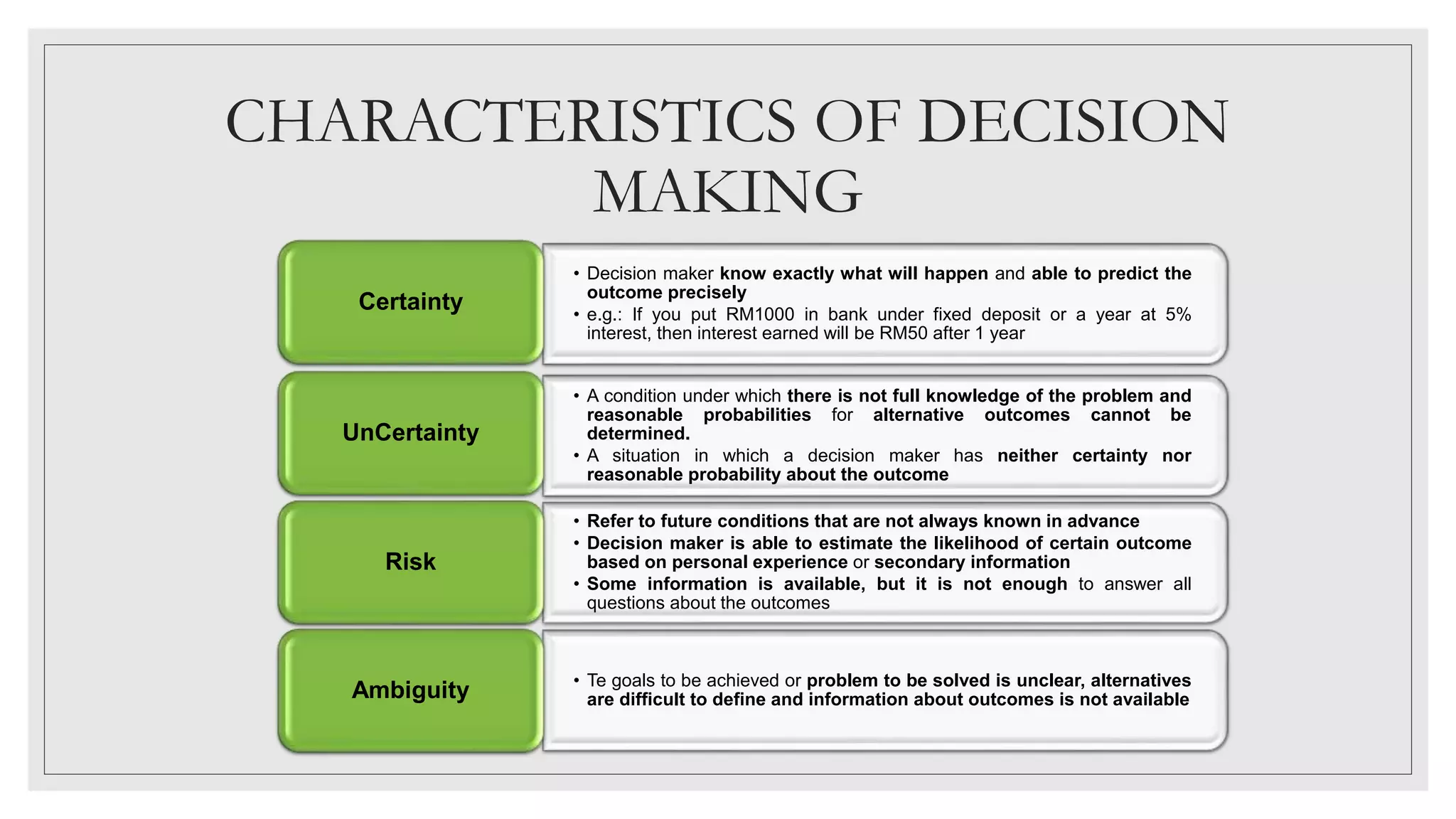
• Decision maker know exactly what will happen and able to predict the
outcome precisely
• e.g.: If you put RM1000 in bank under fixed deposit or a year at 5%
interest, then interest earned will be RM50 after 1 year
Certainty
• A condition under which there is not full knowledge of the problem and
reasonable probabilities for alternative outcomes cannot be
determined.
• A situation in which a decision maker has neither certainty nor
reasonable probability about the outcome
UnCertainty
• Refer to future conditions that are not always known in advance
• Decision maker is able to estimate the likelihood of certain outcome
based on personal experience or secondary information
• Some information is available, but it is not enough to answer all
questions about the outcomes
Risk
• Te goals to be achieved or problem to be solved is unclear, alternatives
are difficult to define and information about outcomes is not available
Ambiguity
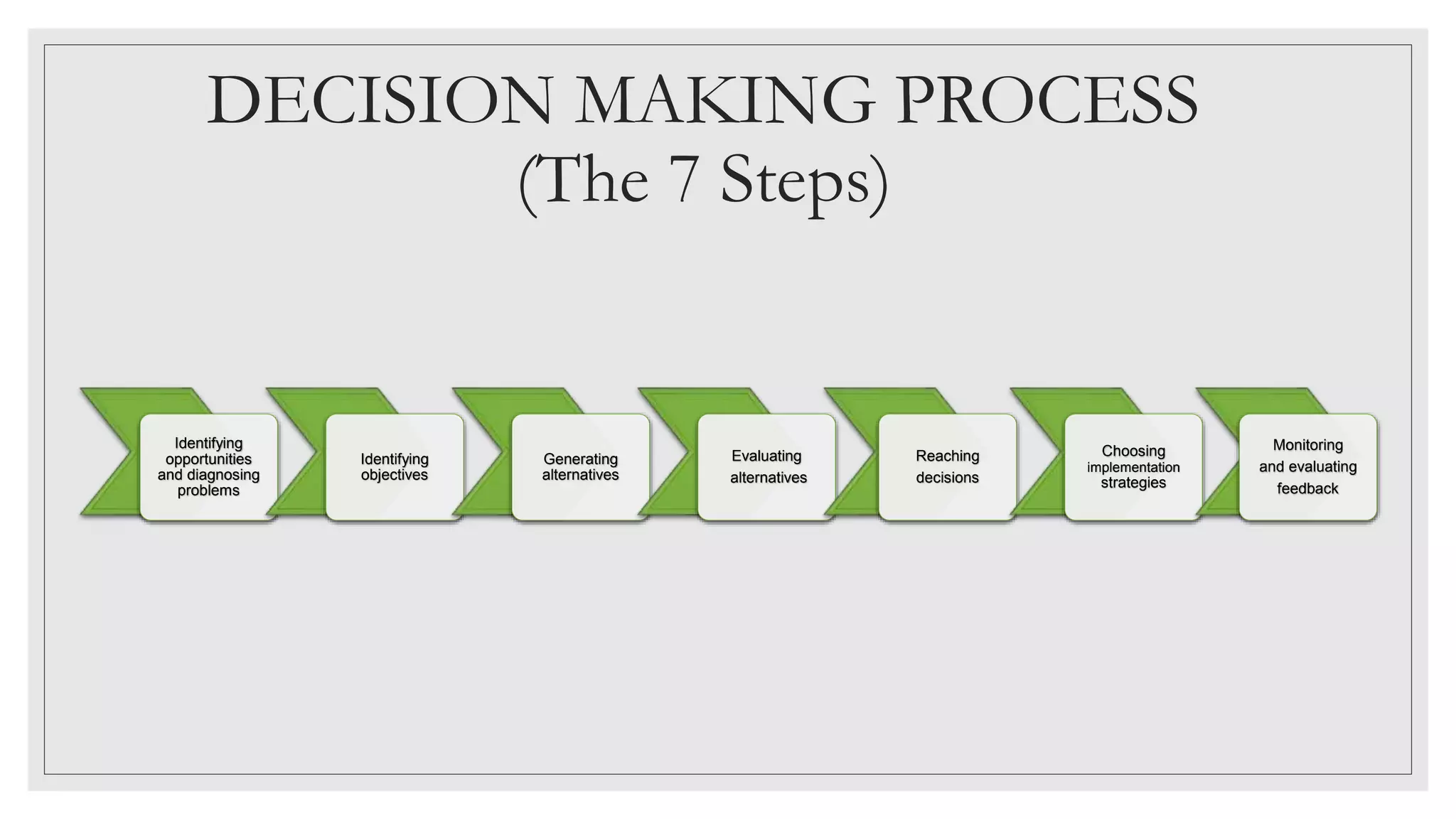
DECISION MAKING PROCESS
(The 7 Steps)
Identifying
opportunities
and diagnosing
problems
Identifying
objectives
Generating
alternatives
Evaluating
alternatives
Reaching
decisions
Choosing
implementation
strategies
Monitoring
and evaluating
feedback
GROUP
DECISION
MAKING
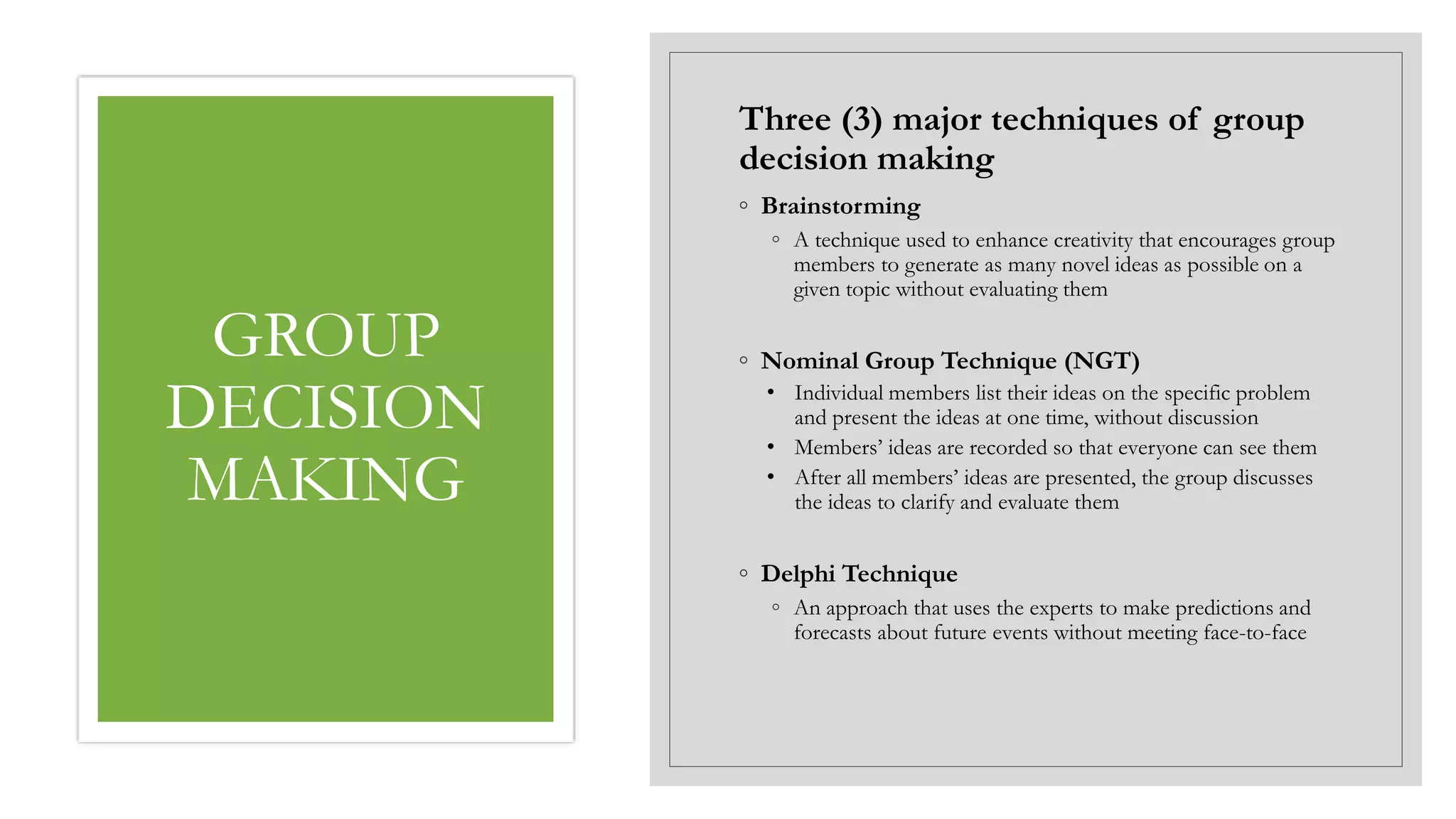
Three (3) major techniques of group
decision making
◦ Brainstorming
◦ A technique used to enhance creativity that encourages group
members to generate as many novel ideas as possible on a
given topic without evaluating them
◦ Nominal Group Technique (NGT)
• Individual members list their ideas on the specific problem
and present the ideas at one time, without discussion
• Members’ ideas are recorded so that everyone can see them
• After all members’ ideas are presented, the group discusses
the ideas to clarify and evaluate them
◦ Delphi Technique
◦ An approach that uses the experts to make predictions and
forecasts about future events without meeting face-to-face
GROUP
DECISION
MAKING:
Advantages &
Disadvantages
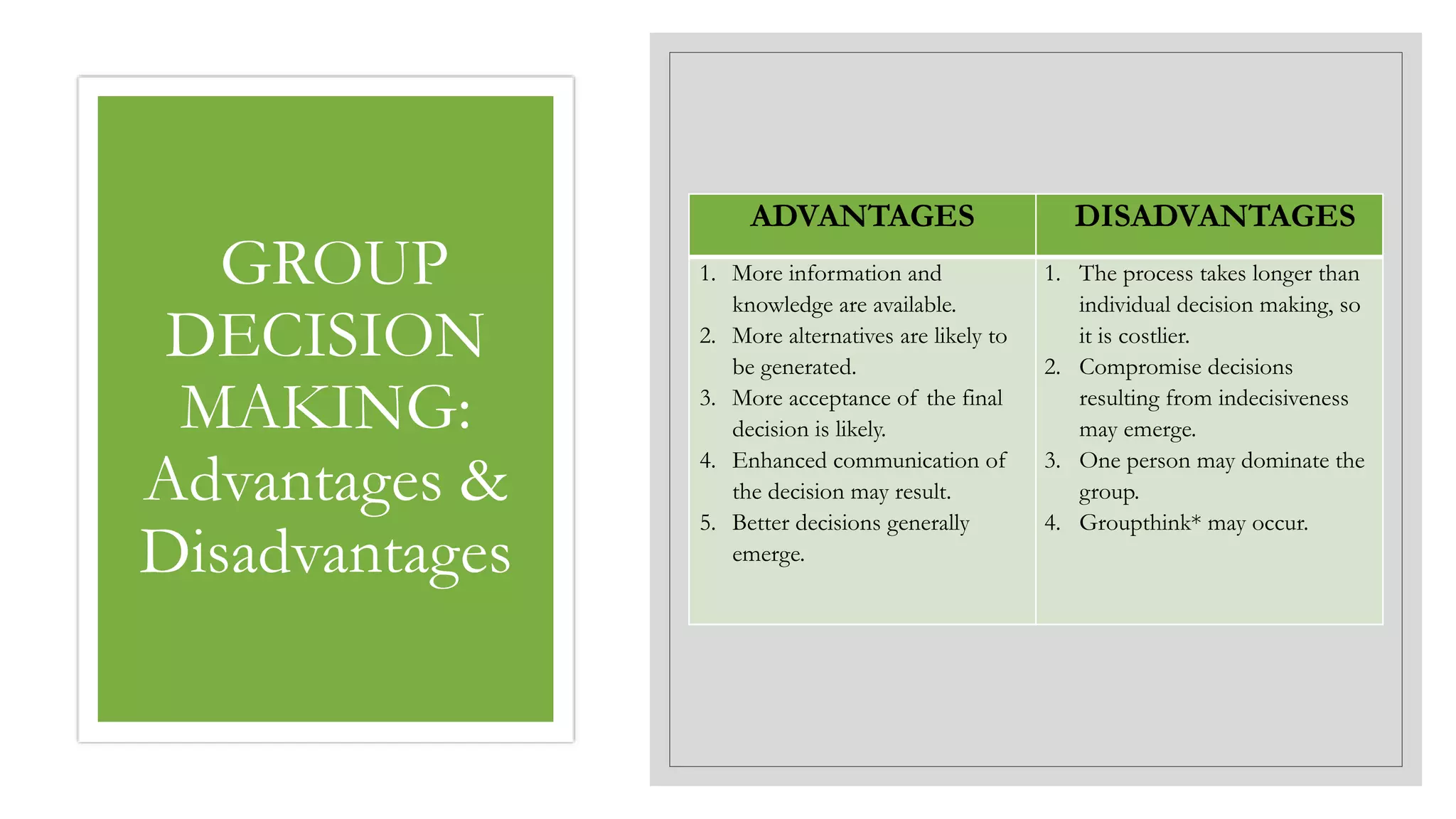
ADVANTAGES DISADVANTAGES
1. More information and
knowledge are available.
2. More alternatives are likely to
be generated.
3. More acceptance of the final
decision is likely.
4. Enhanced communication of
the decision may result.
5. Better decisions generally
emerge.
1. The process takes longer than
individual decision making, so
it is costlier.
2. Compromise decisions
resulting from indecisiveness
may emerge.
3. One person may dominate the
group.
4. Groupthink* may occur.

Chapter 3 decision making (3)

  • 1.
    CHAPTER 3: The Natureof Decision Making FUNDAMENTALS OF MANAGEMENT (MGT 162)
  • 2.
    LEARNING OBJECTIVES ◦ Definition ofdecision making ◦ Types of decision making ◦ Programmed decision ◦ Non-programmed decision ◦ Characteristics of decision making ◦ Decision making process ◦ Group decision making techniques
  • 3.
    DEFINITION ◦ The processthrough which managers identify and resolve problems and capitalize on opportunities. ◦ The process by which a course of action is selected as the way to deal with a specific problem.
  • 4.
    TYPES OF DECISION MAKING Program It isstructured A repetitive decision that can be handled by a routine approach Example: Rules & regulations i.e. UiTM Dress Code, Usage of Student ID Non-Program It is unstructured and requires higher level management. It usually deals with unique, unusual or exceptional problem Non-routine decision making that occurs in response to unusual, unpredictable opportunities and threat Example: Government’s decision to prevent H1N1
  • 5.
    CHARACTERISTICS OF DECISION MAKING •Decision maker know exactly what will happen and able to predict the outcome precisely • e.g.: If you put RM1000 in bank under fixed deposit or a year at 5% interest, then interest earned will be RM50 after 1 year Certainty • A condition under which there is not full knowledge of the problem and reasonable probabilities for alternative outcomes cannot be determined. • A situation in which a decision maker has neither certainty nor reasonable probability about the outcome UnCertainty • Refer to future conditions that are not always known in advance • Decision maker is able to estimate the likelihood of certain outcome based on personal experience or secondary information • Some information is available, but it is not enough to answer all questions about the outcomes Risk • Te goals to be achieved or problem to be solved is unclear, alternatives are difficult to define and information about outcomes is not available Ambiguity
  • 6.
    DECISION MAKING PROCESS (The7 Steps) Identifying opportunities and diagnosing problems Identifying objectives Generating alternatives Evaluating alternatives Reaching decisions Choosing implementation strategies Monitoring and evaluating feedback
  • 7.
    GROUP DECISION MAKING Three (3) majortechniques of group decision making ◦ Brainstorming ◦ A technique used to enhance creativity that encourages group members to generate as many novel ideas as possible on a given topic without evaluating them ◦ Nominal Group Technique (NGT) • Individual members list their ideas on the specific problem and present the ideas at one time, without discussion • Members’ ideas are recorded so that everyone can see them • After all members’ ideas are presented, the group discusses the ideas to clarify and evaluate them ◦ Delphi Technique ◦ An approach that uses the experts to make predictions and forecasts about future events without meeting face-to-face
  • 8.
    GROUP DECISION MAKING: Advantages & Disadvantages ADVANTAGES DISADVANTAGES 1.More information and knowledge are available. 2. More alternatives are likely to be generated. 3. More acceptance of the final decision is likely. 4. Enhanced communication of the decision may result. 5. Better decisions generally emerge. 1. The process takes longer than individual decision making, so it is costlier. 2. Compromise decisions resulting from indecisiveness may emerge. 3. One person may dominate the group. 4. Groupthink* may occur.