Control Structures in C++
1)While
2)do/while,
3)for
4) Switch
5) Break
6)continue
The while Repetition Structure
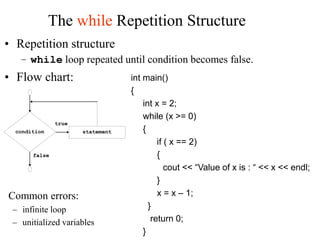
• Repetition structure
– while loop repeated until condition becomes false.
• Flow chart:
condition statement
true
false
int main()
{
int x = 2;
while (x >= 0)
{
if ( x == 2)
{
cout << “Value of x is : “ << x << endl;
}
x = x – 1;
}
return 0;
}
• Common errors:
– infinite loop
– unitialized variables
Example
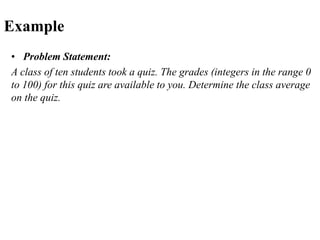
• Problem Statement:
A class of ten students took a quiz. The grades (integers in the range 0
to 100) for this quiz are available to you. Determine the class average
on the quiz.
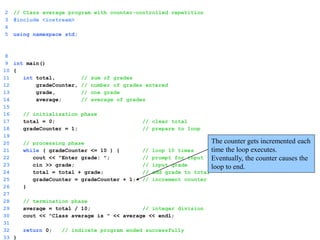
2 // Class average program with counter-controlled repetition
3 #include <iostream>
4
5 using namespace std;
8
9 int main()
10 {
11 int total, // sum of grades
12 gradeCounter, // number of grades entered
13 grade, // one grade
14 average; // average of grades
15
16 // initialization phase
17 total = 0; // clear total
18 gradeCounter = 1; // prepare to loop
19
20 // processing phase
21 while ( gradeCounter <= 10 ) { // loop 10 times
22 cout << "Enter grade: "; // prompt for input
23 cin >> grade; // input grade
24 total = total + grade; // add grade to total
25 gradeCounter = gradeCounter + 1; // increment counter
26 }
27
28 // termination phase
29 average = total / 10; // integer division
30 cout << "Class average is " << average << endl;
31
32 return 0; // indicate program ended successfully
33 }
The counter gets incremented each
time the loop executes.
Eventually, the counter causes the
loop to end.
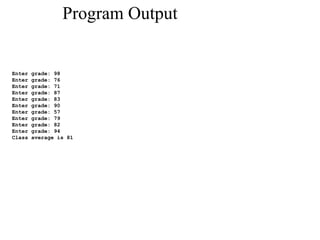
Program Output
Enter grade: 98
Enter grade: 76
Enter grade: 71
Enter grade: 87
Enter grade: 83
Enter grade: 90
Enter grade: 57
Enter grade: 79
Enter grade: 82
Enter grade: 94
Class average is 81
The for Repetition Structure
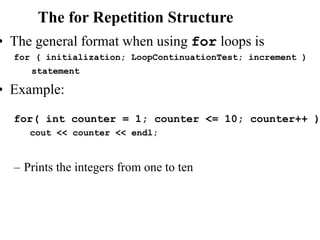
• The general format when using for loops is
for ( initialization; LoopContinuationTest; increment )
statement
• Example:
for( int counter = 1; counter <= 10; counter++ )
cout << counter << endl;
– Prints the integers from one to ten
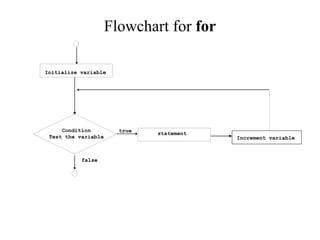
Flowchart for for
Condition
Test the variable
statement
true
false
Increment variable
Initialize variable
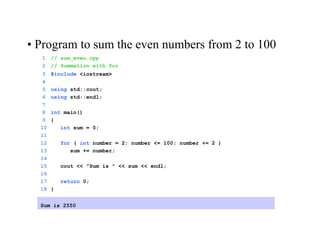
1 // sum_even.cpp
2 // Summation with for
3 #include <iostream>
4
5 using std::cout;
6 using std::endl;
7
8 int main()
9 {
10 int sum = 0;
11
12 for ( int number = 2; number <= 100; number += 2 )
13 sum += number;
14
15 cout << "Sum is " << sum << endl;
16
17 return 0;
18 }
Sum is 2550
• Program to sum the even numbers from 2 to 100
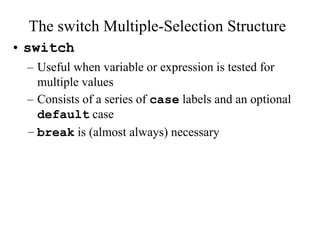
The switch Multiple-Selection Structure
• switch
– Useful when variable or expression is tested for
multiple values
– Consists of a series of case labels and an optional
default case
– break is (almost always) necessary
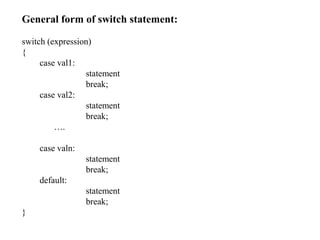
General form of switch statement:
switch (expression)
{
case val1:
statement
break;
case val2:
statement
break;
….
case valn:
statement
break;
default:
statement
break;
}
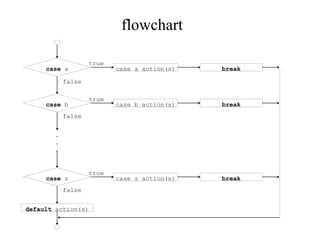
flowchart
true
false
.
.
.
case a case a action(s) break
case b case b action(s) break
false
false
case z case z action(s) break
true
true
default action(s)
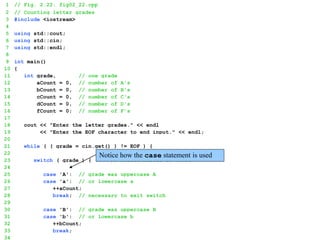
1 // Fig. 2.22: fig02_22.cpp
2 // Counting letter grades
3 #include <iostream>
4
5 using std::cout;
6 using std::cin;
7 using std::endl;
8
9 int main()
10 {
11 int grade, // one grade
12 aCount = 0, // number of A's
13 bCount = 0, // number of B's
14 cCount = 0, // number of C's
15 dCount = 0, // number of D's
16 fCount = 0; // number of F's
17
18 cout << "Enter the letter grades." << endl
19 << "Enter the EOF character to end input." << endl;
20
21 while ( ( grade = cin.get() ) != EOF ) {
22
23 switch ( grade ) { // switch nested in while
24
25 case 'A': // grade was uppercase A
26 case 'a': // or lowercase a
27 ++aCount;
28 break; // necessary to exit switch
29
30 case 'B': // grade was uppercase B
31 case 'b': // or lowercase b
32 ++bCount;
33 break;
34
Notice how the case statement is used
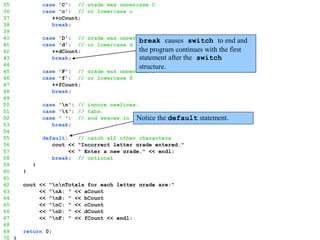
35 case 'C': // grade was uppercase C
36 case 'c': // or lowercase c
37 ++cCount;
38 break;
39
40 case 'D': // grade was uppercase D
41 case 'd': // or lowercase d
42 ++dCount;
43 break;
44
45 case 'F': // grade was uppercase F
46 case 'f': // or lowercase f
47 ++fCount;
48 break;
49
50 case 'n': // ignore newlines,
51 case 't': // tabs,
52 case ' ': // and spaces in input
53 break;
54
55 default: // catch all other characters
56 cout << "Incorrect letter grade entered."
57 << " Enter a new grade." << endl;
58 break; // optional
59 }
60 }
61
62 cout << "nnTotals for each letter grade are:"
63 << "nA: " << aCount
64 << "nB: " << bCount
65 << "nC: " << cCount
66 << "nD: " << dCount
67 << "nF: " << fCount << endl;
68
69 return 0;
70 }
break causes switch to end and
the program continues with the first
statement after the switch
structure.
Notice the default statement.
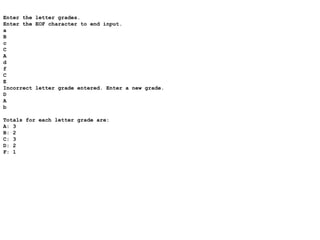
Program Output
Enter the letter grades.
Enter the EOF character to end input.
a
B
c
C
A
d
f
C
E
Incorrect letter grade entered. Enter a new grade.
D
A
b
Totals for each letter grade are:
A: 3
B: 2
C: 3
D: 2
F: 1
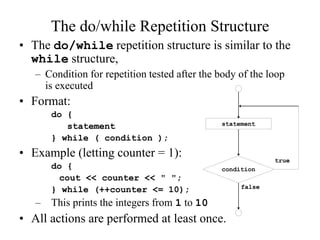
The do/while Repetition Structure
• The do/while repetition structure is similar to the
while structure,
– Condition for repetition tested after the body of the loop
is executed
• Format:
do {
statement
} while ( condition );
• Example (letting counter = 1):
do {
cout << counter << " ";
} while (++counter <= 10);
– This prints the integers from 1 to 10
• All actions are performed at least once.
true
false
statement
condition
The break and continue Statements
• Break
– Causes immediate exit from a while, for,
do/while or switch structure
– Program execution continues with the first
statement after the structure
– Common uses of the break statement:
• Escape early from a loop
• Skip the remainder of a switch structure
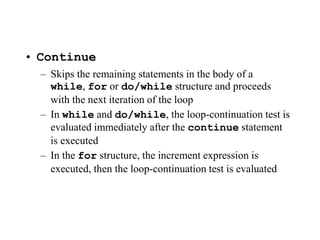
• Continue
– Skips the remaining statements in the body of a
while, for or do/while structure and proceeds
with the next iteration of the loop
– In while and do/while, the loop-continuation test is
evaluated immediately after the continue statement
is executed
– In the for structure, the increment expression is
executed, then the loop-continuation test is evaluated
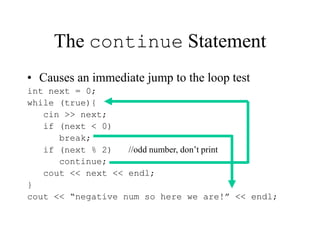
The continue Statement
• Causes an immediate jump to the loop test
int next = 0;
while (true){
cin >> next;
if (next < 0)
break;
if (next % 2) //odd number, don’t print
continue;
cout << next << endl;
}
cout << “negative num so here we are!” << endl;
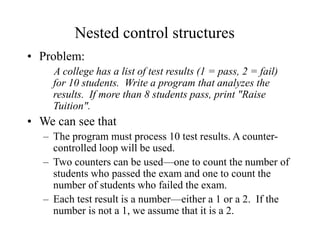
Nested control structures
• Problem:
A college has a list of test results (1 = pass, 2 = fail)
for 10 students. Write a program that analyzes the
results. If more than 8 students pass, print "Raise
Tuition".
• We can see that
– The program must process 10 test results. A counter-
controlled loop will be used.
– Two counters can be used—one to count the number of
students who passed the exam and one to count the
number of students who failed the exam.
– Each test result is a number—either a 1 or a 2. If the
number is not a 1, we assume that it is a 2.
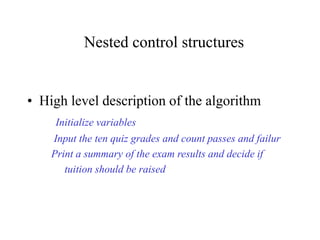
Nested control structures
• High level description of the algorithm
Initialize variables
Input the ten quiz grades and count passes and failur
Print a summary of the exam results and decide if
tuition should be raised
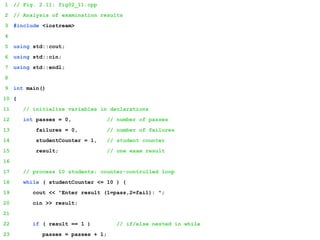
1 // Fig. 2.11: fig02_11.cpp
2 // Analysis of examination results
3 #include <iostream>
4
5 using std::cout;
6 using std::cin;
7 using std::endl;
8
9 int main()
10 {
11 // initialize variables in declarations
12 int passes = 0, // number of passes
13 failures = 0, // number of failures
14 studentCounter = 1, // student counter
15 result; // one exam result
16
17 // process 10 students; counter-controlled loop
18 while ( studentCounter <= 10 ) {
19 cout << "Enter result (1=pass,2=fail): ";
20 cin >> result;
21
22 if ( result == 1 ) // if/else nested in while
23 passes = passes + 1;
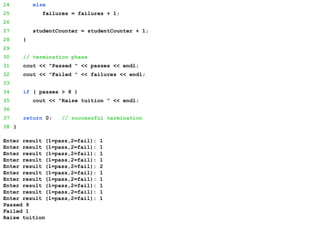
3. Print results
24 else
25 failures = failures + 1;
26
27 studentCounter = studentCounter + 1;
28 }
29
30 // termination phase
31 cout << "Passed " << passes << endl;
32 cout << "Failed " << failures << endl;
33
34 if ( passes > 8 )
35 cout << "Raise tuition " << endl;
36
37 return 0; // successful termination
38 }
Enter result (1=pass,2=fail): 1
Enter result (1=pass,2=fail): 2
Enter result (1=pass,2=fail): 1
Passed 9
Failed 1
Raise tuition
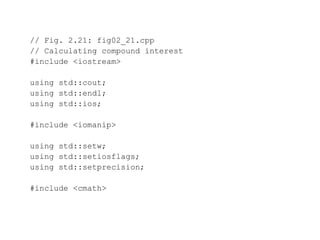
// Fig. 2.21: fig02_21.cpp
// Calculating compound interest
#include <iostream>
using std::cout;
using std::endl;
using std::ios;
#include <iomanip>
using std::setw;
using std::setiosflags;
using std::setprecision;
#include <cmath>
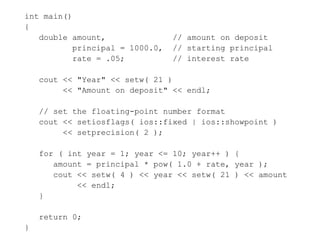
int main()
{
double amount, // amount on deposit
principal = 1000.0, // starting principal
rate = .05; // interest rate
cout << "Year" << setw( 21 )
<< "Amount on deposit" << endl;
// set the floating-point number format
cout << setiosflags( ios::fixed | ios::showpoint )
<< setprecision( 2 );
for ( int year = 1; year <= 10; year++ ) {
amount = principal * pow( 1.0 + rate, year );
cout << setw( 4 ) << year << setw( 21 ) << amount
<< endl;
}
return 0;
}

Chapter 3 Control structures.ppt

  • 1.
    Control Structures inC++ 1)While 2)do/while, 3)for 4) Switch 5) Break 6)continue
  • 2.
    The while RepetitionStructure • Repetition structure – while loop repeated until condition becomes false. • Flow chart: condition statement true false int main() { int x = 2; while (x >= 0) { if ( x == 2) { cout << “Value of x is : “ << x << endl; } x = x – 1; } return 0; } • Common errors: – infinite loop – unitialized variables
  • 3.
    Example • Problem Statement: Aclass of ten students took a quiz. The grades (integers in the range 0 to 100) for this quiz are available to you. Determine the class average on the quiz.
  • 4.
    2 // Classaverage program with counter-controlled repetition 3 #include <iostream> 4 5 using namespace std; 8 9 int main() 10 { 11 int total, // sum of grades 12 gradeCounter, // number of grades entered 13 grade, // one grade 14 average; // average of grades 15 16 // initialization phase 17 total = 0; // clear total 18 gradeCounter = 1; // prepare to loop 19 20 // processing phase 21 while ( gradeCounter <= 10 ) { // loop 10 times 22 cout << "Enter grade: "; // prompt for input 23 cin >> grade; // input grade 24 total = total + grade; // add grade to total 25 gradeCounter = gradeCounter + 1; // increment counter 26 } 27 28 // termination phase 29 average = total / 10; // integer division 30 cout << "Class average is " << average << endl; 31 32 return 0; // indicate program ended successfully 33 } The counter gets incremented each time the loop executes. Eventually, the counter causes the loop to end.
  • 5.
    Program Output Enter grade:98 Enter grade: 76 Enter grade: 71 Enter grade: 87 Enter grade: 83 Enter grade: 90 Enter grade: 57 Enter grade: 79 Enter grade: 82 Enter grade: 94 Class average is 81
  • 6.
    The for RepetitionStructure • The general format when using for loops is for ( initialization; LoopContinuationTest; increment ) statement • Example: for( int counter = 1; counter <= 10; counter++ ) cout << counter << endl; – Prints the integers from one to ten
  • 7.
    Flowchart for for Condition Testthe variable statement true false Increment variable Initialize variable
  • 8.
    1 // sum_even.cpp 2// Summation with for 3 #include <iostream> 4 5 using std::cout; 6 using std::endl; 7 8 int main() 9 { 10 int sum = 0; 11 12 for ( int number = 2; number <= 100; number += 2 ) 13 sum += number; 14 15 cout << "Sum is " << sum << endl; 16 17 return 0; 18 } Sum is 2550 • Program to sum the even numbers from 2 to 100
  • 9.
    The switch Multiple-SelectionStructure • switch – Useful when variable or expression is tested for multiple values – Consists of a series of case labels and an optional default case – break is (almost always) necessary
  • 10.
    General form ofswitch statement: switch (expression) { case val1: statement break; case val2: statement break; …. case valn: statement break; default: statement break; }
  • 11.
    flowchart true false . . . case a casea action(s) break case b case b action(s) break false false case z case z action(s) break true true default action(s)
  • 12.
    1 // Fig.2.22: fig02_22.cpp 2 // Counting letter grades 3 #include <iostream> 4 5 using std::cout; 6 using std::cin; 7 using std::endl; 8 9 int main() 10 { 11 int grade, // one grade 12 aCount = 0, // number of A's 13 bCount = 0, // number of B's 14 cCount = 0, // number of C's 15 dCount = 0, // number of D's 16 fCount = 0; // number of F's 17 18 cout << "Enter the letter grades." << endl 19 << "Enter the EOF character to end input." << endl; 20 21 while ( ( grade = cin.get() ) != EOF ) { 22 23 switch ( grade ) { // switch nested in while 24 25 case 'A': // grade was uppercase A 26 case 'a': // or lowercase a 27 ++aCount; 28 break; // necessary to exit switch 29 30 case 'B': // grade was uppercase B 31 case 'b': // or lowercase b 32 ++bCount; 33 break; 34 Notice how the case statement is used
  • 13.
    35 case 'C':// grade was uppercase C 36 case 'c': // or lowercase c 37 ++cCount; 38 break; 39 40 case 'D': // grade was uppercase D 41 case 'd': // or lowercase d 42 ++dCount; 43 break; 44 45 case 'F': // grade was uppercase F 46 case 'f': // or lowercase f 47 ++fCount; 48 break; 49 50 case 'n': // ignore newlines, 51 case 't': // tabs, 52 case ' ': // and spaces in input 53 break; 54 55 default: // catch all other characters 56 cout << "Incorrect letter grade entered." 57 << " Enter a new grade." << endl; 58 break; // optional 59 } 60 } 61 62 cout << "nnTotals for each letter grade are:" 63 << "nA: " << aCount 64 << "nB: " << bCount 65 << "nC: " << cCount 66 << "nD: " << dCount 67 << "nF: " << fCount << endl; 68 69 return 0; 70 } break causes switch to end and the program continues with the first statement after the switch structure. Notice the default statement.
  • 14.
    Program Output Enter theletter grades. Enter the EOF character to end input. a B c C A d f C E Incorrect letter grade entered. Enter a new grade. D A b Totals for each letter grade are: A: 3 B: 2 C: 3 D: 2 F: 1
  • 15.
    The do/while RepetitionStructure • The do/while repetition structure is similar to the while structure, – Condition for repetition tested after the body of the loop is executed • Format: do { statement } while ( condition ); • Example (letting counter = 1): do { cout << counter << " "; } while (++counter <= 10); – This prints the integers from 1 to 10 • All actions are performed at least once. true false statement condition
  • 16.
    The break andcontinue Statements • Break – Causes immediate exit from a while, for, do/while or switch structure – Program execution continues with the first statement after the structure – Common uses of the break statement: • Escape early from a loop • Skip the remainder of a switch structure
  • 17.
    • Continue – Skipsthe remaining statements in the body of a while, for or do/while structure and proceeds with the next iteration of the loop – In while and do/while, the loop-continuation test is evaluated immediately after the continue statement is executed – In the for structure, the increment expression is executed, then the loop-continuation test is evaluated
  • 18.
    The continue Statement •Causes an immediate jump to the loop test int next = 0; while (true){ cin >> next; if (next < 0) break; if (next % 2) //odd number, don’t print continue; cout << next << endl; } cout << “negative num so here we are!” << endl;
  • 19.
    Nested control structures •Problem: A college has a list of test results (1 = pass, 2 = fail) for 10 students. Write a program that analyzes the results. If more than 8 students pass, print "Raise Tuition". • We can see that – The program must process 10 test results. A counter- controlled loop will be used. – Two counters can be used—one to count the number of students who passed the exam and one to count the number of students who failed the exam. – Each test result is a number—either a 1 or a 2. If the number is not a 1, we assume that it is a 2.
  • 20.
    Nested control structures •High level description of the algorithm Initialize variables Input the ten quiz grades and count passes and failur Print a summary of the exam results and decide if tuition should be raised
  • 21.
    1 // Fig.2.11: fig02_11.cpp 2 // Analysis of examination results 3 #include <iostream> 4 5 using std::cout; 6 using std::cin; 7 using std::endl; 8 9 int main() 10 { 11 // initialize variables in declarations 12 int passes = 0, // number of passes 13 failures = 0, // number of failures 14 studentCounter = 1, // student counter 15 result; // one exam result 16 17 // process 10 students; counter-controlled loop 18 while ( studentCounter <= 10 ) { 19 cout << "Enter result (1=pass,2=fail): "; 20 cin >> result; 21 22 if ( result == 1 ) // if/else nested in while 23 passes = passes + 1;
  • 22.
    3. Print results 24else 25 failures = failures + 1; 26 27 studentCounter = studentCounter + 1; 28 } 29 30 // termination phase 31 cout << "Passed " << passes << endl; 32 cout << "Failed " << failures << endl; 33 34 if ( passes > 8 ) 35 cout << "Raise tuition " << endl; 36 37 return 0; // successful termination 38 } Enter result (1=pass,2=fail): 1 Enter result (1=pass,2=fail): 1 Enter result (1=pass,2=fail): 1 Enter result (1=pass,2=fail): 1 Enter result (1=pass,2=fail): 2 Enter result (1=pass,2=fail): 1 Enter result (1=pass,2=fail): 1 Enter result (1=pass,2=fail): 1 Enter result (1=pass,2=fail): 1 Enter result (1=pass,2=fail): 1 Passed 9 Failed 1 Raise tuition
  • 23.
    // Fig. 2.21:fig02_21.cpp // Calculating compound interest #include <iostream> using std::cout; using std::endl; using std::ios; #include <iomanip> using std::setw; using std::setiosflags; using std::setprecision; #include <cmath>
  • 24.
    int main() { double amount,// amount on deposit principal = 1000.0, // starting principal rate = .05; // interest rate cout << "Year" << setw( 21 ) << "Amount on deposit" << endl; // set the floating-point number format cout << setiosflags( ios::fixed | ios::showpoint ) << setprecision( 2 ); for ( int year = 1; year <= 10; year++ ) { amount = principal * pow( 1.0 + rate, year ); cout << setw( 4 ) << year << setw( 21 ) << amount << endl; } return 0; }