BLM101
Chapter 3: Structured Program
Development in C
1
C How to Program
Deitel & Deitel
 Algorithms
 Pseudocode
 Control Structures
 The if Selection Statement
 The if...else Selection Statement
 The while Repetition Statement
2
Algorithms
 Algorithm is defined as the actions to be executed
in a specific order to solve a given problem.
 Program control is an important concept and it
defiens the specific order in which statements are
to be executed.
3
Pseudocode
 Artificial or informal language which is used to
develop algorithms
 Pseudocodes are not executed on computers.
 They are similar to everyday English.
 Pseudocodes can be converted easily to C
program.
4
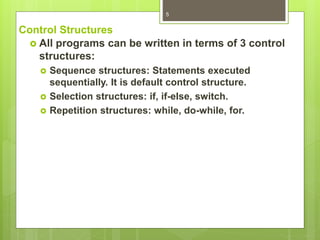
Control Structures
 All programs can be written in terms of 3 control
structures:
 Sequence structures: Statements executed
sequentially. It is default control structure.
 Selection structures: if, if-else, switch.
 Repetition structures: while, do-while, for.
5
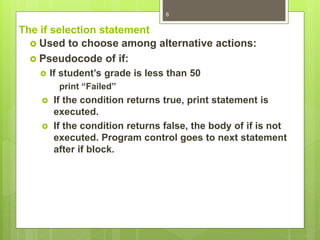
The if selection statement
 Used to choose among alternative actions:
 Pseudocode of if:
 If student’s grade is less than 50
print “Failed”
 If the condition returns true, print statement is
executed.
 If the condition returns false, the body of if is not
executed. Program control goes to next statement
after if block.
6
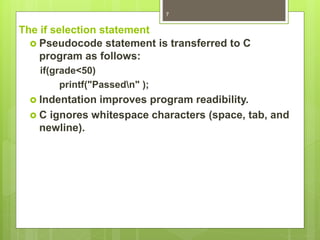
The if selection statement
 Pseudocode statement is transferred to C
program as follows:
if(grade<50)
printf("Passedn" );
 Indentation improves program readibility.
 C ignores whitespace characters (space, tab, and
newline).
7
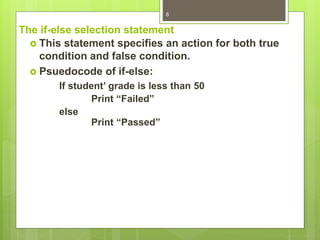
The if-else selection statement
 This statement specifies an action for both true
condition and false condition.
 Psuedocode of if-else:
If student’ grade is less than 50
Print “Failed”
else
Print “Passed”
8
The if-else selection statement
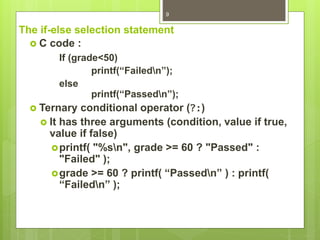
 C code :
If (grade<50)
printf(“Failedn”);
else
printf(“Passedn”);
 Ternary conditional operator (?:)
 It has three arguments (condition, value if true,
value if false)
printf( "%sn", grade >= 60 ? "Passed" :
"Failed" );
grade >= 60 ? printf( “Passedn” ) : printf(
“Failedn” );
9
The if-else selection statement
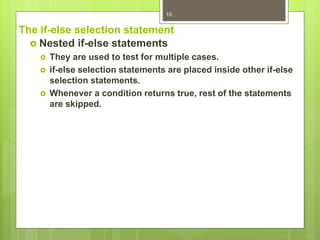
 Nested if-else statements
 They are used to test for multiple cases.
 if-else selection statements are placed inside other if-else
selection statements.
 Whenever a condition returns true, rest of the statements
are skipped.
10
The if-else selection statement
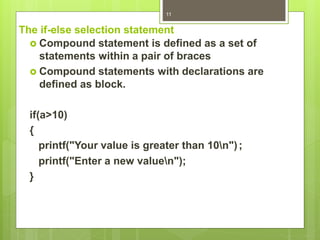
 Compound statement is defined as a set of
statements within a pair of braces
 Compound statements with declarations are
defined as block.
if(a>10)
{
printf("Your value is greater than 10n");
printf("Enter a new valuen");
}
11
The while repetition statement
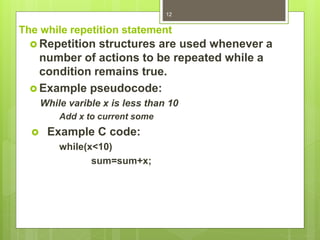
 Repetition structures are used whenever a
number of actions to be repeated while a
condition remains true.
 Example pseudocode:
While varible x is less than 10
Add x to current some
 Example C code:
while(x<10)
sum=sum+x;
12
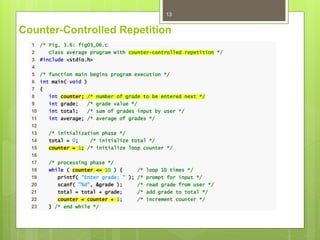
Counter-Controlled Repetition
13
1 /* Fig. 3.6: fig03_06.c
2 Class average program with counter-controlled repetition */
3 #include <stdio.h>
4
5 /* function main begins program execution */
6 int main( void )
7 {
8 int counter; /* number of grade to be entered next */
9 int grade; /* grade value */
10 int total; /* sum of grades input by user */
11 int average; /* average of grades */
12
13 /* initialization phase */
14 total = 0; /* initialize total */
15 counter = 1; /* initialize loop counter */
16
17 /* processing phase */
18 while ( counter <= 10 ) { /* loop 10 times */
19 printf( "Enter grade: " ); /* prompt for input */
20 scanf( "%d", &grade ); /* read grade from user */
21 total = total + grade; /* add grade to total */
22 counter = counter + 1; /* increment counter */
23 } /* end while */
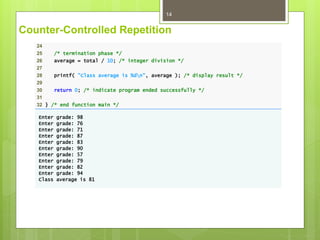
Counter-Controlled Repetition
14
24
25 /* termination phase */
26 average = total / 10; /* integer division */
27
28 printf( "Class average is %dn", average ); /* display result */
29
30 return 0; /* indicate program ended successfully */
31
32 } /* end function main */
Enter grade: 98
Enter grade: 76
Enter grade: 71
Enter grade: 87
Enter grade: 83
Enter grade: 90
Enter grade: 57
Enter grade: 79
Enter grade: 82
Enter grade: 94
Class average is 81
Algorithms (Top-down, stepwise refinement)
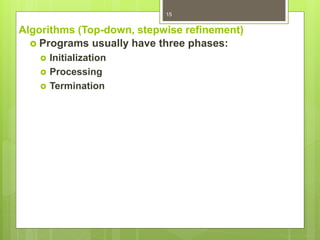
 Programs usually have three phases:
 Initialization
 Processing
 Termination
15
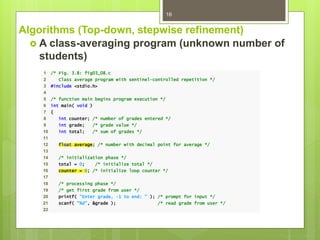
Algorithms (Top-down, stepwise refinement)
 A class-averaging program (unknown number of
students)
16
1 /* Fig. 3.8: fig03_08.c
2 Class average program with sentinel-controlled repetition */
3 #include <stdio.h>
4
5 /* function main begins program execution */
6 int main( void )
7 {
8 int counter; /* number of grades entered */
9 int grade; /* grade value */
10 int total; /* sum of grades */
11
12 float average; /* number with decimal point for average */
13
14 /* initialization phase */
15 total = 0; /* initialize total */
16 counter = 0; /* initialize loop counter */
17
18 /* processing phase */
19 /* get first grade from user */
20 printf( "Enter grade, -1 to end: " ); /* prompt for input */
21 scanf( "%d", &grade ); /* read grade from user */
22
Algorithms (Top-down, stepwise refinement)
 A class-averaging program (unknown number of
students)
17
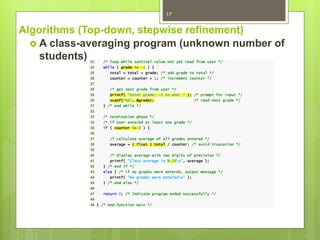
23 /* loop while sentinel value not yet read from user */
24 while ( grade != -1 ) {
25 total = total + grade; /* add grade to total */
26 counter = counter + 1; /* increment counter */
27
28 /* get next grade from user */
29 printf( "Enter grade, -1 to end: " ); /* prompt for input */
30 scanf("%d", &grade); /* read next grade */
31 } /* end while */
32
33 /* termination phase */
34 /* if user entered at least one grade */
35 if ( counter != 0 ) {
36
37 /* calculate average of all grades entered */
38 average = ( float ) total / counter; /* avoid truncation */
39
40 /* display average with two digits of precision */
41 printf( "Class average is %.2fn", average );
42 } /* end if */
43 else { /* if no grades were entered, output message */
44 printf( "No grades were enteredn" );
45 } /* end else */
46
47 return 0; /* indicate program ended successfully */
48
49 } /* end function main */
Algorithms (Top-down, stepwise refinement)
 A class-averaging program (unknown number of
students)
18
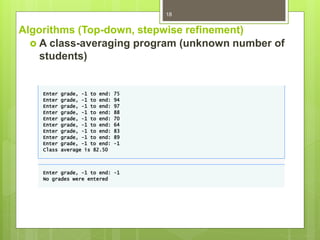
Enter grade, -1 to end: 75
Enter grade, -1 to end: 94
Enter grade, -1 to end: 97
Enter grade, -1 to end: 88
Enter grade, -1 to end: 70
Enter grade, -1 to end: 64
Enter grade, -1 to end: 83
Enter grade, -1 to end: 89
Enter grade, -1 to end: -1
Class average is 82.50
Enter grade, -1 to end: -1
No grades were entered
Algorithms (Top-down, stepwise refinement)
 Nested Control Structures
19
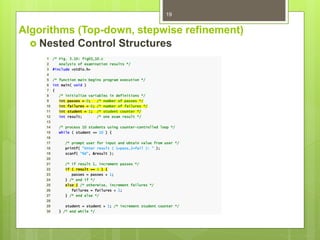
1 /* Fig. 3.10: fig03_10.c
2 Analysis of examination results */
3 #include <stdio.h>
4
5 /* function main begins program execution */
6 int main( void )
7 {
8 /* initialize variables in definitions */
9 int passes = 0; /* number of passes */
10 int failures = 0; /* number of failures */
11 int student = 1; /* student counter */
12 int result; /* one exam result */
13
14 /* process 10 students using counter-controlled loop */
15 while ( student <= 10 ) {
16
17 /* prompt user for input and obtain value from user */
18 printf( "Enter result ( 1=pass,2=fail ): " );
19 scanf( "%d", &result );
20
21 /* if result 1, increment passes */
22 if ( result == 1 ) {
23 passes = passes + 1;
24 } /* end if */
25 else { /* otherwise, increment failures */
26 failures = failures + 1;
27 } /* end else */
28
29 student = student + 1; /* increment student counter */
30 } /* end while */
Algorithms (Top-down, stepwise refinement)
 Nested Control Structures
20
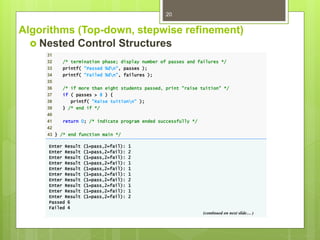
31
32 /* termination phase; display number of passes and failures */
33 printf( "Passed %dn", passes );
34 printf( "Failed %dn", failures );
35
36 /* if more than eight students passed, print "raise tuition" */
37 if ( passes > 8 ) {
38 printf( "Raise tuitionn" );
39 } /* end if */
40
41 return 0; /* indicate program ended successfully */
42
43 } /* end function main */
Enter Result (1=pass,2=fail): 1
Enter Result (1=pass,2=fail): 2
Enter Result (1=pass,2=fail): 1
Enter Result (1=pass,2=fail): 2
Enter Result (1=pass,2=fail): 1
Enter Result (1=pass,2=fail): 2
Passed 6
Failed 4
(continued on next slide… )
Algorithms (Top-down, stepwise refinement)
 Nested Control Structures
21
(continued from previous slide…)
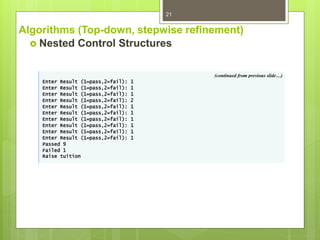
Enter Result (1=pass,2=fail): 1
Enter Result (1=pass,2=fail): 2
Enter Result (1=pass,2=fail): 1
Passed 9
Failed 1
Raise tuition
Assignment Operators
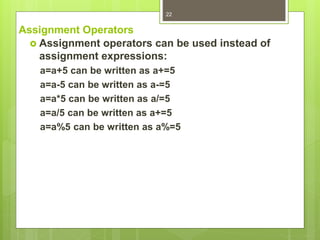
 Assignment operators can be used instead of
assignment expressions:
a=a+5 can be written as a+=5
a=a-5 can be written as a-=5
a=a*5 can be written as a/=5
a=a/5 can be written as a+=5
a=a%5 can be written as a%=5
22
Increment and Decrement Operators
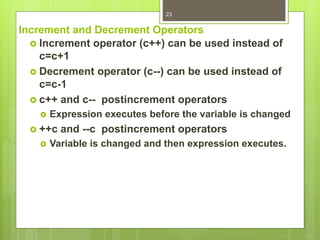
 Increment operator (c++) can be used instead of
c=c+1
 Decrement operator (c--) can be used instead of
c=c-1
 c++ and c-- postincrement operators
 Expression executes before the variable is changed
 ++c and --c postincrement operators
 Variable is changed and then expression executes.
23
Increment and Decrement Operators
24
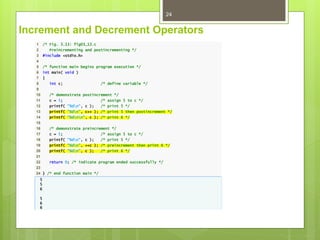
1 /* Fig. 3.13: fig03_13.c
2 Preincrementing and postincrementing */
3 #include <stdio.h>
4
5 /* function main begins program execution */
6 int main( void )
7 {
8 int c; /* define variable */
9
10 /* demonstrate postincrement */
11 c = 5; /* assign 5 to c */
12 printf( "%dn", c ); /* print 5 */
13 printf( "%dn", c++ ); /* print 5 then postincrement */
14 printf( "%dnn", c ); /* print 6 */
15
16 /* demonstrate preincrement */
17 c = 5; /* assign 5 to c */
18 printf( "%dn", c ); /* print 5 */
19 printf( "%dn", ++c ); /* preincrement then print 6 */
20 printf( "%dn", c ); /* print 6 */
21
22 return 0; /* indicate program ended successfully */
23
24 } /* end function main */
5
5
6
5
6
6

BLM101_2.pptx

  • 1.
    BLM101 Chapter 3: StructuredProgram Development in C 1 C How to Program Deitel & Deitel
  • 2.
     Algorithms  Pseudocode Control Structures  The if Selection Statement  The if...else Selection Statement  The while Repetition Statement 2
  • 3.
    Algorithms  Algorithm isdefined as the actions to be executed in a specific order to solve a given problem.  Program control is an important concept and it defiens the specific order in which statements are to be executed. 3
  • 4.
    Pseudocode  Artificial orinformal language which is used to develop algorithms  Pseudocodes are not executed on computers.  They are similar to everyday English.  Pseudocodes can be converted easily to C program. 4
  • 5.
    Control Structures  Allprograms can be written in terms of 3 control structures:  Sequence structures: Statements executed sequentially. It is default control structure.  Selection structures: if, if-else, switch.  Repetition structures: while, do-while, for. 5
  • 6.
    The if selectionstatement  Used to choose among alternative actions:  Pseudocode of if:  If student’s grade is less than 50 print “Failed”  If the condition returns true, print statement is executed.  If the condition returns false, the body of if is not executed. Program control goes to next statement after if block. 6
  • 7.
    The if selectionstatement  Pseudocode statement is transferred to C program as follows: if(grade<50) printf("Passedn" );  Indentation improves program readibility.  C ignores whitespace characters (space, tab, and newline). 7
  • 8.
    The if-else selectionstatement  This statement specifies an action for both true condition and false condition.  Psuedocode of if-else: If student’ grade is less than 50 Print “Failed” else Print “Passed” 8
  • 9.
    The if-else selectionstatement  C code : If (grade<50) printf(“Failedn”); else printf(“Passedn”);  Ternary conditional operator (?:)  It has three arguments (condition, value if true, value if false) printf( "%sn", grade >= 60 ? "Passed" : "Failed" ); grade >= 60 ? printf( “Passedn” ) : printf( “Failedn” ); 9
  • 10.
    The if-else selectionstatement  Nested if-else statements  They are used to test for multiple cases.  if-else selection statements are placed inside other if-else selection statements.  Whenever a condition returns true, rest of the statements are skipped. 10
  • 11.
    The if-else selectionstatement  Compound statement is defined as a set of statements within a pair of braces  Compound statements with declarations are defined as block. if(a>10) { printf("Your value is greater than 10n"); printf("Enter a new valuen"); } 11
  • 12.
    The while repetitionstatement  Repetition structures are used whenever a number of actions to be repeated while a condition remains true.  Example pseudocode: While varible x is less than 10 Add x to current some  Example C code: while(x<10) sum=sum+x; 12
  • 13.
    Counter-Controlled Repetition 13 1 /*Fig. 3.6: fig03_06.c 2 Class average program with counter-controlled repetition */ 3 #include <stdio.h> 4 5 /* function main begins program execution */ 6 int main( void ) 7 { 8 int counter; /* number of grade to be entered next */ 9 int grade; /* grade value */ 10 int total; /* sum of grades input by user */ 11 int average; /* average of grades */ 12 13 /* initialization phase */ 14 total = 0; /* initialize total */ 15 counter = 1; /* initialize loop counter */ 16 17 /* processing phase */ 18 while ( counter <= 10 ) { /* loop 10 times */ 19 printf( "Enter grade: " ); /* prompt for input */ 20 scanf( "%d", &grade ); /* read grade from user */ 21 total = total + grade; /* add grade to total */ 22 counter = counter + 1; /* increment counter */ 23 } /* end while */
  • 14.
    Counter-Controlled Repetition 14 24 25 /*termination phase */ 26 average = total / 10; /* integer division */ 27 28 printf( "Class average is %dn", average ); /* display result */ 29 30 return 0; /* indicate program ended successfully */ 31 32 } /* end function main */ Enter grade: 98 Enter grade: 76 Enter grade: 71 Enter grade: 87 Enter grade: 83 Enter grade: 90 Enter grade: 57 Enter grade: 79 Enter grade: 82 Enter grade: 94 Class average is 81
  • 15.
    Algorithms (Top-down, stepwiserefinement)  Programs usually have three phases:  Initialization  Processing  Termination 15
  • 16.
    Algorithms (Top-down, stepwiserefinement)  A class-averaging program (unknown number of students) 16 1 /* Fig. 3.8: fig03_08.c 2 Class average program with sentinel-controlled repetition */ 3 #include <stdio.h> 4 5 /* function main begins program execution */ 6 int main( void ) 7 { 8 int counter; /* number of grades entered */ 9 int grade; /* grade value */ 10 int total; /* sum of grades */ 11 12 float average; /* number with decimal point for average */ 13 14 /* initialization phase */ 15 total = 0; /* initialize total */ 16 counter = 0; /* initialize loop counter */ 17 18 /* processing phase */ 19 /* get first grade from user */ 20 printf( "Enter grade, -1 to end: " ); /* prompt for input */ 21 scanf( "%d", &grade ); /* read grade from user */ 22
  • 17.
    Algorithms (Top-down, stepwiserefinement)  A class-averaging program (unknown number of students) 17 23 /* loop while sentinel value not yet read from user */ 24 while ( grade != -1 ) { 25 total = total + grade; /* add grade to total */ 26 counter = counter + 1; /* increment counter */ 27 28 /* get next grade from user */ 29 printf( "Enter grade, -1 to end: " ); /* prompt for input */ 30 scanf("%d", &grade); /* read next grade */ 31 } /* end while */ 32 33 /* termination phase */ 34 /* if user entered at least one grade */ 35 if ( counter != 0 ) { 36 37 /* calculate average of all grades entered */ 38 average = ( float ) total / counter; /* avoid truncation */ 39 40 /* display average with two digits of precision */ 41 printf( "Class average is %.2fn", average ); 42 } /* end if */ 43 else { /* if no grades were entered, output message */ 44 printf( "No grades were enteredn" ); 45 } /* end else */ 46 47 return 0; /* indicate program ended successfully */ 48 49 } /* end function main */
  • 18.
    Algorithms (Top-down, stepwiserefinement)  A class-averaging program (unknown number of students) 18 Enter grade, -1 to end: 75 Enter grade, -1 to end: 94 Enter grade, -1 to end: 97 Enter grade, -1 to end: 88 Enter grade, -1 to end: 70 Enter grade, -1 to end: 64 Enter grade, -1 to end: 83 Enter grade, -1 to end: 89 Enter grade, -1 to end: -1 Class average is 82.50 Enter grade, -1 to end: -1 No grades were entered
  • 19.
    Algorithms (Top-down, stepwiserefinement)  Nested Control Structures 19 1 /* Fig. 3.10: fig03_10.c 2 Analysis of examination results */ 3 #include <stdio.h> 4 5 /* function main begins program execution */ 6 int main( void ) 7 { 8 /* initialize variables in definitions */ 9 int passes = 0; /* number of passes */ 10 int failures = 0; /* number of failures */ 11 int student = 1; /* student counter */ 12 int result; /* one exam result */ 13 14 /* process 10 students using counter-controlled loop */ 15 while ( student <= 10 ) { 16 17 /* prompt user for input and obtain value from user */ 18 printf( "Enter result ( 1=pass,2=fail ): " ); 19 scanf( "%d", &result ); 20 21 /* if result 1, increment passes */ 22 if ( result == 1 ) { 23 passes = passes + 1; 24 } /* end if */ 25 else { /* otherwise, increment failures */ 26 failures = failures + 1; 27 } /* end else */ 28 29 student = student + 1; /* increment student counter */ 30 } /* end while */
  • 20.
    Algorithms (Top-down, stepwiserefinement)  Nested Control Structures 20 31 32 /* termination phase; display number of passes and failures */ 33 printf( "Passed %dn", passes ); 34 printf( "Failed %dn", failures ); 35 36 /* if more than eight students passed, print "raise tuition" */ 37 if ( passes > 8 ) { 38 printf( "Raise tuitionn" ); 39 } /* end if */ 40 41 return 0; /* indicate program ended successfully */ 42 43 } /* end function main */ Enter Result (1=pass,2=fail): 1 Enter Result (1=pass,2=fail): 2 Enter Result (1=pass,2=fail): 2 Enter Result (1=pass,2=fail): 1 Enter Result (1=pass,2=fail): 1 Enter Result (1=pass,2=fail): 1 Enter Result (1=pass,2=fail): 2 Enter Result (1=pass,2=fail): 1 Enter Result (1=pass,2=fail): 1 Enter Result (1=pass,2=fail): 2 Passed 6 Failed 4 (continued on next slide… )
  • 21.
    Algorithms (Top-down, stepwiserefinement)  Nested Control Structures 21 (continued from previous slide…) Enter Result (1=pass,2=fail): 1 Enter Result (1=pass,2=fail): 1 Enter Result (1=pass,2=fail): 1 Enter Result (1=pass,2=fail): 2 Enter Result (1=pass,2=fail): 1 Enter Result (1=pass,2=fail): 1 Enter Result (1=pass,2=fail): 1 Enter Result (1=pass,2=fail): 1 Enter Result (1=pass,2=fail): 1 Enter Result (1=pass,2=fail): 1 Passed 9 Failed 1 Raise tuition
  • 22.
    Assignment Operators  Assignmentoperators can be used instead of assignment expressions: a=a+5 can be written as a+=5 a=a-5 can be written as a-=5 a=a*5 can be written as a/=5 a=a/5 can be written as a+=5 a=a%5 can be written as a%=5 22
  • 23.
    Increment and DecrementOperators  Increment operator (c++) can be used instead of c=c+1  Decrement operator (c--) can be used instead of c=c-1  c++ and c-- postincrement operators  Expression executes before the variable is changed  ++c and --c postincrement operators  Variable is changed and then expression executes. 23
  • 24.
    Increment and DecrementOperators 24 1 /* Fig. 3.13: fig03_13.c 2 Preincrementing and postincrementing */ 3 #include <stdio.h> 4 5 /* function main begins program execution */ 6 int main( void ) 7 { 8 int c; /* define variable */ 9 10 /* demonstrate postincrement */ 11 c = 5; /* assign 5 to c */ 12 printf( "%dn", c ); /* print 5 */ 13 printf( "%dn", c++ ); /* print 5 then postincrement */ 14 printf( "%dnn", c ); /* print 6 */ 15 16 /* demonstrate preincrement */ 17 c = 5; /* assign 5 to c */ 18 printf( "%dn", c ); /* print 5 */ 19 printf( "%dn", ++c ); /* preincrement then print 6 */ 20 printf( "%dn", c ); /* print 6 */ 21 22 return 0; /* indicate program ended successfully */ 23 24 } /* end function main */ 5 5 6 5 6 6