Marketing Six Concepts
Chapter 21
Tapping Into Global Markets
Guo,Li (Lisa)
Ateneo Graduate School of Business
May 9, 2013
Outline
• Six Concepts
• Global Markets......
• 1. Four Factors that draws companies into the international arena.
• 2. Three criteria should be rated.
• 3. Developed versus developing markets.
• 4. Best mode of entry.
• 5. Companies decide on a marketing program.
• 6.Companies manage their international marketing activity in three
ways.
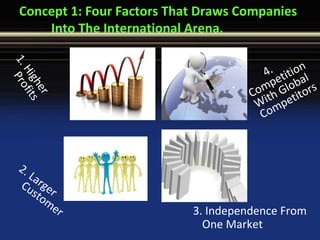
Concept 1: Four Factors That Draws Companies
Into The International Arena.
3. Independence From
One Market
1.Higher
Profits
•   
4.
Competition
With Global
Competitors
2. Larger
Customer
Example of Concept 1
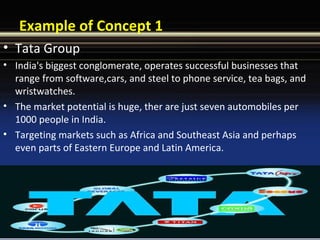
• Tata Group
• India's biggest conglomerate, operates successful businesses that
range from software,cars, and steel to phone service, tea bags, and
wristwatches.
• The market potential is huge, ther are just seven automobiles per
1000 people in India.
• Targeting markets such as Africa and Southeast Asia and perhaps
even parts of Eastern Europe and Latin America.
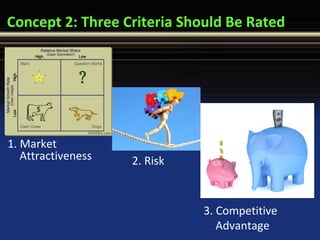
Concept 2: Three Criteria Should Be Rated
1. Market
Attractiveness 2. Risk
3. Competitive
Advantage
Example of Concept 2
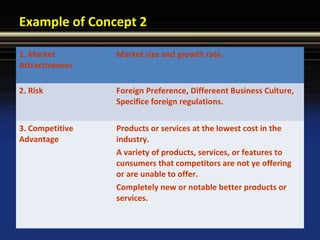
1. Market
Attractiveness
Market size and growth rate.
2. Risk Foreign Preference, Differeent Business Culture,
Specifice foreign regulations.
3. Competitive
Advantage
Products or services at the lowest cost in the
industry.
A variety of products, services, or features to
cunsumers that competitors are not ye offering
or are unable to offer.
Completely new or notable better products or
services.
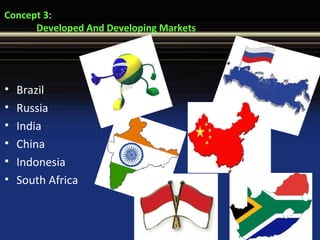
Concept 3:
Developed And Developing Markets
• Brazil
• Russia
• India
• China
• Indonesia
• South Africa
Example of Concept 3
• Each nation has unique features.
• Depend on its demographic,
economic, sociocultural, natural,
technological, and political-legal
environments.
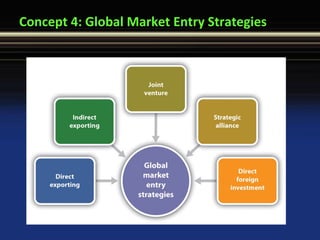
Concept 4: Global Market Entry Strategies
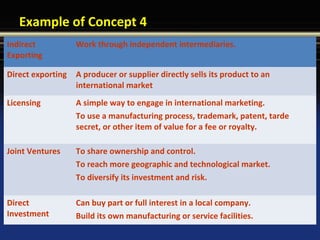
Example of Concept 4
Indirect
Exporting
Work through independent intermediaries.
Direct exporting A producer or supplier directly sells its product to an
international market
Licensing A simple way to engage in international marketing.
To use a manufacturing process, trademark, patent, tarde
secret, or other item of value for a fee or royalty.
Joint Ventures To share ownership and control.
To reach more geographic and technological market.
To diversify its investment and risk.
Direct
Investment
Can buy part or full interest in a local company.
Build its own manufacturing or service facilities.
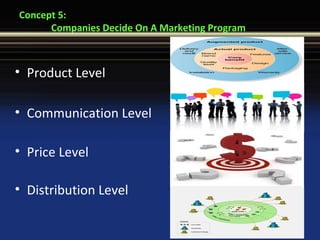
Concept 5:
Companies Decide On A Marketing Program
• Product Level
• Price Level
• Communication Level
• Distribution Level
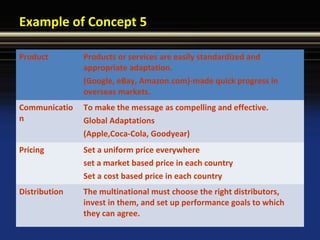
Example of Concept 5
Product Products or services are easily standardized and
appropriate adaptation.
(Google, eBay, Amazon.com)-made quick progress in
overseas markets.
Communicatio
n
To make the message as compelling and effective.
Global Adaptations
(Apple,Coca-Cola, Goodyear)
Pricing Set a uniform price everywhere
set a market based price in each country
Set a cost based price in each country
Distribution The multinational must choose the right distributors,
invest in them, and set up performance goals to which
they can agree.
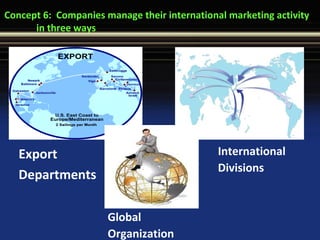
Concept 6: Companies manage their international marketing activity
in three ways
Export
Departments
Global
Organization
International
Divisions
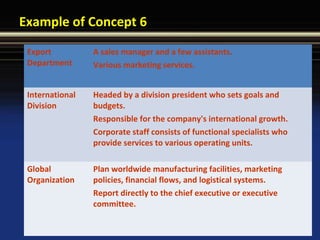
Example of Concept 6
Export
Department
A sales manager and a few assistants.
Various marketing services.
International
Division
Headed by a division president who sets goals and
budgets.
Responsible for the company's international growth.
Corporate staff consists of functional specialists who
provide services to various operating units.
Global
Organization
Plan worldwide manufacturing facilities, marketing
policies, financial flows, and logistical systems.
Report directly to the chief executive or executive
committee.
Summary
• Six Concepts
• Global Markets......
• 1. Four Factors that draws companies into the
international arena.
• 2. Three criteria should be rated.
• 3. Developed versus developing markets.
• 4. Best mode of entry.
• 5. Companies decide on a marketing program.
• 6.Companies manage their international marketing
activity in three ways.

Chapter 21 six concepts

  • 1.
    Marketing Six Concepts Chapter21 Tapping Into Global Markets Guo,Li (Lisa) Ateneo Graduate School of Business May 9, 2013
  • 2.
    Outline • Six Concepts •Global Markets...... • 1. Four Factors that draws companies into the international arena. • 2. Three criteria should be rated. • 3. Developed versus developing markets. • 4. Best mode of entry. • 5. Companies decide on a marketing program. • 6.Companies manage their international marketing activity in three ways.
  • 3.
    Concept 1: FourFactors That Draws Companies Into The International Arena. 3. Independence From One Market 1.Higher Profits •    4. Competition With Global Competitors 2. Larger Customer
  • 4.
    Example of Concept1 • Tata Group • India's biggest conglomerate, operates successful businesses that range from software,cars, and steel to phone service, tea bags, and wristwatches. • The market potential is huge, ther are just seven automobiles per 1000 people in India. • Targeting markets such as Africa and Southeast Asia and perhaps even parts of Eastern Europe and Latin America.
  • 5.
    Concept 2: ThreeCriteria Should Be Rated 1. Market Attractiveness 2. Risk 3. Competitive Advantage
  • 6.
    Example of Concept2 1. Market Attractiveness Market size and growth rate. 2. Risk Foreign Preference, Differeent Business Culture, Specifice foreign regulations. 3. Competitive Advantage Products or services at the lowest cost in the industry. A variety of products, services, or features to cunsumers that competitors are not ye offering or are unable to offer. Completely new or notable better products or services.
  • 7.
    Concept 3: Developed AndDeveloping Markets • Brazil • Russia • India • China • Indonesia • South Africa
  • 8.
    Example of Concept3 • Each nation has unique features. • Depend on its demographic, economic, sociocultural, natural, technological, and political-legal environments.
  • 9.
    Concept 4: GlobalMarket Entry Strategies
  • 10.
    Example of Concept4 Indirect Exporting Work through independent intermediaries. Direct exporting A producer or supplier directly sells its product to an international market Licensing A simple way to engage in international marketing. To use a manufacturing process, trademark, patent, tarde secret, or other item of value for a fee or royalty. Joint Ventures To share ownership and control. To reach more geographic and technological market. To diversify its investment and risk. Direct Investment Can buy part or full interest in a local company. Build its own manufacturing or service facilities.
  • 11.
    Concept 5: Companies DecideOn A Marketing Program • Product Level • Price Level • Communication Level • Distribution Level
  • 12.
    Example of Concept5 Product Products or services are easily standardized and appropriate adaptation. (Google, eBay, Amazon.com)-made quick progress in overseas markets. Communicatio n To make the message as compelling and effective. Global Adaptations (Apple,Coca-Cola, Goodyear) Pricing Set a uniform price everywhere set a market based price in each country Set a cost based price in each country Distribution The multinational must choose the right distributors, invest in them, and set up performance goals to which they can agree.
  • 13.
    Concept 6: Companiesmanage their international marketing activity in three ways Export Departments Global Organization International Divisions
  • 14.
    Example of Concept6 Export Department A sales manager and a few assistants. Various marketing services. International Division Headed by a division president who sets goals and budgets. Responsible for the company's international growth. Corporate staff consists of functional specialists who provide services to various operating units. Global Organization Plan worldwide manufacturing facilities, marketing policies, financial flows, and logistical systems. Report directly to the chief executive or executive committee.
  • 15.
    Summary • Six Concepts •Global Markets...... • 1. Four Factors that draws companies into the international arena. • 2. Three criteria should be rated. • 3. Developed versus developing markets. • 4. Best mode of entry. • 5. Companies decide on a marketing program. • 6.Companies manage their international marketing activity in three ways.