DEVELOPING
A
GLOBAL VISION
Prof. Rajendra Sharma
rajsharma03@yahoo.co.in
Developing a global Vision
• Deciding whether to enter International Markets
• Environmental Analysis Issues in Global Markets
• Deciding Which Markets to Enter
• Ways of entering global marketplace
• The Global Marketing Mix
External Environment Facing
Global Marketers
External Environment: Social
Culture: Set of values shared by group that
determine what is socially acceptable,
including
 social structure
 assumptions and attitudes
 personal beliefs and assumptions
 interpersonal relationships
Economic Environment
• Stages of Development
– Traditional Society
– Pre-Industrial Society
– Takeoff Economy
– Industrializing/Developing
– Fully Industrialized Society
• Buying Power
– Gross National Product- total value of
goods and services produced in a
particular country
– Per capita income- income per person
in a particular country
• Currency
– Exchange rate-price of currency in
terms of another country
Other Environments
• Political and Legal Environment:
– How much control exerted over private organizations?
– Attitude toward foreign business?
– Political Stability?
• Technological Environment
– Levels of Technological Development
– Available Infrastructure
Other Environments
• Competitive Environment
– Government involvement in competition
– Ownership of competitors: local, foreign, government
• Natural Environment
– Resources Available
Deciding Which Markets to
Enter
• Need to first define international marketing
objectives and policies
• Generally, company should enter fewer
countries with a deeper commitment and
penetration in each when
– market entry & control costs high
– product & communication adaptation costs high
– population, income size & growth high in initial countries chosen
– Dominant foreign firms establish high barriers to entry.
More about deciding which
markets to enter
• Some groups of countries to consider
– Triad Markets: United States, Western Europe and Far
East
– Regional Free Trade Zones
» European Union--offers trade opportunities for US
and other non-European nations
» NAFTA--includes US, Canada and Mexico, but will
likely expand to include South American countries
More about deciding which
markets to enter: Consider
• Markets that have psychic proximity
• Markets that are
– high on market attractiveness
– low in market risk
– in which company possesses competitive advantage
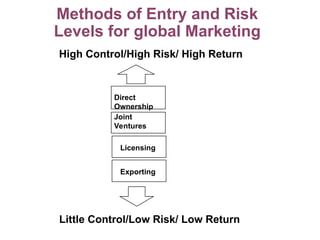
Methods of Entry and Risk
Levels for global Marketing
Direct
Ownership
Joint
Ventures
Licensing
Exporting
High Control/High Risk/ High Return
Little Control/Low Risk/ Low Return
Methods of Entering the Global
Marketplace - Export
+ simple
+ minimal financial risk
- may be less profitable than other mechanisms
• Licensing: Licensor agrees to let another firm
use its manufacturing
+ minimal capital outlay
+ useful for serving countries with export restrictions
- difficult to control licensee
- when licensing agreement ends, licensee may become competitor so licensor
usually supplies some proprietary ingredients or components
- may give up profits
Methods of Entering the Global
Marketplace: Licensing
Methods of Entering the Global
Marketplace: Joint Venture
• Joint Venturing: Domestic firm buys or joins with a foreign company to
create a new entity
+ risk limited to organizations share in venture
+ foreign partner contributes expertise the organization lacks
+ useful when host country limits foreign ownership
- share control with venture partner; may disagree
- partner may learn technology or secrets
– can prevent a multinational company from carrying out specific manufacturing and marketing policies
on a world wide basis
Methods of Entering the Global
Marketplace: Direct Ownership
+ maximum control over foreign operations
+assures company of access to market in case host country
insists purchased goods have domestic content
+ are close to customers
- expensive to set up
- requires extensive knowledge of foreign markets and contacts
overseas
The Global Marketing Mix
• To succeed, must begin with market research
about foreign markets
Product & Promotion
• One Product, One message (global marketing standardization)
• Product Invention: developing new or drastically changing old product
• Message Adaption: maintain basic product, but change promotion
• Product Adaption--slightly alter product
Pricing
• Level:uniform,market based,cost based
• Dumping--the sale of an exported product at a
price lower than that charged for the same or
a like product in the “home” market of the
exporter
• Countertrade: form of trade in which all or
parts of the payment for goods or services is
in the form of other goods or services
Distribution
• Cross country differences in where people go
to buy products
• differences in retail outlets
• Physical infrastructure may be inadequate

Developing global vision for international expansion

  • 1.
    DEVELOPING A GLOBAL VISION Prof. RajendraSharma rajsharma03@yahoo.co.in
  • 2.
    Developing a globalVision • Deciding whether to enter International Markets • Environmental Analysis Issues in Global Markets • Deciding Which Markets to Enter • Ways of entering global marketplace • The Global Marketing Mix
  • 3.
  • 4.
    External Environment: Social Culture:Set of values shared by group that determine what is socially acceptable, including  social structure  assumptions and attitudes  personal beliefs and assumptions  interpersonal relationships
  • 5.
    Economic Environment • Stagesof Development – Traditional Society – Pre-Industrial Society – Takeoff Economy – Industrializing/Developing – Fully Industrialized Society • Buying Power – Gross National Product- total value of goods and services produced in a particular country – Per capita income- income per person in a particular country • Currency – Exchange rate-price of currency in terms of another country
  • 6.
    Other Environments • Politicaland Legal Environment: – How much control exerted over private organizations? – Attitude toward foreign business? – Political Stability? • Technological Environment – Levels of Technological Development – Available Infrastructure
  • 7.
    Other Environments • CompetitiveEnvironment – Government involvement in competition – Ownership of competitors: local, foreign, government • Natural Environment – Resources Available
  • 8.
    Deciding Which Marketsto Enter • Need to first define international marketing objectives and policies • Generally, company should enter fewer countries with a deeper commitment and penetration in each when – market entry & control costs high – product & communication adaptation costs high – population, income size & growth high in initial countries chosen – Dominant foreign firms establish high barriers to entry.
  • 9.
    More about decidingwhich markets to enter • Some groups of countries to consider – Triad Markets: United States, Western Europe and Far East – Regional Free Trade Zones » European Union--offers trade opportunities for US and other non-European nations » NAFTA--includes US, Canada and Mexico, but will likely expand to include South American countries
  • 10.
    More about decidingwhich markets to enter: Consider • Markets that have psychic proximity • Markets that are – high on market attractiveness – low in market risk – in which company possesses competitive advantage
  • 11.
    Methods of Entryand Risk Levels for global Marketing Direct Ownership Joint Ventures Licensing Exporting High Control/High Risk/ High Return Little Control/Low Risk/ Low Return
  • 12.
    Methods of Enteringthe Global Marketplace - Export + simple + minimal financial risk - may be less profitable than other mechanisms
  • 13.
    • Licensing: Licensoragrees to let another firm use its manufacturing + minimal capital outlay + useful for serving countries with export restrictions - difficult to control licensee - when licensing agreement ends, licensee may become competitor so licensor usually supplies some proprietary ingredients or components - may give up profits Methods of Entering the Global Marketplace: Licensing
  • 14.
    Methods of Enteringthe Global Marketplace: Joint Venture • Joint Venturing: Domestic firm buys or joins with a foreign company to create a new entity + risk limited to organizations share in venture + foreign partner contributes expertise the organization lacks + useful when host country limits foreign ownership - share control with venture partner; may disagree - partner may learn technology or secrets – can prevent a multinational company from carrying out specific manufacturing and marketing policies on a world wide basis
  • 15.
    Methods of Enteringthe Global Marketplace: Direct Ownership + maximum control over foreign operations +assures company of access to market in case host country insists purchased goods have domestic content + are close to customers - expensive to set up - requires extensive knowledge of foreign markets and contacts overseas
  • 16.
    The Global MarketingMix • To succeed, must begin with market research about foreign markets
  • 17.
    Product & Promotion •One Product, One message (global marketing standardization) • Product Invention: developing new or drastically changing old product • Message Adaption: maintain basic product, but change promotion • Product Adaption--slightly alter product
  • 18.
    Pricing • Level:uniform,market based,costbased • Dumping--the sale of an exported product at a price lower than that charged for the same or a like product in the “home” market of the exporter • Countertrade: form of trade in which all or parts of the payment for goods or services is in the form of other goods or services
  • 19.
    Distribution • Cross countrydifferences in where people go to buy products • differences in retail outlets • Physical infrastructure may be inadequate