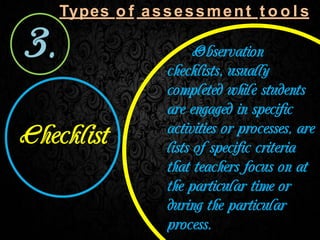
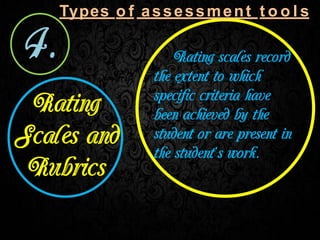
4
Different Normative
Ethical Theories
Commonly Used in
Business Decision
MakingCitation
Prepared by:
Malika D. Usman
Kohlberg's Stages of Moral
Development
The Machiavellian Principles
Utilitarianism The Principles of
Rights and Virtuous : The Kantian
Ethics John Rawls'Principles of
Justice The Moral Positivism of
Hobbes Divine Command of Ethics
Ethical Egoism of Ayn Rand.
Kohlberg’s Stages of Moral
Develpment
psychologist Lawrence Kohlberg developed one
of the best-knoAmericanwn theories exploring
some of these basic questions.2
His work
modified and expanded upon Jean Piaget's
previous work but was more centered on
explaining how children develop moral
reasoning.
How did the two theories differ? Piaget
described a two-stage process of moral
development.3
Kohlberg extended Piaget’s theory, posing
that moral development is a continual process
3 levels of Moral Development
Stages of Moral Development
Kohlberg's theory is broken down into three primary
levels. At each level of moral development, there are
two stages. Similar to how Piaget believed that not all
people reach the highest levels of cognitive
development, Kohlberg believed not everyone
progresses to the highest stages of moral
development.
1. Preconventional morality - morality is the
first stage of moral development, and lasts until
approximately age 9. At the preconventional level
children don't have a personal code of morality, and
instead moral decisions are shaped by the standards of
adults and the consequences of following or breaking
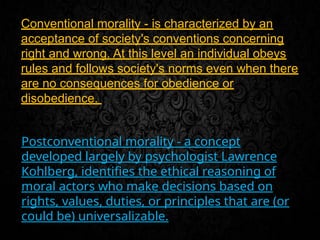
Conventional morality - is characterized by an
acceptance of society's conventions concerning
right and wrong. At this level an individual obeys
rules and follows society's norms even when there
are no consequences for obedience or
disobedience.
Postconventional morality - a concept
developed largely by psychologist Lawrence
Kohlberg, identifies the ethical reasoning of
moral actors who make decisions based on
rights, values, duties, or principles that are (or
could be) universalizable.
The machiavellian principles
 Machiavelli proposed that immoral
behavior, such as the use of deceit
and the murder of innocents, was
normal and effective in politics. He
also notably encouraged politicians
to engage in evil when it would be
necessary for political expediency.
The machiavellian principles
 Machiavelli proposed that immoral
behavior, such as the use of deceit
and the murder of innocents, was
normal and effective in politics. He
also notably encouraged politicians
to engage in evil when it would be
necessary for political expediency.
The machiavellian principles
1. You must believe your own lies.
2. Think about how people suck and
don't deserve your honesty.
3. Recognize that not everyone will be
easy to fool
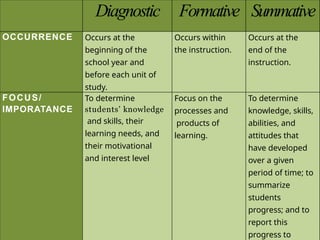
Diagnostic Formative Summative
OCCURRENCE Occurs at the
beginning of the
school year and
before each unit of
study.
Occurs within
the instruction.
Occurs at the
end of the
instruction.
FOCUS/
IMPORATANCE
To determine
students’ knowledge
and skills, their
learning needs, and
their motivational
and interest level
Focus on the
processes and
products of
learning.
To determine
knowledge, skills,
abilities, and
attitudes that
have developed
over a given
period of time; to
summarize
students
progress; and to
report this
progress to
Types o f
a s s es sm e nt
t o o l s
Assessment data
can be collected
and recorded by
both the teacher
and students in a
variety
ways.
Whatever methodofdata
collection isused,
teachers
should:
• meet with students
regularly to discuss
their progress
• adjust rating criteria as
learners change progress.
Types o f assessment t o o l s
•
Types o f assessment t o o l s
Kinds of
Language
Test
Assessment is
perhaps one of the
least understood
areas of language
teaching and
learning
Studentss
e
etesta
sa
threattotheir
c
o
m
p
e
t
e
n
c
e
,b
e
c
a
u
s
e
theyareafraid that
theywill not
perform well..
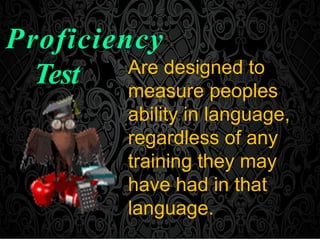
Proficiency
Test Are designed to
measure peoples
ability in language,
regardless of any
training they may
have had in that
language.
Ach iev
ement
Test
Generally, most
teacher will be
involved in the
preparation and use
of achievement tests.
Diagnostic
Test
Are test to
identify learners
strength and
weaknesses.
Placement
Tests
Are their name
suggest, are
intended to provide
information that will
help to place
students at the
stage of the
teaching program
most appropriate to
their abilities.

References
https://www.slideshare.net/FrancisCalubaya
n1/types-of-language-assessment-71892055
https://www.slideshare.net/HennaAnsari/to
ols-of-assessment-201436472
https://www.slideshare.net/geumjen2/kinds-
of-language-tests
END
!
For
Listening

Chapter 2; Types Of Language Assessment.pptx

  • 1.
  • 3.
    Different Normative Ethical Theories CommonlyUsed in Business Decision MakingCitation Prepared by: Malika D. Usman
  • 4.
    Kohlberg's Stages ofMoral Development The Machiavellian Principles Utilitarianism The Principles of Rights and Virtuous : The Kantian Ethics John Rawls'Principles of Justice The Moral Positivism of Hobbes Divine Command of Ethics Ethical Egoism of Ayn Rand.
  • 5.
    Kohlberg’s Stages ofMoral Develpment psychologist Lawrence Kohlberg developed one of the best-knoAmericanwn theories exploring some of these basic questions.2 His work modified and expanded upon Jean Piaget's previous work but was more centered on explaining how children develop moral reasoning. How did the two theories differ? Piaget described a two-stage process of moral development.3 Kohlberg extended Piaget’s theory, posing that moral development is a continual process
  • 6.
    3 levels ofMoral Development Stages of Moral Development Kohlberg's theory is broken down into three primary levels. At each level of moral development, there are two stages. Similar to how Piaget believed that not all people reach the highest levels of cognitive development, Kohlberg believed not everyone progresses to the highest stages of moral development. 1. Preconventional morality - morality is the first stage of moral development, and lasts until approximately age 9. At the preconventional level children don't have a personal code of morality, and instead moral decisions are shaped by the standards of adults and the consequences of following or breaking
  • 7.
    Conventional morality -is characterized by an acceptance of society's conventions concerning right and wrong. At this level an individual obeys rules and follows society's norms even when there are no consequences for obedience or disobedience. Postconventional morality - a concept developed largely by psychologist Lawrence Kohlberg, identifies the ethical reasoning of moral actors who make decisions based on rights, values, duties, or principles that are (or could be) universalizable.
  • 8.
    The machiavellian principles Machiavelli proposed that immoral behavior, such as the use of deceit and the murder of innocents, was normal and effective in politics. He also notably encouraged politicians to engage in evil when it would be necessary for political expediency.
  • 9.
    The machiavellian principles Machiavelli proposed that immoral behavior, such as the use of deceit and the murder of innocents, was normal and effective in politics. He also notably encouraged politicians to engage in evil when it would be necessary for political expediency.
  • 10.
    The machiavellian principles 1.You must believe your own lies. 2. Think about how people suck and don't deserve your honesty. 3. Recognize that not everyone will be easy to fool
  • 11.
    Diagnostic Formative Summative OCCURRENCEOccurs at the beginning of the school year and before each unit of study. Occurs within the instruction. Occurs at the end of the instruction. FOCUS/ IMPORATANCE To determine students’ knowledge and skills, their learning needs, and their motivational and interest level Focus on the processes and products of learning. To determine knowledge, skills, abilities, and attitudes that have developed over a given period of time; to summarize students progress; and to report this progress to
  • 12.
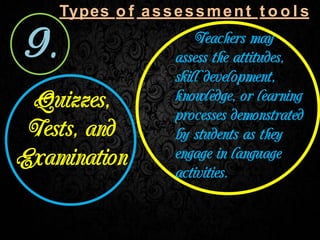
    Types o f as s es sm e nt t o o l s Assessment data can be collected and recorded by both the teacher and students in a variety ways.
  • 13.
    Whatever methodofdata collection isused, teachers should: •meet with students regularly to discuss their progress • adjust rating criteria as learners change progress.
  • 14.
    Types o fassessment t o o l s
  • 16.
    Types o fassessment t o o l s
  • 18.
    Types o fassessment t o o l s
  • 20.
    Types o fassessment t o o l s
  • 22.
    • Types o fassessment t o o l s
  • 24.
    Types o fassessment t o o l s
  • 25.
    Types o fassessment t o o l s
  • 26.
    Types o fassessment t o o l s
  • 27.
    Types o fassessment t o o l s
  • 28.
  • 29.
    Assessment is perhaps oneof the least understood areas of language teaching and learning Studentss e etesta sa threattotheir c o m p e t e n c e ,b e c a u s e theyareafraid that theywill not perform well..
  • 30.
    Proficiency Test Are designedto measure peoples ability in language, regardless of any training they may have had in that language.
  • 31.
    Ach iev ement Test Generally, most teacherwill be involved in the preparation and use of achievement tests.
  • 32.
    Diagnostic Test Are test to identifylearners strength and weaknesses.
  • 33.
    Placement Tests Are their name suggest,are intended to provide information that will help to place students at the stage of the teaching program most appropriate to their abilities.

  • 34.
  • 35.