1
CHAPTER 2 – UNDERSTANDING WINE
QUALITY
2
CHAPTER 2 – UNDERSTANDING WINE QUALITY
Contents
• Introduction
• Texture
• Length of flavour
• Intensity of flavour
• Tannins and bitterness
• Balancing acid and sweetness
• Overall balance
• Focused Tastings
3
CHAPTER 2 – UNDERSTANDING WINE QUALITY
Introduction
• Texture
• Length of fruit flavours on the palate
• Intensity of fruit flavours
• Quality of tannins and lack of bitterness
• Balance between acid and sweetness
• Overall balance of the wine
Several factors combine to influence the quality of
wine as it is consumed:
4
CHAPTER 2 – UNDERSTANDING WINE QUALITY
Texture
• Historically very important:
– “full bodied red”
– “light bodied white”
• Technology has eroded this
quality benchmark:
“thin but fruity”
X “textured but no flavour”
• Malo-Lactic Fermentation
(MLF) adds texture – “the
Chardonnay effect”
5
CHAPTER 2 – UNDERSTANDING WINE QUALITY
Texture
Measuring texture on a scale 1 –
5
(1 as thin as water)
(5 as thick as tomato juice)
1. Chablis, Dry Riesling, Vinho Verde
2. Red Beaujolais, Villages Burgundy,
NZ Sauvignon Blanc
3. Most Chardonnay, commercial reds,
Chianti
4. Sauternes or Botrytis Semillon,
“Parkerised” Reds
5. Australian Shiraz, US Zinfandel,
Vintage Port
6
CHAPTER 2 – UNDERSTANDING WINE QUALITY
Length of fruit flavours
• The single most
important quality factor
• A wine with longer
lasting flavours in the
mouth is better quality
than one that
disappears as soon as
you swallow it.
7
CHAPTER 2 – UNDERSTANDING WINE QUALITY
Intensity of flavour
• Traditionally, the more
intense the better the
quality.
• Now – technology can
create super charged
artificially concentrated
wines (excessive).
• Should be an appropriate
level in respect to overall
taste.
8
CHAPTER 2 – UNDERSTANDING WINE QUALITY
Tannins and bitterness
• Bitter wines are simply
inferior wines.
• Two common sources of
tannins and bitterness:
1. Grapes (stalks, skins,
seeds)
2. Wood (oak barrels used
for maturation)
• Tannins are important for
red wine, but mismanaged
lead to bitterness.
9
CHAPTER 2 – UNDERSTANDING WINE QUALITY
Balancing acid and sweetness
• Acidity is a very important
component of wine – it protects
against bacteria and preserves
the colour of red wine.
• For a drink to appear
“refreshing”, the human palate
needs to encounter some acid.
• If the climate is too hot – grapes
over-ripen, gain fruit sweetness
but loose acid (may have to add
some extra acid otherwise will
taste dull or “flabby”).
10
CHAPTER 2 – UNDERSTANDING WINE QUALITY
Balancing acid and sweetness
• If the climate is too cold –
grapes don’t ripen, so too
much acid (may have add
sugar to stop wine tasting
sharp).
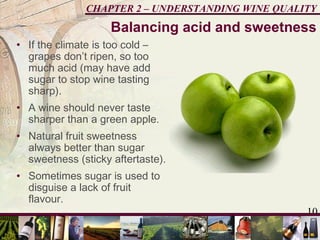
• A wine should never taste
sharper than a green apple.
• Natural fruit sweetness
always better than sugar
sweetness (sticky aftertaste).
• Sometimes sugar is used to
disguise a lack of fruit
flavour.
11
CHAPTER 2 – UNDERSTANDING WINE QUALITY
Overall balance (red wines)
12
CHAPTER 2 – UNDERSTANDING WINE QUALITY
Overall balance (white wines)

Chapter 2 - Quality

  • 1.
    1 CHAPTER 2 –UNDERSTANDING WINE QUALITY
  • 2.
    2 CHAPTER 2 –UNDERSTANDING WINE QUALITY Contents • Introduction • Texture • Length of flavour • Intensity of flavour • Tannins and bitterness • Balancing acid and sweetness • Overall balance • Focused Tastings
  • 3.
    3 CHAPTER 2 –UNDERSTANDING WINE QUALITY Introduction • Texture • Length of fruit flavours on the palate • Intensity of fruit flavours • Quality of tannins and lack of bitterness • Balance between acid and sweetness • Overall balance of the wine Several factors combine to influence the quality of wine as it is consumed:
  • 4.
    4 CHAPTER 2 –UNDERSTANDING WINE QUALITY Texture • Historically very important: – “full bodied red” – “light bodied white” • Technology has eroded this quality benchmark: “thin but fruity” X “textured but no flavour” • Malo-Lactic Fermentation (MLF) adds texture – “the Chardonnay effect”
  • 5.
    5 CHAPTER 2 –UNDERSTANDING WINE QUALITY Texture Measuring texture on a scale 1 – 5 (1 as thin as water) (5 as thick as tomato juice) 1. Chablis, Dry Riesling, Vinho Verde 2. Red Beaujolais, Villages Burgundy, NZ Sauvignon Blanc 3. Most Chardonnay, commercial reds, Chianti 4. Sauternes or Botrytis Semillon, “Parkerised” Reds 5. Australian Shiraz, US Zinfandel, Vintage Port
  • 6.
    6 CHAPTER 2 –UNDERSTANDING WINE QUALITY Length of fruit flavours • The single most important quality factor • A wine with longer lasting flavours in the mouth is better quality than one that disappears as soon as you swallow it.
  • 7.
    7 CHAPTER 2 –UNDERSTANDING WINE QUALITY Intensity of flavour • Traditionally, the more intense the better the quality. • Now – technology can create super charged artificially concentrated wines (excessive). • Should be an appropriate level in respect to overall taste.
  • 8.
    8 CHAPTER 2 –UNDERSTANDING WINE QUALITY Tannins and bitterness • Bitter wines are simply inferior wines. • Two common sources of tannins and bitterness: 1. Grapes (stalks, skins, seeds) 2. Wood (oak barrels used for maturation) • Tannins are important for red wine, but mismanaged lead to bitterness.
  • 9.
    9 CHAPTER 2 –UNDERSTANDING WINE QUALITY Balancing acid and sweetness • Acidity is a very important component of wine – it protects against bacteria and preserves the colour of red wine. • For a drink to appear “refreshing”, the human palate needs to encounter some acid. • If the climate is too hot – grapes over-ripen, gain fruit sweetness but loose acid (may have to add some extra acid otherwise will taste dull or “flabby”).
  • 10.
    10 CHAPTER 2 –UNDERSTANDING WINE QUALITY Balancing acid and sweetness • If the climate is too cold – grapes don’t ripen, so too much acid (may have add sugar to stop wine tasting sharp). • A wine should never taste sharper than a green apple. • Natural fruit sweetness always better than sugar sweetness (sticky aftertaste). • Sometimes sugar is used to disguise a lack of fruit flavour.
  • 11.
    11 CHAPTER 2 –UNDERSTANDING WINE QUALITY Overall balance (red wines)
  • 12.
    12 CHAPTER 2 –UNDERSTANDING WINE QUALITY Overall balance (white wines)