Wallaga University
Introduction to Artificial Intelligence
Chapter two: Intelligent Agents
1
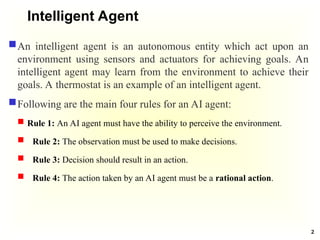
Intelligent Agent
[
An intelligent agent is an autonomous entity which act upon an
environment using sensors and actuators for achieving goals. An
intelligent agent may learn from the environment to achieve their
goals. A thermostat is an example of an intelligent agent.
Following are the main four rules for an AI agent:
 Rule 1: An AI agent must have the ability to perceive the environment.
 Rule 2: The observation must be used to make decisions.
 Rule 3: Decision should result in an action.
 Rule 4: The action taken by an AI agent must be a rational action.
2
Agents in Artificial Intelligence
An AI system can be defined as the study of the rational agent and
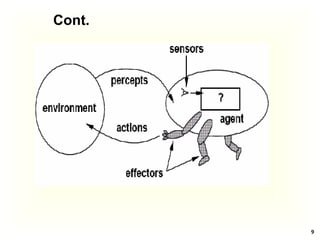
its environment. The agents sense the environment through sensors
and act on their environment through actuators. An AI agent can
have mental properties such as knowledge, belief, intention, etc.
What is an Agent?
• An agent can be anything that perceive its environment through
sensors and act upon that environment through actuators. An
Agent runs in the cycle of perceiving, thinking, and acting. An
agent can be:
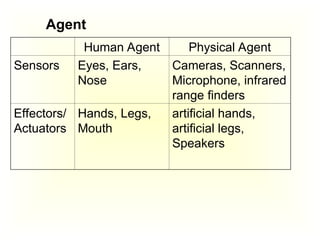
Human-Agent: A human agent has eyes, ears, and other organs which work
for sensors and hand, legs, vocal tract work for actuators.
Agent
Robotic Agent: A robotic agent can have cameras, infrared range
finder, NLP for sensors and various motors for actuators.
Software Agent: Software agent can have keyboard, file contents
as sensory input and act on those inputs and display output on the
screen. Hence the world around us is full of agents such as
thermostat, cellphone, camera, and even we are also agents.
 The agent is assumed to exist in an environment in which it
perceives and acts. Before moving forward, we should first know
about sensors, effectors, and actuators.
Sensor: is a device which detects the change in the environment
and sends the information to other electronic devices. An agent
observes its environment through sensors.
4
Cont..
Actuators: Actuators are the component of machines that converts
energy into motion. are only responsible for moving and controlling
a system. can be an electric motor, gears, rails, etc.
Effectors: are the devices which affect the environment. can be legs,
wheels, arms, fingers, wings, fins, and display screen. Actuator
component.
Rational Agent:
 is one that does the right thing.
 is an agent which has clear preference, models uncertainty, and
acts in a way to maximize its performance measure with all
possible actions. Logically clear.
5
Cont..
In summary what is rational at any given point depends on PEAS
(Performance measure, Environment, Actuators, Sensors)
framework.
Performance measure: defines degrees of success of the agent
Environment-
Knowledge: What an agent already knows about the environment
Actuators – generating actions
The actions that the agent can perform back to the environment
Percept sequence(sensors-receiving percept)
Perception: Everything that the agent has perceived so far
concerning the current scenario in the environment 6
Cont.
is said to perform the right things. AI is about creating rational
agents to use for game theory and decision theory for various real-
world scenarios.
For an AI agent, the rational action is most important because in AI
reinforcement learning algorithm, for each best possible action,
agent gets the positive reward and for each wrong action, an agent
gets a negative reward.
 An agent is rational since it does the right thing to achieve the specified goal
 The right action is the one that will cause the agent to be most successful.
Note: Rational agents in AI are very similar to intelligent agents.
7
Rationality
The rationality of an agent is measured by its performance measure.
Rationality can be judged on the basis of following points:
 Performance measure which defines the success criterion.
 Agent prior knowledge of its environment.
 Best possible actions that an agent can perform.
 The sequence of percepts.
Note: Rationality differs from Omniscience because an Omniscient
agent knows the actual outcome of its action and act accordingly,
which is not possible in reality.
8
Cont.
9
Agent
Human Agent Physical Agent
Sensors Eyes, Ears,
Nose
Cameras, Scanners,
Microphone, infrared
range finders
Effectors/
Actuators
Hands, Legs,
Mouth
artificial hands,
artificial legs,
Speakers
How Agents should act?
A rational agent should strive to "do the right thing", based on what
it can perceive and the actions it can perform.
 What does right thing mean?
 It is an action that will cause the agent to be most successful and
is expected to maximize goal achievement, given the available
information
A rational agent is not omniscient
 An Omniscient agent knows the actual outcome of its actions, and
can act accordingly, but in reality omniscience is impossible.
 Rational agents take action with expected success, where as
omniscient agent take action with 100% sure of its success
Are human beings Omniscient or Rational agent?
Performance measure
How do we decide whether an agent is successful or not?
 Establish a standard of what it means to be successful in
an environment and use it to measure the performance
 A rational agent should do whatever action is expected to
maximize its performance measure, on the basis of the
evidence provided by the percept sequence and whatever
built-in knowledge the agent has.
What is the performance measure for “crossing the road”?
What about “Chess Playing”?
Example: PEAS
Consider the task of designing an automated taxi
driver agent; with the goal of “creating comfortable
trip and maximize profits”:
 Performance measure: Safe, Speed, follow traffic rule
 Environment: Roads, other traffic, pedestrians, customers
 Actuators: Artificial legs & hands, Speaker
 Sensors: Cameras, GPS, engine sensors, recorder
(microphone)
 Goal: driving safely from source to destination point
Autonomy
 If the agent's actions are based completely on built-in knowledge, such
that its AUTONOMY need pay no attention to its percepts, then we say
that the agent lacks autonomy
 For example, if the clock manufacturer already knows that the clock's
owner would be going to Australia at some particular date, then a
mechanism could be built in to adjust the hands automatically by some
hours at just the right time
 This would certainly be successful behavior, but the intelligence seems to
belong to the clock's designer rather than to the clock itself
 An agent's behavior can be based on both its own experience and
the built-in knowledge
 as evolution provides animals with enough built-in reflexes so that
they can survive long enough to learn for themselves,
 it would be reasonable to provide an artificial intelligent agent with some initial
knowledge as well as an ability to learn
14
Types of AI Agents
Agents can be grouped into five classes based on their
degree of perceived intelligence and capability. All these
agents can improve their performance and generate better
action over the time. These are given below:
 Simple Reflex Agent
 Model-based reflex agent
 Goal-based agents
 Utility-based agent
 Learning agent
Types of AI Agents Cont..
Simple Reflex agent:
 are the simplest agents.
 These agents take decisions on the basis of the current
percepts and ignore the rest of the percept history.
 These agents only succeed in the fully observable
environment.
 It does not consider any part of percepts history during their
decision and action process.
Cont..
works on Condition-action rule, which means it maps the current
state to action. Such as a Room Cleaner agent, it works only if there
is dirt in the room.
 Problems for the simple reflex agent design approach:
o They have very limited intelligence
o They do not have knowledge of non-perceptual parts of the current
state
o Mostly too big to generate and to store.
o Not adaptive to changes in the environment.
Model-based reflex agent
can work in a partially observable environment, and track the
situation. It works by finding a rules whose condition matches the
current situations. Can handle partial observable environment.
has two important factors:
o Model: It is knowledge about "how things happen in the world," so
it is called a Model-based agent.
o Internal State: It is a representation of the current state based on
percept history.
These agents have the model, "which is knowledge of the world"
and based on the model they perform actions.
Updating the agent state requires information about:
a. How the world evolves b. How the agent's action affects the world.
3. Goal based agents
 Choose actions that achieve the goal (an agent with explicit goals).
expand the capabilities of the model-based agent by having the
"goal" information.
 Involves consideration of the future:
 Knowing about the current state of the environment is not
always enough to decide what to do.
 For example, at a road junction, the taxi can turn left, right or go
straight.
 The right decision depends on where the taxi is trying to get to.
Goal based agents cont..
 As well as a current state description, the agent needs some sort of
goal information, which describes situations that are desirable.
E.g. being at the passenger's destination.
 The agent may need to consider long sequences, twists and
turns to find a way to achieve a goal.
 Focuses only on reaching the goal set and hence the
decision took by the agent is based on how far it is currently
from their goals or desired state.
4.Utility based agents
 Goals are not really enough to generate high quality behavior. act
based not only goals but also the best way to achieve the goal.
For e.g., there are many action sequences that will get the taxi to its
destination, thereby achieving the goal. Some are quicker, safer,
more reliable, or cheaper than others. We need to consider Speed
and safety.
 When there are several goals that the agent can aim for, non of
which can be achieved with certainty.
 is useful when there are multiple possible alternatives, and an agent
has to choose in order to perform the best action.
 are similar to the goal-based agent but provide an extra component
of utility measurement which makes them different by providing a
measure of success at a given state.
5. Learning Agent
is the type of agent which can learn from its past experiences, or it
has learning capabilities. It starts to act with basic knowledge and
then able to act and adapt automatically through learning. has mainly
four conceptual components, which are:
a. Learning element: It is responsible for making improvements by
learning from environment
b. Critic: Learning element takes feedback from critic which describes
that how well the agent is doing with respect to a fixed performance
standard.
c. Performance element: It is responsible for selecting external action
d. Problem generator: is responsible for suggesting actions that will
lead to new and informative experiences.
Hence, learning agents are able to learn, analyze performance, and
look for new ways to improve the performance. 22
Agent and Environments
Agents design is affected by the environment
 actions are done by the agent on the environment, which in turn
provides percepts to the agent
There are different Features (properties) of an environment
1. Fully observable vs Partially Observable:
If an agent sensor can sense or access the complete state of an
environment at each point of time then it is a fully observable
environment, else it is partially observable.
A fully observable environment is easy as there is no need to
maintain the internal state to keep track history of the world.
An agent with no sensors in all environments then such an
environment is called as unobservable.
23
2. Deterministic vs Stochastic:
If an agent's current state and selected action can completely
determine the next state of the environment, then such environment is
called a deterministic environment.
A stochastic environment is random in nature and cannot be
determined completely by an agent.
In a deterministic, fully observable environment, agent does not need
to worry about uncertainty.
3. Episodic vs Sequential:
 In an episodic environment, there is a series of one-shot actions,
and only the current percept is required for the action. o However,
in Sequential environment, an agent requires memory of past
actions to determine the next best actions.
24
4. Single-agent vs Multi-agent
If only one agent is involved in an environment, and operating
by itself then such an environment is called single agent
environment. However, if multiple agents are operating in an
environment, then such an environment is called a multi-agent
environment. The agent design problems in the multi-agent
environment are different from single agent environment.
5. Static vs Dynamic: If the environment can change itself while an
agent is deliberating then such environment is called a dynamic
environment else it is called a static environment.
25
Cont..
Static environments are easy to deal because an agent does
not need to continue looking at the world while deciding for an
action. However for dynamic environment, agents need to keep
looking at the world at each action.
 Taxi driving is an example of a dynamic environment whereas
Crossword puzzles are an example of a static environment.
6. Discrete vs Continuous: If in an environment there are a
finite number of percepts and actions that can be performed
within it, then such an environment is called a discrete
environment else it is called continuous environment. 26
Cont.
A chess game comes under discrete environment as there is a
finite number of moves that can be performed.
 A self-driving car is an example of a continuous environment.
7. Known vs Unknown:- both are not actually a feature of an
environment, but it is an agent's state of knowledge to perform
an action. In a known environment, the results for all actions
are known to the agent. While in unknown environment,
agent needs to learn how it works in order to perform an
action.
27
Cont.
It is quite possible that a known environment to be partially
observable and an Unknown environment to be fully
observable.
8. Accessible vs Inaccessible:-
If an agent can obtain complete and accurate information about
the state's environment, then such an environment is called
an Accessible environment else it is called inaccessible. An
empty room whose state can be defined by its temperature is
an example of an accessible environment. Information about
an event on earth is an example of Inaccessible environment.
28
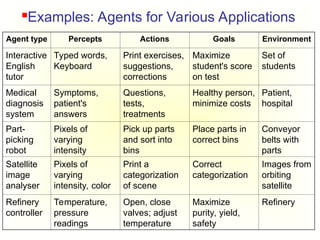
Agent type Percepts Actions Goals Environment
Interactive
English
tutor
Typed words,
Keyboard
Print exercises,
suggestions,
corrections
Maximize
student's score
on test
Set of
students
Medical
diagnosis
system
Symptoms,
patient's
answers
Questions,
tests,
treatments
Healthy person,
minimize costs
Patient,
hospital
Part-
picking
robot
Pixels of
varying
intensity
Pick up parts
and sort into
bins
Place parts in
correct bins
Conveyor
belts with
parts
Satellite
image
analyser
Pixels of
varying
intensity, color
Print a
categorization
of scene
Correct
categorization
Images from
orbiting
satellite
Refinery
controller
Temperature,
pressure
readings
Open, close
valves; adjust
temperature
Maximize
purity, yield,
safety
Refinery
Examples: Agents for Various Applications
Chapter Review Quiz
Report the following (20minute)
1. What is rationality of intelligent agents?
2. What is agent sensor?
3. What is agent effectors?
4. What is intelligent autonomy?
5. What is precept sequence-action mapping?
6. Why the design of intelligent agent is complex?
30
chapter -2 Intelligent Agents power Point .ppt

  • 1.
    Wallaga University Introduction toArtificial Intelligence Chapter two: Intelligent Agents 1
  • 2.
    Intelligent Agent [ An intelligentagent is an autonomous entity which act upon an environment using sensors and actuators for achieving goals. An intelligent agent may learn from the environment to achieve their goals. A thermostat is an example of an intelligent agent. Following are the main four rules for an AI agent:  Rule 1: An AI agent must have the ability to perceive the environment.  Rule 2: The observation must be used to make decisions.  Rule 3: Decision should result in an action.  Rule 4: The action taken by an AI agent must be a rational action. 2
  • 3.
    Agents in ArtificialIntelligence An AI system can be defined as the study of the rational agent and its environment. The agents sense the environment through sensors and act on their environment through actuators. An AI agent can have mental properties such as knowledge, belief, intention, etc. What is an Agent? • An agent can be anything that perceive its environment through sensors and act upon that environment through actuators. An Agent runs in the cycle of perceiving, thinking, and acting. An agent can be: Human-Agent: A human agent has eyes, ears, and other organs which work for sensors and hand, legs, vocal tract work for actuators.
  • 4.
    Agent Robotic Agent: Arobotic agent can have cameras, infrared range finder, NLP for sensors and various motors for actuators. Software Agent: Software agent can have keyboard, file contents as sensory input and act on those inputs and display output on the screen. Hence the world around us is full of agents such as thermostat, cellphone, camera, and even we are also agents.  The agent is assumed to exist in an environment in which it perceives and acts. Before moving forward, we should first know about sensors, effectors, and actuators. Sensor: is a device which detects the change in the environment and sends the information to other electronic devices. An agent observes its environment through sensors. 4
  • 5.
    Cont.. Actuators: Actuators arethe component of machines that converts energy into motion. are only responsible for moving and controlling a system. can be an electric motor, gears, rails, etc. Effectors: are the devices which affect the environment. can be legs, wheels, arms, fingers, wings, fins, and display screen. Actuator component. Rational Agent:  is one that does the right thing.  is an agent which has clear preference, models uncertainty, and acts in a way to maximize its performance measure with all possible actions. Logically clear. 5
  • 6.
    Cont.. In summary whatis rational at any given point depends on PEAS (Performance measure, Environment, Actuators, Sensors) framework. Performance measure: defines degrees of success of the agent Environment- Knowledge: What an agent already knows about the environment Actuators – generating actions The actions that the agent can perform back to the environment Percept sequence(sensors-receiving percept) Perception: Everything that the agent has perceived so far concerning the current scenario in the environment 6
  • 7.
    Cont. is said toperform the right things. AI is about creating rational agents to use for game theory and decision theory for various real- world scenarios. For an AI agent, the rational action is most important because in AI reinforcement learning algorithm, for each best possible action, agent gets the positive reward and for each wrong action, an agent gets a negative reward.  An agent is rational since it does the right thing to achieve the specified goal  The right action is the one that will cause the agent to be most successful. Note: Rational agents in AI are very similar to intelligent agents. 7
  • 8.
    Rationality The rationality ofan agent is measured by its performance measure. Rationality can be judged on the basis of following points:  Performance measure which defines the success criterion.  Agent prior knowledge of its environment.  Best possible actions that an agent can perform.  The sequence of percepts. Note: Rationality differs from Omniscience because an Omniscient agent knows the actual outcome of its action and act accordingly, which is not possible in reality. 8
  • 9.
  • 10.
    Agent Human Agent PhysicalAgent Sensors Eyes, Ears, Nose Cameras, Scanners, Microphone, infrared range finders Effectors/ Actuators Hands, Legs, Mouth artificial hands, artificial legs, Speakers
  • 11.
    How Agents shouldact? A rational agent should strive to "do the right thing", based on what it can perceive and the actions it can perform.  What does right thing mean?  It is an action that will cause the agent to be most successful and is expected to maximize goal achievement, given the available information A rational agent is not omniscient  An Omniscient agent knows the actual outcome of its actions, and can act accordingly, but in reality omniscience is impossible.  Rational agents take action with expected success, where as omniscient agent take action with 100% sure of its success Are human beings Omniscient or Rational agent?
  • 12.
    Performance measure How dowe decide whether an agent is successful or not?  Establish a standard of what it means to be successful in an environment and use it to measure the performance  A rational agent should do whatever action is expected to maximize its performance measure, on the basis of the evidence provided by the percept sequence and whatever built-in knowledge the agent has. What is the performance measure for “crossing the road”? What about “Chess Playing”?
  • 13.
    Example: PEAS Consider thetask of designing an automated taxi driver agent; with the goal of “creating comfortable trip and maximize profits”:  Performance measure: Safe, Speed, follow traffic rule  Environment: Roads, other traffic, pedestrians, customers  Actuators: Artificial legs & hands, Speaker  Sensors: Cameras, GPS, engine sensors, recorder (microphone)  Goal: driving safely from source to destination point
  • 14.
    Autonomy  If theagent's actions are based completely on built-in knowledge, such that its AUTONOMY need pay no attention to its percepts, then we say that the agent lacks autonomy  For example, if the clock manufacturer already knows that the clock's owner would be going to Australia at some particular date, then a mechanism could be built in to adjust the hands automatically by some hours at just the right time  This would certainly be successful behavior, but the intelligence seems to belong to the clock's designer rather than to the clock itself  An agent's behavior can be based on both its own experience and the built-in knowledge  as evolution provides animals with enough built-in reflexes so that they can survive long enough to learn for themselves,  it would be reasonable to provide an artificial intelligent agent with some initial knowledge as well as an ability to learn 14
  • 15.
    Types of AIAgents Agents can be grouped into five classes based on their degree of perceived intelligence and capability. All these agents can improve their performance and generate better action over the time. These are given below:  Simple Reflex Agent  Model-based reflex agent  Goal-based agents  Utility-based agent  Learning agent
  • 16.
    Types of AIAgents Cont.. Simple Reflex agent:  are the simplest agents.  These agents take decisions on the basis of the current percepts and ignore the rest of the percept history.  These agents only succeed in the fully observable environment.  It does not consider any part of percepts history during their decision and action process.
  • 17.
    Cont.. works on Condition-actionrule, which means it maps the current state to action. Such as a Room Cleaner agent, it works only if there is dirt in the room.  Problems for the simple reflex agent design approach: o They have very limited intelligence o They do not have knowledge of non-perceptual parts of the current state o Mostly too big to generate and to store. o Not adaptive to changes in the environment.
  • 18.
    Model-based reflex agent canwork in a partially observable environment, and track the situation. It works by finding a rules whose condition matches the current situations. Can handle partial observable environment. has two important factors: o Model: It is knowledge about "how things happen in the world," so it is called a Model-based agent. o Internal State: It is a representation of the current state based on percept history. These agents have the model, "which is knowledge of the world" and based on the model they perform actions. Updating the agent state requires information about: a. How the world evolves b. How the agent's action affects the world.
  • 19.
    3. Goal basedagents  Choose actions that achieve the goal (an agent with explicit goals). expand the capabilities of the model-based agent by having the "goal" information.  Involves consideration of the future:  Knowing about the current state of the environment is not always enough to decide what to do.  For example, at a road junction, the taxi can turn left, right or go straight.  The right decision depends on where the taxi is trying to get to.
  • 20.
    Goal based agentscont..  As well as a current state description, the agent needs some sort of goal information, which describes situations that are desirable. E.g. being at the passenger's destination.  The agent may need to consider long sequences, twists and turns to find a way to achieve a goal.  Focuses only on reaching the goal set and hence the decision took by the agent is based on how far it is currently from their goals or desired state.
  • 21.
    4.Utility based agents Goals are not really enough to generate high quality behavior. act based not only goals but also the best way to achieve the goal. For e.g., there are many action sequences that will get the taxi to its destination, thereby achieving the goal. Some are quicker, safer, more reliable, or cheaper than others. We need to consider Speed and safety.  When there are several goals that the agent can aim for, non of which can be achieved with certainty.  is useful when there are multiple possible alternatives, and an agent has to choose in order to perform the best action.  are similar to the goal-based agent but provide an extra component of utility measurement which makes them different by providing a measure of success at a given state.
  • 22.
    5. Learning Agent isthe type of agent which can learn from its past experiences, or it has learning capabilities. It starts to act with basic knowledge and then able to act and adapt automatically through learning. has mainly four conceptual components, which are: a. Learning element: It is responsible for making improvements by learning from environment b. Critic: Learning element takes feedback from critic which describes that how well the agent is doing with respect to a fixed performance standard. c. Performance element: It is responsible for selecting external action d. Problem generator: is responsible for suggesting actions that will lead to new and informative experiences. Hence, learning agents are able to learn, analyze performance, and look for new ways to improve the performance. 22
  • 23.
    Agent and Environments Agentsdesign is affected by the environment  actions are done by the agent on the environment, which in turn provides percepts to the agent There are different Features (properties) of an environment 1. Fully observable vs Partially Observable: If an agent sensor can sense or access the complete state of an environment at each point of time then it is a fully observable environment, else it is partially observable. A fully observable environment is easy as there is no need to maintain the internal state to keep track history of the world. An agent with no sensors in all environments then such an environment is called as unobservable. 23
  • 24.
    2. Deterministic vsStochastic: If an agent's current state and selected action can completely determine the next state of the environment, then such environment is called a deterministic environment. A stochastic environment is random in nature and cannot be determined completely by an agent. In a deterministic, fully observable environment, agent does not need to worry about uncertainty. 3. Episodic vs Sequential:  In an episodic environment, there is a series of one-shot actions, and only the current percept is required for the action. o However, in Sequential environment, an agent requires memory of past actions to determine the next best actions. 24
  • 25.
    4. Single-agent vsMulti-agent If only one agent is involved in an environment, and operating by itself then such an environment is called single agent environment. However, if multiple agents are operating in an environment, then such an environment is called a multi-agent environment. The agent design problems in the multi-agent environment are different from single agent environment. 5. Static vs Dynamic: If the environment can change itself while an agent is deliberating then such environment is called a dynamic environment else it is called a static environment. 25
  • 26.
    Cont.. Static environments areeasy to deal because an agent does not need to continue looking at the world while deciding for an action. However for dynamic environment, agents need to keep looking at the world at each action.  Taxi driving is an example of a dynamic environment whereas Crossword puzzles are an example of a static environment. 6. Discrete vs Continuous: If in an environment there are a finite number of percepts and actions that can be performed within it, then such an environment is called a discrete environment else it is called continuous environment. 26
  • 27.
    Cont. A chess gamecomes under discrete environment as there is a finite number of moves that can be performed.  A self-driving car is an example of a continuous environment. 7. Known vs Unknown:- both are not actually a feature of an environment, but it is an agent's state of knowledge to perform an action. In a known environment, the results for all actions are known to the agent. While in unknown environment, agent needs to learn how it works in order to perform an action. 27
  • 28.
    Cont. It is quitepossible that a known environment to be partially observable and an Unknown environment to be fully observable. 8. Accessible vs Inaccessible:- If an agent can obtain complete and accurate information about the state's environment, then such an environment is called an Accessible environment else it is called inaccessible. An empty room whose state can be defined by its temperature is an example of an accessible environment. Information about an event on earth is an example of Inaccessible environment. 28
  • 29.
    Agent type PerceptsActions Goals Environment Interactive English tutor Typed words, Keyboard Print exercises, suggestions, corrections Maximize student's score on test Set of students Medical diagnosis system Symptoms, patient's answers Questions, tests, treatments Healthy person, minimize costs Patient, hospital Part- picking robot Pixels of varying intensity Pick up parts and sort into bins Place parts in correct bins Conveyor belts with parts Satellite image analyser Pixels of varying intensity, color Print a categorization of scene Correct categorization Images from orbiting satellite Refinery controller Temperature, pressure readings Open, close valves; adjust temperature Maximize purity, yield, safety Refinery Examples: Agents for Various Applications
  • 30.
    Chapter Review Quiz Reportthe following (20minute) 1. What is rationality of intelligent agents? 2. What is agent sensor? 3. What is agent effectors? 4. What is intelligent autonomy? 5. What is precept sequence-action mapping? 6. Why the design of intelligent agent is complex? 30