Wolaita Sodo University
School of Informatics
Department of Computer Science
Course title: Introduction to Artificial Intelligence
Compiled by: Eyob S. (MSc)
CHAPTER TWO
INTELLIGENT AGENTS
Introduction
In AI, an agent is a computer program or system that is designed to
perceive its environment (through sensors), make decisions and take
actions to achieve a specific goal or set of goals (through actuators).
It can also be described as a software entity / anything that can be viewed as
perceiving the environment through sensors and acting upon the
environment though actuators.
Thus, it uses actuators to initiate action in that environment.
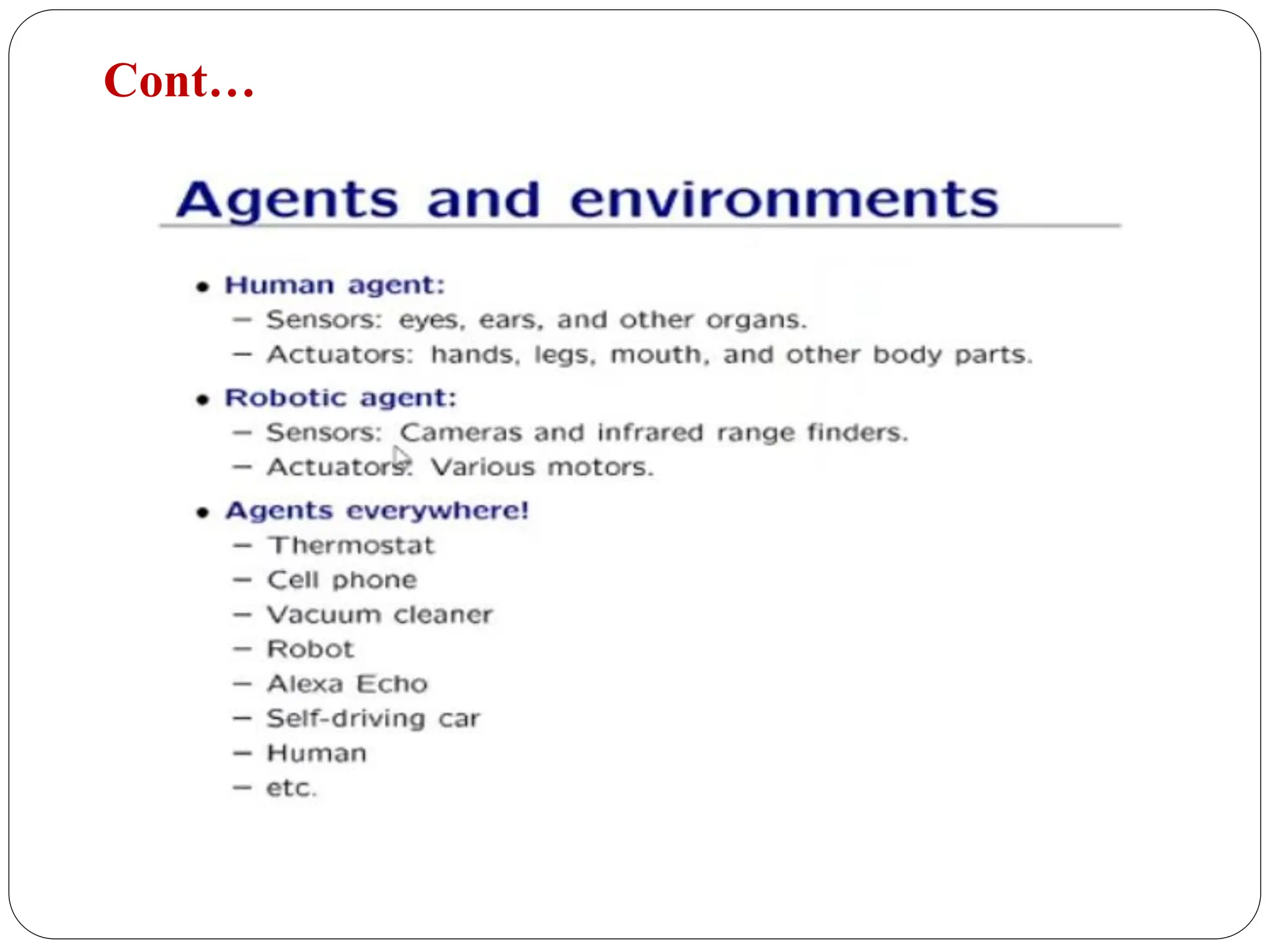
For example: a human agent has eyes, ears, and other organs for sensors
where as hands, legs for actuators.
Cont…
The two main functions of intelligent agents include:
1. perception and
2. action
Perception is done through sensors while actions are initiated
through actuators.
 An AI system is composed of an agent and its environment.
The agents act in their environment. The environment may
contain other agents.
 Thus,AI study of rational agents and its environment.
Characteristics of intelligent agents
Intelligent agents have the following distinguishing
characteristics:
 They have some level of autonomy that allows them to perform
certain tasks on their own.
 They have a learning ability that enables them to learn even as tasks
are carried out.
 They can interact with other entities such as agents, humans, and
systems.
Cont…
 New rules can be accommodated by intelligent agents
incrementally.
 They exhibit goal-oriented habits.
 They are knowledge-based.
 They use knowledge regarding communications (with like
understanding and responding to natural language, recognizing
speech, and exchanging messages through text), processes, and
entities.
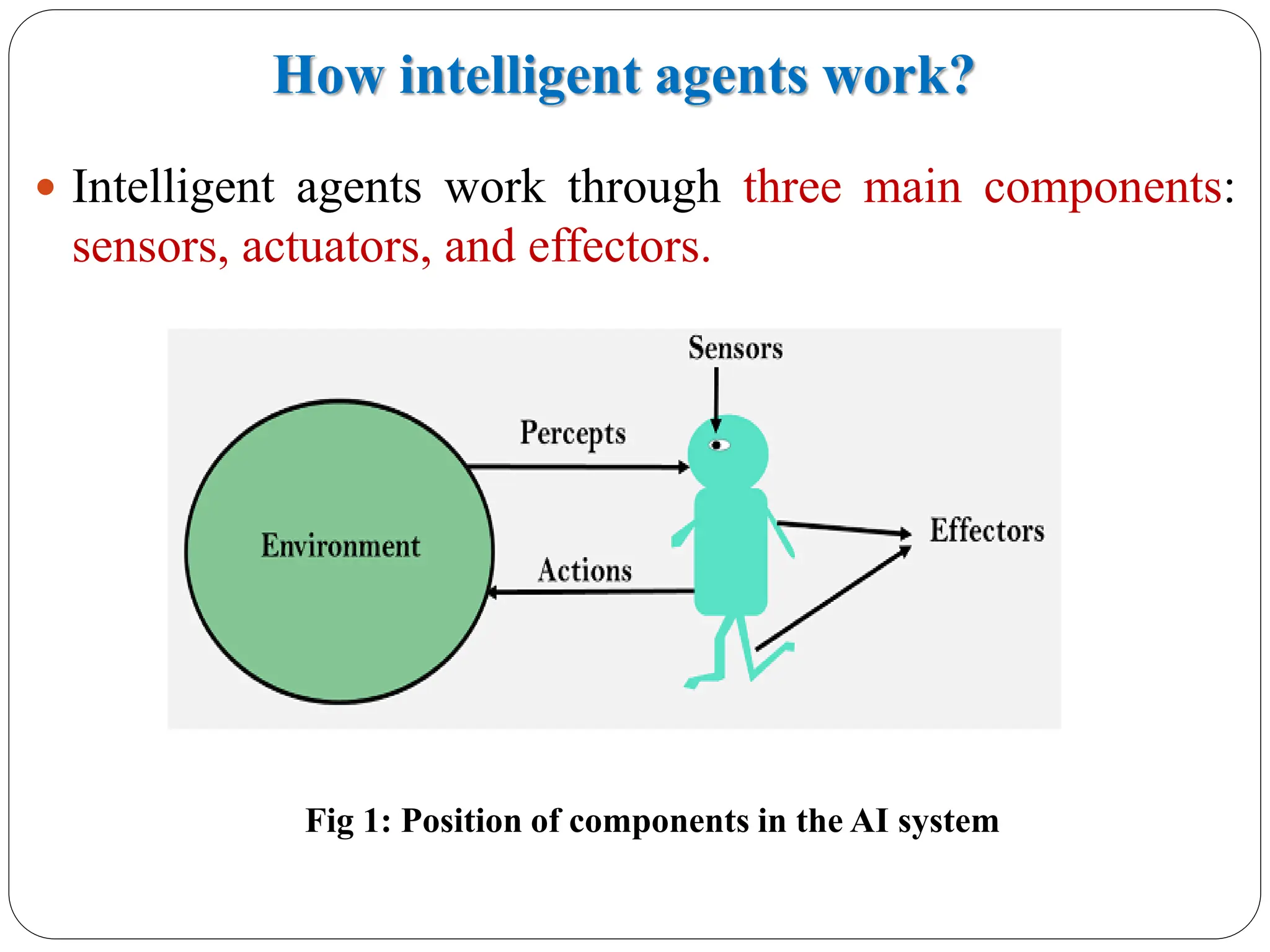
How intelligent agents work?
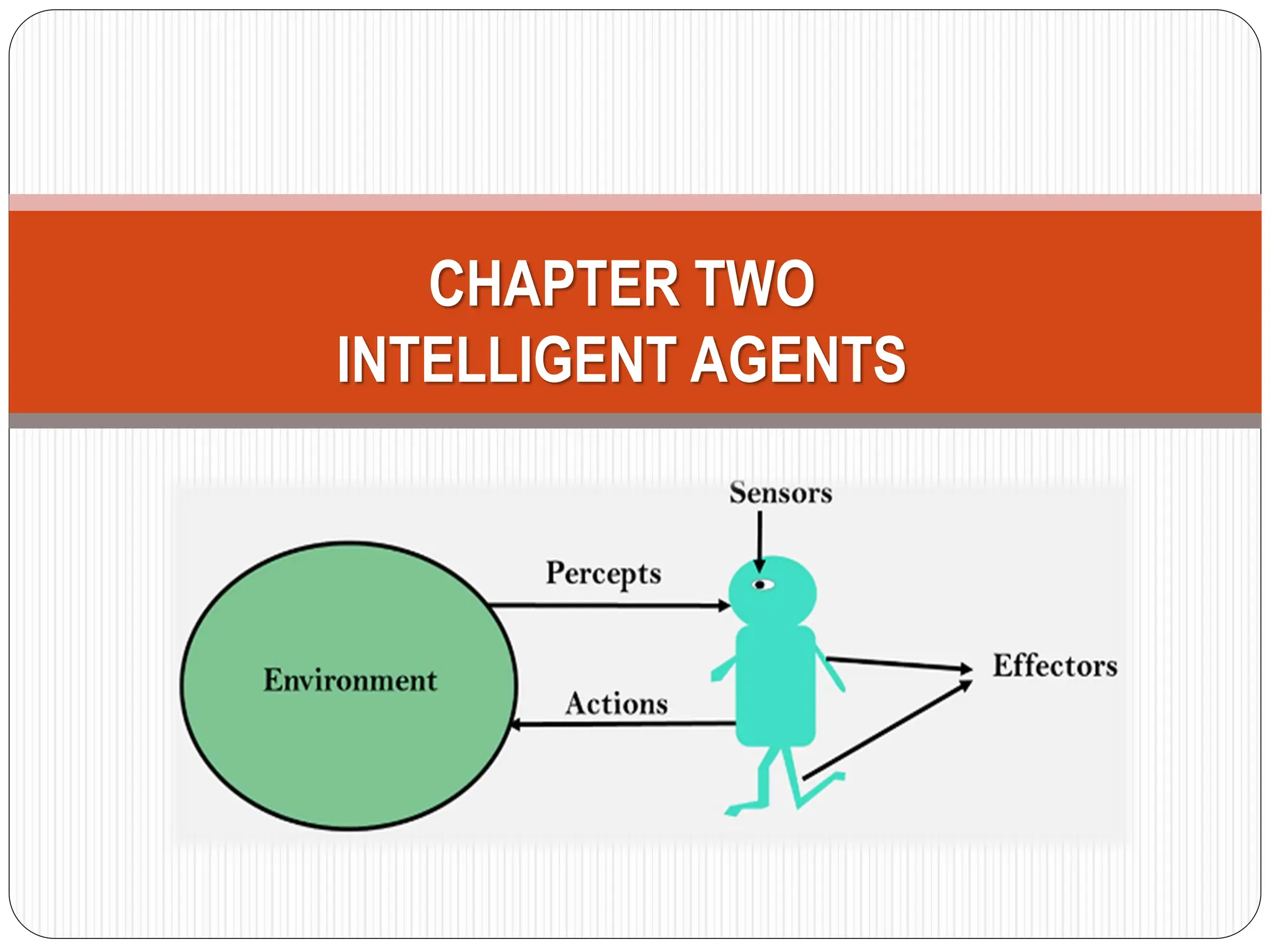
 Intelligent agents work through three main components:
sensors, actuators, and effectors.
Fig 1: Position of components in the AI system
Cont…
 Sensors: These are devices that detect any changes in the
environment.
 This information is sent to other devices.
 In artificial intelligence, the environment of the system is
observed by intelligent agents through sensors.
 Actuators: These are components through which energy is
converted into motion (They convert energy into physical action,
allowing the agent to perform tasks and affect the world around it).
 They perform the role of controlling and moving a system.
Examples include rails, motors, and gears.
 Effectors: is the device which affects the environment. i.e. the
environment is affected by effectors.
 Examples include legs, fingers, wheels, display screen, and arms.
Agents and Environments
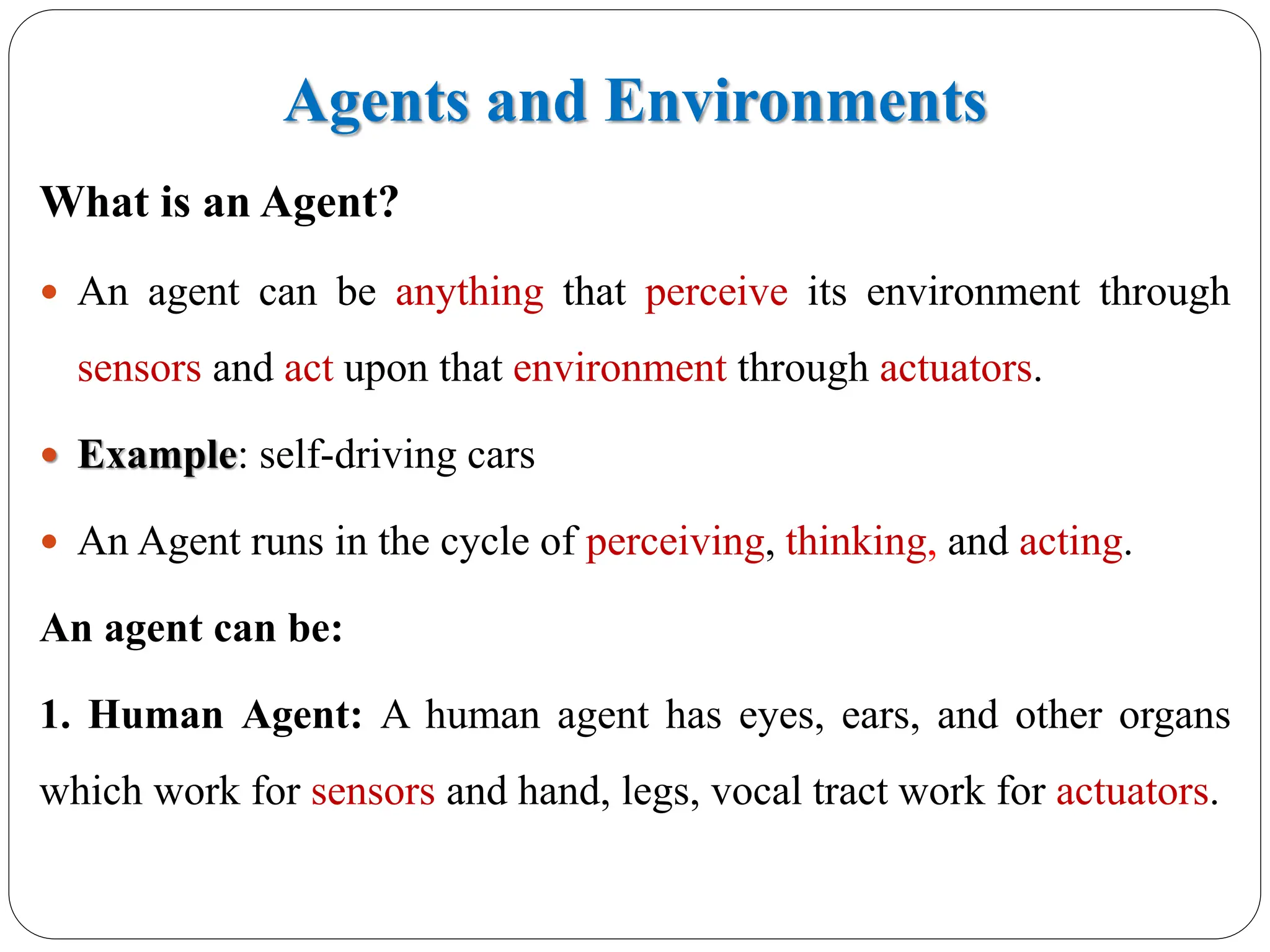
What is an Agent?
 An agent can be anything that perceive its environment through
sensors and act upon that environment through actuators.
 Example: self-driving cars
 An Agent runs in the cycle of perceiving, thinking, and acting.
An agent can be:
1. Human Agent: A human agent has eyes, ears, and other organs
which work for sensors and hand, legs, vocal tract work for actuators.
Cont…
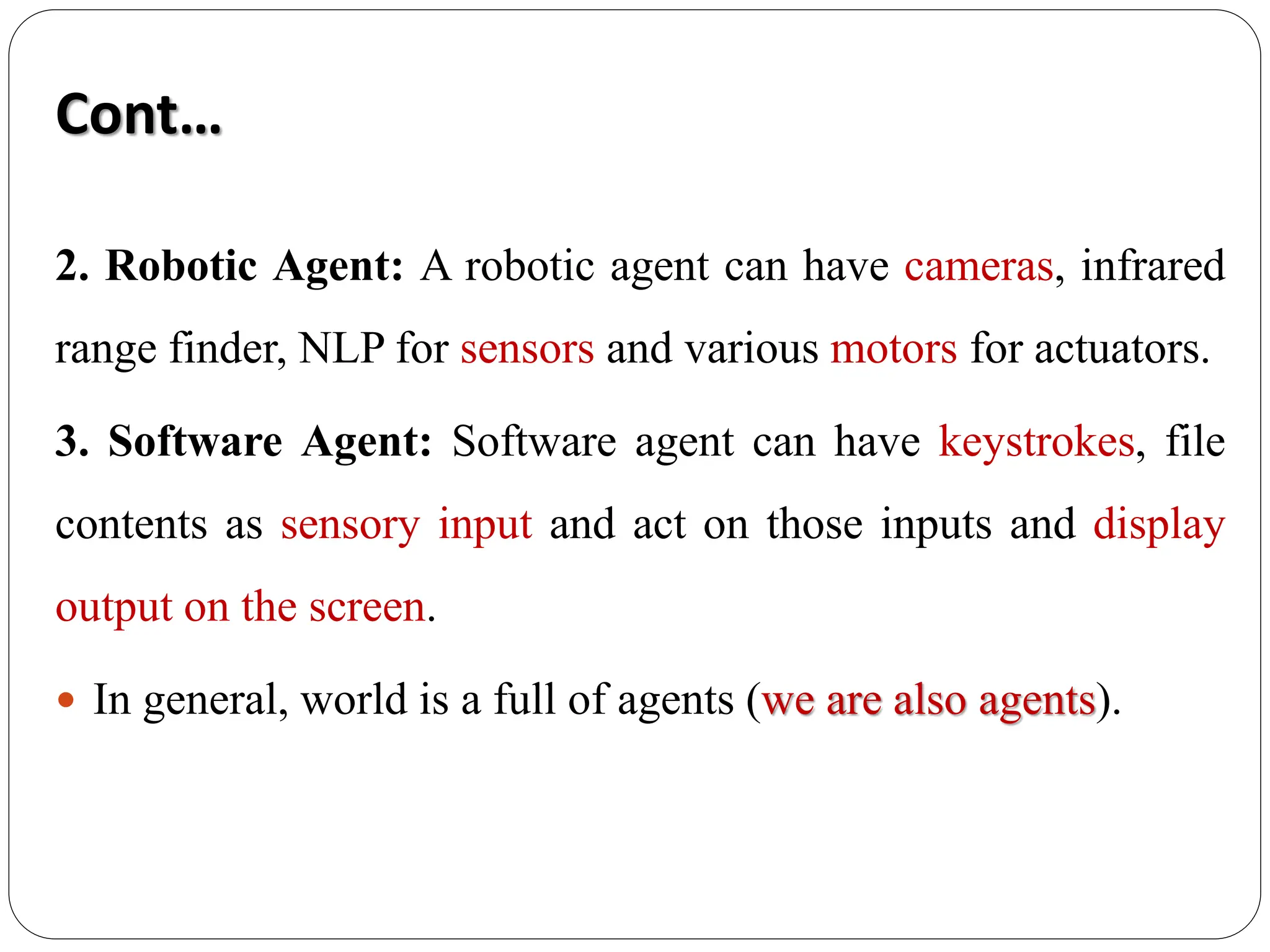
2. Robotic Agent: A robotic agent can have cameras, infrared
range finder, NLP for sensors and various motors for actuators.
3. Software Agent: Software agent can have keystrokes, file
contents as sensory input and act on those inputs and display
output on the screen.
 In general, world is a full of agents (we are also agents).
Cont…
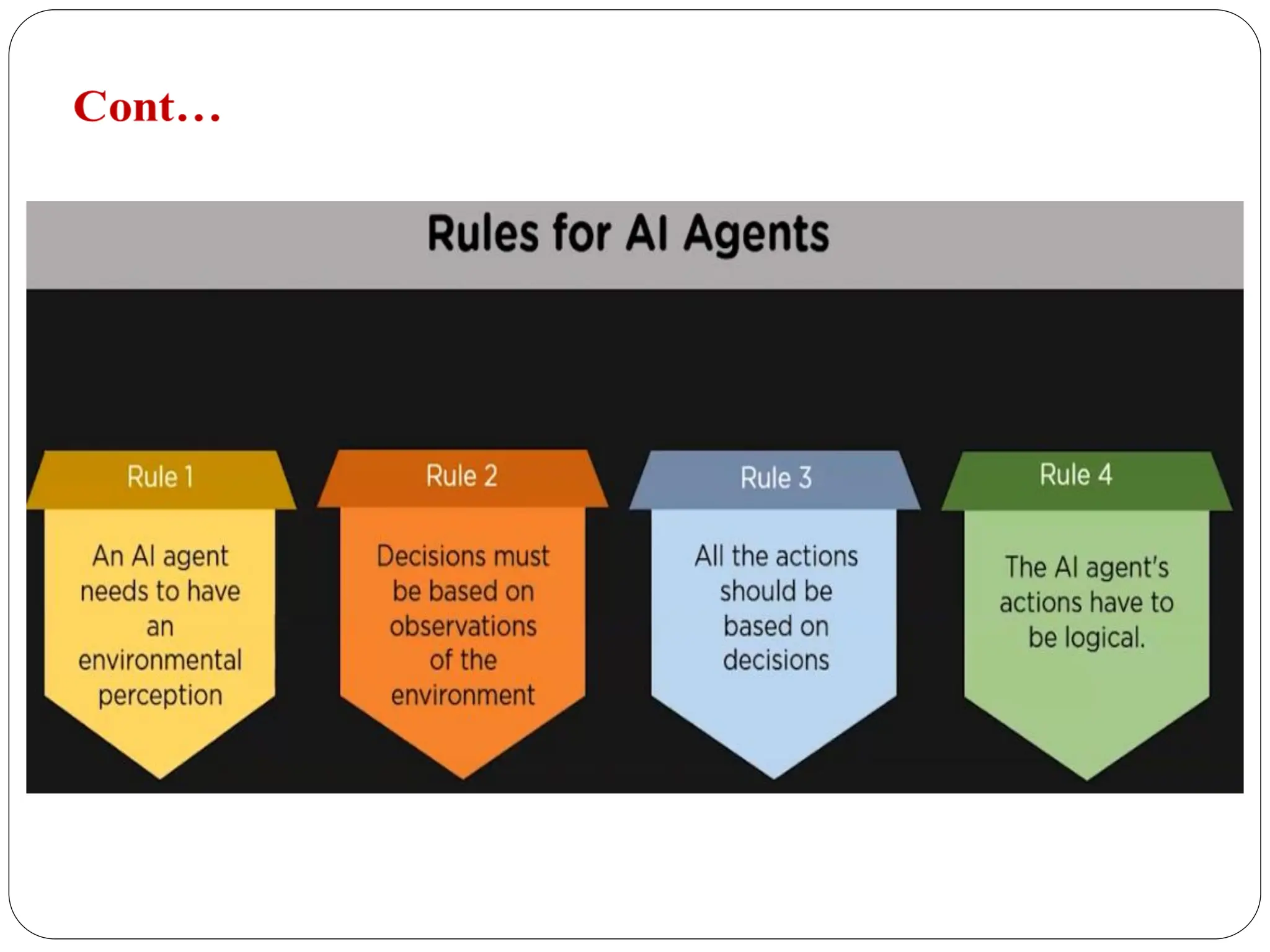
Rules for AI agents
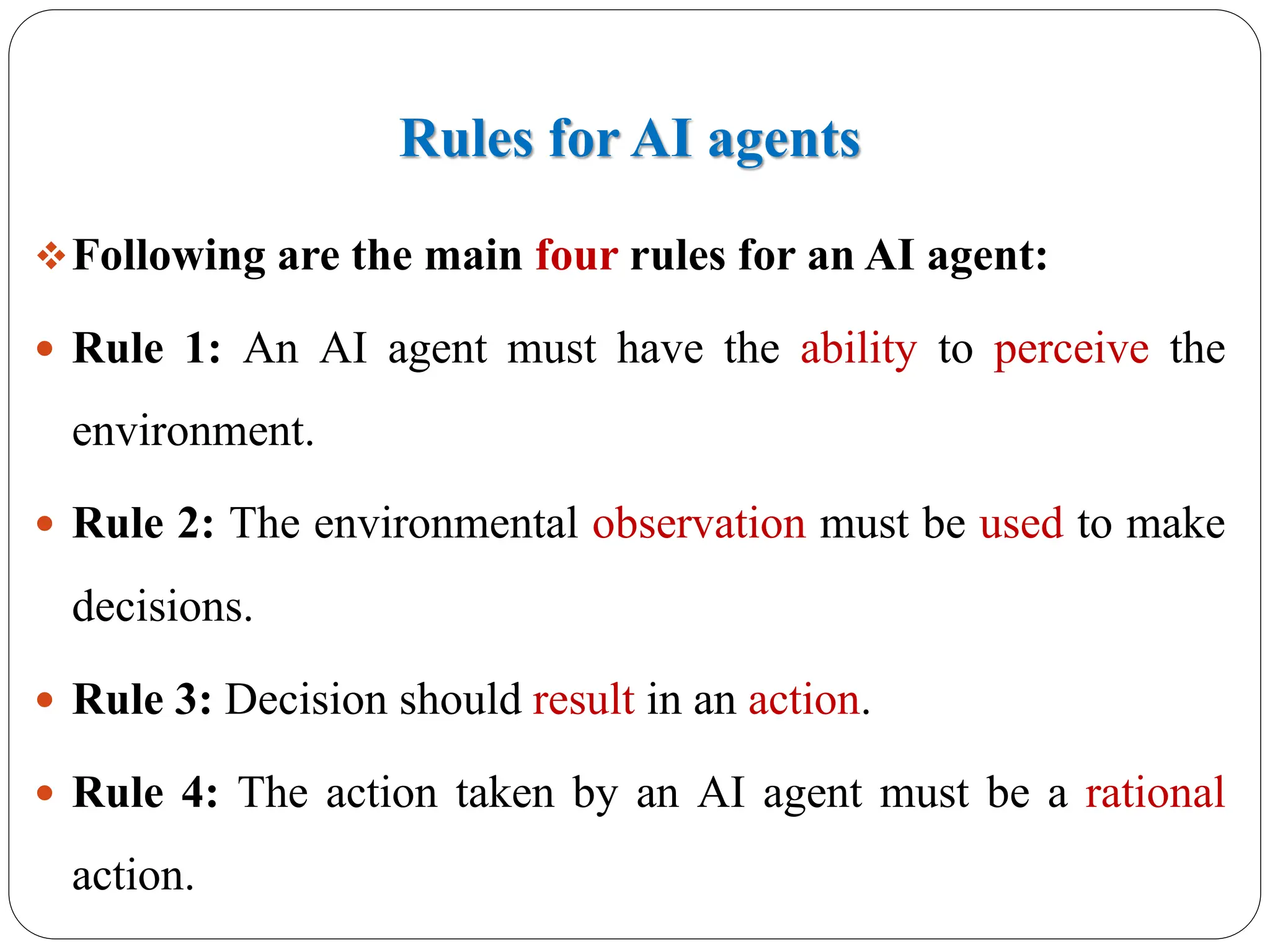
❖Following are the main four rules for an AI agent:
 Rule 1: An AI agent must have the ability to perceive the
environment.
 Rule 2: The environmental observation must be used to make
decisions.
 Rule 3: Decision should result in an action.
 Rule 4: The action taken by an AI agent must be a rational
action.
Agent Terminology
 Percept − It is agent’s perceptual inputs at a given instance.
E.g., if the agent is virtual assistant, it must have to understand the language.
 Percept Sequence − It is the history of all that an agent has
perceived till date.
 Performance Measure of Agent − It is the criteria, which
determines how successful an agent is.
 Behavior of Agent − It is the action that agent performs after any
given sequence of percepts.
 Agent Function − It is a map from the precept sequence to an
action.
 A rational agent is one that does the right thing.
 The concept of rationality refers to the ability of an AI agent to work
as per the desired actions.
 If the sequence is desirable, then the agent has performed well.
 The notion of desirability is captured by a performance measure
that evaluates any given sequence of environment states.
 A rational agent chooses whichever action maximizes the expected
value of the performance measure given the percept sequence.
Acting of Intelligent Agents (Rationality)
 A rational agent not only to gather information (exploration) but
also to learn as much as possible from what it perceives.
 An agent relies on the prior knowledge of its designer rather than
on its own percepts, we say that the agent lacks autonomy.
 A rational agent should be autonomous.
 In general, the concept of rationality is based on four measures:
1. Performance Measure: To put it simply, it is a way to evaluate
the effectiveness of the agent. For instance, in the case of a self-
driving car, the performance measure would be to reach the
destination safely and on time.
Cont…
2. Agent's Prior Knowledge: An agent's prior knowledge is the
knowledge that it has acquired from the environment.
It determines the actions that the agent can perform. For
example, a self-driving car's agent has prior knowledge of the
traffic rules and road conditions.
3. Actuator Dependency: A rational agent must take actions that
satisfy the performance measure. To do so, it depends on the
actuators to perform the required actions.
4. Agent's Percept Sequence: The percept sequence is the history
of what the agent has perceived from the environment.
It is based on the sensors that detect changes in the environment.
Cont…
Discussion Questions (10 min)
1. Why we needAI? Discuss at least 3 reasons in detail
2. Discuss in detail, how to improve the performance of intelligent
agents?
3. Discuss the challenges and future directions of AI in detail.
it is answer itself
.ethical and legal issues
.technical limitation
algorithm optimization
human AI collaboration
Environment
 An environment is everything in the world which surrounds
the agent, but it is not a part of an agent itself.
 An environment can be described as a situation in which an
agent is present.
 The environment is where agent lives, operate and provide
the agent with something to sense and act upon it.
Properties/Features of Environment
The environment has multifold properties such as:
 Fully Observable / Partially Observable − If it is possible to
determine the complete state of the environment at each time point
from the percepts it is fully observable; otherwise it is only
partially observable. E.g. vacuum cleaner
 Discrete / Continuous − If there are a limited number of distinct,
clearly defined, states of the environment, the environment is
discrete (For example, game of chess); otherwise it is continuous
because the environment in which the actions performed cannot be
numbered. E.g. self driving car
 Static / Dynamic − If the environment does not change while
an agent is acting, then it is static; otherwise it is dynamic.
 Accessible / Inaccessible − If the agent’s sensory apparatus /
devices can have access to the complete state of the
environment, then the environment is accessible to that agent.
 Single agent / Multiple agents − The environment may
contain other agents which may be of the same or different
kind as that of the agent (the decision can be individual or
collective).
Cont…
 Deterministic / Non-deterministic (Stochastic) − If the next state of
the environment is completely determined by the current state and the
actions of the agent, then the environment is deterministic; otherwise it
is non-deterministic / stochastic. E.g. Taxi driver is stochastic
 Episodic / Non-episodic (Sequential) − In an episodic environment,
each episode consists of the agent perceiving and then acting.
oThe quality of its action depends just on the episode itself.
oSubsequent episodes do not depend on the actions in the previous
episodes.
oEpisodic environments are much simpler than non-episodic because
the agent does not need to think ahead.
Cont…
Structure of Intelligent Agents
The Intelligent agent structure consists of three main parts:
architecture, agent function, and agent program.
1. Architecture: This refers to devices that consists of actuators and
sensors (physical platform or HW that the agent runs on).
 The intelligent agent executes on this machinery.
 Examples include a personal computer, a car, or a camera.
2. Agent function: This is a function in which actions are mapped
from a certain percept sequence.
 Percept sequence refers to a history of what the intelligent agent has
perceived.
3. Agent program: This is an implementation or execution of the
agent function.
 The agent function is produced through the agent program’s
execution on the physical architecture.
 PEAS is a type of model on which an AI agent works upon.
 In designing and agent, the first step must always be to specify the
task environment as fully as possible.
 When we define an AI agent or rational agent, then we can group
its properties under PEAS representation model.
 Task environment is the description of Performance measure,
Environment, Actuators, and Sensors (PEAS). It is made up of
four words:
 P: Performance measure
 E: Environment
 A: Actuators
 S: Sensors
Here, performance measure is the output we get from agent
(results we get after agent processing).
PEAS Representation
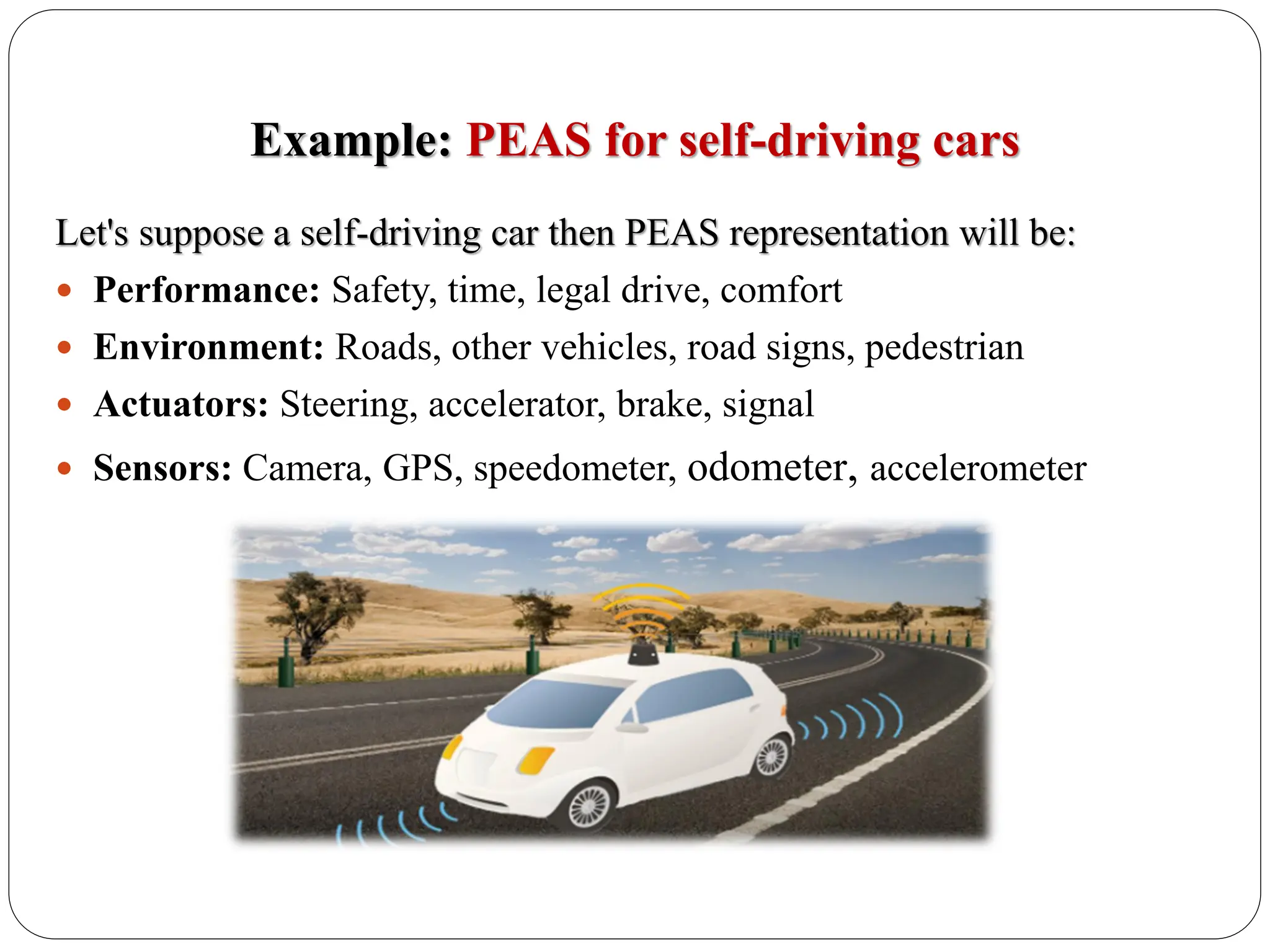
Example: PEAS for self-driving cars
Let's suppose a self-driving car then PEAS representation will be:
 Performance: Safety, time, legal drive, comfort
 Environment: Roads, other vehicles, road signs, pedestrian
 Actuators: Steering, accelerator, brake, signal
 Sensors: Camera, GPS, speedometer, odometer, accelerometer
Example of Agents with their PEAS representation
Fig: PEAS description of the task environment for the self driving car
Types of AI Agents
 Agents can be grouped into five classes based on their degree of
perceived intelligence and capability.
 All these agents can improve their performance and generate
better action over the time.
 These are given below:
1. Simple Reflex Agent
2. Model-based reflex agent
3. Goal-based agents
4. Utility-based agent
5. Learning agent
1. Simple Reflex Agent
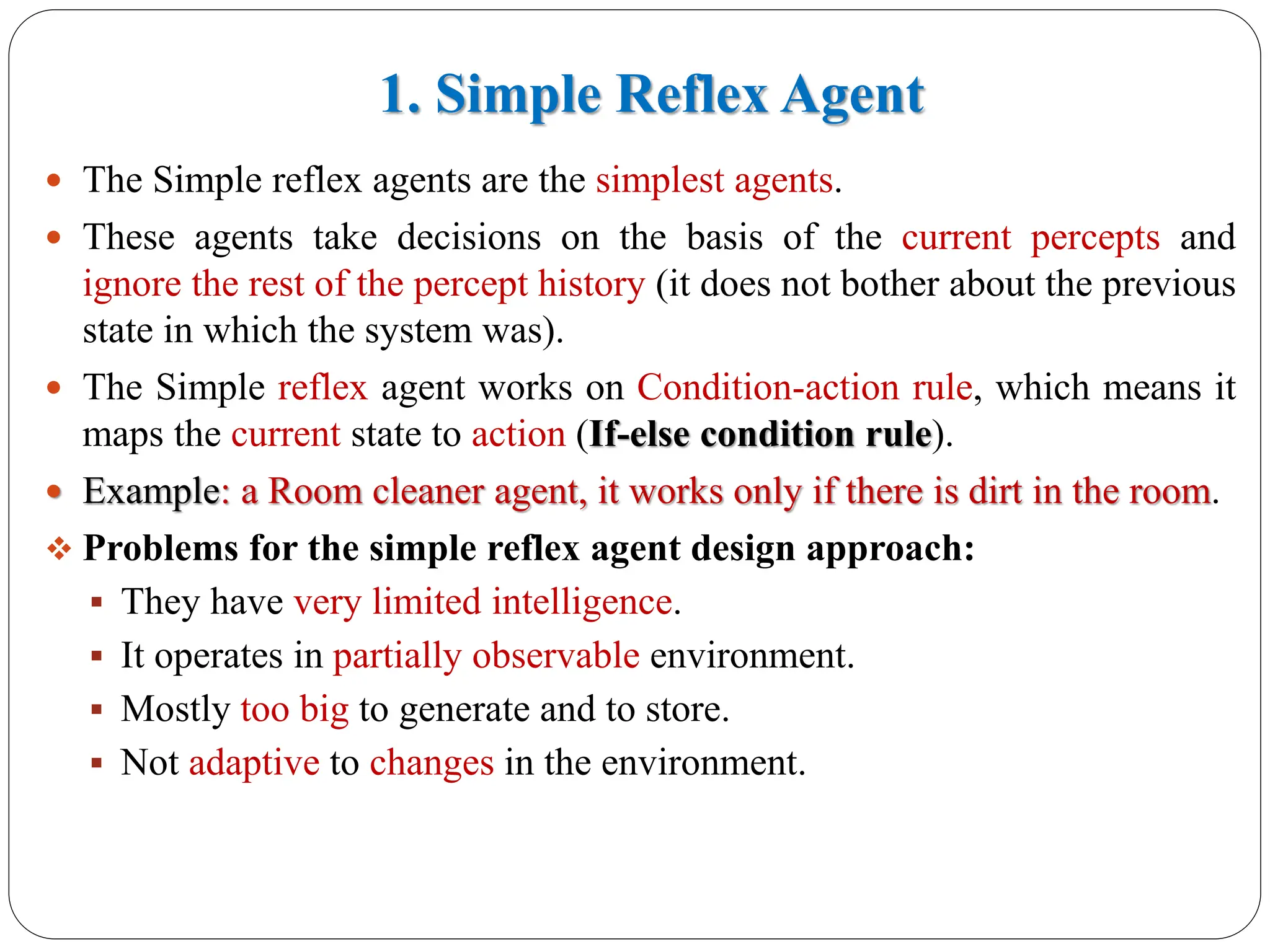
 The Simple reflex agents are the simplest agents.
 These agents take decisions on the basis of the current percepts and
ignore the rest of the percept history (it does not bother about the previous
state in which the system was).
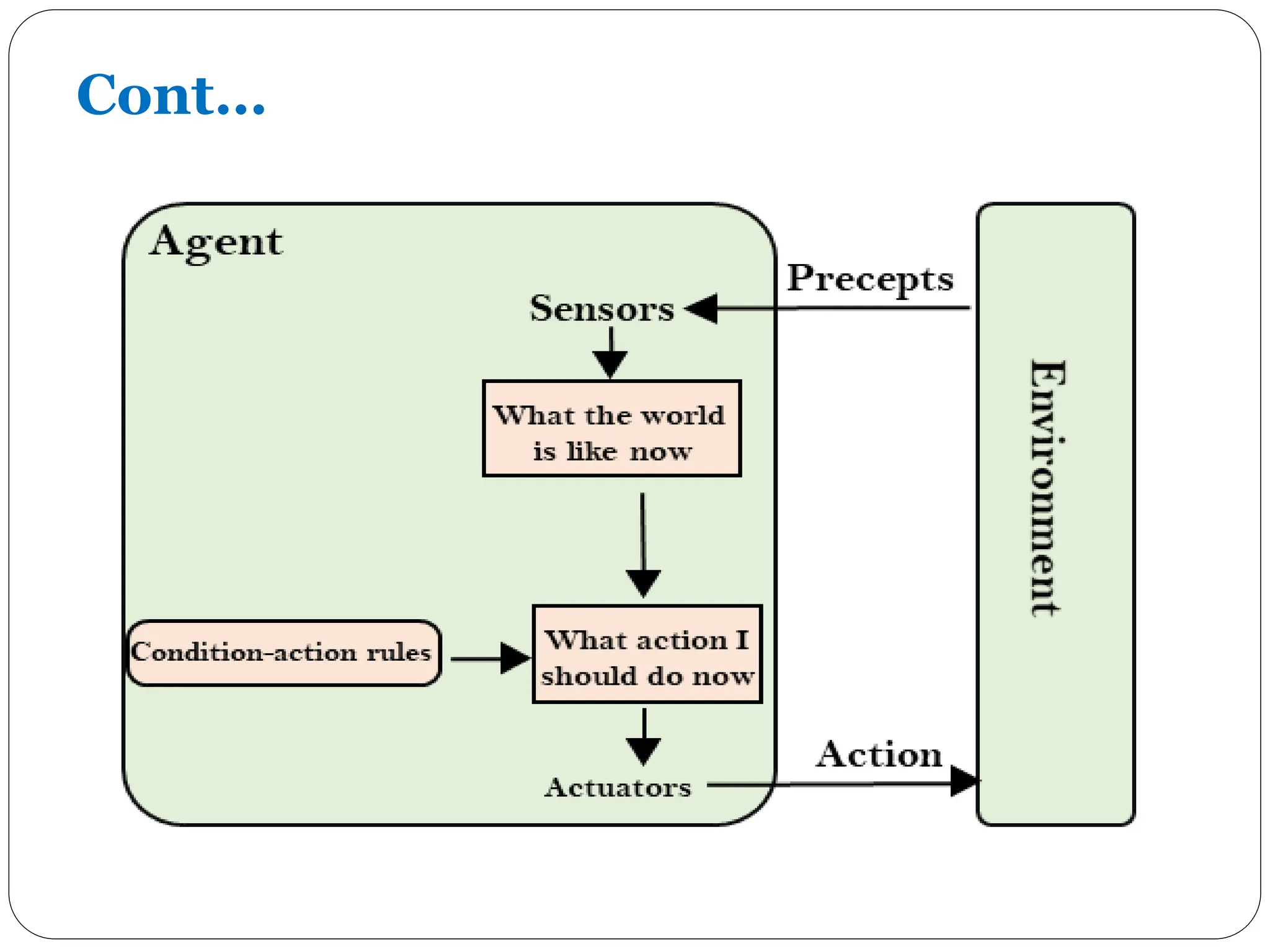
 The Simple reflex agent works on Condition-action rule, which means it
maps the current state to action (If-else condition rule).
 Example: a Room cleaner agent, it works only if there is dirt in the room.
❖ Problems for the simple reflex agent design approach:
▪ They have very limited intelligence.
▪ It operates in partially observable environment.
▪ Mostly too big to generate and to store.
▪ Not adaptive to changes in the environment.
Cont…
2. Model-based reflex agent
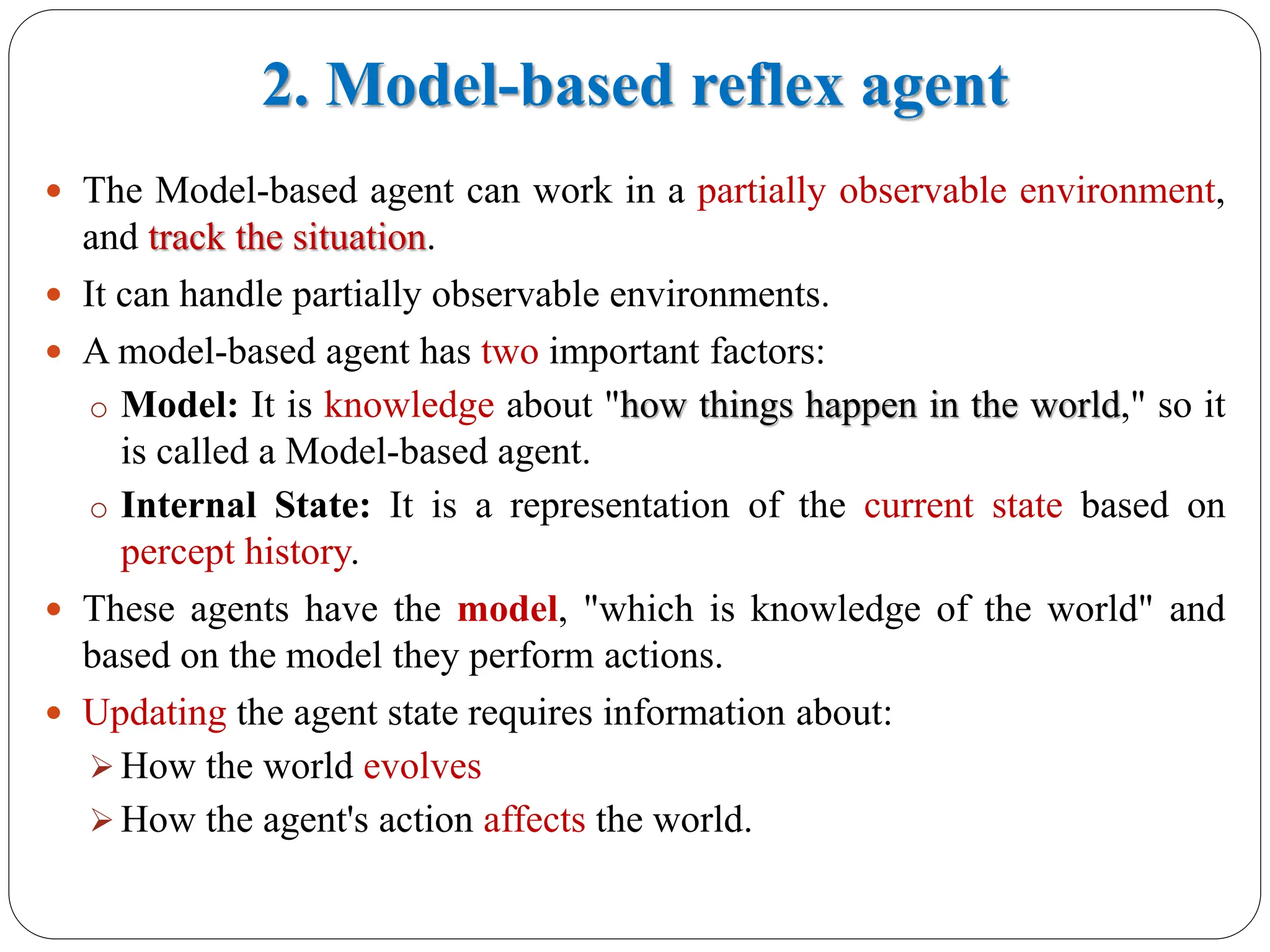
 The Model-based agent can work in a partially observable environment,
and track the situation.
 It can handle partially observable environments.
 A model-based agent has two important factors:
o Model: It is knowledge about "how things happen in the world," so it
is called a Model-based agent.
o Internal State: It is a representation of the current state based on
percept history.
 These agents have the model, "which is knowledge of the world" and
based on the model they perform actions.
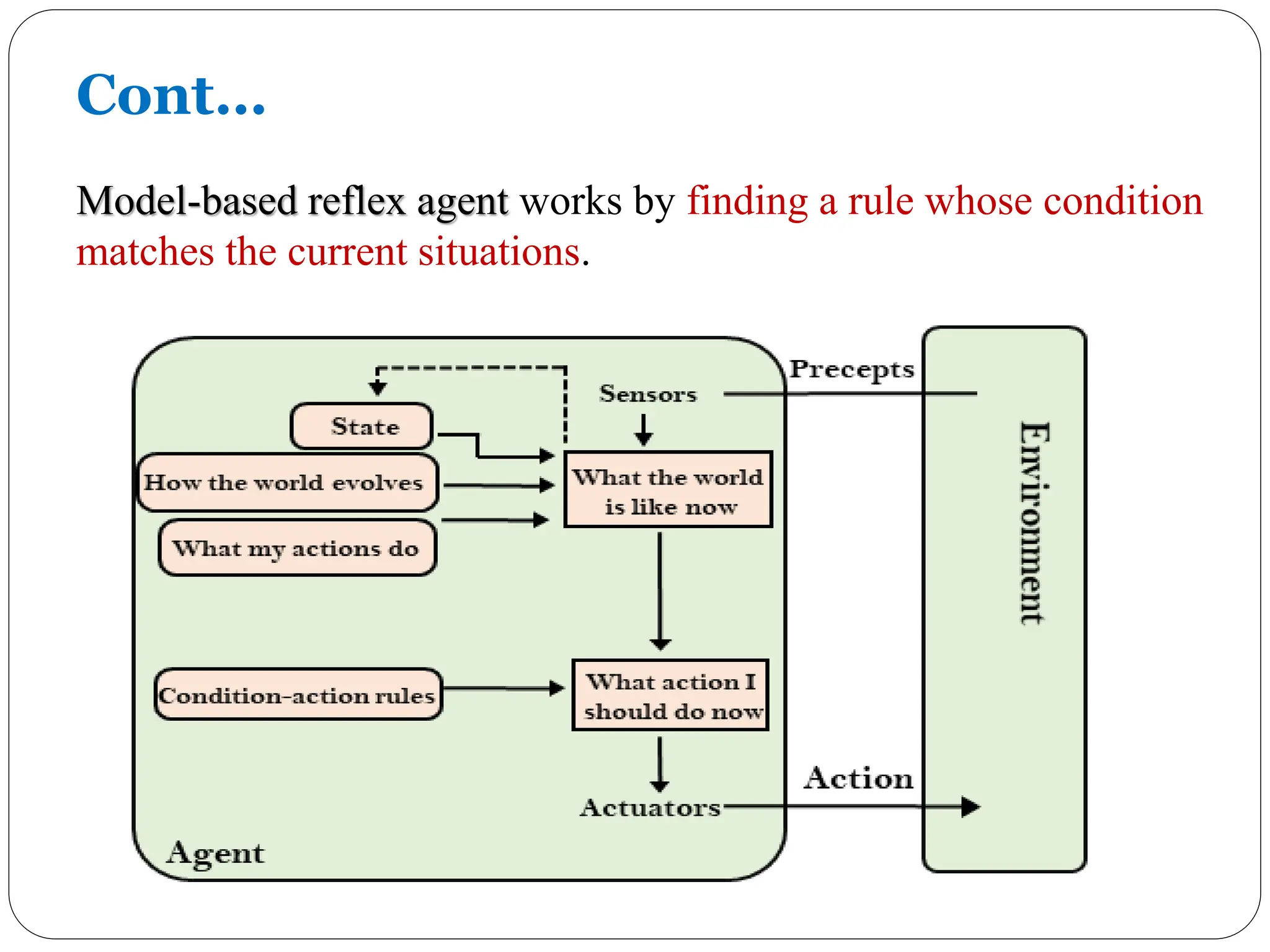
 Updating the agent state requires information about:
➢ How the world evolves
➢ How the agent's action affects the world.
previous
Cont…
Model-based reflex agent works by finding a rule whose condition
matches the current situations.
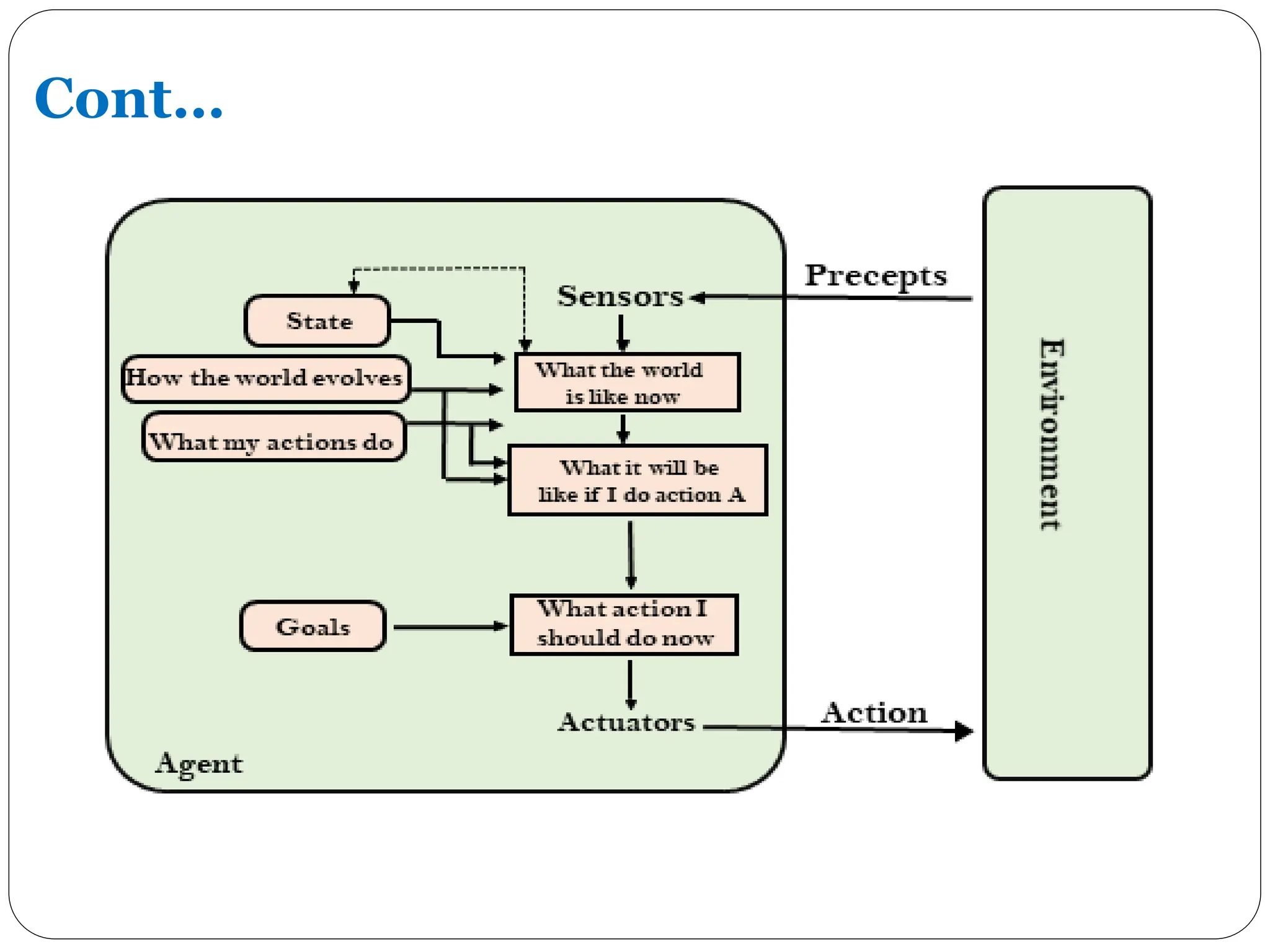
3. Goal-based agents
 The goal based agent focuses only on reaching the goal set and hence the
decision took by the agent is based on how far it is currently from their
goal or desired state.
 The agent needs to know its goal which describes desirable situations.
 Their every action is intended to minimize their distance from the goal.
 Goal-based agents expand the capabilities of the model-based agent by
having the "goal" information.
 They choose an action, so that they can achieve the goal.
 These agents may have to consider a long sequence of possible actions
before deciding whether the goal is achieved or not.
 Such considerations of different scenario are called searching and
planning, which makes an agent proactive.
 Example: Game AI: Game characters often employ goal-based
agents to make decisions.
Cont…
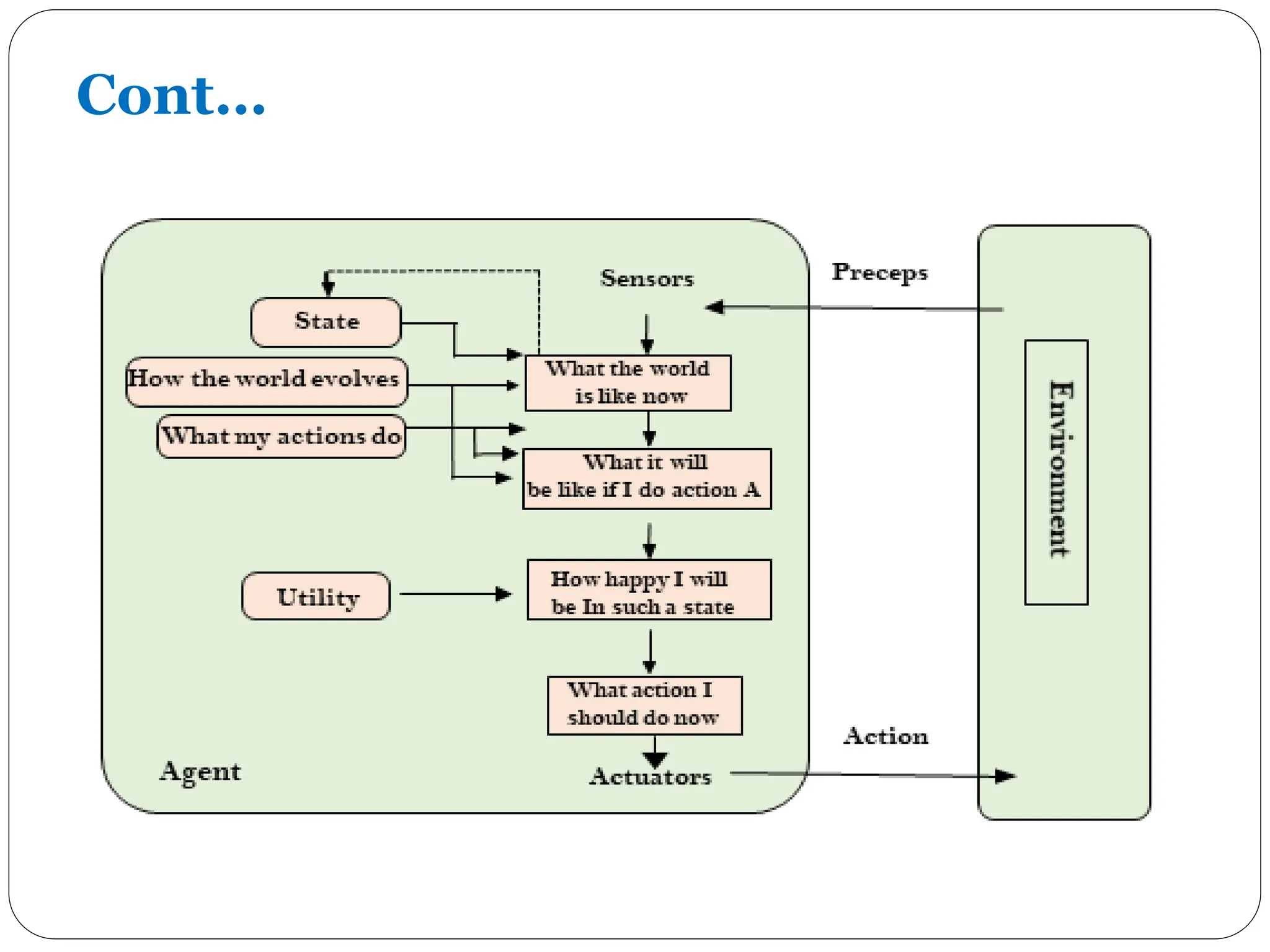
4. Utility-based agents
 These agents are similar to the goal-based agent but provide an extra
component of utility measurement which makes them different by
providing a measure of success at a given state.
 Utility-based agent act based not only goals but also the best way to
achieve the goal.
 The Utility-based agent is useful when there are multiple possible
alternatives, and an agent has to choose in order to perform the best
action.
 The utility function maps each state to a real number to check how
efficiently each action achieves the goals.
Cont…
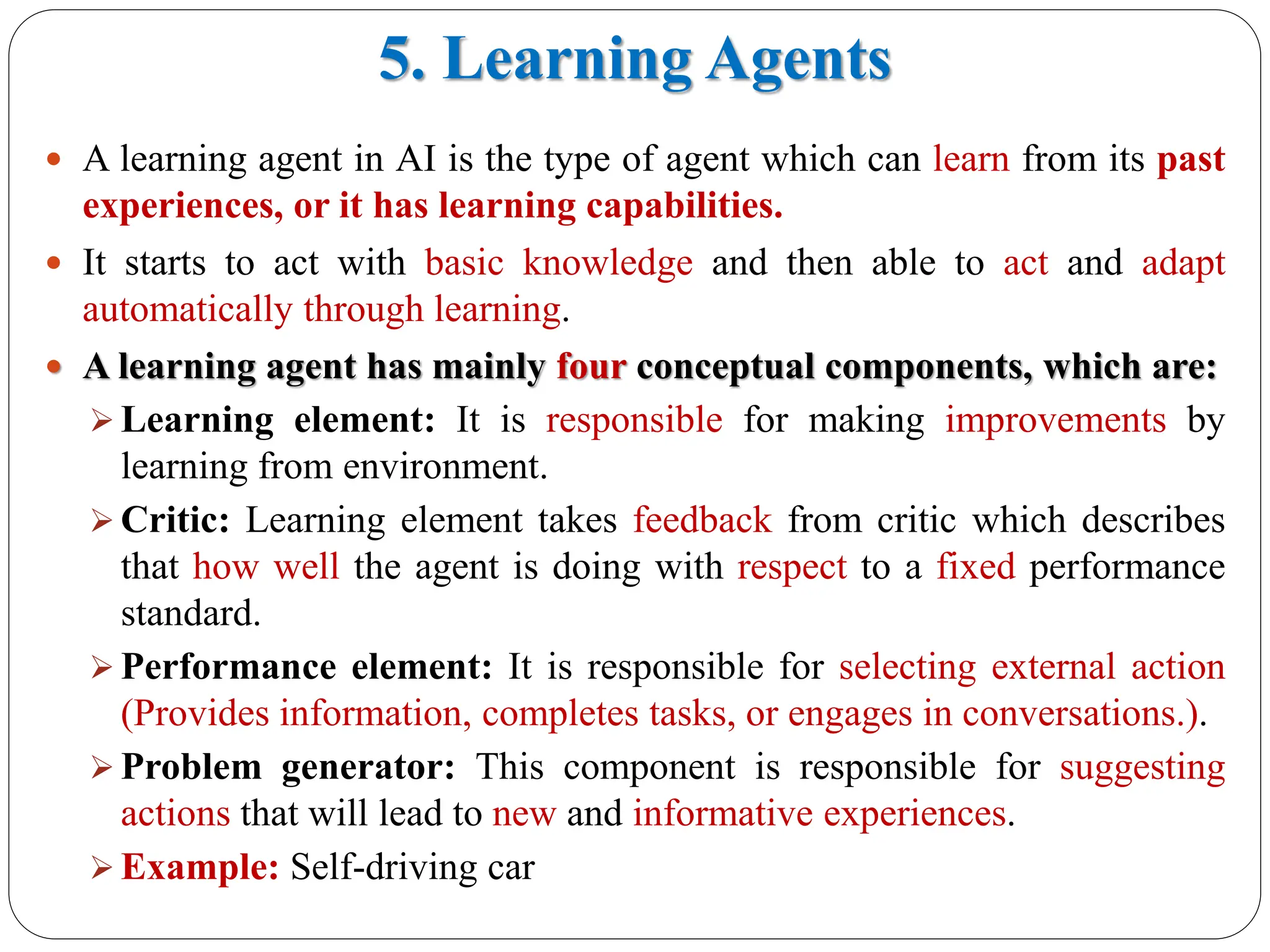
5. Learning Agents
 A learning agent in AI is the type of agent which can learn from its past
experiences, or it has learning capabilities.
 It starts to act with basic knowledge and then able to act and adapt
automatically through learning.
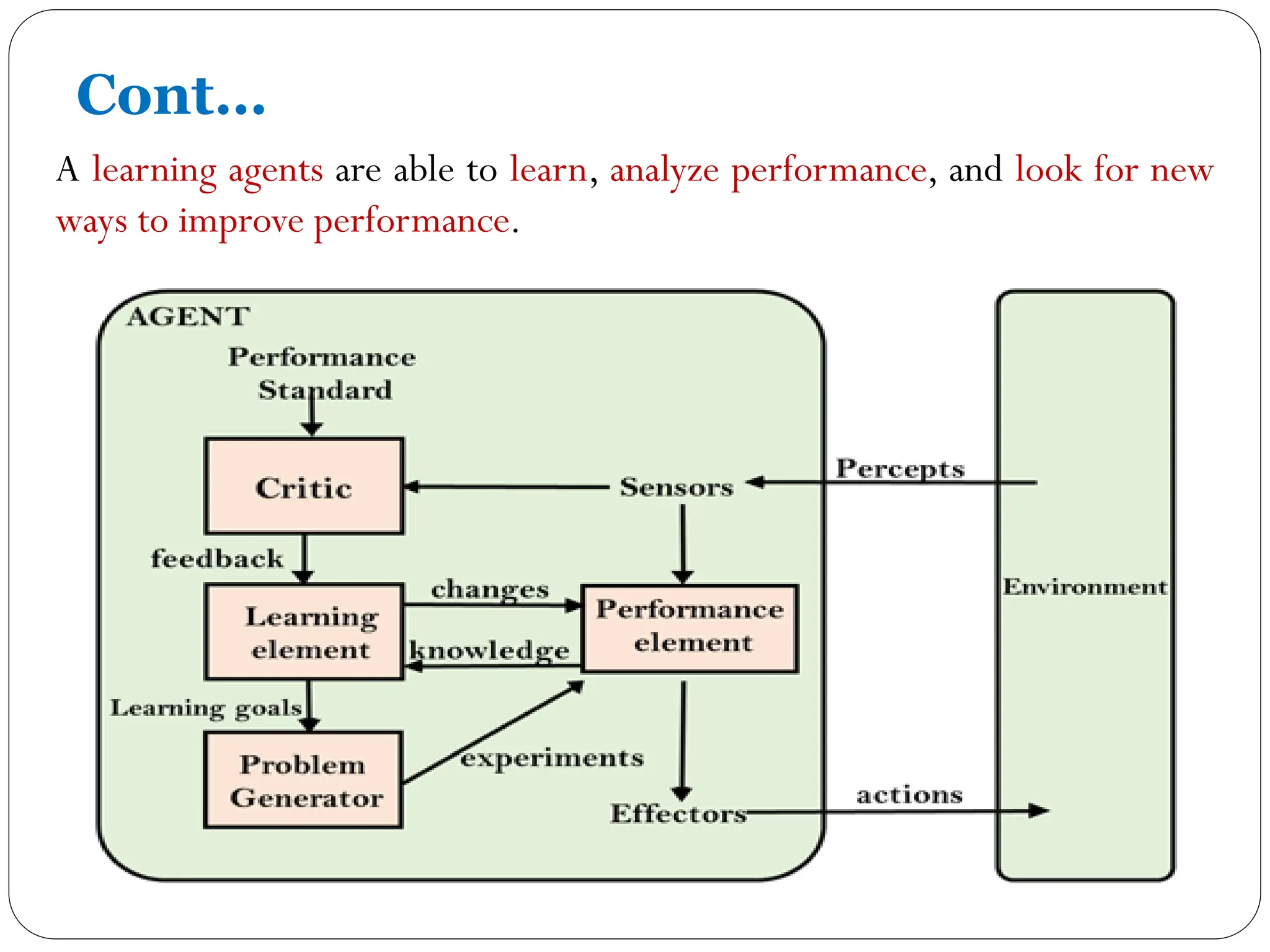
 A learning agent has mainly four conceptual components, which are:
➢ Learning element: It is responsible for making improvements by
learning from environment.
➢ Critic: Learning element takes feedback from critic which describes
that how well the agent is doing with respect to a fixed performance
standard.
➢ Performance element: It is responsible for selecting external action
(Provides information, completes tasks, or engages in conversations.).
➢ Problem generator: This component is responsible for suggesting
actions that will lead to new and informative experiences.
➢ Example: Self-driving car
Cont…
A learning agents are able to learn, analyze performance, and look for new
ways to improve performance.
Applications of Intelligent Agents
Intelligent agents, driven by artificial intelligence, are increasingly being
deployed across various sectors. Here are some of the most prominent
applications:
1. Customer Service and Support (Repetitive office activities):
 Chatbots and Virtual Assistants: These agents interact with customers through
text or voice, answering queries, providing information, and resolving issues.
Personalized Customer Experiences:
 Intelligent agents can analyze customer data to offer tailored recommendations
and support.
2. Information search, retrieval, and navigation
 Intelligent agents enhance access and navigation of information. This is
achieved through the search of information using search engines.
 The internet consists of many data objects that may take users a lot of time to
search for a specific data object.
 Intelligent agents perform this task on behalf of users within a short time.
3. In healthcare:
Intelligent agents have also been applied in healthcare services to improve the
health of patients.
Medical Diagnosis: AI-powered agents can analyze medical data to assist in
accurate diagnosis.
Drug Discovery: Intelligent agents can accelerate drug discovery processes by
analyzing vast amounts of biological data.
Patient Monitoring: Real-time patient monitoring and alert systems can be
powered by intelligent agents.
4. E-commerce:
Personalized Recommendations: AI-powered recommendation systems can suggest
products based on user preferences and behavior.
Cont…
4.Autonomous driving
 Intelligent agents enhance the operation of self-driving cars.
 Intelligent agents are the core of autonomous driving technology,
enabling vehicles to perceive their surroundings, make decisions,
and execute actions without human intervention. These agents
are responsible for a wide range of tasks, from sensor data
processing to complex decision-making.
 Sensor Fusion: Combines data from various sensors (cameras,
radar, etc.) to create a comprehensive understanding of the
environment.
 Object Detection and Tracking: Identifies and tracks objects
like vehicles, pedestrians, and cyclists.
Cont…
Thank you!!
Any Query?

Chapter word of it Intelligent Agents.pdf

  • 1.
    Wolaita Sodo University Schoolof Informatics Department of Computer Science Course title: Introduction to Artificial Intelligence Compiled by: Eyob S. (MSc)
  • 2.
  • 3.
    Introduction In AI, anagent is a computer program or system that is designed to perceive its environment (through sensors), make decisions and take actions to achieve a specific goal or set of goals (through actuators). It can also be described as a software entity / anything that can be viewed as perceiving the environment through sensors and acting upon the environment though actuators. Thus, it uses actuators to initiate action in that environment. For example: a human agent has eyes, ears, and other organs for sensors where as hands, legs for actuators.
  • 4.
    Cont… The two mainfunctions of intelligent agents include: 1. perception and 2. action Perception is done through sensors while actions are initiated through actuators.  An AI system is composed of an agent and its environment. The agents act in their environment. The environment may contain other agents.  Thus,AI study of rational agents and its environment.
  • 5.
    Characteristics of intelligentagents Intelligent agents have the following distinguishing characteristics:  They have some level of autonomy that allows them to perform certain tasks on their own.  They have a learning ability that enables them to learn even as tasks are carried out.  They can interact with other entities such as agents, humans, and systems.
  • 6.
    Cont…  New rulescan be accommodated by intelligent agents incrementally.  They exhibit goal-oriented habits.  They are knowledge-based.  They use knowledge regarding communications (with like understanding and responding to natural language, recognizing speech, and exchanging messages through text), processes, and entities.
  • 7.
    How intelligent agentswork?  Intelligent agents work through three main components: sensors, actuators, and effectors. Fig 1: Position of components in the AI system
  • 8.
    Cont…  Sensors: Theseare devices that detect any changes in the environment.  This information is sent to other devices.  In artificial intelligence, the environment of the system is observed by intelligent agents through sensors.  Actuators: These are components through which energy is converted into motion (They convert energy into physical action, allowing the agent to perform tasks and affect the world around it).  They perform the role of controlling and moving a system. Examples include rails, motors, and gears.  Effectors: is the device which affects the environment. i.e. the environment is affected by effectors.  Examples include legs, fingers, wheels, display screen, and arms.
  • 9.
    Agents and Environments Whatis an Agent?  An agent can be anything that perceive its environment through sensors and act upon that environment through actuators.  Example: self-driving cars  An Agent runs in the cycle of perceiving, thinking, and acting. An agent can be: 1. Human Agent: A human agent has eyes, ears, and other organs which work for sensors and hand, legs, vocal tract work for actuators.
  • 10.
    Cont… 2. Robotic Agent:A robotic agent can have cameras, infrared range finder, NLP for sensors and various motors for actuators. 3. Software Agent: Software agent can have keystrokes, file contents as sensory input and act on those inputs and display output on the screen.  In general, world is a full of agents (we are also agents).
  • 11.
  • 12.
    Rules for AIagents ❖Following are the main four rules for an AI agent:  Rule 1: An AI agent must have the ability to perceive the environment.  Rule 2: The environmental observation must be used to make decisions.  Rule 3: Decision should result in an action.  Rule 4: The action taken by an AI agent must be a rational action.
  • 14.
    Agent Terminology  Percept− It is agent’s perceptual inputs at a given instance. E.g., if the agent is virtual assistant, it must have to understand the language.  Percept Sequence − It is the history of all that an agent has perceived till date.  Performance Measure of Agent − It is the criteria, which determines how successful an agent is.  Behavior of Agent − It is the action that agent performs after any given sequence of percepts.  Agent Function − It is a map from the precept sequence to an action.
  • 15.
     A rationalagent is one that does the right thing.  The concept of rationality refers to the ability of an AI agent to work as per the desired actions.  If the sequence is desirable, then the agent has performed well.  The notion of desirability is captured by a performance measure that evaluates any given sequence of environment states.  A rational agent chooses whichever action maximizes the expected value of the performance measure given the percept sequence. Acting of Intelligent Agents (Rationality)
  • 16.
     A rationalagent not only to gather information (exploration) but also to learn as much as possible from what it perceives.  An agent relies on the prior knowledge of its designer rather than on its own percepts, we say that the agent lacks autonomy.  A rational agent should be autonomous.  In general, the concept of rationality is based on four measures: 1. Performance Measure: To put it simply, it is a way to evaluate the effectiveness of the agent. For instance, in the case of a self- driving car, the performance measure would be to reach the destination safely and on time. Cont…
  • 17.
    2. Agent's PriorKnowledge: An agent's prior knowledge is the knowledge that it has acquired from the environment. It determines the actions that the agent can perform. For example, a self-driving car's agent has prior knowledge of the traffic rules and road conditions. 3. Actuator Dependency: A rational agent must take actions that satisfy the performance measure. To do so, it depends on the actuators to perform the required actions. 4. Agent's Percept Sequence: The percept sequence is the history of what the agent has perceived from the environment. It is based on the sensors that detect changes in the environment. Cont…
  • 18.
    Discussion Questions (10min) 1. Why we needAI? Discuss at least 3 reasons in detail 2. Discuss in detail, how to improve the performance of intelligent agents? 3. Discuss the challenges and future directions of AI in detail. it is answer itself .ethical and legal issues .technical limitation algorithm optimization human AI collaboration
  • 19.
    Environment  An environmentis everything in the world which surrounds the agent, but it is not a part of an agent itself.  An environment can be described as a situation in which an agent is present.  The environment is where agent lives, operate and provide the agent with something to sense and act upon it.
  • 20.
    Properties/Features of Environment Theenvironment has multifold properties such as:  Fully Observable / Partially Observable − If it is possible to determine the complete state of the environment at each time point from the percepts it is fully observable; otherwise it is only partially observable. E.g. vacuum cleaner  Discrete / Continuous − If there are a limited number of distinct, clearly defined, states of the environment, the environment is discrete (For example, game of chess); otherwise it is continuous because the environment in which the actions performed cannot be numbered. E.g. self driving car
  • 21.
     Static /Dynamic − If the environment does not change while an agent is acting, then it is static; otherwise it is dynamic.  Accessible / Inaccessible − If the agent’s sensory apparatus / devices can have access to the complete state of the environment, then the environment is accessible to that agent.  Single agent / Multiple agents − The environment may contain other agents which may be of the same or different kind as that of the agent (the decision can be individual or collective). Cont…
  • 22.
     Deterministic /Non-deterministic (Stochastic) − If the next state of the environment is completely determined by the current state and the actions of the agent, then the environment is deterministic; otherwise it is non-deterministic / stochastic. E.g. Taxi driver is stochastic  Episodic / Non-episodic (Sequential) − In an episodic environment, each episode consists of the agent perceiving and then acting. oThe quality of its action depends just on the episode itself. oSubsequent episodes do not depend on the actions in the previous episodes. oEpisodic environments are much simpler than non-episodic because the agent does not need to think ahead. Cont…
  • 23.
    Structure of IntelligentAgents The Intelligent agent structure consists of three main parts: architecture, agent function, and agent program. 1. Architecture: This refers to devices that consists of actuators and sensors (physical platform or HW that the agent runs on).  The intelligent agent executes on this machinery.  Examples include a personal computer, a car, or a camera. 2. Agent function: This is a function in which actions are mapped from a certain percept sequence.  Percept sequence refers to a history of what the intelligent agent has perceived. 3. Agent program: This is an implementation or execution of the agent function.  The agent function is produced through the agent program’s execution on the physical architecture.
  • 24.
     PEAS isa type of model on which an AI agent works upon.  In designing and agent, the first step must always be to specify the task environment as fully as possible.  When we define an AI agent or rational agent, then we can group its properties under PEAS representation model.  Task environment is the description of Performance measure, Environment, Actuators, and Sensors (PEAS). It is made up of four words:  P: Performance measure  E: Environment  A: Actuators  S: Sensors Here, performance measure is the output we get from agent (results we get after agent processing). PEAS Representation
  • 25.
    Example: PEAS forself-driving cars Let's suppose a self-driving car then PEAS representation will be:  Performance: Safety, time, legal drive, comfort  Environment: Roads, other vehicles, road signs, pedestrian  Actuators: Steering, accelerator, brake, signal  Sensors: Camera, GPS, speedometer, odometer, accelerometer
  • 26.
    Example of Agentswith their PEAS representation Fig: PEAS description of the task environment for the self driving car
  • 27.
    Types of AIAgents  Agents can be grouped into five classes based on their degree of perceived intelligence and capability.  All these agents can improve their performance and generate better action over the time.  These are given below: 1. Simple Reflex Agent 2. Model-based reflex agent 3. Goal-based agents 4. Utility-based agent 5. Learning agent
  • 28.
    1. Simple ReflexAgent  The Simple reflex agents are the simplest agents.  These agents take decisions on the basis of the current percepts and ignore the rest of the percept history (it does not bother about the previous state in which the system was).  The Simple reflex agent works on Condition-action rule, which means it maps the current state to action (If-else condition rule).  Example: a Room cleaner agent, it works only if there is dirt in the room. ❖ Problems for the simple reflex agent design approach: ▪ They have very limited intelligence. ▪ It operates in partially observable environment. ▪ Mostly too big to generate and to store. ▪ Not adaptive to changes in the environment.
  • 29.
  • 30.
    2. Model-based reflexagent  The Model-based agent can work in a partially observable environment, and track the situation.  It can handle partially observable environments.  A model-based agent has two important factors: o Model: It is knowledge about "how things happen in the world," so it is called a Model-based agent. o Internal State: It is a representation of the current state based on percept history.  These agents have the model, "which is knowledge of the world" and based on the model they perform actions.  Updating the agent state requires information about: ➢ How the world evolves ➢ How the agent's action affects the world. previous
  • 31.
    Cont… Model-based reflex agentworks by finding a rule whose condition matches the current situations.
  • 32.
    3. Goal-based agents The goal based agent focuses only on reaching the goal set and hence the decision took by the agent is based on how far it is currently from their goal or desired state.  The agent needs to know its goal which describes desirable situations.  Their every action is intended to minimize their distance from the goal.  Goal-based agents expand the capabilities of the model-based agent by having the "goal" information.  They choose an action, so that they can achieve the goal.  These agents may have to consider a long sequence of possible actions before deciding whether the goal is achieved or not.  Such considerations of different scenario are called searching and planning, which makes an agent proactive.  Example: Game AI: Game characters often employ goal-based agents to make decisions.
  • 33.
  • 34.
    4. Utility-based agents These agents are similar to the goal-based agent but provide an extra component of utility measurement which makes them different by providing a measure of success at a given state.  Utility-based agent act based not only goals but also the best way to achieve the goal.  The Utility-based agent is useful when there are multiple possible alternatives, and an agent has to choose in order to perform the best action.  The utility function maps each state to a real number to check how efficiently each action achieves the goals.
  • 35.
  • 36.
    5. Learning Agents A learning agent in AI is the type of agent which can learn from its past experiences, or it has learning capabilities.  It starts to act with basic knowledge and then able to act and adapt automatically through learning.  A learning agent has mainly four conceptual components, which are: ➢ Learning element: It is responsible for making improvements by learning from environment. ➢ Critic: Learning element takes feedback from critic which describes that how well the agent is doing with respect to a fixed performance standard. ➢ Performance element: It is responsible for selecting external action (Provides information, completes tasks, or engages in conversations.). ➢ Problem generator: This component is responsible for suggesting actions that will lead to new and informative experiences. ➢ Example: Self-driving car
  • 37.
    Cont… A learning agentsare able to learn, analyze performance, and look for new ways to improve performance.
  • 38.
    Applications of IntelligentAgents Intelligent agents, driven by artificial intelligence, are increasingly being deployed across various sectors. Here are some of the most prominent applications: 1. Customer Service and Support (Repetitive office activities):  Chatbots and Virtual Assistants: These agents interact with customers through text or voice, answering queries, providing information, and resolving issues. Personalized Customer Experiences:  Intelligent agents can analyze customer data to offer tailored recommendations and support. 2. Information search, retrieval, and navigation  Intelligent agents enhance access and navigation of information. This is achieved through the search of information using search engines.  The internet consists of many data objects that may take users a lot of time to search for a specific data object.  Intelligent agents perform this task on behalf of users within a short time.
  • 39.
    3. In healthcare: Intelligentagents have also been applied in healthcare services to improve the health of patients. Medical Diagnosis: AI-powered agents can analyze medical data to assist in accurate diagnosis. Drug Discovery: Intelligent agents can accelerate drug discovery processes by analyzing vast amounts of biological data. Patient Monitoring: Real-time patient monitoring and alert systems can be powered by intelligent agents. 4. E-commerce: Personalized Recommendations: AI-powered recommendation systems can suggest products based on user preferences and behavior. Cont…
  • 40.
    4.Autonomous driving  Intelligentagents enhance the operation of self-driving cars.  Intelligent agents are the core of autonomous driving technology, enabling vehicles to perceive their surroundings, make decisions, and execute actions without human intervention. These agents are responsible for a wide range of tasks, from sensor data processing to complex decision-making.  Sensor Fusion: Combines data from various sensors (cameras, radar, etc.) to create a comprehensive understanding of the environment.  Object Detection and Tracking: Identifies and tracks objects like vehicles, pedestrians, and cyclists. Cont…
  • 41.