Chapter II
Chapter Outline
Introduction to Intelligent Agents
 Introduction
 Agents and Environments
 Acting of Intelligent Agents (Rationality)
 Structure of Intelligent Agents
 Agent Types
 Important Concepts and Terms
Introduction
 AI has two major roles:
1. Study the intelligent part concerned with humans.
 It have two goals
 Scientific Goal:
 To determine knowledge representation, learning, rule systems search,
and so on
 Explain various sorts of real intelligence.
Introduction
 Engineering Goal:
 To solve real world problems using AI techniques such as Knowledge
representation, learning, rule systems, search, and so on.
 Traditionally, computer scientists and engineers have been more
interested in the engineering goal, while
 Psychologists, philosophers and cognitive scientists have been more
interested in the scientific goal.
Introduction
2. Design those actions using computers (Representation).
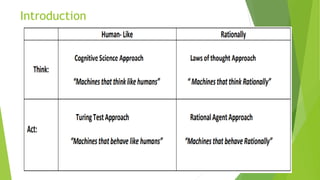
 In order to design intelligent systems, it is important to categorize them
into four categories (Luger and Stubberfield 1993), (Russell and Norvig,
2003)
 1. Systems that think like humans
 2. Systems that think rationally
 3. Systems that behave like humans
 4. Systems that behave rationally
Introduction
Introduction
 Cognitive Science: Think Human-Like
 Requires a model for human cognition. Precise enough models
allow simulation by computers.
 Focus is not just on behavior and I/O, but looks like reasoning
process.
 Goal is not just to produce human-like behavior but to produce a
sequence of steps of the reasoning process, similar to the steps
followed by a human in solving the same task.
Introduction
 Laws of thought: Think Rationally
 The study of mental faculties through the use of computational models;
that it is, the study of computations that make it possible to perceive
reason and act.
 Focus is on inference mechanisms that are probably correct and
guarantee an optimal solution.
 Goal is to formalize the reasoning process as a system of logical rules
and procedures of inference.
 Develop systems of representation to allow inferences to be like
“Socrates is a man. All men are mortal. Therefore Socrates is mortal”.
Introduction
 Turing Test: Act Human-Like
 The art of creating machines that perform functions requiring intelligence
when performed by people; that it is the study of, how to make computers
do things which, at the moment, people do better.
 Focus is on action, and not intelligent behavior centered around the
representation of the world.
 Rational agent: Act Rationally
 Tries to explain and emulate intelligent behavior in terms of
computational process; that it is concerned with the automation of the
intelligence.
 Focus is on systems that act sufficiently if not optimally in all situations.
 Goal is to develop systems that are rational and sufficient.
Agents and Environments
 An agent is an entity that perceives and acts.
 Abstractly, an agent is a function from percept histories to
actions:
[f: P* → A]
 For any given class of environments and tasks, we seek the agent
(or class of agents) with the best performance.
Agents and Environments
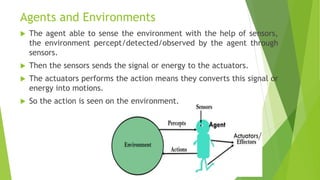
 The agent able to sense the environment with the help of sensors,
the environment percept/detected/observed by the agent through
sensors.
 Then the sensors sends the signal or energy to the actuators.
 The actuators performs the action means they converts this signal or
energy into motions.
 So the action is seen on the environment.
AI Agent Terminologies
 An agent:
 Is anything that can perceive/observe/detect its environment through
sensors and acts upon that environment through actuators.
 Agents can be three types:
 A human agent:
 Has sensory organs such as eyes, ears, nose, tongue and skin and has
actuators such as hands, legs, mouth.
 A robotic agent:
 Has cameras and infrared range finders for the sensors, and various
motors/tires used as actuators.
 A software agent:
 Has encoded bit strings as its programs and actions (by key strokes).
AI Agent Terminologies
 Sensor:
 It is a device which perceives/observes/detects the change in the
environment and sends the information to the other electronic
devices/actuators/effectors.
 Actuators/effectors:
 It is component of machine that converts energy into motion.
 It is responsible for moving and controlling of the system.
 It is the device which affects the environment.
 It can be legs, wheels, arms, fingers and display screens.
AI Agent Terminologies
 Performance Measure of Agent
 It is the criteria, which determines how successful an agent is.
 Behavior of Agent
 It is the action that agent performs after any given sequence of percepts.
 Percept
 It is agent’s perceptual inputs at a given instance.
 Percept Sequence
 It is the history of all that an agent has perceived till date.
 Agent Function
 It is a map from the precept sequence to an action.
Agent Rationality
 Rationality is nothing but status of being reasonable,
sensible, and having good sense of judgment.
 Rationality is concerned with expected actions and results
depending upon what the agent has perceived.
 Performing actions with the aim of obtaining useful
information is an important part of rationality.
Ideal Rational Agent
 It is which has a capable of doing expected actions to maximize its
performance measure, on the basis of:
 Its percept sequence
 Its built-in knowledge base
 They always performs right action, where the right action means the
action that causes the agent to be most successful in the given
percept sequence.
 The problem the agent solves is characterized by Performance
Measure, Environment, Actuators, and Sensors (PEAS).
Rationality of an agent depends
 The performance measures, which determine the degree
of success.
 Agent’s Percept Sequence till now.
 The agent’s prior knowledge about the environment.
 The actions that the agent can carry out.
 Structure of Intelligent Agents.
Agent’s structure can be viewed as:
 Agent = Architecture + Agent Program
 Architecture = the machinery that an agent executes on.
 Agent Program = an implementation of an agent function.
Types of Agents
 Agents can be grouped into four classes based on their degree of
perceived intelligence and capability:
o Simple Reflex Agents: Complete Observation of only current
state
o Model-Based Reflex Agents: partially observable, depends on
the percept history
o Goal-Based Agents: selecting the one which reaches a goal
state
o Utility-Based Agents: it bother about happiness
o Learning Agent: is the type of agent that can learn from its
past experiences or it has learning capabilities.
Types of Agents
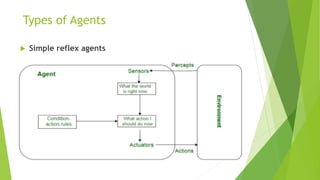
 Simple reflex agents
 It works only on the basis of current perception and it does
not bother about the previous state in which the system
was.
 It ignore the rest of the percept history and act only on the
basis of the current percept.
 Percept history is the history of all that an agent has
perceived till date.
 It is based on the condition-action rule
 A condition-action rule is a rule that maps a state i.e.,
condition to an action.
 If the condition is true, then action is taken, else not taken.
Types of Agents
 Simple reflex agents
Types of Agents
 Problems with simple reflex agents are:
 They choose actions only based on the current percept.
 They are rational only if a correct decision is made only on
the basis of current precept.
 Their environment is completely observable.
 Very limited intelligence.
 No knowledge of non-perceptual parts of state. Usually
too big to generate and store.
Types of Agents
 Model Based Reflex Agent
 It works by finding a rule whose condition matches the current
situation.
 It can handle partially observable environments by use of model
about the world.
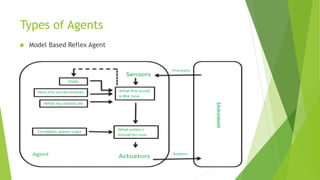
 The agent has to keep track of internal state which is adjusted by
each percept and that depends on the percept history.
 Updating the state requires the information about:
 How the world evolves in-dependently from the agent, and
 How the agent actions affects the world.
Types of Agents
 Model Based Reflex Agent
Types of Agents
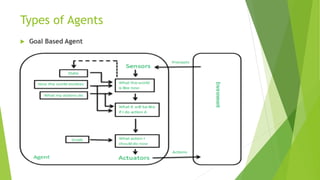
 Goal Based Agent
 Agents take decision based on how far they are currently from their
goal(description of desirable situations).
 Their every action is intended to reduce its distance from goal.
 This allows the agent a way to choose among multiple possibilities, selecting the
one which reaches a goal state.
 The knowledge that supports its decisions is represented explicitly and can be
modified, which makes these agents more flexible.
 Usually require search and planning.
 The goal based agent’s behavior can easily be changed.
Types of Agents
 Goal Based Agent
Types of Agents
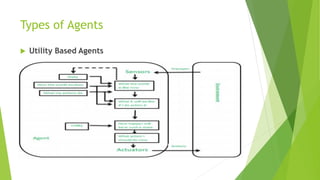
 Utility Based Agents
 The agents which are developed having their end uses as
building blocks are called utility based agents.
 When there are multiple possible alternatives, then to
decide which one is best, utility based agents are used.
 They choose actions based on a preference(utility) for each
state. Sometimes achieving the desired goal is not enough.
 We may look for quicker, safer, cheaper trip to reach a
destination.
Types of Agents
 Utility Based Agents
 Agent happiness should be taken into consideration.
 Utility describes how “happy” the agent is.
 Because of the uncertainty in the world, a utility agent chooses
the action that maximizes the expected utility.
 A utility function maps a state onto a real number which
describes the associated degree of happiness.
Types of Agents
 Utility Based Agents
Types of Agents
 Learning Agents
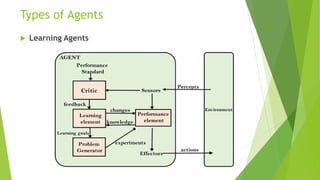
 A learning agent in AI is the type of agent that can learn from its
past experiences or it has learning capabilities. It starts to act with
basic knowledge and then is able to act and adapt automatically
through learning. A learning agent has mainly four conceptual
components, which are:
1. Learning element: It is responsible for making improvements by learning
from the environment.
2. Critic: The learning element takes feedback from critics which describes
how well the agent is doing with respect to a fixed performance standard.
3. Performance element: It is responsible for selecting external action.
4. Problem Generator: This component is responsible for suggesting actions
that will lead to new and informative experiences.
Types of Agents
 Learning Agents
Interacting with the Environment
 In order to enable intelligent behaviour, we will have to interact
with our environment.
 Properly intelligent systems may be expected to:
 Sensory input
Vision, Sound, …
 Interact with humans
Understand language, recognise speech,
generate text, speech and graphics, …
 Modify the environment
Robotics
Properties of an Environment
 The environment has multifold properties:
 Discrete / Continuous
If there are a limited number of distinct, clearly
defined, states of the environment, the environment
is discrete (For example, chess); otherwise it is
continuous (For example, driving).
 Complete Observable / Partially Observable
If it is possible to determine the complete state of
the environment at each time point from the
percepts it is observable; otherwise it is only
partially observable.
Properties of an Environment
 Static / Dynamic
 If the environment does not change while an agent is
acting, then it is static; otherwise it is dynamic.
 Single agent / Multiple agents
 The environment may contain other agents which may
be of the same or different kind as that of the agent.
 Accessible / Inaccessible
 If the agent’s sensory apparatus can have access to the
complete state of the environment, then the
environment is accessible to that agent.
Properties of an Environment
 Deterministic / Non-deterministic
 If the next state of the environment is completely
determined by the current state and the actions of the
agent, then the environment is deterministic;
otherwise it is non-deterministic.
The Disadvantages of AI
 Increased costs
 Difficulty with software development - slow and
expensive
 Few experienced programmers
 Few practical products have reached the market as yet.
End of Chapter II
 Chapter III Outline
 Problem Solving by Searching
 Problem Solving Agents
 Problem Formulation
 Search Strategies
 Constraint Satisfaction Search
 Games as Search Problems
Next Chapter III
AI Chapter II for computer Science students

AI Chapter II for computer Science students

  • 1.
  • 2.
    Chapter Outline Introduction toIntelligent Agents  Introduction  Agents and Environments  Acting of Intelligent Agents (Rationality)  Structure of Intelligent Agents  Agent Types  Important Concepts and Terms
  • 3.
    Introduction  AI hastwo major roles: 1. Study the intelligent part concerned with humans.  It have two goals  Scientific Goal:  To determine knowledge representation, learning, rule systems search, and so on  Explain various sorts of real intelligence.
  • 4.
    Introduction  Engineering Goal: To solve real world problems using AI techniques such as Knowledge representation, learning, rule systems, search, and so on.  Traditionally, computer scientists and engineers have been more interested in the engineering goal, while  Psychologists, philosophers and cognitive scientists have been more interested in the scientific goal.
  • 5.
    Introduction 2. Design thoseactions using computers (Representation).  In order to design intelligent systems, it is important to categorize them into four categories (Luger and Stubberfield 1993), (Russell and Norvig, 2003)  1. Systems that think like humans  2. Systems that think rationally  3. Systems that behave like humans  4. Systems that behave rationally
  • 6.
  • 7.
    Introduction  Cognitive Science:Think Human-Like  Requires a model for human cognition. Precise enough models allow simulation by computers.  Focus is not just on behavior and I/O, but looks like reasoning process.  Goal is not just to produce human-like behavior but to produce a sequence of steps of the reasoning process, similar to the steps followed by a human in solving the same task.
  • 8.
    Introduction  Laws ofthought: Think Rationally  The study of mental faculties through the use of computational models; that it is, the study of computations that make it possible to perceive reason and act.  Focus is on inference mechanisms that are probably correct and guarantee an optimal solution.  Goal is to formalize the reasoning process as a system of logical rules and procedures of inference.  Develop systems of representation to allow inferences to be like “Socrates is a man. All men are mortal. Therefore Socrates is mortal”.
  • 9.
    Introduction  Turing Test:Act Human-Like  The art of creating machines that perform functions requiring intelligence when performed by people; that it is the study of, how to make computers do things which, at the moment, people do better.  Focus is on action, and not intelligent behavior centered around the representation of the world.  Rational agent: Act Rationally  Tries to explain and emulate intelligent behavior in terms of computational process; that it is concerned with the automation of the intelligence.  Focus is on systems that act sufficiently if not optimally in all situations.  Goal is to develop systems that are rational and sufficient.
  • 10.
    Agents and Environments An agent is an entity that perceives and acts.  Abstractly, an agent is a function from percept histories to actions: [f: P* → A]  For any given class of environments and tasks, we seek the agent (or class of agents) with the best performance.
  • 11.
    Agents and Environments The agent able to sense the environment with the help of sensors, the environment percept/detected/observed by the agent through sensors.  Then the sensors sends the signal or energy to the actuators.  The actuators performs the action means they converts this signal or energy into motions.  So the action is seen on the environment.
  • 12.
    AI Agent Terminologies An agent:  Is anything that can perceive/observe/detect its environment through sensors and acts upon that environment through actuators.  Agents can be three types:  A human agent:  Has sensory organs such as eyes, ears, nose, tongue and skin and has actuators such as hands, legs, mouth.  A robotic agent:  Has cameras and infrared range finders for the sensors, and various motors/tires used as actuators.  A software agent:  Has encoded bit strings as its programs and actions (by key strokes).
  • 13.
    AI Agent Terminologies Sensor:  It is a device which perceives/observes/detects the change in the environment and sends the information to the other electronic devices/actuators/effectors.  Actuators/effectors:  It is component of machine that converts energy into motion.  It is responsible for moving and controlling of the system.  It is the device which affects the environment.  It can be legs, wheels, arms, fingers and display screens.
  • 14.
    AI Agent Terminologies Performance Measure of Agent  It is the criteria, which determines how successful an agent is.  Behavior of Agent  It is the action that agent performs after any given sequence of percepts.  Percept  It is agent’s perceptual inputs at a given instance.  Percept Sequence  It is the history of all that an agent has perceived till date.  Agent Function  It is a map from the precept sequence to an action.
  • 15.
    Agent Rationality  Rationalityis nothing but status of being reasonable, sensible, and having good sense of judgment.  Rationality is concerned with expected actions and results depending upon what the agent has perceived.  Performing actions with the aim of obtaining useful information is an important part of rationality.
  • 16.
    Ideal Rational Agent It is which has a capable of doing expected actions to maximize its performance measure, on the basis of:  Its percept sequence  Its built-in knowledge base  They always performs right action, where the right action means the action that causes the agent to be most successful in the given percept sequence.  The problem the agent solves is characterized by Performance Measure, Environment, Actuators, and Sensors (PEAS).
  • 17.
    Rationality of anagent depends  The performance measures, which determine the degree of success.  Agent’s Percept Sequence till now.  The agent’s prior knowledge about the environment.  The actions that the agent can carry out.  Structure of Intelligent Agents.
  • 18.
    Agent’s structure canbe viewed as:  Agent = Architecture + Agent Program  Architecture = the machinery that an agent executes on.  Agent Program = an implementation of an agent function.
  • 19.
    Types of Agents Agents can be grouped into four classes based on their degree of perceived intelligence and capability: o Simple Reflex Agents: Complete Observation of only current state o Model-Based Reflex Agents: partially observable, depends on the percept history o Goal-Based Agents: selecting the one which reaches a goal state o Utility-Based Agents: it bother about happiness o Learning Agent: is the type of agent that can learn from its past experiences or it has learning capabilities.
  • 20.
    Types of Agents Simple reflex agents  It works only on the basis of current perception and it does not bother about the previous state in which the system was.  It ignore the rest of the percept history and act only on the basis of the current percept.  Percept history is the history of all that an agent has perceived till date.  It is based on the condition-action rule  A condition-action rule is a rule that maps a state i.e., condition to an action.  If the condition is true, then action is taken, else not taken.
  • 21.
    Types of Agents Simple reflex agents
  • 22.
    Types of Agents Problems with simple reflex agents are:  They choose actions only based on the current percept.  They are rational only if a correct decision is made only on the basis of current precept.  Their environment is completely observable.  Very limited intelligence.  No knowledge of non-perceptual parts of state. Usually too big to generate and store.
  • 23.
    Types of Agents Model Based Reflex Agent  It works by finding a rule whose condition matches the current situation.  It can handle partially observable environments by use of model about the world.  The agent has to keep track of internal state which is adjusted by each percept and that depends on the percept history.  Updating the state requires the information about:  How the world evolves in-dependently from the agent, and  How the agent actions affects the world.
  • 24.
    Types of Agents Model Based Reflex Agent
  • 25.
    Types of Agents Goal Based Agent  Agents take decision based on how far they are currently from their goal(description of desirable situations).  Their every action is intended to reduce its distance from goal.  This allows the agent a way to choose among multiple possibilities, selecting the one which reaches a goal state.  The knowledge that supports its decisions is represented explicitly and can be modified, which makes these agents more flexible.  Usually require search and planning.  The goal based agent’s behavior can easily be changed.
  • 26.
    Types of Agents Goal Based Agent
  • 27.
    Types of Agents Utility Based Agents  The agents which are developed having their end uses as building blocks are called utility based agents.  When there are multiple possible alternatives, then to decide which one is best, utility based agents are used.  They choose actions based on a preference(utility) for each state. Sometimes achieving the desired goal is not enough.  We may look for quicker, safer, cheaper trip to reach a destination.
  • 28.
    Types of Agents Utility Based Agents  Agent happiness should be taken into consideration.  Utility describes how “happy” the agent is.  Because of the uncertainty in the world, a utility agent chooses the action that maximizes the expected utility.  A utility function maps a state onto a real number which describes the associated degree of happiness.
  • 29.
    Types of Agents Utility Based Agents
  • 30.
    Types of Agents Learning Agents  A learning agent in AI is the type of agent that can learn from its past experiences or it has learning capabilities. It starts to act with basic knowledge and then is able to act and adapt automatically through learning. A learning agent has mainly four conceptual components, which are: 1. Learning element: It is responsible for making improvements by learning from the environment. 2. Critic: The learning element takes feedback from critics which describes how well the agent is doing with respect to a fixed performance standard. 3. Performance element: It is responsible for selecting external action. 4. Problem Generator: This component is responsible for suggesting actions that will lead to new and informative experiences.
  • 31.
    Types of Agents Learning Agents
  • 32.
    Interacting with theEnvironment  In order to enable intelligent behaviour, we will have to interact with our environment.  Properly intelligent systems may be expected to:  Sensory input Vision, Sound, …  Interact with humans Understand language, recognise speech, generate text, speech and graphics, …  Modify the environment Robotics
  • 33.
    Properties of anEnvironment  The environment has multifold properties:  Discrete / Continuous If there are a limited number of distinct, clearly defined, states of the environment, the environment is discrete (For example, chess); otherwise it is continuous (For example, driving).  Complete Observable / Partially Observable If it is possible to determine the complete state of the environment at each time point from the percepts it is observable; otherwise it is only partially observable.
  • 34.
    Properties of anEnvironment  Static / Dynamic  If the environment does not change while an agent is acting, then it is static; otherwise it is dynamic.  Single agent / Multiple agents  The environment may contain other agents which may be of the same or different kind as that of the agent.  Accessible / Inaccessible  If the agent’s sensory apparatus can have access to the complete state of the environment, then the environment is accessible to that agent.
  • 35.
    Properties of anEnvironment  Deterministic / Non-deterministic  If the next state of the environment is completely determined by the current state and the actions of the agent, then the environment is deterministic; otherwise it is non-deterministic.
  • 36.
    The Disadvantages ofAI  Increased costs  Difficulty with software development - slow and expensive  Few experienced programmers  Few practical products have reached the market as yet.
  • 37.
    End of ChapterII  Chapter III Outline  Problem Solving by Searching  Problem Solving Agents  Problem Formulation  Search Strategies  Constraint Satisfaction Search  Games as Search Problems Next Chapter III