CHAPTER 2
CREATIVITY SKILLS
FTS 1103
THINKING SKILLS
Learning Objectives
• Students will be able to define creativity skills
• Students will be able to understand about
importance of creative thinking skills
• Students will be able to explain regarding
process of creative thinking skills
• Students will be able to know about techniques
of creative thinking skills
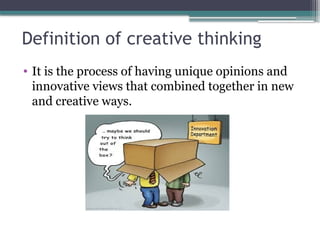
Definition of creative thinking
• It is the process of having unique opinions and
innovative views that combined together in new
and creative ways.
Let’s see the video
https://www.youtube.com/watch?
v=HPQN0qrQ0AI
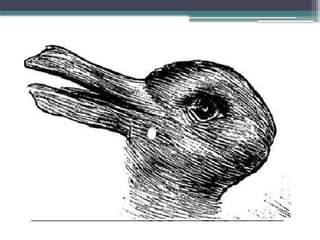
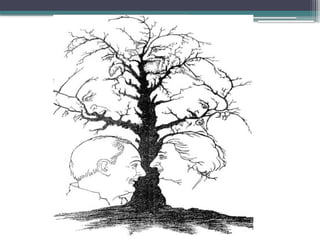
You’re Exceptionally Creative if
You See the Correct Image
• Creative thinking is a great skill to develop.
• The ability to build up fresh and creative ideas,
concepts and strategy to be creative person.
• Creativity comes from looking for the
unanticipated and involves the process of
thinking out of the box.
Creative thinking
What is creativity?
According to social psychologist Teresa Amabile, there are
three elements of creativity:
• Domain skills
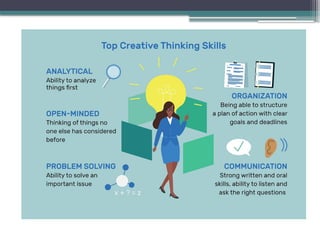
• Creative thinking skills
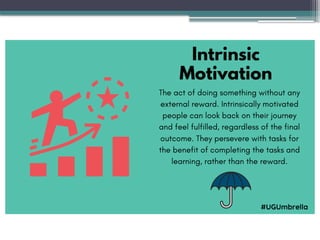
• Intrinsic motivation
Characteristics of creative thinker
• Receptivity
• Curiosity
• Wide range of Interest
• Attentives
• Connection Seeking
• Conviction
• Complexity
IMPORTANCE OF CREATIVE THINKING
• Problems always occur.
• Creative thinking involves the imagination.
• There are process involved in creative thinking
to increase understanding towards certain
problems.
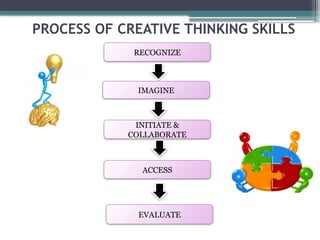
PROCESS OF CREATIVE THINKING SKILLS
RECOGNIZE
IMAGINE
INITIATE &
COLLABORATE
ACCESS
EVALUATE
• Brainstorming
• Mind Mapping
• Role Play
• Thinking across Discipline
Techniques for Creative Thinking
BRAINSTORMING
Definition:
Large number of ideas to produce in a short period of
time.
Rules for Brainstorming:
▫ Generate ideas as much as possible
▫ No idea is a bad idea
▫ Build on one another’s ideas
▫ Display all ideas
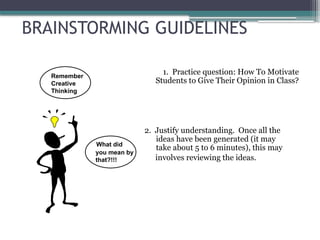
1. Practice question: How To Motivate
Students to Give Their Opinion in Class?
2. Justify understanding. Once all the
ideas have been generated (it may
take about 5 to 6 minutes), this may
involves reviewing the ideas.
BRAINSTORMING GUIDELINES
Remember
Creative
Thinking
What did
you mean by
that?!!!
BRAINSTORMING GUIDELINES (CON’T)
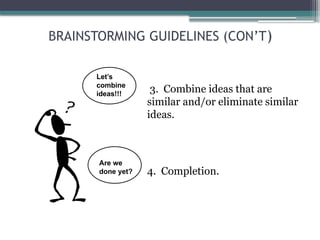
3. Combine ideas that are
similar and/or eliminate similar
ideas.
4. Completion.
Let’s
combine
ideas!!!
Are we
done yet?
MIND MAPPING
• Definition : Opinions, concepts or issues are being
visualized through pictures.
• Purposes:
▫ Unblock our thinking.
▫ Observe the idea.
▫ See how ideas relate to one another.
▫ Look at things in a new and different way.
▫ Look at an idea in depth.
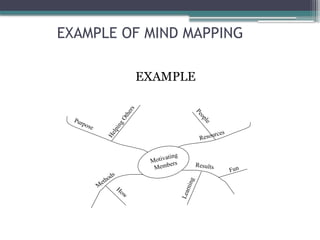
EXAMPLE OF MIND MAPPING
EXAMPLE
Resources
P
e
o
p
l
e
Motivating
Members
H
e
l
p
i
n
g
O
t
h
e
r
s
Purpose
L
e
a
r
n
i
n
g
Results
Fun
M
ethods
How
ROLE PLAY
Definition:
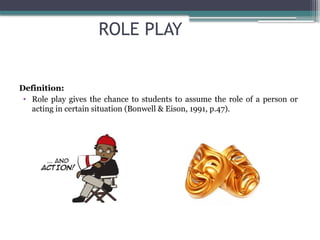
• Role play gives the chance to students to assume the role of a person or
acting in certain situation (Bonwell & Eison, 1991, p.47).
Example of Role Play
• Interview practice
• Marketing
• Retailing
• Counseling
• Teaching
• Debates
Thinking Across Discipline
Definition:
• It is a group of people that discuss among them to collect and integrate
different types of expertise to solve problems in various different of
perspectives (Gibbons et al. 1994).
Six Thinking Hats
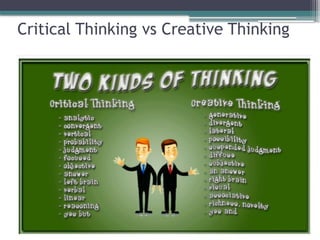
Critical Thinking vs Creative Thinking
Summary
• Creativity involves an ability to come up with new and
different viewpoints on a subject.
• There are many importance of creative thinking that
involves imagination and look certain problem/things at
different ways.
References
• Bonwell, C. C., & Eison, J. A. (1991). Active learning: Creating excitement in the classroom.
Washington, DC: The George Washington University.
• De Bono, E. (2005). De Bono’s thinking Course . Barnes & Noble Books; Revised edition
(2005)
• De Bono, E. (1990). Six thinking hats. London: Penguin
• Everyday Creativity: Principles for Innovative Design. Dr. Larry G Richards
• http://www.destinationimagination.org/who-we-are/the-creative-process
• http://cw.routledge.com/textbooks/0415345421/about/pdf/sample.pdf
• Innovative Thinking; Six Simple Secrets By Padi Selwyn, M.A
• Michalko, M. (1998). Cracking creativity . Berkeley: Ten Speed
• Northern Illinois University, Faculty Development and Instructional Design Center
facdev@niu.edu, http://facdev.niu.edu, 815.753.0595
• Techniques for Creative Thinking: Yes, They Work by Gary A. Davis, Ph.D.

Chapter 2-creativity thinking skills.pptx

  • 1.
    CHAPTER 2 CREATIVITY SKILLS FTS1103 THINKING SKILLS
  • 2.
    Learning Objectives • Studentswill be able to define creativity skills • Students will be able to understand about importance of creative thinking skills • Students will be able to explain regarding process of creative thinking skills • Students will be able to know about techniques of creative thinking skills
  • 3.
    Definition of creativethinking • It is the process of having unique opinions and innovative views that combined together in new and creative ways.
  • 4.
    Let’s see thevideo https://www.youtube.com/watch? v=HPQN0qrQ0AI
  • 5.
    You’re Exceptionally Creativeif You See the Correct Image
  • 10.
    • Creative thinkingis a great skill to develop. • The ability to build up fresh and creative ideas, concepts and strategy to be creative person. • Creativity comes from looking for the unanticipated and involves the process of thinking out of the box. Creative thinking
  • 11.
    What is creativity? Accordingto social psychologist Teresa Amabile, there are three elements of creativity: • Domain skills • Creative thinking skills • Intrinsic motivation
  • 15.
    Characteristics of creativethinker • Receptivity • Curiosity • Wide range of Interest • Attentives • Connection Seeking • Conviction • Complexity
  • 16.
    IMPORTANCE OF CREATIVETHINKING • Problems always occur. • Creative thinking involves the imagination. • There are process involved in creative thinking to increase understanding towards certain problems.
  • 17.
    PROCESS OF CREATIVETHINKING SKILLS RECOGNIZE IMAGINE INITIATE & COLLABORATE ACCESS EVALUATE
  • 18.
    • Brainstorming • MindMapping • Role Play • Thinking across Discipline Techniques for Creative Thinking
  • 19.
    BRAINSTORMING Definition: Large number ofideas to produce in a short period of time. Rules for Brainstorming: ▫ Generate ideas as much as possible ▫ No idea is a bad idea ▫ Build on one another’s ideas ▫ Display all ideas
  • 20.
    1. Practice question:How To Motivate Students to Give Their Opinion in Class? 2. Justify understanding. Once all the ideas have been generated (it may take about 5 to 6 minutes), this may involves reviewing the ideas. BRAINSTORMING GUIDELINES Remember Creative Thinking What did you mean by that?!!!
  • 21.
    BRAINSTORMING GUIDELINES (CON’T) 3.Combine ideas that are similar and/or eliminate similar ideas. 4. Completion. Let’s combine ideas!!! Are we done yet?
  • 22.
    MIND MAPPING • Definition: Opinions, concepts or issues are being visualized through pictures. • Purposes: ▫ Unblock our thinking. ▫ Observe the idea. ▫ See how ideas relate to one another. ▫ Look at things in a new and different way. ▫ Look at an idea in depth.
  • 23.
    EXAMPLE OF MINDMAPPING EXAMPLE Resources P e o p l e Motivating Members H e l p i n g O t h e r s Purpose L e a r n i n g Results Fun M ethods How
  • 24.
    ROLE PLAY Definition: • Roleplay gives the chance to students to assume the role of a person or acting in certain situation (Bonwell & Eison, 1991, p.47).
  • 25.
    Example of RolePlay • Interview practice • Marketing • Retailing • Counseling • Teaching • Debates
  • 26.
    Thinking Across Discipline Definition: •It is a group of people that discuss among them to collect and integrate different types of expertise to solve problems in various different of perspectives (Gibbons et al. 1994).
  • 27.
  • 28.
    Critical Thinking vsCreative Thinking
  • 29.
    Summary • Creativity involvesan ability to come up with new and different viewpoints on a subject. • There are many importance of creative thinking that involves imagination and look certain problem/things at different ways.
  • 30.
    References • Bonwell, C.C., & Eison, J. A. (1991). Active learning: Creating excitement in the classroom. Washington, DC: The George Washington University. • De Bono, E. (2005). De Bono’s thinking Course . Barnes & Noble Books; Revised edition (2005) • De Bono, E. (1990). Six thinking hats. London: Penguin • Everyday Creativity: Principles for Innovative Design. Dr. Larry G Richards • http://www.destinationimagination.org/who-we-are/the-creative-process • http://cw.routledge.com/textbooks/0415345421/about/pdf/sample.pdf • Innovative Thinking; Six Simple Secrets By Padi Selwyn, M.A • Michalko, M. (1998). Cracking creativity . Berkeley: Ten Speed • Northern Illinois University, Faculty Development and Instructional Design Center facdev@niu.edu, http://facdev.niu.edu, 815.753.0595 • Techniques for Creative Thinking: Yes, They Work by Gary A. Davis, Ph.D.

Editor's Notes

  • #1 INSTRUCTION: VO Chapter 2 Creativity skills
  • #2  Learning Objectives: - Students will be able to define creativity skills - Students will be able to understand about importance of creative thinking skills - Students will be able to explain regarding process of creative thinking skills - Students will be able to know about techniques of creative thinking skills
  • #3  Definition of creative thinking It is the process of having unique opinions and innovative views that combined together in new and creative ways. Creative Thinking also can be defined as a method of looking at problems or situations from a new viewpoint. Creative thinking can be stimulated both by an unstructured process such as brainstorming and by a structured process such as lateral thinking.
  • #4  Masukkan video seperti link di bawah ini https://www.youtube.com/watch?v=HPQN0qrQ0AI
  • #10  Creative thinking Creative thinking is a great skill to develop. The ability to build up fresh and creative ideas, concepts and strategy to be creative person. Creativity comes from looking for the unanticipated and involves the process of thinking out of the box.
  • #11  What is creativity? According to social psychologist Teresa Amabile, there are three basic ingredients to creativity: Domain skills- are develop people to be proficient in their field. For example, to be creative mechanical engineer, they need to expert in this area. 2) Creative thinking skills- It include looking for originality and diversity, being self-governing, being constant and having high standards. 3) Intrinsic motivation- It includes factors that come from within of people. It cannot be seen but actually exists. Gambar masuk daripada tepi sebelah kanan & voice akan keluar apabila klik pd perkataan domain skills, creative thinking skills & intrinsic motivation
  • #16  Problems always occur because business in not being operating in the vacuum environment. It is being operating in the environment that keep on going changing that needs different or new solutions towards problems. Creative thinking involves the imagination that can be best solution and the ideas are different of others. There are process involved in creative thinking to increase understanding towards certain problems.
  • #17  Process of creative thinking skills: Recognize Becoming alert of a challenge or opportunity within a field of interest It is involves the process of finding the problem b) Imagine - It is the process of application of thinking skills to expand thoughts for solutions - It involves the process of future thinking c) Initiate & Collaborate - It involves by using process and design thinking It includes the process of taking risks and learn to manage behaviour This process involves working in a collaborative ways whereby includes to learn and practice interpersonal and leadership skills d) Access It is monitoring progress and involves the corrective actions if the solutions are failed. e) Evaluate It involves about the experience, resources, teamwork, and enjoy the solution
  • #18  Techniques for Creative Thinking Brainstorming: b) Mind mapping c) Role Play Techniques for Creative Thinking: Yes, They Work by Gary A. Davis, Ph.D.
  • #19  Definition: Large number of ideas to produce in a short period of time. Rules for brainstorming: Generate ideas as much as possible- People think freely in order to gather as many ideas as possible. No idea is a bad idea – No criticizing over other people’s ideas and opinions. Build on one another’s ideas Display all ideas(using flipchart).
  • #20  BRAINSTORMING GUIDELINES Practice question: How To Motivate Students to Give Their Opinion in Class? 2. Justify understanding. Once all the ideas have been generated (it may take about 5 to 6 minutes), this may involves reviewing the ideas.
  • #21 . 3. Combine ideas that are similar and/or eliminate similar ideas. 4. The brainstorming process is completed once the ideas have been offered, discussed and consolidated.
  • #22  Definition : Opinions, concepts or issues are being visualized through pictures. Purpose : Unblock our thinking. Observe the idea on a one sheet of paper. See how ideas relate to one another. Look at things in a new and different way. Look at an idea in depth.
  • #24  Role Play Definition: Role play gives the chance to students to assume the role of a person or acting in certain situation. This can be done by individually, in pairs or in groups that can be performed in complex situation. This method engaged students in real-life situations which includes their personal feelings toward others in given situation (Bonwell & Eison, 1991, p.47).
  • #25  Example of role play Interview practice—In preparation for career interviews, students can assume the role of the interviewer and/or the interviewee. Marketing—In preparation for a class presentation, students can assume the position of a sales representative and sell a product. Retailing—To help prepare students for a guest speaker in merchandising course, students can play the role of sales manager and sales representative to gain better insight on the responsibilities of these positions. Counseling—In preparing for clinical practice, students can role play a family therapist whose client has revealed she has committed a criminal act. Teaching—In preparation for a job fair, students can role play the teacher and the student, or the administrator and the student, or the teacher and a parent. Debates—As a spontaneous exercise, the instructor has students briefly prepare arguments for and arguments against positions on a topic Minta tolong masukkan video & gambar yang berkenaan dengan role play.
  • #26  Thinking across discipline Definition: Groups of individuals are called upon to gather and integrate multiple forms of expertise to address problems that cannot be satisfactorily engaged through single perspectives (Gibbons et al. 1994). Example: “Cross-functional teams” combine engineers, scientists, writers, social-science researchers, businesspeople, and others to develop products and solutions in corporate settings. - Educational collaborations link developmental psychologists, teachers, curriculum designers, artists, computer programmers, and others in designing new technologies for student learning. Minta tolong masukkan gambar yang bersesuaian dengan thinking across discipline.
  • #29  Summary Creativity involves an ability to come up with new and different viewpoints on a subject. It involves breaking down and restructuring knowledge about the subject in order to gain new insights into its nature. There are many importance of creative thinking that involves imagination and look certain problem/things at different ways. Creative thinking involves process and there are several techniques can be used in order to come out with unique ideas that different from other people.