CSC 450/550
Part 1: Introduction
CSC 450/550
Summary
(1) Contact information
(2) Course objective and topics
(3) Course evaluation
(4) * The layering principle of network protocols
(5) * Connection-oriented and connectionless services
(6) Service primitives
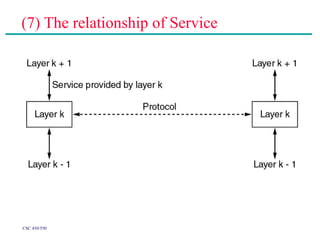
(7) The relationship of services to protocols
(8) * Reference models
CSC 450/550
(1) Contact Information
Course web page: http://www.csc.uvic.ca/~wkui/Courses/networks/index.htm
Lab web page: http://www.csc.uvic.ca/~csc450
Webboard: http://webboard.uvic.ca/
Instructor: Kui Wu
Email: wkui@cs.uvic.ca
Office hours: TW 2:00 - 3:00 p.m.
EOW: 233
CSC 450/550
(2.1) Course Objectives
•To help you gain a general understanding of the principles and concepts
governing the operations of computer networks;
•To provide you with the opportunity to become skillful in the implementation
and use of communication protocols;
•To help you grasp the basic research methodologies in the field of computer
networks (for CSc 550 students).
CSC 450/550
(2.2) Topics
•Overview of network layers and
protocols
•The Physical Layer
- transmission media
- the Nyquist limit and the Shannon
limit
• * The Data Link Layer
- framing
- error detecting and correcting codes
- sliding window protocols
• * The Medium Access Control Layer
- ALOHA
- IEEE 802.3
- IEEE 802.11
• * The Network Layer
- routing algorithms
- congestion control
- IP
• * The Transport Layer
- connection establishment/termination
- multiplexing
- flow control
- TCP and UDP
• Utility Protocols
CSC 450/550
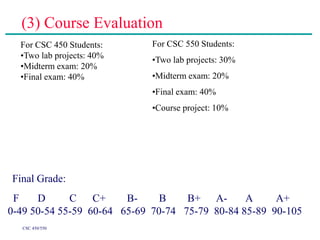
(3) Course Evaluation
For CSC 450 Students:
•Two lab projects: 40%
•Midterm exam: 20%
•Final exam: 40%
For CSC 550 Students:
•Two lab projects: 30%
•Midterm exam: 20%
•Final exam: 40%
•Course project: 10%
F D C C+ B- B B+ A- A A+
0-49 50-54 55-59 60-64 65-69 70-74 75-79 80-84 85-89 90-105
Final Grade:
CSC 450/550
(4.1) Protocols
Basically, a protocol is an agreement between the
communicating peers on how communication is to proceed.
CSC 450/550
(4.2) The layering Principle (1)
CSC 450/550
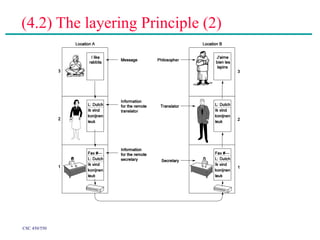
(4.2) The layering Principle (2)
CSC 450/550
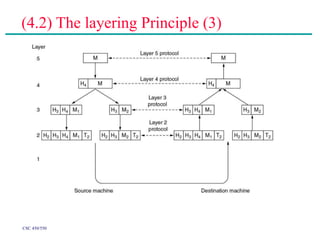
(4.2) The layering Principle (3)
CSC 450/550
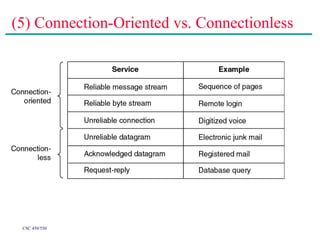
(5) Connection-Oriented vs. Connectionless
CSC 450/550
(6) Service Primitives
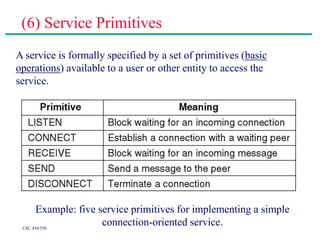
A service is formally specified by a set of primitives (basic
operations) available to a user or other entity to access the
service.
Example: five service primitives for implementing a simple
connection-oriented service.
CSC 450/550
(7) The relationship of Service
CSC 450/550
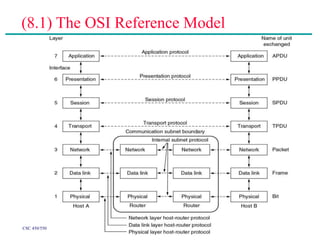
(8.1) The OSI Reference Model
CSC 450/550
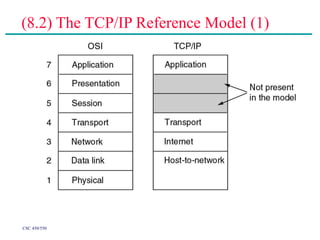
(8.2) The TCP/IP Reference Model (1)
CSC 450/550
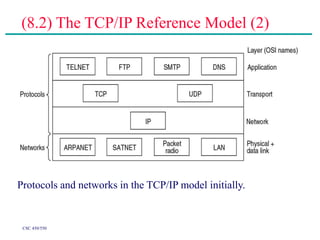
(8.2) The TCP/IP Reference Model (2)
Protocols and networks in the TCP/IP model initially.
CSC 450/550
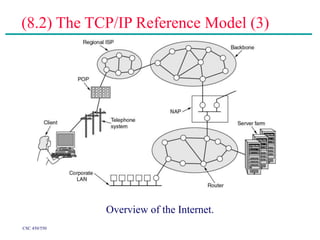
(8.2) The TCP/IP Reference Model (3)
Overview of the Internet.

chapter 1.ppt

  • 1.
    CSC 450/550 Part 1:Introduction
  • 2.
    CSC 450/550 Summary (1) Contactinformation (2) Course objective and topics (3) Course evaluation (4) * The layering principle of network protocols (5) * Connection-oriented and connectionless services (6) Service primitives (7) The relationship of services to protocols (8) * Reference models
  • 3.
    CSC 450/550 (1) ContactInformation Course web page: http://www.csc.uvic.ca/~wkui/Courses/networks/index.htm Lab web page: http://www.csc.uvic.ca/~csc450 Webboard: http://webboard.uvic.ca/ Instructor: Kui Wu Email: wkui@cs.uvic.ca Office hours: TW 2:00 - 3:00 p.m. EOW: 233
  • 4.
    CSC 450/550 (2.1) CourseObjectives •To help you gain a general understanding of the principles and concepts governing the operations of computer networks; •To provide you with the opportunity to become skillful in the implementation and use of communication protocols; •To help you grasp the basic research methodologies in the field of computer networks (for CSc 550 students).
  • 5.
    CSC 450/550 (2.2) Topics •Overviewof network layers and protocols •The Physical Layer - transmission media - the Nyquist limit and the Shannon limit • * The Data Link Layer - framing - error detecting and correcting codes - sliding window protocols • * The Medium Access Control Layer - ALOHA - IEEE 802.3 - IEEE 802.11 • * The Network Layer - routing algorithms - congestion control - IP • * The Transport Layer - connection establishment/termination - multiplexing - flow control - TCP and UDP • Utility Protocols
  • 6.
    CSC 450/550 (3) CourseEvaluation For CSC 450 Students: •Two lab projects: 40% •Midterm exam: 20% •Final exam: 40% For CSC 550 Students: •Two lab projects: 30% •Midterm exam: 20% •Final exam: 40% •Course project: 10% F D C C+ B- B B+ A- A A+ 0-49 50-54 55-59 60-64 65-69 70-74 75-79 80-84 85-89 90-105 Final Grade:
  • 7.
    CSC 450/550 (4.1) Protocols Basically,a protocol is an agreement between the communicating peers on how communication is to proceed.
  • 8.
    CSC 450/550 (4.2) Thelayering Principle (1)
  • 9.
    CSC 450/550 (4.2) Thelayering Principle (2)
  • 10.
    CSC 450/550 (4.2) Thelayering Principle (3)
  • 11.
  • 12.
    CSC 450/550 (6) ServicePrimitives A service is formally specified by a set of primitives (basic operations) available to a user or other entity to access the service. Example: five service primitives for implementing a simple connection-oriented service.
  • 13.
    CSC 450/550 (7) Therelationship of Service
  • 14.
    CSC 450/550 (8.1) TheOSI Reference Model
  • 15.
    CSC 450/550 (8.2) TheTCP/IP Reference Model (1)
  • 16.
    CSC 450/550 (8.2) TheTCP/IP Reference Model (2) Protocols and networks in the TCP/IP model initially.
  • 17.
    CSC 450/550 (8.2) TheTCP/IP Reference Model (3) Overview of the Internet.

Editor's Notes