1
BS (Information Technology) 2024
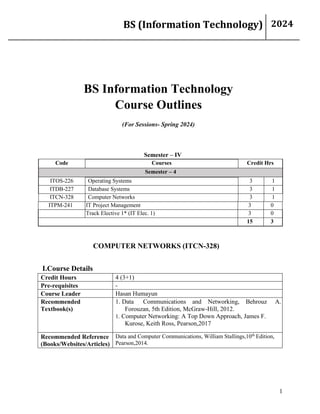
BS Information Technology
Course Outlines
(For Sessions- Spring 2024)
Semester – IV
Code Courses Credit Hrs
Semester – 4
ITOS-226 Operating Systems 3 1
ITDB-227 Database Systems 3 1
ITCN-328 Computer Networks 3 1
ITPM-241 IT Project Management 3 0
Track Elective 1* (IT Elec. 1) 3 0
15 3
COMPUTER NETWORKS (ITCN-328)
I.Course Details
Credit Hours 4 (3+1)
Pre-requisites -
Course Leader Hasan Humayun
Recommended
Textbook(s)
1. Data Communications and Networking, Behrouz A.
Forouzan, 5th Edition, McGraw-Hill, 2012.
1. Computer Networking: A Top Down Approach, James F.
Kurose, Keith Ross, Pearson,2017
Recommended Reference
(Books/Websites/Articles)
Data and Computer Communications, William Stallings,10th
Edition,
Pearson,2014.
2
BS (Information Technology) 2024
II. Course Learning Outcomes (CLO)
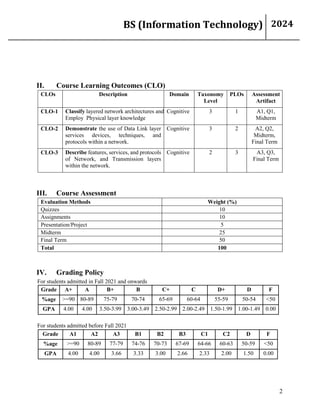
CLOs Description Domain Taxonomy
Level
PLOs Assessment
Artifact
CLO-1 Classify layered network architectures and
Employ Physical layer knowledge
Cognitive 3 1 A1, Q1,
Midterm
CLO-2 Demonstrate the use of Data Link layer
services devices, techniques, and
protocols within a network.
Cognitive 3 2 A2, Q2,
Midterm,
Final Term
CLO-3 Describe features, services, and protocols
of Network, and Transmission layers
within the network.
Cognitive 2 3 A3, Q3,
Final Term
III. Course Assessment
Evaluation Methods Weight (%)
Quizzes 10
Assignments 10
Presentation/Project 5
Midterm 25
Final Term 50
Total 100
IV. Grading Policy
For students admitted in Fall 2021 and onwards
Grade A+ A B+ B C+ C D+ D F
%age >=90 80-89 75-79 70-74 65-69 60-64 55-59 50-54 <50
GPA 4.00 4.00 3.50-3.99 3.00-3.49 2.50-2.99 2.00-2.49 1.50-1.99 1.00-1.49 0.00
For students admitted before Fall 2021
Grade A1 A2 A3 B1 B2 B3 C1 C2 D F
%age >=90 80-89 77-79 74-76 70-73 67-69 64-66 60-63 50-59 <50
GPA 4.00 4.00 3.66 3.33 3.00 2.66 2.33 2.00 1.50 0.00
3
BS (Information Technology) 2024
V. Course Contents
Introduction and protocols architecture, basic concepts of networking, network topologies, layered
architecture, physical layer functionality, data link layer functionality, multiple access techniques, circuit
switching, and packet switching, LAN technologies, MAC address, networking devices, network layer
protocols, IPv4 and IPv6, DHCP, NAT, IP addressing, IP datagram, ICMP, routing protocols, UDP and
(TCP), ports and sockets, connection establishment, flow and congestion control, application layer
protocols, latest trends in computer networks.
VI. Weekly Breakdown
Week
No.
CLO Topics Reference
1 CLO-1 Intro to Networks components, Basic concepts of networking.
Network topologies, network layers, internet standards, and
architecture.
Chapter 1
2 The concept of layered architecture modeling. TCP/IP protocol suite,
comparison, protocols and OSI.
Chapter 2
3 The distinction between Data and Signals of Analog and Digital
Transmission Impairments. Network performance measures
including throughput, and delays. Data vs. signaling rates. Channel
bandwidth and capacity, delay product.
Chapter 3
4 Switching Technologies: Circuit Switching, Packet Switching,
datagram, and Virtual Circuit Switching: Phases, efficiency, and
delays.
Chapter 8
5 CLO-2 Data link layer (DLL), Nodes and links, services, framing, flow,
error, congestion control, data link addressing, ARP, and
communication using DLL.
Chapter 9
6 Error Detection and Correction, Types of Error, Redundancy, Error
Detection, Parity, checksum, VRC, LRC, cyclic codes, Detection
versus Correction, Forward Error Correction (Hamming codes,
Hamming distance) versus Retransmission
Chapter 10
7 Data link control services, Flow, and error control (simple protocol
& stop N wait protocol), PAP and CHAP Protocols, Go back N
(GBN) and Selective Reject.
Chapter 11 &
Chapter 23
4
BS (Information Technology) 2024
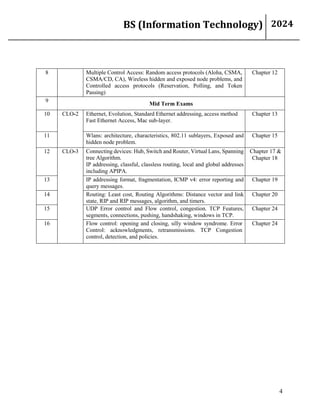
8 Multiple Control Access: Random access protocols (Aloha, CSMA,
CSMA/CD, CA), Wireless hidden and exposed node problems, and
Controlled access protocols (Reservation, Polling, and Token
Passing)
Chapter 12
9
Mid Term Exams
10 CLO-2 Ethernet, Evolution, Standard Ethernet addressing, access method
Fast Ethernet Access, Mac sub-layer.
Chapter 13
11 Wlans: architecture, characteristics, 802.11 sublayers, Exposed and
hidden node problem.
Chapter 15
12 CLO-3 Connecting devices: Hub, Switch and Router, Virtual Lans, Spanning
tree Algorithm.
IP addressing, classful, classless routing, local and global addresses
including APIPA.
Chapter 17 &
Chapter 18
13 IP addressing format, fragmentation, ICMP v4: error reporting and
query messages.
Chapter 19
14 Routing: Least cost, Routing Algorithms: Distance vector and link
state, RIP and RIP messages, algorithm, and timers.
Chapter 20
15 UDP Error control and Flow control, congestion. TCP Features,
segments, connections, pushing, handshaking, windows in TCP.
Chapter 24
16 Flow control: opening and closing, silly window syndrome. Error
Control: acknowledgments, retransmissions. TCP Congestion
control, detection, and policies.
Chapter 24
5
BS (Information Technology) 2024
COMPUTER NETWORKS (ITCN-328) – LAB
I.Course Details
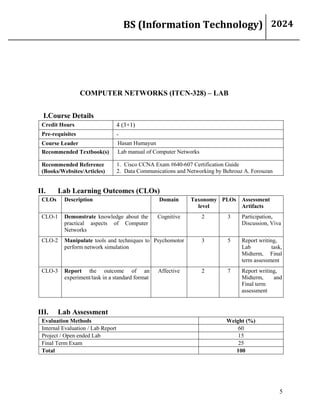
Credit Hours 4 (3+1)
Pre-requisites -
Course Leader Hasan Humayun
Recommended Textbook(s) Lab manual of Computer Networks
Recommended Reference
(Books/Websites/Articles)
1. Cisco CCNA Exam #640-607 Certification Guide
2. Data Communications and Networking by Behrouz A. Forouzan
II. Lab Learning Outcomes (CLOs)
CLOs Description Domain Taxonomy
level
PLOs Assessment
Artifacts
CLO-1 Demonstrate knowledge about the
practical aspects of Computer
Networks
Cognitive 2 3 Participation,
Discussion, Viva
CLO-2 Manipulate tools and techniques to
perform network simulation
Psychomotor 3 5 Report writing,
Lab task,
Midterm, Final
term assessment
CLO-3 Report the outcome of an
experiment/task in a standard format
Affective 2 7 Report writing,
Midterm, and
Final term
assessment
III. Lab Assessment
Evaluation Methods Weight (%)
Internal Evaluation / Lab Report 60
Project / Open ended Lab 15
Final Term Exam 25
Total 100
6
BS (Information Technology) 2024
BSIT Curriculum -Version
IV. Weekly Breakdown (All CLOs shall be assessed in every lab)
Week No. TOPICS
1 Cables, Connectors, and Preparing Ethernet Cables
2 Understanding Network Commands
3 IP Addressing and Subnetting
4 Configuring basic Switch and Router: Switch configuration, Speed, and Duplex
5
Securing the Switch and Router: Setting up telnet, MOTD banner, etc, Test telnet
connection, Line VTY, Cisco Password Encryption, Cisco port security
6
Virtual LAN (VLANs): Create VLANs, Router On A Stick, Native VLAN, and
Mismatch
7 Servers and CDP: DHCP server, Web Server, CDP Protocol
8 Switch Redundant connections and Loops (STP)
9 Mid Term Exams
10 Configuring Static Routing
11 Setting up Static Routes and Default Routes
12 Configuring WAN Connection and Default Routes
13 Setting up Dynamic Routing Protocol RIP ver.1
14 Implementing Router Information Protocol (RIP) ver. 2
15 Open Ended Lab
16 Lab Project

BSIT-4th-CN-Course Outlines.pdfc gjcnbcmjhmn

  • 1.
    1 BS (Information Technology)2024 BS Information Technology Course Outlines (For Sessions- Spring 2024) Semester – IV Code Courses Credit Hrs Semester – 4 ITOS-226 Operating Systems 3 1 ITDB-227 Database Systems 3 1 ITCN-328 Computer Networks 3 1 ITPM-241 IT Project Management 3 0 Track Elective 1* (IT Elec. 1) 3 0 15 3 COMPUTER NETWORKS (ITCN-328) I.Course Details Credit Hours 4 (3+1) Pre-requisites - Course Leader Hasan Humayun Recommended Textbook(s) 1. Data Communications and Networking, Behrouz A. Forouzan, 5th Edition, McGraw-Hill, 2012. 1. Computer Networking: A Top Down Approach, James F. Kurose, Keith Ross, Pearson,2017 Recommended Reference (Books/Websites/Articles) Data and Computer Communications, William Stallings,10th Edition, Pearson,2014.
  • 2.
    2 BS (Information Technology)2024 II. Course Learning Outcomes (CLO) CLOs Description Domain Taxonomy Level PLOs Assessment Artifact CLO-1 Classify layered network architectures and Employ Physical layer knowledge Cognitive 3 1 A1, Q1, Midterm CLO-2 Demonstrate the use of Data Link layer services devices, techniques, and protocols within a network. Cognitive 3 2 A2, Q2, Midterm, Final Term CLO-3 Describe features, services, and protocols of Network, and Transmission layers within the network. Cognitive 2 3 A3, Q3, Final Term III. Course Assessment Evaluation Methods Weight (%) Quizzes 10 Assignments 10 Presentation/Project 5 Midterm 25 Final Term 50 Total 100 IV. Grading Policy For students admitted in Fall 2021 and onwards Grade A+ A B+ B C+ C D+ D F %age >=90 80-89 75-79 70-74 65-69 60-64 55-59 50-54 <50 GPA 4.00 4.00 3.50-3.99 3.00-3.49 2.50-2.99 2.00-2.49 1.50-1.99 1.00-1.49 0.00 For students admitted before Fall 2021 Grade A1 A2 A3 B1 B2 B3 C1 C2 D F %age >=90 80-89 77-79 74-76 70-73 67-69 64-66 60-63 50-59 <50 GPA 4.00 4.00 3.66 3.33 3.00 2.66 2.33 2.00 1.50 0.00
  • 3.
    3 BS (Information Technology)2024 V. Course Contents Introduction and protocols architecture, basic concepts of networking, network topologies, layered architecture, physical layer functionality, data link layer functionality, multiple access techniques, circuit switching, and packet switching, LAN technologies, MAC address, networking devices, network layer protocols, IPv4 and IPv6, DHCP, NAT, IP addressing, IP datagram, ICMP, routing protocols, UDP and (TCP), ports and sockets, connection establishment, flow and congestion control, application layer protocols, latest trends in computer networks. VI. Weekly Breakdown Week No. CLO Topics Reference 1 CLO-1 Intro to Networks components, Basic concepts of networking. Network topologies, network layers, internet standards, and architecture. Chapter 1 2 The concept of layered architecture modeling. TCP/IP protocol suite, comparison, protocols and OSI. Chapter 2 3 The distinction between Data and Signals of Analog and Digital Transmission Impairments. Network performance measures including throughput, and delays. Data vs. signaling rates. Channel bandwidth and capacity, delay product. Chapter 3 4 Switching Technologies: Circuit Switching, Packet Switching, datagram, and Virtual Circuit Switching: Phases, efficiency, and delays. Chapter 8 5 CLO-2 Data link layer (DLL), Nodes and links, services, framing, flow, error, congestion control, data link addressing, ARP, and communication using DLL. Chapter 9 6 Error Detection and Correction, Types of Error, Redundancy, Error Detection, Parity, checksum, VRC, LRC, cyclic codes, Detection versus Correction, Forward Error Correction (Hamming codes, Hamming distance) versus Retransmission Chapter 10 7 Data link control services, Flow, and error control (simple protocol & stop N wait protocol), PAP and CHAP Protocols, Go back N (GBN) and Selective Reject. Chapter 11 & Chapter 23
  • 4.
    4 BS (Information Technology)2024 8 Multiple Control Access: Random access protocols (Aloha, CSMA, CSMA/CD, CA), Wireless hidden and exposed node problems, and Controlled access protocols (Reservation, Polling, and Token Passing) Chapter 12 9 Mid Term Exams 10 CLO-2 Ethernet, Evolution, Standard Ethernet addressing, access method Fast Ethernet Access, Mac sub-layer. Chapter 13 11 Wlans: architecture, characteristics, 802.11 sublayers, Exposed and hidden node problem. Chapter 15 12 CLO-3 Connecting devices: Hub, Switch and Router, Virtual Lans, Spanning tree Algorithm. IP addressing, classful, classless routing, local and global addresses including APIPA. Chapter 17 & Chapter 18 13 IP addressing format, fragmentation, ICMP v4: error reporting and query messages. Chapter 19 14 Routing: Least cost, Routing Algorithms: Distance vector and link state, RIP and RIP messages, algorithm, and timers. Chapter 20 15 UDP Error control and Flow control, congestion. TCP Features, segments, connections, pushing, handshaking, windows in TCP. Chapter 24 16 Flow control: opening and closing, silly window syndrome. Error Control: acknowledgments, retransmissions. TCP Congestion control, detection, and policies. Chapter 24
  • 5.
    5 BS (Information Technology)2024 COMPUTER NETWORKS (ITCN-328) – LAB I.Course Details Credit Hours 4 (3+1) Pre-requisites - Course Leader Hasan Humayun Recommended Textbook(s) Lab manual of Computer Networks Recommended Reference (Books/Websites/Articles) 1. Cisco CCNA Exam #640-607 Certification Guide 2. Data Communications and Networking by Behrouz A. Forouzan II. Lab Learning Outcomes (CLOs) CLOs Description Domain Taxonomy level PLOs Assessment Artifacts CLO-1 Demonstrate knowledge about the practical aspects of Computer Networks Cognitive 2 3 Participation, Discussion, Viva CLO-2 Manipulate tools and techniques to perform network simulation Psychomotor 3 5 Report writing, Lab task, Midterm, Final term assessment CLO-3 Report the outcome of an experiment/task in a standard format Affective 2 7 Report writing, Midterm, and Final term assessment III. Lab Assessment Evaluation Methods Weight (%) Internal Evaluation / Lab Report 60 Project / Open ended Lab 15 Final Term Exam 25 Total 100
  • 6.
    6 BS (Information Technology)2024 BSIT Curriculum -Version IV. Weekly Breakdown (All CLOs shall be assessed in every lab) Week No. TOPICS 1 Cables, Connectors, and Preparing Ethernet Cables 2 Understanding Network Commands 3 IP Addressing and Subnetting 4 Configuring basic Switch and Router: Switch configuration, Speed, and Duplex 5 Securing the Switch and Router: Setting up telnet, MOTD banner, etc, Test telnet connection, Line VTY, Cisco Password Encryption, Cisco port security 6 Virtual LAN (VLANs): Create VLANs, Router On A Stick, Native VLAN, and Mismatch 7 Servers and CDP: DHCP server, Web Server, CDP Protocol 8 Switch Redundant connections and Loops (STP) 9 Mid Term Exams 10 Configuring Static Routing 11 Setting up Static Routes and Default Routes 12 Configuring WAN Connection and Default Routes 13 Setting up Dynamic Routing Protocol RIP ver.1 14 Implementing Router Information Protocol (RIP) ver. 2 15 Open Ended Lab 16 Lab Project