Copyright © 2016, 2012, 2009 Pearson Education, Inc. All Rights Reserved
Analysis of Markets
(COMM 220-B)
Majid Maleki
Fall 2022
Microeconomics
By Robert S. Pindyck, Daniel Rubinfeld
Ninth Edition
Chapter 1
Preliminaries
Copyright © 2016, 2012, 2009 Pearson Education, Inc. All Rights Reserved
Chapter 1
Preliminaries
CHAPTER OUTLINE
Microeconomics deals with the behavior of
individual economic units.
By contrast, macroeconomics deals with
aggregate economic quantities.
CHAPTER OUTLINE
1.1 The Themes of Microeconomics
1.2 What Is a Market?
1.3 Real versus Nominal Prices
1.4 Why Study Microeconomics
LIST OF EXAMPLES
1.1 The Market for Sweeteners
1.2 A Bicycle Is a Bicycle. Or Is It?
1.3 The Price of Eggs and the Price of a College
Education
1.4 The Authors Debate the Minimum Wage
Health Care and College Textbooks
Copyright © 2016, 2012, 2009 Pearson Education, Inc. All Rights Reserved
Microeconomics vs Macroeconomics
Microeconomics Branch of economics that deals with the behavior of individual economic
units—consumers, firms, workers, and investors—as well as the markets that these units
comprise.
Macroeconomics Branch of economics that deals with aggregate economic variables,
such as the level and growth rate of national output, interest rates, unemployment, and
inflation.
Copyright © 2016, 2012, 2009 Pearson Education, Inc. All Rights Reserved
1.1 The Themes of Microeconomics (1 of 4)
Trade-Offs
CONSUMERS
Trade-offs in the purchase of more of some goods for less of others
Trade-off between current consumption and future consumption
WORKERS
Trade-offs in their choice of employment
Trade-off between labor and leisure
FIRMS
Trade-offs in what to produce
Trade-offs in the resources to use in production
image: Freepik.com
Copyright © 2016, 2012, 2009 Pearson Education, Inc. All Rights Reserved
1.1 The Themes of Microeconomics (2 of 4)
Prices and Markets
Trade-offs are based on the prices faced by consumers, workers, or firms.
In a centrally planned economy, prices are set by the government.
In a market economy, prices are determined by the interactions of consumers, workers, and
firms in markets—collections of buyers and sellers that together determine the price of a
good.
image: Freepik.com
Copyright © 2016, 2012, 2009 Pearson Education, Inc. All Rights Reserved
1.1 The Themes of Microeconomics (3 of 4)
Theories and Models
Like any science, economics is concerned with the explanations of observed phenomena
and predictions based on theories developed from a set of assumptions.
A model is a mathematical representation, based on economic theory, of a firm, a market,
or some other entity.
Statistics and econometrics let us measure the accuracy of our predictions.
When evaluating a theory, it is important to keep in mind that it is invariably imperfect and
has limited success in making predictions.
Copyright © 2016, 2012, 2009 Pearson Education, Inc. All Rights Reserved
1.1 The Themes of Microeconomics (4 of 4)
Positive versus Normative Analysis
Positive questions deal with explanation and prediction, normative questions with what
ought to be.
positive analysis Analysis describing relationships of cause and effect.
Positive analysis is central to microeconomics.
normative analysis Analysis examining questions of what ought to be.
Normative analysis is often supplemented by value judgments. When value judgments are
involved, microeconomics cannot tell us what the best policy is. However, it can clarify the
trade-offs and thereby help to illuminate the issues and sharpen the debate.
Copyright © 2016, 2012, 2009 Pearson Education, Inc. All Rights Reserved
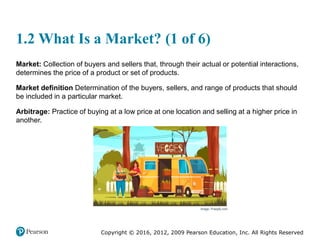
1.2 What Is a Market? (1 of 6)
Market: Collection of buyers and sellers that, through their actual or potential interactions,
determines the price of a product or set of products.
Market definition Determination of the buyers, sellers, and range of products that should
be included in a particular market.
Arbitrage: Practice of buying at a low price at one location and selling at a higher price in
another.
image: Freepik.com
Copyright © 2016, 2012, 2009 Pearson Education, Inc. All Rights Reserved
1.2 What Is a Market? (2 of 6)
Competitive versus Noncompetitive Markets
Perfectly Competitive Market: Market with many buyers and sellers, so that no single
buyer or seller has a significant impact on price. (e.g., most agricultural products)
Many other markets are competitive enough to be treated as if they were perfectly
competitive.
Other markets containing a small number of producers may still be treated as competitive
for purposes of analysis. (e.g., Airline markets)
Some markets contain many producers but are Noncompetitive ; that is, individual firms
can jointly affect the price. (e.g., The world oil market – OPEC cartel)
Copyright © 2016, 2012, 2009 Pearson Education, Inc. All Rights Reserved
1.2 What Is a Market? (3 of 6)
Market Price
market price Price prevailing in a competitive market.
In markets that are not perfectly competitive, different firms might charge different prices for
the same product.
The market prices of most goods will fluctuate over time, and for many goods the
fluctuations can be rapid. This is particularly true for goods sold in competitive markets.
Copyright © 2016, 2012, 2009 Pearson Education, Inc. All Rights Reserved
1.2 What Is a Market? (4 of 6)
Market Definition—The Extent of a Market
extent of a market Boundaries of a market, both geographical and in terms of range of
products produced and sold within it.
For some goods, it makes sense to talk about a market only in terms of very restrictive
geographic boundaries.
We must also think carefully about the range of products to include in a market.
Market definition is important for two reasons:
A company must understand who its actual and potential competitors are for the various
products that it sells or might sell in the future.
Market definition can be important for public policy decisions.
Copyright © 2016, 2012, 2009 Pearson Education, Inc. All Rights Reserved
1.2 What Is a Market? (5 of 6)
EXAMPLE 1.1
THE MARKET FOR SWEETENERS
In 1990, the Archer-Daniels-Midland Company (ADM) acquired the Clinton Corn Processing
Company (CCP).
The U.S. Department of Justice (DOJ) challenged the acquisition on the grounds that it
would lead to a dominant producer of corn syrup with the power to push prices above
competitive levels.
ADM fought the DOJ decision, and the case went to court. The basic issue was whether
corn syrup represented a distinct market.
ADM argued that sugar and corn syrup should be considered part of the same market
because they are used interchangeably to sweeten a vast array of food products
Copyright © 2016, 2012, 2009 Pearson Education, Inc. All Rights Reserved
1.2 What Is a Market? (6 of 6)
EXAMPLE 1.2
A BICYCLE IS A BICYCLE. OR IS IT?
There are actually two different markets for bicycles, which can be identified by the type of
store where the bicycle is sold.
TABLE 1.1 MARKETS FOR BICYCLES
TYPE OF BICYCLE COMPANIES AND PRICES (2011)
Mass Market Bicycles: Sold
by mass merchandisers such
as Target, Wal-Mart, Kmart,
and Sears.
Huffy: $90—$140
Schwinn: $140—$240
Mantis: $129—$140
Mongoose: $120—$280
Dealer Bicycles: Sold by
bicycle dealers – stores that
sell only (or mostly) bicycles
and bicycle equipment.
Trek: $400—$2500
Cannondale: $500—$2000
Giant: $500—$2500
Gary Fisher: $600—$2000
Mongoose: $700—$2000
Ridley: $1300—$2500
Scott: $1000—$3000
Ibis: $2000 and up
Copyright © 2016, 2012, 2009 Pearson Education, Inc. All Rights Reserved
1.3 Real versus Nominal Prices (1 of 7)
nominal price Absolute price of a good, unadjusted for inflation.
real price Price of a good relative to an aggregate measure of prices; price adjusted for
inflation.
Consumer Price Index (CPI): Measure of the aggregate price level.
Producer Price Index (PPI): Measure of the aggregate price level for intermediate
products and wholesale goods.
Consumer Price Index Data Visualization Tool (statcan.gc.ca)
Copyright © 2016, 2012, 2009 Pearson Education, Inc. All Rights Reserved
1.3 Real versus Nominal Prices (2 of 7)
After correcting for inflation, was the price of butter more expensive in 2010 than in 1970?
To find out, let’s calculate the 2015 price of butter in terms of 1970 dollars. The CPI was
38.8 in 1970 and rose to about 237.0 in 2015.
$0.57
$3.48
237.0
38.8


The nominal price of butter went up by about 300 percent, while the CPI went up 511
percent. Relative to the aggregate price level, butter prices fell.
1970 1980 1990 2015
Consumer Price
Index
38.8 82.4 130.7 237.0
Nominal Prices
Butter $0.87 $1.88 $1.99 $3.48
Copyright © 2016, 2012, 2009 Pearson Education, Inc. All Rights Reserved
1.3 Real versus Nominal Prices (3 of 7)
EXAMPLE 1.3 THE PRICE OF EGGS AND THE PRICE OF A COLLEGE EDUCATION
TABLE 1.2 THE REAL PRICES OF EGGS AND OF A COLLEGE EDUCATION
1970 1980 1990 2000 2016
Consumer Price
Index
38.8 82.4 130.7 172.2 241.7
Nominal Prices
Grade A Large Eggs $0.61 $0.84 $1.01 $0.91 $2.47
College Education $1,784 $3,499 $7,602 $12,922 $25,694
Real Prices ($1970)
Grade A Large Eggs $0.61 $0.40 $0.30 $0.21 $0.40
College Education $1,784 $1,624 $2,239 $2,912 $4,125
Copyright © 2016, 2012, 2009 Pearson Education, Inc. All Rights Reserved
1.3 Real versus Nominal Prices (4 of 7)
EXAMPLE 1.3 THE PRICE OF EGGS AND THE PRICE OF A COLLEGE EDUCATION
The real prices of eggs and a college education in 1970 dollars is calculated as follows:
1980
in
price
nominal
CPI
CPI
1980
in
eggs
of
price
Real
1980
1970


1990
in
price
nominal
CPI
CPI
1990
in
eggs
of
price
Real
1990
1970


and so forth.
Copyright © 2016, 2012, 2009 Pearson Education, Inc. All Rights Reserved
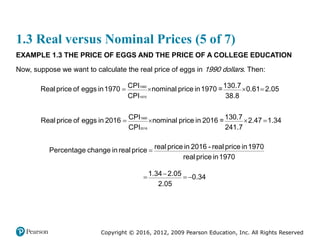
1.3 Real versus Nominal Prices (5 of 7)
EXAMPLE 1.3 THE PRICE OF EGGS AND THE PRICE OF A COLLEGE EDUCATION
Now, suppose we want to calculate the real price of eggs in 1990 dollars. Then:
2.05
0.61
38.8
130.7
=
1970
in
price
nominal
CPI
CPI
1970
in
eggs
of
price
Real
1970
1990




1.34
2.47
241.7
130.7
=
2016
in
price
nominal
CPI
CPI
2016
in
eggs
of
price
Real
2016
1990




1970
in
price
real
1970
in
price
real
-
2016
in
price
real
price
real
in
change
Percentage 
0.34
2.05
2.05
1.34 



Copyright © 2016, 2012, 2009 Pearson Education, Inc. All Rights Reserved
1.3 Real versus Nominal Prices (6 of 7)
EXAMPLE 1.4 THE AUTHORS DEBATE THE MINIMUM WAGE
It is the real minimum wage that matters, and
that has been declining
FIGURE 1.1
THE MINIMUM WAGE
In nominal terms, the minimum wage has
increased steadily over the past 80 years.
However, in real terms its 2016 level is below
that of the 1970s.
Copyright © 2016, 2012, 2009 Pearson Education, Inc. All Rights Reserved
1.3 Real versus Nominal Prices (7 of 7)
EXAMPLE 1.5 HEALTH CARE AND COLLEGE TEXT BOOKS
FIGURE 1.2
THE PRICES OF HEALTH CARE AND COLLEGE TEXTBOOKS
The prices of both health care and college textbooks have been rising much faster than
overall inflation. This is especially true of college textbook prices, which have increased
about three times as fast as the CPI.
Copyright © 2016, 2012, 2009 Pearson Education, Inc. All Rights Reserved
1.4 Why Study Microeconomics? (1 of 2)
Corporate Decision Making: The Toyota Prius
In 1997, Toyota Motor Corporation introduced the Prius in Japan, and started selling it worldwide
in 2001. The design and production of the Prius involved not only some impressive engineering,
but a lot of economics as well.
Many of the challenges faced by Toyota in building the Prius are discussed throughout this
textbook.
Copyright © 2016, 2012, 2009 Pearson Education, Inc. All Rights Reserved
1.4 Why Study Microeconomics? (2 of 2)
Public Policy Design: Fuel Efficiency Standards for the Twenty-First Century
In 1975, the U.S. government imposed regulations designed to improve the average fuel
economy of domestically-sold cars and light trucks. The CAFE (Corporate Average Fuel
Economy) standards have become increasingly stringent over the years.
A number of important decisions have to be made when designing a fuel efficiency
program, and most of those decisions involve economics.
First, the government must evaluate the monetary impact of the program on consumers.
Before imposing CAFE standards, it is important to estimate the likely impact those
standards will have on the cost of producing cars and light truck.
The government must also ask why problems related to oil consumption are not solved by
our market-oriented economy.
Copyright © 2016, 2012, 2009 Pearson Education, Inc. All Rights Reserved
Copyright

Chapter 1.pdf

  • 1.
    Copyright © 2016,2012, 2009 Pearson Education, Inc. All Rights Reserved Analysis of Markets (COMM 220-B) Majid Maleki Fall 2022 Microeconomics By Robert S. Pindyck, Daniel Rubinfeld Ninth Edition Chapter 1 Preliminaries
  • 2.
    Copyright © 2016,2012, 2009 Pearson Education, Inc. All Rights Reserved Chapter 1 Preliminaries CHAPTER OUTLINE Microeconomics deals with the behavior of individual economic units. By contrast, macroeconomics deals with aggregate economic quantities. CHAPTER OUTLINE 1.1 The Themes of Microeconomics 1.2 What Is a Market? 1.3 Real versus Nominal Prices 1.4 Why Study Microeconomics LIST OF EXAMPLES 1.1 The Market for Sweeteners 1.2 A Bicycle Is a Bicycle. Or Is It? 1.3 The Price of Eggs and the Price of a College Education 1.4 The Authors Debate the Minimum Wage Health Care and College Textbooks
  • 3.
    Copyright © 2016,2012, 2009 Pearson Education, Inc. All Rights Reserved Microeconomics vs Macroeconomics Microeconomics Branch of economics that deals with the behavior of individual economic units—consumers, firms, workers, and investors—as well as the markets that these units comprise. Macroeconomics Branch of economics that deals with aggregate economic variables, such as the level and growth rate of national output, interest rates, unemployment, and inflation.
  • 4.
    Copyright © 2016,2012, 2009 Pearson Education, Inc. All Rights Reserved 1.1 The Themes of Microeconomics (1 of 4) Trade-Offs CONSUMERS Trade-offs in the purchase of more of some goods for less of others Trade-off between current consumption and future consumption WORKERS Trade-offs in their choice of employment Trade-off between labor and leisure FIRMS Trade-offs in what to produce Trade-offs in the resources to use in production image: Freepik.com
  • 5.
    Copyright © 2016,2012, 2009 Pearson Education, Inc. All Rights Reserved 1.1 The Themes of Microeconomics (2 of 4) Prices and Markets Trade-offs are based on the prices faced by consumers, workers, or firms. In a centrally planned economy, prices are set by the government. In a market economy, prices are determined by the interactions of consumers, workers, and firms in markets—collections of buyers and sellers that together determine the price of a good. image: Freepik.com
  • 6.
    Copyright © 2016,2012, 2009 Pearson Education, Inc. All Rights Reserved 1.1 The Themes of Microeconomics (3 of 4) Theories and Models Like any science, economics is concerned with the explanations of observed phenomena and predictions based on theories developed from a set of assumptions. A model is a mathematical representation, based on economic theory, of a firm, a market, or some other entity. Statistics and econometrics let us measure the accuracy of our predictions. When evaluating a theory, it is important to keep in mind that it is invariably imperfect and has limited success in making predictions.
  • 7.
    Copyright © 2016,2012, 2009 Pearson Education, Inc. All Rights Reserved 1.1 The Themes of Microeconomics (4 of 4) Positive versus Normative Analysis Positive questions deal with explanation and prediction, normative questions with what ought to be. positive analysis Analysis describing relationships of cause and effect. Positive analysis is central to microeconomics. normative analysis Analysis examining questions of what ought to be. Normative analysis is often supplemented by value judgments. When value judgments are involved, microeconomics cannot tell us what the best policy is. However, it can clarify the trade-offs and thereby help to illuminate the issues and sharpen the debate.
  • 8.
    Copyright © 2016,2012, 2009 Pearson Education, Inc. All Rights Reserved 1.2 What Is a Market? (1 of 6) Market: Collection of buyers and sellers that, through their actual or potential interactions, determines the price of a product or set of products. Market definition Determination of the buyers, sellers, and range of products that should be included in a particular market. Arbitrage: Practice of buying at a low price at one location and selling at a higher price in another. image: Freepik.com
  • 9.
    Copyright © 2016,2012, 2009 Pearson Education, Inc. All Rights Reserved 1.2 What Is a Market? (2 of 6) Competitive versus Noncompetitive Markets Perfectly Competitive Market: Market with many buyers and sellers, so that no single buyer or seller has a significant impact on price. (e.g., most agricultural products) Many other markets are competitive enough to be treated as if they were perfectly competitive. Other markets containing a small number of producers may still be treated as competitive for purposes of analysis. (e.g., Airline markets) Some markets contain many producers but are Noncompetitive ; that is, individual firms can jointly affect the price. (e.g., The world oil market – OPEC cartel)
  • 10.
    Copyright © 2016,2012, 2009 Pearson Education, Inc. All Rights Reserved 1.2 What Is a Market? (3 of 6) Market Price market price Price prevailing in a competitive market. In markets that are not perfectly competitive, different firms might charge different prices for the same product. The market prices of most goods will fluctuate over time, and for many goods the fluctuations can be rapid. This is particularly true for goods sold in competitive markets.
  • 11.
    Copyright © 2016,2012, 2009 Pearson Education, Inc. All Rights Reserved 1.2 What Is a Market? (4 of 6) Market Definition—The Extent of a Market extent of a market Boundaries of a market, both geographical and in terms of range of products produced and sold within it. For some goods, it makes sense to talk about a market only in terms of very restrictive geographic boundaries. We must also think carefully about the range of products to include in a market. Market definition is important for two reasons: A company must understand who its actual and potential competitors are for the various products that it sells or might sell in the future. Market definition can be important for public policy decisions.
  • 12.
    Copyright © 2016,2012, 2009 Pearson Education, Inc. All Rights Reserved 1.2 What Is a Market? (5 of 6) EXAMPLE 1.1 THE MARKET FOR SWEETENERS In 1990, the Archer-Daniels-Midland Company (ADM) acquired the Clinton Corn Processing Company (CCP). The U.S. Department of Justice (DOJ) challenged the acquisition on the grounds that it would lead to a dominant producer of corn syrup with the power to push prices above competitive levels. ADM fought the DOJ decision, and the case went to court. The basic issue was whether corn syrup represented a distinct market. ADM argued that sugar and corn syrup should be considered part of the same market because they are used interchangeably to sweeten a vast array of food products
  • 13.
    Copyright © 2016,2012, 2009 Pearson Education, Inc. All Rights Reserved 1.2 What Is a Market? (6 of 6) EXAMPLE 1.2 A BICYCLE IS A BICYCLE. OR IS IT? There are actually two different markets for bicycles, which can be identified by the type of store where the bicycle is sold. TABLE 1.1 MARKETS FOR BICYCLES TYPE OF BICYCLE COMPANIES AND PRICES (2011) Mass Market Bicycles: Sold by mass merchandisers such as Target, Wal-Mart, Kmart, and Sears. Huffy: $90—$140 Schwinn: $140—$240 Mantis: $129—$140 Mongoose: $120—$280 Dealer Bicycles: Sold by bicycle dealers – stores that sell only (or mostly) bicycles and bicycle equipment. Trek: $400—$2500 Cannondale: $500—$2000 Giant: $500—$2500 Gary Fisher: $600—$2000 Mongoose: $700—$2000 Ridley: $1300—$2500 Scott: $1000—$3000 Ibis: $2000 and up
  • 14.
    Copyright © 2016,2012, 2009 Pearson Education, Inc. All Rights Reserved 1.3 Real versus Nominal Prices (1 of 7) nominal price Absolute price of a good, unadjusted for inflation. real price Price of a good relative to an aggregate measure of prices; price adjusted for inflation. Consumer Price Index (CPI): Measure of the aggregate price level. Producer Price Index (PPI): Measure of the aggregate price level for intermediate products and wholesale goods. Consumer Price Index Data Visualization Tool (statcan.gc.ca)
  • 15.
    Copyright © 2016,2012, 2009 Pearson Education, Inc. All Rights Reserved 1.3 Real versus Nominal Prices (2 of 7) After correcting for inflation, was the price of butter more expensive in 2010 than in 1970? To find out, let’s calculate the 2015 price of butter in terms of 1970 dollars. The CPI was 38.8 in 1970 and rose to about 237.0 in 2015. $0.57 $3.48 237.0 38.8   The nominal price of butter went up by about 300 percent, while the CPI went up 511 percent. Relative to the aggregate price level, butter prices fell. 1970 1980 1990 2015 Consumer Price Index 38.8 82.4 130.7 237.0 Nominal Prices Butter $0.87 $1.88 $1.99 $3.48
  • 16.
    Copyright © 2016,2012, 2009 Pearson Education, Inc. All Rights Reserved 1.3 Real versus Nominal Prices (3 of 7) EXAMPLE 1.3 THE PRICE OF EGGS AND THE PRICE OF A COLLEGE EDUCATION TABLE 1.2 THE REAL PRICES OF EGGS AND OF A COLLEGE EDUCATION 1970 1980 1990 2000 2016 Consumer Price Index 38.8 82.4 130.7 172.2 241.7 Nominal Prices Grade A Large Eggs $0.61 $0.84 $1.01 $0.91 $2.47 College Education $1,784 $3,499 $7,602 $12,922 $25,694 Real Prices ($1970) Grade A Large Eggs $0.61 $0.40 $0.30 $0.21 $0.40 College Education $1,784 $1,624 $2,239 $2,912 $4,125
  • 17.
    Copyright © 2016,2012, 2009 Pearson Education, Inc. All Rights Reserved 1.3 Real versus Nominal Prices (4 of 7) EXAMPLE 1.3 THE PRICE OF EGGS AND THE PRICE OF A COLLEGE EDUCATION The real prices of eggs and a college education in 1970 dollars is calculated as follows: 1980 in price nominal CPI CPI 1980 in eggs of price Real 1980 1970   1990 in price nominal CPI CPI 1990 in eggs of price Real 1990 1970   and so forth.
  • 18.
    Copyright © 2016,2012, 2009 Pearson Education, Inc. All Rights Reserved 1.3 Real versus Nominal Prices (5 of 7) EXAMPLE 1.3 THE PRICE OF EGGS AND THE PRICE OF A COLLEGE EDUCATION Now, suppose we want to calculate the real price of eggs in 1990 dollars. Then: 2.05 0.61 38.8 130.7 = 1970 in price nominal CPI CPI 1970 in eggs of price Real 1970 1990     1.34 2.47 241.7 130.7 = 2016 in price nominal CPI CPI 2016 in eggs of price Real 2016 1990     1970 in price real 1970 in price real - 2016 in price real price real in change Percentage  0.34 2.05 2.05 1.34    
  • 19.
    Copyright © 2016,2012, 2009 Pearson Education, Inc. All Rights Reserved 1.3 Real versus Nominal Prices (6 of 7) EXAMPLE 1.4 THE AUTHORS DEBATE THE MINIMUM WAGE It is the real minimum wage that matters, and that has been declining FIGURE 1.1 THE MINIMUM WAGE In nominal terms, the minimum wage has increased steadily over the past 80 years. However, in real terms its 2016 level is below that of the 1970s.
  • 20.
    Copyright © 2016,2012, 2009 Pearson Education, Inc. All Rights Reserved 1.3 Real versus Nominal Prices (7 of 7) EXAMPLE 1.5 HEALTH CARE AND COLLEGE TEXT BOOKS FIGURE 1.2 THE PRICES OF HEALTH CARE AND COLLEGE TEXTBOOKS The prices of both health care and college textbooks have been rising much faster than overall inflation. This is especially true of college textbook prices, which have increased about three times as fast as the CPI.
  • 21.
    Copyright © 2016,2012, 2009 Pearson Education, Inc. All Rights Reserved 1.4 Why Study Microeconomics? (1 of 2) Corporate Decision Making: The Toyota Prius In 1997, Toyota Motor Corporation introduced the Prius in Japan, and started selling it worldwide in 2001. The design and production of the Prius involved not only some impressive engineering, but a lot of economics as well. Many of the challenges faced by Toyota in building the Prius are discussed throughout this textbook.
  • 22.
    Copyright © 2016,2012, 2009 Pearson Education, Inc. All Rights Reserved 1.4 Why Study Microeconomics? (2 of 2) Public Policy Design: Fuel Efficiency Standards for the Twenty-First Century In 1975, the U.S. government imposed regulations designed to improve the average fuel economy of domestically-sold cars and light trucks. The CAFE (Corporate Average Fuel Economy) standards have become increasingly stringent over the years. A number of important decisions have to be made when designing a fuel efficiency program, and most of those decisions involve economics. First, the government must evaluate the monetary impact of the program on consumers. Before imposing CAFE standards, it is important to estimate the likely impact those standards will have on the cost of producing cars and light truck. The government must also ask why problems related to oil consumption are not solved by our market-oriented economy.
  • 23.
    Copyright © 2016,2012, 2009 Pearson Education, Inc. All Rights Reserved Copyright